Submission on the Draft National Planning Framework: Ireland 2040 - On behalf of the Sligo BID CLG in respect of the settlement of Sligo
←
→
Page content transcription
If your browser does not render page correctly, please read the page content below
Submission on the Draft National
Planning Framework: Ireland 2040
On behalf of the Sligo BID CLG in respect of
          the settlement of Sligo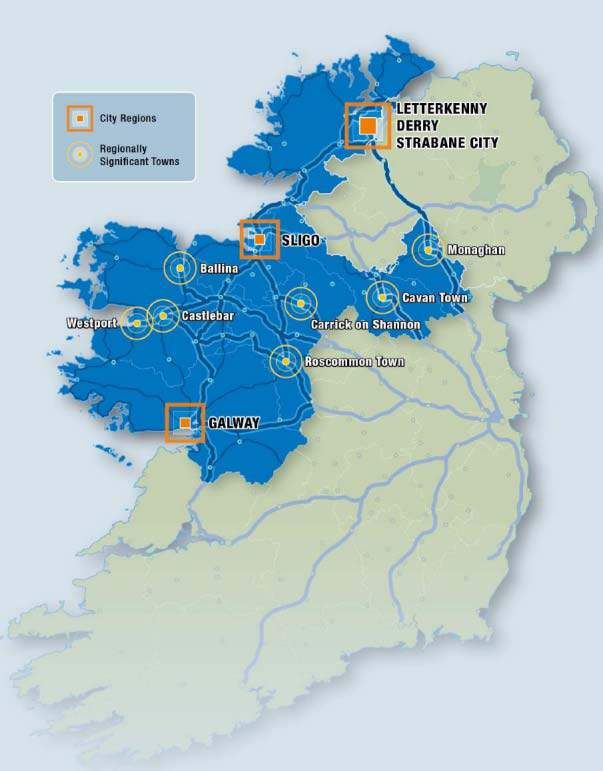
170204a – Draft NPF Sligo BID Sub – 2017.11.09 – F

DOCUMENT DETAILS

Client:                       Sligo BID CLG

Project title:                Sligo NPF Submission

Project Number:               170204a

Document Title:               170204a – Draft NPF Sligo BID Sub

Doc. File Name:               170204a – Draft NPF Sligo BID Sub –
                              2017.11.09 – F

Prepared By:                  McCarthy Keville O’Sullivan Ltd.
                              Planning & Environmental Consultants
                              Block 1, G.F.S.C.
                              Moneenageisha Road, Galway

Document Issue:
Rev   Status   Issue Date   Document File Name                       Author(s)        Approved By:

                            170204a – Draft NPF Sligo BID
01    D1       17.10.2017                                            CMcG             SMcC
                            Sub – 2017.10.27 – D1

                            170204a – Draft NPF Sligo BID
02    D2       07.11.2017                                            CMcG             SMcC
                            Sub – 2017.11.07 – D2

                            170204a – Draft NPF Sligo BID
03    F        09.11.2017                                            CMcG             SMcC
                            Sub – 2017.11.09 – F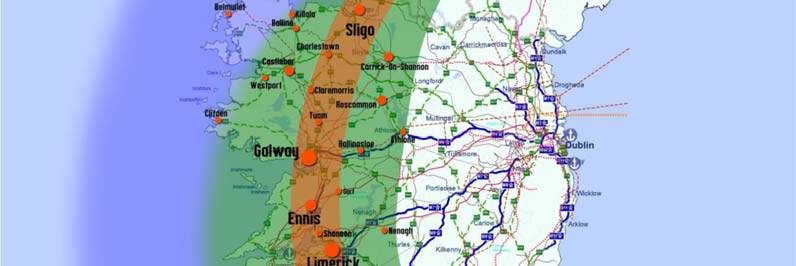
Table of Contents

1      Executive Summary................................................................................ 2
2      Introduction ............................................................................................ 4
    2.1        Introduction ...............................................................................................................4
    2.2        About Sligo BID Company CLG. .................................................................................4

3      Context ................................................................................................... 5
    3.1        Sligo: An Overview ....................................................................................................5

4      Strategic Planning Policy ....................................................................... 7
    4.1        Introduction ...............................................................................................................7
    4.2     National Spatial Strategy 2002-2020 ........................................................................7
       4.2.1 Critical Assessment – National Level .....................................................................7
       4.2.2 Critical Assessment – Sligo ....................................................................................8
    4.3        Realising our Rural Potential: Action Plan for Rural Development .........................9

5      SWOT ANALYSIS ................................................................................... 11
6      Assessment of NPF Draft Publication .................................................. 12
    6.1        Disparity with Atlantic Economic Corridor .............................................................12
    6.2        Disparity with European Entrepreneurial Region (EER) 2018 ................................13
    6.3        Continued Disregard for the Regional Importance of Sligo ...................................14
    6.4     Implications of Growth Targets ..............................................................................15
       6.4.1 Hierarchy of Settlements ...................................................................................... 16

7      SLIGO and the National planning Framework ...................................... 18
    7.1        Why Sligo? ...............................................................................................................18
    7.2        What should the NPF achieve? ...............................................................................20
    7.3        Implementation of the NPF .....................................................................................20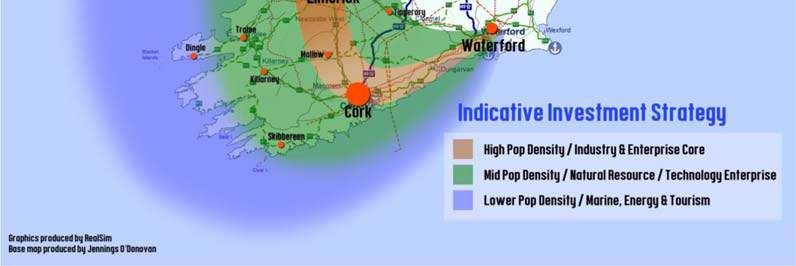
1      EXECUTIVE SUMMARY
         Sligo town is the most important settlement in the North West of Ireland and is the
         obvious candidate in the North West for designation as a regional centre. Although the
         population of Sligo is 25,2191, the ‘greater’ Sligo area has a population of as much as
         60,000 people2. Sligo is a growing conurbation located in the heart of the North West
         and already functions as the administrative, economic and cultural centre for South
         County Donegal, County Sligo and parts of Counties Leitrim, Roscommon and Mayo,
         serving key towns such as Ballina, Castlebar, Westport, Carrick-on-Shannon and
         Donegal town. The population of the North West as a whole is in the region of 250,000
         people and Sligo is the regional anchor for this entire catchment area. In addition, Sligo
         IT and St. Angela’s College host 7,500 term time students.

         As currently drafted, the NPF would see Sligo town grow by approximately 40%, the
         equivalent of around 8,000 people. This level of growth is insufficient to enable Sligo
         fully establish itself as the economic hub required in the North West. Sligo’s growth
         potential allows for an increase in population far in excess of 8,000. In the Sligo and
         Environs Development Plan 2010-2016, which is the current statutory planning
         document for the town, there is sufficient lands zoned in the settlement (including the
         strategic land reserve) for the provision of housing for up to 26,000 new residents.
         Furthermore, Sligo’s Main Drainage Scheme, a 50,000-PE wastewater treatment plant
         completed in 2008, has the capacity for expansion to serve 80,000 PE (population
         equivalent). Failure to utilise this capacity, where it already exists, would contravene
         the principles of proper planning and sustainable development and would be
         detrimental to Sligo and the region.

         Sligo BID CLG contend that special consideration should also be given to Sligo given its
         regional importance. The omission of Sligo as a priority region is a serious threat to
         further regional imbalance and a missed opportunity given the capacity of Sligo to
         harbour significant growth and absorb some of the pressure from the greater Dublin
         region. There is already a strong foundation in place in a demographic and geographic
         context for achieving critical mass which will drive Sligo on to further growth. Located
         centrally in the European Entrepreneurial Region 2018, the omission of Sligo in the
         Draft NPF is a complete contradiction of the EU’s recognition of the ability of the region.
         Similarly, there is an apparent contradiction between the vision of the Draft NPF and
         the Irish Government’s announcement of a Task Force to pursue the Atlantic Economic
         Corridor. The four recognised cities in the Draft NPF, namely Galway, Limerick, Cork
         and Waterford, could of course form the basis of this strong alternative spatial
         development model, however simply to focus on those four urban centres is to ignore
         the needs of large areas of the country to the west and north-west and indeed the
         significant regional urban centre of Sligo.

         It is of paramount importance that an urban agglomeration in the North West is
         promoted and focussed around Sligo. This would have a clear impact on reinforcing
         the urban structure of the entire region. The adopted National Planning Framework
         should identify Sligo as a key city in the region and, on foot of this designation, must
         direct significant infrastructure investment to the town. This infrastructure investment
         will facilitate and lay the foundation for growth in population and employment. This
         investment should be targeted at ensuring that Sligo has better connectivity with
         Dublin and the other city regions. Sligo has all the characteristics of a city and

1 Sligo’s town population is made up of the inner town (19,199), Collooney (1610), Standhill,
(1753), Ballysadare (1350), Rosses Point (883), Ballincar (424).
2 Sligo County Retail Strategy 2017-2023 – Section 3.1

                                                                                                   2
McCarthy Keville O’Sullivan Ltd. – Planning & Environmental Consultants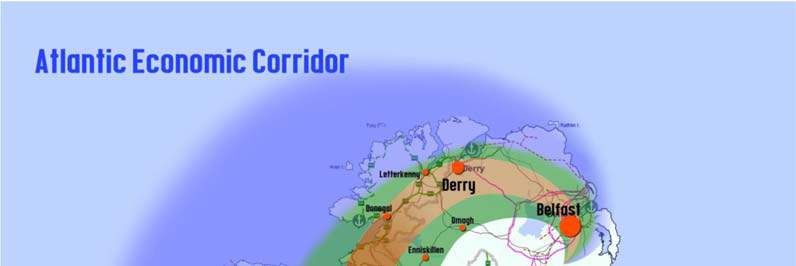
competes as a city. Furthermore, the Greater Sligo population is comparable to a city.
         This submission requests that the key position of Sligo city is addressed in the NFP in
         terms of its role as a key city in the Region (Sligo City Region) to facilitate the future
         growth, success and sustainability of what is still technically a town.

                                                                                                  3
McCarthy Keville O’Sullivan Ltd. – Planning & Environmental Consultants
2 INTRODUCTION
2.1 Introduction
On behalf of our client, Sligo BID (Business Improvement District) CLG, we wish to
make a submission on the draft publication of ‘Ireland 2040 Our Plan - National
Planning Framework’. The purpose of this submission is to ensure that the finalised
and adopted National Planning Framework: Ireland 2040 (NPF) takes proper
cognisance of the importance of Sligo in the national and regional context and that this
importance is reflected in its designation as a significant growth centre in the adopted
plan. Furthermore, this submission will seek to ensure that the policies, objectives and
provisions of the adopted NPF facilitate targeted growth which will contribute to the
expansion and growth of business and enterprise in the town and the surrounding area.
The designation of Sligo as a significant growth centre in the NPF and the inclusion of
policies and objectives which bolster this designation will drive both public and private
investment into the town and the surrounding area. Sligo has historically suffered from
a lack of connectivity with the major urban centres in the country which has led to
depressed economic growth and in turn migration from the town, and the North West
as a whole, to the greater Dublin area and Galway. The first national planning
framework for the country (National Spatial Strategy 2002-2020) identified a number
of the issues which affect Sligo and indeed, proposed measures to address these
issues. However, in 2017 Sligo still suffers from a number of the issues which
historically restricted its growth and success and these include lack of connectivity,
lack of investment and outward migration.
2.2 About Sligo BID Company CLG.
Sligo BID CLG is a non-profit Company Limited By Guarantee whose purpose is to
implement, manage, administer and renew the BID scheme. The Sligo BID concept is
an initiative designed to increase the footfall to Sligo town centre, to attract more
businesses and to secure a long term sustainable model for the management of the
town. Sligo BID represents businesses in the town and is designed to benefit all of the
business people in Sligo, and in turn the city/town’s inhabitants.
Sligo BID (Business Improvement District) was the first BID to form on the west coast
of Ireland (July 2015). Sligo BID formed as a direct result of the “Better Towns through
Partnership” Project run by Sligo County Council from September 2013 to March 2015
and was the first town to appoint a Town Centre Manager in the country.
Sligo BID was highlighted as an example of best practice in ‘A Framework for Town
Centre Renewal’. The Framework identifies the key attributes of a successful town
centre. It also sets out an Action Plan and the existing supports for Town Centre
Renewal. The Framework notes that the key objective of Sligo BID is to develop and
implement initiatives designed to promote and improve the trading environment.
4
McCarthy Keville O’Sullivan Ltd. – Planning & Environmental Consultants3 CONTEXT
3.1 Sligo: An Overview
Sligo is located in the north-western corner of Ireland approximately 180 kilometres
north west of Dublin and approximately 45 kilometres south west of the border with
Northern Ireland. In practice Sligo and its environs incorporate the settlements of
Collooney, Strandhill, Ballysadare, Rosses Point and Ballincar which gives a population
total of 25,219. Sligo town settlement has a population of 19,1193 people within its
administrative boundary making it the 24th largest urban centre in the country in its
own right. This population is based on a boundary which is not at all representative of
the full extent of the town of Sligo and when taking into account Sligo town and its
environs, the increased population total elevates Sligo to the 13th largest urban centre
in the country. It is the major urban settlement in the North West of the country. Sligo
is home to two third level education facilities, Sligo Institute of Technology and St.
Angela’s College. It is also home to Sligo University Hospital, an acute general hospital
serving the northwest of the country.
The town is located on a low lying plain between Lough Gill and the Atlantic Ocean, the
Garvoge River flows from Lough Gill through the town discharging into Sligo Harbour.
Sligo is circled by hills and mountains with Keelogyboy Mountain to the north east,
Knocknarea to the west in Strandhill and Slieve Dargan to the south west. Benbulbin
further to the north is visible from the town.
Sligo serves as an administrative, employment, commercial, health and education
centre for a large catchment area, while also acting as an important distribution centre
for the North West. It is the primary location for industry and enterprise within the
county and the North West as a whole due to its large pool of skilled workers, ease of
access and relatively good telecommunications infrastructure. The availability of
labour, transport facilities and infrastructure attracts enterprise and stimulates
agglomeration effects in the local economy4.
The natural scenery of County Sligo is amongst the finest in the country. It is the
County’s primary tourist attraction. The mountains, forests, woodlands, lakes, rivers,
coastline, offshore islands and largely unspoiled rural landscape offer a wide range of
natural amenity and recreational pursuits5. This makes the town of Sligo an important
accommodation location for tourists. In addition, Sligo has many attractions in its own
right such as the Sligo County Museum and The Model, Home of the Niland Collection.
Sligo is the nearest point to Dublin on the Wild Atlantic Way, which is one of the most
popular tourist destinations in the country. It is also placed in the second tier of the
national retail hierarchy, serving as a ‘regional’ retail centre for the western part of
the Border region.
Sligo is not served by a motorway. In terms of the national motorway network the
nearest embarkation point is Tuam following the recent opening of the M17 between
Gort and Tuam. If travelling by car from Dublin to Sligo the only feasible option is the
M4-N4 route via Mullingar. In both cases the majority of the route would be on national
primary roads as opposed to motorways. The N4 between the village of Collooney and
Sligo town centre is formed by Type 1 Dual Carriageway which provides an important
link between Sligo and its surrounding hinterland to the south. In addition, the
3 Census of Ireland 2016
4 Sligo County Development Plan 2017-2023 – Section 4.2.3: Industry and Enterprise Locations
5 Sligo County Development Plan 2017-2023 – Section 4.4 Tourism Development
5
McCarthy Keville O’Sullivan Ltd. – Planning & Environmental Consultantsproposed upgrade to the N4 between Collooney to Castlebaldwin is scheduled for
completion in 2020.
While the significance of Sligo Port in national terms is quite low, it remains important
in the regional and local economy, supporting local industry and providing an
import/export transportation facility. Capital and maintenance dredging is required
within the harbour to enhance the use and longevity of the Port6 but national funding
has been withheld in the past decade which has stymied the Port’s natural growth
trajectory.
There are seven scheduled train services daily from MacDiarmada Station Sligo to
Connolly Station, Dublin7. Bus Éireann Expressway operate eight bus services daily to
Dublin from Sligo Bus Station8. Sligo Airport is located in Strandhill approximately
7.5km west of the Sligo town. As of 2011 no scheduled services operate to or from the
airport although it is a base for Irish Coastguard operations and is also used by a local
flying club.
In 2008, a new waste water treatment plant was commissioned for Sligo and its
surrounding area. The plant accepts wastewater from a population equivalent of
50,0009. There is significant capacity within the plant for additional loading and
therefore capacity for additional development within the town and the surrounding
catchment.
Sligo also has world class internet connectivity. Sligo was the first town in Connacht to
be serviced by SIRO’s fibre-optic high-speed broadband rollout scheme. Broadband
speed and quality is an important asset to Sligo’s growth, and the rollout of this
network creates a platform for future business development in the region, while also
enhancing established businesses.
Sligo is the most important settlement in the North West of the country and although
the population of Sligo conurbation is 25,219, the population of the ‘greater’ Sligo area
is as much as 60,000 people10. The town is home to higher order services that serve the
wider region and not just the town or the county. There are significant levels of
infrastructure serving the town and there exists opportunities to upgrade and expand
the existing infrastructure. There are also significant opportunities to grow the
economic footprint of the town through enterprise and tourism. It is paramount that
Sligo is identified as a key urban growth centre in the adopted National Planning
Framework to facilitate the future growth, success and sustainability of the town and
the wider region.
6 Sligo County Development Plan 2017-2023 – Section 8.6 Port and Harbours
7 http://www.irishrail.ie/media/07_dublin-sligo_25052015.pdf (Accessed 07/03/17)
8 http://www.expressway.ie/route23.php (Accessed 07/03/17)
9 http://www.caw.ie/case-studies/sligo-wastewater-treatment-works (Accessed 07/03/17)
10 Sligo County Retail Strategy 2017-2023 – Section 3.1
6
McCarthy Keville O’Sullivan Ltd. – Planning & Environmental Consultants4 STRATEGIC PLANNING POLICY
4.1 Introduction
The purpose of this section is to identify and assess strategic planning policy at a
national level which has guided the growth of Sligo in the recent past as well as
providing a review of other existing and proposed national strategic planning policy.
This submission will undertake a critical assessment of the National Spatial Strategy
2002-2020 and as well as a review of Realising our Rural Potential: Action Plan for
Rural Development in order to identify how these publications, and the adopted
National Planning Framework, can contribute to a sustainable and successful town in
Sligo.
4.2 National Spatial Strategy 2002-2020
The purpose of the National Spatial Strategy (NSS) was to provide a national planning
framework for Ireland. The NSS aimed to achieve a better balance of social, economic
and physical development across Ireland, supported by more effective planning. In
order to drive development in the regions, the NSS proposed that areas of sufficient
scale and critical mass will be built up through a network of gateways and hubs.
Within this framework Sligo was identified as a new national gateway which in effect
ensured that the town was targeted for growth. Gateways were identified as having a
strategic location, both nationally and relative to their surrounding areas, and were
intended to provide national scale social, economic infrastructure and support
services. Gateways were therefore seen as engines of regional and national growth.
The NSS stated that critical mass in the west and north west could be strengthened by
developing Sligo as a gateway to capitalise on its strategic location and energise its
associated hinterland. Building up the national role and scale of Sligo was a crucial
first step and this was to be achieved by the development of a planning, land use and
transportation framework. It was envisaged that this framework would provide a focus
around which local authorities, business and community interests could reach
consensus on the future development of Sligo and utilise its substantial physical
capacity for development, while safeguarding its outstanding natural setting.
In addition to the macro-level objectives and policies relating to the future development
of Sligo, more specific micro-level actions were identified which were to contribute to
building Sligo’s national role and these included items such as providing improved
access to Sligo that built on previous investment in road and rail routes, improving
reliability of electricity and gas supply in western, north western, border and north
eastern parts of the country and the provision of a Derry-Sligo-Galway-Limerick-Cork-
Rosslare rail link (Western strategic rail link).
4.2.1 Critical Assessment – National Level
The NSS was not a success in the national context and the reasons can be broadly
summarised under the following headings:
Initial Gateway and Hub Designations
In the first instance, too many hubs and gateways were identified (i.e. 9
gateways and 11 hubs) for growth which immediately spread resources too
thinly over too many locations in disparate geographical locations. The initial
designation of settlements became politicized which resulted in too many
areas being identified for growth to satisfy individual political ambitions.
7
McCarthy Keville O’Sullivan Ltd. – Planning & Environmental ConsultantsAttempts to achieve nationwide investment and growth diluted the potential
positive impact of the NSS.
Decentralisation
The Decentralisation Programme announced by the Government in December
2003 saw the headquarters of eight government departments decentralised
from Dublin to a range of gateway, hub and other towns. These towns included
Newbridge, Carlow, Trim, Longford and Carrick-on-Shannon which were not
identified in the NSS. However, in order to accommodate new residents, these
towns had to build more houses, invest in infrastructure etc. which ultimately
drew growth and investment away from the settlements where it should have
been directed.
Disconnect between NSS and Local Level Planning
Despite the provisions set out in the NSS at local level planners continued to
zone lands for housing and other development and continued to grant planning
permission for development on these lands. The continued inappropriate
zoning of lands for development throughout the boom years was ultimately
politically driven however the decisions to permit development on these lands
were entirely planning ones. Brian Hughes, in his 2015 article on the subject,
articulates this view as follows –
‘Instead of the intended objective of achieving accelerated growth in the
nominated Gateways and Hubs Balanced Regional Development
encouraged additional, geographically scattered one-off housing
completions.’11
He goes onto note that the construction of these housing developments continues a-
pace despite the effects of the economic downturn. The approach set out in the NSS
has, he notes, -
‘Promoted the proliferation of hundreds, of newly-emerging villages and
small-town settlements, usually occurring at the expense of urban
consolidation’12
A striking indictment of the overall success of the National Spatial Strategy is set out
in the National Planning Framework: Issues and Choices Paper (2017) which states
that:
‘Not one of the twenty-two fastest growing towns in Ireland between 2002
and 2016 was an NSS gateway or hub settlement.’13
4.2.2 Critical Assessment – Sligo
Sligo was identified as a gateway and an engine for regional and national growth in the
NSS and there was a general commitment given to drive development in the North
Western region. Furthermore, it committed to building up critical mass in the town in
order to drive this development. However, in spite of the objectives of the NSS, in the
11 Hughes, B. (2015) Effects of the 2002-2020 National Spatial Strategy (NSS) on Ireland’s
Settlement Growth, Its cities, and on Other Gateways and Hubs, P5, Para 3
12 Hughes, B. (2015) Effects of the 2002-2020 National Spatial Strategy (NSS) on Ireland’s
Settlement Growth, Its cities, and on Other Gateways and Hubs, P5, Para 4
13 National Planning Framework: Issues and Choices Paper. Department of Housing,
Planning, Community and Local Government, 2017. Print.
8
McCarthy Keville O’Sullivan Ltd. – Planning & Environmental Consultantsperiod 2002-2011, the population of the Sligo inner town settlement fell by 1.4% from
19,735 to 19,45214.
In addition to the identification of Sligo as a growth centre there were more specific
actions identified which were intended to drive this growth and these primarily related
to the provision of infrastructure. A longstanding issue for Sligo going back to before
the implementation of the NSS was the lack of a motorway link with Dublin and with
nearby gateways such as Galway. The NSS set out the requirement for the
establishment of strategic radial corridors emanating from Dublin to towns and cities
on the west coast including Sligo. Crucial to the success of these corridors was the
requirement to improve road access to Sligo and to continue to invest in road and public
transport links. As of 2017 Sligo remains without a motorway to either Dublin or
Galway.
Similar to the above in terms of the requirement to improve connectivity and access to
Sligo, in order to drive its growth, the NSS identified the importance of a Western
Strategic Rail Link running from Derry-Sligo-Galway-Limerick-Cork-Rosslare. This
aspiration ultimately took the form of the Western Rail Corridor with plans to link
Limerick and Sligo by rail. Works were progressed in respect of the Western Rail
Corridor with the Ennis-Athenry section opening in 2009. There are currently no plans
to extend the corridor further, which means that Sligo is not directly connected to
Galway, Ennis or Limerick by rail. In a similar vein to the connectivity issues identified
above, scheduled services between Sligo Airport and Dublin Airport ceased in 2011.
The lack of investment in infrastructure for Sligo is also evidenced in the fact that as of
October 2017 Gas Networks Ireland’s pipe network does not extend as far as Sligo.
While the above summary is not exhaustive, it demonstrates that because of a lack of
investment in infrastructure, among other things, Sligo did not grow as envisaged by
the NSS.
4.3 Realising our Rural Potential: Action Plan for Rural Development
The purpose of ‘Realising our Rural Potential: Action Plan for Rural Development’ is to
drive Rural Development by focusing on its positive attributes and unlock the potential
of rural Ireland through a framework of supports at national and local level. While Sligo
is obviously an urban centre, its catchment includes a large rural hinterland and the
success of Sligo is central to the success of the rural areas that it serves. In this regard,
it is important to take consideration of the actions and policies set out in the Plan.
A brief selection of key targets set out in the Plan, which are relevant in the context of
Sligo, are set out below:
Support the creation of 135,000 new jobs in rural Ireland by 2020 by supporting
indigenous businesses.
Accelerate the preparation for the rollout of high-speed broadband and ensure
that all homes and businesses in rural Ireland are connected to broadband.
Develop an Atlantic Economic Corridor to drive jobs and investment along the
Western seaboard.
Sligo BID CLG welcomes these aspirations given that the creation of jobs in the rural
hinterland surrounding Sligo will keep people in the region, which in turn will benefit
the town. Similarly, the provision of high speed broadband in rural areas will allow
14 Central Statistics Office
9
McCarthy Keville O’Sullivan Ltd. – Planning & Environmental Consultantsindividuals to work for businesses and enterprises in the town while still being based
in the locality and surrounding hinterland. This will help to stem and reverse the flow
of skilled workers to Dublin and other major urban centres. The retention of people
and skilled people in Sligo and the surrounding hinterland will ultimately contribute to
the success and sustainability of Sligo.
Sligo is specifically mentioned once within the document under the ‘Growing and
Attracting Enterprise’ section and specifically Action 71 which is:
‘As part of the IDA’s €150m property investment programme, complete the
construction of three new advance buildings in Tralee, Castlebar and Sligo.’15
In addition to the above, the Plan sets out the aspiration to improve rural transport
links through a review of services, support for regional airports and investment in rural
infrastructure. Sligo BID CLG welcome the commitment to the construction of IDA
buildings in the town as this will attract business and enterprise and create jobs. Sligo
BID CLG also welcomes the commitment to improving rural infrastructure links and
support for regional airports such as Sligo Airport. The improvement of these links will
improve connectivity between Sligo and the rest of the country, which, in turn, will
attract people, investment and employment. It is vital that the National Planning
Framework that is ultimately settled on should set out a joined-up approach that works
in tandem with other existing plans and frameworks where possible and not against
them. One such example is the Action Plan for Rural Development.
15Realising Our Rural Potential: Action Plan for Rural Development. Publication. Department
of Housing, Planning, Community and Local Government, 2017. Print.
10
McCarthy Keville O’Sullivan Ltd. – Planning & Environmental Consultants5 SWOT ANALYSIS
We have prepared a SWOT analysis in the context of the National Planning Framework which sets out the strengths and weaknesses of the town of Sligo, the opportunities that exist for the town and the threats which it faces.
Strengths Threats
Established regional centre with large population catchment in surrounding rural
Failure to prioritise Sligo as a regional growth centre threatening jobs and
hinterland.
development.
Existing critical mass of population to facilitate future infrastructure and services
investment.
National Planning Framework not recognising Sligo as a city settlement and
Higher order services located in the town i.e. University Hospital Sligo, Sligo directing growth elsewhere.
Institute of Technology, St. Angela’s College (NUIG). International, European or National economic situation deteriorating and
Strong and successful retail core with a mixture of diverse and eclectic preventing investment and growth in Sligo.
independent retailers and traders interspersed with nationally recognisable Unpredictable impacts of Brexit
brands.
High quality primary and secondary school facilities.
Strong existing infrastructure i.e. seaport, airport, road, rail and bus connections
to Dublin.
220 hectares of land zoned ‘BITP: Business, Industry and Technology Park’ to
facilitate employment growth in the town.
Substantial amounts of serviced residentially zoned lands
which have the capacity to accommodate up to 26,000
new residents.
Purple Flag and an active Business Improvement
District.
Educated workforce emerging from third level institutes. SWOT
Opportunities
New NPF can ensure that Sligo is designated as a city and receives significant Weaknesses
levels of investment. Sligo is geographically isolated from other city settlements.
A continually buoyant national economy can allow Sligo to grow jobs and Sligo is not served by a motorway and there are no immediate plans to provide one.
enterprise and attract new residents to the town. Sligo is not served by the national natural gas network.
The growing popularity of the Wild Atlantic Way and Sligo’s location on it can help The growth of the town is somewhat restricted by the natural geography in the area
to grow local tourism and hospitality sectors in the town. i.e. it can only grow on north/south axis.
Extension of the M4 motorway would include Sligo in the national motorway
network and make it readily accessible from the other city settlements.
Significant levels of zoned and services land to facilitate population and
employment growth provided that growth is directed to Sligo at a national level.
Access to the eastern side of the town could be improved to facilitate growth and
this can be done by creating more river crossings - the Eastern Garavogue
crossing project represents a great opportunity to facilitate better access.
Figure 4.1 – SWOT Analysis
11
McCarthy Keville O’Sullivan Ltd. – Planning & Environmental Consultants6 ASSESSMENT OF NPF DRAFT PUBLICATION
Sligo BID previously made a submission to the ‘National Planning Framework: Issues
and Choices Paper’ outlining a compelling case for the inclusion of the Sligo as a ‘city
settlement’ in the adopted NPF. Following this pre-draft consultation period which
concluded in March of this year, the Department of Housing, Planning, Community and
Local Government have now published a draft of the National Planning Framework.
Quite remarkably, and perhaps somewhat illogically, the Draft NPF makes little
reference to Sligo or the significant role it plays in the urban structure of the North
West. The following paragraphs herein Section 6 illustrate the main concerns of Sligo
BID in relation to the draft publication.
6.1 Disparity with Atlantic Economic Corridor
On the 6th March 2017, An Taoiseach, Enda Kenny TD, and the Minister of State for
Regional Economic Development at the Department of Arts, Heritage, Regional, Rural
and Gaeltacht Affairs, Michael Ring TD, announced the establishment of the Atlantic
Economic Corridor Taskforce. The establishment of this Taskforce is one of the actions
committed to in the Realising our Rural Potential: The Action Plan for Rural
Development (See Section 3.3 above). The concept of the Atlantic Economic Corridor
is to contribute to effective regional development by creating sufficient scale along the
western part of Ireland to match other regions, particularly the East coast, in attracting
Irish and multinational investment, growing jobs and supporting vibrant local
communities. The Taskforce aims to provide a platform for collaboration between
stakeholders from the private sector, the public sector and the wider community, to
identify how best an economic corridor can be created along the Atlantic seaboard,
while ensuring that it is aligned with the new National Planning Framework. The
taskforce will seek to maximise the region’s potential in terms of natural resources,
tourism, infrastructure and human capital, to increase the prosperity of the region and
bring new investment to the cities and towns along the Atlantic seaboard.
A number of urban centres have been identified as gateways to the Wild Atlantic Way,
namely Cork, Killarney, Limerick, Ennis, Galway, Westport, Sligo, Donegal and
Letterkenny. The recently completed extension of the motorway network from
Limerick to Tuam opens the possibility of a new linear city model with three key nodes
of Limerick, Galway and Sligo delivering real critical mass along the western seaboard.
Completion of the motorway network to Sligo would unleash the potential of the entire
region. The completion of these works will assist the current key economic driver of
Galway City and enable the progression of the emerging northern growth driver of
Letterkenny – Derry.
12
McCarthy Keville O’Sullivan Ltd. – Planning & Environmental ConsultantsFigure 1: Atlantic Economic Corridor (extracted form Atlantic Economic Corridor
Regional Strategy February 2016)
The four recognised cities in the Draft NPF, Galway, Limerick, Cork and Waterford,
could form the basis of a strong alternative spatial development model – that of an
Atlantic Corridor. However simply to focus on those four urban centres is to ignore the
needs of large areas of the country to the west and north-west and indeed the
significant regional urban centre of Sligo. The National Planning Framework should
complement, and be consistent with, the Government’s vision for the Atlantic Economic
Corridor. The Draft NPF makes few references to the Atlantic Economic Corridor,
offering little in the way of explanation of the concept or how it can be achieved. In this
regard, the apparent gap between the vision of the Draft National Planning Framework
and the Government announcement of a Task Force to pursue the Atlantic Economic
Corridor must be bridged in the adopted NPF.
6.2 Disparity with European Entrepreneurial Region (EER) 2018
The European Union has named Ireland’s Northern and Western region as European
Entrepreneurial Region (EER) 2018 recognising the “enormous strides” the region has
taken to foster entrepreneurship and arrest decades of economic decline. The North
West region consists of counties Donegal, Mayo, Galway, Sligo, Roscommon, Leitrim,
Monaghan and Cavan and has a total population of 846,86216. Announced by the EU’s
16 Census of Ireland 2016
13
McCarthy Keville O’Sullivan Ltd. – Planning & Environmental ConsultantsCommittee of the Regions, the award was given to the region because it has collectively
developed policies that are transforming the area 'from adversity to advantage', and in
the process, making it one of the most resilient and ambitious places in Europe. The
EER award identifies and rewards EU regions and cities with outstanding, future-
oriented entrepreneurial strategies.
The Government has warmly welcomed the accolade, with Minster for Community and
Rural Affairs Michael Ring TD saying that “The Northern and Western region is now
finally being recognised as one of the most vibrant, responsive and entrepreneurial
places in Europe," Minister Ring said.
Sligo is located in the heart of the European Entrepreneurial Region 2018. The
remarkable omission of Sligo from the Draft NPF is a complete contradiction of the
EU’s recognition of the ability of the region.
6.3 Continued Disregard for the Regional Importance of Sligo
The Draft NPF (pg 44) states, ‘’Only 7 of Ireland’s 41 large towns had a population of
more than 25,000 people in 2016 and more than half of the 41 large towns are located
within the Dublin or Cork city regions’’. This again highlights the failure of the NSS and
further illustrates the disproportionate regional growth that has occurred. Despite its
regional importance in the North West, the Draft NPF identifies no distinction between
Sligo and the other 41 designated large towns in the country. In contrast, Dundalk is
the only former NSS Gateway nominated in the Draft NPF for the purpose of
“developing the critical mass of the Newry-Dundalk area to compete with other large
cities” (Fig. 7.2 on page 103 in Section 7.3). Given that Dundalk is a large town located
in the wider Dublin catchment area, it is not clear why it receives explicit support for
growth while Sligo, which is outside the catchment area of any city, is not mentioned in
a similar context. The Draft NPF refers repeatedly to the structural weakness of the
North West region. However, despite this, there is no commitment to investing in large
towns outside city catchment areas or any coherent plan to address the structural
weakness of the North West. Specifically designating the settlement of Sligo for
investment and growth (in a similar vein to Dublin, Cork and so on ….) would represent
the first step in addressing the historic underinvestment and resultant poor economic
performance of the region. Designation and recognition would create an economic
anchor for the North West which in turn would invigorate and bolster the region.
Targeted growth and investment in the settlement would help to ensure that jobs stay
in the North West and which in turn would facilitate achieving a critical mass of
population to elevate Sligo to one of the country’s major urban centres. Focusing on
Dundalk and other large towns in city catchment areas is to the detriment of large
areas of the country to the west and north-west.
Furthermore, it appears that Sligo has also been overlooked in a regional context. The
Draft NPF (pg 44) states; ‘’There are few large towns in the Northern and Western
Region as a whole, with the strongest urban influence north of Galway City being the
crossborder North-West City Region focused on Derry City in Northern Ireland.’’ The
development of the North-West City region focused on Derry City has been identified
in the NPF as essential to achieving the potential of the North West and maximising its
contribution to regional and all-island economic development. Sligo BID contend that
the Draft NPF has been unequivocally dismissive of the position of Sligo within the
North West. While Sligo BID support the concept of all-island economic growth, they
are also apprehensive regarding the fallout from the forthcoming Brexit negotiations.
Derry City is undoubtedly very important to the North-West region, however reinforcing
the position of Sligo should be equally important, pre-empting any potential fallout
14
McCarthy Keville O’Sullivan Ltd. – Planning & Environmental Consultantsfrom Brexit which may regrettably damage links between Derry and the North West. In
the context of a ‘Hard Brexit’ Donegal may be forced to look at forging stronger links
with Sligo. The NPF as currently drafted, plans to have two cities, Galway and Derry, at
either end of the West region, with approximately 300 KM between the cities. With this
arrangement, and should a ‘Hard Brexit’ ensue, the urban structure of the North-West
will be weakened further.
Outside the established five cities (Dublin, Galway, Cork, Limerick & Waterford), the
Draft NPF has given special consideration to developing both Dundalk and Derry as city
regions. Sligo BID contend that special and urgent consideration must now be given to
Sligo town given its regional importance.
6.4 Implications of Growth Targets
The agreed EU/OECD definition of a ‘city’ is a settlement around a core centre with a
population of more than 50,000 people. The Draft Plan identifies five cities within
Irelands urban structure; Dublin, Cork, Limerick, Galway and Waterford. In the Draft
NPF, Sligo is considered to be a large town as it has a population greater than 10,000.
Identification of Sligo as a ‘large town’ is a misnomer and does not reflect a true
understanding of the makeup of the North West where Sligo is clearly the regional
capital. Furthermore, Sligo’s functional area extends far beyond the County
boundaries, as demonstrated by the thousands of people who travel there daily for
work from Mayo, Donegal, Roscommon and Leitrim. The population of Sligo and
surrounding counties exceeds 400,000 and it has been estimated that the daytime
population of Sligo can be as high as 40,00017.
The Draft NPF (pg 48) states that ‘’In recognition of a significantly weaker urban
structure in the north and west of Ireland, overall targeted population growth for large
towns with >10,000 population in 2016 within the Northern and Western Regional
Assembly area, should generally be 40%, or almost twice projected national average
growth.’’ As currently drafted, this would see Sligo grow by approximately 40%, the
equivalent of around 8,000 people. This level of growth is insufficient to enable Sligo
fully establish itself as the economic hub required in the North West. An arbitrary cap
on the level of growth of Sligo will only serve to stifle the settlement itself but also the
surrounding settlements of Tubbercurry, Ballymote, Boyle, Carrick on Shannon and
Ballyshannon, and the region as a whole. Sligo’s growth potential allows for a far
greater increase in population than 8,000. As mentioned in Section 1 above, the Sligo
and Environs Development Plan 2010-2016, which is the current statutory planning
document for the town, there is sufficient lands zoned in the settlement (including the
strategic land reserve) for the provision of housing for up to 26,000 new residents.
Furthermore, Sligo’s Main Drainage Scheme, a 50,000-PE wastewater treatment plant
completed in 2008, has the capacity for expansion to serve 80,000 PE. Failure to utilise
this capacity, where it already exists, would contravene the principles of proper
planning and sustainable development and would be detrimental to Sligo and the
region.
The Draft NPF acknowledges that in all three regional assembly areas, individual
settlements can develop beyond the targeted growth rate. As it stands the NPF
provides no guarantee as to the role or growth of Sligo, meaning that the future of Sligo
will be determined through the Regional Spatial and Economic Strategies (RSESs)
prepared North Western Regional Assembly. If the growth potential for Sligo and its
17
Sligo Ready to Grow Submission to the National Planning Framework by Sligo County
Council 16 March 2017
15
McCarthy Keville O’Sullivan Ltd. – Planning & Environmental Consultantsenvirons is realised, the population of Sligo could reach approximately 50,000 which is
deemed to be city levels according to the EU/OECD definition. Sligo BID strenuously
argue that further consideration should be been given to Sligo within NPF given its
capacity for growth and prominent position on the western seaboard. In addition, Sligo
IT and St Angela’s College are estimated to host as many as 7,500 term time students.
6.4.1 Hierarchy of Settlements
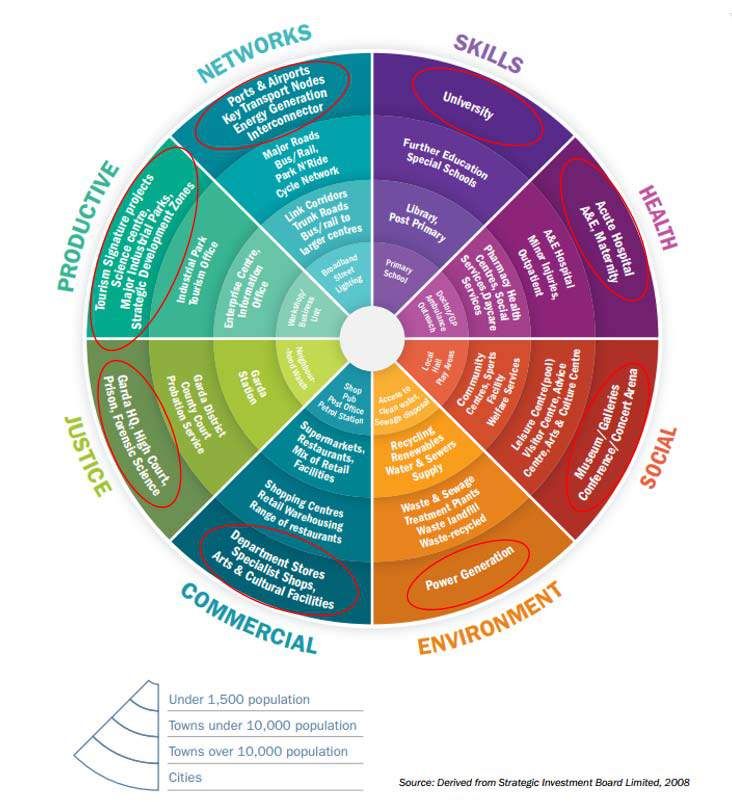
The diagram below extracted from the Draft NPF (pg 77) indicates the level of service
provision that applies to settlements of varying size across Ireland. The outermost ring
of the diagram shows the typical high-level services that are available in cities. In this
regard, we have also outlined how Sligo possesses each of the services/facilities which
are traditionally attributed to a city settlement. Figure 2 illustrates how Sligo already
competes with other larger cities in terms of the services and facilities which it can
offer, reinforcing its position as a key service centre in the North West.
16
McCarthy Keville O’Sullivan Ltd. – Planning & Environmental ConsultantsFigure 2 : Hierarchy of Settlements and related infrastructure
Skills
St Angela’s College, IT Sligo (working towards
university status)
Networks
Sligo Port, Sligo Airport
(Strandhill), Knock Airport
Health
Sligo University Hospital
Productive Social
Wild Atlantic Way, IDA business
Sligo County Museum, Hamilton
parks, The Innovation Centre at IT Sligo
Gallery, The Model, Home of the
Niland Collection.
Environment
Justice Wind farm capacity available in the
New regional Garda headquarters, High County in 2016 was 49.15 MW,
Court (Provincial Venue), Circuit Court Installed capacity of 2.7 MW in two
hydroelectric power
Commercial
Cultural Quarter, The Model Arts
Centre, The Model
17
McCarthy Keville O’Sullivan Ltd. – Planning & Environmental Consultants7 SLIGO AND THE NATIONAL PLANNING
FRAMEWORK
The adopted National Planning Framework (NPF) must learn from the mistakes of its
predecessor. The NPF must drive Balanced Regional Development (BRD) and not of
the type fostered in the National Spatial Strategy. The type of BRD which is pursued
must strike a balance between Dublin and other key regional centres. At present,
Dublin is attracting an unsustainable level of investment, jobs and growth to the
detriment of the rest of the country. The Draft NPF has identified the 4 cities – Cork,
Waterford, Limerick and Galway which will be targeted for major employment growth
and housing construction and act as a counterbalance to Dublin. The Draft NPF offers
no distinction between Sligo and the other 41 designated large towns in the country.
Given its prominent position in the North West, Sligo is the most obvious large regional
town that should be supported without reservation by the NPF and the National
Investment Plan to achieve its growth potential in terms of employment and population
growth, in parallel with infrastructural development and regeneration of the town
centre. Plans for this growth should be developed concurrently with a capital works
investment programme which ensures that infrastructure serving and within these
centres can facilitate the growth i.e. road, rail, public transport, waste water etc.
The strategy of the NPF should be to identify the effective growth centres in each region
and to prioritise the policies and investments which will enable them to flourish
individually and also to collaborate effectively to form a real counterbalance to the
established Greater Dublin conglomerate. Previous attempts to ensure that all
settlements, of any significant size, within the State should be targeted for new jobs
and significant levels of growth has proven to be a failure and has led to unsustainable
patterns of development. Critical mass should be pursued in key regional centres,
such as Sligo, and in turn their rural hinterlands and satellite towns will benefit and
flourish. The adopted NPF must clearly set out the strategy referred to above with clear
objectives and policies which will facilitate the desired outcomes. The primacy of Sligo
as a settlement must be entrenched in the framework from the outset.
7.1 Why Sligo?
Sligo is the most important settlement in the North West of the country and although
the population of Sligo is 25,219 the ‘greater’ Sligo area has a population of as much as
60,000 people18. It is the obvious candidate in the North West for designation as a
regional centre as it already functions as the administrative, economic and cultural
centre for south County Donegal, County Sligo and parts of Counties Leitrim,
Roscommon and Mayo. As mentioned, the population of the North West as a whole is
in the order of 250,000 people and Sligo is the regional anchor for this entire
catchment. There is already a strong foundation in place in a demographic context for
achieving critical mass which will drive Sligo on to further growth.
Again, as mentioned, In the Sligo and Environs Development Plan 2010-2016, which is
the current statutory planning document for the town, there is sufficient lands zoned
in the settlement (including the strategic land reserve) for the provision of housing for
up to 26,000 new residents. Following investment by Sligo County Council in the 2000’s
there is substantial capacity within the wastewater treatment system which can
accommodate this growth. Therefore, Sligo is prepared for and has the infrastructure
18 Sligo County Retail Strategy 2017-2023 – Section 3.1
18
McCarthy Keville O’Sullivan Ltd. – Planning & Environmental Consultantsin place to accommodate significant population growth through the provision of new
housing.
In addition to the capacity for population growth there is significant capacity for growth
in industry and employment within the town. In the Sligo and Environs Development
Plan 2010-2016 there are 220 hectares19 of land zoned ‘BITP: Business, Industry and
Technology Park’. This is a substantial land bank which, with support from the IDA and
other national bodies, could be promoted and incentivised for development. Population
and employment growth are intrinsically linked and the conditions exist in Sligo to
facilitate the substantial growth of both. Sligo BID urge the Department to ensure that
the finalised National Planning Framework identifies Sligo for significant levels of
growth in order that it can achieve its potential.
Sligo is home to two third level education facilities, Sligo Institute of Technology and
St. Angela’s College (with an estimated term time student number at 7,500) as well as
a variety of high quality primary and secondary schools which are an attractive
proposition for people and families considering coming to the area. In addition to this
Sligo has a strong and successful retail core with a mixture of diverse and eclectic
independent retailers and traders interspersed with nationally recognisable brands.
The town centre is compact, pedestrian friendly and walkable which are the
fundamentals of a successful town centre. While there are vacancies these units can
serve as the location for future growth on the back of wider population and employment
growth. In addition to a strong retail core, the town has appropriately located retail
parks to facilitate larger scale retailers and bulky goods retailers. There is capacity in
these parks to accommodate future growth.
While Sligo has a substantial and growing population and the capacity to expand
significantly in terms of employment and population numbers, it also offers the appeal
of an attractive historic town centre and easy access to the open countryside, beach
resorts at Rosses Point and Strandhill as well as many other cultural and heritage
destinations. The town offers the best of city and country and is therefore an attractive
proposition for both young professionals and families. In addition to the points above
the cost of living in Sligo is considerably lower than in the other regional centres and
particularly in the context of Dublin. Rents and house prices are affordable in contrast
to Dublin and some of the other city settlements. The cost of doing business is also
lower than the other city settlements with rates and commercial rents which are
affordable.
It is fostering a sense of place that makes a settlement successful and attractive to
existing residents as well as newcomers. Sligo is striving to create a sense of place and
enhance the offer and attractiveness of the town centre. This is evidenced in the fact
that Sligo is the only town in Ireland with a Business Improvement District and a Purple
Flag. A Purple Flag is an award for excellence in the evening and night time economy.
There is also significant potential to further develop Sligo as a tourism destination
given that it is located on the section of the Wild Atlantic Way which is closest to Dublin.
Provided that good quality linkages and infrastructure can be developed between Sligo
and Dublin in the near future (the completion of the M4) then Sligo could become the
principal stop off point for people travelling north or south on the Wild Atlantic Way.
On the basis of the above and the strong and obvious case that exists, we respectfully
request that Sligo is identified as a growth centre commensurate with its status as the
capital of the North West. As demonstrated above in Section 5.3.1, Sligo has all the
19 Sligo and Environs Development Plan 2010-2016
19
McCarthy Keville O’Sullivan Ltd. – Planning & Environmental Consultantscharacteristics of a city and competes as a city. This submission requests that the key
position of Sligo is addressed in the NFP in terms of its role as a key city in the Region
(Sligo City Region) to facilitate the future growth, success and sustainability of the town.
7.2 What should the NPF achieve?
The adopted National Planning Framework should identify Sligo as a key city in the
region and on foot of this designation must direct significant infrastructure investment
to the town. This infrastructure investment will facilitate and lay the foundation for
growth in population and employment. This investment should be targeted at ensuring
Sligo has better connectivity with Dublin and the other city regions.
The National Planning Framework should also be given a statutory basis so that the
next Regional Spatial and Economic Strategies (RSESs), Sligo County Development
Plan and all Local Area Plans are obliged to accord with its provisions. This in turn will
ensure that development management decisions at local level, both in Sligo and across
the country, are made in accordance with the provisions of the Framework and not
contrary to it which is one of the reasons why the previous spatial strategy failed. In
addition to the above, all future government plans and strategies should take
cognisance of the provisions of the NPF to facilitate a ‘joined up approach’. This will
help to ensure that investment is directed to the right areas and that the mechanisms
of government are all pulling in the right direction to ensure a prosperous and
sustainable future for Sligo and for the rest of the country.
7.3 Implementation of the NPF
The objectives of the NPF will be applied on a regional basis through statutory Regional
Spatial and Economic Strategies (RSESs). These are new plans that will address more
detail at a regional scale, being prepared by each of the three Regional Assemblies that
were established in 2014. The North Western Regional Assembly in their submission
on the ‘National Planning Framework: Issues and Choices Paper’, has identified the
three City Regions of Galway, Sligo and Letterkenny-Derry/Strabane as key
development areas for future population growth, supported through a network of
significant towns, villages and rural catchments. It is proposed that the designation of
these three key urban centres as City’s or City Region’s, will reinforce the Atlantic
Economic Corridor (AEC) model, as being comprised of a network of major urban
Regional Centres which encompass the length of the Western Seaboard. Furthermore,
it incorporates the crucial element to enable effective regional development, with at
least two designated centres north of the Dublin – Galway axis.
20
McCarthy Keville O’Sullivan Ltd. – Planning & Environmental ConsultantsYou can also read


