Success Factors in the FIFA 2018 World Cup in Russia and FIFA 2014 World Cup in Brazil
←
→
Page content transcription
If your browser does not render page correctly, please read the page content below
ORIGINAL RESEARCH
                                                                                                                                                  published: 09 March 2021
                                                                                                                                           doi: 10.3389/fpsyg.2021.638690

                                                Success Factors in the FIFA 2018
                                                World Cup in Russia and FIFA 2014
                                                World Cup in Brazil
                                                Hannes Lepschy*, Alexander Woll and Hagen Wäsche*

                                                Institute of Sports and Sports Science, Karlsruhe Institute of Technology (KIT), Karlsruhe, Germany

                                                Research on success factors in football focusing on national teams is sparse. The current
                                                study examines the success factors during the World Cup 2018 in Russia and the World
                                                Cup 2014 in Brazil. A total of 128 matches were analyzed using a generalized order
                                                logit approach. Twenty-nine variables were identified from previous research. The results
                                                showed that defensive errors (p = 0.0220), goal efficiency (p = 0.0000), duel success
                                                (p = 0.0000), tackles success (p = 0.0100), shots from counterattacks (p = 0.0460),
                                                clearances (p = 0.0130), and crosses (p = 0.0160) have a significant influence on winning
                                                a match during those tournaments. Ball possession, distance, and market value of the
                                                teams had no influence on success. Overall, most of the critical success factors and
                                                those with the highest impact on winning close games were defensive actions. Moreover,
                             Edited by:         the results suggest that direct play and pressing were more effective than ball possession
                       Goran Vuckovic,
       University of Ljubljana, Slovenia
                                                play. The study contributes to a better understanding of success factors and can help to
                      Reviewed by:
                                                improve effectiveness of training, match preparation, and coaching.
               Gibson Moreira Praça,
                                                Keywords: match analysis, performance analysis, performance indicators, soccer, sport analytics
          Federal University of Minas
                        Gerais, Brazil
                          Miguel Pic,
   South Ural State University, Russia          INTRODUCTION
                  *Correspondence:
                                                To understand the mechanisms underlying success in football is critical for coaches, players,
                     Hannes Lepschy
                h.lepschy@t-online.de
                                                managers, journalists, and other stakeholders. This understanding is in football as crucial as in other
                       Hagen Wäsche             sports, but it is still a challenge to determine what leads to success in football. Various attempts have
              hagen.waesche@kit.edu             been undertaken to identify and quantify indicators of performance, but results vary and are partly
                                                inconsistent. Most studies focused on domestic leagues consisting of club teams, while studies on
                   Specialty section:           the performance of national teams at tournaments are sparse. Only 11 studies involving data of
         This article was submitted to          success factors from a World Cup were published in recent years (Lepschy et al., 2018). Of these
        Movement Science and Sport              studies, only six used a predictive study design compared with 24 studies about club teams, which
                           Psychology,          can provide more sophisticated conclusions (Lepschy et al., 2018). None of those studies about
               a section of the journal
                                                World Cup matches used market value as an independent variable. Moreover, in most studies,
               Frontiers in Psychology
                                                only a small selection of variables was used, and a possible effect of the home advantage was not
       Received: 07 December 2020               always considered. Therefore, more research is needed to close this gap in possible unidentified
        Accepted: 08 February 2021
                                                success factors.
         Published: 09 March 2021
                                                    Besides a careful consideration of independent variables, a meaningful dependent variable
                             Citation:
                                                needs to be selected. Regarding the independent variables the most studied variables with regard
    Lepschy H, Woll A and Wäsche H
   (2021) Success Factors in the FIFA
                                                to success factors in football are shots and shots on goals followed by variables like goal
  2018 World Cup in Russia and FIFA             efficiency (number of goals divided by shots), passing, and possession (Sarmento et al., 2014;
             2014 World Cup in Brazil.          Lepschy et al., 2018). Goal efficiency and shots on goal were shown to be important factors
           Front. Psychol. 12:638690.           for winning a football match (Hughes and Franks, 2005; Brito de Souza et al., 2019; Lepschy
     doi: 10.3389/fpsyg.2021.638690             et al., 2020). Broich et al. (2014) found that goal efficiency is more important than the quantity

Frontiers in Psychology | www.frontiersin.org                                          1                                            March 2021 | Volume 12 | Article 638690
Lepschy et al. Success Factors FIFA World Cups
of shots. They also showed a stronger correlation between goals TABLE 1 | Performance variables and contextual variables.
and goal efficiency than between goals and number of shots.
Group Variables
Additionally, Lago-Peñas et al. (2010) found that effectiveness
was significantly higher for winning teams. Castellano et al. Variables related to goal Total shots, shots on target, shots from
(2012) showed that the effectiveness of the attacking play was scoring counterattack, shots from inside 6-yard box, shots
discriminating between winning and losing in three World Cup from inside penalty area, goal efficiency (Goals ×
tournaments (2002–2010). Sarmento et al. (2018) showed in an 100/Total shots)
analysis that fast attacks and counterattacks also increased the Variables related to passing Ball possession (%), passes, pass accuracy (%),
and organizing long passes, short passesa , Average pass streak,
success of an attack. crosses, successful dribbles, corners, aerials won,
However, ball possession and passing showed mixed results distance in kilometers
but seem to be not significant success factors if studies are Variables related to defense Tackles success (%), fouls, yellow cards, red cards,
controlled for other variables (Oberstone, 2009; Liu et al., 2015; defensive errors, duel success (%), clearances,
Lepschy et al., 2020). Notably, Collet (2013) showed that, if interceptions
controlled for team quality and home advantage, ball possession Contextual variables Quality of opponent (FIFA coefficient), average age
was a consistent negative effect in domestic leagues as well as starting formation, total market value starting
formation, home advantage (0;1)
club tournaments. On the other hand, Lago-Peñas et al. (2011)
came to the conclusion that higher ball possession is a significant a Removed after test of multicollinearity.
influence on winning.
Lepschy et al. (2020) studied the success factors of the German
Bundesliga and showed that defensive errors are an influential 2013). A sample of the collected data has been compared
success factor. They also revealed a significant effect for the total with the official match sheets of the FIFA. The agreement
market value of the starting formation. Home advantage and was constantly above 0.9. The data for distance covered were
the quality of opponent are two further important contextual collected from www.fifa.com. The data about market value of
variables explaining success (Clarke and Norman, 1995; Santos the starting formation and average age were retrieved from
et al., 2017). www.transfermarkt.de, which are provided for each match prior
Not only the selection of the independent variables needs to to the kickoff. To take into account the effect of home advantage
be done carefully, but also the dependent variable needs to be (12 matches were played by the host nations in 2014 and 2018),
chosen sensibly. Success in football games is usually evaluated a binary dummy variable for home advantage was included in
based on results (win, draw, and loss) or based on goals (goals the analysis. To control for the strength of the opponent, the
scored and conceded). Despite providing more information, the last FIFA coefficient prior to the tournament was used (FIFA,
goal-based approach does not perform better than the results- 2014, 2018). Eventually, the 29 variables related to goal scoring,
based approach (Goddard, 2005). An alternative method is the to passing and organizing, to defense, and to context were
approach of the closeness/balance of the game, which allows to included in the analysis (Table 1). The tournament rules allow
overcome the moderator effect that one team does not play at its matches to be only decided after 30 min of extra time and/or a
best level when the game is seemingly decided (Liu et al., 2015; penalty shootout. Eight matches were decided through a penalty
Lepschy et al., 2020). The approach of unbalanced matches and shootout; these were counted as tied. Five matches were decided
close matches divides the sample into a group of matches with a after extra time; these were counted as a win for the respective
narrow goal difference (close matches) and a group of matches team. The dependent variable was in all cases the results-based
with a wide goal difference (unbalanced matches). This approach outcome of the match, described as win, draw, or loss.
will be also used in this study to reduce data bias and to show
success factors that lead to a win in those close matches. Operational Definition
The goal of this exploratory study is to identify the success The market value is an estimated figure, which is built on
factors for the FIFA World Cup 2018 in Russia and the different aspects. The following factors are part of the estimation:
FIFA World Cup 2014 in Brazil using an elaborated statistical performance and stability of the performance, experience,
approach. Twenty-nine variables will be investigated using a perspectives for the future, and prestige. The market value data
results-based approach. This will be the first study to include have been used in various studies and are considered to be reliable
market value as a success factor of a FIFA World Cup. (Göke et al., 2014) and show a high correlation with actual values
(Frick, 2011). The average age of the starting formation is the
METHODS age of each player at the day of the match day summarized and
divided by 11. The operational definition of the 25 performance
Sample variables can be found on https://www.optasports.com/insight-
The data used for this study were freely available. Most data for-fans/opta-s-event-definitions/ (OPTA, 2018).
(except duel success, distance, average age, and market value)
for all 128 matches were collected from www.whoscored.com. Statistical Analysis
The data for duel success were gathered from www.kicker.de. A K-means cluster was used to determine the balance of the
The data on both websites are provided by OPTA. The reliability game. One hundred eight matches were classified as close
of the OPTA data lies between 0.92 and 0.94 (Liu et al., (goal difference 0–2 goals) and 20 matches as unbalanced (goal
Frontiers in Psychology | www.frontiersin.org 2 March 2021 | Volume 12 | Article 638690Lepschy et al. Success Factors FIFA World Cups
TABLE 2 | Descriptive statistics.
Mean Std. deviation Std. error 95% confidence interval for mean Minimum Maximum
Lower bound Upper bound
Total shots 13.00 5.43 0.37 12.27 13.72 3.00 39.00
Shots on target 4.14 2.41 0.16 3.82 4.47 0.00 17.00
Shots from counterattack 0.37 0.80 0.05 0.26 0.48 0.00 5.00
Shots from inside 6-yard box 0.73 0.92 0.06 0.60 0.85 0.00 4.00
Shots from inside penalty area 6.40 3.34 0.23 5.96 6.85 1.00 23.00
Goal efficiency 10.12 9.68 0.66 8.83 11.42 0.00 57.14
Ball possession (%) 50.00 12.46 0.85 48.33 51.67 21.00 79.00
Passes 447.32 137.83 9.38 428.83 465.80 156.00 1,115.00
Pass accuracy (%) 79.97 7.10 0.48 79.02 80.92 57.00 93.00
Long passes 58.92 13.96 0.95 57.05 60.79 29.00 107.00
Short passes 434.05 143.17 9.74 414.85 453.25 147.00 1,104.00
Average pass streak 4.61 1.28 0.09 4.44 4.78 2.00 10.00
Crosses 18.78 8.69 0.59 17.61 19.94 3.00 53.00
Successful dribbles 10.14 4.62 0.32 9.52 10.76 1.00 23.00
Corners 5.07 2.75 0.19 4.71 5.44 0.00 19.00
Aerials won 17.57 7.59 0.52 16.55 18.58 2.00 49.00
Distance 109.63 11.73 0.80 108.05 111.20 93.00 155.00
Tackles success (%) 64.63 10.76 0.73 63.19 66.08 33.33 94.44
Fouls 14.26 5.03 0.34 13.58 14.93 4.00 31.00
Yellow cards 1.57 1.15 0.08 1.42 1.73 0.00 6.00
Red cards 0.05 0.21 0.01 0.02 0.08 0.00 1.00
Defensive errors 0.40 0.65 0.04 0.31 0.49 0.00 3.00
Duel success (%) 50.00 5.46 0.37 49.27 50.73 36.00 64.00
Clearances 25.25 10.68 0.73 23.82 26.68 4.00 67.00
Interceptions 11.66 5.00 0.34 10.99 12.33 2.00 29.00
FIFA coefficient 964.53 249.78 17.00 931.03 998.03 457.00 1,558.00
Average age starting formation 27.84 1.38 0.09 27.65 28.02 24.40 30.90
Total market value starting formation 191.52 180.41 12.28 167.32 215.71 4.83 710.00
difference 3 or more goals). The 108 matches were analyzed twice, Review Board of the Institute of Sports and Sports Science,
since the home team (first mentioned team) on the schedule is Karlsruhe, Germany.
not playing at home except for the 12 matches mentioned before.
Hence, this analysis is based on 216 observations.
The test of parallel regression was significant (Brant: RESULTS
chi2 = 260.7; p = 0.000); therefore, the assumption of
proportional odds is violated (Brant, 1990). Consequently, the The descriptive statistics are presented in Table 2. The average
generalized ordered logit regression was used for the analysis goals per match were 2.66 (2.64 in 2018 and 2.67 in 2014).
(Williams, 2016). To test for the multicollinearity, the command The marginal effects for the outcome “win” of all analyzed
collin was used (Ender, 2010). A variance inflation factor (VIF) variables are displayed in Table 3. Shots from counterattack,
above 10 was set as the cutoff value (Craney and Surles, goal efficiency, crosses, tackle success (%), defensive errors,
2002). The variables passes (VIF = 654.69) and short passes duel success (%), and clearances had a significant influence on
(VIF = 662.10) showed higher values. The variable short passes winning a match. Defensive errors showed the highest influence
was removed from the model. Pseudo R2 of the analyzed model (dy/dx = −0.1025, p < 0.05), with one defensive error decreasing
was 0.3622. the probability of winning by 10.25%. One additional shot
To interpret the results, marginal effects (command margins) from a counterattack increased the chance of winning by 6.51%
were calculated (Williams, 2012). The significance level was set to (dy/dx = 0.0651, p < 0.05). However, duel success (%) and goal
p < 0.05 for all statistical analyses. efficiency showed to be important as well and highly significant
The data were analyzed in IBM SPSS Statistics 24 and STATA (dy/dx = 0.0214, p < 0.01, respectively, dy/dx = 0.0193, p <
15. The study received ethical approval by the Institutional 0.01). None of the contextual variables showed a significant
Frontiers in Psychology | www.frontiersin.org 3 March 2021 | Volume 12 | Article 638690Lepschy et al. Success Factors FIFA World Cups
TABLE 3 | Marginal effects for the outcome “win.”
dy/dx Std. err. z p>z 95% conf. interval
Total shots 0.0149 0.0099 1.5100 0.1310 −0.0044 0.0343
Shots on target 0.0182 0.0153 1.1900 0.2340 −0.0118 0.0481
Shots from counterattack* 0.0651 0.0326 2.0000 0.0460 0.0012 0.1291
Shots from inside 6-yard box 0.0090 0.0278 0.3200 0.7460 −0.0454 0.0634
Shots from inside penalty area 0.0003 0.0124 0.0200 0.9810 −0.0239 0.0245
Goal efficiency** 0.0193 0.0034 5.7300 0.0000 0.0127 0.0259
Ball possession (%) 0.0091 0.0052 1.7500 0.0810 −0.0011 0.0192
Passes −0.0004 0.0005 −0.7600 0.4450 −0.0014 0.0006
Pass accuracy (%) −0.0082 0.0065 −1.2700 0.2050 −0.0209 0.0045
Long passes −0.0013 0.0022 −0.5700 0.5710 −0.0057 0.0031
Average pass streak 0.0121 0.0393 0.3100 0.7590 −0.0650 0.0891
Crosses* −0.0111 0.0046 −2.4100 0.0160 −0.0201 −0.0021
Successful dribbles −0.0066 0.0065 −1.0300 0.3050 −0.0193 0.0060
Corners 0.0044 0.0127 0.3400 0.7320 −0.0205 0.0293
Aerials won −0.0021 0.0036 −0.5900 0.5540 −0.0092 0.0049
Distance −0.0021 0.0028 −0.7600 0.4470 −0.0075 0.0033
Tackles success (%)* 0.0057 0.0022 2.5600 0.0100 0.0013 0.0100
Fouls 0.0065 0.0065 1.0000 0.3150 −0.0062 0.0192
Yellow cards −0.0148 0.0192 −0.7700 0.4400 −0.0525 0.0228
Red cards −0.0165 0.0768 −0.2100 0.8300 −0.1669 0.1339
Defensive errors* −0.1025 0.0448 −2.2900 0.0220 −0.1903 −0.0148
Duel success (%)** 0.0214 0.0062 3.4900 0.0000 0.0094 0.0335
Clearances* 0.0084 0.0034 2.4900 0.0130 0.0018 0.0150
Interceptions −0.0038 0.0046 −0.8300 0.4080 −0.0130 0.0053
FIFA coefficient 0.0002 0.0001 1.3600 0.1730 −0.0001 0.0004
Average age starting formation −0.0190 0.0171 −1.1100 0.2660 −0.0525 0.0145
Total market value starting formation 0.0001 0.0002 0.5300 0.5980 −0.0003 0.0005
Home advantage 0.0822 0.1158 0.7100 0.4780 −0.1448 0.3093
**p < 0.001; *p < 0.05.
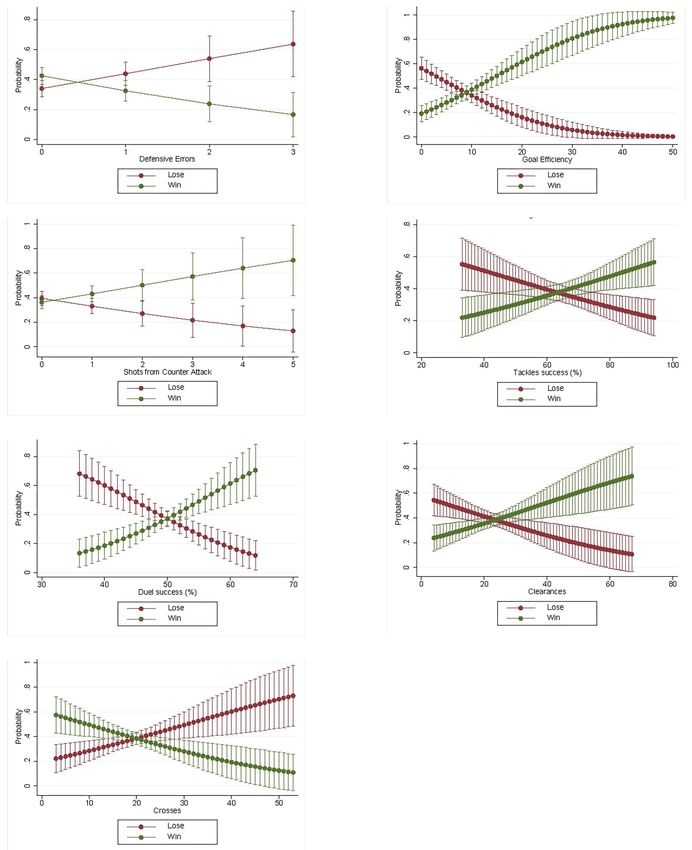
impact. However, the contextual variable home advantage had Overview of Significant Variables
the highest positive value (dy/dx = 0.0822, p = 0.4780) of Of the significant variables, four variables related to defense
all variables1 . [defensive errors, tackles success (%), duel success (%), and
The seven significant variables including the 95% confidence clearances] were significant. Two variables related to goal scoring
intervals are also shown in Figure 1. All graphs show a clear [goal efficiency (%) and shots from counterattack], and one
development of the predictors regarding the probability of variable related to passing and organizing (crosses) showed
winning or losing. The higher or lower the value of the predictor, significant influence. No contextual variables were significant.
the higher is the probability of winning or losing.
Significant Defensive Factors
DISCUSSION The most influential success factor was defensive errors. Each
defensive error decreases the probability of winning by 10.25%
The purpose of this research was to identify success factors in (p < 0.001). Despite being an intuitive result, defensive errors
the games played at the Football World Cups in 2018 and 2014. were rarely analyzed in recent studies, and this study permits
The significant positive success factors during the World Cup a quantification of the impact. Lepschy et al. (2020) showed
2018 and 2014 were shots from counterattack, duel success (%), similar results for the German Bundesliga. The impact of errors
goal efficiency (%), clearances and tackles success (%). On the in this study is slightly higher than the impact in the German
other hand, defensive errors and crosses had a significant negative Bundesliga. The operational definition of a defensive errors could
impact on the probability of winning. Despite that none of the also contribute to the big impact, “A mistake made by a player
contextual factors in this study were significant, it is still worth losing the ball that leads to a shot or a goal” (OPTA, 2018).
noting that the effects of those variables were substantial. Losing the ball by a mistake usually also leaves the defense in
an imbalanced status. Tenga et al. (2010) showed that playing
1 Non-significance is due to the small sample size for home advantage (n = 12). against an imbalanced defense increases the chance of a goal for
Frontiers in Psychology | www.frontiersin.org 4 March 2021 | Volume 12 | Article 638690Lepschy et al. Success Factors FIFA World Cups FIGURE 1 | Margins with 95% CIs of the significant variables. Frontiers in Psychology | www.frontiersin.org 5 March 2021 | Volume 12 | Article 638690
Lepschy et al.                                                                                                     Success Factors FIFA World Cups

the attacking team. Several studies showed that the chance of              if other variables were included in the model (Collet, 2013).
a defensive errors is also increasing toward the end of a match            However, studies related to success factors in football leagues
because of physical deterioration and diminished cognitive                 show ambiguous results (Collet, 2013; Liu et al., 2015, 2016).
function (Simiyu, 2014). The next significant factor related to            In this study, ball possession showed no effect, supporting the
defense is duel success in percentage, showing the third highest           assumption that ball possession is losing significant impact
value of all significant success factors. Each additional percentage       if the results are controlled for other influencing variables
increases the chance of winning by 2.14% (p < 0.001). However,             (Collet, 2013).
duel success has the lowest standard deviation of the following                Interestingly, total shots, shots from inside six-yard box, and
significant defensive factors and has the lowest range. Therefore,         shots from inside penalty area did not affect the outcome of the
it could be argued that despite the higher value, the positive             games. Total shots and subgroups of shots (shots from inside six-
effect of duel success is limited. Furthermore, the percentage             yard box and shots from inside penalty area) were widely studied
of successful tackles was a significant positive success factor as         in the past, and the results showed mostly a significant positive
well (0.57%, p < 0.05). However, previous research has yielded             effect on success (Oberstone, 2009; Lago-Peñas et al., 2010; Liu
inconclusive results about whether the percentage of successful            et al., 2015, 2016; Pappalardo and Cintia, 2018; Lepschy et al.,
tackles is significant or not (Oberstone, 2009; Liu et al., 2015,          2020). However, our non-significant results might be due to goal
2016). Future research should investigate this further and focus           efficiency and points toward the importance of precision over
on identifying possible interacting factors such as the location           quantity of shots.
of the tackles or the direction of the tackles. Finally, clearances            In our analysis, distance showed no effect, although recent
showed a significant positive effect (0.84%, p < 0.05) on success.         studies identified it as the most influential variable in the German
This confirms previous research by Carmichael et al. (2000)                Bundesliga (Schauberger et al., 2017). However, in the latest study
and Lepschy et al. (2020). However, clearances were only rarely            on the Bundesliga, with a wide range of variables, distance had
included in past research. In the light of those results, future           also no effect on success (Lepschy et al., 2020).
research should consider including clearances for an analysis of               In contradiction to prior results of the German Bundesliga,
success factors in football.                                               market value was not a significant predictor of success (Lepschy
                                                                           et al., 2020). Seemingly, the market value of national teams
Significant Offensive Factors                                              at World Cups is less important than in club football. A
Besides the multitude of significant defensive factors, the analysis       reason might be the different character of tournament games
revealed that there are also actions of offensive performance that         including single knockout games to games played during a
can make the difference. Notably, each shot from a counterattack           regular season. However, further research is needed to determine
increased the chance of winning by 6.51% (p < 0.05). Moreover,             if this hypothesis can be supported. Other explanations could
the conversion of shots into goals is shown to be a very important         be that not enough matches with a distinct difference in market
success factor. In agreement with previous research, it was shown          value were included or that a mediator variable, which is not yet
that goal efficiency has a significant positive effect on winning          identified, is present.
(Broich et al., 2014; Lepschy et al., 2020). A positive change of              In general, it showed that actions related to defense had a
one percentage in goal efficiency increases the chance of winning          high impact of success in the last two World Cups. Moreover, it
by 1.93% (p < 0.001).                                                      appears that variables related to efficiency such as duel success
                                                                           (%), goal efficiency (%), and tackles success (%) are more
Significant Factors Related to Passing and                                 important than the quantity of single factors, a finding that
Organizing                                                                 is supported by Collet (2013). Finally, ball possession seems
Crosses are the only significant variable related to passing and           to be of less importance also on a national team level. A
organizing. The number of crosses had a significant negative               more pressing/direct style, as reflected in defensive errors of the
effect (−1.11%, p < 0.05). Again, this confirms previous research          opponent and shots from counterattacks as well as duel and
(Lago-Peñas et al., 2010; Liu et al., 2015; Lepschy et al., 2020).         tackles success, seems to be more successful. This finding is in
The reason might be that only quantity and not quality of                  line with other studies (Pollard, 2019).
crosses was considered. This assumption is supported by a study
that found that long passes are linked to losing ball possession           Practical Implications
(Reis et al., 2017). Unsuccessful crosses are likely to initiate a         The results of this study have various implications for coaches
counterattack. Moreover, crosses from the midfield could be an             of national teams but could also be helpful for coaches of
indicator of limited technical and tactical skills or a compact            club teams. Our findings point toward aspects that can make
defense of the opponent. Nevertheless, there is also an indication         the difference at high-level football matches. Shot accuracy
of a positive effect for crosses (Oberstone, 2009). Hence, future          during matches is critical and should be properly addressed in
research should consider the quality of crosses.                           training sessions. The development and utilization of apt training
                                                                           methods could be beneficial for the goal efficiency and eventually
Non-significant Factors in Contrast to                                     lead to more success. Accuracy instead of quantity should be
Previous Research                                                          the maxim. Furthermore, more effective ways to lower the
The effect of ball possession has been discussed controversially.          probability of defensive errors should be found and implemented
It was not a significant predictor in past FIFA tournaments                in specific training sessions. Next to technical and tactical skills,

Frontiers in Psychology | www.frontiersin.org                          6                                     March 2021 | Volume 12 | Article 638690
Lepschy et al. Success Factors FIFA World Cups
the improvement of endurance, speed, and mental strength could the mechanism of success in football (Courneya and Cheiadurai,
be critical in this context. To increase the duel and tackles success 1991; Fernandez-Navarro et al., 2016, 2018; Hewitt et al., 2016;
rate, specific training methods could be utilized, and players Lago-Peñas et al., 2017; Gómez et al., 2018; Castellano and Pic,
should be focused on the importance of these factors in match 2019).
preparations. Substitutions to accommodate for physical and Methodologically, predictive analyses are the methods of
mental fatigue of the starting formation could also contribute to choice. However, alternative methodological approaches such
a lower error rate and can help to win a match [see also Njororai as social network analysis (Wäsche et al., 2017) should be
(2012) and Njororai (2013)]. Instead of substituting forwards in considered. Social network analysis already revealed some new
during the second half, coaches could consider strengthening insights (Pina et al., 2017).
the defense through specific substitutions. On the tactical side,
coaches should be aware of the significance of counterattacks
CONCLUSION
especially when playing against stronger opponents. The play
against an imbalanced defense can lead to more scoring The study showed that defensive errors had the strongest
opportunities especially if played at a faster pace (Almeida, 2019). influence on the probability of winning or losing a football
match during the World Cups 2018 and 2014. In addition, goal
Limitations and Future Research efficiency, duel success in percentage, and tackles success in
By interpreting the results of this study, four restrictions have percentage were shown to be of high significance. It appears that
to be taken into account. First, the sample size contained only efficiency factors are more important than single factors alone.
matches of national teams during a tournament including only Shots from counterattacks and clearances also revealed a positive
128 matches. Therefore, the possible generalization of the results impact. In contrast, the number of crosses showed a negative
is limited. In addition, the sample consisted of matches from the impact on winning. In total, four different variables related
group stages and knockout stages. The tactics used in the different to defense, two variables related to goal scoring, one variable
stages could have interfered with the results. Second, the variable related to passing and organizing, and no contextual variables
short passes was dropped in favor of reduced collinearity. Any were significant. Interestingly, shots from counterattacks, tackles,
effects of this variable were not accounted for. Third, the variable and duel success are significant predictors of success, whereas
market value of the starting formation was gathered from a public ball possession and passes are not significant. This could be
website and is not a standardized factor. Fourth, the data were an indicator for the assumption that tactics dominated by
collected from third parties, and the reliability of their collection pressing could be a better strategy than tactics solely based
process was checked in previous research for a specific sample, on ball possession. However, national teams and club teams
which showed 0.92 and 0.94 and not directly for the obtained cannot readily be compared due to different contexts such as the
samples (see Sample section). competition format. Future research needs to determine possible
With regard to future research, the study points toward several differences. In addition, the ambiguous results for ball possession
aspects that need further investigation. The influence of ball and number of crosses from different studies needs to be
possession needs to be analyzed in more detail. This study addressed in future research. Further research on success factors,
showed no significant influence, which is in agreement with building on existing knowledge and utilizing apt methods, will
previous research (Collet, 2013; Lepschy et al., 2020). However, further contribute to the knowledge of coaches, managers, and
other recent studies found a significant effect of ball possession other practitioners to improve team performance in football.
but in opposite directions (Liu et al., 2015; Schauberger et al.,
2017).
Future research also needs to analyze the effects of the DATA AVAILABILITY STATEMENT
distance covered, since results are inconsistent. In addition, the
The datasets generated for this study are available on request to
negative impact of crosses should be analyzed. Lepschy et al.
the corresponding authors.
(2020) found similar results for the Bundesliga. It needs to be
determined when crosses are a negative predictor and in which
cases they are not. Moreover, the non-significant influence of ETHICS STATEMENT
shots, except shots from counterattack, should be investigated
further to confirm previous results that showed a clear positive Studies involving animal subjects: No animal studies are
effect (Oberstone, 2009; Lago-Peñas et al., 2010; Liu et al., 2015; presented in this manuscript. Studies involving human subjects:
Pappalardo and Cintia, 2018; Brito de Souza et al., 2019; Lepschy No human studies are presented in this manuscript. Inclusion
et al., 2020). Also, the effect of home advantage at World Cups of identifiable human data: No potentially identifiable human
needs to be studied further considering crowd support, climate, images or data is presented in this study.
and possible influences of a “once in a lifetime experience” for
players. Additionally, the styles of play could be incorporated into AUTHOR CONTRIBUTIONS
a model of success factors. Not only does the match status interact
with the playing style, but also certain performance factors can be HL contributed to the conception and design of the study, the
linked to a specific style. The success factors could vary between data collection, the data analysis and interpretation, the drafting
those playing styles and contribute to a better understanding of the article, and gave the final approval of the version to be
Frontiers in Psychology | www.frontiersin.org 7 March 2021 | Volume 12 | Article 638690Lepschy et al. Success Factors FIFA World Cups
published. HW and AW contributed to the conception and ACKNOWLEDGMENTS
design of the study, the data analysis and interpretation, the
drafting the article, and gave the final approval of the version to We acknowledge support by Deutsche Forschungsgemeinschaft
be published. All authors contributed to the article and approved and Open Access Publishing Fund of Karlsruhe Institute
the submitted version. of Technology.
REFERENCES in Greek professional soccer. Int. J. Perform. Anal. Sport 18, 986–997.
doi: 10.1080/24748668.2018.1539382
Almeida, C. H. (2019). Comparison of successful offensive sequences in the group Hewitt, A., Greenham, G., and Norton, K. (2016). Game style in soccer: what
stage of 2018 FIFA World Cup. Eliminated vs. qualified teams. Sci. Med. is it and can we quantify it? Int. J. Perform. Anal. Sport. 16, 355–372.
Football 1, 1–7. doi: 10.1080/24733938.2019.1613557 doi: 10.1080/24748668.2016.11868892
Brant, R. (1990). Assessing proportionality in the proportional odds model Hughes, M., and Franks, I. (2005). Analysis of passing sequences, shots and
for ordinal logistic regression. Biometrics 46, 1171–1178. doi: 10.2307/25 goals in soccer. J. sport sci. 23, 509–514. doi: 10.1080/026404104100017
32457 16779
Brito de Souza, D., López-Del Campo, R., Blanco-Pita, H., Resta, R., and Del Coso, Lago-Peñas, C., Gómez-Ruano, M., and Yang, G. (2017). Styles of play in
J. (2019). An extensive comparative analysis of successful and unsuccessful professional soccer: an approach of the Chinese Soccer Super League.
football teams in LaLiga. Front. Psychol. 10:2566. doi: 10.3389/fpsyg.2019. Int. J. Perform. Anal. Sport. 17, 1073–1084. doi: 10.1080/24748668.2018.14
02566 31857
Broich, H., Mester, J., Seifriz, F., and Zengyuan, Y. U. E. (2014). Statistical analysis Lago-Peñas, C., Lago-Ballesteros, J., Dellal, A., and Gómez, M. (2010). Game-
for the first Bundesliga in the current soccer season. Adv. Appl. Math. 7, 1–8. related statistics that discriminated winning, drawing and losing teams from
Carmichael, F., Thomas, D., and Ward, R. (2000). Team performance. The the Spanish soccer league. J. Sports Sci. Med. 9, 288–293. Available online at:
case of English Premiership football. Manag. Decis. Econ. 21, 31–45. https://www.jssm.org/jssm-09-288.xml%3EFulltext
doi: 10.1002/1099-1468(200001/02)21:13.0.CO;2-Q Lago-Peñas, C., Lago-Ballesteros, J., and Rey, E. (2011). Differences in performance
Castellano, J., Casamichana, D., and Lago, C. (2012). The use of match statistics indicators between winning and losing teams in the UEFA Champions League.
that discriminate between successful and unsuccessful soccer teams. J. Hum. J. Hum. Kinet. 11, 32–41. doi: 10.2478/v10078-011-0011-3
Kinet. 31, 139–147. doi: 10.2478/v10078-012-0015-7 Lepschy, H., Wäsche, H., and Woll, A. (2018). How to be successful
Castellano, J., and Pic, M. (2019). Identification and preference of game styles in in football. A Systematic Review. Open Sports Sci. J. 11, 3–23.
LaLiga associated with match outcomes. Int. J. Environ. Res. Public Health 16, doi: 10.2174/1875399X01811010003
5090. doi: 10.3390/ijerph16245090 Lepschy, H., Wäsche, H., and Woll, A. (2020). Success factors in football: an
Clarke, S. R., and Norman, J. M. (1995). Home ground advantage of individual analysis of the German Bundesliga. Int. J. Perform. Anal. Sport 20, 150–164.
clubs in English soccer. Statistician 44, 509–521. doi: 10.2307/2348899 doi: 10.1080/24748668.2020.1726157
Collet, C. (2013). The possession game? A comparative analysis of ball retention Liu, H., Gomez, M.-Á., Lago-Peñas, C., and Sampaio, J. (2015). Match
and team success in European and international football, 2007-2010. J. Sports statistics related to winning in the group stage of 2014 Brazil FIFA
Sci. 31, 123–136. doi: 10.1080/02640414.2012.727455 World Cup. J. Sports Sci. 33, 1205–1213. doi: 10.1080/02640414.2015.10
Courneya, K. S., and Cheiadurai, P. (1991). A model of performance measures in 22578
baseball. J. Sport Exerc. Psychol. 13, 16–25. doi: 10.1123/jsep.13.1.16 Liu, H., Hopkins, W., Gómez, A. M., and Molinuevo, S. J. (2013). Inter-operator
Craney, T. A., and Surles, J. G. (2002). Model-dependent variance inflation factor reliability of live football match statistics from OPTA Sportsdata. Int. J. Perform.
cutoff values. Qual. Eng. 14, 391–403. doi: 10.1081/QEN-120001878 Anal. Sport 13, 803–821. doi: 10.1080/24748668.2013.11868690
Ender, P. B. (2010). Collin. Collinearity Diagnostics. Institute for Digital Research Liu, H., Hopkins, W. G., and Gómez, M.-A. (2016). Modelling relationships
and Education, University of California, Los Angeles. between match events and match outcome in elite football. Eur. J. Sport Sci.
Fernandez-Navarro, J., Fradua, L., Zubillaga, A., Ford, P. R., and McRobert, 16, 516–525. doi: 10.1080/17461391.2015.1042527
A. P. (2016). Attacking and defensive styles of play in soccer: analysis Njororai, W. (2012). Physical demands of soccer: Lessons from team USA and
of Spanish and English elite teams. J. Sports Sci. 34, 2195–2204. Ghana matches in the 2010 FIFA WORLD CUP. J. Phys. Educ. Sport 12,
doi: 10.1080/02640414.2016.1169309 407–412. doi: 10.7752/jpes.2012.04060
Fernandez-Navarro, J., Fradua, L., Zubillaga, A., and McRobert, A. P. (2018). Njororai, W. W. S. (2013). Analysis of goals scored in the 2010 world cup
Influence of contextual variables on styles of play in soccer. Int. J. Perform. Anal. soccer tournament held in South Africa. J. Phys. Educ. Sport 13, 6–13.
Sport 18, 423–436. doi: 10.1080/24748668.2018.1479925 doi: 10.7752/jpes.2013.01002
FIFA (2014). FIFA World Ranking. Available online at: https://www.fifa.com/fifa- Oberstone, J. (2009). Differentiating the Top English Premier League Football
world-ranking/ranking-table/men/rank=239/index.html (accessed August 05, Clubs from the Rest of the Pack. Identifying the Keys to Success. J. Quant. Anal.
2018). Sports 5, 10. doi: 10.2202/1559-0410.1183
FIFA (2018). FIFA World Ranking. Available online at: https://www.fifa.com/fifa- OPTA (2018). Opta’s Event Definitions. Available online at: https://www.optasports.
world-ranking/ranking-table/men/rank=287/index.html (accessed August 05, com/insight-for-fans/opta-s-event-definitions/ (accessed January 16, 2021).
2018). Pappalardo, L., and Cintia, P. (2018). Quantifiying the relation between
Frick, B. (2011). Performance, salaries and contract length: empirical evidence Performance and success in soccer. Adv. Complex Syst. 21, 1750014.
from German Soccer. Int. J. Sport Finan. 6, 87–118. Available online at: doi: 10.1142/S021952591750014X
https://fitpublishing.com/content/performance-salaries-and-contract-length- Pina, T. J., Paulo, A., and Araújo, D. (2017). Network characteristics of successful
empirical-evidence-german-soccer-pp-87-118 performance in association football. A Study on the UEFA Champions League.
Goddard, J. (2005). Regression models for forecasting goals and Front. Psychol. 8:534. doi: 10.3389/fpsyg.2017.01173
match results in association football. Int. J. Forecast. 21, 331–340. Pollard, R. (2019). Invalid interpretation of passing sequence data to assess team
doi: 10.1016/j.ijforecast.2004.08.002 performance in football: repairing the tarnished legacy of charles reep. Open
Göke, S., Prinz, J., and Weimar, D. (2014). Diamonds are forever: job- Sports Sci. J. 12, 17–21. doi: 10.2174/1875399X01912010017
matching and career success of young workers. J. Econ. Stat. 234, 450–473. Reis, M. A. M., d., Vasconcellos, F. V., d., A., and Almeida, M. B. d. (2017).
doi: 10.1515/jbnst-2014-0402 Analysis of the effectiveness of long distance passes in 2014 Brazil FIFA
Gómez, M.-Á., Mitrotasios, M., Armatas, V., and Lago-Peñas, C. (2018). World Cup. Rev. Bras. Cineantropom. Desempenho Hum. 19, 676–685.
Analysis of playing styles according to team quality and match location doi: 10.5007/1980-0037.2017v19n6p676
Frontiers in Psychology | www.frontiersin.org 8 March 2021 | Volume 12 | Article 638690Lepschy et al. Success Factors FIFA World Cups Santos, P., Lago-Peñas, C., and García-García, O. (2017). The influence of Wäsche, H., Dickson, G., Woll, A., and Brandes, U. (2017). Social network analysis situational variables on defensive positioning in professional soccer. Int. J. in sport research. An emerging paradigm. Eur. J. Sport Soc. 14, 138–165. Perform. Anal. Sport 17, 212–219. doi: 10.1080/24748668.2017.1331571 doi: 10.1080/16138171.2017.1318198 Sarmento, H., Figueiredo, A., Lago-Peñas, C., Milanovic, Z., Barbosa, A., Tadeu, Williams, R. (2012). Using the margins command to estimate and P., et al. (2018). Influence of tactical and situational variables on offensive interpret adjusted predictions and marginal effects. Stata J. 12, 308. sequences during elite football matches. J. Strength Cond. Res. 32, 2331–2339. doi: 10.1177/1536867X1201200209 doi: 10.1519/JSC.0000000000002147 Williams, R. (2016). Understanding and interpreting generalized ordered logit Sarmento, H., Marcelino, R., Anguera, M. T., CampaniÇo, J., Matos, N., and models. J. Math. Sociol. 40, 7–20. doi: 10.1080/0022250X.2015.1112384 LeitÃo, J. C. (2014). Match analysis in football. A systematic review. J. Sports Sci. 32, 1831–1843. doi: 10.1080/02640414.2014.898852 Conflict of Interest: The authors declare that the research was conducted in the Schauberger, G., Groll, A., and Tutz, G. (2017). Analysis of the importance absence of any commercial or financial relationships that could be construed as a of on-field covariates in the German Bundesliga. J. Appl. Stat. 11, 1–18. potential conflict of interest. doi: 10.1080/02664763.2017.1383370 Simiyu, W. W. N. (2014). Timing of goals scored in selected european Copyright © 2021 Lepschy, Woll and Wäsche. This is an open-access article and South American Football Leagues, FIFA and UEFA tournaments distributed under the terms of the Creative Commons Attribution License (CC BY). and the critical phases of a match. Int. J. Sports Sci. Coach 4, 56–64. The use, distribution or reproduction in other forums is permitted, provided the doi: 10.5923/s.sports.201401.08 original author(s) and the copyright owner(s) are credited and that the original Tenga, A., Holme, I., Ronglan, L. T., and Bahr, R. (2010). Effect of playing tactics publication in this journal is cited, in accordance with accepted academic practice. on goal scoring in Norwegian professional soccer. J. Sports Sci. 28, 237–244. No use, distribution or reproduction is permitted which does not comply with these doi: 10.1080/02640410903502774 terms. Frontiers in Psychology | www.frontiersin.org 9 March 2021 | Volume 12 | Article 638690
You can also read


