Surviving Sepsis Campaign hour-1 bundle - This 2018 update to the sepsis bundle focuses on beginning treatment immediately - American Nurse Today
←
→
Page content transcription
If your browser does not render page correctly, please read the page content below

Surviving Sepsis
              Campaign
            hour-1 bundle
           This 2018 update to the sepsis bundle focuses on
                   beginning treatment immediately.

                                     By Christa Schorr, DNP, MSN, RN, NEA-BC, FCCM

Editor’s note: September is Sepsis       the years, the bundles have been         Rationale and supporting
Awareness Month. Learn more at           revised to reflect the best available    evidence
sepsis.org/sepsisawarenessmonth.         evidence; the most recent revision       The hour-1 bundle includes five key
                                         was published in June 2018. (See         elements. (See SSC hour-1 bundle.)
SEPSIS is recognized as a leading        Follow the evidence.)                    1. Measure lactate level (remeasure
cause of death around the world,            This article will review the new         if initially > 2 mmol/L).
with more than 1 million patients        hour-1 sepsis bundle and outline            Rationale: Although serum lac-
affected each year in the United         the implications for nursing practice.   tate isn’t a direct measure of tissue
States. In 2002, as part of interna-                                              perfusion, it can serve as a surro-
tional efforts to improve care for       The hour-1 bundle                        gate for worse outcomes. Lactate-
patients with sepsis, the Surviving      The most recent SSC International        guided resuscitation has been as-
Sepsis Campaign (SSC) was creat-         Guidelines for Management of Sep-        sociated with mortality reduction.
ed to spread sepsis awareness, im-       sis and Septic Shock: 2016 were          This is a weak recommendation
prove diagnosis and recognition,         published in March 2017, with de-        with low quality of evidence.
increase use of appropriate and          tailed definitions of sepsis and
timely care, educate healthcare          septic shock and associated inter-       2. Obtain blood cultures prior to
providers, develop guidelines, and       ventions. Updated evidence led to           administration of antibiotics, but
implement performance improve-           revisions of the 3- and 6-hour bun-         don’t delay appropriate antibiot-
ment programs. After publication         dles, resulting in a single combined        ic therapy if obtaining blood cul-
of the SSC Guideline for the Man-        bundle. The June 2018 update is             tures is difficult.
agement of Severe Sepsis and Sep-        identified as the hour-1 bundle.            Rationale: Blood cultures are im-
tic Shock in 2004, the first sepsis          The objective of this bundle is to   portant for pathogen identification.
bundles were presented. They were        begin resuscitation and management       Obtaining them before administering
created to bring key elements of         immediately, even though some of         antibiotics is listed as a best practice
the guidelines to bedside clinicians.    the resuscitation measures may re-       statement, which is an ungraded
(See Bundle development.) Over           quire more than an hour to complete.     strong recommendation used when

16   American Nurse Today    Volume 13, Number 9                                                   AmericanNurseToday.com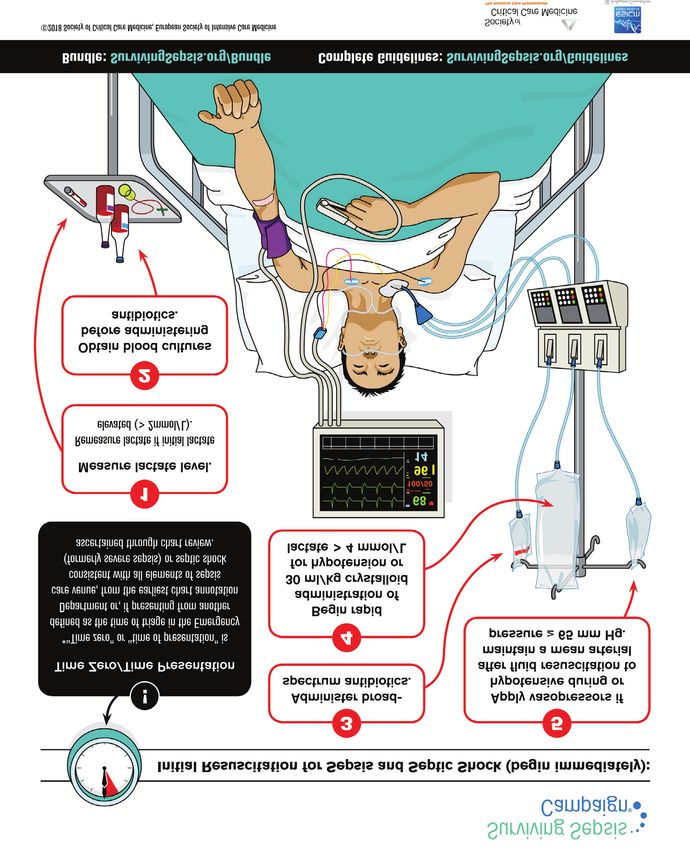
Bundle development
  The original sepsis bundles were developed by the Surviving Sepsis Campaign (SSC) in collaboration with the Institute for
  Healthcare Improvement. The goal was to make the International Guidelines for the Management of Severe Sepsis and Septic
  Shock easier to execute at the bedside.

                  2004                                       2012                                        2014
   The initial sepsis bundles incorporat-     Evidence cited in the 2012 SSC guide-       Revisions in 2014 were prompted by
   ed a two-phased approach using the         lines supported removal of the 24-          results of three large randomized con-
   6-hour resuscitation bundle and the        hour bundle, which resulted in the          trolled trials evaluating protocol-based
   24-hour management bundle, meas-           3- and 6-hour bundles measuring sev-        care in septic shock. Researchers con-
   uring 11 quality indicators.               en quality indicators. Both the original    cluded that routine use of central
                                              6- and 24-hour bundles and the re-          venous catheters (CVC) and hemo-
                                              vised 2012 sepsis bundles were wide-        dynamic monitoring aren’t required to
                                              ly adopted in hospitals around the          achieve adequate initial resuscitation
                                              world.                                      of septic shock, resulting in a revision
                                                                                          to the 6-hour bundle. CVCs are no
                                                                                          longer required, but are one of many
                                                                                          options to guide initial resuscitation.

                                                                                           port the 30 mL/kg fluid dose, sever-
  Follow the evidence                                                                      al interventional and observational
  Substantial international evidence has demonstrated that implementing the                studies provide support. Evaluate
  Surviving Sepsis Campaign (SSC) sepsis bundles is associated with improved               and assess fluid responsiveness be-
  outcomes. In a single-center U.S. study, investigators described a severe sepsis         fore administering additional fluid
  and septic shock mortality reduction to less than 10% with improved bundle               beyond the 30 mL/kg dose.
  compliance.
     Similar results were observed in other countries, including Spain and the             5. Apply vasopressors if the patient is
  United Kingdom. Results of the sepsis bundle implementation over 7.5 years                  hypotensive during or after fluid
  found that participation in the quality improvement program was associated                  resuscitation to maintain mean ar-
  with decreased mortality and reduced hospital costs. Hospitals with higher bun-
                                                                                              terial pressure (MAP) ≥ 65 mm Hg.
  dle compliance showed reductions in intensive care unit and hospital length of
  stay. Developing countries, including India, Brazil, and China, reported the same.
                                                                                              Rationale: Restoring perfusion
     Evidence for the clinical benefit of the bundles increased public awareness           pressure to vital organs is essential.
  and raised national interest. The 3- and 6-hour bundles were adopted by the              Vasopressor administration in a hy-
  National Quality Forum in 2012 and the New York State Department of Health in            potensive patient is graded as a
  2014. In 2015, the Centers for Medicare & Medicaid Services mandated hospital            strong recommendation with mod-
  reporting of the early management of sepsis and septic shock (Core Measure               erate-quality evidence.
  SEP-1), which closely follows the 3- and 6-hour SSC bundles.
                                                                                           Nursing implications
                                                                                           Nurses are instrumental to improv-
the benefit or harm is certain but the       quired; discontinue antimicrobials if         ing outcomes for patients with sep-
evidence is difficult to summarize.          no infection exists.                          sis or septic shock. They can pro-
                                                                                           vide early recognition of signs and
3. Administer broad-spectrum anti-           4. Begin rapid administration of 30           symptoms, implement treatment,
   biotics.                                     mL/kg crystalloid fluids for hy-           help remove barriers to care, and
   Rationale: Adherence to early an-            potension or lactate ≥ 4 mmol/L.           promote education.
tibiotics and antibiotic stewardship            Rationale: Sepsis patients with
are important to provide high-quali-         tissue hypoperfusion or septic                Recognizing signs and
ty care. Administering broad-spec-           shock require early fluid resuscita-          symptoms
trum antibiotics with one or more            tion. Administration of 30 mL/kg of           As nurses interact with patients in a
I.V. antimicrobials is a strong rec-         crystalloid for hypotension or lac-           wide variety of settings—emergency
ommendation with moderate quali-             tate ≥ 4 mmol/L is graded as a                departments, intensive care units,
ty of evidence. Administer narrow-           strong recommendation with low                medical/surgical units, skilled nurs-
spectrum antimicrobial therapy after         quality of evidence. Despite the              ing facilities, the community, homes,
the pathogen and sensitivity are ac-         lack of controlled studies to sup-            and medical offices—they’re likely

AmericanNurseToday.com                                                               September 2018    American Nurse Today          17
SSC hour-1 bundle The goal of the Surviving Sepsis Campaign (SSC) hour-1 bundle is to begin resuscitation and management immediately. Reproduced from survivingsepsis.org. Copyright ©2018 Society of Critical Care Medicine and the European Society of Intensive Care Medicine. 18 American Nurse Today Volume 13, Number 9 AmericanNurseToday.com
Educational resources                                                                  Educational resources and tools are
  Use these resources to promote education about the Surviving Sepsis Campaign           available at survivingsepsis.org. (See
  (SSC) hour-1 bundle.                                                                   Educational resources.)
  Intensive Care Medicine: The Surviving Sepsis Campaign Bundle:
  2018 Update                                                                            Quality, timely treatment
                                                                                         Sepsis bundles are designed for
  This video provides an overview of the new hour-1 bundle.
      youtube.com/watch?v=y8b20TMA-7Q
                                                                                         bedside application of key ele-
                                                                                         ments of the SSC guidelines and
  SSC Hour-1 Bundle infographic                                                          promote the importance of appro-
  Download this infographic to share with colleagues and your organization’s             priate and timely treatment. The
  leadership.                                                                            2018 hour-1 bundle update focus-
      survivingsepsis.org/SiteCollectionDocuments/Surviving%20-Sepsis-Hour-              es on five elements within a single
      1-Bundle-Infograph.pdf                                                             sepsis bundle. Nurses are instru-
  SSC hour-1 bundle pocket card                                                          mental in early sepsis identifica-
  Download and print this pocket card to keep with you as a reminder of the five         tion and patient management. Ad-
  elements of the new hour-1 bundle.                                                     hering to their role in providing
     survivingsepsis.org/SiteCollectionDocuments/Surviving-Sepsis-Campaign-              quality timely treatment will result
     Hour-1-Bundle-2018-Print-Card.pdf                                                   in better patient outcomes.

                                                                                         Visit americannursetoday.com/?p=50812 for a
                                                                                         complete list of selected references.
to encounter patients with signs and
symptoms of sepsis. Prompt recogni-
tion is an important step in sepsis
                                                     Nurses are                          Christa Schorr is an associate professor of medicine at
                                                                                         Cooper Medical School of Rowan University and a
management, and some organiza-
tions have shown that specialty
                                                instrumental to                          clinical nurse scientist—critical care at Cooper Uni-
                                                                                         versity Hospital in Camden, New Jersey.
trained sepsis rapid response teams
lead to improved patient outcomes.           improving outcomes                          Selected references
                                                                                         De Backer D, Dorman T. Surviving sepsis
Implementing treatment                           for patients with                       guidelines: A continuous move toward better
                                                                                         care of patients with sepsis. JAMA. 2017;
After confirming a sepsis diagnosis                                                      317(8):807-8.
with the provider, the nurse should                     sepsis or                        Ju T, Al-Mashat M, Rivas L, Sarani B. Sepsis
collaborate with others to initiate                                                      rapid response teams. Crit Care Clin. 2018;
guideline-recommended treatment.                    septic shock.                        34(2);253-8.
Sepsis bundle interventions are im-                                                      Kleinpell R. Promoting early identification of
plemented in the form of an order-         Removing barriers                             sepsis in hospitalized patients with nurse-led
set, protocol, pathway, or care plan.      In addition to delayed recognition of         protocols. Crit Care. 2017;21(1):10.
Screening and monitoring patients          sepsis, barriers to sepsis bundle im-         Levy MM, Rhodes A, Phillips GS, et al. Sur-
with sepsis may differ from hospital       plementation include lack of knowl-           viving Sepsis Campaign: Association be-
                                                                                         tween performance metrics and outcomes in
to hospital and even from unit to          edge, resources, staff, and informat-
                                                                                         a 7.5-year study. Intensive Care Med. 2014;
unit because of the nature of the          ics support. The organizations most           40(11):1623-33.
patient population. Follow your or-        successful at managing sepsis are
                                                                                         Levy MM, Evans LE, Rhodes A. The Surviv-
ganization’s protocol, and review          those with senior leadership back-            ing Sepsis Campaign bundle: 2018 update.
protocols and care plans to see if         ing, physician and nursing staff en-          Crit Care Med. 2018;46(6):997-1000.
updates based on the new hour-1            gagement, and informatics support.            Mukherjee V, Evans L. Implementation of the
bundle are indicated.                                                                    Surviving Sepsis Campaign guidelines. Curr
   Several studies have demonstrat-        Promoting education                           Opin Crit Care. 2017;23(5):412-6.
ed that nurse-driven protocols are         A sepsis education program that in-           Rhodes A, Evans LE, Alhazzani W, et al. Surviv-
effective in improving adherence           cludes guidance for sepsis screening,         ing Sepsis Campaign: International guidelines
to SSC guideline recommendations;          a process to communicate findings,            for management of sepsis and septic shock:
                                                                                         2016. Crit Care Med. 2017;45(3):486-552.
implement protocols that align with        and knowledge of the hour-1 bundle
your state’s practice acts. Whether        components will keep nurses up-to-            Schorr C, Odden A, Evans L, et al. Imple-
                                                                                         mentation of a multicenter performance im-
you work in the acute or post-acute        date. Staff should know what to do            provement program for early detection and
care setting, it’s essential to be aware   and why; understanding why pro-               treatment of severe sepsis in general med-
of the hour-1 bundle elements and          vides motivation for timely appropri-         ical-surgical wards. J Hosp Med. 2016;11(sup-
to promote prompt implementation.          ate treatment to patients with sepsis.        pl 1):S32-9.

AmericanNurseToday.com                                                             September 2018        American Nurse Today                19
You can also read


