SUSTAINABLE PROCESS INDUSTRY (SPIRE) CPPP OPPORTUNITIES FOR 2018-2020 - JAROSLAW PIEKARSKI NATIONAL CONTACT POINT IN POLAND - EAP PLUS
←
→
Page content transcription
If your browser does not render page correctly, please read the page content below
Sustainable Process Industry (SPIRE) cPPP
                      opportunities for 2018-2020
                             Jaroslaw PIEKARSKI
                       National Contact Point in Poland
                               EaP Plus Webinar,
Organisation                   23 November 2017
    logo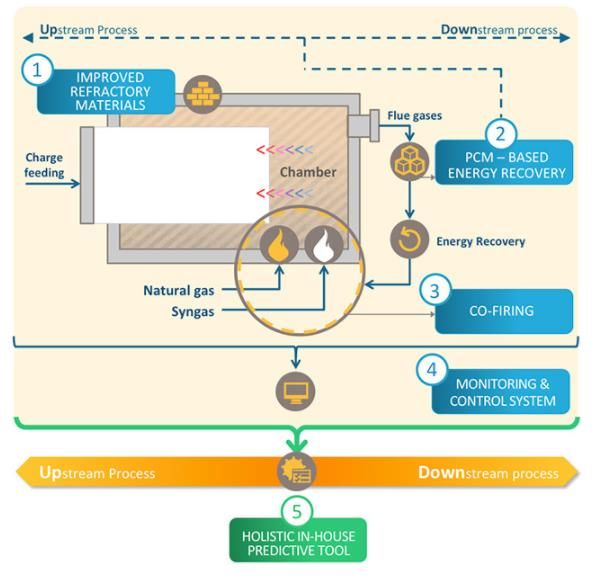
Sustainable Process Industry in HORIZON 2020

                               Societal           Industrial
        Excellent              Challenges        Leadership
         Science
                                   Environment          NMBP
                                      Energy     Manufacturing
Societal          Industrial
Challenges       Leadership

     Indicative budget:
                                                                 Indicative budget:
         75 billion €
                                                                      900 M€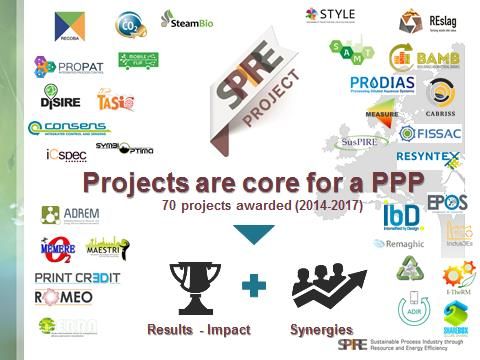
SPIRE in Horizon 2020 Workprogramme 2018-20

                      3.1. SUSTAINABLE PROCESS INDUSTRY (SPIRE)
                      ……
                         In line with the strategy for EU international
                      cooperation in research and innovation
                      (COM(2012)497), international cooperation may be
                      particularly appropriate in some areas of the
                      Sustainable Process Industry, in particular with
                      Eastern Partnership countries (Ukraine, Moldova,
                      Georgia, Armenia, Azerbaijan and Belarus).
Sustainable Process Industry
SPIRE is a contractual Public-Private Partnership
    dedicated to innovation in resource and energy efficiency
    enabled by the process industries.
EU budget:     900M€ for H2020 (2014 – 2020)

Key targets:   30% less energy consumption;
               20% fewer raw materials;
               40% CO2 equiv. footprint reduction
• Creating knowledge, skills and high-tech jobs;
• Increased use of renewable feedstocks;
• Efficient sorting, separation and recovery technologies.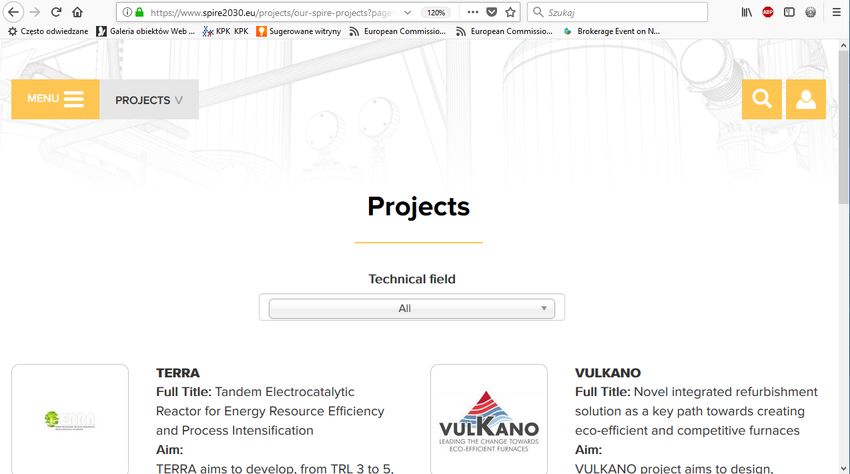
Sustainable Process Industry
Implementation:
                                                                      www.spire2030.eu
   Based on European Commission and stakeholders agreement
       representing eight sectors of the process industry: chemicals, cement,
       ceramics, minerals, steel, non-ferrous metals, industrial water and
       process engineering.

   The technological objectives are guided by a 2014-2020 multi-annual
       roadmap developed by the research and industrial stakeholders
        and validated in a Europe-wide open consultation process.

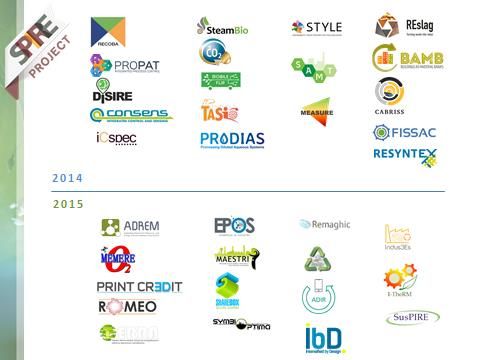
   Calls are implemented according to normal HORIZON 2020 procedure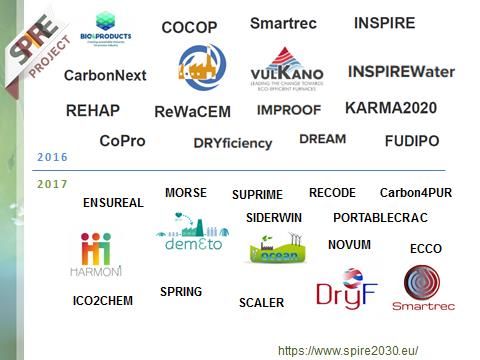
Resource Efficiency in the whole production process

   Input
                                 Process
                                                                         CO2
                                                                       Output
  ENERGY

                                                                      PRODUCTS
RAW MATERIAL
                                                                      By-products
  Solvents,
                                                                       Residues
 Catalysts &
 Auxiliaries                                                        WASTE WATER
   WATER
                                                                     Landfill Waste
 PACKAGING
                                Recycling                               Gaseous
                                                                       Emissions

                                             Source: A. Górak, TU Dortmund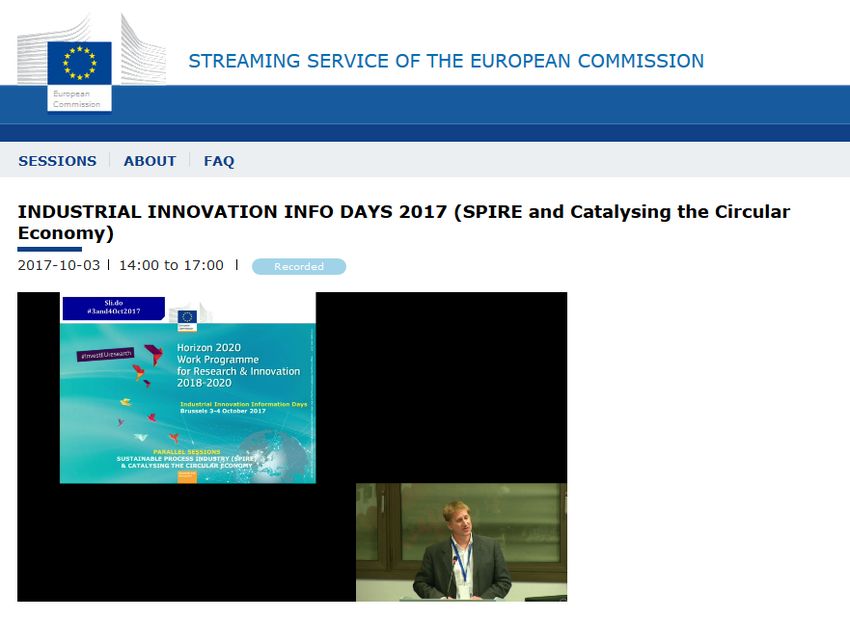
TARGETS OF SPIRE PPP – COMPARISON TO THE CURRENT STATUS (2016)

                                                                           OBJECTIVE        ON-GOING
         OBJECTIVES: innovative systems and technologies
                                                                             2020           (by 2016)
TOTAL                                                                           40            45 + 128
Adaptable processes able to use different feedstock                              7                 6
Reduction and re-use of waste with ambition to close the loop                    6                 9
Innovative processes leading to CO2 reduction                                    9                 8
Green technologies to develop novel materials for new and existing
                                                                                 8                10
markets
Industrial processes reducing water use                                          6                 8
Technology uptake within/between sectors to enable industrial
                                                                                 4                 4
symbiosis
Other exploitable technologies, processes and methods (systems,
                                                                               Not
tools, modules, algorithms, etc.) that are complementary to one or                               128
                                                                            foreseen
several of the above mentioned
                                                         SOURCE: PROGRESS MONITORING REPORT FOR 2016, SPIRE CPPP
SPIRE Projects – EC Contribution
EC contribution 2014-17: 447 M€
Av. EC contrib / project: 6,4 M€
Av. EC contrib / partner: 0,43 M€
Av. success rate: 16%SPIRE Projects – Type of organisations
SPIRE Projects – Top 10 organisations
                Organisation                        Country       EC contrib. [M€]
VTT          Etykiety wierszy                            FI
                                         Suma z Dofinansowanie KE       10,7
FRAUNHOFERuczestnika                                     DE              9,6
             VTT       FI      10,7
TECNALIA     FRAUNHOFER        DE        9,6             ES              8,6
SINTEF       TECNALIA ES       8,6                       NO              7,0
CEA          SINTEF NO         7,0                       FR              6,6
             CEA       FR      6,6
UNIVERSITEIT UNIVERSITEIT
              GENT         GENT          BE       5,3    BE              5,3
SWEREA MEFOS     AB MEFOS AB SE
             SWEREA                      4,8             SE              4,8
ARCELORMITTALARCELORMITTAL    MAIZIERES SA
                 MAIZIERES RESEARCH     RESEARCH SA      FRFR     4,2    4,2
             VDEH-BETRIEBSFORSCHUNGSINSTITUT GMBH DE              4,1
VDEH-BETRIEBSFORSCHUNGSINSTITUT
             IRIS      ES      4,0      GMBH             DE              4,1
IRIS                                                     ES              4,0
Name / Institution
SPIRE Projects – PL Participation
H2020-SPIRE-2014 H2020-CIRC-2016TwoStage
DISIRE (KGHM, KGHM Cuprum, WrUT) ZERO BRINE (SUT)
iCspec (Airoptic, WrUT)
RECOBA (MINKON SP ZOO) H2020-SPIRE-2016
KARMA2020 (IBChW)
VULKANO (IEn)
H2020-SPIRE-2015
ADIR (IMN)
EPOS (CEMEX Polska)
H2020-SPIRE-2017
MAESTRI (IZNAB, LEAN Enterprise) CO2EXIDE (AGH)
ENSUREAL (LUVENA, ODLEWNIE POLSKIE)
NOVUM (ABB sp. z o.o, AGH, RMA sp z o.o.)
process control, energy and resource management systems, industrial symbiosis,
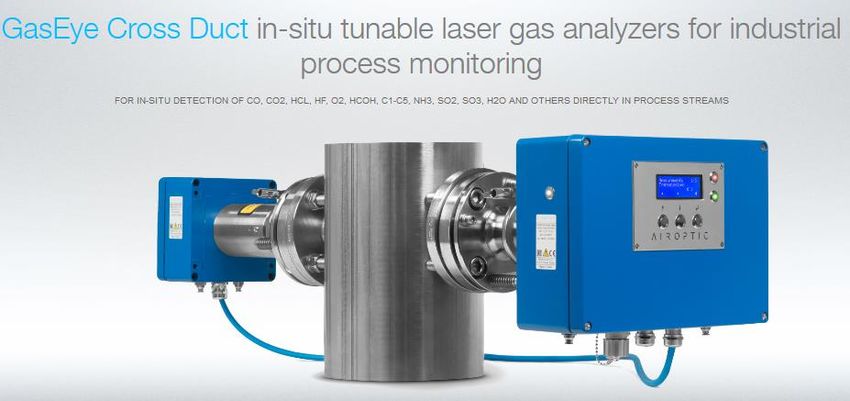
recovery technologies, valorization of bio-resources, industrial furnacesin-line Cascade laser spectrometer for process control
Call ID: H2020-SPIRE-2014 Objective:
EU contribution: EUR 5 587 932 to develop gas analyzers for fast in-line
Coordinator: SIEMENS (DE) multi-component monitoring of gas
compositions in a process stream and to
replace currently employed analyzers …Novel integrated refurbishment solution as a key path towards
creating eco-efficient and competitive furnaces
Call ID: H2020-SPIRE-2016 Objective:
EU contribution: 6 940 813,75 the retrofitting of two types of industrial
Coordinator: CIRCE Foundation (ES) furnaces, namely preheating and melting,
applied on three energy–intensive sectors
(steel, ceramic and aluminium) ….SPIRE 2018 calls
CE-SPIRE-02-2018: Processing of material feedstock using non-conventional energy
sources (IA)
CE-SPIRE-03-2018: Energy and resource flexibility in highly energy intensive
industries (IA 50%)
CE-SPIRE-10-2018: Efficient recycling processes for plastic containing materials (IA)
Deadline: 22 February 2018
Budget: EUR 97,500,000SPIRE 2019 calls
CE-SPIRE-04-2019: Efficient integrated downstream processes (IA)
CE-SPIRE-05-2019: Adaptation to variable feedstock through retrofitting (IA 50%)
DT-SPIRE-06-2019: Digital technologies for improved performance in cognitive
production plants (IA)
Deadline: 22 February 2018
Budget: EUR 97 700,000ENERGY and ENVRONMENT topics
CE-SC3-NZE-2-2018: Conversion of captured CO2
LC-SC3-RES-7-2019: Solar Energy in Industrial Processes
LC-SC3-EE-6-2018-2019-2020: Business case for industrial waste heat/cold recovery
CE-SC5-01-2018: Methods to remove hazardous substances and contaminants from
secondary raw materials
CE-SC5-04-2019: Building a water-smart economy and societyCE-SPIRE-02-2018: Processing of material feedstock using non- TRL 4-6
conventional energy sources (IA) 6-10 M€
Deadline
Specific Challenge: (…) The processes powered by non-conventional energy sources 27.02.2018
are suitable for connection to the electricity grid. (…)
[Non-conventional] technologies are suitable for downscaling and continuous processing.
Scope: (…) develop technologies applying non-conventional energy sources to processes of high
industrial interest. (…) Show potential for integration in a renewable electricity grid (…)
advantages in terms of resource and energy efficiency (…) applicable to continuous
processes (…)
Impact: Allowing for a -30% to +30% energy input (…) improvement in energy efficiency of
30%;(…) resource efficiency of 30%; (…) decrease in CO2 emissions by 40% (…)
Decreased OPEX and CAPEX by 15%; (…) Effective dissemination (…)CE-SPIRE-03-2018: Energy and resource flexibility TRL 5-7
in highly energy intensive industries (IA 50%) 8-12M€
Deadline
Specific Challenge: Energy intensive industries should adapt (…) to increasingly 22.02.2018
sustainable, but highly fluctuating energy supply. The challenge is to establish
synergistic integration at a regional level among different production sectors (…)
Scope: Solutions (…) for value chain optimisation through energy [and raw materials] efficiency
(…) of manufacturing equipment and processes, collective demand side strategies, and
potential integration of the nearby renewable energy sources.
Impact: Cost reduction of the process of at least 10% through the implementation of a flexible
scheme in raw materials
(…) Improved process efficiency (…) by at least 15%;
(…) CO2 emissions reduction by at least 5%,
and reduction of the environmental impact (…) by at least 15%;CE-SPIRE-10-2018: Efficient recycling processes for plastic TRL 5-7
containing materials (IA) 6-8 M€
Specific Challenge: (…) The wide use of [Plastic materials] results in a huge amount Deadline
of plastic waste. (…) Recycling and redesign of plastics are essential in reusing 22.02.2018
plastic waste material (…) A better use of [plastic waste] support the circular economy.
Scope: (…) cover processes for the production of recyclable materials containing plastics.
(…) Improved energy and resource efficiency [LCA, LCC]
(…) value chains (…) ensuring the secure supply of the raw materials
(…) Process flexibility and ability to utilise waste heterogeneous plastic materials
(…) Non-technological hurdles (…) to enable the prompt deployment in industry
Impact: (…) efficient and sustainable (…) process (…) utilising plastic waste … (excluding fuels);
(…) decreased utilisation of primary fossil resources (…) of at least 30%;
(…) decrease in CO2 emissions of at least 20%;
(…) utilise at least 70% of waste material including at least 40% of plastic waste;CE-SC5-01-2018: Methods to remove hazardous substances TRL 5-6
and contaminants from secondary raw materials (RIA) 3-5M€
Deadline
Specific Challenge: (…) The uptake and recyclability of secondary raw materials 27.02.2018
can be hampered by the presence of undesirable contaminants (…)
Scope: (…) develop innovative solutions for removing undesirable substances ; (…)the safe
utilisation or disposal of substances thus removed ; (…) provide evidence of the potential
market impact ; (…) recommendations on the design and manufacturing of materials for
recyclability and for standardisation
Impact: (…) increased purity and/or desirable quality of secondary raw materials;
(…) increased recycling rate for (…) secondary raw materials;
(…) reduced risk of retaining hazardous substances … ;
(…) relevance to EU circular economy strategiesTRL 3-6
CE-SC3-NZE-2-2018: Conversion of captured CO2 (RIA) 3-4M€
Deadline
Specific Challenge: (…) Conversion of captured CO2 (…) to produce fuels is not only 06.09.2018
a means to replace fossil fuels, but also a promising solution for seasonal
energy storage (…); CO2 (…) conversion process is highly energy intensive
Scope: (…) develop of energy-efficient and (…) viable CO2 conversion technologies for chemical
energy storage or displacement of fossil fuels (…)
define ambitious but achievable targets for energy requirements of the conversion process (…)
Impact: (…) New solutions for the conversion of captured CO2 (…) to useful products ;
(…) diversify the economic base in carbon-intensive regions,
(…) contribute to achieving a Circular Economy
International cooperation: ChinaLC-SC3-EE-6-2018-2019-2020: Business case for industrial waste TRL 4-8
heat/cold recovery 3-4M€
(2018) Cost-benefit models for industrial waste heat/cold recovery
Deadline
Specific Challenge: (…) significant parts of the input-energy are still lost in the form 06.09.2018
of waste heat/cold (…)streams.
Wide-scale deployment of industrial waste heat/cold recovery is hindered (…) by the lack of
financial/ economic justification (…) and (…)by the limited industrial applicability
Scope: (…) integrated cost-benefit simulation tools that, (…) , can determine the best utilisation
options of recovered waste heat/cold and/ or surplus renewable energy from industrial and
eventual other sources (…).
Impact: (…) Accurate prediction and holistic modelling of industrial waste heat/cold and/or surplus
renewable energy (…)
(…)Better impact of the various factors/ variables on the cost-benefits of industrial waste
International cooperation: China
heat/cold and/or surplus renewable energy (…)
(..)Valorisation in assessments of cost-benefit of industrial waste heat/cold and/or surplus
renewable energy (…)Open Innovation Days Brussels, 3-5 Oct. 2017 https://webcast.ec.europa.eu/industrial-innovation-info-days-2017-spire-and-catalysing-the-circular-economy-day1-0a
SPIRE 2018 calls – GET SUPPOT

           http://ec.europa.eu/research/participants/portal

           https://www.spire2030.eu/

                   https://www.NMPTEAM.eu/
SPIRE 2018 calls – GET SUPPOT
Thank you for your attention!
Jarosław PIEKARSKI
NCP in POLAND
E-mail: jaroslaw.piekarski@kpk.gov.pl
You can also read


