Swellendam Municipality 2017 - Western Cape Government
←
→
Page content transcription
If your browser does not render page correctly, please read the page content below
Swellendam Municipality
2017
SWELLENDAM: AT A GLANCE

1.   DEMOGRAPHICS                  1

2.   EDUCATION                     3

3.   HEALTH                        7

4.   POVERTY                      12

5.   BASIC SERVICE DELIVERY       15

6.   SAFETY AND SECURITY          19

7.   THE ECONOMY                  24

8.   INFRASTRUCTURE DEVELOPMENT   28

SOURCES                           33
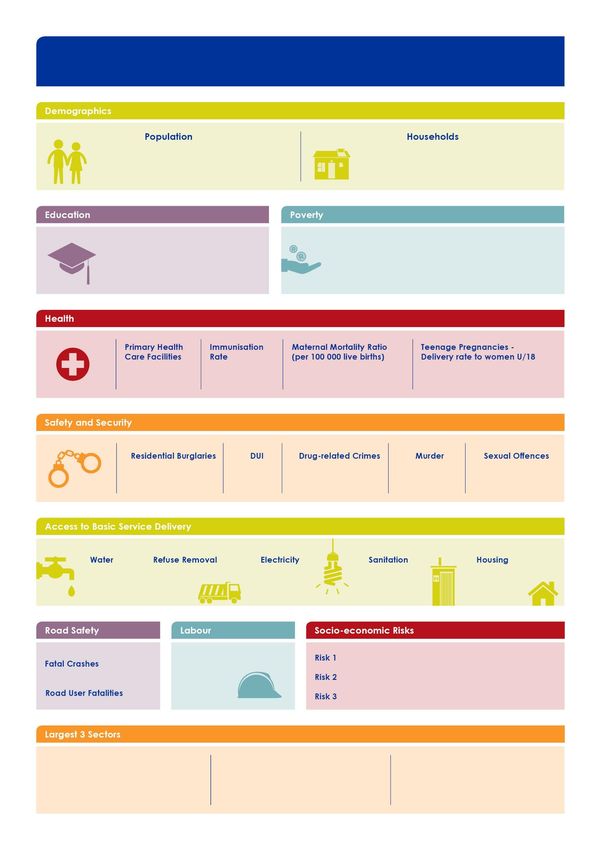
Swellendam: At a Glance
                                                                          Population Estimates, 2018; Actual households, 2016

                                                                          Population Estimates, 2018; Actual households, 2016

             38 700                                                                    11 678
                                            2016                                                                         2016

                                            2016                                                                         2016

             Matric Pass Rate          92.7%                        Gini Coefficient                                0.57
          Learner-Teacher Ratio         33.5                        Human Development Index                         0.69
           Gr 12 Drop-out Rate         37.2%                                                                             2016

                                                                                                                         2016

                                        Percentage change between 2016 and 2017 in number of reported cases per 100 000

                     5                 65.5%                          0.0                           12.5%

                                        Percentage change between 2016 and 2017 in number of reported cases per 100 000

                                                                Percentage of households with access to basic services, 2016

                        2.1%              -6.5%                 20.5%                   1.3%                 -4.0%

                                                                Percentage of households with access to basic services, 2016

                 2016                               2016

      97.2%             86.5%                       97.6%                       96.9%                    96.0%

                 2016                               2016

                                                                         Drought
                13              Unemployment Rate
                                                                                                     Contribution
                                                                        Financial Sustainability (Grant           to GDP, 2015
                                                                                                        dependency)

                15              8.9%                                     Stagnating Economic Growth

                                                                                                    Contribution to GDP, 2015

 Wholesale and retail trade,                                                               Finance, insurance, real estate
                                            Agriculture, forestry and fishing
catering and accommodation                                                                     and business services

      22.9%                                         19.5%                                       16.3%
1
                            DEMOGRAPHICS

    This first chapter of the SEP focusses on the people living in Swellendam itself. A demographic
    perspective on a municipality allows to observe not only simple changes in population growth,
    but also to look at other various developments that influence the social life of every citizen.
    Demographics allow to emphasise aspects of society like, e.g. gender, race, migration or life
    expectancy. Decisions made by politicians as well as by the administration affect in almost
    every case at least one aspect of Demographics. Therefore, a good understanding of this area
    is crucial for the government’s work.

    The overview of key demographic factors given in this chapter comprises of the estimates of
    population size, the distribution of population within age cohorts and furthermore the
    dependency ratio, which is of high importance for understanding economic activity in the
    area as well as for planning welfare systems. With this short, but informative overview, the SEP
    tries to help the municipalities in their budgeting process by delivering precise data as a solid
    foundation for future decisions.

    Data source: Department of Social Development, 2017

1   2017 Socio-economic Profile: Swellendam Municipality
POPULATION
     140 000

     120 000

     100 000

      80 000

      60 000

      40 000

      20 000

             0
                  Cape Agulhas           Overstrand           Swellendam          Theewaterskloof
         2018         35 331               91 190                38 700               119 052
         2019         35 637               92 624                39 078               120 413
         2020         35 934               94 028                39 449               121 739
         2021         36 223               95 401                39 813               123 029
         2022         36 503               96 746                40 168               124 284
         2023         36 773               98 065                40 518               125 505

    In 2018, Swellendam will have an estimated population of 38 700, after five years this
    population is estimated to be 40 518. This equates an estimated growing rate in this time span
    of 4.6 per cent. The estimated population growth rate of Swellendam is therefore
    0.9 percentage points lower than the estimated population growth of its Overberg District
    which is 5.6 per cent.

    AGE COHORTS
                    Children:              Working Age:               Aged:           Dependency
      Year
                   0 – 14 Years            15 – 65 Years               65 +              Ratio
      2011            9 393                    23 908                     2 617            50.2

      2018            9 393                    25 974                     3 333            49.0

      2023            9 354                    27 192                     3 972            49.0

    The above table depicts the population composition regarding age cohorts. The total
    population is broken down into three different groups: Age 0 - 14: children; Age 15 - 65: working
    age population; Age 65+: seniors. A comparison with the basis year 2011 and the estimated
    numbers for 2023 show a growth in the percentage in the aged population, a decline in the
    percentage of children despite a slight growth in total numbers, and a steady percentage in
    the working age population.

    This is an important factor in the calculation of the dependency ratio. In Swellendam, this ratio
    was 50.2 in 2011 and will slightly decrease to an estimated 49.0 in 2023. This ratio expresses the
    dependency of people who are part of the workforce (age 15 - 65) and those, who are
    depending on them (children and seniors). A higher dependency ratio means a higher
    pressure on social systems and the delivery of basic services.

2   2017 Socio-economic Profile: Swellendam Municipality
2
                                   EDUCATION

    Education and training improves access to employment opportunities and helps to sustain and
    accelerate overall development. It expands the range of options available from which a
    person can choose to create opportunities for a fulfilling life. Through indirect positive effects
    on health and life expectancy, the level of education of a population also influences its
    welfare.

    Data source: Western Cape Education Department, 2017

3   2017 Socio-economic Profile: Swellendam Municipality
LEARNER ENROLMENT
       20 000

       18 000

       16 000

       14 000

       12 000

       10 000

        8 000

        6 000

        4 000

        2 000

           0
                   Overstrand             Swellendam          Theewaterskloof       Cape Agulhas
         2014        11 118                  5 652                18 245                4 527
         2015        11 436                  5 685                18 815                4 565
         2016        11 696                  5 724                18 815                4 606

    Learner enrolment in Swellendam increased at a growth rate of 1.27 per cent between 2014
    and 2016 from 5 652 to 5 724.

    LEARNER-TEACHER RATIO
                              The learner–teacher ratio in Swellendam increased from 29.3 in 2014 to
                              34.7 in 2015 but decreased to 33.5 in 2016, which could in future affect
                              learner performance within the Swellendam municipal area. Factors
                              influencing the learner-teacher ratio is the ability of schools to employ
                              more educators when needed and the ability to collect fees.

    GRADE 12 DROP-OUT RATES
    A total of 37.2 per cent of students that enrolled in Grade 10 in 2014 dropped out of school by
    the time they reached Grade 12 in 2016. This figure is alarmingly higher than the 22.3 per cent
    recorded for 2015. These high levels of drop-outs are influenced by a wide array of economic
    factors including unemployment, poverty, indigent households, high levels of households with
    no income or rely on less than R515 a month and teenage pregnancies.

4   2017 Socio-economic Profile: Swellendam Municipality
EDUCATIONAL FACILITIES
    The availability of adequate education facilities such as schools, FET colleges and schools
    equipped with libraries and media centres could affect academic outcomes positively.

          20
          18
          16
          14
          12
          10
           8
           6
           4
           2
           0
                     Number of Schools with Libraries                          Total Number of Schools
         2014                       8                                                    19
         2015                      11                                                    19
         2016                      11                                                    19

    Swellendam had 19 schools in 2016. Given the tough economic climate, schools have been
    reporting an increase in parents being unable to pay their school fees. However, the
    proportion of no-fee schools deteriorated from 80.4 per cent in 2014 to 77.6 per cent in 2016,
    This could in future further increase the drop-out rate. The number of schools equipped with
    libraries increased from 8 to 11 between 2014 and 2016, which could in future affect the overall
    educational outcome within the Swellendam municipal area.

     100,0%
      90,0%
      80,0%
      70,0%
      60,0%
      50,0%
      40,0%
      30,0%
      20,0%
      10,0%
       0,0%
                                                Proportion of no-fee schools
        2014                                               79,0%
        2015                                               79,0%
        2016                                               84,2%

    The proportion of no-fee schools within Swellendam municipal area remained unchanged at
    79.0 per cent between 2014 and 2015. However, in 2016 they increased to 84.2 per cent. This
    increase could mean better accessibility of education.

5   2017 Socio-economic Profile: Swellendam Municipality
EDUCATION OUTCOMES
                               Education remains one of the key avenues through which the state
                               is involved in the economy. In preparing individuals for future
                               engagements in the broader market, policy decisions and choices in
                               the sphere of education play a critical role in determining the extent
                               to which future economy and poverty reduction plans can be
                               realised. This section measures the matric pass rate within the
                               Swellendam municipal area.

     100,00%
      98,00%
      96,00%
      94,00%
      92,00%
      90,00%
      88,00%
      86,00%
      84,00%
      82,00%
      80,00%
                  Overstrand             Swellendam          Theewaterskloof       Cape Agulhas
         2014       86,40%                 88,20%                88,80%               87,80%
         2015       88,20%                 94,90%                88,00%               94,00%
         2016       90,90%                 92,70%                92,40%               97,30%

    Swellendam matric pass rate increased since 2014, with a peak of 94.9 per cent in 2015.
    However, in 2016 the matric pass was declined to 92.7 per cent.

6   2017 Socio-economic Profile: Swellendam Municipality
3
                                          HEALTH

    Health is another major factor contributing to the general quality of life in Swellendam. It is,
    therefore important to monitor the public health facilities as well as a variety of factors such as
    diseases like HIV or TB and general topics that affect the community, like maternal health. This
    Socio-economic Profile provides the basic statistics concerning those issues. Since this profile
    focusses on the public health facilities, private facilities do not appear in it.

    Data source: Department of Health, 2017

7   2017 Socio-economic Profile: Swellendam Municipality
HEALTHCARE FACILITIES
All citizens’ right to access to healthcare services are directly affected by the number and
spread of facilities within their geographical reach. South Africa’s healthcare system is geared
in such a way that people have to move from primary, with a referral system, to secondary
and tertiary levels.
10
9
8
7
6
5
4
3
2
1
0
Number of PHC Total number of
Number of ART Number of TB
Number of Clinic - non-fixed Number of PHC PHC facilities
clinics/ clinics/
district hospitals (mobiles/satelite Clinics - Fixed (Fixed Clinics,
treatment sites treatment sites
) CHCs and CDCs)
2014 5 1 3 5 9 5
2015 6 1 3 5 9 5
2016 6 1 3 5 9 5
In 2016, Swellendam had a total of 5 primary healthcare facilities, all of which were fixed clinics.
In addition to 3 non-fixed mobile clinics, there are also 6 ART clinics as well as 9 TB clinics. Whilst
there is no regional hospital in the area, there is 1 district hospital. The municipal area had no
community day/health centres.
EMERGENCY MEDICAL SERVICES
Access to emergency medical services is critical for rural citizens
due to rural distances between towns and health facilities being
much greater than in the urban areas. Combined with the
relatively lower population per square kilometre in rural areas,
ambulance coverage is greater in rural areas in order to
maintain adequate coverage for rural communities.
A bigger number of operational ambulances can provide a
greater coverage of emergency medical services. Swellendam
with 0.5 ambulances per 10 000 inhabitants in 2016, is almost on
par with 0.6 ambulances per 10 000 of Overberg District.
8 2017 Socio-economic Profile: Swellendam MunicipalityHIV/AIDS
HIV/AIDS management is crucial given its implications for
the labour force and the demand for healthcare services.
Registered patients Number of new ART
HIV Transmission Rate
receiving ART patients
Area
2014 2015 2016 2014 2015 2016 2014 2015 2016
Swellendam 619 737 856 146 162 177 0.0 2.8 0.0
Overberg District 7 233 8 703 10 397 1 451 1 983 1 767 1.3 0.6 0.0
Swellendam is seeing a steady rise in patients receiving antiretroviral treatment (ART) over the
past three years. Patients receiving antiretroviral treatment increased by 237 between 2014
and 2016. The 856 patients receiving antiretroviral treatment are treated in six clinics or
treatment sites. A total of 10 397 registered patients received antiretroviral treatment in
Overberg District in 2016. Swellendam at 856 patients represent 8.2 per cent of the patients
receiving ART in Overberg District.
The number of new antiretroviral patients increases to 177 in 2016 from 146 in 2015.
HIV transmission rate for the Swellendam was 2.8 in 2015, but in 2016 it decreased to zero.
TUBERCULOSIS
300
255 242 240
250
200
2014
150
2015
100 2016
50
0
Number of TB patients
In contrary to the rising numbers of HIV/AIDS cases, Swellendam experiences a decline in
tuberculosis (TB) cases. In 2016 the Municipality of Swellendam provides for 240 TB patients
compared to 255 in 2014.
9 2017 Socio-economic Profile: Swellendam MunicipalityCHILD HEALTH
Overberg
Health Indicator Swellendam
District
Immunisation 65.5% 71.5%
Malnutrition 0.3 1.6
Neonatal mortality rate 8.4 6.3
Low birth weight 15.6% 11.8%
The Department of Health strongly advises mothers to protect their children from infectious
diseases by getting them vaccinated from birth to when they are 12 years old. Vaccination is
free of charge at all health facilities. The Department also runs immunisation campaigns and
health workers are sent to nursery schools and crèches to immunise the children.
Immunisation rate in Swellendam has declined from 71.8 per cent in 2014 to 65.5 per cent in
2016.
Swellendam malnutrition rate decreased from 1.2 per cent in 2014 to 0.3 per cent in 2016.
Neonatal mortality rate (NMR) in Swellendam municipal area has shown an increase from
6.7 deaths per 1 000 live births in 2015 to 8.4 in 2016. A rise in the NMR may indicate
deterioration in new-born health outcomes, or it may indicate an improvement in the reporting
of neonatal deaths.
The indicator of Low birth weight has registered an improvement between since 2015. It was
17.5 per cent and has decreased to 15.6 per cent in 2016.
DEFINITIONS
Immunisation: The immunisation rate is calculated as the number of children immunised as
a percentage of the total number of children less than one year of age. Immunisation
protects both adults and children against preventable infectious diseases. Low immunisation
rates speak to the need for parents to understand the critical importance of immunisation,
as well as the need to encourage parents to have their young children immunised.
Malnutrition: Expressed as the number of malnourished children under five years per
100 000 people. Malnutrition (either under- or over-nutrition) refers to the condition whereby
an individual does not receive adequate amounts or receives excessive amounts of
nutrients.
Neonatal mortality rate: Measured as the number of neonates dying before reaching
28 days of age, per 1 000 live births in a given year. The first 28 days of life (neonatal period)
represent the most vulnerable time for a child’s survival. The Province’s target for 2019 is
6.0 per 1 000 live births.
Low birth weight: Percentage of all babies born in facility that weighed less than 2 500 g. Low
birth weight is associated with a range of both short- and long-term consequences.
10 2017 Socio-economic Profile: Swellendam MunicipalityMATERNAL HEALTH
Overberg
Health Indicator Swellendam
District
Maternal Mortality Ratio 0.0 0.1
Delivery Rate to Women
12.5% 7.8%
under 18 years
Termination of Pregnancy Rate 0.4% 0.5%
Maternal mortality rate: Very positively, the maternal mortality rate is zero for the last three
years in Swellendam.
Births to teenage mothers: A negative development can be observed in the delivery rate to
women under 18 years, which is increasing from 6.8 in 2015 to 12.5 in 2016.
Termination of pregnancy: The termination of pregnancy rate remains steady at 0.4 per cent.
DEFINITIONS
Maternal health refers to the health of women during pregnancy, childbirth and the
postpartum period.
Maternal mortality rate: Maternal deaths per 100 000 live births in health facilities. Maternal
death is death occurring during pregnancy, childbirth and the puerperium of a woman
while pregnant or within 42 days of termination of pregnancy, irrespective of the duration
and site of pregnancy and irrespective of the cause of death (obstetric and non-obstetric).
Births to teenage mothers: Percentage of babies born to mothers under the age of 18 years.
Teenage pregnancy is almost always unplanned; as a result when young parents are placed
in a position to care for their children, life can become particularly tough, especially if they
do not have family or social support.
Termination of pregnancy: The percentage of terminations as a proportion of the female
population aged 15 to 44 years. Government hospitals, designated private doctors and
gynaecologists, and non-profit providers offer safe and legal termination of pregnancy. To
have a free abortion, the request must be made at a primary healthcare clinic, where the
pregnancy will be confirmed, counselling provided, an appointment made, and a referral
letter be given to a facility where the procedure can be performed.
11 2017 Socio-economic Profile: Swellendam Municipality4
POVERTY
This section shows living conditions and economic circumstances of households in the
Swellendam municipal area based on most recent data including Statistics South Africa’s Non-
Financial Census of Municipalities 2016 and Quantec. Economic theory suggests that when
an economy prospers its households are expected to enjoy a good standard of living. On the
contrary, a declining economy tends to lower the standards of living of people. This section
uses indicators in terms of GDP per capita, income inequality, human development, as well as
indigent households and free basic services to show the current reality of households residing
in the Swellendam municipal area.
The deteriorating financial health of households and individuals under the weight of economic
pressures, specifically between 2011 and 2015, has resulted in an increase in the poverty levels,
according to the Poverty Trends in South Africa report released by Statistics South Africa in
2017. The report cites rising unemployment levels, low commodity prices, higher consumer
prices, lower investment levels, household dependency on credit, and policy uncertainty as
the key contributors to the economic decline in recent times. These recent findings indicate
that the country will have to reduce poverty at a faster rate than previously planned.
According to the report the categories of people vulnerable to poverty remained to be
African females, children 17 years and younger, people from rural areas, and those with no
education. Inflation-adjusted poverty lines show that food poverty increased from R219 in 2006
to R531 per person per month in 2017. The lower-bound poverty line has increased from R370
in 2006 to R758 per person per month in 2017 while the upper-bound poverty line has increased
from R575 in 2006 to R1 138 per person per month in 2017.
12 2017 Socio-economic Profile: Swellendam MunicipalityGDPR PER CAPITA
An increase in real GDPR per capita, i.e. GDPR per person, is experienced only if the real
economic growth rate exceeds the population growth rate. Even though real GDP per capita
reflects changes in the overall well-being of the population, not everyone within an economy
will earn the same amount of money as estimated by the real GDPR per capita indicator.
70 000
60 000
50 000
40 000
GDPR per capita
30 000
20 000
10 000
0
2005 2006 2007 2008 2009 2010 2011 2012 2013 2014 2015 2016
Swellendam 34 954 35 767 37 779 40 803 40 416 40 856 41 932 42 776 43 556 44 712 44 385 44 123
Overberg 39 150 39 785 41 944 44 659 43 947 44 316 45 074 45 471 45 915 46 673 46 027 45 517
Western Cape 54 363 56 550 59 251 60 656 58 845 59 197 60 423 61 095 61 648 61 935 61 794 61 199
The real GDPR per capita for Swellendam is below the average real GDPR per capita rates for
the Overberg district as well as the Western Cape. At 44 123 in 2016, Swellendam’s real GDPR
per capita is below that of the Overberg District as well as the Western Cape.
INCOME INEQUALITY
The National Development Plan has set a target of reducing income inequality in South Africa
from a Gini coefficient of 0.7 in 2010 to 0.6 by 2030. Income inequality has increased between
2010 and 2016 with the exception of 2011 and 2015, when it dropped below 0.56.
0,64
0,62
0,60
0,58
0,56
0,54
0,52
0,50
0,48
Theewaterskloof Overstrand Cape Agulhas Swellendam Overberg Western Cape
2010 2011 2012 2013 2014 2015 2016
Source: IHS Global Insight, 2017
Income inequality levels were marginally lower in Swellendam than in the Overberg District
and the Western Cape despite the steady increase of the Gini coefficient over the last years.
Swellendam’s Gini coefficient was in 2016 calculated to be 0.57.
13 2017 Socio-economic Profile: Swellendam MunicipalityHUMAN DEVELOPMENT
The United Nations uses the Human Development Index (HDI) 1 to assess the relative level of
socio-economic development in countries. Indicators that measure human development are
education, housing, access to basic services and health.
0,74
0,72
0,70
0,68
0,66
0,64
0,62
0,60
0,58
Swellendam Overberg WC
2010 2011 2012 2013 2014 2015 2016
There has been a general increase in the HDI in Swellendam, Overberg District and the whole
of the Western Cape between 2011 and 2016. Swellendam’s HDI was estimated to be 0.69 in
2016.
INDIGENT HOUSEHOLDS
The objective of the indigent policies of municipalities is to alleviate poverty in economically
disadvantaged communities.
Area 2014 2015 2016
Swellendam 1 702 1 746 1 902
Overberg District 16 045 18 053 20 058
Western Cape 404 413 505 585 516 321
Source: Stat SA, 2016; Non-financial Census of Municipalities, 2015
The Swellendam municipal area experienced an increase in the number of indigents between
2014 and 2015, implying an increased demand for support and higher burdens on municipal
financial resources. Also, the overall number of indigent households has increased in the
Overberg district as well as the Western Cape.
1 The HDI is a composite indicator reflecting education levels, health, and income. It is a measure of peoples' ability
to live a long and healthy life, to communicate, participate in the community and to have sufficient means to be
able to afford a decent living. The HDI is represented by a number between 0 and 1, where 1 indicates a high
level of human development and 0 represents no human development.
14 2017 Socio-economic Profile: Swellendam Municipality5
BASIC SERVICE DELIVERY
The Constitution of the Republic of South Africa states that every citizen has the right to access
to adequate housing and that the state must take reasonable legislative and other measures
within its available resources to achieve the progressive realisation of this right. Access to
housing also includes access to services such as potable water, basic sanitation, safe energy
sources and refuse removal services, to ensure that households enjoy a decent standard of
living.
This section reflects on housing and basic services access levels (Census 2011) and the
incremental progress municipalities have made hereto within the last 5 years (Community
Survey 2016).
15 2017 Socio-economic Profile: Swellendam MunicipalityHOUSEHOLDS
In order to ensure basic service delivery to all, municipal
budget allocations should be informed by credible and
accurate assumptions regarding the number of households
within a municipal area.
Access to formal housing and services in Swellendam is
measured against a total number of households of 10 139 in
2011 and 11 678 in 2016. The growth rate of Swellendam is
therefore lower than the districts rate.
Average
Average annual
Area 2011 2016 annual growth
increase
2011 - 2016
Swellendam 10 139 11 678 308 2.9%
Overberg District 77 196 91 835 2 928 3.5%
ACCESS TO HOUSING
SERVICE STANDARD DEFINITION: Households with access to a formal dwelling.
Average Average
Total
annual annual
Area 2011 2016 increase
increase growth
2011 - 2016
2011 - 2016 2011 - 2016
Swellendam 88.3% 96.0% 2 260 452 4.6%
Overberg District 81.9% 81.8% 11 853 2 371 3.5%
The number of formal dwellings in Swellendam increased by
2 260 between 2011 and 2016, at an average annual rate of
4.6 per cent, which translates into approximately
452 additional formal dwellings per year over this period. This
increase in formal dwellings results in the proportion of formal
households increasing from 88.3 per cent in 2011 to
96.0 per cent in 2016.
16 2017 Socio-economic Profile: Swellendam MunicipalityACCESS TO WATER
Given the Western Cape’s current drought situation, great focus is currently placed on water
availability and supply. This goes hand in hand with due consideration for water quality. Access
to safe potable water is essential to prevent the contraction and spread of diseases and
maintaining a healthy life.
SERVICE STANDARD DEFINITION: Households with access to piped water inside the dwelling
or yard or within 200 metres from the yard.
Average Average
Total
annual annual
Area 2011 2016 increase
increase growth
2011 - 2016
2011 - 2016 2011 - 2016
Swellendam 98.5% 97.2% 1 362 272 2.6%
Overberg District 99.2% 97.9% 13 296 2 659 3.3%
Although Swellendam experienced an annual increase of household access to piped water
(to within 200 metres of the yard) of approximately 272 households per annum between 2011
and 2016, the proportion of households with access declined over this period from 98.5 per
cent in 2011 to 97.2 per cent in 2016. This is indicating that access to piped water was unable
to keep pace with the growth in the total number of households.
ACCESS TO SANITATION
Access to sanitation promotes health and dignity through the provision of safe disposal and
treatment of human waste. Where sanitation systems are inadequate, negative health effects
can be extremely serious. The current drought highlights challenges in the use of potable water
within the sanitation services process.
SERVICE STANDARD DEFINITION: Households with access to a flush or chemical toilet
connected to the sewerage system.
Average Average
Total
annual annual
Area 2011 2016 increase
increase growth
2011 - 2016
2011 - 2016 2011 - 2016
Swellendam 85.8% 96.9% 2 612 522 5.4%
Overberg District 89.7% 95.7% 18 636 3 727 4.9%
Swellendam experienced significant progress in household access to sanitation services, as
the proportion of households with access to acceptable standards of sanitation services
increased from 85.8 per cent in 2011 to 96.9 per cent in 2016. The Municipality was able to
provide an additional 522 households with access annually; access growing at an average
annual rate of 5.4 per cent.
17 2017 Socio-economic Profile: Swellendam MunicipalityACCESS TO ELECTRICITY
Energy is essential for human life; generally identified household uses include energy for
cooking, heating and lighting. Energy sources also have usage risks; for example, health and
safety risks especially in the use of paraffin and open flame usage. The information below
relates to the use of electricity for lighting purposes.
SERVICE STANDARD DEFINITION: Households with access to electricity as the primary source
of lighting.
Average Average
Total
annual annual
Area 2011 2016 increase
increase growth
2011 - 2016
2011 - 2016 2011 - 2016
Swellendam 94.0% 97.6% 1 867 373 3.6%
Overberg District 91.2% 94.6% 16 508 3 302 4.3%
The annual growth in household access to electricity of 373 outstripped the total household
growth of approximately 308 on average per annum. This coincides with an increase in the
proportion of households with access to electricity, increasing from 94.0 per cent in 2011 to
97.6 per cent in 2016.
ACCESS TO REFUSE REMOVAL
Refuse removal is an essential service that ensures that health related problems are kept at
bay. A lack of or inadequate service is likely to result in uncontrolled and unregulated
dumping. There are growing concerns around the land and environmental limitations in the
creation and lifespan of landfill sites. This would benefit greatly from the ‘reduce – reuse –
recycle’ approach, that firstly encourages non-wasteful consumption practices (reduce), the
reuse of products where possible (reuse) and the recycling of the product where its use in
current form has been exhausted (recycle).
SERVICE STANDARD DEFINITION: Households who have waste removed by local authorities
at least weekly.
Average Average
Total
annual annual
Area 2011 2016 increase
increase growth
2011 - 2016
2011 - 2016 2011 - 2016
Swellendam 74.2% 86.5% 2 572 514 6.1%
Overberg District 83.2% 87.1% 15 715 3 143 4.5%
Household access to refuse removal services in Swellendam has increased from 74.2 per cent
in 2011 to 86.5 per cent in 2016; household access to this service increasing faster (additional
514 households annually) than the growth in formal households (452 annually).
18 2017 Socio-economic Profile: Swellendam Municipality6
SAFETY AND SECURITY
The Constitution upholds the notion that everybody has the right to freedom and security of
the person. The safety of persons and property is therefore vitally important to the physical and
emotional well-being of people and business. Without the respect of person and property, it
would be impossible for people to live peacefully, without fear of attack and for businesses to
flourish.
The extent of crime in South Africa does however not only have a significant impact on the
livelihood of citizens, but also affects the general economy. Crime hampers growth and
discourages investment and capital accumulation. If not addressed with seriousness, it has the
potential to derail both social and economic prosperity.
People’s general impressions, as well as official statistics on safety and crime issues, mould
perceptions of areas as living spaces or place in which to establish businesses. The discussion
in this section that follows is limited to the reported contact and property-related crime such
as murder and sexual crimes, as well as crime heavily dependent on police action for
detecting drug-related crimes and driving under the influence of alcohol/drugs.
Note: Percentage change calculation will differ from the actuals reflected due to rounding
down to per 100 000 population.
Data source: The data depicted in the following section was sourced from the 2017 Crime
Statistics released by the South African Police Service (SAPS) in October 2017. Incidences of
crime per 100 000 were calculated using actual crime and estimated population figures
provided by SAPS. Also note that although the crime data contained in the following section
is for ease of reference depicted as a single calendar year, it is in actual fact referring to
criminal activity within a financial year i.e. incidences of murder for 2016 is referring to
occurrences within the period April 2016 to March 2017.
The information relating to fatal crashes and crash fatalities were sourced from the
Department of Transport and Public Works.
19 2017 Socio-economic Profile: Swellendam MunicipalityMURDER
Area 2016 2017 % Change
Swellendam
24 24 1.3
(per 100 000)
Overberg District
35 38 9.0
(per 100 000)
Definition: Murder is a social contact crime resulting in the loss of life of the victim, but excludes
cases where the loss of life occurred as a result of a response to a crime, for example
self-defence.
Crime remains a prominent issue in South Africa at a high socio-economic cost. Overall, the
country has a very high rate of murder when compared to most countries.
Within the Swellendam area, the murder rate showed an increase of 1.3 per cent from 24 in
2016 to 24 in 2017 (per 100 000 population) and the murder rate within the Overberg District
also increased by 9.0 per cent from 35 in 2016 to 38 in 2017. The murder rate remains a grave
concern throughout the Overberg District; Swellendam though has the districts lowest rate.
SEXUAL OFFENCES
Area 2016 2017 % Change
Swellendam
138 132 -4.0
(per 100 000)
Overberg District
114 120 5.2
(per 100 000)
Definition: Sexual offences includes rape (updated to the new definition of rape to provide for
the inclusion of male rape), sex work, pornography, public indecency and human trafficking.
The rate of sexual violence in South Africa is amongst the highest in the world. In addition, a
number of sexual offence incidences often go unreported (as in the case of rape).
The cases of sexual offences in the Swellendam area declined by 4.0 per cent from 138 in 2016
to 132 in 2017 (per 100 000 population). The cases of sexual offences in the Overberg District
area overall increased instead by 5.2 per cent from 114 in 2016 to 120 in 2017 (per
100 000 population). Swellendam therefore shows a positive trend contrary to its District.
20 2017 Socio-economic Profile: Swellendam MunicipalityDRUG-RELATED CRIMES
Area 2016 2017 % Change
Swellendam
1 839 2 216 20.5
(per 100 000)
Overberg District
1 534 1 689 10.1
(per 100 000)
Definition: Drug-related crimes refers to the situation where the perpetrator is found to be in
possession of, under the influence of, or selling illegal drugs. This is a crime detected through
police activity rather than reports by members of the public. An increase in crimes of this nature
may therefore reflect an increase in police.
Drug-related crimes have a negative impact on human development by degrading the
quality of life as it infiltrates all aspects of society including families, health, the work
environment and the economy. Drug-related crimes within the Swellendam area displays an
increase in 2017, up by 20.5 per cent from 1 839 cases in 2016 to 2 216 cases in 2017 (per
100 000 population). The Overberg District’s trend is also on an increasing trajectory, with
drug-related crimes increasing by 10.1 per cent from 1 534 in 2016 to 1 689 in 2017 (per
100 000 population).
DRIVING UNDER THE INFLUENCE
Area 2016 2017 % Change
Swellendam
315 294 -6.5
(per 100 000)
Overberg District
196 207 5.5
(per 100 000)
Definition: DUI refers to a situation where the driver of a vehicle is found to be over the legal
blood alcohol limit. This is a crime detected through police activity rather than reports by
members of the public.
Despite concerted efforts by government our roads are still considered amongst the most
dangerous in the world. Reckless driving and alcohol consumption remain the top reason for
road accidents.
The number of cases of driving under the influence of alcohol or drugs in the Swellendam area
shows a decrease of 6.5 per cent from 315 in 2017 to 294 in 2017 (per 100 000 population). In
the Overberg District area, the number of cases dropped by 5.5 per cent from 196 in 2016 to
207 in 2017 (per 100 000 population). It is concerning that Swellendam’s cases of driving under
the influence of drugs and alcohol is significantly above that of the Districts per
100 000 population.
21 2017 Socio-economic Profile: Swellendam MunicipalityRESIDENTIAL BURGLARIES
Area 2016 2017 % Change
Swellendam
837 855 2.1
(per 100 000)
Overberg District
1 133 1 212 7.0
(per 100 000)
Definition: Residential burglary is defined as the unlawful entry of a residential structure with the
intent to commit a crime, usually a theft.
Given its regular occurrence and the psychological impact on victims, residential burglaries
are an obstinate concern in South Africa. Residential burglary cases within the Swellendam
area increased by 2.1 per cent from 837 in 2016 to 855 in 2017 (per 100 000 population).
Residential burglaries within the Overberg District also show an even higher increase of
7.0 per cent from 1 133 in 2016 to 1 212 in 2017 (per 100 000 population). The number of cases
of residential burglaries crimes therefore remain a serious concern throughout the Cape
Winelands District area.
FATAL CRASHES
Area 2015 2016 % Change
Swellendam 11 13 18.2
Overberg District 58 65 12.1
Definition: A crash occurrence that caused immediate death to a road user, i.e. death upon
impact, flung from the wreckage, burnt to death, etc.
In 2015 there were a total of 11 fatal crashes involving motor vehicles, motorcycles, cyclists and
pedestrians within the jurisdiction of the Swellendam Municipality. This number increased by
18.2 per cent to 13 in 2016 which indicates two more fatal crashes. The number of fatal crashes
in the broader Overberg District increased by 12.1 per cent from 58 crashes in 2015 to 65 in
2016.
22 2017 Socio-economic Profile: Swellendam MunicipalityROAD USER FATALITIES
Area 2015 2016 % Change
Swellendam 19 15 -21.0
Overberg District 73 83 13.7
Definition: The type of road user that died in or during a crash i.e. driver, cyclist, passengers,
pedestrians.
According to a recent study, the majority of road fatalities in Africa fall within the working age
cohort - between the ages of 15 - 44 years - whilst three out of four fatalities were found to be
male (Peden et al., 2013). The untimely death of these primary breadwinners therefore impacts
directly upon not only the livelihood of family structures, but deprive society of active
economic participants that contribute towards growth and development. The
socio-economic impact of such road fatalities has proven to be particularly devastating in
South Africa where the majority of road users hail from poor and vulnerable communities.
The previous section specified that a total of 13 fatal crashes occurred within the Swellendam
region in 2016. This gave rise to a total of 15 road users succumbing in those crashes. This is 4 less
deaths than the 19 recorded in 2015 which equates to a 21.05 per cent decrease in road user
fatalities.
Additional, lower-level information regarding the time, location, gender, ages of above
specified crashes are available from the Department of Transport and Public Works upon
request.
23 2017 Socio-economic Profile: Swellendam Municipality7
THE ECONOMY
Economic activity within municipal boundaries is important as it shows the extent of human
development and living standards of communities. Although municipalities have no power to
increase or decrease taxes in order to stimulate economic activity, there are few levers that
local government authorities have control over to contribute to economic performance,
including, among others, procurement of goods and services, job creation through expanded
public works programmes as well as creating an enabling environment for small businesses.
The ability of households to pay for services such as water, electricity, sanitation, and refuse
removal depends on income generated from economic activities. A slowdown in economic
activity may result in job losses and inability of households to pay for services leading to
reduced municipal revenues. Data on macroeconomic performance, especially the
information on sectorial growth and employment, is useful for municipalities’ revenue and
expenditure projections.
Most municipalities within the Western Cape are currently experiencing hydrological drought
conditions where the severe weather is affecting groundwater levels in natural springs, streams,
reservoirs and dams to the extent that potable water has reached alarmingly low levels. An
overview of the current economic reality facing the municipalities of the Western Cape would
therefore not be complete without elaborating on the manner in which the drought impacts
upon the short and medium term financial and economic sustainability of local authorities.
24 2017 Socio-economic Profile: Swellendam MunicipalityECONOMIC SECTOR PERFORMANCE
The Swellendam municipal area has a regional gross domestic product amounting to
R2.2 billion in 2015. Economic activity in the Swellendam municipal area is dominated by the
tertiary sector which amounted to R1.58 billion (or 71.6 per cent) in 2015. The tertiary sector is
estimated to have grown by 2.9 per cent in 2016, boosted by the finance, insurance, real
estate and business services sector and the wholesale, retail trade, catering and
accommodation sector (see Table below). The finance, insurance, real estate and business
services sector recorded an average growth of 7.2 per cent between 2005 and 2015, and has
continuously reported high growth rates post the 2008 recession.
The secondary sector has also been recovering from the 2008 recession albeit at a slower
pace. The secondary sector, which totalled R404 million in 2015, grew by an average of
4.2 per cent between 2005 and 2015. Real GDPR growth experienced some changes in the
last years, resulting in a 2.0 per cent growth in 2016. The secondary sector within the Knysna
municipal economy is largely supported by the manufacturing industry which recorded
consistently growth rates above 2.3 per cent over the last years.
The primary sector, which totalled R220 million in 2015, is experiencing a large decline. Both
agriculture, forestry and fishing subsector, as well as mining and quarrying are estimated to
decline significantly by 10.2 per cent and 6.8 per cent respectively.
Swellendam’s GDPR performance per sector, 2005 – 2016
Contribution R million Trend Real GDPR growth (%)
to GDPR (%) value
Sector 2015 2015 2005 - 2015 2010 - 2015 2011 2012 2013 2014 2015 2016e
Primary sector 10.0 220.9 1.4 0.9 -0.6 0.5 1.5 7.3 -4.1 -10.1
Agriculture, forestry 10.0 219.9 1.4 0.9 -0.6 0.5 1.5 7.3 -4.1 -10.2
and fishing
Mining and quarrying 0.0 1.1 -0.6 2.3 2.3 0.5 2.3 6.5 0.0 -6.8
Secondary sector 18.4 404.2 4.2 3.0 1.8 3.9 2.9 4.3 2.2 2.0
Manufacturing 9.4 206.9 4.6 3.6 3.6 4.5 2.3 4.5 3.1 2.7
Electricity, gas and 2.4 52.2 -2.8 -2.6 -0.3 -2.3 -3.2 -3.2 -3.9 -7.1
water
Construction 6.6 145.1 7.5 4.2 -0.4 5.7 6.5 6.9 2.5 3.5
Tertiary sector 71.6 1 575.7 5.2 4.7 6.2 5.1 4.8 4.1 3.5 2.9
Wholesale and retail 19.9 438.2 4.6 4.4 6.1 5.7 4.0 3.1 3.0 2.9
trade, catering and
accommodation
Transport, storage 10.3 225.8 3.9 3.6 5.0 3.6 3.8 4.3 1.2 0.7
and communication
Finance, insurance, 22.5 495.2 7.2 6.2 7.3 6.1 6.2 5.3 6.1 4.6
real estate and
business services
General government 10.8 237.8 4.0 3.8 6.3 3.8 4.8 3.2 1.1 1.6
Community, social 8.1 178.7 3.8 3.4 4.1 3.9 3.5 3.2 2.1 1.8
and personal
services
Total Swellendam 100 2 200.9 4.4 4.0 4.5 4.3 4.1 4.5 2.3 1.2
Source: Quantec Research, 2017 (e denotes estimate)
25 2017 Socio-economic Profile: Swellendam MunicipalityLABOUR
There were approximately 16 424 people employed within the Swellendam municipal area in
2015, translating to 13.0 per cent of employment in the Overberg District. The area is third place
with regard to employment in the District, after Theewaterskloof and Overstrand. The table
below indicates the trend in employment growth within each economic sector in Swellendam
municipal area.
The primary sector in the Swellendam municipal economy employed 3 201 people (or 19.5 per
cent of jobs in Swellendam) in 2015, with almost all of the jobs falling under the agriculture,
forestry and fishing sector (3 198).
The secondary sector is mainly driven by the construction industry with 1 098 jobs (6.7 per cent
of the total workforce). The whole sector contributes with 1 959 jobs 11.9 per cent to
Swellendam’s employment.
The large majority of jobs is in the tertiary sector with 11 264 jobs (68.6 per cent). Within this
sector, wholesale and retail trade, catering and accommodation provides the largest amount
of jobs with 3 758 which is 22.9 per cent of the total workforce.
Swellendam employment growth per sector
Contribution to
employment Number Trend Employment (net change)
(%) of jobs
Sector 2015 2015 2005 - 2015 2010 - 2015 2011 2012 2013 2014 2015 2016e
Primary sector 19.5 3 201 -1 077 646 -125 138 123 -187 697 -52
Agriculture, forestry 19.5 3 198 -1 077 646 -125 138 123 -187 697 -52
and fishing
Mining and quarrying 0.0 3 0 0 0 0 0 0 0 0
Secondary sector 11.9 1 959 411 310 49 42 70 80 69 63
Manufacturing 5.0 815 105 79 9 -4 33 14 27 15
Electricity, gas and 0.3 46 7 4 1 0 0 1 2 0
water
Construction 6.7 1 098 299 227 39 46 37 65 40 48
Tertiary sector 68.6 11 264 4 354 2 355 390 426 543 472 524 185
Wholesale and retail 22.9 3 758 1 297 696 137 149 126 128 156 58
trade, catering and
accommodation
Transport, storage 4.5 740 358 187 17 48 50 7 65 -26
and communication
Finance, insurance, 16.3 2 676 1 253 662 121 101 137 111 192 73
real estate and
business services
General government 9.7 1 592 523 225 78 43 35 98 -29 43
Community, social 15.2 2 498 923 585 37 85 195 128 140 37
and personal
services
Total Swellendam 100 16 424 3 688 3 311 314 606 736 365 1 290 196
Source: Quantec Research, 2017 (e denotes estimate)
26 2017 Socio-economic Profile: Swellendam MunicipalityUnemployment experienced a slow but steady rise since 2006 in the Swellendam municipal
area, with an unemployment rate of 8.6 per cent recorded in 2015 compared to 7.7 per cent
in 2006. In 2016, the unemployment rate of the Swellendam municipal area is therefore
significantly lower than in its Overberg District and also the whole Western Cape. For 2016, the
unemployment rate is estimated to be 8.9 per cent.
Unemployment Rates for the Western Cape (%)
Area 2005 2006 2007 2008 2009 2010 2011 2012 2013 2014 2015 2016e
Swellendam 7,7 7,1 7,4 7,4 7,9 7,9 8,0 8,5 8,3 8,5 8,6 8,9
Overberg District 10,6 10,0 10,3 10,2 10,9 11,0 11,4 12,1 12,0 12,4 12,8 13,5
Western Cape 16.5 15.8 15.7 15.3 15.8 16.1 16.4 17.0 16.7 17.2 17.8 18.7
Source: Quantec Research, 2017 (e denotes estimate)
27 2017 Socio-economic Profile: Swellendam Municipality8
INFRASTRUCTURE DEVELOPMENT
As economic theory and empirical work suggest that public investment in infrastructure will
boost economic growth by stimulating related private sector investments – the so-called
“crowding-in effect” – as well as providing a solid foundation for social development (Swilling,
2006). In South Africa the importance of infrastructure has not only been emphasised at
national level but also at regional level. The Western Cape Government’s main infrastructure
budgets and investment, both in social and economic infrastructure over the 2017 MTEF,
includes spending by provincial government departments and public entities; as well as
spending on public private partnerships.
In the Western Cape, the region needs efficient transport systems, water and sanitation,
telecommunications and power supplies in order to influence the standard of living of their
populations and regional economic growth. There is, thus, a pressing need to determine
whether government’s strategy on infrastructure investment will yield the desired economic
growth benefits at micro (i.e. project or sector level) or at national or macro level.
28 2017 Socio-economic Profile: Swellendam MunicipalityPROVINCIAL INFRASTRUCTURE SPEND
Empirical evidence at a National level has shown that investment in economic infrastructure
has a positive impact on economic growth. This growth however depends crucially on
provincial and municipal performance. All municipalities are tasked with basic service delivery
objectives in order to stimulate local economic development. Population growth and
deteriorating infrastructure has continued to place strain on infrastructure budgets. The
objective of this section is to determine if there is a relationship between infrastructure
investment and growth in the Overberg District and Swellendam and to show the success the
region has had in providing infrastructure.
West Coast
R731.5 million
Overberg 9% Across districts
R416.0 million R2.6 billion
5% 30%
Eden
R1 billion
12%
Cape Winelands
City of Cape Town R1.3 billion
R2.4 billion Central Karoo 15%
28% R127.7 million
1%
Source: Provincial Treasury, 2017
In fulfilment of Provincial Strategic Goal 1 (PSG 1: Grow the economy and create jobs), the
Western Cape Government has dedicated R28.0 billion towards infrastructure development
across the 2017 Medium Term Expenditure Framework (MTEF). This amount will be spent on new
assets, replacements assets maintenance and repairs, upgrades and additions, rehabilitation,
renovation as well as the refurbishment of existing assets (Western Cape Estimates of Provincial
Revenue and Expenditure, 2017). Of this total, an amount of R26.1 billion has been set aside
for physical infrastructure developments whilst R231.0 million and R1.7 billion will respectively
be channelled towards broadband connectivity and public private partnerships.
The total Provincial Infrastructure budget for 2017/18 amounts to R8.6 billion which will be split
amongst the various municipal districts by taking into consideration a wide array of socio-
economic variables, most notably anticipated population growth trends as well as estimated
economic growth potential, the latter being influenced largely by the 2014 Growth Potential
Study of Towns (Donaldson et al, 2014).
For the financial year 2017/18, the City of Cape Town assumes the majority of the Western
Cape’s infrastructure allocations with an estimated infrastructure spend of R2.4 billion
(28 per cent of Provincial allocation). The Overberg region is a rather small receiver of
Infrastructure funding with approximately R416 million (5 per cent) allocated from the
Provincial Government. As will be discussed during the course of this section, it’s the mirroring
of Provincial infrastructure allocation with Municipal infrastructure budgets and plans which will
truly set the municipality and the Province on a higher growth path and improved
socio-economic environment.
29 2017 Socio-economic Profile: Swellendam MunicipalityProvincial Infrastructure Allocations: Overberg
There have been varying levels of infrastructure investments and development across the
131 towns outside the Cape Town Metropolitan areas. Some towns have solid development
potential while others are declining. A number of growth factors have contributed to this
decline (Donaldson et al 2010). Amongst these factors is a deteriorating infrastructure.
Municipal infrastructure consists mainly of bulk treatment plants, pump networks, pump stations
treatment works, reservoirs and distribution pipelines, electricity transmission and distribution
infrastructure. In some municipalities’ infrastructure remains under threat and requires
increasingly more astute management whilst other municipalities have invested significantly in
infrastructure provision and experience high growth rates.
Vote
Overberg District Swellendam Theewaterskloof Overstrand Cape Agulhas
R’000
CapeNature - - - 16 961 -
Education - - 400 00 25 000 -
Health - 1 000 352 1 300 10 879
Human Settlements - 3 350 72 621 31 670 20 450
Public Works - - - - -
Roads 89 383 1 000 87000 13 000 2 000
Social Development - - - - -
Total 89 383 5 350 199 973 87 931 33 329
Source: Provincial Treasury, 2017
The above table presents the Western Cape Government’s Provincial allocation for
infrastructure in 2017/18 across the Overberg District in R1000. The Provincial expenditure on
infrastructure is mainly concentrated in Theewaterskloof (R199.9 million) followed by
Overstrand (R87.9 million). Especially Theewaterskloof is dominant in the Overberg district
regarding infrastructure allocations. Swellendam in contrary is the smallest recipient of
allocations with only R5.3 million.
Swellendam allocates its infrastructure budget mainly on human settlements, health and roads
play minor roles. Human settlements is also of high priority throughout the district.
The following table shows the current top ten infrastructure projects in Swellendam Municipality
regarding the financial size of the project:
R’000
Sector Project/Programme Name
2017/18 2018/19 2019/20
Transport C1091 PRMG Ashton-Swellendam - - 40 000
Human 3184-xx - Barrydale Smitsville Infill (79 units) IRDP - 9 480 -
Settlements
Human 3439 - Swellendam Railton A Ptn Erf 157 Transnet land (Land 3 000 - -
Settlements Acquisition) IRDP - (30 services - 30 units) IRDP
Health CI830117: Swellendam - Swellendam Hospital - Acute 800 1 200 -
Psychiatric Ward
Transport C1031 Op-de-Tradouw-Barrydale-Ladismith 1 000 - -
Human 3584 -Swellendam Bethel Kop (350 services and 350 units) IRDP 350 - -
Settlements
Health CI820023: Swellendam - Swellendam Ambulance Station - 200 - -
Upgrade and Additions
Source: Provincial Treasury, 2017
30 2017 Socio-economic Profile: Swellendam MunicipalityMUNICIPAL INFRASTRUCTURE SPEND
National and Provincial Transfers
The main sources of infrastructure funding at municipal level mostly emanate from either
internal (own) revenue sources and National or Provincial Government grants. These grants
are complimentary to municipal own funding and are aimed to address historical social and
economic infrastructure backlogs.
However, budgetary constraints call for an investigation into the types of infrastructure that
would influence growth within the municipality. “Priority should be given to infrastructure
programmes that contribute to regional integration” (NDP, 2012: 159). These include projects
such as revising transport links and improving access to energy or water as they form a vital
part of the Western Cape economy. The region is blessed with a well-maintained road
infrastructure although it does face severe challenges in the provision of a public transport
network.
The table below shows the capital transfers and grants received by Swellendam Municipality
from national government and provincial government. It shows, that Swellendam gets its
infrastructure budget almost exclusively from national government, via the municipal
infrastructure grant. The information depicted below was obtained from the budget schedules
within the Municipality’s 2017/18 approved budget. The names of specific grants may
therefore differ from their official wording.
2017/18 Medium Term Revenue
2013/14 2014/15 2015/16 Current Year 2016/17
and Expenditure Framework
Description Audited Audited Audited Original Adjusted Full Year
R’000 Outcome Outcome Outcome Budget Budget Forecast 2017/18 2018/19 2019/20
National Government 18 387 24 875 15 664 17 362 17 385 17 385 14 810 12 175 16 947
Municipal Infrastructure 10 489 10 829 11 100 15 607 15 631 15 631 10 056 10 421 10 807
Grant (MIG)
Integrated National - - 3 000 1 754 1 754 1 754 1 754 1 754 6 140
Electrification Program
Regional Bulk - - - - - - - - -
Infrastructure Grant
Municipal Systems - 934 435 - - - - - -
improvement grant
ACIP/RBIC 7 898 13 112 1 130 - - - - - -
Human Settlement - - - - - - 3 000 - -
Provincial Government 401 2 026 454 1 520 1 520
Housing - Infrastructure 1 419 - - - - - -
Human Settlement - - - - - -
Library Service grant 283 351 1 228 1 228 - - -
Other (Caravan park - - - - - - - - -
and Thusong centre)
Municipal 401 324 - - - - - - -
Replacement Fund
Social Plan Fund - - - 18 18 18 - - -
Economic - - - 11 - - - - -
Development Plan
Masababane Project - - - 8 8 8 - - -
Multipurpose Centre - - - 67 67 67 - - -
WC Financial - - - - 200 200 - - -
Management Support
Grant
Total Capital Transfers
18 788 26 902 15 664 17 815 18 905 18 905 14 810 12 175 16 947
and Grants
Source: Swellendam Municipality, 2017/18 Approved Budget Schedules (SA18)
31 2017 Socio-economic Profile: Swellendam MunicipalityThe Municipality will apply the allocations received from above specified funding sources to
prioritise the following projects for 2017/18:
R’000
Sector Project description
2017/18 2018/19 2019/20
Water Supply Infrastructure Barrydale bulk water infrastructure 2 854 - -
Roads Infrastructure Railton upgrade gravel roads and 2 584 3 000 -
stormwater phase 2
Sanitation Infrastructure Suurbraak waste water treatment works 2 193 - -
Housing Purchase of land Swellendam Railton 2 000 - -
Transnet
Electrical Infrastructure Swellendam Main substation supply, 1 754 1 754 6 140
protection substation upgrading
Water Supply Infrastructure Suurbraak water purification and reservoir 1 196 2 929 4 853
Housing Purchase of land Malagas 1 000 - -
Sport and Recreation Railton sport stadium phase 2 877 1 063 900
Facilities
Operational Buildings Extension of traffic offices 600 - -
Computer Equipment Computer equipment 400 600 600
Source: Swellendam Municipality, 2017/18 Approved Budget Schedules (SA36)
32 2017 Socio-economic Profile: Swellendam Municipality1. Demographics
Population: Department of Social Development, 2017
Age cohorts: Department of Social Development, 2017
2. Education
Learner enrolment: Western Cape Education Department, 2017; Annual Survey of Public
and Independent Schools (ASS), 2016
Learner-teacher ratio: Western Cape Education Department, 2017; Annual Survey of
Public and Independent Schools (ASS), 2016
Grade 12 drop-out rates: Western Cape Education Department, 2017; Annual Survey of
Public and Independent Schools (ASS), 2016
Educational facilities: Western Cape Education Department, 2017; Annual Survey of Public
and Independent Schools (ASS), 2016
Educational outcomes: Western Cape Education Department, 2017; Annual Survey of
Public and Independent Schools (ASS), 2016
3. Health
Healthcare facilities: Department of Health, 2017
Emergency medical services: Department of Health, 2017
HIV/AIDS: Department of Health, 2017
Tuberculosis: Department of Health, 2017
Child health: Department of Health, 2017
Maternal health: Department of Health, 2017
4. Poverty
GDP per capita: Statistics South Africa, 2017; own calculations
Income Inequality: IHS Global Insight, 2017
Human Development: IHS Global Insight, 2017
Indigent households: Department of Local Government, 2017
33 2017 Socio-economic Profile: Swellendam Municipality5. Basic Services
Households: Statistics South Africa, Census 2011 and Community Survey 2016
Access to housing: Statistics South Africa, Census 2011 and Community Survey 2016
Access to water: Statistics South Africa, Census 2011 and Community Survey 2016
Access to electricity: Statistics South Africa, Census 2011 and Community Survey 2016
Access to sanitation: Statistics South Africa, Census 2011 and Community Survey 2016
Access to refuse removal: Statistics South Africa, Census 2011 and Community Survey 2016
6. Safety and Security
Murder: South African Police Service (SAPS), 2017
Sexual offences: South African Police Service (SAPS), 2017
Drug-related crimes: South African Police Service (SAPS), 2017
Driving under the influence: South African Police Service (SAPS), 2017
Residential burglaries: South African Police Service (SAPS), 2017
Fatal crashes: Department of Transport and Public Works, 2017
Road user fatalities: Department of Transport and Public Works, 2017
7. Economy
Sector Performance: Quantec Research, 2017
Labour: Quantec Research, 2017
8. Infrastructure Development
Provincial Infrastructure Spend: Provincial Treasury, 2017
Municipal Infrastructure Spend: Municipal Budget Schedules (SA18 & SA36)
34 2017 Socio-economic Profile: Swellendam MunicipalityYou can also read


