Swiss Payment Standards 2018 - Swiss Implementation Guidelines QR-bill Technical and functional specifications of the payment part with Swiss QR ...
←
→
Page content transcription
If your browser does not render page correctly, please read the page content below
Swiss Payment Standards 2018
Swiss Implementation Guidelines QR-bill

Technical and functional specifications of the payment part with Swiss QR
Code and of the receipt

Version 2.0, with effect from 15 November 2018

           Version 2.0 – 15.11.2018
General note
Comments and questions about this document can be directed to the respective financial institution or
to SIX at the following address: billing-payments.pm@six-group.com.
Change control
This document "Swiss Implementation Guidelines QR-bill", Version 2.0 dated 15.11.2018, entirely
replaces the previous Version 1.0 dated 27.04.2017.
All changes that have been made compared with Version 1.0 are listed in a separate document. This can
be found in the archive under www.paymentstandards.ch/archives.
Patent notice
SIX and the responsible project sponsors for the new QR-bill for the Swiss financial center have together
carefully reviewed the technical and legal framework conditions for the territory of Switzerland in
consultation with specialists and are providing corresponding specifications for a standardized QR-bill
("standardization"). The usage possibilities for billing and paying a QR-bill listed below were used as a
basis:
Payer captures QR code using a reader or camera in e-/m-banking
Payer captures QR code using a reader or scanner in their own infrastructure and transmits the
payment instruction electronically (e.g. as pain message)
Cash inpayment at post office counter (branches and branches with a partner company)
Credit transfer instruction form
Further uses of the QR-bill that are not listed, such as payment via an ATM, are also not a component of
the standardization.
For the commercial technological implementation of the standardization, accepted industry solutions
and measures are to be planned by the commercial users.
Important notices
Third-party specifications and company-specific functionality do not form part of the standardisation
process. Individual providers are responsible for finding appropriate solutions. This applies particularly
to the option of embedding structural information or content in the "Alternative procedures" fields.
The "Billing information" element can be used for sending structured information between the bill issuer
and bill recipient. The layout of the QR-bill includes a data field for this purpose.
Containers for alternative procedures are also provided in the "Alternative procedures" elements. The
content and use of such data are the responsibility of the providers of those procedures.
In order for the content of the "Billing information" and "Alternative procedures" fields to be identifiable,
SIX is prescribing certain coding. This, and use of the fields at all, must be agreed with SIX in a
contractual arrangement before they are used.
Page 2 of 53 Version 2.0 – 15.11.2018
Guidelines for the QR-bill
If all the processes involved in producing and processing QR-bills are to work smoothly, the Guidelines
for the QR-bill must be observed.
The Guidelines for the QR-bill are addressed primarily to the issuers of invoices, but they also apply to
financial institutions and their service providers who offer their customers payment traffic services
based on the QR-bill, the developers of software for invoice issuers and recipients and banks, and all
other associated participants in the market.
In particular, the following three documents are relevant to the Guidelines for the QR-bill:
Technical and specialist specifications for the payment section with Swiss QR Code and receipt (this
document).
Layout rules and recommendations for the QR-bill.
Processing rules for QR-bills.
Failure to comply with the Guidelines for the QR-bill may result, for example, in
it not being possible for the debtor and their financial institution to enter the payment.
it not being possible for payments to be executed by the debtor and their financial institution.
credits to the bill issuer and their financial institution being booked incorrectly or not at all.
laws ebing violated (e.g. data protection).
SIX Interbank Clearing Ltd assumes no responsibility or liability for the correctness and comple-
teness of the information provided. Likewise, SIX Interbank Clearing Ltd does not offer advice for
the specific scope of functionality for systems for using the QR-bill, provides no control mecha-
nisms for technical procedures and offers no guarantee and accepts no liability for the actual
mechanical or procedural implementation of the standardisation process or of solutions for using
and processing QR-bills.
Support and resources
SIX makes various help resources and other support materials available without liability. Find out more
at www.paymentstandards.ch.
© Copyright 2018 SIX Interbank Clearing Ltd, CH-8021 Zurich
Version 2.0 – 15.11.2018 Seite 3 von 53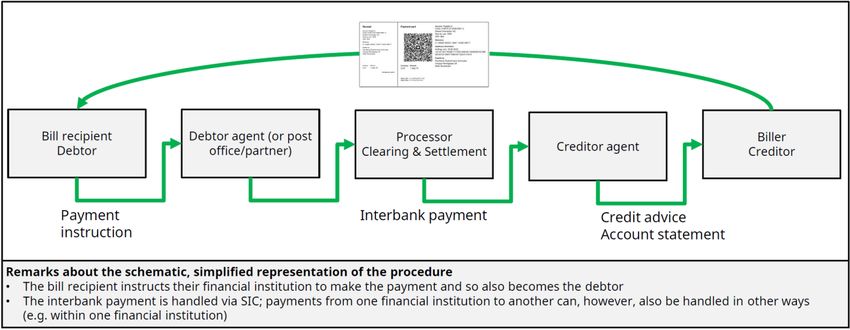
Table of contents                                                                                     Swiss Implementation Guidelines QR-bill

Table of contents

1         Introduction ............................................................................................................................... 6
1.1       Introduction to the QR-bill .................................................................................................................... 6
1.2       Change ownership ................................................................................................................................. 7
1.3       Versioning of the Swiss Implementation Guidelines QR-bill ............................................................ 7
1.4       Reference documents ............................................................................................................................ 8
2         Definition of terms .................................................................................................................... 9
2.1       QR-bill ....................................................................................................................................................... 9
2.2       Payment part with Swiss QR code and receipt ................................................................................... 9
2.3       QR Code according to ISO 18004 ....................................................................................................... 10
2.4       The term "module" according to ISO 18004 ..................................................................................... 10
2.5       The term "error correction level" according to ISO 18004 ............................................................. 10
2.6       Swiss QR Code ....................................................................................................................................... 10
2.7       DPI .......................................................................................................................................................... 11
2.8       IID ........................................................................................................................................................... 11
2.9       QR-IID ..................................................................................................................................................... 11
2.10      IBAN ........................................................................................................................................................ 11
2.11      QR-IBAN ................................................................................................................................................. 11
2.12      Customer references ........................................................................................................................... 12
2.12.1    QR reference ......................................................................................................................................... 12
2.12.2    Creditor Reference ............................................................................................................................... 12
3         Layout rules for the payment part with Swiss QR Code and receipt .................................. 13
3.1       The basics .............................................................................................................................................. 13
3.2       Correspondence language .................................................................................................................. 13
3.3       Paper format and quality .................................................................................................................... 14
3.4       Fonts and font sizes ............................................................................................................................. 14
3.5       Sections of the payment part ..............................................................................................................                  15
3.5.1     Title section ...........................................................................................................................................    15
3.5.2     Swiss QR Code section .........................................................................................................................              15
3.5.3     Amount section .....................................................................................................................................         15
3.5.4     Information section ..............................................................................................................................           16
3.5.5     Further information section ................................................................................................................                 17
3.6       Sections of the receipt .........................................................................................................................            18
3.6.1     Title section ...........................................................................................................................................    18
3.6.2     Information section ..............................................................................................................................           19
3.6.3     Amount section .....................................................................................................................................         20
3.6.4     Acceptance point section .....................................................................................................................               20
3.7       Notes about the QR-bill in PDF format .............................................................................................. 21
4         Swiss QR Code database ......................................................................................................... 22
4.1       In general ............................................................................................................................................... 22
4.2       Technical specifications .......................................................................................................................             22
4.2.1     Character set .........................................................................................................................................      22
4.2.2     Field lengths ..........................................................................................................................................     22
4.2.3     Separator element ................................................................................................................................           22
4.2.4     Delivery of the data elements .............................................................................................................                  22

Page 4 of 53                                                                                                                      Version 2.0 – 15.11.2018
Swiss Implementation Guidelines QR-bill                                                                                                      Table of contents

4.2.5         Data groups ........................................................................................................................................... 23
4.3           Data structure ....................................................................................................................................... 23
4.3.1         Depiction conventions ......................................................................................................................... 23
4.3.2         Permitted characters in the field definitions .................................................................................... 24
4.3.3         Data elements in the QR-bill ............................................................................................................... 25
4.4           Technical specifications ....................................................................................................................... 31
4.4.1         Use of address information ................................................................................................................ 31
4.4.2         Customer references ............................................................................................................................ 32
4.4.3         Additional information ......................................................................................................................... 32
4.4.4         Alternative schemes ............................................................................................................................. 33
5             Parameters for generating the code ..................................................................................... 34
5.1           Error correction level ............................................................................................................................ 34
5.2           Maximum data range and QR code version ..................................................................................... 34
5.3           Minimum module size .......................................................................................................................... 34
5.4           Measurements of the Swiss QR Code for printing ........................................................................... 34
5.4.1         Ruhezone gemäss ISO 18004 ............................................................................................................. 34
5.4.2         Recognition characters ........................................................................................................................ 35
5.4.3         The payment amount ........................................................................................................................... 35
6             Field contents and meta data ................................................................................................ 36
6.1           Checking of field contents ................................................................................................................... 36
6.2           Meta data ............................................................................................................................................... 36
Annex A: Examples .................................................................................................................................. 37
Annex B: Check digit generation by Modulo 10 recursive ................................................................... 44
Annex C: Depiction of the customer reference in the ISO 20022 pain.001 payment message ........ 46
Annex D: Multilingual headings ............................................................................................................. 49
Annex E: "Recommended structure for information from the biller on QR-bills" from Swico ........ 50
Annex F: Index of tables and figures .................................................................................................... 53

Version 2.0 – 15.11.2018                                                                                                                           Seite 5 von 53
Introduction Swiss Implementation Guidelines QR-bill
1 Introduction
The Swiss Implementation Guidelines QR-bill were compiled on behalf of the Board of
Directors of SIX Interbank Clearing Ltd. The primary target group comprises the
developers of software for billers, bill recipients and banks.
The most recent version of this document can be found at www.paymentstandards.ch.
1.1 Introduction to the QR-bill
The payment slips used in Switzerland go back over a hundred years and are used
100 million times a year.
The increasing regulatory requirements for payment traffic make some system modi-
fications necessary, in particular a review of data management. Payment traffic must
also take account of digital structural changes in business and society, without for-
getting those groups of the population who make payments over the post office
counter or by post.
The QR-bill is replacing the existing multiplicity of payment slips in Switzerland and so
is helping to increase efficiency and simplify payment traffic, at the same time
offering a way of dealing with the challenges presented by digitalisation and regula-
tion.
The following diagram explains the basic process:
Figure 1: Basic process
This is the basic process. There are also other use cases which vary slightly from it
(e.g. where the payer and the debtor are different; the payment part with receipt is
used for a donation; debtor is unknown when the payment is set up). We will not go
into those any further here.
The basic process comprises the following steps: the biller generates a QR-bill with a
payment part and receipt and sends it to the bill recipient. It is usually sent on paper
or digitally as a PDF document. The bill recipient (who in this case is also the debtor)
can now trigger the payment using various payment channels:
M-banking
Page 6 of 53 Version 2.0 – 15.11.2018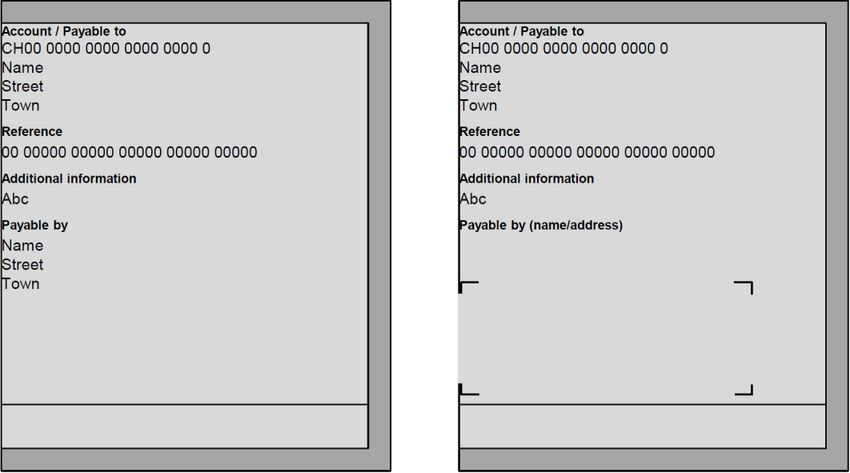
Swiss Implementation Guidelines QR-bill Introduction
E-banking
Paper payment instruction sent to their bank
Payment at a post office or post office agency
Entering a payment order in their institution’s own infrastructure
The data contained in the QR-code serves as an aid in filling in the data so that no
manual entries are required. Alternatively, data can be entered manually based on
the textual information.
Complying with the requirements stated in this document will ensure that payments
sent via any payment channel can be executed reliably.
In addition to various Swiss Implementation Guidelines governing customer-bank
data exchange based on the ISO 20022 standard (e.g. for credit transfers, cash man-
agement), the following documents are also relevant to QR-bills:
Processing rules for QR-bills
Technical information on the QR-IID and QR-IBAN
Layout rules and recommendations for QR-bills
The "Processing rules for QR-bills" describe the relevant technical processing
stages. The "Technical information on the QR-IID and QR-IBAN" provides detailed
information about the use of the QR-IBAN based on a QR-IID.
1.2 Change ownership
The document «Swiss Implementation Guidelines QR-bill» can only be changed by
SIX Interbank Clearing Ltd
Pfingstweidstrasse 110
P.O. Box
CH-8021 Zurich
and contains the recommendations of the Swiss financial institutions. Future changes
and updates will be made by Interbank Clearing Ltd, which expressly reserves the
right to amend, supplement or delete any part or all of it.
The latest version of this document can be downloaded at www.paymentstandards.ch.
1.3 Versioning of the Swiss Implementation Guidelines QR-bill
The main versions place the versioning counter in the first position. (Version 1.0; Ver-
sion 2.0). Main versions can either have an impact on the data structure, the content
or on the design recommendations, and generally require technical adaptations.
Subversions (Version 1.1; Version 1.11) generally do not require any technical adapta-
tions.
The version must be depicted in the data structure (for details see 4.3 "Data
structure", "Version" element).
Version 2.0 – 15.11.2018 Page 7 of 53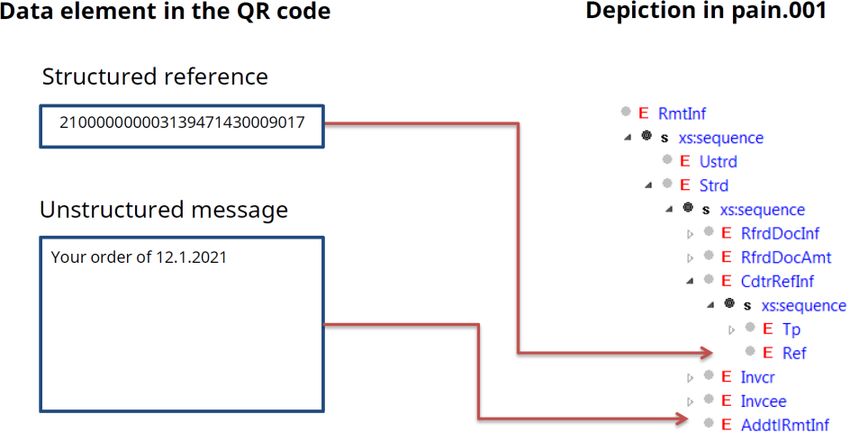
Introduction                                                     Swiss Implementation Guidelines QR-bill

1.4                  Reference documents

Ref    Document/schema          Title                                                       Source
[1]    ISO 18004                ISO 18004 Third Edition of 2015-02-01 (Information tech-    ISO
                                nology – Automatic identification and data capture tech-
                                niques – QR Code bar code symbology specification)
[2]    pain.001.001.03          XML Schema Customer Credit Transfer Initiation V03          ISO
[3]    pain.001.001.03.ch.02    Swiss Implementation Guidelines for customer-bank           SIX
                                messages for credit transfers in payment traffic
[4]    Processing rules         Processing rules for QR-bills                               SIX
[5]    QR-IID; QR-IBAN          Technical information on the QR-IID and QR-IBAN for         SIX
                                financial institutions
[6]    Style Guide              Layout rules and recommendations for QR-bills               SIX

                     Table 1:   Reference documents

 Organisation                   Link
 ISO                            www.iso20022.org
 SIX                            www.iso-payments.ch
                                www.sepa.ch
                                www.six-group.com/interbank-clearing
 Harmonization of Swiss         www.paymentstandards.ch
 payments

                     Table 2:   Links to the relevant Internet pages

Page 8 of 53                                                                    Version 2.0 – 15.11.2018
Swiss Implementation Guidelines QR-bill Definition of terms
2 Definition of terms
2.1 QR-bill
The "QR-bill" is understood to mean
a bill with a payment part and receipt integrated in the form, and
a bill with a separately enclosed payment part and receipt.
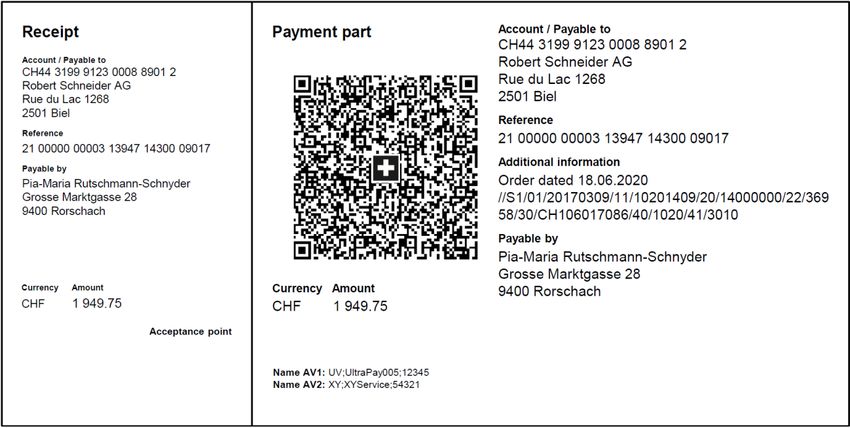
The following figure serves a sketch of two possible designs of a QR-bill with payment
part, intended to improved comprehension of the subsequent definitions.
Figure 2: Schematic depiction of a QR-bill with integrated payment part/receipt and
with payment part/receipt as an enclosure
2.2 Payment part with Swiss QR code and receipt
The payment part of the QR-bill with receipt contains the information that is required
to execute the payment in the form of a QR code and also as readable information.
The receipt must be on the left of the payment part, regardless of whether it is inte-
grated in the bill or on a separate sheet of paper.
The payment part is in DIN-A6 landscape format (148 mm x 105 mm). The receipt to
the left of the payment part measures 62 mm x 105 mm, so the two together meas-
ure 210 mm x 105 mm (DIN long).
Version 2.0 – 15.11.2018 Page 9 of 53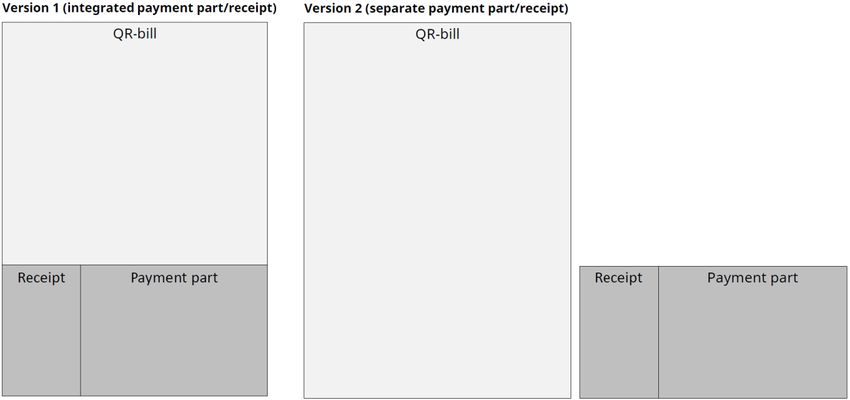
Definition of terms                                                 Swiss Implementation Guidelines QR-bill

2.3                   QR Code according to ISO 18004

                      The QR Code is a two-dimensional barcode, in accordance with ISO 18004, based on
                      the development of the company DENSO WAVE INCORPORATED. "QR Code" is a reg-
                      istered trademark of DENSO WAVE INCORPORATED.
                      The QR Code standard stipulates versions for the coding of various data volumes
                      (from Version 1 to Version 40) with correspondingly different storage capacities in the
                      form of modules. The respective codeable data volume depends, on the one hand, on
                      the error correction level chosen, and on the other, on the data to be encoded
                      (numeric, alphanumeric, binary, Kanji).

                      A fixed number of modules is allocated to each version.

2.4                   The term "module" according to ISO 18004

                      A module designates the smallest information carrier in the QR Code, comparable
                      with a data bit. In the QR Code the modules correspond to the white and black dots
                      of the code.

2.5                   The term "error correction level" according to ISO 18004

                      The QR Code has the ability to restore the data contained in the code if the code is
                      damaged (e.g. through dirt, folding, imprinting). The standard includes four error
                      correction levels corresponding to different restoration capacities (L = approx. 7%, M
                      = approx. 15%, Q = approx. 25%, H = approx. 30%). The higher the error correction
                      level that is chosen, the lower the codeable data volume.

2.6                   Swiss QR Code

                      The Swiss QR Code complies with the specifications in this document and enables
                      payments to be triggered by financial institutions across all payment channels and at
                      post office counters (at branches and branches of a partner company). It is marked
                      with a Swiss cross in the middle.

                      Figure 3:     Swiss QR Code

Page 10 of 53                                                                       Version 2.0 – 15.11.2018
Swiss Implementation Guidelines QR-bill Definition of terms
2.7 DPI
The printer and scanner resolution are customarily specified in Dots per Inch (DPI).
2.8 IID
The IID (institution identification) is used in Switzerland and Liechtenstein to identify
financial institutions as participants in the Swiss RTGS systems. Every institution is
assigned at least one IID.
2.9 QR-IID
The QR-IID is derived from the institutional identification (IID). QR-IIDs consist
exclusively of numbers from 30000 to 31999. IBANs (QR-IBANs) based on these QR-
IIDs are used only for the new procedure with a QR reference in the QR-bill (see also
paragraph 2.11).
2.10 IBAN
The IBAN is the internationally standardised representation of a bank account num-
ber in accordance with the ISO 13616 standard.
2.11 QR-IBAN
For payments with a structured QR reference, the QR-IBAN must be used to indicate
the account to be credited. The formal structure of the QR-IBAN corresponds to the
rules stipulated in ISO 13616 standard for IBAN. The payment scheme with reference
is recognized through a special financial institution identification (QR-IID). The values
30000 – 31999 are exclusively reserved for the QR-IID. Each legally independent
financial institution participating in the scheme is assigned one QR-IID. The QR-IBAN
contains the QR-IID of the account-keeping financial institution for identification of
the scheme.
Detailed information about the QR-IID and QR-IBAN can be found in the "Technical
information on the QR-IID and QR-IBAN" document [5]. The latest version can be
downloaded at www.paymentstandards.ch.
Version 2.0 – 15.11.2018 Page 11 of 53Definition of terms Swiss Implementation Guidelines QR-bill
2.12 Customer references
For payments with structured reference, the two following reference types are used.
2.12.1 QR reference
The structure of the QR reference corresponds to that of the ISR reference
(26 numerical characters followed by a Modulo 10 recursive check digit, see Annex B
«Check digit generation by Modulo 10 recursive») and can be used by the biller as a
structured reference.
2.12.2 Creditor Reference
Creditor Reference according to the ISO 11649 standard.
Page 12 of 53 Version 2.0 – 15.11.2018Swiss Implementation Guidelines QR-bill Gestaltungsvorgaben
3 Layout rules for the payment part with Swiss
QR Code and receipt
3.1 The basics
The following layout rules apply to the payment part on a QR-bill with receipt which
can be used in the following ways:
integrated in a QR-bill in paper form
as an enclosure to a QR-bill in paper form
The QR-bill can also be produced as a PDF file (see paragraph 3.7 "Notes about the
QR-bill in PDF format").
The layout rules for the payment part apply regardless of whether it is incorporated
in a bill or enclosed with it.
The payment part with receipt must be positioned at the lower edge of the QR-bill.
The receipt must be positioned to the left of the payment part. It is of the same
height as the payment part. The payment part and receipt together come to the same
length as the shorter side of DIN-A4 format.
If the payment part with receipt is integrated in a QR-bill in paper form, there must
be a perforation between the bill details and the payment part and receipt.
There should be a perforation between the payment part and the receipt, if the QR-
bill is generated on paper.
A perforation between the payment part and the receipt is also required if the
payment part and the receipt are enclosed separately with a bill.
If information about the amount and debtor (payable by (name/address)) are not
imprinted during the billing process, then corresponding fields are to be provided
both in the payment part and on the receipt, for filling in by hand (see also Figure 5,
Figure 6, Figure 9). Other handwritten supplementations are not permitted.
Only the defined headings and information or values may be imprinted (see part 3.5
"Sections of the payment part") for the individual sections (see part 3.5.4 "Information
section").
Use of payment part and receipt as an advertising platform or advertising is not per-
mitted. The reverse side may not be imprinted.
A Style Guide [6] giving detailed layout information and examples of the payment part and
receipt – whether integrated or separate – is available from the Download Center at
www.paymentstandards.ch.
3.2 Correspondence language
The QR-bill can be produced in the correspondence languages German, French, Ital-
ian and English. The biller is free to choose the correspondence language used. The
terms to be used in the respective correspondence languages are listed in multiple
languages in Annex D "Multilingual headings".
Version 2.0 – 15.11.2018 Page 13 of 53Gestaltungsvorgaben Swiss Implementation Guidelines QR-bill
3.3 Paper format and quality
The payment part with receipt must be printed on white paper with a weight of at
least 80 to max. 100 g/m². The use of certified recycled, FSC and TCF papers is permit-
ted. Neither coated nor reflecting standard paper may be used.
The payment part is in DIN-A6 landscape format (148 mm x 105 mm). The receipt to
the left of the payment part measures 62 mm x 105 mm, so that the two together
measure 210 mm x 105 mm (DIN long).
3.4 Fonts and font sizes
Only the sans-serif fonts Arial, Frutiger, Helvetica and Liberation Sans are permitted
in black. Type may not be in italic nor underlined.
The font size for headings and their associated values on the payment part must be
at least 6 pt, and maximum 10 pt. Headings in the "Amount" and "Details" sections
must always be the same size. They should be printed in bold and 2 pt smaller than
the font size for their associated values. The recommended font size for headings is
8 pt and for the associated values 10 pt. The exception, in font size 11 pt (bold), is the
title "Payment part".
When filling in the "Alternative procedures" element, the font size is 7 pt, with the
name of the alternative procedure printed in bold.
The "Final debtor" element is intended for use in the future but will not be used when
QR-bill is introduced and should therefore not be filled in. If approval is given for the
field to be filled in, the font size is expected to be 7 pt with the designation in bold.
The font sizes for the receipt are 6 pt for the headings (bold) and 8 pt for the
associated values. The exception, in font size 11 pt (bold), is the title "Receipt".
If, during scanning, in addition to the content of the Swiss QR Code, the information
in the visible section of the payment part is also read, the best results will be achieved
if the headings are in font size 8 pt. and the text information is in 10 pt. However, it
must be ensured that all the required information can be shown in the visible section.
Page 14 of 53 Version 2.0 – 15.11.2018Swiss Implementation Guidelines QR-bill Gestaltungsvorgaben
3.5 Sections of the payment part
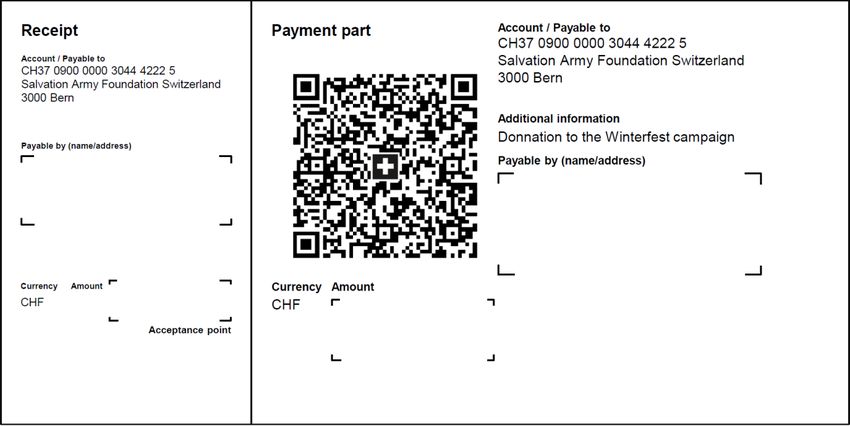
The following illustration depicts the five sections of the payment part. The contents
are described in the following chapters.
Figure 4: Schematic illustration of the payment part of a QR-bill
The spaces between the sections – darker in color in Figure 4 – are mandatory, must
be at least 5 mm in height and width, and may not be printed.
3.5.1 Title section
The term "Payment part" must be printed in the title section in 11 pt type bold.
3.5.2 Swiss QR Code section
In the Swiss QR Code section, the maintaining of the 5 mm wide border ensures that
the Swiss QR Code can be read without problems.
3.5.3 Amount section
The amount section includes the currency and the amount, which are used as
headings. The currencies Swiss francs and euros are supported. The currency codes
"CHF" or "EUR" must be printed to the left in front of the amount or the amount field.
If the amount is included in the Swiss QR Code, then it must be printed after the cur-
rency code. A blank (space) should be used as the thousands separator and a full stop
"." as the decimal separator. The amount must always include two decimal places.
If no amount is contained in the Swiss QR Code, a blank field measuring 1.5 x 4.0 cm
and with black edges (line thickness 0.75 pt) must be provided in which the debtor
("Payable by ") can add the amount by hand, preferably in black. A file for creating the
corner marks is available from the Download Center at www.paymentstandards.ch.
Version 2.0 – 15.11.2018 Page 15 of 53Gestaltungsvorgaben Swiss Implementation Guidelines QR-bill
Figure 5: Schematic depiction of the amount section
3.5.4 Information section
All values relevant for a payment from the Swiss QR Code must be printed in the
information section. While doing so each bit of information must be marked with a
heading. The values must, if they are contained in the Swiss QR Code, be
positioned in the following correct order. If the Swiss QR Code contains no values, the
relevant headings should not be shown.
Heading Comments
Account / Payable to IBAN/QR-IBAN from the Swiss QR Code. Printed in blocks of 4
characters (5x4-character groups, the last character separate).
Holder of the listed account
Reference QR reference or Creditor Reference (ISO 11649). The QR reference is
printed in blocks of 5 characters (beginning with 2 characters, then
5x5-character groups). The Creditor Reference is printed in blocks of
4 characters, the last block being able to contain less than 4 charac-
ters).
Additional information Additional information for the bill recipient.
This is where the content from the data elements "Ustrd"
(Unstructured message) and "StrdBkginf" (Billing information) is
shown. Both fields together can only contain a maximum of 140
characters. If both elements are filled in, then a line break can be
introduced after the information in the first element "Ustrd"
(Unstructured message). If there is insufficient space, the line break
can be omitted (but this makes it more difficult to read). If not all the
details contained in the QR code can be displayed, the shortened
content must be marked with "..." at the end. It must be ensured
that all personal data is displayed.
Page 16 of 53 Version 2.0 – 15.11.2018Swiss Implementation Guidelines QR-bill Gestaltungsvorgaben
Heading Comments
Payable by If the debtor is not included in the Swiss QR Code, then instead of
or "Payable by " the heading "Payable by (name/address)” must be
used and a blank field with black edges (line thickness 0.75 pt)
Payable by (name/address)
printed out (see Figure 5). The field must measure at least 2.5 x 6.5
cm. A file for this purpose is available from the Download Center at
www.paymentstandards.ch.
Payable by Corresponds to the due date proposed by the biller
Table 3: Headings of the payment part in the information section
Comments
Use of the above-listed headings (see Annex D "Multilingual headings" is mandatory
and they may not be changed, if they are contained in the Swiss QR Code.
Figure 6: Schematic depiction of the information section
3.5.5 Further information section
Note: The following information about the "Final creditor" field is only for advance
information, in the event of it being used in the future.
This section is where the "Final creditor" field, if available and approved for use, is
displayed. Instead of the designation "Final creditor", the relevant values in the Swiss
QR Code are preceded by the words "In favour of" (bold). Just one line is available, so
it is possible that not all the information in the QR-bill can be printed there. If that is
the case, the shortened entry must be marked by "..." at the end. The data is printed
in font size 7 pt, in the same order as in the Swiss QR Code.
Beneath the "Final creditor" field, the "Alternative procedures" elements are
displayed, if available. There are a maximum of two elements, each consisting of one
line in font size 7 pt. The element includes at the start the (abbreviated) name of the
alternative procedure (e.g. eBill, TWINT). This must be followed by the personal data,
so that this is certain to be displayed.
Version 2.0 – 15.11.2018 Page 17 of 53Gestaltungsvorgaben Swiss Implementation Guidelines QR-bill
In the Swiss QR Code, there are always 100 alphanumerical characters available for
the "Alternative procedures". A maximum of approx. 90 characters can be printed on
one line, so it is possible that not all the data included in the QR code can be
displayed. If that is the case, the shortened entry must be marked by "..." at the end.
It must be ensured that all personal data is displayed.
3.6 Sections of the receipt
The following illustration shows the four sections of the receipt. The content of the
different sections is described in the paragraphs below. The QR code and further
information sections from the payment part are omitted.
The blank areas – shaded dark in Figure 7– are mandatory, must measure at least 5
mm in height or width and must not be printed in.
Figure 7: Schematic depiction of the receipt for the payment part of a QR-bill
3.6.1 Title section
The term "Receipt" must be printed in the title section in 11 pt bold type.
Page 18 of 53 Version 2.0 – 15.11.2018Swiss Implementation Guidelines QR-bill Gestaltungsvorgaben
3.6.2 Information section
In the information section, the values used must be printed, just as they are in the
payment part, exactly matching those in the Swiss QR Code. Each piece of infor-
mation must be labelled with a heading. The following values must be shown, in the
order indicated below, provided they are contained in the Swiss QR Code:
Heading Comments
Account / Payable to IBAN/QR-IBAN from the Swiss QR Code. Printed in blocks of 4
characters (5x4-character groups, the last character separate).
Holder of the listed account
Reference QR reference or Creditor Reference (ISO 11649). The QR reference is
printed in blocks of 5 characters (beginning with 2 characters, then
5x5-character groups). Der Aufdruck der Creditor Reference erfolgt
in blocks of 4 characters, the last block being able to contain less
than 4 characters).
Payable by If the debtor is not included in the Swiss QR Code, then instead of
or "Payable by" the heading "Payable by (name/address)” must be used
and a blank field with black edges (line thickness 0.75 pt) printed out
Payable by (name/address)
(see Figure 9). The field must measure at least 2.0 x 5.2 cm. A file for
this purpose is available from the Download Center at
www.paymentstandards.ch.
Table 4: Headings of the payment part in the information section
Comments
Use of the above-listed headings (see Annex D "Multilingual headings" is mandatory
and they may not be changed, if they are contained in the Swiss QR Code.
Figure 8: Schematic depiction of the information section on the receipt of a QR-bill
Because of the limited space, it is permitted to
enter information in smaller or different font sizes from in the payment part. The
minimum font size is 6 pt.
omit the street name and building number from the addresses of the creditor
(Payable to) and the debtor (Payable by).
Version 2.0 – 15.11.2018 Page 19 of 53Gestaltungsvorgaben Swiss Implementation Guidelines QR-bill
3.6.3 Amount section
The amount section includes the currency and the amount, which are printed as
headings. The currencies Swiss francs and euros are supported. The currency codes
"CHF" or "EUR" must be printed to the left in front of the amount or the amount field.
If the amount is included in the Swiss QR Code, then it must be printed after the cur-
rency code. A blank (space) should be used as the thousands separator and a full stop
"." as the decimal separator. The amount must always include two decimal places
(e.g. CHF 1 590.00).
If no amount is contained in the Swiss QR Code, a blank field measuring 1.0 x 3.0 cm
and with black edges (line thickness 0.75 pt) must be provided in which the debtor
can add the amount by hand. A file for this purpose is available from the Download
Center at www.paymentstandards.ch.
3.6.4 Acceptance point section
The acceptance point section contains the word "Acceptance point", which should be
printed right-aligned in the language of correspondence.
Figure 9: Schematic depiction of the receipt of a QR-bill
Page 20 of 53 Version 2.0 – 15.11.2018Swiss Implementation Guidelines QR-bill Gestaltungsvorgaben
3.7 Notes about the QR-bill in PDF format
QR-bills (or separate payment parts with receipts) in PDF format are only suitable for
payments in e-banking or mobile banking, but not for paper payment traffic. When
printing out PDF files, it must be ensured that the format specifications given above
are complied with.
If the QR-bill with payment part and receipt or the separate payment part with receipt
are generated as a PDF document and sent electronically, the A6 format of the pay-
ment part and the receipt on the left must be indicated by lines. Each of these lines
must bear the scissors symbol "" or alternatively the instruction "Separate before
paying in" above the line (outside the payment part). This indicates to the debtor that
he or she must neatly separate the payment part and receipt if they want to forward
the QR-bill to their financial institution by post for payment, or settle it at the post
office counter (branches or branches of partner organisations).
Version 2.0 – 15.11.2018 Page 21 of 53Swiss QR Code database Swiss Implementation Guidelines QR-bill
4 Swiss QR Code database
4.1 In general
The database of the Swiss QR Code is oriented upon the Swiss Implementation
Guidelines for Credit Transfers for the ISO 20022 "Customer Credit Transfer Initia-
tion" message (pain.001).
4.2 Technical specifications
4.2.1 Character set
According to the Swiss standard, in the Swiss QR Code, for reasons of compatibility
with the Swiss Implementation Guidelines for Credit Transfers for the ISO 20022
"Customer Credit Transfer Initiation" message (pain.001) [3], only the Latin character
set is permitted. UTF-8 should be used for encoding.
For certain fields, additional restrictions apply regarding characters e.g. only
alphanumerical values are possible for the IBAN.
4.2.2 Field lengths
The field lengths specified represent maximum lengths for the individual elements.
It is not permitted to fill in the elements with blanks up to the maximum length.
4.2.3 Separator element
The individual elements in the Swiss QR Code according to the Swiss standard are
separated from one another with a carriage return (CR + LF).
The carriage return is eliminated after the final element.
Note: Instead of the characters CR + LF, the LF character can be used alone (see also
the FAQ at www.paymentstandards.ch/FAQ)
4.2.4 Delivery of the data elements
All data elements must be present. If there is no content for a data element, then at
least one carriage return (CR + LF or LF) must take place.
The sole exceptions to this are additional data elements marked with "A" (alternative
scheme). These may be omitted if they are not being used.
The last data element delivered may not be completed with a concluding carriage
return (CR + LF or LF).
Page 22 of 53 Version 2.0 – 15.11.2018Swiss Implementation Guidelines QR-bill Swiss QR Code database
4.2.5 Data groups
The data groups highlighted in light blue in Table 5 "Status of the elements" serve
solely for depiction of the technical context and the definition of common rules.
Such data groups may not be delivered in the Swiss QR Code.
If a data group is used, in those marked with "optional", all sub-elements marked as
"dependent" must be filled.
4.3 Data structure
Table 7 "Swiss QR Code data elements" specifies all elements relevant for the Swiss
QR Code.
4.3.1 Depiction conventions
The following depiction conventions apply for this document.
Table 7 "Swiss QR Code data elements" about the data structure contains the
following columns and information:
1. Data structure
Logical data structure, defined data groups (name of the data group always in the
blue fields) which logically belong to one another
2. Element name
Technical element name
3. St.
Status
4. General definition
Technical definitions and terms
5. Field definition
Technical field definitions
Status
The following status values (information about usage) are possible for the individual
elements:
Status (St.) Designation Description
M Mandatory Field must mandatorily be delivered filled.
D Dependent Field must mandatorily be filled if the superordinate
optional data group is filled.
O Optional Field must mandatorily be delivered, but not neces-
sarily filled (can be empty).
Version 2.0 – 15.11.2018 Page 23 of 53Swiss QR Code database Swiss Implementation Guidelines QR-bill
Status (St.) Designation Description
A Additional Field does not necessarily have to be delivered.
X Do not fill in Field must not be filled in but must be sent (intend-
ed "for future use", so the field separator needs to
be sent).
Table 5: Status of the elements
Coloring in the tables
Data elements that contain at least one sub-element represent so-called data groups
and are colored light blue.
Depiction of the logical structure in the tables
To be able to recognize where in the logical structure of the Swiss QR Code an ele-
ment is positioned, the nesting depth is indicated with a "+" sign placed in front of the
“Data structure” column. For example, the IBAN in the "Creditor information" is
shown as follows:
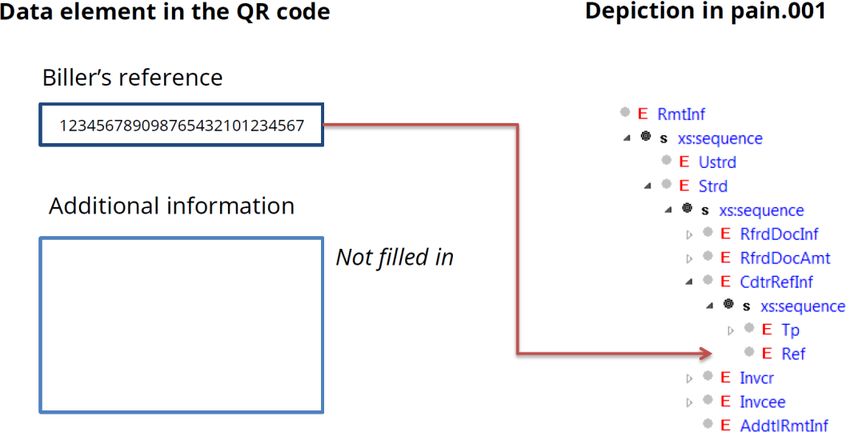
QRCH
+CdtrInf
++IBAN
Depiction of deviations in naming in the payment part/receipt
A name is listed in the table for individual data groups that differ from the field
names, which is to be used as a designation in the payment part/receipt. This
designation is listed in the tables in italics and in blue beneath the designation of the
data group:
Ultimate Creditor
Payable by
Figure 10: Data group with technical element name and technical name for the
payment part
4.3.2 Permitted characters in the field definitions
Details about the "Field definitions" column in Table 7:
Characters Field definitions
general Character set as stipulated in part 4.2.1
numeric 0–9
alphanumeric A–Z a-z 0–9
decimal 0–9 plus decimal separator "."
Table 6: Characters permitted
Page 24 of 53 Version 2.0 – 15.11.2018Swiss Implementation Guidelines QR-bill Swiss QR Code database
4.3.3 Data elements in the QR-bill
QR Elements Swiss QR Definition
Data Structure Element Name St. General Definition Field Definition
QRCH Header Header Mandatory data group
+Header Header Data. Contains basic information about the Swiss QR
Code
QRCH QRType M QRType Fixed length: three-digit, alphanumeric
+Header Unambiguous indicator for the Swiss QR Code. Fixed value
++QRType "SPC" (Swiss Payments Code)
QRCH Version M Version Fixed length: four-digit, numeric
+Header Contains version of the specifications (Implementation
++Version Guidelines) in use on the date on which the Swiss QR Code
was created. The first two positions indicate the main
version, the following two positions the sub-version. Fixed
value of "0200” for Version 2.0
QRCH Coding M Coding Type Fixed length: one-digit, numeric
+Header Character set code. Fixed value 1 (indicates UTF-8 restricted
++Coding to the Latin character set)
QRCH CdtrInf Creditor information Mandatory data group
+CdtrInf Account / Payable to
QRCH IBAN M IBAN Fixed length: 21 alphanumeric characters, only IBANs
+CdtrInf IBAN or QR-IBAN of the creditor. with CH or LI country code permitted.
++IBAN
QRCH Cdtr Creditor Mandatory data group
+CdtrInf
++Cdtr
QRCH AdrTp M Address type Fixed length: one-digit, alphanumeric
+CdtrInf The address type is specified using a code. The following
++Cdtr codes are defined:
+++AdrTp "S" - structured address
"K" - combined address elements (2 lines)
QRCH Name M Name Maximum 70 characters permitted
+CdtrInf The creditor's name or company according to the account First name (optional, sending is recommended, if
++Cdtr name. available) + last name or company name
+++Name Comment: always matches the account holder
Version 2.0 – 15.11.2018 Page 25 of 53Swiss Implementation Guidelines QR-bill Swiss QR Code database
QR Elements Swiss QR Definition
Data Structure Element Name St. General Definition Field Definition
QRCH StrtNmOrAdrLine1 O Street or address line 1 Maximum 70 characters permitted
+CdtrInf Structured Address: Street/P.O. Box from the creditor’s
++Cdtr address
+++StrtNmOrAdrLine1 Combined address elements: Address line 1 including street
and building number or P.O. Box
QRCH BldgNbOrAdrLine2 O Building number or address line 2 Structured Address: max. 16 characters allowed
+CdtrInf Structured Address: Building number from creditor’s Combined address elements: maximum 70 characters
++Cdtr address permitted
+++BldgNbOrAdrLine2 Combined address elements: Address line 2 including postal Must be provided for address type "K".
code and town from creditor’s address
QRCH PstCd D Postal code Maximum 16 characters permitted
+CdtrInf Postal code from creditor’s address The postal code is must be provided without a country
++Cdtr code prefix.
+++PstCd
Combined address elements: must not be provided
QRCH TwnNm D Town Maximum 35 characters permitted
+CdtrInf Town from creditor’s address
++Cdtr Combined address elements: must not be provided
+++TwnNm
QRCH Ctry M Country Two-digit country code according to ISO 3166-1
+CdtrInf Country from creditor’s address
++Cdtr
+++Ctry
QRCH UltmtCdtr Ultimate Creditor Optional data group; may only be used in agreement with
+UltmtCdtr In favour of the creditor’s financial institution
Information about the ultimate creditor This whole data group must not be filled in for the time
being (for Future Use)
QRCH AdrTp X Address type Fixed length: one-digit, alphanumeric
+UltmtCdtr The address type is specified using a code. The following
++AdrTp codes are defined:
"S" - structured address
"K" - combined address elements (2 lines)
QRCH Name X Name Maximum 70 characters permitted
+UltmtCdtr The ultimate creditor's name or company First name (optional, sending is recommended, if
++Name available) + last name or company name
Version 2.0 – 15.11.2018 Page 26 of 53Swiss Implementation Guidelines QR-bill Swiss QR Code database
QR Elements Swiss QR Definition
Data Structure Element Name St. General Definition Field Definition
QRCH StrtNmOrAdrLine1 X Street or address line 1 Maximum 70 characters permitted
+UltmtCdtr Structured Address: Street/P.O. Box from ultimate creditor’s
++StrtNmOrAdrLine1 address
Combined address elements: Address line 1 including street
and building number or P.O. Box
QRCH BldgNbOrAdrLine2 X Building number or address line 2 Structured Address: max. 16 characters allowed
+UltmtCdtr Structured Address: Building number from ultimate Combined address elements: maximum 70 characters
++BldgNbOrAdrLine2 creditor’s address permitted
Combined address elements: Address line 2 including postal Must be provided for address type "K".
code and town from ultimate creditor’s address
QRCH PstCd X Postal code Maximum 16 characters permitted
+UltmtCdtr Postal code from ultimate creditor’s address The postal code is must be provided without a country
++PstCd code prefix.
Combined address elements: must not be provided
QRCH TwnNm X Town Maximum 35 characters permitted
+UltmtCdtr Town from ultimate creditor’s address
++TwnNm Combined address elements: must not be provided
QRCH Ctry X Country Two-digit country code according to ISO 3166-1
+UltmtCdtr Country of the ultimate creditor’s address
++Ctry
QRCH CcyAmt Payment amount information Mandatory data group
+CcyAmt
QRCH Amt O Amount The amount element is to be entered without leading
+CcyAmt The payment amount zeroes, including decimal separators and two decimal
++Amt places.
Decimal, maximum 12-digits permitted, including decimal
separators. Only decimal points (".") are permitted as
decimal separators.
QRCH Ccy M Currency Only CHF and EUR are permitted.
+CcyAmt The payment currency, 3-digit alphanumeric currency code
++Ccy according to ISO 4217
QRCH UltmtDbtr Ultimate Debtor Optional data group
+UltmtDbtr Payable by
Version 2.0 – 15.11.2018 Page 27 of 53Swiss Implementation Guidelines QR-bill Swiss QR Code database
QR Elements Swiss QR Definition
Data Structure Element Name St. General Definition Field Definition
QRCH AdrTp D Address type Fixed length: one-digit, alphanumeric
+UltmtDbtr The address type is specified using a code. The following
++AdrTp codes are defined:
"S" - structured address
"K" - combined address elements (2 lines)
QRCH Name D Name Maximum 70 characters permitted
+UltmtDbtr The ultimate debtor's name or company First name (optional, sending is recommended, if
++Name available) + last name or company name
QRCH StrtNmOrAdrLine1 O Street or address line 1 Maximum 70 characters permitted
+UltmtDbtr Structured Address: Street/P.O. Box from ultimate debtor’s
++StrtNmOrAdrLine1 address
Combined address elements: Address line 1 including street
and building number or P.O. Box
QRCH BldgNbOrAdrLine2 O Building number or address line 2 Structured Address: max. 16 characters allowed
+UltmtDbtr Structured Address: Building number from ultimate debtor’s Combined address elements: maximum 70 characters
++BldgNbOrAdrLine2 address permitted
Combined address elements: Address line 2 including postal Must be provided for address type "K".
code and town from ultimate debtor’s address
QRCH PstCd D Postal code Maximum 16 characters permitted
+UltmtDbtr Postal code from ultimate debtor’s address The postal code is must be provided without a country
++PstCd code prefix.
Combined address elements: must not be provided
QRCH TwnNm D Town Maximum 35 characters permitted
+UltmtDbtr Town from ultimate debtor’s address
++TwnNm Combined address elements: must not be provided
QRCH Ctry D Country Two-digit country code according to ISO 3166-1
+UltmtDbtr Country from ultimate debtor’s address
++Ctry
QRCH RmtInf Payment reference Mandatory data group
+RmtInf
Version 2.0 – 15.11.2018 Page 28 of 53Swiss Implementation Guidelines QR-bill Swiss QR Code database
QR Elements Swiss QR Definition
Data Structure Element Name St. General Definition Field Definition
QRCH Tp M Reference type Maximum four characters, alphanumeric
+RmtInf Reference type (QR, ISO) Must contain the code QRR where a QR-IBAN is used;
++Tp The following codes are permitted: where the IBAN is used, either the SCOR or NON code can
QRR – QR reference be entered
SCOR – Creditor Reference (ISO 11649)
NON – without reference
QRCH Ref D Reference Maximum 27 characters, alphanumeric; must be filled if a
+RmtInf Note: The structured reference is either a QR reference or QR-IBAN is used.
++Ref an ISO 11649 Creditor Reference QR reference: 27 characters, numeric, check sum
calculation according to Modulo 10 recursive (27th
position of the reference)
Creditor Reference (ISO 11649): max 25 characters,
alphanumeric
The element may not be filled for the NON reference
type.
QRCH AddInf Additional information Unstructured message and Booking instructions may
+RmtInf Additional information can be used for the scheme with contain a common total of up to 140 characters
++AddInf message and for the scheme with structured reference.
QRCH Ustrd O Unstructured message Maximum 140 characters permitted
+RmtInf Unstructured information can be used to indicate the
++AddInf payment purpose or for additional textual information
+++Ustrd about payments with a structured reference.
QRCH Trailer M Trailer Fixed length: three-digit, alphanumeric
+RmtInf Unambiguous indicator for the end of payment data. Fixed
++AddInf value "EPD" (End Payment Data).
+++Trailer
QRCH StrdBkgInf O Bill information Maximum 140 characters permitted
+RmtInf Bill information contain coded information for automated Use of the information is not part of the standardization.
++AddInf booking of the payment. The data is not forwarded with the In the Annex you will find the version of Swico‘s
+++StrdBkgInf payment. "Recommendations on the structure of information from
the biller for QR-bills" that is valid at the time of
publication of these Implementation Guidelines.
QRCH AltPmtInf Alternative schemes Optional data group with a variable number of elements
+AltPmtInf Parameters and data of other supported schemes
Version 2.0 – 15.11.2018 Page 29 of 53You can also read


