Taieri College - New Zealand Qualifications Framework Student Handbook 2020 Assessment Procedures
←
→
Page content transcription
If your browser does not render page correctly, please read the page content below
Taieri College

      New Zealand
Qualifications Framework
   Student Handbook 2020
   Assessment Procedures
Contents Introduction Page 3-4 Student Responsibilities Page 5 Course Information and Assessment Statement Page 6-7 Attendance Page 8 Authenticity Page 9 Missed Assessment, Late Work and Extensions Page 10-11 Gathering Evidence for Internally Assessed Standards Page 12-13 Appeals Page 14-15 Misconduct Page 16 Acknowledgement and Recording of Assessments Page 17 Assessment Rules Page 18-21 External Assessment – Derived Grades Page 22-23 Recognising High Achievement with ‘Endorsements’ Page 24 University of Otago Page 25 Scholarship Page 26 NCEA Fees for 2020 Page 27 Taieri College NZQF Student Handbook March 2020 Page 2 of 27
Introduction to the National Certificate of
Educational Achievement (NCEA)
NCEA is the national qualification for senior secondary school students in New
Zealand. It is a system that assesses students against standards based on the
knowledge and skills they have learned in courses of study. Each standard clearly
identifies what a student must do in order to achieve the standard. Subjects are
divided into Achievement Standards, some of which are assessed internally and some
externally. These standards are assessed through NZQA (New Zealand Qualifications
Authority). Some subjects may also be assessed against Unit Standards, which are all
internally assessed. Some Unit Standards are assessed according to the requirements
of the relevant ITO (Industry Training Organisation).
Each assessment generates credits that contribute to a certificate at Level 1, 2 or 3 of
the NZQF (New Zealand Qualifications Framework). These credits are achieved
through:
Internally Assessed Achievement Standards – these Achievement Standards assess
knowledge and skills developed through the school year which are best assessed
in a way other than by examination. They are assessed as part of the learning
programme, e.g. research assignments, portfolios, practical work.
Internally Assessed Unit Standards – these are internally assessed standards that
are assessed at Taieri College during the year as learning takes place and also
contribute credits to the NCEA.
Externally Assessed Achievement Standards – these Achievement Standards
assess knowledge and skills through a national external examination or portfolio
submission.
o During the year students will gain knowledge and practise the skills needed for
the end of year externally assessed Achievement Standards. Examinations will
be held at Taieri College but will be assessed by a nationally appointed panel
of assessors.
Supplementary Courses developed by external providers – these are courses that
students can complete alongside their selected subjects, e.g. a First Aid courses or
a driver licence also contribute credits or credit equivalents to the NCEA.
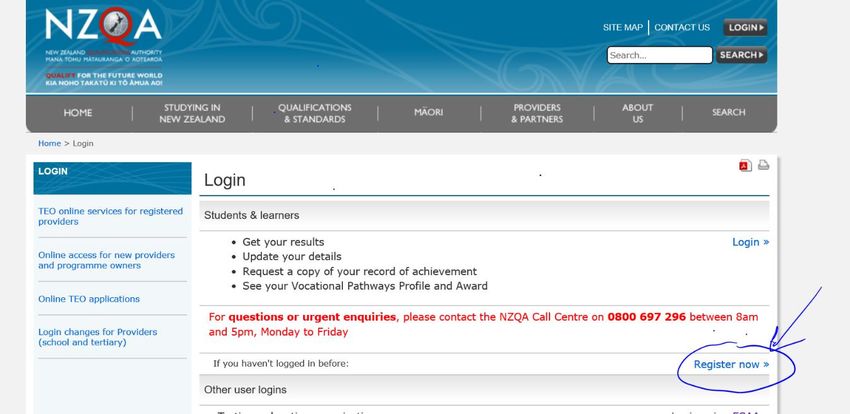
Taieri College NZQF Student Handbook March 2020 Page 3 of 27There are four different grades for Achievement Standards Not Achieved Students have not met the required standard Achieved Students have met the required standard Merit Students have achieved the standard with Merit Excellence Students have achieved the standard with Excellence When viewing your results online, there may be a further “grade” listed – SNA (Standard Not Attempted). This relates to the external assessment only and indicates that you did not attempt the external assessment. Unit Standard grades are Not Achieved and Achieved. Note: There are some Unit Standards which offer the opportunity for students to gain Merit or Excellence. NZQA You will receive a National Student Number (NSN). This will enable you to access personal details in the Learner Login area of the NZQA website. All the results are listed on the Results Notice and Record of Achievement. www.nzqa.govt.nz To register you will use you NSN and date of birth. You then follow the prompts and create a password. Taieri College NZQF Student Handbook March 2020 Page 4 of 27
Student Responsibilities
Students must:
Familiarise themselves with the course assessment statements issued by each
subject at the beginning of the year
Keep a record of internal assessment results
Check and sign to verify that grades are correct and have been accurately
recorded by the teacher
Appeal assessment decisions that they disagree with
Meet all deadlines
Produce a medical certificate if an assessment or deadline is missed due to illness
Ensure that all work produced for assessment is genuinely their own work
Ensure that all sources used have been properly acknowledged.
Students are encouraged to check their progress using the Kamar portal. This also
shows progress in Vocational Pathways.
Contact: Mr Hackfath ( bhackfath@taieri.school.nz ) NCEA Principal’s Nominee
Taieri College NZQF Student Handbook March 2020 Page 5 of 27Course Information and Assessment Statement
Procedures
Your subject teachers will give you full written course information and a statement
of all assessments at the beginning of the year. This will detail Achievement and/or
Unit Standards being covered. (This may be electronic)
It will also include timing and the type of each assessment to be used. You should
keep an accurate record of your results as a check against the result your teacher
has recorded.
The National Certificate in Educational Achievement (NCEA) will use standards to
show what you know and can do.
The standards will describe the level of work you have produced and how well you
have done.
Your teachers will be able to explain to you exactly what you have to do to
achieve the standard.
Grades for Achievement Standards will be reported for each skill – Not Achieved,
Achieved, Achieved with Merit and Achieved with Excellence.
Grades for Unit Standards will be reported as Not Achieved, Achieved and, in
some cases, Merit or Excellence.
Every standard is worth a set number of credits, which are like points towards a
qualification.
80 credits equal a National Certificate in Educational Achievement at Level One,
Two and Three. However, you can reuse 20 of your credits from the previous Level
to make up your 80 credits.
There are also minimum requirement for literacy (10 credits) and numeracy (10
credits). These are to ensure that you have sound reading and writing skills and
can work with numbers.
Credits can be accumulated over more than one year and can include approved
achievement and unit standard credits.
Taieri College NZQF Student Handbook March 2020 Page 6 of 27University Entrance
It is important that students are fully aware of the requirements for University Entrance.
This is an absolutely vital prerequisite for a number of career pathways, not just
university.
University Entrance (UE) is the minimum requirement to go to a New Zealand university.
To qualify you will need:
Approved subjects – 60 Level 3 credits which must include 42 credits at Level 3 or
higher, made up of 14 credits, each in three approved subjects
Literacy requirements – 10 credits in Literacy at Level 2 or higher, made up of
5 credits in reading and
5 credits in writing
Numeracy requirements – 10 credits in Numeracy at Level 1 or higher, made up of
Achievement Standard credits through a range of subjects
or a package of three Unit Standard credits (US 26623, 26626, 26627)
NCEA Level 3
Taieri College NZQF Student Handbook March 2020 Page 7 of 27Attendance
You must understand that each lesson is part of a sequential learning plan and it is to
your advantage to attend all classes.
Procedures
Your subject teacher will be recording your absences every period. You need to
be aware that every absence will affect your learning. Once your absences are at
a concerning level your subject teacher will inform the Dean. The Dean and the
Principal’s Nominee will discuss the reasons for your absence, in consultation with
your subject teacher.
It is your responsibility to ensure that you come to College the day of an
assessment.
It is important that you check your assessment dates for each subject before
getting involved in other College activities that will take you out of the classroom.
Where you are involved in a Gateway or Careers work placement, you must
discuss assessments that fall on the day you are at your work placement with your
subject teacher so that it is clear when you are completing this assessment. The
Gateway/Careers Coordinator must be informed of when you are undertaking this
assessment.
It may not be possible to provide you with the opportunity to sit any assessment
you have missed.
Taieri College NZQF Student Handbook March 2020 Page 8 of 27Authenticity
Procedures
You and your parents/caregivers must sign the Authenticity Statement at the back of
this book and return it to your Form Teacher by the end of Week Nine, Term One.
Authenticity means the work you are handing in for assessment is your own.
Your subject teachers may also give you a form to complete and attach to
assignment work.
Proven Breach
If students are found to submit work which is not their own, plagiarised or have been
involved in any dishonest practices (such as impersonation, false declarations of
authenticity, cheating, dishonestly assisting or hindering others), they will receive a Not
Achieved grade for the assessment.
A practical application of this is in the situation where a student Achieved initially and
during a Resubmission was found to have breached Authenticity by copying and
pasting from the Internet. The student in this situation receives Not Achieved because
NZQA deems that the student has undermined the integrity of the assessment.
This is a sample of what a subject specific authenticity form might look like.
Authenticity Declaration
Name ........................................................ Form .........................................
Subject ...................................................... Teacher ...................................
This is to state that I had no outside assistance of any kind in completing:
Achievement/Unit Standard ........................................................................................
...........................................................................................................................................
What has been submitted for assessment is entirely my own work.
Signature ................................................... Date ..................................................
This form must be attached to the student’s work when submitted. The teacher will
detach it and store the form in the department, to be available for audit purposes if
required.
Taieri College NZQF Student Handbook March 2020 Page 9 of 27Missed Assessment, Late Work and Extensions
Students may miss assessments for following legitimate reasons:
circumstances beyond your control, bereavement of a close family member or a
close friend
school trips
Where possible, extensions or re-assessment opportunities will usually be granted in these
circumstances.
Students may also miss assessments for following non-legitimate reasons:
self interest, such as a holiday during school time
wilful absence.
Extensions or re-assessment opportunities will not be granted in these circumstances.
Procedures
If you submit work late, without being granted an extension, it will not be marked
and you will received a Not Achieved Grade.
If you have not made a sufficient attempt in the first instance you will received a
Not Achieved Grade.
You can apply for an extension, using the Assignment Extension Request, at least
one full school day prior to the due date. Your subject teacher and the HOD will
discuss and approve/reject the extension.
Extensions will only be granted for circumstances outside your control and do not
apply to non-attendance situations, such as work experience, work placement
(Gateway), holidays during school time and wilful absence.
If you are sick on the date work is due, it is your responsibility to get the work
handed in on time or to contact the college and make alternative arrangements.
Taieri College NZQF Student Handbook March 2020 Page 10 of 27This form is available from your subject teacher.
Assignment Extension Request
This form must be completed at least one full school day before the due date of the Assignment.
Student’s Name: ________________________________________ Form: _____________
Subject: _______________________ Assignment: ________________________________
Due Date: _______________________ Proposed Extension Date: __________________
Reason for Extension:
Signed: ___________________________ (Student) Date: / /
Signed: ___________________________ (Teacher) Date Received: / /
Extension Granted Extension Denied
Reason:
Signed: __________________________ (Subject Teacher) Date: / /
Signed: __________________________ (HOD) Date: / /
Taieri College NZQF Student Handbook March 2020 Page 11 of 27Gathering Evidence for Internally Assessed
Standards
Procedures
If you don’t obtain the grade you are hoping for in a particular standard, a teacher
may choose one of the following strategies:
offer one resubmission opportunity on the assessment that was completed
provide you with one further new assessment opportunity after further teaching
has taken place (if providing a new assessment/CD is manageable and
appropriate)
gather evidence from your work over a period of time.
NOTE: resubmissions and reassessments are not offered by all subjects
Resubmission
A resubmission opportunity will be offered where a teacher judges that a minor
mistake has been made by the student and that fixing this mistake will improve their
grade. The student should be capable of discovering and correcting for themselves
without specific teacher direction. This would relate to a specific aspect of the
assessment only, not the whole assessment. Reassessments will be offered soon after
the assessment has been completed.
Further Assessment Opportunity
A further assessment opportunity occurs when a new, quality assured assessment is
provided. This could be a new test, a new writing topic or a new research opportunity.
For some tasks, offering a further assessment opportunity will not be possible for
manageability and practical reasons. In this instance, students will be advised from the
outset that there is only one opportunity to be assessed against that standard.
Collecting Evidence Over Time
It may be appropriate, in some standards, for the teacher to gather evidence over
time. In this case there is no specific “assessment event”. This applies when the
standard assesses a skill or piece of knowledge that students could demonstrate over
the course of their normal class work or outside the classroom in controlled contexts,
for example, safe practice in a workshop, public speaking, performing arts, or
appropriate use of technical equipment.
Taieri College NZQF Student Handbook March 2020 Page 12 of 27This form is available from your subject teacher.
Gathering Evidence Record
This form must be completed at least one full school day before the due date of the Assignment.
Student’s Name: ________________________________________ Form: _____________
Subject: _____________________________________________
Type of Assessment: _______________________________________________________
Teacher: ________ Grade Awarded: _________ Date Result Received: / /
Signed: ___________________________ (Student) Date: / /
Signed: ___________________________ (Teacher) Date Received: / /
Strategy
Further Assessment Opportunity Resubmission
Collection of evidence from work during the teaching programme
Other (Please specify) ______________________________________________________
Outcome: NA A AM AE
Reason:
Signed: ________________________________ (Student) Date: / /
Signed: ________________________________ (Teacher) Date: / /
This record must be attached to the student’s work.
Taieri College NZQF Student Handbook March 2020 Page 13 of 27Appeals
Procedures
You can appeal any assessment-related decision within one week of receiving
your assessment result.
You should discuss your result with your subject teacher first. If you are still not
satisfied, ask your subject teacher for an Assessment Appeal Form. This must be
completed by you, outlining the reason for your appeal, and handed to your
subject teacher within one week of receiving your result.
Taieri College NZQF Student Handbook March 2020 Page 14 of 27This form is available from your subject teacher.
Assessment Appeal
This form must be completed within a week of the receipt of your result.
Student’s Name: ________________________________________ Form: _____________
Subject: _________________________ Assessment: _______________________________
Teacher: ________ Grade Awarded: _________ Date Result Received: / /
Reason for Appeal:
Signed: ___________________________ (Student) Date: / /
Signed: ___________________________ (Teacher) Date Received: / /
Appeal Granted Appeal Denied
Outcome: NA A AM AE
Reason:
Signed: ___________________________ (Subject Teacher) Date: / /
Signed: ___________________________ (HOD) Date: / /
If the Appeal is denied, you have the right to appeal to the Principal’s Nominee.
Taieri College NZQF Student Handbook March 2020 Page 15 of 27Misconduct This refers to: 1. Students suspected of cheating during an assessment task – see ‘Authenticity’. 2. Students who misbehave in an assessment task may, at the teacher’s discretion, be removed from the room, and may fail that assessment after consultation with the HOD/CD and Principal’s Nominee. Procedures All allegations of misconduct must be immediately reported to the following personnel: Curriculum Director or Head of Department Principal’s Nominee (Mr Hackfath) Each allegation will be investigated under the leadership of the Principal’s Nominee. Documentation will be retained by the Principal’s Nominee. The final decision will be made by the Principal’s Nominee and a Deputy Principal on all the evidence/submissions provided. If deemed to be necessary a consultation process will take place between the Principal’s Nominee, a Deputy Principal, and the Principal to arrive at a final decision. Misconduct is a breach of assessment regulations and may result in a student receiving a Not Achieved Grade. Taieri College NZQF Student Handbook March 2020 Page 16 of 27
Acknowledgement and Recording of Assessments
Procedures
You should keep a record of your results on the Assessment Statement handed out
in each subject at the start of the year.
You are advised to check Kamar regularly to ensure that all of your assessment
results have been entered into Kamar accurately. You will also be required to sign
the subject teacher’s record for each assessment result during the year to
acknowledge your grade. This makes sure that your results are accepted and
accurate.
It is your responsibility to check your results. You can do this by using your Learner
Login for the NZQA website which is updated at the beginning of each month –
www.nzqa.govt.nz (see p3).
You can also check your results on the Kamar portal. These results are live on the
portal as soon as the teacher has reported them.
Please note:
NZQA may require your work to be sent to them for checking, from time to time. In
addition, the college will be running its own internal check.
Taieri College NZQF Student Handbook March 2020 Page 17 of 27Assessment Rules - Internal
Procedures
Subject teachers will tell you of specific rules relating to their assessments.
If you are working on an assessment task at home, using a computer programme,
and require it to be printed at Taieri College, you must check the compatibility
with the college system in advance. Always keep a backup in a second file
location or pen drive.
Plan your time so that assessments are not being done on the last day prior to the
deadline.
Assessment Rules – Senior School and NZQA
External Examinations
Each student will receive information from NZQA before the national examinations.
The exams are administered by the New Zealand Qualification Authority. The College
will run preparatory examinations during the academic year to allow students to
become familiar with the exam process.
Before the Examinations
1. It is recommended that all students use the toilets before reporting to their
examination room. Under normal circumstances students will not be permitted
to leave the examination room. Should they need to go they will be
accompanied by a supervisor.
2. No student is to pass on to or request from another student any information
about the content or structure of examinations or tests. Both the provider(s) of
information and the recipient(s) potentially face penalties for such action.
On the Day of the Examinations
Students must arrive at least 20 minutes before the examination starts. If a student is
more than 30 minutes late, they will not be permitted to enter the examination room.
In some special circumstances NZQA may approve an application for arriving late to
an examination.
Taieri College NZQF Student Handbook March 2020 Page 18 of 27What Students May Bring Into An Examination Room
College bags are to be left at the front of the room.
Pens (black and blue only), pencils, rulers, erasers etc. required for the examination
or test are to be loose on the desk or kept in a clear plastic bag on the desk in full
view of the supervisor. Twink is not permitted.
Electronic Equipment: A calculator (permitted models only) or any other electronic
equipment may be taken into the examination room only if the need for it is
specified by the HOD.
Use of Calculators: Calculators must be silent, hand-held, non-printing and work
from their own power. Students cannot keep notes or routines in the calculator
memory.
What Students May Not Bring Into An Examination Room
No material or information, which may be of assistance, can be within a student’s
reach; this includes a dictionary (English, foreign language dictionary or Te Reo
dictionary or translators) or any other reference material, be it printed or digital,
unless specifically permitted by the HOD responsible for that exam. No information
may be written on refill paper, on a student’s body or on any object hidden on a
student’s body.
Blank paper or refill paper is not permitted to be brought into the room.
Watches, cell phones and ipods must be switched off and placed in a clear plastic
bag under their seat.
In the Examination Room
Students are to:
at all times, listen to and follow the instructions of the supervisor
sit at the desk where they are told to sit - the exam booklets at this desk will have
been selected and coded specifically for them
check all the answer booklets have their NSN and Examination Code on them and
are listed on their Admission Slip
when they are told, check that all pages in each exam booklet are printed
correctly
put their hand up if they have any problems.
Students cannot leave in the first 45 minutes or the last 15 minutes of the examination,
even to use the toilet.
Taieri College NZQF Student Handbook March 2020 Page 19 of 27During the Examination
Examination/test procedures apply from the moment the student enters the
examination/test room.
A student may not communicate in any way with other students once the
examination room is entered. All communications must be through the supervisor.
A student may not share equipment. Students must contact the supervisor if there
is a problem.
Students may not look at another student’s work or make it possible for another
student to see or copy their work.
If a student’s work contains pencil or correction fluid (Twink), that section will not
be considered for re-marking, except where the examination instructions
specifically allow pencil.
Five minutes before the end of the assessment, the supervisor will remind students
that scripts must be named and additional pages numbered before the
completion time. No one may write anything after the supervisor has instructed
‘pens down’.
Writing Answers
Students are to:
follow all the instructions on the front cover of the exam booklet
use only black or blue pen (pencil not to be used unless instructed to do so)
write neatly, so the marker can read the answers
cross out any work that you don’t want marked
fill in their details at the top of any additional sheets of paper provided and put
them inside the answer booklet.
Students are not to:
write or draw anything that may be regarded as offensive
write to the marker or write in the part of the answer booklet “For assessor’s use
only”
write their answers for one standard in the answer booklet for another – they may
request extra paper is they have filled up the answer booklet.
At the End of the Assessment
After the supervisor has said ‘pens down’, this must be obeyed immediately. All
students are to remain seated in silence until the supervisor collects in:
a. all assessment answers
b. all assessment papers
c. any other paper/material.
All material to be marked must be handed to the supervisor before the student
leaves. Any work taken outside the examination room will not be marked. Students
can keep resource booklets and separate question booklets.
Taieri College NZQF Student Handbook March 2020 Page 20 of 27 Only when the supervisor gives permission may students speak and/or leave the
room.
Students need to be aware that the penalties for breaking the rules may be severe
and may result in the assessment not being achieved and/or a disciplinary
response from the College.
Any alleged breach of assessment procedures must immediately be report to the
Principal’s Nominee (Mr Hackfath).
Taieri College NZQF Student Handbook March 2020 Page 21 of 27External Assessment – Derived Grades
A student who considers that their performance in an external assessment has been
seriously impaired because of exceptional circumstances beyond their control may
apply for a derived grade. This includes the death of a family member or close
acquaintance, or national representative duties which have prevented them from
sitting examinations or otherwise presenting materials for external assessment.
The Principal’s Nominee has extensive information regarding the application for
derived grades.
Procedures
A candidate or parent/caregiver should contact the Principal’s Nominee as soon
as possible if an application is likely.
An application form must be collected or downloaded before consulting a
medical practitioner. Applications cannot be processed without the correct
documentation and a medical certificate may not be sufficient as it may not
cover all requirements. Applications must refer to events of a medical or non-
medical nature that have clearly had an effect on the candidate during the exam
or prevented the candidate from attending the exam. Significant conditions or
events in the month prior to the start of the exam period that interfere with
preparation for the exam might be accepted, as well as temporary illness or
trauma occurring during the actual exams. Candidates suffering a temporary
illness, trauma or other serious event should be encouraged to sit the examination
and apply for a derived grade if they consider their performance was
compromised. If the application is approved, the best result will be awarded.
A Derived Grade application form must be returned to the Principal’s Nominee by
the date indicated.
Taieri College forwards all applications to NZQA who make the decision to
approve or decline an application.
The overriding principles for the award of a derived grade are:
fairness to the applicant and to all other candidates
whether the candidate was able to perform on the day of the examination to
the level of actual measured performance during the school year based
exclusively on pre-existing standard-specific evidence held by Taieri College.
Taieri College NZQF Student Handbook March 2020 Page 22 of 27 This means that attendance at Taieri College practice examinations is essential so
that the College has evidence to base the derived grade on. Non-attendance at
Taieri College practice examinations is not an option. Without this evidence, or its
equivalent, Taieri College will be unable to assist you with a derived grade
application should the need arise.
Situations that do not qualify for a derived grade
A candidate arrived at the wrong time for the examination session.
A candidate arrived late for the examination (after 30 minutes and cannot enter
the examination room) unless an application has been made and prior approval
granted by NZQA.
A candidate considers they have been disadvantaged by the structure and
nature of their teaching, learning or assessment environment.
Candidates suffering from long term or recurring conditions will have to accept
that their results will be affected because the on-going effects of their condition
may have compromised their performance throughout the year.
Taieri College NZQF Student Handbook March 2020 Page 23 of 27Recognising High Achievement with ‘Endorsements’ When students perform consistently above the 'Achieved' level, their result(s) can be 'endorsed' to reflect that high achievement. This can occur at either the Certificate or individual course level. Certificate Endorsement An Excellence endorsement of an NCEA certificate is issued to candidates who have achieved 50 or more credits from standards with a grade of Excellence at the same or higher Level as the NCEA Certificate being endorsed during the year. A Merit endorsement of an NCEA certificate is issued to Candidates who have achieved 50 or more credits from standards with a grade of either Merit or Excellence at the same or higher Level as the NCEA Certificate being endorsed during that year. A Candidate may apply for NCEA Certificate endorsement in a year subsequent to the year the Candidate received an NCEA Certificate, where the Candidate achieves the required 50 or more credits at either Excellence or Merit at the same Level of the NCEA Certificate to be endorsed. Course Endorsement Course endorsement provides recognition for students who perform exceptionally well in individual courses. Students will gain an endorsement for a course if, in a single school year, they achieve: 14 or more credits at Merit or Excellence, where at least 3 of these credits from externally assessed standards and 3 credits from internally assessed standards. Note: this does not apply to Physical Education, Religious Studies and Level 3 Visual Arts. A course endorsement is not a qualification. A course endorsement can be gained independently of a qualification. For example, a student may gain a Merit endorsement for their Level 2 Mathematics course without achieving the NCEA Level 2 qualification. For further information log on to the NZQA website nzqa.govt.nz Taieri College NZQF Student Handbook March 2020 Page 24 of 27
University of Otago
The University of Otago has set up a dual pathway for its year one programme.
Preferential entry comes from a student gaining one of five criteria stipulated by the
University of Otago. These are as follows:
L3 NCEA 140 points from the best 80 credits, across five approved subjects
Points accumulated by multiplying Excellence credits by 4, Merit credits by 3 and
Achieved credits by 2.
L2 Certificate endorsed with Merit or Excellence
Accepted for an Otago Scholarship
Being of Maori/Pasifika descent
Accepted for a place in a Residential College
Provided the student meets any of the above five requirements, as well as the
requirements of Year 13 university entrance (see page 6), then the student will be
granted guaranteed entry into university study at the University of Otago. Students
currently in Year 12 should take particular note of the second criteria listed above and
dedicate their efforts to achieving this. Students would need to note that some
programmes have additional entry requirements.
Students who do not gain preferential entry through any of the above criteria are wait-
listed. They must also meet the requirements for university entry from their NCEA Level
3 results. The University of Otago will then work through its wait-list and advise students
if they have a place.
Other Universities may have a different procedure. It is essential that students and their
families check on the requirements for any tertiary programme they are interested in.
If you are unsure, please consult with the Careers Advisor,
Mrs West, or Mr Hackfath, NZQA Principal’s Nominee/Deputy Principal.
Taieri College NZQF Student Handbook March 2020 Page 25 of 27Scholarships NZQA Scholarships Talented students are encouraged to try for scholarship in Level 3 NCEA. Taieri College has been part of a Dunedin wide programme of tutorials for scholarship students. These are funded by the University of Otago, Community Grants and the Otago Principal’s Association. There is no cost to the student. Tutors are found from each of the schools participating and a timetable of after school tutorials is put together in term two running through until the beginning of study leave. It is the student and the family’s responsibility to get to the tutorial venue which can be any of the secondary schools in the wider Dunedin area. We have been informed that a similar programme will run in 2020. We will advise you when this programme commences. The benefits of a scholarship award can be monetary or preferential entry to restricted programmes. The scholarship tutorials enable students to get together with other like- minded students and provide an element of competition which is beneficial in the student’s preparation for external assessment. Other Scholarships Many tertiary institutions e.g. The University of Otago and Otago Polytechnic offer their own scholarships. Year 13 students need to apply for these when the applications open. It should be noted that students who have gained excellent results at Level 2 generally have a much greater chance of receiving these scholarships. For more information on these scholarships please contact the Tertiary Institution you are interested in attending. If you are unsure how to do this please consult with the Careers Advisor, Mrs West, or Mr Hackfath, NZQA Principal’s Nominee/Deputy Principal. Taieri College NZQF Student Handbook March 2020 Page 26 of 27
NZQA Fees for 2020

Fee Structure for Domestic Candidates
There are no NZQA fees for domestic candidates.

Fee structure for International Students
If you are an international fee paying student (generally a non-resident of New Zealand), a
different fee structure applies.
                        Enrolment                           Fee
               Any NZQA standards                   $383.30 per
                                                    candidate per year

You must pay all of your fees to the College Office by the date notified by
Mr Hackfath. If you have any questions about the payment of fees you should contact
Mr Hackfath. Late fees will incur an extra charge and will need to be paid directly to NZQA.

Students must pay their fees to have their results recorded on their Record of
Achievement and to receive certificates.

         Deadline for payment of fees to Taieri College is Friday 28 August 2020

Taieri College NZQF Student Handbook March 2020                                   Page 27 of 27
You can also read


