Taunton Deane Borough Council - Meetings, agendas, and ...
←
→
Page content transcription
If your browser does not render page correctly, please read the page content below
Taunton Deane Borough Council

Executive - 12 October 2011

Taunton Car Parking Strategy 2011 - 2021

Report of the Strategic Director and Civil Contingencies and Parking
Services Manager
(This matter is the responsibility of Executive Councillor Edwards)

1.     Executive Summary

The most recent review of car parking provision for Taunton occurred in 2008
(Executive May 2008). Closure of some of the town centre car parks has now
occurred and time scales for development in other parts of the town centre have
changed. The economic downturn and the opening of the second Park and Ride
have also had an impact on parking behaviour. This strategy looks at the period
2011 – 2021, although it is recognised that it will need further review at regular
intervals within this period. The strategy mainly deals with the question of
availability of spaces to meet demand although the potential financial impacts are
dealt with within section 4 of this report.

2.     Background

       The last report to the Executive on this subject was in May 2008. That
       report looked at both the availability of spaces and the future impact on
       Taunton Deane’s revenue funding. Three years further down the line,
       some of the closures have occurred and there is a clearer understanding
       of when other closures may occur. The second County Council Park and
       Ride facility, at Taunton Gateway (J25), has also opened. This update of
       the strategy deals with the numbers of spaces predicted as needed to
       meet demand within Taunton over the next 10 year period – though clearly
       it will need regular review and updating during that period. It looks at a
       number of management issues by which more spaces can be made
       available as well as recommending some car parks remaining open in the
       medium term.

       The financial implications for the preferred option in the strategy are dealt
       with within section 4 of this report. However, it is clear that the economic
       downturn and the opening of the park and ride are also having a
       significant impact on the revenue generated from pay and display. This is
       something that must be considered as a corporate issue, and perhaps
       some of the recommendations in the May 2008 report (investment of
capital income to produce returns) taken forward. This will be considered
as part of the Budget Review programme.
3. The Strategy Options
The objectives, options and a description of the measures are found within
the strategy document at Appendix A. The conclusions reached are for
discussion and it is recognised that members may wish to reach
alternative conclusions.
4. Finance Comments
The Medium Term Financial Plan already picks up the potential loss of
income from the redevelopment of the retail centre in the town centre. The
viability of this scheme is still marginal and the developer would need to
take all the income from the parking provision to make it work. However,
the discussions on the terms for any agreement are still to be had and we
will want to ensure that as the economic situation improves and schemes
become more profitable, that some return will be available for Taunton
Deane. However, for the purposes of the MTFP a loss of £900k is
identified, which is the worst case scenario based on closure of the two
multi-storey car parks with no replacement funding stream.
All of the options for better space and traffic management identified in the
Strategy have financial implications. Some options are inter-related and
the overall impact will depend on decisions made, and, not least perhaps,
on reactions and changes in behaviour by motorists.
5. Legal Comments
The Council’s car parks are governed by the Off-Street Parking Places
Order 1985 (as mended). Any proposals to alter charging times, tariffs or
classes of vehicles subject to charges or limit duration of stays will have to
be taken through the formal public process to amend the Order
6. Links to Corporate Aims
The provision of car parking is a key element of Project Taunton which
links to the Corporate Aim Regeneration.
7. Environmental Implications
Included in the aims of the strategy are: reducing congestion and making a
better town centre environment.8. Community Safety Implications
No particular issues identified. Any new car parking would need to
consider safety as part of the design and operation.
9. Equalities Impact
If members choose to support the proposed changes to the parking of
Blue Badge Holders, a full equalities impact assessment will be required.
10. Risk Management
There are considerable reputational risks and risks to the local economy if
the Council does not take a longer term and strategic view on the supply
of parking spaces to meet demand within the town centre.
11. Partnership Implications
Somerset County Council has provided extremely valuable assistance in
modelling the options contained within this report.
12. Scrutiny Committee
Scrutiny Committee debated the Strategy on 22 September. Members
welcomed the review, felt the document was very thorough and reaffirmed
the existing strategy of maintaining town centre spaces primarily for
shoppers and visitors whilst encouraging commuters and long term
parkers to use Park & Rides sites or other peripheral car parks. They were
broadly supportive of Package 2, although some concerns were
expressed on Sunday charging. Other issues specifically mentioned were
future demand for spaces, disabled parking provision and charges,
RingGo, motor cycle and bicycle parking, electric vehicles and the impact
of public transport.
13. Recommendations
The Executive is recommended
(i) To approve the Strategy;
(ii) To agree to a phased implementation of Package 2 as the best
range of options to achieve the aims, including
• restricting some car parks to short-stay only;
• adjusting disabled parking length of stay;
• encouraging use of Park & Ride;
• adjusting the charging scheme and reviewing payment methods;
• charging on Sundays;
• increasing fees on long stay; and
• providing better information to users(iii) To require further work, and consultation as appropriate, on the
above to be undertaken prior to implementation and in particular
• car park usage, travel habits and modelling of the impact of
travel planning
• costs of alternative space provision as part of a phased
approach to retail redevelopment
• useage by Blue Badge Holders
Contact: Joy Wishlade
Strategic Director
Tel: 01823 356403
Email: j.wishlade@tauntondeane.gov.uk
John Lewis
Parking & Civil Contingencies Manager
Tel 01823 356501
Email: j.lewis@tauntondeane.gov.ukTaunton Car Parking
Strategy
2011-2021
Joy Wishlade
Strategic Director, Taunton Deane Borough Council
John Lewis,
Parking & Civil Contingencies Manager, Taunton Deane Borough Council
Nell Cruse
Technical Lead – Transport Policy, Somerset County Council
August 2011
Revision Purpose Summary of Originator Date
changes
Version
1.0 Report to Scrutiny Committee JDL 31.08.11
DRAFT VERSION – TDBC PARKING STRATEGY AUGUST 2011 1DRAFT VERSION – TDBC PARKING STRATEGY AUGUST 2011 2
TAUNTON PARKING STRATEGY REVIEW

Executive Summary

This Strategy has been produced in order to realign parking requirements for the
future in light of the recent economic downturn.

The aims of this Strategy are to identify measures to:
      • Reduce long stay in town centre;
      • Increase supply for shoppers;
      • Create a better town centre environment;
      • Reduce congestion; and
      • Make the transport network more efficient.

The timescale for this Strategy looks to a 10-year period from 2011 to 2021, with
a provision for interim review and update every two years to reflect any changes
in circumstance and to look at the Project Taunton achievements and proposals.
Data has been examined to determine:

The Current Situation
   • Existing Car Park Capacity
   • Ticket Pricing
   • Park and Ride
   • Analysis of Car Park Data
   • Current Demand for Pay and Display Car Parks
   • Length of Stay in pay and Display Car Parks
   • Current Demand for Park and Ride Car Parks

Future Proposals
   • Planned Changes to the Car Parks
   • Impact of Car Parking Closures

This identified that commuter parking supply is likely to be adequate up to 2021
but shopper parking supply would fall short over the same time period.

From this, a number of options were identified and drawn up into Packages to
address shortfall in shopper car parking.

It is recommended that TDBC pursue a light-touch approach in the short term (1-
2 years) as part of Package 2. This will include:
     • Restrict some car parks to short-stay only;
     • Adjust Disabled Parking Length of Stay; and
     • Efficiency Options:
        o Adjust Charging Scheme;
        o Increase parking fees on long stay;
        o Provide better information to users; and
        o Review Payment Methods.

DRAFT VERSION – TDBC PARKING STRATEGY AUGUST 2011                                  3
Following further assessment, implementing the remainder of Package 2 (a
Smarter Choices-based approach) is most likely to achieve the strategy
objectives and it is recommended that this is pursued in the longer term. This
includes:
• Retain Castle Street and Enfield
• Encourage shoppers to use Park and Ride; and
• Efficiency Options:
o Implement Charges on Sundays; and
o Increase Motorcycle Spaces.
Package 2 would also align well with the Somerset Future Transport Plan 2011-
2026 (FTP) and the Bridgwater, Taunton and Wellington Future Transport
Strategy (formerly TTSR2) 2011-2026, which supports the reduction in
congestion and the improvement in traffic management. A more engineered-led
Package (Package 3) does not align as well with these transport strategies
because it is likely to attract more vehicles to the town centre, which will increase
congestion and be contrary to traffic management initiatives.
DRAFT VERSION – TDBC PARKING STRATEGY AUGUST 2011 41. Introduction
1.1 Background
The Parking Strategy for Taunton originates from the late 1990s when various
options for improving traffic and congestion management in the town were
proposed. The original Strategy was produced jointly between Taunton Deane
Borough Council (TDBC) and Somerset County Council (SCC).
The main aims were to
• reduce the number of short distance vehicle trips within the town;
• encourage all day parkers to use car parks on the outskirts of the town,
leaving the central car parks for use by shoppers and visitors, using
tariffs as the main mechanism for influencing use;
• provide Park & Ride facilities on the main east and west approaches to
retain and grow Taunton’s position as an economic hub; and
• introduce Decriminalised Parking Enforcement (later Civil Parking
Enforcement (CPE)) to achieve better use of the highway network,
including residents parking schemes and on-street charging, where
appropriate
The Strategy was developed alongside the County Council’s Local Transport
Plan, the Urban Design Framework, and the Vision for Taunton aspirations.
It was reviewed in 2005 by W S Atkins, and again in 2007 by Parsons
Brinckerhoff, with reports going to the TDBC Executive. The latter review looked
at the effect of the first Park & Ride site at Silk Mills, the latest developments and
timetable for the Project Taunton initiatives, and the overall need (demand) for
off-street parking provision.
It is now prudent to review the position again in the light of:
• TDBC’s proposed Core Strategy;
• the current Project Taunton timetable;
• the Taunton Town Centre Action plan;
• changes in Planning Policy advice from Central Government;
• the newly adopted Somerset Future Transport Plan (2011-2026)
• the planned introduction of county-wide CPE; and
• the present economic climate.
‘Project Taunton’ is one of the largest town centre regeneration programmes in
the South West. It is a multi-million pound programme of improvements for
Taunton, ensuring a sustainable and prosperous future for Somerset's principal
town. Within the town it will help create 2,200 new homes and 6-7,000 new jobs.
Project Taunton will also provide 67,000m2 (gross) retail space and a further
85,000m2 of other commercial floorspace including office and leisure uses.
Across the Borough Council’s area there is provision for around 17,000 new
homes over the period 2008-2028. Some of the redevelopment proposals will
require closure of car parks and provision of replacement parking stock.
DRAFT VERSION – TDBC PARKING STRATEGY AUGUST 2011 51.2 Review of Parsons Brinckerhoff Study
In 2007, Parsons Brinckerhoff undertook a study ‘Taunton Parking Strategy
Review’ to determine likely capacity requirements for parking demand in Taunton
until 2021. This was based on data used in an earlier study in 2006 by WS Atkins
‘Taunton Parking Study: Development Review’ and data that Parsons
Brinckerhoff collected as part of the study. The Parsons Brinckerhoff report was
updated in 2008 and showed that, based on their work, there would be a shortfall
in shopper/short stay parking but commuter/long stay parking provision was
adequate and would more than likely have an oversupply in the future when both
park and ride sites were built to capacity. The report presented a number of
different options to mitigate the short stay shortfall.
One issue the current Strategy has identified with the Parsons Brinckerhoff and
WS Atkins work was that the parking numbers used to make the calculations
were incorrect, assuming 5722 spaces in total. Data provided by Taunton Deane
Borough Council and an audit of car parks undertaken in October 2010 by
Somerset County Council suggests that at the time of these studies there were in
the region of 5540 spaces in Taunton.
1.3 Aims, Objectives and Strategy Timescales
The underlying context of the Strategy remains the requirement to manage the
impact of congestion within the town whilst ensuring adequate parking provision
for those needing to bring vehicles into the town for shopping, visiting or
commercial purposes.
The aims of this Strategy are to identify measures to:
• Reduce long stay in town centre;
• Increase supply for shoppers;
• Create a better town centre environment;
• Reduce congestion; and
• Make the transport network more efficient.
The timescale for this Strategy looks to a 10-year period from 2011 to 2021, with
a provision for interim review and update every two years to reflect any changes
in circumstance and to look at the Project Taunton achievements and proposals.
1.4 Methodology
This is to be examined in the light of the aims mentioned in 1.3 above by
considering:
• current usage of existing car parks, including location and tariff;
• the impact of the current Park & Ride provision;
• current national and local policies in relation to tariff;
• nature of charging regime, e.g. Pay & Display, Pay on Exit etc;
• approved Project Taunton developments; and
• planned Project Taunton developments.
Issues currently not taken into consideration include:
• the effect of new road schemes (TTW and NIDR 1 );
1
Taunton Third Way and Northern Inner Distributor Road
DRAFT VERSION – TDBC PARKING STRATEGY AUGUST 2011 6• the impact of future additional Park and Ride provision; and
• potential effect of changes to on-street provision.
2. The Current Situation
2.1 Existing Car Park Capacity
Since Parsons Brinckerhoff’s work was done, Old Gas Works, a private SCC car
park, Greenbrook Terrace and Livestock Market have all closed. This means that
the existing stock of car parking spaces in Taunton is currently 4880 (including
1565 private spaces belonging to supermarkets, Somerset County Cricket Club
and Network Rail). This means approximately 2/3rds of the parking stock is under
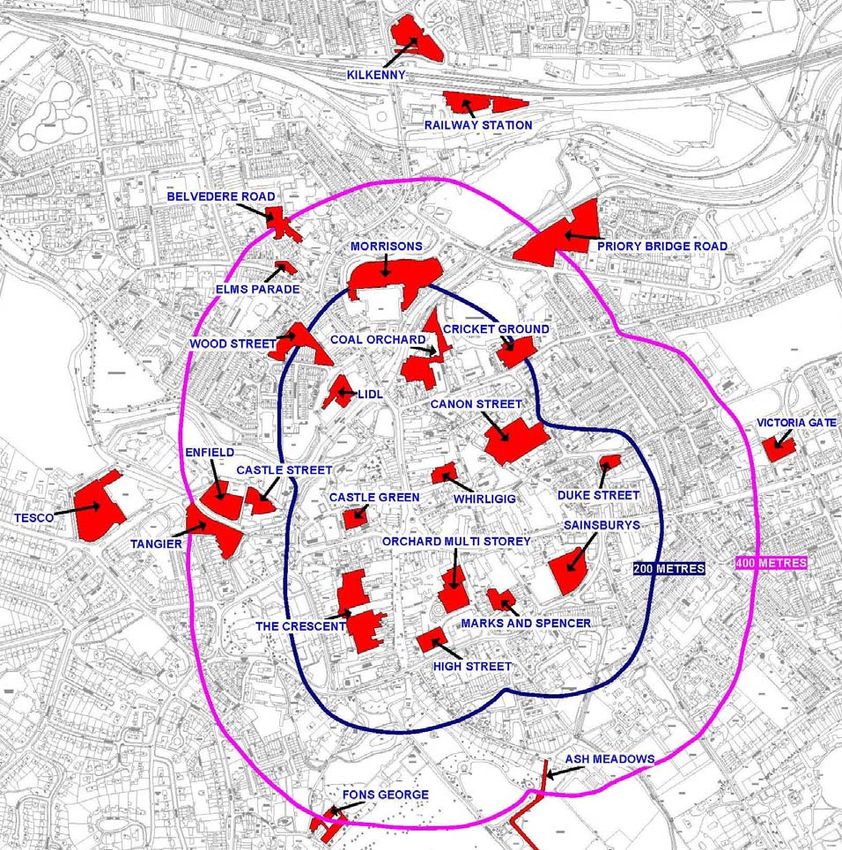
TBDC control. This data is shown in Table 2.1. The location of these car parks
are shown in Figure 2.1.
Ownership Number of Number of
Location Commuter Spaces Shopper Spaces
Belvedere Road TDBC 0 110
Canon Street TDBC 0 288
Castle Green TDBC 0 61
Castle Street TDBC 0 70
Coal Orchard TDBC 0 110
Crescent TDBC 0 226
Cricket Ground Private 200 0
Duke Street TDBC 0 58
Elms Parade TDBC 0 27
Enfield TDBC 197 0
Fons George TDBC 0 83
High Street TDBC 0 257
Kilkenny TDBC 259 0
Lidl Private 0 77
Marks & Spencer Private 0 59
Morrisons Private 0 436
Orchard Multi Storey TDBC 0 553
Priory Bridge Road TDBC 464 0
Railway Station Private 200 0
Sainsbury's Private 0 263
Tangier TDBC 247 0
Tesco Private 0 330
Victoria Gate TDBC 73 0
Whirligig TDBC 0 36
Wood Street TDBC 0 196
TOTAL 1640 3240
Table 2.1 showing total current parking provision at March 2011.
During Summer 2011, it is likely that some of the car parks will be closed or
changed. These are discussed in more detail in Section 3.
DRAFT VERSION – TDBC PARKING STRATEGY AUGUST 2011 7200m - All car parks
within this area are
designated Shopper.
200m to 400m - All car
parks within this area are
designated Shopper apart
from Enfield, Priory
Bridge Road and Tangier
– all Commuter.
Beyond 400m - All car
parks within this area are
designated Commuter.
Based on a medium
walking speed of 3mph
(www.walkit.com), 200m
will take 2 and a half
minutes to walk and
400m will take 5 minutes
to walk.
Figure 2.1 – Location of car parks within Walking Distance of the Shopping Area.
DRAFT VERSION – TDBC PARKING STRATEGY AUGUST 2011 8Privately-owned car parks have also not been included in any detailed analysis of
current trends, along with 4 existing public car parks that were likely to skew
current trend analysis due to their unique nature. These are shown in Table 2.2:
Castle Green Limited Waiting of 2 hours and likely to be closed in the next 6
months.
Fons George Located on the 400m perimeter from the town centre and not
near any retail premises. It has a 6 hour maximum stay and its
primary purpose is to serve leisure use at Vivary Golf course
and Park.
Shire Hall (County Limited to use on a Saturday as used privately during the week.
Hall)
Whirligig Limited Waiting of 2 hours and only provides 36 spaces in total.
Plays a role for those needing to make a very short visit to
Taunton Town Centre.
Table 2.2 Public Car Parks not considered during current trend analysis
However, all of these car parks have been included in future trend predictions.
2.2 Ticket Pricing
Table 2.3 shows the current TDBC car park pricing structure, as of March 2011.
Of note are the three different tariffs. Whirligig and Castle Green are not
represented. Charges apply on Saturdays and Bank Holidays but not Sundays.
Up to
1 hour £1.20
Shopper 1 Car Parks 2 hours £2.00
Canon Street 3 hours £2.70
Coal Orchard 4 hours £3.40
Crescent (maximum stay 4 hours) 5 hours £5.70
High Street, 6 hours £6.10
Orchard Levels 1, 1A, 2, 2A, 3 and 3A 7 hours £7.00
Over 7 £7.60
hours
Up to
Shopper 2 Car Parks 1 hour £1.10
Ash Meadows (maximum stay 3 hours) 2 hours £1.80
Belvedere Road 3 hours £2.10
Castle Street 4 hours £2.60
Duke Street 5 hours £3.70
Elms Parade 6 hours £4.40
Fons George (maximum stay 6 hours) 7 hours £5.20
Orchard Levels 4, 4A, 5 and 5A Over 7 £5.90
Wood Street Shire Hall/The Well/County Hall Car Park (Saturdays) hours
Up to
DRAFT VERSION – TDBC PARKING STRATEGY AUGUST 2011 9Commuter Car Parks 1 hour £1.10
Enfield 2 hours £1.80
Kilkenny 3 hours £2.10
Priory Bridge Road 4 hours £2.60
Tangier 5 hours £3.50
Victoria Gate 6 hours £4.30
7 hours £4.60
Over 7 £5.10
hours
Table 2.3 Car Park Charges for Taunton
All of these car parks are pay and display. All TDBC car parks operate RingGo,
which allows users to book their car into the car park over the phone without
displaying a ticket. The latest data shows that 8% of parking charges are
currently paid for using RingGo (2010/11). Long stay is currently defined as over
7 hours.
2.3 Park and Ride
Since the last review, Gateway Park and Ride (east of M5 J25) has been
completed. A planned extension to the Silk Mills site has been postponed due to
the economic downturn and lack of current demand. Data is shown for the park
and ride sites from November 2010 to mid June 2011 2 :
Silk Mills – Cars Gateway – Cars Ticket Sales
Capacity - 600 Capacity - 1000
Total Daily Average 344 (57%) 313 (31%) 1030
Weekday Average 375 (63%) 344 (34%) 1106
Saturday Average 178 (30%) 153 (15%) 625
Table 2.4 Average Car Occupancy and Ticket Sales at the Park and Ride sites
It is also possible to identify the average people per car overall based on tickets
purchased (not including data on Season tickets):
People per car
Weekdays 1.5
Saturday 1.8
Table 2.5 Average People per Car at Park and Ride sites
Clearly there is still plenty of capacity within both car parks for these to take on
further demand in the short to medium term.
Pricing for the Park and Ride is as follows (July 2011):
• Adult Day Return - £2.20; Child Day Return - £1.30 (5-15 years old
inclusive);
• Shopper Special Ticket - £1.50 per car. Valid for up to 5 people travelling
in the same car, who must travel together on both journeys. Available for
use 10am to 4pm on Mondays to Fridays only;
2
Note that this includes the Christmas period and snow affected days
DRAFT VERSION – TDBC PARKING STRATEGY AUGUST 2011 10• Group ticket - £5.50 (up to 5 people travelling together; valid on day of
purchase only). This ticket makes travel into town even cheaper for groups
of people who car share to the site;
• Weekly ticket - £9.00 or Flexirider - £11.00 (allows 12 single journeys;
valid for one calendar month from day of issue);
• Calendar monthly ticket - £30.00 or Annual season ticket - £300.00.
Data from both the Silk Mills and Gateway Park and Ride sites 3 for an average
weekday shows that most entries (72%) into the car park occur by 9.00am.
Figure 2.2 shows entries into both sites over time during the day, which shows
the peak time for entry is around 8am.
40%
35%
Gateway % of entries by car
Silk Mills % of entries by car
30%
25%
20%
15%
10%
5%
0%
05:00 06:00 07:00 08:00 09:00 10:00 11:00 12:00 13:00 14:00 15:00 16:00 17:00 18:00 19:00 20:00 21:00 22:00 23:00
-5%
Time
Figure 2.2 Entries by car at Silk Mills and Gateway Park and Ride on an average
weekday (April 2010 to April 2011)
2.4 Analysis of Car Park Data
Figure 2.3 shows the total transactions for each month and the percentage split
over time during the day. This data shows that length of stay in the car parks is
broadly consistent during the year and that most shoppers/short stay users park
for 2 hours or less. The exception is in December, where shoppers/short stay
users park for up to 4 hours with a slight trend still shown at 5 hours. After this
point, there is a significant fall in the number of tickets purchased for each hour
until 7 hours and over. Statistical data of this pattern is shown in Appendix A.
3
Automatic Traffic Counters at the entrance to the Park and Ride site
DRAFT VERSION – TDBC PARKING STRATEGY AUGUST 2011 1135%
30%
25%
Total December
20%
15%
10%
5%
0%
1 hour 2 hours 3 hours 4 hours 5 hours 6 hours 7 hours 7+ hours
Figure 2.3 Percentage of tickets sold for each time period during the day in all car
parks compared with December only, 2010/11
2.5 Current Demand for Pay and Display Car Parks
One way to determine current demand is to identify utilisation rates in each car
park and correlate this against the available capacity. This will effectively give a
percentage of the capacity that is currently used. In order to achieve this, In and
Out surveys were conducted in October 2010. During the data collection process,
the vehicle registrations were recorded on entry and exit of each car park, along
with the time that this took place. Using software to match the registrations, it
was possible to build a precise picture of the patterns of activity in each car park.
The data gives the number of vehicles in the car parks of every five-minute
intervals between 7am and 6pm. From this, it is possible to identify the maximum
number of vehicles in the car park at any one point in the day. However it should
be noted that this does not necessarily mean that all those vehicles are parked.
Some people may just drive in, wait for a short while or sometimes just leave
straight away. Indeed 14% of all cars entering and exiting the car parks did so
within the same five-minute period, indicating a drop-off or collection visit. The
highest levels of this activity were identified in The Crescent and Elms Parade
car parks.
By dividing the maximum number of spaces used per day in the remaining car
park by the total number available, it was possible to establish how close to
capacity each car park was (i.e. the utilisation of car parking). In some car parks,
utilisation exceeded 100%. This included Castle Street, the Crescent and
Belvedere Road. It was felt that in these three car parks, additional activity is
taking place that changes the dynamic of the car park and skews the data and
these are discussed below:
DRAFT VERSION – TDBC PARKING STRATEGY AUGUST 2011 12• Belvedere Road Within this car park there was a significant amount of
long stay (likely to be from TDBC staff and residents over night), very
short stay (especially between 12pm and 2pm) as well as activity likely to
be generated by the Tone Leisure Centre. Due to the uncertainties in
these patterns, it is unwise to use this data in capacity analysis.
• Castle Street The data from this car park showed a significantly higher
utilisation to the spaces available. In practical terms it is not possible to
explain this activity that may well be due to the location of the data
collectors, the trips generated to the car park by the Castle Hotel as well
as activity generated by taxis.
• The Crescent There were times during the day when utilisation exceeded
capacity but it is likely this is in part generated by the existence of a motor
repair shop, as well as most deliveries to the High Street accessing these
locations via this car park. In addition the newly opened Tesco store has
its own car park which would not have been included in the TDBC car park
audit.
Due to the factors examined above, it was decided that these three car parks
should be excluded from the overall assessment of existing demand. In addition,
Enfield car park was not included in the original In and Out counts.
The data was combined to give an overall indication of utilisation. This was
divided into Shopper and Commuter parking to ensure that neither datasets were
skewed. This data is displayed in Appendix B. The calculations show the current
demand for Shopper car parks is 83%. In Commuter car parks this figure is 34%.
2.6 Length of Stay in Pay and Display Car Parks
A further calculation was undertaken to identify the total length of stay of each
vehicle that went in and out of the car park. All car parks except Enfield were
included in this analysis. Average length of stay for all car parks is shown in
Figure 2.4. This shows that Commuter car parks have the highest length of stay
at the beginning of the day and this drops off as the day goes on. Shopper car
parks also see a peak prior to 9am, which assumes commuters using these car
parks, and a further peak around 11am, which is more likely to be shoppers. On
average, people in commuter car parks stay longer than in shopper car parks.
DRAFT VERSION – TDBC PARKING STRATEGY AUGUST 2011 137.0
6.0 Commuter
Shopper
5.0
4.0
Hours
3.0
2.0
1.0
0.0
6 7 8 9 10 11 12 13 14 15 16 17 18
Time
Figure 2.4 Average length of stay in Shopper and Commuter Car Parks by arrival
time
In addition, Appendix C shows the proportion of vehicles staying up to a certain
length of time, for example, 1 hour, 2 hours and so on in all car parks. Also
shown is the proportion of vehicles staying for over five and over seven hours.
This is broken down by car park location to show the car parks within 200m,
within 400m and beyond 400m of the shopping area. This shows that within
200m of the shopping area, the majority of users stay for up to 2 hours. However
it should be noted that in Duke Street, High Street and in Orchard Multi Storey,
11% of vehicles stay longer than five hours. This is important because all the car
parks within 200m of the shopping area are designated as Shopper car parks.
Clearly commuters are using these car parks for long stay purposes. In addition,
of the Shopper car parks beyond 200m and within 400m of the shopping area,
Belvedere Road and Castle Street both have high levels of occupancy over five
hours (30% and 42% respectively). It is interesting to note within this category
that Priory Bridge Road has low occupancy over five hours (8%) despite it being
designated as Commuter car park. However, it is anticipated that the new
development at Firepool will significantly increase demand for commuter car
parking in this area. Beyond 400m, car parks are solely for commuter use and
this is largely reflected in the patterns of length of stay. This supports the
discussion in Section 2.4 regarding length of stay of users.
While commuters parking in shopper spaces isn't currently a problem in capacity
terms, as spaces become more in demand in the future this could become an
issue. It is also well known publicly that the lack of Traffic Regulation Order
preventing returns within the day at the Crescent Car Park allows users to stay
all day (by returning to buy an additional ticket as needed). Although The
Crescent Car Park is a four hour maximum stay the Traffic Regulation Order
does not prevent returns on the same day. Renewal of a parking stay can be
affected with RingGo.
DRAFT VERSION – TDBC PARKING STRATEGY AUGUST 2011 142.7 Short stay / long stay timescales The current cut-off between short stay and long stay in TDBC car parks is 7 hours. Through our analysis of In and Out data and the data summarised in Section 2.6, it is clear that a short stay of up to 7 hours could easily accommodate commuter use and that commuters frequently park in designated shopper car parks. The Parsons Brinckerhoff 2007 Report defined short stay as over 6 hours, although this was based on historical best practice rather than evidence of use. In order to define a more accurate cut-off for short and long stay, the In and Out data collected from shopper car parks was used. The length of stay in hours for every vehicle arriving between 9am and 4pm in these car parks was determined. This timeframe was chosen to specifically rule out any obvious commuter users prior to 9am and also to align with the typical retail opening timescale. The 90th percentile was taken from this data and came to 4.1 hours. The 95th percentile came to 5.6 hours. This means that more than 90% of users in shopper car parks stayed for less than 5 hours. Additionally, the data in Figure 2.3 showing the percentage of tickets purchased for 5 hours or more give a representation of the amount of long stay users parking in short stay car parks. This shows a drop in ticket purchases between 4 and 5 hours. Based on the above analysis, it can be assumed that short stay in shopper car parks is realistically up to 5 hours. 2.8 Current Demand for Park and Ride Car Parks It cannot be assumed that people using the Park and Ride sites would automatically park in the town centre if the Park and Ride did not exist so although it provides additional capacity, different behaviours cause people to choose whether to park in the town centre or to park at a Park and Ride. Not all the people using the two sites will wish to travel to the town centre. Some people are also not prepared to pay for parking in the town centre. Furthermore, it is known that some people park and share or park and cycle from the two sites. It is not therefore possible to use the total mean value of use as the current demand for Park and Ride. Based on these externalities, it has been assumed that 75% of the average car park use at the Park and Ride sites contributes to the overall demand for car parking in Taunton. 3. Future Proposals 3.1 Planned Changes to the Car Parks The Project Taunton regeneration work identified the car parks still to be redeveloped within Taunton: DRAFT VERSION – TDBC PARKING STRATEGY AUGUST 2011 15
Importance
                                   Total                                                to Project
                                               Original    Revised
                                 Number of                                            Taunton (1-
Existing Car          Total                   Predicted   Predicted
                                  Parking                                 Notes            very
Park                 Spaces                    Year of     Year of
                                  Spaces                                              important;3
                                               Closure     Closure
                                   Lost                                                   -mildly
                                                                                       important)
                                                                            Not
Castle Green           61              61       2008         2011       counted in          1
                                                                        this study
                                                                          Out of
Cricket
                       200             200      2008         2013         TDBC              3
Ground
                                                                          control
Coal Orchard           110             110      2009         2014                           1
                                                                         Will lose
                                                                        spaces for
Tangier                247             40       2009         2013                           1
                                                                          coach
                                                                         parking
The Crescent           226             226      2011      Not closing                       -
                                                                        Reopen in
High Street            257             257      2011         2014                           1
                                                                           2017
Orchard Multi                                                           Reopen in
                       553             553      2011         2014                           1
Storey                                                                     2017
                                                                        Reduce to
Priory Bridge                                                              200 &
                       464             264      2012         2011                           1
Road                                                                     relocated
                                                                        at Firepool
Castle Street          70               70      2012         2016                           3
Enfield                197              197     2012         2016                           3
TOTAL                 2385             2062

Table 3.1 Car Parks likely to be required for Project Taunton regeneration plans

3.2 Impact of Car Parking Closures
Taking into consideration the above information and using it to project forwards
to 2021, assessments of the demand and available capacity have been
undertaken.

Commuter Parking Levels
Table 3.2 and Figure 3.1 represent the likely impact on commuter car parking
supply and demand if the Project Taunton plans are implemented without any
intervention to mitigate this change. Parking capacity declines steadily until 2014.
At this point, it is assumed that the Silk Mills Park and Ride will be extended,
increasing commuter supply, and parking supply remains static from this point
forwards.

The commuter demand reflects the projected growth in non-residential
(commercial) development (equating to 60,000m² of floor space), which is likely
to take place over the next 10 years. This assumes that 1000 spaces will be
required to accommodate this growth 4 , with development tailing off after 2018.
Commuter demand assumes a consistent rate of growth to 2018. The demand
also assumes that all non-residential development will solely use public car
parks. Realistically, at least some development will provide private spaces. For
4
    Parsons Brinckerhoff 2007 Report

DRAFT VERSION – TDBC PARKING STRATEGY AUGUST 2011                                      16
more information on the previous calculations, see the Parsons Brinckerhoff
2007 Report.
Difference
Commuter Commuter between
Year Notes
Do Nothing Demand capacity and
demand
Current Usage inc P&R + those
2010 3458 1057 2401
using shopper spaces
Priory Bridge Road - 264
2011 3194 1182 2012
reduction
2012 3194 1307 1887
2013 2947 1432 1515 Tangiers Closed - 247
Silk Mills Extension + 400;
2014 3147 1557 1590
Cricket Ground Closed - 200
2015 3147 1682 1465
2016 2950 1807 1143 Enfield Closed - 197
2017 2950 1932 1018
2018 2950 2057 893
2019 2950 2057 893
2020 2950 2057 893
2021 2950 2057 893
Table 3.2 Comparison of Commuter capacity and predicted demand
4000
3500
3000
Available Parking Spaces
2500
2000
1500
1000
500
0
2010 2011 2012 2013 2014 2015 2016 2017 2018 2019 2020 2021
Commuter Do Nothing Commuter Demand
Figure 3.1 Future Demand - Commuter shown against current levels (‘Do
Nothing’ approach)
Shopper Parking Levels
Table 3.3 and Figure 3.2 represents the likely impact on shopper car parking
supply and demand if the Project Taunton plans are implemented without any
intervention to mitigate this change.
The shopper demand reflects the assumption that an additional 721 additional
parking spaces will be required to serve the predicted retail floor space increase
of 50,100m² to 2021. More information on this report can be found in the Parsons
DRAFT VERSION – TDBC PARKING STRATEGY AUGUST 2011 17Brinckerhoff 2007 Report. This has been distributed evenly across the lifetime of
the strategy and reflects the growth in population of the town through the Local
Development Framework process. In addition, the IHT 2005 document ‘Parking
Strategies and Management’ suggests that for retail parking, a degree of
capacity should always be retained to allow for people circulating car parks
looking for a space. It is suggested that this figure is somewhere between 10%
and 15%. For the purposes of this strategy, this figure has been set at 10%.
Difference
Difference
between
between
Shopper Do Shopper Shopper capacity
Year capacity Notes
Nothing Demand Demand +10% and
and
demand
demand
+10%
Current Usage including
2010 3022 2519 503 2771 252 reduction in spaces assumed
to be used by commuters
2011 2961 2584 377 2842 119 Castle Green Closed - 61
2012 2961 2649 312 2914 48
2013 2851 2714 137 2985 -134 Coal Orchard closed - 110
High Street and Orchard MS
2014 2041 2779 -738 3057 -1015
Closed - 257 - 553
2015 2041 2844 -803 3128 -1087
2016 1971 2909 -938 3200 -1228 Castle Street Closed - 70
High Street and Orchard MS
2017 2781 2974 -193 3271 -490
Reopened + 553 + 257
2018 2781 3039 -258 3343 -561
2019 2781 3104 -323 3414 -633
2020 2781 3169 -388 3486 -704
2021 2781 3234 -453 3557 -776
Table 3.3 Comparison of Shopper capacity and predicted demand
4000
3500
3000
Available Parking Spaces
2500
2000
1500
1000
500
0
2010 2011 2012 2013 2014 2015 2016 2017 2018 2019 2020 2021
Shopper Do Nothing Shopper Demand Shopper Demand +10%
Figure 3.2 Future Demand - Shopper shown against current levels (‘Do Nothing’
approach)
DRAFT VERSION – TDBC PARKING STRATEGY AUGUST 2011 184. Possible Strategies to Mitigate Shortfall
The data suggests that given the current provision for commuters, there should
be sufficient parking to meet overall demand when taking into account the two
Park and Ride sites available to users. It is assumed that the Silk Mills Park and
Ride will be extended within the lifetime of the strategy. However, a number of
options need to be considered to address the shortfall in public parking spaces
for shoppers and short-stay visitors. In addition, other options are needed to
address how the car parks function to see if they could be made more efficient or
easier to use. Sections 4.1 and 4.2 look at these two sets of Options separately.
The options are provided simply to give a scope of the range of measures that
can be used to achieve the objectives, without a detailed assessment of how
they may be implemented or supported. Section 5 examines how each option
performs against the Strategy objectives and also at any pros and cons for each
one.
4.1 Options to increase shopper capacity
All of the Options below work on the assumption that the Park and Ride sites
have capacity to take displaced commuters from the town centre 5 .
Option 1 – Restrict all commuter parking in the town centre
It is clear from the analysis that there is capacity within the existing car parking
supply to accommodate shopping users from commuter parking stock if parking
was to be unequivocally reallocated to meet shopper demand. An approach of
limiting the length of stay and greatly increasing long-stay pricing would provide
in the region of 700 additional spaces long-term to 2021. This option would apply
to all TDBC-controlled car parks in Taunton. Commuters would be expected to
use either the Park and Ride or private long stay car parking within the town
centre. It is acknowledged that this option may prove difficult to implement and
may not be appropriate given the lack of flexibility this would then mean for
people wishing to park in Taunton.
Option 2 – Restrict some car parks to short-stay only
As discussed in Section 2.6, some commuters use short stay car parks for long
stay use because there in no restriction on this activity. One way of addressing
this would be to designate more car parking within the town centre (within 200m
of the retail area) as short stay, rather than giving a choice of staying longer.
Retaining some commuter parking both inside and outside of the 200m retail
zone alongside the provision of the two Park and Ride sites should still provide
sufficient provision for commuters, although this should be discouraged through a
pricing mechanism. The short stay for shoppers would also encourage a higher
turnover of users in the car parks. This option would make it more difficult (but
not impossible) for commuters to park in the core of the town centre, prioritising
available capacity for short stay retail purposes. As noted in Section 2.4, short
stay should be set at 5 hours or less. Suggested car parks to include are:
• High Street;
• Orchard Multi Storey, potentially retaining some commuter parking at a
premium;
5
It should be noted that the Silk Mills P&R site has not yet been extended from 600 to 1000
spaces.
DRAFT VERSION – TDBC PARKING STRATEGY AUGUST 2011 19• Canon Street;
• Coal Orchard; and
• Realign the Crescent Traffic Regulation order to 4 hours, no return.
In order to determine the likely additional spaces that could be available, the
percentage of users over 5 hours in these car parks was determined, using data
summarised in Appendix C. However, it should also be noted that some of these
car parks will be closed over the lifetime of this Strategy and therefore the total
additional number of spaces is relatively low. It is anticipated that approximately
200 spaces are currently being used by commuters/long stay. However, more
importantly, this process will create a behaviour change among users so that
commuters are not encouraged to park in the town centre. Long stay parking will
still be available in short stay car parks within 400m of the Town Centre at:
• Belvedere Road;
• Duke Street
• Elms Parade;
• Priory Bridge Road (Firepool);
• Tangier; and
• Wood Street.
Option 3 – Adjust Disabled Parking Length of Stay
The present charging policy allows blue badge holders to park without payment
in any bay in any car park for any length of time. As Table 4.1 shows, there is an
under provision in disabled spaces in some car parks 6 , although Taunton Deane
Borough Council has made progress in ensuring that car parks nearest the town
centre have higher levels of disabled parking than those further away. This
means that if disabled users turn up later in the day and wish to park, they may
be forced to use standard bays.
Percentage
Disabled
Car Park Bays
Canon Street 3%
Coal Orchard 7%
Crescent 3%
Duke Street 2%
High Street 0%
Orchard Multi Storey 1%
Wood Street 0%
Whirligig 19%
Belvedere Road 4%
Castle Street 4%
Elms Parade 0%
Table 4.1 Percentage of Disabled Bays at Shopper Car Parks in Taunton
This option proposes to restrict the time that blue badge holders can stay for free
in marked disabled bays to 3 hours in line with current best practice. In addition,
6
From DfT document ‘Inclusive Mobility’ For car parks associated with shopping areas, leisure or
recreational facilities, and places open to the general public: A minimum of one space for each
employee who is a disabled motorist, plus 6% of the total capacity for visiting disabled motorists.
DRAFT VERSION – TDBC PARKING STRATEGY AUGUST 2011 20more marked bays should be provided, particularly where demand is likely to be higher. Disabled users parking in unmarked bays would be expected to pay. Counts of current usage would be useful to determine existing demand. Option 4 – Retain Castle Street and Enfield As shown in Table 3.1, Castle Street and Enfield car parks are not as fundamental to the Project Taunton regeneration plans as the other car parks. An option is to retain these car parks and ensure they are both short stay only. Option 5 – Retain Coal Orchard There are currently plans to develop on the Coal Orchard car park and they have been identified as fundamental to the Project Taunton proposals. This option would retain Coal Orchard, which is likely to have an impact on the regeneration plans. Option 6 – Encourage shoppers to use Firepool Some of the commuter parking spaces to be provided by the proposed Firepool car park (Priory Bridge Road) could be re-allocated to shoppers in order to diminish the shortfall in town centre parking. The location of this car park will be beyond the desirable walking distance of 200 metres from the edge of the Primary Shopping Area. Therefore, due to the distance from the town centre core area, this is possibly only an option for very mobile shoppers/short stay visitors, or used at Christmas as an overspill facility. This would be very unfavourable for the mobility impaired. Option 7 – Encourage shoppers to use the Park and Ride At present data from traffic counters at the Silk Mills site suggests that just over 20% of shoppers and short-stay visitors use the Park & Ride facility in Taunton. When the shortfall of shopper parking spaces occurs, more shoppers may consider using the Park & Ride facilities rather than attempt to find a parking space in the town centre. Tickets purchased between 10am and 4pm are cheaper for individuals and groups. An estimated 15% increase in Park and Ride use would see 200 more spaces being occupied across the two current sites. A further part of this option would be to allow group tickets to be purchased on Saturdays. Option 8 – Provide temporary parking facilities Figure 3.3 shows that during the years of 2014, 2015 and 2016, the number of town centre parking spaces for shoppers/short-stay visitors will be at the lowest following the closure of the Orchard Multi Storey and High Street car parks. These three years will have a maximum shortfall of approximately 500-680 spaces from the 2010 demand levels before the new Paul Street car park opens in 2017. This option only aims to mitigate the 3-year significant shortfall in provision and not any long term shortfall in parking provision. It would be necessary to work with the developer to phase parking facilities in and out to minimise the impact during construction. Option 9 – Convert Canon Street to a Multi-Storey The potential to convert the existing Canon Street surface car park into a multi- storey car park is identified in the Taunton Town Centre Area Action Plan (October 2006), produced by TDBC. This could provide an additional 300 parking spaces that could be allocated to shoppers and short-stay visitors. Canon Street DRAFT VERSION – TDBC PARKING STRATEGY AUGUST 2011 21
car park is located within 200m of the edge of the Primary Shopping Area.
However there are a number of problems associated with this option: the car
park is situated adjacent to a conservation area, the surrounding highway
network is congested at peak times and the road geometry of Canon Street itself
is relatively poor. Additionally, there is a significant cost associated with this
option, which would need to be addressed.

4.2 Options to improve car park efficiency

Option A – Adjust Charging Scheme
The current scheme consists of three different tariffs – Shopper 1, Shopper 2 and
Commuter. It is not clear what the difference is in these and operationally to
users given the minimal price differences, it is unlikely to make a significant
change in behaviour. This is especially true where the Orchard Multi Storey has 2
sets of shopper charges on different levels. It is possible that this car park could
still retain a limited amount of Commuter parking at a premium rate. The charging
tariffs could be realigned to simply a single shopper tariff and one for the
commuter. Alternatively, the scheme could be redesigned to a short-stay tariff
and a long stay tariff.

Option B – Implement Charges in the Evenings
The current charging tariff ends at 6pm. One option is to charge a flat tariff after
this time for evening use. This is most likely to affect residents parking in public
car parks and people accessing evening events and recreation in the town
centre. Counts of current use are needed to determine existing demand.

Option C – Implement Charges on Sundays
The current tariff system does not charge for parking on Sundays. One option is
to charge a flat tariff for Sunday use. This is most likely to affect people shopping
on Sundays, as Sunday shopping has increased in recent years. Counts of
current use are needed to determine existing demand.

Option D – Increase parking fees on long stay
The car parking within Taunton offers relatively low charges for long stay parkers.
Current parking charges for the existing long term starting point (7 hours) are as
follows:
Shopper 1 £7.60
Shopper 2 £5.90
Commuter £5.10
Increasing charges on long stay (over 5 hours) in both commuter and shopper
car parks would make it a less attractive option for long stay parking in the town
centre. One issue that needs to be considered is that it should not be possible to
buy two short stay tickets for a lower price than one long stay one. Additionally,
maximum stays should be enforced to prevent long stays. Current government
advice seeks not to increase costs on motorists so re-profiling of tariffs would be
required, potentially supporting Option A.

Option E – Provide better information to users
Variable Message Signing on the entrance to the town centre that adjust as car
parks fill up are useful tools to help the motorist find a car parking space more
efficiently, although various studies have questioned their effectiveness over the

DRAFT VERSION – TDBC PARKING STRATEGY AUGUST 2011                               22
long- term 7 . Additionally, improved information via leaflets and the internet (e.g.
height information, availability of disabled spaces and motorcycle parking) can be
made available for users to make better choices before they arrive in the town
centre.

Option F – Increase Motorcycle Spaces
As part of making Taunton a better environment to shop and live, allowing people
to park motorcycles is important as these modes can help to reduce congestion.
Provision in car parks for motorcyclists would fill an identified need 8 . More
information is required on demand as current use is not known. .

Option G – Review Payment Methods
Taunton Deane Borough Council uses Pay and Display on arrival in all of its car
parks as well as operating RingGo. Pay on Foot is a more popular option with
users where motorists are issued a ticket and pay as they leave for the time that
they used, but significant investment is required for implementation. It is
suggested that as new car parks are constructed, such as Firepool and Paul
Street, Pay on Foot is designed in. A phased programme of changes could be
drawn up for the existing car parks where pay on foot could be viably
implemented. Since the system relies on barriers, there may be car parks where
this realistically may not be feasible due to the operational nature of the car park.

Option H – Environmental Improvements
Advances in alternative fuel technology have provided a viable market for electric
vehicles. The Government has recognised the environmental benefits of this
through its purchase subsidy. Running parallel with this is the provision of
charging points. Taunton Deane Borough Council, in conjunction with Project
Taunton and Somerset County Council, has installed two charging points at the
Gateway Park & Ride site and will shortly have twp points in a central Taunton
car park. It is suggested that further investment should be made to increase the
number of charging points across the Borough as vehicle ownership grows.

4.3 Progressing Options
The next section looks at the options appraisal process to see which of the above
options fit best with the aims of this Strategy, as outlined in Section 1.3.

7
  Smith, J. and Phillips, S. (1993) H5/9E:Evaluation of the Leeds Car Park guidance system TRL,
Crowthorne. // IHT/I Struct E (1984) Design Recommendations for Multi-storey and Underground
Car Parks (2nd Edition), IHT/ IStructE // Axhausen, K.W..; Polak, J. W.; Bolttze, M. and Puzicha,
J. (1994) Effectiveness of the Parking Guidance Information system in Frankfurt au Main, Traffic
Engineering and Control, May 1994, 304-309.
8
  Research for the emerging Somerset Motorcycling Strategy identified that lack of suitable
places to secure their vehicles in public car parks is a significant issue for users.

DRAFT VERSION – TDBC PARKING STRATEGY AUGUST 2011                                          23
5. Option Appraisal
    Each option is appraised against the aims of the Strategy, outlined in Section 1.3. An assessment of the main issues is outlined.
    Strongly supports aim 99; Partly supports aim 9; Neither supports nor conflicts with aim -; Conflicts with aim2; Strongly conflicts with aim 22

                                                                                    Make
                          Reduce         Increase     Create better
         Option                                                       Reduce        transport
Option                    long stay in   supply for   town centre                                  Pros                        Cons
         Description                                                  congestion    network more
                          town centre    shoppers     environment
                                                                                    efficient
                                                                                                                               Would prove unpopular
                                                                                                                               given the reduction in
                                                                                                                               choice available to those
                                                                                                                               wishing to park for longer
                                                                                                   Should help reduce peak     periods in the town centre
                                                                                                   hour traffic in town        (even at a premium price);
         Restrict all                                                                              centre;                     Initial changes are likely to
                                                                                                   Encourage commuters to      cause confusion as people
         commuter
1                             99            99               -            9             99         use Park and Ride;          learn new habits;
         parking in the                                                                            Opportunity for travel      Unlikely to be popular with
         town centre                                                                               behaviour change;           the business community as
                                                                                                   Should increase turnover    it requires changes of
                                                                                                   of shoppers in car parks.   patterns of use;
                                                                                                                               More information is
                                                                                                                               needed to determine the
                                                                                                                               exact impacts on traffic
                                                                                                                               flows.

    DRAFT VERSION – TDBC PARKING STRATEGY AUGUST 2011                              24
Make
Reduce Increase Create better
Option Reduce transport
Option long stay in supply for town centre Pros Cons
Description congestion network more
town centre shoppers environment
efficient
Initial changes are likely to
cause confusion as people
learn new habits;
Encourage commuters to
Unlikely to be popular with
Restrict some use Park and Ride;
the business community as
Opportunity for travel
2 car parks to 99 99 - 9 9 it requires changes of
behaviour change;
short-stay only patterns of use;
Should increase turnover
More information is
of shoppers in car parks.
needed to determine the
exact impacts on traffic
flows.
Increased turnover of
users; Need to identify demand
Enforcement through from commuters with a
Adjust Disabled
existing blue badge blue badge to ensure they
3 Parking Length 9 9 - 2 2
(clock system); are not put at a
of Stay
Fairer system for all disadvantage; No current
users, as opposed to knowledge of use.
those who arrive first.
Both car parks within Enfield is a commuter car
Retain Castle 400m of retail zone; park so not designated as
4 Street and - 9 - 9 2 Not identified as short stay;
Enfield fundamental to plans by Unlikely to be that effective
Project Taunton without Option 2
DRAFT VERSION – TDBC PARKING STRATEGY AUGUST 2011 25Make
Reduce Increase Create better
Option Reduce transport
Option long stay in supply for town centre Pros Cons
Description congestion network more
town centre shoppers environment
efficient
Within 200m of retail
zone;
Reduces availability of
Captures vehicles
Retain Coal land for development;
5 - 9 - 9 2 coming from the north
Orchard Capacity not fully utilised if
before entering the town
Option 2 not implemented.
centre even after the
Firepool development
On the cusp of 400m from
Captures vehicles from
the retail zone;
the north before they
Distance may cause an
enter the town centre;
inconvenience for
Frees up short stay in the
Encourage shoppers;
town centre;
6 shoppers to use 2 9 9 9 2 May not provide significant
Puts less demand on
Firepool capacity due to proposed
sites needed for
use;
development and could
Without Option E, may
affect the need for
increase vehicle trips
Options 4 and 5.
around town.
It is cheaper for groups
Reliant on a strong
or families due to the
Encourage marketing campaign;
availability of group
7 shoppers to use 2 9 99 99 99 Makes the shopping
tickets;
Park and Ride experience less
Less traffic in the town
convenient.
centre
DRAFT VERSION – TDBC PARKING STRATEGY AUGUST 2011 26Make
Reduce Increase Create better
Option Reduce transport
Option long stay in supply for town centre Pros Cons
Description congestion network more
town centre shoppers environment
efficient
Significant cost implication
would need committed
funding;
Provide Resolves phasing issues
Would need to take into
temporary with High Street and
account Conservation Area
parking facilities Orchard Multi Storey;
8 2 9 2 2 2 issues;
(likely to be Could increase short stay
Encourages more traffic
Canon Street or spaces with or without
into the town centre;
the Crescent) Option 2.
Any beyond 400m from the
retail zone are likely to be
undesirable.
Significant cost implication
would need committed
funding;
Convert Canon Could increase short stay
Would need to take into
9 Street to a 2 99 22 2 22 spaces with or without
account Conservation Area
Multi-Storey Option 2.
issues;
Encourages more traffic
into the town centre.
DRAFT VERSION – TDBC PARKING STRATEGY AUGUST 2011 27Make
Reduce Increase Create better
Option Reduce transport
Option long stay in supply for town centre Pros Cons
Description congestion network more
town centre shoppers environment
efficient
Easier for decision
makers and users to
understand;
Make better use of the
Adjust Charging Little value implementing in
A 9 9 - 2 9 transport network by
Scheme isolation
influencing behaviour;
Best implemented in
conjunction with other
efficiency measures.
Potential displacement of
people using car parks for
overnight (residential)
purposes;
Does not help increase
supply for shoppers or
Implement Increased revenue
reduce congestion since
B Charges in the - - - 2 - stream for TDBC.
the shops are shut and
Evenings
congestion is less of an
issue in the evenings;
Discourages growth in the
night-time economy;
Needs more enforcement
resource.
DRAFT VERSION – TDBC PARKING STRATEGY AUGUST 2011 28You can also read


