The ANTARES experiment in the Mediterranean sea: overview and first results
←
→
Page content transcription
If your browser does not render page correctly, please read the page content below
D. Zaborov (ITEP-Moscow)
                on behalf of the ANTARES collaboration

           The ANTARES experiment in the
             Mediterranean sea: overview
                   and first results
14th Lomonosov conference on Elementary Particle physics
19-25 Aug 2009
Moscow

* ANTARES = Astronomy with a Neutrino Telescope
and Abyss environmental RESearch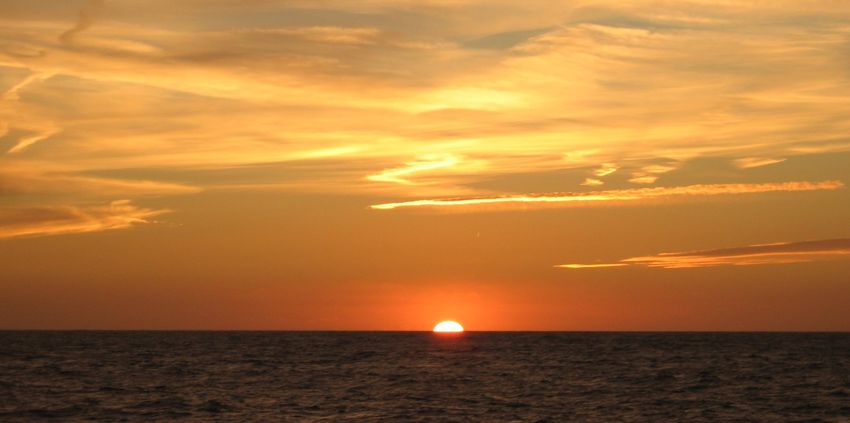
ANTARES site                                         ANTARES shore station

42° 48’ N, 6° 10’ E

                                                     40 km
Deep site near Toulon (France)
                                                 submarine cable
Light absorption length 55 m (at
λ=460 nm)                                                                    -2500 m
Effective diffusion length > 300 m

 Aug 20, 2009         D. Zaborov, ANTARES experiment and its first results             2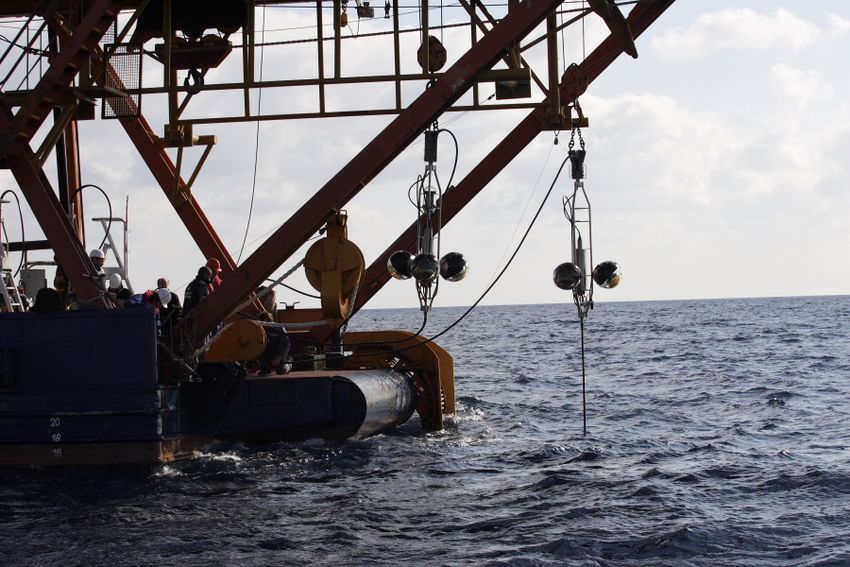
The ANTARES collaboration
NIKHEF, Amsterdam
KVI Groningen
ITEP,Moscow
MSU, Moscow
NIOZ Texel
University of Erlangen
Rem. Stern., Bamberg
ISS, Bucarest
IFIC, Valencia
UPV, Valencia
UPC, Barcelona
CPPM, Marseille
DSM/IRFU/CEA, Saclay
APC, Paris University/INFN of Bari
LPC, Clermont-Ferrand University/INFN of Bologna
IPHC (IReS), Strasbourg University/INFN of Catania
Univ. de H.-A., Mulhouse LNS – Catania
IFREMER, Toulon/Brest University/INFN of Pisa
C.O.M. Marseille University/INFN of Rome
LAM, Marseille University/INFN of Genova
GeoAzur Villefranche
Aug 20, 2009 D. Zaborov, ANTARES experiment and its first results 3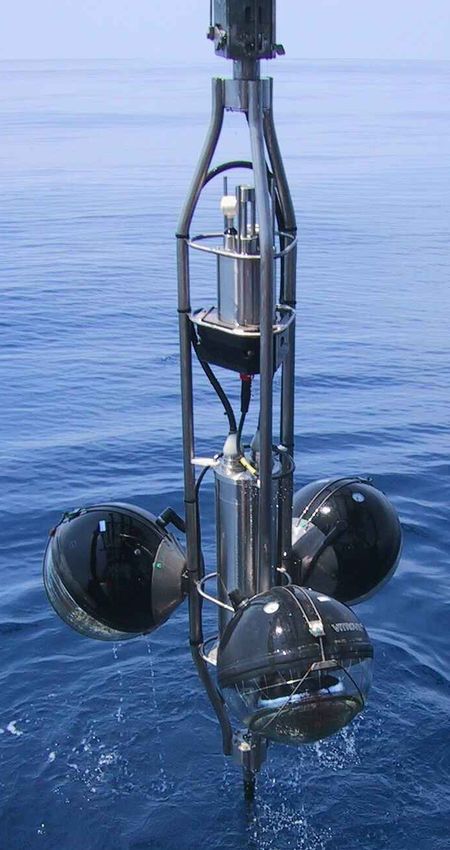
The detector (artist’s view)
                                                              a storey
12 lines (about 900 PMTs)
25 storeys / line
3 PMTs/storey

                                     14.5 m

                                                                350 m
                                                                            40 km to
Horizontal layout                                                            shore

                                                                 100 m Junction
                                                                         box
  ~70 m
Sea
Aug 20,bed
        2009           D. Zaborov, ANTARES experiment and its firstInterlink
               ~ -2500 m                                           results   cables4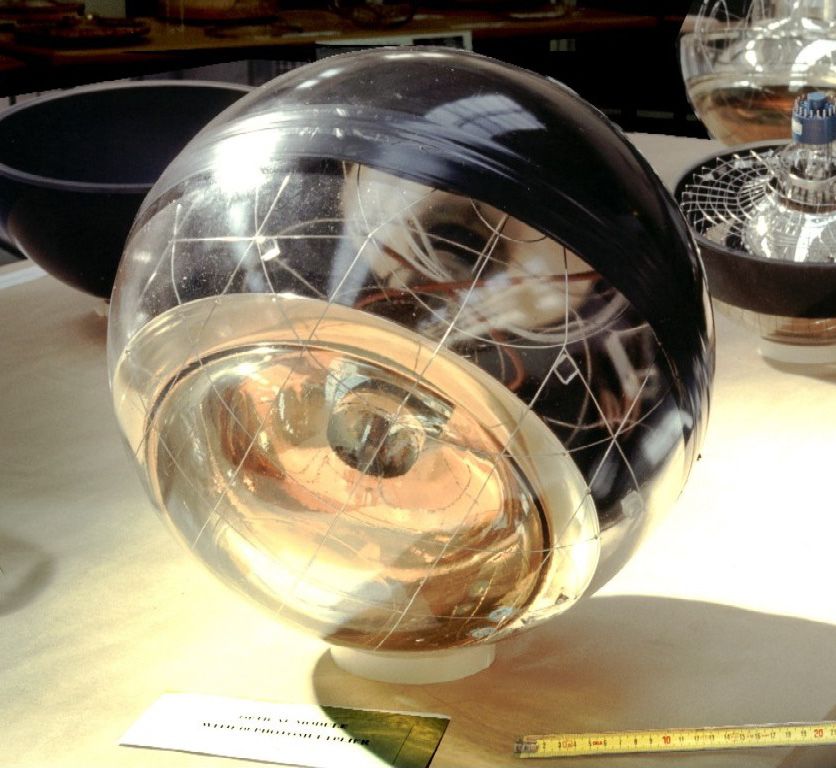
The storey

                                                                             Optical Beacon
                                                                             with blue LEDs:
                                                                            timing
                                                                            calibration
      Optical Module:
10” PMT in 17” glass sphere
     photon detection

 Local Control Module
   (in Ti container):
   Front-end ASIC,
                                                                       Hydrophone:
    Clock, DAQ/SC,
                                                                    acoustic positioning
  compass/roll/pitch
 Aug 20, 2009        D. Zaborov, ANTARES experiment and its first results                5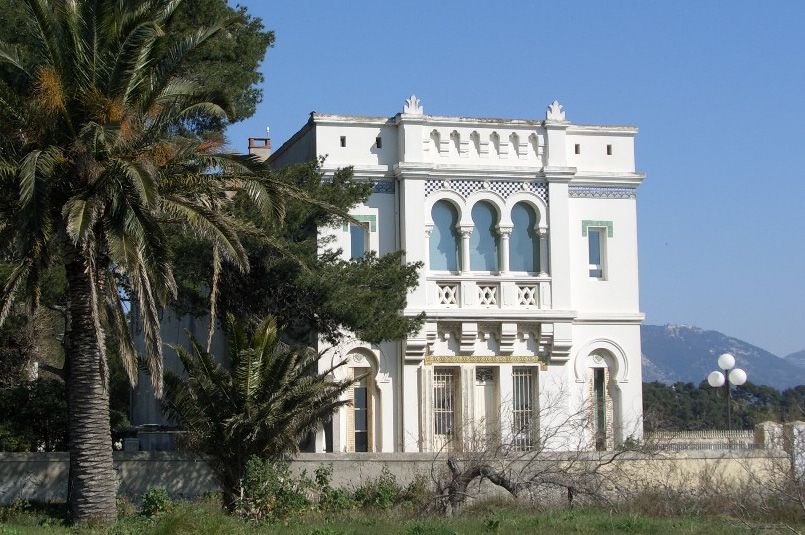
Effective area and angular resolution for νμ

                                                                                  μ
                                                                              ν

For E10 TeV, the resolution is limited
Ndet = Aeff × Time × Flux                         by track reconstruction errors
WB diffuse -> 3 events (7.5 atm) / yr
Aug 20, 2009           D. Zaborov, ANTARES experiment and its first results           6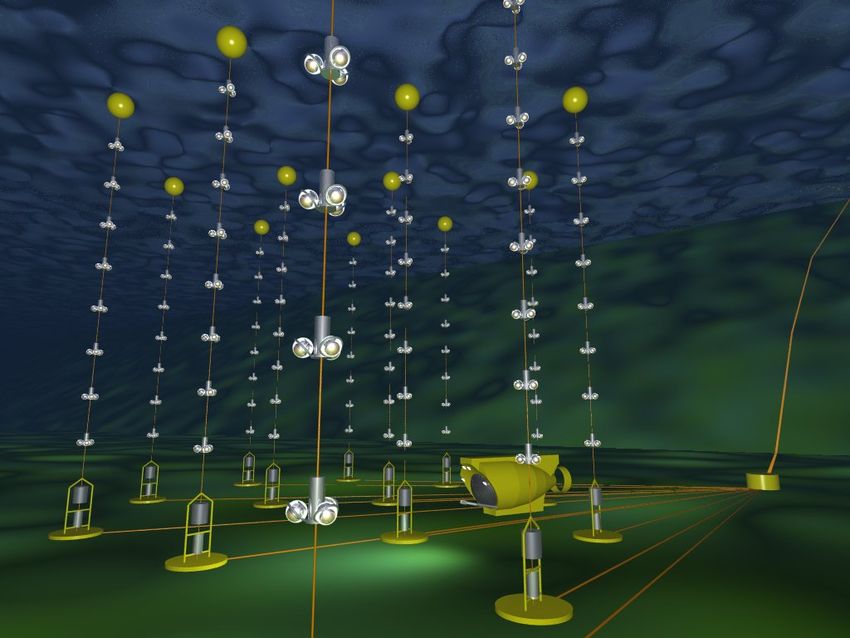
Possible neutrino sources

                       Supernova remnants

                                                      Gamma Ray Bursts

                                  p + A / γ J mesons J ν, γ

                       Microquasars
                       Binary systems
                                                          Active
                                                         Galactic
                                                          Nuclei
                                        …

                   Dark Matter
                   (Neutralino)
?
Exotics (Magnetic Monopoles, etc)
 Aug 20, 2009          D. Zaborov, ANTARES experiment and its first results   7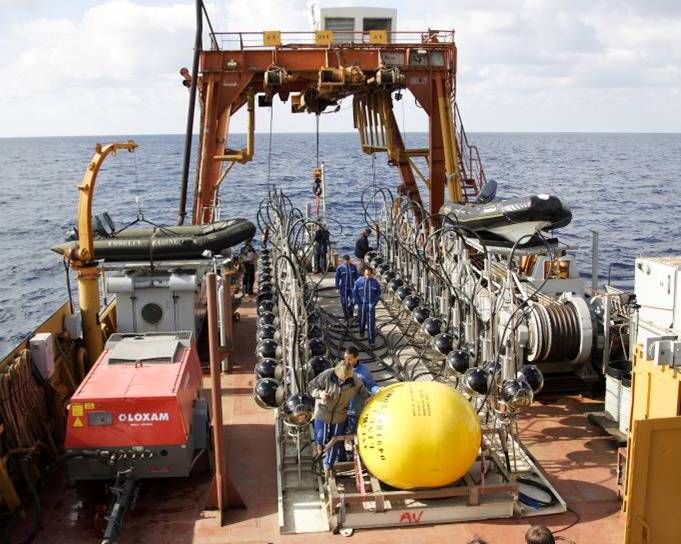
Sky coverage

* Dark grey = visible 100% of the time            Most gamma TeV and UHECR sources
Light grey = visible part of the time             in the field of view of ANTARES !
  Aug 20, 2009           D. Zaborov, ANTARES experiment and its first results    8
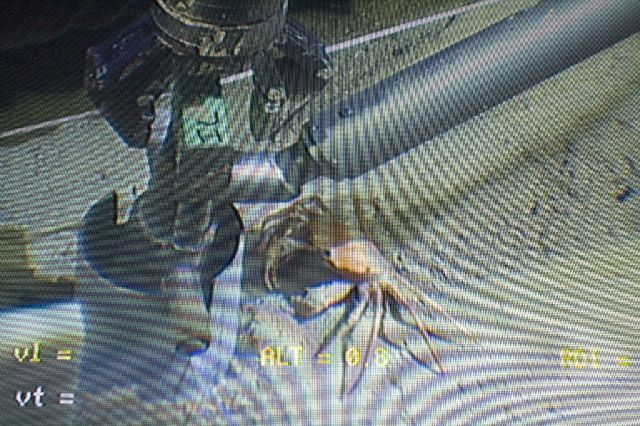
Detector construction
•    1996-2000: detector R&D, site exploration
•    2001: Deployment of 40 km main electro-
     optical cable (Alcatel)
•    2002: Deployment and connection of
     Junction Box
•    2003-2005: Various prototype lines
•    2006-2008: deployment and connection of
     12 detector lines

•    MILOM: 17th Mar 2005
•    Line 1: 2nd Mar 2006

                                                               ~60 m
•    Line 2: 21st Sep 2006
•    Line 3, 4, 5: 29th Jan 2007
•    Line 6, 7, 8, 9, 10 + IL07: 7th Dec 2007
•    Line 11, 12: 30th May 2008
                                                              Apparatus completed!
    Aug 20, 2009       D. Zaborov, ANTARES experiment and its first results    9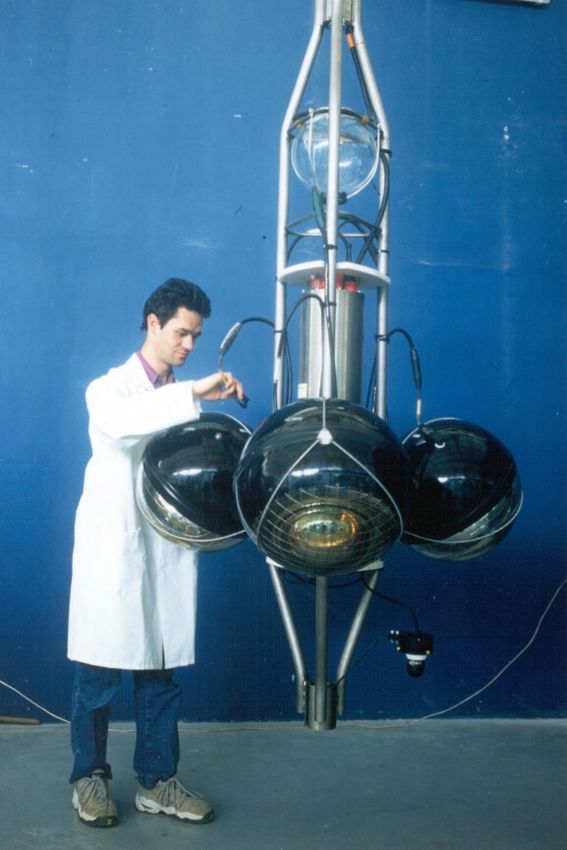
In situ calibration with LED Beacons
                  Time of signal in OMs relative to reference
                   PMT for LED beacon flashes (example)
         3 OMs

                  LED Optical Beacon (LOB) is a powerful source of
                  light flashes, used to control PMT timing in situ
                  Precision ~ 0.5 ns
36 LEDs +
reference PMT
Aug 20, 2009     D. Zaborov, ANTARES experiment and its first results   10
In situ calibration using sea water
Time difference between hits in two OMs Pedestal = random
coincidences
entries
(from 40K and
bioluminescence)
Gaussian peak =
genuine coincidences
γ σ = 4 ns
from 40K
Cherenkov γ Peak offset
e- (β decay) Integral under Gaussian
40K
fit curve = rate of Cross-check of
genuine coincidences time calibration
40Ca LOB-K40
High precision (~5%)
difference σ = 0.4 ns
Concentration of 40K is very stable monitoring of
Rate of genuine coincidences: 16+/-3 Hz OM efficiencies
(independent of bioluminescent activity)
Aug 20, 2009 D. Zaborov, ANTARES experiment and its first results 11A high-energy muon bundle (event display)
Example of a reconstructed down-
height going muon, detected in all 12
detector lines:
time
Aug 20, 2009 D. Zaborov, ANTARES experiment and its first results 12A neutrino-induced muon
Example of a reconstructed up-going
height muon (i.e. a neutrino candidate)
detected in 6/12 detector lines:
time
Aug 20, 2009 D. Zaborov, ANTARES experiment and its first results 13Depth Intensity Relation for the muon flux
1. Track reconstruction (zenith angle)
2. Convertion to “slant depth”
1-line data:
The ANTARES collaboration,
Performance of the First
ANTARES Detector Line,
arXiv:0812.2095 [astro-ph]
5-line data:
Paper in preparation
Aug 20, 2009 D. Zaborov, ANTARES experiment and its first results 14New method: coincidences in adjacent storeys
Integral under the peak
~ muon flux
Delay
between Energy threshold
storeys ~ 4 GeV Δt
(track length)
Muon flux
The analysis is repeated for above 20 GeV
every detector storey
The effect of muon flux reduction with
depth is directly (!) measured
Systematic errors mainly in
normalization (otherwise ~3%)
Aug 20, 2009 D. Zaborov, ANTARES experiment and its first results 15Zenith angle distribution
All 2007/2008 silver runs June 2007 – Dec 2008
5+10+12 lines
neutrinos
341 active day
1062 upward neutrino candidates
upgoing downgoing
Good agreement with “standard” neutrino oscillations: sin2 2θ = 1; Δm2 = 2.4 · 10-3 eV2
Aug 20, 2009 D. Zaborov, ANTARES experiment and its first results 16Neutrino sky map (all sky search)
2007 neutrino sky map
Equatorial coordinates
Data: silver runs 2007 (5 line) No significant excess found
Effective live time: 140 days
94 upgoing multi-line events (neutrino candidates)
Aug 20, 2009 D. Zaborov, ANTARES experiment and its first results 17Search for point-like sources (candidate list) Upper limits obtained with 2007 data (5 lines, 140 livetime days), compared with 1 year of complete detector (12 lines) and other experiments Analysis of 12-line data is ongoing Aug 20, 2009 D. Zaborov, ANTARES experiment and its first results 18
Search for Dark Matter (neutralino annihilation in the Sun)
                                                    Integrated flux above 1 GeV
•     Random walk in mSUGRA
      parameter space:
      0 < m1/2 < 2000 GeV
      0 < m0 < 8000 GeV
      0 < tan β < 60
      -3 m0 < A0 < 3 m0
•     Calculated with DarkSUSY
      and ISASUGRA (RGEcode)
      with mtop = 172.5 GeV
•     Including oscillations

    Using all 5 Line data, and
    only considering time when
    sun was below the horizon,         Flux limit as a function of neutralino mass for two
    including quality cuts,            extreme annihilation cases:
    effective lifetime of 68.4 days
                                       • W-bosons ‘hard’

     Aug 20, 2009            D. Zaborov,•ANTARES
                                          b-quarksexperiment
                                                   ‘soft’ and its first results         19
Outlook • The construction of ANTARES has been completed in May 2008, regular maintenance foreseen for at least 5 years • The setup is operating well, calibration is good • The background of atmospheric muons is well under control • Over 1000 neutrinos have been recorded, zenith angle distribution agrees with MC prediction assuming “standard” neutrino oscillations (sin2 2θ = 1; Δm2 = 2.4 10-3 eV2) • The search for astrophysical neutrino sources is ongoing, as well as Dark Matter searches, and other exciting studies • ANTARES is presently the largest neutrino detector operated in the Northern hemisphere, and it is taking data Aug 20, 2009 D. Zaborov, ANTARES experiment and its first results 20
Thank you for your attention!

Aug 20, 2009       D. Zaborov, ANTARES experiment and its first results   21
Backup slides

Aug 20, 2009   D. Zaborov, ANTARES experiment and its first results   22
Detection principle
                                                                              3D PMT
 p, α                     νμ
                                                                               array
 107           μ                       p Cherenkov light
 μ atm                   104
                         ν atm                 from μ
                                                             γč

             νμ
           1-100          γ                              43°
            ν cosm
                                           Sea floor

                                   μ
νμ         μ         interaction
       W                                  Reconstruction of μ trajectory (~ ν)
N          X         ν                    from timing and position of PMT hits
    Aug 20, 2009              D. Zaborov, ANTARES experiment and its first results 23
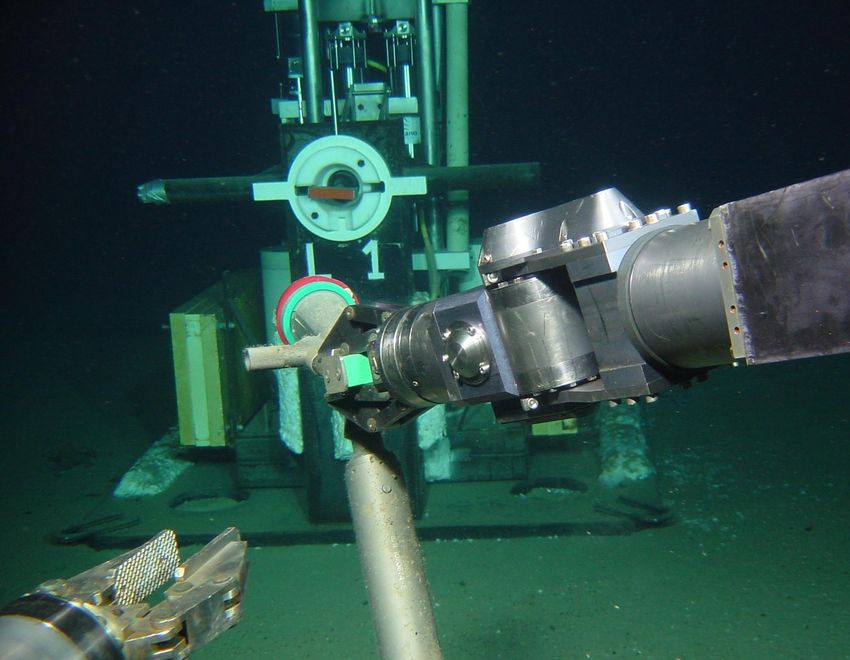
Deployment & connection Aug 20, 2009 D. Zaborov, ANTARES experiment and its first results 24
Optical Module (OM)
Glass sphere                                                          The ОМ

                                                              Hamamatsu R7081-20
                                                             (440 cm2 photocathode)

      PMT            Magnetic screen                                  TTS 1.3 ns
Aug 20, 2009   D. Zaborov, ANTARES experiment and its first results                25
Instrumentation Line IL07
Goals:
• monitor of environmental sea parameters IL 07
• apparatus calibration hydrophones CT
+ acoustic detection prototyping
14.5m
• Components: Camera ADCP
• WetLabs CSTAR light transmissometer (2)
OM
• CT = Seabird Conductivity-Temperature probe 80m
C-Star
with water pump (2)
SV CT
• SV = Sound Velocimeter 14.5m
• ADCP = Acoustic Doppler Current Profiler (1 up,
hydrophones O2
1 down)
• GURALP seismometer with direct Ethernet link 14.5m
• 2 OMs hydrophones C-Star
• 1 Laser + 2 Led Beacon
80m
• Acoustic Positioning RxTx & Rx
Camera
• 02-probe
OM ADCP
• 2 sensitive cameras + IR flash light
hydrophone 98m
• Three floors equipped for acoustic detection
RxTx
R&D (6 hydrophones/storey, part of the Seismo
AMADEUS system)
Aug 20, 2009 D. Zaborov, ANTARES experiment and its first results 26Counting rates (short timescale)
2 min of data
Continuous baseline: Bursts:
Radioactivity of sea water (40K) bioluminescence from
+ bioluminescent bacteria Macroscopic organisms
Aug 20, 2009 D. Zaborov, ANTARES experiment and its first results 27Counting rates (long timescale)
•• MILOM
MILOM
•• L1F1 MILOM
L1F1
•• L1F25 & L1
L1F25 Full Antares
•• IL07
IL07 L1 & L2 Ant. 5L Ant. 10L
& IL07
MILOM Cable Fault
out
MILOM
Only
2005 2006 2007 2008 2009
Long term variations due to seasonal and sea current variability
Aug 20, 2009 D. Zaborov, ANTARES experiment and its first results 28Event display basics
upgoing downgoing
h = 0 – point of closest approach
Aug 20, 2009 D. Zaborov, ANTARES experiment and its first results 29Energy reconstruction (muons)
Two different methods:
• 10 GeV < Em < 100 GeV ⇒ muon range (hit positions)
• Eμ > 1 TeV ⇒ muon energy loss (hit multiplicity/charge)
Average energy loss of muon in water:
High energies dominated by pair
production, bremsstrahlung
Energy resolution ~ factor 2-3
Aug 20, 2009 D. Zaborov, ANTARES experiment and its first results 30Observation of induced electromagnetic showers
from atmospheric muons
μ Light from EM shower is
produced in “one point” on
the muon path and arrives
π delayed
e+e- photo-nuclear
γ pair-creation
bremsstrahlung
Use of dense clusters of hits to
estimate shower multiplicity
preliminary
Aug 20, 2009 D. Zaborov, ANTARES experiment and its first results 31Other analyses
• Search for anisotropies
– downgoing and upgoing muon flux
• Multi-messenger approach
– Neutrino from GRB
• Dump raw data when receiving a GRB alert from GCN
• >300 alerts acuumulated, data analysis in progress
– Optical follow-up program
• collaboration with TAROT
– Coincidences with gravitational wave detectors
• Collaboration with VIRGO and LIGO being discussed
• Galactic center trigger
– First directional trigger in ANTARES
• Diffuse flux limits
– Using muons or hadronic showers
(all-flavor neutrino)
• Exotics
– Magnetic Monopole, nuclearites, etc
Aug 20, 2009 D. Zaborov, ANTARES experiment and its first results 32You can also read


