The BRIDGE initiative and project fact sheets - June 2017 - Cooperation between Horizon 2020 Projects in the - Bridge H2020
←
→
Page content transcription
If your browser does not render page correctly, please read the page content below
Cooperation between Horizon 2020 Projects in the
    field of Smart Grids and Energy Storage

 The BRIDGE initiative and
    project fact sheets

                 June 2017
This brochure has been developed by TECHNOFI within the INTENSYS4EU Coordination and
Support Action (H2020 Grant Agreement n° 731220).

More information at http://www.h2020-bridge.eu/.
Contents
FOREWORD........................................................................................... 3
INTRODUCTION TO THE BRIDGE INITIATIVE ..................................... 5
  PURPOSE OF THE INITIATIVE ................................................................................................. 5
  BRIDGE WORKING GROUPS ............................................................................................... 5
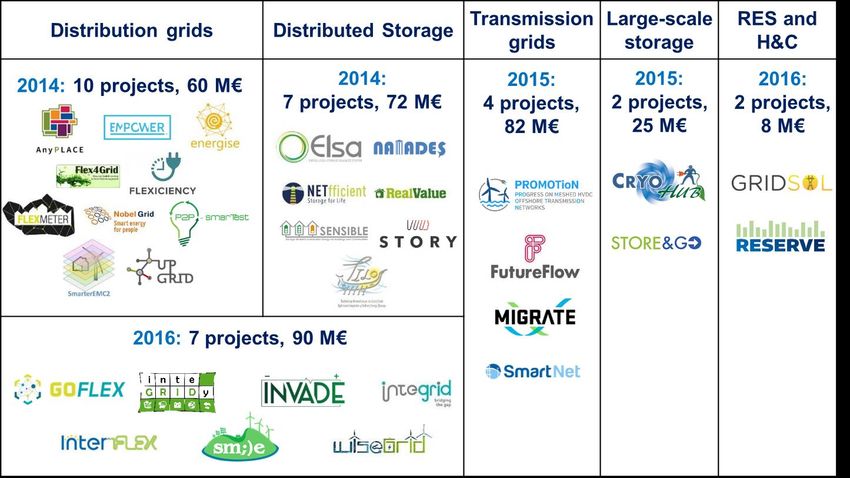
OVERVIEW OF THE BRIDGE PROJECTS ............................................ 6
  HORIZON 2020 CALLS AND CORRESPONDING PROJECTS ....................................................... 6
  STAKEHOLDERS INVOLVED IN BRIDGE PROJECTS ................................................................ 9
  GEOGRAPHICAL DISTRIBUTION OF BRIDGE PROJECTS ........................................................11
     Geographical distribution of stakeholders ..................................................................................... 11
     Geographical distribution of physical demonstrators and pilots .................................................... 13
  TECHNOLOGIES TACKLED BY BRIDGE PROJECTS................................................................15
PROJECT FACT SHEETS ................................................................... 19
  LCE-07-2014 - DISTRIBUTION GRID AND RETAIL MARKET .....................................................20
     AnyPLACE ..................................................................................................................................... 20
     EMPOWER .................................................................................................................................... 22
     ENERGISE .................................................................................................................................... 24
     Flex4Grid ....................................................................................................................................... 26
     FLEXICIENCY ............................................................................................................................... 28
     FLEXMETER ................................................................................................................................. 30
     NOBEL GRID................................................................................................................................. 32
     P2P-SmarTest ............................................................................................................................... 34
     SmarterEMC2 ................................................................................................................................ 36
     UPGRID ......................................................................................................................................... 38
  LCE-08-2014 - LOCAL / SMALL-SCALE STORAGE ................................................................40
     ELSA .............................................................................................................................................. 40
     NETfficient ..................................................................................................................................... 42
     RealValue ...................................................................................................................................... 44
     SENSIBLE ..................................................................................................................................... 46
     STORY .......................................................................................................................................... 48
     TILOS ............................................................................................................................................ 50
  LCE-10-2014 - NEXT GENERATION TECHNOLOGIES FOR ENERGY STORAGE ..........................52
     NAIADES ....................................................................................................................................... 52
  LCE-05-2015- INNOVATION AND TECHNOLOGIES FOR THE DEPLOYMENT OF MESHED OFF-SHORE
  GRIDS ................................................................................................................................54
     PROMOTioN.................................................................................................................................. 54
  LCE-06-2015 - TRANSMISSION GRID AND WHOLESALE MARKET ...........................................56
     FutureFlow ..................................................................................................................................... 56
     MIGRATE ...................................................................................................................................... 58
     SmartNet ........................................................................................................................................ 60

                                                                          1
LCE-09-2015 - LARGE SCALE ENERGY STORAGE ................................................................62
  CryoHub ......................................................................................................................................... 62
  STORE&GO .................................................................................................................................. 64
LCE-02-2016 - DEMONSTRATION OF SMART GRID, STORAGE AND SYSTEM INTEGRATION
TECHNOLOGIES WITH INCREASING SHARE OF RENEWABLES: DISTRIBUTION SYSTEM ...............66
  GOFLEX ........................................................................................................................................ 66
  InteGrid .......................................................................................................................................... 68
  inteGRIDy ...................................................................................................................................... 70
  InterFlex ......................................................................................................................................... 72
  INVADE ......................................................................................................................................... 74
  SMILE ............................................................................................................................................ 76
  WiseGRID ...................................................................................................................................... 78
LCE-07-2016-2017 - DEVELOPING THE NEXT GENERATION TECHNOLOGIES OF RENEWABLE
ELECTRICITY AND HEATING/COOLING ...................................................................................80
  GRIDSOL ....................................................................................................................................... 80
  RESERVE ...................................................................................................................................... 82

                                                                       2
Foreword
The vision of the Energy Union put forward by the European Commission in February 2015 is of an
integrated continent-wide energy system where strong, innovative and competitive companies can
develop the industrial products and technology needed to deliver energy efficiency and low-carbon
technologies. Citizens should be able to take ownership of the transition and participate actively in the
market. Both the Energy Union and the Digital Single Market focus on tangible benefits for the consumer.
Important milestones for this transformation are the EU's energy and climate targets for 2030 which also
underpin Europe's leading role in the fight against climate change.
A shift towards a low-carbon economy calls for increasing digitalisation of the energy system. Digital
developments (big data, the internet of things, 5G, artificial intelligence, smart grids, smart metering,
smart buildings, smart charging solutions for electric vehicles, etc.) impact multiple aspects of European
energy policy. An ever smarter energy system can perform power generation, transmission, network
management and marketing-related tasks with better precision and faster response times than human-
dependent systems, thereby saving energy, prioritising usage, and setting policies for quick response
to outages. Technological developments also allow for much-needed cross-sectorial synergies (e.g.
between energy, ICTs and telecoms).
With the strong belief that innovation is an investment in our future, the European Commission is
supporting, via Horizon 2020 – the biggest EU Research and Innovation programme ever – close to
market projects on Smart Grids and Energy Storage, which have the potential to contribute to a
successful, digitally-supported energy transition.
To complement the work of each individual project, we have launched the BRIDGE initiative. This allows
ongoing Horizon 2020 Smart Grid and Energy Storage projects to contribute to creating a common view
on cross-cutting issues they encounter that may be obstacles to innovation.
We welcome the first BRIDGE projects brochure. It shows clearly the different areas they address in
terms of technologies or enabled services, the project partners and the geographical coverage. We look
forward to welcoming new projects when they start, thus making it a living platform.
Enjoy the reading!

      Andreea Strachinescu                   Eddy Hartog                     Robert Goodchild

    Head of Unit, New energy
  technologies, innovation and        Head of Unit, Smart Mobility      Head of Unit, H2020 Energy
     clean coal, Directorate            and Living, Directorate          Research, Innovation and
  General for Energy, European         General Communications           Networks Executive Agency,
          Commission                    Networks, Content and             European Commission
                                        Technology, European
                                             Commission

                                                   3
4
Introduction to the BRIDGE initiative
Purpose of the initiative
BRIDGE is a cooperation group involving
                                                      Regulations
32 Low Carbon Energy (LCE) Smart-Grid
and Energy Storage projects funded under              • As regards to energy storage, the regulatory
the Horizon 2020 program over the last                  framework needs to provide clear rules and
three years (2014-2016). It aims to foster              responsibilities    concerning      ownership,
the exchange of information, experience,                competition, technical modalities and
                                                        financial conditions, for island and mainland
knowledge and best practices among its
                                                        cases
members.
                                                      • In terms of smart grids, regulatory
BRIDGE wants to provide field experience,               challenges arise regarding the incentives for
feedback and lessons learned from the                   demand-side        response,       commercial
participating projects to help overcome the             arrangements, smart meter data, etc.
barriers to effective innovation. It aims to
gather coordinated, balanced and coherent
recommendations to strengthen the                     Customer Engagement
messages and maximize their impacts
towards policy makers in view of removing             • Customer      Segmentation,    analysis   of
barriers to innovation deployment.                      cultural,     geographical    and     social
                                                        dimensions,
                                                      • Value systems - Understanding Customers
BRIDGE Working Groups                                 • Drivers for Customer Engagement
                                                      • Effectiveness of Engagement Activities
This cooperation group involves four                  • Identification of what triggers behavioral
different types of activities (Working                  changes (e.g. via incentives)
Groups) addressing cross-cutting issues
                                                      • The Regulatory Innovation to Empower
enlisted as follows:                                    Consumers

 Data Management
• Communication Infrastructure, embracing
  the technical and non-technical aspects of          Business Models
  the communication infrastructure needed to          • Defining common language and frameworks
  exchange data and the related requirements            around business model description and
• Cybersecurity and Data Privacy, entailing             valuation
  data integrity, customer privacy and                • Identifying and evaluating existing and new
  protection                                            or innovative business models from the
• Data Handling, including the framework for            project demonstrations or use cases
  data exchange and related roles and                 • The development of a simulation tool
  responsibilities, together with the technical         allowing for the comparison of the
  issues supporting the exchange of data in a           profitability of different business models
  secure and interoperable manner, and the              applicable to smart grids and energy storage
  data analytics techniques for data processing         solutions is being developed and tested by the
                                                        Working Group members

                                                  5
Overview of the BRIDGE projects
Horizon 2020 calls and corresponding projects
The participating projects to the BRIDGE LCE-07-2014 - Distribution grid and
initiative have been selected under different retail market
H2020 calls from 2014 to 2016.
AnyPLACE: Adaptable Platform for
The projects selected under the 2014 calls Active Services Exchange
focus on distribution grid and storage http://www.anyplace2020.org/
topics. EMPOWER: Local Electricity retail
Markets for Prosumer smart grid pOWER
LCE-08-2014 - Local / small-scale services
storage http://empowerh2020.eu/
ENERGISE: ICT-based ENERgy Grid
ELSA: Energy Local Storage Advanced
Implementation – Smart and Efficient
system http://elsa-h2020.eu/
http://project-energise.eu/
NETFFICIENT: Energy and economic
Flex4Grid: Prosumer Flexibility Services
efficiency for today’s smart
for Smart Grid Management
communities through integrated multi
https://www.flex4grid.eu/
storage technologies
http://netfficient-project.eu/ FLEXICIENCY: energy services
demonstrations of demand response,
RealValue: Realising Value from FLEXibility and energy effICIENCY
Electricity Markets with Local Smart based on metering data
Electric Thermal Storage Technology http://www.flexiciency-h2020.eu/
http://www.realvalueproject.com/
FLEXMETER: Flexible smart metering
SENSIBLE: Storage-Enabled for multiple energy vectors with active
Sustainable Energy for Buildings and prosumers
Communities http://flexmeter.polito.it/
http://www.h2020-project-sensible.eu/ NOBEL GRID: New Cost Efficient
STORY: Added value of STORage in Business Models for Flexible Smart Grids
distribution sYstems http://nobelgrid.eu/
http://horizon2020-story.eu/ P2P-SmartTest: Peer to Peer Smart
TILOS: Technology Innovation for the Energy Distribution Networks
Local Scale, Optimum Integration of http://www.p2psmartest-h2020.eu/
Battery Energy Storage SmarterEMC2: Smarter Grid:
http://www.tiloshorizon.eu/ Empowering SG Market Actors through
Information and Communication
Technologies
LCE-10-2014 - Next generation http://www.smarteremc2.eu/
technologies for energy storage UPGRID: Real proven solutions to enable
active demand and distributed generation
NAIADES: Na-Ion bAttery flexible integration, through a fully
Demonstration for Electric Storage controllable LOW Voltage and medium
http://www.naiades.eu/ voltage distribution grid
http://upgrid.eu/
6
In 2015, the H2020 calls covered The demonstration projects selected under
transmission grid and large-scale storage the 2016 H2020 calls focused on
areas. distribution system (grid and storage). In
addition, two projects dealing with
LCE-05-2015 - Innovation and renewable technologies and their
technologies for the deployment of integration to the power system were
meshed off-shore grids invited to join BRIDGE.
PROMOTION: Progress on Meshed LCE-02-2016 - Demonstration of smart
HVDC Offshore Transmission Networks grid, storage and system integration
https://www.promotion-offshore.net/ technologies with increasing share of
renewables: distribution system
LCE-06-2015 - Transmission grid and
wholesale market GOFLEX: Generalized Operational
FLEXibility for Integrating Renewables in
FutureFlow: Designing eTrading the Distribution Grid
Solutions for Electricity Balancing and http://www.goflex-community.eu/
Redispatching in Europe InteGrid: Demonstration of INTElligent
http://www.futureflow.eu/ grid technologies for renewables
INTEgration and INTEractive consumer
MIGRATE: Massive InteGRATion of participation enabling INTEroperable
power Electronic devices market solutions and INTErconnected
https://www.h2020-migrate.eu/ stakeholders
SmartNet: Smart TSO-DSO interaction https://integrid-h2020.eu/
schemes, market architectures and ICT inteGRIDy: integrated Smart GRID
Solutions for the integration of ancillary Cross-Functional Solutions for Optimized
services from demand side management Synergetic Energy Distribution, Utilization
and distributed generation Storage Technologies
http://smartnet-project.eu/ http://www.integridy.eu/
INTERFLEX: Interactions between
LCE-09-2015 - Large scale energy automated energy systems and
storage Flexibilities brought by energy market
players
http://interflex-h2020.com/
CryoHub: Developing Cryogenic Energy
Storage at Refrigerated Warehouses as INVADE: Smart system of renewable
an Interactive Hub to Integrate energy storage based on INtegrated EVs
Renewable Energy in Industrial Food and bAtteries to empower mobile,
Refrigeration and to Enhance PowerGrid Distributed and centralised Energy
Sustainability storage in the distribution grid
http://cryohub.eu/en-gb/ https://www.invadeh2020.eu/
SMILE: SMart IsLand Energy systems
STOREandGO: Innovative large-scale
Website under construction
energy STOragE technologies AND
Power-to-Gas concepts after WiseGRID: Wide scale demonstration of
Optimisation Integrated Solutions and business
http://www.storeandgo.info/ models for European smartGRID
http://www.wisegrid.eu/
7
In 2017, BRIDGE gathers a total of 32
LCE-07-2016-2017 - Developing the
projects, involving 379 organisations from
next generation technologies of
31 countries for a total EC funding to all
renewable electricity and
projects of 337 M€.
heating/cooling
GRIDSOL: Smart Renewable Hubs For
Flexible Generation: Solar Grid Stability
http://www.gridsolproject.eu/
RE-SERVE: Renewables in a Stable
Electric Grid
http://www.re-serve.eu/
8Stakeholders involved in BRIDGE projects
Different types of stakeholders are
participating in the BRIDGE initiative. The
following categorisation has been adopted.
Power technology providers are
hardware manufacturers for power
transmission, distribution and generation
technologies. Storage providers are
Consumers include residential, considered in a separate category (all
professional and industrial consumers, as storage technologies are considered,
well as cities acting as consumers in including batteries from EVs and hot water
projects. tanks). ICT providers are software and
telecommunication vendors.
Regulated Operators are TSOs and DSOs
as defined by the Electricity Directive. Energy Suppliers include power
generators, retailers, energy service
companies (ESCOs) acting in the
competitive energy market. Aggregators
are market participants that combine
multiple customer loads or generated
Regulators are the National Regulatory electricity for sale, for purchase or auction
Authorities as defined by the Electricity in any organised energy market. Market
Directive. operators include power exchanges,
brokers and traders on the energy markets.
Local Energy Communities are defined
as associations, cooperatives, Research & Innovation stakeholders
partnerships, non-profit organisations or include research centres, universities,
other legal entities which are effectively think-tanks, consultants and other services.
controlled by local shareholders or
members, generally value rather than
profit-driven, involved in distributed
generation and in performing activities of a Others is a category that covers
distribution system operator, supplier or stakeholders that do not fall in any of the
aggregator at local level, including across above-defined categories such as
borders. international organisations, communication
agencies, water supply operators…
9The type of an association depends on the Technology providers represent equally
type of members it represents. power technology providers, storage
providers and ICT providers (one third
Some stakeholders fall into several each).
categories: electricity operators on islands
for instance, act both as energy suppliers Energy suppliers constitute the main
and DSOs; some power technology electricity market players involved in
providers sell ICT tools and storage BRIDGE projects followed by a small
devices. number of aggregators. No Market
operators are involved in BRIDGE
The following diagram categorises projects.
stakeholders according to their dominant
role within the BRIDGE projects, as seen by Research and Innovation actors are the
the project coordinators. dominant category of stakeholders in
BRIDGE projects.
One third of the regulated operators are
TSOs and two thirds are DSOs.
Regulators are not represented in
H2020 project involved in BRIDGE.
10Geographical distribution of BRIDGE projects
Geographical distribution of stakeholders
BRIDGE projects involve stakeholders from number of projects, meaning that on
31 countries as presented by the figure average two partners from the same
below. country are participating in each project. In
some cases however, there are more
The number of projects per country is projects than stakeholders involved for a
calculated based on the stakeholders given country, meaning that the same
involved in the projects stakeholders participate in several projects
The number of stakeholders involved (examples from Austria and Finland).
per country corresponds to the total It has to be noted that non-EU stakeholders
number of partners from this country in (from Norway, Switzerland, Turkey, Iceland
all the BRIDGE projects. and Serbia) are participating in BRIDGE
German stakeholders are the most projects.
represented in BRIDGE projects, followed Furthermore, two Member States are not
by stakeholders from Spain, UK, Italy, represented in BRIDGE projects: Croatia
France and Belgium. and Lithuania.
The number of stakeholders involved per
country is in general about twice the
11Number of stakeholders involved per country
12Geographical distribution of physical demonstrators and pilots
Most of the BRIDGE projects involve Germany hosts the highest number of
demonstrations or pilot tests of demo sites, followed by Spain, Italy, UK,
technologies and solutions. France, Greece, Portugal and Sweden.
BRIDGE demos or pilots are hosted by 26
countries as indicated on the figure and the
map below.
13Number of demos or pilot sites per country
14Technologies tackled by BRIDGE projects
A broad range of technologies and services
are being tested by BRIDGE projects. Six
main categories are considered here:
Technologies for Consumers: Demand Small-scale storage technologies, in
response, smart appliances, and smart general connected at distribution level2:
metering. batteries (including from electric vehicles),
thermal energy storage (including power to
heat, heat pumps, hot water tanks,
geothermal storage), and flywheels.
Grid technologies: HVDC, HVAC, Multi
terminal, protections, HVDC breaker,
inertia, network management, monitoring
and control tools, and micro-grid. Generation technologies: wind turbines,
photovoltaic (PV), solar thermal, biogas,
tidal energy, and micro-generation.
Large-scale storage technologies, in
general connected at transmission
level1: Power to Gas (P2G), Compressed Market: electricity market and ancillary
Air Energy Storage (CAES) and hydro services
storage.
1 It might happen however that such 2 Batteries might also be connected at
technologies, at a smaller scale, are connected transmission level.
at distribution level (in particular CAES).
15The next figure indicates the number of technologies and again two thirds are
BRIDGE projects deploying the 6 main addressing market issues.
categories of technologies and services.
Generation technologies are addressed by
It appears that two thirds of the BRIDGE 14 projects.
projects are dealing with technologies for
consumers. Storage is mainly addressed at small-scale
level by half of the projects.
Two thirds of the projects (overlapping with
the previous ones) are dealing with grid
16The next figures show more specifically the Regarding storage technologies, one
exact distribution of projects for each project deals with power to gas, two with
category of technologies or services. CAES and one involves hydro storage. The
main small-scale storage technologies
Technologies for consumers mainly addressed are the batteries (a large part
address demand response and smart being from electric vehicles) and thermal
metering; 10 projects also deal with smart energy storage. Flywheels are tested by 2
appliances to be deployed at consumer projects.
level.
In terms of grid technologies, a high
number of projects deal with network
management, monitoring and control tools,
as well as with micro-grids.
17With regards to generation technologies, In terms of market aspects, electricity
PV, wind and micro-generation are the markets and ancillary services are equally
most commonly addressed. addressed.
18Project fact sheets
The current section describes each Each project is presented over two pages:
project participating in the BRIDGE On the first page, a brief summary of the
initiative. project is given, as well as the project
Projects are presented by call – easily start and end years, the budget, the
identifiable by a colour – and for each website, the technologies and services
deployed, the project partners’
call by alphabetical order.
countries, the name of the coordinating
LCE-07-2014 - Distribution grid and organisation and of the other partners;
retail market The second page presents the project in
details, in terms of scope, technical
LCE-08-2014 - Local / small-scale description and expected impact.
storage
LCE-10-2014 - Next generation
technologies for energy storage
LCE-05-2015 - Innovation and
technologies for the deployment of
meshed off-shore grids
LCE-06-2015 - Transmission grid and
wholesale market
LCE-09-2015 - Large scale energy
storage
LCE-02-2016 - Demonstration of smart
grid, storage and system integration
technologies with increasing share of
renewables: distribution system
LCE-07-2016-2017 - Developing the
next generation technologies of
renewable electricity and
heating/cooling
19H2020 call: LCE-07-2014 - Distribution grid and retail market
AnyPLACE
Adaptable Platform for Active Services
Exchange
AnyPLACE is a European project that will develop a modular energy management system
capable monitoring and controlling local devices according to the preferences of end-
users.
From 2015 Project total cost EU contribution Website
To 2017 3.0 M€ 2.5 M€ http://www.anyplace2020.org/
Technologies and services Project partners’ countries
Demand response
Technologies for consumers Smart appliance
Smart metering
Grid technologies Micro-grid
Large-scale storage technologies
Batteries
Distributed storage technologies
Electric Vehicles
PV
Generation technologies
Micro-generation
Electricity market
Market
Ancillary services
Coordinator: INESC TEC (PORTUGAL)
Other partners:
TECHNISCHE UNIVERSITAET WIEN (Austria) EFACEC ENERGIA - MAQUINAS E EQUIPAMENTOS
HOCHSCHULE OSTWESTFALEN-LIPPE (Germany) ELECTRICOS SA (Portugal)
JRC -JOINT RESEARCH CENTRE- EUROPEAN POWER PLUS COMMUNICATIONS AG (Germany)
COMMISSION (Belgium) BOSCH TERMOTECNOLOGIA SA (Portugal)
KREIS LIPPE (Germany)
20Project Description Impact. Replicability: the modular and
configurable nature of the solution supported by
Context. The platform to be developed within the regulatory and context characterization of
the AnyPLACE project is designed to allow the the potential cases of use of AnyPLACE make
energy management of buildings, targeting the solution under development to be applicable
mainly households, by managing and to a wide variety of scenarios.
controlling existing loads, generation and
storage resources according to their flexibility. It Socio-economics: the characterization of the
will allow the local energy management, with socio-economic contexts in the different
the purpose of optimizing the energy use, and consortium countries and the cost-effective
allow the end-user to become an active nature of the solution under development
participant in new energy services provision like makes it focused on taking advantage of
demand response, offered by service providers existing devices and system that allow benefits
like retailers or aggregators. to be derived by common users instead of
focusing of state-of-the-art fully automated and
Scope. The overall scope of the project is to
expensive cases (households) which are not
implement an energy management platform
accessible to all.
that truly engages its end-users to manage and
control their energy use inside their houses and Environment: the increase in awareness by the
buildings. In order to achieve that, a variety of end-users about the flexible and optimized use
functionalities regarding control and of energy resources, that is expected to be
management of in-building energy resources accomplished by the solution, will allow them to
have to be defined along with an interoperable take more informed decisions and align their
strategy between components, systems and financial interest with the potential
actors. environmental benefits associated to the
The envisaged solution is expected to be highly efficiency increase.
configurable and adaptable to different contexts Market Transformation: the integration of
(e.g. regulatory, social and economic), several stakeholders in the definition of the
scenarios (e.g. types of building, available loads solution allows it to be explored in the provision
and generation) and types of end-user (e.g. of new energy services by making the end-user
different age, background), allowing its use to an active participant in them.
be as broader as possible.
Policy: the support of new services that is
The platform is oriented towards the
expected to be shown by the project can
management of the energy use by exploring the
potentially contribute towards their use in
potential flexibility in the electricity consumption,
countries where currently the legal regulation
and whenever possible, make use of local
does not allow them or discourages their
energy generation and storage.
implementation (e.g. demand response).
As a product the AnyPLACE platform is
Embedded User Interface Remote User Interfaces
expected to be used by general domestic users End-User
End-User
and some special groups of users (commercial Display
Gadgets
and services). The modular and interoperable Legacy Appliances
Legacy Electricity Meters
characteristics makes this solution usable in End-User
Integration Interface Appliances
most of the EU countries. Retrofitting
Technical description and implementation. Water, Gas & Heat Meters
AnyPLACE Control Smart Appliances
The project is not focused on the research of Integration
Central
any particular type of technology but rather on Smart Meters
Unit Compatibility
the use of existing one in a cost-effective way Cybersecurity
Ineroperability
Compatibility
that allow the successful implementation of an
Microgeneration & EV
energy management solution. As such the main External Entities
result is the design and implementation of a
Water, Gas &
software and hardware platform that interacts DSO Heat utilities
with devices, systems and users to explore the DSO communication infrastructure Energy
Retailer
flexibility of loads and generation to increase the
efficient use of energy. Given the high TRL AnyPLACE Basic Modules AnyPLACE External Communications
AnyPLACE Advanced Modules AnyPLACE In-Building Communications
expected of the final solution of AnyPLACE the
technology should be close to the market
implementation.
21H2020 call: LCE-07-2014 - Distribution grid and retail market
EMPOWER
Local Electricity Retail Markets for
Prosumer Smart Grid Power Services
EMPOWER encourages micro-generation and the active participation of prosumers to
exploit the flexibility created for the benefit of all connected to the local grid.
From 2015 Project total cost EU contribution Website
To 2017 6.1 M€ 4.4 M€ http://www.empowerh2020.eu/
Technologies and services Project partners’ countries
Demand response
Technologies for consumers Smart appliance
Smart metering
Grid technologies Network management,
monitoring and control
tools
Micro-grid
Large-scale storage technologies
Batteries
Distributed storage technologies
Electric vehicles
Wind Turbine
Generation technologies
PV
Electricity market
Market
Ancillary services
Coordinator: SCHNEIDER ELECTRIC NORGE AS (NORWAY)
Other partners:
SMART INNOVATION NORWAY AS (Norway) UNIVERSITAT POLITECNICA DE CATALUNYA (Spain)
ESMART SYSTEMS AS (Norway) MALTA INTELLIGENT ENERGY MANAGEMENT
FREDRIKSTAD ENERGI NETT AS (Norway) AGENCY (Malta)
UNIVERSITAET ST. GALLEN (Switzerland) NEWEN PROJECTS GMBH (Germany)
22Project Description and involvement and the design and
development of the new local energy
Context. The EMPOWER project aims to market.
encourage and enable active end-user
participation for local energy trading and related The cloud-based trading platform being
services in the distribution grid. To this end, a developed will enhance participation of the
new market player role titled "Smart Energy market agents and the creation of submarkets
Service Provider" (SESP) has been defined. in order to satisfy the community needs. The
SESP engages the local community, involves design of cooperative community markets, its
various agents towards energy and flexibility effect on incentivizing cooperatives to promote
trading, optimizes market operations and transition to renewable energy generation that
creates value that can be translated to novel fosters climate solidarity will be outlined.
business models. SESP manages all its Furthermore, investment decisions of
operations by means of an integrated cloud- cooperatives into energy storage to increase
based ICT platform that facilitates their market options as well as to reach self-
communication and trading between agents. sustainability will be designed and
implemented. In order to quantify the impact of
Scope. The EMPOWER project is focused on: these effects, a life cycle analysis is being
Defining a community for local trading of conducted.
energy, flexibility and energy related Impact. Socio-economics: Prosumer oriented
services. business models relevant for the market design.
Creating a trading system for continuous Environment: Enabling the transition towards
exchange of energy, flexibility and service renewable energies thanks to the ICT based
contracts and any combinations of these. monitoring and management system developed
Designing a cloud-based ICT platform for by the project.
operating local markets.
Market Transformation: New market design for
Implementing and testing the ICT platform local trading and involvement of prosumers
in three pilot sites for several distribution through a cloud based ICT.
grid management and services (i.e.,
Policy: Standardisation activities identify and
decision-making, load forecasting,
advance the Smart Grid standardisation
consumer profiling, load aggregation,
undertakings which are relevant for EMPOWER
demand-response programs, energy
consumption and supply balancing, cost components (Local Smart Grid (LSG)
reduction). Architecture, LSG Communications platform,
LSG Control Cloud) and selected pilot sites.
Offering communication services, like web
access and mobile apps to participants to
support their engagement to the ICT
platform.
The ICT platform merged with the trading
system will allow neighbours from a community
to participate in the local markets sending and
receiving offers for their energy resources like
photovoltaic panels, flexible appliances and
storage units.
Technical description and implementation.
The developments being performed cover two
specific areas:
The local smart grid area, with ICT
extensions of the infrastructure will lead to
the participation of new actors in local
energy markets and development of new
business models.
The business-related area of the project,
with the definition of the new players’ role
23H2020 call: LCE-07-2014 - Distribution grid and retail market
ENERGISE
ICT-based ENERgy Grid Implementation
– Smart and Efficient
ENERGISE was launched to analyse smart grid communication infrastructure together
with the different parties on DSO, telecommunications and governmental side. The main
focus is on identifying the different decision-making factors which determine if a dedicated
or shared communication infrastructure should be deployed. The project sets out to
facilitate the efficient deployment of smart grid solutions by offering to all relevant
stakeholders a toolkit that supports their decision-making process as regards the use of
telecommunication infrastructure for existing or projected business cases.
From 2015 Project total cost EU contribution Website
To 2017 1.0 M€ 1.0 M€ http://project-energise.eu
Technologies and services Project partners’ countries
Technologies for consumers
Grid technologies
Large-scale storage technologies
Distributed storage technologies
Generation technologies
Market
Coordinator: TÜV RHEINLAND CONSULTING GMBH (GERMANY)
Other partner:
WIK WISSENSCHAFTLICHES INSTITUT FUER INFRASTRUKTUR UND KOMMUNIKATIONSDIENSTE (Germany)
24Project Description
Context. In a world of decentralized energy
generation and consumption, not only the data
volume but also the number of data exchanging
parties and devices will increase significantly.
New business models and technical solutions
will alter the interaction of all energy system
participants on every level and scale.
Therefore also the ICT-infrastructure has to
evolve and provide the necessary
communication solutions to allow for this
evolution in the energy sector. The core
question is: Who will provide the necessary
services and on which communication
infrastructure will these services be realized?
One solution might be energy grid operators
maintaining their own communication
infrastructure built upon existing connections –
Technical description and implementation.
dedicated infrastructure. Another solution could
The ENERGISE toolkit consists of two major
be the use of already deployed public
parts: the decision tool and other relevant
infrastructure like mobile communication
project outcomes. The decision tool is a
operated by the communications providers –
comprehensive compilation of existing and
shared infrastructure. Considering the high
feasible solutions for cross-sector cooperation.
costs linked to infrastructure deployment, a mix
The database consists of 47 cases from 17
of both solutions and a co-operative approach
European countries. For each of the cases
seems to be the best option.
information on the country’s market
In the end, the search for the optimal solution is environment, company characteristics and a
affected by a vast amount of different description of the smart grid application and the
influencing factors. Nonetheless in order to use decision outcome have been listed in a
possible synergies and achieve wide-scale structured way. Overall 5 areas of cooperation
smart grid deployment in the most efficient way in smart grid applications and related relevant
cooperation between the energy and telco areas were identified in the project: smart
sector is necessary. metering, network operation, infrastructure
sharing, joint deployment and the development
Scope. By gathering information from industry of new products and services. On top of this
and regulatory stakeholders as well as by using information detailed cross-case analysis for
results from relevant studies and reports, drivers of cooperation was executed and
ENERGISE has established important insight included in the toolkit.
into the motivations and rationales of DSOs’
and telecommunication companies’ decisions In addition, the toolkit represents a central
concerning the issue of implementing ICT- information hub of the main findings gathered
infrastructure. On the one hand, the roles and during the two years project including all
responsibilities (e.g. regarding security published reports and the survey results. It aims
requirements or downtime regulations) of DSOs at market players finding themselves faced with
play a major role as well as rules and the decision to rely on dedicated or shared
regulations in the energy sector. Especially the telecommunications infrastructures for
regulation of distribution grids and the question implementing smart grid solutions, and can
how smart grid investments are treated is of furthermore present an orientation and
outstanding importance. On the other hand, the evidence base for policy makers.
telecommunication sector and its specific
characteristics (e.g. regarding mobile deep
indoor coverage) in different countries are a
decisive parameter when it comes to the
investment in smart grids.
25H2020 call: LCE-07-2014 - Distribution grid and retail market
Flex4Grid
Prosumer Flexibility Services for Smart
Grid Management
Flex4Grid aims at creating an open data and service framework that enables a novel concept
of prosumer flexibility management.
From 2015 Project total cost EU contribution Website
To 2017 3.2 M€ 2.7 M€ https://www.flex4grid.eu/
Technologies and services Project partners’ countries
Demand response
Technologies for consumers Smart appliance
Smart metering
Network management,
Grid technologies
monitoring and control tools
Large-scale storage technologies
Distributed storage technologies
Generation technologies
Electricity market
Market
Ancillary services
Coordinator: TEKNOLOGIAN TUTKIMUSKESKUS VTT Oy (FINLAND)
Other partners:
SAE-AUTOMATION, S.R.O (Slovakia) ENERGIE- UND WASSERVERSORGUNG
SMART COM DOO INFORMACIJSKI IN BONN/RHEIN-SIEG GMBH (Germany)
KOMUNIKACIJSKI SISTEMI (Slovenia) ELEKTRO CELJE D.D. (Slovenia)
INSTITUT JOZEF STEFAN (Slovenia) BOCHOLTER ENERGIE UND WASSERVERSORGUNG
FRAUNHOFER GESELLSCHAFT ZUR FOERDERUNG GMBH (Germany)
DER ANGEWANDTEN FORSCHUNG E.V. (Germany)
26Project Description processing by the DSOs, with a special focus on
security and privacy issues.
Context. The advent of distributed power
sources, such as photovoltaics and windmill Pilots covering scenarios from rollout to large-
plants, gave rise to energy prosumers, which scale federation will be carried out to
generate and consume electrical energy. demonstrate the achievements of the Flex4Grid
Energy demand and energy generation by activity. This is made possible by the three DSO
prosumers is volatile and can impact the grid consortium members and their electricity
infrastructure and stakeholders, but they can be networks that feature different characteristics
flexibly adapted to thwart those impacts where the Flex4Grid prototype will be integrated
into the Distribution Management Systems and
Scope. Flex4Grid aims at creating an open data
a selected group of households in their
and service framework that enables a novel
electricity networks. In these real-world pilots
concept of managing flexibility of prosumer
we will prove that Flex4Grid offers added value
demand and generation, utilising cloud
and can exploit its prosumer management
computing for power grid management and,
facilities in order to efficiently reduce and shift
opening DSO infrastructure for aggregator
peak loads and also to ensure network stability
services. The system will be built up from
and continuity of electricity supply by managing
existing ICT components. This high maturity
efficiently the whole network with different
allows Flex4Grid to aim for a system prototype
distributed generation and demand response
of TRL 7.
scenarios.
The Flex4Grid system will include a) a data
cloud service with anonymised interface and Impact. The system introduced by the
advanced security and privacy mechanisms for Flex4Grid activity will use results from
data exchange and service management, b) preceding research projects as baseline to
prosumer generation and demand flexibility, transfer the results into the market and follows
and c) a more viable business model to a business-driven approach by exploring new
accelerate the deployment. The major value-generating service offerings for
innovations are a) opening the market for new customers.
entrants by secure and privacy enabling third Active demand response will be demonstrated
party cloud data and energy management in the life electricity networks of all three pilot
services, b) actionable common and multilevel locations. New business models will be
data management and analytics services for deployed where DSOs, prosumers and the third
Smart Grids, and c) the use of co-creation to party hosting the data manager will act as
bring end users into the value creation process. marketer. Participating companies will roll out
System validation will be carried out in real- new services to the market place to ensure
world pilots in three live electricity networks with business viability of the project.
different scenarios.
The Flex4Grid system will open new markets for
Technical description and implementation. third parties via cloud-based services, going
The goal of Flex4Grid is to combine beyond smart meters. Applying cloud solutions
communication and data cloud service (security, privacy, analytics, predictions for the
infrastructures with the power grid of DSOs into customer) in the context of smart grids will
a data and service framework that enables a strengthen the competitiveness in this sector.
novel concept of managing demand and
generation flexibility, i.e. prosumer flexibility
management and opening DSO infrastructure
for operator services.
Flex4Grid will draw up new business models,
for the demand and generation management
scenario co-creation will be used to bring end
users, i.e. prosumers, into the value creation
process and to engage them in it. In addition, a
third-party service model for data management,
including data analytics, will be developed in the
Flex4Grid project to decouple the data
acquisition by the smart meters from the data
27H2020 call: LCE-07-2014 - Distribution grid and retail market
FLEXICIENCY
energy services demonstrations of demand response,
FLEXibility and energy effICIENCY based on metering data
On the basis of a technical model reflecting a common framework for data exchange at
EU level, FLEXICIENCY will demonstrate novel energy services in the electricity retail
markets, accelerated via an open EU Market Place for B2B interactions developed in the
project.
From 2015 Project total cost EU contribution Website
To 2019 19.1 M€ 14.0 M€ http://www.flexiciency-h2020.eu/
Technologies and services Project partners’ countries
Demand response
Technologies for consumers
Smart metering
Network management,
Grid technologies monitoring and control tools
Micro-grid
Large-scale storage technologies
Distributed storage technologies Electric Vehicles
Generation technologies
Market Ancillary services
Coordinator: E-DISTRIBUZIONE SPA (ITALY)
Other partners:
ENDESA DISTRIBUCION ELECTRICA S.L (Spain) SIEMENS SPA (Italy)
ENEDIS (France) JOULE ASSETS EUROPE AB OY (Finland)
VATTENFALL ELDISTRIBUTION AB (Sweden) VAASAETT LTD AB OY (Finland)
EUROPEAN DISTRIBUTION SYSTEMS OPERATORS FUNDACION CIRCE CENTRO DE INVESTIGACION
FOR SMART GRIDS AISBL (Belgium) DE RECURSOS Y CONSUMOS ENERGETICOS
ENEL ENERGIA SPA (Italy) (Spain)
VATTENFALL AB (Sweden) UNIVERZA V LJUBLJANI (Slovenia)
AYUNTAMIENTO DE MALAGA (Spain) KIWI POWER LTD (United Kingdom)
SAP SE (Germany) VERBUND Solutions GmbH (Austria)
CYBERGRID GMBH (Austria) ENDESA ENERGIA S.A. (Spain)
28Project Description i. Interoperable DSO Platforms for meter data
accessibility in a non-discriminatory way, with
Context. Four major Distribution System customer consent.
Operators (DSOs) with smart metering
infrastructure in place, together with retailers, ii. Service platforms of different market players
aggregators, software providers, research operating in diverse regional contexts, and
organizations and one large consumer, carry making use of data to provide services to their
out five large-scale demonstrations to show that customers.
the deployment of novel services in the retail iii. Field components for measurement, data
markets can be accelerated thanks to an open acquisition and control.
EU Market Place for standardized interactions
among electricity stakeholders. Accessibility of iv. EU Market Place: a virtual ICT environment
metering data made available by DSOs in a communicating with both the DSOs and Service
non-discriminatory way, under customer platforms, acting as a pan-European meeting
consent, will facilitate the emergence of new point between retail market players and DSOs
markets for energy services, enhancing to exchange data and services.
competitiveness and encouraging the entry of Impact. Replicability: a modular technical
new players in the retail energy market. The architecture has been defined and adopted in
development of a virtual ICT environment to the five demos in different regional contexts and
exchange data and services, together with the under diverse regulatory and market conditions.
definition of a common language at EU level,
will catalyse B2B interactions between relevant Socio-economics: creating new opportunities in
stakeholders and encourage cross-country and the energy market, both for the final customer -
cross-player access to innovative energy empowered with data, evolving to a more active
services based on data. player, and benefit from new services- and for
market players, benefiting from a more
Scope. Novel energy services will be provided
competitive and open market, exploiting new
in real world within a framework where metering
B2B and B2C services by accessing data and
data made available by DSOs can be
building up new business opportunities.
exchanged by energy players to design new
services to contribute to demand response Environment: the provision of information/data
approaches. FLEXICIENCY will demonstrate in to the customers is expected to address higher
particular novel energy services in the electricity awareness on their energy behaviours.
retail markets, such as: System’s flexibility could also favour a higher
i. Advanced energy monitoring (data from smart production from renewable energy.
meters as well as other relevant Market Transformation: Data accessibility
measurements), would enhance market competiveness and
ii. Local energy control for a larger exploitation foster the birth of new business models and
of flexibility services at aggregated and system opportunities.
level, as enabling the active management of
electricity loads and generation; Policy: a framework defining the relationships
between DSOs, service providers and end
iii. Flexibility, by a group of aggregated users to support new services for a paradigm
customers, distributed systems of loads and shift from passive to active customers and
generators. encouraging data accessibility across Europe.
The implementation of such energy services in
Europe will be accelerated via an open EU
Market Place for B2B interactions cross-
countries and cross-players, developed in the
project. For this to happen, a common language
for B2B data exchange has been defined in the
project while addressing service accessibility at
EU scale.
Technical description and implementation.
The overall project architecture has been
defined to be applicable to different regional and
market contexts:
29H2020 call: LCE-07-2014 - Distribution grid and retail market
FLEXMETER
Flexible smart metering for multiple
energy vectors with active prosumers
The FLEXMETER project focus is the development and demonstration of a flexible smart
metering architecture, based on cheap and already available components, that can be
implemented in a plug and play way, combining metering of different services (electricity,
water, gas, district heating), providing advanced services to the users, to the DSOs and to
the other utilities, and enhancing the possibilities of the retail market.
From 2015 Project total cost EU contribution Website
To 2017 3.9 M€ 3.2 M€ http://flexmeter.polito.it/
Technologies and services Project partners’ countries
Demand response
Technologies for consumers
Smart metering
Network management,
Grid technologies monitoring and control
tools
Large-scale storage technologies
Distributed storage technologies
Generation technologies
Market
Coordinator: POLITECNICO DI TORINO (ITALY)
Other partners:
STMICROELECTRONICS SRL (Italy) UNIVERSITATEA POLITEHNICA DIN BUCURESTI
TELECOM ITALIA SPA (Italy) (Romania)
RHEINISCH-WESTFAELISCHE TECHNISCHE SIVECO ROMANIA SA (Romania)
HOCHSCHULE AACHEN (Germany) ALMA MATER STUDIORUM - UNIVERSITA DI
INSTITUT POLYTECHNIQUE DE GRENOBLE (France) BOLOGNA (Italy)
JRC -JOINT RESEARCH CENTRE- EUROPEAN E.ON SVERIGE AB (Sweden)
COMMISSION (Belgium) IREN SPA (Italy)
30Project Description meters; ii) Storage planning and management
algorithms, allowing to optimize the location and
Context. The introduction of the electricity market, dynamically manage the charge-discharge cycles;
the widespread diffusion of distributed generation iii) Load forecasting based on a machine learning
from renewable and non-programmable energy approach; iv) NIALM algorithm with fast recognition
sources and the need for storage are quickly of loads without requiring a-priori knowledge of
changing the problems that Transmission and energy profiles.
Distribution system operators have to face in their
activity and are requiring a smarter grid. This IoT platform: a software platform able to interface
smarter grid should also enable new services to with various smart meter devices and with existing
increase people awareness of consumption and utility repositories is being developed.
production to optimize energy usage. Real-time co-simulation: A real-time grid distributed
A first step in this direction, is the development and simulator that is able to interoperate in different
installation of a flexible smart meter architecture to physical locations and supports the co-simulation of
enable an easy development of innovative services the software infrastructure for metering data
for both, the prosumers and the DSOS, and be able collection and processing. This innovative simulator
to manage meters for multiple energy vectors. For enables the evaluation of grid management
instance, the new metering systems must provide services at a large scale.
information about end-user affordability of Impact. The impact of the FLEXMETER project will
electricity, more detailed information about energy be important both on the provider and consumer
consumption and production, energy and market side, in particular by reducing costs for the utility
efficiency improvement, CO2 emissions and company for reading the data, real-time services to
pollutants reduction. the user, fault detection and network load balancing
Scope. In the FLEXMETER project a flexible, multi- being the most important. Moreover, the
utility, multi-service metering architecture is development of a “second generation electric
designed and deployed in two demonstrators (Italy energy smart meters” interconnected to other public
and Sweden). The main component of the utility services, thanks to a common data-exchange
architecture is a software platform for meter data platform, will foster the spreading of innovative
collection/actuation and a set of data analytics, services both at consumer and DSO level. Open,
storage and visualization components. The real-time data systems will play a fundamental role
software platform communicates using IoT (Internet in the future of smart grid. The multi-service
of Things) paradigms and resides on a central cloud approach should also allow to reduce costs of the
system. The proposed architecture allows whole system.
innovative services for the prosumers (e.g. analysis Social impacts will be strictly related to real-time
of the energy consumption), for the Distribution data availability even at consumer level. The
System Operators (DSOs) (e.g. fault detection, knowledge of each own consumptions (electrical
network balancing and storage integration) and for but also others, like water, LPG for heating and
the retail market. cooking,...) is the starting point for other more
In addition, FLEXMETER paves the way for new integrated and innovative services (house remote
business models and companies providing such control systems) that will change people behaviours
innovative services to end-users and DSOs. Also (active demand).
demand-side management devices could be
plugged into the system. The project develops a
real-time co-simulation framework able to simulate
the smart grid and the whole software infrastructure
processing simulated energy data to help the
scaling up of demo results (i.e. cities).
Technical description and implementation.
Smart meters: Unobtrusive and self-powered
meters with support for accurate (1Hz) sampling
suitable to enable Non-Intrusive Load Monitoring
(NILM) have been developed.
Innovative algorithms for grid and load
management: i) Fault detection and location
algorithms exploiting substation and prosumer-side
31You can also read


