The Effects of Scapular Stabilization Exercises Accompanied by Spine Stabilization Exercises Using An Unstable Surface on Muscle Activities for ...
←
→
Page content transcription
If your browser does not render page correctly, please read the page content below
International Journal of Human Movement and Sports Sciences 11(1): 77-87, 2023                               http://www.hrpub.org
DOI: 10.13189/saj.2023.110110

    The Effects of Scapular Stabilization Exercises
Accompanied by Spine Stabilization Exercises Using An
Unstable Surface on Muscle Activities for Subjects with
                   Scapular Winging
                                      Ying Ying Tang1, Zhe Cui1, Tae Ho Kim2,*

                    1
                     Department of Rehabilitation Sciences, Graduate School, Daegu University, South Korea
                              2
                                Department of Physical Therapy, Daegu University, South Korea

                        Received August 31, 2022; Revised November 16, 2022; Accepted November 29, 2022

Cite This Paper in the Following Citation Styles
(a): [1] Ying Ying Tang, Zhe Cui, Tae Ho Kim , "The Effects of Scapular Stabilization Exercises Accompanied by Spine
Stabilization Exercises Using An Unstable Surface on Muscle Activities for Subjects with Scapular Winging,"
International Journal of Human Movement and Sports Sciences, Vol. 11, No. 1, pp. 77 - 87, 2023. DOI:
10.13189/saj.2023.110110.
(b): Ying Ying Tang, Zhe Cui, Tae Ho Kim (2023). The Effects of Scapular Stabilization Exercises Accompanied by Spine
Stabilization Exercises Using An Unstable Surface on Muscle Activities for Subjects with Scapular Winging.
International Journal of Human Movement and Sports Sciences, 11(1), 77 - 87. DOI: 10.13189/saj.2023.110110.
Copyright©2023 by authors, all rights reserved. Authors agree that this article remains permanently open access under the
terms of the Creative Commons Attribution License 4.0 International License

Abstract This study was intended to inspect the                  combination of such exercises with spine stabilization
influence of scapular stabilization exercises accompanied        exercises on an unstable surface was shown to confer
by spine stabilization exercises using an unstable surface       greater benefits than scapular stabilization exercises alone
on muscle activity in subjects with scapular winging.            and is thus recommended.
Thirty subjects with scapular winging participated in the
experiment. The subjects were randomly divided into two          Keywords Wining Scapular, Scapular Stabilization
groups. One group performed scapular stabilization               Exercise, Spine Stabilization Exercise, Serratus Anterior
exercises accompanied by spine stabilization exercises on
an unstable surface, whereas the other group performed
only scapular stabilization exercises. In order to study the
influence of the intervention, the muscle activity around
the shoulder was measured. According to the experimental         1. Introduction
results, the activation of the lower trapezius muscle and
serratus anterior muscle increased significantly in both            The shoulder joint is the joint with the strongest mobility
groups after intervention. The muscle activities of the          and the highest risk of injury [1]. Scapular dysfunction,
lower trapezius and serratus anterior in the control group       which includes scapular winging, causes pain and shoulder
were not as high as those in the experimental group.             dysfunction [2]. By breaking the scapulohumeral rhythm,
Moreover, the muscle activities of upper trapezius and           scapular winging can cause flexion and abduction
pectoralis major decreased significantly in both groups          limitations, upper limb strength loss, as well as
after the exercise interventions, but no significant             considerable pain [3].
difference was observed between the two groups. As a                There are two common causes for scapular winging. The
result, the scapular stabilization exercises that are widely     first is a problem with nerves, which makes it difficult to
used in clinical practice were shown to increase lower           actively bend the shoulders more than 120°. The second
trapezius and serratus anterior activities. Moreover, a          cause is serratus anterior muscle weakness. This muscle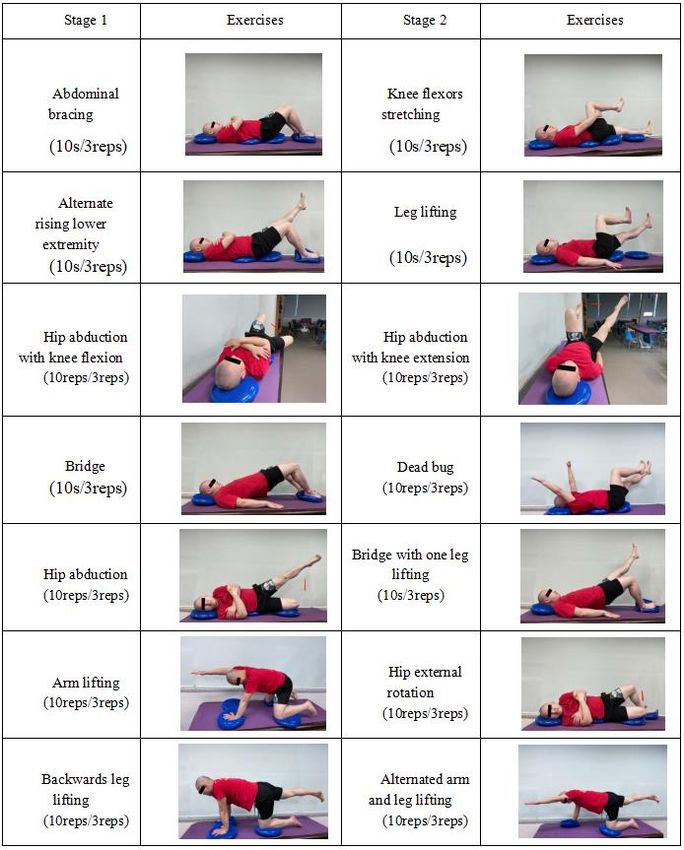
78                The Effects of Scapular Stabilization Exercises Accompanied by Spine Stabilization Exercises
                      Using An Unstable Surface on Muscle Activities for Subjects with Scapular Winging

plays a major role in the upward rotation of the scapula. It     instability created by an unstable surface increases the
is related to scapular alignment, functional movement, and       demands on the neuromuscular system, thereby increasing
normal scapulohumeral rhythm [4]. Motion of the scapula          muscle activity and improving the stability of the proximal
is inseparable from the involvement of the serratus anterior,    joints and trunk [19,20]. Biscarini et al. [21] found that
such as posterior tilt, upward rotation, and protraction [5].    compared with training on a stable surface, performing
If this muscle is weak, it is an important cause of              spinal stabilization exercises on an unstable surface
glenohumeral joint impingement, shoulder pain, and               produced more anterolateral abdominal muscle activity
scapular winging [4,6]. Therefore, the serratus anterior         and increased muscle activation in the shoulder.
muscle is the key in therapeutic exercise programs to               Scapular stabilization exercises can enhance the stability
prevent and restore scapular winging [7].                        and strength of the muscles surrounding the scapula [14–16]
   In the past, it was thought that the overall weakening of     and prevent upper trapezius and pectoralis major muscle
scapulothoracic musculature was the cause of abnormal            compensation during scapular protraction due to serratus
movement of the shoulder and scapula. However, many              anterior weakness [8,12]. Furthermore, spine stabilization
people now believe that the imbalance of scapular muscle         exercises can increase trapezius and serratus anterior
activity is the reason for abnormal scapular movement and        muscle activities in the shoulder joint while exercising the
scapular pathology [8]. If shoulder dysfunction is the           abdominal and back muscles [21,22]. The combination of
reason for the imbalance of scapulothoracic muscle activity      these two types of exercises can further improve scapular
[9], therapeutic exercise should decrease the activity level     winging. Although many previous studies have
of the compensatory muscle and increase the activation of        investigated scapular winging, none have directly
the serratus anterior muscle [8]. The imbalance of               compared the effectiveness of scapular stabilization
scapulothoracic musculature will cause abnormal scapular         exercises combined with spinal stabilization exercises
kinematics and tipping [10,11].                                  versus scapular stabilization exercises alone. The present
   In particular, when the shoulder flexes, the                  study aimed to inspect the influence of scapular
overactivation of the upper trapezius muscle and reduction       stabilization exercises accompanied by spine stabilization
of the lower trapezius and the serratus anterior may be an       exercises using an unstable surface on muscle activity in
important reason for scapular winging and abnormal               subjects with scapular winging.
scapulohumeral rhythm [4]. During scapular protraction,
compensatory replenishment of pectoralis is majorly due to
serratus anterior’s weakness in patients who had scapular        2. Methods
winging [12]. Therefore, the use of therapeutic shoulder
recovery exercises can selectively increase serratus             2.1. Experimental Subjects
anterior and lower trapezius muscle activities while
                                                                    The sample size was calculated using G-power software,
minimizing pectoralis major and upper trapezius muscle
activities.                                                      with the calculations showing that 30 subjects were
   Exercise may be an effective choice for correcting            required (power = 0.85, effect size = 1.14, α level = 0.05).
scapular position and improving scapular muscle                  Thirty subjects with scapular winging were thus included
performance to relieve other symptoms and pain [13]. In          in the study and divided into two groups. Subjects
order to determine which exercise can most effectively           participating in the experiment were required to read and
induce serratus anterior muscle activation to treat scapular     sign the university’s approved human consent forms before
winging, including scapular stabilization exercises and          participating. The Institutional Review Board of Daegu
kinetic chain exercises, but these exercises have already        University      approved     the    study      (IRB     No.
been included in the shoulder rehabilitation plan [12].          1040621-202107-HR-021). The inclusion criteria were as
Scapular stabilization exercises can enhance the activity        follows: a distance of more than 3 cm between the thoracic
and stability of scapula muscle to reduce related pain,          wall and medial border of scapula [23]; and shoulder joint
maintain proper muscle position, and other symptoms [14–         supination and horizontal adduction within the normal
16]. Some studies have shown that scapular stabilization         range of motion [24]. The exclusion criteria were shoulder
exercises not only improve the performance and control of        pain or dysfunction from the past to the present; a history
the scapular muscles but also the position of the scapula        of shoulder, back, or abdominal injury; and more than 5
[14–17]. This method of improving winged scapular                hours of upper limb strength training per week [7].
posture has been studied by many researchers. Spine
stabilization exercise can not only stabilize the shoulder,      2.2. Experimental Procedure
spine, and pelvis but also provide a basis for the movement
                                                                 2.2.1. Experimental Design
of limbs by exercising different muscles [18]. To further
increase muscle activity during exercise, clinicians               Thirty subjects with scapular winging participated in this
commonly instruct patients to perform the exercises on an        experiment. The subjects were divided into two groups. All
unstable base of support. Many studies have shown that the       assignments were made randomly. The two exercise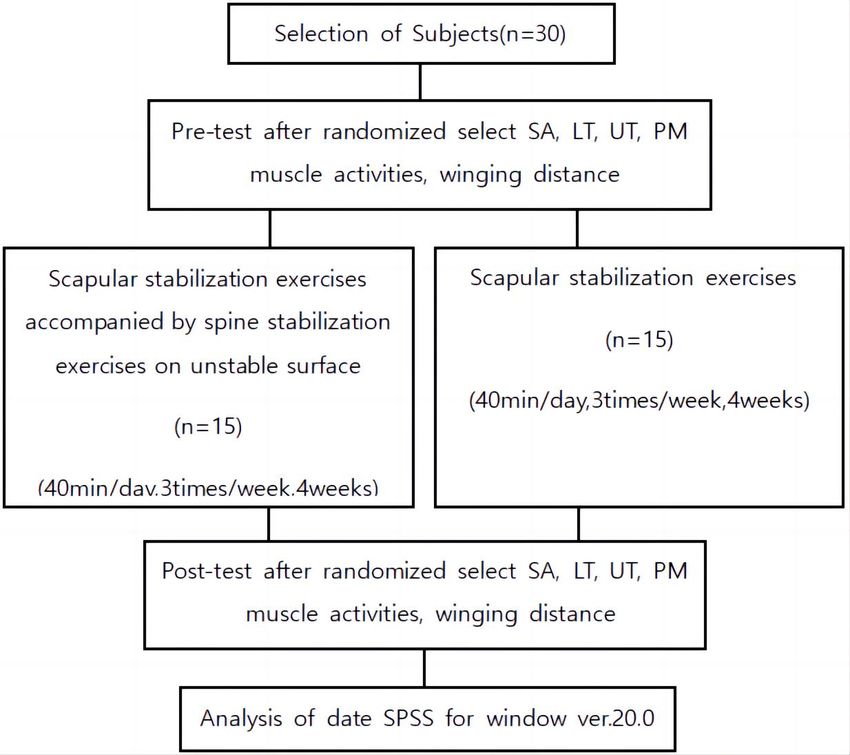
International Journal of Human Movement and Sports Sciences 11(1): 77-87, 2023                    79

programs were written on slips of paper, and the subjects      stabilization exercise three times a week, lasting for four
were assigned to each program by drawing lots. The             weeks. The control group received scapular stabilization
participants’ serratus anterior, lower trapezius, upper        exercises for 40 minutes three times a week, lasting for
trapezius, and pectoralis major muscle activities were         four weeks. After the intervention period, the participants’
measured. The experimental group received 20 minutes of        muscle activity was measured again. (Figure 1)
scapular stabilization exercise and 20 minutes of spinal

                                               Figure 1. Experimental design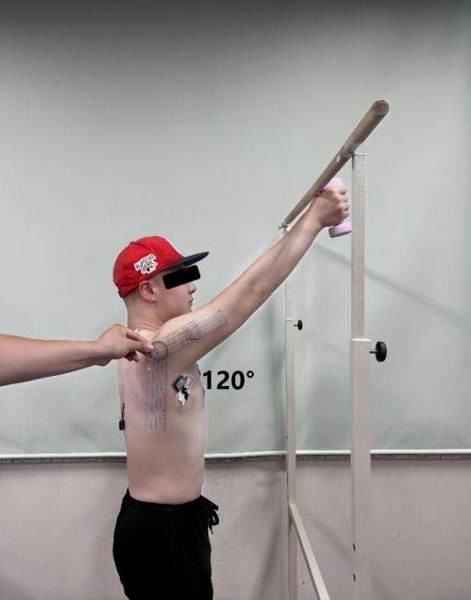
80                The Effects of Scapular Stabilization Exercises Accompanied by Spine Stabilization Exercises
                      Using An Unstable Surface on Muscle Activities for Subjects with Scapular Winging

2.2.2. Scapular Stabilization Exercises                            2.2.3. Spine Stabilization Exercises
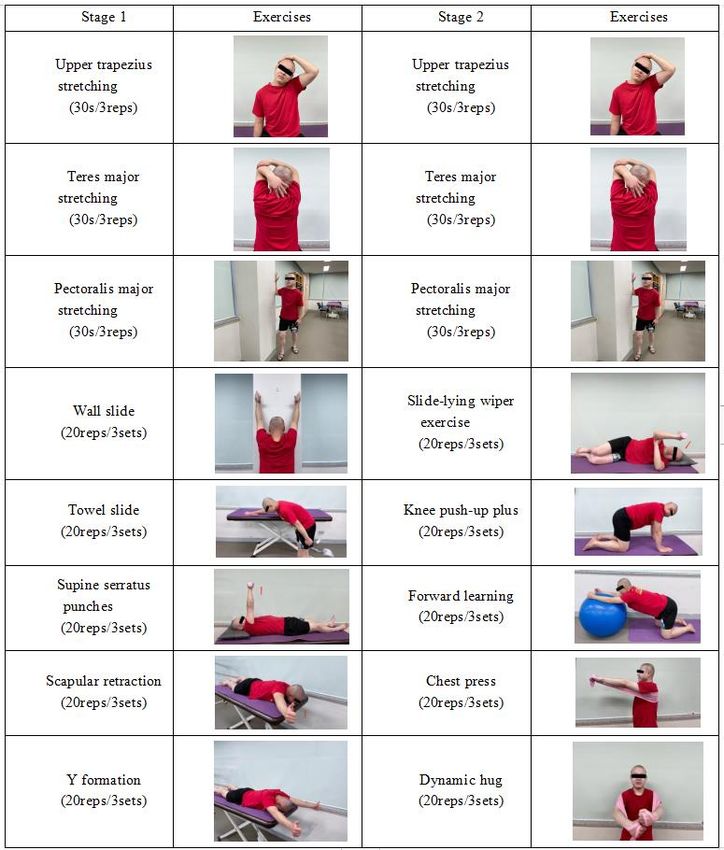
   The scapular stabilization exercises used were taken               The spine stabilization exercises used were taken from
from previous studies [25–28], consisting of two two-week          previous studies [29]. The spine stabilization exercises also
stages, with the first two weeks comprising the first stage,       consisted of two two-week stages—the first two weeks
and the last two weeks making up the second stage. (Figure         comprised the first stage, and the last two weeks made up
2) Thirty-second rest intervals were allowed between the           the second stage. (Figure 3) Thirty-second rest intervals
exercises.                                                         were allowed between the exercises.

                                             Figure 2. Scapular stabilization exercises
International Journal of Human Movement and Sports Sciences 11(1): 77-87, 2023 81
Figure 3. Spine stabilization exercises
2.3. Measurement Methods USA). The root mean square (RMS) values of the EMG
data were calculated to quantify the amplitude of the EMG
2.3.1. Electromyography signals.
(1) Signal collection and analysis
(2) Normalization
The TeleMyo DTS system was used to convert analog
signals into digital signals, and data processing was done Surface electrodes were placed on the serratus anterior,
using Myoresearch XP 1.08 software (Noraxon Inc., AZ, lower trapezius, upper trapezius, and pectoralis major82 The Effects of Scapular Stabilization Exercises Accompanied by Spine Stabilization Exercises
Using An Unstable Surface on Muscle Activities for Subjects with Scapular Winging
muscles of the dominant hand. The dominant hand was
determined as the hand the participants preferred to use for
eating and writing [30]. The RMS values of the EMG data
were calculated to quantify the amplitude of the EMG
signals using three seconds of the EMG measurements of
the four muscles, excluding the first second and the last
second. The measurements were carried out three times,
and the average values were taken [4]. The Myoresearch
XP 1.08 software was used for data processing.
The EMG activity was normalized by measuring the
maximum voluntary isometric contraction (MVIC) activity
of the muscle. The MVIC value was calculated as the
average RMS of the three measurements. Under manual
resistance, each subject contracted each muscle to the
maximum and held it for five seconds. To avoid fatigue, a
three-minute break was allowed between measurements.
The average EMG activity was expressed as a percentage
of the MVIC value [4]. The measurement method used has
been described in a previous study [11]. For the pectoralis
major, the shoulder was horizontally adducted to 90°, and
resistance was applied to the upper part of the elbow. For
the serratus anterior, the shoulder rotated inward and flexed
to 125°, against the resistance of the elbow. For the upper Figure 4. Measuring posture
trapezius, the right shoulder was lifted, and the participant
turned to face the left so that the occiput behind the right 2.4. Statistical Analysis
ear was close to the shoulder. For the lower trapezius, in The Kolmogorov–Smirnov test was used to evaluate the
the prone position, the participants performed horizontal normality of the data. The difference before and after
shoulder extensions and external rotations and against the intervention within each group was evaluated by a paired
resistance of the elbow. t-test. The difference between the two groups was
evaluated by an independent t-test. SPSS 20.0 for
(3) Placement of surface electrodes Windows was used to perform the statistical analysis. The
For the serratus anterior, the electrodes for the EMG level of statistical significance was α = .05.
measurements were attached below the axillary region,
horizontally at the lower end of scapula. For the lower
trapezius, they were attached to the medial edge of scapula. 3. Results
For the upper trapezius, they were attached at half the
3.1. General Characteristics of the Subjects
distance between C7 of the cervical vertebra and acromion.
For the pectoralis major, they were attached at the oblique Table 1 shows the general physical characteristics of the
angle about 2 cm below the clavicle [31]. subjects. No significant difference was observed in the
general characteristics of the subjects between the two
(4) Measuring posture groups.
To determine the differences in muscle activity before Table 1. General characteristics of the subjects(N=30)
and after the exercise interventions, muscle activity
EG(n=15) CG(n=15) p
measurements were performed while the participants held
α
a dumbbell with their dominant hand and flexed their arms Age(year) 24.40±2.29 24.13±2.61 .858
at 120°. The measurement method used was described in a Height(cm) 168.60±7.15 170.80±9.99 .063
previous study. When the angle was set to 120°, the Weight(kg) 60.53±12.10 65.00±12.55 .684
serratus anterior, trapezius, and pectoralis major muscle 2
BMI(kg/m ) 21.12±2.73 22.16±3.15 .252
activities were displayed [32]. Accordingly, the arm flexed
EG, experimental group; CG, control group; mean ± standard
α
120° was used as the measurement posture. (Figure 4)
deviationInternational Journal of Human Movement and Sports Sciences 11(1): 77-87, 2023 83
3.2. Changes in EMG-measured Muscle Activation muscle activities of the lower trapezius and serratus
within and between the Groups anterior in the control group were not as high as those in the
experimental group (p < .05). The muscle activities of the
The difference in the two groups before and after upper trapezius and pectoralis major decreased
intervention was statistically significant. The activities of significantly in the two groups after interventions, but no
the lower trapezius and serratus anterior increased significant difference was observed between the two
significantly in the two groups after intervention. The groups (p > .05) (Table 2).
Table 2. A comparison for EMG activation of muscle within and between the groups(N=30)
Muscle Group Pre Post t p Between group
EG 27.20±8.82α 43.60±10.33 -13.190 .000* 16.40±4.82
CG 27.26±12.60 35.21±13.28 -11.551 .000* 7.95±2.67
SA ( %MVIC)
t 5.946
p .004*
EG 21.26±5.92 28.37±6.74 -5.650 .000* 7.10±4.87
LT CG 20.09±8.42 24.66±8.44 -6.516 .000* 4.58±2.72
( %MVIC) t 1.755
p .049*
EG 33.92±15.35 25.32±12.92 4.639 .000* 8.59±7.17
UT CG 27.15±10.23 21.37±9.08 6.628 .000* 5.78±3.37
( %MVIC) t 1.376
p .106
EG 11.53±5.83 8.68±4.78 5.003 .000* 2.86±2.21
PM CG 7.89±4.77 5.89±3.87 4.772 .000* 2.00±1.63
( %MVIC) t 1.203
p .104
α
SA, serratus anterior; LT, lower trapezius; UT, upper trapezius; PM, pectoralis major; EG, experimental group; CG, control group; mean ± standard
deviation; *p< .0584 The Effects of Scapular Stabilization Exercises Accompanied by Spine Stabilization Exercises
Using An Unstable Surface on Muscle Activities for Subjects with Scapular Winging
4. Discussion to the scapula [44]. Therefore, scapular stabilizer muscles
can be trained and supplied with energy through the
Scapular winging is becoming increasingly common. thoracolumbar fascia. The purpose of the scapula and spine
The aim of the study was to investigate the effects of stabilizer muscles is to develop a stabilized foundation for
exercise on subjects in scapular winging. upper extremity mobility. Thus, spine stabilization
The results of the serratus anterior activity showed exercises train not only the trunk muscles but also the
significant increases in both groups after the exercise scapula stabilizer muscles. In this study, the experimental
interventions, although the control group had significantly group participants performed both scapular stabilization
less increases than the experimental group. Both groups and spine stabilization exercises. Scapular stabilization
executed scapular stabilization exercises. Alizadeh et al. exercises balance the muscles around the scapula, and
[14] reported that scapular stabilization exercises enhance spine stabilization exercises provide a stable basis for the
stability and increase the activation of muscles in the upper limbs and facilitate arm lifting while exercising the
shoulder joint to maintain its proper position. In this study, back and abdominal muscles. Spine stabilization programs
the experimental group performed spine stabilization include many exercises for the trunk and lower limbs. By
exercises along with scapular stabilization exercises. exercising the back and abdominal muscles, the
Previous studies have shown that prior to upper limb thoracolumbar fascia contracts and tightens, and the stress
flexion, extension exercises and abdominal muscle is transmitted to the contralateral scapula. The results of the
contraction to strengthen the abdominal muscles are present study were consistent with those of Cho et al. [22]
requisite for the restoration of the scapular force couple. As and Biscarini et al. [21], who reported that spine
arm lifting may be an unstable activity, the enhanced stabilization exercises increased serratus anterior activity.
stability of the lumbar spine may provide a stable basis for Through this mechanism, the experimental group in this
the scapula’s proper upward rotation. Muscle activation study showed a greater increase in serratus anterior activity
around the scapula increases with the flexion of the arm than the control group.
[33,34]. In this study, lower trapezius muscle activity increased
The shoulder rehabilitation program is composed of significantly in both groups after the exercise interventions.
proprioceptive scapular stabilization and closed kinetic The activity in the control group was not as high as that in
chain exercises. However, such exercise programs focus on the experimental group. Spine stabilization exercises can
the upper limbs and ignore the contributions of the trunk strengthen the core muscles. Small core muscles include
and lower limbs [35]. Recently, a trend in the rehabilitation the trapezius, latissimus dorsi, and gluteus maximus. Big
of athletes is the kinetic chain approach, which tends to core muscles include the transversus abdominis,
combine other body segments to solve shoulder problems diaphragm, and pelvic floor [41]. The lower trapezius can
[36-38]. be strengthened by performing spine stabilization exercises.
Spine stabilization exercises can stabilize the pelvis, Many scapular stabilization exercises are aimed at
shoulder, and spine by training different muscles. increasing lower trapezius activity. In this study, the two
Furthermore, it can provide a basis for the movement of groups both performed scapular stabilization exercises.
extremities [18]. The muscles that can be trained by spinal The experimental group also performed spine stabilization
stabilization exercises mainly include the abdominal and exercises based on the scapular stabilization exercises.
back muscles [39]. All of these muscles are attached to the This explains the greater lower trapezius activity in this
spine and thoracolumbar fascia indirectly or directly and group.
are connected to the lower and upper limbs [40,41]. The In this study, upper trapezius muscle activity decreased
thoracolumbar fascia covers the trunk and plays a key significantly in both groups after the exercise interventions.
role—for example, transferring energy and load between However, no significant difference was found between the
the upper and lower limbs [39,42]. The thoracolumbar two groups. Excessive upper trapezius activity may be due
fascia links many muscles, including the trapezius, small to an attempt to compensate for the weakness of the
and large rhomboids, and serratus anterior. These muscles serratus anterior muscle, which is considered to be a reason
help control the movement transfer of strength and weight, for the abnormal rotation of the scapula [6]. Buttagat et al.
as well as assign external load to the body [39]. [13] reported that scapular stabilization exercises can
The scapula is connected to other body segments and has reduce scapular winging and improve stability by
stability [35]. Scapular stabilization forms a kinetic chain increasing the activity of muscles surrounding the scapula
of movement from the pelvis through the trunk to the upper so as to maintain its proper position and reduce other
limbs [43]. The scapula is a pivot used to transfer force and symptoms and pain. In this study, both groups performed
energy from the trunk and legs to upper limbs [41]. The scapular stabilization exercises to stabilize and increase the
scapula and spine stabilizer muscles derive from common activation of muscles surrounding the scapula. Thus, the
fascial layers. Spine stability exercises can exercise the compensatory effort expended by the upper trapezius
back and abdominal muscles. When these muscles contract, during arm lifts was reduced in both groups. Similarly,
they tighten the thoracolumbar fascia and transfer the stress Jang et al. [45] reported that enhancing spine stability mayInternational Journal of Human Movement and Sports Sciences 11(1): 77-87, 2023 85
be effective in reducing the compensatory effort of the used in clinical practice were shown as potentially
upper trapezius. The experimental group in this study increasing lower trapezius and serratus anterior activity.
performed spine stabilization exercises based on scapular Moreover, a combination of such exercises with spine
stabilization exercises. However, the reduction in upper stabilization exercises on an unstable surface was shown to
trapezius activity did not differ significantly from that in confer greater benefits than scapular stabilization exercises
the control group. This may be because both groups alone and is thus recommended.
performed the same exercises or because the exercise
period was insufficient.
In this study, pectoralis major activity decreased
significantly after the exercise interventions in both groups. REFERENCES
However, no significant difference was observed between
[1] Senbursa G., Baltacı G., Atay A, “Comparison of
the two groups. Park et al. [46] reported that during conservative treatment with and without manual physical
scapular protraction, subjects with scapular winging will therapy for patients with shoulder impingement syndrome:
perform compensatory supplementation of the pectoralis a prospective, randomized clinical trial,” Knee surgery,
major due to the weakening of the serratus anterior muscle. sports traumatology, arthroscopy, vol. 15, no. 7, pp.
915-921, 2007. DOI: org/10.1007/s00167-007-0288-x
In this study, the experimental group participants
performed both scapular stabilization and spine [2] Didesch J, T., Tang P, “Anatomy, etiology, and
stabilization exercises. The experimental group in this management of scapular winging,” The Journal of hand
study showed a greater increase in serratus anterior activity surgery, vol. 44, no. 4, pp. 321-330, 2019. DOI:
org/10.1016/j.jhsa.2018.08.008
than the control group, thereby reducing the compensatory
activity of the pectoralis major. However, no significant [3] Martin R, M., Fish D, E, “Scapular winging: anatomical
difference between the two groups was found, likely review, diagnosis, and treatments,” Current reviews in
because both groups performed the same exercises or musculoskeletal medicine, vol. 1, no. 1, pp. 1-11, 2008.
DOI: org/10.1007/s12178-007-9000-5
because the intervention duration was insufficient.
Some limitations of this study should be noted. First, the [4] Weon J, H., Kwon O, Y., Cynn H, S., Lee W, H., Kim T, H.,
experimental period was too short—the experiments were Yi C, H, “Real-time visual feedback can be used to activate
scapular upward rotators in people with scapular winging:
only conducted for four weeks. In many previous studies,
an experimental study,” Journal of physiotherapy, vol. 57,
the experimental treatment effects were determined no. 2, pp. 101-107, 2011. DOI:
through 8-12 weeks of training. Future studies should org/10.1016/S1836-9553(11)70020-0
employ long experimental periods to determine the effects
[5] Hwang U, j., Kwon O, y., Jeon I, c., Kim S, h., Weon J, h,
of treatment. Second, the dependent variable of this
“Effect of Humeral-Elevation Angle on Electromyographic
experiment was only muscle activity; there were not Activity in the Serratus Anterior During the Push-Up-Plus
enough dependent variables to identify other functional Exercise,” Journal of sport rehabilitation, vol. 26, no. 1,
changes. This should be corrected in the future. Third, 2017. DOI: org/10.1123/jsr.2015-0090
patients with scapular winging without pain were selected [6] Ludewig P, M., Cook T, M, “Alterations in shoulder
to be included in the experimental group. In the future, kinematics and associated muscle activity in people with
patients with scapular winging with pain should be selected symptoms of shoulder impingement,” Physical therapy, vol.
for training to observe the therapeutic effects. 80, no. 3, pp. 276-291, 2000. DOI:
org/10.1093/ptj/80.3.276
[7] Park K, M., Cynn H, S., Yi C, H., Kwon O, Y, “Effect of
5. Conclusions isometric horizontal abduction on pectoralis major and
serratus anterior EMG activity during three exercises in
This study compared the influence of scapular subjects with scapular winging,” Journal of
stabilization exercises accompanied by spine stabilization electromyography and kinesiology, vol. 23, no. 2, pp.
using an unstable surface and scapular stabilization 462-468, 2013. DOI: org/10.1016/j.jelekin.2012.11.013
exercises without spine stabilization on muscle activity for
[8] Choi W, J., Yoon T, L., Choi S, A., Lee J, H., Cynn H, S,
subjects with scapular winging. According to the “Different weight bearing push-up plus exercises with and
experimental results, the activation of lower trapezius without isometric horizontal abduction in subjects with
muscle and serratus anterior muscle increased significantly scapular winging: A randomized trial,” Journal of
in the two groups after intervention. The muscle activities Bodywork and Movement Therapies, vol. 21, no. 3, pp.
of the lower trapezius and serratus anterior in the control 582-588, 2017. DOI: org/10.1016/j.jbmt.2016.08.018
group were not as high as those in the experimental group. [9] Escamilla R, F., Andrews J, R, “Shoulder muscle
Moreover, the muscle activities of the upper trapezius and recruitment patterns and related biomechanics during upper
pectoralis major decreased significantly in both groups extremity sports,” Sports medicine, vol. 39, no. 7, pp.
after the exercise interventions, but no significant 569-590, 2009. DOI: org/10.2165/00007256-200939070-0
0004
difference was observed between the two groups. As a
result, the scapular stabilization exercises that are widely [10] Page P., Frank C., Lardner R, “Assessment and treatment of86 The Effects of Scapular Stabilization Exercises Accompanied by Spine Stabilization Exercises
Using An Unstable Surface on Muscle Activities for Subjects with Scapular Winging
muscle imbalance: the Janda approach,” Journal of https://doi.org/10.1123/jsr.2018-0089
orthopedic & sports physical therapy, vol. 41, no. 10, pp.
799-800, 2011. [22] Cho J, Y., Shim J, H., Choi H, Y., Song K, M., Moon S, I.,
Seo K, T, “The effects of core stability exercise using an
[11] Shin A, R., Lee J, H., Kim D, E., Cynn H, S, “Tactile cues ultrasound imaging system on muscle activation of shoulder
change trunk and scapular muscle activity, scapular region,” International Journal of Digital Content
winging, and thoracic kyphosis during knee push-up plus in Technology and its Applications, vol. 7, no. 11, pp. 375,
subjects with scapular winging: The cross-sectional study,” 2013. DOI: 10.4156/jdcta.vol7.issue11.48
Medicine, vol. 97, no. 44, 2018. DOI:
10.1097/MD.0000000000012569 [23] Park J, S., Jeon H, S., Kwon O, Y, “A comparison of the
shoulder stabilizer muscle activities during push-up plus
[12] Baek Y, J., Jung Y, J., Son J, I., Lim O, B., Yi C, H, between persons with and without winging scapular,”
“Comparison of muscle activity and trunk compensation Physical Therapy Korea, vol. 14, no. 2, pp. 44-52, 2007.
during modified push-up plus exercises in individuals with URL: http://www.riss.kr/link?id=T10833586&outLink=K
scapular winging,” Isokinetics and Exercise Science, vol.
25, no. 3, pp. 201-207, 2017. DOI: 10.3233/IES-171107 [24] Warner J J., Allen A, A., Marks P, H., Wong P,
“Arthroscopic release of postoperative capsular contracture
[13] Buttagat V., Taepa N., Suwannived N., Rattanachan N, of the shoulder,” JBJS, vol. 79, no. 8, pp. 1151-1158, 1997.
“Effects of scapular stabilization exercise on pain related DOI: 10.2106/00004623-199708000-00006
parameters in patients with scapulocostal syndrome: a
randomized controlled trial,” Journal of Bodywork and [25] Ha S, M., Kwon O, Y., Cynn H, S., Lee W, H., Kim S, J.,
Movement Therapies, vol. 20, no. 1, pp. 115-122, 2016. Park K, N, “Selective activation of the infraspinatus muscle,”
DOI: org/10.1016/j.jbmt.2015.07.036 Journal of athletic training, vol. 48, no. 3, pp. 346-352, 2013.
DOI: org/10.4085/1062-6050-48.2.18
[14] Alizadeh M., Daneshmandi H., Shademan B., Ahmadizad S,
“The effects of exercise training on scapula position of [26] Hotta G, H., de Assis Couto A, G., Cools A, M., McQuade
muscle activity measured by EMG,” World, vol. 2, no. 1, pp. K, J., de Oliveira A, S, “Effects of adding scapular
48-52, 2013. stabilization exercises to a periscapular strengthening
exercise program in patients with subacromial pain
[15] Başkurt Z., Başkurt F., Gelecek N., Özkan MH, “The syndrome: A randomized controlled trial,” Musculoskeletal
effectiveness of scapular stabilization exercise in the Science and Practice, vol. 49, pp. 102171, 2020. DOI:
patients with subacromial impingement syndrome,” Journal org/10.1016/j.msksp.2020.102171
of back and musculoskeletal rehabilitation, vol. 24, no. 3,
pp. 173-179, 2011. DOI: 10.3233/BMR-2011-0291 [27] Turgut E., Duzgun I., Baltaci G, “Effects of scapular
stabilization exercise training on scapular kinematics,
[16] Struyf F., Nijs J., Mollekens S., Jeurissen I., Truijen S.,
disability, and pain in subacromial impingement: a
Mottram S, “Scapular-focused treatment in patients with
randomized controlled trial,” Archives of physical medicine
shoulder impingement syndrome: a randomized clinical
and rehabilitation, vol. 98, no. 10, pp. 1915-1923, 2017.
trial,” Clinical rheumatology, vol. 32, no. 1, pp. 73-85, 2013.
DOI: org/10.1016/j.apmr.2017.05.023
DOI: https://doi.org/10.1007/s10067-012-2093-2
[17] Hibberd EE., Oyama S., Spang J, T., Prentice W., Myers J, [28] Regan, D,“The role of scapular stabilization in overhead
B, “Effect of a 6-week strengthening program on shoulder motion,” Strength & Conditioning Journal, vol. 18,no. 1,
and scapular-stabilizer strength and scapular kinematics in pp. 33-38,1996.
division I collegiate swimmers,” Journal of sport [29] Sahrmann S, “Diagnosis and Treatment of Movement
rehabilitation, vol. 21, no. 3, pp. 253-265, 2012. DOI: Impairment Syndromes: Pageburst Retail,” Elsevier Mosby,
https://doi.org/10.1123/jsr.21.3.253 2001.
[18] Guskiewicz K, M, “Regaining postural stability and balance.
[30] Lee J, h., Cynn H, s., Yoon T, l., Ko C, h., Choi W, j., Choi
Rehabilitation techniques for sports medicine and athletic
S, a, “The effect of scapular posterior tilt exercise,
training prentice,” WE 6th ed. McGraw Hill NY, pp.
pectoralis minor stretching, and shoulder brace on scapular
145-170, 2011.
alignment and muscles activity in subjects with
[19] Lee S., Lee D., Park J, “The effects of changes in hand round-shoulder posture,” Journal of electromyography and
position on the electromyographic activities of the shoulder kinesiology, vol. 25, no. 1, pp. 107-114, 2015. DOI:
stabilizer muscles during push-up plus exercises on org/10.1016/j.jelekin.2014.10.010
unstable surfaces,” Journal of Physical Therapy Science,
vol. 25, no. 1, pp. 125-128, 2013. DOI: [31] Criswell E, “Cram's introduction to surface
https://doi.org/10.1589/jpts.25.125 electromyography,” Jones & Bartlett Publishers, 2010.
[20] Nascimento V, Y, S., Torres R, J, B., Beltrão N,B., Dos [32] Ekstrom R, A., Soderberg G, L., Donatelli R, A,
Santos P, S., Pirauá A, L, T., de Oliveira V, M, A, “Normalization procedures using maximum voluntary
“Shoulder muscle activation levels during exercises with isometric contractions for the serratus anterior and trapezius
axial and rotational load on stable and unstable surfaces,” muscles during surface EMG analysis,” Journal of
Journal of applied biomechanics, vol. 33, no. 2, pp. 118-123, electromyography and kinesiology, vol. 15, no. 4, pp.
2017. DOI: https://doi.org/10.1123/jab.2016-0177 418-428, 2005. DOI: org/10.1016/j.jelekin.2004.09.006
[21] Biscarini A., Contemori S., Grolla G, “Activation of [33] Hodges P., Richardson C, “Feedforward contraction of
scapular and lumbopelvic muscles during core exercises transversus abdominis is not influenced by the direction of
executed on a whole-body wobble board,” Journal of sport arm movement,” Experimental brain research, vol. 114, no.
rehabilitation, vol. 28, no. 6, pp. 623-634, 2019. DOI: 2, pp. 362-370, 1997. DOI: org/10.1007/PL00005644International Journal of Human Movement and Sports Sciences 11(1): 77-87, 2023 87
[34] Toro A, S, V., Cools A, M., de Oliveira A, S, “Instruction no. 4, pp. 859-864, 2015. DOI: 10.3233/BMR-150618
and feedback for conscious contraction of the abdominal
muscles increases the scapular muscles activation during [41] Cobanoglu G., Zorlular A., Polat E, A., Akaras E, “The
shoulder exercises,” Manual therapy, vol. 25, pp. 11-18, relationship between scapular and core muscle endurance in
2016. DOI: org/10.1016/j.math.2016.05.331 professional athletes,” Annals of Medical Research, vol. 26,
no. 7, pp. 1295-1300, 2019. DOI:
[35] McMullen J., Uhl T, L, “A kinetic chain approach for 10.5455/annalsmedres.2019.03.142
shoulder rehabilitation,” Journal of athletic training, vol. 35,
no. 3, pp. 329, 2000. [42] Vleeming A., Schuenke M., Danneels L., Willard F, “The
functional coupling of the deep abdominal and paraspinal
[36] Henning L., Plummer H., Oliver G, D, “Comparison of muscles: the effects of simulated paraspinal muscle
scapular muscle activations during three overhead throwing contraction on force transfer to the middle and posterior
exercises,” International journal of sports physical therapy, layer of the thoracolumbar fascia,” Journal of anatomy, vol.
vol. 11, no. 1, pp. 108, 2016. 225, no. 4, pp. 447-462, 2014. DOI: org/10.1111/joa.12227
[37] Kim D, e., Shin A, r., Lee J, h., Cynn H, s, “Effect of the [43] Wilke J., Krause F., Vogt L., Banzer W, “What is
abdominal drawing-in maneuver on the scapular stabilizer evidence-based about myofascial chains: a systematic
muscle activities and scapular winging during push-up plus review,” Archives of physical medicine and rehabilitation,
exercise in subjects with scapular winging,” Physical vol. 97, no. 3, pp. 454-461, 2016. DOI:
Therapy Korea, vol. 24, no. 1, pp. 61-70, 2017. DOI: org/10.1016/j.apmr.2015.07.023
org/10.12674/ptk.2017.24.1.061
[44] Myers T, W, “Anatomy trains e-book: myofascial
[38] Kim H, g., Hwang B, j., Kim J, w, “Comparison of Muscle meridians for manual and movement therapists,” Elsevier
Activities Serratus Anterior and Upper Trapezius Muscle Health Sciences, 2013.
During Scapular Protraction in Quadruped Position at Legs
Difference,” The Journal of Korean Academy of [45] Jang H, j., Kim S, y,, Oh D, w, “Effects of augmented trunk
Orthopedic Manual Physical Therapy, vol. 25, no. 1, pp. stabilization with external compression support on shoulder
29-36, 2019. URL: https://www.earticle.net/Article/A3610 and scapular muscle activity and maximum strength during
28 isometric shoulder abduction,” Journal of
electromyography and kinesiology, vol. 25, no. 2, pp.
[39] Hazar Kanik Z., Pala O, O., Gunaydin G., Sozlu U., Alkan 387-391, 2015. DOI: org/10.1016/j.jelekin.2014.12.005
ZB, Basar S, “Relationship between scapular muscle and
core endurance in healthy subjects,” Journal of back and [46] Park K, M., Cynn H, S., Kwon O, Y., Yi C, H., Yoon T, L.,
musculoskeletal rehabilitation, vol. 30, no. 4, pp. 811-817, Lee J, H, “Comparison of pectoralis major and serratus
2017. DOI: 10.3233/BMR-150497 anterior muscle activities during different push-up plus
exercises in subjects with and without scapular winging,”
[40] Bayraktar D., Özyürek S., Genç A, “The relationship
The Journal of Strength & Conditioning Research, vol. 28,
between isometric trunk muscle endurance and physical
no. 9, pp. 2546-2551, 2014. DOI:
activity related energy expenditure in healthy young adults,”
10.1519/JSC.0000000000000443
Journal of back and musculoskeletal rehabilitation, vol. 28,You can also read


