The Future of Programmatic and Automation - Amazon S3
←
→
Page content transcription
If your browser does not render page correctly, please read the page content below
The Future of Programmatic
and Automation
November 2019
Executive Summary•4
Background and Introduction•7
Research Methodology•8
Qualitative Research Description•8
Quantitative Research Description•10
Findings•11
Qualitative Themes•11
Key Theme #1: The Promise of Programmatic is Still Not Realized•12
Key Theme #2: The Perception of Programmatic Still Varies•13
Key Theme #3: The Views on Automation Also Vary
and Fall into Two Buckets•13
Key Theme #4: Investments in Talent and Technology Are
Ongoing and Significant•14
Key Theme #5: The Role of the Agency is Changing Rapidly•14
Key Theme #6: Data Quality is Slammed, But Data-Driven
Marketing is the Future•15
Key Theme #7: It’s Not about Tech Tax—It’s about Tech Value•16
Key Theme #8: The Future of Programmatic is Automation, and
That Refers to All Media…Including TV•17
   TV•17
   The Automated Future•18
Quantitative Findings•19
Perceptions of Programmatic and Automation•19
Table 1: Definition of Marketing and Advertising Automation•19
Table 2: Perceptions of Programmatic Advertising •21
Business Priorities•22
Table 3: Three Benefits of Programmatic Advertising to Your Business•23
Table 4: Most Important Near-Term Marketplace Needs/
Challenges in Programmatic Advertising•24
Table 5: Importance of Benefits of Identity Resolution Across •26
the Walled Gardens and the Publishing Ecosystem•26

November 2019                                          The Future of Programmatic and Automation • 2
The Changing Role of the Agency Now and In the Future•27
Table 6: Importance of Agency Functions to Business Today •27
Table 7: Perceptions of Agency Functions in the Next Two to Three Years•29
In-Housing•30
Table 8: Perceptions of Programmatic In-housing•31
TV and Automation•32
Table 9: Estimated Speed of TV Network Movement of Inventory
to Automated Planning and Buying•32
Table 10: Perceptions of Changing TV Landscape•33
Investments in Talent and Technology•33
Table 11: Value of Investments in Talent and Technology•34
Investments in Data and Measurement•35
Table 12: Value Driven by Data and Measurement•35
Top Priority in the Next Three Years•36
Table 13: #1 Priority for Marketing and Advertising Automation
in the Next Three Years•37

Implications•37
Fulfilling the promise: All media are fully automated with
interoperable processes•37
Data, data and data together with interoperability:
New cost-value mindset around technology investments•38
Automation, quality data and data science power
the new creative paradigm•38
Embracing automated TV—and the sooner, the better•38
Future roles of the agency: Centralized expertise,
consultative services and reinventing storytelling•38

The Path Forward•39
Publishers and Sponsors•40
About The 4A’s•40
About The 614 Group•40
Sponsors•41
The Future of Programmatic and Automation•42

November 2019                                          The Future of Programmatic and Automation • 3
Executive Summary
  The 4A’s and The 614 Group partnered to conduct         empirical explorations of the ecosystem.
  research on programmatic advertising and automa-
                                                          The key themes that surfaced from the qualitative
  tion today and tomorrow. The primary goal of the
                                                          study are substantiated in the quantitative study. In
  research is twofold:
                                                          addition, there is evidence of an emerging cost-val-
                                                          ue narrative in the industry—a better understanding
  •   Redirect the industry conversation around pro-
                                                          of the capabilities and value of programmatic infra-
      grammatic advertising and automation based on
                                                          structure and automation—which may be related to
      empirical facts, and
                                                          a shift to a value-for-cost mindset.
  •   Identify ways to plan for a future that is
      value-focused for the marketing ecosystem.          Both the qualitative and quantitative studies indicate
                                                          that the noise around in-housing, the role of the
                                                          agency, cost transparency, and cost-value relation-
  The research consisted of three phases:
                                                          ships are far more sensationalized than the reality
                                                          based on the research. This does not mean that
  •   A literature review to determine what is known,     there are no challenges or issues in the program-
      what is not known, and the development of           matic market. The research examines and measures
      topics to learn what we need to know                both challenges and possible solutions.
      —more than 200 studies, articles, and blogs
                                                          Data, data, and more data is an overarching find-
      reviewed
                                                          ing throughout the research. The qualitative study
  •   A qualitative study designed to capture the voic-   found that programmatic is more about data than
      es, expertise, and opinions of senior executives    it is about executing media transactions. Another
      at advertising agencies, advertisers, publishers,   overarching concept is interoperability. Respondents
      and ad tech companies                               want technology that works seamlessly and products
      —47 one-on-one interviews with 60 hours of          that “talk to each other.” They want data that is of
      analyzed transcripts                                known quality and provenance, and they want to use
                                                          vast arrays of data and data streams in an integrated
  •   A quantitative study to measure and benchmark
                                                          manner.
      the learnings in the qualitative study
      —219 respondents, director-level and up,            The promise of programmatic is as yet unfulfilled.
      completed a survey questionnaire in the field       One of the elements of the unfulfilled promise is
      between July 18 and September 11, 2019              that programmatic is not yet fully automated: there
                                                          are many manual processes in the workflow and a
                                                          lack of abilities to harness higher levels of automa-
  The literature review revealed that most of the         tion like AI to deliver the right message to the right
  research in the public domain focuses on specific       person at the right time. The overwhelming majority
  areas that are part of the programmatic marketplace     of respondents (90.4%) chose the following as the
  (e.g., DSPs and SSPs). Moreover, there is a dearth of   definition of marketing and advertising automation
  research that seeks to capture a full cross-ecosystem   that most closely matches their own: “Marketing
  view including agencies, advertisers, publishers, and   and advertising automation are more than just the
  ad tech. While there are a multitude of individual or   use of technology to eliminate manual tasks—it also
  company POVs available, there are few bona fide         includes the use of data-based rules and decisioning

  November 2019                                                    The Future of Programmatic and Automation • 4
such as algorithms, machine learning, or AI.” The paign optimization in real time (44.3%)
view that “programmatic is the technology infra-
• Solutions to provide holistic evaluations of cam-
structure that will underpin all data-driven market-
paigns that run across online and offline media
ing in the future” is shared by nearly two thirds of
(39.3%)
respondents (62.6%).
• Identity resolution across/between walled gar-
More than three fourths (76.3%) of respondents dis-
dens and publishers (31.5%)
agree with the statement “Programmatic advertising
has eliminated nearly all the manual work in buying All respondents, regardless of their answers to
digital media.” Over two thirds (67.6%) disagree that the question on the two most important needs/
“programmatic and automation are the same thing.” challenges to their business in the next year, were
asked to select the degree of importance of each of
Agreement with the statement “The array of in-
seven benefits of identity resolution. All seven were
puts needed to reach the right person at the right
deemed important by at least half of the respon-
time with the right message cannot currently be
dents (50.2%). The top three in importance selected
leveraged in programmatic without higher levels
by a majority of respondents (upwards of two thirds)
of automation” is significantly higher (45.2%) than
were:
disagreement (29.2%). Another item, “The highly
sophisticated algorithms used in programmatic • Greater accuracy in running and evaluating
advertising reliably deliver real-time optimization cross-device campaigns to ensure delivery to the
without human involvement,’’ garners disagreement target audiences rather than devices (77.2%)
by half the respondents (50.2%) and agreement by a • True audience reach numbers (74.9%)
significantly smaller proportion (35.2%). These quan-
titative data points support the qualitative findings • Facilitation of frequency management (68.5%)
that the promise of programmatic is still unfulfilled Taken together, these three benefits highlight the
and that programmatic and automation are not the importance of accurate delivery, measurement, man-
same thing. agement, and optimization of target audiences for
Respondents were asked to rank three benefits of campaigns. This underscores the impact of identity
programmatic advertising to their respective busi- resolution as an overall industry issue that needs
nesses today, and the top benefit selected most solutions. Current concerns around privacy are criti-
often (59.4%) is “Ability to leverage data in biddable cal considerations in identity resolution.
marketplaces to achieve cost efficient audience tar- The quantitative study measures perceptions of
geting.” The second-most frequently cited benefit the changing role of the advertising agency in the
(27.9%) is “Enables greater impact in a media buy short term, (the next year) and in the future (the
regardless of cost or labor efficiencies.” Embedded next three years). The qualitative study found that
in these statements is an as-yet unmeasured con- like the rest of the ecosystem, agency roles and
struct of cost value. The research was not designed responsibilities are rapidly changing. But the need
to measure what “cost-efficient means”—is it spend- for the centralized leadership role of the agency is
ing the least amount, as in buying the cheapest car not disappearing. It is actually becoming somewhat
on the lot, or is it getting a good deal on the BMW more necessary. Current agency roles that are critical
of your dreams? today include leveraging data, helping to develop
From a series of eight items that describe market- a strategic vision for clients, and providing broad
place needs and challenges in programmatic adver- expertise to navigate the complexity of today’s mar-
tising, where respondents were asked to select the keting landscape.
two most important to their respective businesses in In response to a question about the functions of
the next six months to one year, only three were se- the advertising agency in the next two to three
lected by more than 20% of respondents. They are: years, nearly three quarters (73.1%) of respondents
• Better integration of data and campaign- agree with the statement “The creative function will
tracking technologies to fully empower cam- have to use data to go from the linear storytelling
November 2019 The Future of Programmatic and Automation • 5paradigm that dominates today to more dynamic, confusion regarding the difference between address-
personalized messaging.” This statement about able TV, OTT, CTV” by more than three quarters of
possible future functions of advertising agencies got respondents (76.7%).
the highest level of agreement among five measured
As previously mentioned, a goal of this research is to
statements. This finding is important not only due
identify ways to plan for a future that is value-focused
to the possibility that in the next three years the
for the marketing ecosystem. Thus, future roles and
agency creative function will be a data-infused art
responsibilities, as well as challenges and benefits
that adapts to immediacy in a way that the current
of possible solutions, were measured. This leaves us
linear storytelling paradigm cannot, but also because
with the question: What is the #1 priority for mar-
it enhances our understanding of where data-driven
keting and advertising automaton in the next three
marketing is headed.
years? And the answer is not entirely unequivocal.
The research examined in-housing and found that it Respondents selected two of three possible #1 prior-
is neither all or nothing, nor is it as definitive as the ities at statistically equal levels:
press headlines may indicate. It is happening to vary-
• A fully automated methodology that flags in-
ing degrees, and it is altering the client-agency rela-
ventory for purchase based on predetermined
tionship. It is opening the doors to agencies’ growing
audience and ROI criteria—41.1%
consultative data and technology assessments and
services. There is also recognition that in-housing has • Higher levels of automation such as AI to enable
its challenges, among them attracting and retaining optimized activation across all marketing touch-
the right talent (58% of respondents cite this as the points—37. 9%
biggest challenge) and concerns that in-house talent • The effective application of automation to cap-
will not be able to keep up with the latest develop- ture and resolve supply chain issues—18.3%
ments in ad technology (41.1%). Not surprisingly,
more than half of the respondents (53.9%) see the • Other—2.7%
main benefit of in-housing to be marketer control Both items selected are focused on quantifiable
over first-party data. better outcomes for advertising and marketing. Both
The research also examined the perceived value of need fuller automation and deployment of machine
investments in talent and technology, as well as in learning/AI. Both also require an understanding of
data and measurement. Data scientists (66.2%), fraud broad campaign goals. While the first choice is more
prevention, brand safety tools, ad verification, re- transactional in nature, it is far from simple, particu-
source growth to advance the tech stack, tech talent larly given the current state of data quality coupled
including engineering, IT, and Ops (53.9%) are seen with ROI models. Both priorities require effort to
as having high value and contributing to business improve business models, data quality, talent deploy-
success by one half to two thirds of respondents. ment (especially data scientists), and interoperable
The two data and measurement investments that are data flows.
assigned high value by respondents are first-party The Implications and Path Forward sections of this
data (78.5%) and attribution (71.7%), exceeding high paper put forth some concrete steps to move the
value talent and technology investments. market forward with value creation and to continue
The qualitative study found that the future of pro- to generate the best possible outcomes for advertis-
grammatic is automation, and that includes all ing and marketing.
media, especially TV. The quantitative study discov-
ered that the majority of respondents (62.1%) do not
believe that TV networks will move inventory into
programmatic markets quickly, and they expect that
the largest TV and video companies will ultimately
create their own walled gardens (68%). Perhaps more
telling is the prevailing notion that “there is a lot of
November 2019 The Future of Programmatic and Automation • 6Background and Introduction
The 4A’s partnered with The 614 Group to conduct are part of the programmatic marketplace (for
research that would provide the empirical basis for example, SSPs or DSPs).
envisioning the future of programmatic advertising
• There is an abundance of POVs in the program-
and automation. The choice to explore this very
matic marketplace. Many of the POVs focus
broad and, in many ways, complex topic was driven
on the problems in programmatic advertising,
by a need to get past the noise in the marketplace,
such as too many technology middlemen and
and begin creating a roadmap for the future using
insufficient clarity around costs; too much fraud;
empirical facts. The ad spend using programmatic
and brand safety glitches. There is very little
infrastructure is significant and growing. EMarketer
fact-based work on possible solutions to these
estimates that by the end of 2019, programmatic
issues.
advertising spend will be $59.45 billion annually,
nearly half of which is going to digital video. By • There are estimates of the cost of tech relative
2021, programmatic ad spend is forecast to reach to actual media purchased that have been used
$81 billion. to support the existence of a “tech tax,” but
almost no research on the value of technology
The primary goals of the research program are to:
and tech capabilities in the programmatic mar-
• redirect the industry conversation around pro- ketplace.
grammatic advertising and automation based on
• Some studies have been published that generat-
empirical facts, and
ed headlines about lack of trust and transparen-
• identify ways to plan for a future that is value-fo- cy, thus painting a bleaker picture than evidence
cused for the marketing ecosystem. would suggest.
With a plethora of research by many parties readily • There is quite a bit of noise around in-housing,
available and a robust trade press that covers many but no real clarity on what in-housing really is.
of the issues, The 4A’s and The 614 Group sought For example, is it a natural evolution driven by
to capitalize on existing knowledge and opinions. first-party data needs, or is it a partial transfer of
As part of the research design, The 614 Group workflow and responsibilities so that agencies
reviewed more than 200 articles, papers, and col- can concentrate on other client-focused work or
umns in order to find out what is known, what is not something else?
known, and what appears to be known, and identify
• There is a great deal of research about increas-
what still needs to be known.
ing marketer investments in the technology
The literature review indicated that : stack and on innovation, but little on how tech
talent and deployment by brand marketers af-
• There is a dearth of empirical research that
fect budgets and the overall organization.
explores the opinions of all constituents in the
marketplace—advertising agencies, marketers, The research review substantiated the need for more
advertising/marketing technology companies, facts, deeper understanding, and an empirical basis
and publishers—in comparable terms. Most for informed conversations about solutions for today
available research studies focus on one or two and for the future of programmatic and automation.
segments alone. The points detailed above also served as the gen-
esis for topic areas included in the measurement
• Existing studies do not explore the meanings
phases of the research.
and perceptions of programmatic and automa-
tion either separately or together.
• Most of the studies examine specific areas that
November 2019 The Future of Programmatic and Automation • 7Research Methodology
As mentioned above, the research design began executives and senior-level experts from advertising
with a review of the existing research. The key find- agencies, advertisers, advertising technology sup-
ings of that review are presented above. Armed with pliers, and publishers. The quantitative study used
a full grasp of knowledge gaps and an understand- a survey questionnaire and, for respondent recruit-
ing of what is known, development of the next two ment, mailing lists of executives, director-level and
phases, related custom primary research studies, higher, at ad tech companies, advertising agencies,
began. advertisers, and publishers.
The custom primary research design included both
qualitative and quantitative studies. The qualita-
tive methodology was one-on-one interviews with
Qualitative Research Description
The objective of the qualitative one-on-one inter- anteed anonymity, and they were informed at the
views was to capture deep insights from respon- outset that the interviews were being recorded and
dents using their own words and, in turn, using their that the resulting transcripts would be used solely
words to develop a quantitative survey question- for the purpose of analyses.
naire that would be comprehensive, easy to com-
Prior to commencing the fieldwork, the discussion
plete, and short.
guide was pilot-tested for flow, comprehensibility,
Brief survey instruments are necessary in order to ease of administration, and duration. From January
enhance rates of completion and reduce the possi- through May 2019, The 614 Group conducted 47
bility of respondent fatigue and possible bad data. one-on-one interviews with senior industry leaders
Brevity of surveys is particularly important in busi- including C-level executives, business unit heads,
ness-to-business research.In addition, qualitative re- SVPs, and VPs. The interviews produced 60 hours of
search was required because of the necessary range transcripts, which were analyzed. Each interview last-
of skills and expertise among respondents who are ed approximately one hour, and many respondents,
needed to provide well-rounded research. To put including marketers, exceeded this by 15 to 30
further context around this point, programmatic and minutes. The average one-on-one interview duration
automation are complex, and the levels of knowl- was 1 hour and 17 minutes.
edge about technology and expertise across the
disciplines of marketing, advertising, data, trading,
and technology are diverse.
The one-on-one interviews were conducted by a
four-person team of trained researchers and inter-
viewers. All four used the same moderator’s guide
(topic areas outlined below), and all four used the
same forms to summarize observations from the
interviews. The team also participated in rigorous
training on how to administer the interviews and
generate safety and openness to encourage respon-
dents to speak freely. All respondents were guar-
November 2019 The Future of Programmatic and Automation • 8Participating companies included:
Advertisers Ad Tech Agencies Publishers
Indeed Simulmedia Spark Foundry Univision
GSK MediaMath Digitas Warner Media (formerly
Hershey Centro Essence Global Turner)
State Farm Ampersand (formerly NCC) Xaxis/GroupM Viacom
Bank of America Marcus Thomas LLC The Skimm
Cadillac Havas Media Group NA NewsCorp
Marriot UMWW Spotify
Google Media Works Watson Advertising
ThirdLove NEXTMedia Hulu
Unilever 22squared Fox
Sony Duncan Channon CBS
Carat Maven
Mindshare N.A.
Horizon Media
Cadreon
Publicis
Laughlin Constable
CROSSMEDIA
AKQA
Topics covered in the interviews after opening and • Talent Cost
warm-up were:
• In-Housing
• Dynamics of the Ecosystem
• The Future of Programmatic and Automation
—Roles and Responsibilities
—GDPR Analysis of the qualitative interviews focused on
identifying key themes across individual respondents
• Mechanics of Programmatic Advertising
within their market segment (i.e. advertiser, agency,
—“The Tech Tax”
ad tech, publisher). The final portion of the analysis
—Brand Safety and Ad Verification
was to integrate the themes as well as compare and
—Identity Resolution
contrast across the market segments.
• Programmatic Media: Connected TV/OTT,
Audio, DOOH
November 2019 The Future of Programmatic and Automation • 9Quantitative Research Description
The objective of the quantitative study was to build • views on ad agency functions in the next two to
on the learnings from the research review and the three years
custom qualitative study to benchmark perceptions,
• perceptions of in-housing
attitudes, and business and investment priorities for
programmatic advertising and automation today and • value of investments in talent, technology, data,
in the near future. and measurement
Questionnaire development relied heavily on key • perceptions of the TV landscape
themes and findings from the qualitative study to • priorities for the future (defined as the next three
both identify content areas and use language rele- years) of programmatic and automation
vant across the ecosystem. As indicated previously,
the complexities of some of the concepts examined
and the fairly broad swath of leadership roles and
responsibilities among the respondents mandated
use of language in the survey that would be clearly
understood by all.
Further, the questionnaire had to be brief and
reasonably simple to complete. This constraint is
common in most survey work, especially in busi-
ness-to-business research in order to avoid respon-
dent fatigue and to bolster completion rates.
Respondents were recruited using mailing lists from
three sources: The 4A’s database, The 614 Group
database, and a purchased list of top brands’ man-
agement personnel. The target respondents were
director-level and above individuals at advertising
agencies, marketers, publishers, and ad
tech companies.
Field dates were July 18, 2019, through September
11, 2019. During the course of the fieldwork, re-
minder emails were sent at intervals of approximate-
ly two weeks. A total of 219 executives completed
the survey questionnaire. While the goal had been
to reach 300 completes, timing and response rates
did not permit extending the field dates beyond
September 11.
Survey questionnaire areas include:
• perceptions of programmatic and automation
• the current state of marketplace needs/challeng-
es in critical areas
• the importance of the benefits of identity reso-
lution
• the importance ad agency functions today
November 2019 The Future of Programmatic and Automation • 10Findings
Qualitative Themes
The themes that emerged show nuances across and Lack of data interoperability has two components:
even among the segments. Regardless of who they lack of identity resolution across the walled gardens
are, what they do, where they work, or what their and the rest of the ecosystem, as well as data from
titles are, most respondents talk about data, and multiple sources that may not integrate accurately
they do so early in the interviews when the com- or at all. Data interoperability is seen as hampering
pletely open-ended warm-up conversations take the ecosystem’s ability to understand the full value
place. This indicates that data is top-of-mind in of campaigns, including basics like reach. Identity
conversations about programmatic. resolution is generally a priority for all constituents of
the ecosystem, but there is nuance around scale and
Data looms large over everything programmatic
how much granularity might be too much.
and, as such, over the discussions around auto-
mation. The overarching presence of data is also Without interoperability, data flows, even putting
a foundational point in the conversations about aside the walled-garden issues, are not consistent
in-housing and certainly about investments in and thus diminish data quality and timeliness. The
technology and talent. Early in the analyses of the capacity to utilize all available data sources is also
transcripts, it became clear that programmatic is diminished.
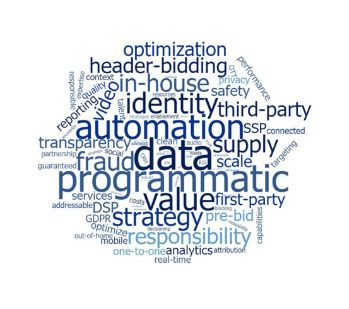
far more about data than about media transactions
There is demand for technology products that speak
alone.
to one another. The lack of interoperability among
The word cloud below depicts the dominance of technology products affects staffing, training, and
data among the many words in the one-on-one operating fees. The evolving ad tech landscape
interviews. characterized by both ad tech fragmentation and
possible consolidation can affect how tech stacks are
built and upgraded over time. This adds complexity
when simplicity is desired.
For publishers, a specific challenge of lack of in-
teroperability is the lack of transparency around
inventory pricing in different programmatic market-
places. Costs associated with yield management in
this environment affect budgets and client service.
In addition to data and interoperability as overar-
ching concepts, there are eight key themes that
surfaced in the analyses. They are:
1. The Promise of Programmatic is Still
Not Realized
2. The Perception of Programmatic Still Varies
Another overarching concept that applies to much 3 The Views on Automation Also Vary and Fall
of what interviewees talked about is interoperability Into Two Buckets
of data, along with business process and business 4. Investments in Talent and Technology Are
intelligence. There are nuances and some detail in- Ongoing and Significant
volved in interoperability as expressed in the study.
November 2019 The Future of Programmatic and Automation • 115. The Role of the Agency is Changing Rapidly viewees mentioned the need for respect, privacy
and compliance. Some prefaced certain data use
6. Data Quality is Slammed, but Data-Driven
aspirations with the caveat that the privacy regula-
Marketing is The Future
tions and compliance be strictly observed. One se-
7. It’s Not about Tech Tax; It’s About Value nior marketing executive brought an imperative for
8. The Future of Programmatic is Automation, and ownership and control of first-party data front-and-
That Refers to ALL Media…Including TV center into the discussion of privacy. When probed,
some expressed a degree of wait-and-see regarding
A brief note on GDPR and privacy is in order. The pending U.S. privacy regulation with the hope for
interview discussion guide used for the one-on-ones consistency across states.
included open-ended questions on privacy. Inter-
Key Theme #1: The Promise of Programmatic is Still Not Realized
“
Interviewees voiced disappointment in the as-yet
unfulfilled promise of programmatic. The unfulfilled In a lot of marketplaces, when new technology
promise is evidenced in disappointment in the ca- comes online, we are great about leveraging data
to target people. The creativity and the storytelling
pacity of programmatic to deliver the right message
behind a company or a brand or an offer—that
to the right person at the right time. It shows up in was left behind.”
comments about the wonder that programmatic
—Global Agency Executive
promised versus the reality of programmatic devolv-
ing into a driver of low cost rather than value. These
comments wrap around the notion of programmatic
being unable to truly understand mindset, motiva- “ To reach the next level of programmatic is to
introduce the missing variable, which is the human
compassion and empathy and creativity that comes
tion, and need states to deliver hyper-relevant mes-
sages. The more tech-focused perspective is that along with marketing science.”
rather than create simplicity and deliver on amazing —Programmatic Agency Lead
possibilities, programmatic has instead increased
“
complexity in some areas.
We have a propensity-to-buy model, which is for
all these internal prospects, and one of the things
“
we’re working on now, to actually talk about creative
If we go back to [the origins of] programmatic, as well, is working out what’s the right creative
going back to this amazing promise of price dis- messaging for these different buckets.”
covery, right creative, right audience, and you could
—Executive, Marketer
eliminate, theoretically, wasted impressions in the
marketplace, that was the overarching umbrella
as to why programmatic became so exciting.…The
promise to agencies at the time was that it was
going to be more efficient to them from a labor
perspective.…It’s increased the need for separate
teams or separate people. It’s increased complexity.
It’s ushered in a ton of new things that we weren’t
dealing with before.”
—Ad Tech Founder
November 2019 The Future of Programmatic and Automation • 12Key Theme #2: The Perception of Programmatic Still Varies
To some respondents, it appears that programmatic fashion, which means less paper involved and more
is scalable electronic media execution. To others, connecting of pipes, trading of inventory, etc. Some
of it may be on a real-time basis, while others might
programmatic is the future of all marketing. And if it
be inventory that we’ve already planned to buy
is the future of marketing, then is it the data ex- together, and we’re just exchanging it electronically,
change and analytics vehicle from inception of mar- as opposed to submitting an IO, for example.”
keting campaigns through deep consumer insight
for all media? This notion of data and analytics is —Senior Executive, Marketer
mentioned in reference to a number of core market-
“
ing processes: identifying the campaign target and
media to go with the target; message optimization; I think of programmatic as being biddable
marketplaces where you’re leveraging your data at
cross-media understandings and creation of new in-
scale to make decisions about what you market, how
sights that span marketing touchpoints and consum- you market, to whom you market and, most import-
er experiences with a brand. ant, what is that message. The automation comes
in with programmatic in that these things are done
best with machines, are done best leveraging billions
“ The way that I define programmatic is taking out
as much paperwork and manpower work around
the paperwork to get a deal done and being able
and billions of data touch points. So, the idea is,
how do you get smarter?”
—CEO, Agency Division
to structure deals and trading in a more electronic
Key Theme #3: The Views on Automation Also Vary
and Fall into Two Buckets
As one can see from the above comments, inter-
viewees generally distinguished between automa-
“ Automation to me is limited to no actual
paperwork involved and using electronic means to
basically get the work done.”
tion and programmatic. For some respondents,
automation is primarily a workflow efficiency issue: —Senior Executive, Marketer
seamless technology that eliminates rote tasks and
multiple layers of manual interference in the pro-
grammatic transaction workflow. Other interview-
ees expressed an understanding of automation as “ Programmatic is a way to buy. Automation is so
much more. That could be anything from setting
up triggers on the back end— i.e., someone meets
higher level decisioning rules or higher level think-
certain requirements or doesn’t meet certain
ing functions using multiple data inputs along with
requirements based on either engagement or
sophisticated algorithms, machine learning, and AI. non-engagement with an ad, or engagement or
In regards to the latter point, the last interviewee non-engagement on a site, and then you can
quote above states that the automation comes into automate programs or campaigns to
programmatic to answer the need to be smarter with re-market to them.”
billions of data points. Automation enables complex —Head of Programmatic, Marketer
analytics to be assimilated and leveraged in the
campaign management process. Quotes that exem-
plify the two understandings of automation, no more
manual work and higher level decisioning, follow. “ Automation is typically associated with some
form of algorithmic or machine learning or
perhaps a specialized form of machine learning
such as artificial intelligence.”
—Senior Executive, Marketer
November 2019 The Future of Programmatic and Automation • 13Key Theme #4: Investments in Talent and Technology Are
Ongoing and Significant
“
As the entire ecosystem evolves, with a focus on
data and data-driven marketing, there are impacts Reporting is still not unified, so it still requires
on budgets for media, technology, and talent. For
agencies and publishers, there are some immediate
a lot of manual work from analysts to marry data
effects on operating revenue. The costs that were sets and analyze them, prgrammatic talent is more
mentioned break out into three areas: talent costs, expensive and there are fewer of them than direct
technology, and costs associated with moving func- IO talent”
tions in-house. —CRO, publisher
Regarding the first, talent, both data scientists
“
and technology (engineering, IT) are the primary
It’s huge [tech investments]. I’ll be honest. As a
mentions by respondents. One senior marketer percent of my total budget, we’re spending more in
expressed the concern that when new tech talent technology and platforms than ever before.…The
is needed to enhance the marketing tech stack, number that you have for disposable, discretionary
executives in finance frequently want to assign that advertising shrinks because, in my case, it comes out
cost to a general IT budget even though the talent of the same fund.”
—Senior Executive, Marketer
is needed to achieve marketing goals and requires
highly specialized skills.
As for technology costs, some interviewees men-
tioned data management platforms and analytics
programs as well as second- and third-party data
“ It’s way too expensive to keep the tech stack
up-to-date—too many players.”
—Senior Sales Executive, Media Company
fees.
“
The third cost parameter mentioned the costs asso-
ciated with moving certain programmatic and media If I’m a publisher, I am not trying to build
functions in-house. Those mentions revolved around anything programmatic.”
the high costs for the right talent and the tech stack, —Senior Sales Executive, Media Company
as well as the marketing dollars being used to cover
those costs.
Key Theme #5: The Role of the Agency is Changing Rapidly
There is a tremendous amount of noise in the mar- Interviewees cited the capacity and the need for
ketplace about agency-client relationships, in-hous- agencies to be consultants on technology required
ing, and other topics that collectively create an for media and marketing success. The respondents
unnecessary sense of doom and gloom. What this also talked about the important role of agencies in
study illustrated quite sharply is that as the market evaluating the many technology and data vendors.
evolves, so does the role of the agency. That entails One marketer cited the need for specialized talent
transformative action on several fronts including and broad overviews of the market as a primary
investments and business models. Even marketers reason for not moving programmatic or other media
who have moved many programmatic functions functions in-house. Others mentioned that consul-
in-house were clear on the notion that the central tative expertise on unraveling complexities in the
role of the agency—that is, having cross-client and marketing landscape is a vital function for agencies.
cross-vendor expertise—is vital to the success of
The quotes below articulate some of what is sum-
their in-house efforts and their marketing success.
November 2019 The Future of Programmatic and Automation • 14marized and also provide depth around how art and create and tell brand stories.
science together will ultimately alter how creatives
“ The role of the agency is to be the conduit, to
have the lens of the client, but also
the lens of the media landscape, and bridge
“ I think the onus is on everybody; it’s not
just the agencies that need to change.
Marketers need to be very clear that the agencies
those two together.” have an important role in the success of making
—Head of Programmatic, Agency sure we’re a successful programmatic advertiser.”
—Senior Executive, Marketer
“ Agencies need to be strategic consultants with
clients, helping them audit their access to data, and
then, most importantly, how the client should own
“ So, for TV, we do use an agency. I don’t know if
that really counts as far as, like, using an agency, but
the data.…The agency should be agnostic and come I will say that there has been some pressure from
in as a consultant, whether it’s about the DMP or our leadership team to have us buy TV direct.”
their access to their data.” —Executive, Marketer
—CEO, Agency Division
“ I believe agencies are important in the ecosystem;
“ For agencies, two things are coming to the
forefront. You’ve got to execute on big data, and
you’ve got to start building data -science capabilities
however, I see them as needing to evolve into more
consultative roles and less so in terms of providing
strategy, and more so in being able to provide
in your agencies.…And then you’re going to have operational excellence and capabilities. Again, they
creatives think differently. Not as one-dimensionally are a necessity in the market.”
about how a campaign rolls out, [but] about how —Programmatic Executive, Publisher
the campaign can change dynamically in real time.…
Messaging…could be multiple messages. It still might
ladder up to a big core idea.…I think it’s going to
get tougher on the creatives because the science is
getting so precise.”
—Senior Executive, Marketer
Key Theme #6: Data Quality is Slammed, But Data-Driven
Marketing is the Future
Throughout the interviews, there were strong in-
dictments about the quality of data being used in “ Data is the problem right now in programmat-
ic. It’s all treated like an exogenous variable it’s all
the same, it’s all standard. And it’s not. The quality
today’s programmatic advertising market. In some
of data is the Wild West. Some environments, like
cases, the dearth of data quality transparency and
the walled gardens, don’t pass data back to you
control was mentioned, along with the inability in any useful way. Other environments have data
to assess data coming from the walled gardens. that comes back that’s been treated or processed
More than one interviewee called for some kind of or is old. The data signal we use can be corrupted.
centralized industry function or body to evaluate There needs to be Tier 1 data, Tier 2 data, and Tier
data quality, with the quote below even going as 3 data, where Tier 3 is crap and Tier 1 is gold. And
we don’t have that today, and so it requires a lot of
far as suggesting a data rating system. Despite the
work. If other marketers looked under the hood on
concerns, the strongly and widely held belief that the quality of data, it would definitely be significant
data-driven marketing is the future is dominant in headwind for programmatic adoption.”
the interviews. As you will see later in this paper, this —Senior Executive, Marketer
is borne out by the quantitative research.
November 2019 The Future of Programmatic and Automation • 15“ We use data targeting in two ways—one is to
understand the kind of person that we’re trying to
address, and then two is just to optimize to reach
“ I think our whole attribution space and
measurement model beyond the basics is nowhere
close to being cleaned up where it needs to be.
our goals better now. When we’re talking about So, even if you are buying and using these data
third-party data, if I’m trying to sell cars, I’m gonna overlays to buy like that, I think the jury’s still out on
go for that in-market auto segment, probably, and how you pinpoint if it’s working or not, is it adding
when I put it on a media plan to present to clients, value or not. ”
they like to see that data. The thing is that that data —Senior Executive, Marketer
set is probably modeled to heck, and I don’t know
whether those are people that are actually
in-market auto or not.”
—Global Head of Activation, Agency
Key Theme #7: It’s Not about Tech Tax—It’s about Tech Value
“
In exploring the concept of the tech tax, it was im-
portant to try to parse out what the concept of the I think the fees are getting more transparent, but
tech tax represents across the ecosystem, both to publishers certainly do not know. The buyers are
seeing more, but the sellers are still in the dark.”
those who deal with these costs hands-on and those
who sign off on the expenses. Is the “tech tax” —Advertising Technology Executive
simply the cost of doing business, or does it refer to
“
hidden fees and unexpected costs associated with
various tools and services needed to execute pro- The so-called tech tax is often the non-transpar-
grammatic advertising? In order to understand the ent part of the equation, which I think that’s the
reason I believe many clients brought programmatic
dichotomy embedded in the question “What is the
in-house so they would have access to seeing those
tech tax?”, you have to closely consider the views of fees and managing those fees.”
each part of the ecosystem. Many respondents were
—Agency Holding Company Executive
unclear as to the exact meaning of the term (con-
trary to noise in the marketplace). However, once it
“
was explained, the respondents understood that,
yes, while it is part of the cost of doing business, it The tech tax is something that people perceive as
being tremendously egregious, and I think the
is transparency around those costs that is the heart
expectation for transpaency in the ecosystem, I don’t
of the issue. From marketer to publisher, there was have any issue with that happening. I think, though,
a range of views as evidenced by the quotes below. we really need to get at the nuts and bolts of what
Some of the quotes illustrate what we believe is an transparency means and who we expect to have it.”
emerging narrative of value associated with costs. —Agency Holding Company Executive
The quantitative data also helps to shine a light on
what costs people feel are essential, those which
have the most value, and those which are less so.
“ What are the truly meaningful pieces? Because
we’re perfectly happy paying for and asking our
clients to pay for things that are truly meaningful,
“ There’s a lot of quotes about how big the
tech tax is, and when I see those numbers, I’m like,
‘Somebody is very bad at negotiation.’ Which is fine.
that are truly adding value, but let’s minimize,
if not eliminate, those areas that aren’t.”
—Agency Holding Company Executive
We’ve worked really hard as we’ve brought on our
new partners to get our tech tax down to a number
that makes sense for our business.”
—Executive, Marketer
November 2019 The Future of Programmatic and Automation • 16“ A technical fee commensurate with the value it
brings between the buyer and seller of media makes
a lot of sense. I think the reason that the word
“ On costs being clear: “No, it’s not clear. I want to
talk to somebody that says it is, but, no, I get lost all
the time. For instance, why is this CPM or why
‘tax’ has come into play is that people always feel is this cost associated? I don’t know what the hell
like taxes are too high, and it’s an unfair amount they’re charging.”
that’s withdrawn from the transaction, and that’s —Operations Executive, Media Company
the issue, which is I think that we as an industry
have allowed too many players to take an outsized
amount of value out of the transaction versus what
value they bring.”
—Advertising Technology Executive
Key Theme #8: The Future of Programmatic is Automation, and
That Refers to All Media…Including TV
Across multiple interviews from all parts of the eco- using more data and more integrated thinking is
system, two central ideas about the future of pro- clear from the interviews. The quotes below
grammatic emerged. One is that TV must and will be illustrate that.
part of the programmatic marketplace in order for
In addition, the bigger notion of the power of
all advertising to be data-driven, and in conjunction
automation for a future that is smarter, faster, and
with that is the idea that automation is the future of
real-time, and that also eliminates manual work,
programmatic. One interviewee even hypothesized
ensures inventory hygiene, and enhances creatives,
that perhaps in the future the term programmatic
is illustrated in quotes following those regarding TV
will not be used for data-driven marketing automa-
and video.
tion. The aspiration that TV will become automated
and that advertising will be planned and transacted
TV
“ There will be a time, I don’t know when,
when almost all media is bought programmatically
or is automated in some way. You just look across
“ Data-driven marketers are insisting on [TV/OTT/
addressable TV]. It’s relatively scaled, and most of
the time ,we’re doing it as part of a more compre-
the entire landscape and look at the financial world, hensive cross-channel video strategy. So how do you
and media is the laggard. So I don’t think there’s any get targeted video in front of people, whether it’s on
way you could stop that.” a smartphone or a laptop or an iPad or through a
—Senior Executive, Marketer
connected TV or a streaming device?”
—CEO, Agency Division
“ My hope is that one day, every TV ad I put on TV
could be individually addressed down to the
household with the one message to the customers “ I think the most notable over the next
three to five years is going to be the platformization/
and one to non-customer homes.” automation of television. I think people that have
—Advertising Director, Marketer
data and technology backgrounds are kind of
invading the TV world. And some people really do
feel like that’s the right word: to create a different
way of transacting, and just a lot more automation
and a lot more transparency in the TV world, similar
to that of the last 10 years of digital.”
—Global Head of Activation, Agency
November 2019 The Future of Programmatic and Automation • 17“ Going forward in the future, I don’t think the in-
dustry becomes 100% programmatic...endemic client
relationships with brand-content fit will still comprise
20% of sold inventory.”
—Head of Revenue, Tech and Content Provider
The Automated Future
“ AI everywhere, machine learning—automation
needs to have more and more around it, how we
can provide more automation to the supply chain
“ I would like it to be automation. I would like it
to be a fair and equitable marketplace and
relationship where we have been able to use data
and then the creation of bespoke automation.…The between the parties, between the publishers and
future of automation is custom.” the advertisers and the middle men, in an equitable
—SVP of Global Partnerships, Ad Tech
way so that we can all find the best partnerships for
each other and it’s transacted quickly, obviously. So
decisions are made and you can transact quickly,”
“
—VP of Programmatic, Media Company
I think the future is AI and machine
learning. It comes down to these machines and
“
these systems just getting smarter and smarter, and
it allows for people… So it is the future of what we’re doing that will
to do more of the creative, strategic, manifest itself in different forms of programmatic
thoughtful work.” trading—programmatic guaranteed or
—CEO, Agency Division
programmatic direct, private marketplace versus
an open RTB kind of biddable infrastructure. But I
believe further automation and further enablement
“
of data to drive performance is the future
The machine is doing optimization for us on of our industry.”
a very impactful placement level basis right now.
—Sales Executive, Media Company
I think it increasingly will understand what your
preferences are for brand safety and do that
“
configuration. It’ll seek out non-fraudulent
inventory and make that optimization easier and There will not be a need for manual ad
kind of crawl up the waterfall.” operations anymore. There will be systems that are
—Global Head of Activation, Agency
directly plugged into one another across all
platforms, with the exception, I think, of linear. I
don’t think that goes full, full automation. There will
“
be elements of automation that will be there.”
I think the next generation is
—Sales Executive, Media Company
things like AI.”
—Global CEO, Agency Division
“ We will find a more natural and beautiful bal-
ance of things that can be and should be automated
which frees up the human brain to do what only the
human brain can do. And that is…clean insights,
develop strategies, come up with big, beautiful,
creative, brand-building, business-driving ideas,
and let the technology and the automation take the
brunt of those formerly more manual, labor-inten-
sive pieces off of our hands, off of our back.”
—President, Advertising Agency
November 2019 The Future of Programmatic and Automation • 18Quantitative Findings
In addition to quantifying themes from the quali- confirmed that the themes in the qualitative study
tative research, the survey research also examines are valid. Moreover, the survey data expands upon
areas that surfaced in the qualitative insights. For the qualitative nuances in a manner that permits an
example, the questionnaire specifically asks about understanding of where the market is today.
the value of investments in talent, technology, data,
Findings from the survey are organized by topic
and measurement to the respondents’ respective
below. Throughout the analyses, references to the
businesses. Another example stemming from the
qualitative findings are made. An important note
qualitative analyses is a question that outright asks
is that analyses that include subgroups all indicate
respondents to select their #1 priority for marketing
when the findings are directional due to small
and advertising automation in the next three years.
sample sizes.
A high-level finding is that the quantitative research
Perceptions of Programmatic and Automation
The qualitative research indicated that perceptions advertising automation.
of programmatic and automation still vary. In the
The dominant perception is that marketing and
quantitative study, respondents answered a number
advertising automation are inclusive of using
of questions that flesh out the market’s view of what
technology to eliminate manual tasks as well as
programmatic and automation are.
data-based rules and decisioning such as algorithms,
The survey questionnaire asked respondents to machine learning, and AI (90.4% selected this as the
choose a definition of marketing and advertising definition). Only 9.1% of respondents selected the
automation that most closely matches their own. alternative definition: ”Marketing and Advertising
This particular question offered the opportunity for Automation is a process that is strictly referring to
the research to examine how the two notions of the use of technology to eliminate manual tasks and
automation fit into a holistic view of marketing and paperwork.”
Table 1: Definition of Marketing and Advertising Automation
Q: Please choose the definition of Marketing and Advertising Automation % Of Respondents
that most closely matches your own definition. Choosing
Marketing and Advertising Automation is more than just the use of technology to
eliminate manual tasks—it also includes the use of data-based rules and decision- 90.4%
ing such as algorithms, machine learning, or artificial intelligence.
Marketing and Advertising Automation strictly refers to the use of technology to
eliminate manual tasks and paperwork in transacting advertising.
9.2%
Other 0.4%
November 2019 The Future of Programmatic and Automation • 19As discussed in the section on the qualitative find- provide a notion of direction for improvement and
ings, a key theme that emerged is that for interview- potentially realizing programmatic’s promise. One
ees across the ecosystem, the promise of program- is that agreement with the statement “The array
matic remains unfulfilled. The industry leaders who of inputs needed to reach the right person at the
spoke with us cited needs for: right time with the right message cannot currently
be leveraged in programmatic without higher levels
• more automated processes and interoperable
of automation” (45.2%) is significantly higher than
programmatic technology that will simplify
disagreement (29.2%) with the statement. The other
workflow,
item, “The highly sophisticated algorithms used in
• automation that will enable higher level programmatic advertising reliably deliver real-time
decisioning, such as AI (within the programmatic optimization without human involvement,” garners
workflow), and disagreement by half the respondents (50.2%) and
• better quality data than that used in agreement by a significantly smaller proportion
decisioning today. (35.2%). In both instances, today’s differentiation
between programmatic and automation are evident.
These issues are at the heart of the disappointment
found in the qualitative research indicating that The current in-market meme of reaching the right
programmatic is still unable to deliver the right mes- person at the right time with the right message is
sage to the right person at the right time. Thus, the not widely accepted nor is the notion of delivering
survey measured perceptions of programmatic and real-time optimization. Both perceived inadequacies
automation in simple statements that break down are framed in the context of higher levels of automa-
the component issues. tion that are still lacking.
The findings unequivocally substantiate the percep-
tion that programmatic does not equal automation.
More than three quarters of the respondents (76.3%)
disagree with the statement “Programmatic ad-
vertising has eliminated nearly all the manual work
in buying digital media.” Over two thirds (67.6%)
disagree that “programmatic and automation are
the same thing.”
While respondents currently believe that program-
matic and automation are not the same, and that
marketing and advertising automation are inclusive
of both elimination of manual tasks and higher-lev-
el decisioning and data-based rules, the view that
“programmatic is the technology infrastructure that
will underpin all data driven marketing in the fu-
ture” is shared by nearly two thirds of respondents
(62.6%).
The quantitative data on perceptions of program-
matic shows directions for improvement in the cur-
rent state and thus for getting closer to the promise
of programmatic. And these directions foreshad-
ow what we learned in questions that specifically
tapped into priorities for business in the near- and
longer-term futures, where near-term is up to one
year and longer-term is equal to the next
three years. Two items that may be interrelated
November 2019 The Future of Programmatic and Automation • 20You can also read


