The GreenPoint Rated Climate Calculator - June 2008 - California Office of ...
←
→
Page content transcription
If your browser does not render page correctly, please read the page content below
The GreenPoint Rated Climate Calculator

June 2008

GreenPoint Rated Climate Calculator 2

Contents

Executive Summary......................................................................................................................... 3
Introducing the GreenPoint Rated Climate Calculator................................................................... 4
Background & methodology ........................................................................................................... 5
Notable findings.............................................................................................................................. 6
What these findings mean for….................................................................................................... 11
   Policymakers & climate action planners ...........................................................................................11
   Builders, developers & building designers........................................................................................11
Next steps ..................................................................................................................................... 11
Case studies .................................................................................................................................. 13
Project background....................................................................................................................... 19
Appendices.................................................................................................................................... 21
   A.      Methodology..................................................................................................................... 22
   B.      Measures Included in the Calculator ................................................................................ 24
   C.      Emissions Factors & Coefficients ...................................................................................... 29
   D.      Measures Not Yet Included in the Calculator ................................................................... 30
   E.      Measures Not Applicable to the Calculator...................................................................... 34
   F.      Other Emissions Calculators ............................................................................................. 36

GreenPoint Rated Climate Calculator 3

Executive Summary
A number of lifestyle-based carbon calculators have been developed to estimate an individual’s or
household’s carbon footprint, but until now, no tool existed to measure the total avoided greenhouse
gas emissions from building green homes.1

The new GreenPoint Rated Climate Calculator, developed by a team led by Green Building in Alameda
County, provides this information in a way that’s systematic, credible and backed by third-party
verification.

The Climate Calculator is likely to be an influential tool for helping California’s residential building
industry reduce its carbon footprint. The Calculator is an adjunct to the GreenPoint Rated program,
which provides a consumer label for green homes.

When a house or multifamily building undergoes the GreenPoint Rating process, the Rater will use the
Climate Calculator to generate data on greenhouse gas (GHG) emissions avoided, measured in carbon
dioxide equivalents, or CO2e. Other savings are also calculated, including non-CO2 savings like gallons of
water, tons of waste, kilowatt-hours of electricity, and therms of natural gas.

Notable findings
 Buildings in denser, transit-oriented communities provide the greatest emissions reductions.

 In the building’s design, the most important CO2e reduction strategies are building energy
  efficiency, reduced home size, photovoltaic systems, energy-efficient appliances (including non-
  HCFC refrigerants), and water-efficient landscapes and fixtures.

 Construction and demolition waste recycling produces significant CO2e savings for the building
  and community.

 Green remodeling reduces net CO2e emissions, while constructing new housing (whether green or
  conventional) increases net CO2e emissions. Given that 70% of homes in the state were built
  before 1980,2 the opportunity for true emissions reduction is enormous in the home remodeling
  sector.

1
    See Appendix F for an abbreviated list of carbon calculators.
2
 California Energy Commission household forecast for California Energy Demand 2008–2018, November 2007,
report number CEC-200-2007-015-SF2.
GreenPoint Rated Climate Calculator 4

Introducing the GreenPoint Rated Climate Calculator
Green buildings incorporate a suite of environmentally preferable practices during siting, design and
construction. Consequently, most green buildings are thought to have lower carbon footprints than
traditionally built or remodeled buildings. But how much lower? Which green building strategies are
most effective for reducing greenhouse gas (GHG) emissions? While the energy-related emissions
savings from the building industry are well understood, how do the non-energy benefits of green
buildings compare? How will the growing inventory of green homes contribute to the state’s ambitious
GHG reduction goals?

The GreenPoint Rated Climate Calculator helps answer these questions. When a remodeled or newly
built residence undergoes the GreenPoint Rating process, a third-party Rater will use the Calculator to
generate data on GHG emissions avoided and other savings. 3 The Climate Calculator produces four sets
of data:

 CO2e data derived from the building’s green design features, including:
     o building energy efficiency,
     o reduced home size,
     o photovoltaic systems,
     o energy-efficient appliances,
     o advanced refrigerants,
     o water-efficient plumbing fixtures, and
     o water-efficient landscapes;

 CO2e data related to the recycling of construction and demolition waste;

 CO2e data related to the project’s location, which quantifies the potential reduction in miles driven
  by residents who live in more compact, transit-oriented, mixed-use developments; and

 Non-CO2 savings, including gallons of water, tons of waste, kilowatt-hours of electricity, and therms
  of natural gas.

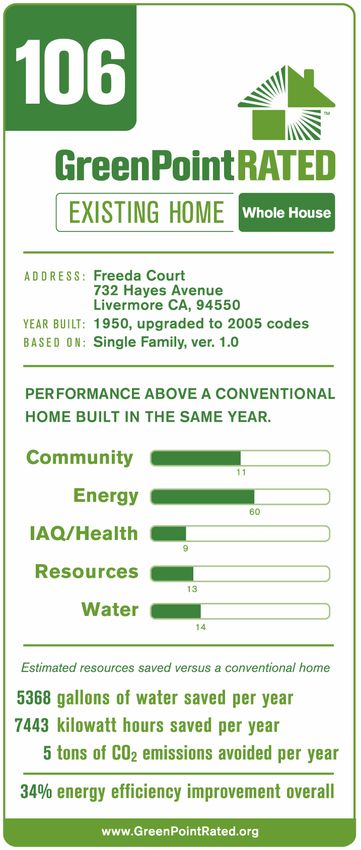
All these results will be incorporated into a new GreenPoint Rated consumer label (see page 12 for a
preview illustration).

3
 See the Build It Green website at www.builditgreen.org for more information on the GreenPoint Rated program
and the Green Building Guidelines for New Homes, Multifamily buildings, and Existing Homes.
GreenPoint Rated Climate Calculator 5

Background & methodology
The green building measures included in the Calculator are
drawn from the Green Building Guidelines published by            Energy Efficiency Strategies for
                                                                 Exceeding Title 24
Build It Green, which includes single-family new
                                                                 Exceeding California’s Building Energy
construction, multifamily new construction and single-           Efficiency Standards (Title 24) results in
family existing homes.                                           reduced greenhouse gas emissions, lower
                                                                 utility costs and increased comfort. Although
The project team encountered some challenges as they             appropriate strategies will differ depending on
sought to develop a Calculator based on accurate, verifiable     the local climate, in general the top strategies
data and assumptions. Foremost was the need to make the          include:
                                                                 o Passive solar design with high thermal
Calculator truly representative of the numerous co-benefits
                                                                      mass
that green buildings provide, some of which have impacts         o Increased building insulation
on GHGs while others do not. Also, to be credible the            o High performance windows
Calculator had to reference valid standards, research            o 14+ SEER air conditioners
                                                                 o 92%+ AFUE furnaces
reports, and assumptions.
                                                                 o Pipe insulation on all hot water lines
                                                                 o Home Energy Rating System (HERS)
Lastly, and perhaps most challenging, the Calculator must
                                                                      inspections on quality of insulation
work for the GreenPoint Raters in the field. A calculator that        installation, infiltration leakage and duct
is too onerous to fill out would drive up the cost of                 efficiency
GreenPoint Ratings, while an overly simplified calculator        For information on these and other energy
would lack credibility. The GreenPoint Rated Calculator          efficiency strategies, refer to the Green
                                                                 Building Guidelines for Multifamily, New
currently meets these objectives, and will continue to be
                                                                 Homes and Home Remodeling at
refined as more and better data becomes available and as         www.builditgreen.org.
GreenPoint Raters provide feedback based on their
experience with using the Climate Calculator in the field.

For a more detailed discussion of the Calculator’s methodology, see Appendix A. Appendix B lists all the
measures included in the Calculator at this time. Many Green Building Guidelines measures were
excluded from the Calculator or deferred to a future version because of the measure’s low correlation
with climate change or resource benefits (such as light pollution reduction), insufficient data (for
example, no third-party study on the energy savings of a gearless elevator compared to a hydraulic
elevator), or difficulty devising a way of measuring its impact (for example, environmentally preferable
materials). See Appendix D for a list of measures not yet included in the Calculator and Appendix E for a
list of measures excluded from the Calculator.
GreenPoint Rated Climate Calculator 6

Notable findings
The findings described here are derived from the project team’s extensive research and analysis into the
correlations between specific green building strategies and their impacts on GHG emissions and
consumption of energy, water and other resources. Others
                                                                 Indoor Environmental Quality
consulted on the Climate Calculator include:
                                                                 Although the Climate Calculator doesn’t
        o climate change experts,                                specifically address healthy home issues,
        o State of California agency staff, and                  better indoor environmental quality is one of
                                               4                 the most important benefits of building green.
        o energy and green building leaders.
                                                                    Having a healthier home is also one of the
 Buildings in denser, transit-oriented communities                 main motivations for people to buy green
                                                                    homes, green products and green remodeling
  provide the greatest emissions reductions. The
                                                                    services. Best practices for better indoor
  research and analysis underpinning the development of             environmental quality include:
  the Climate Calculator confirmed what many land use               o Noise and vibration control, especially in
  experts have long claimed: that a project’s location and              multifamily and mixed-use buildings
  layout plays a larger role in its climate change impacts          o Kitchen and bathroom fans that exhaust
                                                                        to the outside
  than does the building’s design. On average, people
                                                                    o Track-off systems at entryways to keep
  living in less sprawling, more transit-oriented                       dirt and other contaminants from entering
  communities and cities travel by car much less than                   the building
  people living in lower density communities without                o Low- or no-VOC paints, coatings and
                                                                        adhesives
  good access to public transit or local jobs.
                                                                    o Pressed-wood products with reduced
                                                                        formaldehyde and flooring with low VOC
       To assign GHG impacts related to a building’s location,
                                                                        emissions
       the Climate Calculator uses average vehicle miles            For information on these and other green
       traveled (VMT) data based not just on a project’s            building practices, see the Green Building
       density, but also on its proximity to public transit,        Guidelines for Multifamily, New Homes and
       shopping and other services, and on the neighborhood’s       Home Remodeling at www.builditgreen.org.

       accessibility for pedestrians and bicyclists.

4
    The project team and stakeholders are listed on page 19.
GreenPoint Rated Climate Calculator 7
In the building’s design, the most important CO2e Resource Conservation
reduction strategies are building energy efficiency, The GreenPoint Rated Climate Calculator
calculates CO2e savings from construction and
reduced home size, photovoltaic systems, energy-
demolition (C&D) waste reduction, which can
efficient appliances, advanced refrigerants, and water- be significant. However, green building
efficient landscapes and fixtures. provides many other resource conservation
o Building energy efficiency. The GreenPoint Rated benefits that aren’t reflected in the Climate
Calculator, such as:
Climate Calculator’s baseline assumptions include
o Durable products that require less
all the building design strategies required to meet frequent maintenance and replacement
Title 24 Energy Efficiency Standards. The Climate o Advanced framing techniques, engineered
Calculator uses the project’s Title 24 energy lumber, and Forest Stewardship Council
modeling results to assign a CO2e reduction value (FSC)-certified framing lumber
o Recycled-content building products, such
based on avoided emissions from energy savings
as decking, ceramic tiles and carpets
achieved by exceeding Title 24. This means that the o Flooring made from rapidly renewable
Climate Calculator provides an aggregated CO2e resources such as cork, linoleum and
total for most of the building energy efficiency bamboo
For information on these and other green
strategies rather than presenting CO2e results for
building strategies, refer to the Green Building
individual strategies. Energy measures that are Guidelines for Multifamily, New Homes and
required in the California Building Energy Code (Title Home Remodeling at www.builditgreen.org.
24) are not included in the energy savings analysis
since they do not exceed minimum code requirements. For those energy-related measures
above code minimums but not accounted for in Title 24 analysis, the Climate Calculator has
separately quantified the energy and GHG savings. At this time, the Title 24 energy savings are
based on calculated kilowatt-hour per year reductions and are thus independent on the time of
day energy is conserved. Analysis for existing homes was calculated based on the improved
performance over a typical home of the same vintage (see Appendix B for more information on
measures included in the calculations for existing homes).
o Home size efficiency. The size of a house or multifamily housing unit has a large impact on the
amount of materials used to construct the home and its energy use once occupied. Larger
homes tend to use more heating and cooling energy and produce more construction waste. The
Climate Calculator factors in a home’s size to show the net energy benefits and reduced waste
of building compact spaces.
o Photovoltaic systems. If a project has a solar electric system, the Climate Calculator uses the
system’s estimated kilowatt-hour per year output to assign a CO2e reduction benefit. The
emissions resulting from the project’s net electricity use are calculated using the unique power
generation mix of the utility that serves that particular location. Solar hot water systems are
accounted for in Title 24, so are not broken out separately by the Climate Calculator.
o Appliances. Energy- and water-efficient appliances are not accounted for in Title 24 but can
represent a significant portion of a project’s CO2e savings.GreenPoint Rated Climate Calculator 8
o Central laundry. For multifamily projects, the largest
Water Conservation
appliance-related savings come from having central Water conservation directly impacts energy
laundry facilities. When residents use common use at the state level, since energy is needed
laundry facilities they tend to wash and dry larger to source, purify, convey and heat water in
homes. Once used, even more energy is spent
loads less frequently than when laundry appliances
to move and then treat wastewater.
are located inside each individual home. Altogether, the management of water in
o Advanced refrigerants. Using HCFC (R-22) and a California accounts for 19% of the state’s
leakage rate of 2% per year as the baseline electricity and 30% of its natural gas usage.*
condition, the Calculator estimates the avoided And water efficiency has benefits beyond just
energy, including helping conserve the state’s
global warming potential (GWP) of using advanced
diminishing supplies of potable water.
refrigerants, including HFC-134A and HFC-407A, in
refrigerators and air conditioners. Measures that slow the flow of stormwater
runoff, such as permeable paving, swales and
o Water-efficient plumbing fixtures. The Calculator
green roofs, aren’t included in the GreenPoint
includes CO2e reductions for the efficient use of
Rated Climate Calculator because their CO2
water indoors. Low-flow showerheads, faucets and benefits are at present difficult to quantify for
toilets provide significant water savings in homes. individual projects. However, these measures
Depending on where the project is located and may in fact have significant climate change
where the water supply is coming from, the water benefits. A report by the California Energy
Commission notes that increased runoff in the
impacts on GHGs may be quite small compared to
Chino Basin results in more than 40,000 acre-
the Calculator’s other savings areas. However, water feet per year of stormwater going into
efficiency has other benefits, including helping stormwater treatment facilities instead of
conserve the state’s diminishing supplies of potable recharging groundwater. The lost
stormwater’s energy value was 2,250 kWh per
water.
acre-foot on average, according to the
o Water-efficient landscapes. The Calculator includes report.**
water savings from well designed and maintained
landscapes that utilize a range of water-efficient *“California’s Water-Energy Relationship,”
California Energy Commission, Nov. 2005, document
elements. Principles taken from the Bay-Friendly #CEC-700-2005-011-SF.
Landscaping Guidelines are included in GreenPoint
**“The Role of Land Use in Meeting California’s
Rated as a basis for holistic water conservation Energy and Climate Change Goals,” California Energy
Commission, Aug. 2007, document #CEC-600-2007-
techniques outdoors.5 Landscape water 008-SF.
conservation starts with creating drought-resistant
soils with compost and mulch, selecting low-water
using plants, planning for hydrozoned irrigation areas, and installing high efficiency irrigation
technologies. These strategies combined together can save large amounts of water.
5
Information about the Bay-Friendly Landscaping program can be found at www.bayfriendly.org. For more details
on the landscaping guidelines used in the Calculator, see Appendix B.GreenPoint Rated Climate Calculator 9
Construction and demolition waste recycling produces significant CO2e savings for the building
and community. Construction and demolition (C&D) waste generation on an individual project
occurs only at the time of construction and is not ongoing like energy use. However, recycling high
levels of C&D waste can avoid significant CO2e emissions for the first year on some projects as well
as provide ongoing community benefits by reducing emissions from landfills.6
Waste diversion is a critical consideration given the state’s approaching 2020 deadline for reducing
GHG emissions.7 Compared to measures such as energy efficiency that accrue emissions reductions
over time, C&D waste recycling provides immediate savings. Further, cities and local governments
should consider waste an ongoing source of GHG reductions because construction—and the waste it
produces—is an ongoing activity. California will add 2.6 million new homes by 2020,8 and thus the
impacts from avoided construction waste are immense. At 5.6 tons of CO2e saved per home,9
recycling construction waste has the potential to reduce CO2e emissions by more than 14.5 million
tons by 2020!
Green remodeling reduces net CO2e emissions, while constructing new homes (whether green or
conventional) increases net CO2e emissions. Given that 70% of homes in the state were built
before 1980, the opportunity for true emissions reduction is enormous in the home remodeling
sector. When comparing Climate Calculator results for various projects, it’s important to do an
apples-to-apples comparison of similar types of projects. Savings are not directly comparable for
new and existing buildings. For new homes, the Calculator is intended to show the avoided
emissions of building a green home instead of a traditional home. But building a new home creates
emissions that wouldn’t have existed otherwise. On the other hand, when an existing home is
remodeled using green building practices, the Climate Calculator can be expected to show a net
reduction in CO2e, assuming the home’s demand on energy, water and other resources wasn’t
increased from its previous footprint due to factors such as greatly expanding the home’s size.
6
See the Case Studies section for examples.
7
Assembly Bill 32, the California Global Warming Solutions Act of 2006, establishes regulatory and market
mechanisms for reducing greenhouse gas emissions in California to 1990 levels by 2020.
8
California Energy Commission household forecast for California Energy Demand 2008–2018.
9
StopWaste.Org study on emissions reductions from an average size new GreenPoint home.GreenPoint Rated Climate Calculator 10
For each project, the Climate Calculator shows net Carbon Footprint vs. Emissions Avoided
carbon emissions reductions compared to a baseline, not The Calculator is not a carbon footprint
the total carbon footprint (see sidebar). The Climate analysis tool. A footprint seeks to chronicle
Calculator will typically show larger savings for a new the total emissions for a particular building (or
household, individual or organization). The
home than for a remodeled home because more green Climate Calculator quantifies the emissions
building strategies are available to the new home avoided by building a green home or using
builder. These strategies include orienting the building green remodeling practices. The Calculator
to take advantage of passive solar design, daylighting results demonstrate that green homes built or
remodeled to reduce waste, energy and water
and natural ventilation and using super-efficient building
have lower emissions than the same home
techniques such as structural insulated panels (SIPs). But built without green building strategies.
even though more savings per home are available to the
new home sector, total emissions actually increase with each new home. When a new home is built
that doesn’t replace an existing building, there is inevitably a net increase in GHG emissions because
the construction has added another building to the state’s building stock.
While about 200,000 new homes are built each year, the existing housing stock makes up over 13
million homes and has the greatest potential for net emissions reductions. The GreenPoint Rated
Existing Home rating system has been designed to provide an entry point for rating small green
remodels and additions, as well as tackling larger renovation projects.10
More data is needed on GHG impacts from many green building strategies. Many of the green
building measures in the Green Building Guidelines were excluded from the Climate Calculator either
because they are not applicable (see Appendix E) or because there is currently little or no
information about their GHG reduction potential (Appendix D). A consensus-based life-cycle
assessment (LCA) tool, for example, is currently not available to estimate the total carbon footprint
and embodied energy of specific green building materials. 11 However, those impacts combined with
other excluded green building measures could be significant. Climate change and building science
researchers are encouraged to help expand knowledge and data in this area.
10
More on the GreenPoint Rated Existing Home program can be found online at www.greenpointrated.org.
11
At this time, the only measures included in the Calculator that account for embodied energy are the C&D waste
recycling measures. The Climate Calculator relies on the EPA WAste Reduction Model (WARM), which includes the
upstream benefits (manufacturing, extraction, transportation) and downstream energy savings (transportation,
methane capture, cogeneration) from recycling.GreenPoint Rated Climate Calculator 11 What these findings mean for… Policymakers & climate action planners Green building is a cross-cutting strategy that can augment a city’s or local government’s Climate Action Plan by reducing emissions in all major policy areas, including transportation, energy and waste. The Climate Calculator is intended to support public-sector policy initiatives in California, such as Assembly Bill 32 and other state and local initiatives for reducing greenhouse gas emissions. Policymakers have enormous influence over the GHG reduction potential of residential buildings. As noted earlier, compact, transit-friendly communities reduce average vehicle miles traveled. The resulting GHG savings dwarfs the savings arising from a building’s design. Planning policies that discourage sprawl and support mixed-use neighborhoods that are walkable, bikable and transit-friendly have the potential to play a major role in reducing a community's carbon footprint. Policymakers and climate action planners can use results from the Climate Calculator to estimate the GHG emissions reduction potential of homes and multifamily projects in their jurisdiction. The Calculator is also useful for highlighting cross-cutting best practices in a Climate Action Plans or for City planning purposes, such as in adopting green building ordinances or construction and demolition waste recycling policies. Builders, developers & building designers The GreenPoint Rated Climate Calculator is not intended as a design tool to help architects or engineers compare the impacts of various design options. Instead, it’s intended to allow the builder to demonstrate to the owner or future owners the climate benefits of that building. By providing data for the GreenPoint Rated consumer label, the Climate Calculator will help stimulate market demand for green single-family and multifamily homes as well as green remodeling activities. It also will reward green building professionals by providing them with another tool with which to distinguish their products from competitors who build conventional homes with higher waste, utility bills and GHG emissions. Next steps The GreenPoint Rated Climate Calculator will be incorporated into the GreenPoint Rating process over the next few months. By the end of 2008 all new GreenPoint Rated projects will receive a new version of the consumer label (see preview next page) that includes both the GreenPoint Rated score and the Climate Calculator results. The Climate Calculator will continue to be refined and updated as more and better data becomes available and as GreenPoint Raters provide feedback based on their experiences with using the Climate Calculator in the field.
GreenPoint Rated Climate Calculator 12

Sample GreenPoint Rated Consumer Label
 with Climate Calculator Savings Results
GreenPoint Rated Climate Calculator 13

Case studies
To illustrate the type of information produced by the GreenPoint Rated Calculator, four pilot projects
were run through the Calculator and are presented here. These case studies are from real projects that
have been or are expected to be GreenPoint Rated. They represent four very different residential
projects: a new multifamily project, a new single-family production home development, a new single-
family custom home, and a remodeled single-family home. These case studies show a range of possible
reductions across various types of projects. The case studies are:

    1. Multifamily Building, Oakland

    2. Production Single-Family Home Development, Santa Rosa

    3. Custom Single-Family Home, Santa Rosa

    4. Remodeled House, Berkeley

While it is interesting to look at the Climate Calculator results for these homes, it’s important not to
extrapolate too much based on this limited number of projects. Also, all these projects are from the Bay
Area, so emissions factors are different than for homes in other parts of the state (particularly the
water-energy emissions factors). Some projects were already completed at the time of these Calculator
run-throughs, so some data was not verifiable or obtainable.

A note on C&D recycling representation on charts:

   To compare both types of savings (one-time and annual) on an individual project, the Climate
   Calculator spreads savings related to C&D waste over a 12-year time frame (from 2008 to 2020).
   Although the savings for C&D waste generally only occur in the first year on an individual project, the
   decision was made to spread those savings over a period of time in order to align them with the
   other annual savings numbers. The year 2020 was chosen because it is the deadline for California to
   reduce its GHG emissions to 1990 levels under the Global Warming Solutions Act of 2006 (Assembly
   Bill 32).
GreenPoint Rated Climate Calculator 14
Case Study chart notes:
o Appliances: central laundry, dishwasher, clothes washer and refrigerator (water and energy
savings).
o Aggregate (annual): includes all savings in CO2e included in the Calculator (one-time and
ongoing savings).
o Building Infrastructure: The sum of savings attributed to the building or the process of building
(CO2e from energy, waste, & water). Does not include savings from reduced automobile trips
due to location and land use.
o C&D Waste: represents the savings from recycling construction and demolition waste spread
over 12 years (2008–2020).
o CO2e: carbon dioxide equivalent.
o Home Systems: fireplaces, bathroom fans and ceiling fans (non-Title 24 energy use).
o Location & Land Use: Savings related to a reduction in vehicle miles traveled (VMT) by residents
due to dense, transit-friendly neighborhood layouts and locations.
o Outdoor Water: savings from water conservation due to Bay-Friendly or other holistic water
conserving landscape design.
o Plumbing: toilets, bath and kitchen faucets, shower fixtures and spray valves (water savings
only).
o PVs & Misc.: Photovoltaics (PVs) make up the only savings shown in this column in this report.
However, other savings from rainwater collection, greywater use, and building commissioning
would fall under this catch-all category.
o Refrigerants: savings related to new refrigerators and air conditioners installed with advanced
refrigerants.
o Title 24 Performance: savings from energy conservation above what is required by the
California energy code, Title 24 part 6.GreenPoint Rated Climate Calculator 15
Case Study #1: Multifamily Building, Oakland
This affordable multifamily housing development is located in Oakland’s Uptown district, an urban infill
location with excellent access to public transit, stores, jobs and local services. The savings from reduced
vehicle travel for residents is enormous. Green features of the building include an energy-efficient
design, efficient hydronic heating, a photovoltaic system to power common area loads, and 65%
reduction in construction and demolition waste. The calculator results are based on the entire project.
Type: Multifamily new construction % above Title 24–2005: 26.6%
Density: 94 units/acre Est. electricity use: 465,623 kWh/yr
Number of housing units: 80 Est. gas use: 20,035 therms/yr
Square Footage: 109,166 ft2 GreenPoint Rating: 107 (target – in construction now)
Annual CO2e Avoided: 306 Tons/yr Total CO2e Avoided by 2020: 3,672 Tons
Total Elect. Avoided: 192,734 kWh/yr Total Waste Diverted: 971 Tons
Total Water Avoided: 1,287,946 gal/yr Total CO2e Avoided - C&D Recycling: 68.0 Tons (5.7T/yr)
Oakland Multifamily, Aggregate (annual)
Aggregate (annual) 306
Location & Land Use 236
Building Infrastructure 70
0 100 200 300
CO2e savings/yr (Tons), 2008 - 2020
Oakland Multifamily, Building Infrastructure (annual)
C&D waste 5.7
Outdoor water 0.003
Refrigerants NA
T24 performance 36.3
Plumbing 0.7
Appliances 16.9
Home systems 5.7
PVs & Misc. 5.0
0 10 20 30 40
CO2e savings/yr (Tons), 2008 - 2020GreenPoint Rated Climate Calculator 16
Case Study #2: Production Single-Family Home Development, Santa Rosa
This community of 3-bedroom, 2.5-bath attached homes are on an urban infill site close to downtown
Santa Rosa. Floor areas are 600 square feet smaller than the average 3-bedroom home, resulting in
significant savings. Built by a production builder, the homes feature ENERGY STAR dishwashers and
bathroom fans, water-conserving toilets, small 500 sf water-conserving landscapes, and the project
recycled 75% of construction waste. The Calculator results are based on the entire 33-unit project.
Type: Single-family homes, new Avg. % above Title 24–2005: 16% per home
Square Footage per Home: 1,284 Est. electricity use per home: 954 kWh/yr
Size of Development: 33 homes Est. gas use per home: 467 therms/yr
Density: 13 units/acre GreenPoint Rating: 106 (preliminary)
Annual CO2e Avoided: 93 Tons/yr Total CO2e Avoided by 2020: 1,119 Tons
Total Elect. Avoided: 44,162 kWh/yr Total Waste Diverted: 162 Tons
Total Water Avoided: 128,953 gal/yr Total CO2e Avoided - C&D Recycling: 77.8 Tons (6.5T/yr)
Santa Rosa Production Home, Aggregate (annual)
Aggregate 93
Location & Land Use 18
Building Infrastructure 75
0 25 50 75 100
CO2e savings/yr (Tons), 2008 - 2020
Santa Rosa Production Home, Building Infrastructure (annual)
C&D waste 6.5
Outdoor water 0.08
Refrigerants NA
T24 performance 18.5
Home size efficiency 41.6
Plumbing 0.05
Appliances 2.8
Home systems 5.5
PVs & Misc. NA
0 10 20 30 40GreenPoint Rated Climate Calculator 17
Case Study #3: Custom Single-Family Home, Santa Rosa
This custom-built three-bedroom, three-bath home includes many advanced green building products
and technologies, including passive solar design, structural insulated panel (SIP) walls and roof, a heat
recovery ventilation system, high efficiency hydronic heating, and a solar-powered water pumping
system. The outdoor landscape was not included in this analysis. The project is not near public transit, so
location-based savings are not calculated.
Type: Custom single family new home % above Title 24–2005: 41%
Square Footage: 3,836 Est. electricity use: 1,794 kWh/yr
GreenPoint Rating: 221 Est. gas use: 324 therms/yr
Annual CO2e Avoided: 2.0 Tons/yr Total CO2e Avoided by 2020: 24.4 Tons
Total Electricity Avoided: 1,638 kWh/yr Total Waste Diverted: 5.0 Tons
Total Water Avoided: 430 gal/yr (indoor only) Total CO2e Avoided - C&D Recycling: 4.8 Tons (0.4T/yr)
Santa Rosa Custom Home, Aggregate (annual)
Aggregate 2.0
Location & Land Use NA
Building Infrastructure 2.0
0.0 0.5 1.0 1.5 2.0
CO2e savings/yr (Tons), 2008 - 2012
Santa Rosa Custom Home, Building Infrastructure (annual)
C&D waste 0.4
Outdoor water NA
Refrigerants NA
T24 performance 1.4
Plumbing NA
Appliances 0.1
Home systems 0.1
PVs & Misc. NA
0.0 0.4 0.8 1.2 1.6
CO2e savings/yr (Tons), 2008 - 2012GreenPoint Rated Climate Calculator 18
Case Study #4: Remodeled House, Berkeley
This remodeled 1950s home received a top-to-bottom overhaul although its size was increased by only
50 square feet. Upgrades include a 3-kilowatt photovoltaic system, radiant-floor heating, a tankless
water heater, double-pane windows, and water- and energy-efficient appliances. Most of the
construction and demolition waste was recycled, although data on quantities and type were not
available so no savings are shown below. The outside landscape was not included in this analysis.
Type: Single-family remodel Est. electricity use: 982 kWh/yr
Square footage: 1,470 Est. gas use: 450 therms/yr
Annual CO2e Avoided: 4.6 tons/yr Total CO2e Avoided by 2020: 54.8 tons
Tot. Electricity Avoided: 5,164 kWh/yr Total Waste Diverted: Unavailable
Tot. Water Avoided: 22,888 gal/yr (indoor only)
Berkeley Remodeled Home, Aggregate (annual)
Total ongoing (annual) 4.6
Location & Land Use NA
Building Infrastructure 4.6
0 1 2 3 4 5
CO2e savings/yr (Tons), 2008 - 2020
Berkeley Remodeled Home, Building Infrastructure (annual)
C&D waste Data Unavailable
Outdoor water NA
Refrigerants NA
T24 performance 3.4
Plumbing 0.04
Appliances 0.1
Home systems 0.1
PVs & Misc. 1.0
0 1 2 3 4
CO2e savings/yr (Tons), 2008 - 2020GreenPoint Rated Climate Calculator 19
Project background
The GreenPoint Rated Climate Calculator was developed with input from many stakeholders, including
climate change experts, State of California staff, and energy and green building leaders.
Project team
Project management and funding: Green Building in Alameda County
Technical lead: KEMA Green Building Services
Technical support: ICLEI–Local Governments for Sustainability
GreenPoint Rated coordination: Build It Green
Stakeholder group: Representatives from the following agencies: California Energy
Commission, California Air Resources Board, California
Integrated Waste Management Board, California Department of
Public Health, California Urban Water Conservation Council,
Center for Clean Products, City of Berkeley, City of Emeryville,
City of Rohnert Park, City of San Jose, City of Sacramento,
Collaborative for High Performance Schools, CTG Energetics,
Environmental Defense, Healthy Buildings Network, Natural
Resources Defense Council, San Francisco Department of the
Environment, Scientific Certification Systems, SolData,
Sustainable Capital, What’s Working, U.S. EPA Region 9.
About Green Building in Alameda County
The Green Building in Alameda County program works with building professionals and local
governments in Alameda County to increase the supply and capacity for green building, and engages in
consumer outreach and policy development to increase the demand for green building. Green Building
in Alameda County is a program of StopWaste.Org, which is the Alameda County Waste Management
Authority and Source Reduction and Recycling Board operating as one public agency.
For more information: Green Building in Alameda County
1537 Webster Street, Oakland, CA 94612
510.891.6500 www.buildgreennow.org
Contact: Wes Sullens, Karen Kho, Orion Fulton
About Build It Green
Build It Green is a non-profit membership organization whose mission is to promote healthy, energy-
and resource-efficient building practices in California.
For more information: Build It Green
1434 University Avenue, Berkeley, CA 94702
510.845.0472 www.builditgreen.org
Contact: Tenaya AsanGreenPoint Rated Climate Calculator 20
GreenPoint Rated Climate Calculator 21

                             Appendices
A. Methodology

B. Measures Included in the Calculator

C. Emissions Factors & Coefficients

D. Measures Not Yet Included in the Calculator

E. Measures Not Applicable to the Calculator

F. Other Emissions Calculators
GreenPoint Rated Climate Calculator 22
Appendix A: Methodology
The Climate Calculator quantifies the climate change benefits of building a specific GreenPoint
Rated home. The data inputs for the climate calculator will be incorporated into the Rater
verification process for GreenPoint Rated so that all participating homes will be assigned
greenhouse gas and resource reduction benefits. GreenPoint Raters have provided input on the
feasibility of obtaining various data in the field. California Climate change experts, State of
California agency staff, and energy & green building leaders also consulted on the assumptions
behind the calculator.1
The green building measures were drawn from the GreenPoint Rated program, which includes
single-family new construction, multifamily new construction and single-family existing homes.
The measures were broadly grouped into the following six impact categories with corresponding
metrics and methodologies:
1) Energy efficiency and energy reduction measures included in Title 24
performance modeling
2) Energy issues not accounted for in Title 24 (appliances, renewable energy,
refrigerants etc.)
3) Outdoor water use
4) Indoor water use
5) Land use and siting effects on occupant vehicle use
6) Materials and recycling
The sources of greenhouse gas emissions addressed by the calculator include:
o Electricity generated by power plants: For example, 0.49 lbs of CO2e are created for
every kilowatt hour (kWh) used in PG&E service territory.2 Each investor owned utility in
California has a corresponding emissions factor of CO2e depending on their mix of
power sources.
o Electricity demand from water use: On average, the consumption of one million gallons
of water in California requires 3950 kWh of electricity for conveyance and treatment.3
Thus, water savings can be equated to GHG emissions. See Appendix C: Emissions
Factors for list of California utility coefficients used in the Calculator.
o Heating with natural gas: In California, 12.36 lbs CO2e are generated per Therm of
natural gas used.4
o Transportation as a function of density: Emissions from mobile sources are calculated
using vehicle miles traveled (VMT), engine data (e.g. engine type and fuel efficiency),
and GHG emissions per mile traveled. Research has shown that the average number of
housing units per residential acre (which excludes other land uses) correlates well with
1
See the project team and stakeholders on page 19
2
California Climate Action Registry, http://www.climateregistry.org/CARROT/public/reports.aspx, Clean
Air and Climate Protection (CACP), ICLEI and National Association of Clean Air Agencies (NACAA),
www.cacpsoftware.org. See Appendix C: Emissions Factors for full citation.
3
CEC Staff Report: California’s Water-Energy Balance (Report CEC-700-2005-11-SF).
4
Clean Air and Climate Protection (CACP), ICLEI and National Association of Clean Air Agencies (NACAA),
www.cacpsoftware.orgGreenPoint Rated Climate Calculator 23
the average vehicle miles traveled (VMT); the higher the density the lower the VMT.5 As
such, it is possible to predict VMT reduction based on change in density at the project
level. But density must be done correctly; the Calculator only shows savings if
alternative transportation options and pedestrian-friendly design are included as well.
o Waste materials going to the landfill: Construction waste typically includes wood,
wallboard, corrugated (cardboard), concrete, metal, green waste and other debris. Each
has a corresponding GHG emissions factor that is a function of embodied energy,
transportation, and recycling.6 Material waste streams included in the Calculator include
recycled wood, cardboard, concrete and metal. Reduced greenwaste from following
sustainable landscaping practices are also included.
o Leakage of refrigerants: Gases used in refrigeration escape at a rate of 2% a year, or 1 lb
per year for a typical home application.7 Each refrigerant has an associated global
warming potential (GWP) related to this amount and interval that can be compared to
the same mass of CO2 (with a GWP of 1).
Many measures were excluded from the calculator because of either a low correlation with
climate change or resource benefits (e.g. light pollution reduction), insufficient data available
(e.g. no third party study on the energy savings of a gearless elevator over a hydraulic elevator),
or difficulty devising a solid metric by which to measure its impact (e.g. environmentally
preferable materials). See Appendix D for a list of measures not yet included in the calculator
and Appendix E for a list of measures excluded from the Calculator.
For new homes, energy measures that are required in the 2005 California Building Energy Code
(Title 24 part 6) are not included in energy savings estimates since they do not exceed minimum
code requirements. The building measures taken to achieve energy performance beyond code
are detailed as part of the whole building energy modeling, and thus are not quantified
individually. Energy savings from good design and high performance building technologies are
included as part of the modeled home’s performance.
For existing homes, there are two types of GreenPoint Rated categories: whole house and
partial house (called “Elements”).
o Whole House: The project must meet the minimum requirements of the Green Point
Rated checklist, which includes Title 24 performance modeling.
o Elements: For partial retrofits (or any other project not requiring Title 24 performance
modeling), the checklist identifies specific measures a project may claim prescriptively.
Savings for energy-related measures are calculated based on the improved performance
over a typical home of the same size and vintage. The Elements program uses four
vintage categories: a) pre-1980 (i.e. pre-Title 24); b) 1980-2001; c) 2002-2005; and d)
2006-present. The four vintages correspond with significant changes in building energy
efficiency practices coinciding with major Title 24 updates. Historic information, like
SEER of air conditioning or insulation levels in the walls, can be estimated based on
vintage and energy savings over the assumed basecase. These measures are listed in
Appendix B.
5
Holtzclaw, John, Smart Growth As Seen From the Air, Convenient Neighborhood, Skip the Car, June 2000,
www.sierraclub.org/sprawl/transportation/holtzclaw-awma.pdf
6
Waste Reduction Model (WARM) calculator, US EPA, www.epa.gov
7
LEED NC Reference Guide Version 2.2, US Green Building Council, October 2005GreenPoint Rated Climate Calculator 24
Appendix B: Measures Included in the Calculator
The information included in this table was used in the design and creation of the calculator.
Measures are organized by categories outlined in Build It Green’s Single Family and Multifamily
Green Building guidelines. A list of regional emissions factors used in calculations are e
summarized in Appendix C.
Description Data
Measure impact input Savings Baseline Calculation
Community Planning and Design
Conserve Resources by Typical density of single
Increased density is VMT emissions data are
home Calculator family dwellings in sprawl.
Increasing Density (10 shown to correlate to correlated with avg housing
density developed by Adapted from John Holtzclaw
Units per Acre or higher use of transit, units per residential acre and
average ICLEI study “Smart Growth As Seen
and less driving. proximity to services/transit.
Greater) From the Air”.
Pedestrian and bicycle-
Included in ICLEI
Design for Walking & friendly design Same as
Same as above Same as above density/VMT calculation
Bicycling correlates with less above
above
driving
Mixed-use
Pedestrian Access to developments with Included in ICLEI
Same as
Community Services pedestrian access
above
Same as above Same as above density/VMT calculation
within ½ Mile correlate with less above
driving
Increased public transit Included in ICLEI
Same as
Transit Options options correlate with
above
Same as above Same as above density/VMT calculation
less driving above
Assume baseline home size
per BIG single family Rater
Energy: Multiply kWh/sf x
Manual (version 3.4, January
difference in sf from basecase
Home Size Efficiency 2008, page 65), based on
Smaller homes reduce sf
kWh and pounds ANSI Z765-2003
(for new single family heating and cooling house sf
of waste Energy: kWh/sf from Title 24
Waste: multiply
homes only) loads. lbs/generated per sf by
model.
difference in sq ft from
Waste: from StopWaste.Org
basecase sf
study on average waste
generation for new homes.
Site
Recycling construction
waste results in
upstream benefits
Recycle Job Site Crushed
(manufacturing,
lbs waste concrete, mixed
Construction Waste extraction, Savings based on EPA WAste
diverted by metals, No recycling of materials.
(Including Green transportation) and Reduction Model (WARM)
material cardboard &
downstream energy
Waste) wood tons
savings (transportation,
methane capture,
cogeneration) .GreenPoint Rated Climate Calculator 25
Description Data
Measure impact input Savings Baseline Calculation
Landscaping
Electricity used to Assume 50% of
source, convey and landscaping consists Based on the EPA
treat water in the of regularly watered GreenScapes tool and
state has associated kWh/gallon of H2O plants (turf), assumptions. Must
Minimize Turf Areas in Square feet of
GHG emissions. coefficient adapted remaining 50% also include
landscape and types of
Landscape Installed by Following Bay-
landscaped area (turf,
from CEC study on consists of occasional Hydrozoning, High-
Builder Friendly Landscaping Water-Energy watering plants. No Efficiency Irrigation
shrubs, trees, etc.).
techniques can relationship weather-based Systems, and must use
significantly reduce controllers. Weather- compost and mulch to
water demands from based controllers save retain water.
landscapes.8 20% over baseline.
Implement
Hydrozoning: Group Same as above Same as above Same as above Same as above Same as above
Plants by Water Needs
Install High-Efficiency
Same as above Same as above Same as above Same as above Same as above
Irrigation Systems
Apply 2 inches Compost
into the Top 6-12 inches Same as above Same as above Same as above Same as above Same as above
of Soil
Mulch All Planting Beds
to greater of 2” or Local Same as above Same as above Same as above Same as above Same as above
Water Ordinance
Meets California- Water
Reduced water use in kWh/gallon of
Friendly Landscape landscapes.
budget
H2O conserved
Conventional landscaping kWh/gallon of H2O conserved
requirements calculation
Plumbing
gallons per
Install Only High (1.6 gpf - project gpf) x 3
Water is saved by fixture over Assume an average flush rate
flushes/ day/person x 2.92
Efficiency Toilets (Dual- installing toilets that use # fixtures baseline; apply of 1.6 gpf, 2.92 people/HH,
people/HH x 365 days =
Flush or ≤1.3 gpf) less water per flush. kWh/gallon of and 3 flushes/day/person
gallons saved annually
water savings
Rain water collection Amount of water collected
Rain Water Collection gallons kWh/gallon of
reduces the need for No rain water collection annually = gallons of water
System collected H2O conserved
utility water saved
(1.6 gpf x 5.1 flushes per
Composting or Waterless toilets reduce kWh/gallon of
# fixtures conventional toilet of 1.6 gpf person per day) = 8.16
waterless toilet the need for water. H2O conserved
gallons of water saved
Greywater system Use of greywater
reduces the need for
operational (includes gallons kWh/gallon of Quantity of greywater =
utility water supply and No greywater system
washing machine at collected H2O conserved gallons of water saved
for wastewater
minimum) treatment
8
Prerequisite requirements for the Bay-Friendly Landscaping principles are included in the GreenPoint
Rated Guidelines. See www.bayfriendly.org for more information on the program.GreenPoint Rated Climate Calculator 26
Description Data
Measure impact input Savings Baseline Calculation
Plumbing fixtures with (2.5 - 2.0) = 0.5
Reduces water use, Conventional plumbing
gallons/minute savings.
below standard flow which saves electricity savings (gal) per fixtures (2.5 gal/min
# fixtures 0.5 ga/min x 5.3
rates (faucetsGreenPoint Rated Climate Calculator 27
Description Data
Measure impact input Savings Baseline Calculation
151 kWh/yr
Install Effective Exhaust ENERGY STAR Energy use by typcial ceiling
saved per year
number of fan (specific data for ENERGY STAR bathroom
Systems in Bathrooms bathroom fans use less
fans
based on
bathroom fans not available fans.
and Kitchens energy. ENERGY STAR
at this time).
data
Install ENERGY STAR 151 kWh/yr
Ceiling Fans & Light Kits Ceiling fans can reduce number of
saved per year
Conventional ceiling fan with
(296 kWh/year - 151
the need for air based on kWh/yr) = kWh saved per
in Living Areas & fans lighting uses 295 kWh/year
conditioning ENERGY STAR year per fixture
Bedrooms data
Automatically Night
Integrated systems heat Breeze Davis Energy Group savings
Controlled Integrated Varies based on
and cool more system No Night Breeze system. estimates by climate zone for
System (including climate zone
efficiently. installed or a typical home.
variable speed control) not
Building Performance
Design and Build High Title 24
Title 24 performance model
High performance report Baseline house that is Title 24
Performance Homes - homes use less energy kWh &
% above code
compliant.
output. Electricity and therm
15% above Title 24 - usage below baseline code.
therms
2-20% savings
Commissioning ensures Are Assume no commissioning
typical. Assume 3% energy savings relative to
that the building diagnostics done - current average
Building Diagnostics operates according to included or
3% conservative
energy consumption, or T24
to performance model for
estimate (LBNL Title 24 home (design case).
design intent. not? performance model results
study)
Renewable Energy
PV installations displace Estimated (Annual kWh solar output x
Install Photovoltaic
the need for fossil-fuel annual kWh offset Assume no PV panels. tons CO2/utility kWh) = tons
(PV) Panels based grid electricity output of CO2 displaced
Estimated
Energy Upgrades for kWh
Retrofitting existing
savings of % above code or No actions – modeled average Calculate using performance
Existing Homes (whole homes increases energy
whole basecase current energy consumption software.
house) perfomance
houseGreenPoint Rated Climate Calculator 28
Description Data
Measure impact input Savings Baseline Calculation
Existing Home GPR measures (Elements - when no T24 modeling required) 9
Energy Upgrades, Tier 1
Climate
Attic, crawl space, and A well insulated zone, Better than Based on typical house within Annual kWh and Btu savings
building has better
wall insulation insulation basecase vintage category over baseline
energy performance.
thickness
Climate
Higher efficiency
High Efficiency zone, equip Better than Based on typical house within
furnaces consume less Rater verification of AFUE
Furnace (+90% AFUE) energy specificatio basecase vintage category
ns
Minimal Duct Leakage Less leakage = higher From test Better than Based on typical house within Annual kWh and Btu savings
< 15% lost efficiency protocol basecase vintage category over baseline
High Efficiency Air Climate
Higher efficiency AC
zone, equip Better than Based on typical house within Annual kWh and Btu savings
Conditioning Unit units use less energy to
specificatio basecase vintage category over baseline
(zones 2,4,8-16) cool the home
ns
Blower Door Test sealing air leaks can
From test Better than Based on typical house within Rater verification in the field
0.5 ACH or 50% reduce heating and
protocol basecase vintage category (Based on KEMA study)
improvement cooling loads
Energy Upgrades, Tier 2
Climate
High Efficiency Water Higher efficiency water zone, equip Better than Based on typical house within Annual kWh and Btu savings
heaters consume less
Heater specifica- basecase vintage category over baseline
energy
tions
Reduces penetration of Installed or Better than Based on typical house within Rater verification in the field
Radiant Barrier roof heat into attic not basecase vintage category (Based on KEMA study)
Climate
Improves the loss/gain
zone, equip Better than Based on typical house within Annual kWh savings over
Window Upgrades of heat through
specifica- basecase vintage category baseline
windows
tions
Climate
zone, Better than Based on typical house within Annual kWh savings over
Duct Insulation Minimize losses in ducts
insulation basecase vintage category baseline
R-value
Allows for more control
Programmable Climate Better than Based on typical house within Rater verification in the field
of HVAC use, helpful in
Thermostat zone basecase vintage category (Based on KEMA study)
reducing energy
High Efficiency Air Climate
Higher efficiency AC
zone, equip Better than Based on typical house within Annual kWh and Btu savings
Conditioning Unit units use less energy to
specificat- basecase vintage category over baseline
(zones 1,3,5,6,7) cool the home
ions
# machines
Water and Energy Water-efficient and Use ENERGY
Based on typical house within Project use = Gallons/cycle x
Efficient Dishwasher dishwashers reduce ENERGY STAR calculator
vintage category 0.1 cycles/day x 365 days
Installed water and energy use STAR for kWh savings.
ratings
# machines
ENERGY STAR kWh savings
ENERGY STAR & ENERGY Based on typical house within Based on ENERGY STAR
refrigerators can reduce from ENERGY
Refrigerator Installed STAR vintage category calculator
electricity bills. STAR calculator
ratings
Energy Efficient
Energy efficient lighting Lighting Better than code Based on typical house within
Lighting (at least 10% saves energy survey basecase vintage category
kWh savings
of total)
9
Savings are based on the CEC Database for Energy Efficiency Resources (DEER) study,
www.energy.ca.gov/deer except where noted as savings estimates from the KEMA Measure
Quantification Study of Savings for NCPA/SCPPA, 2006 (referenced herein as “KEMA Study”).You can also read


