THE IMPACT OF THE COVID-19
ON THE AIRLINE INDUSTRY AND
A PATH TO RECOVERY

22/04/2020
←
→
Page content transcription
If your browser does not render page correctly, please read the page content below

THE IMPACT OF THE COVID-19 ON THE AIRLINE INDUSTRY AND A PATH TO RECOVERY 22/04/2020
THE LAST DAYS OF MARCH HAVE SEEN THE AIRLINE INDUSTRY ENTERING THE
BIGGEST CRISIS EVER EXPERIENCED
Traffic compared to the year before
Despite the fact that China accounts for almost a fifth of the global economy,
the Covid-19 started to impact the global airline industry mainly from mid
March with the weekend of the 20th being turning point.
Following the spread of the virus in Italy and other EU countries, the US
closed its sky to flights from the EU from March 13 for 30 days.
Several EU countries will follow with movement restrictions (see next slide).
EU Airlines have first hesitated but then started to cancelled flights
massively.
The measures initiated by most of the countries globally will ground almost
all international traffic but also in the EU most of the domestic traffic. Well
before the outbreak of the virus in the EU (see below)
By the beginning of April, all the airlines around the world have reduced
their capacity. Western Europe, the Southwest Pacific and Lower South
America are all reporting capacity some 90% below the levels planned
Daily Frequency March 2020
Source: OAG
Source: OAG
2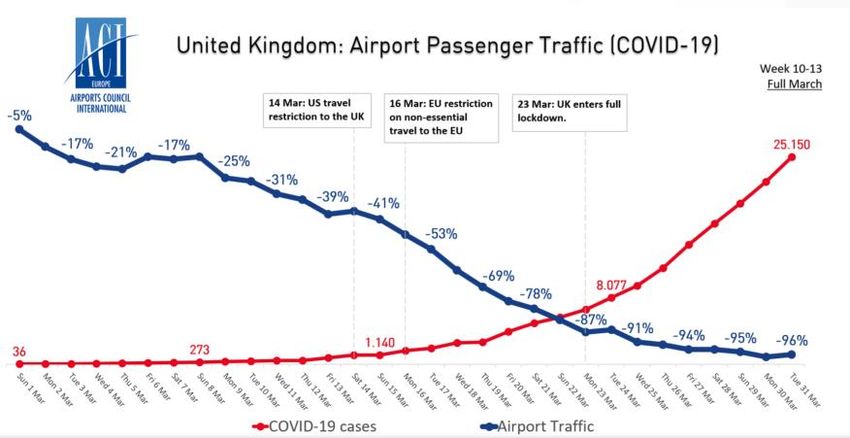
MOVEMENTS RESTRICTIONS AND BORDER CHECK HAVE SPREAD ALL OVER EUROPE.
THEY HAVE ACCELERATED THE DECISION TO GROUND THE FLEETS BUT THE DEMAND
HAD ALREADY DISAPPEARED. 30 EU and Schengen countries closed their borders on March 17 to contain the
pandemic. Since then, the travel ban has blocked entry to those nations for all
tourists and most foreigners. The initial 30-day border closure has been extended
Borders are back in the Schengen area to May 15.
Most of the EU countries require that arriving passengers restrict their movement
for 14 days on arrival.
A significant number of EU countries closed their borders (see graph) and will
…. Border check surely only reopen them to specific countries.
___ Closed Border The lockdown (see graph) and cross-border restrictions have been the key drivers
Colour : incidence of Covid 19 of decrease in air traffic. easyJet decision to ground almost all a/c (24/03) follows
the announcement of movements restrictions in the UK. Following the lockdown
in France (16/03), AF announced a capacity reduction up to 90%. Iberia will wait
the announcement of IAG (16/03).
A lot of company have already announced that they intend to stay grounded until
mid-June. The release of the lockdown will not be the key factor for the relaunch
of operations. Demand will have to materialise. Companies will surely restart
progressively. Obviously, first will be domestic but this will not be of a great help
for most of the EU airlines (see further). Intra European demand will be subdued
as long as the virus will be significantly active in Europe (at least until the
summer, based on the Chinese dynamics).
The hub / feeder model will be particularly at risk with customers avoiding big
airports
Measures in place As shown in next slide, the fear of the virus has impacted the industry well before
the movements restrictions.
Lockdown
Restrictions
349995 Easyjet, Daily seats, March 2020
299995
249995
Lockdown before 16/03
199995
16-22 March 149995
99995
After 22/03
49995
* End of Lockdown -5
3
Source: Le Monde Source: CAPA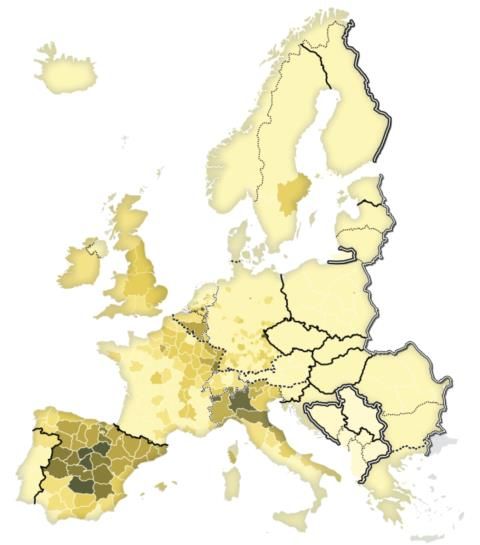
FEAR HAD DRIVEN DEMAND DOWN BEFORE THE MEASURES RESTRICTING
MOVEMENTS
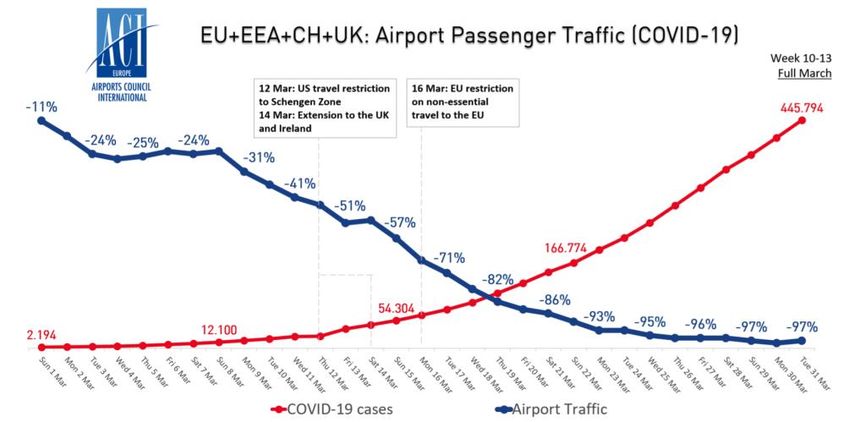
Passenger traffic fell by -59.5% during the month of March,
dragging Q1 passenger traffic down by -21%. But while Europe’s
airports still handled 5,120,000 passengers on 1 March (-
11.7% compared to the same day in 2019), that number had
reduced to just 174,000 by 31 March (-97.1% compared to the
same day in 2019). 80% of airports are still open and only 93 have
close.
106 million passengers have been lost in March 2020 (ACI), more
than during the 12 months of 2009.
Before the first travel ban (US-EU), the demand was already 41%
lower than a year ago. At the same date the number of flights was
just 20% lower than a year ago (see graph). De facto, airlines have
experienced a decrease of their load factor by almost 25%, an
unsustainable level notably for the LCC.
Before the decision to restrict non-essential travels, demand was
down 71% in Europe.
Customers have massively resigned flying by fear of the virus and
companies have rapidly extended the travel ban for their
employees.
This happened at a time where the population was not aware of the
real impact of the virus and where a lot of people were still talking
of this as a ”bad flue”. After a month of information, thousands of
deaths, hundred of thousands of cases, the knowledge on the virus
has significantly improved and with this the fear as surely increased.
Travel has been at the centre of the spread of the virus. Europe
has played a key role in the process. Travel from and within
Europe preceded the first coronavirus cases in at least 93 countries
across all five continents, accounting for more than half of the
world’s index cases. Travel from Italy alone preceded index cases in
at least 46 countries, compared to 27 countries associated with
travel from China. The main reason for this is the late closure of air
links. Italy closed one terminal of Milan’s main airport on March 16,
when the northern region of Lombardy already had 3,760 cases in a
population of 10 million people. By contrast, China had shut down
flights out of Hubei province on January 23, when there were 500
reported cases worldwide and 17 deaths in Hubei among a
population of 58 million. (the Intercept) .
.
4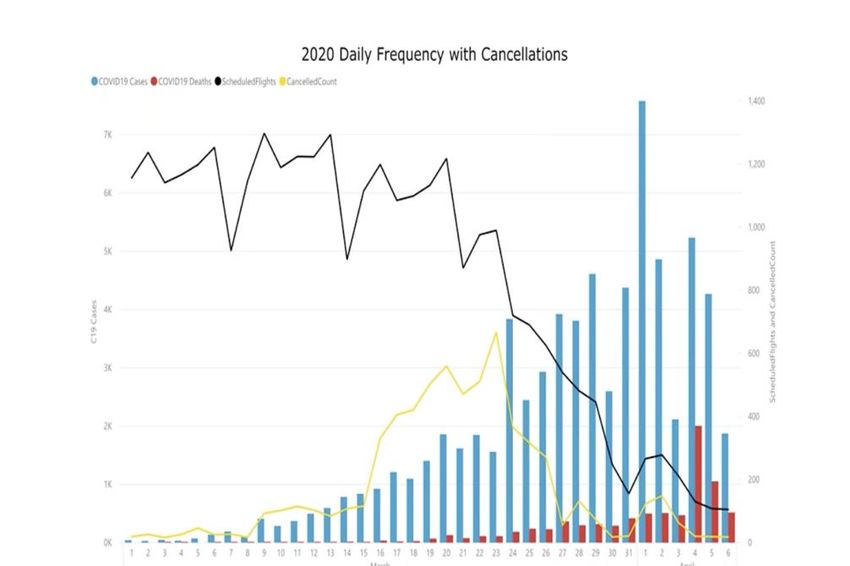
EUROPE WILL SUFFER AS A DESTINATION … AND INTRA EUROPEAN BORDERS WILL
NOT DISAPPEAR .
Europe is key for the spread of the virus in Africa. Senegal’s first case,
for example, was imported from France, while the Gambia’s was the
U.K., Angola’s was from Portugal, and Suriname’s was from the
Netherlands Europe accounts for 84% of imported case in Africa until
March 28 (Covid 19- Afro tracking team)
On April 13th, with 108 new cases, China’s new case rise to a six week-
high with 90% being imported notably from Russia.
If a second wave developed in China the case for long term borders
closure will be made almost everywhere.
France has announced on April 13 that its border with non EU
countries will be closed until further notice. Given the intensity of the
virus spread within the EU, the call for intra EU cross border
regulation will be hard to resist.
But again, whatever the regulation will be the dynamic will be above
all driven by the fear of the infection.
As shown by the first graphic on this page, traffic in Italy was down
72% before any travel restriction (9/03). People were just avoiding to
travel to Italy. At the same date, traffic in the UK was already 25%
below the year before, whereas the country had less than 300 cases.
People were already avoiding big hubs and numerous passengers
were wearing masks.
As long as the virus will not be fully eradicated the demand for air
travel will be subdued, independently of official restrictions. People
will avoid any non-essential travel and companies will surely adopt
strict precaution principle.
The game changer will be the vaccine which could lead us waiting 12
to 24 months or the natural extinction of the virus which could take
even longer (and would maybe never happen after the end of
lockdowns)
On the top of this, given its track record, Europe, and notably the
main business and touristic spots, will suffer as a destination.
European flights will surely be banned by a significant number of
countries.
Without even mentioning the impact of the economic crisis, it will
take at least 2 years for the airline industry to recover. This also the
timeline expected by the CEO’s for AF/KLM or Lufthansa.
5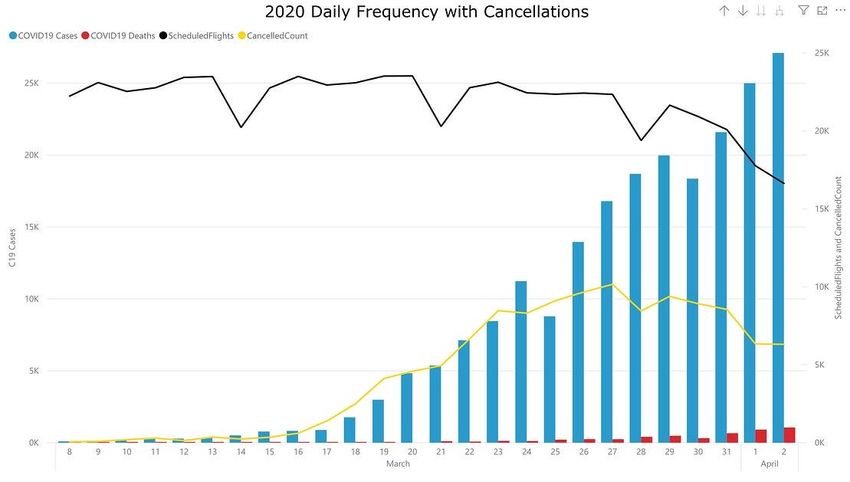
EUROPE IS THE MOST IMPACTED REGION WITH A DECLINE OF RPK BY ALMOST 50%
IN 2020 COMPARED TO 2019.
Since the end of March, most of the European air traffic has
stopped. On April 6, the traffic for LCC was -98% compared to
2019 and for flag carriers -92%. At the same date the US had
experienced a drop of capacity by 45%. On April 20, the world
has experienced a drop of capacity of 66%China at the peak of
the crisis has seen a drop of 70%.
IATA has estimated that global RPKs will fall by 71% in 2Q2020
and that this measure will still be down by around 20% in
4Q2020, giving a 38% reduction for the full year. Even this
could be optimistic, requiring significant quarter on quarter
recoveries in 3Q and 4Q in order to be born out.
Source: OAG
Europe has so far undergone heavier capacity cuts than the
rest of the world and IATA estimates a 46% fall in RPKs for
Europe in 2020.
Daily traffic April 3, 2020
Source: OAG Source: The Guardian
6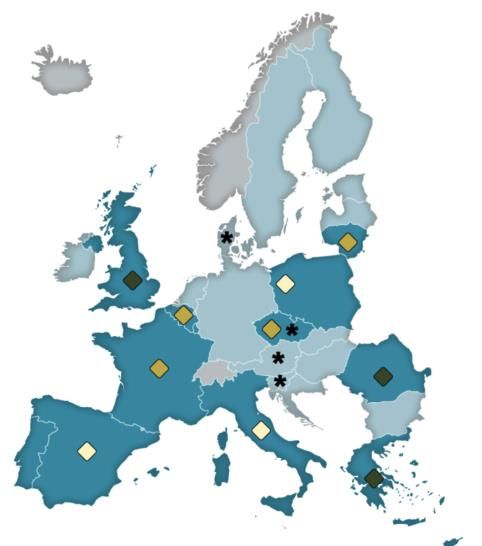
The current crisis has impacted all the players with the same intensity.
NO ONE IS SPARED… Almost everyone, apart maybe the Cargo operators are experiencing a
decrease in revenue between 85% and 100%.
As repatriation is coming to an end, most of the airlines have grounded
their entire passenger fleet.
Airports are in the same situation, with the main hubs being the more
badly impacted with almost 90% decrease in activity. For airports, the
higher the share of international connections the higher is the decrease
in activity.
ACI forecast loss of -873 million passengers for Europe’s airports
in 2020, representing a decrease of -35% in a year that was predicted to
see +2.3% passenger growth in a business-as-usual scenario. In financial
terms, a loss of -€23 billion in revenues, representing a decrease of -
41% compared to the business-as-usual scenario
Airports are maybe the weakest link with a loss of revenue (ADP, rent,
duty free, …) and far less share of variable costs (around 20%) than the
airlines. UBS estimated that most of the airports have less than 6
months liquidity.
Services companies are also suffering. With labour representing 70% of
operational costs, work retention packages put in place by the different
government offered a relief but not enough to allow the sector to
survive a long standstill.
Airports, EBITDA compared to 2019
7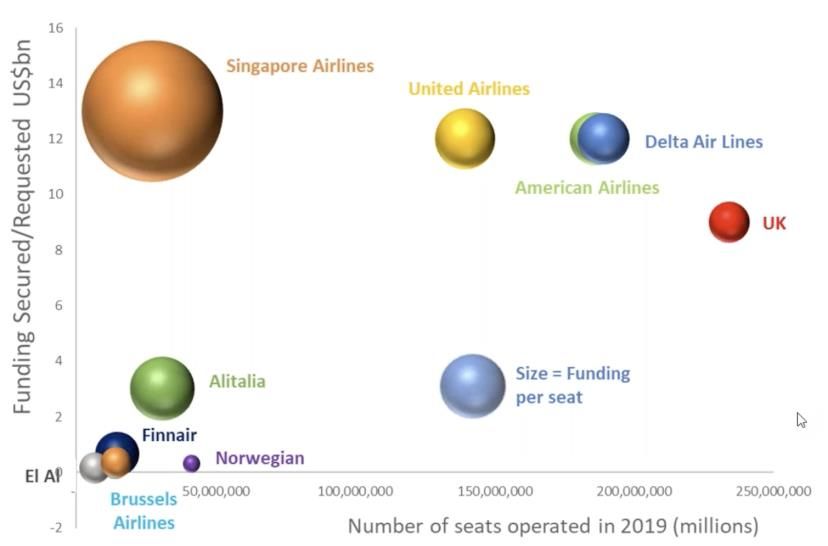
GROUND HANDLERS, CLEANERS, FUEL TANKERS, BUT ALSO AIR TRAFFIC MANAGEMENT,
ALL THE VALUE CHAIN IS UNDER EXTREME PRESSURE
If commercial passengers' airlines have grounded almost their entire fleet, the
infrastructure of the industry is still active to allow the small activity to continue. This
concerns the very limited commercial traffic, repatriation and above all freight.
The number of closed airport is limited, and the sky is still open.
Cargo traffic has slowed down but moderately and start to pick up again since mid April
(see also slide 4). Cargo traffic has decreased by 9% compared to 2019, with a significant
increase of converted passenger a/c into full cargo.
The revenue from the cargo traffic is not sufficient to sustain the viability of the supply
chain. The main private service providers have already reported significant cash flow
challenges with dramatic impact on the workforce. Moreover, the activity being more
irregular (cargo, repatriation, …) the continuity of services requires a flexibility for which
the current furlough schemes are not always well fitted.
Cargo handlers have often introduced surcharge, highly criticised by the freight industry
but this is not sufficient to cover for the loss on revenue on the passenger's side of the
operations.
Air traffic management is another part of the industry facing a significant cash squeeze.
ANSPs are still delivering almost the same service than before the crisis but with a drop of
70% to 90% of their revenue . On the top of this Eurocontrol has postponed the collection
of ATM charges including February until November. This will boost the cash flow of the
airlines by €1.1bn but will leave the ANSPs with almost no revenue for six months. Cash
savings measures have been put in place but they are limited. Labour costs represent 70-
80% of total costs of ANSPs but they are not always eligible to state backed furlough
scheme and capacity cannot be reduced beyond 80%. ANSP are still paying 80-90% of
their usual costs.
In order to finance the cash requirements ANSPs have sometimes received additional
funding from the States and/or have borrowed money. Eurocontrol itself has borrowed
€500m to support national ANSPs. This is not sufficient and some ANSPs are already
reducing wages and to laying-off employees.
This cash squeeze impacts the ANSPs at a time when they need to invest massively in new
technology and recruitment to avoid any shortage of competencies in 3 to 4 years.
With the increased risk of bankruptcy of airlines, debt of the ANSPO could become
unsustainable. Given the importance of the service an additional public funding will be
necessary. 8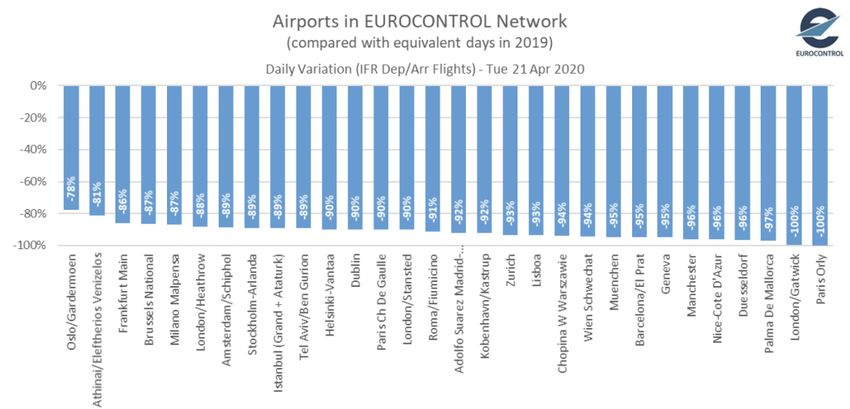
THE US HAVE TAKEN A DIFFERENT PATH… AIMING AT PROTECTING THE NETWORK
Despite being the new centre of the epidemic, the US have taken a
different path.
US airlines have on recently started to massively decrease their
capacity. By April 6, the decrease in capacity was of 46% despite a
demand 95% lower. The load factor is estimated at 10%.
This situation explains the dramatic cash burn of US airlines as the cost
reduction is not comparable to the one achieved by European airlines.
The main reason for this strategy is the requirement of the
government to maintain the network as a condition to be eligible to
public support (see further)
Following a strong lobby from small carriers, the DOT has revised its
expectations but maintained capacity is a condition of eligibility to the
CARES act.
The big 4 will have to maintain 90% of their domestic weekly
frequencies, the smaller airlines 60%. The US government has
decided to protect the domestic routes and the connectivity and not
the airlines. International network could also be considered if critical
supply chains break down.
Some airlines plan to develop more “tag flying”. Alaska has already
announced two stops out of Seattle rather than just one.
The US solution could be a source of inspiration for the European
industry but with greater consideration of environmental issues
(lower frequencies on route supported to allow maximum load
factor)
US only
Source: OAG
Source: OAG 9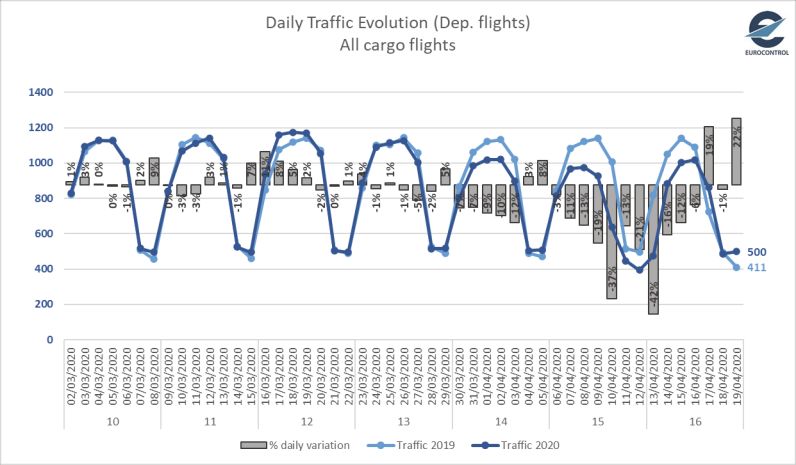
HOW TO PROTECT AN INDUSTRY IN EUROPE : EXAMPLE OF THE CORONAVIRUS AID,
RELIEF, AND ECONOMIC SECURITY (CARES) VOTED ON MARCH 27 AND THE AIR
CARRIER WORKER SUPPORT
Third, the Act places restrictions on fund recipients’ executive
The Act provides liquidity in the form of loans, loan guarantees pay, including limiting pay increases and severance pay or other
and other investments to aviation industry eligible businesses benefits upon terminations.
that incurred, or are expected to incur, covered losses such that
the continued operations of the business are jeopardised as a Fourth, the issuance of a loan or loan guarantee cannot be made
result of COVID-19 coronavirus contingent upon an air carrier’s or eligible business’s
implementation of measures to enter into negotiations with the
The loan and loan guarantee amounts will not exceed the certified bargaining representative or class of employees of the
following amounts: air carrier or eligible business regarding pay or other terms and
conditions of employment. This is explicitly contrary to the ATSB
$25 billion for passenger air carriers, including general process post 9/11, in which economic concessions from all
aviation operators that conduct flights under Federal significant stakeholders in the air carriers, including the labour
Aviation Regulations (“FAR”) unions, were a key government condition to receiving financial
assistance in several negotiations.
The Act imposes several restrictions and burdens on eligible Fifth, all eligible businesses participating in the program must also
businesses taking advantage of the grants and loan guarantee maintain employment levels at the levels in place as of March 24,
program that make participation in such programs burdensome. 2020, to the extent practicable, and are prohibited from reducing
their employment levels by more than 10% from that date until
First, like the Air Transportation Stabilization Board (the “ATSB) September 30, 2020.
the Act requires government equity or debt participation by
eligible businesses utilising the loan or loan guarantee program, Sixth, eligible businesses participating in the program must be
and “the principal amount of any obligation issued to an eligible created or organised in the U.S. or under the laws of the U.S. and
business … shall not be reduced through loan forgiveness.” In have significant operations in and a majority of its employees
other words, eligible businesses must exchange warrants, an based in the U.S.
equity interest or debt in their companies to take advantage of
the loan or loan guarantee programs, and the loans cannot be Seventh, eligible business participating in the program must have
forgiven incurred or is expected to incur covered losses such that the
continued operations of the business are jeopardised, as
Second, participating eligible businesses are prohibited from determined by the Treasury
share buybacks, paying dividends or making capital contributions
from the date of the loan until 12 months after the direct loan is
repaid in full.
10THE AIR CARRIER WORKER SUPPORT: THE US TREASURY WILL PAY THE SALARY UNTIL
SEPTEMBER 2019
The Act provides financial assistance that is to be (5) to the extent reasonable and practicable, an air carrier
exclusively used for the continuation of payment of provided financial assistance under this subtitle to maintain
employee wages, salaries and benefits to employees of (1) scheduled air transportation service, as the DOT deems
passenger air carriers, in an aggregate amount up to $25 necessary, to ensure services to any point served by that
billion; (2) cargo air carriers, in the aggregate amount up to carrier before March 1, 2020.
$4 billion; and (3) contractors, in an aggregate amount up to
$3 billion. Finally, the Treasury may receive warrants, options,
preferred stock, debt securities, notes, or other financial
The Treasury is required to provide financial assistance to: instruments issued by recipients of financial assistance
(1) an air carrier in an amount equal to the salaries and under the Air Carrier Worker Support program, which, in the
benefits reported by such air carrier to the DOT for the sole determination of the Treasury, provide appropriate
period from April 1, 2019 through September 30, 2019; compensation to the government
To be eligible for financial assistance, an air carrier or 30% of the funds will have to be repaid and the act could
contractor will need to enter into an agreement with the give the government warrants equal to 10% of the loan
Treasury that will require the participating air carrier or amount. The government could end up owning about 2.3%
contractor to do the following: of United Airlines Holdings Inc, 1% of Delta Air Lines Inc,
1.3% of JetBlue Airways Corp, 0.6% of Southwest Airlines Co
(1) refrain from conducting involuntary furloughs or and 3% of American Airlines
reducing pay rates and benefits until September 30, 2020;
(2) refrain from share buy back until September 2021 Based on wages and benefits in the second and third
(3) through September 30, 2021, ensure that the air carrier quarters of 2019, United was eligible for about $6 billion in
or contractor shall not pay dividends, or make other capital grants, Delta about $5.6 billion and Southwest about $4
distributions, with respect to the common stock (or billion.
equivalent interest) of the air carrier or contractor; and
(4) meet the requirements of sections regarding collective
bargaining collections and executive compensation
restrictions.
11IMPACT OF THE COVID 19 ON THE AIRLINE INDUSTRY IN EUROPE : PRESSURE ON
FINANCES
in bn€ AF-KLM IAG LUFTH EASY RYAN WIZZ NORW The airline industry is experiencing serious turbulences through a very
Crew only difficult time, but the short term is surely not the most significant concern.
Employees (% of total cost) 31% 25% 24% 15% 15% 10% 19% All European airlines have reacted swiftly to the crisis and have put in place
Employees costs 2019 7.6 5.6 9.1 1.0 1.0 0.2 0.9
drastic cash-saving measures and in most of the cases have been eligible to
Monthly spent on employees in m 635 470 759 82 82 17 71 public support covering a large part of the costs of the furloughed
Cash available 5.5 10.7 5.0 2.3 4.0 1.5 0.5 employees.
CASH BURN in DAYS Contrary to newspapers headlines and industry bodies, most of the airlines
Salary in months of cash 8.7 22.8 6.6 27.9 48.8 90.6 6.7 in the EU will easily survive the crisis at least as long as they will not have
Total operating costs 2019 24.4 22.9 37.3 6.8 6.7 2.0 4.5 to flight again…
daily cash burn in m 67 63 102 19 18 6 12 We estimate that the main European airlines (representing 50% of total ASK)
days before cash dry BAU 82 171 49 123 219 271 38 have enough cask to survive from 5 months (Norwegian) to 6 years (Wizzair)
with their entire fleet grounded under the current conditions in terms of
HSBC estimate 18/03
public support and without taking into account refinancing requirements or
End of Feb 6.5 7.8 4.9 1.9 4.3 1.4 0.5
End of june 1.2 2.7 -2.3 0.9 2.6 0.9 0.0 fuel hedge settlements.
Monthly cash burn 1.3 1.3 1.8 0.3 0.4 0.1 0.1 Some airlines are facing specific refinancing issues and will need significant
Daily in m 44.1 42.0 60.2 8.4 14.3 4.2 3.8 additional support to survive. Norwegian is proposing a debt to equity to its
bondholders which will dilute its shareholders to almost nothing. The strings
Capex monthly in m (Capex as BAU) 296 292 267 113 450 12 34
Capex monthly in m (estimation Syndex) 267 233 240 54 90 12 24
attached by the government to the support package are too demanding to
allow Norwegian to be eligible to the plan (notably the required third party
Estimate Syndex (with furlough) funding). Virgin asked for £750m to the UK government. The latter refused
Fixed operational expenses (annual) 5.9 6.3 5.6 1.2 0.4 0.1 0.8 so far any industry specific package. easyJet has borrowed £600m through
Daily opex in m 16.3 17.2 15.2 3.3 1.2 0.4 2.3
the Covid Fund (CCFF) in order to meet the remaining payment to Airbus
Daily Capex in m (BAU) 9.9 9.7 8.9 3.8 15.0 0.4 1.1
Total daily cash outflow in m 26.2 26.9 24.1 7.1 16.2 0.8 3.5
following the deferral of a portion only of 2020 CAPEX commitments. Alitalia
Months before bankruptcy Capex BAU 7 13 7 11 8 63 5 will be nationalised and massively restructured.
Months before bankruptcy reduced Capex 7 14 7 15 31 63 5 Some companies are entering in unknown territories. The cancellation of
Daily cash burn reduced capex (estimation LOT’s offer on Condor could end up in the bankruptcy of the former Thomas
Syndex) 25.2 25.0 23.2 5.1 4.2 0.8 3.1
cook company.
Some companies are clearly candidates to the role of consolidator notably
IAG and Ryanair.
Source: Companies report, HBSC, Syndex But the main challenge will be the financial burden of the relaunch of the
operations with a subdued demand and surely significant health and safety
constraints.
12THE EUROPEAN AIRLINES CANNOT RELY ON DOMESTIC MARKETS AND WILL NEED A
EUROPEAN COORDINATED APPROACH
Given the ban on cross-border travel it is natural
Share of Share of total
domestic ASK Share of ASK in domestic travel in
that the relaunch of air traffic in China has started
Ryanair
on total ASK
9.05%
Europe
10.5%
Europe
10%
with the domestic market
Lufthansa German Airlines
Easyjet
6.28%
10.92%
7.2%
6.4%
5%
7%
Domestic flights worldwide counted for 89% of
British Airways 3.13% 6.2% 2% departures on the week of April 6th.
Air France 11.00% 5.7% 6%
KLM-Royal Dutch Airlines 0.00% 4.0% 0% In the US the domestic traffic has allowed the
Wizz Air 0.00% 3.2% 0%
Iberia 17.63% 3.1% 5% airlines to fly a significant share of their fleet. The
SAS Scandinavian Airlines 19.45% 2.3% 5%
TAP Air Portugal 6.69% 2.3% 2% US domestic market represents 85% of the seats
Jet2.com 0.03% 2.2% 0%
Vueling Airlines 34.63% 2.2% 8% offered by US airlines and 60% of ASK.
Eurowings 12.41% 2.0% 3%
Norwegian Air Shuttle 14.66% 2.0% 3% In the EU, the domestic market is small and
Pegasus Airlines 29.22% 1.9% 6%
Alitalia - Societa Aerea accounts for 25% of seats and 8% of ASK in western
Italiana S.p.A 26.12% 1.9% 5%
Finnair 4.90% 1.9% 1% Europe, and 30% of seats in eastern and central
TUI Airways 0.00% 1.9% 0%
SWISS 0.71% 1.9% 0% Europe (including CEI)
Condor Flugdienst
Virgin Atlantic Airways
0.07%
0.00%
1.5%
1.3%
0%
0%
Share of
domestic Share of domestic
The Spanish market is the biggest market with 59m
Norwegian
Air Europa
5.61%
21.43%
1.3%
1.3%
1%
3%
traffic (seats) traffic (ASK) seats, followed by Italy. De facto only some Spanish
Africa : Central/Western Africa 39% 10%
Aer Lingus
SunExpress
1.09%
10.38%
1.3%
1.2%
0%
1% Africa : Eastern Africa 35% 5% airlines (Iberia/ Vueling/Air Europa/ Volotea) or
Austrian Airlines AG dba
Austrian 1.10% 1.2% 0%
Africa : North Africa 18% 5% Italian (Alitalia) and some Nordics have more than
Africa : Southern Africa 63% 26%
LOT - Polish Airlines
Transavia.com
4.29%
0.01%
1.0%
0.9%
0%
0%
Asia : Central Asia 47% 22% 25% of their capacity on the domestic market.
Nord Wind
Pobeda
17.64%
68.66%
0.9%
0.9%
2%
6%
Asia : North East Asia 75% 51%
For most of the European airlines there is no hope
Asia : South Asia 73% 44%
Brussels Airlines
TUIfly
0.00%
0.01%
0.9%
0.8%
0%
0%
Asia : South East Asia 59% 26% any relaunch of operations if the intra European
Aegean Airlines 0.00% 0.8% 0% Europe : Eastern/Central Europe
Europe : Western Europe
30%
25%
25%
8%
market is not reopen.
AZUR air 0.08% 0.8% 0%
Icelandair 0.00% 0.7% 0% Latin America : Caribbean 9% 1% The end of the ban on travel will be key but also the
Transavia.com France 2.65% 0.6% 0%
TUI fly Belgium 1.18% 0.6% 0%
Latin America : Central America 60% 35%
coordination of safety measures :
LAUDAMOTION GMBH 0.00% 0.5% 0%
Norwegian Air UK ltd 0.00% 0.5% 0% Latin America : Lower South America 84% 51% Social distancing on board
Edelweiss Air 0.00% 0.5% 0%
Volotea 50.59% 0.4% 2% Latin America : Upper South America 74% 30% Social distancing at the airport
SmartWings 0.03% 0.4% 0%
Air Baltic Corporation 0.08% 0.4% 0%
Middle East
North America
22%
85%
6%
60%
Heath screening
Wizz Air UK 0.00% 0.4% 0%
TUI fly Netherlands 0.31% 0.4% 0% Southwest Pacific 70% 29% PPE
Red Wings Airlines 24.28% 0.4% 1%
Corendon Airlines 0.38% 0.4% 0%
Grand Total 59% 35%
Staff / customers interactions
Blue Air 9.14% 0.4% 0%
If this is left to member states, the intra European
Source: OAG/CAPA, Syndex
market could stay disrupted.
13EUROPEAN AIRLINES ARE ALREADY TRIMMING CAPACITY.
The Chinese model shows that the recovery is far from being a V shape. With the
expected recession to come, the demand will be subdued for years, at least
three years according to the consensus.
As a result airlines are trimming capacity.
LH plans to reduce the fleet under its mainline brand and Eurowings are the first
such restructuring announced by a major European airline group in response to
the expected significant decline in air travel post covid-19 travel restrictions
The permanent retirement of 21 widebodies and 11 narrowbodies represents
9% of the Lufthansa branded fleet and 13% of its seats. In addition, the axing of
11 Eurowings narrowbodies represents 6% of the low cost brand's fleet.
Source: CAPA
AF/KLM, IAG have also announced significant a/c retirement. EasyJet has
Recovery time line of previous crisis deferred a significant part of its A320 and A320 orders. Order cancellations are
growing.
We estimate a potential reduction of capacity of 20 to 30% to base line due to
capacity trimming and bankruptcy.
But governments could help the consolidation without leaving the immediate
profitability deciding of the services offered and the lessors picking the
consolidators based on the strength of of their balance sheet by deciding to
whom borrowing money against lease buy back aircraft. Considerations in terms
of public services, social responsibility (climate change and employment
standards) as well as structural role within the sector (support to the airport,
maintenance, service providers). Leaving the consolidation to the market only
Impact of the Covid crisis in % GDP will surely challenged the EU position on ownership and control. Indeed middle
east and Chinese capital has different way to influence the consolidation with
their funding of lessors and their subscription to debt emissions. This financial
position could be used later to leverage on more strategical corporate decision .
The support should come with strings attached but, moreover, a new regulation
should be put in place to strengthen the balance sheet of the airlines. As the
crisis of 2009 has triggered a request for additional capital buffer for the banks,
the current crisis should trigger a request for similar cash buffer for the airline
industry .
Source: OECD
14GOVERNMENT SUPPORT TO CHANGE THE INDUSTRY FOR A STRONGER
SUSTAINABILITY
The support to the airline industry has taken the form of wage support for
furloughed staff
The sums allocated so far are rather symbolic compared to the American
airlines but the immediate needs are also lower
Airports have offered parking discounts
A significant number of companies will resist any public support in order to
facilitate the consolidation (see graphic) in the EU (far lower than in the
USA) but also to avoid any restrictions in terms of shareholders and
executive pay.
Since 2015, IAG has used 66.6% of its FCF for buy back its own share
well above Delta (50%)
IAG has paid in dividends and share buy backs more than 171% of its
Easyjet
Free Cash Flow.
easyJet has pay £174m dividend in March, at a time when it was
asking staff to take unpaid leave and proposed to ditch crew food.
Source: CAPA
Governments find difficult to finance private companies with often a
significant share of foreign shareholders, highly paid bosses and lavish
dividends. Financing the services and not the companies is surely the
solution. This would protect the industry and avoid any Malthusianism
aiming at maximising the ROCE (as illustrated by the stance of the biggest
shareholder of easyJet, Stellios Haji-Ioannou).
Source: IAG
15POST OUTBREAK RECOVERY WILL REQUIRE EVEN MORE PUBLIC SUPPORT
As long as the vaccine will not be available, fear will be a key element. In order to convince customers to fly again, the industry will have to work on new
standards. One of them will surely be social distancing., at least following the immediate period after the lockdowns
Most of the airlines still flying are already implementing social distancing :
Middle seats free
Sequenced boarding
Limited on board services
Airports are working on new guidance with could lead to the introduction of social distancing, health screening.
The low demand will facilitate the implementation of new measures but if they have to last they will constitute a significant financial burden. Most of the flights
will become non-profitable at the current ticket price. The LCC model based on high load factor will particularly be challenged.
A 320-200 with twenty-nine 6-seat rows and two 3-seat rows, will have only 120 seats available without the middle seats. With the two first rows as
well as the three last rows (28/29/30, 12 seats) top protect the crew and allow access to toilets, this leaves 96 seats only ie. 53% load factor … once
taken into account the loss of in-flight sales, the longer turnaround due to social distancing at boarding/ loading/ maintenance/ cleaning, reducing the
a/c utilisation by at least 30% … most of the operations would not be profitable, Even if demand comes back..
Social distancing, given low fuel price, could even make widebodies more attractive for short haul ….
All the economics of the industry could be challenged and the pressure to put profit before people will be significant. At the restart, social distancing and other
measures will be easy to respect due to low demand. It will even avoid a price war which has been damaging to the industry in the past. But with the demand
picking up the pressure for lower constraints will grow. The rules need to be dictated by medical consideration only.
The only way to avoid this will be to accept that the services rendered by the airlines under these conditions require a public financial support. This support
should aim at the sustainability of the intra European connectivity for which the social distancing measures could be more a challenge to profitability.
This European plan could take the model of the US plan by focusing on supporting the routes and notably the one at risk of significant capacity reduction and
not only directly the airlines. The subsidies to the routes are already a reality of the industry whether through Public Services Obligations or more controversial
launching schemes and regional funding. The current crisis would see the extension of this principle in order to sustain structurally viable operations or mitigate
the risk for potential consolidators in a period where the underlying profitability will surely be limited. By doing this it could also help to support the airports. It
should also support the employment by focusing on mitigating the labour costs and conditioning the support to quality and stable jobs. It could also favour the
consolidation and incentivise an internalisation of most of the services, notably for health and safety purpose. It could also boost the commitments to climate
change by supporting the best in class. It could also help to mitigate the loss on passenger traffic by supporting the development of an enhanced cargo offer.
The EU is thinking at relaxing rules on state aid with at the same time requiring more strings attached in terms of dividend, buy back shares and executive
remuneration . This is creating a good basis to implement a package for the airline industry. At the same time it is also reported that the Commission would limit
the right to buy up rival while still repaying the state. In the case of the airline industry this would be counterproductive as it will halt the consolidation.
Alternatively, support should be directed to structurally healthy airlines which are also delivering the higher environmental social and governance metric aiming
at supporting a consolidation which will deliver a competitive and quality service without the damage of social dumping and bogus employment experienced by
the industry over the last cycle. The state aid should allow significant investment in new and cleaner aircraft in order to boost the reduction of emission while
supporting the aerospace industry. The EU will surely fund the support to the industry through a unique program and the delivery will be a matter of national
governments. It could nevertheless design a coordinated approach in consultation with all the stakeholders.
16You can also read


