THE JAMES YOUNG HIGH SCHOOL IMPROVEMENT PLAN - 2018 / 2019 Factors Influencing the Improvement Plan
←
→
Page content transcription
If your browser does not render page correctly, please read the page content below
THE JAMES YOUNG HIGH SCHOOL
                        IMPROVEMENT PLAN

                                           2018 / 2019

Factors Influencing the Improvement Plan

                                                         1
School Factors
Addressing Action Points identified in school’s Self Evaluation procedures
Cluster Improvement Plan
Consistency in learning and teaching, implementing recommendations of Improving Scottish Education
Flexible early learning and childcare implementation
Local Authority Factors
Moving Forward in Learning – Leadership for Improvement; Learning, Teaching and Assessment; Wellbeing and Inclusion; Early Years Framework
Raising attainment, including closing the gap
Delivering Better Outcomes
Single Outcome agreement
Corporate Plan
Integrated Children’s Services Plan (Life Stages)
Education Services Management Plan
West Lothian’s Early Years’ Framework
West Lothian Parental Engagement Framework
Increased entitlement to early years’ provision
National Factors
National Improvement Framework / Scottish Attainment Challenge / National Improvement Hub / Raising Attainment for All
Pupil Equity Funding
How Good is Our School? 4th Edition and How Good is Our Early Learning and Childcare
Getting it Right for Every child (GIRFEC)
Curriculum for Excellence
Developing Scotland’s Young Workforce
Building the Ambition
Standardised Assessments
Child Protection Issues / Guidance
National Legislation: Children and Young People (Scotland) Act 2014
GTCS standards and professional update
Effective moderation processes (internal and external) to inform the achievement of a CfE level
Children and young people’s assessments that are accurate and inform decisions and interventions and contribute to their progress and wellbeing
With a focus on:
2Achievement: where we are all learners engaging in excellent, challenging and innovative learning experiences where we
all have opportunities to achieve
our full potential
Relationships: where we value and respect all members of our community and communicate openly and honestly, working
collaboratively
Aspiration: where we pursue excellence through resilience, hard work and determination, and have high expectations of
ourselves and others
Our Aims
Leadership and Management
• To foster an ethos of effective partnership working with school, home, partner agencies and the wider community to
empower our children.
Learning Provision
• To create a safe and enjoyable learning environment where children and staff can thrive and succeed, and each
individual’s uniqueness is celebrated.
• To develop a progressive and challenging curriculum, which develops skills for life-long learning, which is meaningful,
relevant and enjoyable.
Successes and Achievements
• To ensure the best possible outcomes for all our learne
3where School/Faculty Ensuring Excellence and Equity
Desired outcomes linked to NIF priorities NIF driver mapping HGIOS4 Proposed Actions By By Measures of Success
(observable, measurable outcomes which (check as appropriate) QIs Whom When (include performance
focus on learning, achievement and wellbeing) data, quality indicators
and stakeholders’ views)
Raising attainment for all: ☒School Improvement 1.1
☒School Leadership 1.2
A strengthened curriculum rationale with ☒Teacher Professonalism 1.3 Revision of our curriculum rationale to reflect Vision, DHTC Oct 2018 QI 2.2; staff & pupil views
a clear line of sight to our Vision that is ☒Parental Engagement 2.2 Values and Aims; impact of curricular decisions and
understood by all ☒Assess. of Children’s Progress 2.3 embed any agreed improvements or alterations to our
☐Performance Information 2.7 curriculum model
3.2 Communicate to all pupils, staff and parents DHTC Oct 2018 QI 2.2; staff, parent & pupil views
Use of improvement methodology to strengthen cross DHTC Oct 2018 QI 2.2; staff, parent & pupil views
including 5 aday
cutting themes delivery as well as IDL
Consider the inclusion of personalisation & choice within PTCs Oct 2018 QI 2.2; staff, parent & pupil views
Including 5 aday
subject areas
Development of outdoor learning strategy to allow organic REMIT March
2019
QI 2.2; staff, parent & pupil views
growth in subject areas
Clearly establishing the role of all staff in RoA including PTHWB March
2019
QI 2.2; staff, parent & pupil views
HWB and Digital Literacy
Further developed curriculum pathways Faculty strategic review of learner pathways from and PTCs Oct 2018 QI 2.2, 3.2; staff, parent & pupil
views, increased options
to ensure Equity and Excellence for all infiltrating BGE
groups of learners CLPL for staff involved in course choice DHTC Jan
2019
Qi 1.2; teacher views, QA
process
Engagement as an SCQF Ambassador School to support ELT Oct 2018 Increased options, increased
increased course choice tariff scores
Improvement methodology to enhance the process of DHTC Dec
2018
QI 2.2, 3.2; staff, parent & pupil
views
curricular transition
DHTC Oct 2018 QI 2.2; staff, parent & pupil views
Strengthening the purpose of BGE; in particular S3, to
ensure suitable and challenging progression to SP
Building curriculum opportunities in the Resource DHTC
PTC
May
2019
QI 2.2, QI 3.2; pupil views,
attainment profile
To develop the concept of iaspire in learning REMIT Dec QI 3.2; pupil views, teacher
2018 surveys, tariff scores,
Increased ownership and involvement of reintegration data
parents, partners and pupils in all Opportunities for 5 aday, focus groups and improvement
aspects of school improvement sessions for parents, pupils and partners in SLT Self- DHTC Oct 2018 QI 1.1, 2.7; participation figures
in improvement activities
Evaluation Calendar
Expansion of PDF opportunities DHTC Oct 2018 QI 1.1, 1.3; feedback from
teachers, teacher survey March
2019
Creation of pupil voice strategy including use of Learner HT
DHTC
May
2019
QI 1.1, 1.2, 2.3, 3.2; impact of
pupil voice in any initiatives, pupil
HGIOS 4; with a clear line of sight regarding impact at surveys
whole school and faculty level
You Said We Did created for parents, pupils and staff to DHTC Sep
2018
QI 2.3; parent, pupil and staff
surveys March 2019
show value of stakeholder input
4 Review of Self-Evaluation policy including Phase B CSI DHTC Dec QI 1.1, 2.3; policy document,
2018 staff views
Family Learning activities impacting on A programme of targeted family learning activities REMIT Dec
2018
QI 2.7; participation figures, pupil
and parental surveys
targeted pupils including work with SDS in primary transition
A legacy from Tapestry developed by Development of a learning, teaching and assessment REMIT Oct 2018 QI 1.2, 1.3, 2.3, 3.2; VSE findings
staff and pupils which outlines our statement to reflect our vision and including our aim for from classroom visits, CSI,
learner surveys
Learning & Teaching vision that learning and teaching and Creativity
positively impacts on all learners
consistently across our school Capture the impact of Tapestry through baseline data and PTC May QI 1.1, 2.3; VSE findings from
PRD impact discussions 2019 classroom visits, CSI, learner
surveys, PRD discussions
Creation of Digital Literacy Strategy including CLPL for PTC May
2019
QI 1.3, 2.3; CSi, learner &
teacher surveys March 2019
staff and training for pupils to embed in classroom practise
Positive relationships observed Review of positive relationships policies by SLWG in line DHTS Oct 2018 QI 1.3, 2.3; Learner and Teacher
consistently across our school with WLC surveys March 2019
Implementation of ACE Awareness training PTHWB May QI 2.3; Learner and Teaching
2019 surveys March 2019
All staff see the value in capturing the Discussion and sharing of practise at PTC meetings to DHTC Oct 2018 Qi 2.3; minutes of PTC meetings;
faculty SESS
impact of change on learners ensure inward, forward and outward angles considered
Inclusion of IP impact meetings DHTC Oct 2018 Qi 1.3; minutes
Encourage staff to evaluate impact of any changes in DHTC Oct 2018 Qi 1.2; minutes, teacher survey
March 2019
classroom
Data to inform all decision making to Raising Attainment strategy to include use of standardised DHTC Oct 2018 Qi 1.1, 2.3; PF meeting minutes
positively impact on all learners data such as CAT and SNSA
Analysis of SP assessment and rationale post unit DHTC Dec Qi 2.3; PTC Minutes, T&M
assessment removal 2018 document
Expansion of intelligent use of data amongst all staff to
lead to school improvement such as class performance DHTC Dec Qi 2.3; departmental Minutes
2018
from SP tracking and BGE tracking
Full implementation of JYHS on track to demonstrate DHTC Oct 2018 QI 2.3; JYHS on track trends and
attainment over time attainment summaries
Use of JYHS on Track data to monitor and intervene for DHTC Sep
2018
QI 1.1, 2.3, 3.2; PF meetings
actions
BGE learners including ASD, Q1 & 2 and LAC learners in
PF meetings DHTC Sep Qi 1.1, 2.3; departmental tracking
Agreement of non-negotiable tracking data required in 2018 systems
departmental tracking to underpin JYHS on Track DHTC Sep QI 2.3; departmental minutes
Inclusion of ASD resource Attainment meetings 2018
Use of Improvement Methodologies with wider PTCs and DHTC May
2019
QI 1.3; impact on learners from
interventions
5staff groups
DHTC May QI 2.3; parental survey March
Progression through BGE and purpose Use of website and ‘visible curriculum’ to support parental 2019 2019
of assessment clearly understood and understanding of progression
valued by parents and pupils DHTC Dec QI 1.1, 2.3; VSE findings from
2018 classroom visits, CSI, learner
Senior Phase techniques to replicate in BGE in relation to surveys March 2019
quality learner conversations; clear message to pupils
regarding the value and purpose of assessment S1-3
DHTC Oct 2018 QI 2.3; parental survey March
2019
Review of all standard letters
DHTC Oct 2018 QI 1.1; teacher survey March
Evidence of impact of moderation activities to be gathered 2019
DHTC Dec QI 1.1; course plans
A review of progression pathways in line with Benchmarks 2018
DHTC Sep QI; 3.2 parental post event
Introduction of BGE Information Session; PATPAL; family PTLiT 2018 survey & March 2019 survey
learning orientated with further links to support PTNUM
DHTC Oct 2018 QI 1.1, 1.3; teacher survey March
A vision that we see every day in our Redefine our Aims and Values to help us achieve our DHTS 2019, VSE classroom visits, CSI
interactions with pupils Vision using core QIs and making this visible every day
DHTC Sep QI 1.2, 1.3; attendance at CLPL,
An increase in professional learning Creation of an internal CLPL calendar including cross PTC 2018 impact surveys
opportunities for all staff which has an cutting themes DHTC Aug QI 1.2, 1.3; teacher surveys
impact directly on learners Weekly staff bulletin with reflective questions from GTCS 2018
and HGIOS 4 DHTC Aug QI 1.3; data from surveys
Impact surveys on all internal and external CLPL activities DHTC
2018
May QI 1.1; teacher surveys March
Further development of PRD process to ensure clear 2019 2019
impact of CLPL on pupils is clear DHTC May QI 1.2; learner views, teacher
Evaluate the impact of SLWG activity on learners DHTS 2019 views, data specific to SLWG eg
instances of use of CES
Improvement in Literacy for all: ☐School Improvement 1.1
☐School Leadership 3.2
An increase in individualised progression ☐Teacher Professonalism Expansion of igrow in S2 with clear impact data PTC May
2019
QI 3.2; baseline data v end point
pathways ☐Parental Engagement
☒Assess. of Children’s Progress Completion of Literacy strategy including clarity around PTC Dec
2018
QI 3.2; teacher survey March
2019
Clarity around RoA in Literacy ☒Performance Information RoA ‘where literacy lives’ and use of data, targets (stretch
aims), universal and targeted support
Opportunities for Literacy moderation and support for PTC May
2019
QI 1.1; teacher survey March
2019, CLPL impact data
Literacy interventions such as work in vocabulary
Instilling a love for reading in all S1 Focus on reading; establishing baseline from YARC PTC Sep QI 3.2; YARC assessment data,
pupils leading to improved reading assessment for paired Scotland Reads Programme. 2018 pupil views
scores in standardised assessments Training for staff and parents involved
PTC Sep QI 3.2; YARC assessment data,
Additional resources sourced including Literacy Space/s 2018 pupil views
6Improvement in Numeracy for all: ☐School Improvement 1.1
☐School Leadership 3.2
An increase in individualised progression ☐Teacher Professonalism Expansion of igrow in S2 with clear impact data PTC May
2019
QI 3.2; baseline data v end point
pathways ☐Parental Engagement
☒Assess. of Children’s Progress Completion of Numeracy strategy including clarity around PTC Dec
2018
QI 3.2; teacher survey March
2019
Clarity around RoA in Numeracy ☒Performance Information RoA and use of data, targets (stretch aims), universal and
targeted support
Development of curriculum in S4-6 to increase exit point PTC Dec
2018
QI 3.2; insight data
Level 5 Numeracy (66% in S4 stretch aim) and ensure a
reduction in our gap between Q1 & Q5 to 14%
Opportunities for Numeracy moderation with a link teacher PTC Dec
2018
QI 1.1; teacher survey March
2019; CLPL impact data
from each subject
Inset Numeracy focus – explaining SNSA, using PTC Dec QI 2.2; teacher survey March
benchmarks and aim for a sustainable annual event 2018 2019
Individual Maths teacher to link with each subject area to PTC Oct 2018 QI 2.2; teacher survey March
target Numeracy subject specific support 2019
Develop further common strategies between primary and PTC Oct 2018 QI 3.2; teacher feedback
secondary linking with DHT Numeracy
Numeracy Ambassadors to focus on S1 & S2 pupils and PTC Sep
2018
QI 3.2; pupil feedback
offer peer to peer tutoring
Consider Stretch Aims 2023 and strategies to achieve this PTC May QI 3.2; Insight analysis
including 25% of school leavers to achieve Higher Maths, 2018
a reduction in the gap between Q1 & Q5 pupils achieving
N5 Maths to 20% (35% achieving overall)
Improvement in all children and ☐School Improvement 1.1 Establish joint pupil/staff working group to establish
young people’s wellbeing: ☐School Leadership 1.3 Wellbeing strategy and future direction within JYHS, Creation of Wellbeing
☐Teacher Professonalism 2.1 ensuring that wellbeing is a key feature of the school’s Strategy
To raise the profile of all aspects of ☐Parental Engagement 2.2 vision and values moving forward Vision statement
Wellbeing (physical, mental and ☐Assess. of Children’s Progress 2.3 Programme of CLPL(HUB model) opportunities to DHTS
/PTC
May
2019 CLPL programme for
emotional) and develop a consistent and ☐Performance Information 2.7 discuss aspects of wellbeing with other professionals HWB staff and evaluation
shared understanding of Wellbeing 3.1 (out with education) committed to its promotion Impact of professional
across whole school community and its 3.2 Professional Discussion Forums on Wellbeing learning
direct relationship and impact on pupil Data on wellbeing accessible to staff and opportunities DHTS May
2019 Ethos
experience, attainment and achievement for analysis and professional dialogue Increased profile of
Increase awareness amongst staff of ACE’s, trauma, DHT/ Ongoing HWB
To raise awareness of wellbeing detachment, Care experienced and how these impact PSM/HH
indicators among all stakeholders and children’s development and learning. DHTS/ Dec Surveys and feedback
develop a clearer understanding of Implement and update staff with local, national and, PTC 2018 from staff
significance of indicators in terms of where appropriate, international legislation affecting the HWB
Assembly programme
GIRFEC and how they can be used rights, wellbeing and inclusion of all young people e.g. DHTS Dec
7effectively by all staff to inform planning West Lothian Council Promoting positive relationships, 2018 and evaluation with
to meet pupils’ needs. Relationships for Learning Policy, LAC policy, updated DHTS June pupils
guidance on medication in school and revised 2019 HWB Programme for
To ensure opportunities are embedded Continuum of Support. parents & evaluation
within the curriculum for pupils to self- Review and Moderate standards of AofWB, IEPs and DHTS Jan
evaluate using indicators and increase CPMs /PSM/ 2019
pupils’ confidence in assessing wellbeing Structured Assembly Programme for pupils on key ALL Evaluation of HWB
and employing strategies to improve it aspects of wellbeing and useful strategies/supports curriculum
available Feedback from staff
Develop a robust system for tracking Implementation of Wellbeing programme for re confidence in
wellbeing concerns across the school parents/carers based on needs analysis to provide assessing wellbeing
community including those reported to us strategies and signpost to services to enable them to and using toolkits
by other agencies with a view to continue to promote and safeguard wellbeing of DHTS/ Dec
PSM/HH 2018
identifying common themes which will child/young person
inform future strategy/ priorities and Review of HWB across the curriculum to ensure that DHTS Aug 18
curriculum planning in the area of HWB opportunities are embedded for exposure to wellbeing /HH
Data
indicators and discussion
Improve average attendance across all CPD for staff on materials/resources/toolkits developed QA learner
quintiles with a focus on achieving 95% by the authority to support assessment and moderation, DHTS May conversations
2019 Progress in HWB
attendance for pupils in quintiles 1, 2 and planning and review in the area of Wellbeing –
3 responsibility of all (indicators being met)
All pupils, staff and partners have a clear To develop the concept of iaspire Support ELT Dec 18
understanding of expectations and the Staff feedback
importance of positive relationships in Creation of Promoting Positive Attendance Strategy Number of staff
promoting wellbeing and positive consulting wellbeing
attitudes towards learning plans as part of L&T
preparation process
• Termly self-evaluation exercise with all pupils in S1-S3 Improved knowledge
Develop a shared vision for i-aspire using the Wellbeing Wheel. Information used by staff to and understanding of
moving forward ensuring that the needs lead learner conversations around wellbeing, discuss pupils’ needs
DHTS/ Dec 18
of all learners are met through this strategies and plan interventions leading to improvement HH
Tracking system to
provision including those at risk of • Revise GIRFEC & Wellbeing Planning Tooklit to include a
exclusion enable Identification
RAG approach to wellbeing indicators according to level of
of need
concern/need for all year groups
Data used to inform
• Creation of electronic wellbeing information folders for all
modifications to
pupils containing wellbeing plans hyperlinked to GIRFEC &
An increase in opportunities to celebrate curriculum/interventio
Wellbeing Planning Toolkit
pupil achievement n planning
DHTS/ May Improved early
• Implementation of wellbeing concern tracking system PSM 2019
HH intervention
Increased participation in personal • Regular analysis of wellbeing data including wellbeing
achievement including leadership concern forms, assessments of wellbeing, child protection, PSM Aug 18
activities across all quintiles domestic abuse, police concern reports, attendance data Professional dialogue
Minutes of meetings
• Termly House Assemblies using achievement database DHTS/P May Collaborative practice
now incorporated in GIRFEC spreadsheet SM/HH 2019 Development of
• i-participate strategy aligned to PSE programme to ensure common
link between achievement and skills development is clear approaches/policies
8• Expansion of i-lead programme in particular for pupils S1-4 FLO
DHTS/ May
and S5 i-develop linked to school improvement HH 2019 Termly House
• Evaluation and development of the concept of i-aspire DHTS/
PSM
Sept
2018
Assemblies
• Expansion of pupil voice opportunities and creation of pupil HH Sept
DHTS 2018
voice strategy /PSM
• Evidence gathering during CSI activities to inform further /HH Pupil surveys
future actions
• Review and revise current system for recognising and
celebrating achievement.
SIMD data file
CSI pupil views and
observations
Improvement in employability skills ☐School Improvement 1.1
and sustained, positive school leaver ☒School Leadership 1.2
destinations for all young people: ☐Teacher Professonalism 2.2
☐Parental Engagement 2.7
☒Assess. of Children’s Progress 3.2
Increase in pupil confidence in talking ☒Performance Information Strengthen the links to skills development in all ijourney PTC May QI 2.2, QI 3.2; pupil views
about their skills and strengths options 2019
confidently
Introduction of iAmSkilled in S3 DHTC May QI 1.1, 2.2, 3.2, Career
2019 Education Standard, baseline
and end point data, PD
qualifications, pupil & staff views
Launch and embedding of cluster skills framework DHTC May QI 2.2, 3.2, Career Education
2019 Standard, baseline and end point
data, pupil & staff views, CSI
Use Didbook exemplars and reports as part of staff DHTC May
2019
QI 1.1, 2.2, Career Education
Standard, increase in Didbook
Career Education Standard fully newsletter to enhance quality of entries entries and quality
embedded naturally in all subject areas
i-participate policy realigned to PSE programme – DHTC October QI 2.3, 3.2; participation
including JASS - with increased opportunities for 2018 measures in JYHS on Track
celebration of achievement at house assemblies
DHTC October QI 1.1, 2.3, 3.2; participation
Pupils feel resilient and can come back Creation of a mechanism for tracking participation and PTS 2018 measures in JYHS on Track
from any adverse situation engagement in JYHS on Track
PTC October QI 1.1, 2.3 3.2; participation,
Expansion of i-lead pathway S1-5 2018 leadership qualifications
All pupils; no matter their choice of post Robust tracking of S6 enhanced curriculum including an REMIT October
2018
QI 2.3 3.2; tariff scores
school destination route feels supported increase in accredited courses
and confident in their next steps
9 Establishment of DYW Working Group to foster organic LEAD May
2019
QI 2.2, QI 3.2; pupil views,
impact analysis in departments,
links to skills and careers in subject areas as well as number of partnership links
encourage further partnership working in curriculum design
& delivery. Also encompasses cluster primary DYW
Expansion of industry placement opportunities for staff REMIT May QI 1.2; impact of engagement,
2019 pupil surveys Mach 2019
Audit of ican statements in PSE DHTC Sep QI 3.2; pupil surveys March 2019
2018
Utilise assembly programme to link in ‘did you know’ and DHTC Dec QI 3.2; pupil surveys March
LMI information 2018 2019, Leavers surveys March
2019
Resilience training for S5 pupils with Asda DHTC Oct 2018 Baseline data v exit point,
leavers surveys March 2019
DHTC Oct 2018 Leavers survey March 2019
Parity of esteem for UCAS and non-UCAS routes during
PSE including speakers, videos of ex-pupils talking about
their diverse career routes
DHTC Feb Leavers survey March 2019
S6 Assessment Centre Day 2019
Preparation for sessions – building on ex-pupil network – DHTC Dec Leavers survey March 2019
‘alumni’ 2018
Consider ways to narrow the gap in HE destinations from DHTC Dec
2018
Leavers survey March 2019
most deprived and least deprived pupils including raising
attainment workshops with identified non-UCAS applicants
Additionality: Pupil Equity Funding Plan:
Closing the attainment gap between the most and least advantaged children
PART 1: Contextual Data Analysis & Rationale
a) Background
10JYHS is a non-denominational secondary school in West Lothian, serving the communities of Dedridge, Bankton, Murieston and
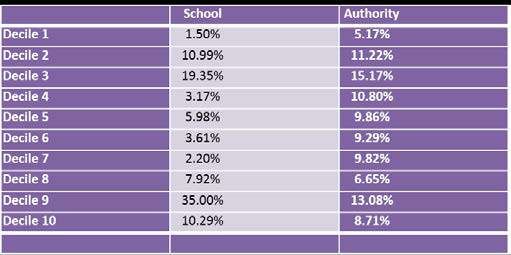
Bellsquarry. Our social demographic profile is polar with 31% of our young people living in SIMD 1-3 and 45% living in SIMD8-10. On
average 12% of young people are registered for FME.
Each year we usually have 20% of our pupils coming from out with catchment schools. 2018/19 this figure is 33% (2017-18 - 33%).
11b) Data
Our data incudes attendance/exclusions/attainment in BGE and Senior Phase. Faculty exit point data/SIMD data and SFL/ASN data and
participation data including post school positive destinations. All of this is whole school but analysed individually per yeargroup/cohort.
Education deprivation (from JYHS PEF profile):
School Attendance Attainment No NEET HESA Attend:Attainment Correlation
Catchment (Note 1) Qualification*
Armadale 81% 5.3 114 10% 4% 0.65
Bathgate 82% 5.3 109 9% 7% 0.64
Broxburn 83% 5.5 98 5% 8% 0.13
Deans 82% 5.4 100 7% 7% 0.60
Inveralmond 81% 5.4 113 7% 5% 0.91
James
Young 84% 5.6 75 5% 11% 0.86
Linlithgow 90% 5.9 62 3% 15% 0.85
West Calder 84% 5.6 102 6% 8% 0.70
Whitburn 81% 5.3 143 9% 6% 0.59
West
Lothian 83% 5.5 102 7% 8% 0.73
12Attainment:
(Lit & numeracy graphs here)
CfE Level 3 JYHS Gap Analysis 2017 v 2018
% of pupils in each quintile achieving L3 Num % of pupils in each quintile achieving L3 Writing
Quintile 1 2 3 4 5 Quintile 1 2 3 4 5
2017 JYHS 85.71% 85.37% 100.00% 100.00% 98.90% 2017 JYHS 71.43% 78.05% 87.50% 88.24% 96.70%
2017 WLC 87.12% 85.01% 90.00% 92.83% 96.34% 2017 WLC 85.28% 85.40% 90.57% 94.79% 95.65%
2018 JYHS 88.5% 95.0% 94.4% 94.4% 95.1% 2018 JYHS 92.3% 97.5% 94.4% 100.0% 97.6%
2018 WLC 86.5% 90.7% 94.5% 95.2% 97.1% 2018 WLC 86.0% 86.6% 93.8% 93.9% 96.4%
JYHS Q1 V Q5 2017 13.19% JYHS Q1 V Q5 2017 25.27%
JYHS Q1 V Q5 2018 6.7% JYHS Q1 V Q5 2018 5.3%
Gap Reduction 6.53% Gap Reduction 20.02%
Q1 increase/decrease 2.75% Q1 increase/decrease 20.88%
Q5 increase/decrease -3.78% Q5 increase/decrease 0.86%
% of pupils in each quintile achieving L3 Reading % of pupils in each quintile achieving L3 L&T
Quintile 1 2 3 4 5 Quintile 1 2 3 4 5
2017 JYHS 78.57% 82.93% 87.50% 94.12% 97.80% 2017 JYHS 89.29% 87.80% 93.75% 100.00% 100.00%
2017 WLC 86.50% 87.77% 90.00% 95.44% 96.57% 2017 WLC 88.04% 88.36% 90.00% 95.44% 96.34%
2018 JYHS 88.5% 97.5% 100.0% 100.0% 97.6% 2018 JYHS 92.3% 95.0% 94.4% 100.0% 97.6%
2018 WLC 86.5% 87.8% 96.0% 96.1% 97.6% 2018 WLC 87.1% 89.8% 95.0% 97.9% 97.3%
JYHS Q1 V Q5 2017 19.23% JYHS Q1 V Q5 2017 10.71%
JYHS Q1 V Q5 2018 9.1% JYHS Q1 V Q5 2018 5.3%
Gap Reduction 10.13% Gap Reduction 5.46%
Q1 increase/decrease 9.89% Q1 increase/decrease 3.02%
Q5 increase/decrease -0.24% Q5 increase/decrease -2.44%
132
2
2
2
J
J
G
Q
Q
2
2
2
2
J
J
G
Q
Q
Attendance:
1415
Lates:
                                       Average number of days late per stage and quintile

                                  Quintile 1    Quintile 2        Quintile 3       Quintile 4    Quintile 5

                          25.00

                          20.00

                          15.00

                          10.00

                           5.00

                           0.00
                                      S1       S2        S3            S4            S5         S6

   Exclusion:
                         Exclusions number of openings
                50
                                                                                                                   Exclusions by Number
                45                                                                                   10

                40                                                                                    9

                35                                                                                    8

                30                                                                                    7
                                                                                                      6
                25
                                                                                                      5
                20
                                                                                                      4
                15
                                                                                                      3
                10
                                                                                                      2
                5
                                                                                                      1
                0
                     1            2            3              4                5                      0
                                                                                                              Q1    Q2       Q3      Q4   Q5

                                                                                                                                               16
c) What is our ‘gap’ and who are our target groups and their barriers to learning?
After thorough analysis of data we have identified gaps and patterns of attainment and participation which reflect the pattern of SIMD within
our school. Pupils living in lower SIMD are performing less well than pupils living in higher SIMD areas. Pupils in lowers SIMD are
excluded more, attend less and are late more often than pupils from High SIMD.
Targeted groups will include some young people who are in receipt of free school meals, who live in an SIMD decile 1-3 area, are care
experienced or are identified as having an additional support need. Although these will be the main target groups, they will continue to be
extended to include pupils who are facing other potential barriers to learning including young carers, those with English as an additional
language and any other factors which may impact on their learning potential.
This year we started to implement interventions using our PEF funding which are beginning to show an impact in the wellbeing of some of
our identified young people, increasing confidence for small groups in literacy and numeracy, an increased understanding of numerical
concepts and increased participation for young people in SIMD in extra-school club & activities.
d) Summary/overview of proposal & non-negotiable outcomes.
The PEF interventions which have been put in place, and which will continue in session 2018-19, have led to our “gaps” between Q1 and Q5
in literacy and numeracy narrowing over 2017-18. This has led to us revising our 2020 targets based on 2018 CfE figures – see data tables
above. These new targets are detailed in the proposal that follows. Our PEF champions will continue to implement these and our new
interventions and the impact will be tracked and measured through improvement methodology techniques.
The proposal detailed below aims to continue the progress we have made in narrowing the attainment gap in literacy and numeracy. We plan
to target pupils through support groups aimed at pupils experiencing difficulty in their literacy, numeracy and emotional development whilst
at the same time building a culture of literacy, numeracy and health and wellbeing across all areas of the school. In addition we will continue
to work with our cluster primary schools to develop literacy and numeracy practices will can be implemented cluster wide.
Levels of literacy and numeracy in Q1 and 2 will increase in line with West Lothian and Scottish Government stretch aims.
We aim to build on the increase seen in participation for young people in SIMD 1 & 2 to ensure a larger representation of lower SIMD pupils
in all areas of excellence and across the school community.
1718
PART 2: Actions & Outcomes

PEF Priority    Proposed Actions &                           Stage/                 What is the expected impact on reducing                           How will you measure the
                Resources                                    Year Grp               the gap in your context of your proposed                          impact?
                 (These should be based around the                                  actions?                                                          (You must be specific here in terms of:
                organisers of Learning & Teaching,                                  (What story will your data tell by end of next session? By June   •   new and existing performance data and
                Leadership, and Families & Communities.                             2020? You should include any targets linked to data)                  other quantitative and qualitative information
                Also consider activities within and beyond                                                                                                that will be required
                the classroom)
                                                                                                                                                      •   plans for how data will be collected and
                                                                                                                                                          reported)
Literacy        Attainment:
                                                                                                                                                      •     York Assessment of Reading
                • PEF Attainment Champion to                 S1-S3                                                                                          Comprehension (YARC)
                                                                                    Increase the reading age for identified
                  support identified pupils                                                                                                                 standardised reading assessments
                                                                                    pupils.
                  across literacy and numeracy.                                                                                                             for baseline and to measure
                                                                                                                                                            impact.
                                                                                    Narrow the gap (Q1 – Q5) in L3 reading from 9%
                Develop “Building a Reading                                                                                                           •     Standardised Testing
                Culture” within JYHS.                        Initially S1 pupils,   (2018) to 7% by 2020.
                                                             roll out to S2 if      Narrow the gap (Q1 – Q5) in L3 writing from 5%
               • Improved reading skills                                                                                                              •     Teacher judgement
                   through development & use of              appropriate this       (2018) to 3% by 2020.
                   Scotland Reads programme                  year, continue         Narrow the gap in (Q1 – Q5) L3 L&T from 5%
                                                                                                                                                      •     Relevant programme assessment
                   with identified pupils from               programme with S1      (2018) to 3% by 2020.                                                   measures.
                   SIMD 1&2.                                 & S2 2019-2020
               • Develop “Breakfast Club”                                           •    Increase number of pupils achieving Level 3                  •     Survey of pupil confidence and
                   programme for identified                                              reading by end of S3 to 98% from 96.7% by                          enjoyment of reading
                   pupils to support literacy,                                           2020
                   time-keeping and attendance.                                     •    Increase number of pupils achieving Level 3                  • West Lothian Council S3
               • Literacy Ambassadors to                                                 writing by end of S3 to 98% from 96.3% by                      attainment data.
                   support literacy work in BGE                                          2020
                   classes including training S6                                    •    Increase number of pupils achieving Level 3
                   pupils in Scotland Reads                                              L&T by end of S3 to 98% from 95.8% by
                   paired reading.                                                       2020
               • Launch First Minister’s
                   Reading Challenge tracking                                       •    Increase from 42% to 55% in writing in
                   pupils from identified groups.                                        Quintile 1

                                                                                                                                                                                                     19
• Increase from 53.8% to 60% in reading in
Quintile 1
• Identify pupils from SIMD 1&2 S3
• Increased moderation and
feedback. Narrow the gap (Q1 – Q5) in L4 reading from
• S3 pupils, develop “working 26% (2018) to 7% by 2020.
words” small test of change, Narrow the gap (Q1 – Q5) in L4 writing from
roll out across all departments S1
40% (2018) to 3% by 2020.
through literacy group
monitoring and tracking
Narrow the gap in (Q1 – Q5) in L4 L&T from
progress of pupils from 5% (2018) to 3% by 2020.
identified groups. • Teacher judgement
• Reading for understanding. S1-S3 • Increase number of pupils achieving Level 4
reading by end of S3 to 78% from 67.7% by
2020
• Increase number of pupils achieving Level 4
writing by end of S3 to 70% from 59% by
• Continue supported 2020
interventions for identified • Increase number of pupils achieving Level 3
S1/2 pupils in small group L&T by end of S3 to 70% from 61% by 2020
settings. Improve pupils’ confidence in and enjoyment
of reading.
• IDL programme assessment
• Identified EAL pupils Improve pupils’ confidence in understanding and measures.
supported to improve their use of English language, reading, writing and • Teacher judgement across
literacy skills through IDL talking. learning.
package.
Increased confidence in accessing the
curriculum.
Numeracy Attainment: • Standardised Testing
• PEF Attainment Champion to • Increase number of pupils achieving Level 3 • Teacher judgement
support identified pupils across Numeracy by end of S3 to 95% from 93.5%
literacy and numeracy. by 2020 and to 96% by 2023 • Relevant programme assessment
20• Implement Numeracy Ninja measures (GL Assessment).
program in BGE. • Narrow the gap (Q1 – Q5) for pupils
• Continued primary liaison using achieving Level 3 Numeracy by end of S3 • West Lothian Council S3
Cluster Numeracy DHT role from 6.7% to 4.5% by 2020. attainment data.
• Further teachers trained in
Maths Recovery to support • Increase from61.5% to 72% in level 3
interventions including Small numeracy in Quintile 1 • Performance tracking comparison
Group Setting tbc comparing Maths assessment data
• Develop Small Group setting • Increase number of pupils achieving Level 4 to CAT predictions to highlight
model to allow greater Numeracy by end of S3 to 78% from 75.5% those who are potentially
flexibility to allow more pupils by 2020. underperforming
to allow pupils to move
between groups/classes as
appropriate. • Narrow the gap (Q1 – Q5) for pupils
• Supported study programme achieving Level 4 Numeracy by end of S3
with additional resources from 26% to 16% by 2020.
created for pupils not able to
attend. • Increase the number of pupils achieving
Level 5 Numeracy by exit point to 70% (54%
2018) by 2020 in line with VC schools
• Develop Breakfast Club (Insight)
programme for identified pupils
to support literacy, time-
keeping and attendance.
• Numeracy Ambassadors to
support interventions in S1
including use of PS time and
breakfast club programme.
Health and Attendance: • Attendance and late-coming data
Wellbeing • Targeted interventions to Increase in average attendance from 87% in from SEEMIS.
address decreasing quintile 1 to 95% by 2020 (same as 2017 plan)
attendance across SIMD 1-3 in
all year groups. Narrow the attendance gap for all pupils Q1 to
• Small test of change for Q5 from 7% to 3% by 2020 (new stretch aim)
21attendance (“return to school” * data accurate at April 2018
appointments, language and
catchup).
• Positive attendance strategy.
• Continue to support non-
attenders through Family Link
Worker.
• Small test of change to Reduce lates for S1/2 pupils in SIMD Q 1-2 from
improve time-keeping at all 58% to 20% of total days lost by May 2019.
(of total S1/2 lates)
stages for identified pupils in
S1 and S2
• Develop Breakfast Club
programme for identified
pupils to support literacy,
time-keeping and attendance.
Inclusion/Exclusion:
• PEF Inclusion Champion to Reduce exclusion rates for pupils in SIMD Q 1-2
support identified pupils • Exclusion data
from 79 openings to 40 by May 2019
(SIMD 1 – 34, 2 – 47 openings.)
• Review of current • Improved engagement and
inclusion provision and participation – Leuven Scale
develop “alternative to
exclusion” options.
• Develop strategies to
support return to classes.
• Counselling (SMILE) –
continue to provide Improve mental wellbeing enabling identified • Improved engagement and
emotional support for pupils to be more “ready to learn”. participation – Leuven Scale
identified pupils. • Improved attendance.
Reduce anxiety. • Parental and HH judgement.
22• Mental health training for
key staff in order to support Increase attendance/class participation.
pupils Improved understanding and reduced
stigma.
Across Learning Central PEF Posts: This team will support schools as follows: HTs will be asked at the end of the
• Identifying the gap and providing financial year to provide feedback in
• Numeracy, Literacy and a baseline relation to these central posts. This
Health & Wellbeing PEF information will be used to determine
Leads have been established • Assist with sourcing appropriate staff and if these positions have been effective
to provide strategic advice, resources to fulfil the intervention in assisting schools to fulfil their
support and CLPL to schools strategies strategies aimed as closing the gap.
• PEF Manager post has been
provided to assist schools in • Assist with measuring the impact of the A decision will be made in March
relation to Finance, HR and strategies · Sharing good practice across the 2018 if these posts should be
Procurement. schools to assist with 2018 planning extended beyond this date.
• Provide Professional Learning Professional Learning Opportunities
Opportunities for Literacy, Numeracy and will be evaluated and their impact will
H&WB in order to upskill staff be measured in schools by staff
undertaking the training.
PEF Champion develop whole Whole school School will have a statement of action to address Statement of Action (PEF Template)
school poverty strategy and cost of the school day 2020.
implement Cost of the School Day
toolkit in order to produce action Whole school community will have an awareness Less costs associated with attending
statement 2020 of the implication of poverty for young people and learning at JYHS
and families and be able to minimise the impact
of any associated costs.
Develop space within school to
support interventions in literacy,
numeracy and HEB zones,
breakfast club programme,
23parental engagement.
(All key indicators)
Improved pedagogy to support high quality • Learner conversations, learning
Tapestry Programme for all staff learning and teaching on questioning, feedback, walks and evidence of feedback
differentiation – all staff involved in TLC group • Comparative analysis of questions
and tasks that motivate and elicit
Raised attainment for all evidence of learning
• Measure of self-regulation
Learners from Quintile 1 and 2 are able to techniques to support Learning to
support each other’s learning and take increased Learn programme
responsibility for their own learning
PEF Champs S1-3 • Increased attainment in subject
Improvement in literacy, numeracy and HWB data T&M spreadsheets
targets are indicated above. • Increased attendance
• Identification and direct • Reduction in exclusions
working with specific groups • Reduction in lates per pupil
of pupils within key • Increased participation data in
indicators of attainment, supported study and Personal
attendance, Achievement areas in School SIMD
inclusion/exclusion, Data file
participation and
engagement.
Increase SIMD 1 & 2 parental attendance for S1 &
Engagement:
S2 parents evening from 19% to 35% for S1 and
Parental Improved attendance at S1 & S2
44% to 55% S2 by May 2019.
Small test of change to look at parents’ evenings.
increased parental engagement
for parents’ evenings from SIMD
1 & 2.
24Cluster
Professional
Learning (bespoke)
25You can also read


