THE MARSH MONITOR - Bird Studies Canada
←
→
Page content transcription
If your browser does not render page correctly, please read the page content below
The Great Lakes Marsh Monitoring Program
                                                                         THE MARSH
                                                                           MONITOR
Strong as Ever                                     Great Lakes MMP routes surveyed for birds,
                                                             frogs, or both in 2017
We are proud to report the Great Lakes                Click here to see a map of route availability
Marsh Monitoring Program (GLMMP) has
               th
reached its 24 year! An impressive 421,000
bird and frog observations now fill our
databases. We thank you and all of our
participants for making the program an
outstanding success. Read on and see how
we've been busy putting your hard-earned
survey results to good use.

How are we doing?
In the 2017 season, we completed bird
surveys at 315 routes and 876 stations, and
frog surveys at 278 routes and 676 stations.
Over 400 volunteers contributed nearly 5000
hours of work. The number of routes and
stations surveyed for birds and frogs vary
from year to year, but are always in the
                                                  Great Lakes MMP surveys from 1995 to 2017
hundreds (see graph). Using your
contributions, it is possible to draw important
conclusions on the status and trends of
species and help guide conservation actions.
Thank you!

How are birds and frogs doing?
The latest trends show that populations of 7
of 18 (39%) marsh-associated bird species
significantly declined between 1995 and
2017, and 1 of 8 (13%) marsh-associated
frog species significantly declined (see page
2). On the up side, 4 of 18 (22%) bird species
and 3 of 8 (38%) frog species significantly         Interested in Joining the Great Lakes Marsh
increased. Populations of 39% of the 18 bird                    Monitoring Program?
species and 50% of the 8 frog species             Simply complete the online New Participant Form. You
remained stable (i.e., did not significantly      will be sent the general program information and added
increase or decrease).                            to the queue for route assignment. Remember that your
                                                  details will help us with find the right route for you.
Trends tell us how species change over many

Summer 2018
Number 24
                                                                                                Page 1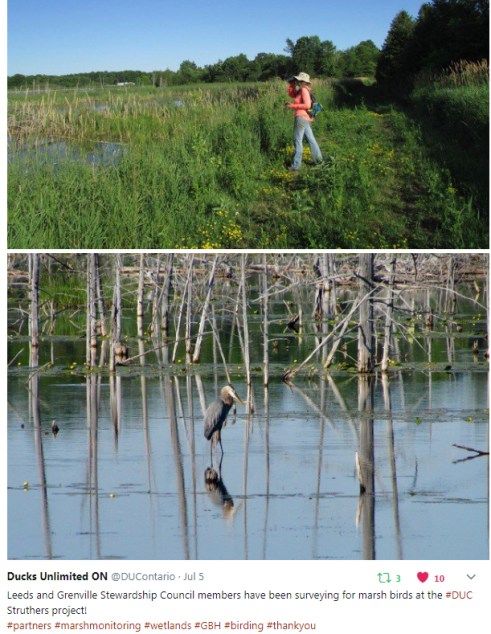
The Marsh Monitor

                 Great Lakes Marsh Monitoring Program
              Trends for Marsh Birds and Frogs 1995 - 2017

Summer 2018                                                  Page 2
Number 24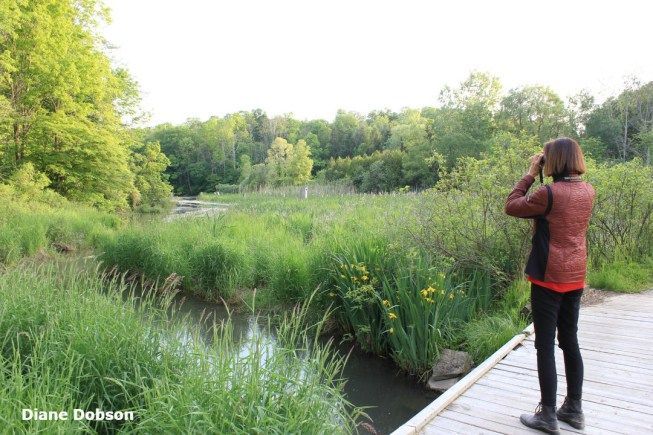
The Marsh Monitor

years. To get a sense of year-to-year differences,
take a look at the annual abundance indices for
birds (see page 4) and occupancy for frogs (see
page 5). The plots contain a wealth of unique
information for marsh bird and frog conservation.

Activities
With the tremendous effort of volunteer surveyors
and financial assistance from supporters (see last
page), we have been able to accomplish many
important activities over the past year. These
include reports and presentations, which
summarize and draw conclusions from your hard-
earned data:
Presentations:
• Lake Erie: What do the birds tell us? Great
  Lakes Sea Kayaking Association, Port Credit, ON; Hamilton Naturalists' Club Bird Study Group,
  Burlington, ON. You can watch this presentation on YouTube at https://youtu.be/3anh3LiiSgA.
• Do you have what it takes to be a frog citizen scientist? Royal Botanical Gardens, Burlington,
  ON.
• Multispecies benefits of wetland conservation for marsh birds and other wildlife. Latornell
  Conservation Symposium, Alliston, ON; Ontario Great Lakes Coastal Wetland Restoration Working
  Group, Oshawa, ON.
• State of the Great Lakes: Bird and frog-based indicators to assess the status and trends of
  the Great Lakes ecosystem. Great Lakes Coastal Wetland Monitoring Program, Midland, MI.
• Detecting and monitoring elusive marsh breeding birds in the Great Lakes. International
  Association of Great Lakes Research, Toronto.
• Great Lakes Marsh Monitoring Program: Volunteer orientation and training. Kincardine
  Shoreline Environmental Working Group,
  Kincardine, ON.

Reports:
• Influence of call broadcast timing within
  point counts and survey duration on
  detection probability of marsh breeding
  birds. Published in Avian Conservation and
  Ecology, this peer-reviewed scientific paper
  uses your GLMMP data to improve the way
  marsh birds are monitored in the Great Lakes
  and beyond.
• Multispecies benefits of wetland
  conservation for marsh birds, frogs, and
  species at risk. Published in Journal of

Summer 2018                                                                             Page 3
Number 24
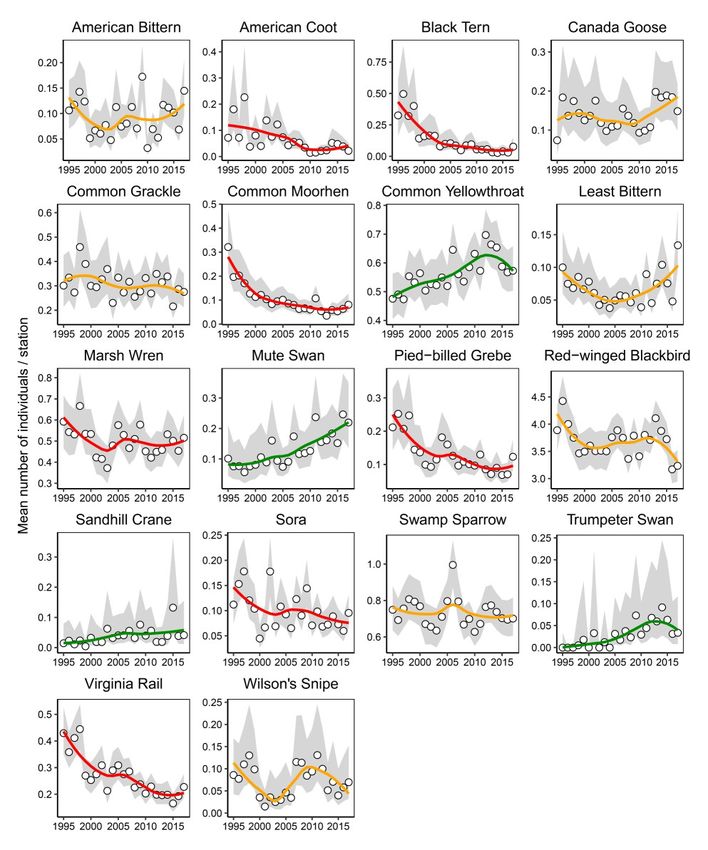
The Marsh Monitor

              Great Lakes Marsh Monitoring Program
                    Annual Abundance for Birds

Summer 2018                                          Page 4
Number 24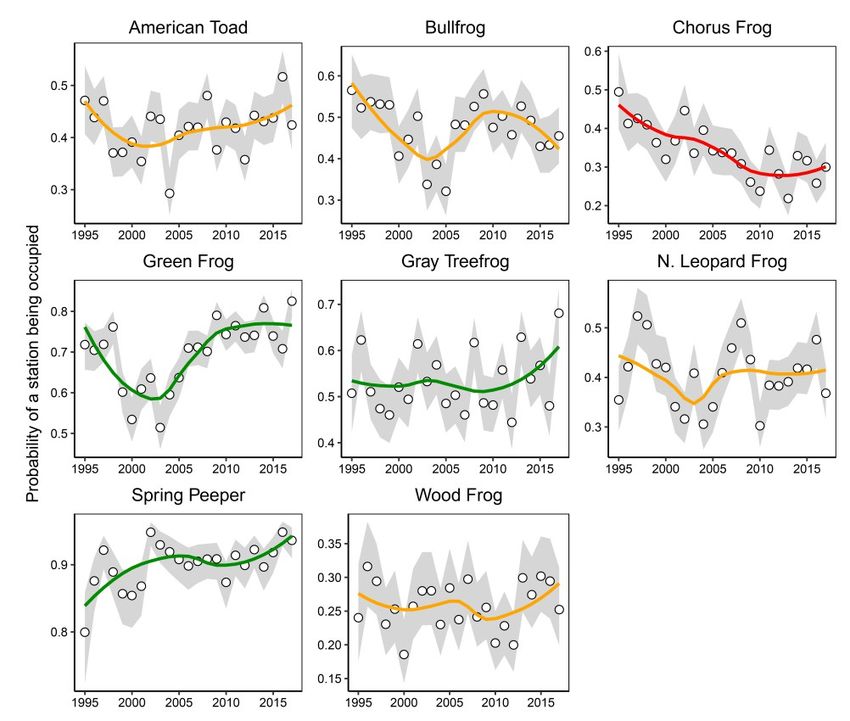
The Marsh Monitor

                         Great Lakes Marsh Monitoring Program
                              Annual Occupancy for Frogs

    Interested in viewing your Raw Data?
You can conduct your own research and request
raw data at birdscanada.org/birdmon under
the “Download” tab. Note that: bird and
amphibian data must be requested separately
using a login and password.
NatureCounts Update: Any changes you make
to your profile information will automatically be
forwarded to membership/supporter department.

Summer 2018                                                     Page 5
Number 24
The Marsh Monitor

  Environmental Management, this peer-reviewed
  scientific paper uses your GLMMP data to garner support
  for expanding and improving conservation and protection
  of wetlands.
Data:
We supplied the following partners with information based
on your hard-earned data to achieve and advance wetland
conservation:
• Environment and Climate Change Canada to inform a
  pilot study on Chorus Frog monitoring, update the Status
  of Birds in Canada website, and the Population Status
  of Migratory Game Birds in Canada report.
• Toronto Region Conservation Authority to assess, track,
  and report on wetland health.
• Royal Botanical Gardens, Raisin Region Conservation
  Authority, and many others to monitor biodiversity.
• Ducks Unlimited Canada to make timely management
  decisions.
• Minnesota Audubon and University of Minnesota, Natural
  Resources Research Institute to show population trends
  at the Great Lakes scale in the online Minnesota
  Breeding Bird Atlas.
• Environment and Climate Change Canada and US
  Environmental Protection Agency to assess status and
  trends of wetland health in the upcoming State of the
  Great Lakes 2019 report.
In the media:
• Honk, honk, ribbit, ribbit in protected wetlands.
  Published in the Great Lakes Echo by the Knight Center
  for Environmental Journalism at Michigan State
  University, this article overviews the “Multispecies
  benefits” paper listed above.
• Citizen Scientists: the core of Bird Studies Canada's
  Marsh Monitoring Program. Published in Habitat
  Matters by the North American Wetlands Conservation
  Council (Canada), this article overviews the history and
  success of the program.
 Would you like some additional training but can’t find the
 opportunity?
 Check out the Bird Studies Canada YouTube page
 (youtube.com/birdstudiescanada). Here, you can find the
 webinars for new volunteers and refresher webinars for more
 experienced participants.

Summer 2018                                                    Page 6
Number 24
The Marsh Monitor

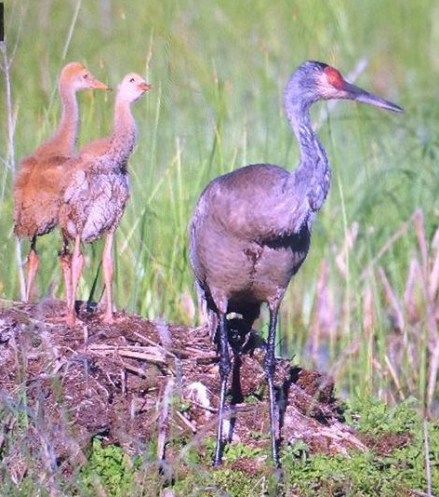
               Marsh Monitors in Action!
                  Social Media Posts
Click here for the 2018 #MMPSurvey Social Media photo album!
                                                       Diana Bright by Diane Dobson

Summer 2018                                                                Page 7
Number 24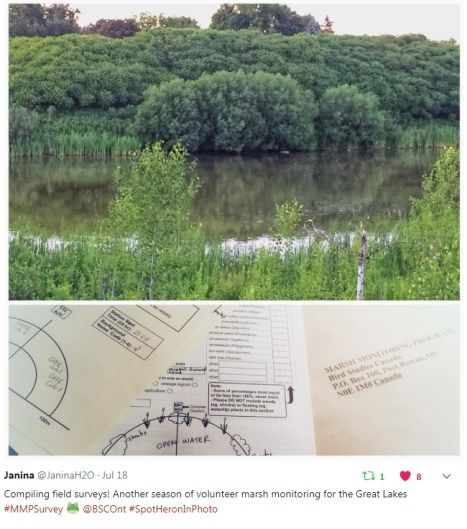
The Marsh Monitor

      Marsh Monitors in
            Action!
      Social Media Posts

Summer 2018                Page 8
Number 24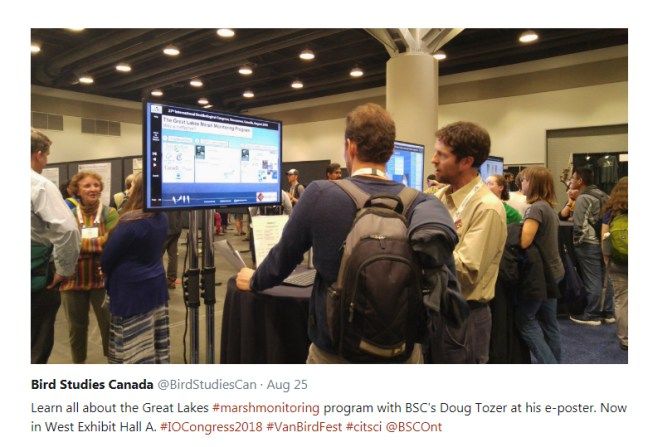
The Marsh Monitor

Doug Tozer presenting
             Your Dataan e-poster on the GLMMP
                           at Work!                      Kathy Jones mentoring students at an early
  Marsh Monitoring Staff in Action!                      career workshop
Social Media Posts from meetings and
            conferences.

                                                                  You Tube video of Doug Tozer’s Lake
                                                                  Erie presentation

Jody Allair, Citizen Science and Community Engagement,
presenting on the importance of Citizen Science.

                                                         Sonya Richmond, GIS Data Analyst, presenting a
                                                         modelling technique using GLMMP data.

Summer 2018                                                                                      Page 9
Number 24
The Marsh Monitor

Great Lakes Marsh Monitoring Program, Bird Studies Canada
     P.O. Box 160, Port Rowan, Ontario, Canada N0E 1M0
               Toll-free: 1-888-448-2473 ext. 124
            birdscanada.org/volunteer/glmmp
                  volunteer@birdscanada.org                               A program of:
    JOIN THE CONVERSATION ON SOCIAL MEDIA USING #MMPSURVEY

            Are you a registered participant in the
          Great Lakes Marsh Monitoring Program?                                 \
          If so, USE the NatureCounts online website

            birdscanada.org/birdmon/mmp                                 With Support from:
           for ALL your Great Lakes MMP needs:
=   Regional coordinator list      =
                                   Bird call broadcast MP3 file
=   Equipment lenders list         =
                                   Training MP3 files
=   Brochure                       =
                                   MMP metadata
=   Handbooks (protocols)          =
                                   Custom data search engine
=   Fact sheets                    =
                                   Online data request application
=   Survey forms                   =
                                   Data download tool
=   Past MMP Newsletters           =
                                   Results and trend graphs
                                   =
                                   Updating contact information.
To access monitoring resources on NatureCounts you will need to
  register through the NatureCounts Marsh Monitoring Program
                Home page and wait for approval.

Launched in 1995, the Great Lakes Marsh Monitoring
Program is:
= A bi-national, long-term monitoring program developed by Bird
     Studies Canada;
=    Built on the commitment of individuals, foundations,
     governments and non-governmental organizations that work in
     partnership toward effective conservation;
=    A coordination of skills, interests, and stewardship of hundreds
     of citizens across the Great Lakes basin.

   Bird Studies Canada
  would like to thank all
Marsh Monitoring Program
       participants.      Assistance for this project
  Your efforts make this  was provided by the
    survey successful!    Government of Ontario.

Summer 2018                                                                           Page 10
Number 24
You can also read


