The Optimal Ambient Conditions for World Record and World Class Performances at the Berlin Marathon
←
→
Page content transcription
If your browser does not render page correctly, please read the page content below
ORIGINAL RESEARCH
                                                                                                                                                        published: 28 May 2021
                                                                                                                                              doi: 10.3389/fphys.2021.654860

                                                The Optimal Ambient Conditions for
                                                World Record and World Class
                                                Performances at the Berlin Marathon
                                                Volker Scheer 1, David Valero 1, Elias Villiger 2, José Ramón Alvero Cruz 3,
                                                Thomas Rosemann 2 and Beat Knechtle 2,4*
                                                1
                                                 Ultra Sports Science Foundation, Pierre-Bénite, France, 2 Institute of Primary Care, University Hospital Zürich, Zürich,
                                                Switzerland, 3 Departamento de Fisiología Humana, Histología, Anatomía, Patológica y Educación Física y Deportiva,
                                                Universidad de Málaga, Málaga, Spain, 4 Medbase St. Gallen Am Vadianplatz, St. Gallen, Switzerland

                        Edited by:
                  Katsuhiko Suzuki,             The “Berlin Marathon” is the fastest marathon racecourse in the world and has witnessed
            Waseda University, Japan            11 world records (WRs; eight in men and three in women). Weather conditions can have
                       Reviewed by:             an important impact on race time and we therefore examined the influence of environmental
                           Naoto Fujii,
                                                conditions (i.e., temperature, sunshine, precipitation, barometric pressure, and cloud
        University of Tsukuba, Japan
                      Yuri Hosokawa,            cover) on WRs and elite (i.e., winner, top three and top 10 finishers) marathon performances
           Waseda University, Japan             of men and women at the “Berlin Marathon” between 1974 and 2019. Average world
                         Brian Hanley,
            Leeds Beckett University,           record marathon times in men were 2:03:52 ± 0:01:19 h:min:s and 2:25:05 ± 0:08:25 h:min:s
                     United Kingdom             in females ( p < 0.05). Male competitions were held 44 times (mean winning time:
                        Lars Brechtel,
                                                2:09:48 ± 0:09:15 h:min:s) and female competitions 41 times (mean winning time:
      Medical School Berlin, Germany
                                                02:30:35 ± 0:19:09 h:min:s; p < 0.05). World record performances were set at mean
                  *Correspondence:
                        Beat Knechtle           temperatures of 18.61 ± 2.59°C for men and 13.07 ± 4.01°C for women (p > 0.05). The
            beat.knechtle@hispeed.ch            ideal environmental conditions for world record performances for men were temperatures
                                                of 18.61°C (p > 0.05), sunny, mostly dry days, with higher atmospheric pressure and little
                   Specialty section:
         This article was submitted to          cloud cover (all p > 0.05). In women, ideal conditions for world records performances
                   Exercise Physiology,         were temperatures of 13.07°C (p > 0.05), with low atmospheric pressure (p > 0.05), but
               a section of the journal
               Frontiers in Physiology          significantly more rain (p < 0.05), and with no sunshine (p < 0.05) and cloud cover
         Received: 17 January 2021              (p < 0.05). With elite performances, the ideal temperatures were of 17.36 ± 4.33°C for
           Accepted: 30 April 2021              men and 17.93 ± 4.07°C for women (p > 0.05), with little to no rain, and moderate cloud
           Published: 28 May 2021
                                                cover and sunshine ( p > 0.05). In summary, novel findings are, that environmental
                            Citation:
                                                conditions in world records performances differ between men and women, with women
        Scheer V, Valero D, Villiger E,
   Alvero Cruz JR, Rosemann T and               obtaining world records in bad weather (with rain, cloud cover, and no sunshine) and men
      Knechtle B (2021) The Optimal             in good weather (sunny, mostly dry days, with little cloud cover). Larger sample sizes are
Ambient Conditions for World Record
  and World Class Performances at               needed to examine sex differences and environmental conditions on world record
                 the Berlin Marathon.           marathon performances.
          Front. Physiol. 12:654860.
   doi: 10.3389/fphys.2021.654860               Keywords: running, heat, cold, rain, performance, environmental conditions

Frontiers in Physiology | www.frontiersin.org                                            1                                                May 2021 | Volume 12 | Article 654860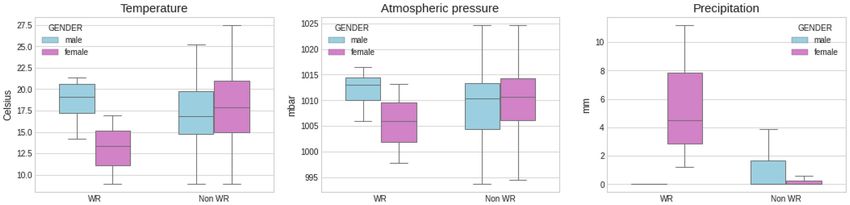
Scheer et al.                                                                                                   Weather and Marathon World Record

INTRODUCTION                                                              strong tail wind can impair performance (Miller-Rushing et al., 2012;
                                                                          Knechtle et al., 2019), although this seems to depend on the
Marathon running (distance of 42.195 km) is the longest                   marathon race course, as wind speed had no influence on race
endurance running discipline in athletics and the Olympics.               performance at the Stockholm marathon (Vihma, 2010).
Historically, the origins of marathon running often refers to                 The marathon with the largest numbers of world records
the Greek runner Pheidippides, who returned from Marathon                 (WRs) and world class performances is the “Berlin Marathon”
to Athens to deliver the victory message over the Persians in             (Robinson, 2019). The “Berlin Marathon” was founded in 1974
the battle of Marathon; however, this is largely thought to               and there have been slight changes to the race course. Events
be a fictional story, based on a poem from Robert Browning                prior to 1990 were limited to West Berlin. Since the German
in 1879. The true historical origin probably dates back to the            reunification, the race course covers the whole city of Berlin.
text of Herodotus, where Pheidippides ran from Athens to                  However, the course profile remained then largely unchanged.
Sparta and back during the battle of Marathon (490 BC; Grogan,            There have been 11 world record performances recorded, as
1981; Scheer, 2019). Since its inaugural competition during               well as the first sub 2:05 h:min, sub 2:04 h:min, and sub
the Olympic Games in Athens in 1896, marathon running has                 2:03 h:min marathon performances (Robinson, 2019). Eilud
seen a stark increase in participation, not only in elite but             Kipchoge from Kenya is the current world record marathon
also in recreational runners (Knechtle et al., 2018).                     holder with a time of 2:01:39 h:min:s during the 2018 edition
   Performance aspects are well researched in marathon running,           of the “Berlin Marathon” (Robinson, 2019). In 2020, the “Berlin
especially the physiological determinants, genetics, training,            Marathon” was canceled for the first time since inception, due
nutritional, technology and logistical aspects (Joyner, 1991;             to the COVID-19 pandemic (Scheer et al., 2021). The “Berlin
Larsen, 2003; Jones et al., 2020; Joyner et al., 2020), as well           Marathon” is unique and therefore ideally suited to investigate
as the importance of optimal pacing strategies (Angus, 2014,              the potential influence of ambient conditions on world records
2019; Nikolaidis and Knechtle, 2018). However, external                   and elite athletes’ performance. Indeed, it is preferable to
determinants, such as environmental conditions, like ambient              investigate environmental conditions at one marathon location,
temperature, wind, cloud cover, barometric pressure, and                  so that data cannot be influenced by other, non-weather factors
precipitations are also important and can have an important               such as marathon racecourse. To date, no study ever investigated
impact on marathon performance (Montain et al., 2007; Ely                 the influence of environmental conditions on world records
et al., 2008; Knechtle et al., 2019). Indeed, it has been shown           and elite performance times at the “Berlin Marathon.”
among the World Marathon Major races (i.e., Boston, London,                   Therefore, the aim of the present study was to investigate
Berlin, Chicago, and New York), that weather conditions have              the influence of environmental conditions such as temperature,
important effects on race times and they may be more important            sunshine duration, precipitation, barometric pressure, and cloud
than race profile (Maffetone et al., 2017).                               cover on world records and elite marathon race performances
   The weather variable with the strongest influence on marathon          (i.e., winner, top three and top 10 finishers) at the “Berlin
race performance is ambient temperature (Suping et al., 1992;             Marathon” (1974 until 2019). In addition, we sought to describe
Ely et al., 2007a,b). In elite marathon runners, the ideal                the ideal weather conditions for world record performances
temperatures seem to be around 10–12°C, both in men and                   and compare performances between sexes. We hypothesized
women (Martin and Buoncristiani, 1999; Ely et al., 2007b);                that temperatures of ~10–12°C would be the optimum
however, even temperatures as low as around 8°C can lead                  temperature for both women and men to achieve a world
to fast marathon times (Trapasso and Cooper, 1989). Warm                  record and elite performance in the “Berlin Marathon” and
weather conditions seem to slow down marathon performances,               that fast marathon times were achieved in sunny weather, with
both in men and women; however, slow runners seem to                      little cloud cover and precipitation.
be more negatively impacted than elite runners (Ely et al., 2007b).
   Female athletes may be performing better in cooler ambient
temperatures than men, but there is no definite evidence for              MATERIALS AND METHODS
this (Martin and Buoncristiani, 1999; Ely et al., 2007b). It has
been shown that thermal comfort and rating of perceived                   Ethical Approval
exertion were significantly higher during exercise in males than          This study was approved by the Institutional Review Board
in females with ice slurry ingestion (Iwata et al., 2020).                of Kanton St. Gallen, Switzerland, with a waiver of the requirement
   The presence of cloud cover or low solar load is often cited           for informed consent of the participants as the study involved
as being ideal conditions for running fast marathons; however,            the analysis of publicly available data.
there is no conclusive evidence and it may be that in elite
marathon runners this does not even impact on performance                 The Race
times (Bodishbaugh, 1988; Ely et al., 2007b). However, cloud              The first marathon in Berlin was held 1974 as “1. Berliner
cover and/or solar radiation can be additional factors contributing       Volksmarathon.” At that time, the race was started before the
to the likelihood of running a fast marathon race (Hughson,               “Mommsenstadion” and the course led to “Grunewald” until
1980; Morgan, 1980; Ely et al., 2007b). Wind speed can also               the “Strandbad Wannsee” with the finish again before the
have an impact on performance, especially tail wind can improve           “Mommsenstadion.” The race took place in the forest of
race performance (Knechtle et al., 2019), whereas headwind or             “Grunewald” and passed the lake of “Wannsee.” In contrast to

Frontiers in Physiology | www.frontiersin.org                         2                                        May 2021 | Volume 12 | Article 654860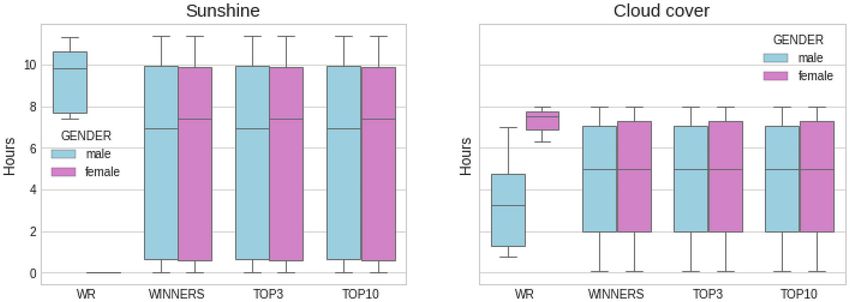
Scheer et al.                                                                                                       Weather and Marathon World Record

the actual city marathon “BMW Berlin Marathon,” the course                   Statistical Analysis
was at that time a commute in the “Grunewald.” In 1975, the                  Descriptive statistical analyses were performed on four nested
course was changed with both start and finish in the                         performance tiers: world record, elite (subgroups: winner, top
“Mommsenstadion.” In 1981, the course moved to the city of                   three, and top 10 finishers) for males and females, separately,
Berlin with the start before the “Reichstagsgebäude,” leading                both on race finish times and weather variables. The resulting
to “Checkpoint Charlie” and finishing on the “Kurfürstendamm.”               values are presented in terms of their average value (mean)
In 1987, the start was moved to “Strasse des 17. Juni.” In 1990,             and SD and maximum and minimum values for each category,
the course crossed for the first time the “Brandenburger Tor.”1              For the finish times results, also the 25, 50, and 75%, quartiles
The race start has changed in the history of “Berlin Marathon.”              are included. The finish time normal distributions for the full
   In 1977, when the first female world record was set in                    sample (male and female) are proven graphically, however, the
Berlin, the “4. Berlin Marathon” was started in the morning                  downsampling into world records, elite, top three and top 10
at 09:00 a.m., whereas the German Championship was started                   results in non-normal samples, as it similarly occurs with the
in the afternoon (02:45 p.m. for men and 04:15 p.m. for                      weather factors. We have therefore used the Kolmogorov-Smirnov
women). The race course was a “Double Shuttle Race” and                      two-sample test, which is independent of the distributions and
was held nearby and within the forest.2                                      sizes of the samples, whenever our results required of statistical
                                                                             significance analysis. Statistical significance was set at 5%
Data Set and Data Preparation                                                (p < 0.05). All analyses were carried out using the Python
Data (i.e., year of performance, finishing times, and place)                 programming language (Python Software Foundation, www.
were obtained directly from the website of the “Berlin Marathon”3            python.org/), and a Google Colab notebook.4
in JSON format and then convert into an Excel file using a
custom Python script.
    Weather data on race day was obtained from the website                   RESULTS
of “Deutscher Wetterdienst” by using https://opendata.dwd.de/
climate_environment/CDC/observations_germany/climate/                        World record marathon performances were set eight times for
hourly/ and then to air temperature, sunshine, precipitation,                male and three times for female athletes at the “Berlin Marathon”
barometric pressure, and cloud cover.                                        and finishing times with their corresponding weather data are
    For historic data, the appropriate location has to be selected           shown in Table 1. Male competitions were held 44 times and
by using www.dwd.de/DE/leistungen/klimadatendeutschland/                     female competitions 41 times during the observational period
statliste/statlex_html.html?view=nasPublication&nn=16102. We                 and the corresponding marathon finishing times by performance
selected weather station 433, which is located at the old West-              groups and gender, expressed as mean, SD, 25, 50, 75% quartile,
Berlin airport Tempelhof for data for all years since this weather           and minimum and maximum in h:min:s are shown in Table 2.
station covered all years of the race. The maximal distance of                  Figure 1 depicts and compares marathon finishing times
this weather station to the start/finish area and/or the race                from world record performances and elite athletes (i.e., winner,
course was between 8.3 and 14 km. We selected the time of                    top three, and top 10) by gender. Figures 2, 3 show another
the measurement respecting the start time of the marathon                    set of boxplot charts illustrating a comparative analysis of the
(i.e., air temperature 2 h after the start) since the world record           weather conditions [sunshine and cloud cover in hours and
in 1977 was set in the afternoon. Sunshine (duration in hours),              temperature (°Celsius), atmospheric pressure (mbar), and
precipitation (mm), cloud cover (duration in hours), and                     precipitation (mm)] on world record marathon performances
atmospheric pressure (mbar) were selected for the whole race                 and elite marathon performances (i.e., winner, top three, and
day. Weather type was classified according to Woś by thermal                 top 10) by gender, with 95% CI. Temperatures were similar
temperature types as warm, when mean temperatures were                       for the elite groups but lower for female world records and
between 10.1 and 15°C, cloudiness (sunny, cloudy, and very                   non-significant (p > 0.05) among all performance groups and
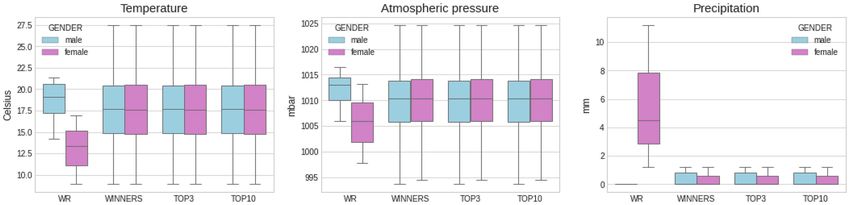
cloudy) and precipitation (Piotrowicz and Ciaranek, 2020).                   sexes. Atmospheric pressure, precipitation, sunshine, and cloud
                                                                             cover were similar and not statistically different in elite marathon
Data Processing                                                              performances. Female world record-breaking performances
Two data files were used in this study: first, a register of the             occurred in bad weather (i.e., rain, cloud cover, and no sunshine;
finishing times in the format h:min:s, along with their sex,                 p < 0.05) compared to males.
and the year of the marathon, and second, a register of the                     Figures 4, 5 show another set of boxplots illustrating a
weather data. These files were visually inspected in an Excel                comparative analysis of the weather conditions [sunshine and
spreadsheet first, and then uploaded into a Google Colab                     cloud cover in hours and temperature (°Celsius), atmospheric
notebook, where Python was used to perform the statistical                   pressure (mbar), and precipitation (mm)] on world record
processing and to create the results.                                        marathon performances and non-world record marathon
                                                                             performances by gender, with 95% CI. The average temperatures
 www.bmw-berlin-marathon.com/news-center/news/detail/
1
                                                                             for world record breaking events were 18.61 ± 2.59°C for men
eine-einzigartige-geschichte-30-jahre-real-berlin-marathon/
 www.runnersworld.de/news-fotos/die-elf-berliner-marathon-weltrekorde/
2                                                                           and 13.07 ± 4.01°C for women (p > 0.05), compared to
 www.bmw-berlin-marathon.com/impressionen/statistik-und-geschichte/
3

ergebnisarchiv/                                                               https://colab.research.google.com/
                                                                             4

Frontiers in Physiology | www.frontiersin.org                            3                                         May 2021 | Volume 12 | Article 654860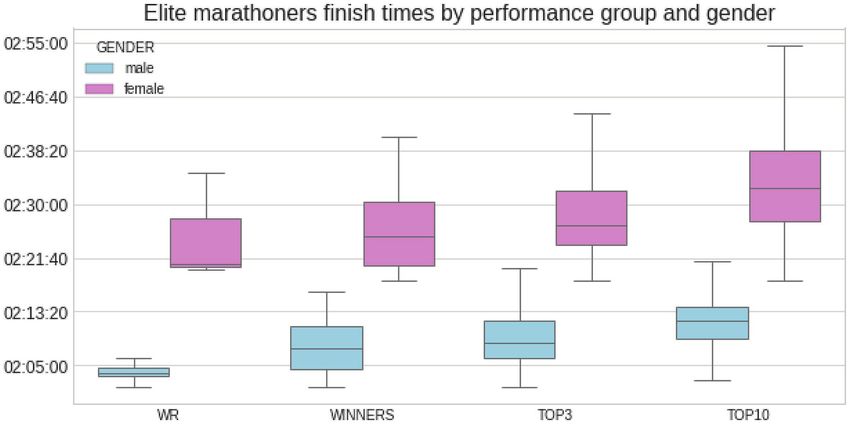
Scheer et al.                                                                                                                                Weather and Marathon World Record

TABLE 1 | Marathon world record performances by year, gender, and weather conditions.

Year                 Gender              Nationality         Time (h:min:s)       Temperature         Sunshine (h)          Cloud cover       Precipitation      Atmospheric
                                                                                     (°C)                                       (h)              (mm)           pressure (mbar)

1998                 Male                BRA                    2:06:05                19.8                9.9                  1.0                0.0             1026.8
2003                 Male                KEN                    2:04:55                17.6                7.4                  4.3                9.8             1005.9
2007                 Male                ETH                    2:04:26                15.9                0.8                  7.0                0.0             1012.5
2008                 Male                ETH                    2:03:59                18.4               10.6                  2.2                0.0             1013.6
2011                 Male                KEN                    2:03:38                20.4               11.3                  0.8                0.0             1010.3
2013                 Male                KEN                    2:03:23                14.2               10.7                  1.4                0.0             1008.9
2014                 Male                KEN                    2:02:57                21.2                9.8                  4.5                0.0             1016.4
2018                 Male                KEN                    2:01:39                21.4                7.8                  5.6                0.0             1013.8
1977                 Female              FRG                    2:34:48                 8.9                0.0                  8.0               11.2             1013.1
1999                 Female              KEN                    2:20:43                16.9                0.0                  6.3                1.2              997.7
2001                 Female              JPN                    2:19:46                13.4                0.0                  7.5                4.5             1006.0

BRA, Brazil; KEN, Kenya; ETH, Ethiopia; FRG, Federal Republic of Germany; and JPN, Japan.

TABLE 2 | Marathon finishing times by performance groups and gender, expressed as mean, SD, 25, 50, 75% quartile and minimums and maximum in h:min:s.

Group              Gender                   n              Mean                SD             Minimum             25%                 50%            75%                Max

                   Men                      8             02:03:52          00:01:19           02:01:39          02:03:16         02:03:48          02:04:33          02:06:05
World record
                   Women                    3             02:25:05          00:08:25           02:19:46          02:20:14         02:20:43          02:27:45          02:34:48
                   Men                     44             02:09:48          00:09:15           02:01:39          02:04:23         02:07:41          02:11:00          02:47:08
Winner
                   Women                   41             02:30:35          00:19:09           02:18:11          02:20:32         02:25:00          02:30:22          03:59:15
                   Men                     132            02:11:06          00:09:26           02:01:39          02:06:14         02:08:34          02:12:00          02:50:02
Top three
                   Women                   123            02:34:59          00:25:51           02:18:11          02:23:38         02:26:49          02:32:00          04:39:24
                   Men                     440            02:14:22          00:10:30           02:01:39          02:09:09         02:11:58          02:14:00          02:58:55
Top 10
                   Women                   404            02:40:55          00:29:44           02:18:11          02:27:25         02:32:36          02:38:20          05:40:10

Men were significantly faster than women in all performance groups (p < 0.05) and within the groups world record performances were significantly faster than top three and top 10
performances among both sexes (p > 0.05).

  FIGURE 1 | Marathon finishing times from world record (WR) performances and elite athletes (winner, top three, and top 10) by gender, with SD. Around 95% CI
  was used to create the boxplots. Statistical differences between male and female performances among all groups p < 0.05 and within sexes between WR and top
  three and top 10 performances.

17.36 ± 4.33 and 17.93 ± 4.07°C for non-world record                                          DISCUSSION
performances (p > 0.05), respectively for men and women,
with no statistical difference between the groups. Male world                                 The aim of the present study was to investigate the influence
records occurred on dry, high pressure days, while female                                     of environmental conditions such as air temperature, sunshine
world records were broken on days with lower barometric                                       duration, precipitation, barometric pressure, and cloud cover
pressure (p > 0.05) and more precipitation (p < 0.05). The                                    on world records and elite marathon race performances (i.e.,
sunshine and cloud cover charts re-enforce further the idea                                   winner, top three and top 10 finishers) at the “Berlin Marathon”
that men performed better on sunny days, while women’s                                        between 1974 and 2019. In addition, we sought to describe
performance behaved rather the opposite way.                                                  the ideal weather conditions for world record performances

Frontiers in Physiology | www.frontiersin.org                                            4                                                  May 2021 | Volume 12 | Article 654860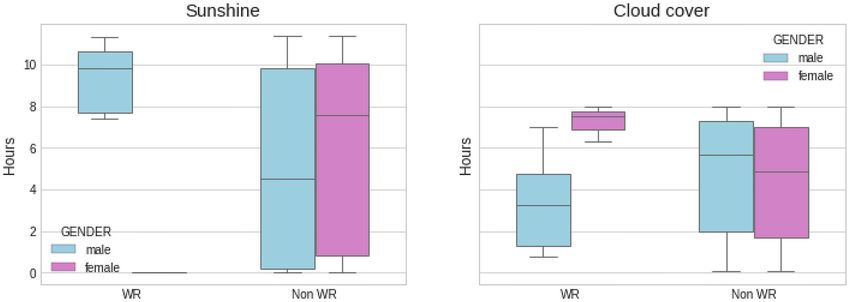
Scheer et al.                                                                                                                     Weather and Marathon World Record

  FIGURE 2 | Comparative analysis of weather conditions (sunshine and cloud cover in hours) on WR marathon performances and elite marathon performances
  (winner, top three, and top 10) by gender, with SD. About 95% CI was used to create the boxplots. Statistical difference between WR men and women for both
  sunshine and cloud cover (p < 0.05).

  FIGURE 3 | Comparative analysis of weather conditions [temperature (°Celsius), atmospheric pressure (mbar), and precipitation (mm)] on WR marathon
  performances and elite marathon performances (winner, top three, and top 10) by gender, with SD. Around 95% CI was used to create the boxplots. Statistical
  difference between WR female performance and precipitation to other performance groups (p < 0.05).

  FIGURE 4 | Comparative analysis of weather conditions (sunshine and cloud cover in hours) on WR marathon performances and non WR marathon performances by
  gender, with SD. About 95% CI was used to create the boxplots. Statistical differences between female WR and other groups for sunshine and cloud cover (p < 0.05).

and to compare performances between sexes. We hypothesized                            of 18.61°C for men and 13.07°C for women, whereas elite
that temperatures of ~10–12°C would be the optimum                                    performances were achieved at mean temperatures of 17.36
temperature for both women and men to achieve a world                                 and 17.93°C for men and women (p > 0.05), respectively; (ii)
record and elite performance in the “Berlin Marathon” and                             hours of sunshine, cloud cover, precipitation, and atmospheric
that fast marathon times were achieved in sunny weather, with                         pressure were similar between male and female elite marathon
little cloud cover and precipitation. The main findings were:                         performances (p > 0.05), and (iii) ideal weather conditions
(i) world record performances were set at a mean temperature                          for world record performances differed between male and

Frontiers in Physiology | www.frontiersin.org                                     5                                              May 2021 | Volume 12 | Article 654860
Scheer et al.                                                                                                              Weather and Marathon World Record

  FIGURE 5 | Comparative analysis of weather conditions [temperature (°Celsius), atmospheric pressure (mbar), and precipitation (mm)] on WR marathon
  performances and non WR marathon performances by gender, with SD. About 95% CI was used to create the boxplots. Statistical differences between female WR
  precipitation and all groups (p < 0.05).

female athletes, where female athletes achieved world record                      differences in other ambient conditions between world record
performances with bad weather (i.e., rain and zero hours of                       performance and between sexes. While world record
sunshine and cloud cover), while males did so on sunny, mostly                    performances in men were held on mostly sunny and dry
dry days, with higher atmospheric pressure and lower cloud cover.                 days, female world records were achieved in rather bad weather,
                                                                                  with lower temperatures, rain and no sunshine, and this was
World Record Performances and Ambient                                             statistically significant (p < 0.05).
Temperature                                                                           These finding are novel and have not previously been
The “Berlin Marathon” is the fastest marathon racecourse in                       reported in the literature. Cloud cover and/or solar radiation
the world, with the current marathon world record for men                         can be additional factors contributing to the likelihood of
obtained by Eliud Kipchoge in 2:01:39 h:min:s in 2018. In                         running a fast marathon race (Hughson, 1980; Morgan,
total, 11 world record performances were achieved at the                          1980; Ely et al., 2007b), although no conclusive evidence
“Berlin Marathon” since its inception in 1974. This represents                    exists (Bodishbaugh, 1988; Ely et al., 2007b). Our results
50% of all male and 10% of all female marathon world record                       provide the first evidence, that world record performances
performances worldwide since 1974. The reasons for this are                       in female athletes at the “Berlin Marathon” are possible in
said to be the cool climatic conditions, flat well-maintained                     “bad weather.” However, we also recognize that only three
roads, and carefully selected elite fields and pacemakers                         female athletes achieved a world record at the “Berlin
(Robinson, 2019); however, this has never been examined or                        Marathon,” so data interpretation is more challenging, and
confirmed in a scientific study. Indeed, the average temperature                  it may be speculative to draw firm conclusion from this.
for world record at the “Berlin Marathon” were 18.61°C for                        The female world records were set in 1977, 1999, and 2001.
men and 13.07°C for women, which can be classified as very                        Especially in the Seventies of the last century, a female
warm thermal weather (Piotrowicz and Ciaranek, 2020). The                         marathon world record could be achieved more easily than
temperatures are clearly higher than we expected, as previously                   nowadays. Therefore, also rainy conditions may have not
ideal temperatures for elite performances were described in                       such a strong impact on the performance than in the male
the range of between 8 and 12°C (Trapasso and Cooper,                             race of the last 2 decades.
1989; Martin and Buoncristiani, 1999; Ely et al., 2007b).                             However, these gender differences in respect to ambient
Although the difference may be relatively small, a world record                   conditions are interesting to note and represent a unique sample
performance is unique and rare and this warmer temperature                        of performances. Larger sample sizes are needed to assess sex
may be enough to make a difference in performance time.                           differences and environmental conditions and their impact on
As a matter of fact, male world record athletes originate from                    race performance. However, we also need to recognize that
Ethiopia and Kenya and they may be more accustomed to                             examining one marathon event is preferable to multiple marathon
running in warmer, dryer weather with sunshine (Nikolaidis                        events at different race locations, as non-weather factors such
et al., 2017; Vitti et al., 2020). Additionally, these athletes                   as marathon racecourse can influence performance, hence this
have different body dimensions, with lower body mass and                          will always be a limitation to sample size.
lower body mass index, that may be of advantage in higher                             Since the most recent male world records were set by Kenyan
temperatures (Mooses and Hackney, 2017).                                          marathoners, the aspect of doping must be considered. In 2012,
                                                                                  a German television report showed drug use by top Kenyan
                                                                                  runners, and under international pressure, Kenyan antidoping
World Record Performances, Ambient                                                task force reported a spike in doping cases in Kenyan runners
Conditions, and Gender Differences                                                at that time. It has been reported that 15 doped runners were
Ambient temperatures were sensibly different between male                         marathoners, and most were sub-elite runners trying to become
and female world record performances. There were also                             elite marathoners (Eichner, 2015).

Frontiers in Physiology | www.frontiersin.org                                 6                                           May 2021 | Volume 12 | Article 654860
Scheer et al. Weather and Marathon World Record
Elite Marathon Performances and Ambient that world record performances are rare and unique and that
Conditions the “Berlin Marathon” provides the greatest number of world
For elite performances, the ideal temperatures were of record performances of any singular marathon racecourse,
17.36 ± 4.33°C for men and 17.93 ± 4.07°C for women. The therefore making it an ideal competition to investigate factors
average temperature range for elite performances at the “Berlin affecting these unique performances. Examining ambient
Marathon” was very warm thermal weather (Piotrowicz and conditions of world record performances from different
Ciaranek, 2020), with no statistical differences between the racecourses will provide a larger dataset and may provide further
sexes. These ambient temperatures are higher than we expected, information about sex differences in ambient conditions for
and higher than the ones previously reported in the literature these performances. An additional, historic limitation is that
(between 8 and 12°C; Trapasso and Cooper, 1989; Ely et al., the characteristics of the race course changed from the beginning
2007b). Again, this may be related to the number of elite to the actual version. In the first years (1974–1980), the race
athletes originating from the African continent (Vitti et al., was held outside of Berlin as a commute in the “Grunewald”
2020), with the advantages of running in warmer weather and and moved then to the city of Berlin. In the beginning, the
their described physiological advantages (Mooses and Hackney, racecourse was held in and near the forest covered by trees.
2017; Nikolaidis et al., 2017), or it may simply be an intrinsic The start times of the race have also changed over time, with
advantage of the ambient conditions at the “Berlin Marathon.” a staged start used nowadays. As usual in a large city marathon,
However, it has also been shown, that elite women may benefit several aid stations are offered during the course and electronic
more from increasing temperatures for a fast marathon race time recording for block starts is used. Therefore, the first
time than men (Vihma, 2010). Other ambient conditions such female world record in 1977 was held under different conditions
as hours of sunshine, cloud cover, precipitation, and atmospheric (i.e., race start in the afternoon and course covered by trees)
pressure were similar between the sexes in elite marathon compared to the other female world records after 1981.
performances in our data, with ideal conditions of little to
no precipitation, moderate cloud cover, and sunshine.
CONCLUSION
Limitations The “Berlin Marathon” is the fastest marathon racecourse in
The methods of weather measurements might have changed the world and has seen 11 world records since it was first held
during the decades, which also may have an impact on the in 1974. The ideal environmental conditions for world record
results. The wet-bulb globe temperature (WBGT) as a combined performances for men were temperatures of 18.61°C, sunny,
index of ambient temperature, relative humidity, and solar mostly dry days, with higher atmospheric pressure and little
radiation, has on occasion been used to examine performances cloud cover. In women, ideal conditions for world record
(Ely et al., 2007b); however, the WBGT cannot distinguish performances were temperatures of 13.07°C, with low atmospheric
between important weather variables, e.g., cloud cover or sunshine pressure, but significantly more rain, and with no sunshine and
and rain on performance (e.g., a hot, dry, overcast day can with cloud cover. No significant gender differences were observed
result in a WBGT that is very similar to a cool and humid in elite (i.e., winner, top three and top 10 finishers) performances
day with plenty of sunshine). Therefore, we have not analyzed at the “Berlin Marathon,” and the best ambient conditions in
data using the WBGT as our aim was to examine the different those are little to no precipitation, moderate cloud cover, and
ambient conditions on performance separately. Wind speed sunshine. For any athlete intending to break the marathon world
may have an influence on performance on some marathon record in an official race, optimum environmental conditions
race courses (Vihma, 2010; Miller-Rushing et al., 2012; Knechtle are needed apart from a fast race course. Future studies might
et al., 2019); however, we are unable to assess this for the consider the analysis of specific biomarkers during a marathon
“Berlin Marathon,” as we did not have data on wind speed, run in the heat (Lim et al., 2009; Suzuki, 2019) and the use
but this would be another interesting aspect to examine in of hourly weather data respecting race start and race finish.
future studies. Although the historic weather data are mostly
quality controlled by the “Deutscher Wetterdienst,” the use of
historic weather data has its limitations. We used average DATA AVAILABILITY STATEMENT
humidity and average barometric pressure, sunshine duration,
and precipitation for the whole day, but temperature respecting The raw data supporting the conclusions of this article will
start times of the races (i.e., morning start in recent years, be made available by the authors, without undue reservation.
afternoon start in the world record race in 1977). However,
future studies examining especially world record performances
should bear this in mind. Hourly changes of weather data are AUTHOR CONTRIBUTIONS
obtainable from weather report data bases to correlate better
with race start and race finish of athletes of each performance VS drafted the manuscript. DV performed the data processing
level (race time). The low number of world record performances and statistical analyses. EV collected the data. JA, TR, and
make it difficult to generalize our results, especially in respect BK helped in drafting the manuscript. All authors contributed
to a female world record. However, we also need to recognize to the article and approved the submitted version.
Frontiers in Physiology | www.frontiersin.org 7 May 2021 | Volume 12 | Article 654860Scheer et al. Weather and Marathon World Record
REFERENCES Miller-Rushing, A. J., Primack, R. B., Phillips, N., and Kaufmann, R. K. (2012).
Effects of warming temperatures on winning times in the Boston marathon.
Angus, S. D. (2014). Did recent world record marathon runners employ optimal PLoS One 7:e43579. doi: 10.1371/journal.pone.0043579
pacing strategies? J. Sports Sci. 32, 31–45. doi: 10.1080/02640414.2013.803592 Montain, S. J., Ely, M. R., and Cheuvront, S. N. (2007). Marathon performance
Angus, S. D. (2019). A statistical timetable for the sub-2-hour marathon. Med. in thermally stressing conditions. Sports Med. 37, 320–323. doi:
Sci. Sports Exerc. 51, 1460–1466. doi: 10.1249/MSS.0000000000001928 10.2165/00007256-200737040-00012
Bodishbaugh, R. G. (1988). Boston marathoners get red carpet treatment in the Mooses, M., and Hackney, A. C. (2017). Anthropometrics and body composition
medical tent. Phys. Sportsmed. 16, 139–142. doi: 10.1080/00913847.1988.11709561 in east African runners: potential impact on performance. Int. J. Sports
Eichner, E. R. (2015). Top marathon performance: interesting debate and troubling Physiol. Perform. 12, 422–430. doi: 10.1123/ijspp.2016-0408
trends. Curr. Sports Med. Rep. 14, 2–3. doi: 10.1249/JSR.0000000000000115 Morgan, P. P. (1980). Running into danger: heat stroke in competing runners.
Ely, M. R., Cheuvront, S. N., and Montain, S. J. (2007a). Neither cloud cover Can. Med. Assoc. J. 122, 1113–1115.
nor low solar loads are associated with fast marathon performance. Med. Nikolaidis, P. T., and Knechtle, B. (2018). Pacing strategies in the “Athens
Sci. Sports Exerc. 39, 2029–2035. doi: 10.1249/mss.0b013e318149f2c3 classic marathon”: physiological and psychological aspects. Front. Physiol.
Ely, M. R., Cheuvront, S. N., Roberts, W. O., and Montain, S. J. (2007b). 9:1539. doi: 10.3389/fphys.2018.01539
Impact of weather on marathon-running performance. Med. Sci. Sports Exerc. Nikolaidis, P. T., Onywera, V. O., and Knechtle, B. (2017). Running performance,
39, 487–493. doi: 10.1249/mss.0b013e31802d3aba nationality, sex, and age in the 10-km, half-marathon, marathon, and the
Ely, M. R., Martin, D. E., Cheuvront, S. N., and Montain, S. J. (2008). Effect 100-km ultramarathon IAAF 1999–2015. J. Strength Cond. Res. 31, 2189–2207.
of ambient temperature on marathon pacing is dependent on runner ability. doi: 10.1519/JSC.0000000000001687
Med. Sci. Sports Exerc. 40, 1675–1680. doi: 10.1249/MSS.0b013e3181788da9 Piotrowicz, K., and Ciaranek, D. (2020). A selection of weather type classification
Grogan, R. (1981). Run, Pheidippides, run! The story of the battle of marathon. systems and examples of their application. Theor. Appl. Climatol. 140, 719–730.
Br. J. Sports Med. 15, 186–189. doi: 10.1136/bjsm.15.3.186 doi: 10.1007/s00704-020-03118-2
Hughson, R. L. (1980). Primary prevention of heat stroke in Canadian long- Robinson, R. (2019). The Record-Breaking History of the Berlin Marathon.
distance runs. Can. Med. Assoc. J. 122, 1115–1119. Available at: https://www.runnersworld.com/races-places/a23085728/berlin-
Iwata, R., Kawamura, T., Hosokawa, Y., Chang, L., Suzuki, K., and Muraoka, I. marathon-history/ (Accessed December 22, 2020).
(2020). Diferences between sexes in thermoregulatory responses and exercise Scheer, V. (2019). Participation trends of ultra endurance events. Sports Med.
time during endurance exercise in a hot environment following pre-cooling Arthrosc. Rev. 27, 3–7. doi: 10.1097/JSA.0000000000000198
with ice slurry ingestion. J. Therm. Biol. 94, 102746. doi: 10.1016/j. Scheer, V., Valero, D., Villiger, E., Rosemann, T., and Knechtle, B. (2021). The
jtherbio.2020.102746 impact of the COVID-19 pandemic on endurance and ultra-endurance
Jones, A. M., Kirby, B. S., Clark, I. E., Rice, H. M., Fulkerson, E., Wylie, L. J., running. Medicina 57:10052. doi: 10.3390/medicina57010052
et al. (2020). Physiological demands of running at 2-hour marathon race Suping, Z., Guanglin, M., Yanwen, W., and Ji, L. (1992). Study of the relationships
pace. J. Appl. Physiol. 130, 369–379. doi: 10.1152/japplphysiol.00647.2020 between weather conditions and the marathon race, and of meteorotropic
Joyner, M. J. (1991). Modeling: optimal marathon performance on the basis effects on distance runners. Int. J. Biometeorol. 36, 63–68. doi: 10.1007/BF01208915
of physiological factors. J. Appl. Physiol. 70, 683–687. doi: 10.1152/ Suzuki, K. (2019). Characterization of exercise-induced cytokine release, the
jappl.1991.70.2.683 impacts on the body, the mechanisms and modulations. Int. J. Sports Exerc.
Joyner, M. J., Hunter, S. K., Lucia, A., and Jones, A. M. (2020). Last word on Med. 5, 1–13. doi: 10.23937/2469-5718/1510122
viewpoint: physiology and fast marathons. J. Appl. Physiol. 128, 1086–1087. Trapasso, L. M., and Cooper, J. D. (1989). Record performances at the Boston
doi: 10.1152/japplphysiol.00181.2020 marathon: biometeorological factors. Int. J. Biometeorol. 33, 233–237. doi:
Knechtle, B., Di Gangi, S., Rüst, C., Rosemann, T., and Nikolaidis, P. (2018). 10.1007/BF01051083
Men’s participation and performance in the Boston marathon from 1897 Vihma, T. (2010). Effects of weather on the performance of marathon runners.
to 2017. Int. J. Sports Med. 39, 1018–1027. doi: 10.1055/a-0660-0061 Int. J. Biometeorol. 54, 297–306. doi: 10.1007/s00484-009-0280-x
Knechtle, B., Di Gangi, S., Rüst, C. A., Villiger, E., Rosemann, T., and Vitti, A., Nikolaidis, P. T., Villiger, E., Onywera, V., and Knechtle, B. (2020).
Nikolaidis, P. T. (2019). The role of weather conditions on running performance The “new York City marathon”: participation and performance trends of
in the Boston marathon from 1972 to 2018. PLoS One 14:e0212797. doi: 1.2M runners during half-century. Res. Sports Med. 28, 121–137. doi:
10.1371/journal.pone.0212797 10.1080/15438627.2019.1586705
Larsen, H. B. (2003). Kenyan dominance in distance running. Comp. Biochem.
Physiol., Part A Mol. Integr. Physiol. 136, 161–170. doi: 10.1016/ Conflict of Interest: The authors have no conflicts of interest to report. The
S1095-6433(03)00227-7 authors confirm that the research presented in this article met the ethical guidelines,
Lim, C. L., Pyne, D., Horn, P., Kalz, A., Saunders, P., Peake, J., et al. (2009). including adherence to the legal requirements.
The effects of increased endurance training load on biomarkers of heat
intolerance during intense exercise in the heat. Appl. Physiol. Nutr. Metab. Copyright © 2021 Scheer, Valero, Villiger, Alvero Cruz, Rosemann and Knechtle.
34, 616–624. doi: 10.1139/H09-021 This is an open-access article distributed under the terms of the Creative Commons
Maffetone, P. B., Malcata, R., Rivera, I., and Laursen, P. B. (2017). The Boston Attribution License (CC BY). The use, distribution or reproduction in other forums
marathon versus the world marathon majors. PLoS One 12:e0184024. doi: is permitted, provided the original author(s) and the copyright owner(s) are credited
10.1371/journal.pone.0184024 and that the original publication in this journal is cited, in accordance with accepted
Martin, D. E., and Buoncristiani, J. F. (1999). The effects of temperature on marathon academic practice. No use, distribution or reproduction is permitted which does not
runners’ performance. Chance 12, 20–24. doi: 10.1080/09332480.1999.10542170 comply with these terms.
Frontiers in Physiology | www.frontiersin.org 8 May 2021 | Volume 12 | Article 654860You can also read


