The Role of Strategy, Culture and Leadership in the Nedbank Turnaround - The Tom Boardman Story
←
→
Page content transcription
If your browser does not render page correctly, please read the page content below
The Role of Strategy, Culture and Leadership in the
 Nedbank Turnaround – The Tom Boardman Story

                                             1|Page
Table of Contents
Executive Summary ....................................................................................................................................... 3
It all Starts with a Vision, driven by Strategy ................................................................................................ 4
Corporate Culture and Values....................................................................................................................... 5
Transformation ............................................................................................................................................. 6
Leadership ..................................................................................................................................................... 8
Measurement and Tracking .......................................................................................................................... 9
When it’s all Said and Done ........................................................................................................................ 10
Annexure 1: Dagwood 2004 ....................................................................................................................... 11
Annexure 2: Nedbank Staff Survey ............................................................................................................. 12
Annexure 3: Nedbank Transformation – Employment Equity .................................................................... 13
Annexure 4: Entropy Improvement ............................................................................................................ 14
Annexure 5: Improvement in Business Ratios ............................................................................................ 15
2|PageExecutive Summary
When Tom Boardman was announced as the Chief Executive Officer (CEO) of Nedbank in late 2003, the
bank was about to go on to record full year results of Headline Earnings down 98% (to R55m), and a
Return on Equity (ROE) of 0.4%. Nedbank’s Market Capitalisation was the lowest of the ‘Big Four’, and
on a downward trajectory in direct contrast to the competitors’ upward trajectory, at R17bn. Their
parent company Old Mutual plc would have to inject R2bn of secondary capital to keep it afloat, and
R5.2bn primary capital had to be raised through a rights issue. Coupled with the poor financial view,
market sentiment of the appointment of the CEO whose job it was to lead Nedbank out of these
troubled times was negative, and a day after the announcement Nedbank’s share price tumbled 6%. At
the same time, Nedbank was in the midst of the complicated merger with BOE, which involved not only
aligning people, culture, and values, but was becoming more costly the longer it took to implement, and
thus real ‘savings’ were not being immediately realized.
It was immediately clear that a lot of hard work would be required in order to turnaround one of South
Africa’s oldest and traditionally ‘aspirational’ banks. Everything from the way it did business (corporate
strategy and operations), to the way that the employees functioned (corporate culture), to the way it
ensured successful implementation, execution and attainment of goals and objectives (corporate
leadership) had to be reviewed and reinvented.
3|PageIt all Starts with a Vision, driven by Strategy
‘To become Southern Africa’s most highly rated and respected bank … by our staff, clients, shareholders,
regulators and communities.’ ‐ Tom Boardman, 2004.
The vision of an organization gives it direction. This is ‘If you don’t know where you are
going then any road will take you
enabled and underpinned by its corporate strategy and
there.’ – Cheshire Cat, Alice in
values. In the absence of a vision, an organization has Wonderland
no direction.
Strategically, Tom realized that there were a number of pressing and immediate issues that had to be
dealt with quickly in order to fully carry out his vision. To address these pressing concerns, Tom
launched the ‘Journey Back to the Top’ initiative, underpinned by a three year planning process. This
was meant to provide focus to these and other key initiatives aimed at the turnaround of Nedbank, and
ensured that each responsible business division, as well as Tom, would be actively tracked and
measured against these items.
10 Steps for shifting an Organization
At the same time, in 2004, Tom personally led the
1. Develop a vision, mission, strategy
Strategy, Values and Brand (SVB) workshops. These and operating plan
were held for the top senior leadership in Nedbank to 2. Set high expectations with specific
goals and objectives
brainstorm the strategic direction, corporate
3. Build trust
aspirations, key focus areas, and core values. A number
of these workshops were held to constantly evolve and 4. Define person’s and group’s goals,
responsibilities and job content
improve these aspects. The summaries of the
5. Agree on measures for people to
discussions from every workshop, together with track how they are doing
amendments to the group strategy, values and brand, 6. Give frequent feedback and relate to
were consolidated into one document, which was plans
presented to, and approved by, the Nedbank Group 7. Continuously update people on
external situation
Executive Committee. The result was a finalized group
8. Recognize and praise success and
strategy and clear direction for the Nedbank Group
progress
brand campaign and values ‐ the ‘Dagwood’.
9. Reward success and the desired
behaviour
10. Celebrate success together and share
setbacks
4|PageGlobal research has shown that highly successful companies often use a single concept that focuses all
the efforts in their organizations. Powerful single concepts are built on three pillars: what the
organization is passionate about, what sets the organization apart from competitors and what drives the
organization’s economic engine. Tom believed that Nedbank could be the best at understanding their
clients’ needs and that they could deliver value propositions that would meet these specific needs
better than any other bank in Southern Africa. He believed that being more client‐driven would set
Nedbank apart from the rest and would be a cornerstone in the ‘journey back to the top’.
Furthermore, and in line with the strategy of becoming a more client‐driven organization and to remove
the silo mentality from the business, the frontline business model had to be reviewed. As a result, the
existing retail and operations business structures were reviewed and a new business model was
introduced with the aim of unifying the business, which in turn would support a more client‐centric
approach. The review was based on feedback received from all Nedbank employees, and by evaluating
best practice in other international markets. This is aligned to the maxim of ‘the wisdom of many is
better than the wisdom of few.’
Corporate Culture and Values
‘The culture of an organization or any group of individuals is a reflection of the values, beliefs and
behaviours of leaders of the group.’ ‐ Richard Barrett.
The breaking down of silo behaviour within Nedbank was
another one of the key challenges. To encourage unity one ‘The excellent companies developed
set of values were developed ‐ values that were shared by cultures that incorporated the values
and practices of their great leaders,
staff in all the clusters and divisions, and that were also in
and those shared values can be seen
line with the values of the broader Old Mutual group. to survive for decades.’ – Tom Peters
Four values which aligned to the greater Old Mutual group,
and which were adapted for Nedbank, were chosen, as well
as a fifth which was chosen specifically in order to create a
‘Organizational transformation
sense of uniqueness and relevance to Nedbank. All staff begins with personal transformation
was invited for their input in selecting the fifth value as this of the leaders. Organizations do not
transform; people do.’ – Richard
represented buy‐in into the shifting of the corporate culture
Barrett
which was a prerequisite for the turnaround. Being People‐
5|PageCentered was eventually selected, to go along with Deep Green’ Aspirations
Integrity, Respect, Accountability, and Pushing Beyond
• Great Place to Work
Boundaries. In order to create a ‘High Performing Culture’ it
• Great Place to Bank
was critical these values were adopted, accepted and lived
• Great Place to Invest
by all employees, and be seen to exist within top leadership.
• Unleashing Synergies
Another key concept as a result of the SVB workshops was
• World‐class at Managing Risk
‘Deep Green’. This idea was about a composite culture,
• Community of Leaders
encompassing the vision, and driven by a depth of
• Most Respected and Aspirational
aspirations, values, and focus areas (‘Deep’), built around Brand
the brand imaging of Nedbank (‘Green’). It represented the
• Highly Involved in the Community
feeling that the senior leadership team at the time of the and Environment
SVB workshops felt best summarized the Nedbank that they • Leading Transformation
had planned to see, and would work towards. • Living our Values
To enable Deep Green, the ‘Leading For Deep Green’ (L4DG) programme was constituted. This
encompassed employee and team mastery and effectiveness, while also focusing on community
involvement and staff volunteerism. One of the workstreams that was constituted was a combined
leadership and strategy process. It was a unique process that had been developed for Nedbank by the
Centre for Conscious Leadership (CCL), a team of organisational psychologists. The process was built on
the latest thinking in leadership development. The key aspects of this was to be aware of oneself in
terms of ones personality, leadership style, and on the impact and influence on others, and how
Nedbank could harness the synergy of differences and leverage our insight to build a sustainable future
for Nedbank. To date 162 teams and 1,969 staff members have gone on the programme, and it is
continually being enhanced to ensure an effective working corporate culture and values.
Transformation
Another area where much change occurred and ‘It is our responsibility to break down
excelled under the leadership of Tom is that of barriers of division and create a
country where there will be neither
Transformation. He saw that Nedbank, as a leading Whites nor Blacks, just South
banking group, had an ‘opportunity to effect and Africans, free and united in diversity.’
influence transformation at a number of levels – not – Oliver Tambo
6|Pageonly internally but also in the markets that we serve, among our corporate clients, in capital formation
projects, and in all out business interactions.’
Transformation is not just a numbers game, where it looks like it’s all about employment equity targets
and black economic empowerment. This checklist mindset can diminish the socio‐economic actualities
of what transformation is really about. It’s about human rights, equality, justice, and dignity. It’s about a
belief in an abundant future for all.
The financial sector charter was one of the first movers
Nedbank’s Transformation Truths
in organizing business to setup a governing charter that
1. It is the right thing to do.
would prioritize Black Economic Empowerment (BEE) Transformation is a business
imperative.
within the sector and guide financial services
2. Transformation affects every single
institutions in its implementation. The Financial Sector
area of our business.
Charter (FSC) was developed by the major players in the
3. It is the responsibility of every person
sector and brought into effect in January 2004. It sets to make it happen.
out key strategic measures to promote BEE across the 4. Trust and transparency is required.
Everyone should be heard.
sector, together with targets for implementation. The
Department of Trade and Industry (DTI) have since 5. Transformation at Nedbank must be
unifying, fair and transparent.
introduced the BEE Codes of Good Practice, which
6. Transformation will have short‐term
forms an addendum to the B‐BBEE Act and provide a cost with long‐term benefit.
means of measuring BEE on the broad‐based terms 7. Transformation targets will be
introduced with the Act. This marks a further step to embedded in our strategies and
business plans through on‐going
motivate transformation in the private sector. consultation.
8. We will pro‐actively grow and
In all the measurement areas of Ownership, develop our own talent pool.
Management Control, Corporate Social Investment
9. We will focus strongly on the support
(CSI), Enterprise Development, Preferential and empowerment of blacks, with
particular emphasis on Africans, all
Procurement, Skills Development and Employment women and all people with
Equity there has been a steady increase, and in some disabilities.
cases surpassing annual targets, since their 10. Transformation is non‐negotiable.
introduction.
7|PageThis is not only directly related to the leadership of Tom being an example of a positive role model in his
belief of Transformation, but also in his ability to get comprehensive buy‐in from all levels of employees
to the merits and spirit of Transformation. Indeed, the success of the transformation of the employee
composition of Nedbank contributes greatly to it being named as the third most empowered company
in South Africa in 2008, and ahead of its other ‘Big 4’ competitors.
Leadership
In his book ‘Let Africa Lead’, Reuel Khoza refers to the Doughnut Leadership model. The highest level of
attainment in this model is that of an organization which is led by a value‐based leader. ‘Guiding the 21st
century business are value‐based leaders who depend on experts to shape innovation and create
networks of exchange. The implementers – no longer mere ‘workers’ – are those who share the vision
and carry it into the workplace and the marketplace.’ The Seven Keys to Business
When Tom took over in late 2003, one of the more 1. Trust your Subordinates: You can’t
expect them to go all out for you if
immediate organizational structure tasks was the you don’t trust them.
reorganization and appointment of a new Executive 2. Develop a Vision: Contrary to some
Committee. This was coupled with a reorganization of executive’s suspicions, planning for
the long term pays off. People want
the Nedbank divisions in order to align it to a synergistic to follow someone who know where
he or she is going
client‐driven business model. It was vital that he chose
3. Keep your Cool: The best leaders
leaders that would not only be able to buy into his
show their mettle under fire
vision, but who would also be great leaders in their own
4. Encourage Risk: Nothing demoralizes
right and be able to galvanize their employees in the the troops like knowing that the
slightest failure could jeopardize their
achievement of the turnaround. Tom and his senior entire career
leadership had to be values‐based and had to lead by
5. Be an Expert: From boardroom to
example. mail room, everyone had better
understand that you know what you
are talking about
One of the key elements of Tom’s first ‘Five Point Plan’
6. Invite Dissent: Your people aren’t
was that of improving transparency. This was not only
giving you their best or learning how
related to transparency with regards to accounting to lead if they are afraid to speak up
policies and reporting, which was also important, but 7. Simplify: You need to see the big
picture in order to set a course,
more so with regards to employee communications, communicate it, and maintain it.
specifically to the early days of the ‘Journey to the Top’. Keep the details at bay
8|PageA variety of mediums were utilized to ensure that all
levels of employees were kept informed of strategic
decisions being made which would undoubtedly affect Five Keys to Effective Leadership
morale and confidence. A key of this was the ‘Talk to 1. A Leader Plans
Tom’ concept, a vehicle for employees to share with
2. A Leader has a Vision
Tom their concerns, fears and suggestions. This ensured
3. A Leader Shares His or Her Vision
that he was in‐touch with what all of the employees
4. A Leader Takes Charge
were feeling and thinking, but also more importantly, it
5. A Leader Inspires Through Example
opened the doors for employees to him and made him
more accessible and the relationship more personal. All
great leaders are great communicators.
Measurement and Tracking
‘A strong culture is said to exist where staff respond to stimulus because of their alignment to
organizational values. In such environments, strong cultures help firms operate like well‐oiled machines,
cruising along with outstanding execution and perhaps minor tweaking of existing procedures here and
there.’ ‐ Dean McFarlin.
It has been said that ‘what cannot be measured, does not count’. This is also applicable in the areas of
cultural change, transformation, and staff morale. These dimensions in particular were carefully
monitored and tracked on a monthly and annual basis by Nedbank. All of these dimensions have shown
marked improvement, year on year.
In order to track alignment of employee’s personal
‘If you are losing good people, look to
values versus current organizational culture values
their immediate manager. Immediate
versus desired organizational culture values, Tom manager is the reason people stay
enlisted the help of Richard Barrett. In his annual and thrive in an organization. And
Barrett Surveys, which have seen the number of the reason why people leave. When
people leave they take knowledge,
respondents in 2005 increase from 1,827 (or 20% of experience and contacts with them,
employees) to 18,206 (or 63% of employees) in 2009, straight to the competition. People
the number of matches of culture dimensions increased leave managers not companies.’ –
Marcus Buckingham
(between current culture to desired culture) steadily
9|Pageover the years, from 3 matches to 6 (out of the top 10 dimensions selected). This was indicative of an
organizational culture shift in a positive direction, aligning what employees wanted to see from the
organizations culture, to what it actually experienced of the organization.
Another important element of the Barrett Survey is that of the measurement of Entropy, which is a
measurement of the degree of dysfunctionality within an organization’s culture. A less than 10% value is
a healthy functioning organization. The best employers have the lowest entropy, and the employers
with the lowest entropy also have the highest financial returns (Hewitt Associates & Barrett Values
Centre, 2008). In 2005 this value stood at 25%, which meant that there were significant problems
requiring attention. In 2009 the value almost halved to 13%, which is indicative of an improvement in
staff morale, and working towards the less than 10% value would result in healthy functioning of the
organization.
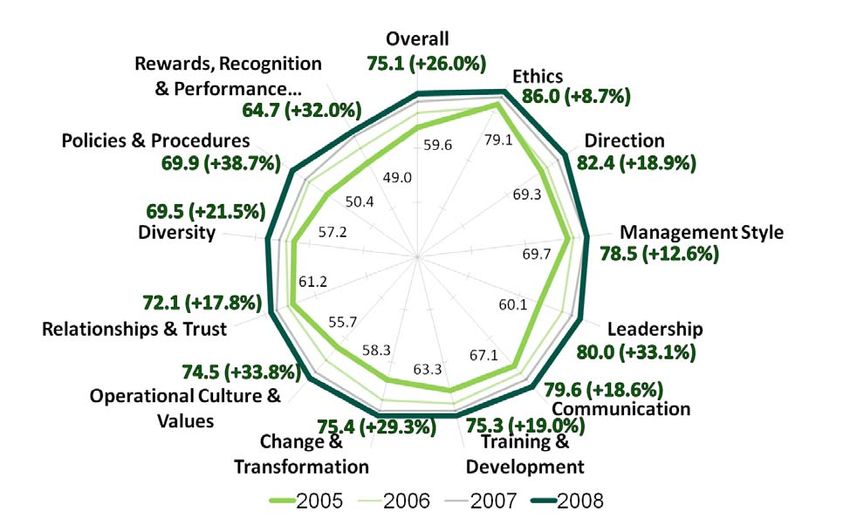
The Nedbank Staff Survey (NSS) was another annual survey used to measure the staff morale of the
organization. There are 12 dimensions measured, with an ‘Overall’ value also tracked which is a
composite of all the dimensions. All of the dimensions showed major improvement since 2005, some as
high as 38.7%, and overall the score improved by 26%. Staff morale had indeed turned for the better.
When it’s all Said and Done
Tom Boardman’s time at Nedbank can be described as
one where success has been achieved in the face of ‘There is no miracle moment.
Incremental wins in a common
extreme adversity. This adversity included negative
direction will restore Nedbank to a
market sentiment, low staff morale, a dysfunctional highly rated & respected financial
organizational culture, no clearly articulated vision and institution’ –Tom Boardman, 2004
strategy, and a low confidence level in the senior
leadership of Nedbank.
The effective turnaround of Nedbank happened as Tom had promised: at the end of the first cycle of the
three year planning process. The ‘hard’ target measures of 20% ROE and 55% Cost‐to‐Income ratio were
delivered and celebrated. But all of this would not have been possible without strong leadership, a
determination and conviction to change the culture and values, and more importantly, to win the
support and belief of not only the outside investor community, but of all employees.
10 | P a g eAnnexure 1: Dagwood 2004
Vision To become Southern Africa’s most highly rated and respected bank… = DEEP GREEN
…by our staff, clients, shareholders, regulators and communities.
Great place to work
Deep Green Great place to bank Great place to invest
aspirations
Unleashing synergies World-class at managing risk Community of leaders
Most respected and Highly involved in the
Leading transf ormation Living our values
aspirational brand community and environment
What makes us Great at
different & listening, understa
dictates our nding clients’
business needs and
model? delivering
Making sure
it happens Strategic Recovery & Turnaround Of f ice
Drive transactional Beyond Align the organisation
Strategic banking (client Build a high Optimise mix to a synergistic client-
(group, segment and transf ormation
acquisition &
focus perf ormance culture product) (FSC, community, environ driven business
retention, primary
ment and brand) model
banker, cross sell, volume)
Scope of the
game Back to basics Full spectrum banking Southern Af rica f ocus
Pushing beyond
Our values Integrity Respect Accountability People-centred
boundaries
11 | P a g eAnnexure 2: Nedbank Staff Survey
12 | P a g eAnnexure 3: Nedbank Transformation – Employment Equity
The increasing representitvity of Black employees at Nedbank.
74%
70.8%
62%
49% 49%
41.0% 42%
40%
36% 36%
34%
32%
29% 31% 29%
25% 24%
22% 22.4%
19% 18%
14%
11%
Senior Middle Junior Total
Management Management Management Management
2004 2005 2006 2007 2008
2008 Targets
13 | P a g eAnnexure 4: Entropy Improvement
25%
25%
20%
19%
15%
17%
14%
13%
10%
5%
0%
2005 2006 2007 2008 2009
Entropy Risk Bands
< 10% : Healthy functioning
10% - 19% : Some problems requiring careful monitoring
20% - 29% : Significant problems requiring attention
30% - 39% : Crisis situation requiring immediate change
Above 40% : Impending risk of implosion, bankruptcy, or failure
14 | P a g eAnnexure 5: Improvement in Business Ratios
6,000 80%
5,921
5,765
72.5%
71.8%
4,435
64.8%
58.2%
54.9%
51.1%
3,167
3,000 40%
1,732
21.4% 20.1%
18.6%
15.5%
11.1%
55
0 0.4% 0%
Rm 2003 2004 2005 2006 2007 2008
Headline Earnings ROE Efficiency Ratio
15 | P a g eYou can also read


