The Teutonic Order and the Baltic Crusades - Digital Commons @ WOU
←
→
Page content transcription
If your browser does not render page correctly, please read the page content below
Western Oregon University
Digital Commons@WOU
Student Theses, Papers and Projects (History)                                                                         Department of History

6-10-2019

The Teutonic Order and the Baltic Crusades
Alex Eidler
Western Oregon University, aeidler14@mail.wou.edu

Follow this and additional works at: https://digitalcommons.wou.edu/his
  Part of the European History Commons, Medieval History Commons, and the Military History
Commons

Recommended Citation
Eidler, Alex, "The Teutonic Order and the Baltic Crusades" (2019). Student Theses, Papers and Projects (History). 273.
https://digitalcommons.wou.edu/his/273

This Paper is brought to you for free and open access by the Department of History at Digital Commons@WOU. It has been accepted for inclusion in
Student Theses, Papers and Projects (History) by an authorized administrator of Digital Commons@WOU. For more information, please contact
digitalcommons@wou.edu, kundas@mail.wou.edu, bakersc@mail.wou.edu.
The Teutonic Order and the Baltic Crusades

                   By

               Alex Eidler

         Senior Seminar: Hst 499

        Professor David Doellinger

       Western Oregon University

               June 5, 2019

                 Readers

        Professor Elizabeth Swedo

        Professor David Doellinger

      Copyright © Alex Eidler, 2019
Eidler 1
Introduction
When people think of Crusades, they often think of the wars in the Holy Lands rather
than regions inside of Europe, which many believe to have already been Christian. The Baltic
Crusades began during the Second Crusade (1147-1149) but continued well into the fifteenth
century. Unlike the crusades in the Holy Lands which were initiated to retake holy cities and
pilgrimage sites, the Baltic crusades were implemented by the German archbishoprics of Bremen
and Magdeburg to combat pagan tribes in the Baltic region which included Estonia, Prussia,
Lithuania, and Latvia.1 The Teutonic Order, which arrived in the Baltic region in 1226, was
successful in their smaller initial campaigns to combat raiders, as well as in their later crusades to
conquer and convert pagan tribes. As an Order that focused on Eastern Europe and the Baltic, the
Teutonic Order had to balance their relationship between both the papacy and other Christian
kingdoms near the region, particularly the Holy Roman Empire. The Teutonic Order successfully
balanced the support of the Holy Roman Empire and the papacy, to become a powerful
theocratic state carrying out a mission of conquest and conversion in the Baltic region. The
Teutonic Order, despite its success through the Baltic crusades, would eventually fail in the
sixteenth century against a coalition of Mongol, Russian, and Turkish forces. After this defeat
the Order became purely a secular in the Baltic region, ceasing involvement in crusading in
2
1525.
When people think of the Teutonic Order, they often imagine German crusaders fighting
in the name of the church. However, this is not necessarily the case as the Teutonic Order had
complex ties with both the papacy and the Holy Roman Empire, the homeland to many of the
1
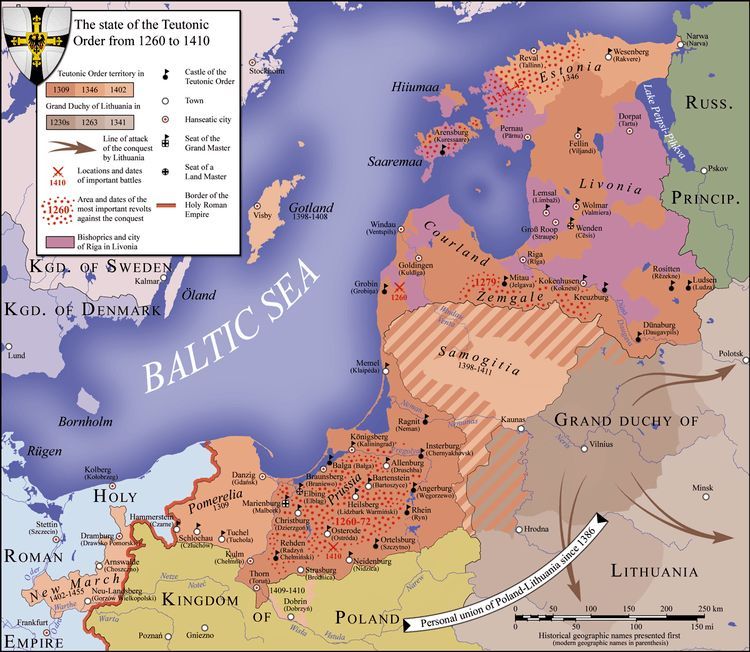
For map of Baltic region, refer to Appendix Figure 1.
2
William Urban, The Teutonic Knights a Military History (Barnsley: Frontline Books, 2018), 256.Eidler 2
Teutonic Knights. Additionally, as the Order began to relocate from the Holy Lands to the Baltic
in 1226, political interactions between the Teutonic Order and both the papacy and the Holy
Roman Empire increased. Despite these positive external relations for the Order, the papacy and
the Holy Roman Empire remained in a political war with one another, with the Emperor
Friedrich II being excommunicated by the pope. Amongst historians there are conflicting
interpretations regarding the relationships between the Teutonic Order, the Holy Roman Empire,
the papacy, and the effect those relationships had on the establishment of the Teutonic Order as a
theocratic state.
Historiography
Scholars specializing in the Teutonic Order, like other historical fields, argue and dispute
the success of the Teutonic Order in the Baltic Region, especially with regard to their methods
and reasons for crusading. Scholars such as Iben Fonnesberg-Schmidt, Kaspar Klavins, and Eric
Christiansen interpret the presence of the Order in the Baltic as a negative influence, impacting
politics in the region. While initially the Order maintained their loyalty to the church, eventually
their freedom of activity in the Baltic led the knights to become independent and power driven,
driving them astray from their stated mission of conversion. Other scholars such as William
Urban and Nicholas Morton assess the external influences on the Order. These scholars argue
that those positive external connections allowed the Order to expand in power and influence,
which brought about the eventual conversion of the Baltic.
Political ties in the Baltic were a defining factor of the Baltic Crusades and the Teutonic
Order. Iben Fonnesberg-Schmidt in The Popes and the Baltic Crusades 1147-1254 explains theEidler 3
3
power struggle between the papacy and other secular powers in the Baltic region. During the
Baltic crusades, before the introduction of the Teutonic Order in the region, the Christian forces,
although on the same side, did not all answer to the same leaders. This separation of leadership
made it difficult to amass a force large enough to actually crusade. Popes would therefore grant
authority or power to specific individuals instead, in order to bring different forces in the region
4
together under the banner of crusade. This authority could easily change from one leader to
another depending on the confidence the pope had in that individual. This action was not unique
to a singular pope but rather an approach taken consecutively by many consecutive popes during
the Baltic crusades. In 1226, the pope granted such authority to the Teutonic Order rather than to
5
any specific individual, since the Order’s purpose for being in the region was crusade. This role
would further expand with the papacy endorsing the Teutonic Order as a theocratic state in 1230.
These changes in authority granted by the church to the Order led increasingly to conflict
as the Teutonic Order was no longer solely under the control of the papacy but had become its
own theocratic state. Kaspar Klavins in The Ideology of Christianity and Pagan Practice among
the Teutonic Knights: The Case of the Baltic Region also looks at the political relations with the
6
church and the Teutonic Order as having negative aspects as well. When the Teutonic Order
became its own theocratic state, it retained the lands it had taken, therefore keeping the taxes and
income of the towns and people living there from members of the clergy which had their own
taxes and properties. This changing of power in the region resulted in a situation where, “the
archbishops proved increasingly adept at winning over the sympathy of the papacy and setting it
3
Iben Fonnesberg-Schmidt, Popes and the Baltic Crusades, 1147-1254 (Boston: Brill, 2007), 187.
4
Fonnesberg-Schmidt, Popes and the Baltic Crusades, 188.
5
Ibid., 189.
6
Kaspar Klavins, “The Ideology of Christianity and Pagan Practice among the Teutonic Knights: The Case of the
Baltic Region,” Journal of Baltic Studies 37, no.3 (2006): 260-268.Eidler 4
7
against the Order.” This change of power in the Baltic further fractured the relations between
the Order and the clergy operating in the Baltic.
This change led to political disputes between the Teutonic Order and the papacy.
Christiansen in The Northern Crusades explains these disputes by describing the conflicts that
8
emerged between bishops in the Baltic and the Teutonic Order. Christiansen explains, “in 1253,
the see of Riga was raised to an archbishopric and given to Albert Suerbeer, who as legate and
archbishop of Prussia had been fighting to reduce the power of the Order for the previous six
9
years.” The creation of a new archbishopric was significant as the relationship between the
church and the Order was no longer a partnership but rather a competition for power in the
Baltic, with each competing for influence in the region. While Fonnesberg-Schmidt details the
trust that the papacy had in the Teutonic Order, she also describes the authority granted to the
Order in 1226 as a direct response to permissions given by the Holy Roman Empire in 1226.
Fonnesberg-Schmidt asserts that, “with the so-called Golden Bull of Rimini of March 1226, its
master became an imperial prince for the province of Kulmerland and all land conquering in the
10
future in Prussia.” This new imperial title is important as it explains how the Order was not just
a power beholden to the papacy but to the Holy Roman Empire as well.
Politics facing the Teutonic Order, while having negative aspects for their success in the
Baltic, also had redeeming factors. Nicholas Morton in The Teutonic Knights in the Holy Land
1190-1291 emphasizes these redeeming factors by telling how the Teutonic Order was created at
11
the political urging of German crusaders in the Holy Lands in 1190. Morton digs further into
7
Klavins, “Christian and Pagan Practice,” 270.
8
Eric Christiansen, The Northern Crusades ( London: Penguin Group, 1997), 127.
9
Christiansen, The Northern Crusades, 128.
10
Fonnesberg-Schmidt, The Popes and the Baltic, 203-204.
11
Nicholas Morton, The Teutonic Knights in the Holy Land, 1190-1291 (Woodbridge: The Boydell Press, 2017), 24.Eidler 5
these political ties with the Holy Roman Empire and the relationship held with Emperor
Friedrich II, who granted them privileges to take any land conquered in Prussia. This agreement
with the Holy Roman Empire allowed the Teutonic Order to become its own theocratic state, and
the Master of the Order to hold the title of Imperial Prince. David Nicolle furthers describes the
political benefits of the Teutonic Order becoming its own state. This autonomy allowed the
Order to govern itself and to conduct its own negotiations and war, without the church constantly
looking over their shoulder and dictating all of their actions. This independence as a state
allowed for closer political ties with not only the Holy Roman Empire but other neighboring
12
kingdoms like Poland and Hungary. These kingdoms were the first to give the Teutonic
Knights a mandate to operate in the region.
Political ties in the Baltic consisted of more than just diplomatic relations between
countries; such ties were also an important component in the public image the Order projected to
the peoples of these countries. An essential contribution to the success of the Order was its use
13
of chivalry, which was the just and Christian way of conducting war. William Urban in The
Teutonic Knight and Baltic Chivalry explains the importance of politics and chivalry to the
14
Order and its continued existence as a monastic military order. Chivalry as an ideal was
essential for recruiting knights and lords to crusade in the Baltic as it demonstrated honor and
an organization that was pure in its intent to wage war. This chivalrous image, along with the
same rewards given for crusading in the Holy Lands, brought in crusaders from the whole of
15
Europe. This idea of crusading is best described by Riley-Smith as, “packaged crusading.”
12
David Nicolle, Teutonic Knight: 1190-1561 (New York: Osprey Publishing, 2007), 30.
13
William Urban, “The Teutonic Knight and Baltic Chivalry,” The Historian 56, no. 3 (1994): 520.
14
Urban, “Baltic Chivalry,” 521.
15
Jonathan Riley-Smith, The Crusades a History (London: Yale University Press, 2005), 263.Eidler 6
Chivalry showed knights and lords that the Order could be trusted with leading a crusade,
crusades which were dependent on those said knights and lords to fill the armies necessary to
success.
The Teutonic Order remains a disputed subject, allowing many different scholars to
arrive at different conclusions. Some scholars, like Christiansen, Fonnesberg-Schmidt, and
Klavins, believe that the complex politics faced by the Order negatively impacted the Order’s
influence and ability to crusade in the Baltic. Other scholars, such as Urban and Morton, interpret
the connections between the Holy Roman Empire and the papacy as being positive for the
Teutonic Order, helping it to expand the Crusades in the Baltic.
Primary Sources
Primary source material on the Teutonic Order is not especially difficult to come across,
however, sources translated from German and Latin to English are uncommon since research on
the Teutonic Order is mainly based in Europe. Despite the scarcity of these translations, there is
still much to learn about the Order from these translated documents. The types of documents
used in this paper primarily consist of letters and chronicles. These sources were written between
the ninth and fourteenth centuries, during the time of Church involvement in the Baltic. This
Christian intervention started in the ninth century; the Teutonic involvement starting in the
thirteenth century. Each of these sources was created by a priest or chronicler of either the Latin
or Orthodox churches, meaning each of the sources is translated from either Latin, Old Russian,
or Middle High German. Many of these sources also had multiple writers, spanning hundreds of
years to keep the history of their area, adding different authors’ interpretations of situations to
events that their predecessors may have recorded. These sources held a favorable bias towardsEidler 7
any means of Christian conversion which took place in the Baltic region. Christian authors
looked at these missionary activities as God's work. Clergy also viewed the traditions and
cultural norms of the indigenous peoples in a negative light.
The precise beginning of Christianity in the Baltic and the specific involvement of
missionaries and early crusaders is unknown. While the exact date of these attempts is unknown,
16
the Chronicle of the Slavs gives the earliest telling of those endeavors. Helmold (1120-1170), a
priest in Bosau, Germany, a city on the edge of the Baltic and Northern regions, authored this
chronicle, which covers the period 800-1177. Multiple writers completed the records prior to
Helmold’s and covered the attempts to convert the local inhabitants to Christianity, all of which
were written in Latin. This source is assumed to have been written as a history for the conversion
efforts in the region, as well as a means for new missionaries in the region to learn more of past
efforts and the cultures they were attempting to convert. As a chronicle, this source gives an
historical account of facts in chronological order by major events by year, often including
references to local events alongside events of historical renown. In the chronicle, Helmold
explains the religious situation in the Baltic. He viewed the Russians as fellow Christians but
observed that they tried to imitate the Greeks rather than Helmold’s own Latin beliefs; he refers
17
to the Russians’ religion as Orthodox Christianity. As the earliest mentioning of Christian
involvement in the Baltic, this source is generally accepted, despite the negative bias the priest
exhibited towards the indigenous peoples and their pagan religions. This chronicle is important
as it gives some of the earliest information available of early conversion in the Baltic region.
16
Helmold, The Chronicle of the Slavs, trans. Francis Joseph Tschan (New York: Columbia University Press, 1935).
17
Helmold, Chronicle of the Slavs, 46.Eidler 8
A significant text exploring the rhetoric behind conquering the Baltic is the Livonian
Rhymed Chronicle, written by an unknown author and covering the period between 1180 and
18
1343; the chronicle was written in Middle High German. The chronicle was written to be read
to knights of the Baltic crusades usually during meals so that they could nourish not only their
19
bodies but their spirits as well. This source shows the mentality and reasonings behind why the
Christians believed they should crusade. To encourage crusaders, the chronicle gave examples of
pagans converting to Christianity and their evil pagan cousins fearing the increase in Christian
20
numbers, massacring villages known to have converted leaving thousands dead. This source
has a sizeable number of errors as it was written to inspire the crusaders to action. Therefore,
many events in the chronicle are either exaggerated or pure propaganda with no real association
with the events occurring in the region. Many crusaders joined the crusades to not only save the
souls of the pagans in the North but also to save their own souls in the process. The Livonian
Rhymed Chronicle mentioned many times that the pope and therefore God would forgive any
sins for the time spent crusading and that the killing of any pagan towards this goal would be
21
forgiven. This chronicle displays the propaganda used by the church to encourage the crusaders
and conversion in the Baltic region.
The Latin Christians were not the only sect of Christianity involved in the Baltic region.
In the Chronicle of Novgorod, the relationship between the Latin and Orthodox churches in the
22
Baltic is explored. This chronicle, written by multiple monks of the Yuriev Monastery in
18
The Livonian Rhymed Chronicle, trans. Jerry C.Smith and William L. Urban (Bloomington: Indiana University,
1977).
19
Ibid., 12.
20
Ibid., 5.
21
Ibid., 7.
22
The Chronicle of Novgorod 1016-1471, trans. Robert Michell and Nevill Forbes (London: Camden, 1914).Eidler 9
Novgorod, Russia, covers the history of the Russian principality known as Novgorod. The oldest
comprehensive history of Novgorod, the chronicle covers the periods between 1016-1471 and
gives an overall history of the nation, including significant events involving royals and their
effects on Novgorod. It also details the indigenous people of the Baltic as well as the Teutonic
Order’s involvement, beginning as allies to the Russians in their conflicts against the pagans,
23
then after conversion becoming enemies.
A significant part of understanding Teutonic involvement in the Baltic requires looking
into The Chronicle of Henry of Livonia, written by Henricus Lettis, a priest believed to be born
24
in Germany around 1180. This source covers 1180-1227 in the Baltic and surrounding regions.
This chronicle is important as it describes the use of merchants and political envoys in crusading
armies. Lettis’ inclusion of merchants and political envoys is essential as it differs from other
primary sources used; none of which describes the importance of both the merchants and
diplomats in the Baltic crusades. Having these types of people within the ranks of the crusaders
supports the idea that crusaders were not only interested in Christianizing the region but also in
exploiting the region for gain in political and economic power.
Analysis utilized using these sources provides a better understanding of how the
combination of the Holy Roman Empire and the papacy influenced the Teutonic Order. These
influences had a profound effect on the actions of the Order in the Baltic, evolving from
operating in singular outposts, to becoming a theocratic state with dual ties to both the Holy
Roman Empire and the papacy.
Historical Background
Chronicle of Novgorod, 28.
23
Henricus Lettis, The Chronicle of Henry of Livonia, trans. James A. Brundage (United States: Columbia University
24
Press, 2004).Eidler 10
To be a Teutonic Knight, an individual had to be dedicated not only to the life of a
warrior but to that of a friar. Friars are similar to monks in that they are devoted to a religious
life. The difference is that a friar lives and works among regular people in society, while a monk
25
lives in a secluded, self-sufficient group of monks. In the Teutonic Order, an initiate had to pass
preliminary examinations by which one must first be ordained as a friar and then a knight. It was
during this period of training as a friar and then a knight that the Order would decide whether an
26
initiate had the calling to devote their lives to the Order. After being deemed worthy by the
Order, the novitiate would then be inducted into the Order with the oath, “I promise the chastity
of my body, and poverty, and obedience to God, Holy Mary, and to you the Master of Teutonic
Order, and your successors, according to the rules and practices of the Order, obedience unto
27
death.” With this vow the new knight of the Teutonic Order was initiated. These vows and
traditions not only ensured that a knight was completely devoted to the Order but also to the
ideal for which the Order stood, which was the expansion and protection of Christendom. The
warrior friars of the Order, despite their involvement in the Baltic region, were not the first
religious men to try and convert the region.
The Teutonic Order began as a minor order consisting of German knights and monks
protecting and healing at hospitals in the port city of Acre in the Holy Lands, similar to the
28
creation of the other major monastic military orders like the Templars and Hospitallers. At this
time in 1190, they were known as the Teutonic Hospital. Over several years the Order began to
grow as more German knights began to join the crusades, not finding places amongst the
25
Oxford English Dictionary, s.v.“Friar,” accessed May 08, 2019,
https://www.oed.com/viewdictionaryentry/Entry/90670
26
William Urban, The Teutonic Knights a Military History (Barnsley: Frontline Books), 18.
27
Nicolle, Teutonic Knight 1190-1561, 22.
28
Acre is located in modern day Israel.Eidler 11
29
Templars or Hospitallers due to different culture and language. After the Third Crusade in
which a large portion of the force was German and affiliated with the Holy Roman Empire, the
crusade commanders recommended changing the Teutonic Hospital into a militarized order as
well. In 1198, the papacy granted this request, and through the help of the papacy, Holy Roman
Empire, and other established monastic military orders, the new Teutonic Order was given funds
30
and the chance to expand and become a major contributor to the keeping of the Holy Lands.
The Holy Lands during the thirteenth century was the Teutonic Order’s main theatre of
operation, however requests from Hungary allowed for the first Teutonic involvements in
Europe. The Kingdom of Hungary, unable to cope with pagan Cuman raids in the countryside,
31
eventually requested the Teutonic Order to assist in 1211. The Cumans were a nomadic people
originally situated in Eurasia, who began their interference in Hungary after being displaced by
32
the Mongol Horde in the early thirteenth century. The Teutonic Order was allowed into the
Burzenland, which is modern day Transylvania, to combat the Cuman raids. After successful
expansions into pagan Cuman lands and fortification of conquered lands, the Order was expelled
from Hungary in 1225 as the nobility were concerned about the power of the Order within their
33
kingdom. After being dismissed from Hungary, the Order quickly discovered new opportunities
in the Baltic region.
The Baltic region has a long history of conflict with Christian kingdoms prior to the
arrival of the Teutonic Order. Pagan raids in Christian lands over several centuries eventually led
29
Morton, Teutonic Holy Lands, 1.
30
Morton, Teutonic Holy Lands, 13.
31
Kyra Lyublyanovics, “The Cumans in Medieval Hungary and the Question of Ethnicity,” Annual of Medieval
Studies at CEU (2011), 153.
32
Lyublyanovics, “Cumens in Hungary,” 153.
33
Armin Vambery and Louise Heilprin, The Story of Hungary (New York: Knickerbocker Press, 1886), 130.Eidler 12
to the Wendish Crusade in 1147. Many of the initial pagan raids were initiated by tribes in
Prussia, the closest region to the Christian territory. The social system used by tribes in Prussia
revolved around the warrior as the highest status in society. By raiding into Christian lands to
gather slaves, warriors not only distinguished themselves in battle but also made a profit through
34
selling the slaves to other tribes. Raiding therefore boosted their own reputations as warriors.
By the twelfth century, Christians viewed war with the Prussians as a necessity, as trying to
peacefully convert them was very unlikely because of the constant raids between Christian and
35
pagan forces during the late twelfth century. This crusade consisted of forces including Jutland
36
(Denmark), Scandinavia, Kingdom of Poland, and the Holy Roman Empire. This force,
however, used the premise of crusade as a means to invade and take land for their individual
kingdoms. While the crusade was successful, it only converted a small region of the Baltic.
Religious conversion attempts in the Baltic region began centuries before the
involvement of the Teutonic Order. In The Chronicle of the Slavs, written around 900 A.D,
Helmold describes the efforts of the missionaries and their mission, “For many days and very
many years the missionaries labored to their utmost among these peoples; but so deep was the
darkness of their errors and so obstinate their rank idolatry that it could be neither promptly nor
37
easily overcome.” Helmold describes the indigenous peoples as deeply misled by their pagan
beliefs, indicating that their society was so steeped in their own religion that it was very difficult
to convert any of the indigenous peoples. The pagan beliefs of the people of the Baltic revolved
around the concept of a war god, who influenced their society profoundly encouraging warlike
34
Urban, The Teutonic Knights, 45.
35
Tiina Kala, “The Incorporation of the Northern Baltic Lands into the Western Christian World,” Crusade and
Conversion on the Baltic Frontier 1150-1500 (Hampshire:Ashgate, 2001), 8.
36
Christiansen, The Northern Crusades, 54.
37
Helmold, The Chronicle of the Slavs, 57.Eidler 13
behaviors. The information regarding pagan belief in the Baltic is scarce, as prior to pagan
conversion to Christianity the tribes had no written language. However, scholars such as
Algirdas Greimas have determined that the Baltic peoples had a complete pantheon of gods and
spirits which were involved in all aspects of life, ranging from agriculture and fertility to war and
38
revenge. In the eyes of the Christians however, they were worshipping the devil.
In the early thirteenth century pagan raids into Polish territory were increasing, often with
Poland conducting its own raids in retaliation. The trading of conflicts in Poland only became
more frequent and costly. In the early thirteenth century, the Prussians began to invade Christian
lands with more determination but still poorly armed and organized warriors, either provoked by
Poland's attempts to take the regions and convert them, or from a desire for war and the
39
reputations and slaves to be gained. These attacks eventually led not only to the involvement of
Poles and Pomeranians but also to aid from the Holy Roman Empire. Involvement of other
Christian countries resulted in continued raids across the borders of the Baltic and Christian
lands. These raids and the Christian kingdoms’ inability to properly defeat them led to the
involvement of the Teutonic Knights.
Many of the initial pagan raids were initiated by tribes in Prussia, the closest region to the
Christian territory. The social system used by tribes in Prussia revolved around the warrior as the
highest status in society. By raiding into Christian lands to gather slaves, warriors not only
distinguished themselves in battle but also made a profit through selling the slaves to other tribes.
Raiding therefore boosted their own reputations as warriors. By the twelfth century, Christians
viewed war with the Prussians as a necessity, as trying to peacefully convert them was very
38
Greimas Algirdas, Of Gods and Men: Studies in Lithuanian Mythology (New York: Indiana University Press,
1992), 5.
39
Urban, The Teutonic Knights, 35.Eidler 14
unlikely because of the constant raids between Christian and pagan forces during the late twelfth
century.
Political Ties between the Teutonic Order and the Holy Roman Empire
Through their political connections to the papacy and other nations, the Teutonic Order
was able to not only fund themselves but also use those connections to expand their mission to
convert the Baltic lands. These political ties, stretching through Europe from England to Italy,
brought much needed manpower into the Baltic region. The most important political tie that the
Teutonic Order nurtured, however, was their relationship with the Holy Roman Empire, from
which most of their funding and knights originated.
The Order in the Baltic became more independent, even securing itself as an autonomous
monastic state, which had its own currency and government in 1226 but was only approved and
allowed by Papal See in 1230. Modern historian Nicholas Morton explains how intertwined the
Teutonic Order was with the Holy Roman Empire and the papacy, both prior to abandoning the
Holy Lands after its fall to the Mamluks in 1291, and later when the Teutonic Knights focused
40
on the Baltic Region. The Order aligned with the papacy because of their duty to God and
therefore the Church, and with the Holy Roman Empire because it was their knights’ homeland
and their most important benefactor in the Baltic region.
The strongest advocate for the Teutonic Order in the Baltic region was Emperor
Friederich II (1194-1250) of the Holy Roman Empire. During Friederich’s reign, he first
supported the Teutonic Order in the Holy Lands with donations of funds and lands for the Order
to occupy and use, in exchange for the Order’s participation in his crusades into the Holy Lands
40
Morton, The Holy Lands, 119.Eidler 15
41
and support in political issues with the papacy. This relationship would change in the Baltic
region, with the Order providing security from Prussian raiders and the Empire giving funds and
political support. Friederich himself had very complicated ties with the papacy, with the Holy
42
Roman Empire and papacy even going to war in 1254.
Emperor Friederich II did not view the Roman Church favorably, perceiving the pope and
his servants as liars, more concerned about material wealth and power than in embodying God's
will. According to a letter sent by Friederich to all the lords of Europe in 1246, the church was
threatening the authority of all monarchical rulers with its excommunication of Friederich and
the reasoning for his sentencing. “What is implied by our maltreatment is made plain by the
presumption of Pope Innocent IV for, having summoned a council--he has declared to pronounce
a sentence of deposition against us who were neither summoned nor proved guilty of any deceit
43
or wickedness, which sentence he could not enact without grievous prejudice to all kings.” The
source of the pope's condemnation was political, beginning with a brief battle between rebels
under the command of the Cardinal Ranieri of the local church of Viterbo, an essential castle of
44
Friederichs near Rome in 1243. Pope Innocent IV, after ensuring the rebels would surrender,
had Friederich remove his garrison so the rebels could surrender unharmed. Those same rebel
45
forces then attacked and slaughtered the garrison of the city of Viterbo. Shortly after, the Pope,
along with Cardinal Ranieri, declared Emperor Friederich II to be a heretic and not worthy of the
title of emperor, and he was thus excommunicated. This event enraged Friederich and he
41
Morton, The Holy Lands, 120.
42
John P. Adams, "Sede Vacante 1254,"Sede Vacante 1254, California State University Northridge, accessed May
18, 2019, https://www.csun.edu/~hcfll004/SV1254.html.
43
"Letter of Frederick to the Kings of Christendom, 1246." Internet Medieval Sourcebook. Accessed June 3, 2019.
44
"Letter of Frederick."
45
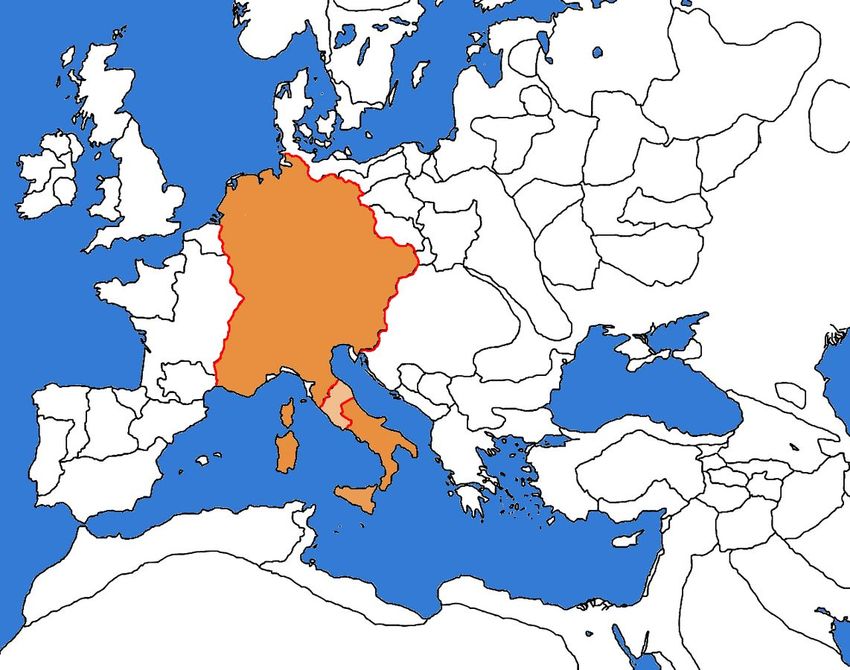
For map showing territories of the Holy Roman Empire and papacy refer to Appendix Figure 2.Eidler 16
marshalled his own army to march on Pope Innocent and Cardinal Ranierie, both of which who
fled to France. Under the protection of the French king, reaching them was impossible without
war. With this development Friederich addressed a letter to the numerous kings of Europe which
explained how distrustful the papacy was, declaring the papacy false in its accusations of the
emperor being a sinner. Friederich labelled this blatant sentencing as an affront that all kings
should be insulted by, as at any time these accusations might be made against them. Despite the
dangerous relations between the papacy and the Holy Roman Empire, connections between the
Holy Roman Empire and the Teutonic Order remained beneficial.
Relations between the Holy Roman Empire and papacy in regard to the Teutonic Order
46
expanded but also became more complicated during the thirteenth through sixteenth centuries.
Reliance on the Holy Roman Empire became much more apparent as the Order began to move
into the Baltic region where closer bonds and borders with the Holy Roman Empire became
essential for new recruits, funding, and political support became essential to the Order as an
47
institution. The political alliance with the Holy Roman Empire was pivotal to the Order.
Without those ties, the Order’s objective in the Baltic would have been more difficult to achieve,
without the money to support and feed their troops or the weapons to arm their soldiers,
The Order’s close ties with other kingdoms was entirely necessary to its survival and
continued participation in the Baltic. Urban explains in The Teutonic Knights and Baltic Chivalry
that without delegations of crusaders from kingdoms such as France, Poland, Prussia, Bohemia,
England, and the Holy Roman Empire, the feats that the Order accomplished likely would not
48
have been possible. King John of Bohemia (1296-1346) was one such crusader; he made three
46
“Letter of Frederick.”
47
Morton, The Holy Lands, 17.
48
Urban, “Baltic Chivalry,” 519.Eidler 17
49
different expeditions into Prussia with various princes. King John viewed the crusaders as a
force for good in the region as shown in a charter he published on the Order in 1329 after his
third crusade into the Baltic:
their praiseworthy state and their memorable holiness of life and worship attract us; they
suffer heavy and unbearable labours and expenses for the extension of the orthodox faith,
and have made themselves into an unbreakable wall to defend the faith against the
Lithuanians and their partisans, whoever they may be - pestilential enemies of Christ! - as
we have seen ourself; everyday they expose themselves fearlessly to danger and death,
50
hemmed in, divided, hopelessly slaughtered and afflicted.
The Teutonic Order’s ability to gather the recruits and funds necessary to wage crusades was due
to charters such as these, in which the Order helped with a lord’s need for crusade and convinced
those lords that their ideal for crusade was chivalrous, resulting in a public endorsement of the
Order. These nations and their lords contributed not only knights and soldiers, but money and
good reputation to feed the Teutonic Order’s expansion. This relationship with the Holy Roman
Empire facilitated treaties and alleviated pressures from other nations involved in the region, as
the Holy Roman Empire was dominant compared to any other power in the Baltic.
The Order’s relations in the Baltic region first began with the duchy of Masovia. Konrad
of Masovia called on the Teutonic Order to defend the borders against pagan Prussians raiders.
The Duke of Masovia called for outside aid as the countries bordering the Baltic regions of
Prussia and Livonia were unable to keep the raids from the indigenous tribes under check. The
Teutonic Order responded to the raiding in Masovia in 1226, as the Order was the closest
51
monastic military order to Poland with facilities in the Holy Roman Empire. Historically an
independent duchy and then after 1526, a lordship within the Polish kingdom, Masovia lay in
49
Christiansen, The Northern Crusades, 155.
50
Christiansen, The Northern Crusades, 156.
51
Zdzislaw Zygulski, “Knightly Arms – Plebian Arms,”The Society for Medieval Military History, Wordpress.
accessed March 20th, 2019. https://deremilitari.org/2014/07/knightly-arms-plebian-arms/.Eidler 18
52
mid-north-eastern Poland, including the cities of Warsaw, Raga, and Plock. Masovia welcomed
intervention from the Teutonic Order as the Order possessed experienced fighting forces, with
experience in combat since their founding in Acre in 1198.
The Order realized the area within the duchy in which they were operating, Cumberland,
was an effective base from which to attack pagans in the Baltic. Konrad’s request therefore
continued to benefit the Order after the campaign in Masovia; if they kept that castle in the
Cumberland they would launch more crusades in the future as well as expanding their Order. The
Cumberland territory was then officially granted to the Teutonic Order in 1226 by the Holy
Roman Empire, despite the misgivings of Konrad of Masovia, who would eventually dismiss
53
them from the duchy for having too much power in the region.
The kingdom of Poland and the duchy of Masovia were not the only states encountering
difficulties with pagan raiders. The Holy Roman Empire, noticing how effective the Order was at
containing the pagan raiders in Masovia, began to assist the Order. After meeting with the
Order’s Grand Master Hermann Von Salza, the Holy Roman Empire declared the Golden Bull of
Rimini in 1226, authorized by Emperor Friedrich II. This bull gave authorization to commence
54
war against the pagans in Prussia in 1226.
The Golden Bull granted the Emperor’s permission to the Order to operate in this region,
with the support of the Holy Roman Empire’s military. The Bull also authorized the Teutonic
Order to take any territory that the Holy Roman Empire had not previously claimed as well as to
52
"Duchy of Masovia". Revolvy. Accessed June 8, 2019. https://www.revolvy.com/page/Duchy-of-Masovia.
53
Morton, The Holy Lands, 64.
54
“Summary of the Golden Bull of Rimini, March 1226,” Internet Medieval Sourcebook, Fordham University,
accessed March 17th, 2019, https://sourcebooks.fordham.edu/source/12-13Cbalticcrusade.asp#_Toc378084754Eidler 19
retain any territory previously promised to the Order by the Duke of Masovia, the region of
55
Culm. In the bull, the emperor also proclaimed,
He also gives the brothers his imperial rights over mountains, plains, rivers, woods and
the sea, which they will hold free of all service and exaction and they will be held to
reply to no one. When they have conquered the land they can take tolls, set up markets
and fairs, coin money, exact tallage and other rights, etc., create judges and rectors to
whom the people will be subject, both those people who convert and those who do not;
and the brothers may lay down good usages and customs and hold assize and make
56
statutes to strengthen the believers and keep the peace.
This declaration by the Holy Roman Empire effectively allowed the Teutonic Order to conquer
its own lands, create currency, and rule the land that they conquered rather than have to give it to
other lords or the church. The Holy Roman Empire enabled the Teutonic Order to separate itself
from the authority of the papacy and the church, by allowing it to become a self-governed
territory. The bull sanctioned the Teutonic Order to become an independent state: known as the
57
Monastic State of the Teutonic Knights or the Ordenstat.
The Golden Bull changed the course of the Teutonic Order and its mission in the Baltic
entirely. Instead of having to rely solely on other countries to fund and support their Order
campaigns, the Order, with its own state, had its own taxes and merchants to create their own
sources of income and towns from which to levy soldiers. The Order now also created its own
treaties and made its own combat decisions, instead of relying on decisions of the ruler in
whatever country they were involved, like Masovia where they had to follow the duke’s
authority.
55
The Duke of Masovia reneged on the agreement after noticing the amount of power the Order had amassed within
his own borders.
56
“Golden Bull of Rimini.”
57
Urban, The Teutonic Knights, 36.Eidler 20
One example of this reliance had previously occurred in Hungary in 1222. King Andrew
II of Hungary responded to his failing power by reluctantly passing the Golden Bull of
58
1218-1222. This Golden Bull is different from the Golden Bull of Rimini, as it was only called
the Golden Bull for the detailing on the document itself. According to the 1218-1222 Bull, “If
foreigners come to the country they shall not be elevated to dignitaries without the consent of the
59
council of the realm; land shall not be given to those who are strangers of the realm.” This bull
relieved the Teutonic Order of any obligations or rights to operate in the Kingdom of Hungary,
as the nobles had effectively restrained the authority of King Andrew II in matters of state. In
this matter King Andrew II had very little choice, as the nobles were threatening civil war in
favor of his son, if the Bull was not endorsed. Until the Bull of Rimini in 1226, the Teutonic
Order had no guarantee of operating in any given region for a meaningful duration of time,
before being expelled due to their completing what their host country had expected of them. In
this case, the expulsion of Cumen tribes in Hungary, which had become a local threat to the local
nobility on Hungary's eastern borders. After the formation of the Ordenstaat, the Teutonic Order
could operate without such constraints.
This political independence allowed the Teutonic Order to associate with people of
different religious standing, mainly the Orthodox Christians. The Latin Christians were not the
only nations involved with the conversion of the Baltic region; the Orthodox Christians of
Novgorod were active in the region as well. The Chronicle of Novgorod describes the
relationships between the Orthodox Novgorod and the other powers in the Baltic region, with the
Novgorod’s state and secular leaders initially considering the Teutonic Order in the region as an
58
Vambery, Story of Hungary, 130.
59
Vambery, Story of Hungary, 131.Eidler 21
asset. “In this year the Nemtsy [Germans] came from beyond sea to Riga, and all united here . . .
60
the men of Pleskov sent aid. . . and they went against the godless Litva [Lithuanians]. . .” The
Rus of Novgorod also intended to pacify the pagan raiders on their western border, eliminating
or converting the pagan tribes in order to improve trade routes between the East and West.
However, with the conversion of the Baltic region, these friendly relations between the
Order and Novgorod and its allies in the Hanseatic League soon became hostile. The Hanseatic
League was a group of towns that over the twelfth through fourteenth centuries banded together
61
in a trading consortium. The main goal of the League was to obtain trading agreements with the
other members of the league that were mutually beneficial to each respective town. While not all
of the Hanseatic League joined with Novgorod, many league cities became enemies with the
Order, mainly because of their different sects of Christianity but also because of tension over
who would control the now conquered Baltic regions of Prussia and Lithuania.
While the relationship with Novgorod ultimately soured, initially the Teutonic Order--as
an autonomous state--was able to form alliances with an Orthodox nation to help expedite its
own goal, the conversion of the Baltic. This alliance was essential; although Order was strong in
the Baltic, it could only take on so many enemies at one given time. The Roman Church
disapproved of this type of relationship with Novgorod; however, because of the Order’s
increasing independence, it was able to make this alliance without concern about papal
intervention.
Political Ties between the Teutonic Order and the Papacy
60
Chronicles of Novgorod, 22.
61
Ernst Daenell, “The Policy of the German Hanseatic League Respecting the Mercantile Marine.” The American
Historical Review 15, no. 2 (1909): 48.
http://www.furthark.com/hanseaticleague/documents/Ernst_Daenell-Mercantile_Marine.pdf.Eidler 22
Having this close relationship with the Holy Roman Empire was dangerous for the
Teutonic Order. As a monastic military order, its first loyalty should have been unquestioningly
to the church. While having close ties to a secular authority is common for monastic orders, in
the early thirteenth century the Holy Roman Empire and the papacy had been in a power
struggle, vying over who had authority over the other. The relationship with the Holy Roman
Empire for the Order was risky because it obtained most of its power as well as purpose through
the Church as it used the Church's rules and morals in the way it operated. If the Order lost the
support of the papacy, then it would have effectively failed to remain a monastic order.
This balance of power was most at risk because of the way in which the Emperor
Friedrich II was being punished by the church in the form of his excommunication, meaning that
he was in all ways cut off from his religion as well as Christendom and heaven. Despite the
Order’s need for both the papacy and the Holy Roman Empire, relations between the two
institutions were strained. This issue is best described through letter between the papacy and the
Holy Roman Empire. During the Council of Lyons in 1245, the pope issued a writ of
excommunication to anyone involved with Emperor Friederich II: “We absolve forever all who
owe him alliegence in virtue of an oath of fealty.... Whoever shall in future afford him advice,
help or goodwill as if he were Emperor or king, shall fall ‘ipso facto’ under the binding force of
62
excommunication.” This enmity that the papacy had for the Holy Roman Empire was due to the
Emperor not acknowledging the power of the papacy as well as multiple occasions where the
Emperor agreed to crusade, but failed to be present when he agreed. A decree of
excommunication required the rest of the Christian community to shun and ban the
62
Daenell, “Hanseatic League,” 49.Eidler 23
63
excommunicant in all daily and political aspects. Emperor Friedrich II was neither the first or
last European leader to be excommunicated by the papacy.
Despite his excommunication, the Order, under the leadership of Herman von Salza, was
able to maneuver itself through the politics and act as a mediator between the two medieval
superpowers. Urban explains Von Salza’s efforts, noting that “Herman was evidently acutely
aware that his Order, as a religious and imperial institution, sat uneasily on this political
64
fault-line and was highly dependant upon both for patronage and protection.” This balancing
was most apparent when Salza reconciled the Pope and the Emperor in 1230 with the treaty of
65
San Germano. It is because of this renewed communication between both the Emperor and the
Pope that the Teutonic Order was able to create the Ordenstat, its own recognized, autonomous
monastic military state.
The Order also had issues with the church in Rome. When the Teutonic Order was on
crusade in the Baltic, often their actions came under the purview of the church, and letters
condemning the Order were sent back to the papacy. The Order, to keep such actions from
interrupting their operations in the Baltic, often sent a liaison to Rome to disprove any false
rumors. According to Christiansen, “when the Prussian Brothers deviated from papal policy,
there was usually someone in Rome to deny awkward rumors, correct misunderstandings, and
66
put in a word at the right moment.” This strategy allowed the grandmaster of the Teutonic
Order to remain focused on the crusade in the Baltic, allowing the Order to operate largely
without interruption or backlash from the church for any questionable actions taken on crusade.
63
S.J Allen, The Crusades: A Reader ( New York: University of Toronto Press, 2014), 284.
64
Morton, The Holy Lands, 84.
65
Morton, The Holy Lands, 77.
66
Christiansen, The Northern Crusades, 84.Eidler 24
The Church in Rome was already rife with different groups harboring different agendas and
67
beliefs as explained by Lynch.
Having a liaison to deny rumors in Rome demonstrated that the Teutonic Order was
trying to keep itself from the politics in Rome, to distance itself from the authority that the
papacy had over the Order so that it might operate by itself with little to no supervision in the
Baltic. These decisions by the Order were taken out of practical necessity to fuel the conquest of
the region, rather than actions made for purely selfish gain on the part of the Order. The Order in
the Baltic had difficulties with members of the church in charge of the Baltic region. As stated
earlier by Fonnesberg-Schmidt and Klavins, the church in the Baltic region had many disputes
with the Teutonic Order over regional authority, with members of the church making charges
68
against the Order directly to the papacy in Rome.
Despite this hindrance to the Order, many members of the church in the Baltic actually
sent letters to clear up situations that may have been twisted by church officials to make the
Order look like a villain in the region. One of these groups were the Franciscans of Thorn, in
response to claims that the Order was ignoring papal authority in the Baltic region in 1258. The
Franciscans asserted that, “they are not slow in carrying out papal commands, since they honour
the Holy Roman Church as lord and master, love its messengers and observe imperial orders in
69
all their deeds especially those made with Papal approval.” The episcopal leadership of the
church in the Baltic was not universally accepted, as members of the church were actively
writing to disprove their leaders in regards to the Teutonic Order.
67
Joseph H. Lynch, The Medieval Church a Brief History (Essex: Pearson Education Limited, 1992), 208.
68
In the historiography section, refer to pages 2-3.
69
“Summary of the complaints of Bishop Christian against the Teutonic Order,” Internet Medieval Sourcebook,
Fordham University, accessed April 27, 2019,
https://sourcebooks.fordham.edu/source/12-13Cbalticcrusade.asp#_Toc378084757.Eidler 25
Although the Order may have leaned towards a more independent stance, many
influences of the church still helped shape the Teutonic Order in the Baltic region. While
Christiansen and Ekdahl described the independence of the Order in the Baltic, Lynch explains
how the idea of Christendom heavily influenced the rising crusader fervor in the twelfth through
fourteenth centuries, directly fueling the Teutonic Order in the Baltic. This fervor was supported
by the rising belief that no individual who was a part of Christendom was an “outsider” and
70
therefore not to be trusted. This frame of mind is exemplified in letter during the Sixth Crusade
in 1256. A knight named Guy declared, “we can expect neither good faith from the perfidious,
nor humanity from the inhuman, nor charity from dogs, unless God, to whom nothing is
impossible, works this miracle. It is He who has purged the Holy Land from the wicked
71
Charismians.” Christians viewed any not of the same religion as akin to dogs. This mentality
relates to the Baltic, as anyone not a member of the Roman or Latin Christianity (as the Order
was perceived) was viewed as either a soul in need of saving, or a threat to Christendom that
must be destroyed. The Order relied on the church to bring recruits and resources as much as it
did its own capacities and connections.
The Order, through the influence of both the Holy Roman Empire and the papacy, forged
itself into its own theocratic state. By navigating the fine line between both powers and acting as
the mediator, the Order was able to keep each side from violence. At the same time, the Teutonic
Order used the resources and prestige of both powers to expand itself in growth, military might,
and influential circles.
Conclusion
70
Lynch, The Medieval Church, 161.
71
“Guy, A Knight, to B. of Chartres,” Internet Medieval Sourcebook, Fordham University, accessed May 2, 2019,
https://sourcebooks.fordham.edu/source/1249sixthcde-let.asp.Eidler 26
During the Baltic Crusades the Teutonic Order was intertwined between its
responsibilities to both the Holy Roman Empire and the papacy. These influences affected their
relationships with the indigenous peoples as well as other Christian forces operating in the
Baltic. These political ties allowed for the Teutonic Order first to become involved with the
Baltic as a form of military assistance. The Teutonic Order, being a political and military force,
utilized the influence granted to it as an institution by the papacy via papal bull. This authority
enabled the Teutonic Order to become the predominant power in the Baltic region, relative to the
two other great monastic military orders and the Holy Roman Empire.
The Teutonic Knights, as a force in the Baltic, endured complicated relations with the
indigenous peoples in Teutonic territory and on campaign. The Teutonic Knights committed
actions in the Baltic that were unfavorable towards any peoples in the Baltic. These actions
included torture, rape, and plundering of Christian churches in newly converted regions. These
knights were not representative of the entirety of the Teutonic Order. On the whole, the Teutonic
Order acted as a stabilizing force in the Baltic creating forts to protect not only large towns but
the small towns in the country as well. The Order also trained the people to defend themselves
through knight advocates and brought in new trade routes to the newly converted peoples of the
72
Baltic through Christianity.
The Teutonic Order had complicated allegiances to both the papacy and the Holy Roman
Empire. These political relationships became more complicated when the Order became its own
state. Because of these ties political disputes and conflicts between the members of the church
73
and the Teutonic Order occurred in the Baltic. Despite the complexity, these alliances were
72
Urban, The Teutonic Knights, 22.
73
Urban, The Teutonic Knights, 36.Eidler 27
essential to the success of the Order in the Baltic Crusades. Prior to the crusades in the Baltic, it
was political power from the Holy Roman Empire that led to the creation of the Teutonic Order
as a monastic military order. Additionally diplomacy was essential as the Teutonic Order during
74
Baltic Crusade required soldiers and knights from other countries. Despite the numerous
shortcomings of the Teutonic Order, the influences of the papacy and the Holy Roman Empire
enabled the Order to not only become the predominant power in the Baltic Crusades but also a
means by which to protect the people from pagan threats.
74
Urban, Baltic Chivalry, 519.Eidler 28
Appendix
Figure 1: Map of the Baltic Region and Teutonic Order
https://www.ancient.eu/image/9295/northern-crusades-1260-1410-ce/
Figure 2: Territories of Holy Roman Empire and papacy
https://commons.wikimedia.org/wiki/File:The_Holy_Roman_Empire_at_it%27s_peak_of_power
!.pngEidler 29
Bibliography
Primary Sources
“Guy, A Knight to B. of Chartres.” Internet Medieval Sourcebook. Fordham University,
accessed May 2, 2019, https://sourcebooks.fordham.edu/source/1249sixthcde-let.asp.
Helmold. The Chronicle of the Slavs, translated by Francis Joseph Tschan. New York:
Columbia University Press, 1935.
Lettis, Henricus. The Chronicle of Henry of Livonia, translated by James A. Brundage. United
States: Columbia University Press, 2004.
"Letter of Frederick to the Kings of Christendom, 1246." Internet Medieval Sourcebook.
Fordham University. Accessed June 3, 2019.
https://sourcebooks.fordham.edu/source/1245FrederickII.asp
“Summary of the complaints of Bishop Christian against the Teutonic Order,” Internet Medieval
Sourcebook. Fordham University, accessed April 27, 2019,
https://sourcebooks.fordham.edu/source/12- 13Cbalticcrusade.asp#_Toc378084757.
“Summary of the Golden Bull of Rimini,” March 1226. Internet Medieval Sourcebook:
Documents relating to the Baltic Crusade 1199-1266. Fordham University. Accessed
March 17th, 2019.
https://sourcebooks.fordham.edu/source/12-13Cbalticcrusade.asp#_Toc378084754.
The Chronicle of Novgorod 1016-1471, translated by Robert Michell and Nevill Forbes.
London: Camden, 1914.
The Livonian Rhymed Chronicle, translated by Jerry C. Smith and William L. Urban.
Bloomington: Indiana University, 1977.
Secondary Sources
Algierdas, Greimas. Of Gods and Men: Studies in Lithuanian Mythology. New York: Indiana
University Press, 1992.
Allen, S.J., ed. The Crusades: A Reader. New York: University of Toronto Press, 2014.
Christiansen, Eric. The Northern Crusades. London: Penguin Group, 1997.
Daenell, Ernst. “The Policy of the German Hanseatic League Respecting the Mercantile
Marine.” The American Historical Review 15, no. 2 (1909): 47-53.
http://www.furthark.com/hanseaticleague/documents/Ernst_Daenell-Me
rcantileMarine.pdf.You can also read


