The Thin Case for Passenger Rail in Ontario's Northern Regions - northernpolicy.ca
←
→
Page content transcription
If your browser does not render page correctly, please read the page content below
Research Report No. 42 | July 2020

The Thin Case for Passenger Rail
in Ontario’s Northern Regions

Lead Author: Al Phillips             northernpolicy.ca
2          Northern Policy Institute / Institut des politiques du Nord
           The Thin Case for Passenger Rail in Ontario’s Northern Regions | July 2020

NPI – Who We Are
President & CEO                                                                     Land acknowledgement
Charles Cirtwill
                                                                                    NPI would like to acknowledge the First Peoples on
Board of Directors                                                                  whose traditional territories we live and work. NPI
                                                                                    is grateful for the opportunity to have our offices
Pierre Bélanger (Chair)                 Dwayne Nashkawa                             located on these lands and thank all the generations
Dr. Brian Tucker (Treasurer)            (Secretary)
                                                                                    of people who have taken care of this land.
Suzanne Bélanger-Fontaine               Alan Spacek
Dave Canfield                           Asima Vezina (Vice-Chair
Kevin Eshkawkogan                       Northeast)                                  Our main offices:
Florence MacLean (Vice-Chair            Charles Cirtwill (President                   •Thunder Bay on Robinson-Superior Treaty
Northwest)                              & CEO)                                        territory and the land is the traditional territory of
Corina Moore                                                                          the Anishnaabeg and Fort William First Nation

                                                                                        •Sudbury is on the Robinson-Huron Treaty
Advisory Council                                                                        territory and the land is the traditional territory
                                                                                        of the Atikameksheng Anishnaabeg as well as
Jean Pierre Chabot (Chair,              Cheryl Kennelly
NPI Advisory Council)                   Winter Dawn Lipscombe                           Wahnapitae First Nation
Adam Castonguay                         Dr. George C. Macey
Michael Atkins                          Ogimaa Duke Peltier                             •Both are home to many diverse First Nations,
Kim Jo Bliss                            Danielle Perras                                 Inuit and Métis peoples.
George Graham                           Bill Spinney
Audrey Gilbeau                          David Thompson                              We recognize and appreciate the historic
Peter Goring                            Danielle Perras                             connection that Indigenous people have to these
                                                                                    territories. We recognize the contributions that they
                                                                                    have made in shaping and strengthening these
                                                                                    communities, the province and the country as a
Research Advisory Board                                                             whole.
Dr. Heather Hall (Chair,                Leata Rigg
NPI Research Advisory Board)            Ken Carter
Dr. Hugo Asselin                        Dr. Peter Hollings
Riley Burton                            Brittany Paat
George Burton                           Dr. David Robinson
Carolyn Hepburn                         J.D. Snyder
Dr. Barry Prentice                      Dr. Lindsay Tedds

This report was made possible through the support of our partner, Northern Ontario                               © 2020 Northern Policy Institute
Heritage Fund Corporation. Northern Policy Institute expresses great appreciation for                      Published by Northern Policy Institute
their generous support but emphasizes the following: The views expressed in this report                                         874 Tungsten St.
are those of the author and do not necessarily reflect the opinions of the Institute, its
                                                                                                                  Thunder Bay, Ontario P7B 6T6
Board of Directors or its supporters. Quotation with appropriate credit is permissible.
                                                                                                                         ISBN: 978-1-989343-71-5

Author’s calculations are based on data available at the time of publication and are
therefore subject to change.

Editor: Barry Norris
Northern Policy Institute / Institut des politiques du Nord
                                                  The Thin Case for Passenger Rail in Ontario’s Northern Regions | July 2020        3

                                      About the Lead Author
                                          Al Phillips

Al Phillips completed his M.Sc. in agricultural economics at the University of Guelph in 1981, focusing on
resource economics and land use. Subsequently he was active in the agricultural marketing research
sector where he expanded his skills in primary data collection procedures and research methods.

He joined the University of Manitoba Transport Institute in 1999, taking the lead in many of the Transport
Institute's projects, and providing guidance in research techniques and analysis to the Transport Institute
team. He remains an associate of the Transport Institute and is a retired Professional Agrologist in the
Province of Manitoba.
4             Northern Policy Institute / Institut des politiques du Nord
              The Thin Case for Passenger Rail in Ontario’s Northern Regions | July 2020

                                                             Table of Contents

Executive Summary:.....................................................................................................................................................................5

Introduction ...................................................................................................................................................................................6

      Objective: ................................................................................................................................................................................6

      Background:.............................................................................................................................................................................6

      The Study Approach: ..............................................................................................................................................................7

Rail in Thin Markets and Remote Regions ..................................................................................................................................8

Key Factors for Passenger Rail in Remote Regions ...................................................................................................................12

       Complementary or Supporting Freight Rail.........................................................................................................................12

       Volume and Frequency ........................................................................................................................................................14

       Subsidies...................................................................................................................................................................................16

Other Rationales for Remote Passenger Rail .............................................................................................................................17

Road Congestion and Traveller Safety........................................................................................................................................17

Improving Limited Access to Services..........................................................................................................................................18

Environmental Considerations.......................................................................................................................................................21

Connectivity with First Nations, Supporting Nation Building.......................................................................................................22

Conclusions ...................................................................................................................................................................................23

References.....................................................................................................................................................................................24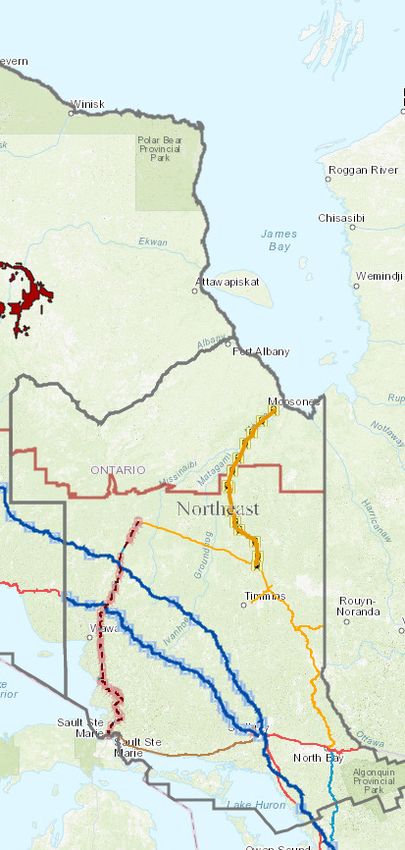
Northern Policy Institute / Institut des politiques du Nord
                                                         The Thin Case for Passenger Rail in Ontario’s Northern Regions | July 2020        5

                                Executive Summary:

There is much to be said about infrastructure in Northern Ontario, especially with respect to transportation modes. In
particular, passenger rail has been the subject of debate for the past several years. Given this, Northern Policy Institute
posed the question: Does passenger rail make sense for Northern Ontario? To explore this question, the lead author
analyzed passenger rail in thin and remote regions, while also discussing three key factors for passenger rail in such
areas: complementary or supporting freight rail, volume and frequency, and subsidies. Finally, the paper addresses other
rationale for remote passenger rail such as road congestion, environmental considerations and nation building. Overall,
the study finds that there is no be-all and end-all definite answer. From an economics perspective, and in the context of
allocation of resources, passenger rail does not appear to make sense for Northern Ontario. However, there is merit in the
other rationale analyzed and further study is encouraged to fully flesh out the benefits and drawbacks.
6        Northern Policy Institute / Institut des politiques du Nord
         The Thin Case for Passenger Rail in Ontario’s Northern Regions | July 2020

                                                       Introduction

Objective:                                                                       demands. For example, the demand for “just in time”
                                                                                 delivery has shifted the advantage from rail to road
                                                                                 (trucks) for many consumer goods. Similarly, the cusp
The purpose of this study is to assess the parameters
                                                                                 for the modal shift from road to rail used to be around
that would decide the practicality of passenger rail in
                                                                                 30 miles (48 kilometres). In the early 1950s, if a shipment
Northern Ontario — more colloquially, whether passenger
                                                                                 had to move more than about that distance, it was
rail in the region “makes sense.” In July 2017, the Ministry
                                                                                 sometimes considered more efficient to move by
of Transportation Ontario and the then Ministry of
                                                                                 rail. However, as the public road network expanded,
Northern Development and Mines (now the Ministry of
                                                                                 and truck technologies advanced, that cusp moved
Energy, Northern Development and Mines) released
                                                                                 outward. Now, with the exception of bulk commodity
a draft study designed to set the framework for further
                                                                                 shipments, road is generally the preferred mode in North
discourse regarding “transportation policy, program and
                                                                                 America. This shift has also been facilitated by changes
investment opportunities for a modern and sustainable
                                                                                 in consumer demand and the just-in-time culture.
transportation system in Northern Ontario” (Ontario
                                                                                 Concurrently, brick and mortar warehousing has been
2017,p. 1). This was a comprehensive document that
                                                                                 consolidated, and augmented by warehousing provided
called for input from invested players on a number of
                                                                                 by trucks on the road. These shifts, in their own time, might
topics.
                                                                                 be replaced by newer transportation and warehousing
                                                                                 models.
In referencing passenger rail, the document presents the
objective to “reinvigorate passenger rail service where
                                                                                  Both freight rail and passenger rail contribute extensively
appropriate” (p. 20). In choosing the caveat of “where
                                                                                  to meeting global demand for transportation, with
appropriate,” the authors appear to assign conditional
                                                                                  passenger rail being particularly significant in areas of
expectations on passenger rail in some markets and
                                                                                  higher population density. In North America, freight rail
in the face of the expansion of alternate modes of
                                                                                  dominates to a greater extent, particularly in Canada,
transportation.
                                                                                  where, in 2009, 68 per cent of freight was moved
                                                                                  by rail, the highest share of any country at that time
                                                                                  (OECD 2013). In terms of rail-passenger-kilometres per
Background:                                                                       capita, however, Canada does not rank in the top 30
                                                                                  (International Union of Railways 2015), although some
The ability to move commodities and persons is integral to                        regional or municipal rail data are excluded from the
the stability of an economy, and a robust transportation                          data from which the rankings are sourced.
infrastructure is required to maximize opportunity for
the economy. Transportation is, for the most part, a
derived demand: transportation infrastructure expands or
contracts in response to the needs of the economy — for
example, industry locates along or near transportation
routes to take advantage of such networks. Where
existing infrastructure is well established or expensive to
remove, however, transportation infrastructure in place
can serve to support a network even if the economy’s
current demands would not necessarily support similar
new development. Since the mid-1800s, rail has often
provided the initial major way to and through remote
areas of North America to facilitate expanding resource
extraction and access to new markets.

The life expectancy of infrastructure of a transportation
mode, particularly under relatively low usage, may
exceed its place as the optimal choice. A mode might
shift from being the best choice to a vestige of past
market demands and a victim of changing relative
costs, new ownership models, and changing consumer
Northern Policy Institute / Institut des politiques du Nord
                                                           The Thin Case for Passenger Rail in Ontario’s Northern Regions | July 2020        7

The Study Approach:
Canadian transportation policy, particularly rail policy,
has been driven disproportionately by political or policy
considerations outside the framework of economics
and efficiency, but that tend to use regulation and/or
subsidies as facilitators. This has been a driving force for
a number of reasons, including to facilitate economic
development in areas where critical mass might not
support that activity or where population density does
not support extensive transportation infrastructure.
Canada’s path has been largely determined by ongoing
attempts to balance great distances with, in many areas,
small populations. Policy will continue to be a main driver
in forming Canada’s future passenger rail services.

This study attempts, where possible, to inform policy by
taking an operational approach to the role of passenger
rail in thin markets. The analysis focuses on the economics
and comparative costs of operations; acknowledgement
of societal aspects; and comparison with other
modes that also might meet passenger transportation
requirements. It does not look at economic modelling or
economic spinoff effects.

The following section reviews freight and passenger rail
operating in thin and/or remote markets and summarizes
key elements of those operations. The salient features
of a representative group of railway operations will
begin to frame the discussion around factors which
determine the viability of remote rail. The third section
builds on the traits of remote and thin market rail in
order to highlight the conditions or circumstances that
appear to be necessary for the viability particularly of
passenger rail in such markets. The analysis is based upon
a review of operational aspects of rail and feedback
from rail practitioners. Key players have put forward a
number of arguments for the adoption or reintroduction
of passenger rail in thin markets. Some of the most
commonly cited arguments could be best classified as
societal or socio-economic, environmental, cultural, or
associated with nation building.

The fourth section includes a review of these arguments
as they pertain to the adoption or reintroduction
of passenger rail to areas of Northern Ontario, as
described in the Draft 2041 Northern Ontario Multimodal
Transportation Strategy (Ontario 2017). While not
necessarily an exhaustive list of rationales for the support
of passenger rail, the arguments discussed in this section
represent the main focus of efforts by various stakeholder
groups advocating a resurgence of passenger rail in
Northern Ontario.
8        Northern Policy Institute / Institut des politiques du Nord
         The Thin Case for Passenger Rail in Ontario’s Northern Regions | July 2020

                  Rail in Thin Markets and Remote
                                Regions
“Remote” rail is a relative term, but this study considers “remote” rail as that travelling within or through areas or
 communities with relatively low population densities and sparse existing infrastructure. In the context of Canadian
 passenger rail, Northern Ontario accounts for 90 per cent of the provincial land area but only 6 per cent of Ontario’s
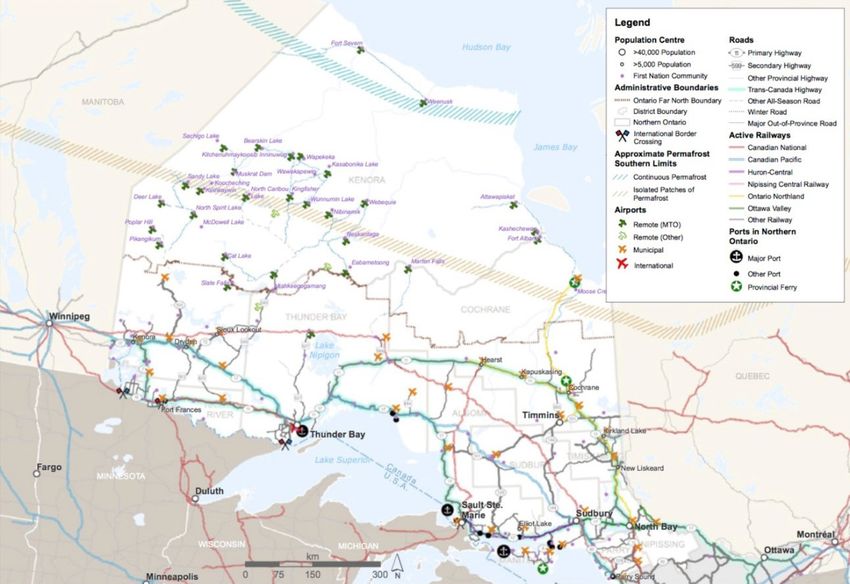
 population (Statistics Canada 2016b). Nonetheless, in meeting the transportation needs of Northern Ontario, an extensive
 infrastructure has been built, as depicted in Figure 1.

                                          Figure 1: Northern Ontario Transportation Infrastructure

Source: Ontario 2017, 3.
Northern Policy Institute / Institut des politiques du Nord
The Thin Case for Passenger Rail in Ontario’s Northern Regions | July 2020 9
Table 1 lists a number of remote or thin market railways operating in North America and other regions around the globe.
While some of these operations have a passenger component, for the most part they have been primarily associated with
resource extraction (iron ore and coal). Other track has been laid to serve bulk freight handling or export markets. Where
northern or remote passenger travel is involved, it generally is not undertaken without rail freight to contribute to offsetting
fixed costs. Dedicated passenger rail (excluding the tourism or excursion market) is rare in thin markets.
Table 1: A Cross-Section of Remote Railways in Current Operation
Track Capacity, Traffic
Administrative Track Length
Location Name of Railway Type of Transport load (frequency &
Environment +/- (KM)
tonnage)
Summit Excursion:
White Pass &Yukon Daily early May to
British Columbia, White Pass and Route Railway; early October; Bennett 96 (both
Tourism
Yukon, Alaska Yukon Route Heritage Railway Scenic Journey – 5 countries)
status trips/week mid-May to
early September
Alaska (Seward–
Alaska Railroad Passengers and 415,500 passengers
Fairbanks and State of Alaska 760
Corporation freight (2012), 5 MGT1 Freight
beyond)
Passengers
Manitoba VIA / Arctic
Hudson Bay and freight
(Winnipeg– Gateway Group 2 trips/week 1,700
Railway / VIA Rail (re-established
Churchill) Limited
December 2018)
Manitoba
Keewatin Railway KRC (3 partner First Passengers and
(The Pas– 2 trips/week, variable 329
Company Nations) freight
Pukatawagan)
Ontario (Sault Ste. Agawa Canyon Agawa Canyon Daily (mid-June to
Tourism, excursion 185
Marie) Tour Train Tour Train / CN mid-October)
Ontario
Ontario Northland Government of Passengers and
(Cochrane– 5 trips/week (summer) 300
Railway Ontario freight
Moosonee)
Quebec,
Sept-Îles–Schefferville
Newfoundland Transport
Tshiuetin Rail Passengers and (Monday, Thursday)
and Labrador Ferroviaire 213
Transportation freight Schefferville–Sept-Îles
(Schefferville– Tshiuetin Inc.
(Tuesday, Friday)
Emeril Junction)
Sweden 80,000 tonnes of
STA, LKAB, Ore, passengers,
(Riksgränsen– Malmbanan iron ore products 473
CargoNet, and groceries
Luleå) transported/day
Russia (Lake
Baikal–Amur Passengers and 8–18 million tonnes of
Baikal– Russian Railways 4,325
Mainline freight freight/year
Khabarovski Krai)
Avg. 2.1 million
Qinghai–Tibet Qingzang Railway Passengers and passengers/ year
China 1,955
Railway Company freight (2006–09); Avg. 2.8
MGT freight/year
Source: Various
1
MGT = million gross tonnes10 Northern Policy Institute / Institut des politiques du Nord
The Thin Case for Passenger Rail in Ontario’s Northern Regions | July 2020
The White Pass and Yukon Route, initially laid to meet
the needs of the Yukon gold rush, is a successful tourism
and excursion route, and has Heritage Railway status.
The Alaska Railroad Corporation is a Class 2 railway that
offers a combination of excursion service, passenger rail
service, and heavy freight throughout its network. The
Hudson Bay Railway, serving Churchill, Manitoba, was
initially completed in 1929 to provide tidewater access
for bulk grain shipments to Europe in direct competition
with port facilities on the St. Lawrence River. Freight and
passenger rail followed, intended to serve the needs of
the port community and to support short-sea shipping
to communities in the Kivalliq region of what would later
become Nunavut (Malone 2016).
There was no alternate access via an all-weather road.
After being washed out in spring 2017, this rail line,
the only surface link to the south from Churchill, was
reopened to traffic in December 2018.
In Northern Ontario, the Agawa Canyon Tour Train
provides seasonal tourism and excursion services from
Sault Ste. Marie. Although road service is available in the
area, it does not precisely follow the route of the rail, and
therefore does not provide alternate access. Similarly,
there is no road paralleling the Cochrane–Moosonee
train operated by Ontario Northland Railway. That
passenger and freight service is what remains of service
that used to connect Cochrane to Toronto, which was
discontinued in 2012, reportedly by some to be due to
insufficient ridership (Ontario 2013, p. 7, p. 27), while others
cite policy decisions as contributing factors.2
Elsewhere in eastern Canada, Tshiuetin Rail Transportation
operates regular passenger and freight service between
Emeril Junction and Schefferville, Quebec. The Quebec
North Shore and Labrador Railway shifted its focus
toward general freight in 2004, which made the line to
Schefferville surplus. It was purchased in 2005 by Transport
Ferroviaire Tshiuetin Inc. (Wheeler 2015). The track is the
only ground access between Schefferville and Emeril
Junction and Sept-Îles.
Looking at rail in Scandinavia, iron ore extraction has
been a major influence in the role of rail in Sweden and
Norway. The Malmbanan (“Iron Ore Train”) has operated
since 1888 and under LKAB since 1890 (LKAB 2017; Barrow
2019). Ore shipments are the rationale for the existence
of the rail, but passenger service and other commodity
shipments have been integrated into regularly scheduled
service on the rail line.
2
See “Passenger rail revival plan rolling out this fall,” Northern Ontario Business, October 9, 2018, online at https://www.northernontariobusiness.com/industry-
news/transportation/passenger-rail-revival-plan-rolling-out-this-fall-1078531 and personal communication with Ontario Northland Transportation Commission
executive, June 2019.Northern Policy Institute / Institut des politiques du Nord
The Thin Case for Passenger Rail in Ontario’s Northern Regions | July 2020 11
As with the iron ore rail in Sweden, remote market
passenger rail in Russia (for example, the Baikal–Amur
Mainline) and China (the Qinghai–Tibet Railway) is of a
different scale in comparison to that in Canada (save
for geography). In Canada’s remote rail, the discussion
is about thousands of passengers or thousands of tons
of freight per year, whereas in Russia and China the
discussion is based on millions of both. Accordingly,
comparisons with markets in Russia and China must be
made with caution, particularly when considering the
population base of the latter. As noted earlier, however,
even when standardized on a per capita basis, Canada
does not enter the top 30 countries in terms of rail
passenger indicators.
There are few, if any, Canadian precedents of passenger
rail in remote markets functioning without support of
freight rail or the use of rail originally intended for freight
use. While rail in remote and thin markets is unlikely to
generate the activity required to create an economically
viable stand-alone operation, there might be other
variables in assessing the sustainability of passenger rail
in certain circumstances. For example, in arguing for the
expansion of passenger rail in Northern Ontario, some
have suggested that the use of track associated with
the Canadian Pacific Railway (CPR) rather than those
operated by Canadian National (CN) would improve the
chances of passenger rail success. Much of that argument
deals with population centre opportunities along the
CPR line and a perceived better fit for the long-haul
“Canadian” routing (Budd 2018).12 Northern Policy Institute / Institut des politiques du Nord
The Thin Case for Passenger Rail in Ontario’s Northern Regions | July 2020
Key Factors for Passenger Rail in
Remote Regions
Remote or thin market rail is usually distinguished as
either freight based, freight/passenger based, or tourism
Complementary or Supporting
passenger based. Within the freight-based classification, Freight Rail
remote rail is primarily dedicated to resource extraction,
where there tends to be a limited routing with a single A common theme in reviewing remote or thin market
extraction point (or very few points) connected by passenger rail is the apparent need for complementary
rail to other supply chain infrastructure. In this, it differs freight rail activity. Further, industry sources suggest that,
somewhat from freight rail in denser markets, where in Canada, regular freight rail activity is a prerequisite for
service is not specific to one access point, but is part of a potentially viable passenger rail component due to
the greater supply chain. relatively small, widely dispersed populations and difficult
route conditions.3 This assertion is based, in part, on the
In looking at passenger rail in general, we are reminded need to disperse the extensive fixed costs of track and
that “[t]rains are superb movers of large quantities of rolling stock that passenger rail could not support on its
people and goods over certain distances and under very own. This is corroborated by the extensive use of passenger
specific conditions. But rail is extremely capital intensive rail subsidies and Train Service Agreements (TSAs) by VIA
and it must be applied judiciously” (Gormick 2017, p.1). Rail Canada, Canada’s main passenger rail provider. VIA
Indeed, in relatively sparse markets, such as those found Rail operates on a network comprising 7,417 route-miles,4
in Northern Ontario, the amortization of infrastructure but owns just 3 per cent of that network. The rest is owned
becomes a more important component, as fixed or semi- by seven separate entities: CN, CPR, the Goderich-Exeter
fixed costs tend to represent a greater share of total costs Railway, Hudson Bay Railway, Société de chemin de
of providing service. fer de la Gaspésie, Metrolinx, and Southern Railway of
Vancouver Island (VIA Rail Canada 2017b). VIA Rail has
Passenger rail in remote regions revolves around the asserted, however, that, despite having TSAs in place, it is
resupply of communities or tourism. Tourism-related rail in in competition with freight rail for access to track:
remote regions does not necessarily need to partner with
freight rail as long as the tourism or excursion revenue Infrastructure owners are mostly rail operators
stream is sufficient. Also, tourism rail is often seasonal, (primarily freight carriers) that conduct their own
allowing operators to reduce or suspend operations business on the same infrastructure. As a result, VIA
when continuing to operate would jeopardize financial Rail competes with the host for capacity. As freight
viability. This offers tourism rail a significant advantage traffic has increased drastically since the financial
over regular passenger rail, which would be expected crisis of 2007–2008, VIA Rail has been unable to
to provide scheduling throughout the year. In reviewing obtain the infrastructure access required for reliable,
existing passenger rail in more remote or inhospitable frequent, and on-time operations, which limits its
environments, there still appear to be some keys to competitiveness, cost recovery, profitability, and
success, such as complementary or supporting freight rail, relevancy to travellers. This is a serious constraint
volume and frequency, and subsidies. noted by the Auditor General of Canada with its
Special Examination Report that “existing rail service
agreements with the main track-owning railway
companies did not give VIA Rail trains the right-of-
way” (VIA Rail Canada 2017b, 26).
3
Personal communication with Canadian Class 1 rail executive, May 2018.
4
Route-miles comprise the physical length of track over which trains in the network operate. Train-miles are the total number of miles that trains travel on the
route. Simplified, five trains travelling over a 100-mile route would collectively log 500 train-miles.Northern Policy Institute / Institut des politiques du Nord
The Thin Case for Passenger Rail in Ontario’s Northern Regions | July 2020 13
Table 2 illustrates the distribution of VIA Rail’s current usage of track by infrastructure owner. VIA Rail’s own track ownership
is all associated with traffic along the Quebec City–Windsor corridor. As Table 3 shows, 12 per cent of VIA Rail’s 6,797,000
train-miles is over infrastructure it owns. There is a linkage between an asset’s level of use and the rationale for ownership
of the asset. Where usage is below a certain level, the logic for ownership gives way to entering into a TSA. Other variables
are also at play in assessing feasibility, but level of usage is still a major component in the rationale for aspiring to track
ownership. In the choice of asset ownership or TSAs, the presence of complementary asset use is key. In Canada, rail freight
provides that asset use.
Table 2: VIA Rail’s Route-Miles, by Type of Service and Infrastructure Owner
Service CN VIA CP GEXR HBR SCFG Metrolinx SVI Total
Corridor 758 186 0.2 55 98 1,099
Long-haul 3,600 14 3,614
Regional and
1,833 301 570 0 0 2,704
remote
Total 6,191 186 302 55 570 0 112 0 7,417
% of total 83 3 4 1 8 0 2 0
Note: CN = Canadian National; CP = Canadian Pacific; GEXR = Goderich-Exeter Railway; HBR = Hudson Bay Railway;
SCFG = Société de chemin de fer de la Gaspésie; SVI = Southern Railway of Vancouver Island.
Source: VIA Rail Canada, 2017b, 27.
Table 3: VIA Rail’s Train-Miles, by Service Type and Infrastructure Owner
Service CN VIA CP GEXR HBR SCFG Metrolinx SVI Total
(thousands of miles)
Corridor 3,694 837 1 81 400 5,014
Long-haul 983 3 987
Regional and
524 94 179 797
remote
Total 5,202 837 95 81 179 404 6,797
% of total 77 12 1 1 3 0 6 0
Note: CN = Canadian National; CP = Canadian Pacific; GEXR = Goderich-Exeter Railway; HBR = Hudson Bay Railway;
SCFG = Société de chemin de fer de la Gaspésie; SVI = Southern Railway of Vancouver Island.
Source: VIA Rail Canada 2017b, 28.14 Northern Policy Institute / Institut des politiques du Nord
The Thin Case for Passenger Rail in Ontario’s Northern Regions | July 2020
Traffic along the Quebec City–Windsor corridor accounts
for 94 per cent of VIA Rail’s passengers, with the main
Volume and Frequency
function being to provide intercity rail services (VIA Rail
Volume and frequency are not only prerequisites for
Canada 2017b, 36). Long-distance services are in place
passenger rail. Freight rail also needs to adhere to these
primarily to provide coast-to-coast tourism and basic
requirements, and uncertainty is a great detriment to
transportation as a public service, accounting for four
making rational rail investment decisions. The uncertainty
per cent of VIA’s passengers, leaving just two per cent of
is magnified when considering investment decisions in
passengers of regional (and remote) services that exist
remote regions. For example, as recently as 2015, the
mainly to connect remote communities (VIA Rail Canada
Baffinland Iron Ore Railway was proposing to move iron
2017a, 2).
ore from the Mary River mine site on northern Baffin Island
to port facilities about 160 kilometres distant.6 However,
As freight rail grows, passenger rail is under increasing
reduced expected mine production in response to lower
competitive pressures. The track needed to serve
world prices, in part, led to the choosing of an alternate
passenger rail becomes less available — a major
road route to tidewater on the other side of Baffin Island.
constraint in high volume traffic areas — placing
A key observation to be taken from this decision is that
scheduling and operational challenges on the providers
road quickly becomes the front-runner when there is
of passenger rail, particularly where they have to share
insufficient expected rail traffic volume.
with a freight rail infrastructure owner.
Therefore, decisions based on assumed volume and
In areas where freight rail traffic has declined or has
frequency should be tempered by the increased
been discontinued, some proponents of passenger rail
uncertainty of demand for transportation infrastructure
note that “the rail is already there,” so passenger rail
in remote and thin markets. Further, volume and
should have favourable access. Existing rail is not a free
frequency are relative terms. Passenger rail operators
asset, however, and requires regular maintenance. In
in Canada’s relatively thin markets are hard pressed
the absence of significant support activity by the rail
to define thresholds where volumes or frequency are
owner (if the passenger rail provider does not buy the
sufficient to warrant a passenger rail service. Passenger
track outright), the passenger rail provider would be
rail routes in other parts of the world, however, clearly
expected to enter into a TSA in which a large share of the
exceed those thresholds, and give a sense of the scale
maintenance costs would be borne by the passenger
in which passenger rail can operate efficiently. For
rail operator. Due diligence would be required before
example, about one hundred trains run each way every
entering into such an arrangement, and the expected
day over the Beijing–Hong Kong high-speed rail route,
traffic load would factor into any discussions leading to a
with a planned usage by over 80,000 passengers per day
TSA. The passenger rail provider would have to consider if
(Leung 2018). In Britain, “every day more than four million
such an arrangement was in its best interests.
passenger journeys start, end or pass through the stations
we manage” (Network Rail 2017). In 2017, Germany
Also, freight rail and passenger rail do not interact
recorded slightly over 2.8 billion domestic rail passenger
with the track in exactly the same way. Optimal track
trips (Eurostat 2017).
geometry is different for freight rail and passenger
rail, with the different axle loads — usually 25 tons for
Focusing on Northern Ontario, the region’s thin
passenger rail and 36 tons for North American Class 1
population, spread out over 90 per cent of Ontario’s
freight — having different traits in vertical and lateral
land area, translates to a population density of about
loading of the track, which, in turn, affect train movement
1 per square kilometre. In contrast, the remainder of
characteristics.5
the province is home to about 12.6 million residents
(Statistics Canada, 2016b), which translates into a
population density of about 123 per square kilometre,
while population density in the Toronto Census
Metropolitan Area is approximately 1,000 per square
kilometre (Statistics Canada 2016a). With these contrasts
in population density, it is understandable that the
challenges faced in the thin markets of Northern Ontario
are distinctive, and the corresponding solutions, if any,
would present a unique profile.
5
Personal communication with Canadian Class 1 rail executive (retired), September 2018.
6
Personal communication with Baffinland Iron Mines Corporation executive, May 2015.Northern Policy Institute / Institut des politiques du Nord
The Thin Case for Passenger Rail in Ontario’s Northern Regions | July 2020 15
In addition to complementary (and sometimes
competitive) freight rail, relatively stable passenger
rail service requires volume and frequency. Canadian
passenger rail practitioners are aware of these
considerations, in fact suggesting these are prerequisites to
a rational decision to develop or expand passenger rail.7
The required volume and frequency are provided by:
• A sufficiently large population in the origin/
destination city pairs and/or along the passenger rail
corridor; and
•A “cultural link” between origin/destination
communities along the rail corridor, which creates
the desire to take advantage of the rail corridor. It is
noted that, despite the large size of both Toronto and
Montreal, there is a smaller market for passenger rail
between those two cities than would be expected
given their respective populations. In contrast, the
Ottawa–Toronto passenger rail corridor is in a growth
position. Similarly, within VIA Rail Corridor traffic, the
Ottawa–Montreal segment is disproportionately strong.8
Volume and frequency are complementary. By adding
departures on the Ottawa–Toronto segment, the total
passenger traffic on that route was increased, rather
than experiencing simply a dilution of a fixed traffic
volume across an increased number of departures (with
corresponding reduced load factors). By providing more
departure choices, passenger rail increased its market
base by becoming a more convenient option.9 Thin
market passenger rail, however, might have difficulty in
operationalizing that strategy.
The actual population threshold required to provide
sufficient volume is the subject of debate, but a
subsequent discussion of required subsidies will shed light
on some operational thresholds. Similarly, the threshold
for the frequency of departures is difficult to ascertain.
VIA Rail suggests, however, that high-frequency rail routes
with 12 to 15 departures normally generate progressively
increasing return on investment, but beyond that
frequency, only very large population origin/destination
pairs are resistant to diminishing returns.10
In short, the economic imperatives of passenger rail
in remote or thin markets appear to be, first, freight
rail operations to offset fixed costs of rail and, second,
volume and frequency.
7
Personal communication with VIA Rail Canada executive, July 2018.
8
Ibid.
9
Ibid.
10
Ibid.16 Northern Policy Institute / Institut des politiques du Nord
The Thin Case for Passenger Rail in Ontario’s Northern Regions | July 2020
Subsidies Subsidies have also been made to facilitate rail
infrastructure in thin markets: “In 2005, the Iron Ore
Company of Canada sold the portion of the railway north
Even where passenger rail is considered to be justified,
of Emeril Junction to the Innu nations of Uashat Mak Mani-
it is heavily subsidized.11 The story of Canadian rail,
Utenam and Matimekush-Lac John and the Naskapi
particularly passenger rail, is characterized by the need
nation of Kawawachikamach for $1, and Tshiuetin Rail
for subsidized operations. On a per passenger basis,
Transportation Inc. was born” (Ellingson 2019), thereby
larger subsidies are invariably associated with more
facilitating continued operation of passenger rail up to
remote or thin market rail. The economics, as discussed
Schefferville via Tshiuetin Rail Transportation. Another
earlier, do not support these operations without subsidies.
example is that “[i]n 1997, the federal government
brokered the sale of the CN track to Churchill (and
The history and pattern of subsidies has led some to
the seaport) to OmniTrax of Denver, Colorado. The
suggest that the precedent has been set, and that
government invested in upgrades to the port and
additional subsidies are required to support an expanded
provided $16M to CN Rail. OmniTrax paid $11M for the
passenger rail network in Northern Ontario. There is
track and $10 for the port” (Financial Post 2017). The
no doubt that passenger rail subsidies are common in
level of subsidy required for passenger rail might, in some
remote markets. For example, “Tshiuetin Railway from
cases, appear independent of the ownership of the rail
Sept-Îles to Schefferville, in Quebec, got $9.5 million
assets. Despite receiving ownership of the track for $1, the
in 2016 to carry 14,757 passengers — $643 per trip,”
per passenger subsidy on the Tshiuetin Railway remains at
and “The Keewatin Railway Company from The Pas to
least as high as for other subsidized operations. There are
Pukatawagan, in Manitoba, took 11,279 passengers and
many variables, however, not the least of which is that
got $1.7 million directly from the federal government, plus
the Tshiuetin Railway is totally isolated and not linked to
$2.9 million from VIA — $408 per rider” (Dehaas 2017).
other rail.
These are interesting precedents, but one should also
consider that, in these cases, rail is the only land-based
In higher-volume rail corridors, subsidies also serve system
transportation option. There are no all-weather roads
efficiency. By moving commuters off the roads, as in
serving these communities.
the case of GO Transit, there are benefits to the overall
system of mobility. However, it has been suggested that
Subsidized passenger rail also occurs where rail is
GO Transit only broke even on operating costs because
not the only option. The VIA Rail route from Montreal
bus revenue was offsetting train costs.13
to Senneterre, Quebec (near the Val-d’Or airport)
is subsidized, as is the branching of that line over to
Subsidies have been shown to be integral to passenger
Jonquière. Other VIA Rail routes, particularly within
rail, particularly in thin markets. That said, a broader
VIA’s long haul service model, are subsidized.12 These
strategy might be to consider the use of rail subsidies, and
are based on policy-driven decisions at the provincial
subsidies in other sectors, in the context of other possible
and federal levels. It should be noted that increased
uses of those funds.
passenger demand might be an additional factor.
Specifically, VIA Rail posted a 10 per cent increase in
traffic demand on its regional services in 2016 (VIA Rail
2017c), so there are other considerations in the mix.
With respect to routes in Northern Ontario, Dehaas (2017)
reports that “[r]idership on the ACR [Algoma Central
Railway] averaged only 7,400 per year from 2005 to
2013, with $2.2 million of its roughly $2.5 million in revenue
coming from Transport Canada — a subsidy of $426
per trip based on 2013 passenger counts.”Although the
key termini of the ACR, Sault Ste. Marie and Hearst, are
connected by road, numerous communities are more in
alignment with the railway route, and not accessible by
dependable roads. As such, the ACR is a bit of a “hybrid”
when it comes to offering non-rail alternate modes.
11
Personal communication with Canadian Rail Research Laboratory staff, June 2018.
12
Personal communication with VIA Rail Canada executive, July 2018.
13
Personal communication with Ontario Government staff (retired), May 2018.Northern Policy Institute / Institut des politiques du Nord
The Thin Case for Passenger Rail in Ontario’s Northern Regions | July 2020 17
Other Rationales for Remote
Passenger Rail
As suggested earlier, a decision to support passenger
rail in thin markets based solely on revenue efficiency is
Road Congestion and Traveller
difficult to justify, even with subsidies. It is easier to support Safety
the concept if there is no surface alternative to rail.
However, if those alternatives exist, rail’s need for volume Passenger rail is an effective tool to minimize road
and frequency might make it difficult to conclude that congestion in intercity travel between dense urban
Northern Ontario passenger rail is warranted. markets. It also contributes to reduce downtown parking
congestion and improves productivity by reducing
In the face of these constraints, some advocates of travellers’ downtime during transit.14 These and other
passenger rail have proposed that decisions regarding benefits of passenger rail in dense markets are well
passenger rail in thin markets should also consider other documented, but their benefits in sparse markets with
factors. On April 19, 2018, the Northeastern Ontario lower population densities might be more challenging to
Passenger Rail Summit was hosted by the Northern & quantify.
Eastern Ontario Rail Network, the Coalition for Algoma
Passenger Trains, and other groups in Sault Ste. Marie. Two-lane undivided highways, common in Northern
This summit provided a venue for the presentation of Ontario, present challenges for the smooth movement of
a number of other viewpoints and reasons to support road traffic, particularly when there are highway closures
passenger rail in thin markets (as proxied by Northern and due to crashes or other events such as winter blizzards
Eastern Ontario). The majority of arguments presented fell or forest fires. Congestion is also understood as being an
into one or more of the following categories: exacerbating factor. In a presentation, Mark Andrews, a
former Ontario Provincial Police traffic expert, mentioned
• road congestion and traveller safety; the importance of reducing congestion on Northern
Ontario’s road network. Specifically, he suggested that
• limited access to services, exacerbated by an aging moving travellers out of their cars and onto passenger
population; rail could be a good idea. However, he pointed out that
there is a complex interaction on Northern Ontario roads:
• environmental considerations and greenhouse gas “[A]llow the transport trucks to do their job and allow the
(GHG) emissions; and buses to do their job. They’re professional drivers…Trucks
are at fault 30 per cent of the time. It’s the rest of us and
• connectivity with First Nations and the support of our small cars that are doing the problem” (Andrews
nation building. 2018)
Although other factors — such as changing It is unclear if Andrews was specifically citing northern
demographics and emerging modifications to Ontario data in indicating that trucks are “at fault 30
transportation modes — are involved in the discussion of per cent of the time,” but his assessment appears to be
rationales for remote passenger rail, this section discusses that passenger vehicles are a greater contributor to the
each of the above four aspects of the arguments for problem than are trucks. He also pointed to concerns
passenger rail in thin markets, with specific focus on the about capacity issues and the benefits of reducing the
Northern Ontario framework. It is important to note the traffic load, particularly given the increasing average
need for further analysis of these items (as well as of other age of drivers in Northern Ontario and possible increased
social benefits), as the intended purpose of this study cognitive impairment among the driving population
limits that task. The information in this study is still valuable, (Andrews 2018).
however, as it provides more context to the various
factors that should be considered further for future Andrews also suggested that, while the twinning of
policymaking decisions. highways would be desirable, there is an increasing
capacity issue, and alternate solutions such as rail
could assist with these concerns. The related challenge
is in determining how much road congestion could
be reduced by the expansion of passenger rail. The
passenger rail link from Toronto to Cochrane was
cancelled in 2012. The ACR lost its operating subsidy in
2015 (after a one-year extension) because the federal
14
Personal communication with VIA Rail Canada executive, July 2018.18 Northern Policy Institute / Institut des politiques du Nord
The Thin Case for Passenger Rail in Ontario’s Northern Regions | July 2020
government decided that it no longer qualified under In dense traffic corridors and areas of significant
Transport Canada’s Remote Passenger Rail Program passenger movement requirements, passenger rail
(Canada 2016). Indeed, the program itself ended on makes a significant contribution to the reduction of
March 31, 2018 (Canada 2017). road congestion. However, given suggested previously
low passenger rail ridership in Northern Ontario, and
One approach to estimating the effect on congestion of minimal observed shifts in the (albeit sparse) AADT data,
re-establishing the passenger rail route between Toronto restoration of passenger rail in the thin market of Northern
and Cochrane or the ACR from Sault Ste. Marie to Hearst Ontario might not reduce road congestion to any great
is first to evaluate the increase in congestion that took degree. That said, any reduction in congestion would be
place after those services were ended. Using the Ontario a positive step in increasing highway safety in Northern
Ministry of Transportation “Traffic Volumes on Demand” Ontario. Further traffic study and rail ridership research
website (Ontario 2016), it is possible to track annual is recommended to determine if a re-emphasis on
average daily traffic (AADT) on the various highway passenger rail could contribute significantly to alleviating
segments that would likely be used in the absence of a congestion in the region.
passenger rail option.
Increasing the number of departures on a route could
Considering the Toronto to Cochrane route, passenger increase the number of travellers who choose passenger
rail was cancelled in September 2012, with the rail by more fully meeting passengers’ schedules.16 If a
“before and after” time frames being of interest. In the lack of ridership was a major factor in the loss of Northern
Gravenhurst area, AADT on Highway 11 consistently rose Ontario passenger rail, however, finding a rationale for
by 1 per cent per year from 2012 to 2016, slightly lower increasing the frequency of departures in a restored
than the 2–3 per cent annual increase that had taken service might be difficult. In-depth ridership modelling
place from 2009 to 2011. Slightly north, in the Huntsville would be needed to determine if the catchment area
area, Highway 11’s AADT increases from 2014 to 2016 provides the critical mass necessary to respond to
were from 1 to 2 per cent. During the period from 2005 enhanced departure time options.
to 2013, there was no strong pattern in AADT, with little
evidence of a strong structural shift in traffic flows. The
annual percentage increases in AADT prior to 2005
appear to have differed little from those experienced Improving Limited Access to
from 2014 to 2016. Considering the rail service between
Sault Ste. Marie and Hearst, AADT on Road 631 linking
Services
Highway 11 with Highway 17 has showed little change Some invested players advocating a return of passenger
since the end of rail service. However, the dataset is rail suggest the need for Northern Ontario communities to
extremely sparse and applicable for only one calendar have access to services that major centres in the region
year, so any observations would be inconclusive. and in Southern Ontario enjoy. Access to health care
services is understandably high on the priority list. Indeed,
This topline assessment covers only small segments of a all Northern Ontario districts are experiencing an aging
subset of highways that could be affected by the loss population and increasing ratio of dependents to the
of passenger rail traffic. A more in-depth analysis might working-age population (Zefi 2018, 9). Rail advocates
be revealing, but, based on road traffic counts during also suggest there is a higher incidence of age-related
and after the availability of a passenger rail alternative, cognitive impairment among drivers in Northern Ontario
it has been difficult to observe any significant increases than in Southern Ontario (Andrews 2018). There is also a
in road traffic volumes as a result of the loss of passenger growing market for retirement community living in the
rail in the area. Given that passenger rail was, according area. The net result is likely a higher per capita demand for
to some, discontinued due to low ridership, it might be third-party transportation services, including passenger rail.
difficult to identify a major increase in road congestion
after that service ended. An argument could be In Northern Ontario, a number of communities are served
presented that the average load factor of automobile only by rail or air. Most of the population, however, has
traffic has risen in response to the loss of passenger rail road access. Figure 2 presents the train loop proposed
in the area (thereby masking increased demand on by the Northeastern Ontario Rail Network (NEORN) and
road usage), but exploring that hypothesis would also the Coalition for Algoma Passenger Trains (CAPT), using
require further research. Also, the Ontario Northland existing track. Comparing it to Ontario Northland’s current
Transportation Commission (ONTC) increased bus service bus routing, match in the overlay of these routes, while not
to take some of the former rail passengers.15 This could universal, is extensive.17
further mitigate observed changes in road traffic loads,
and data on changes in bus ridership would be a key
element of further research into load factors before and
after the termination of passenger rail services.
15
Personal communication with ONTC executive, September 2019.
16
Personal communication with VIA Rail Canada executive, July 2018.
17
See Ontario Northland’s Service Map. Available online at http://www.ontarionorthland.ca/en/service-map.Northern Policy Institute / Institut des politiques du Nord
The Thin Case for Passenger Rail in Ontario’s Northern Regions | July 2020 19
Figure 2: Possible Northeastern Ontario Passenger Train Loop
MOOSONEE
HEARST
KAPUSKASING
OBA SMOOTH ROCK FALLS
COCHRANE IROQUOIS FALLS
TIMMINS
FRANZ KIRKLAND LAKE
DUBREUILVILLE
WAWA
NEW LISKEARD
SEARCHMONT
ELLIOT LAKE SUDBURY
BLIND RIVER
NORTH BAY
SAULT STE.MARIE
FIRST NATIONS
HUNTSVILLE
CN RAIL BRACEBRIDGE
GRAVENHURST
WASHAGO
HURON CENTRAL RAILWAY
LAKE SIMCOE
OTTAWA VALLEY RAILWAY
RICHMOND HILL
TORONTO
VIA RAIL (ON CN RAIL NORTH TRACK
AND CP RAIL SOUTH TRACK)
ONTARIO NORTHLAND
POSSIBLE NORTHEASTERN
ONTARIO PASSENGER TRAIN LOOP
Source: Northeastern Ontario Rail Network. Modified slightly from original source.20 Northern Policy Institute / Institut des politiques du Nord
The Thin Case for Passenger Rail in Ontario’s Northern Regions | July 2020
Passenger rail and intercity bus serve similar functions, but Northland network in 2017 by a factor of about five to
are often not associated with the same markets, and in one. There are other factors to consider in comparing the
thin markets they are not positioned as direct substitutes costs of bus and passenger rail, but it is difficult to envision
for each other. In the rail excursion market, the trip is part, a scenario in which passenger rail with a low load-factor
if not almost all, of the experience, but passenger rail in would gain the more financially advantageous position in
Northern Ontario is mainly seen as a mode for meeting those calculations.
the transportation needs of residents for example, by
offering less travel fatigue and greater convenience for Limited access to services, particularly for those with
those with mobility issues. mobility issues, remains a significant issue in Northern
Ontario, as in other regions with sparse populations. In
Intercity bus, however, while perhaps considered assessing the strategies for meeting those transportation
less comfortable, offers better frequency and more needs, both passenger rail and bus are considerations.
connection points on most routes. Moreover, to “close the
gap” with respect to services travellers might expect with
a return of passenger rail, Ontario Northland, is continuing
to purchase new bus equipment that is wheelchair
accessible and capable of transporting mobility aids,
including scooters.18 The company has also purchased
three fully wheelchair-accessible washroom buses that
allow a passenger in a wheelchair to use the onboard
facilities without the need to get off the bus at a rest stop,
which takes time when using the wheelchair lift.19
Ontario Northland management recognizes the relative
advantages of complementary passenger rail and
intercity bus, suggesting that “in southern Ontario there
is an issue of congestion. In Northern Ontario, there’s an
issue of connectivity” (see Moore 2018 presentation).
Existing and planned changes to the ONTC bus fleet
and services are targeted to improve connectivity in
the network for a broader range of the travelling public.
A collateral outcome, while not necessarily a driving
motive, might be to narrow the perceived benefits of bus
service vis-à-vis those provided by passenger rail.
How, if at all, do changes to bus service in
Northern Ontario relate to the determination of the
appropriateness of passenger rail service in the region? It
is understood that bus and passenger rail are not direct
substitutes, but they both facilitate public transit and,
serving the public need in thin markets, invariably have a
subsidy component. The subsidies they receive, however,
are dramatically different on a per passenger basis.
Earlier, passenger rail subsidies in the range of hundreds
of dollars per rider were cited, and the Ontario Northland
passenger rail subsidy of about $257 per passenger trip
also appears to be in that range, although at the lower
end. The ONTC bus subsidy in 2017, in contrast, was $2.16
per passenger trip.20
Certainly, there are standardization issues in comparing
per capita passenger rail and bus subsidies. Bus services
operate on public roads shared by other traffic.
Quantification of costs associated with buses could be
increased to include a congestion component and also
to account for bus usage of a public roadway. Also, bus
passengers outnumbered rail passengers in the Ontario
18
Personal communication with ONTC executive, September 2019.
19
Ibid
20
Personal communication with ONTC executive, October 2018.You can also read


