The Zadko Telescope: A Southern Hemisphere Telescope for Optical Transient Searches, Multi-Messenger Astronomy and Education - Cambridge ...
←
→
Page content transcription
If your browser does not render page correctly, please read the page content below
CSIRO PUBLISHING
                       www.publish.csiro.au/journals/pasa                                            Publications of the Astronomical Society of Australia, 2010, 27, 331–339

                               The Zadko Telescope: A Southern Hemisphere Telescope for Optical
                               Transient Searches, Multi-Messenger Astronomy and Education

                               D. M. CowardA,E, M. ToddB, T. P. VaalstaA, M. Laas-BourezD,A, A. KlotzC,D,
                               A. ImeritoA, L. YanA, P. LuckasA, A. B. FletcherA, M. G. ZadnikB,
                               R. R. BurmanA, D. G. BlairA, J. ZadkoA, M. Bo€erD, P. ThierryC, E. J. HowellA,
                               S. GordonA, A. AhmatA, J. A. MooreA, and K. FrostA
                               A
                                 School of Physics, M013, The University of Western Australia, 35 Stirling Hwy,
                                 Crawley, WA 6009, Australia
                               B
                                 Department of Imaging and Applied Physics, Bldg 301, Curtin University of Technology,
                                 Kent St, Bentley, WA 6102, Australia
                               C
                                 CESR, Observatoire Midi-Pyrénées, CNRS, Université de Toulouse, BP 44346,
                                 F–31028 Toulouse Cedex 4, France
                               D
                                 Observatoire de Haute-Provence, F–04870 Saint Michel l’Observatoire, France
                               E
                                 Corresponding author. Email: coward@physics.uwa.edu.au

                               Received 2009 October 19, accepted 2010 June 9

                               Abstract: The new 1 m f/4 fast-slew Zadko Telescope was installed in June 2008 about 70 km north of Perth,
                               Western Australia. It is the only metre-class optical facility at this southern latitude between the east coast of
                               Australia and South Africa, and can rapidly image optical transients at a longitude not monitored by other similar
                               facilities. We report on first imaging tests of a pilot program of minor planet searches, and Target of Opportunity
                               observations triggered by the Swift satellite. In 12 months, 6 gamma-ray burst afterglows were detected, with
                               estimated magnitudes; two of them, GRB 090205 (z ¼ 4.65) and GRB 090516 (z ¼ 4.11), are among the
                               most distant optical transients imaged by an Australian telescope. Many asteroids were observed in a systematic
                               3-month search. In September 2009, an automatic telescope control system was installed, which will be used to
                               link the facility to a global robotic telescope network; future targets will include fast optical transients triggered
                               by high-energy satellites, radio transient detections, and LIGO gravitational wave candidate events. We also
                               outline the importance of the facility as a potential tool for education, training, and public outreach.

                               Keywords: instrumentation: miscellaneous — gamma rays: bursts — minor planets, asteroids — telescopes

                       1 Introduction                                                                        include large optical and radio facilities, space-based
                       The Universe is teeming with fleeting transients, visible                             detectors, and the next generation of gravitational wave
                       across the entire electromagnetic spectrum. In the optical,                           and neutrino observatories. The 1 m Zadko Telescope,
                       some last for only a few seconds, while others vary in                                with its 18 field of view, is perfectly poised to study the
                       brightness over years. Sources classed as transient include                           transient sky, by following up and monitoring the many
                       blazars, cataclysmic variable stars, stellar flares, super-                           transients that will be detected by these facilities in the
                       novae, and hypernovae; many of the recently discovered                                coming decade.
                       sources are not easily explained.                                                         The study of transient optical sources that vary on
                          Some transients, such as gamma-ray bursts (GRBs),                                  timescales of seconds to hours is an exciting and growing
                       have complex emissions spanning the gamma-ray, X-ray                                  field, boosted by the widespread use of small to medium,
                       and optical bands, and are possibly also strong gravita-                              rapid-response automated telescopes. Many of the smal-
                       tional wave and neutrino sources. In ‘multi-messenger’                                ler instruments are being networked to coordinate obser-
                       astronomy (see Sathyaprakash & Schutz 2009), coordi-                                  vations to allow near-continuous monitoring of rapidly
                       nated observations of the different kinds of radiation and                            fading (or flaring) optical transients.
                       information carriers emitted by such sources offers the                                   The Zadko Telescope (ZT), shown in Figure 1, is just
                       opportunity to probe the physics of these exotic transients,                          starting first operations as a networked robotic observa-
                       by studying their diverse emissions over a range of energies                          tory. Made possible by a philanthropic donation to the
                       and timescales, from seconds to days.                                                 University of Western Australia (UWA), it is a new
                          There are new and upcoming facilities which are expected                           resource for research, training, and science education.
                       to discover a huge number of transient objects — these                                It is colocated with a science and astronomy outreach

                       Ó Astronomical Society of Australia 2010                                                                            10.1071/AS09078         1323-3580/10/03331

Downloaded from https://www.cambridge.org/core. IP address: 46.4.80.155, on 06 Nov 2021 at 16:46:11, subject to the Cambridge Core terms of use, available at https://www.cambridge.org/core/terms.
https://doi.org/10.1071/AS09078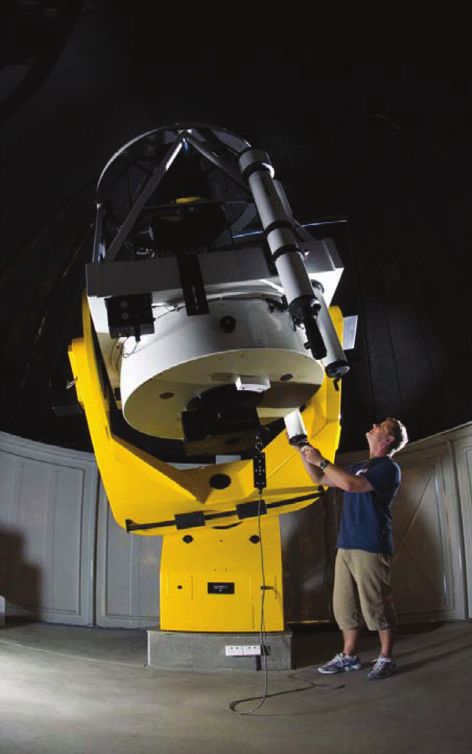
332                                                                                                                                          D. M. Coward et al.

                                                                                                    The LIGO2 and VIRGO3 interferometers are now
                                                                                                 entering a sensitivity regime where GW emissions from
                                                                                                 coalescing compact binaries should be detectable out to
                                                                                                 10s of Mpc; the next-generation Advanced GW detectors
                                                                                                 will expand this horizon out to 100s of Mpc (Abadie et al.
                                                                                                 2010). This presents an enormous opportunity to combine
                                                                                                 optical transient searches with GW burst searches. From
                                                                                                 early 2010, the ZT is being employed by LIGO as a
                                                                                                 test facility for optical follow-ups of large error boxes
                                                                                                 (E10 deg2). The first tests and methods of this pilot
                                                                                                 program will be reported in a later publication.
                                                                                                    The ZT has already allowed scientists to engage with
                                                                                                 the broader community on several research projects that
                                                                                                 have captured the public imagination. Furthermore, the
                                                                                                 ZT has opened up new research opportunities that have
                                                                                                 the potential to contribute to Australia’s already impor-
                                                                                                 tant role in optical transient astronomy. In this paper, we
                                                                                                 describe the status of the facility, and its planned role in
                                                                                                 several current and emerging transient astronomy science
                                                                                                 programs.

                                                                                                 2 The Zadko Telescope
                                                                                                 The ZT4 is a new 1 m f/4 Cassegrain telescope, built by
                                                                                                 DFM Engineering, Inc.,5 and situated in the state of
                                                                                                 Western Australia at longitude 1158420 4900 E, latitude
                                                                                                 318210 2400 S, and altitude 47 m above sea level. Located
                                                                                                 67 km north of Perth, the site has a typical ‘Californian’
                                                                                                 climate — hot, dry summers with mostly clear skies, and
                                                                                                 mild, wet winters, with a mean of 83 clear days per year.
                                                                                                 The closest towns are each 19 km away, with small
                                                                                                 populations (1628 & 531 in the 2006 Census); the site is
           Figure 1 Zadko Telescope: a new 1 m f/4 Cassegrain reflector,
                                                                                                 not strongly affected by man-made lighting.
           located 67 km north of Perth. Built by DFM Engineering, Inc., and
           donated to UWA by resource company Claire Energy. It was opened                          The ZT is an equatorial, fork-mounted telescope with a
           by Australia’s Chief Scientist on 1 April 2009.                                       primary mirror clear aperture of 1007.0 mm, and a system
                                                                                                 focal length of 4038.6 mm. Its fast optics have a low
                                                                                                 f-ratio, and a flat and wide field of view. It uses state-of-
           facility, and with the Australian International Gravita-                              the-art friction drives to achieve high stiffness and excel-
           tional Observatory (AIGO).                                                            lent tracking on both axes. The fork mount provides for a
               The leaders of Télescopes à Action Rapide pour les                              convenient and compact telescope, able to carry a max-
           Objets Transitoires (TAROT,1 the French robotic tele-                                 imum instrument load of 200 kg, and requiring minimal
           scope network; Klotz et al. 2008a) recognised that the ZT                             counterweights for fast dynamic response — with a
           is uniquely located in a region devoid of similar facilities.                         maximum slew speed of 3.08 s1. The observatory’s
           This led to an ongoing partnership to robotise the facility                           Sirius dome rotates at 3.78 s1 on average.
           for optical transient science, using the TAROT robotic                                   The primary and secondary mirrors are spaced with
           observatory control system. The joint science capability                              Invar (ArcelorMittal: Luxembourg) rods to minimise
           of the ZT will be substantially extended by this partner-                             focus shift with temperature. The carbon fibre technology
           ship in two ways: firstly, the ZT will provide deeper                                 within the focus housing provides additional thermal
           observations, so it can follow up on transients fainter than                          compensation of the optical spacing.6 For a slowly chan-
           TAROT can detect; secondly, it will increase the overall                              ging temperature, the optical assembly has an essentially
           detection rate, due to its wide longitudinal separation                               zero temperature coefficient.
           from the Chilean TAROT site.
               The ZT, in partnership with other facilities, such as
           TAROT and SkyMapper, can make valuable contribu-                                      2
                                                                                                     http://www.ligo.caltech.edu.
           tions to frontier multi-messenger astronomy, including                                3
                                                                                                     http://www.virgo.infn.it.
           searches for optical counterparts of radio, X-ray, and                                4
                                                                                                     http://www.zt.science.uwa.edu.au.
           LIGO gravitational wave (GW) transients.                                              5
                                                                                                     http://www.dfmengineering.com.
                                                                                                 6
                                                                                                  This focus housing delivered by DFM Engineering, Inc., is the first
           1
               http://tarot.obs-hp.fr.                                                           based on a new carbon fibre design.

Downloaded from https://www.cambridge.org/core. IP address: 46.4.80.155, on 06 Nov 2021 at 16:46:11, subject to the Cambridge Core terms of use, available at https://www.cambridge.org/core/terms.
https://doi.org/10.1071/AS09078
The Zadko Telescope 333
The ZT is mounted on a vibration-isolated concrete
pier, and housed in a 6.7 m diameter fibreglass dome.
Mechanical vibrations transferred from the observatory
floor to the mount do not exceeded 1 arcsec, and are
damped within 1 s. The dome has two shutters: the upper
is driven by electric motor, and the lower is a hydraulically
controlled drawbridge; both are powered by battery, which
is recharged by a solar panel. The dome is interfaced
with the ZT using the AStronomy Common Object
Model (ASCOM) protocol, and is controlled via the
French Robotic Observatory Control System, installed in
September 2009 (see Section 3).
Figure 2 Wavelength sensitivity (QE) of the iKon-L DW436-BV
2.1 Optical Design CCD camera (Andor Technology 2007).
The ZT optical design is a hybrid related to the traditional
Ritchey-Chrétien (RC), but with a small, thin, 4th-order The iKon-L sensor is currently used without filters
refracting field corrector/flattener. The two mirrors and has a nominal peak quantum efficiency (QE) of
form a modified RC system, but are significantly more 95% near 5700 Å (in the V-band — see Figure 2). The
aspheric — especially the secondary mirror. The optical effective area of the ZT with unfiltered Andor CCD is
design also incorporates the effects of the glass in the filter proportional to their combined spectral response, which
wheel and CCD vacuum window. peaks at AEFF ¼ 3371 cm2 at lp ¼ 5685 Å, with a mean
In this design, incident light is reflected by a light- wavelength lm ¼ 6225 Å, and full-width at half-maximum
weight f/2.3 primary mirror of 1007.0 mm diameter (clear DlFWHM ¼ 4336 Å; the overall response is like a ‘wide-V/R’
aperture), an f/4.9 secondary mirror of 469.9 mm dia- band, with relatively low IR and UV sensitivity.
meter, and passes through the very fast and thin 6.35 mm- Assuming Vega’s mean spectral irradiance from 2000
thick 4th-order Schmidt corrector/flattener plate of to 12 000 Å to be S0 E 2.58 109 erg cm2 s1 Å1, we
236.2 mm diameter, placed 126.2 mm above the primary estimate the zero-point flux8 detected by the unfiltered ZT
mirror surface. The resulting system focal ratio is f/4.0105 system to be F0 E 6.21 106 erg cm2 s1. Integrating
at the Cassegrain focus, which is nominally 467.9 mm over area, the zero-point power detected is P0 E 4.95
below the primary mirror surface. 102 erg s1, corresponding to a photoelectron rate
Focusing is achieved at the secondary mirror housing of F0 E 1.33 1010 s1, and to a zero-point magnitude
which allows 77 mm of back focus travel. When properly m0 ¼ 24.56 0.16; the effective wavelength of Vega is
focused, 80% of the incident light falls within 0.6 arcsec l0 E 5332 Å in this system.
(in vacuo). The ZT is designed to image on detectors as Stellar aperture photometry on LIGO trigger wide-
wide as 99 mm in diameter, giving an unvignetted 1.48 field mosaic frames taken on 25 July 2009 gave an
field of view (FOV), and the image spot size nominally estimated zero-point of m0 ¼ 24.41 on the USNO-A2.0
remains o1 arcsec at a deviation of 0.658 off-axis. magnitude scale, consistent with our preliminary theore-
tical estimate.
2.2 Low-noise CCD Imager
3 Robotic Observatory Control System
The main ZT imaging detector is the iKon-L with a
As part of the TAROT collaboration, the ZT is being
DW436-BV back-illuminated sensor, built by Andor
robotised so as to be similar to the existing TAROT
Technology PLC.7 This is a large-area, low-noise,
robotic telescopes (Klotz et al. 2008a). The ultimate aim is
thermoelectrically-cooled CCD with 2048 2048
to make the ZT a node of the TAROT network, enabling
13.5 mm square pixels, corresponding to 0.69 arcsec at the
much larger coverage of the transient sky for participation
ZT f/4.0 Cassegrain focus; the CCD FOV is 230 .6 230 .6.
in several frontier optical transient science projects. The
The pixel well-depth is E100 000 e1, and the response is
centralised system at the core of this network is a cluster
linear up to E80 000 e1, with a maximum deviation
of database servers known as the Coordination et Analyse
from linearity of 1%. The CCD frame is usually read out at
des Données des Observatoires Robotiques (CADOR —
500 kHz; this takes 8 s, with the data stored in an 8 MB
see Bourez-Laas et al. 2008; Klotz et al. 2008b).
FITS file. The readout noise is E6.5 e1 pix1, with a gain
Control of the observatory and initial processing of
g E 2 e1 ADU1. A short (10 s) dark frame exposure has a
astronomical images is performed by the TAROT robotic
bias offset level of E623.4 ADU pix1, with an rms fluc-
telescope software system. This suite of independently
tuation E3.6 ADU pix1, comparable to the readout noise.
At an operating temperature of 508C, the dark current is
typically E0.030 e pix1 s1. 8
The zero-point flux detected by a telescope system is that from an
unextincted standard star of zero magnitude, e.g. Vega (see Zombeck
7
http://www.andor.com. 1990).
Downloaded from https://www.cambridge.org/core. IP address: 46.4.80.155, on 06 Nov 2021 at 16:46:11, subject to the Cambridge Core terms of use, available at https://www.cambridge.org/core/terms.
https://doi.org/10.1071/AS09078334 D. M. Coward et al.
Figure 3 Zadko Telescope automated data processing pipeline.
running programs comprises two main components: 4. Preprocess raw images.
AudeLA9 and the Robotic Observatory Software (ROS). 5. Monitor environmental conditions, and activate
There is also 3rd-party software (mostly device drivers) appropriate software to respond to non-benign changes
for the mechanical and ancillary systems of the observa- (e.g. strong wind, rain, high temperature or humidity).
tory (i.e. telescope, dome, dome interior & weather 6. Operate Webcam for remote monitoring of observatory.
station). For the ZT, the DFM-supplied Telescope Control 7. Enable data transfer to/from remote locations.
System (TCS) is interfaced to ROS via the ASCOM10 8. Maintain operational log files.
protocol.
Many of the above functions rely on AudeLA’s
AudeLA is written mainly in C/Cþþ, and contains
routines to perform the operations (e.g. telescope,
lower-level routines than ROS (which is scripted in Tcl/
dome & camera control, image preprocessing — see
Tk). The AudeLA routines can be used by an operator to
Figure 3). After acquiring a raw image from the tele-
directly control the telescope/camera combination, and to
scope, which is stored locally on disk, a standard set of
process images. Alternatively, AudeLA can be driven by
processing operations is then performed on a copy of
user-created Tcl/Tk scripts, or by other high-level control
each image. Calibration frame corrections (bias, dark,
software — such as ROS — to create a fully robotic
and flats) are applied. Cosmic ray artefacts are removed.
observatory. The following are the main functions of the
Mirror transformations are applied to put north at the top
robotic observatory software:
of the image, and east to the left. Stars are identified
1. Create a prioritised observation schedule for the night. and catalogued by SExtractor (Bertin & Arnouts 1996).
Observing requests can be made at any time; the queue Astrometric calibration is then performed (e.g. using the
is dynamically recalculated whenever such changes USNO-A2.0 catalogue), followed by photometric deter-
occur. minations. The image file FITS header is written, and
2. Conduct telescope observations according to the the resulting processed file is saved to disk. The
queued observing requests and priority interrupts (e.g. CADOR database is also updated with the new sources
from GRBs). measured by SExtractor. Postprocessing and data extrac-
3. Perform CCD camera operations: data capture and tion are then done. The observer can specify particular
transfer to disk. operations to be applied to the image by the automated
pipeline (e.g. checking sources for transient events). The
9
http://www.audela.org/english_audela.php.
processed images and any science products (e.g. light
10
http://ascom-standards.org. ASCOM is a widely avail-
curves) are then made available for the observer to
able interface standard for freeware device drivers commonly used in download via the Web. JPEG images are also produced,
astronomical instruments, e.g. telescopes, cameras, focusers, and domes. for Web page rendering.
Downloaded from https://www.cambridge.org/core. IP address: 46.4.80.155, on 06 Nov 2021 at 16:46:11, subject to the Cambridge Core terms of use, available at https://www.cambridge.org/core/terms.
https://doi.org/10.1071/AS09078The Zadko Telescope 335
The TAROT control system was installed in September
2009, and will be tested in 2010. This robotic
commissioning period will also see the installation of
new environmental monitoring hardware to ensure that
the system is robust. Also, the dome shutter hardware will
be modified to reduce the risk of mechanical failure, and to
ensure reliable software control. We plan to start science
programs in full robotic mode in 2010.
4 Pilot Science Program
In 2009 the telescope and imager performance were tested,
under different observing conditions, with a pilot science
program in optical transient detection. These first tests
served two purposes: they provided the first sensitivity limits
of the optical and imaging system, and the first photometric
data obtained from optical transient observations.
4.1 ZT Imaging Sensitivity
Figure 4 2009 HT57 image, showing the change in position of this
A field of faint standard stars centred at RA(J2000)
minor planet relative to background stars. Arrows indicate position at
16h11m04s, Dec.(J2000) þ 148560 3600 (Saha et al. 2005) noted times. Movement is apparent even over a few minutes.
was imaged with integration times ranging from 15 to
600 s, from 20 April to 29 May 2009. Stars in the images
were detected using a 2s threshold (i.e. 2 rms noise).
Measured stellar FWHMs ranged from 1 to 6 arcsec; at 5.28 elevation, m ¼ 11, 16% phase, with scattered
varying from 1 to 3.5 arcsec at zenith, and 3.5 to 6 arcsec clouds present).
at 458 elevation. However, these may tend to overpredict
the atmospheric seeing due to problems with collimation 4.2 Minor Planet Searches
and focusing (a good focus cannot be found over the broad
ZT bandwidth). In March 2009 a pilot minor planet search program started
For these first tests the limiting magnitude of the ZT, with observations of selected known Near-Earth Objects
with the unfiltered Andor camera, was estimated to be (NEOs). Using the Minor Planet Center (MPC) web
20.5 0.1 for integration times of 300 to 600 s under 40% pages, for both bright and faint objects,11 a shortlist of
Moon illumination and with average seeing. With no Near-Earth Asteroids (NEAs), with magnitudes in the
Moon the system is sensitive to sources with R E 21 for 18–22.5 range, was compiled for observations in March
a single 180 s exposure. A more typical sensitivity for a and April 2009; selection was based on considerations
2 180 s exposure is R E 20 for a star 908 from the Moon of the number of previous observations, on information
(at 38% phase; stellar image UFWHM ¼ 4.5 arcsec). Ima- from the MPC urging further observations, and on the
ging Target of Opportunity transients showed that objects capability of the ZT to detect faint objects.
with m E 23 are marginally detectable (SNR E 3) using The positions of these selected targets were obtained
deeper exposures in favourable observing conditions (i.e. using the Minor Planet Ephemeris Service12 provided by
good seeing, dark sky), as demonstrated by the GRB the MPC. This service also advises which targets require
imaging described in Section 4.3. priority observations, enabling a subset of 4–6 objects to
Our detailed theoretical calculations of the final be selected for each observing session. Three images of
SNR — after careful sky subtraction and averaging of each target were obtained using 300 s exposures, followed
calibrated CCD frames — suggest the following unex- by a second set of three images 1 h later. The IRIS
tincted limiting magnitudes for unresolved sources astronomical software package13 was used for image
detected (with SNR ¼ 5; image UFWHM ¼ 2 arcsec) by preprocessing, astrometric, and photometric determina-
the unfiltered ZT system: m E 24.1 (23.8) for a 10 100 s tions. The resulting images show the object shifting its
stacked integration at zenith angle z ¼ 08 (608) in New position relative to background stars (see Figure 4). These
Moon; m E 23.0 (22.7) for a 10 100 s stacked integration results were subsequently submitted to the MPC to help
at zenith angle z ¼ 08 (608) in Full Moon. In these estimates, refine orbit solutions for use in future searches.
typical values of the atmospheric extinction coefficient
(see Barbieri 2007) and sky brightness (see McLean 2008)
11
were assumed in the standard UBVRI filter bandpasses. www.cfa.harvard.edu/iau/NEO/TheNEOPage.html.
12
On the 25 July 2009 a minimum sky brightness of www.cfa.harvard. edu/iau/MPEph/MPEph.html.
m 21.16 0.04 mag arcsec2 was measured (Moon 13
http://www.astrosurf.com/buil/us/iris/iris.htm.
Downloaded from https://www.cambridge.org/core. IP address: 46.4.80.155, on 06 Nov 2021 at 16:46:11, subject to the Cambridge Core terms of use, available at https://www.cambridge.org/core/terms.
https://doi.org/10.1071/AS09078336 D. M. Coward et al.
12
Table 1. Some asteroids found using the ZT (2009)
10
Number distribution
2009 ZT 2009 ZT Previous 2010 Feb
designation obs. date obs. years status 8
A
2009 FH19 Mar 18 Arc 6
2009 FK30B Mar 18 2004, 2007 Known
2009 FL30 Mar 21 ArcE 4
2009 GY02 Apr 2 Arc
2009 GZ02 Apr 2 Arc 2
2009 FN57 Mar 27 Arc
2009 HT57C Apr 20 2002, 2005 Known 0
2009 FN59 Mar 27 LostF 100 80 60 40 20 0 20 40 60 80
2009 HY81 Apr 20 Arc Dec.
2009 HZ81D Apr 23 1999–2009 Known
2009 JW12 May 14 Lost Figure 5 Observed GRB optical afterglow distribution in
2009 KM22 May 24 Lost declination.
A
2009 FH19 is not 30 980 ¼ 1995 QU3, as prev. claimed by Palomar,
and AstDyS database.
B
2009 FK30 linked by MPC to 2007 UY14 previously found in 2004 by record of satellite-triggered optical transient observations
Apache Point/SDSS survey. has revealed a strong bias in the number of GRB after-
C
2009 HT57 linked by MPC to 2005 MH16 previously found in 2002 by
Palomar/NEAT survey.
glows observed at different declinations.
D
2009 HZ81 previously found in 1999 by Palomar. About half of the observations triggered and localised
E
Orbital elements, derived from a limited arc, are uncertain but predic- by the Swift satellite have not been observed with any
tions are still possible. optical emission, despite deep follow-up observations. To
F
Orbital elements are too uncertain to make any further reliable fully capitalise on the positional information from Swift,
predictions.
and other satellite detectors, requires follow-up by optical
telescopes of as many triggers as possible. As the con-
tinental land mass is strongly biased to the northern hemi-
In this program 12 asteroids were found by chance (see sphere, most rapid-response telescopes engaged in optical
Table 1). As of February 2010 at least three of these have transient science are located in Europe, Asia, and North
since been identified14 to be recoveries of known aster- America. This has resulted in a deficit of GRB optical
oids previously discovered in other programs. Whether afterglow (OA) science at declinations south of 608.
any of the remaining nine asteroids are ‘new’ discoveries Figure 5 highlights the drop in GRB OA follow-up in the
(i.e. for which reliable orbital elements have never been southern hemisphere, by plotting the distribution of GRB
determined) is unknown; three of these nine have since OA discoveries with declination. Without OA detections,
been lost, and six have uncertain elements. For the nine redshifts cannot be secured to these bursts. Coward et al.
objects with known elements, the semi-major axes range (2008) showed how such selection effects can modify the
from 1.89 to 3.17 AU, which suggests that they are main- observed spatial distribution of GRB optical properties.
belt asteroids. It is clear from this distribution that a niche role exists
for metre-class telescopes in Australia, including the ZT,
4.3 Optical Transient Searches to help fill the GRB OA (and other transient) deficit at
TAROT employs two fully robotic 0.25 m telescope negative declinations.
systems located in Calern (France) and La Silla (Chile), After installing the Andor camera on the ZT in
mainly for the rapid follow-up of GRBs. GRBs are high- September 2008, a Target of Opportunity (ToO) pilot
energy transients, lasting from milliseconds to hundreds program was started, aimed at GRB OAs. Even though the
of seconds. Observations of these emissions provides a facility was not enabled for robotic response when this
probe of the extreme physics associated with the largest program started,15 the communication infrastructure was
explosions in the Universe. Optical flares have been in place to receive external triggers, and to manually
observed by TAROT and other telescopes, in some cases intervene in any scheduled observing. Just weeks after
tens of seconds after the trigger, allowing new insight into installing the camera, the ZT was imaging Swift satellite-
the prompt emission regime of GRBs (Klotz et al. 2009). triggered GRB optical afterglows reported in online
The record of ‘missed’ GRB optical afterglow obser- circulars of the GRB Coordinates Network (GCN).16
vations provides insight into the impact that the ZT will Below, we summarise these pilot observations (also see
have on obtaining photometry on bursts at negative Table 2):
declinations. In the following we show how the historical
15
In 2009 September, the French ROS system was installed, enabling
14 rapid response to GRB satellite triggers; this system will be tested over
http://www.minorplanetcenter.org/iau/mpc.html.
http://hamilton.dm.unipi.it/astdys/. the following year.
16
http://www.hohmanntransfer.com/about.htm. http://gcn.gsfc.nasa.gov.
Downloaded from https://www.cambridge.org/core. IP address: 46.4.80.155, on 06 Nov 2021 at 16:46:11, subject to the Cambridge Core terms of use, available at https://www.cambridge.org/core/terms.
https://doi.org/10.1071/AS09078The Zadko Telescope 337
Table 2. ZT GRB ToO observations (2008]2009)
GRB number ZT estim. z ZT obs. report
magnitude
GRB 081118A 20.9 0.5 2.58 GCN 8675
GRB 090205 23.2 0.3 4.65 GCN 8976
GRB 090313 18.0 - 18.8 3.38 GCN 8996
GRB 090509 417.6C GCN 9363
GRB 090516 18.9 - 20.3 4.11 GCN 9380
GRB 090927B 19.8 - 20.0C 1.37 GCN 9956
GRB 091127D 18.9 0.1 0.49 GCN 10238
A
GRB 081118 is one of the most distant transients imaged with a video
camera (the Adirondack Stellacam).
B
Possibly a short GRB.
C
Based on R-band magnitudes of USNO catalogue stars.
D
GRB with unusually slow-decaying OA.
GRB 081118: This was the first optical transient
imaged by the ZT. Imaging started 1.96 h post-Swift
burst trigger, using an unfiltered, integrating CCD
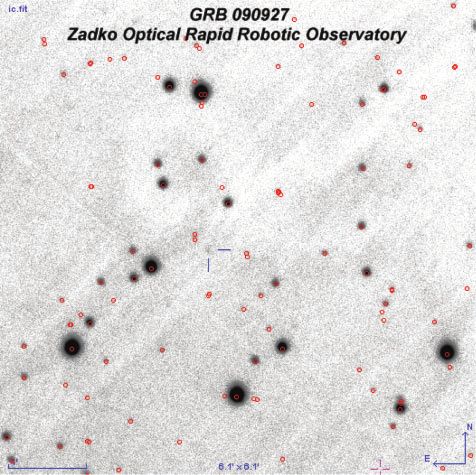
Figure 6 GRB 090927 optical afterglow, shown by the pointer
video camera, and continued for 1 h. The OA candidate
marks near the image centre. Red circles are known stars from the
reported in GCN 8529 was seen in a selected stack of NOMAD1 catalog. This ZT image is a sum of 2 180 s exposures
40 5 s exposures, though it was near the detection taken 2.6 h post-Swift trigger. Stellar images have UFWHM ¼
limit. Using nearby USNO-B1 stars, the OA magnitude 1.8 arcsec. The afterglow at this time had R ¼ 20.0 0.5 (image
was found to be 20.9 0.5 (GCN 8675). Confirmations processed by TAROT collaboration).
of this OA candidate were made by the 2.2 m GROND
telescope and the VLT; a VLT spectroscopic redshift of
z ¼ 2.58 was determined 8 h after the ZT observation. in piloted robotic mode. A fading source was found
GRB 090205: This was a late-time observation; ima- within the XRT error circle — see Figure 6. Preliminary
ging started 17.6 h post-Swift trigger, with the unfil- photometry of this OA candidate gave R-band magni-
tered Andor camera, and continued for 4460 s. In a tudes of: 19.8 0.5 (540 s exposure) and 20.0 0.5
1100 s stacked image, a candidate OA with 23.2 0.3 (360 s), at post-burst times of 126 and 158 min, respec-
white magnitude was marginally detected (SNR ¼ 3.3) tively (GCN 9956).
at the enhanced XRT position reported in GCN 8885. GRB 091127 — with a slowly-decaying OA: This
This OA magnitude was estimated using nearby was a bright 15.0 mag source which triggered after
USNO-B1 stars (GCN 8976). As the source was near dawn but had an unusually slow decay time. Using a
the detection limit, the same field was imaged 2 weeks Pentax K200D digital SLR camera mounted at the
later: the candidate OA was not detected, which is Cassegrain focus, late-time imaging of the field
consistent with a fading GRB as a possible cause of this reported in GCN 10191 started 18.5 h post-Swift trigger
transient. and continued for 28 min; during this time the Moon set
GRB 090313: Imaging of the field reported in GCN and weather conditions were good. A faint source was
8980 started 4.26 h post-Swift trigger, with significant found at the OA candidate location reported in GCN
sky brightness from the Moon. The OA decayed from 10199. Photometry on a co-added sum of 4 CCD
18.02 0.08 to 18.84 0.12 in 8500 s (GCN 8996). images (of 806 s total exposure time) gave an OA
GRB 090509: Imaging of the field reported in GCN magnitude of 18.9 0.1 (GCN 10238).
9325 started 8 h post-Swift trigger; 48 5 s exposures
were made over 14 min. Due to sky brightness from a 5 Future Development
full Moon, no candidate OA was found at the GROND
position (GCN 9326), nor at the BAT-refined position 5.1 Instrument Upgrade
(GCN 9349), with an upper limit of R ¼ 17.6 estimated The Guide Acquire Module (GAM) supplied with the
from nearby USNO-B1 stars (GCN 9363). DFM telescope places the optimal image plane too close
GRB 090516: Imaging started 275 min post-Swift to the current optical mounting plate to allow a large filter
trigger, and continued for 131 min. An OA candidate wheel to be placed in front of the current Andor camera.
was found within the XRT error circle, and it faded from There are several solutions to this problem, depending
18.9 0.5 to 20.26 0.14 over 21 min (GCN 9380). on available funds; a particularly attractive one would
GRB 090927 — a possible short GRB: Imaging of be to replace the GAM with a new optical mounting
the field reported by Swift/UVOT (GCN 9946) started structure, to ensure that there is space for mounting the
110 min post-Swift trigger, and continued for 50 min filter wheel, electronic focuser, and Andor CCD camera.
Downloaded from https://www.cambridge.org/core. IP address: 46.4.80.155, on 06 Nov 2021 at 16:46:11, subject to the Cambridge Core terms of use, available at https://www.cambridge.org/core/terms.
https://doi.org/10.1071/AS09078338 D. M. Coward et al.
The new design will allow for three optical paths: for to ASKAP also provides a unique advantage in the follow-
filtered CCD imaging, an integrating video camera and a up of short-lived ASKAP radio transients.
spectrograph.
Subject to funding, a new CCD camera, filter wheel, 5.3 Remote Access Astronomy in Education
and filter system will be installed. One of the imagers The ZT has initiated a novel public outreach program that
being considered is the Fairchild Peregrine 486 CCD allows small groups to obtain CCD images on site for a
camera which can be matched to the image focal plane few hours every month. This program is part of a broader
of the existing optical mount. It has a 61.44 61.44 mm science outreach project. Furthermore, projects are being
chip, with an imaging FOV of 18 or 7 times the area of the developed that will allow students to participate in ZT
existing camera; by significantly increasing the survey science, and to design and implement projects which will
speed, this camera would extend the science capabilities allow them to make useful scientific contributions. The
of the ZT in the field of transient searches. project list is long, but includes:
5.2 ZT Science Linkages Minor planet and NEO recovery and discovery.
Supernova surveys, discovery and follow-up.
ZT research is tightly linked to several existing and
GRB and other transient event follow-up.
upcoming international programs in transient astronomy.
The ZT team is part of the TAROT collaboration, which As the global awareness of the importance of astron-
already uses two other very rapid response telescopes (in omy as a context for teaching science continues to
France and Chile). We are working closely with the GW increase, educators are now able to re-engage in observa-
astronomy community (the LIGO Scientific Collaboration) tional astronomy through the use of remote access to
to use the ZT for optical follow-ups of candidate GW robotic telescopes. In parallel with this trend, wide-field
events, and to survey galaxies within the LIGO sensitivity instruments are generating a wealth of data directly
horizon for coincident optical-GW transients. Our TAROT available to the public for analysis. There are very
collaboration is also working with the the Antares deep-sea practical reasons for this, namely that the huge data
neutrino telescope to follow up on possible neutrino events. volumes make it difficult to search for faint optical
These projects are at the frontier of multi-messenger transients. This represents an opportunity for science
astronomy, and it is very timely for the ZT to play a role educators to tap into at relatively small cost, with the
when these projects are just starting. benefit of contributing to real science.
The U.S. GW observatory LIGO started searching for The ZT is primed to take advantage of these opportu-
GW transient signals, with unprecedented sensitivity, in nities in education, training and outreach. The ZT obser-
late 2009 (Abbott et al. 2007). Despite the detection of vatory control system, using the TAROT robotic system,
significant numbers of candidate GW transient events in allows science data to be acquired remotely using a web-
LIGO data in recent science runs, the SNR of these based interface. Our French collaborators have success-
correlated signals is relatively small. It is difficult to fully used this system for education and outreach. The ZT
confirm that these events are astrophysical in origin, rather will act as a node in a distributed network of robotic
than environmental (Fox et al. 2005). However, the asso- telescopes, allowing the opportunity for students in Eur-
ciation of such an event with an astrophysical transient ope to acquire image data from the ZT. Conversely, local
observed in the optical would dramatically improve the students can acquire data from the other networked
confidence of GW detection. The ZT, with our partners in telescopes in France and Chile.
the TAROT collaboration and other transient telescopes, An education research project is being developed, as
will be testing and developing procedures to search for part of an ARC Linkage grant, aimed at measuring the
coincident GW and optical transients. effectiveness of student learning via remote access astron-
The Australian SKA Pathfinder (ASKAP), currently omy. With astronomy as the context, this will provide
under construction, is a revolutionary new design of radio valuable data on how different modes of learning science
telescope, capable of monitoring 30 deg2 of sky instanta- influence students’ choices to continue science education
neously, forming images with 10 arcsec resolution from high school to tertiary level.
(Johnston et al. 2008). ASKAP will have both wide sky
coverage and high sensitivity, plus the ability to locate Acknowledgments
transient radio sources to high precision. However, for D. M. Coward is supported by ARC grants DP 0877550,
fast radio transients that appear and disappear on time- LP 0667494, and by the University of Western Australia
scales as short as a millisecond, searches will initially (UWA). The ZT facility is managed by the School of
be incoherent (i.e. uncorrelated); this will only provide Physics, UWA, the International Centre for Radio
low-resolution positional information, although offline Astronomy Research (ICRAR), and the Australian
postprocessing of the raw data can also provide high- International Gravitational Research Centre (AIGRC).
resolution positions. Incoherent detection will provide We also acknowledge the Centre for Learning Technol-
ASKAP triggers with positional accuracy of 18 which is ogy (CLT) at UWA, and the Western Australian
well-matched to the capability of the ZT once it is Department of Education and Training (DET), for sup-
upgraded to achieve a 18 FOV. The proximity of the ZT porting a science training and outreach program.
Downloaded from https://www.cambridge.org/core. IP address: 46.4.80.155, on 06 Nov 2021 at 16:46:11, subject to the Cambridge Core terms of use, available at https://www.cambridge.org/core/terms.
https://doi.org/10.1071/AS09078The Zadko Telescope 339
References Johnston, S. et al., 2008, ExA, 22, 151
Klotz, A., Bo€er, M., Eysseric, J., Damerdji, Y., Laas-Bourez, M.,
Abadie, J. et al. (LIGO Scientific Collaboration and the VIRGO Pollas, C. & Vachier, F., 2008a, PASP, 120, 1298
Collaboration), 2010, LSC Document LIGO-P0900125, e-print Klotz, A., Vachier, F. & Bo€er, M., 2008b, AN, 329, 275
(arxiv:1003.2480v2 [astro-ph.HE]) Klotz, A., Gendre, B., Atteia, J. L., Bo€er, M., Coward, D. M. &
Abbott, B. et al., 2007, PhRvD, 76, 062003 Imerito, A. C., 2009, ApJ, 697, L18
Andor Technology PLC, 2007, iKon-L DW436-BV Technical McLean, I. S., 2008, Electronic Imaging in Astronomy: Detectors
Document (Belfast, N. Ireland: Andor Technology PLC) and Instrumentation (2nd ed; Chichester, UK: Springer-Praxis
Barbieri, C., 2007, Fundamentals of Astronomy (Boca Raton FL, Publ. Ltd.), 46
USA: CRC Press, Taylor & Francis), 292 Saha, A., Dolphin, A. E., Thim, F. & Whitmore, B., 2005, PASP,
Bertin, E. & Arnouts, S., 1996, A&AS, 117, 393 117, 37
Bourez-Laas, M., Vachier, F., Klotz, A., Damerdji, Y. & Bo€er, M., Sathyaprakash, B. S. & Schutz, B. F., 2009, Living Reviews in
2008, Proc. SPIE, 7019, 701918 Relativity, 12(2), 99–102 (arxiv:0903.0338v1 [gr-qc])
Coward, D. M., Guetta, D., Burman, R. R. & Imerito, A., 2008, Zombeck, M. V., 1990, Handbook of Space Astronomy & Astro-
MNRAS, 386, 111 physics (2nd ed; Cambridge, UK: Cambridge Univ. Press), 100
Fox, D. B. et al., 2005, Nature, 437, 845
Downloaded from https://www.cambridge.org/core. IP address: 46.4.80.155, on 06 Nov 2021 at 16:46:11, subject to the Cambridge Core terms of use, available at https://www.cambridge.org/core/terms.
https://doi.org/10.1071/AS09078You can also read


