Trading Standards Scotland - Business Plan 2021 - 2022 HOME OF TRADING STANDARDS
←
→
Page content transcription
If your browser does not render page correctly, please read the page content below
Trading
Standards
Scotland
Business Plan
2021 - 2022

             HOME OF
        TRADING STANDARDS
            SCOTLAND
Contents

1. Foreword.............................................................. 3

2. Introduction........................................................ 5

3. Governance & Authorisation........................... 6

4. Representation................................................... 7

5. Team Structure................................................... 8

6. Resources for Local Authorities...................... 9

7. National Priorities.............................................. 12

8. Conclusion........................................................    15

9. Key Performance Indicators..........................                  16
1                                  Foreword

    Welcome to Trading Standards Scotland’s
    Business Plan for 2021/22. After an extremely
    challenging year, we begin this financial year
    still very much in the grip of the COVID-19
    pandemic and living under necessary
    restrictions on many aspects of our lives.
    Rogue traders and scammers have been quick to identify
    and exploit consumer vulnerabilities during this time and
    as a consequence, we have seen price gouging, false
    and misleading marketing of PPE equipment, bogus testing kits and latterly, vaccine
    related scams.
    There has been an increased demand for certain ‘lockdown’ products and services
    which in many cases, has caused a boom in illicit trade. The sale of puppies sourced
    from illegal, low welfare puppy farms which are being marketed as the offspring
    of family pets. The rise in unlicensed suppliers of internet protocol TV streaming
    services which appears to be a victimless crime threatens the creative and sporting
    industries as well as jobs in the legitimate supply chain.
    Protecting consumers and legitimate business from illicit trade is a vital part of
    Scotland’s economic recovery from the impact of COVID. Therefore Trading
    Standards Scotland will proactively focus its enforcement activity on tackling these
    issues.
    The UK and Scottish Governments have both identified the transition to a low
    carbon economy as a key objective to tackle climate change and as a route to
    economic recovery post COVID. To support this, TSS will target rogue traders in the
    energy efficiency sector to protect consumers as they seek to improve the energy
    efficiency of their homes.
    The Trade and Cooperation Agreement between the UK and the EU was struck on
    the 24th December 2020, days before the transition period came to an end. At this
    early stage in 2021, with COVID restrictions continuing to impact upon commerce,
    it is still unclear what effect the new trading environment will have on consumers
    and how scammers might seek to exploit it. However there are early indications of
    higher charges for goods sourced from the EU.
    TSS will actively monitor intelligence on this issue so any consumer detriment can
    be identified and tackled as it emerges.
    As a councillor, I am acutely aware of the impact COVID is having and will continue
    to have on local authority resilience. With this in mind and in recognition of UK
    Government’s continued commitment to review trading standards services both
    nationally and locally, last year I wrote to Council Chief Executives and other

                                           3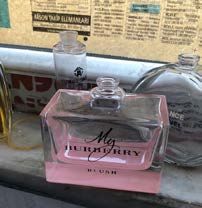
stakeholders asking how the resources of TSS could best support local authority
trading standards services.
I am grateful to everyone who has taken the time to respond and this year we will
publish the key points emerging from the consultation along with an action plan
to develop the service TSS delivers accordingly. I hope that this will strengthen
the relationship between local trading standards and Trading Standards Scotland
enabling the service as a whole to work together more effectively to tackle trading
malpractice and illicit trade in order to protect consumers and legitimate business.
.

    Kelly Parry
    COSLA Spokesperson for the Community & Wellbeing Board and
    Chair of the Trading Standards Scotland Governance Board

                                        4
2                          Introduction

    Trading Standards Scotland is a team delivered by COSLA and
    funded by UK government to add capacity to local authority trading
    standards services in Scotland. The team is funded to:
    •   tackle consumer detriment occurring across local authority
        boundaries;
    •   provide expertise in cybercrime investigations ;
    •   provide national intelligence capability; and
    •   tackle illegal money lending investigations and undertake
        initiatives to prevent individuals from turning to this source of
        lending.

                                     5
3            Governance & Authorisation

    Governance
    As part of its funding agreement with Cosla, the Depart of Business, Energy and
    Industrial Strategy and HM Treasury set out the broad functions that they wish TSS
    to undertake and key performance indicators on which it is to report. These are
    set out in the Appendix to this Plan.
                   In addition TSS is accountable to a political Governance
                   Board within COSLA chaired by COSLA’s Spokesperson for
                   Community Wellbeing, Cllr Kelly Parry. It comprises elected
                   members representing all major political parties in Scotland and
                   representatives from BEIS; SCOTSS and the Consumer and Low
                   Carbon Division of Scottish Government are also represented on
                   the Board.
    Being part of COSLA means that Trading Standards Scotland is at the heart of
    policy development for local government enabling consumer protection issues to
    be given prominence and be linked to other relevant policy areas such as health
    and social care, community safety and sustainable economic growth.

    Authorisation
    In order to undertake an enforcement role, TSS receives delegated authorisation
    from councils which it obtains by virtue of the Local Government (Scotland) Act
    1973. It engages with local authority trading standards services via the Society
    of Chief Trading Standards Officers in Scotland (SCOTSS). On a bi-monthly basis
    regional representatives from SCOTSS attend a Tactical Tasking meeting with
    TSS management to jointly oversee the work undertaken by TSS to tackle cross
    council border and agree whether new referrals to the team meet the threshold
    for TSS involvement.

                                        6
4                                      Representation

    Consumer Protection Partnership
    TSS represents Scottish trading standards at the UK Consumer Protection
    Partnership (CPP); the forum through which partners1 in the consumer landscape
    come together strategically and operationally to address UK emerging consumer
    issues.

    Consumer Network
    TSS is also part of Scottish Government’s Consumer Network which brings
    together individuals and organisations involved in consumer protection in
    Scotland. It is anticipated that Consumer Scotland, the new advocacy and advice
    body will be established in shadow form this year and Trading Standards Scotland
    looks forward to working closely with it to align enforcement with advice and
    advocacy in the developing consumer protection landscape in Scotland.

    Scams Prevention Strategy
    In its 2019 Programme for Government, Scottish Government announced its
    intention to develop a Scams Prevention Strategy for Scotland. TSS is participating
    with other stakeholders to develop proposals for the Strategy including the
    establishment of a single point of contact for victims of scams. The proposals will
    be put before the Minister for Business, Fair Work and Skills for consideration in
    2021.

    Scottish Crime Campus
    TSS is a partner organisation at the Scottish Crime Campus. It engages with
    Police Scotland, HMRC, Border Force and other enforcement agencies to share
    intelligence and participate in multi-agency activity and assisting in tackling serious
    and organised crime.

    1 In addition to TSS, the Partners are: BEIS, Competition and Markets Authority; Citizens Advice (England
    and Wales), National Trading Standards (England and Wales), Chartered Trading Standards Institute, Trading
    Standards Northern Ireland, Consumer Council of Northern Ireland, Advertising Standards Authority, Financial
    Conduct Authority

                                                    7
5 Team Structure
The diagram below shows the current structure of TSS:
Chief
Officer
Head of Intelligence Admin Support /
& Coordination Digital Marketing
Principal Prevention Enforcement National
Intelligence Coordinator Coordinator Database
Officer Administrator
Strategic Tactical
Analyst Analyst
Principal Principal
Investigator Investigator
(Fair Trading) (Illegal Money)
Intelligence
Development
Officer
Investigators Cybercrime Investigators Partnership
(5 FTE) Investigator (4 FTE) & Support
(1 FTE) Officer
86 Resources for Local Authorities
As well as undertaking investigations on behalf of local authority trading standards,
the national team provides other kinds of resource such as the provision of
equipment, financial support and intelligence support.
In 2020/21 the Chair of the Trading Standards Scotland Governance Board, Cllr
Kelly Parry wrote to local authorities and other stakeholders to ask what other
areas of support they would like to see from the national team. The responses will
be analysed and a report will be produced for the Board to consider.
1. Call Blocking Devices
This year, TSS will disseminate 725 call blocking devices to
vulnerable consumers. These have been procured jointly by
TSS and Scottish Government2 and will be available to the
general public in March 2021. Local authorities and third sector
organisations can apply on behalf of vulnerable consumers known
to them.
As well as protecting individuals, the call blockers are a valuable source of
intelligence which can be used to identify the most prolific nuisance callers. They
record the numbers they block and this data is shared with TSS to link numbers to
known rogue traders. This is shared with local authority trading standards to assist
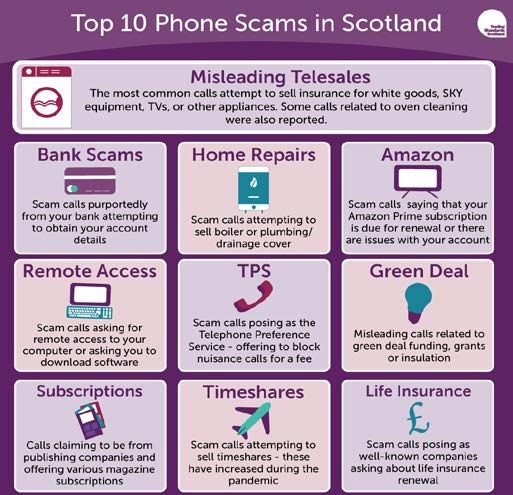
with investigations into scams and misleading marketing. The infographic below
shows the ten most common phone scams from 2020.
2 TSS provided £20k and SG provided £60k
92. Scam Victim Data
TSS funds access to a database known as Compass; a web-
based system which holds details of potential scam victims. The
database which is run by the national trading standards body
for England and Wales, is accessible to Scottish local authority
trading standards enabling them to undertake interventions often
in conjunction with health and social care colleagues, in order to
protect victims from further financial harm.
3. Prevention Campaign Material
TSS has produced a bank of prevention material for use on social
media which is available on the TSS website. It also has supplies of
physical leaflets, banners and other products which are available
for local authority trading standards to use on issues such as
scams and doorstep crime.
Recently it has started to produce podcasts which appear on
podcast sites and on the TSS website. These focus on national issues of consumer
detriment and speakers are from Scottish trading standards and other relevant
partner organisations.
TSS also produces a weekly ScamShare bulletin which as the name suggests,
alerts consumers to the latest scams. The bulletin is widely shared by local
authority trading standards services, Scottish Government, third sector
organisations, community groups and individuals. On average the bulletin is read
by between 800 and 1000 people per week.
TSS is currently working with East Renfrewshire Council, Advice Direct Scotland
and Scottish Government to develop a Financial Harm Toolkit for national use. It
will pilot a scheme to allow local authorities to develop a bespoke toolkit which
reflects local services.
4. Enterprise Act 2002 support
Part 8 of the Enterprise Act 2002 provides for civil enforcement to
be taken against traders who persist in a course of conduct which
is detrimental to consumers.
TSS is not a designated enforcer under the Act and where there is
cross local authority consumer detriment which merits civil action
of this kind, it relies on local authority trading standards services
and solicitors to undertake civil action on its behalf. TSS provides dedicated
officers to guide the process and conduct the investigation.
TSS has delivered training to local authority trading standards services to
encourage greater use of Part 8 actions and has created a knowledge hub where
best practice is shared.
105. Intelligence Database
TSS owns and administers the national intelligence database
known as Memex on behalf of Scottish trading standards and
Food Standards Scotland. It pays the licensing costs to give local
authorities access to the system to both input and view intelligence.
TSS also provides ongoing training on use of the system and the
deployment of intelligence more generally.
This year, TSS will relinquish its ownership of Memex and Scottish trading
standards will transfer to use of another database known as IDB which is used by
trading standards in England and Wales, the Intellectual Property Office and the
Office of Product Safety and Standards. TSS will oversee and fund the transition of
the data on behalf of Scottish local authorities. It will also fund access to the IDB
database for Scottish trading standards.
117 National Priorities
Every year TSS identifies issues which it will prioritise its resources at tackling.
These are usually identified from analysis of the previous years’ intelligence.
Given the impact that COVID 19 on commerce last year, it has been difficult to
predict the issues that will present the greatest risk to consumers and/or legitimate
business in 2021/22.
It is also unclear what fair trading issues may emerge as a consequence of the UK
now having third country status in relation to the EU. A flexible approach will be
required and continually monitor intelligence.
Having evaluated the impact of the projects undertaken in 2020/21, this year TSS
will focus on a smaller number of issues but over the course of the whole year. The
intention is to achieve a more enduring impact than has been achieved by short
bursts of enforcement activity which have seen only a temporary disruption of
trading malpractice.
Proactive Campaigns for 2021/22
In 2021/22 TSS will focus on three proactive campaigns:.
1. Project Maxwell - Misleading Marketing of Energy Efficiency
Products
Unscrupulous traders are exploiting the existence of government
energy efficiency grants and funding schemes by falsely claiming
that they are available for the products they are selling in order to
hook consumers into purchasing them. In addition false/misleading
statements are being made as to the efficacy of the products and
their suitability within consumer’s homes.
Consumers are particularly vulnerable in this market due to their lack of knowledge
of the products and the complex landscape of grants and schemes available from
UK, Scottish and local government.
Last year TSS investigated 8 traders in the energy efficiency sector responsible for
known consumer detriment estimated at £4.5 million, although the actual figure
is likely to be far higher. Intelligence shows that many consumers are hooked into
dealing with rogue traders such as these through false and misleading adverts
which often appear on social media. The adverts are generally placed by lead
generators who pass consumer details on to rogue traders. They hook consumers
in by falsely claiming that government grants and funding are available for the
products.
TSS undertook a project to tackle the misleading adverts and within a month, some
430 adverts had identified and action was taken to have them removed or altered.
12Although the project caused a cessation in adverts and prevented significant
consumer detriment, adverts have re-emerged. This year TSS will embark on a
rolling programme of advertisement monitoring and enforcement in order to
bring about a more enduring cessation to misleading adverts of this kind.
As well as preventing consumer detriment, it will promote economic growth
amongst legitimate traders in the energy efficiency sector and in so doing, assist
Scottish Government in its aims to reduce carbon emissions through improved
energy efficiency in private dwellings.
2. Project Jasper - Counterfeit goods sold on social media and
online market places
Social media is now an established platform for individuals to buy
and sell goods including the sale of counterfeit goods. The public
perception of counterfeit goods prevails that it is a victimless
crime and that sellers are only trying to make a bit of money
on the side. There is little public recognition of the scale of the
problem and that it often funds serious organised crime. Neither
is there recognition of the safety risk presented by low quality
and potentially unsafe electrical equipment, toys and cosmetics being passed off
as high quality brands. Regardless of public perception, it is an area of significant
detriment to the economy and tax revenue of the country.
TSS previously undertook Project Jasper in the run up to Christmas to disrupt
sellers at their busiest point. However it is an all year round phenomenon and
this year, TSS intends to run a rolling programme of intelligence gathering and
enforcement activity.
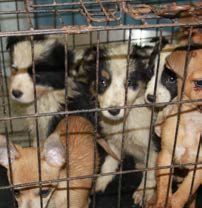
3. Project Redpath - Misleading marketing on online platforms of
puppies from low welfare puppy farms and other illicit sources
Demand for puppies, particularly new ‘designer’ breeds, has grown
over the years. However lockdown have given rise to an even
greater demand and supply from legitimate high welfare sources is
nowhere near sufficient to meet it. Criminals are moving into the
market and the number of puppies being sourced from illegal, low
welfare puppy farms is increasing. There has also been an increase
in scams where criminals take deposits and then fail to produce a puppy.
As well as the suffering caused to the animals, the illicit trade in puppies causes
financial and emotional detriment to consumers who find they have purchased an
ill puppy which may die shortly after purchase and/or requires expensive veterinary
care.
The illicit puppy trade is being facilitated through online platforms such as
Gumtree and Pets4homes where adverts are being placed by dealers posing as
individuals selling pups from their family pet.
13TSS aims to disrupt this trade by tackling false and misleading adverts. It will focus
on identifying these throughout the course of the year and taking enforcement
action where appropriate.
4. Project Fall - Itinerant Doorstep Crime
The most consistent and pernicious form of doorstep crime is
perpetrated by itinerant groups that travel the length and breadth
of the country, repeatedly targeting elderly and vulnerable people
in our communities. They cold call ostensibly to undertake home
maintenance work such as roof or driveway repairs with the aim of
exploiting as much money as possible from the victim for little or
no actual work.
Local authority trading standards services and police divisions work in partnership
to tackle localised incidents of doorstep crime. Trading Standards Scotland is
working with Police Scotland at a national level to develop a national intelligence
picture of this type of crime so that collective, proactive approach can be adopted.
148 Conclusion
Trading Standards Scotland provides a service which complements
that of local authority trading standards; tackling trading malpractice
which affects consumers across Scottish local authorities. By setting
out our resources and planned activity for the coming year, it is
hoped that local authorities will engage with the service so that
better outcomes are achieved for consumers and businesses that
trade fairly.
159 Performance Indicators
In consultation with BEIS and HM Treasury, TSS has identified key performance
indicators for 2021/22 intended to improve outcomes in tackling consumer
detriment and illegal money lending. These are the same as the previous year and
are set out below along with the outputs from 2020/21.
KPI Output for 20/21
Operations commenced in the period, broken
into seperate activity strands:
• Criminal
• Civil
• Cyber
Total
Reports submitted to the Procurator Fiscal
Commenced Part 8 actions under the Enterprise
Act 2002
• Breach of enforcement orders pursued
• Enhanced consumer measures sought
Cases referred for POCA investigations (Police
Function)
Cases referred to Civil Recovery Unit
(Police Function)
Cases referred to other enforcement agencies
Enforcement outcomes undertaken in
partnership with local authority trading standards
teams and/or other enforcement agencies
TSS training events undertaken for local
authority Trading Standards services.
(Enforcement, Intelligence or Prevention)
Intelligence logs submitted by TSS
Analytical products produced
Intelligence development cases commenced
Intelligence packages developed for local
authority operations (cybercrime/other)
Consumers/businesses reached in preventative
campaigns: online, printed media, radio/TV
16Cost Benefit analysis will capture:
• Number of consumer affected in each case (vulnerability of consumers
assessed)
• Value of goods seized
• Cash/assets assessed for POCA/Civil Recovery
• Evaluation of enforcement outcomes resulting from training local authorities
• Participation of local authority TS in events coordinated by TSS
• Number of intelligence logs submitted by each local authority
Illegal Moneylending KPIs
STOP £OAN SHARKS
Scottish Illegal Money Lending Unit
Output for
KPI
20/21
Operations commenced
Operations commenced on behalf of or supporting
stakeholders
Calls to hotline
Reports submitted to the Procurator Fiscal
Individuals reported
Individuals convicted
Custodial sentences
Non-custodial sentences
Total length of custodial sentences
Total value of fines
Referrals for POCA action
Value of cash/goods seized
Value of any associated financial restraints
Value of any associated POCA recovery
Estimated financial savings to consumers
Estimated value of criminality
Consumers affected
Victims provided with support
People reached through community education
projects
17HOME OF
TRADING STANDARDS
SCOTLAND
www.tsscot.co.uk
@TSScot
@tsscotland
TSScot
@StopLoanSharks
STOP £OAN SHARKS
Scottish Illegal Money Lending Unit @stoploansharks
ScottishIMLUYou can also read


