TRANSIT SERVICE POLICY OCTOBER 2015 - Metro
←
→
Page content transcription
If your browser does not render page correctly, please read the page content below
Los Angeles County
Metropolitan Transportation Authority

TRANSIT SERVICE POLICY
OCTOBER 2015
2016 Metro Transit Service Policies & Standards

                                                  TABLE OF CONTENTS

EXECUTIVE SUMMARY ................................................................................................................. 5

     BACKGROUND ................................................................................................................ 5

SECTION 1: INTRODUCTION, PURPOSE & BACKGROUND .................................................... 9

     1.1 Introduction .............................................................................................................. 9

     1.2 2015 Peer Review Committee (PRC) ..................................................................... 10

     1.3 Purpose ................................................................................................................... 11

     1.4 Background ............................................................................................................. 12

     1.5 APTA Peer Review Committee ............................................................................... 15

SECTION 2: DESIGNING A REGIONAL TRANSIT NETWORK ................................................. 17

     2.1 Key Principles of Network Design.......................................................................... 17

     2.2 Markets Served ....................................................................................................... 20

     2.3 Transit Service Classifications ............................................................................... 21

     2.4 Metro Transit Service Types ................................................................................... 21

     2.5 Alternative Service Delivery Options ..................................................................... 25

     2.6 Facilities .................................................................................................................. 25

SECTION 3: SERVICE DESIGN GUIDELINES ............................................................................ 27

     3.1 Metro Service Councils .......................................................................................... 27

     3.2 Service Design ........................................................................................................ 29

     3.3 Customer Information & Amenities ...................................................................... 42

SECTION 4: SERVICE PERFORMANCE EVALUATION ............................................................. 47

     4.1 Service Performance Indicators ............................................................................. 47

     4.2 Route Performance Index ....................................................................................... 51

     4.3 Service Change Performance Evaluation ................................................................ 52

                                                                                                                                            1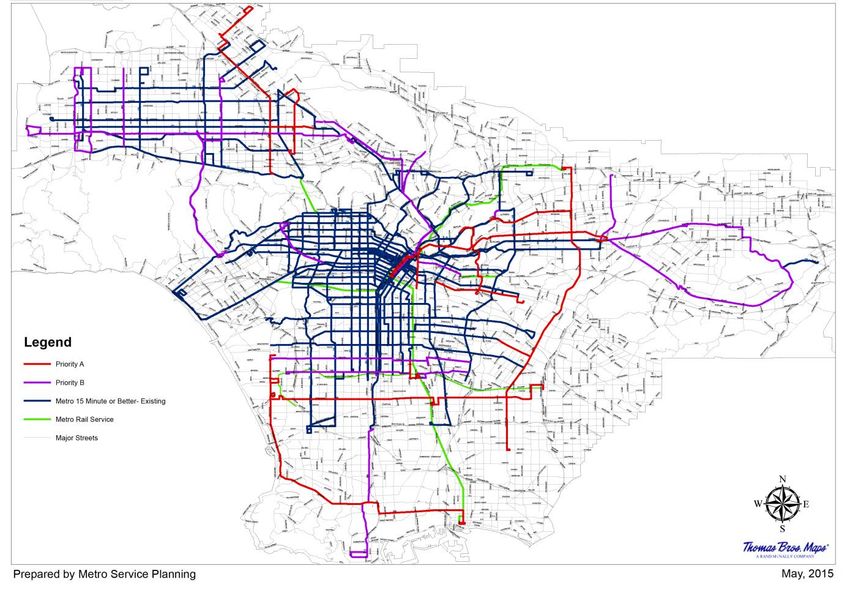
2016 Metro Transit Service Policies & Standards

      4.4 Service Policy Regarding Realignment of Metro and Municipal Bus Service ...... 52

SECTION 5: IMPLEMENTING THE PLAN ................................................................................. 54

      5.1 Changes to the Rapid Bus Network ....................................................................... 55

      5.2 Goals and Objectives ............................................................................................. 56

      5.3 System and Service Evaluation .............................................................................. 57

      5.4 Develop Service Draft Restructuring Plan ............................................................. 57

SECTION 6: SERVICE CHANGE PROCESS ................................................................................ 59

      6.1 Title VI Equity Analysis ........................................................................................... 60

      6.2 Public Outreach ...................................................................................................... 62

      6.3 Public Hearing Process .......................................................................................... 64

      6.4 Implementing Minor Changes on an Interim Basis ............................................. 65

SECTION 7: CONCLUSION ........................................................................................................ 66

APPENDICES ................................................................................................................................ 67

      APPENDIX A: 2015 PEER REVIEW COMMITTEE MEMBERS...................................... 68

      APPENDIX B: METRO LINE IDENTIFICATION ........................................................... 69

General Standards ........................................................................................................................ 69

Printed Materials and Electronic Customer Information ........................................................... 69

Bus Stop Signage: ........................................................................................................................ 69

Vehicle Headsigns ........................................................................................................................ 70

Automatic Voice Announcements ............................................................................................... 70

Assigning Line Identifiers ............................................................................................................ 70

      APPENDIX C: METRO RAPID PROGRAM SERVICE WARRANTS ............................... 72

Corridor Alignment ...................................................................................................................... 72

Stop Location ............................................................................................................................... 72

2
2016 Metro Transit Service Policies & Standards

Transit Priority .............................................................................................................................. 73

Rapid Vehicle Fleet ....................................................................................................................... 73

Service Frequencies...................................................................................................................... 73

Service Span ................................................................................................................................. 73

      APPENDIX D: TYPICAL BUS STOP/ZONE DESIGN AND GUIDELINES................... 74

      APPENDIX E: SCHOOL TRIPPER SERVICE CHANGE PROCEDURES ....................... 79

      APPENDIX F: LOS ANGELES COUNTY LOCAL FIXED ROUTE TRANSIT OPERATORS
          ................................................................................................................................. 80

      APPENDIX G: SERVICE CHANGE PROCESS ............................................................... 82

                                                              Metro Rapid Stop

                                                                                                                                                 3
2016 Metro Transit Service Policies & Standards

                           This page intentionally left blank.

4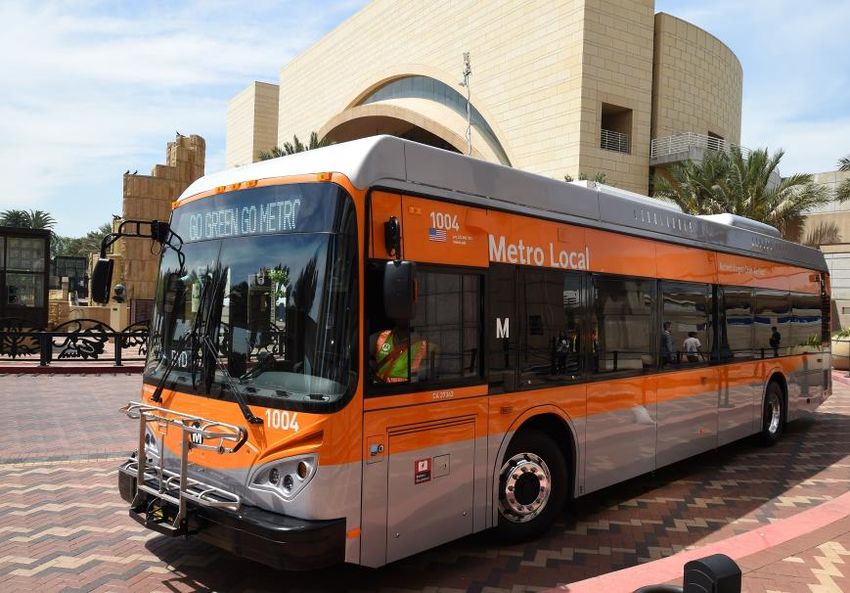
2016 Metro Transit Service Policies & Standards

EXECUTIVE SUMMARY

The Transportation Service Policy (TSP) document sets forth the policies, principles and
requirements that will be used by Metro staff in the design or modification of the current
service network in order to better serve our customers and make better use of available
operating resources. Subsequent analyses will determine the actual service changes to be
made in accordance with the requirements of the public review process. This document
updates the 2012 version previously adopted by the Board.

BACKGROUND
On June 25, 2015, the Metro Board of Directors (Board) was given an update on the short-
and long-term fiscal capacity of the agency. 1 The overall assessment of the agency’s financial
health is that both capital and operating programs are at risk given:
   • The potential for economic downturn could trigger a recession event. Presently bids
        for capital projects are coming in higher than anticipated and operating costs are
        rising faster than the Consumer Price Index (CPI);
   • Borrowing strategies which use the capacity of Propositions A and C are at risk
        because fares are not keeping pace with costs, and the demand for Access Paratransit
        services is growing;
   • New revenue sources are an important component for the agency’s fiscal stability.

Nearly $1.8 billion in projects have been added to the Short Range Transportation Plan
(SRTP) for the period from FY2015 to FY2024. This has created the potential for a $1.0 billion
operating shortfall when combined with the need for specialized services for individuals that
cannot use public transportation. A fare increase would help keep the projected shortfall to
the estimated $1.0 billion mark. However, if fares remain flat, if Americans with Disabilities
Act (ADA) costs continue to rise, and/or the region experiences an economic downturn, the
shortfall could more than double to $2.1 billion, jeopardizing Metro’s ability to support the
critical services needed by the residents and visitors of Los Angeles County.

In March 2015, the Board directed staff to look at ways to innovate and redesign the service
system to better meet the transportation needs of the Los Angeles region. The principles
outlined in the TSP are intended to carry the agency forward and support improvements to
Metro’s core transit services such as improved on-time service, greater service frequencies on
core network bus services, and increased rail bus interface and coordination.

Forecasts of Local and Rapid Bus Revenue Service Hours (RSH) allocations for the agency
reflect a slight overall reduction in the number of hours over the next several years.
Conversely, Bus Rapid Transit (BRT) RSHs are expected to grow with the projected conversion
of Rapid Line 720 to BRT in FY2016. Total annual Bus RSHs are fixed at 7,061,735 for FY2016
through FY2018, falling slightly with the introduction of the Regional Connector and the

1
    Fiscal Stability Overview and Funding Commitments Inventory (2014 SRTP Financial Update), Item 19.

                                                                                                         5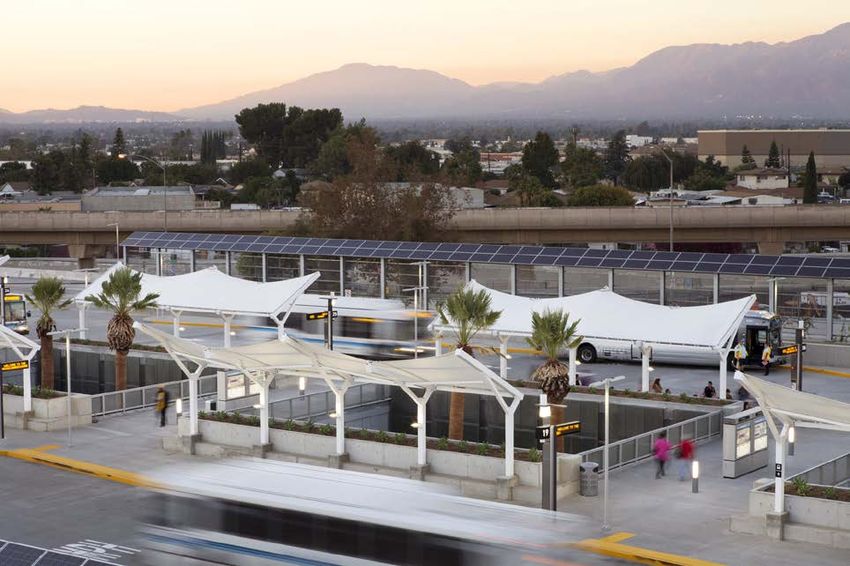
2016 Metro Transit Service Policies & Standards

Crenshaw Lines in FY2020. Table 5.1 in Section 5 of this document displays the allocation of
Bus RSHs by year. Clearly, the supporting bus network will be constrained over the next
several years.

Additions to existing transit services including new rail projects Expo Phase 2, Gold Line
Foothill Extension, Regional Connector Transit Corridor, and the Crenshaw/LAX Transit
Project should be considered as enhancements to the system. These new rail services will
expand and enhance the travel options for residents and visitors to Los Angeles County.

As a result of the recognized budgetary constraints, the Board of Directors engaged the
American Public Transportation Association (APTA) to conduct a peer review of our service
principles, fare structure, and mechanisms for acquiring and identifying new sources of
revenue. Their recommendations were published in January 2015.

The APTA Peer Review panel made a number of recommendations to increase efficiency and
productivity. The most significant of those recommendations is to increase the allowable
number of standees on buses from 30% of a seated load to 40% of a seated load. The
Committee also recommended that improvements in overall speed of the system were
needed to increase the productivity of operations. Finally, the Committee recommended that
resources be moved from less productive lines to higher productivity services to better
accommodate passenger demand. A detailed listing of their recommendations is presented in
Section 1.5 APTA Peer Review Committee.

In addition, Metro consulted with its own Peer Review Committee (PRC) to provide input and
recommendations on:

    1. Identification of gaps in the 15-minute frequent service network. Gap closure
       recommendations were prioritized by Service Planning staff into four categories (A-D).
       As discussed in Section 5, categories A and B will be incorporated into the work
       program and implemented in phases. Later phases will incorporate recommended
       changes identified as priorities C and D.

    2. Incorporation of the APTA Peer Review Committee findings into the TSP. The most
       significant change was in the loading standard for buses based on seats by vehicle type
       and time of day; (see Section 4.1). The methodology for calculating the Route
       Performance Index (RPI) used to evaluate a bus route’s performance has been
       changed to evaluate all lines in sequence rather than within their specific service types.
       Hence, instead of measuring the performance of Express routes as a class of service,
       the Express routes were evaluated alongside all other routes. These evaluations are
       completed quarterly and will include an evaluation of the impacts of the service
       changes implemented.

    3. Establishment of a policy direction that outlines when a Municipal operator may be
       considered to assume Metro bus line operation; see Section 4.4. Before a bus line can

6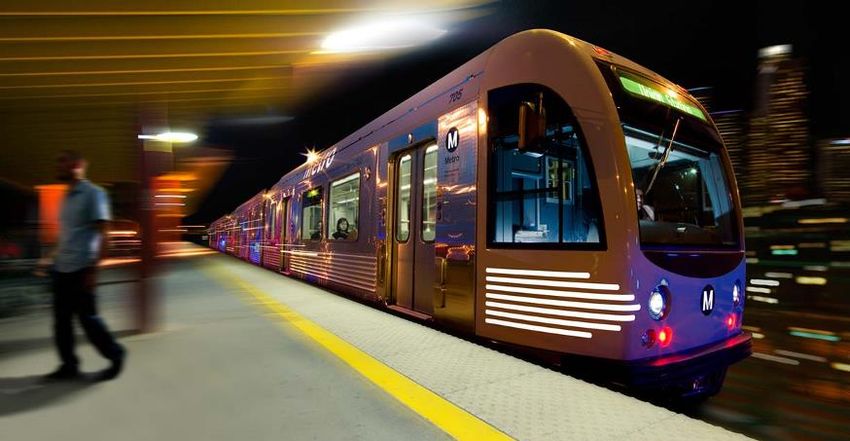
2016 Metro Transit Service Policies & Standards

      be assumed by another operator, Metro must cancel the service and observe all public
      notice and hearing guidelines.

The document also provides for recommendations to improve the core Bus and Rapid service
network, consideration of changes to the owl network, along with service guidelines
developed for each type of service. The goal is to develop a high frequency network of
sustainable services that provide a quality ride to our customers.

The principles enumerated below and supported by service standards outlined in Sections 2
and 3 of the document are summarized as follows:

   1. Aggressively feed rail transit stations with convenient transfers to provide customers
      with faster and more frequent services.

   2. Identify core bus services and increase the peak frequencies to 15-minute headways.
      These services were reviewed and identified for enhancement by the PRC.

   3. Change our bus load factors to better tailor service based on service frequency, vehicle
      size, and peak or off-peak operation. This includes a change to the method used to
      calculate the maximum load at the peak load point. Specifically, the approach is to use
      the mode in lieu of the average so that service calculations are based on the most
      likely expected load.

   4. Cull out seldom used stops to improve the in-service speed of the system and
      productivity.

   5. Upgrade the remaining Bus Rapid network with more frequent service and seek
      opportunities to increase the number of Rapid services

   6. Redesign and enhance the owl bus network in conjunction by: reallocating resources
      where needed, improving timed connections to facilitate convenient transfers with very
      little wait times, and improving access to late night services and destinations in
      conjunction with Rail operations.

   7. Work with Municipal and Local Return operators to improve service connections and
      facilitate transfers between operators. Where possible, allow Metro to reinvest in its
      core services by allowing Local providers the opportunity to operate more service in
      their reserved service area.

   8. Seek expansion of point-to-point Express services or BRT-type services to extend the
      reach of the system, provide faster services, make connections between major centers
      of activity, and encourage choice riders to use public transportation.

   9. Seek to innovate in the areas of service provision and provision of first mile-last mile
      connections.

                                                                                            7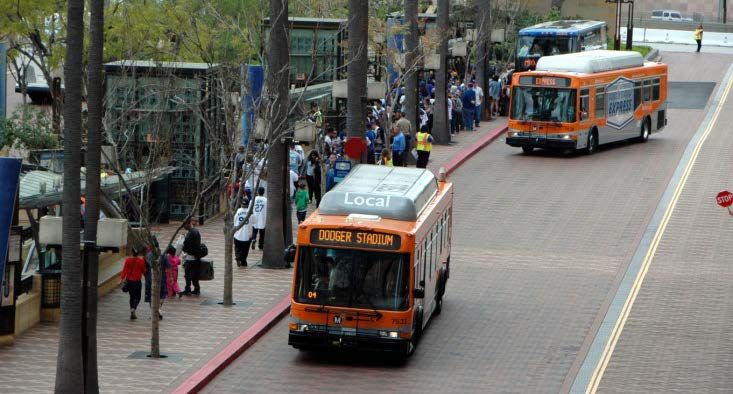
2016 Metro Transit Service Policies & Standards

    10. Seek to insure the involvement of our labor partners as the plan and program are
        developed and initiated through the planning and public review process.

The TSP is a comprehensive guide for the development of public transportation services for
the Los Angeles region. This update to the TSP recognizes funding constraints and seeks to
establish principles for the use and distribution of scarce transit resources. Sections 5 and 6
deal with implementation of the proposed changes and direct the analysis and public
information process and procedures that would be fulfilled to bring the recommended
changes to fruition.

                                       Metro Orange Line

8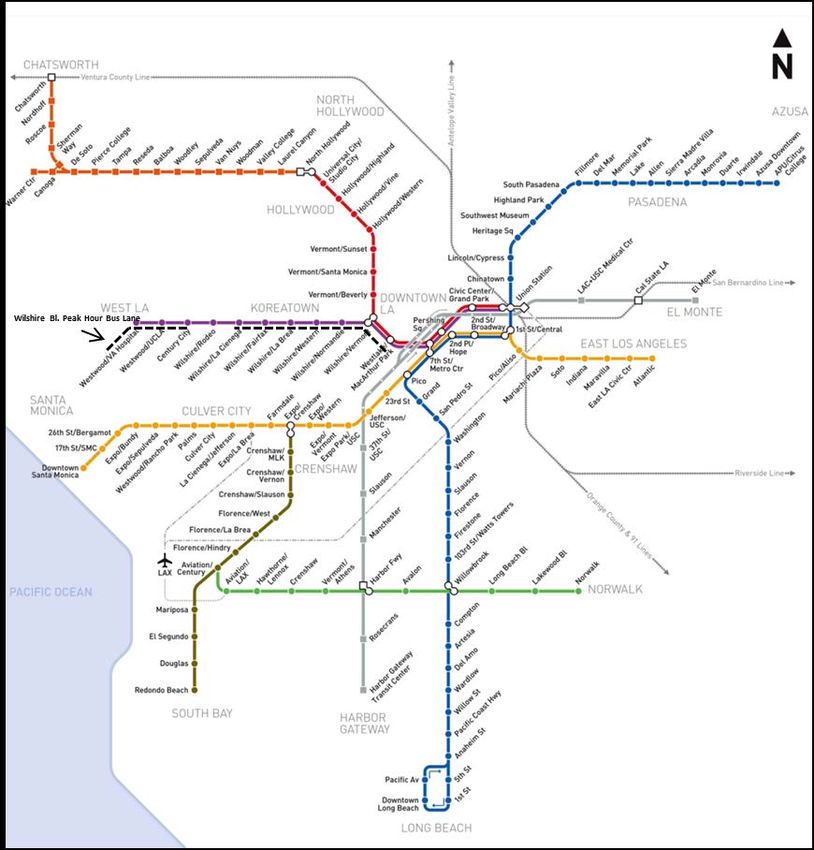
2016 Metro Transit Service Policies & Standards

SECTION 1: INTRODUCTION, PURPOSE & BACKGROUND

1.1      Introduction

Public transportation is a major force in redefining of communities both within Los Angeles
County and neighboring counties. Transportation providers must be more nimble and
capable to respond to the mobility needs of the next generation of Angelenos who
increasingly use technology to arrange their travel needs. Furthermore, service providers are
no longer confined to just buses and trains, but must embrace and enhance the entire
experience from the time a customer leaves their home to the time they reach their ultimate
destination.

The Los Angeles County Metropolitan Transportation Authority (Metro) takes its role as a
regional service provider broadly and is moving to enhance first mile-last mile transit options
along with its program of rail expansion and development of a strategic bus network. Service
quality, speed and frequency of service, as well as community connections are key elements of
a strategic planning process that seeks to continually create a seamless and easy way to
navigate the regional transportation systems.

Metro is keenly aware that as steward of the public dollars allocated to it, the agency is
expected to make wise use of its resources. The provision of well-used, cost-efficient, reliable,
and effective service is a prime mover for all transit agencies. “To attain this goal, public
transit agencies must design their services around a clear and defined process as well as a
process to monitor the results achieved and respond accordingly.” 2 This document puts forth
those principles and standards.

Strategic Bus Network Plan, Peer Review Committee, and APTA Peer Review Process
Metro has taken on a multi-faceted campaign to increase ridership in Los Angeles. In addition
to annual evaluations of its current transit services, Metro engaged APTA and representatives
of its Local Service Councils to assist the agency in the refinement of the Strategic Bus
Network Plan (SBNP) 3 and take other reasonable steps to improve the current systems’
performance and close service gaps towards building a sustainable network of high quality,
very frequent services. Metro is focused on allocating resources to maximize the benefits of

2
  “Best Practices in Transit Service Planning,” Project#BD549-38 Final Reports, Center for Urban Transportation
Research, University of South Florida, March 2009.
3
  The Strategic Bus Network Plan (SBNP) was developed through collaboration with the City of Los Angeles’s
Planning Department and a consultant, TMD. The purpose of the plan is not only to provide a foundation for
short term service adjustments, but to provide a basis for mid and long term coordination with other planning
efforts (e.g. the City of LA’s Mobility Plan 2035), infrastructure investments (e.g. bus lanes, transit priorities, sub-
regional transfer facilities), and funding opportunities (e.g. Cap and Trade, Sales Tax Measure). The plan has not
yet gone to the Metro Board for adoption; however, Metro staff is in the process of developing recommended
next steps and a path forward for the use and application of the plan. Metro staff worked with the Service
Councils to develop specific service recommendations based on the proposed Strategic Bus Network Plan, as
recommended by an APTA Peer Review.

                                                                                                                      9
2016 Metro Transit Service Policies & Standards service to transit riders while ensuring that service delivery is efficient and cost effective. Achieving this delicate balance requires establishing policy guidance and service standards that are designed to achieve target levels of productivity, efficiency, quality, and equity. Metro is committed to providing high quality transit service to all of its customers. These goals are reflected in Metro’s Vision, Mission, and Core Business Goals, and carried forward as the foundation of this Transit Service Policy (TSP). Vision The agency is envisioned to be a world class operation that provides excellence in all of the services offered as well as excellence in supporting the continued growth and redevelopment of the region. Metro must insure that: our customers feel safe when riding, that they do so in clean equipment, service is reliable and on-time, and our staff is dedicated to providing service in a courteous manner. Mission Metro is responsible for the continuous improvement of an efficient and effective transportation system that is sustainable for Los Angeles County. Core Business Goals Goal 1: Improve Bus & Rail Transit Services Goal 2: Provide Excellent Customer Service Goal 3: Deliver Metro’s Bus & Rail Projects Goal 4: Ensure Civil Rights Compliance Goal 5: Deliver Metro’s Highway & Freeway Projects Goal 6: Increase Emphasis on Safety & Security In times of fewer resources, Metro’s success to meet challenges related to serving the diverse needs of current and potential passengers, communities, and operators will be contingent on innovative thinking that stems from a solid base of sound planning principles. In addition, Metro seeks to work with other municipal operators and local return operators to provide support and connectivity throughout the Los Angeles region. 1.2 2015 Peer Review Committee (PRC) To help develop policy guidance for service development, Metro established a Blue Ribbon Committee (BRC) in November 2009 represented by key stakeholders who serve as operators in the region as well as beneficiaries of transit service. In 2015, a new committee was formed with much of the same membership. This committee was designated a Peer Review Committee (PRC) and met five times to review elements of the TSP and make recommendations relative to the service network. The PRC recommended a service concept conveyed as a set of policy statements that provides a blueprint to build a better transit system for greater regional mobility while consuming fewer resources. The service concept also defines the roles of Metro Bus, Rail, and municipal 10
2016 Metro Transit Service Policies & Standards

operations, identifies and prioritizes essential service quality attributes, and recommends
policy guidance on service coordination, bus-rail integration, and reduction of duplicative
services. The key principles of the service concept set policy direction for Service Priorities,
Service Design, Service Quality Attributes, and Governance. A list of the 2015 PRC
participating members is provided in Appendix A.

Summary Position Statement
Increased regional coordination and integration of service, and improved reliability are
essential to having a seamless system that is convenient, simple to use, and of high quality –
and provides maximum benefit in light of scarce resources.

      − Service Priorities: Service should be focused first in high-density areas and be scaled to
        fit the overall density and passenger demand in the service area.
      − Service Design: The network should be coordinated and designed to be simple and
        user-friendly to increase trip-making by existing riders and attract new riders.
      − Service Attributes: The system should provide high quality transit service to better
        serve existing riders and attract new riders. Service quality priorities include:
           • Reliability
           • Fast travel options
           • Real-time information
           • Clean and safe transit vehicles, stops, and transit facilities (e.g. Transit Centers,
               Park & Ride, Rail Stations, etc.)
      – Governance: Metro should serve as a facilitator to coordinate services among
        operators in the region.

Ultimately, the policy guidance is reflected in the TSP as a set of regional network and service
design guidelines, performance criteria and standards. In addition, this document outlines
the service change process that provides the quantitative tools to evaluate the system,
identifies opportunities for service improvements, and ensures the regional transit system is
adjusted accordingly to achieve the goals and objectives of the service concept.

1.3      Purpose

Metro’s TSP establishes the following: (1) a formal process for evaluating existing services;
(2) a methodology and process for developing and implementing service adjustments; and
(3) service design guidelines to ensure that the transit system is developed consistent with
policy guidance approved by the Metro Board of Directors.

The TSP was originally adopted in 1986 and is reviewed on an annual basis. When required,
the TSP is updated to better reflect agency goals and objectives, major initiatives, and
changes in local, state, and federal regulations and funding.

This document updates the 2012 TSP formerly adopted in July 2012. The policy is organized
into seven sections:
    – Introduction, Purpose & Background

                                                                                               11
2016 Metro Transit Service Policies & Standards
– Designing a Regional Transit Network
– Service Design Guidelines
– Service Performance Evaluation
– Implementing the Plan
– Service Change Process
– Conclusion
1.4 Background
Metro is the 3rd largest transit provider in the United States. Metro’s service area is over
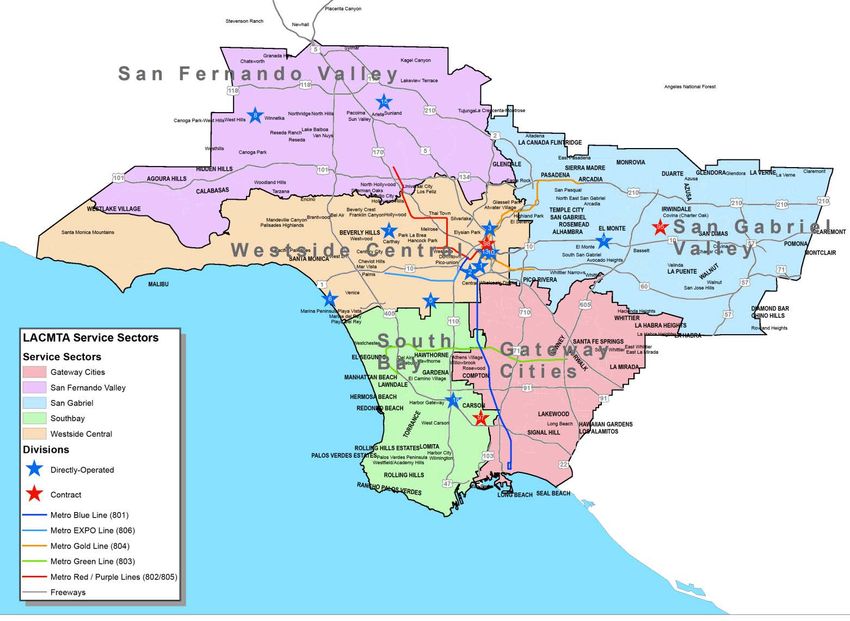
1,400 square miles and is divided into five distinct service areas overseen by their respective
Metro Service Councils; their role and responsibilities are described in Section 3.1. Metro
supports transit operation throughout Los Angeles County with an annual budget of
approximately $5.668 billion. In 2016, Metro will spend $1,050.4 billion on its bus operations
and $399.2 million on its rail operations. The remainder of the budget goes toward fare
subsidies, funding a number of other local return operators, and funding Access Services, the
principal ADA paratransit provider in the County. Table 1.1 displays the major budget
categories and expenditures for 2016.
Table 1.1
Summary of FY2016 Expenditures by Program
Expense Category FY16 Budget Comments
Metro Bus & Rail Operations $1,472.4 billion Includes Bus, Rail, operations & regional activities
Metro Capital Expenses $2,131.3 billion Includes operating capital and new construction
Subsidy Funding Programs $1,373.1 billion Metro distributes subsidies to Municipal
Operators, Local Return Operators, Metrolink, and
Access Services4
Congestion Management & $ 93.1 million Includes Freeway Service Patrol, Express Lanes,
Highways Call Box, Intelligent Transp., and Rideshare
services
General Planning & $ 169.8 million Includes Planning programs and studies, Legal,
Programs audit, treasurer, Transit Court and other, and
Property Management/Union Station and
Development
Debt Service $ 328.7 million
Total FY 2016 Expenditures $5,568.4 billion
Source: LACMTA FY2016 Adopted Budget for July 1, 2015 – June 30, 2016, Summary of Expenditures by
Program, Page 34.
Metro’s transit system consists of light rail, heavy rail, and bus operations. Metro’s bus
operations consist of both directly operated and contract operated services. Metro operates
4
It is important to note that Metro Operations is a recipient of the distribution of subsidies from Metro as
regional service provider. Metro does not directly subsidize other operators.
122016 Metro Transit Service Policies & Standards
the largest share of all bus services provided in the region. However, municipal and Local
Return operators provide additional public bus and paratransit services in areas of the region
where Metro provides limited service or no service at all.
Metro currently operates 169 bus routes, of which 18 routes are contracted out, and 6 rail
lines. On weekdays, Metro currently operates 1,957 peak buses and 190 peak heavy and light
rail cars. On any given weekday, Metro experiences approximately 1.1 million bus boardings
and 350,000 rail boardings. Metro serves over 15,000 bus stops, including station stops on
the Orange Line and Silver Line. Metro operates six rail lines (2 heavy and 4 light rail lines)
serving a total of 73 stations across approximately 84 route miles. Metro Rail operates in
heavily congested travel corridors and provides connections to many key multi-modal
transportation hubs.
Measure R and the 30/10 Initiative
Metro will continue to expand its transit network across the region under Measure R and the
30/10 Policy Initiative. In November 2008, Los Angeles County voters approved Measure R, a
half-cent sales tax. The measure is expected to generate $35 billion for countywide
transportation projects over 30 years. In April 2010, Metro’s Board of Directors adopted the
30/10 Initiative to use revenue from Measure R as collateral for long-term bonds, grants, and
anticipated federal loans that will allow Metro to reduce the time needed to build 12 major
transit projects from 30 years to 10 years. Part of the funds generated through Measure R will
be used to expand Metro Rail projects throughout the region. Five of the twelve projects listed
or under consideration are currently under construction and projected to begin operations
within the next several years; one project has been completed:
– Gold Line Foothill Extension to Azusa (FY 2016)
– Exposition Line – Phase II to Santa Monica (FY 2016)
– Crenshaw/LAX Transit Project (FY 2020; subject to change with addition of Airport
Metro Connector)
– Regional Connector Transit Corridor Project (FY 2021)
– Purple Line Extension to Westwood (Section 1 Extension to La Cienega FY 2023;
Section 2 to Century City FY2026; Section 3 to Westwood FY2035)
– Gold Line Eastside Extension from East Los Angeles – Phase II (Under Study)
– Rail Extension to South Bay (Under Study)
– Orange Line Canoga Extension (completed)
– Airport Metro Connector
– East San Fernando Valley Transit Corridor
– West Santa Ana Branch
– Sepulveda Pass
Figure 1.1 illustrates Metro’s projected rail network by 2022 along with its Metro Liner
services (Orange Line and Silver Line).
132016 Metro Transit Service Policies & Standards Figure 1.1 Metro Rail Projected Concept Map 14
2016 Metro Transit Service Policies & Standards

1.5      APTA Peer Review Committee

In 2014, Metro contracted with APTA to perform a peer review of the restructured fare
policies, proposals to increase the efficiency and productivity of service operations, and to
provide guidance on alternative sources of revenues to support operations. The panel met in
Los Angeles during the week of January 26-30, 2015. As a result of their review, the panel
made the following recommendations to increase efficiency and productivity:

      1. Adjust the bus load standard from 1.3 to 1.4 and ultimately consider going to an area-
         based standard;
      2. Consider implementation of a bus stop consolidation plan to improve speed of
         operations;
      3. Initiate a system-wide program to improve in service on time performance;
      4. Seek to coordinate operations with other local service providers in the region;
      5. Adopt and implement a policy to guide the redeployment of resources from chronically
         underperforming routes or route segments to higher performing locations and times;
      6. Develop a service design to minimize duplication and encourage transfers among
         transit modes;
      7. Provide frequent service on a more sparsely configured network;
      8. Realign services to establish and maintain a core network of frequent services, and;
      9. Encourage the use of the system at off-peak times.

These recommendations, along with the recommendations of the PRC, have been
incorporated into the service policies and standards outlined in this document.

2015 PRC Recommendations
The 2015 PRC was composed of members of the Regional Service Councils and other
operators in the region. The PRC’s work included a review of the proposed 15-minute frequent
service bus map along with major change proposals that are incorporated into this update to
the TSP. The PRC completed a number of tasks and made recommendations as follows:

      1. Identified and recommended development of services to address gap closures in the
         15-minute frequent service network. Gap closure recommendations were prioritized by
         Service Planning staff into four categories (A-D). As discussed in Section 5, categories
         A and B will be incorporated into the work program and implemented in phases.

      2. Recommended incorporation of the APTA Peer Review Committee findings into the
         TSP. The most significant was the change in the loading standard for buses based on
         seats by vehicle type and time of day; see Section 4.2.

      3. Established a policy direction for consideration of assumption Metro line services by
         Municipal operators; see Section 4.4.

                                                                                              15
2016 Metro Transit Service Policies & Standards
4. Recommended that Metro and other operators ensure that adequate layover facilities
be provided or that the transit service provider be aware of additional costs incurred
for consolidation or relocation of bus services.
The PRC made significant contributions to the generation of the 2016 TSP.
Patsaouras Plaza Dodger Stadium Shuttle Operation 2015
162016 Metro Transit Service Policies & Standards
SECTION 2: DESIGNING A REGIONAL TRANSIT NETWORK
Transit network design must take into account both the needs of passengers and transit
operators, as well as the practical ability to provide the service. From the passenger’s
perspective, the transit network should provide convenient service when and where they need
to go, operate on time and safely, and provide good customer service and information. From
a system-wide transit operations perspective, the transit network must be manageable,
operable, and sustainable – all within the constraints of a fixed operating budget.
2.1 Key Principles of Network Design
At times, competing service interests result in unproductive use of scarce transit resources.
As such, the PRC was charged with identifying and prioritizing the needs of the customer and
the operator. Based on recommendations from the PRC, the critical factors to consider in
network design should be reliability, network simplicity, speed, and safety, followed by vehicle
cleanliness and timely, relevant, accurate customer information.
Based on the PRC policy guidance, the following key principles are critical in building an
efficient and effective transit network:
A. Develop a Network of Services Rather than a Collection of Individual Routes
Individual routes do not need to serve all market needs. Rather, routes should be designed to
serve a specific purpose within the network. Combined, the network should provide service
between all major destinations and densely populated areas throughout the day. The transit
network includes integration of other public transportation services within Los Angeles
County, as well as with other modes, such as bikes, carpool/vanpool, car share, and private
shuttles that provide first and last mile transportation to better access the transit network.
B. Integrate Services to be “Seamless to the User”
Transfer Penalties Should Be Minimized
In developing an integrated network, it is essential that the system is seamless-to-use from a
customer’s perspective. The need to create a simple and convenient system that minimizes
transfer penalties is critical. An integrated regional network should emphasize high frequency
service, timed transfers on less frequent services, and shared stops for ease of transfers. Trip
information, way-finding, and an integrated fare structure also are important elements of a
customer-focused transit network.
Services Must Be Better Coordinated
Given the significant growth in municipal and local return operators as well as Metro Rail,
improved coordination between all operators and modes is vital to establishing an integrated
regional transit network. Metro serves as a regional coordinator of transit services. In
addition, Metro operates within a hierarchy of services, in which Metrolink provides the
region’s commuter rail to serve high volume, longer distance trips. Metro Rail, Metro Liner
172016 Metro Transit Service Policies & Standards (Orange Line and Silver Line), and Metro Rapid Bus serve as the backbone of the urban transit network, which is augmented by Metro-operated Local, and Limited stop, service along with municipal operators. LADOT and local return operators complement the system with community and shuttle buses that serve specific neighborhood needs. Metro meets quarterly with various municipal and local return operators who may be impacted by Metro’s service changes. (Section 5.2 discusses the service change process in greater detail.) Minimize Duplication and Increase Shared Stops From both the patron and operator point of view, operation of overlapping services may be costly, confusing and unproductive. Through better service coordination, duplication between Metro Bus, Metro Rail, and municipal bus services can be minimized. This concept will result in an easier and simpler-to-use transit network. Opportunities to share stops will also help reduce confusion. Customer Trip Information Must be Timely and Readily Available Timely, relevant, accurate, and readily available trip information is necessary to minimize rider confusion when using public transit. Patrons should always be kept informed about the status of their trip. Real-time information is useful for reassuring passengers when the next transit vehicle will arrive or how long the expected delay time is if there has been a service disruption. It should provide them with enough information to help them decide whether to continue to wait for the next transit vehicle, consider alternate routes, or take another mode of transportation to complete their trip. C. Keep the Service Simple and Easy to Use An easy-to-understand-and-use transit system relies on simple network and route design. Consolidating duplicative services on the same or parallel corridors within a quarter-mile to a half-mile distance provides an opportunity to simplify the network for ease of use and reduce unused capacity. This concept requires better coordination of schedules and transfer points, and will result in an easier-to-use and more convenient system while reducing wait time and overall travel time. These enhancements to service quality are expected to help increase ridership and revenue at no additional cost. Furthermore, consistent headways that are predictable for patrons help to reduce uncertainty about next bus arrival times. Consistent headways should be a priority for lines that operate headways of less than 15 minutes. D. Ensure High Quality Services Establishing a world-class transportation system requires identifying and prioritizing service quality attributes that support an effective and sustainable operation. The following are critical service quality attributes of highest priority to consider when designing service: 18
2016 Metro Transit Service Policies & Standards

Reliability
When it comes to key service quality attributes, reliability should be given highest priority.
Reliability is impacted by poor schedule adherence, vehicle breakdowns, and missed trips.
Controlling service reliability requires a coordinated effort between establishing reasonable
running times and schedules, maintenance and management of vehicles, and operator
availability and performance. Service levels are scheduled to meet passenger levels. Early, late
or missed trips result in capacity issues and can eventually lead to pass-ups. Therefore, it is
essential that service is on time and reliable to avoid the misperception that service levels are
inadequate to meet demand.

Maintaining passenger confidence that transit service will depart a stop or station and arrive
at a destination as stated on the timetable is paramount to good transit service. Poor
reliability can cause passengers to arrive late to work or school, miss appointments or critical
transit connections, and result in an overall lack of confidence in the system. Furthermore,
poor reliability creates unnecessary travel delays and greater concerns about safety and
comfort due to longer waits at stops and stations.

For high frequency service with 15 minutes headways or better, schedules should be written to
allow operators to be on time without excessive running time that can slow the service
substantially and result in additional operating costs. Passengers who miss a trip on high
frequency services can be comforted knowing that another bus or train will be available within
a reasonable wait time, minimizing the consequences of reliability.

Reliability becomes even more critical for low frequency service with headways greater than 15
minutes and as wide as 60 minutes. Missing trips on low frequency service increases the
consequences to the passenger given the significant travel delays and wait times. Therefore,
special attention should be made to ensure low frequency services are designed and operated
to the greatest reliability and efficiency.

Achieve Higher Network Speeds
Increasing the speed of transit service improves the competitiveness of transit as compared
to other modes, such as automobiles. Faster service also requires fewer resources to operate,
thus reducing operating costs. Several factors can contribute to the reduction of speed along
a route including excessive turns, particularly left turns, an increased number of stops, traffic-
congestion, and long dwell times at stops and stations.

Increasing bus system speed reduces operating costs and may attract new riders. However,
streamlining routes and limiting the number of stops may also reduce passenger access to
the transit network. Therefore, adjustments to a route that result in slower speeds are
warranted when the ridership benefits outweigh the negative impacts to speed.

Passenger Capacity
Passenger capacity, or the amount of seats and standing room onboard a vehicle, is an
important consideration when designing transit service. The utilization of vehicle capacity
should be maximized to make the most use of resources. However, capacity should not

                                                                                               19
2016 Metro Transit Service Policies & Standards exceed a threshold that deters ridership due to uncomfortably crowded conditions or excessive stop and station dwell times caused by blocked passageways on board. Capacity thresholds are expressed as a load factor indicating the ratio of available capacity to seats as discussed in Section 4 (Table 4.3). This indicator is used to determine how many trips must be scheduled for each direction of travel during specified time periods. Other considerations that may influence design capacity include the duration that passengers must stand based on passenger turnover along the line and operating conditions, such as on freeway routes in which standees should be minimized. Safe Routing and Stops Passenger perceptions of safety and security conditions, either real or imagined, must be addressed because those perceptions contribute to mode choice decisions. Safety includes the potential for being involved in a crash, slips and falls, and other elements such as aggressive passengers or poor passenger conduct. Security covers both real and customer perception of potential incidents of crime that may contribute to a passenger’s unease, even if the actual risk is minimal or non-existent. Passengers want to feel safe and secure both at stops/station and onboard a bus/rail. Measures must be taken to alleviate a passenger’s unease both at stops and onboard transit vehicles. Whenever possible, stops should be located at well-lit areas with ample sidewalk space for ADA compliance and queuing for buses. Other measures to enhance security at stops and on board transit vehicles include police officers in uniform and plainclothes who ride transit, two-way radios, silent alarms for emergency communications, and surveillance cameras at stops and on board transit vehicles. Metro’s bus operators form the core of the agency’s response to any situation that may arise while driving in service. Operators have the ability to silently alert Bus Operations Control (BOC) and /or local law enforcement. They are the initial incident responder and must remain in contact with BOC. Cleanliness and Courtesy Clean and well-maintained transit stops, stations, and vehicles improve the general public’s perception of Metro and their desire to take transit as a viable mode of travel that is comfortable, convenient, and of high quality. Elements make transit more comfortable for passengers include climate-controlled vehicles, seat comfort and availability, courteous operators, and a comfortable ride. 2.2 Markets Served Given the current financial climate, Metro’s goal is to minimize costs and maximize productivity in the delivery of its transit services. Service should be placed when and where the maximum benefit can be provided to the general public. Productive service lowers the net cost per hour, resulting in more service per dollar. 20
2016 Metro Transit Service Policies & Standards

In general, service should be focused on corridors and within areas where high density
population, employment, and activity centers exist. These corridors and areas usually
generate high levels of transit riders to justify frequent service (15-minute or better headways)
that provides convenient access to key origins and destinations. Corridors and areas with
dense ridership should be served throughout the day and week. The emphasis on service
should be during peak periods, base day, weekends, and late night, in priority order.

While service should focus on when and where significant demand exists, there is still a need
to provide basic lifeline service in areas and times of day with low demand. Therefore, a basic
lifeline network should be provided on critical corridors during the owl period and to connect
low density areas to the transit network.

2.3    Transit Service Classifications

Metro classifies its bus and rail services into three categories to provide the framework for
evaluation and planning of the various components of the transit network.

Core Regional Network
Core regional service consists of Metro Liner (Metro Orange Line, Metro Silver Line), Metro
Rapid, Metro Local (for bus lines averaging 9,000 or more boardings per weekday), and Metro
Rail. Together these lines form the basic network in the region and serve the region’s major
activity centers and market areas. Other regionally significant lines may be under
consideration for service improvements as part of the Strategic Network and are discussed in
Section 5.

Significant Corridor Bus Services
Significant corridor bus services provide regional service along major arterials throughout the
service area and carry 4,000 to 9,000 riders per day. Metro operates 14 Local lines, one
Express line, and 10 Rapid lines that meet this threshold. These lines cover long distances,
serving both intra- and inter-community trips, and have an average trip length of
approximately 5.2 miles.

Inter-Community and Community Service
Inter-Community and Community Service supplements the core service, provides primary
coverage in outlying areas, feeds the fixed-route system, and provides community circulation
focusing on local travel. This includes the remainder of the system including Local and
Express lines.

2.4    Metro Transit Service Types

Metro operates six types of bus service (Table 2.1) and two types of rail service to better
match the transit mode with specific passenger demand and needs. (See Appendix B for
Metro’s Bus Line Identification, Route Numbering, and Color Conventions.)

                                                                                              21
2016 Metro Transit Service Policies & Standards
Metro Rail
Metro Rail is high capacity rapid transit service using rail technology. It operates along a
dedicated right-of-way, serves full scale transit stations, and is powered by electricity. The rail
system serves as a backbone of public transportation in the greater Los Angeles region,
linking many key multi-modal transportation centers and destinations together.
Service operates in high-demand travel corridors and is offered in two forms – heavy rail and
light rail. Metro’s heavy rail is the subway system served by the Red and Purple Lines. Metro’s
four light rail lines – Blue, Green, Gold and Expo – are powered by overhead wires, generally
use shorter trains, and operate at slower speeds than heavy rail. Unlike heavy rail, light rail
lines run along a right-of-way ranging from complete grade separation to at-grade in mixed
flow traffic. Rail routes are designated with route numbers between 800 and 899.
Metro Liner and BRT Services
Metro Liner services are specialized BRT services that operate on either an exclusive right-of-
way, a major arterial, or in HOV/HOT lanes. Metro operates two Liner routes: the Orange
Line which operates on its own exclusive right-of-way, and the Silver Line which operates on
the I-10 and I-110 Express Lanes (freeway toll lanes) as well as surface streets through
downtown. Metro Liner services are numbered between 900 and 910. As a form of BRT, Metro
incorporates a series of design features to reduce delays, increase reliability and improve
passenger comfort:
– Dedicated Bus Lanes: This right of way provides fewer traffic conflicts and obstructions
and reduces delays and travel time.
– High-Capacity Vehicles: State-of-the-art high-capacity vehicles are used to meet high
demand and provide greater passenger comfort.
– Transit-Signal Priority: An operational strategy that facilitates the movements of in-
service transit vehicles through signalized intersections to improve transit
performance by extending the green phase or shortening the red phase of traffic
signals.
– Bus Stations and Shelters: Stations and shelters provide customers with enhanced
comfort and safety.
– Streetscape: Streetscape and other design features such as landscaping, pedestrian
count-down signals, bicycle racks, and well-designed crosswalks make it easier for
pedestrians and bicyclists to access the stations.
– Improved Fare Collection: For faster service and convenience, major stations have
ticket vending machines (TVMs) which allow passengers to prepay.
– Park & Ride Facilities: Should be provided in close proximity to major stops and
stations. Adjacent development and joint use parking also is encouraged.
– Advanced Transportation Management Systems: ATMS provide an array of
technologies to improve service reliability and passenger travel.
222016 Metro Transit Service Policies & Standards
Metro is currently studying the feasibility of adding bus lanes on a number of major corridors
to further improve travel times. A peak period bus lane on Wilshire Blvd. benefiting Rapid Line
720 5 opened in FY2015. In addition to two rail alternatives, there are two BRT alternatives
being evaluated in the environmental document for the Van Nuys Blvd. corridor in the east
San Fernando Valley. If BRT is chosen as the preferred alternative, the project could provide a
seamless connection to the Metro Orange Line.
Metro Rapid
Metro Rapid is a form of BRT that operates in mixed-flow traffic on heavily traveled corridors.
Time reductions are achieved through the use of a number of key BRT attributes such as fewer
bus stops and transit signal priority. Metro Rapid services use specially branded buses and
enhanced bus stops that include special shelters and information kiosks. Metro Rapid Lines
are designated with route numbers between 700 and 799.
Service warrants guide the design, monitoring and development of the Metro Rapid program.
The warrants are specific targets or objectives that are linked to each of the program’s key
attributes. These warrants are presented in Appendix B. Current Metro Rapid Lines in
operation are evaluated as outlined in Section 4.0.
Metro Express
Metro Express is used for longer distance trips with fewer stops and typically becomes more
localized near the ends of the routes. Metro Express service usually operates from a collector
area, such as a Park & Ride location, to a specific destination or in a particular corridor with
stops en-route at major transfer points or activity centers. In addition, a major portion of its
routing generally operates on freeways either in mixed flow traffic, HOV and/or HOT lanes, or
dedicated bus lanes. This service type charges a premium fare. Express services serving
downtown Los Angeles are given a 400 route number, while those that do not go downtown
are given a 500 route number.
Metro Limited Stop
Metro Limited is an accelerated bus service with limited stops. Metro Limited operates in
corridors with high transit demand and provides higher-speed services by limiting stops to
key transfer points and major activity centers. It is augmented by Local bus service. Metro
Limited bus service does not include signal priority or unique branding. Limited stop routes
are designated with route numbers between 300 and 399.
Metro Local
Metro Local services operate on city streets and provide service to all stops along a route. The
bulk of Metro’s transit service and ridership is provided by Metro Local. Local routes are
designated with route numbers between 1 and 299.
5
Local Line 20 also benefits from use of the peak bus lanes.
232016 Metro Transit Service Policies & Standards
Metro Shuttle
Shuttle routes operate primarily on secondary streets and serve short-distance trips. These
services specialize in local community circulation and connect residential neighborhoods with
local trunk-line transit services, including rail. Typically these services carry less than 2,000
passengers a day. These bus routes are designated with route numbers between 600 and 699.
Table 2.1 describes the various features of each of Metro’s bus service types.
Table 2.1
Metro Bus Service Types and Features
BUS SERVICE TYPES
Local/
FEATURES Limited Express Shuttle Rapid Metro Liner
Major
Major Arterials and Major Dedicated
Right of Way Arterials Fwys. Local Streets Arterials Right-of-Way
Minimum
Average Stop 0.25 mile /
Spacing 0.60 mile 1.25 miles 0.25 mile 0.80 mile 1.25 miles
Inter-
Target Travel Inter- Community Inter- Inter-
Market Community Regional Neighborhood Community Community
40/60-foot 40-foot bus or 40/45/60- 45/60-foot
Vehicle Type bus 40-foot bus smaller foot buses buses
Color Coded California California California
Buses Poppy Poppy Poppy Rapid Red Silver
Communities
Served Multiple Multiple 1-2 Multiple Multiple
Signal Priority No No No Yes Yes
On Board
Fare Collection On Board On Board On Board On Board /Pre Pay 6
Passenger Benches Shelters and Benches and Shelters and Shelters and
Amenities and Shelters Stations Shelters Stations Stations 7
Real-time
Passenger Info No No No Yes Yes
Route Number
Designations 1-399 400-599 600-699 700-799 900-910
Note: It is recognized that strict adherence to a stop spacing standard may not be possible in
all cases due to street geography or facility design. For example, on the Silver Line, the
distance between stations on the freeways is greater than the desired minimum.
6
Only the Metro Orange Line has off-board fare collection at this point. The Metro Silver Line currently only
accepts fares through the fare box on board.
7
Metro Silver Line Service has a section of on-street boarding and alighting in downtown Los Angeles.
242016 Metro Transit Service Policies & Standards
2.5 Alternative Service Delivery Options
Alternative service delivery options are services not directly operated by Metro, including
contract services, municipal operators, Local Return Operators, van service, taxicabs, flexible
destination operations, and scrip programs. These transportation options may be viable
alternatives and can complement traditional transit service. Metro is considering working with
ride-sourcing service providers (e.g. Lyft and Uber) to potentially provide additional first-mile
and last-mile service options. In addition, Access Services provides mandatory ADA
complimentary paratransit services to individuals whose disabilities prevent them from using
fixed route transit services.
2.6 Facilities
Transit services are supported by facilities including bus stops, transit centers and stations.
These locations are often the first and last points of contact with the passenger. The PRC
considered these facilities to be an essential component of transit infrastructure that direct
passengers to existing transit services, provide a safe and comfortable environment in which
to wait for service, and facilitate safe and efficient transfers between services. Given the
importance of transit facilities, it is vital that transit routes and schedules are developed with
consideration for the quality, appropriateness, and availability of facilities.
Bus stops are locations along the route of a bus line where passengers safely wait to board or
alight from a bus in service. Bus stops consist of route line number, destination and service
qualification signage, curb markings or parking restriction signage. Stops may include
passenger amenities such as shelters, benches, telephones, trash receptacles, lighting, and
information displays installed by the appropriate municipality. Most bus stops are located
along the curb of a street, while others are at offsite facilities such as transit centers or rail
stations that may be owned and maintained by the local municipality or by Metro.
Transit stations are stops along a fixed guideway with features, such as loading platforms,
TVMs for fare pre-payment, shelters, benches, lighting, information displays, trash
receptacles, bike racks and lockers, and emergency call boxes. Many are located adjacent to
Park & Ride lots and passenger pick-up/drop off areas.
Transit centers are high volume transfer points for multiple transit services and layover
spaces for end-of-line bus storage and turn around. Features include passenger loading and
alighting areas, benches, shelters, lighting, information displays, bicycle racks and lockers,
trash receptacles, and bus layover bays.
On-street bus layover zones are designated stopover points for either a bus at or near the end
of the line. They may or may not allow for passenger boarding and alighting. Bus terminals
are major offsite layover areas for multiple bus lines and may or may not allow for passenger
boarding and alighting.
25You can also read


