Transit Services Workplan 2020 - Raymond J Leury MBA President, Electric Vehicle Council of Ottawa
←
→
Page content transcription
If your browser does not render page correctly, please read the page content below
Transit Services Workplan
           2020

              Raymond J Leury MBA
   President, Electric Vehicle Council of Ottawa
               Treasurer, EV Society
              Climate Reality Leader
8. Alternative Fuels Program for OC Transpo
Fleet
As directed by Transit Commission, OC Transpo is procuring two electric buses, that will be into
service by the end of the year, and the related infrastructure. The project team is working closely
with other City departments and Hydro Ottawa to develop a comprehensive strategy to test and
examine the functionality of integrating electric buses into OC Transpo’s fleet. The Request for
Proposals was released in early February with an estimated In-service date for the new vehicles in
December 2020.
In addition, as part of the Transportation Master Plan (TMP) update, the Department, along with its
consultants, will be producing a white paper on the potential future evolution of the OC Transpo bus
fleet from diesel buses to lower-emission or zeroemission vehicles.
The Department will assemble a project team to integrate the:
results of the procurement; initial results from the operation of the pilot buses as part of the OC
Transpo system; results of similar trials at transit systems in other cities; technical findings and
recommendations from Hydro Ottawa; long-term conclusions and recommendations in the
Transportation Master Plan and its white paper; and decisions of Council in the Long Range
Financial Plan Transit and the Climate Change Master Plan and Energy Evolution strategy.
From these sources, staff will construct a plan for the consideration of the Commission and Council
for the acquisition and introduction into service of buses with alternative energy sources. That plan
will include the details of what type of buses could be acquired, what energy source could be
used, what infrastructure is required, and what are the capital and operating financial implications.
This report will be presented to the Transit Commission at the conclusion of the trial period at the
end of 2021.“procuring two electric buses”
Mayor Watson instructed OC Transpo via a motion at
Council on June 12th 2019:
“…BE IT FURTHER RESOLVED that staff pursue funding opportunities
dedicated to transit and environmental initiatives that may arise at
other levels of government to help fund this transition to cleaner
sources of energy.”
-> 8 months ago
“procuring two electric buses”
Would be funded by $6M allocated by City in 2019
Indicates NO funding from other levels of government
Why is Ottawa missing out when so many other municipalities
have got funding?Examples from other cities City No of e-buses Federal Funding Date Kingston 2 $500k 2019-09-05 Brampton 8 $11M 2019-07-29 Edmonton 40 $21.5M 2018-04-13 Toronto (TTC) 60 2017 Guelph 65 $40M 2020-01-24 Edmonton did a winter pilot in 2015 - 5 years ago! Why is Ottawa such a laggard?
RFP for e-buses
“The Request for Proposals was released in early February with an estimated
In-service date for the new vehicles in December 2020.”
Who is telling the truth?Minister of Infrastructure and
Communities Mandate Letter
“Make the federal commitment to fund public
transit permanent and rise with the cost of
construction over time. Ensure that new federal
investments in public transit are used to support
zero-emission buses and rail systems starting in
2023 and work with municipalities to address any
exceptional circumstances.”
CNG is NOT zero emissionsOC Transpo Buses - Options
Compressed Natural Gas (CNG)
Better than diesel from a “pollution” point of view
Much less particulate matter
Not relevant from climate change perspective
Produces 80% of the GHG emissions of diesel buses
-> Only a 20% reduction in GHG
-> If fugitive emissions included, about the same as diesel
-> Just as bad as diesel from a GHG perspective
Not enough by any stretch to get to ZERO emissions by 2040
NOT A SOLUTION for climate change
NOT aligned with Energy EvolutionOC Transpo Buses - Options
Hydrogen Fuel Cells
Over 95% of hydrogen is produced using natural gas
This results in significant CO2 emissions
Not enough to get to ZERO emissions by 2040
Expensive and very low deployment numbers
According to Burnaby's Ballard Power Systems, which
manufactures fuel cell engines, Whistler's hydrogen buses
cost $1.34 per kilometre to maintain, versus 65 cents
per kilometre for diesel-powered buses.
Vancouver sold off it’s fleet in 2014
NOT A SOLUTION for climate change
NOT aligned with Energy EvolutionOC Transpo Buses - Options
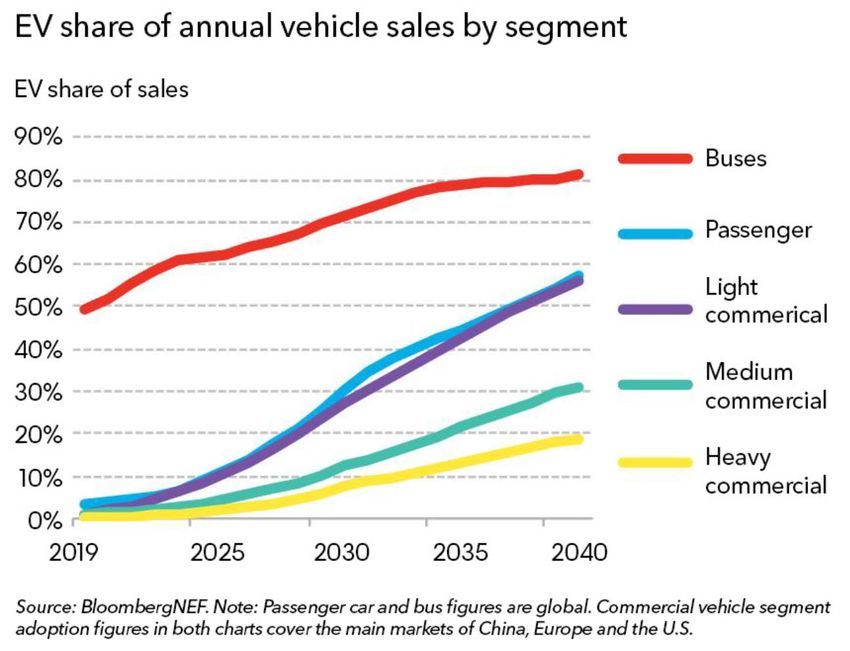
Electric Buses – e-Buses
ZERO emissions
50% market share in 2019
The highest EV market share of ANY category
Almost all of these are long range e-buses
Lower total cost of ownership
TTC saving $56,000 per year per bus on diesel costs alone
EVCO had estimated $30,000 per year
EVCO estimates about $20,000 less maintenance per year per bus
Only SOLUTION for climate change
Aligned with Energy EvolutionBloomberg NEF (New Energy Finance)
https://about.bnef.com/blog/electric-transport-revolution-set-spread-rapidly-light-medium-commercial-
vehicle-market/Timelines with current plans
Receive 2 e-buses – end of 2020 (at the earliest)
“Pilot” – 2021
Report publication – late 2021/early 2022
Engineering work for charging infrastructure -
2022
Order e-buses early 2022
Lead time 12-18 months
Large numbers of e-buses in service in 2024Alternative Timelines Receive 2+ e-buses – end of 2020 (at the earliest) “Pilot” – 2021 Report publication – 2020 Engineering work for charging infrastructure - 2020 Order e-buses – late 2020 Lead time 12-18 months Large numbers of e-buses in service in 2022 250,000 tons of CO2 emissions avoided $100M in operational savings
Recommendations
Realize that e-buses are the only choice
Cancel report outlining alternative energy choices
Speed up procurement
Design charging infrastructure in 2020
Start deploying large numbers of e-buses in
2021/2Conclusion
Ottawa has the ability to reduce it’s corporate emissions by 45%
One single measure will do that
It will take 15 years to replace the fleet
Ottawa can save $50M per year of operational costs by doing what’s
right for the planet
This project would be worth doing even if it was not saving money
125,000 tons of GHG per year
It’s time for Council to set policy, lead and provide an example
Ottawa has declared a climate emergency
Now is the time to act!
This is the single biggest impact council can haveYou can also read


