UNDERSTANDING SPACE WEATHER: THE SUN AS A VARIABLE STAR
←
→
Page content transcription
If your browser does not render page correctly, please read the page content below
UNDERSTANDING SPACE
WEATHER: THE SUN AS A
VARIABLE STAR
by Keith Strong, Julia Saba, and Therese Kucera
Studying the causes of the variability of solar output may help
develop capabilities to predict and mitigate its impacts on our
increasingly space-reliant, technological society.
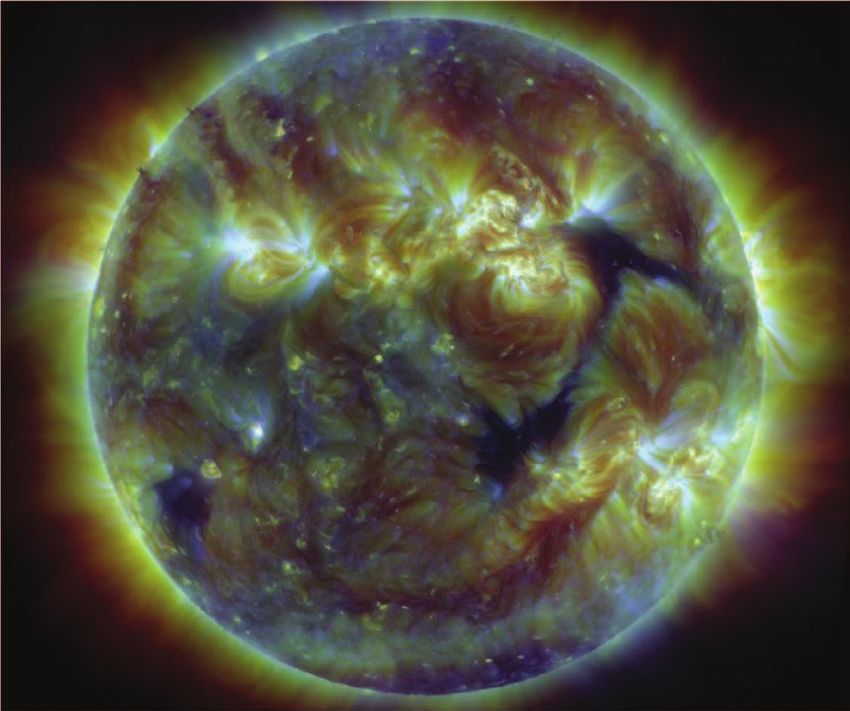
Fig . 1. The solar atmosphere viewed in EUV light shows a wide range of magnetic
structures. This composite false-color image, combining data captured by the Solar
Dynamics Observatory in different filters of the Atmospheric Imaging Assembly,
shows active regions (white), coronal holes (blue), and a million-km-long cold fila-
ment suspended in 1-MK plasma (red). The image was taken at 2214 UTC 2 Feb 2012.
W
e live on a planet that is immersed in the outer atmosphere of a variable star.
Fortunately for us, our star, the Sun (Fig. 1), is relatively benign compared to some
of its overly energetic stellar cousins; otherwise, we would likely not be here to
appreciate it. The solar system has a relatively narrow band of habitability for complex life
forms that is defined by the distance from the Sun where water remains liquid most of the
time. If the Sun were to become significantly brighter, 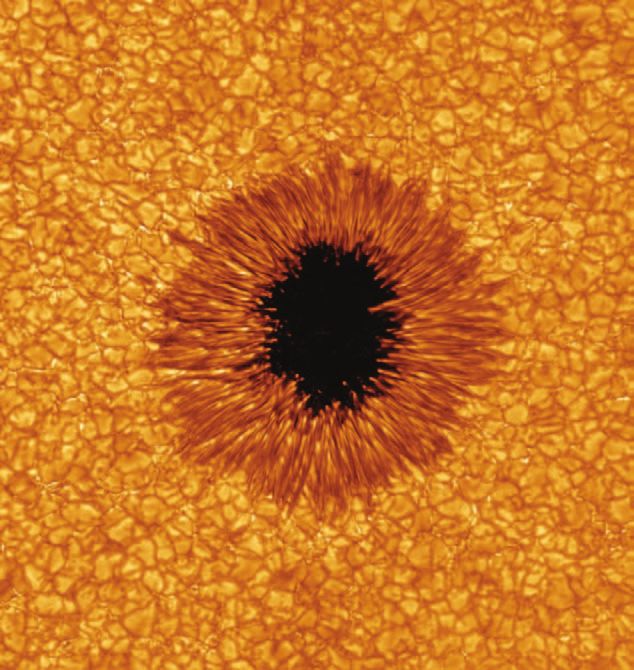
then that zone would move outward, leaving Earth                    energy by fusing protons into helium ions, and in
      inside the hot inner boundary, and our oceans                       doing so converts some of its mass to energy. Every
      would eventually boil away. If the Sun were to dim                  second the Sun destroys about 4 × 10⁶ tons of mass in
      appreciably, then Earth would turn into a ball of ice.              producing nearly 4 × 1026 J. That is equivalent to about
      A quiescent star and relatively stable planetary orbit              a million times the world’s annual energy production.
      are therefore prerequisites for the development of                  The transport of this energy outward from the solar
      complex life forms and the eventual establishment                   core, combined with the internal dynamics of the
      of civilizations.                                                   Sun, creates variations in solar activity that ultimately
          Space weather scientists research the effects of                drive the ambient conditions in interplanetary space
      solar variability throughout the solar system. Their                and, most importantly to us, in geospace. The dif-
      ultimate goal is to be able to predict solar variability            ferent zones in the solar interior play unique roles in
      and how it will affect life and society. Our civilization           the energy transport process, combining to produce
      is increasingly reliant on space-based technologies                 many different types of space weather phenomena on
      and so is becoming more vulnerable to space weather                 a variety of time scales.
      effects. Thus, space weather is important not only for                 The solar interior can be divided into three
      its scientific value but also because it can help mitigate          layers—the core, the radiation zone, and the con-
      damage or loss of susceptible technological systems.                vection zone—each characterized by the dominant
          This is the first in a series of papers that describe           physical processes that take place there (Fig. 2). In
      space weather, its impacts, and our fledgling abilities             general, there are three main mechanisms for trans-
      to predict it. In this paper we describe the wide range             porting solar energy: conduction, radiation, and
      of phenomena that create long-term solar variability.               convection. Conduction is not a very efficient process
      We follow the energy production in the unimaginably                 in the dense solar interior but it plays a significant
      hot and dense fusion reactor at the Sun’s core to the               role in the tenuous solar atmosphere. The conditions
      point where it finally starts its long journey into inter-          favorable for convection only occur nearer to the
      planetary space and beyond. In subsequent papers, we                solar surface. Deep inside the Sun, radiation is the
      describe short-term variability, such as flares and coro-           dominant transport mechanism.
      nal mass ejections, the arduous journey of the solar
      wind throughout the heliosphere, its interaction with               The solar core. The core is the zone where nuclear
      the planets (especially Earth), and the specific threats            fusion occurs; about half the solar mass and 98% of
      that space weather poses to our technology-based                    the energy generation occur within about the first
      society. In the last paper, we review of the status of              25% of the solar radius (RS). The peak energy produc-
      the current solar cycle and assess our ability to model             tion rate occurs at the center of the Sun, where the
      and predict its evolution. We start this journey in the             density and temperature are highest. Densities can
      solar core where the Sun produces most of its energy.               reach 150 T m–3 with temperatures of up to 15 MK.
                                                                          At increasing distance from the center of the Sun,
      The solar interior. The Sun is 90% hydro-                           the temperature and density decrease to match the
      gen by particle count (71% by mass); most of the rest is            gravity gradient, so the energy production rate drops
      helium, with a trace of heavier elements, originating               (Stromgrew 1968).
      primarily in the gaseous nebula from which the Sun                      The Sun has been producing energy like this for
      was formed. The Sun generates vast amounts of                       over 4 billion yr. How is this possible? The answer lies
                                                                          in the huge size of the fusion region within the Sun
                                                                          and the nature of the fusion reaction. The balance
Affiliations: Strong    and Saba —SP Systems, Inc., Greenbelt,
                                                                          between gravitational and pressure forces contains
Maryland, and University of Maryland, College Park, Maryland;
Kucera—NASA Goddard Space Flight Center, Greenbelt,
                                                                          the nuclear furnace in hydrostatic equilibrium. The
Maryland                                                                  rate of a fusion reaction is proportional to both den-
CORRESPONDING AUTHOR: Dr. Keith T. Strong, 12310                          sity and temperature. An increase in the rate of fusion
Longwater Drive, Bowie, MD 20721                                          will cause the temperature to rise and the core to
E-mail: drkts@aol.com                                                     expand. An expansion of the core reduces its density
The abstract for this article can be found in this issue, following the   and damps the fusion reaction rate. Thus, the Sun
table of contents.                                                        is effectively a naturally occurring, self-regulating
DOI:10.1175/BAMS-D-11-00179.1                                             fusion reactor. Although the Sun generates only a few
In final form 2 February 2012                                             watts in a cubic meter in the core, the generator is vast,
                                                                          over 30,000 times the volume of Earth.

1328 |          september 2012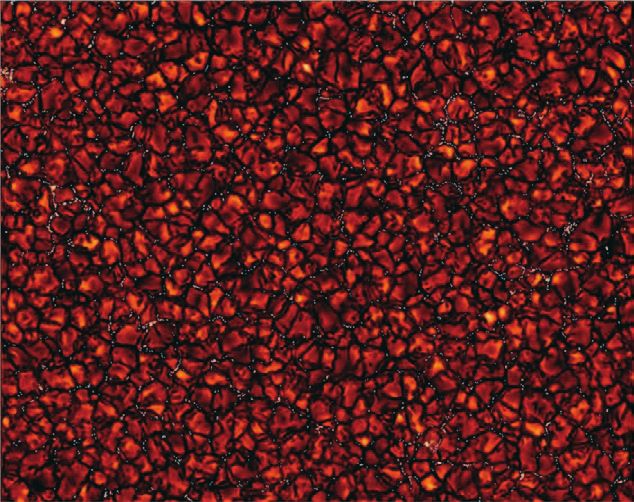
The energetic by-prod-
ucts of the fusion process
are neutrinos and electro-
magnetic radiation (γ-ray
photons). The neutrinos
have such a low proba-
bility of interacting with
anything that they pass
through the body of the
Sun at nearly the speed of
light, carrying away a tiny
fraction of excess energy
produced by fusion, and
play no further role in the
space weather story. Thus,
it is left to the photons to
carry the bulk of the energy
away from the core region.
The γ-ray photons created
in this very high densi-
ty environment interact           Fig. 2. Anatomy of the Sun: The core is dominated by high temperatures and
repeatedly with the par-          densities that enable the nuclear fusion processes that power the Sun. The
                                  location where the temperature and density fall below the critical values
ticles of the solar plasma.
                                  needed to sustain nuclear fusion (thick blue curve) defines the lower bound-
The photons are scattered,        ary of the zone where energy is transported mainly by radiation. The radia-
absorbed, and reemitted as        tive zone rotates as a solid body. At about 0.7 R S the opacity of the plasma
altered photons in random         increases, causing it to warm and become more buoyant, creating a zone
directions, but are gener-        where convection is the predominant transport mechanism. Between the
ally able to travel a little      convective and radiative zones lies a relatively thin region called the tacho-
farther in the direction of       cline where huge shear forces may create a magnetic dynamo. The top of the
                                  convective zone is defined where the opacity is low enough for photons to
decreasing density before
                                  escape into space—the photosphere. Just above the photosphere, the solar
their next interactions, so       atmosphere reaches a temperature minimum (4700 K) in a region called
that the energy is gradually,     the chromosphere. The density drops off rapidly above the chromosphere,
preferentially, transported       and the temperature rises due to nonthermal heating processes, creating
outward. As the photons,          the transition region. Eventually temperatures approach 1 MK, creating the
on average, transfer energy       exquisitely beautiful and dynamic corona.
to the ambient plasma, they
drop in energy and so increase in wavelength, until, the temperature and density of the solar plasma to
as visible light, they reach the solar surface—the fall. At the base of the radiation zone, temperatures
photosphere—from whence the energy escapes into are about 10 MK, but they decrease to 2 MK at its
interplanetary space.                                    upper boundary.
    How long does this tortuous transport of energy
from the core to the surface take? An astonishing The convection zone. At the top of the radiation zone,
30 million yr (Stix 2003)! That is, the sunlight we see the temperature is low enough that some of the
today was generated during the early Oligocene, a heavier trace elements are no longer fully ionized.
period when the continents were nearing their pres- Because multielectron ions can more readily absorb
ent positions.                                           photons, the opacity of the plasma increases, causing
                                                         the temperature to rise and the plasma to expand.
The radiation zone. Immediately above the core, out Thus, it becomes buoyant and rises relatively quickly
to a distance of about 0.7 RS , the dominant mode of to the photosphere. In this upper layer, the optical
energy transport remains radiation. Here the pressure depth of the plasma drops as the density falls to the
of the solar plasma drops steadily, maintaining point where the visible-light photons can escape
hydrostatic equilibrium with the gravitational force unhindered into space. This cools the plasma to
throughout the body of the Sun. This requires both about 5,800 K, so that it becomes denser and slowly

AMERICAN METEOROLOGICAL SOCIETY                                                      september 2012        | 1329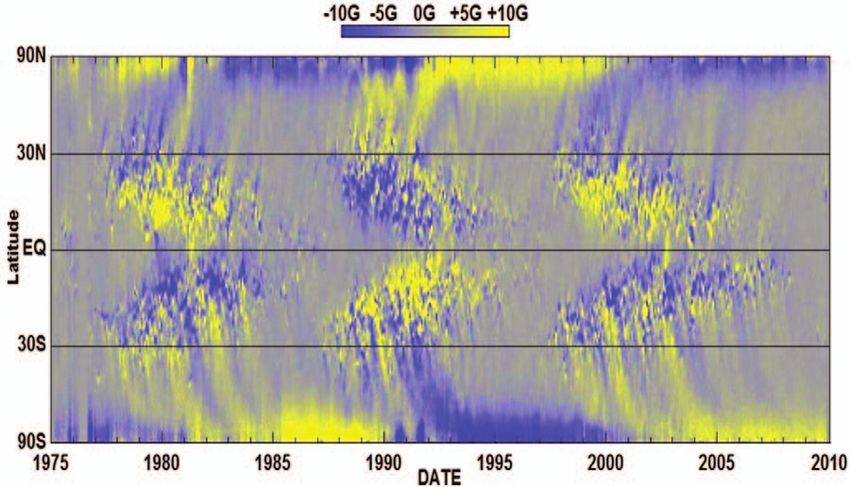
These velocity differences between the extremities of
                                                                the gas cloud imparted spin to the steadily collapsing
                                                                nebula, and, rather like an ice skater pulling in her
                                                                arms when pirouetting, the gradually forming solar
                                                                nebula started to spin faster and faster. Most of the
                                                                angular momentum was eventually shed into the
                                                                planets and other solar system debris.
                                                                    The Sun is not a solid body, and so it would not be
                                                                expected to rotate rigidly. It rotates differentially: at
                                                                the surface, the polar regions rotate more slowly than
                                                                the equator, causing a shearing motion between solar
                                                                plasma at different latitudes. At the equator, the solar
                                                                synodic rotation period (i.e., the rotation period with
                                                                respect to Earth) is about 26 days, but at the poles it
                                                                is nearly 36 days.
Fig. 3. A network of convection cells (granules) in the             However, what is the rotation rate deep inside the
solar photosphere as viewed with the Swedish solar              Sun? To look inside the Sun to determine the internal
telescope on La Palma in the Canary Islands. These              dynamics, we use the tools of helioseismology, akin
granules are about 1 arcsec in diameter and last for            to Earth-based seismology in the use of sound waves
up to 20 min.                                                   to probe beneath the surface. The buffeting of the
                                                                convection zone sends out a continuum of sound-
     sinks back down, only to be reheated. This sets up a       wave frequencies, some of which resonate with the
     convective pattern, and so convection becomes the          structure of the Sun and produce global standing
     dominant energy transport mechanism in the outer           waves. Because pressure is the restoring force for
     layer of the Sun (0.7–1.0 RS).                             these waves, they are called p waves. There are over
         The smallest-scale convection cells, approximately     a million different p-wave modes, each having a fre-
     1,000 km in diameter, are called granules, and can be      quency of 2–5 mHz with a center at 3.33 mHz, which
     seen clearly as a pattern covering the entire surface of   is a natural resonant frequency for the convection
     the Sun (Fig. 3). An individual granule may last only      zone cavity. This frequency corresponds to a period
     a few minutes. There are
     indications of larger-scale
     patterns in the photospheric
     features, suggesting that
     there may be a hierarchy
     of convection cell scales,
     including mesogranules
     (10,000 km), supergranules
     (30,000 km), and giant cells
     (100,000 km) that lie below
     the solar surface (Hathaway
     et al. 2000).

     The rotating sun.
     One theory of the Sun’s
     formation postulates that
     as the huge gaseous nebula
     that was destined to become
     the Sun started to collapse,
     the inner edge had a differ-
     ent velocity from the outer      Fig. 4. The rotation rates derived from observations show the differential
     edge because their orbits        rotation at the photosphere; they also show that the Sun rotates internally
     around the galaxy’s center       at varying speeds as a function of radius throughout the convection zone but
     were at different distances.     as a solid body in the radiation zone. We know little about the core dynamics.

1330 |      september 2012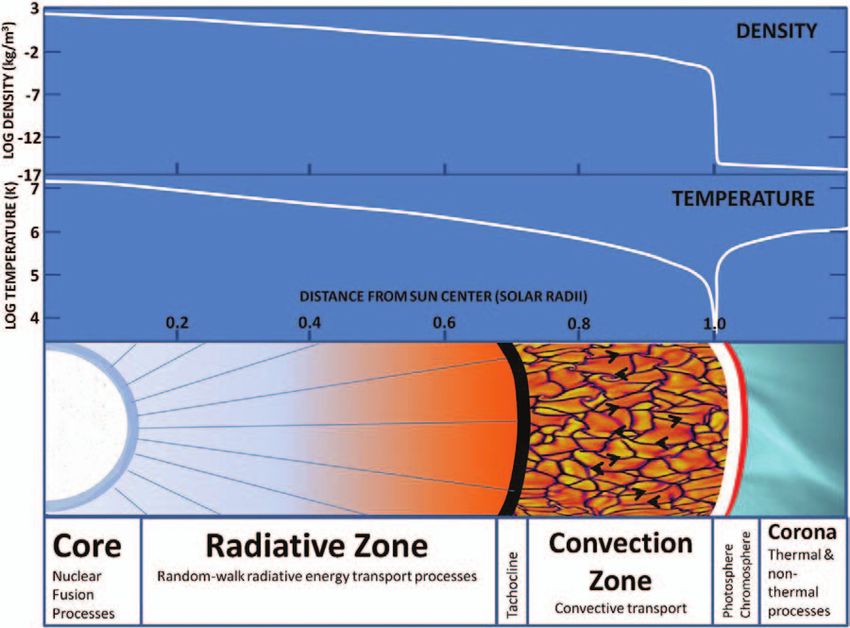
where the maximum radial
                                                                                            and latitudinal shearing
                                                                                            occurs, perhaps generating
                                                                                            large magnetic fields. It is
                                                                                            generally thought that the
                                                                                            tachocline dynamo is the
                                                                                            source of the solar activity
Fig. 5. North–south magnetic field lines deep inside the Sun get stretched and              cycle. The magnetic fields
twisted as differential rotation carries them around the Sun over a period of               generated by this dynamo
years. Eventually they get so stressed that they become unstable and kink,                  are caught up in the dif-
breaking through the solar surface to appear as sunspots.                                   ferential rotation process
                                                                                            and start to be stretched
     of about 5 min. The resonant waves are reflected at and twisted. The poloidal magnetic field (i.e., the
     the photosphere and refracted deep inside the Sun. north–south dipolar field) is gradually turned into
     The longer the wavelength of the waves, the deeper a toroidal field (i.e., an east–west field) through this
     they penetrate into the solar interior.                      rotational process (Fig. 5). This effectively increases
         Although the combined amplitudes of the p modes the strength of the field by converting rotational
     at the solar surface are about 300 m s–1, the individual energy into magnetic energy. Over a period of years,
     p modes are most readily detected via minute Doppler the magnetic pressure near the tachocline builds up
     shifts (at a few centimeters per second) in some of in twisted magnetic “ropes” until it is greater than the
     the Fraunhofer absorption lines in the visible solar local plasma pressure, and the magnetic flux ropes
     spectrum, which occur in cooler plasma overlying expand and become buoyant (Fan 2008) and rise
     the emission region; instruments like the Michelson through the convection zone until they break through
     Doppler Imager (Scherrer et al. 1995) on the Solar the visible surface of the Sun—the photosphere—to
     and Heliospheric Observatory (Domingo et al. 1995) be viewed as sunspots (Fig. 6). This is the so-called
     or ground-based systems like the Global Oscillation
     Network Group (Harvey et al. 1996) are used to make
     these Doppler measurements. Thus, the signatures of
     the p waves visible on the surface of the Sun can be
     used to image the density, temperature, and dynamics
     of the solar interior. Global helioseismology tech-
     niques can be applied to the standing acoustic waves
     to obtain the large-scale structure and dynamics of
     the solar interior, to the base of the convection zone;
     local helioseismology techniques can be used to probe
     the detailed 3D structure of the subsurface structure
     and flows and to image large magnetic structures on
     the far side of the Sun (see, e.g., Hill 1988; Duvall et al.
     1993; Lindsey and Braun 1999).
         Global helioseismic studies of the solar interior
     have found that the solar rotation is differential in
     radius as well as latitude (Fig. 4). The radiation zone
     and core seem to rotate as a solid body at a frequency
     of about 430 nHz (27 days), but the deeper the interior
     is probed, the larger the uncertainties become, so little
     is currently known of the dynamics of the core region.
     Differential rotation is maintained throughout the F ig . 6. Sunspots are the clearest manifestation of
     convection zone.                                             solar magnetic activity, heralding the changes of the
                                                              Sun’s magnetic cycle. However, there are also more
                                                              ubiquitous magnetic variations in the quiet Sun, and
    The magnetic sun. Between the rapidly but
                                                              short-term changes such as flares and coronal mass
    uniformly rotating radiation zone and the differen-       ejections. This average-sized spot is about the size of
    tially rotating convection zone, there is an interface    the Earth. [Image from Big Bear Solar Observatory/
    layer called the tachocline (Spiegel and Zahn 1992)       New Jersey Institute of Technology.]

    AMERICAN METEOROLOGICAL SOCIETY                                                          september 2012        | 1331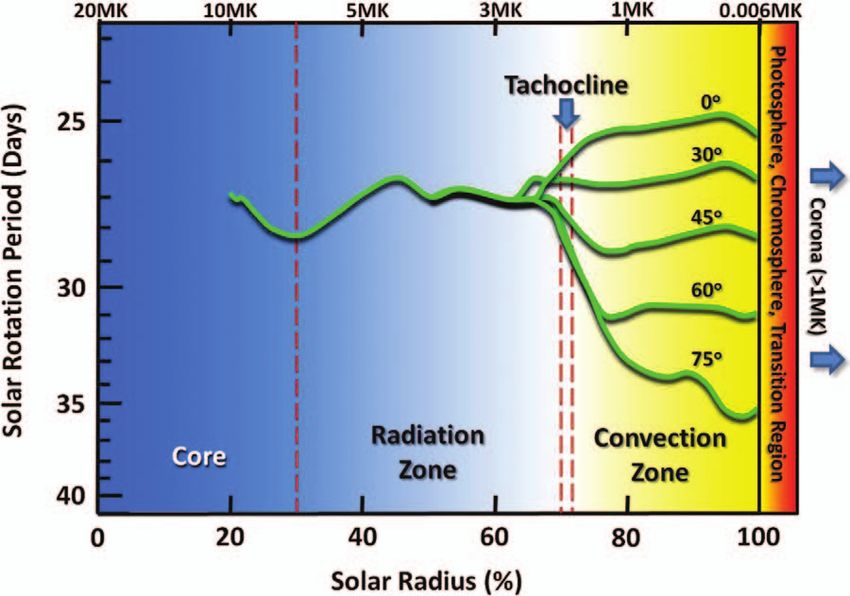
prominences when their height structure is visible
                                                           above the solar limb. The large-scale weak dipolar
                                                           solar field is dominant at the poles where their open
                                                           magnetic configuration is clearly seen by the presence
                                                           of the polar coronal holes.
                                                               Strong magnetic fields extend high above the
                                                           photosphere into the tenuous outer layer of the solar
                                                           atmosphere, namely, the corona (Fig. 7). The hot
                                                           coronal plasma is highly ionized and so is trapped by
                                                           the magnetic fields, thus outlining the fields in X-ray
                                                           and extreme ultraviolet (EUV) light so that their
                                                           evolution and interactions can be traced in detail.
                                                           This reveals a complicated structure of intertwined
                                                           and dynamic magnetic fields that change on every
Fig . 7. Coronal magnetic loops observed in EUV by
                                                           observed temporal and spatial scale in response to
the Transition Region and Coronal Explorer (TRACE)         the dynamic motions in the photosphere, the emer-
satellite. Note the variety of loop sizes and shapes in    gence and dissipation of magnetic structures, and the
the arcade overlying the dark (cool) filament channel      drift caused by differential rotation. This dauntingly
that meanders across the solar surface. The larger         complex magnetic picture of the Sun nevertheless
loops imaged here are over 100,000 km high.                shows a kind of order as the strong magnetic fields
                                                           change continuously in a quasi-regular way, yielding
     deep dynamo model. However, there is a possibility    the solar activity cycle.
     that a shallow surface layer dynamo also plays a role in
     generating some solar magnetic features and activity. The solar cycle. While there are many
         Why does a sunspot appear dark? The presence of ways of measuring the level of solar activity, the
     strong magnetic fields (up to 5,000 G, about 25,000 most common method is sunspot number (SSN),
     times stronger than the Earth’s magnetic field) an approach first used by Rudolf Wolf over 150 yr
     inhibits the convective energy f low from below. ago (Izenman 1985). SSN combines the number of
     A lower-energy f lux means lower temperatures sunspot regions with the total number of individual
     (~4,800 K or less), so the areas where these magnetic spots in a weighted average that loosely correlates
     fields poke through the solar surface appear as dark with various measures of solar activity, such as X-ray
     patches on the photosphere,
     which is at a temperature of
     about 6,000 K.
         Sunspots are not the
     only magnetic feature seen
     at the surface of the Sun.
     There is a network of small
     and relatively weak mag-
     netic dipoles dotted all over
     the Sun—the magnetic car-
     pet (Title and Schrijver
     1998). In addition to the
     magnetic carpet, long, sin-
     uous magnetic neutral lines
     snake their way across the
     photosphere, supporting
     huge and relatively cool
     structures high in the ex-
                                       Fig. 8. The daily SSN for the last five solar cycles averaged over a synodic
     tremely hot ambient solar
                                       rotation period (27.27 days). SSN clearly shows the approximately 11-yr solar
     atmosphere. These struc-          cycle and its variable amplitude. On the far right, the onset of solar cycle
     tures are known as fila-          24 (SC24) is just visible, starting in Dec 2009. [Sunspot data from NOAA/
     ments; they are also called       National Geophysical Data Center.]

1332 |      september 2012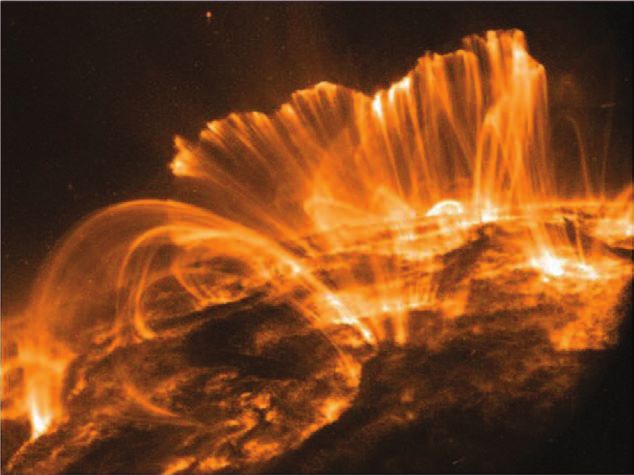
f lux, magnetic field, and
f lare rates. In the short
term, however, it should
be noted that SSN does not
correlate at all well with
these measures.
    When SSN is plotted as
a function of time, a clear
cyclic behavior becomes
apparent (Fig. 8) as Samuel
Schwabe discovered in
1843. The sunspot cycle
takes about 11 yr, although
there have been cycles as
short as 8 and as long as
14 yr. The peak amplitudes
                                   Fig. 9. The magnetic history of the last three complete solar activity cycles
of the cycle are also highly       (cycles 21–23). Note how the polarity in one hemisphere is reversed compared
variable. The reasons for          to the other for a given cycle, and how the polarities reverse from cycle to
such changes in the cycle          cycle. The drift of surface magnetic fields to lower latitudes can be seen as
length and magnitude are           the cycle progresses. [Figure courtesy of D. Hathaway, NASA/MSFC.]
unknown, although there
are proximate “symptoms,” such as observed changes sinks toward the equator in both hemispheres (Fig. 9).
in the flow speeds of material in the meridional cir- Thus, the overall toroidal field is slowly destroyed
culation pattern, which flows from the equator to the by magnetic reconnection, leaving a new large-scale
poles at the surface, with a presumed return flow in poloidal field in place, but with its polarity the reverse
the interior (see, e.g., Zhao and Kosovichev 2004). It is of the previous one.
expected that ongoing helioseismology studies, using           The full solar magnetic cycle is actually about 22 yr
higher-resolution data from the Helioseismic and because of the reversed magnetic polarities in two
Magnetic Imager (HMI; Shou et al. 2012) on the Solar successive activity cycles. In a given activity cycle, all
Dynamics Observatory (SDO; Pesnell et al. 2012), will the magnetic regions have the same polarity in one
offer new insights for producing more physics-based hemisphere and the opposite polarity in the other.
modeling of the solar cycle.                                However, the polarities of the magnetic regions that
    At solar minimum there are often no sunspots, but emerge from one cycle to the next are reversed in each
only a weak, large-scale dipolar field that stretches hemisphere. The polarity of the overall dipole field
from pole to pole and a network of random small also reverses, around the time of solar maximum.
magnetic bipoles. A few old-cycle regions sporadically         Throughout the cycle, in comparing one cycle to
emerge near the solar equator. They are generally the next, the only reliable way to determine the level
small and short lived. Such conditions can persist for of solar activity is to monitor the magnetic field;
several years, as they did recently in the surprisingly however, we have only just over 30 yr of such data
long transition from solar cycle 23 to 24 (Cranmer available, and broad conclusions are hard to defend
et al. 2010, and references therein).                       when based on such a short time line. Further, the
    The first harbingers of the new cycle appear three recent cycles have been very similar in size and
as small, weak sunspot groups at middle latitudes duration. Cycle 24 promises to be different from its
(30°–40°) during solar minimum. As the new cycle three predecessors, perhaps being more like earlier
asserts itself, the old cycle decays until, at the onset of less active and longer cycles, and so it may offer hope
the new cycle, there is a sudden global outbreak of new of extending the range of magnetic observations into
cycle activity with larger, stronger magnetic regions a new domain as it progresses.
appearing at a range of longitudes (Strong and Saba            There were periods during the seventeenth and
2009). Over the next few years, the activity builds to early nineteenth centuries when solar magnetic activ-
a maximum, often remaining at an elevated level for ity declined to exceptionally low levels, the so-called
several years, and then declines to solar minimum Maunder and Dalton minima (Eddy 1977; Usoskin
conditions once again over the next 4–5 yr. As the 2008). Such extended minima have been regularly
activity level declines, the latitude of sunspots slowly observed on other Sun-like stars (Baliunas et al. 1995).

AMERICAN METEOROLOGICAL SOCIETY                                                          september 2012       | 1333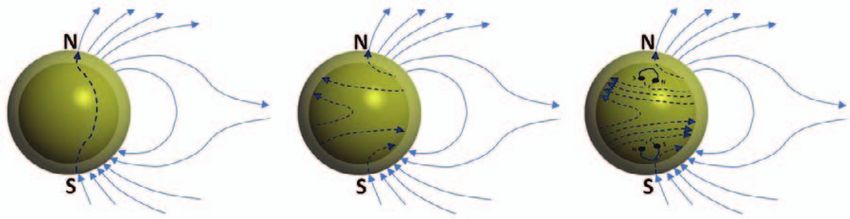
However, it is not yet understood how the Sun gets         much more substantially. For example, UV irradiance
     into or out of a minimum activity state, given our cur-    can vary by 10%–40% over a cycle. However, the
     rent understanding of how the solar dynamo works.          change in the overall energy input to the Earth from
                                                                UV variability is very small. Background X-ray
     The solar energy output. The im-                           emission changes by factors of 100 or more from solar
     portant question about solar activity as far as space      minimum to maximum. These short-wavelength
     weather and terrestrial climate are concerned is           emissions are important; for example, they affect
     whether it causes significant changes in the amount        the scale height of our atmosphere, which changes
     or the nature of the radiation and particles striking      the atmospheric drag on low Earth orbiting (LEO)
     the Earth. To answer the first part of that question,      satellites. We will deal with these issues in more detail
     we must look at the total solar energy output.             in the subsequent papers.
        The Sun’s output is not constant in time, but the
     total output [the total solar irradiance (TSI)] was once   Summary. The Sun is a complex system of systems
     thought to be invariant. With the clarity of hindsight,    and, until recently, less than half of its surface was
     this is somewhat surprising, because sunspots come         observable at any given time and then only from afar.
     and go cyclically and their darkness corresponds to        New observational techniques and modeling capa-
     a decrease in the solar energy output. Hence, one          bilities are giving us a fresh perspective of the solar
     might have expected the solar output to decrease at        interior and how our Sun works as a variable star.
     solar maximum when many sunspots are present.              This revolution in solar observations and modeling
     However, sunspot groups are often surrounded by            provides us with the exciting prospect of being able
     bright patches called faculae, which tend to com-          to use a vastly increased stream of solar data taken
     pensate for the loss of emissions from the dark spots.     simultaneously from several different vantage points
     Which factor dominates, or are they in balance?            to produce more reliable and prompt space weather
        In the late 1970s and early 1980s, instruments on       forecasts.
     two National Aeronautics and Space Administration              Solar variations that cause identifiable space
     (NASA) missions (Nimbus-7 and Solar Maximum                weather effects do not happen only on solar cycle
     Mission) began to monitor the solar output with            time scales from decades to centuries; there are also
     vastly improved precision; their measurements led          many shorter-term events that have their own unique
     to the discovery that TSI was positively correlated        space weather effects and a different set of challenges
     with the sunspot cycle. Thus, the faculae predominate      to understand and predict, such as flares, coronal
     in determining the variation of TSI throughout the         mass ejections, and solar wind variations [see Parts
     cycle. The long-term variation of the TSI is punctu-       II and III, respectively, Strong et al. (2012, manuscript
     ated by short-lived deep dips (~0.3%) when particu-        submitted to Bull. Amer. Meteor. Soc.) and Stromgrew
     larly large sunspot groups transit the solar disk. The     et al. (2012, manuscript submitted to Bull. Amer.
     problem with looking for longer trends in TSI is that      Meteor. Soc.)].
     the observations have been taken by several differ-
     ent spacecraft and the task of making a composite          ACKNOWLEDGMENTS. We have benefited from
     to establish a longer baseline is difficult; there have    constructive discussions with Jack Harvey (NSO), Joan
     been a number of attempts to do so, but there are          Schmelz (University of Memphis), and Karen Fox (ADNET
     wide discrepancies between them, and thus we have          Systems, Inc., at NASA GSFC). This work was made pos-
     no consensus (Frohlich and Lean 2004; Willson and          sible by support from Code 670 at NASA Goddard Space
     Mordvinov 2003).                                           Flight Center via SP Systems, Inc., and the University of
        We now have just over 30 yr of TSI observations,        Maryland, College Park.
     but this represents only three activity cycles, and it
     is dangerous to put too much weight on any broad
     conclusions drawn from them. There are a variety of         REFERENCES
     longer-term proxy data for solar activity, but many of     Baliunas, S. L., and Coauthors, 1995: Long-term solar
     the proxy estimates are based largely on less reliable        brightness changes estimated from a survey of Sun-
     SSN measurements and so may be adding as much                 like stars. Astrophys. J., 438, 269–287.
     noise as signal to our understanding of solar activity     Cranmer, S. R., J. T. Hoeksema, and J. L. Kohl, Eds., 2010:
     patterns.                                                     SOHO-23: Understanding a Peculiar Solar Minimum.
        The change in TSI over a solar cycle is
Domingo, V., B. Fleck, and A. I. Poland, 1995: The Scherrer, P. H., and Coauthors, 1995: The solar oscilla- SOHO Mission: An overview. Sol. Phys., 162, (1–2), tions investigation—Michelson Doppler imager. Sol. 1–37. Phys., 162, 129–188. Duvall, T. L., Jr., S. M. Jefferies, J. W. Harvey, and M. A. Shou, J., and Coauthors, 2012: Design and ground Pomerantz, 1993: Time-distance helioseismology. calibration of the Helioseismic and Magnetic Imager Nature, 362, 430–432. (HMI) instrument on the Solar Dynamics Observa- Eddy, J., 1977: Climate and the changing sun. Climate tory (SDO). Sol. Phys., 275, 229–259. Change, 1, 173–190. Spiegel, E. A., and J.-P. Zahn, 1992: The solar tachocline. Fan, Y., 2008: The three-dimensional evolution of buoy- Astron. Astrophys., 265, 106–114. ant magnetic flux tubes in a model solar convective Stix, M., 2003: On the time scale of energy transport in envelope. Astrophys. J., 676, 680–697. the Sun. Sol. Phys., 212, 3–6. Frohlich, C., and J. Lean, 2004: Solar radiative output Stromgrew, B., 1968: Principles of Stellar Evolution and and its variability: Evidence and mechanisms. Nucleosynthesis. McGraw-Hill, 612 pp. Astron. Astrophys. Rev., 12, 273–320. Strong, K. T., and J. L. R. Saba, 2009: A new approach to Harvey, J. W., and Coauthors, 1996: The Global Oscil- solar cycle forecasting. Adv. Space Res., 43, 256–259. lations Network Group (GONG) Project. Science, Title, A. M., and C. J. Schrijver, 1998: The sun’s mag- 272, 1284–1286. netic carpet. The Tenth Cambridge Workshop on Cool Hathaway, D., J. G. Beck, R. S. Bogart, K. T. Bachmann, Stars, Stellar Systems and the Sun, R. A. Donahue and G. Khatri, J. M. Petitto, S. Han, and J. Raymond, J. A. Bookbinder, Eds., Astronomical Society of the 2000: The photospheric convection spectrum. Sol. Pacific, 345–360. Phys., 193, 299–312. Usoskin, I. G., 2008: A history of solar activity over Hill, F., 1988: Rings and trumpets—Three-dimensional millennia. Living Rev. Sol. Phys., 5. power spectra of solar oscillations. Astrophys. J., 333, Willson, R. C., and A. V. Mordvinov, 2003: Secular 996–1013. total solar irradiance trend during solar cy- Izenman, A. J., 1985: J R Wolf and the Zurich sunspot cles 21 and 22. Geophys. Res. Lett., 30, 1199, relative numbers. Math. Intell., 7, 27–33. doi:10.1029/2002GL016038. Lindsey, C., and D. C. Braun, 1999: Seismic images of the Zhao, J., and A. G. Kosovichev, 2004: Torsional oscilla- far side of the Sun. Science, 287, 1799–1801. tion, meridional flows, and vorticity inferred in the Pesnell, W. D., B. Thompson, and P. C. Chamberlin, 2012: upper convection zone of the sun by time-distance The solar dynamics observatory. Sol. Phys., 275, 3–15. helioseismology. Astrophys. J., 603, 776–784. AMERICAN METEOROLOGICAL SOCIETY september 2012 | 1335
You can also read


