University libraries fighting fake news: an analysis of the knowledge and practices of Portuguese librarians - Tatiana Sanches, Maria Luz Antunes ...
←
→
Page content transcription
If your browser does not render page correctly, please read the page content below
University libraries fighting fake news:
an analysis of the knowledge and practices of Portuguese librarians

Tatiana Sanches, Maria Luz Antunes, Carlos Lopes

                                                             ICISIL 2021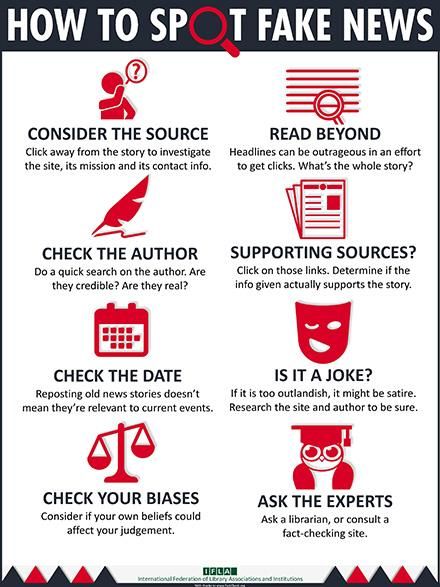
WHY STUDY FAKE NEWS FIGHT
IFLA expressed deep concern about the
public impact that fake news has in the face
of freedom of expression and access to
information
Academic libraries are located on the
frontier of creating new knowledge,
bridging the gap between the production
and dissemination of information and the
public, namely students, teachers, and
researchers
ICISIL 2021
OBJECTIVE

            The aim of this work, based on a survey launched
            to the community of academic libraries in
            Portugal, is to describe and explain which
            strategies and practices are being considered
            and implemented given this problem, and some
            actions to adopt in the future by the academic
            libraries.

                                                      ICISIL 2021
DISSEMINATION OF FAKE NEWS
New lies and camouflages emerge every day and are
used to deceive the most unsuspecting, namely
concerning digital identity theft, hatred, religious and
racial intolerance, fraud in e-commerce transactions,
cybersecurity issues, political fraud, charity, among
others
Preventive behavior in the face of these risks is
increasingly important and urgent
ICISIL 2021
STRATEGIES TO FIGHT FAKE NEWS
Student are competent communicators on
social networks but are unaware of the potential
for manipulation
It is necessary to enable people to navigate the
Internet safely, but it is also essential to teach them
how to filter the contents that will use or place and
make available to others
Libraries have developed several projects and
initiatives to ensure the training of students and
researchers and to awaken the necessary care in
research and information analysis
ICISIL 2021
METHODS
Qualitative and Quantitative analysis, using a
survey launch to Portuguese academic librarians
Questions to know about the ideas, knowledge,
commitment, and strategies of Portuguese librarians
Convenience sample obtained from the universe of
the 177 Portuguese academic libraries
ICISIL 2021
METHODS

Study variables

                  ICISIL 2021
RESULTS

                        Identification                          Universe    % Answers         %
                        Public University Teaching                    71   40.3    38      52.0
73 libraries answered   Private University Teaching                   27   15.3    12      16.4
(41.5% of the           Public Polytechnic Education                  51   29.0    18      24.7
universe under          Private Polytechnic Education                 25   14.2     4        5.5
analysis)               Military and Police Education                  2    1.2     1        1.4
                                                        TOTAL        176   100     73       100

                                                                                        ICISIL 2021
RESULTS

«From what techniques or activities do you believe that the phenomenon of
disinformation responsible for information bubbles and false news on the Internet could
be solved?» (%)                                                                    ICISIL 2021
RESULTS

          ICISIL 2021
RESULTS
«What media and information literacy resources should the library make available to
combat false news?» (%)
ICISIL 2021RESULTS
«Does your institution's library plan any activities in this regard?»
ICISIL 2021RESULTS
«Does your institution's library plan any
activities in this regard?»
Initiatives
Classroom training sessions
Collaboration with the teachers
Individualized support for students to identify
reliable and scientifically reliable resources
Dynamization of graphic materials, especially for
IFLA infographics
Use of social networks to create alerts to fake
news
Partnership with secondary schools to ensure
earlier awareness and training ICISIL 2021CONCLUSIONS
Despite being aware of the issue, librarians
seem to still be unsure about the actions to
be taken, particularly with academic
students, to contribute to their training in
combating fake news
Students need to be exposed to real
information and false news, to learn how to
evaluate the information in order to
produce proactive thinkers, researchers,
and consumers of information that they
identify and surpass as false news and its
harmful effects
ICISIL 2021CONCLUSIONS
Actions must be developed in a
controlled environment, with concrete
measures, based on thoughtful training
strategies, especially in conjunction with
teachers
The teaching of strategies for detecting
fake news among academic students can
restrain its dissemination
That is why the work of librarians, with a
proximity character, should be valued
ICISIL 2021Tatiana Sanches
Ph.D. Researcher / Head Librarian
tsanches@fpie.ulisboa.pt
University libraries fighting fake news:
an analysis of the knowledge and practices of
Portuguese librarians Maria Luz Antunes
Integrated Ph.D. student / Head Librarian
mluz.antunes@estesl.ipl.pt
THANK YOU !
Carlos Lopes
Ph.D. Researcher/ Head Librarian
clopes@ispa.pt
This work is financed by national funds from FCT – Foundation for Science
and Technology under UID/CED/04107/2019 - Unidade de Investigação e
Desenvolvimento em Educação e Formação, Instituto de Educação,
Universidade de Lisboa.
ICISIL 2021You can also read


