The revised VCE Second Language study designs (2019-2023) Community Languages Victoria Conference 7 July 2019 - VCAA Presenter: Maria Dikaiou ...
←
→
Page content transcription
If your browser does not render page correctly, please read the page content below
The revised VCE Second Language study
          designs (2019-2023)

    Community Languages Victoria
           Conference
            7 July 2019

        Presenter: Maria Dikaiou
                 VCAA
       Languages Unit, Curriculum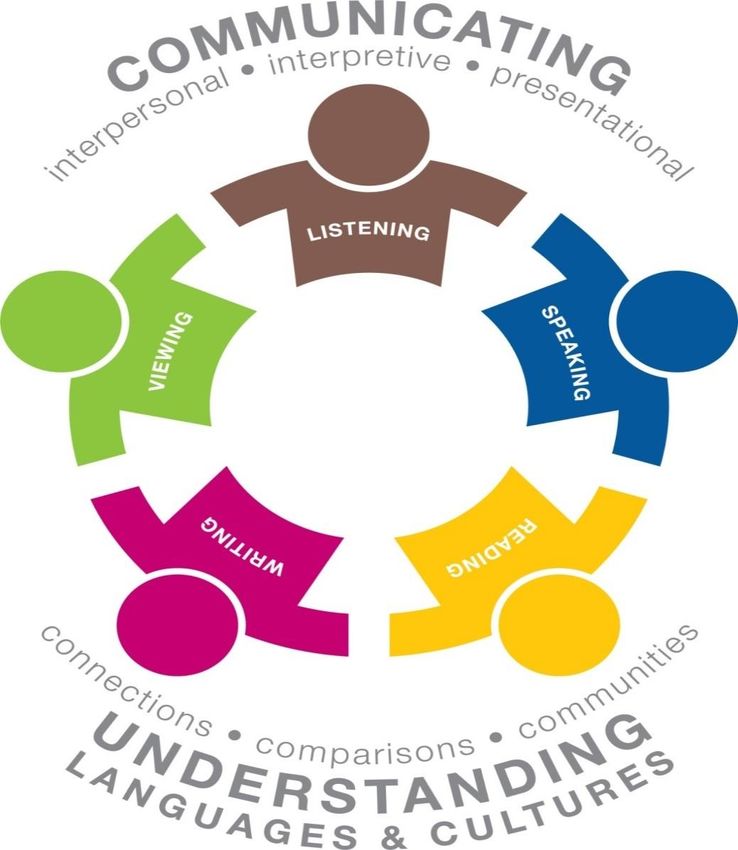
VCE Languages reviewed
The Victorian Curriculum and Assessment Authority has now
completed a review of twelve VCE Second Language studies:
        Arabic                Indonesian Second
                              Language

        Chinese Second        Italian
        Language

        Chinese Second        Japanese Second
        Language Advanced     Language

        French                Korean Second
                              Language
        German                Spanish

        Greek                 Vietnamese Second
                              Language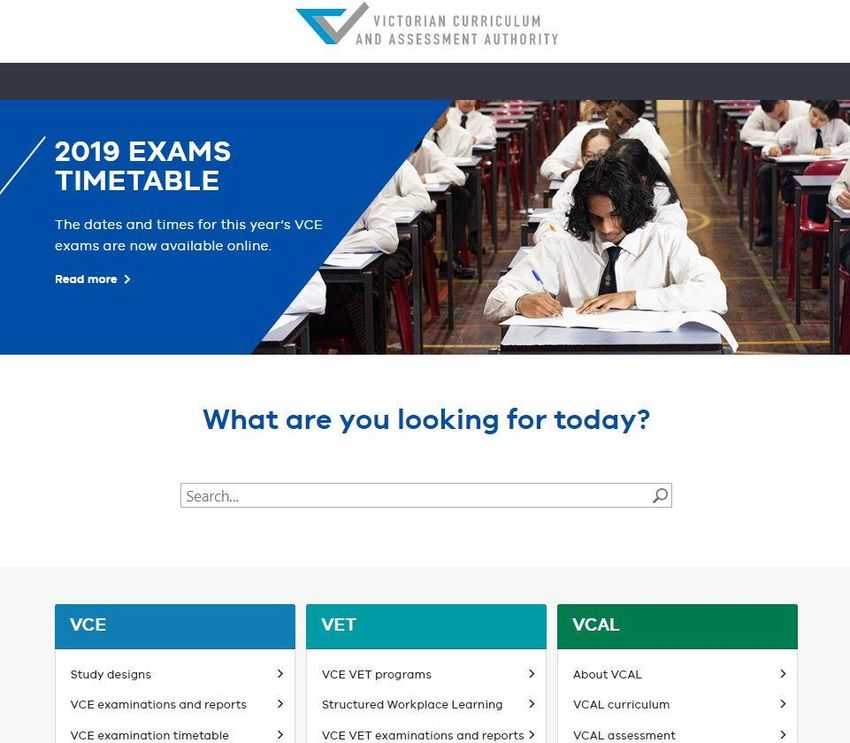
VCE Languages reviewed

All twelve reviewed
study designs
are now available
on the Victorian
Curriculum and
Assessment
Authority website
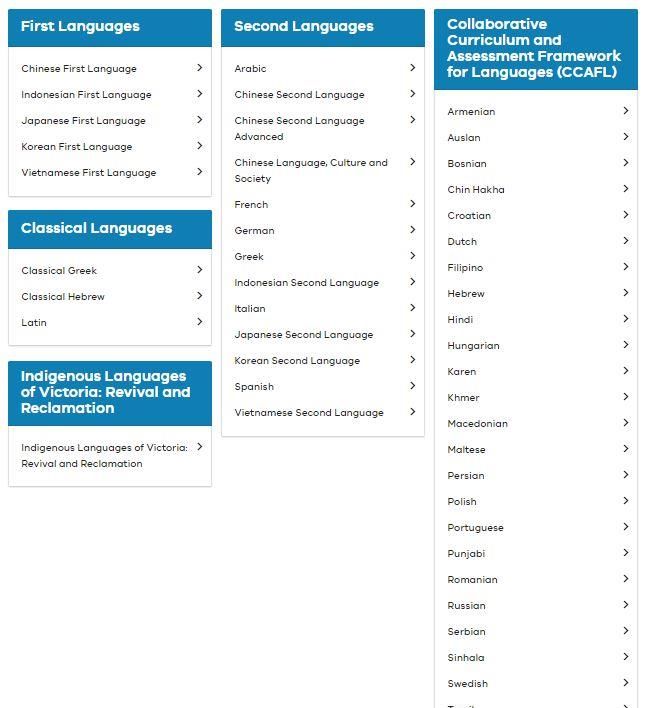
Where to find the revised Study Design

                                All twelve
                                revised study
                                designs are
                                available on the
                                Victorian
                                Curriculum and
                                Assessment
                                Authority
                                (VCAA) website
Where to find the revised Study Design
Staged Implementation

• Units 1 and 2 of the new study designs
  have been implemented in 2019

• Units 3 and 4 will be implemented in
  2020

• The accreditation period for these
  studies will be 2019-2023
Features of revised VCE Second Language studies

  • Online Advice for Teachers (AFT)
    documents have been devised for
    all 12 languages
  • The Advice for Teachers replaces
    the current Assessment Handbook
  • Exam specifications and sample
    SACS will no longer be in study
    designs
Features of revised VCE Second Language studies
• Structure builds on the concepts and
terminology in the Victorian Curriculum
F–10 to allow a clear transition
• Viewing included as 5th macroskill
• Assessment tasks for Units 1and 2 to be
devised by the teacher
• Key knowledge and key skills for each
area of study are in separate lists.School-assessed coursework Units 1 & 2 Units 3 & 4 3 assessment 3 SACs – Unit 3 tasks per unit 3 SACs – Unit 4 Schools report results Report results to the to the VCAA: Only S/N VCAA: S/N and marks Responses in E&SL No SAC responses for Unit 1 Outcome 2 required in English
Features of revised VCE Second Language studies

Each study design sets out

   • Prescribed themes and topics for the
     specific language and culture/s
   • Suggested subtopics
   • Text types students can be expected to
     produce
   • Styles of writing – personal, imaginative,
     persuasive, informative and evaluative
   • Grammar list
Cross-study specifications – common to all languages
Features of revised VCE Second Language studies

  • Viewing included as 5th macroskill

  • “For the purpose of this study, viewed
    texts may include photographs, pictures,
    posters, films or film clips, captioned
    illustrations or maps related to the
    subtopic.” Text types, pg. 12.
Features of revised VCE Second Language studies Students are required to study and analyse “cultural products or practices” as part of some assessment tasks and SACS. • “Cultural products or practices can be drawn from a diverse range of texts, activities and creations. These may include the following: stories, poems, plays, novels, songs, films, photographs, artworks, architecture, technology, food, clothing, sports and festivals.” Communities, pg. 10.
Three Areas of Study in each unit

• Interpersonal communication

• Interpretive communication

• Presentational communication

The outcomes for each unit reflect these.
In Unit 3

• Students participate in a role play to
  negotiate a solution to a personal
  issue

• Students respond to texts

• Students express ideas in personal,
  informative or imaginative writing
Marks
         Unit 3 - Outcomes                               Assessment tasks

Outcome 1                                20     A three- to four-minute role-play,
Participate in a spoken exchange to             focusing on negotiating a solution to
resolve a personal issue                        a personal issue

Outcome 2                                       Responses to specific questions or
Interpret information from texts and     15     instructions using information
write responses                                 extracted from written, spoken and
                                                viewed texts on the selected subtopic

Outcome 3                                15     An approximately 250-word
Express ideas in a personal,                    personal, informative or imaginative
informative or imaginative piece of             piece of writing
writing

                          Total marks    50
Features of revised VCE Second Language studies
In Unit 4
• Two SACs in Unit 4 can be on the same
subtopic
• There are three separate SACs two of
which require analysis of chosen aspects
of culture
• Students produce a piece of evaluative or
personal writing on an issue (SAC 3)Marks
Unit 4 - Outcomes Assessment tasks
Outcome 1 20 A three- to four-minute interview
Share information, ideas and opinions providing information and responding
in a spoken exchange to questions about a cultural product
or practice
Outcome 2 An approximately 250-word written
Analyse information from written, 15 response for a specific audience and
spoken and viewed texts for use in a purpose, incorporating information
written response from three or more texts
Outcome 3 15 An approximately 300- word
Present information, concepts and evaluative or persuasive piece of
ideas in evaluative or persuasive writing
writing on an issue
Total marks 50Features of revised VCE Second Language studies • Chinese Second Language (CSL) and Chinese Second Language Advanced (CSLA) are in separate study designs • Character list for CSL has 440 characters • Character list for CSLA has 618 characters • No translation tasks in VCE Chinese studies • In Japanese Second Language (JSL) there is now only one list - prescribed Kanji
External Exams
Oral Examination
approximately 15 minutes

Written Examination
2 hours plus 15 minutes reading time.

Sample exams will be provided for all
twelve studies
For ongoing information
Contact Details

Email: dikaiou.maria.m@edumail.vic.gov.au

Tel: 9032 1689
Copyright
© Victorian Curriculum and Assessment Authority (2016).
Third parties may own copyright in some content included in this
presentation, as indicated.
The term VCE and associated logos are registered trademarks of the
VCAA.
VCAA content may be used in accordance with the VCAA’s
Intellectual Property and Copyright Policy
http://www.vcaa.vic.edu.au/Pages/aboutus/policies/policy-
copyright.aspx
 Victorian Curriculum and Assessment
                Authority
          www.vcaa.vic.edu.au
You can also read


