User Authentication & Protection Using Decoy Technology & Honeyword
←
→
Page content transcription
If your browser does not render page correctly, please read the page content below
International Research Journal of Engineering and Technology (IRJET)                                          e-ISSN: 2395-0056
         Volume: 08 Issue: 05 | May 2021                   www.irjet.net                                              p-ISSN: 2395-0072

            User Authentication & Protection Using Decoy Technology
                                 & Honeyword
                        Jigar Bipin Chheda1, Sujay Shankar Pol2, Vaishnavi Shivji Joshi3
        1-3Students,   Dept. of Computer Engineering, Pillai Hoc College of Engineering & Technology, Rasayani,
                                                           Maharashtra, India
---------------------------------------------------------------------***----------------------------------------------------------------------
Abstract - We recommend a generally exact and best                       divulgence, in the event that anybody of the honeypot
technique for improving the security of hashed passwords by              passwords gets utilized. during this examination, we break
giving of extra "honeywords" (bogus passwords) related with              down the honeyword approach and gives a few comments
every client's record. An intruder who needs to takes a                  about the wellbeing of the framework. Besides, we infer that
document of hashed passwords and modifies the hash work                  the critical thing for this strategy is that the age calculation
can't tell on the off chance that he has discovered the secret           of the honeywords indicated they will be undefined from the
phrase or a honeyword. the "Honeychecker" can recognize the              legitimate passwords. In this manner, we propose a
client secret phrase from honeywords for the login schedule,             substitution approach that utilizes passwords of different
and will set off an alert if a honeyword is use. we propose an           clients inside the framework for honeyword sets, for
elective methodology that select the honeywords (fake pass)              example practical honeywords are given. Besides, this
from existing client secret phrase in the framework to give              framework likewise lessens the capacity cost.
practical honeywords, a completely level honeyword age                   Fundamentally, a direct however smart thought behind the
strategy and furthermore to decrease the capacity cost.                  investigation is that the inclusion of bogus passwords –
                                                                         called as honeywords – related with every client's record. At
Key Words: Honeywords, Intruder, Honeychecker,                           the point when an enemy gets the password rundown, she
Bogus, Password, Hash                                                    recuperates numerous secret phrase possibility for each
                                                                         record and the person can't make certain about which word
1.INTRODUCTION                                                           is veritable. Subsequently, the broke password documents
                                                                         are frequently recognized by the manager if a login endeavor
                                                                         is done with a honeyword by the foe.
    Revelation of secret password might be a serious security
issue that has influenced various clients and organizations
like Yahoo, LinkedIn and Adobe, since spilled passwords                  1.1 Honeywords
make the clients focus of the numerous conceivable digital
assaults. These new occasions have exhibited that the feeble                 At the point when a foe gets a password document he/she
secret word stockpiling strategies are right now in situ on              may get confounded between the secret word, which one is a
numerous sites. for example, the LinkedIn passwords were                 right. It gives Basically, it's the addition of bogus passwords
utilizing the SHA-1 calculation without a salt and comparably            identified with every client's record. At the point when a foe
the passwords inside the eHarmony framework were                         gets the password run down she recuperates numerous
likewise put away utilizing unsalted MD5 hashes. In fact,                password possibility for each record and she or he can't make
when a secret word record is taken, by utilizing the secret              certain about which word is authentic. Consequently, the
phrase breaking strategies very much like the calculation of             broke secret phrase documents is identified by the PC client if
Weir et al. it's not difficult to catch a large portion of the           a login endeavor is done with a honeyword by the foe.
plaintext passwords .In this regard, there are two issues that
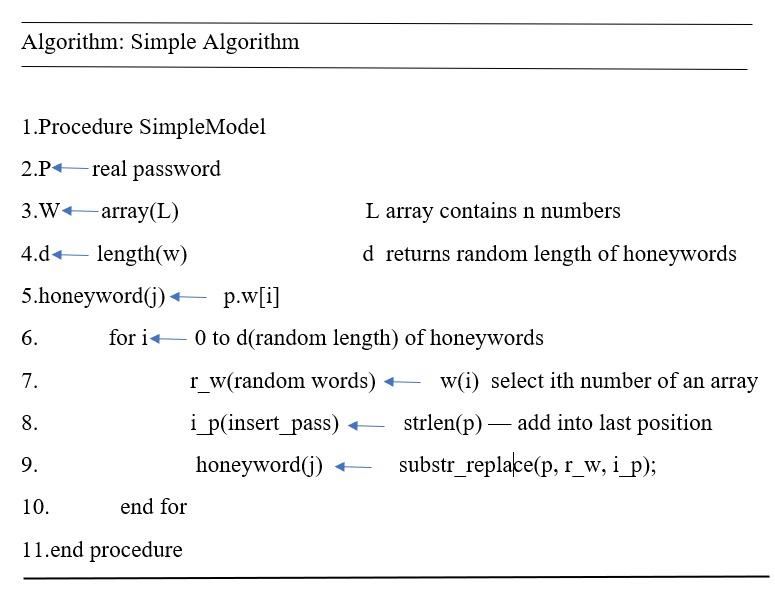
should be considered to beat these security issues: First,                  Honeyword Generator calculation Gen () - The creators
passwords should be ensured by avoiding potential risk and               present a definition in light of the fact that the levelness of
putting away with their hash esteems registered through                  Gen () indicated it gauges the possibility of an enemy in
salting or another perplexing components .Hence, for a foe it            picking the appropriate password from the sweet words.
should be difficult to upset hashes to gather plaintext
passwords. The subsequent point is that a protected                      Primary wording behind this framework is, in information
framework ought to identify whether a secret word                        base we store the genuine password and the honeywords in a
exposure episode occurred or to not make proper moves.                   similar record.
during this investigation, we have practical experience in the
last issue and focus on counterfeit passwords or records as a                In below fig.1.1 we can see that P is the genuine secret
direct and cost compelling answer for distinguish bargain of             word of the client where, as p1,p2,… pn are the honeywords
passwords. Honeypot is one among the techniques to spot                  of that client.
event of a secret phrase data set break. during this
methodology, the manager intentionally makes misleading
passwords to bait foes and identifies a secret word

© 2021, IRJET          |     Impact Factor value: 7.529              |     ISO 9001:2008 Certified Journal                 |   Page 603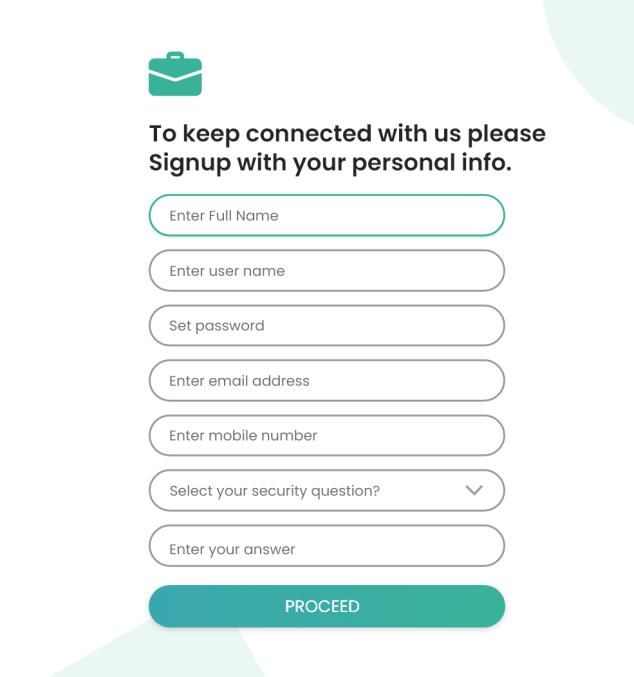
International Research Journal of Engineering and Technology (IRJET)                                   e-ISSN: 2395-0056
        Volume: 08 Issue: 05 | May 2021               www.irjet.net                                           p-ISSN: 2395-0072

                                                                         Recently, Juels and Rivest have introduced the honeyword
                                                                     instrument to distinguish an enemy who endeavors to login
                                                                     with broke passwords. Fundamentally, for each username a
                                                                     bunch of sweet words is developed to such an extent that just
                                                                     a single component is the right secret phrase and the others
                                                                     are honeywords (imitation passwords). Subsequently, when
                                                                     a foe attempts to go into the framework with a honeyword, a
                                                                     caution is set off to tell the chairman about a secret phrase
                                                                     spillage.

                                                                     3. EXISTING SYSTEM

                                                                         As of late, Juels and Rivest proposed honeywords (fake
                                                                     passwords) to identify assaults against hashed secret word
                                                                     data sets. for each client account, the genuine secret phrase is
                                                                     put away with a few honeywords to detect pantomime. On
   These passwords are not produced haphazardly as in the            the off chance that honeywords are chosen appropriately, a
current framework. In our framework honeywords are the               digital aggressor who takes a document of hashed passwords
passwords of the other genuine clients which are doled out           can't be certain if it's the first secret word or a honeywords
arbitrarily at the hour of enlistment of deception of the            for any record. In addition, entering with a honeyword to
genuine passwords to programmer so that login to that                login will trigger a caution informing the manager a couple of
record gets hard for the programmer.                                 secret word document penetrate. To the detriment of
                                                                     quickening the capacity necessity by multiple times, the
    It is not difficult to allocate an arbitrary clients             creators present a clear and compelling answer for the
passwords to specific client yet it is hard for the programmer       identification of secret phrase record exposure occasions.
to get the genuine password to get the passage into the              during this examination, we investigate the honey word
client's record. After a 3 login endeavor programmer gets            framework and present a few comments to highlight
passage into the phony record which is made by the                   conceivable flimsy parts. Likewise, we prompt another
administrator. Administrator can transfer the phony                  methodology that chooses the honey words from existing
documents to the phony record to give the figment of the             client passwords inside the framework in order to supply
genuine client account. Administrator will be advise through         reasonable honey words-a brilliantly level honeyword age
mail and message framework with the username who are                 strategy and furthermore proportional back stockpiling cost
attempting to hack that client's record. Administrator will          of the honey word conspire.
apply the security designs further to forestall the hacking or
to hinder that programmer. This exercises are dealt with by          4. PROPOSED SYSTEM
the administrator, client is uninformed of this exercises.

2. LITERATURE REVIEW

    This thought has been adjusted by Herley and Florencio to
shield internet banking accounts from password savage
power assaults. As per the examination, for every client
mistaken login endeavors for certain passwords lead to
honeypot accounts, for example malevolent conduct is
perceived. For example, there are 108 opportunities for a 8-
digit password and let framework joins 10000 wrong
password to honeypot accounts, so the enemy playing out the
savage power assault multiple times bound to hit a honeypot
account than the certified record. Utilization of distractions
for building burglary safe was presented by Bojinov et al. in
called as kamouflage. In this model, the phony secret word
sets are put away with the genuine client secret phrase set to
hide the genuine passwords, along these lines constraining an
enemy to do a lot of online work prior to getting the right              Proposed model is as yet dependent on utilization of
data.                                                                honeywords to distinguish password cracking. However,
                                                                     instead of existing user’s password we are generating the

© 2021, IRJET        |    Impact Factor value: 7.529             |    ISO 9001:2008 Certified Journal              |   Page 604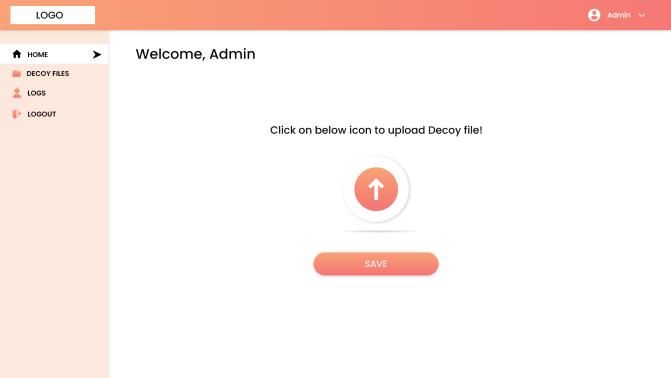
International Research Journal of Engineering and Technology (IRJET)                                     e-ISSN: 2395-0056
         Volume: 08 Issue: 05 | May 2021                 www.irjet.net                                          p-ISSN: 2395-0072

honey words and storing them in the password files for more            F2 keeps the index number and the corresponding hash of
realistic.                                                             the password (create the hash of the password), < ci;H(pi) >

    Every Registered user would have multiple fake entries in          Step 2: Generation of Honeyindex set
the database at the time of registration, which would create           In Step 1 we insert honey index set in file F1 but don’t know
confusion in attackers mind as he/she would be seeing                  how to create that We use honey index generator algorithm
multiple realistic user entries or duplicate user entries and it       Gen(k; SI ) ->ci;Xi Generate Xi
would be difficult to identify the original user or the actual         a. Select xi randomly choosing k-1 numbers from SI and
user.                                                                  furthermore arbitrarily picking a number ci SI.
                                                                       b. ui; ci pair is conveyed to the honeychecker and F1, F2 files
  Admin or user authentication via email that whether the              are refreshed.
user or admin has currently login to the system or not and if
not logged in he/she can directly trigger the logout button            Step 3: Honey checker
and session would be logged out.                                       Set: ci, ui Sets right password record ci for the client ui
                                                                       Check: ui, j Checks whether ci for ui is equivalent to given j.
   In case if some users has any memory loss problem or                Returns the outcome and if fairness doesn't hold, informs
finding difficulties in remembering the password then he/she           framework a honeyword circumstance.
can login to the system using OTC (One time code) received
on registered email only.                                              5. WORKING

4.1 Honeyword Checker Algorithm                                        5.1 Initialization

                                                                           Firstly, T fake user accounts are created with their
                                                                       passwords. Also an index value between [1, N], but not used
                                                                       before it is assigned to every honeypot randomly. Then k 1
                                                                       numbers are randomly selected from the index list and for
                                                                       every account a honeyindex set is constructed like Xi = (xi,1;
                                                                       xi,2……,xi,k); one in every of the weather in Xi is that the
                                                                       correct index (sugar index) as ci. Presently, we utilize two
                                                                       secret word documents as F1 and F2 inside the fundamental
                                                                       worker: F1 stores username and honeyindex set, < hui , Xi >
                                                                       sets where hui indicates a honeypot account. Note that every
                                                                       entry has two elements. the primary one is that the username
                                                                       of the account and also the second element is honeyindex set
                                                                       for the respective account. Likewise, the table is arranged one
                                                                       after another in order by the username field. On the opposite
                                                                       hand, F2 keeps the fact and also the corresponding hash of
                                                                       the password.

                                                                           In this case, each entry within the table has two elements.
Inputs:                                                                The primary element is that the sugar index of the account
1. T fake user accounts (honey pots)                                   and also the second is that the hash of the corresponding
2. Index value between [1;N],                                          password. Notice that the table is sorted in line with the index
    Index list, which is not previously assign to user                 values. Allow SI to mean the list segment and SH address the
                                                                       relating secret phrase hash section of F2.
Procedure:
Understanding Password Database Compromises

Step 1: Honey pots creation: fake user account
a. For each record honey list set is made like
Xi =(xi;1; xi;2; : : : ; xi;k); one of the elements in Xi is the
correct index (sugar index) as ci

b. create two password file file F1 and file F2
F1 Store username and honyindex set
International Research Journal of Engineering and Technology (IRJET) e-ISSN: 2395-0056
Volume: 08 Issue: 05 | May 2021 www.irjet.net p-ISSN: 2395-0072
Table -1: Example Password File F1 for the Proposed Model honeypot. If it's a honeypot, then it follows a predefined
security policy against the password disclosure scenario.
Username Honeyindex Set Notice that for a honeypot account there's no importance of
SujayPol the entered password is genuine or a honeyword, so it
(93, 16626, . . . , 94931) directly manages the event without communicating with the
VaibhavSali (15476, 51443, . . . , 88429) honey checker. Honey checker controls whether j = ci and
returns the result to the most server. At the identical time, if
RohanP (3, 62107, . . . , 91233) it's not equal, then it assured that the proffered password
may be a honeyword and adequate actions should be taken
SiddT (89, 79869, . . . , 59897) betting on the policy.
AdityaM (1009, 23471, . . . , 47623)
5.4 Purpose and Scope
JigarC (63, 51234, . . . , 72382)
• Honeywords are used in validation framework
• The primary point of undertaking is to approving if
Table -2: Example Password File F2 for the Proposed Model information access is allowed when strange data access is
recognized.
SI SH • Mistaking the aggressor for counterfeit data.
H(p3) • This secures against the abuse of the client's genuine
3
information.
7 H(p7)
• We propose an altogether different way to deal with
85 H(p85) getting the cloud utilizing fake data innovation, that we've
. .
. .
come to call haze figuring.
100000 H(p100000) • We utilize this innovation to dispatch disinformation
H(p100004) assaults against malevolent insiders, keeping them from
100004
recognizing the first touchy client information from
counterfeit useless information.
5.2 Registration
5.5 Result
After the initialization process, system is prepared for
user registration. During this phase, a legacy-UI is preferred, User Side:
i.e. username and password are required from the user as ui; 1. Login
pi to register the system. We use the honeyindex generator
algorithm. Last, periodically honey indexes of every account
should be regenerated. Because the number of users within
the system increases to produce uniform distribution of
honey indexes across SI, fresh honeyindex set must involve
numbers from this new larger list. Otherwise, passwords of
newly created accounts wouldn't be used as honeywords
within the system and it should provides a clue to the
adversary to in guessing the right password of those new
accounts. Note that inside a predictable dispersion every
secret phrase is alloted as a honeyword about k occasions, on
the grounds that there are N passwords however Nk
honeywords are required.
5.3 Login Process
Our System first checks whether entered password, g, is
right for the corresponding username ui. To create this,
initially the Xi of the comparing ui is accomplished from the
F1 file. Then, the hash values stored in F2 file for the
respective indices in Xi are compared with H (g) to search out
a match. If a match isn't found, then it means g is neither the
proper password, nor one among the honeywords, i.e. login
fails. On the opposite hand, if H (g) is found within the list,
then the most server checks whether the account may be a
© 2021, IRJET | Impact Factor value: 7.529 | ISO 9001:2008 Certified Journal | Page 606International Research Journal of Engineering and Technology (IRJET) e-ISSN: 2395-0056
Volume: 08 Issue: 05 | May 2021 www.irjet.net p-ISSN: 2395-0072
2. Register required he can download it from this page using his files key
which differs from file to file.
5. Keys
To download the file first the user has to use his actual
username and password so that he can get the key for every
single file that has been uploaded by him.
Admin Side:
1. Admin can login to this page to view the user directories
3. Home Page and logs. The main role of admin is to upload fake files in
case the hacker tries to use the user name to collect the files.
Admin can only get and check the activities about user file
uploads, downloads, viewed and size of the file.
User once logged in at his home page can upload any
file that he has been working on and can be visible only
to him.
4. Files 2. Logs
The file uploaded by admin can be accessed only by
hacker, real user cannot even view those files. Admin can
upload any type of fake file.
For security reasons once the file is prepared the user
should upload that file in database so that when the file is
© 2021, IRJET | Impact Factor value: 7.529 | ISO 9001:2008 Certified Journal | Page 607International Research Journal of Engineering and Technology (IRJET) e-ISSN: 2395-0056
Volume: 08 Issue: 05 | May 2021 www.irjet.net p-ISSN: 2395-0072
6. CONCLUSION
Our framework serves to administrator. Client gets
moment ready when some programmer attempted to get to
his record. Likewise programmer will see the rundown of
fakes documents inside the framework. So he feels that he
got the entrance the record. we've introduced a new way to
deal with make the age calculation as close on quality by
making honeywords with haphazardly picking passwords
that have a place with different clients inside the framework.
we've contrasted the proposed model and different
techniques with significance DoS opposition, evenness, and
3. Decoy Files capacity cost and convenience properties. this strategy
Confuse to the aggressor with counterfeit data. This secures
against the abuse of the client's unique information. We
propose an outrageously extraordinary way to deal with
getting the cloud utilizing bait data innovation, that we've
come to call haze figuring. We utilize this innovation to
dispatch disinformation assaults against malevolent insiders,
keeping them from recognizing the significant delicate client
information from counterfeit useless information.
ACKNOWLEDGEMENT
This project report would not have been come into
reality without the able guidance, support and wishes of all
those who stand by us in the development. We wish to give
Admin can view list of all the user’s and can have a look our special thanks to our guide Prof. Rajashree Gadhave and
on all the details and the activities of user. Moreover also can Head of Department, Dr. Ashok Kanthe for their valuable
create & upload decoy files to make confusion for hacker to guidance and unending support despite of a very busy work
get into the system. schedule. The cheerful spirit they radiated all the time
fuelled our desire to excel in the work that we had
Intruder Side: undertaken. We acknowledge all the staff members of
department of the Computer Engineering for their help and
1. Invalid User Account suggestions during various phases of this project work. It’s
difficult to forget our eminent supporters that are my family
members and friends who are always their encouraging us in
my every deed.
REFERENCES
[1] Ms. KomalNaik, Prof. VarshaBhosale and Prof. Vinayak
D.Shinde, “Honeyword Generation Approach Using ASCII
Values for Security Enhancement”, March 2017.
[2] Muhammad Ali Fauzi, Bian Yang, Edlira Martiri,
“PassGAN-Based Honeywords System”, Dec 2019.
[3] Akshima, Donghoon Chang, Aarushi Goel, Sweta Mishra,
Somitra Kumar Sanadhya, “Generation of Secure and
Reliable Honeywords, Preventing False Detection”,
If the hacker tries to hack the user account then after 2018.
three attempts the hacker can get into fake account which [4] SonaliBamane, Monika Shinde, Mrs.Amrapali
has been created by admin which creates an illusion to Mhaisgawali, Mangal Bargaje, Dr.Sanjay Pawar,
hacker believing that he is using a user’s real account. “Achieving Flatness Using Honeywords Generation
Algorithm”, May 2019.
[5] Neelam More, Minaj M. Pathan , Mahesh .B. Totre, Asst.
Prof. Swati. S. Gore, “Honeyword:Achiving secure
Passwords using HoneyEncryption”, Nov 2016.
© 2021, IRJET | Impact Factor value: 7.529 | ISO 9001:2008 Certified Journal | Page 608International Research Journal of Engineering and Technology (IRJET) e-ISSN: 2395-0056
Volume: 08 Issue: 05 | May 2021 www.irjet.net p-ISSN: 2395-0072
[6] Omkar Madhavi, Avdhut Nalawade, Tejas Nagpure,
Bharati Kavitake, “Intrusion Detection using Honeypots
and Honeywords”, March 2017.
[7] A. Juels and R. L. Rivest, “Honeywords: Making
Password- cracking Detectable,” in Proceedings of the
2013 ACM.
[8] J. Bonneau, “The science of guessing: Analyzing an
anonymized corpus of 70 million passwords,” in
Security and Privacy (SP), 2012 IEEE Symposium on.
IEEE, 2012, pp. 538–552.
[9] Ding Wang, Haibo Cheng, Ping Wang, Jeff Yan, Xinyi
Huang, “A Security Analysis of Honeywords”, 2018.
[10] Omar Z. Akif, G. J. Rodgers, G. J. Rodgers, H. S. Al-
Raweshidy, “Achieving Flatness: Honeywords
Generation Method for Passwords based on User
Behaviours”, March 2019.
[11] Ajay Kumar, E. Jaya Krishna, “Privacy Enhancement For
User Authentication Using Improved Honeyword
Generation And Secure Hashing”, March 2020.
[12] Hackett, “Yahoo Raises Breach Estimate to Full 3 Billion
Accounts, By Far Biggest Known,” fortune.com, Oct. 3,
2017.
[13] K. Akshaya and S. Dhanabal, “Achieving flatness from
non-realistic honeywords,” in 2017 International
Conference on Innovations in Information, Embedded
and Communication Systems (ICIIECS), pp. 1-3. IEEE,
2017.
[14] N. Chakraborty, S. Singh, and S. Mondal, "On Designing a
Questionnaire Based Honeyword Generation Approach
for Achieving Flatness," in 2018.
[15] Z. A. Genc, S. Kardas, and K. M. Sabir, “Examination of a
New Defense Mechanism: Honeywords,” Cryptology
ePrint Archive, Report 2013/696, 2013.
© 2021, IRJET | Impact Factor value: 7.529 | ISO 9001:2008 Certified Journal | Page 609You can also read


