RangoliGAN: Generating Realistic Rangoli Images using GAN - IRJET
←
→
Page content transcription
If your browser does not render page correctly, please read the page content below
International Research Journal of Engineering and Technology (IRJET)                                          e-ISSN: 2395-0056
         Volume: 07 Issue: 04 | Apr 2020                   www.irjet.net                                              p-ISSN: 2395-0072

          RangoliGAN: Generating Realistic Rangoli Images using GAN
                                                      Sainath S1, Sridhar S2
    1Undergraduate        Student, Department of Computer Science, SRM Institute of Science and Technology, India
       2Assistant    Professor, Department of Computer Science, SRM Institute of Science and Technology, India
---------------------------------------------------------------------***---------------------------------------------------------------------
Abstract - The success of generating photorealistic images               Goodfellow et al. in their 2014 paper [1] propose an
lately has been widely attributed to the invention of GAN                adversarial framework where they simultaneously train two
(Generative Adversarial Networks) in 2014 and since then                 models (Generator G and Discriminator D) without the need
there have been multiple interesting applications of GANs. This          of Markov Chain. The training procedure is for G to maximize
paper shows that DCGANs can be used for synthesizing photo-              the mistake made by D. The MNIST, Toronto Face Dataset
realistic rangoli Images with considerable diversity. The                and CIFAR-10 dataset were used in the training process. This
specific domain application of generating rangoli Images                 paved way for more adversarial process frameworks in the
poses a considerable challenge since rangoli Images are                  future. The results from this paper have been improved a lot
mostly symmetric in nature with a varied range of textures               with the various advancement in training techniques and
and hue involved. Rangolis are no less than a mathematical               architectures.
art. The RangoliGAN introduced in this paper is aimed towards            GANs initially evolved from zero-sum game borrowed from
understanding and applying the process of image generation               Game Theory. Two neural networks compete with each
on rangoli images. Many recent advances in GAN training have             other to generate convincing fakes. They have been applied
been taken into consideration in the experimentation process.            to generate images, text, sound, art, videos and also Multi-
The experiments show that this method can effectively                    Modal Cross-domain applications.
generate realistic rangoli images. In simple terms one can say
that the Generator is The Artist and Discriminator is The Art-           Though GANs were originally classified under supervised
Critic.This experiment can be considered as a base for                   learning, they have been adopted in supervised, semi-
exploring more on Creative AI - to demonstrate the creative              supervised and also in reinforcement learning. Putting in
capabilities of machine learning models.                                 layman’s terms GAN consist of two-part Discriminator(D)
                                                                         and Generator(G), the G generates images and the job of D is
                                                                         to identify whether the generated image is real or fake. This
Key Words: convolutional generative adversarial
                                                                         process of adversarial learning is very important in the GAN
networks, Rangoli, image synthesis, neural networks,
                                                                         training, and through this contest, the GANs are able to
creative AI, GAN
                                                                         generate realistic-looking fake data. The generator learns the
                                                                         input distribution of data with the aid of discriminator and
1. INTRODUCTION                                                          thus over time and iterations it is able to generate images
                                                                         Again in GAN there are multiple architectures that are used
Rangoli Images are fascinating and an integral part of Indian            depending upon the application. Since we are going to work
culture since early ages. Over the generations it has gone               with images the DCGAN(Deep Convolutional Generative
through many localization and adaptations. Their symmetric               Adversarial Networks) [2] is of our interest. Although other
nature is well known and they appear to be a combination of              architectures like WGAN (Wasserstein GAN) [3] does not
several simpler designs superimposed over each other. This               stop us from generating fake images, the DCGAN architecture
symmetricity in rangoli can be viewed from an angle of                   introduced by Radford et al. have been proven to give better
Cymatics - the study between vibrations and geometric                    results when applied to the task of working on images thus
patterns concerning them.                                                becoming the de-facto while working on images. The paper
It is well known that the brain actually responds to visual              [17] tries to address the challenge of how AI can be used to
patterns and depending on the shapes & patterns, it can have             evaluate creative designs. This paper aims to form a
different effects on the mind, and this paper tries to                   foundation for Creative AI and Explainable AI to understand
understand and further build on how creativity is perceived              GANs’ creativity and interpretability.
by a machine. It is the GANs (Generative adversarial
Networks) which can be used to generate realistic rangoli
                                                                         2. RELATED WORK
images.
GAN (Generative Adversarial Networks) [1] was first
                                                                         DCGANs [2] have seen many interesting extensions on
introduced by Goodfellow et al. drawing inspiration from
                                                                         categorical images like in art for generating anime characters
generative models. Yann LeCun called GANs the most
                                                                         [4], in medical imaging – MelanoGANs: High Resolution Skin
interesting idea of the decade.
                                                                         Lesion Synthesis with GANs [5] , a report on bird image
                                                                         generation using DCGAN [6], even augmentation of breast

© 2020, IRJET         |     Impact Factor value: 7.529              |    ISO 9001:2008 Certified Journal                 |    Page 6425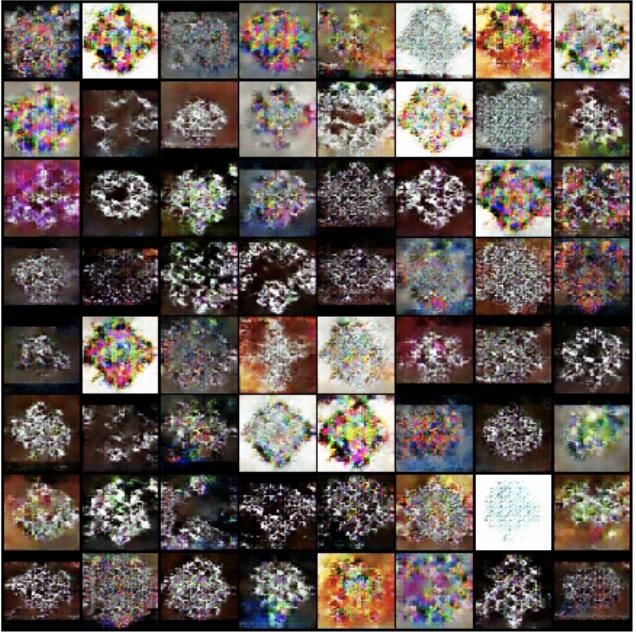
International Research Journal of Engineering and Technology (IRJET) e-ISSN: 2395-0056
Volume: 07 Issue: 04 | Apr 2020 www.irjet.net p-ISSN: 2395-0072
mass in X-ray Mammography [7] have all used DCGAN as challenging to train and the initial results were
their underlying structure. It might be also interesting to unsatisfactory. Since then researchers have worked on
note that DCGANs are not restricted to only image enhancing the overall GAN architecture and bringing in more
generation, there have been many successful attempts to stability while training a GAN.
apply DCGAN to other domains like sound domain(speech,
bird vocalizations, drums, piano) by introducing WaveGAN DCGAN is inferior to both BigGAN [13] and StyleGAN [14]
[8] an adaptation of the existing DCGAN structure. with former being able to produce superior image quality
and latter having styling control over latent space
Few of the other works by authors taken into consideration In designing the DCGAN architecture Radford el al. mainly
while experimentation are [10] , a great paper which lists the emphasis the core to their approach being
latest advancement in GAN with respect to Computer Vision
Paper [9] by Creswell et al. reviews various architectures of Replace Pooling functions with strided Convolutions
GANs and techniques in order to get stable training. - thus allowing networks to learn its own spatial up
sampling in generator
The Two Time-Scale Update Rule [11] proposed by Heusel, Remove Fully Connected Layers after Convolutions -
Martin, et al. which uses individual learning rate both for for a middle ground between faster convergence
discriminator and generator hence making it faster to and increased stability
converge to a local Nash equilibrium thus enhancing the Batch Normalization - with zero mean and unit
learning capabilities of DCGAN. variance to make up for poor initialization thus
helping gradients flow deeper in the model
According to Game Theory, Nash equilibrium is the state
solution in which when two or more players are involved 4.1 Architecture
although each player knows the strategies of other players,
no one gains by bringing a change in their own strategy. The GAN architecture used in this paper has one Generator
Furthermore John Forbes Nash Jr. showed that there is Nash and one Discriminator, there has been an attempt to use
equilibrium for every finite game. multiple generators by proposing an MGAN (Mixture
Generative Adversarial Nets) [12].
In the context of GANs it can be put as Discriminator and As discussed earlier DCGAN in our case consists of a
Generator are said to be in Nash equilibrium if Discriminator Discriminator and Generator.
is making the best decision it can, taking into account
Generator's decision while Discriminator's decision remains
The architecture over the years has been carefully evolved to
unchanged, and Generator is making the best decision it can,
bring it stability and enhanced learning through many
taking into account the Discriminator's decision while
techniques like using ReLU activations to avoid sparse
Generator's decision remains unchanged.
gradients and make computation faster, custom weight
initialization, Two Time-Scale Update Rule, etc.
3. RANGOLI
Rangoli is an ancient Art form which is also followed today in 4.1.1 Generator
most India households. The word rangoli means row of
The Artist tries to generate images that look as real as
colors. The paper [15] trace backs the history of the rangoli
possible. It captures the joint probability p(X, Y), or just p(X)
and its mentions in the Indian text and literature. They are a
if there are no labels. Generator contains the learned vector.
piece of Mathematical Art [16].They come in a variety of
symmetry groups, spirals, mirror curves, fractal self- The learning process happens when Discriminator gives
similarity, and processes of iteration. The paper further feedback to the Generator on whether the generated data is
mentions about these designs being able to transfer as real or fake from the eyes of the Discriminator. A block in our
Kinesthetic intelligence in children. It might also be generator network consists of Transposed Convolutional
interesting how this Kinesthetic is perceived as part of layers, BatchNorm and ReLU. There are 4 such blocks
machine intelligence. This paper is more interested in arranged sequentially in our generator network ending with
understanding how symmetry is learned. Symmetry can be another layer of Transposed Convolution with a Tanh
rotational, reflective, cyclic symmetries. Almost all rangoli function at the very end.
exhibit some kind of symmetry.
The use of Tanh, in the end, is explained in [12] and
attributes to the model’s ability to learn more quickly to
4. DCGAN saturate and cover the color space of the training
distribution. Also Tanh [-1,1] being symmetric in nature also
DCGAN (Deep convolutional generative adversarial helps it to better capture images features like treating dark
networks) [2] introduced by Radford et al. was aimed at and light colors equally.
unsupervised learning. When GANs were initially proposed
they did not draw much attention because they were very
© 2020, IRJET | Impact Factor value: 7.529 | ISO 9001:2008 Certified Journal | Page 6426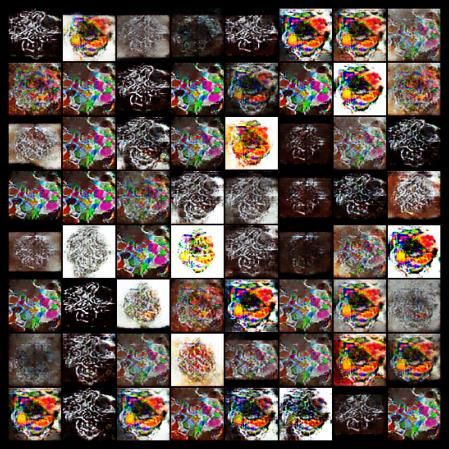
International Research Journal of Engineering and Technology (IRJET) e-ISSN: 2395-0056
Volume: 07 Issue: 04 | Apr 2020 www.irjet.net p-ISSN: 2395-0072
4.1.2 Discriminator The generator has no control over the log(D(x)) term , so it
indirectly minimizes the loss by minimizing log(1 - D(G(z)))
The Art Critic which acts as a binary classifier labelling term. In a nutshell, the generator tries to minimize the above
whether the generated image is Real or Fake. It captures the equation whereas discriminator tries to maximize it.
conditional probability p(Y | X).
A block in our discriminator networks consists of the 4.2.2 Modified Minimax Loss
Convolution layer, BatchNorm, and LeakyReLU. Again there
Studies also found that there is a likelihood that Minimax
are 4 such blocks in our discriminator network ending with
loss can cause the network to get stuck during its early
another 2D Convolutional with sigmoid activation function
learning process as little information about gradient is made
at the very end. The use of LeakyReLU helps in avoiding the
available to the generator. So making the generator
“Dying ReLU” problem of getting stuck in zero gradient
maximize log D(G(z)) would help to overcome this situation
forever. The sigmoid activation function for getting the
when the discriminator is powerful in the initial stages. This
output as the probability of the image being real or fake.
trick is sometimes called log D trick [1] for training GANs
4.3 Training
We use the Discriminator to train the Generator. The
generator loss penalizes the generator for producing a
sample that the discriminator network classifies as fake.
It is harder to train generator models because they have to
model more thus learning from complicated distribution,
whereas discriminator easily tries to classify between real or
fake once it learns the pattern.
Initially in the early stages of GAN training, the discriminator
are more powerful than the generator and the discriminator
is good at rejecting fake images with high confidence, hence
the Minimax loss saturates. Usage of log D trick helps
prevent this
Fig-1: RangoliGAN architecture
4.2 Loss 4.4 Challenges
GANs try to learn from a probability distribution. A distance
Training a GAN is difficult and results are quiet
metric is necessary to understand how far is the generated
unpredictable. Most of the GANs impose the following
distribution from the real data distribution.
challenges which we might need to consider while training
4.2.1 Minimax Loss Mode Collapse - The generator collapses leading to
noise data generation or repeating.
The loss used in our paper is Minimax Loss which is Non Convergence - Happens because the
expressed as discriminator feedback becomes less significant and
hence random over time leading to unstable
parameters
Vanishing Gradients - Discriminator gets too
Where successful thus generator ends up learning nothing
Powerful Discriminator in initial stages.
D(x) - is the probability estimate that X is real, where X is a Highly sensitive to initial hyper parameters
single data instance.
5. DATA COLLECTION
x~P data - this denotes the value that is expected drawn over
all real data points. A total of close to 2000 rangoli images were collected and
each image was manually examined. Many images had to be
G(z) - this denotes the output of the generator for a certain rejected because of them being distorted, incomplete, had
amount of noise denoted by 'z'. texts on them or had interfering objects(like hands) in it.
After careful inspection the cleaned dataset resulted in a
D(G(z)) - denotes the probability estimate by the total of 1079 images which is very less when compared to
discriminator for a fake instance to be real. similar projects done which involved huge datasets.
To compensate for this, appropriate image augmentation
X~P noise - denotes the expected output value drawn over techniques were used to give an illusion of increased
all inputs of the generator training data diversity.
© 2020, IRJET | Impact Factor value: 7.529 | ISO 9001:2008 Certified Journal | Page 6427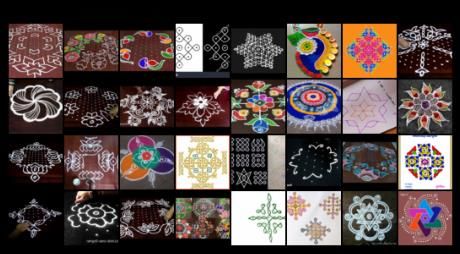
International Research Journal of Engineering and Technology (IRJET)                                e-ISSN: 2395-0056
        Volume: 07 Issue: 04 | Apr 2020               www.irjet.net                                         p-ISSN: 2395-0072

                                                                     results. The main hyper parameters were epochs, batch size,
                                                                     optimizer settings, latent vector size and weight
                                                                     initialization.

                                                                     The number of epochs chosen were 100, 200, 300 and 500.
                                                                     Batch size of 32, and 64 were used depending upon RAM.
                                                                     Optimizer used was Adam (learning rate = 0.0002, 0.0005
                                                                     ,0.002, beta1 = 0.5).

                                                                     5.4 Two Time-Scale Update Rule (TTUR)
                                                                     This involves having different learning rates for Generator
             Fig-2: Sample Data from Dataset                         and Discriminator.

5. EXPERIMENT                                                        The use of TTUR was run on 100, 200 and 500 epochs and
                                                                     D_lr and G_lr of 0.0002 and 0.002 respectively were chosen.
Considering the fact that GANs are hard to train and involve         The experiment was rerun again on 100 epoch with D_lr and
a lot of hyperparameter. Many different experiments were             G_lr swapped to infer the results when the learning rate of
conducted tweaking the hyper parameter settings. The most            Discriminator and Generator are switched.
significant ones are considered for this paper.
                                                                             Table -1: Conducted Experiments Details
5.1 Training Details
                                                                      S No    Epochs    TTUR Used           Learning Rate
There are multiple ways of training a GAN. The author of the
paper studied them and chose the best one considering the               1       100          No           D_lr = G_lr = 0.0002
scenario. The below is well studied and widely used in
training of GAN.                                                        2       100          No           D_lr = G_lr = 0.0005

                                                                        2       200          No           D_lr = G_lr = 0.0002

                                                                        3       300          No           D_lr = G_lr = 0.0002

                                                                        4       500          No           D_lr = G_lr = 0.0002

                                                                        5       100         Yes        D_lr = 0.0002, G_lr = 0.002

                                                                        6       100         Yes        D_lr = 0.002, G_lr = 0.0002

                                                                        7       200         Yes        D_lr = 0.0002, G_lr = 0.002

                                                                        8       500         Yes        D_lr = 0.0002, G_lr = 0.002

                                                                     6. RESULTS
              Fig-3: Training Steps Followed
                                                                     The results were obtained from running many experiments
5.2 Model Architecture
                                                                     under multiple configuration. Loss plots of different runs
The model architecture for Discriminator and Generator was           expose interesting insights into our experimentation
identical to the one described in the Architecture subsection.       process.
See Section 4.1 for more details.

5.3 Hyperparameter
As discussed before, GAN are highly sensitive to hyper
parameter selection. Taking into consideration our dataset
size and available compute power (Tesla K80, P4 and T4 ) a
range of hyperparameters were adjusted to give varied

© 2020, IRJET        |    Impact Factor value: 7.529             |   ISO 9001:2008 Certified Journal           |   Page 6428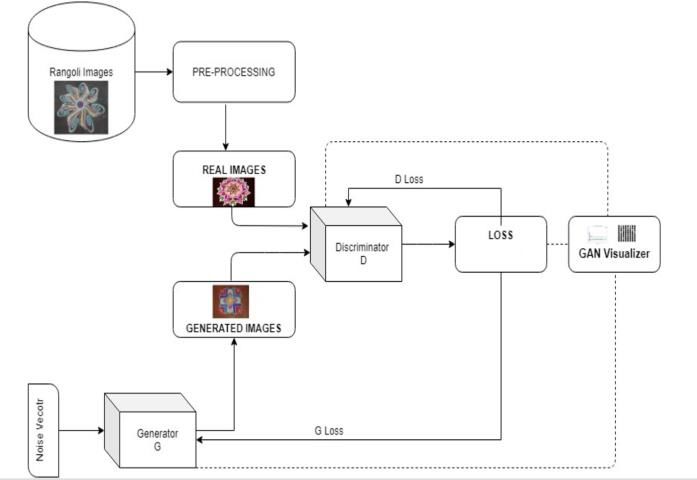
International Research Journal of Engineering and Technology (IRJET)                                  e-ISSN: 2395-0056
         Volume: 07 Issue: 04 | Apr 2020               www.irjet.net                                          p-ISSN: 2395-0072

                                                                      The plot obtained in Fig 6 and Fig 7 are run on 100 epochs
                                                                      each but the values of learning rate of D and G were
                                                                      swapped between the two trials. Again these results are
                                                                      quite surprising. On an average the G_loss in Fig 7 is
                                                                      decreasing. There is a point of convergence in Fig 6 unlike in
                                                                      Fig 7.

  Fig 4: Running for 500 epochs TTUR with D_lr = 0.0002
                      and G_lr = 0.002

From Fig 4 and Fig 5 we see contrasting results which are
quite interesting. The D_loss and G_loss seems to have
converged at around 3500 iterations in the Fig 4 which uses
TTUR but on running for the same number of epochs without
the use of TTUR the losses seems to not converge. There
                                                                      Fig 7: Running for 100 epochs TTUR with D_lr = 0.002 and
seems to be a point of intersection of G_loss and D_loss in Fig
                                                                                            G_lr = 0.0002
4 after which the curves branch out in opposite direction.
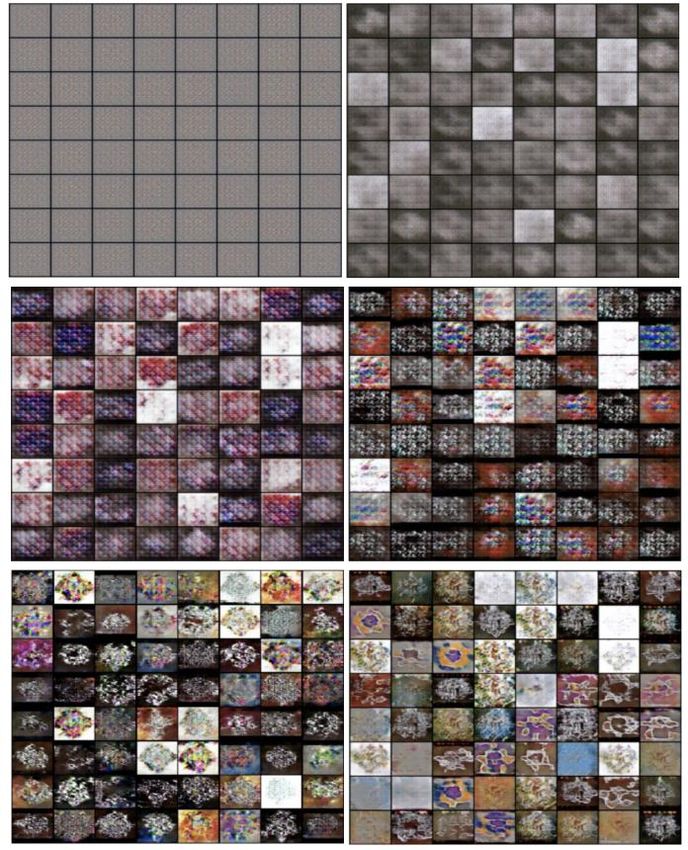
                                                                      The generated images are shown in the Fig 8 and Fig 9.

       Fig 5: Running for 500 epochs without TTUR

                                                                                  Fig 8: Fake Image after 500 epochs
                                                                      Fig 8 we see that images are repeated which indicate maybe
                                                                      there is a possibility of Mode Collapse happening where the
                                                                      generator would have collapsed leading to noise or repeated
                                                                      set of image generation happening

                                                                      In Fig 9, considerable fake Rangoli images have been
 Fig 6: Running for 100 epochs TTUR with D_lr = 0.0002                generated which appear to be symmetry in nature although
                     and G_lr = 0.002                                 we have not enforced symmetry as part of our modelling.

© 2020, IRJET        |    Impact Factor value: 7.529              |   ISO 9001:2008 Certified Journal            |   Page 6429
International Research Journal of Engineering and Technology (IRJET) e-ISSN: 2395-0056
Volume: 07 Issue: 04 | Apr 2020 www.irjet.net p-ISSN: 2395-0072
rangoli images using a GAN. The paper used a small dataset
with limited number of epochs, better results can be
expected with larger dataset. The rangoli images are no
lesser than a piece of mathematical art form with most of
them being symmetry in nature. Currently this paper didn’t
enforce a symmetry on the generated images so a way to
impose a conditional symmetry either implicitly or explicitly
can be a future step of this work. Another possible extension
would be to have a stacking of multiple GAN architecture so
as to generate images at higher resolution. The Image to
Image translation of coloring a rangoli image and an
alternate implementation of DiscoGAN to have cross domain
styling of entities based on rangoli designs seems to be
within the scope of this project’s future work. As art has no
boundaries so does the GAN.
REFERENCES
[1] Goodfellow, Ian, Jean Pouget-Abadie, Mehdi Mirza, Bing
Xu,David Warde-Farley, Sherjil Ozair, Aaron Courville,
and Yoshua Bengio. "Generative adversarial nets." In
Fig 9: Fake Image after 100 epochs Advances in neural information processing systems, pp.
2672-2680. 2014.
[2] Radford, Alec, Luke Metz, and Soumith Chintala.
“Unsupervised representation learning with deep
convolutional generative adversarial networks.” arXiv
preprint arXiv:1511.06434, 2015.
[3] Arjovsky, Martin, Soumith Chintala, and Lon Bottou.
”Wasserstein gan.” arXiv preprint arXiv:1701.07875,
2017.
[4] Yanghua Jin, Jiakai Zhang, Minjun Li, Yingtao Tian,
Huachun Zhu, and Zhihao Fang. Towards the automatic
anime characters creation with generative adversarial
networks. arXiv preprint arXiv:1708.05509, 2017.
[5] Baur, C., Albarqouni, S., Navab, N., 2018b. Melanogans:
high resolution skin lesion synthesis with GANs.
arXiv:1510.07818v1.
[6] Huang, Zhiling. "Bird Generation with DCGAN.",
unpublished
[7] Alyafi, Basel, Oliver Diaz, and Robert Martí. "DCGANs for
realistic breast mass augmentation in x-ray
mammography." Medical Imaging 2020: Computer-
Aided Diagnosis. Vol. 11314. International Society for
Optics and Photonics, 2020.
[8] Donahue, Chris, Julian McAuley, and Miller Puckette.
"Synthesizing audio with GANs." (2018).
[9] Creswell, A., White, T., Dumoulin, V., Arulkumaran, K.,
Sengupta, B., & Bharath, A. A. (2018). Generative
adversarial networks: An overview. IEEE Signal
Fig 10: Learning Evolution across Epochs Processing Magazine, 35(1), 53-65.
7. CONCLUSIONS AND FUTURE WORK [10] Y. Cao et al., "Recent Advances of Generative Adversarial
Networks in Computer Vision," in IEEE Access, vol. 7, pp.
The scope of this project and its future work will be to 14985-15006, 2019.
understand symmetricity and creativity is perceived by a [11] Heusel, M., Ramsauer, H., Unterthiner, T., Nessler, B., &
machine and make it explainable AI. GANs are currently in Hochreiter, S. (2017). Gans trained by a two time-scale
the forefront of building up on Creative AI. The field is update rule converge to a local nash equilibrium. In
dynamic with new and advanced models coming out Advances in neural information processing systems (pp.
regularly. This paper demonstrated on how to generate 6626-6637).
© 2020, IRJET | Impact Factor value: 7.529 | ISO 9001:2008 Certified Journal | Page 6430International Research Journal of Engineering and Technology (IRJET) e-ISSN: 2395-0056
Volume: 07 Issue: 04 | Apr 2020 www.irjet.net p-ISSN: 2395-0072
[12] Hoang, Q., Nguyen, T. D., Le, T., & Phung, D. (2018).
MGAN: Training generative adversarial nets with
multiple generators.
[13] Brock, A., Donahue, J., & Simonyan, K. (2018). Large scale
gan training for high fidelity natural image synthesis.
arXiv preprint arXiv:1809.11096.
[14] Karras, T., Laine, S., & Aila, T. (2019). A style-based
generator architecture for generative adversarial
networks. In Proceedings of the IEEE Conference on
Computer Vision and Pattern Recognition (pp. 4401-
4410).
[15] Thakur, M. (2014). A Creative Expression of
Celebrations: Rangoli.
[16] Bapat, M. (2008). Mathematics in RangoLee art from
India. In Proceedings of Conference on Mathematical Art
(pp. 429-432).
[17] Maher, Mary & Fisher, Doug. (2012). Using AI to
Evaluate Creative Designs. ICDC 2012 - 2nd
International Conference on Design Creativity,
Proceedings. 1.
© 2020, IRJET | Impact Factor value: 7.529 | ISO 9001:2008 Certified Journal | Page 6431You can also read


