2020 Market Outlook Trading opportunities in the year ahead - Published 7 January 2020 - FXTM
←
→
Page content transcription
If your browser does not render page correctly, please read the page content below

Market Outlook             2020   Q1

2020
Market
                                       1

Outlook
Trading opportunities in
the year ahead

Published 7 January 2020
Market Outlook                                                                2020                                                  Q1

   Contents
   Introduction...........................................................................................................03
   The US Dollar....................................................................................................... 04
   The British Pound................................................................................................ 06
   The Japanese Yen ...............................................................................................08
   The Euro................................................................................................................10
   Gold........................................................................................................................12
   Crude Oil................................................................................................................14
   Amazon Stock.......................................................................................................16
   Walt Disney Stock ................................................................................................18

Market  Outlook
 Market Outlook                                                 2020
                                                                2020                                                         Q1     Q1

Introduction
Will the global economy bounce back to life in 2020?
2019 has certainly been a year to remember in the financial      pressure, especially in developed economies, as yield
markets. Geopolitical issues have been at the centre of          curves steepen and investors position for the reflation
news headlines, dominated by the US-China trade dispute,         trade as inflationary pressures re-emerge.
threats of a hard Brexit and demonstrations across many
countries. Fears of a global recession escalated when the        Risks that could upset a potential recovery
US Treasury yield curve inverted in August for the first time
since mid-2007. The combination of these factors weighed         Trade disruption remains the number one risk that could
heavily on business sentiment and economic growth.               threaten the economic recovery and increase the chance
                                                                 of a recession in late 2020. We still believe that both US
That said, global equity markets still had a phenomenal          and China have incentives to improve trade relations.
year with the MSCI World Index, which tracks companies in        President Donald Trump wants to keep stock markets
49 countries, hitting a record high and rising 25% in 2019.      buoyant ahead of his 2020 re-election campaign, which
Thanks to monetary and fiscal policymakers who have              means he needs to lift the economic uncertainty that trade
intervened to restore confidence, 2019 has seen the fastest      tensions pose. However, the unpredictability of the current
pace of central bank easing since the financial crisis in        US administration makes it difficult to guarantee that
2008. Moreover, the agreement of a “phase one” trade             trade talks will continue moving in the right direction. Any
deal by the US and China and more clarity on Brexit have         re-escalation in trade tensions may cause a fatal blow to               3
encouraged risk-taking into year-end.                            economic activity and global equity markets.

The ageing bull cycle likely to last a little longer             Another risk that could lead to a similar scenario is a
                                                                 central bank policy error. After the Fed tightened financial
Loose monetary policy, de-escalation in the trade war            conditions in 2018, we saw one of the most turbulent sell-
and less fears around a hard Brexit are likely to stabilise      offs in financial markets in years. So, central banks in 2020
business sentiment and global manufacturing activity in the      will have little room for error. If they believe that conditions
first half of 2020. This should lead to above trend-growth in    have materially changed opening the way for rate rises, we
the second quarter of next year with the main beneficiaries      may see a repeat of the 2018 meltdown.
being emerging markets, particularly countries tied to
China’s supply chain.                                            Finally, investors need to keep an eye on geopolitical
                                                                 risks, whether it’s the unrest in Hong Kong and elsewhere,
In such an environment, one can expect stock market              possible conflict in the Middle East or further fragmentation
performance to remain positive, although lower returns           in the European Union due to the rise of populists. Many
are expected compared to 2019 given that equities have           of these risks have the potential to become a black swan
already discounted significant improvement in economic           event.
activity. Meanwhile, fixed income returns may come under

“      Trade disruption remains the number one risk that could
                                                         “
       threaten the economic recovery and increase the chance
       of a recession in late 2020.
Market Outlook                                                     2020                                                     Q1

             Written by Hussein Sayed
             Chief Market Strategist at FXTM

The US Dollar
Has the US Dollar already topped
out in 2019?
Considering our base case scenario of moderate global
growth in the first half of 2020, the US Dollar is not likely
to be in favour with many investors. For the Dollar to retain
its uptrend, either the US economy strongly outperforms
or the global economy weakens further, triggering capital
flows into the safety of the Dollar.

As fears of a global recession have dissipated and the
manufacturing cycle looks to be heading for a U-turn in
the first half of 2020, expect to see some rotation from the
US into the Eurozone and emerging markets. This should
benefit the Euro, Chinese Yuan, Brazilian Real and the
Indian Rupee.

Another factor that may contribute to Dollar weakness is a
dovish Federal Reserve. After three rate cuts in 2019, there                                                                      4
is still room for further easing in 2020, especially if business
investment remains fragile and consumer spending begins
to weaken. However, in currency markets, there’s always a
high probability of being surprised.

Fiscal easing into 2020 elections

With the US Presidential elections less than a year away,
the chance of another fiscal boost isn’t out of the question.
Whether President Trump announces another tax cut,                  Trade tensions intensify again
an increase in spending levels or a combination of both,
this would push bond yields higher and attract more                 Financial markets have welcomed the “phase one” US-
capital inflows, especially given the low yield environment         China trade deal and hope it’s the first step towards long-
elsewhere. In this scenario, instead of remaining on hold or        term trade peace. However, no one can guarantee that
lowering interest rates, the Federal Reserve would have no          tensions won’t intensify again. If they do, expect another
option but to raise interest rates in anticipation of higher        wave of outflows from emerging markets and other
inflation. Under this theme, the Dollar is likely to move           developed countries into the US. This scenario will see the
higher and break above 2019 highs.                                  USD outperform against its major counterparts.

“      For the Dollar to retain its uptrend, either the US strongly out-
                                                                                                      “
       performs or the global economy weakens further.
Market Outlook                                       2020                                                     Q1

   Daily timeframe

                                                                Time for Dollar to step off its throne?

                                                                From a technical standpoint, a death cross
                                                                (when its 50-day moving average moves below
                                                                its 200-day moving average) is forming on the
                                                                Dollar Index, which indicates the potential for a
                                                                major decline.

                                                                If 97.80 and 98.50 prove to be stubborn
                                                                resistance levels and the death cross
                                                                materialises, the Dollar Index has the potential
                                                                to slip towards levels not seen since July 2019
                                                                at 96.60. A solid daily close below this support
                                                                should inspire a steeper decline towards 96.25
                                                                and 95.50, respectively. Should the downside
                                                                momentum result in the Dollar Index breaking
                                                                below 95.50 level, the next key support will be
                                                                around 94.50 — a level not seen since 2018.

   4-Hour timeframe                                             Alternatively, the Dollar could maintain its grip
                                                                on the throne if prices can push back above
                                                                98.50. A solid close above this point should
                                                                open the path towards 98.90 and 99.30.

                                                                The Dollar in a Nutshell:
                                                                                                                    5
                                                                The Dollar is expected to fall out of favour
                                                                among investors, as it now stands on the cusp
                                                                of a major decline. However, King Dollar could
                                                                tighten its grip on the throne if the Fed raises
                                                                US interest rates or if US-China trade tensions
                                                                spike once more.

                                                                “A dovish Fed with further
                                                                monetary easing in 2020 may
                                                                contribute to Dollar weakness.”

                                 The Dollar: Key Events in Q1 2020

                            Ongoing           January 29 - 30        March 19 - 20

                      Trump’s impeachment     FOMC meeting           FOMC meeting
                         trial in US Senate
Market Outlook                                                   2020                                                    Q1

            Written by Lukman Otunuga,
            Senior Research Analyst at FXTM

The British Pound
The Pound has been hit by reality
as post-election honeymoon ends
It’s been more than three and a half years since the United
Kingdom voted to leave the European Union and the
country is finally on track to achieving Brexit by the end of
January 2020.

A landslide Conservative win in the general election on
December 12 has paved a clear near-term path for Brexit.
This burst of clarity resulted in Sterling staging its biggest
rally in almost three years against its G10 peers, with the
currency jumping over 3% against the Dollar to hit a 2019
high of 1.3510.

The good news for Brexit is that Boris Johnson is certainly
fulfilling his pledge to ‘get it done’. However, the bad news
is that more uncertainty and drama will be on the cards
during the 11-month transition period which the UK needs                                                                       6
to negotiate a new trade relationship with the EU.

Pound out of the frying pan…… into the fire?

The post-election honeymoon has ended abruptly, with the
Pound’s ‘Boris bounce’ short-lived after suffering one of
the worst weeks of the year in the immediate days after the
election. Investors have quickly turned their attention to the
threat of a no-deal Brexit at the end of the transition period      Politics set to overshadow economic data
in December 2020.
                                                                    Brexit and political developments are set to overshadow
Fears over the United Kingdom failing to reach a trade deal         UK economic fundamentals during the first quarter of
with Brussels are already being fuelled by Johnson’s vow            2019 with the Bank of England expected to leave interest
to outlaw an extension of the EU trade talks beyond the end         rates unchanged.
of the current transition period. Without new trade deals in
place, the UK will revert back to World Trade Organization          A brighter global outlook supported by easing global
(WTO) rules with the EU, which will most likely result              trade tensions could offer a bandage to the UK economy
in additional tariffs and quotas on a range of goods —              while supporting the Pound. Improving economic
essentially hurting businesses and the economy.                     conditions should provide some relief to Europe, which
                                                                    has always been the UK’s largest trading partner. Given
                                                                    the deep economic relationship between both sides, a
                                                                    stronger Europe is good for Britain.

“     Brexit and political developments continue to overshadow
                                                                                                 “
      UK’s economic fundamentals in the first quarter.
Market Outlook                                  2020                                                    Q1

   Daily timeframe

                                                           Will 1.35 act as a ceiling for GBPUSD
                                                           in Q1?

                                                           With regards to the technical picture, GBPUSD
                                                           is under intense pressure on the daily charts
                                                           with prices struggling to keep above 1.30.
                                                           Rising fears over a no-deal Brexit should
                                                           continue to dampen the attractiveness of the
                                                           Pound to investors, resulting in the GBPUSD
                                                           trending lower. A strong close below 1.30 will
                                                           most likely invite a decline towards 1.29 and
                                                           1.2830 in the near term. If the currency keeps
                                                           below 1.29, prices are seen testing 1.2750 and
                                                           even possibly 1.2650 by the end of the first
                                                           quarter.

                                                           Alternatively, the Pound is seen rebounding
                                                           if prices can break above 1.3150. A potential
                                                           advance back above 1.3250 could encourage
   4-Hour timeframe                                        a return to the 2019 December election high of
                                                           1.35 during the first quarter.

                                                           The Pound in a Nutshell:

                                                           The Pound will be mostly influenced by
                                                           politics and Brexit headlines in Q1. Growing      7
                                                           fears of a hard Brexit could see the GBPUSD
                                                           decline towards 1.2750 and possibly even
                                                           lower. However, the currency could still
                                                           stage a rebound towards 1.3250 if there is a
                                                           transition period extension and Brexit-related
                                                           negotiations run reasonably smoothly.

                                                           “Rising fears of a hard-Brexit should
                                                           continue to dampen investors’
                                                           appetite towards the Pound.”

                              The Pound: Key Events in Q1 2020

                        January 30        January 31               March 26

                      Bank of England    Brexit deadline        Bank of England
                       policy meeting                            policy meeting
Market Outlook                                                  2020                                                       Q1

            Written by Han Tan,
            Market Analyst at FXTM

The Japanese Yen
Tight ranges likely to stay in Q1 for
the Japanese Yen
USDJPY is set to nudge towards the 111 mark during
the first quarter of 2020, given the risk-on environment
created by the expected US-China “phase one” deal and the
accompanying rollback of some trade tariffs. Considering
the subdued fears over a global recession, risk-on
sentiment is likely to persist which should translate into
dampened demand for the safe haven Yen.

Yen to keep its low-volatility character

Any moves in the Yen are set to be gradual, in keeping with
last year’s trend of low volatility. In 2019, USDJPY saw its
least-volatile year in about five decades, as it was confined
between the 104 to 112 range. One year realised volatility
has dropped back to 6% annualised, while implied volatility
is 7% - both very low by the standards of USDJPY. The                                                                            8
Japanese currency could only manage a 0.23% annual
gain against the US dollar despite the spikes in global trade
tensions and deteriorating global economic conditions.
This was in stark contrast to the double-digit annual moves
registered by other safe haven assets, such as Gold (17%
gain) and 10-year US Treasury yields (28% decline). The
Yen’s latest bearish run against the US Dollar, which can be
traced back to August 2019, is also set to advance further
once USDJPY crosses above the 110 psychological level.

Yen could find support from domestic events

From a fundamental perspective, the beginning of 2020
will see a limited US-Japan trade deal that removes tariffs        With the benchmark interest rate still at minus 0.1
on industrial and farm goods go into effect. Prime Minister        percent, any policy adjustments by the Bank of Japan are
Shinzo Abe’s $120 billion stimulus package will continue           seen as unlikely during Q1. This means Yen bulls won’t be
making its way through the economy, while spending in the          in the driving seat unless the BOJ can end its negative-
lead up to the 2020 Tokyo Olympics should also bolster             interest rate policy, akin to what Sweden’s Riksbank did in
Japan’s economic fundamentals potentially drawing in               December. At least Shinzo Abe’s fiscal stimulus package
more foreign funds. All these factors should further offset        is allowing the bank to step away from an easing stance,
the downside risks to the Japanese economy and, by                 which could help buffer support for the Yen.
extension, the Yen as well.

“     Any moves in the Yen this year are set to be gradual, keeping
                                                                           “
      with last year’s trend of low volatility.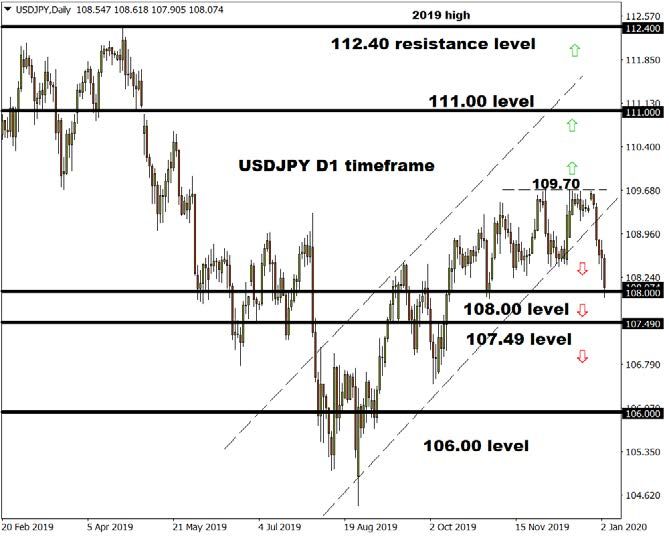
Market Outlook                            2020                                                       Q1

   Daily timeframe

                                                      USDJPY quiet in Q1

                                                      Looking at the technical picture, 1-month implied
                                                      volatility for USDJPY reached a record low in
                                                      December, which suggests that the currency
                                                      pair could be squeezed into a tighter range going
                                                      forward, between 108 and 111 over the coming
                                                      months.

                                                      However, should the risk-on mode go into
                                                      overdrive, a meaningful break above the
                                                      psychological 111 level could see USDJPY
                                                      carving a path towards 112.40 — the high from
                                                      2019. Catalysts for a steeper-than-expected
                                                      decline in the Yen could come in the form of
                                                      solid signs of a protracted recovery in the global
                                                      economy. Also remember that USDJPY retains a
                                                      strong correlation with stock markets, meaning
                                                      that continued upside for the world’s equity
   4-Hour timeframe                                   indices will provide little sustained demand for
                                                      the Yen.

                                                      However, any event that reinvigorates sustained
                                                      risk aversion in the markets for an extended
                                                      period of time, such as a sudden escalation in
                                                      geopolitical tensions, could strengthen the Yen
                                                                                                           9
                                                      and push USDJPY lower towards the 107.49 level
                                                      with longer-term support at 106.00.

                                                      The Yen in a Nutshell:

                                                      USDJPY is set to move gradually towards the
                                                      111 handle, considering the risk-on sentiment
                                                      stemming from the expected US-China trade
                                                      deal. Although the overall demand for the safe
                                                      havens is set to be dampened, the Yen should
                                                      find some measure of support from the easing
                                                      of economic headwinds in Japan.

                      The Yen: Key Events in Q1 2020

                        January 20 - 21          March 18 - 19

                        Bank of Japan            Bank of Japan
                        policy meeting           policy meeting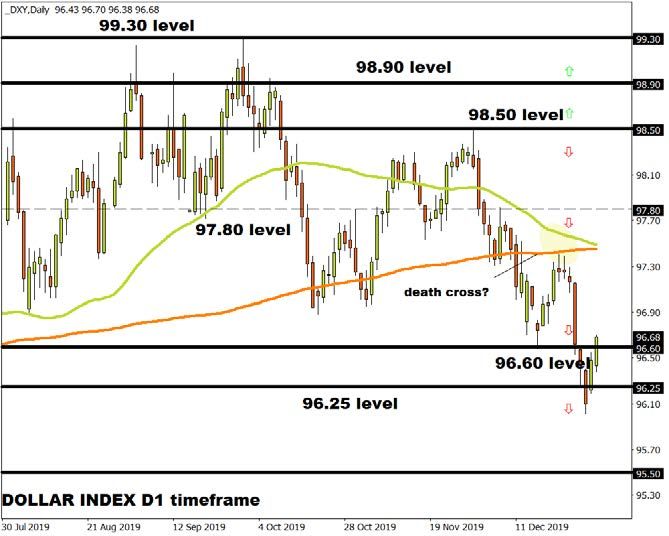
Market Outlook                                                 2020                                                      Q1

            Written by Han Tan,
            Market Analyst at FXTM

The Euro
Can the Euro stage a recovery in
Q1 2020?
2019 was a dismal year for the Euro, as it posted an annual
decline against most G10 and Asian currencies. EURUSD
fell by 4.95% in the first three quarters of 2019, before
paring losses in the final quarter.

Still, the pains of the past year could give way to a steady
recovery for the single currency, considering the softer
Dollar environment that’s expected over the coming
months. With EURUSD’s major support zone raised to
1.10 since November, the pair’s upward path could push it
towards 1.13, provided the current momentum can stay the
course.

US-China “phase one” deal could help EU breathe
easier
                                                                                                                               10
From a fundamental perspective, Euro investors are
only too aware of the economic costs to the region from
heightened global trade tensions. As a prime example,
Germany’s manufacturing Purchasing Managers’ Index
(PMI) contracted every month in 2019, with the domestic
economy flirting with a technical recession in the third
quarter.

With this in mind, the “phase one” US-China trade deal
should bring some respite to the EU economy. With US
tariffs set to be halved on about $120 billion worth of
Chinese goods, while further tariffs on a separate $160
billion worth of imports have been shelved, this reduces          to impose tariffs on the European automobile sector.
the risk of more economic pain for the EU.                        France also now finds itself in President Trump’s
                                                                  tariff crosshairs, as he threatens to retaliate against
EU members could still be embroiled in tariff                     France’s digital tax that’s set to hit US technology
tensions                                                          companies. Meanwhile, China has warned Germany
                                                                  of “consequences” should the latter ban Huawei from
However, the EU is not yet out of the woods, as member            rolling out 5G services in its domestic market. If any of
countries could draw the ire of either the US or China in         these threats materialize during the first quarter of next
the coming months. US President Donald Trump said in              year, that would dim hopes of a meaningful economic
November that he will decide “fairly soon” about whether          recovery in the EU, and in turn dampen the Euro’s upside.

“     EURUSD could test the 1.13 resistance level if the currency
                                                                                                       “
      pair’s upward momentum from Q4 can be sustained.
Market Outlook 2020 Q1
Daily timeframe
EURUSD could test 1.13 resistance level
in Q1
From a technical perspective, EURUSD saw
a golden cross in mid-December (its 50-day
moving average moved above its 100-day
moving average) which indicates the potential
for a major rally. Barring any negative surprises,
a break above 1.1224 for the pair could see
EURUSD testing the 1.1306 level. The key
question for sustained Euro upside will be if the
EU economy can take advantage of the thawing
in global trade tensions, which might allow the
European Central Bank to step away from more
stimulus measures. Any potential German fiscal
stimulus would also be hugely positive.
However, should EURUSD break below the 1.10
support zone, the long-term cycle low at 1.0879
4-Hour timeframe will come into sharp focus. The catalyst for
EURUSD’s push lower could come in the form
of automobile tariffs or other punitive actions
that reignite fears of heightened global trade
tensions.
The Euro in a Nutshell: 11
EURUSD could test the 1.13 resistance level if the
currency pair’s upward momentum from Q4 can
be sustained on solid evidence that the economy
is recovering. Watch for signs of tensions
between EU members and the US or China as
downside risks.
“Watch for signs of tensions be-
tween EU members and the US
or China as downside risks.”
The Euro: Key Events in Q1 2020
January 23 March 12
European Central European Central President Trump’s Germany to decide on EU and UK set to
Bank policy Bank policy meeting threats to impose whether to blacklist begin negotiating
meeting tariffs on French Huawei post-Brexit
goods and EU autos relationshipMarket Outlook 2020 Q1
Written by Jameel Ahmad,
Global Head of Currency Strategy
& Market Research at FXTM
Gold
Gold set to remain range-bound,
global growth the main driver
2019 was a stellar year for Gold investors and while the new
year might not have the same explosive momentum that
saw it gain nearly 20% at its peak earlier in 2019, another
positive year for Gold prices is possible again. The precious
metal at the time of writing remains 15% higher year-to-date
despite a 5% drop since September, suggesting investors
are still concerned over global growth as the new decade
approaches.
Thaw in trade tensions boosts risk-on sentiment
The improved US-China trade relations outlook is one
reason why we could see a near-term decline in Gold
momentum. A narrow trading range between $1445 and
$1500 has been in play since early November and further
improvements in US-China trade relations, as well as a 12
less pessimistic US Federal Reserve, could potentially
encourage a decline in the precious metal through the
lower part of the range. If there is a break below $1445,
weakness towards $1400 for the first time since July 2019
is a possibility.
Although a phase one trade deal between US and China has
been agreed and US Treasury Secretary Steven Mnuchin
recently commented that it should be signed by early
January, many trade issues remain and the agreement
doesn’t significantly change the subdued global growth
outlook going into 2020.
Weak global growth encourages gold bugs The Fed and Dollar outlook key for prices
The OECD recently warned in November that world GDP for Aside from prolonged US-China trade issues, there are
both 2019 and 2020 will be at the weakest levels seen since other reasons to have a positive outlook on Gold.
the global financial crisis. Even the succession of multiple
record-highs in US stock markets do not seal over the The limitations in what ammunition central banks have
cracks that are evident in the world economy. Moreover, left in the tank to combat weaker economic conditions
the US-China trade dispute is protracted and ongoing with could prevent world stock markets from enjoying another
negotiations on the phase two deal yet to commence. stunning year. The current narrative provided by Fed Chair
Jerome Powell that US interest rates will not increase
“ Investors are still concerned over global growth outlook, even
“
with the succession of multi-record-highs in US stock markets.Market Outlook 2020 Q1
Daily timeframe
soon is another potential bonus for Gold prices,
considering that this should make the Greenback
less attractive and Gold historically increases in
value in times of Dollar weakness.
Gold investors should also take into account
geopolitical factors before the November US
election countdown begins by focusing on
relations between the United States and North
Korea. The latter recently made headlines by
testing long-range missiles and suggesting a
’Christmas gift’ depending on the outcome of
nuclear negotiations between Washington and
Pyongyang.
Can Gold breakout of its current range?
The key psychological pivot level in gold prices
4-Hour timeframe will continue to be $1500, and potential buyers
will likely wait for a confirmed move higher before
being tempted into building long positions above
this level. For as long as Gold stays below $1500,
the range seen since November between $1500
and $1445 can continue. 13
In the event that Gold is able to successfully
climb above $1500, more upside should be seen
with resistance at $1520, $1535 and then the
2019 high at $1555 will be in sight.
A strong risk-averse environment due to an
escalation in trade disputes could see Gold
surpass $1555, with uncertainty and negative
market headlines pushing the precious metal
towards $1600 for the first time since 2013.
Gold in a Nutshell:
The outlook for Gold will be influenced by US-
“
China trade developments, health of the global
Gold could benefit from Dollar
“ economy, Federal Reserve and Dollar. A strong
risk averse environment could see Gold surpass
weakness as the Fed pauses $1555 in Q1. However, easing trade tensions
should brighten the global economic outlook
interest rate hikes. which may see the safe-haven metal decline
back towards $1445 and possibly lower.Market Outlook 2020 Q1
Written by Lukman Otunuga,
Senior Research Analyst at FXTM
Crude Oil
What goes up will eventually come
back down for Crude Oil
The themes moving Oil prices in 2019 revolved around
geopolitical tensions, the US-China trade war, oversupply
fears and concerns over slowing global growth.
Despite all the conflicting forces, WTI Crude and Brent
concluded the year on a positive note, gaining roughly 27%
and 24% respectively. Deeper production cuts by OPEC in
Q4, combined with a ‘phase one’ trade deal between the
world’s two largest energy consumers have brightened
the outlook for Oil in 2020. A renewed sense of optimism
over the world economy bouncing back to life will certainly
support ‘black gold’ moving forward. However, demand
and supply side risks could still throw a proverbial ‘spanner
in the works’ for bullish investors.
After the global economic storm, will there be 14
sunshine?
Better than expected economic data from major economies
should continue lifting fears over slowing world growth,
ultimately boosting Oil prices.
Already, manufacturing surveys and reports on industrial
production in the United States, China and India have
started showing signs that the recent deceleration may
be bottoming out. With over 40 central banks easing
monetary policy in 2019, their efforts to revive growth may
bear fruit next year as lower rates encourage consumption
and investment across the globe. If there is truly economic It must be kept in mind that US Shale production remains
sunshine in 2020 after prolonged periods of gloom before, robust with crude output reaching a record level of 12.9
this will provide a solid foundation for Oil to build on current million barrels per day. Fresh worries about excess
gains. supply may weaken Oil prices, especially if US Shale
production continues to rise in 2020. On the demand side
Oil markets are not out of the woods yet of the equation, growth in global demand in 2019 was the
weakest in nearly a decade. The risk of rising supply and
While the outlook for crude looks rosy amid US-China trade fears around falling demand could become themes that
optimism, the commodity is certainly not out of the woods. pressure Oil prices during the first quarter of 2020.
“ Trade optimism and cooling fears of slowing global growth
“
could support Oil prices in 2020.Market Outlook 2020 Q1
Daily timeframe
WTI Oil knocks on $61 door but is
anyone home?
WTI Crude has been marching higher from
the October low on the daily timeframe, with
consistent higher highs and higher lows. A
strong daily close above the $61 resistance
level should encourage a move towards
$61.40 and $62 — levels not seen since
September 2019.
While the outlook on the daily chart certainly
points north, there is a strong resistance zone
around $63.00 which may prove to be very
stubborn. That said, more positive news on
the trade front could result in prices pushing
above $63 by the end of Q1 2020.
However, what goes up will eventually come
4-Hour timeframe down and this is no different for WTI Crude.
Given how Oil prices remain highly sensitive
to trade developments and global growth
concerns, the downside potential must not be
overlooked. Sustained weakness below $61
will invite a decline towards $60 and $58. If
prices end up securing a monthly close below
15
$57.60, then Oil could end the first quarter
around $55.
WTI Oil in a Nutshell:
Oil should remain supported by trade optimism
and cooling fears over slowing global growth
in Q1. The commodity is seen testing $63 if the
$61 resistance is conquered. However, rising
US shale production, slowing demand growth
and renewed trade tensions will weaken the
commodity. Such developments could drag
Oil back below $58 and lower by the end of Q1.
Crude Oil: Key Events in Q1 2020
January 15 February 12 March 5 March 11
OPEC Monthly Oil OPEC Monthly Oil Meeting of the OPEC OPEC Monthly Oil
market report market report Conference in Vienna market reportMarket Outlook 2020 Q1
Written by Jameel Ahmad,
Global Head of Currency Strategy
& Market Research at FXTM
Amazon Stock
Can e-commerce giant Amazon
make more advances next year?
From its humble beginnings as a bookseller to the
renowned international technology giant that it is today,
Amazon has weathered a global financial crisis and
managed to briefly become only the second company
to pass a market cap of $1 trillion, in 2018. There are
however some near-term concerns suggesting that
operating income might have peaked for now, highlighted
by its announcement earlier in 2019 that it was ceasing its
business in China where local competitors such as Alibaba
and JD.com dominate.
Bullish analysts hope for more gains
Still, many remain optimistic on the stock including 45
analysts who have set a median target of $2180, with
a high estimate of $2573 and a low estimate of $1850 16
over the next 12 months, as reported by CNN Business.
Looking at the median estimate alone, this suggests that
the stock price could potentially climb about 18% next year.
Amazon traded between $1705 and $1901 from August to
December, after breaching the psychologically-important
$2000 level in July. Amazon’s stock closed out the year at
$1847.84, which represented an annual advance of 23%.
Investors are clearly still impressed by Amazon and the
consensus above suggests its valuation will continue to
grow. The share price has already climbed by over nearly
500% over the past five years, making the advances in both
Apple (166%) and Facebook (163%) appear insignificant
over the same period. In 2010, the share price of Amazon
was around $180 and this figure climbed as high as $2050
in September 2018. cloud computing sector but currently only contributes 13
percent of its revenue. Amazon is already a household
Product diversification helping growth name for shopping and fast deliveries, while its streaming
service Amazon Prime looks set to get ahead of the curve
Amazon’s ecosystem of different products on offer is against growing competition in the streaming space with
seen as helping the firm manage the risks from slowing further broadcasting of live sporting events, including
global growth. One of its venture successes, Amazon Web the football English Premier League that carries with it a
Services, has become a dominant player in the growing worldwide following.
“
“
Investors believe that Amazon’s stock price could potentially
climb 20% next year.Market Outlook 2020 Q1
Daily timeframe
Investors await earnings update
The technical outlook shows that Amazon’s
share price has found fresh legs. Its 50-day
moving average crossed above its 100-day
moving average recently, after the stock broke
past the upper limit of its sideways trend since
August 2019. Amazon could claim more of its
upside if the upcoming earnings deliver stellar
results from the year-end shopping season,
which the company has already identified as
“record breaking”.
Should Amazon break past $1950, the path back
above $2000 could tempt investors to revisit
2019’s highest closing price near $2020. A solid
close above $2020 may encourage a move
higher towards $2035.76 and potentially beyond
4-Hour timeframe its record high of $2039.51.
To the downside, the $1820 level is seen as the
immediate support level, with stronger support
set to arrive at the mid-$1700s.
Amazon in a Nutshell:
17
Investors appear to be taking a wait-and-see
approach with Amazon, considering that its
near-term operating income may have peaked
after the company pulled the plug on its online
marketplace in China. Still, Amazon’s diverse
offerings can help the tech titan mitigate the risk
of slowing global growth.
“Amazon’s diverse offerings
could help in mitigating the
risk of slowing global growth.”
Amazon: Key Events in Q1 2020
January 30
Earnings release
(estimated)Market Outlook 2020 Q1
Written by Jameel Ahmad,
Global Head of Currency Strategy
& Market Research at FXTM
Walt Disney Stock
The force looks strong for the Walt
Disney Company in 2020
The Disney story represents a fairy tale of its own that has
captured the hearts of generations for close to a century.
The Walt Disney Company has also enjoyed a 2019 full of
achievements, from completing the acquisition of 21st
Century Fox to the successful launch of its new streaming
service, Disney+, and its stock value has benefitted,
jumping 34% year-to-date as of December 18.
Full of attractions, old and new
Disney has a loyal following that has grown the brand as
a household name for decades. This includes family-
friendly and timeless content provided by Walt Disney
Pictures, from Snow White to The Pirates of the Caribbean;
blockbuster fantasy Marvel Group and the Star Wars
franchise; Walt Disney theme parks and resorts - the list 18
goes on. The recent acquisition of 21st Century Fox brings
more well-known names in X-Men and Deadpool into a
company group that has also acquired stakes in Hulu and
ESPN.
There are a number of reasons to remain upbeat about
Disney, starting with the successful launch of its streaming
platform Disney+. There have been over 22 million
downloads of its application a month since its launch and
10 million sign ups within one day following its November
release, meaning that Disney+ is well on track to reach
its 60-90 million global subscriber goal before 2024.
And this is even before the product is fully launched into
international markets.
Investors can also look positively at the fact that Disney has If consumers are faced with questions over spending
enjoyed a lifespan of almost 100 years and has survived habits, the price point of Disney+ swings the hammer in
each and every challenge that the world economy has its favour when considering that it is cheaper than its rival,
faced since the 1920s. The entertainment legend has risen Netflix. Disney+ costs $6.99 per month with the bundle
above economic downturns ranging from the aftermath of including Hulu and ESPN+ available at $12.99 a month,
the Great Depression, to the global financial crisis in 2008 compared to the Netflix standard subscription fee of
and everything in between. $12.99.
“
“
Disney+’s price point gives it an edge over its competitors
such as Netflix.Market Outlook 2020 Q1
Daily timeframe
Short term pain, long term gain
While Disney may still face some hurdles with
higher operating income and the ongoing
integration of Fox’s entertainment assets which
subsequently weigh on its revenue over the next
two years, all eyes will be on the company’s
fiscal Q1 2020 earnings release scheduled in
February. If positive guidance on subscriber
numbers is provided in the upcoming earnings
release, it could boost investor confidence that
the potential worldwide popularity of Disney+
supports the view that its share price likely has
further upside.
The current consensus among 25 investment
analysts polled by CNN Business shows that 19
have a buy recommendation on the stock, with
4-Hour timeframe six expressing that it will outperform.
Technical picture suggests multiple
support levels
The Disney share price is consolidating after a
surge from $111 in April which pushed the stock
all the way to its record-high above $150 in late 19
November. While the uptrend still appears intact,
there are several possible support levels seen
at $135, $130 and $126 should investors decide
to take profits on a star performer of the Dow
Jones Industrial Average in 2019.
Disney in a Nutshell:
Despite hitting a record high in November,
Disney’s stock likely has more upside in the
long term, given the tremendous potential that
Disney+ has in adding to the entertainment
giant’s coffers. Investors contemplating Disney’s
upside can also be heartened by the company’s
content arsenal and storied brand status, as well
as its decades-long track record in overcoming
economic challenges.
Disney: Key Events in Q1 2020
February 4
Earnings release
(estimated)Market Outlook 2020 Q1
20
For more information, please visit: FXTM
FXTM is an international online forex broker offering financial services in forex, stocks, CFDs on Commodities, Spot Metals, Indices,
Shares and digital currencies.
FXTM brand is authorized and regulated in various jurisdictions. ForexTime Limited (www.forextime.com/eu) is regulated by the
Cyprus Securities and Exchange Commission with CIF license number 185/12, licensed by the Financial Sector Conduct Authority
(FSCA) of South Africa, with FSP No. 46614. The company is also registered with the Financial Conduct Authority of the UK with
number 600475. Exinity Limited (www.forextime.com) is regulated by the Financial Services Commission of the Republic of
Mauritius with an Investment Dealer License bearing license number C113012295. Forextime UK Limited (www.forextime.com/uk)
is authorised and regulated by the Financial Conduct Authority, firm reference number 777911.
Trading Forex and CFDs involves significant risk and can result in the loss of your invested capital. You should not invest more
than you can afford to lose and should ensure that you fully understand the risks involved. Trading leveraged products may not be
suitable for all investors. Before trading, please take into consideration your level of experience, investment objectives and seek
independent financial advice if necessary. It is the responsibility of the Client to ascertain whether he/she is permitted to use the
services of the FXTM brand based on the legal requirements in his/her country of residence.
Disclaimer: This written/visual material is comprised of personal opinions and ideas. The content should not be construed as
containing any type of investment advice and/or a solicitation for any transactions. It does not imply an obligation to purchase
investment services, nor does it guarantee or predict future performance. FXTM, its affiliates, agents, directors, officers or
employees do not guarantee the accuracy, validity, timeliness or completeness of any information or data made available and
assume no liability for any loss arising from any investment based on the same.
@2020 FXTMYou can also read


