2021 WOLF - montana fwp hunting and trapping regulations
←
→
Page content transcription
If your browser does not render page correctly, please read the page content below
2021                                                        WOLF
MONTANA FWP HUNTING AND TRAPPING REGULATIONS

                            Gray Wolf   Canis lupus photo by Donald M. Jones
                         TURN IN POACHERS: CALL 1-800-TIP-MONT
                                                             fwp.mt.gov
Highlights & Reminders License Chart
• Persons can take up to 10 wolves via any combination of hunting The following licenses, for the purpose of wolf hunting, are valid
and trapping (maximum harvest of 10 wolves per person). For March 1, 2021, through the dates listed in these regulations.
hunting a separate license is required for each wolf. For trapping, LICENSE REQUIREMENTS COST
only a Trapping License is required. Annual fee charged at the time the $10 Resident
• Two swivels, including a center swivel on the base of the trap, Base Hunting License hunter purchases their first hunting
will be required for all ground set foothold traps. For details, $15 Nonresident
visit: fwp.mt.gov/hunt/trapping license.
• Collared wolves can be lawfully taken, but they provide important $4 Resident
information for monitoring populations and managing livestock Required prerequisite at the time 12-17, 62+
depredations. Conservation License the hunter purchases their first $8 Resident
• A wolf harvest must be reported within 24 hours. hunting or fishing license.
$10 Nonresident
Hunting
• Electronic calls can be used for wolf hunting. Wolf License
Must be purchased by Feb. 28, $12 Resident
• Baiting is now legal for the hunting of wolves. without a
2022. A wolf-hunting license
• Wolves can be hunted on private lands outside of daylight hours Sportsmans or
purchased after August 31 may
with the use of artificial lights, thermal imaging technology, or not be used until 24 hours after $50
Combination
night vision scopes. Night hunting on public lands is prohibited. the license is issued. Maximum of Nonresident
Trapping License
10 per person.
• Snares are now legal for trapping wolves, except in federally Only valid for the first wolf license $10 Resident
designated grizzly bear recovery zones. Additional snare Wolf License with purchased after purchasing
regulations are listed on page 6. a Sportsmans
a sportsman or combination
• The trapping season in grizzly bear recovery zones starts on or Combination
license. Must select “discounted” $25 Nonresident
December 15, but could be adjusted to as early as November 29 License
wolf license.
based on conditions. Check FWP website for any adjustments.
• WMU 313 is closed to wolf trapping in the Deckard Flats to Trail Available to resident Conservation
Creek Wolf Trapping Closure Area. License holders 12 years of age
• Wolf trap pan tension must be at least 10 pounds in Regions General or older. Allows license holder
1,2,3,4, and 5. Trapping License to trap wolves. Completion of $20
• Trappers must immediately dispatch a trapped wolf by gunshot Resident either the Idaho or Montana
– unless otherwise authorized not to do so by FWP prior to wolf-trapping certification class
wolf-trapping efforts. is mandatory.
Applicant must give legal
Regulations Adopted by Fish & Wildlife Commission description of owned or leased
Regulations for season dates, structures, and restrictions were land, name, address, and resident
adopted by the F&W Commission on August 20, 2021, under the ALS number. License holder
authority granted in MCA 87-1-301 and are valid from the date of Landowner restricted to trapping and hunting
adoption, through March 15, 2022. The F&W Commission reserves Trapping License only on their owned property $1
the authority to amend the seasons, limits and regulations herein Resident and leased lands. Completion
if deemed necessary for wildlife management purposes. Statutes of either the Idaho or Montana
and other information, including other agencies’ restrictions, are wolf trapping certification class is
provided as a courtesy and do not fall under Commission authority. mandatory. Issued only through
Henry “Hank” Worsech, Director. FWP offices.
Discrimination Prohibited – State and Federal laws, Title VI of Available only to nonresident
Civil Rights Act of 1964, Section 504 of the Rehabilitation Act
of 1973, Title II of the Americans with Disabilities Act of 1990, Conservation License holders 12
the Age Discrimination Act of 1975, and Title IX of the Education years of age or older, whose state of
Amendments of 1972, prohibit discrimination on the basis of residence has nonresident trapper
race, color, sex, age, religion, national origin, or disability. Anyone licenses available to Montana
believing he or she has been discriminated against (as described Nonresident trappers. Completion of either the $250
above) in any FWP program, activity, or facility may write to FWP Trapping License Idaho or Montana wolf-trapping
Human Resources, 1420 East Sixth Avenue, PO Box 200701, Helena, certification class is mandatory.
MT 59620-0701 or the office of Equal Opportunity, U.S. Department Issued only through FWP offices.
of the Interior, Washington, D.C. 20240. Any changes made to this Valid only for predatory animals
printed publication can be found on the FWP website or by inquiring and nongame wildlife, including
at any local FWP office. wolves.
Definitions A Bow and Arrow License plus $10 Resident
Bow and Arrow the proper hunting license are
Bait (CR) - bait is defined as the meat or viscera of a mammal, bird (Archery) required during wolf Archery $10 Nonresident
or fish, or any part thereof more than one pound in weight. Bleached Only Season.
bones are excluded. Required to trap on state school
Center Swivel (CR) – A swivel located on the underside of the trap trust lands. Contact Montana
as near the center of the base plate as reasonably possible. The Special DNRC
Department of Natural Resources
swivel can be attached directly to the base plate at the center, Recreational Free
and Conservation to apply for
attached to a D-ring centered on the base plate, or can be included Use License
this license (406-444-9726).
in the chain at a point no more than 5 normal chain links from a
centered D-ring or base plate attachment point at the center. Apply by Sept. 30.
Excess Take (CR) - The take of a legally harvestable species after
the season is closed or an individual’s possession limit has been Hunter with a Disability
met. If you or someone you know has a disability and/or is aging, and is in need
Ground Set (CR) – Any trap originally set in or on the land (soil, of assistive technology (AT) or adaptive equipment to help you participate
rock, etc.). This includes any traps elevated less than 48 inches in outdoor recreation, please contact:
above the natural ground or current snow level. MonTech at the University of Montana Rural Institute
Legal Wolf – Any male or female wolf, including young-of-the-year. 29 McGill Hall
Non-target Capture (CR)- Capture of any animal that cannot be Missoula, MT 59803
lawfully trapped, including domestic animals. (406) 243-5751
Relaxing Snare – A relaxing snare has a snare lock that allows the montech.ruralinstitute.umt.edu
2 Turn In Poachers. Enough is Enough! Make the call: 1-800-847-6668snare loop to release constriction pressure on the captured animal you may be required to show additional proof of residency. An
when the cable is not taut (e.g., when the animal stops pulling, it out-of-state driver’s license is NOT an acceptable form of ID
will loosen). This means that the locking device on the snare cable for resident license purchases. Contact your local FWP office
operates both ways allowing the snare cable to move back and for specifics.
forth to some degree. Locks that only close or that use springs or • A person is NOT considered a resident for the purposes of this
other powering devices to hold them closed are not considered section if the person claims residence in any other state or country
relaxing snares. See page 15 for examples of relaxing snares. for any purpose.
Trap (MCA 87-6-101) – to take or harvest or participate in the Hunter/Trapper Education Requirements
taking or harvesting of any wildlife protected by the laws of the
state by setting or placing any mechanical device, snare, deadfall, Hunter Education for Firearm and Archery
pit, or device intended to take wildlife or to remove wildlife from • If you were born after January 1, 1985, you are required to show
any of these devices. proof of completing a Montana Hunter Safety and Education
Wolf Management Unit (WMU) – Areas that define Montana’s Course (or an approved Hunter Safety Course from any other
wolf-hunting and trapping districts as specified under “Wolf state or province) prior to applying for or purchasing a hunting
Management Unit (WMU) Legal Descriptions. license, whether the hunting license is for the rifle or archery
Obtain a License season.
• Bowhunter requirements - in order to purchase a Montana
Persons can take up to 10 wolves via any combination of hunting Bow and Arrow license, a hunter must provide a certificate
and trapping (maximum harvest of 10 wolves per person). For of completion of a National Bowhunter Education Course
hunting, a separate license is required for each wolf. For trapping, or provide any prior year’s archery license from any state or
only a trapping license is required. Completion of mandatory wolf province.
trapping certification is required to trap wolves. • Montana law requires members of the armed forces and their
• A Wolf License is available at all Fish, Wildlife & Parks offices, dependents stationed in Montana to present a Montana hunter
FWP license providers, and online at fwp.mt.gov. education certificate or similar certificate from any state or
• A Wolf License must be purchased by February 28, 2022. province when purchasing any Montana hunting license.
• A Wolf License purchased after August 31 may not be used • Duplicates – Montana certificates of completion for the Montana
until 24 hours after the license is issued. hunter education and/or bowhunter education courses may be
• The Conservation License allows hunters, anglers, and trappers obtained from FWP’s website.
access to all legally accessible state school trust lands. Contact Wolf Trapper Certification – A person must attend and complete
a DNRC office for regulations. a wolf-trapping certification class before setting any trap for a
wolf. Completion of either the Idaho or Montana wolf-trapping
Licensing – Youth Hunting Opportunities certification class will be recognized as meeting this requirement.
A resident or nonresident youth 12 years of age or older may hunt A certificate will be awarded to those completing the Montana
any game species for which their license is valid. Those who will trapping certification class. This certification must be in possession
reach 12 years of age by January 16, 2022, may hunt any game of any person setting wolf traps and/or harvesting a wolf by trap.
species, for which their license is valid, after August 15 of the
2021 license year. Proof of hunter education must be presented LAWS AND RULES
at the time of purchase. Lawful Methods for Hunting Wolves MCA 87-6-401, CR
• Apprentice Hunters - are not eligible to hunt wolves. Visit fwp.
mt.gov for details. As a species in need of management, wolves may only be taken
• In order to carry or use a firearm for any reason, a youth under 14 by hunting (firearms or archery) or trapping during the designated
years of age must be accompanied by a person having charge or seasons.
custody of the youth, or be under the supervision of a qualified - Statute denoted by MCA.
firearms safety instructor or an adult 18 years of age or older - Commission Rule denoted by CR.
who has been authorized by the youth’s parent or guardian, - Arm Rule denoted by ARM.
MCA 45-8-344. Archery Equipment (CR)
Residency • It is unlawful to use any chemical or explosive device attached to
an arrow to aid in the taking of wolves.
It is unlawful to swear to or to affirm a false statement in order • The following criteria define Archery Equipment: It is unlawful to
to obtain an original or duplicate resident hunting and/or fishing use, while hunting game during any Archery Only Season and in
license OR to assist an unqualified applicant in obtaining a Archery Equipment Only areas, archery equipment that does not
resident license. meet the following criteria:
Resident Hunting Bow: A hunting bow for wolves shall be a longbow,
• To be a legal Montana resident and eligible to purchase any flatbow, recurve bow, compound bow, or any combination of
Montana resident fishing, hunting, and trapping licenses, as these designs.
per MCA 87-2-102, you must: --The bow must be a device for launching an arrow, which derives
-- Claim Montana as your principal or primary home or place of its propulsive energy solely from the bending and recovery of two
abode limbs (includes bows with split limbs).
-- Have been physically living in Montana for at least 180 --The bow must be hand drawn by a single and direct uninterrupted
consecutive days immediately prior to purchasing a resident pulling action of the shooter. The bowstring must be moved from
license brace height to the full draw position by the muscle power of the
-- Register your vehicle(s) in Montana shooter’s body. The energy used to propel the arrow shall not
-- Be registered to vote in Montana if you’re registered to vote be derived from any other source such as hydraulic, pneumatic,
-- Not possess current (or have applied for any) resident mechanical, or similar devices. These limitations shall not exclude
hunting, fishing, or trapping privileges in another state or the mechanical leverage advantage provided by eccentric wheels
country or cams, so long as the available energy stored in the bent limbs
-- File Montana state income tax returns as a resident, if you of the bow is the sole result of a single, continuous, and direct
are required to file pulling effort by the shooter.
• Once you have established your residency, you must continue --The bow must be hand-held. One hand shall hold the bow and the
to meet all these requirements and physically reside in other hand draw the bowstring. The bowstring must be moved
Montana as your principal or primary place of abode for not and/or held at all points in the draw cycle entirely by muscle power
less than 120 days per year (days need not be consecutive). of the shooter until release. The bowstring must be released as
• To purchase an annual resident Conservation License, you will be a direct and conscious action of the shooter, either relaxing the
required to show a valid Montana Driver’s License (MDL), a valid tension of the fingers or triggering the release action of a hand-
Montana Identification Card (MIC), or a valid Tribal Identification held release aid.
Card. Exception: Physically disabled bowhunters certified by FWP with the
• If your MDL or MIC has been issued for less than six months, Permit To Modify Archery Equipment (PTMAE) are exempted from
2021 Wolf Hunting & Trapping Regulations Visit fwp.mt.gov 3the requirement of holding or shooting the bow with their hands. Hunter Harassment (MCA 87-6-215)
>>A bow is considered legal if it is at least 28 inches in total length. It is unlawful to:
>>The nominal percent of let-off for hunting bows shall be a • intentionally interfere with the lawful taking of a wild animal.
maximum of 80 percent as advertised by the manufacturer. • disturb an individual engaged in the lawful taking of a wild animal
Arrow: An arrow is a projectile at least 20 inches in overall length. with intent to prevent the taking of the animal.
The length of the arrow is measured from the rearward point of the Hunting Hours (CR) - Authorized hunting hours for the taking of
nock to the tip of the broadhead. wolves on public lands begin one-half hour before sunrise and end
--A broadhead is mounted on the fore end. one-half hour after sunset each day of the hunting season. See the
--The arrow shall weigh no less than 300 grains with the broadhead official Sunrise-Sunset Tables listed on page 15.
attached. Hunter Orange Requirement (MCA 87-6-414) - A person may not
--Arrows must have broadheads with at least two cutting edges and hunt any game animals in this state or accompany any hunter as
be at least 7/8 inch at the widest point. Expandable broadheads an outfitter or guide under any of the provisions of the laws of this
are legal as long as when expanded they are at least 7/8 inch at state without wearing as exterior garments, above the waist, a total
the widest point and weigh no less than 70 grains. of not less than 400 square inches of hunter orange (fluorescent)
--Arrows equipped with lighted nocks are allowed material visible at all times while hunting. This section does not
The following are not considered a hunting bow or legal archery apply to a person hunting with a bow and arrow during the special
equipment during the Archery Only Season or in an Archery archery season; or hunting wolves outside the general deer and elk
Equipment Only area or hunting district: season as authorized by commission rules. However, bowhunters
--Crossbow hunting wolf during any portion of the general (firearm) seasons
--Any device with a gun-type stock or incorporating any device for deer, elk, antelope, moose, sheep, mountain goat, black bear,
or mechanism that holds the bowstring at partial or full draw mountain lion must meet the hunter orange requirement while
without the shooter’s muscle power. hunting.
--Any bow for which a portion of the bow’s riser (handle) or any
track, trough, channel, or other device that attaches directly to Indian Reservations
the bow’s riser contacts, supports, and/or guides the arrow from • The F&W Commission has by rule, closed all lands within the
a point rearward of the bow’s brace height. This is not intended exterior boundaries of Montana’s Indian Reservations to the
to restrict the use of standard overdraw systems. hunting of wolves with the use of state licenses unless provided
--Electronic or battery-powered devices attached to a hunting bow for in a cooperative agreement between the Tribal Government
or arrow. Exception: Camera devices attached to bows for the and the State of Montana.
sole purpose of filming is allowed. • Currently, there are no cooperative agreements between FWP
--A bow sight or arrow that uses artificial light, luminous chemicals and any of the Tribal Governments in Montana and as such the
such as tritium, or electronics. Exception: an arrow may have a season for the hunting of wolves, by nonmembers, with a state
lighted nock. license is closed. Please contact FWP for further information.
Check Stations (MCA 87-6-218) - All hunters are required by law Interstate Wildlife Violator Compact (IWVC) - Montana is a
to stop as directed at all designated check stations on their way to member of the IWVC. Under the compact, member states recognize
and from hunting areas, even if they have nothing to be checked. suspensions of hunting, fishing, or trapping privileges. It is unlawful
Disturbing Traps or Trapped Animals (MCA 87-6-601(4)) – A for a violator whose privilege to hunt, fish, or trap is suspended to
person may not destroy, disturb, or remove any trap or snare obtain or attempt to obtain a license, tag, or permit in a member
belonging to another person or remove wildlife from a trap or state. For more information, call 406‑444‑2452.
snare belonging to another person without permission of the Kill Site Verification (ARM 12.6.1005) - At the request of a
owner of the trap or snare, except that from March 1 to Oct. 1 of department Game Warden, it is required to return to the kill site
each year a person may remove any snare from land owned or of any game animal, game bird, wolf, or furbearer that has been
leased by the person if the snare would endanger livestock. This hunted or trapped.
requirement does not apply to a law enforcement officer acting Landowner Permission (MCA 87-6-415) - A person may not hunt
within the scope of the officer’s duty. or attempt to hunt furbearers, game animals, migratory game
Excess Take Resulting in an Unlawfully Harvested Animal (CR) - birds, nongame wildlife, predatory animals, upland game birds, or
Excess take is defined as the take of a legally harvestable species wolves while hunting on private property without first obtaining
after the season is closed or an individual’s possession limit has permission of the landowner, the lessee, or their agents. Regardless
been met. of whether the land is posted or not, hunters must have permission
• Hunters: If you or a member of your hunting party shoots a wolf from the land owner, lessee, or their agent before hunting on
that results in an unlawfully taken animal, you should notify private property.
an FWP game warden or 1-800-TIP-MONT (1-800-847-6668) For the purposes of this section, the term “hunt” has the same
immediately and follow their instructions. DO NOT transport meaning as provided in 87-6-101 and includes entering private land
the animal until you’ve received instructions. to: (a) retrieve wildlife; or (b) access public land to hunt.
• Trappers: If a wolf trapper catches a wolf beyond the legal License and Permit Possession and Use MCA 87-6-301-314
limit, the wolf must be released. FWP requests to be contacted It is unlawful to:
to assess the potential to fit the wolf with a radio collar for • Hunt or attempt to hunt for any wolf unless the person is carrying
management purposes. the required license or permit at the time.
Exposed Carcass or Baiting (CR) – Baiting is allowed for the hunting • Refuse to produce a license or permit and the identification
of wolves. No trap or snare may be set within 30 feet of an exposed used in purchasing a license or permit for inspection to a game
carcass or bait that is visible from above. warden.
Firearms (CR) • Alter or change a license in any material manner.
• Firearms, including rifles, handguns, muzzleloaders and shotguns • Loan or transfer any license to another person.
with 0, 00, or slugs; archery equipment; and crossbows are lawful • Use a license issued to another person.
for taking wolves. All other methods of take are prohibited. • Attach the person’s license to a wolf killed by another person.
• There is no rifle or handgun caliber limitation or magazine/round • Have physical control over a valid and unused hunting license
capacity restrictions for the taking of wolves. or permit issued to another person while in any location that
• Rifle scopes with illuminated reticles, built-in range -finding the species to be hunted may inhabit. This prohibition does not
capabilities, and “red dot” scopes are lawful for the taking of apply to a person who is carrying or has physical control over a
wolves. license or permit issued to that person’s spouse or to any minor
when the spouse or minor is hunting with that person.
Private Lands – Night Hunting
• Wolves may be hunted on private lands at all hours of the day or night.
• For night hunting on private lands, the use of artificial light, night vision scopes, infrared and thermal imaging
technology is allowed.
4 Turn In Poachers. Enough is Enough! Make the call: 1-800-847-6668/
License Validation and Tagging publicly maintained way when any part thereof is open to the use
• A hunter must cut out the proper month and day of the kill from of the public for purposes of vehicular travel).
the appropriate license and attach it to the animal before the Recorded Animal Sounds - It is lawful to use recorded or electrically
carcass/hide is removed from the site of the kill or before the amplified bird or animal calls or sounds or imitations of bird or animal
hunter leaves the site of the kill. calls or sounds to assist in the hunting, taking, killing or capturing of
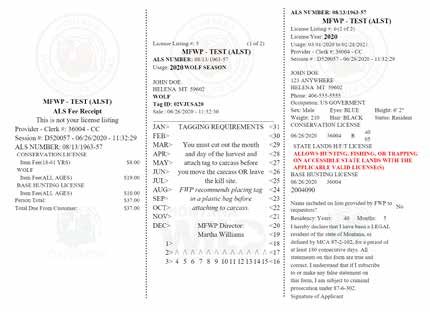
• To properly validate a license (sometimes referred to as a tag): wolves.
• The triangles denoting the month and day the animal was Transport of Wildlife
killed must be completely cut out and removed.
• An individual other than the license holder may transport lawfully
taken, properly tagged wolves.
• It is unlawful to ship, possess, transport, or take out of state
unlawfully killed wolves.
• It is a violation of the Federal Lacey Act to transport an unlawfully
taken game animal across state boundaries.
• If you are transporting lawfully taken wildlife (including parts
and/or products of live or dead animals) between the United
States and any foreign country, you must complete a U.S. Fish
and Wildlife Service declaration form. For further information
contact the USFWS Wildlife inspector at 406-335-4350 or fws.
gov.
Littering (MCA 75-10-212) - A holder of a Montana resident • Questions concerning carcass transport may be directed to
or nonresident hunting license or camping permit convicted FWP Enforcement at 406-444-2452 or to your home state’s
of littering campgrounds, public or private lands, streams, or Wildlife Division.
lakes while hunting, fishing, or camping shall forfeit any current
Montana hunting, fishing or trapping license and the privilege to Two-way Communication (ARM 12.6.1010)
hunt, fish, camp, or trap in Montana for a period of one year. The use of two-way electronic communication is prohibited:
Marked or Radio-Collared Animals (CR) - It is lawful to shoot • While in the act of hunting game animals or wolves to aid in the
wolves that have radio collars, neck bands, ear tags, and/or other taking or locating of live animals.
markers, but markers and radio collars must be returned to FWP. • While in the act of hunting mountain lion or bobcats with dogs,
Please report the killing of a marked animal to the local FWP beginning when the dogs are placed or physically released on
office. tracks or a scent trail.
Motorized Vehicles (MCA 87-6-405) • To avoid game check stations or FWP enforcement personnel.
It is unlawful for anyone to: • To facilitate unlawful hunting activity. The use of two-way
• Use a motor-driven vehicle off road on state land. electronic communication for the use of safety or other
• Use a motor-driven vehicle on a road or trail on state land if legitimate purposes is exempt.
that road or trail is posted as closed by the land management Two-way electronic communication includes, but is not limited
agency. This restriction applies only to state land and not to to, the following; radios (walkie-talkies/CB), cell phones, text
federal land. For more information related to state school trust messages, and the use of social media or other electronic
lands, see page 13. platforms, applications, or programs.
• Use a motor-driven vehicle other than on a road or trail Unmanned Aerial Vehicles (CR) - The use of unmanned aerial
designated for travel by a landowner unless permission has vehicles (UAV) for the purposes of hunting wolves is prohibited.
been given by that landowner. Waste of Game - Wolves are excluded from being considered
Off Road - Federal lands (CR) as “suitable for food.” The remaining carcass may be taken in
• Operate, on federal public lands, a motorized wheeled vehicle possession or be left in the field as per Montana law.
off legal routes (including game retrieval). All federally
approved travel plans on public lands in Montana have been Wolf Trapping Laws and Rules
adopted by the F&W Commission. Contact the appropriate Capture of Domestic Dogs (CR)– To improve the understanding
land management agencies for travel plan information. of accidental dog captures in traps, trappers must report such
Outfitters and Guides (MCA 37-47-301) captures, excluding a trapper’s dog, to an FWP regional office
• A person may not act as an outfitter or guide or advertise or within 24 hours of identifying the capture.
otherwise represent to the public that the person is an outfitter Checking and Placing Traps (CR)
or guide without first securing a license. • Wolf traps shall be visually checked at least once every 48 hours.
• It is unlawful to engage in outfitting/guiding while not licensed. • Wolf traps must be removed within 24 hours of capturing an
• It is unlawful to hire an outfitter or guide not licensed by the individual trapper’s last legally harvested wolf.
Department of Labor and Industry. For information, call 406- • Failure to pick up traps at the end of the trapping season or
841-2300. attending them in a manner that wastes animals constitutes a
misdemeanor per Montana law.
Predators and Nongame Hunting - Predators and nongame • A trapper must immediately dispatch any uncollared wolf
species are unprotected by federal and/or state law or regulation captured that may be legally possessed.
and can be hunted in Montana year-round without a license • A trapper with an unfilled bag limit may release an uninjured
by both resident and nonresident hunters. The State Lands collared wolf.
Recreational License is included in the Conservation License for
the purpose of hunting, fishing, and trapping and is required to Closures (CR)– see page 8 for details.
hunt predators and nongame species on state school trust lands. Landowner Permission (MCA 87-6-601)– Trappers must obtain
Permission must be obtained to hunt predators and nongame permission of the landowner, lessee, or their agent before trapping
species on private land. on private land.
• Predators are classified as coyote, weasel, (striped) skunk, and Lynx Season Closed (CR)– Trapped lynx that are uninjured must
civet cat (spotted skunk). be released immediately and the incident must be reported to a
designated FWP employee within 24 hours of release. If a lynx
• Nongame species are defined as any wild animal not otherwise is injured, trappers must immediately notify a designated FWP
legally classified by statute or regulation in Montana. Examples employee or an FWP regional office, to determine disposition and/
include badger, raccoon, red fox, hares, rabbits, ground squirrels, or collection of the animal.
marmots, tree squirrels, porcupines, and prairie dog.
Non-target Capture Requirement (CR) - The capture of any animal
Public Roadways (CR) - It is unlawful for anyone to hunt or that cannot be lawfully trapped or snared, including domestic
attempt to hunt any wolf: on, from, or across any public highway animals, must be reported to FWP within 24 hours. Any such animal
or the shoulder, berm, barrow pit or right-of-way of any public that is uninjured must be released prior to the trapper leaving the
highway (the entire width between the boundary lines of every
2021 Wolf Hunting & Trapping Regulations Visit fwp.mt.gov 5trap site. If unable to safely release the animal, call FWP. Exception: must be dispatched, is required to present the hide and skull
Any such animal that is injured or dead must promptly (with little to a designated FWP employee within 10 days after harvest for
or no delay) be reported to FWP to determine disposition and/ the purpose of:
or collection of the animal. Animals that may be lawfully trapped -- Inspection and registration of kill
or snared are furbearers or wolves for which the season is open -- Tagging the hide. The hide tag must thereafter remain
and an individual possession limit has not been reached, nongame attached to the hide until tanned.
wildlife and predators. A trapper may NOT trap any game animal, • Any hide or skull not presented or registered to FWP personnel
game bird or migratory bird. within 10 days of harvest is subject to confiscation.
Occupied Dwellings (CR) – Killing ground sets, including all snares, • A person licensed to hunt and authorized to possess a carcass
set for animals larger than ground squirrels are unlawful within of a wolf that requires mandatory department biological
1,000 feet of an occupied dwelling without written notification inspection may, after validating and attaching the license or tag
to the inhabitant. in accordance with 87-6-411, transfer possession of all or part of
Snares (CR) - Snaring is permitted on public and private lands that wolf to any person at any time after leaving the site of the
consistent with trapping season dates, with the exception of those kill, provided a statement of possession has been completed. The
areas federally designated as Grizzly Bear Recovery Zones. statement of possession must be on a form prescribed by the
Trap Identification (MCA-87-6-601(1)(a)) - A person may not use department and signed by the licensed person and the person or
a trap or snare for the purpose of trapping or snaring a fur-bearing persons receiving possession, and must accompany the carcass
animal, a predatory animal, or a nongame species unless: the trap or portion of carcass presented for inspection.
or snare is tagged with a numbered metal device identifying tag REMINDER: The hunter must still personally report their harvest
bearing an individual identifying number issued by the department by phone as required even if a transfer form is completed.
or the owner’s name, and address, and telephone number unless • It is unlawful for anyone to possess, ship, transport, sell, or
the person is trapping or snaring on the person’s land or an purchase any wild wolf harvested in Montana, or part thereof,
irrigation ditch right-of-way contiguous to the person’s land. unless the animal has been tagged as prescribed.
Setbacks (CR) - see page 8 for details. • A hunter or trapper that lawfully harvests a wolf and does not
Trapped Wolves (CR) – Trappers must immediately dispatch wish to retain possession of the hide and skull, is still required
wolves via gunshot. Trappers will be allowed to dispatch trapped to call the wolf reporting number within 24 hours as described
wolves during all hours, including night time. You cannot “high- above and personally present (by direct communication in
grade” your take by releasing a wolf that you do not want. If the person or on the phone) the above harvest information to a
wolf is radio-collared, see the section “Marked or Radio-Collared designated FWP employee within 10 days after harvest.
Animals.” Harvest Monitoring and Closure
Trapping Equipment Requirements (CR) - Foothold traps and
snares are lawful methods during the wolf trapping season. The Harvest Monitoring:
inside jaw spread of foothold traps must not exceed 9 inches. Harvests will be updated on the MTFWP website at myfwp.
A minimum trap pan tension setting of 10 pounds is required in mt.gov/fwpPub/speciesHuntingGuide?wmrSpeciesCd=GW
Regions 1, 2, 3, 4 & 5. Two swivels, including a center swivel on between 11am and 1 pm daily.
the base of the trap, are required for all ground set foothold traps. • A harvest of 450 wolves shall initiate a commission review
Center swivels are defined as a swivel located on the underside with potential for rapid in-season adjustments to hunting
of the trap as near the center of the base plate as reasonably and trapping regulations. Thereafter the commission shall
possible. The swivel can be attached directly to the base plate at be similarly re-engaged at intervals of additional 50 wolves
the center, attached to a D-ring centered on the base plate, or can harvested, if season adjustments allow for additional wolf
be included in the chain at a point no more than 5 normal chain harvest. The following harvests by any Region alone shall initiate
links from a centered D-ring or base plate attachment point at the a commission review:
center. Conibears may not be used to take wolves. Snares must
be equipped with a loop stop that will close to a loop no smaller • Region 1: 195 wolves, Region 2: 116 wolves, Region 3: 82 wolves,
than 2.5 inches in diameter (stop placed at no less than 8 inches Region 4: 39 wolves, Region 5: 11 wolves, Region 6: 3 wolves,
from end of loop). Snares must have a breakaway device rated at Region 7: 4 wolves
1,000 lbs. or less installed on the loop end. Snares must be placed • A non-target capture of one lynx or one grizzly bear shall
such that the bottom of the snare loop is at least 18 inches above initiate a commission review with potential for rapid in-season
the surface. Power-assisted (e.g., spring-loaded) snare locks are adjustments to trapping regulations. The commission shall be
prohibited on wolf snares on public lands. A relaxing snare lock similarly re-engaged for any additional non-target capture of
is required on snares in lynx protection zones (LPZs). Snares may lynx or grizzly bear.
not be used in federally designated Grizzly Bear Recovery Zones.
Wolf Hunting and Trapping Seasons
Procedures to Follow After Harvesting a Wolf
Resident and nonresident hunters and trappers may harvest any
Reporting Requirements wolf in any open WMU statewide during the archery only, general
• All successful wolf hunters and trappers must personally and trapping seasons. A person can take up to 10 wolves via any
report their wolf kill within 24 hours regardless of their intent combination of hunting and trapping (maximum harvest of 10
to retain possession of the hide and skull by calling the Wolf wolves per person). For hunting, a separate license is required for
Reporting Number at 1 877-FWP-WILD (1-877-397-9453) or
406-444-0356 so that FWP can monitor harvest. Hunters and each wolf. For trapping, only a Trapping License is required.
trappers are required to provide: name, telephone number, ALS Archery Only Season: September 4 - September 14, 2021
number, species, date of harvest, WMU, specific location (legal
description), and sex when reporting a wolf harvest. Hunters General Season: September 15 - March 15, 2022
could also report their harvest online at fwp.mt.gov through Trapping Season: Season dates for trapping wolves will be the
myfwp. first Monday after Thanksgiving to March 15 for the entire state.
• When reporting a wolf harvest, it is unlawful to subscribe to or For those districts located in the federally designated Grizzly
make any statement that is materially false. Bear Recovery Zone the department will apply a floating open
Wolf 24‑hour Harvest Reporting season date that could start the Monday after Thanksgiving
1‑877-FWP-WILD (397-9453) or 406-444-0356 or at fwp.mt.gov (November 29, 2021), or any day thereafter as determined by
through myfwp the department based upon a real time reading of conditions.
-- Successful hunters in backcountry areas will be allowed to If the department does not select a date prior to December 15,
report a wolf harvest within 24 hours of reaching a trailhead. then the season will open on December 15 and close on March 15.
• A hunter or trapper that lawfully harvests a wolf and wishes to For more information see fwp.mt.gov/hunt/regulations/wolf.
retain possession of the hide and skull, or captures a wolf that
6 Turn In Poachers. Enough is Enough! Make the call: 1-800-847-6668Wolf Management Units (WMU)
BLACKFEET
100 INDIAN
Daniels
GLACIER NATIONAL RESERVATION Sheridan
PARK
110 Glacier
Lincoln
Toole Liberty Hill Havre Valley
(
! FORT PECK
INDIAN
101 Blaine RESERVATION
Roosevelt
Kalispell FORT BELKNAP
(
! INDIAN
Flathead Pondera ROCKY BOY’S RESERVATION (
Glasgow !
INDIAN
Phillips
RESERVATION 6
1 130 Richland
121 Teton 400
FLATHEAD Lake SUN RIVER Chouteau
INDIAN GAME McCone
Sanders RESERVATION PRESERVE
Great Falls
150 (
!
4 Fergus Garfield
Lewis Dawson
Mineral and Petroleum
280 Cascade
Clark Lewistown
200 Missoula Judith (
!
Missoula !
( 290 Prairie
Powell Basin Wibaux
Meagher
Helena Musselshell
(
!
Wheatland Golden Miles City
(
!
2
Granite Valley
Fallon
250 Custer
210 Broadwater
Ravalli Deer Jefferson 390 Yellowstone
Treasure
Lodge !
( Butte Gallatin
5 7
Sweet Rosebud
Silver Bow Park Grass Billings
Stillwater
(
!
Bozeman
3 (
! Carter
NORTHERN CHEYENNE
330 Madison INDIAN RESERVATION
CROW INDIAN RESERVATION
310 313
Big Horn Powder River
Beaverhead
320 Carbon
316
YELLOWSTONE NATIONAL PARK
0 50
¢
Miles
100
Wolf Management Units
FWP Regions
Grizzly Bear Recovery Zones
Minimum 10 pound trap pan tension area
Closed to hunting
Closed to hunting for game animals
Lynx Protection ZonesCLOSURES
All National Parks, National Wildlife Refuges, and Indian Trust or Tribal Trust lands are closed to trapping except as otherwise specified.
For information or permits to trap on National Wildlife Refuges, contact the local refuge manager.
Region 1 Closures Region 2 Closures
• Mule Pasture recreation area, Thompson Falls. • Lake Como Ski Area – Ground sets are unlawful from Dec. 1 to
• Finely Flats recreation area, between Thompson Falls and Trout Creek. March 31. The area is defined as that portion of the Bitterroot
National Forest, and Ravalli County, lying within the following
• Trout Creek recreation area near Trout Creek. described boundary: Beginning at the junction of U.S. Forest
• Trout Creek administrative and recreation site, Trout Creek. Service Roads (FS) 550 and 550A, then south and west on FS
• Bend Ranger Station- forest service rental cabin and recreation 550A to its junction with FS 13201, then north on said road to its
area in the Thompson River Drainage. junction with FS 550, then east on said road to its junction with
• Sheldon Flats recreation area, Libby. FS 550A, the point of beginning.
• Flower Creek recreation area, south of Libby. • Blue Mountain and Pattee Canyon Recreation Areas, the
• Bear Creek Ski Area, south of Libby. Rattlesnake National Recreation Area (that portion lying outside
and excluding the Rattlesnake Wilderness Area), and the Bass
• Round Meadow Ski Area- North of Kalispell on Star Meadow Road. Creek Recreation Area are closed to furbearer trapping. For
• Blacktail Ski Area, in Lakeside. information or maps of these Special Recreation Areas, contact
• Schnaus Rental Cabin-Sonderson Meadow – North Fork of the the local US Forest Service Office.
Flathead. • Deer and Elk Hunting District 282 is closed to the Bobcat Hound
• Cedar Flats Recreation Area, north of Columbia Falls. Training Season.
SETBACKS
Trapping on Public Land – The following regulations and setbacks apply to all public, federal, and state lands for the trapping of wolves
at any time.
• Campgrounds and Recreational Sites - Ground sets are prohibited within 1,000 feet of a designated campground or recreation site that is
accessible by a highway vehicle. This includes areas such as, but not limited, to boat ramps or fishing access sites that have construction
improvements or are accessible by a highway vehicle at any time of the year.
• Public Land Trailheads (CR)– On public land, foothold traps are prohibited within 1,000 feet of a designated or marked trailhead that is
accessible by a highway vehicle at any time of year.
• Expanded Setbacks along High Recreational Use Trails and Roads – A 500-foot setback from both edges of the trails and roads listed in
this table under expanded setbacks by region/trapping district is required for all ground set traps in regions/trapping districts 1 and 3.
• Roads and Trails – Ground sets require a 150-foot setback from the edge of roads and hiking trails that are designated by administrative
signs or numbers. Exception: Roads closed year-round to motor vehicle and OHV use are not subject to these setbacks, for instance,
Kelly-humped roads that are inaccessible to motor vehicle and OHV use but are lawfully accessible by snowmobile.
NO SETBACKS REQUIRED
All of Sanders County (unless designated as a no trapping area or maintaining current setbacks) and southern portions of
Lincoln County south of Highway 2 to Big Cherry Creek, then west following Big Cherry Creek to the intersection of Lincoln
and Sanders County lines. These no setback areas supersede any setback required otherwise described on this page.
Trapping Exceptions – Maintain current setbacks of 50 ft for furbearers and 150 ft for wolf at:
District 1 - Trout Creek-Hope Valley Road from the forest service boundary to the junction of East Fork Trout Creek and Granite
Creek. Maintained road for public access in the winter. West of Trout Creek.
- Prospect Creek Road from end of snow maintenance to junction of Prospect Creek and Demont Creek, west of
Thompson Falls.
- Forest Service Roads #7507 and #340 in the Baldy Lake area north of Plains. Snowmobile and ski area.
EXPANDED SETBACKS BY REGION/TRAPPING DISTRICT (TD)
Trapping - Big Fork Nordic Trail
District - Eureka Rails to Trails
1 - Whitefish Legacy Trail
West Bridger
Hyalite Area Bozeman Face Trails Gallatin Canyon Paradise Valley
Mountains
- Lick Creek/Wildhorse Trail #452 - Bozeman Creek/Mos- - “M” trails #538, #511, - Porcupine Trail - Mill Creek Trail
- History Rock Loops Trail #424 er winter Trail #850 #512 and #513 in Sec #34 #945
Trapping - Blackmore Loops Trail #423 & #851 27 T1S, R6E - Beehive Basin - Suce Creek
District - Crescent Lake Trail #213 - South Cottonwood - Sypes Trail #531 Winter Trail #861 Trail #44
3 - West Shore Trail #431 winter Trail #852 - Middle Cottonwood
- E. Fork Road/Pallisade Trail #433 - Bear Canyon Trail #586
- Grotto Falls Trail #432 Winter Trail #848 - Truman Gulch Trail
- Moser/Buckskin Road Loop #535
- Maxy Loop Trail #62
8 Turn In Poachers. Enough is Enough! Make the call: 1-800-847-6668Hunter and Trapper Land Access seasons. Additional permitting is required Fish Creek Wildlife Management Area –
through the Department of Natural The Fish Creek Wildlife Management Area
Federal Land Access Resources and Conservation (DNRC) for is divided into seven (7) trapping units.
• National Parks Service: National Parks trapping on trust lands. Permitted trappers will be selected by
are closed to hunting. For other lands • Overnight use must not exceed the random drawing. Trappers will be able to
administered by the National Park Service,
please contact the specific site managers following limits: two consecutive days select a unit to trap in the order that names
for additional information. on leased land, 16 consecutive days are drawn. Each selected trapper shall be
• National Wildlife Refuges – More restrictive within designated campgrounds or on permitted to trap one limit of furbearers
regulations, including species specific unleased land. and wolves, excluding beaver (the entire
restrictions and closures, may apply to • Motorized travel is only allowed on public Fish Creek drainage is closed to beaver
national wildlife refuges open to public roads or on roads designated as open. trapping). Trappers may also take predatory
hunting. Contact the specific refuge and/ This restriction applies to all activity species within their permitted unit. Note:
or visit fws.gov/refuges for additional including game retrieval. Because Trapping Unit #5 is within the
information. • Firearms may not be discharged upon WMA’s winter closure area, trapping activity
• U.S. Forest Service: Area specific closures trust lands within one-quarter mile of within Trapping Unit #5 will be limited to
or restrictions may apply. Inquire at the inhabited dwellings or outbuildings on nonmotorized travel only after December
appropriate Regional Forest Service Office. state trust lands without permission of
the inhabitant. 1. In addition, because Trapping Units
• Bureau of Land Management: Area specific #1 - #7 include state school trust land,
closures or restrictions may apply. Inquire Open fires are prohibited outside of fire pits trappers are reminded to obtain a Special
at the appropriate BLM Field Office. within designated campgrounds. Recreational Use License (application
• Other Federal lands: Area specific closures State Wildlife Management Areas (WMA)- deadline September 30) from the Montana
or restrictions may apply. Inquire at the FWP’s Wildlife Management Areas are
local federal land management agency Department of Natural Resources and
generally open to hunting during the game Conservation (DNRC) prior to trapping or
office. animal hunting season. WMAs with big game
Unlawful Posting of State or Federal Land winter range are closed to public entry, unless snaring on School Trust Lands. All applicants
(MCA 45-8-115) It is unlawful for a person otherwise posted, from the day following must possess a valid Trapper License and,
to knowingly post land that is under the the end of the general deer‑elk season or if they wish to trap wolves, a valid wolf
ownership or control of the state or federal December 1, whichever is later, trapping certification number to apply for
government to restrict access or use of state this permit. Applicants must submit their
or federal land. Special Regulations name, address, phone number, and ALS
Fishing Access Sites - Many of Montana’s Fish, Wildlife & Parks-owned Wildlife number by September 15 to:
Fishing Access Sites (FAS) offer hunting Management Areas (WMAs) are generally Liz Bradley, Fish Creek WMA
opportunities; however, certain restrictions open to trapping, although special regulations
may apply such as no-hunting safety zones Montana Fish, Wildlife & Parks
and/or restrictions on the type of hunting apply to most WMAs. Contact the local 3201 Spurgin Road
weapon or firearm that may be used. WMA manager or FWP regional office for Missoula, MT 59804
Refer to the Fishing Access Site website at information on how to obtain permission
myfwp.mt.gov/fishMT/explore for site- to trap on WMAs in the state. The following Mt. Haggin Wildlife Management Area –
specific information, opportunities, and WMAs have special regulations in effect that The Mt. Haggin WMA consists of four (4)
restrictions. require wolf trappers to apply for a special trapping units where a quota of four (4)
Indian Reservation Trust Lands - Some permit by September 15 to trap all or a portion licensed trappers shall be permitted to
reservations may offer game animal hunting of the area. trap a limit of furbearers and wolves each,
opportunities with the use of tribal licenses to including ten (10) beaver. Trappers will be
Blackfoot-Clearwater Wildlife Management selected by a random drawing. Trappers
non-members. Please contact the appropriate
Tribal Government. See “Contacts Outside Area – The Blackfoot-Clearwater has one will be able to select an area to trap in the
FWP” on page 16 for contact information. (1) wolf trapping unit. One trapper will be order that names are drawn. The last trapper
Montana State Parks - Some of Montana’s selected by random drawing each season selected will be assigned the remaining
State Parks provide hunting opportunities; and permitted to trap up to one limit of trapping area. Permission to trap wolves on
however, certain restrictions may apply such wolves. Trapping will be permitted for wolf Mt. Haggin WMA is extended only to those
as no-hunting safety zones and/or restrictions only; no other furbearing or predatory trappers that were successful in the drawing.
on the type of hunting weapon or firearm that species may be taken within the wolf Note: Because Trapping Unit #4 is within the
may be used. Contact the specific park and/ trapping unit. Because the trapping unit
or refer to the Montana State Parks website winter closure area of the WMA (closed to
is within the WMA’s winter closure area, all motorized travel December 2 – May 15),
at fwp.mt.gov/stateparks/ for site-specific all trapping activity will be limited to
information regarding hunting opportunities trapping activity in this unit will be limited
nonmotorized travel only. In addition, to nonmotorized travel only after December
and restrictions. because the wolf trapping unit includes state
Private Land Access - Montana law requires 1. In addition, because Trapping Units #3
school trust land, trappers are reminded to and #4 include state school trust land,
permission for all hunting on private land. obtain a Special Recreational Use License
Railroad Access - Railroads and railroad trappers are reminded to obtain a Special
(application deadline September 30) Recreational Use License (application
right-of-ways are private property and may from the Montana Department of Natural
not be hunted without permission, nor should deadline September 30) from the Montana
they be used as access to other lands (private Resources and Conservation (DNRC) prior Department of Natural Resources and
or public) without explicit permission from to trapping on school trust lands. Applicants Conservation (DNRC) prior to trapping on
the railroad. must possess a valid Trapper License and school trust lands. Trappers wishing to take
State Game Preserves - See Restricted Area a valid wolf trapping certification number predators must contact Vanna Boccadori for
Descriptions. to apply for this permit. Applicants must a predator permit. The predator permit is
submit their name, address, phone number, valid for animals classified as predators only
State School Trust Lands and ALS number by September 15 to:
Additional information, including closures (i.e. coyotes)—it does NOT apply to wolves.
and restrictions, is available from the DNRC Scott Eggeman, Blackfoot- All applicants must possess a valid Trapper
at 406-444-2074 Clearwater WMA License and, if they wish to trap wolves,
• A Conservation License provides hunters, Montana Fish, Wildlife & Parks a valid wolf trapping certification number
anglers and trappers access to lawfully 3201 Spurgin Road, to apply for this permit. Applicants must
accessible State School Trust lands Missoula, MT 59801 submit their name, address, phone number,
for related activities during applicable and ALS number by September 15 to:
2021 Wolf Hunting & Trapping Regulations Visit fwp.mt.gov 9Vanna Boccadori, Weapons Restriction Areas along said creek to its confluence with Bear
Creek, then northerly along said creek to the
Mt. Haggin WMA Weapons restrictions are in effect in some confluence of Pine Creek, then easterly along
Montana Fish, Wildlife & Parks hunting districts. Such restrictions are stated said creek to the intersection with the USFS
1820 Meadowlark Lane in the license/permit description and/or with Absaroka-Beartooth Wilderness Boundary,
Butte, MT 59701 a specific date range. then southerly along said boundary to the
The following equipment restrictions apply boundary with Yellowstone National Park,
Spotted Dog Wildlife Management Area then westerly along said boundary to the
to Weapons Restriction Areas:
– The Spotted Dog area has one (1) wolf confluence of the Yellowstone River and
trapping unit. One trapper will be selected Archery Reese Creek west of the town of Gardiner,
by random drawing each season and See legal archery equipment then westerly along the Yellowstone River
permitted to trap up to one limit of wolves. in the “Lawful Methods of to its confluence with Little Trail Creek, the
Trapping will be permitted for wolf only; Hunting” section on page 3. point of beginning.
no other furbearing or predatory species Crossbows Flathead Weapons Restriction Area: That
may be taken within the wolf trapping Legal in weapons restriction areas unless portion of Flathead County lying within the
unit. Because the trapping unit is within exception noted in specific hunting district following described boundary: Beginning
the WMA’s winter closure area, all trapping regulations. at the junction of State Route 35 and State
activity will be limited to non-motorized Muzzleloader Route 206, then northerly along State Route
travel only (except for access across the • must not be capable of being loaded from 206 to US Highway 2, then westerly along said
groomed snowmobile Route 314, which is the breech of the barrel highway onto State Route 40 to US Highway
open to over-the-snow vehicles). In addition, 93, then south on said highway to Rocky Cliff
• may not be loaded with any pre-prepared Drive, then easterly to Demersville Road,
because the wolf trapping unit includes state paper or metallic cartridges
school trust land, trappers are reminded to then northerly along said road to Foys Bend
• must be charged with black powder, Lane, then easterly along said road onto
obtain a Special Recreational Use License pyrodex, or an equivalent
(application deadline September 30) Lower Valley Road to the Bonneville Power
• must be ignited by a percussion, flintlock, Administration powerline at Foys Bend, then
from the Montana Department of Natural matchlock, or wheelock mechanism northerly along said powerline across the
Resources and Conservation (DNRC) prior
• must be a minimum of .45 caliber Flathead River to the easterly shore, then
to trapping on school trust lands. Applicants up the most easterly shore of said river to
must possess a valid Trapper License and • may have no more than two barrels
• must only use plain lead projectiles State Route 35 (Old Highway 2 bridge), then
a valid wolf trapping certification number easterly along said route to its junction with
to apply for this permit. Applicants must • Sabots or other similar power and range- State Route 206, the point of beginning.
submit their name, address, phone number, enhancing manufactured loads that enclose
the projectile from the rifling or bore of Freezout Lake WMA, Teton County: As
and ALS number by September 15 to: posted.
Julie Golla, Spotted Dog WMA the firearm are prohibited. “Skirts” or gas
checks on the base of a projectile are Gallatin Valley Weapons Restriction Area
Montana Fish, Wildlife & Parks acceptable. (GVWRA): Rifles may not be used to hunt
3201 Spurgin Road Traditional Handguns wolves in the GVWRA. Beginning at the
Missoula, MT 59804 intersection of Cottonwood Road and
• are not capable of being shoulder mounted; Enders Road, continuing southeast from
• have a barrel length of less than 10½ inches; that intersection along Cottonwood Road,
Wolf Parasites • chamber only a straight wall cartridge, not north to South 19th, then east on South
originally developed for rifles 19th to Nash Road, then east on Nash
Mange - Some wolves have mange – a skin Road to Sourdough Canyon Road, then
parasite that results in the loss of fur on the Shotgun
Must be shouldered, breech-loaded or south on Sourdough Canyon Road, to the
wolf. In mild cases, the wolf can lose hair on its National Forest Boundary, then east along
tail, lower belly, or the lower parts of its legs. In muzzle-loaded firearm with a smooth bore
severe cases, a wolf can lose hair across a large and/or rifled barrel and/or rifled choke said boundary to boundary of State Lands
part of its body. Hunters can visually scan a wolf device designed to fire shot or slugs. Sections 4, 3, 34, 35 and 1 to Bear Canyon
to see if it shows signs of hair loss. If it does, you Road, then northerly on Bear Canyon
may choose to not take the animal, as its fur will Restricted Area Legal Descriptions Road to the Bear Canyon Interchange with
likely not be in prime condition for tanning. If you Interstate 90, then northerly to Rocky
shoot a wolf that does show signs of mange, tag BNSF right-of-way from Marias Pass to the Creek, northwesterly along Rocky Creek
the animal and report the kill to FWP. You may Java Creek Bridge: The BNSF right-of-way to L Street, then north on L Street to Story
be issued another Wolf License. from Marias Pass to the Java Creek Bridge is Mill Road, then north on Story Mill Road to
Tape Worm - Wolves commonly carry tapeworm closed to hunting. Deer Creek Drive, northeast on Deer Creek
in their intestinal tract called Echinococcus Brinkman Game Preserve: The S1/2 Section Drive to Lookfar Way, north on Lookfar Way
granulosus. There is some risk of humans 7, and E1/2, NE1/4 Section 7, and S1/2 Section to Rolling Hills Drive, north on Rolling Hills
becoming infected with this parasite. Hunters 8, and NW 1/4 Section 8, S1/2 Section 9, S1/2 Drive to Sypes Canyon Road, northwesterly
should wear gloves when field dressing a wolf, and E1/2, NE 1/4 Section 10. All of sections 11, on Sypes Canyon Road to Summer Cuttoff
coyote, or fox carcass, and wash hands and 14, 15, 16, 17, 18, 19, 20, 21, 22, 23, 25, 26, 27, Road, then Saddle Mountain Road, then east
forearms thoroughly, since they may have 28, 29, 35, 36; all in T29N, R7E, M.P.M. Liberty on Saddle Mountain Road to Bostwick Road,
come into contact with contaminated feces or County. then north along Bostwick Road to Baseline
fur. When skinning any animal, use common East Road, then west on Baseline East Road
sense precautions: wear rubber (latex) gloves, Deckard Flats to Trail Creek Wolf Trapping to Walker Road, then north on Walker Road
minimize contact with animal fluids, brain and Closure Area: The following described to Penwell Bridge Road, then west on Penwell
spinal tissues, and wash hands and instruments area is closed to all wolf trapping: Those Bridge Road to Wes Davis Road, then north
thoroughly after field dressing. Carry and use portions of Park County lying within the and west on Wes Davis Road to Hamilton
hand sanitizer. following described boundary: Beginning Road, then west and north on Hamilton Road
• For more information visit the FWP website at the confluence of the Yellowstone River to Cactus Road, then west on Cactus Road
at: fwp.mt.gov/hunt/regulations/wolf and Little Trail Creek northwest of Gardiner, to Highway 290, then south on Highway
then northeasterly along Little Trail Creek up 290 to Weaver Road, then west on Weaver
to its headwaters, then easterly to the USFS Road to Highway 10, then northwesterly on
Absaroka-Beartooth Wilderness Boundary, Highway 10 to Heeb Road, then south on
then easterly along said boundary to the Heeb Road to Amsterdam Road, east on
North Fork of Bear Creek, then southeasterly Amsterdan Road, to Linney Road, south on
10 Turn In Poachers. Enough is Enough! Make the call: 1-800-847-6668You can also read


