American Scientist A reprint from
←
→
Page content transcription
If your browser does not render page correctly, please read the page content below
A reprint from

                            American Scientist
                           the magazine of Sigma Xi, The Scientific Research Society

This reprint is provided for personal and noncommercial use. For any other use, please send a request to Permissions,
American Scientist, P.O. Box 13975, Research Triangle Park, NC, 27709, U.S.A., or by electronic mail to perms@amsci.org.
©Sigma Xi, The Scientific Research Society and other rightsholders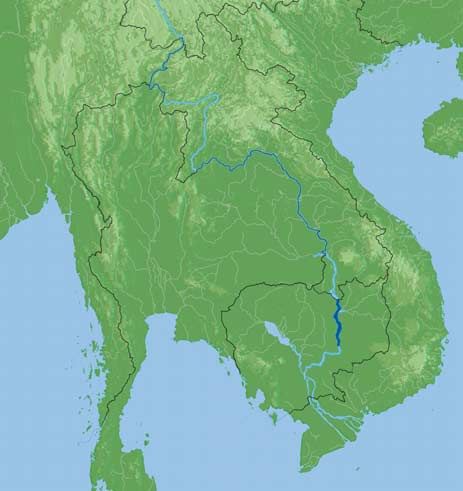
The Imperiled Giants of the Mekong

Ecologists struggle to understand—and protect—
Southeast Asia’s large migratory catfish

Zeb S. Hogan, Peter B. Moyle, Bernie May, M. Jake Vander Zanden and Ian G. Baird

T   he Guinness Book of World Records
    lists the Mekong giant catfish as
Earth’s largest freshwater fish. This
                                                      the Mekong giant catfish in size. In Eu-
                                                      rope, the Wels catfish (Silurus glanis) re-
                                                      portedly once grew to a monstrous 5
                                                                                                      met another of the authors (Baird, a ge-
                                                                                                      ographer and fisheries biologist then
                                                                                                      working in southern Laos with the Lao
species (Pangasianodon gigas), which                  meters in length, but today a 2-meter           Community Fisheries and Dolphin
grows as fast as a bull and looks a bit               specimen is considered remarkable.              Protection Project), who suggested to
like a refrigerator, can measure 3 meters                A century ago, the range of the              Hogan that he focus his graduate re-
in length and weigh up to 300 kilo-                   Mekong giant catfish spanned the en-            search on the threats to various fishes of
grams. Called the “king of fish” in                   tire length of the river and its tribu-         the Mekong ecosystem.
Cambodia, “buffalo fish” in Thailand                  taries from Vietnam to southern Chi-              At the time, this river was gaining
and Laos, and “blubber fish” in Viet-                 na. But in the 1930s and ‘40s, this             recognition as the most important nat-
nam, this catfish is well known through-              species began disappearing, first from          ural resource in the region, because it
out Southeast Asia. Only the caviar-                  the segment of the Mekong that flows            provides up to two million tons of food
producing sturgeon, goliath catfish of                between Thailand and Laos and later             (both animal and plant) for rural peo-
the Amazon and a few species of poorly                upstream, in northern Laos. During re-          ple each year and because only the
understood freshwater sting rays rival                cent times, the status of P. gigas has be-      Amazon and the Congo can boast a
                                                      come extremely precarious. For ex-              greater diversity of freshwater species.
Zeb S. Hogan received his B.S. degree in ecology      ample, in Chiang Khong (northern                But the Mekong also faced new threats.
and evolutionary biology from the University of       Thailand) and across the river in the           Just a year or so earlier, the Mekong
Arizona in 1996. In addition to his substantial
                                                      Houay Xai district (Laos), the 1990 haul        River Commission, a body created by
work on Mekong river fish species, Hogan has also
been involved with conservation projects on the
                                                      included just 69 of these fish. The catch       the four countries bordering the lower
Colorado River and, more recently, in Mongolia.       from this stretch of river has fallen con-      Mekong (Vietnam, Cambodia, Laos
He is currently a Ph.D. candidate in the Depart-      siderably since then, and over the past         and Thailand), coordinated a study to
ment of Wildlife, Fish and Conservation Biology at    three years local fishers have not re-          consider building 12 hydroelectric gen-
the University of California, Davis. Peter B. Moyle   ported a single one. Noting this ab-            erating stations. According to plans,
received a doctorate in zoology from the University   sence and similar patterns unfolding            the dams would stand, on average,
of Minnesota in 1969. He is currently associate di-   elsewhere, we estimate that the total           about 35 meters high. The slack water
rector for the Center for Integrated Watershed Sci-   number of these giant catfish has de-           behind many of these enormous con-
ence and Management at UC Davis. Bernie May           creased by 90 percent or so during the
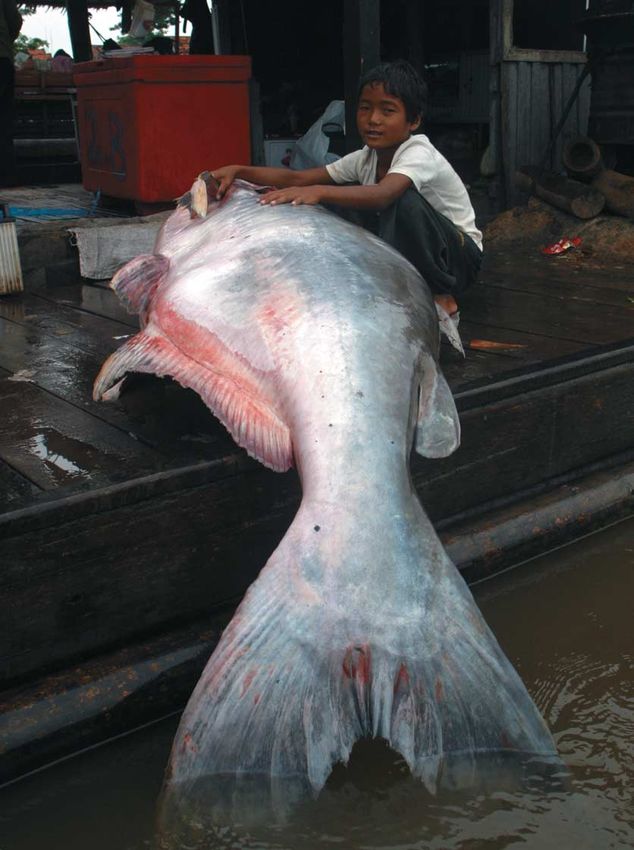
earned a Ph.D. in the Department of Genetics at                                                       Figure 1. Mekong giant catfish (Pangasianodon
                                                      past two decades.                               gigas) is one of the largest freshwater fish in
The Pennsylvania State University in 1980. He is
now an adjunct professor at UC Davis, where he
                                                         Efforts to save this fish from extinc-       the world. This 153-kilogram specimen weighs
directs the Genomic Variation Laboratory in the       tion will hinge on many factors—                roughly half as much as some of the biggest
Department of Animal Science. M. Jake Vander          including how well biologists under-            known, which reach 3 meters in length. The
Zanden received a Ph.D from the Department of         stand the migratory behavior of these           numbers of giant catfish being caught on the
Biology at McGill University in 1999. He is now       animals. Using a variety of approaches,         Mekong have plummeted in recent years, indi-
an assistant professor at the Center for Limnology    we have endeavored to provide such              cating that relatively few remain in the wild, a
and in the Department of Zoology at the Universi-     knowledge. Here we relate how we be-            conclusion that prompted the World Conser-
ty of Wisconsin, Madison. Ian G. Baird holds bach-    came involved in this effort and where          vation Union last year to classify this species as
elor’s and master’s degrees in geography from the                                                     critically endangered. Saving the giant catfish
                                                      that journey of discovery has taken us.
University of Victoria, where he is currently a                                                       and its threatened relatives in the Mekong re-
Ph.D candidate. He has worked extensively on con-                                                     quires that fisheries biologists learn more
servation projects in Thailand, Laos, Cambodia and
                                                      The King (of Fish) and I                        about the migrations of each species. The au-
Vietnam since 1986. Address for Hogan: Depart-        In 1996, one of us (Hogan) received a           thors describe their efforts to improve on this
ment of Wildlife, Fish and Conservation Biology,      Fulbright scholarship for graduate              understanding and suggest ways to help pro-
One Shields Avenue, University of California,         study at Chiang Mai University in Thai-         tect endangered fish. (Except where noted,
Davis, CA 95616. Internet: zshogan@ucdavis.edu        land. During his year in Chiang Mai, he         photographs are courtesy of Zeb Hogan.)

228   American Scientist, Volume 92         © 2004 Sigma Xi, The Scientific Research Society. Reproduction
                                                  with permission only. Contact perms@amsci.org.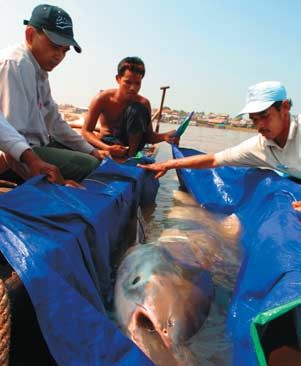
© 2004 Sigma Xi, The Scientific Research Society. Reproduction
      with permission only. Contact perms@amsci.org.
ments through the Mekong river sys-
tem, an effort that would end up en-
gaging all of us in one way or another.
Hogan began by learning the Thai
language. Then, with a small grant
from the Wildlife Conservation Society,
he traveled to towns along the Thai
section of the river to record the species
for sale at local fish markets. During
this time, he narrowed his focus to the
dozen or so Mekong catfish species in
the family Pangasiidae, which were
relatively common, important com-
mercially and interesting ecologically.
What is more, the installation of dams
was thought to pose a particular threat
to these fish, given their highly migra-
tory behavior, adaptation to the natural
variation in river flow, and sensitivity
to water quality and temperature.
What he found generally supported
what was already known about Asia’s
pangasiid catfish: They are seasonal
spawners, grouping together in May,
June and July to breed at the beginning
of the rainy season. Catches of Mekong
catfish peak at this time, when most of
the fish apparently migrate in schools
up the Thai-Lao segment of the river.
H. waandersii
P. macronema Hogan couldn’t describe specific mi-
40 centimeters gratory patterns just by inspecting the
20 centimeters
offerings in fish markets, but these sur-
P. hypophthalmus veys were nevertheless valuable. While
P. krempfi 1.3 meters
80 centimeters traveling from town to town, he had a
chance to learn about the fisheries first-
hand and to chart the distribution in
space and time of various species of
Pangasiidae from the border between
P. gigas
Isan, Thailand, and Champasak Pro-
3 meters vince, Laos, in the south to the Golden
Triangle region in the north.
P. sanitwongsei
2.75 meters He noted, for example, that the
Mekong giant catfish and the slightly
less gargantuan “dog eating” catfish
Figure 2. Dozen or so species of pangasiid catfish ply the waters of the Mekong and its tribu- (Pangasius sanitwongsei) appeared in
taries. The giant catfish (P. gigas) is perhaps the most charismatic (photograph) and the largest, the northern section of the river be-
but a few related species also grow to great size; others are no larger than a human hand (bottom). tween Thailand and Laos in April,
May and June. Smaller species, includ-
crete constructions would stretch for ical link in the biological chain of ing the mouse-faced catfish (Helicopha-
roughly 100 kilometers upstream, rep- migrating species. While it is pos- gus waandersii), the snail-eating cat-
resenting, in total, more than half of the sible that some species may find fish (Pangasius conchophilus) and the
length of the Mekong River along the alternative spawning and rearing whiskered catfish (Pangasius macrone-
span of the slated projects. It was obvi- areas, there is no data to support ma), inhabited the middle stretches of
ous that these dams would have seri- such a possibility. It is not known the river and represented the majority
ous environmental consequences. The how far certain species migrate of the catch in this area between April
Commission found, for example, that [or] whether stocks can continue and June. Surprisingly, one species
… to function between dams, be- commonly found in markets, the ri-
[a]ll of the proposed dams will cause stocks and their migration ver catfish (Pangasius hypophthalmus),
block fish migration. This one im- patterns have not been identified. turned out to come from fish-farming
pact alone may cause the whole- operations, not (as Hogan had first
sale decline in the fishery through- The urgent need for even this basic been led to believe) from the river.
out the lower Mekong River. knowledge prompted Hogan to begin Wild examples of this fish are, in fact,
Blocking migration cuts out a crit- searching for ways to chart fish move- very rare in Thai portions of the Mekong.
230 American Scientist, Volume 92 © 2004 Sigma Xi, The Scientific Research Society. Reproduction
with permission only. Contact perms@amsci.org.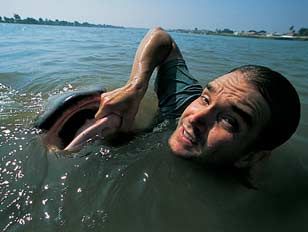
Perhaps most interesting was the pres-
ence of large (meter-long) silver-toned
catfish (Pangasius krempfi) in many fish-
                                                                           CHINA
mongers’ stalls.
   Why were silver-toned catfish a sur-               MYANMAR
prise? A few years before Hogan ar-
rived in Thailand, Baird had reported
that this species could be found in the
South China Sea and also in southern
Laos. Baird surmised that this migra-
tory catfish might be anadromous, trav-
eling from the marine waters of the
South China Sea up the Mekong
through Vietnam and Cambodia and                                                                             LAOS
into Laos, where they presumably
spawned. His basic theory, along with                                        THAILAND
Hogan’s later observation of this
species in Nong Khai, Thailand (about
1,600 kilometers upstream of the
Mekong Delta), provided impetus for a
study of the silver-toned catfish that
                                                                                               CAMBODIA
could better document its travels. We
(Hogan and Baird) began by carefully
examining, of all things, small struc-
tures in its ears.
   Hogan realized that this curious tac-                                                                             VIETNAM
tic might reveal migratory patterns af-
ter a chance meeting with Robert
Kinzie and Richard Radtke of the Uni-
versity of Hawaii at Manoa. These in-                                                                               SOUTH CHINA
vestigators studied the migratory be-                                                                                   SEA
havior of a different kind of fish,
gobies, using a novel technique—
analysis of strontium:calcium ratios in     Figure 3. Southeast Asia’s Mekong River flows out of China, through (or between) Myanmar,
otoliths (“ear stones”). These small,       Laos, Thailand, Cambodia and Vietnam, before reaching the South China Sea. Because this vast
                                            natural resource is shared among countries, conservation efforts can be difficult to coordinate
hard deposits are found in the heads
                                            and threats are often hard to manage. Some sites are especially relevant in this regard, including
of all bony fish. Otoliths can be used to   the 12 places on the Mekong and Tonle Sap rivers where the construction of a dam has been
tell how old a specimen is, because         proposed (red); Chiang Khong, where giant catfish have traditionally been caught (purple); a
they are built up of distinct layers that   controversial dam on the Mun River, one of the Mekong’s tributaries (yellow); Khone Falls,
are deposited annually. Radtke and          where considerable numbers of silver-toned catfish are caught (white); various deep pools,
Kinzie found that otoliths can also in-     which are important habitat for river dolphins and spawning areas for some species fish (dark
dicate events that take place as the ani-   blue); Tonle Sap Lake, which provides a nursing ground for countless fish (pink outline); and
mals mature. In particular, the ratio of    even the South China Sea, where members of one species of catfish live for part of their lives.
strontium to calcium in an otolith
records whether the fish had been liv-      only mainstream waterfall, and a                  of this species move upstream of the
ing in salt water or fresh water, because   stone’s throw from Cambodia. There,               estuarine zone in February or March.
strontium concentrations in the ocean       Hogan collected 36 specimens of silver-           Higher yet on the river, in southern
are one to two orders of magnitude          toned catfish for otolith analysis.               Laos, Baird had seen just adults weigh-
greater than in rivers or streams.             Hogan, Radtke and Baird found that             ing more than a kilogram or so—and
                                            the otoliths contained significant                only from May to October. It thus
Listening to the Stones                     amounts of strontium—clear evidence               seems likely that in February and
With Radtke’s offer of help, Hogan and      that these fish had lived in salt water.          March the silver-toned catfish move
Baird decided to use otoliths to test       Conversely, the analyses did not turn             from the sea into the river to spawn,
whether silver-toned catfish caught far     up elevated strontium concentrations              reaching the Khone Falls, 719 kilome-
inland had migrated up from the sea.        in related species. These results helped          ters upstream, in May and June, which
The base of operation for this study        bring the migratory pattern of this cat-          is when the residents of Ban Hang
was Hang Khone, a small village of          fish into clearer focus. Baird had al-            Khone net 98 percent of their yearly
about 45 families where Baird had           ready documented silver-toned cat-                haul of this fish.
been conducting community-based re-         fish living in the ocean from January                This investigation kept Hogan well
search on Mekong fisheries since 1991.      through April. And Sophie Lenor-                  occupied through his year as a Ful-
This tiny enclave is located in the         mand, a French graduate student                   bright student, but his interest in
southernmost province of Laos, at the       working with the Asian Catfish Project            Mekong catfish did not end there.
edge of Khone Falls, the Mekong’s           in Vietnam, had determined that adults            Hogan moved back to the United States

www.americanscientist.org             © 2004 Sigma Xi, The Scientific Research Society. Reproduction                  2004 May–June       231
                                            with permission only. Contact perms@amsci.org.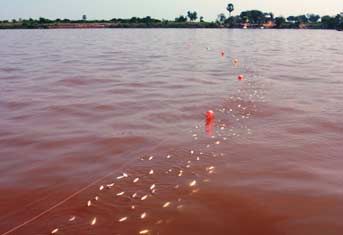
Emma Skurnick
                                            1950                                           1980                                                             2003

                          80                                                                                    90                     Figure 4. Despite an overall increase in com-
                                                                                                                                       mercial fishing effort (as gauged by the number
                          70                                                                                    80
                                                                                                                                       of boats involved), catches of the Mekong giant
number of fish captured

                          60                                                                                    70                     catfish have fallen considerably in recent years.

                                                                                                                     number of boats
                                                                                                                60                     The statistics from Chiang Khong, Thailand,
                          50                                                                                                           are telling (left). The range of this species has
                                                                                                                50                     also diminished: Whereas it lived throughout
                          40
                                                                                                                40                     most of the river in 1950 (top, left), by 1980 it
                          30                                                                                                           was found only in two distinct segments of the
                                                                                                                30
                          20                                                                                                           river (top, middle), suggesting that there might
                                                                                                                20                     be two genetically separate populations. By
                          10                                                                                    10                     2003, the range of the giant catfish became fur-
                                                                                                                                       ther restricted to Tonle Sap Lake, the Tonle Sap
                          0                                                                                   0
                                                                                                                                       River and relatively short stretches of the
                           1986         1988       1990        1992          1994   1996        1998       2000
                                                                      year                                                             Mekong and Basaac rivers nearby (top, right).

in 1997 to begin study for a Ph.D. at the                               ical Research Institute had dubbed it in                       vides habitat for more than 100 kinds
University of California, Davis, under                                  1995. Despite this success, it was clear                       of fish and many more species of birds,
the direction of another one of us                                      early on that these chemical and iso-                          reptiles and amphibians.
(Moyle). A few years into Hogan’s                                       topic methods wouldn’t work to inves-                             Every year at the end of the rainy
studies at Davis, Jake Vander Zanden                                    tigate the migratory habits of other                           season, the flow of the Tonle Sap River
joined Moyle’s research group on a                                      species of Mekong catfish, which, as far                       changes direction from north to south
postdoctoral fellowship sponsored by                                    as we knew, remain in fresh water                              as the water begins to drain from the
The Nature Conservancy. Vander Zan-                                     throughout their lives. The inability of                       flooded forests and plains into the
den’s specialty was stable isotope                                      these techniques to chart such move-                           Mekong. With this outflow come mil-
analysis, specifically the measurement                                  ments prompted Hogan to explore an                             lions of fish. (Residents take advantage
of carbon and nitrogen isotopes, which                                  entirely different avenue of investiga-                        this annual movement by fixing all
can help to delineate food webs and en-                                 tion, one that he had earlier rejected                         manner of traps and nets in the lake
ergy flows in aquatic systems.                                          as being too expensive and difficult—                          and river to snare the migrating fish.)
   So it was quite natural that three of us                             following some fish around.                                    We wanted to determine where exactly
(Hogan, Moyle and Vander Zanden) de-                                                                                                   these animals swim: Do they exit the
cided to use stable isotopes to fill out the                            Tag Team                                                       Tonle Sap River and enter the Mekong?
story pieced together from the earlier                                  At the time, fisheries biologists in the                       If so, where do they then travel? That
otolith study of silver-toned catfish. We                               Mekong region were suggesting that                             is, do they move upstream or down-
figured that such an analysis could read-                               fish migrate between the Mekong Riv-                           stream? How far do they go?
ily tell us whether this big fish fattens                               er and Tonle Sap Lake, the largest in-                            Underwater biotelemetry (fitting
up while at sea. And indeed, our results                                land lake in Southeast Asia, which con-                        fish with acoustic or radio transmitters)
indicated that the flesh of this fish has                               nects to the Mekong through a river                            seemed a good way to answer these
an isotopic signature that reflects growth                              also named Tonle Sap. In the dry sea-                          questions. Biotelemetry systems have
in a marine environment, something not                                  son (November to February), this re-                           often been used to study fish migra-
seen in other related species of catfish.                               markable lake covers about 2,500                               tions, to locate spawning and feeding
   Taken together, our analysis of catch                                square kilometers. At the height of the                        grounds and to describe important sea-
data, strontium in otoliths and stable                                  rainy season (August), the lake area ex-                       sonal habitat. But this high-tech strate-
isotopes in muscle tissues provided                                     pands fourfold, and the maximum                                gy had never before been applied
ample evidence that the silver-toned                                    depth increases from 4 meters to 10.                           to chart fish migrations within the
catfish migrates long distances between                                 Life around the lake, including that of                        Mekong River basin, because most
fresh and salt water—the first docu-                                    the local people, is uniquely adapted                          fisheries biologists believed that such
mented case of anadromy in a Mekong                                     to this annual cycle. Fish use the flood-                      tagging would not be fruitful in a river
River species. That is, we had fully con-                               ed habitat to feed and to grow. The                            system so large and complex. Thank-
firmed the notion that this species was                                 variety of landscapes, including inun-                         fully, Hogan was able to obtain sup-
a Mekong “salmon,” as Baird and                                         dated forests and fields, ephemeral                            port from the World Wildlife Fund to
Tyson Roberts of the Smithsonian Trop-                                  streams and small satellite lakes, pro-                        try this approach as well as the more

232                            American Scientist, Volume 92   © 2004 Sigma Xi, The Scientific Research Society. Reproduction
                                                                     with permission only. Contact perms@amsci.org.
P. krempfi                        18
                                      20
                                                                                        16                                                                     saltwater
                                      10                                                                                       P. larnaudii                       fish
                                                                                                      P. macronema                                                         P. krempfi
                                      0                                                 14
                                                                                                                                       H. waandersii
                                           0            2,000               4,000
                                                                                        12
                                                                                                  freshwater

                                                                                     15N
                                                   P. conchophilus                      10            fish
  strontium:calcium ratio (× 1,000)

                                      20                                                                                                                     P. conchophilus
                                                                                            8
                                      10                                                                                                            P. pleurotaenia
                                                                                            6

                                                                                                                                                                                              Emma Skurnick
                                       0
                                           0            2,000               4,000           4
                                                                                            –32     –30        –28     –26       –24          –22      –20        –18      –16          –14
                                                     P. larnaudii                                                                      13C
                                      20
                                      10                                             Figure 5. Silver-toned catfish (P. krempfi) had been found in the South China Sea and also up-
                                                                                     river, suggesting this species is anadromous, spawning in fresh water but living part of its life at
                                       0                                             sea. The authors confirmed that supposition by examining otoliths—“ear stones,” which can be
                                           0         2,000          4,000
                                                                                     used to document the age of a fish and the environmental conditions it experiences as it matures.
                                                                                     Finding a high strontium:calcium ratio in otoliths of this species indicated that individual fish
                                                    P. macronema                     had indeed lived in marine waters, where strontium is relatively abundant (top panel at left). The
                                      20
                                                                                     ratio drops in the outermost portion of the otolith, which was deposited after the fish migrated
                                      10                                             upriver. Related species of catfish show uniformly low strontium:calcium ratios (bottom three
                                       0                                             panels). Further confirmation that P. krempfi found upriver had fattened up at sea came from an
                                           0             1,000              2,000    analysis of the carbon and nitrogen isotopic composition (expressed as δ13C and δ15N, which rep-
                                               distance from otolith center          resent differences from established isotopic standards) of muscle tissue: Of the pangasiid catfish
                                                     (micrometers)                   examined, only P. krempfi shows values of δ13C and δ15N in the ranges found for saltwater fish.

common form of tagging—attaching                                                     catfish and 11 river catfish with                  meant that it had traveled nearly 5 kilo-
plastic markers to fish.                                                             acoustic transmitters and plastic tags             meters per day. Fishers have since re-
   For this study, Hogan and cowork-                                                 labeled “Please return to the Depart-              captured several other tagged speci-
ers from the Cambodian Department                                                    ment of Fisheries.” On the evening of              mens in this same area (we learn about
of Fisheries collected live fish from a                                              December 9, the hydrophone we were                 such catches promptly, because we pro-
“bagnet” fishery located in the lower                                                trailing from our survey boat picked               vide a small reward for the return of
part of the Tonle Sap River near Ph-                                                 up signals from one of the tagged river            our tags), suggesting that this migra-
nom Penh. This particular fishery con-                                               catfish. We were cruising the Mekong,              tion route—from the Tonle Sap Lake,
tains about 60 individual nets, each                                                 20 kilometers upstream of its conflu-              down the Tonle Sap River and on up
120 meters long and 25 meters in di-                                                 ence with the Tonle Sap and Bassac                 the Mekong—is typical of river catfish.
ameter at the mouth. The first row of                                                rivers. This acoustic contact indicated               Adult river catfish move into deep
four side-by-side nets is located just                                               that the fish had moved out of the Ton-            water areas of the Mekong River to
outside the city, and the final phalanx                                              le Sap River and on up the Mekong.                 survive the dry season. They then mi-
is located some 35 kilometers to the                                                 Although we never actually saw the                 grate upstream and spawn with the
north. This operation, like many other                                               fish, we were able to identify it (a 17-           onset of the first heavy rains in May
fisheries in the Tonle Sap River, runs                                               kilogram specimen we had tagged on                 and June. Young fish float down-
from October to March, the period                                                    the last day of November) using the                stream with the rising water, eventual-
when water flows out of the great lake                                               unique pattern of beats programmed                 ly finding their way into inundated ar-
and into the Mekong and adjacent                                                     into its transmitter.                              eas during the rainy season. These
Bassac River.                                                                           Two months later, this same fish gob-           temporary wetlands, such as the
   Between November 6 and December                                                   bled up the baited hook of a local fisher          flooded forest of the Tonle Sap Lake,
1, 2001, Hogan and his Cambodian col-                                                approximately 300 kilometers up-                   act as rainy season nurseries for young
leagues outfitted two Mekong giant                                                   stream from Phnom Penh, which                      fish of many other species as well.
discharge

      1994        1995        1996      1997
Figure 6. Southeast Asian rainfall varies enormously between the dry season (November to February) and the wet season (March to October),
causing dramatic annual oscillations in the outflow of the Mekong (left). In the dry season, Tonle Sap Lake, a key nursing ground for fish and
the site of much fishing activity, covers more than 2,500 square kilometers of Cambodia (middle). In the wet season, the area of the lake expands
fourfold (right). (Satellite images courtesy of NASA.)

www.americanscientist.org                                                     © 2004 Sigma Xi, The Scientific Research Society. Reproduction                      2004 May–June         233
                                                                                    with permission only. Contact perms@amsci.org.
not buy any live specimens caught and ly that all of the tagged fish had been
release them? In Cambodia, fishermen lucky enough to escape recapture?
capture giant catfish essentially by acci- Knowing that the results of the tagging
dent—as “bycatch” in the local bagnet program might be ambiguous, Hogan
fishery. These fish sell for very little: joined the Genomics Variation Labora-
about fifty cents a kilogram. In Thai- tory at the University of California,
land, this species was in greater de- Davis, where with the help of another
mand and thus was more expensive. A one of the authors (May) he developed
large fish there could fetch as much genetic markers to study the Pangasi-
as $4,000. Although purchasing live idae. Using tissue samples from the
Mekong giant catfish from local fishers upstream and downstream stocks of
clearly wasn’t a long-term solution, the giant catfish, Hogan and May
starting a buy-and-release program hoped to be able to determine whether
seemed better than doing nothing. these two populations mix.
The fishers were happy enough with In 2000, Hogan traveled to northern
our scheme, because we reimbursed Thailand to observe the giant catfish
them for the fish at market price. This fishery in Chiang Khong. His intent
approach was attractive to us, too, for a was to buy, tag and release the giant
reason that went beyond just saving catfish captured there, as well as to ob-
the few individuals that were caught: tain tissue samples. It was mid-April,
By purchasing, tagging and releasing the hottest time of the year. So Hogan
giant catfish, we had a chance—albeit a found a small, well-shaded guesthouse
very small one—to document any link and checked himself in for the month.
that might exist between the specimens Fishing records showed that most gi-
found upstream in Thailand and those ant catfish were caught at about this
found downstream in Cambodia. time—and that the season for them
Hogan figured that it would be was getting shorter each year. In 1992,
straightforward to mark any live spec- for example, the season began with a
imens caught with labeled plastic tags catch on April 26 and lasted until June
and then release the fish back into the 9. In 1999, the season started on May 6
river. Because he had developed con- and finished just two weeks later. So
tacts in both Thailand and Cambodia for a month, Hogan waited on the pa-
and was thus able to monitor both fish- tio of his guesthouse, walked down the
eries, he’d soon know when one of street three times a day for a plate of
these marked fish was recaptured. fried rice, read books and worked on
And, obviously, if a fish tagged in his laptop. But the locals caught none
Cambodia showed itself in Thailand, of the big fish.
or vice versa, he’d have concrete evi- As it turned out, 1999 was the last
dence that these fish moved between year that the catch of giant catfish in
Figure 7. One way to help the critically en- the two locations (and past the pro- Chiang Khong could be termed a “fish-
dangered giant catfish, at least over the short posed dam sites). ery.” After failing to locate any of these
term, is to purchase specimens that have been The study of migratory connectivity fish in 2000, Hogan returned there in
captured live so that they can be released between these two populations was 2001 and again in 2003, yet he never
back into the wild. The captured fish are not just of academic interest. Indeed, saw a specimen. During his last trip,
tagged, weighed and measured before re- developments taking place at the time Hogan spent a month interviewing lo-
lease, requiring that they be transported short made it seem especially important to cal fishers about their practices and the
distances (top). Before releasing it into the understand what the catfish were do- catch of giant catfish. Everywhere the
river, one of the authors (Hogan) holds onto
ing: The upstream section of the river story was grim. In one village, locals
the huge fish until he is sure that it has suffi-
cient strength to swim (bottom).
posed several threats to this species, said that the giant catfish had disap-
the most obvious being the continued peared in 1960. In another community,
Caveat Emptor fishing in Chiang Khong, Thailand, they reported netting the last one 20
While Hogan was tagging fish in the where catches of the giant catfish were years ago. In Chiang Khong, the giant
Tonle Sap River, he was becoming in- shrinking dramatically. Would a de- catfish held out only through 1999.
creasingly concerned about the plight cline in the numbers of giant catfish Taken together, these accounts all
of the giant catfish. Populations were upstream carry over to the down- pointed to the same conclusion—that
clearly in a nosedive, yet this species stream population? the Mekong giant catfish was all but
continued to be caught, and there To address such concerns, we need- gone from northern Thailand.
didn’t seem to be any readily available ed to know whether the two stocks in- Fortunately, downstream in Cambo-
means of regulating the fishery. Then in termingled. But suppose no “northern” dia at least some giant catfish remained.
1999 he and Nicolaas van Zalinge (head fish turned up down south (or vice And the Cambodian Department of
of the Mekong River Commission’s versa)—would this finding, or rather Fisheries was eager to conserve its cat-
Freshwater Capture Fisheries Program lack of finding, mean that these two fish stocks. So Hogan, with financing
in Cambodia) hatched an idea: Why populations lived in isolation or mere- from the University of California and
234 American Scientist, Volume 92 © 2004 Sigma Xi, The Scientific Research Society. Reproduction
with permission only. Contact perms@amsci.org.the National Geographic Conservation there still is an upstream population ready-rare catfish to adapt to chang-
Trust, started a program to buy and re- worth talking about. ing conditions.
lease the giant catfish that survived Despite this setback, we don’t consid- Unfortunately, the program may be
capture, beginning in 2000. In all, he er the investigation a total washout— doing more harm than good. For ex-
and colleagues in the Cambodian De- far from it. Our genetics work has ample, in 1999, the largest catch of
partment of Fisheries have purchased proved valuable for other reasons. For Mekong giant catfish in northern Thai-
21 adult giant catfish—about 80 per- one, our results can be used to study the land in the last ten years (almost two
cent of the total reported catch—letting genetics of other catfish species. And dozen fish) was sacrificed to supply
them slip back into the Tonle Sap River. the genetic markers that we developed eggs and milt for the artificial propa-
(They are confident that they hear also allowed us to examine the diversity gation. Genetic analysis of the proge-
about most captures of giant catfish, of stocks bred in captivity and to antici- ny indicated that roughly 95 percent
both because news of these events pate the effect of release of hatchery- shared the same two parents. More
travels quickly on the river and be- raised fish into the wild. than 10,000 of these fingerlings were
cause their project has garnered released in 2001. Although we applaud
enough publicity that most fishers Sibling Rivalry the Thai government’s desire to rescue
know to contact them.) Hogan and his Hatchery fish were a concern because the giant catfish from the verge of ex-
Cambodian counterparts do the same the Thai Department of Fisheries was tinction, the current method of brood
with 10 other vulnerable species, in- pursuing an artificial breeding pro- collection and captive breeding seems
cluding the giant carp (Catlocarpio sia- gram for the giant catfish. Since 1985, likely to erode the genetic diversity re-
mensis), the giant sting ray (Himantura thousands of giant catfish that were maining in the wild Cambodian popu-
chaophraya) and the river catfish. In all, artificially reared have been stocked lation while also depleting the wild
they have bought, tagged, and released into the Mekong. The site of their re- Thai population.
approximately 5,000 fish. lease is almost certainly spawning Will the southern population ulti-
But with no giant catfish to examine habitat for their wild cousins, raising mately suffer the same fate as the one
from the Thai sections of the Mekong, concern about the loss of genetic di- in the north? Perhaps. But we prefer to
Hogan had no way to verify whether versity that might result from having be more optimistic. Last year there
the tagged “Cambodian” fish migrate large numbers of stocked fish over- were several positive steps that may
upstream, and he, Moyle and May had whelming the small natural popula- help the Mekong giant catfish and oth-
no way to compare genetic makeup be- tion. Loss of genetic diversity would er threatened freshwater species of the
tween the two populations, if indeed further limit the ability of the al- region. For example, in November the
Figure 8. Commercial fishing operations on the Mekong take a variety of forms. For example, the bagnet fishery on the Tonle Sap River near
Phnom Penh makes use of large nets, the mouths of which are anchored to the river (upper left). Permanent “houses” float next to the down-
stream end of the nets, allowing fishers to empty them at intervals, which may be as short as 20 minutes during times of peak catch. In other
places, arrow-shaped bamboo fences are used to herd fish into traps (upper right). In barrage fisheries, a barrier is erected across a portion of the
river, forcing all fish above a certain size into one or more traps (lower left). And in some locales conventional gillnets are suspended from floats,
catching the fish that swim or drift into them (lower right). (Photograph at lower left courtesy of Nicolaas van Zalinge.)
www.americanscientist.org © 2004 Sigma Xi, The Scientific Research Society. Reproduction 2004 May–June 235
with permission only. Contact perms@amsci.org.putative dam. In the end, authorities decided to
parents offspring tested operate the dam at reduced capacity
(opening the massive flood gates for
✔ ✔ ✔ ✔ ✔ ✗ ✔ ✔ ✔ ✔ ✔ ✔ four months of the year), in hopes of
bolstering stocks of migratory fish.
1
If the Mun River Dam is any indica-
2 tion, planners should be cautious about
alleles
proposals for mainstream dams on the
3 Mekong River, recognizing that no
4 workable design yet exists to mitigate
the harm these dams bring to migrato-
ry fish. Dams would also alter the nat-
Figure 9. Giant catfish raised in Thai hatcheries in 1999 were mostly siblings. The dark band-
ing in each lane of this scan shows which two of four possible versions of a gene (alleles, num-
ural variation in river flow, which is
bered 1 through 4) one of the tested offspring received from its parents. A single pair of parents critical to maintain, because the behav-
with the alleles shown at left could have given rise to 11 of the 12 tested offspring (those ior of migratory fish (and the people
shown with check marks). Had the parentage of these 11 fish been more complicated, one who depend on them for a livelihood)
would expect other genetic patterns to emerge in the progeny, such as the one marked with the is closely tied to these seasonal changes.
X, which has two copies of allele 2. Because the central governments
have only limited presence in the rural
World Conservation Union officially tion of aquatic life in the Mekong Riv- areas where the fishing takes place,
classified the Mekong giant catfish as er. The publisher, a Cambodian or- management of this natural resource
critically endangered. This designation ganization called Save Cambodia’s must begin at the local level. But with
is reserved for Earth’s most threatened Wildlife, is distributing the book to fish migrating between Vietnam, Thai-
species—ones living in only a single lo- thousands of youngsters throughout land, Laos and Cambodia, action at the
cation, numbering less than 50 wild in- that country. If the big fish holds on for local, or even the national level, is not
dividuals or suffering rapid, dramatic long enough, perhaps the book will sufficient. The fisheries of the Mekong
population decline. Although nobody raise awareness in the next generation need to be managed as a transbound-
wants to celebrate that this animal is in of Cambodians about the value of con- ary resource. And the authorities draft-
grave danger, the new classification is, serving this and other endangered fish ing the regulations need to be aware
in fact, good news for the giant catfish, species of the Mekong. that in a mixed-species fishery such as
because it raises awareness about the this, slowly maturing species are espe-
necessity for immediate protection. Action Plans cially vulnerable to over-exploitation—
Another recent development shows Although much remains to be learned and thus to extinction. That is, regula-
how important it is to get the word out about the ecology of the migratory cat- tions that are able to maintain the total
that this fish is in trouble. Participants fish inhabiting the Mekong, enough catch in a multi-species fishery can
in the Mekong Wetlands Biodiversity good science is now available to forge a nonetheless lead to severe declines
Program, an effort of the World Con- strategy for the sustainable manage- among vulnerable groups, most no-
servation Union, together with peo- ment of these inland fisheries. This tably large-bodied, migratory fish.
ple working for that organization’s broad survey of the problem isn’t the Ultimately, the preservation of such
Bangkok-based Water and Nature Ini- place to detail prescriptions for better species must be considered not only as
tiative, recently conducted an assess- fisheries management, but we can at a matter of fisheries management but
ment of fish biodiversity, along with a least outline what would be involved. also as a conservation issue. The grow-
study of the community fisheries in First, maintaining the connectivity ing list of threatened migratory fish (P.
northern Laos and Thailand. These ef- between spawning grounds and nurs- gigas, P. sanitwongsei, P. hypophthalmus,
forts produced evidence that the ing areas is absolutely critical, in part P. jullieni, C. siamensis) demonstrates
Mekong giant catfish spawns in the because many seasonal fisheries are the need for precautionary actions to
area where rapids were being blasted based on the catch of migratory fish. It aid their conservation and for greater
as part of the Upper Mekong Naviga- is important to avoid what happened efforts to assess their status.
tion Improvement Project, an initiative on the Mun River, the Mekong’s One option that acknowledges the
intended to spur the local economies. largest tributary in Thailand, where a shortcomings of typical approaches to
Since publication of these results, plans dam blocked the upstream migration fisheries management would be to pur-
for blasting more of the river rapids in of many fish, especially catfish, most of sue an idea recently championed by
Thailand have been postponed. Al- which cannot navigate the ladder con- Harvard entomologist E. O. Wilson:
though the reasons for that postpone- structed to allow them to climb over conservation concessions. Adopting this
ment are manifold, one hopes that this obstruction. Not surprisingly, the tactic on the Mekong River would
icreased awareness of the environmen- local catch of migratory species plum- blend something similar to what can
tal disruptions the blasting causes will meted after construction of the dam. now be found on land in several places
help to keep the project on hold. The resultant political fallout has been (including Guyana, Suriname, Bolivia,
Another recent triumph for the widespread and long lasting: Fishers Peru and the Congo) with the situation
Mekong giant catfish is that one of us protested, and eventually occupied, the in various marine protected areas. The
(Hogan) has just completed Samnang dam site in 2000, and in 2001 the on- idea is to purchase the right to fish com-
and the Giant Catfish, a children’s going opposition prompted the gov- mercially in a specified area but not to
primer on the ecology and conserva- ernment to consider removing the exercise it. These “fishing rights” would
236 American Scientist, Volume 92 © 2004 Sigma Xi, The Scientific Research Society. Reproduction
with permission only. Contact perms@amsci.org.Tonle Sap Lake
Mekong River
forr subsistence
su
Tonle Sap River
fish sanctuary
flooded area
Emma Skurnick
water body
Phnom Penh
Figure 10. Adequate protection for the endangered fish of the Mekong will demand a variety of changes. One is greater public awareness of the
problems, something that author Hogan hopes his primer, Samnang and the Giant Catfish, will help to accomplish: He gives copies of the book
to youngsters in the villages in which he works (left), and his Cambodian publisher will soon be distributing the book to youth throughout that
nation. Because typical fisheries regulations often fail to protect large-bodied species (even if they do manage to sustain the overall yield of fish),
the authors suggest that a valuable approach may be to establish conservation concessions—areas for which conservation groups purchase com-
mercial fishing rights but do not exercise them (or allow others to do so). Commercial fishing rights have already been divvied up in many places,
including the Tonle Sap Lake region of Cambodia (right), where the government leases out various lots (outlined in black) to commercial fishers.
then become nonfishing rights: the What is more, the ban needs to extend something that we have largely failed
power to halt large-scale commercial to wild fish caught for artificial breed- to do in North America: develop truly
fishing in certain areas in favor of small- ing. The Thai Department of Fisheries sustainable fisheries while protecting
scale subsistence fishers—and fish. should breed existing captive stocks to local biodiversity.
Some people living along the Mekong supply the commercial aquaculture
already use a similar tactic on a small sector. The captive stocks should also Bibliography
scale, forbidding fishing in reaches of be used to develop a breeding program
Hogan, Z. S., and B. P. May. 2002. Twenty-
the river adjacent to their villages. that produces greater genetic diversity seven new microsatellites for the migratory
This strategy offers a direct method in the fish that are to be introduced into Asian catfish family Pangasiidae. Molecular
to protect these natural resources for the wild. Even if this strategy fails, ef- Ecology Notes 2:38–41.
the long term. If carried out effectively, fective conservation measures in Cam- Hogan, Z. 1997. Aquatic conservation zones:
conservation concessions have the po- bodia may allow the wild population community management of rivers and fish-
eries. Watershed 3(2):29–33
tential to boost fisheries production there to bounce back, and this “down-
Radtke, R. L., and R. A. Kinzie, III. 1996. Evi-
elsewhere, by increasing the spawning stream” stock might then replenish dence of a marine larval stage in endemic
stock while at the same time providing other stretches of the river. Hawaiian stream gobies from isolated high-
revenue to the governments that issue It’s obvious that in some spots, no- elevation locations. Transactions of the Amer-
them, new jobs for fisheries officials (to tably in China and along some tribu- ican Fisheries Society 125:613–621.
enforce regulations within the conces- taries, the river ecosystem is deteriorat- Roberts, T. R. and I. G. Baird. 1995. Traditional
sions) and opportunities for communi- ing rapidly. But when considering the fisheries and fish ecology on the Mekong
River at the Khone waterfalls in southern
ty participation in their management. Mekong River as a whole, there is still Laos. Natural History Bulletin of the Siam So-
Such concessions could either be estab- ample reason to be optimistic. So far, ciety 43:219–262.
lished with revenues from ecotourism the main channel of the Mekong river Vander Zanden, M. J. and J. B. Rasmussen.
or with funds from organizations such has not been dammed below China. 1999. Primary consumer δ13C and δ15N and
as the Asian Development Bank or the This waterway remains relatively un- the trophic position of aquatic consumers.
Ecology 80:1395–1404.
Global Environment Facility, which are polluted, and fishers here and on many
both currently involved in large-scale of the tributaries are still able to cap-
projects in the Mekong River basin. ture phenomenal quantities—some 16
Whether or not such conservation percent of the world’s total freshwater For relevant Web links, consult this
concessions are quickly established, a catch. The countries of the lower issue of American Scientist Online:
complete moratorium on the catch of Mekong (Thailand, Laos, Cambodia
Mekong giant catfish, including those and Vietnam) have shown resolve to http://www.americanscientist.org/
caught incidentally, is urgently need- work together for the sustainable de- IssueTOC/issue/601
ed. The remaining population simply velopment of their shared aquatic re-
cannot support a fishery at this time. sources. Perhaps they can accomplish
www.americanscientist.org © 2004 Sigma Xi, The Scientific Research Society. Reproduction 2004 May–June 237
with permission only. Contact perms@amsci.org.You can also read


