A Plug and Play Transparent Communication Layer for Cloud Robotics Architectures - MDPI
←
→
Page content transcription
If your browser does not render page correctly, please read the page content below
robotics
Article
A Plug and Play Transparent Communication Layer
for Cloud Robotics Architectures
Alessandra Sorrentino 1,2 , Filippo Cavallo 1,2,3        and Laura Fiorini 1,2, *
 1    The BioRobotics Insititute, Scuola Superiore Sant’Anna, Viale Rinaldo Piaggio 34, 56025 Pontedera, Italy;
      alessandra.sorrentino@santannapisa.it (A.S.); filippo.cavallo@santannapisa.it (F.C.)
 2    Department of Excellence in Robotics & AI, Scuola Superiore Sant’Anna, Piazza Martiri della Libertà 33,
      56127 Pisa, Italy
 3    Department of Industrial Engineering, University of Florence, Via Santa Marta 3, 50139 Florence, Italy
 *    Correspondence: laura.fiorini@santannapisa.it

 Received: 31 January 2020; Accepted: 20 March 2020; Published: 22 March 2020

 Abstract: The cloud robotics paradigm aims at enhancing the abilities of robots by using cloud
 services, but it still poses several challenges in the research community. Most of the current literature
 focuses on how to enrich specific robotic capabilities, overlooking how to effectively establish
 communication between the two fields. Our work proposes a “plug-and-play” solution to bridge
 the communication gap between cloud and robotic applications. The proposed solution is designed
 based on the mature WebSocket technology and it can be extended to any ROS-based robotic platform.
 The main contributions of this work are the definition of a reliable autoconnection/autoconfiguration
 mechanism as well as to outline a scalable communication layer that allows the effective control of
 multiple robots from multiple users. The “plug-and-play” solution was evaluated in both simulated
 and real scenarios. In the first case, the presence of users and robots was simulated with Robot
 Operating System (ROS) nodes running on five machines. In the real scenario, three non-expert
 users teleoperated, simultaneously, three remote robots by using the proposed communication
 layer with different networking protocols. Results confirmed the reliability at different levels: at
 startup (success_rate = 100%); during high-rate communications (message_lost = 0%); in performing
 open-loop spiral trajectories with enhancement, with respect to similar works; and in the quality of
 simultaneous teleoperations.

 Keywords: cloud robotics; system architecture; remote control; tele-operated robots

1. Introduction
      Over the past decades, robotics solutions have been applied to several real-world problems in a
broad list of contexts, like unmanned search and rescue [1], healthcare [2] and medical applications [3].
If, from one side, there is the requirement of improving the autonomous capability of the robotic
platforms, on the other side, there is the need of being in control of the platforms, adopting a
teleoperating approach. As described by [4], several robotic systems are teleoperated based on the
Internet, by using appropriate communication architectures and network infrastructures. In recent
years, constant improvements in telecommunication infrastructures and the recent growth of cloud
technology have led the birth of a new branch of research, namely cloud robotics, where cloud
solutions are used to enhance the abilities of robots. The cloud robotics paradigm can be defined as
“the combination of cloud computing and robotics” [5]. The concept is “not related to a new kind
of robot but to the way in which robots access and store information”. Cloud robots have recently
been defined as “any robot or automation system that relies on either data or code from a network to

Robotics 2020, 9, 17; doi:10.3390/robotics9010017                                   www.mdpi.com/journal/robotics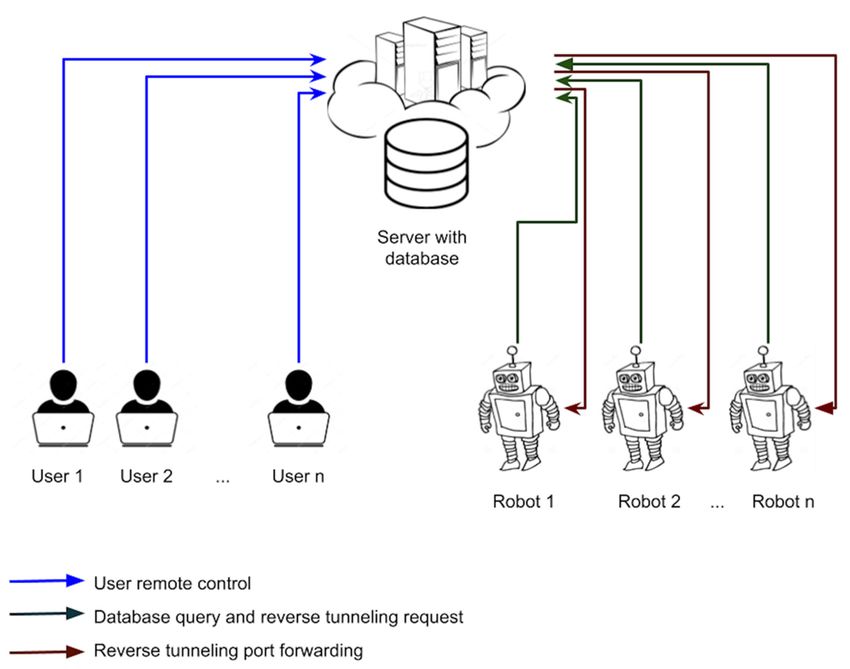
Robotics 2020, 9, 17                                                                                  2 of 15

support its operation, where not all sensing, computation, and memory are integrated into a single
standalone system” [6]. Nowadays, cloud robotics solutions are applied in different applications [7–9].
     Beyond these specific applications, several works focus on the definition and implementation
of the architecture for communication and interaction between physical robots and virtual resources
hosted on cloud infrastructure [10–14]. Different solutions have been provided, but the problem of
bi-directional communication among agents (i.e., from a user interface to a mobile robot platform and
vice-versa) on different networks is often not addressed or underestimated. Virtual Private Networks
(VPNs) are usually introduced as an operative solution to solve visibility issues, but this does not take
into account the effort needed for the configuration of each agent in the virtual network.
     This paper aims to describe a “plug and play” communication layer which is untied from the
hardware composing the system (no further setup work when new hardware is integrated) and
which guarantees stability in any situation where a set of robots has to be remotely controlled by
agents (e.g., user interfaces) outside the robots’ network. As in the case of VPN configurations,
the “plug-and-play” solution relies on configuration methods rather than on the implementation
of new software. The rationale beyond this choice is related to the goal of achieving a reliable
system starting from mature technologies already available. This paper represents and describes a
use-case in using technologies from the world of telecommunication networks into the robotic world.
This could represent a interesting point of view for the robotics community. The proposed approach
is based on:

•     The WebSocket protocol, which allows a full-duplex communication client-server, solving the
      bi-directional visibility issue;
•     Reverse tunneling, which is a popular technique to establish a connection with remote devices;
•     Port remapping, to automatically request the connection on dedicated ports. (To manage the
      presence of multiple involved agents, the information related to the association between devices
      and ports is stored on a central server.)

     Consequently, the challenge addressed in our work is to define a reliable autoconnection/
autoconfiguration mechanism as well as to outline a scalable communication layer that allows the
effective control of multiple robots from multiple users.

2. Related Works
      Cloud robotics provides an efficient solution for migrating intensive computation from the robot
side to the cloud computing infrastructure. Among the several cloud-based applications proposed in
the literature, the challenges of bi-directional visibility and communication among agents (i.e., robots
and cloud resources) are often underestimated or based on non-“plug-and-play” solutions such as
VPNs. Besides, in [11], the authors state three challenges of computation offloading:

1.     Traditional approaches do not consider the characteristics of networked cloud robotics (NCR)
       (e.g., heterogeneity and robotic cooperation);
2.     They fail to capture the characteristics of tasks in a robotic streaming workflow (RSW) (e.g., strict
       latency requirements and varying task semantics);
3.     They do not consider Quality-of-Service (QoS) issues for cloud robotics.

     In the aforementioned paper, a QoS-aware robotic streaming work-flow allocation algorithm for
networked cloud robotics, with joint optimization of latency, energy efficiency, and cost, while considering
the characteristics of both robotic streaming workflow and networked cloud robotics, is proposed.
Focusing on networked robotics (i.e., agents are part of the same network), the problem of agents’
visibility is not included as an issue to be tackled. Similarly, in [12], authors focus on the managing of
cloud resources arguing the presence of technical challenges for multi-robot systems on accessing the
cloud and retrieve resources in near real-time. A general framework for setting up a cloud robotics
system with a novel resource management strategy is presented, and the problem is formally described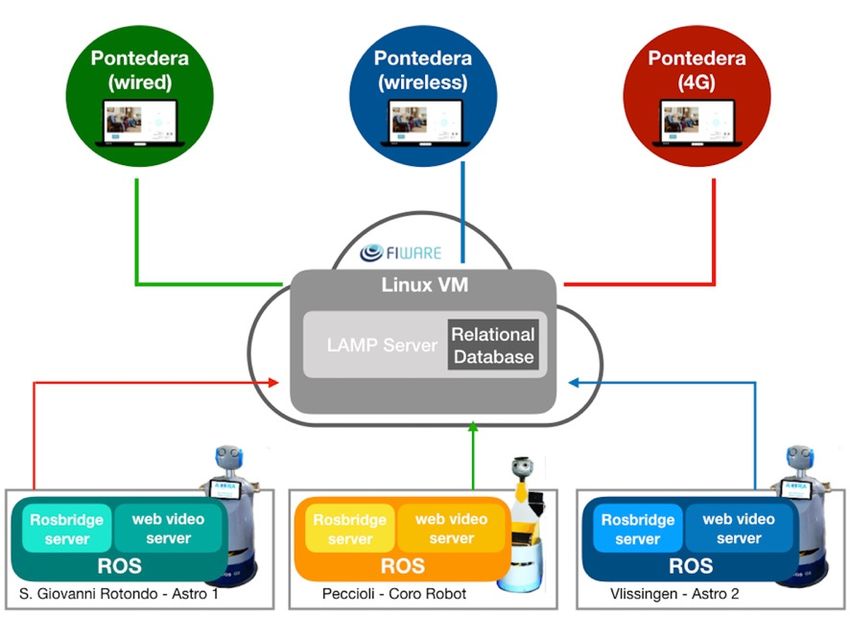
Robotics 2020, 9, 17                                                                                 3 of 15

as a Stackelberg game, proposing an optimal solution with proof. QoS criteria are then defined and
evaluated, without describing the operational method for providing connections among cloud and robot
resources. In [13], cloud robotics is claimed as “one of the most promising applications in the robotics
world”, but its growth is still below expectations due to the risks associated with security and privacy.
Therefore, the paper focuses on security for cloud-based robotic services and it explains a framework that
provides authentication and key agreement using Elliptic Curve Cryptography (ECC) for accessing the
robotic services hosted in the cloud. Nevertheless, despite the interesting results on robustness against
various security attacks, it does not detail the bi-directional communication infrastructure for agents in
different networks.
      In [14], authors aim to integrate the cyber world and the physical world by bringing up the idea
of “Robot Cloud” to combine the power of robotics and cloud computing. To make this possible,
they design a novel Robot Cloud stack and adopt the service-oriented architecture (SOA) to make
the functional modules in the Robot Cloud more flexible, extensible and reusable. In particular, at a
functional level, the last command is retrieved by sending an HTTP request periodically (i.e., polling)
to the scheduling service and receiving their commands in the XML format as the response, in a
similar way to what most SOA applications do. However, it can be argued and demonstrated that
polling solutions are not feasible for low-level remote control (as teleoperation), due to the high rate of
commands. Furthermore, the continuous requests could overload the use of the bandwidth. Focusing
the attention on the “robot side”, several frameworks have been presented to foster the development
of robotic applications, but the Robot Operating System (ROS) [15] can be considered as the de facto
operating system for robots. As a consequence, several works focus on cloud-ROS case studies rather
than more generic cloud-robots.
      In [16], a framework that helps users to work with ROS in a remote master was presented, based
on the use of SpaceBrew [17]. SpaceBrew is defined as “an open, dynamically re-routable software toolkit for
choreographing interactive spaces”. A web-based visual switchboard can be used to connect or disconnect
publishers and subscribers to each other. Unfortunately, the documentation provided on SpaceBrew
is still under development and it is not clear if visibility among agents is requested or managed
by SpaceBrew. However, in the architecture presented in [17], some limitations are presented but
not discussed, as ‘‘it is not possible to use SpaceBrew with two computers connected at the same network”.
Moreover, the results presented are limited to a qualitative analysis.
      In the work presented in [18], ROS packages are encapsulated as web services in cloud virtual
machines and a middleware based on web service technology is designed as the core of the whole
cloud robotics system. This is responsible for parsing the cloud robotics task requests and scheduling
ROS nodes in a distributed network. The communication is based on a proxy virtual machine and the
presented results are limited to one robot, with claims that the situation with multiple robots will be
considered in subsequent research.
      In [19], the authors propose a software cloud architecture for cloud robotics which is intended
for three subsystems in the cloud environment: the middleware subsystem, the background tasks
subsystem, and the control subsystem. The architecture invokes cloud technologies such as cloud
computing, cloud storage, and other networking platforms arranged with the assistance of congregated
infrastructure and shared services for robotics, for instance, the Robot Operating System (ROS).
Bi-directional communications are presented in the paper, but it is not detailed how these are achieved.
Furthermore, the proposed architecture is built upon the ROS Multimaster FKIE [20], which requires
bi-directional visibility among all the agents in the system.
      RoboEarth [21] is one of the most important European funded projects on cloud robotics and
focuses on the collection, storing, and sharing of data independent of specific robot hardware.
With RoboEarth, the Rapyuta Cloud Engine [22] has been developed; it is based on the WebSocket
protocol to guarantee the bi-directionality of the flow of data, but neither RoboEarth nor Rapyuta
detail the visibility requirements between the agents. Furthermore, case studies did not involve the
analysis of forwarding control from remote users to the robot. Nowadays, Rapyuta is a company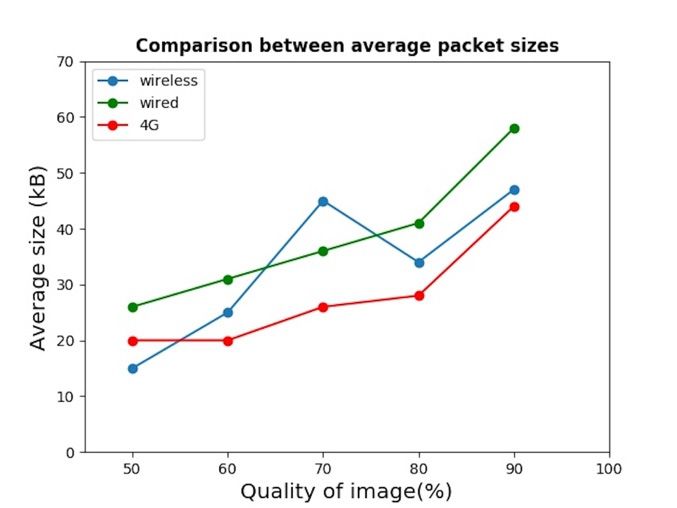
Robotics 2020, 9, 17                                                                                                     4 of 15

with its headquarters in Tokyo [23], and provides a cloud robotics framework at an enterprise level.
However, it is still limited in an early developer program.
      Since the beginning of the 2010s, the rosbridge protocol has been introduced. It is a specification
for sending JavaScript Object Notation (JSON) based commands to ROS (and in theory, to any other
robot middleware). The specification is a programming language and is transport agnostic. The idea
is that any language or transport that can send JSON can talk the rosbridge protocol and interact
with ROS. The protocol covers subscribing and publishing topics, service calls, getting and setting
parameters, and even compressing messages. Upon the rosbridge protocol, several tutorials and
applications have been developed [24–27]. Among these, Robot Web Tools [28] represents the most
successful and widespread implementation. Since its official introduction in 2012, the Robot Web Tools
project has grown tremendously as an open-source community, enabling new levels of interoperability
and portability across heterogeneous robot systems, devices, and front-end user interfaces. At the
heart of Robot Web Tools is the rosbridge protocol as a general means for messaging ROS topics in
a client–server paradigm suitable for wide area networks, and human–robot interaction at a global
scale through modern web browsers. On the other hand, while the rosbridge library provides the
JSONROS conversion, it leaves the transport layer to others. This can be overcome through the use
of rosbridge server, which provides a WebSocket connection. As a common use, a rosbridge server runs
locally on the robot platform allowing to reach ROS topic and services through the rosbridge protocol
from the outside. Nevertheless, this requires the visibility of the robot machine from the outside, a
requirement that is hardly satisfied, especially for platforms that operate in a wireless local network.
      In 2017, a new protocol has been introduced in [10] to integrate Robot Operating System (ROS)
enabled robots with the Internet of Things, arguing for a lack of ROS functionality in monitoring and
controlling robots through the Internet. Actually, the proposed protocol is very similar to the rosbridge
protocol; the tests are limited to a few simulated robots, and the results obtained in the performing of a
spiral trajectory with an open-loop control using commands from the remote server are not promising.
      The solution developed in our work is proposed to endow the ability of remote control to a
set of generic robots controlled using the ROS framework. As introduced, the rosbridge server
provides a layer that can run on the local machine upon the ROS framework, providing an interface
for communications outside the local machine using the rosbridge protocol. Therefore, the problem
issued in this paper can be described as the definition of a method to remote control the desired robot
(chosen from among a not-defined set) from a device (smartphone, tablet, laptop, or desktop PC).
Both controlled robots and controlling devices are in different private networks; in other words, there
is no visibility between robot and user device.
      The current state of the art, described in this paragraph, is summarized in Table 1.

                        Table 1. Summary of other available solutions in the current state of the art.

   References                  Features of the System Used                     Limitation of the Presented Work
                         QoS-aware robotic streaming work-flow
       [11]                                                                Problem of agents’ visibility not included
                                 allocation algorithm
                                                                         No description of the operational method for
       [12]        Problem formally described as Stackelberg game       providing connections among cloud and robot
                                                                                          resources.
                                                                        Bi-directional communication infrastructure for
       [13]              Security for cloud-based robotic services
                                                                           agents in different networks not detailed
                       Last commands retrieved by sending an HTTP    Polling solutions are not feasible for low-level remote
       [14]
                              request periodically (i.e., polling)                 control (as teleoperation)
                                                                      It is not clear if visibility among agents is requested
       [16]                   Based on the use of SpaceBrew             or managed by SpaceBrew. Some limitations are
                                                                             presented in the paper but not discussed
Robotics 2020, 9, 17                                                                                                          5 of 15

                                                         Table 1. Cont.

    References                 Features of the System Used                           Limitation of the Presented Work
                         Communication based on a proxy virtual
       [18]                                                                        Listed results are limited to one robot
                                      machine
                          Based on three subsystems in the cloud
                                                                             Built upon the ROS Multimaster FKIE [20], which
                           environment: middleware subsystem,
       [19]                                                                 requires bi-directional visibility among all the agents
                         background tasks subsystem, and control
                                                                                                 in the system
                                        subsystem
                       Based on WebSocket protocol to guarantee the            Visibility requirements between the agents not
       [21]
                            bi-directionality of the flow of data           detailed. Still limited in an early developer program
       [10]             New protocol, similar to rosbridge protocol                 Tests limited to few simulated robots
                    Approach based on WebSocket communication,
    Presented      reverse tunnelling and port remapping according
     system        to information stored on a central server. Able to
                        manage lack of visibility among agents

3. System Description
      The proposed system implements a communication layer for cloud-based robotic scenarios where
multiple-users-multiple-robots are involved. Due to the variety of technologies, interoperability
between heterogeneous devices (e.g., smartphone, tablets, computers) and different kinds of robots is
required. Besides, the communication mechanism should guarantee real-time performance to enhance
the user’s experience with the robot, even remotely.
      The configuration of the system is depicted in Figure 1. It is composed of a central server, namely a
virtual machine hosted on a cloud service infrastructure, characterized by a static public IP that allows
gateway porting as a Secure Shell (SSH) configuration1 . We explicitly set GatewayPorts parameter
in the file SSH configuration file. Concerning the architecture described in [29], the cloud resource
is a Linux virtual machine running on FIWARE [30], which executes a LAMP server (Linux Apache
MySQL PHP). The robotic platforms introduced in the system are based on ROS middleware for local
control. On each robot, both the rosbridge server [31] and the ROS web video server [32] are running
to allow incoming connections on default ports, one handled by the rosbridge protocol [33] and one
dedicated for video streaming through video server. Since multiple agents are involved, a database is
implemented on the LAMP server where each robot is mapped to a port number. The port number is
defined as the MAC (Media Access Control) address of the robot network hardware, since it is unique
information that can be used to characterize it. This strategy guarantees the flexibility of the system,
since any ROS-based robot can be integrated into the scenario by saving its own information on the
database. Human users can remotely control the robotic platforms through a web page running on the
central server and accessible from any device.
      Based on this configuration, each agent (user or robot) can be in a different private network, while
only the server, characterized by a static public IP address, is reachable from outside. The bi-directional
visibility between the elements of the system is obtained as described in the following paragraphs.

1    In file /etc/ssh/sshd_config it should be explicit GatewayPorts yes.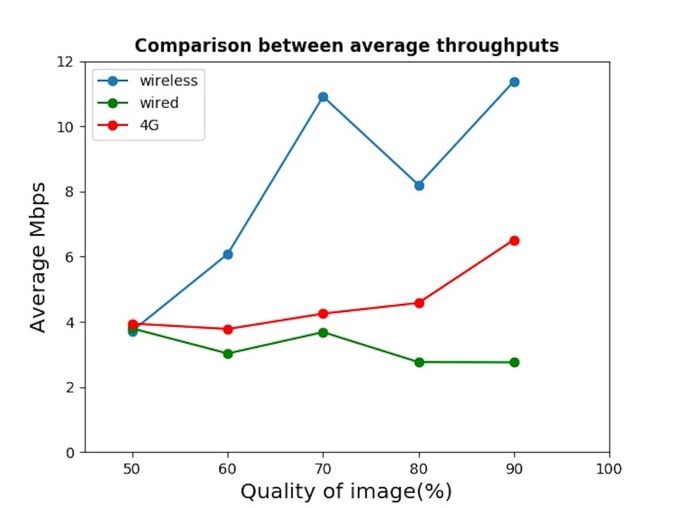
Robotics 2020, 9, 17                                                                                       6 of 15
Robotics 2020, 8, x FOR PEER REVIEW                                                                        6 of 15

Robotics 2020, 8, x FOR PEER REVIEW                                                                        6 of 15

     Figure
     Figure 1.  Server-based architecture
             1. Server-based architecture scheme.
                                          scheme. Each
                                                   Eachagent
                                                        agent(user
                                                              (user or
                                                                     or robot)
                                                                         robot) can
                                                                                 can be
                                                                                     be in
                                                                                        in aa different
                                                                                              different
     private network.
     private network.

3.1. Robot Port Forwarding Configuration
     At the startup phase, the robot can reach the server by executing “reverse SSH tunneling”. This
technique is an alternative strategy to Virtual Private Networks (VPN) to securely access a remote
server that is behind a firewall. In this work, the robot automatically queries the database of the
dedicated ports (for rosbridge controls and video streaming) related to its MAC address. If a record
with the robot MAC address exists in the database, reverse tunneling is performed from the robot
towards the server. The sequence of commands is summarized in the Unified Modeling Language
(UML) diagram shown in Figure 2. The use of SSH reverse tunneling overcomes the problem of lack of
     Figure 1. visibility:
bi-directional  Server-based architecture scheme.
                           communication           Each
                                            is opened byagent (user(instead
                                                         the robot   or robot)
                                                                            of can be server),
                                                                               by the in a different
                                                                                               creating a
     private network.
tunnel that allows bi-directional communication.

     Figure 2. Unified Modeling Language (UML) sequence at robot start up. The database is queried and
     Secure Shell (SSH) reverse tunneling is performed.

3.2 User Remote Control
     User remote control is performed through a web page hosted on the public server. The user can
select the use of a specified robot and this choice is used to instantiate a rosbridge client and a video
client pointing to server IP and the ports specified in the database. Therefore, the communication is
forwarded through the opened reverse tunneling to the selected robot. This sequence is summarized
in the UML diagram shown in Figure 3.
     Once the communication between the user and the robot is established, the user can send
commands
     Figure 2.toUnified
                 the robot  by using
                        Modeling
                        Modeling      web pages
                                  Language
                                  Language   (UML)stored
                                            (UML)   sequence
                                                    sequence onat
                                                                the
                                                               at   server.
                                                                  robot start By
                                                                              up. dedicated
                                                                                  The       web
                                                                                  The database     pages, and
                                                                                               is queried the user
receives feedback    on the  requested  commands
                         reverse tunneling
     Secure Shell (SSH) reverse  tunneling is         (e.g.,
                                           is performed.
                                              performed.     video  streaming,    executing velocity).

3.2 User Remote Control
     User remote control is performed through a web page hosted on the public server. The user can
select the use of a specified robot and this choice is used to instantiate a rosbridge client and a video
client pointing to server IP and the ports specified in the database. Therefore, the communication is
forwarded through the opened reverse tunneling to the selected robot. This sequence is summarized
in the UML diagram shown in Figure 3.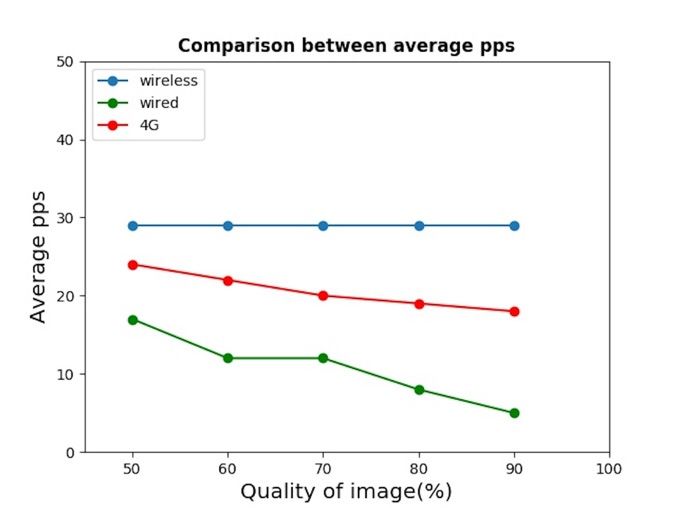
Robotics 2020, 9, 17                                                                                           7 of 15

3.2. User Remote Control
      User remote control is performed through a web page hosted on the public server. The user can
select the use of a specified robot and this choice is used to instantiate a rosbridge client and a video
client pointing to server IP and the ports specified in the database. Therefore, the communication is
forwarded through the opened reverse tunneling to the selected robot. This sequence is summarized
in the UML
Robotics 2020, 8,diagram  shown
                  x FOR PEER     in Figure 3.
                             REVIEW                                                                 7 of 15

      Figure 3.
      Figure 3. UML
                UML sequence
                    sequence at
                              at user
                                 user connection.
                                      connection. Opened
                                                  Opened SSH
                                                           SSH reverse
                                                                 reverse tunneling
                                                                         tunneling is used to
                                                                                   is used to both
                                                                                              both forward
                                                                                                   forward
                         retrieve feedbacks
      user commands and retrieve  feedbacks from
                                            from the
                                                  the robotic
                                                      robotic platform.
                                                              platform.

     Once the communication between the user and the robot is established, the user can send
4. Experimentation
commands to the robot by using web pages stored on the server. By dedicated web pages, the user
     In this paper, five experimental setups were developed to investigate and to demonstrate the
receives feedback on the requested commands (e.g., video streaming, executing velocity).
reliability and effectiveness of the proposed approach. In detail, tailored experiments have been
performed
4.           to verify the following characteristics:
   Experimentation
Requirement      1 (RE1):
     In this paper,     fivereliability
                              experimentalof autoconnection/autoconfiguration
                                                setups were developed to investigateat startup,
                                                                                            andwithout    any specific
                                                                                                 to demonstrate    the
     action   to the  single    machine;
reliability and effectiveness of the proposed approach. In detail, tailored experiments have been
Requirement
performed        2 (RE2):
             to verify    thescalability
                               followingon    several robots;
                                            characteristics:
Requirement 3 (RE3): effectiveness of the remote control (e.g. teleoperation) from multiple users to
Requirement      1 (RE1): reliability of autoconnection/autoconfiguration at startup, without any specific
     multiple robots.
action to the single machine;
     The experimental
Requirement                    setups differ
                 2 (RE2): scalability            from each
                                           on several        other based on the number of agents (users and
                                                        robots;
robots),  network     infrastructures      and   scenarios.
Requirement 3 (RE3): effectiveness of the remote control     For the works   described in [10,18],
                                                                      (e.g. teleoperation)            the number
                                                                                             from multiple          of
                                                                                                              users to
user–robot   pairs
multiple robots.     is always     equal  to or  higher  than three.
     The first four proposed experimental setups evaluate the system in simulated scenarios, in which
     The experimental
the agents  involved (i.e.,  setups   differ
                                 robots andfrom
                                              users)each
                                                      haveother
                                                            beenbased on the number
                                                                 approximated     with aofcomputer
                                                                                           agents (users  and robots),
                                                                                                     running   several
network   infrastructures       and  scenarios.    For the works  described   in [10,18], the number
ROS cores. These tests reflect a practical scenario where the number of agents is high (e.g., more than of user–robot
pairs
three is always
       robots  areequal    to or higher
                    involved).             than
                                   The final      three.
                                              experimental    setup recalls a real situation, where multiple users
interact with multiple robots. The robotssetups
     The  first four   proposed     experimental       used evaluate  the system in phase
                                                             in this experimental     simulated
                                                                                              are scenarios,
                                                                                                   two Astroinrobotic
                                                                                                                 which
the agents [34]
platforms   involved
                  and one(i.e.,Coro
                                 robots and users)
                                      robotic         have[35].
                                                platform    beenBoth
                                                                 approximated
                                                                     robots are with
                                                                                  baseda on
                                                                                          computer   running
                                                                                             the SCITOS     G5 several
                                                                                                                mobile
ROS   cores.   These    tests   reflect a  practical  scenario  where  the  number    of
platform (Metralabs GmbH, Germany). They are equipped with a front and rear laser scanner agents  is high  (e.g., more
                                                                                                                    to
than  three robots    are  involved).    The   final experimental   setup  recalls a real situation,
safely navigate the environment. Cameras for video streaming are also mounted. Astro and Coro         where   multiple
platforms implement a teleoperation service, which allows a remote user to send velocity commands
to the robot and to receive images of the environment where the robot is moving. Both robotic systems
are developed based on the ROS framework. This section aims to describe the different setups, while
the results are detailed in Section 5.
Robotics 2020, 9, 17 8 of 15
users interact with multiple robots. The robots used in this experimental phase are two Astro robotic
platforms [34] and one Coro robotic platform [35]. Both robots are based on the SCITOS G5 mobile
platform (Metralabs GmbH, Germany). They are equipped with a front and rear laser scanner to safely
navigate the environment. Cameras for video streaming are also mounted. Astro and Coro platforms
implement a teleoperation service, which allows a remote user to send velocity commands to the
robot and to receive images of the environment where the robot is moving. Both robotic systems are
developed based on the ROS framework. This section aims to describe the different setups, while the
results are detailed in Section 5.
4.1. Test 1: Reliability at Startup
The first test aims to demonstrate the reliability at startup (RE1) by analyzing the eventual
occurrence of problems in the sequence depicted in Figure 2.
A set of five local machines were used to locally instantiate 10 ROS cores for each machine.
Multiple ROS cores can work on the same machine by changing the local port, running the dedicated
command. A total of 50 ROS cores were set up. A rosbridge server was instantiated for each ROS core.
For this specific purpose, the default port of the rosbridge server has been changed to allow multiple
rosbridge servers on the same machines. Programs automatically started at the starting of the Ubuntu
system. One simple std_msgs::String was sent from a remote machine to each ROS core through the
described architecture to test the opening of communication, while a subscriber is already running
waiting for receiving the message. The success rate of communication opening was computed through
the check reception of the message sent. Test 1 was repeated 1000 times, each time using 50 ROS cores
at the same time.
4.2. Test 2: High Rates Communication
The second test aimed to demonstrate the reliability of communications that involve messages
at high frequency (RE2). A set of 100,000 std_msgs::String messages was sent at 100 Hz (i.e., one
message every 0.01 s for 1000 s was sent) from five machines (users) to five different machines (robots),
through the described architecture, using the server on FIWARE as in Test 1. A subscriber was already
running, waiting to receive the messages. The metric used to evaluate the reliability of communication
was data loss. It was computed as the count of receptions of the total messages sent. Furthermore,
we evaluated the communication bandwith by using iperf [36] and we limited the server bandwidth
through Wondershaper [37]. Test 2 was repeated 10 times, each time using five user–robot pairs.
4.3. Test 3: Different Network Hardware
In Tests 1 and 2, all the machines were connected to the same network infrastructure. To unbind
the results from the hardware used, Tests 1 and 2 were repeated subdividing the groups of five machines
into three sub-groups:
1. Machines connected to the building network infrastructure (fixed line);
2. Machines connected to a router with a 4 g connection;
3. Machines connected to another router with a 4 g connection (same phone company).
The evaluation metrics adopted in Tests 1 and 2 were used to evaluate the reliability of the system.
This allows the comparison of the performance in the different scenarios.
4.4. Test 4: Open-Loop Spiral Trajectories
The effectiveness of the communication layer (RE3) was evaluated based on the experiment
described in [10]. The experiment assesses real-time control of motion of Turtlesim robot (default
simulator in ROS) following an open-loop spiral trajectory. A spiral trajectory is defined as a combination
of an increasing linear velocity over time and a constant angular velocity. Speed commands have been
remotely sent from five machines (users) to five different machines, each one running a Turtlesim robot,Robotics 2020, 9, 17 9 of 15
through the described architecture, using the server on FIWARE as in Test 1. Since a spiral trajectory is
sensitive to delays and jitters, the final pose of the simulated platform was used as a qualitative metric
to evaluate real-time performance, namely the variability of the received commands along the path.
Test 4 was repeated 10 times, each time using five user–robot pairs. Unfortunately, in [10] details of the
network configuration are not provided.
4.5. Test 5: Qualitative Evaluation of Simultaneous Teleoperation
While the previous setups were performed in simulated scenarios, Test 5 involved the presence of
real robots. In detail, remote teleoperation was evaluated for three users simultaneously controlling
three different real robots (RE3). This experiment extends the results already obtained in [29],
where only one-user-one-robot was considered. Since received speed commands were evaluated in
Test 4, the analysis of performance in varying image resolution was computed. Namely, the image
Robotics
quality rate2020,
was8, tuned
x FOR PEER REVIEW
ranging 9 of 15
from 90% to 50%. The teleoperation experiment setup is described in
the following:
the image quality rate was tuned ranging from 90% to 50%. The teleoperation experiment setup is
• described
One in thelocated
operator following:
in the Biorobotics Institute in Pontedera (PI, Italy) controls the Coro robot,
•
situated
One in the Assistive
operator Robotics
located in Lab in Institute
the Biorobotics Peccioli in
(PI, Italy); (PI, Italy) controls the Coro robot,
Pontedera
• situated in the Assistive Robotics Lab in Peccioli (PI, Italy);
One operator situated in the Biorobotics Institute in Pontedera (PI, Italy) teleoperates the Astro 1
• One
robot, operator
located situated
in the WVOinZorg
the Biorobotics
Ter Reede Institute in Pontedera
residential (PI,inItaly)
care center teleoperates
Vlissingen (ZE, the Astro
Netherlands);
1 robot, located in the WVO Zorg Ter Reede residential care center in Vlissingen (ZE,
• One operator located in the WVO Zorg Ter Reede residential care center in Vlissingen (ZE,
Netherlands);
Netherlands) controls the Astro 2 robot, located in Ospedale Casa Sollievo della Sofferenza in San
• One operator located in the WVO Zorg Ter Reede residential care center in Vlissingen (ZE,
Giovanni Rotondo
Netherlands) (FG, Italy).
controls the Astro 2 robot, located in Ospedale Casa Sollievo della Sofferenza in
San Giovanni Rotondo (FG, Italy).
Figure 4 summarizes the experimental setup. During the test, all the robotic platforms and one
operator’sFigure
laptop4 summarizes
were connectedthe experimental setup. During
to the WiFi network of thethe test, all the
building, robotic
except for platforms and that
one operator one was
operator’s laptop were connected to the WiFi network of the building, except for
connected with an Ethernet cable and another operator that was connected to a personal 4G router. one operator that
was connected
The network with an Ethernet
speed specifications cable
were and another
computed operator
using a speedthat
testwas connected
by the Ookla to a personal
website 4G are
and they
router. The network speed specifications were computed using a speed test by the Ookla website and
reported in Table 2. The network specifications reported in Table 2 are useful to assess the quality of
they are reported in Table 2. The network specifications reported in Table 2 are useful to assess the
connection at each robot side. The ping response time can be used to assess the latency; the download
quality of connection at each robot side. The ping response time can be used to assess the latency; the
and the uploadand
download speeds providespeeds
the upload additional
provide information for evaluating
additional information for the performance
evaluating at the robot
the performance at side.
Due to
thethis experimental
robot side. Due todesign, the metrics
this experimental used the
design, to evaluate the performance
metrics used to evaluate thewere the throughput
performance were in
termsthe
of throughput
packets perinsecond(pps) and Mb/s
terms of packets Besides, the
per second(pps) andaverage delay between
Mb/s Besides, the averageconsecutive received
delay between
packets at each teleoperation
consecutive center
received packets was teleoperation
at each computed. The WireShark
center tool was
was computed. Theused to analyze
WireShark toolthe
wasHTTP
used
packets to analyze
received the HTTP
at each packets received
teleoperation centeratoneach
theteleoperation
dedicated port.center on the dedicated port.
Figure 4. Experimental setup for Test 5. The association between user and robot is identified by the
Figure 4. Experimental setup for Test 5. The association between user and robot is identified by the
color color
of theofarrows.
the arrows.
Table 2. Network speed specifications.
Network name Ping (ms) Download (Mbps) Upload (Mbps)
Pontedera (wired) 7 94.41 89.44
Pontedera (wireless) 7 287.77 113.18Robotics 2020, 9, 17 10 of 15
Table 2. Network speed specifications.
Network Name Ping (ms) Download (Mbps) Upload (Mbps)
Pontedera (wired) 7 94.41 89.44
Pontedera (wireless) 7 287.77 113.18
Pontedera (4G) 38 7.13 4.97
San Giovanni Rotondo 19 31.13 8.91
Vlissingen 15 80.07 19.36
Peccioli 31 5.41 5.36
5. Results
The results obtained in all the performed tests demonstrate both the reliability and the feasibility
of the “plug-and-play” system. Specifically, communication was successfully established in every trial
of Test 1 (success_rate = 100%), and no message was lost through the network in Test 2 (message_lost =
0%). Additional analysis was performed to evaluate the influence of bandwidth. Bandwidth between
the local machine and the FIWARE server was 39.4 Mbit/s during Test 2, and the obtained results
highlight that the proposed architecture can work until the sum of all communications through the
server (i.e., communications to every agent) is smaller than the server bandwidth. Communications
bandwidths were measured through the analysis of ROS topic bandwidths. This confirmed that
port forwarding through reverse tunneling does not increase the amount of bandwidth requested
for communication. Test 3 confirmed the results obtained in Tests 1 and 2, demonstrating that the
“plug-and-play” system does not depend on the network hardware. In Test 4, the parameters used
to evaluate open-loops spiral trajectory were a rated frequency equal to 2 Hz, an initial velocity of
1.0 m/s, a constant angular velocity equal to 1.0 rad/s and a linear step equal to 0.05. The results were
obtained by analyzing the final position of the simulated robot at the end of the open-loop in the
overall 50 tests (Test 4 has been repeated 10 times, each time using five user–robot pairs). Results
show that the proposed architecture can transmit open-loop commands, introducing a negligible
variability σx = 0.001 m, σy = 0.004 m over a path long 78.275 m. Concerning the results reported
in [10], the trajectories were correctly accomplished following spiral trajectories. The performance
was not influenced by the presence of delays and jitters at the communication layer, which caused
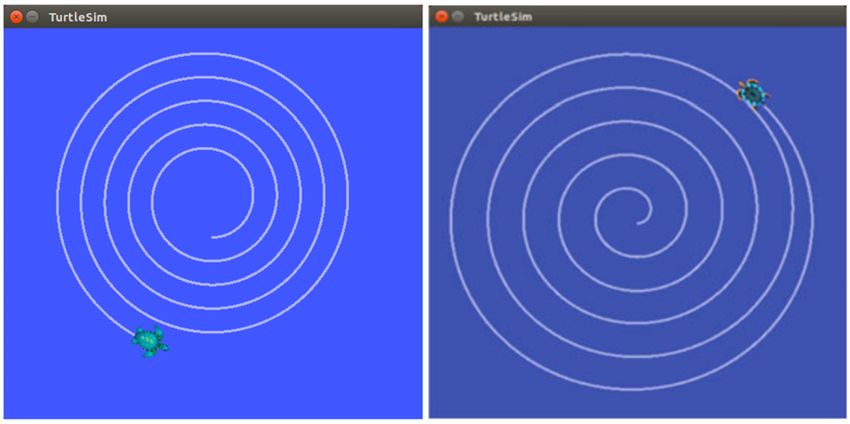
misbehaviours in [10], as shown in Figure 5.
Robotics 2020, 8, x FOR PEER REVIEW 11 of 15
Figure 5. Visual comparison between spiral trajectories performed in open loop using the proposed
architecture (on the left) and obtained through the ROSLink
ROSLink protocol (on the the right)
right) [10].
[10]. It can be
highlighted that misbehaviors are present
present in
in the
the second
second case,
case, especially
especially at
at the
the end
end of
of the
the trajectory.
trajectory.Robotics 2020, 9, 17 11 of 15
Robotics 2020, 8, x FOR PEER REVIEW 11 of 15
The results of Test 5 show that three operators can simultaneously control three robots without
experiencing any significant delay able to corrupt their own experience. Quantitative results on their
experience were collected by measuring the video streaming parameters during the teleoperation.
In detail, five teleoperation modes were tested, each of them characterized by a different encoding quality
of the image. A comparison between the packet size received by each operator at the teleoperation
center is shown in Figure 6. As expected, the packet size decreased as the resolution of the image sent
by the robot camera decreased. One misbehaviour was recorded for the video streaming at 70% sent
by the Astro 1 robot, in which the packet size was bigger than 80% resolution. The average (µ) pps
exchanged by FIWARE and the operator was almost stable (µth = 29 pps and σth = 0 pps for wireless
connection, µth = 20.60 pps and σth = 2.41 pps for 4G connection), except for the experiment involving
Coro robot (and the wired connection), in which the pps varied accordingly to the image resolution
(µth = 10.80 pps and σth = 4.55 pps). The throughput reported in the graph has been calculated as the
amount of http data sent over a certain period of time. It was thus influenced by the network speed both
at the robot and operator’s side. For the mentioned reason, the throughput value of images recorded by
the Coro’s camera (with the wired connection) was extremely low. As shown in the bottom-right graph
Figure
in Figure 5. Visual
6, the most comparison between
significant delay spiral trajectories
between consecutiveperformed
packetsinwasopen loop using
perceived in the
theproposed
case of the 4G
connection (up to 190 ms in case of max resolution of the video streaming). The significantIt delay
architecture (on the left) and obtained through the ROSLink protocol (on the right) [10]. can befor the
highlighted that misbehaviors are present in the second case, especially at the end of the
4G connection derived both from the high ping value of the 4G connection (see Table 2) and from the low trajectory.
upload values at the robot’s side, which was located at San Giovanni Rotondo, as shown in Figure 4.
(a) (b)
(c) (d)
Figure6.6. Quantitative
Figure Quantitative results
results of
of the
the three
three simultaneous
simultaneous teleoperations:
teleoperations: Avg.
Avg.packet
packetsize
size(a),
(a),Avg.
Avg.pps
pps
(b), Avg. throughput (c), Avg. delay
(b), Avg. throughput (c), Avg. delay (d).(d).Robotics 2020, 9, 17 12 of 15
6. Discussion
The rationale behind the development of the proposed architecture for cloud robotics relies on
the need for a reliable solution that can allow the inclusion of new agents in the system without
any specific configuration of the local machines. The term “plug and play” refers to the two main
features of the system. First, a new robotic platform can be easily integrated into the system by
adding a new record in the database. This strategy allows non-technical users to easily change the
system configuration and it can also be performed remotely. Consequently, it is possible to increase or
decrease the number of agents in the system in a flexible way. The second feature regards the types of
technical elements involved in the architecture. The development relies on mature and dependable
technologies, such as LAMP servers, WebSockets, SSH reverse tunneling, the rosbridge protocol, and
servers. With respect to other approaches in the state of the art, the bi-directional visibility issue has
been moved to a “configuration problem” rather than an “implementation problem”. Due to the
introduction of rosbridge technology, no new code or communication protocol is introduced to deal
with the presented issue.
The experimentations and results reported in Sections 4 and 5 confirm the reliability and
effectiveness of the proposed solution. On one side, the simulated scenarios validate the stability of the
communication layer in case of a large number of agents involved (50 ROS cores in Tests 1 and 3) and
in case of a high quantity of messages exchanged (100,000 messages in Tests 2 and 3). On the other side,
the experimentation in the real scenario shows the efficiency of the approach with concrete agents due
to the higher number of challenges, which are discarded in the simulated scenario. It is often the case
that cloud-based applications’ performances are affected by network glitches, bandwidth fluctuations
which provoke irregular robot mobility [11]. Testing the communication layer in both kinds of scenarios
provides precise evidence of its efficiency. Although our system satisfies the requirements detailed in
Section 4, a few limitations have to be highlighted.
One concerns the network architecture topology. Since every communication travels through a
central server, the resulting configuration recalls a typical start topology. This leads to the limitation
that the sum of the bandwidth of every communication has to be smaller than the maximum server
bandwidth. Besides, in the presence of robot reboots, the SSH tunneling is interrupted at robot
shutdown and it is restarted after robot startup. This requires that, on the server, the port has to be
released in this interval of time. By releasing the port in a certain interval of time, it may be possible to
handle multiple incoming requests. In the context of a high number of agents connected through the
cloud, the communication system should integrate a planner to allocate the available services in an
efficient way. In the real scenario of the presented work, each agent directly accesses a dedicated robot,
because the number of robots is limited. By increasing the number of elements in the networked cloud
robotics, the presence of a service planner becomes essential.
As already introduced, the importance of untying the communication layer of architecture from
the network currently used by the agents become more important in the scenario of mobile platforms,
where the agents can use different WiFi connections. At the operator side, the reliability of the proposed
solution despite the hardware used is confirmed by the results achieved in Tests 4 and 5. In the
conducted experimentation, the delay between consecutive packets at the teleoperation center strictly
depends on the network latency and the dimension of the information exchanged. The tradeoff
between the data-rate of the communication channel and the quantity of data can be a limitation for
cloud-based robotics applications. This leads to the challenge of defining the types of robotic tasks that
should be kept on board. Cloud robotics provides a solution for intensive computation and storage of
a high quantity of data, with no clear evidence of which types of information can be exchanged so that
the delay at the receiver side (i.e., robot or operator side) is minimized.
As described in [37–39], ROS suffers from significant security issues. In our work, we address
this issue by introducing an authentication system for the users that want to access the web pages
hosted on the public server (as shown in Figure 3). This design choice can be improved by integrating
secure HTTP and/or by enabling optional features of the rosbridge. It is worth noticing that one of theRobotics 2020, 9, 17 13 of 15
improvements of the protocol is Transport Layer Security (TLS) support for WebSocket connections,
an authorization mechanism to restrict Application Programming Interface (API) calls and to limit
available topics.
In the current approach, the actual problem of bi-directional visibility has been solved by using
a mature networking strategy (e.g., Websockets, reverse SSH, etc.) in a robotic domain. Indeed,
to the best of the authors’ knowledge, few robotics research works have used this approach in their
research ([4,40]), still with a low number of robotic platforms. One possible direction of this work is to
improve the proposed solution by adopting the current trends of networking approaches, such as the
named-data-networking approach [41].
7. Conclusions
This paper aims to describe and evaluate an approach for the cloud robotics system to overcome
the issue of bi-directional visibility, often not dealt with in related works. Even if virtual private
networks represent an effective solution, their implementation requires specific interventions and
configurations for each agent involved in the system. This kind of activity requires the involvement of
technicians or experts.
The proposed system offers a “plug and play” solution, meaning that the configuration is
automatically retrieved from a public database and that reverse tunneling allows any kind of protocol
for the local connection (local WiFi, public WiFi, mobile 3G/4G, etc.). The main contributions of the
proposed work are:
• The implementation of a reliable autoconnection/autoconfiguration mechanism;
• The design a scalable communication layer that allows the effective control of multiple robots
from multiple users;
• The effective control of multiple heterogeneous robots from multiple users, since the communication
layer is untied from the hardware components.
As a consequence, our work facilitates the setup operations needed to install a robotic system in a
real scenario (outside the lab environment). Moreover, in the specific case of mobile platforms, a robot
can travel among different WiFi networks in a large area. The proposed solution avoids managing
particular configurations for each network, basing the communication on a public resource.
The developed system is based on mature technologies that allow achieving encouraging results
on reliability and feasibility for remote control applications. Few limitations arose, mainly related to
server performance in port-management and network architecture star topology. For instance, aspects
of communication bandwidth have to be taken into account related to the specific application and to
the number of agents simultaneously involved.
In conclusion, a deeper introduction of already developed technologies in the context of cloud
robotics can strongly enhance the readiness of the technology, in particular by providing solutions that
can reduce the need for intervention by expert users or developers.
Author Contributions: A.S. and L.F. were responsible for the methodology definition and for designing and
conducing the experimental sessions. They contributed in structuring and writing the paper. F.C. was the scientific
supervisor, guarantor for the work, and contributed in methodology definition, paper writing, discussion, and
conclusion. All authors have read and agreed to the published version of the manuscript.
Funding: This work was supported by the ACCRA Project, founded by the European Commission – Horizon
2020 Founding Programme (H2020-SCI-PM14-2016) and National Institute of Information and Communications
Technology (NICT) of Japan under grant agreement No. 738251.
Acknowledgments: The authors would like to thank the partners of ACCRA Project. Furthermore, the authors
would like to thank Raffaele Limosani for supporting us into the design of experimental procedures.
Conflicts of Interest: The authors declare no conflict of interest.Robotics 2020, 9, 17 14 of 15
References
1. Tomic, T.; Schmid, K.; Lutz, P.; Domel, A.; Kassecker, M.; Mair, E.; Grixa, I.; Ruess, F.; Suppa, M.; Burschka, D.
Toward a fully autonomous UAV: Research platform for indoor and outdoor urban search and rescue. IEEE
Robot. Autom. Mag. 2012, 19, 46–56. [CrossRef]
2. Riek, L.D. Healthcare robotics. Commun. ACM 2017, 60, 68–78. [CrossRef]
3. Su, H.; Yang, C.; Ferrigno, G.; De Momi, E. Improved human-robot collaborative control of redundant robot
for teleoperated minimally invasive surgery. IEEE Robot. Autom. Lett. 2019, 4, 1447–1453. [CrossRef]
4. Silva, Y.M.L.R.; Simões, W.C.S.S.; Naves, E.L.M.; Bastos Filho, T.F.; De Lucena, V.F. Teleoperation training
environment for new users of electric powered wheelchairs based on multiple driving methods. IEEE Access
2018, 6, 55099–55111. [CrossRef]
5. Kuffner, J. Cloud-enabled humanoid robots. In Proceedings of the 2010 10th IEEE-RAS International
Conference Humanoid Robots (Humanoids), Nashville, TN, USA, 6–8 December 2010.
6. Kehoe, B.; Patil, S.; Abbeel, P.; Goldberg, K. A survey of research on cloud robotics and automation. IEEE
Trans. Autom. Sci. Eng. 2015, 12, 398–409. [CrossRef]
7. Mohanarajah, G.; Usenko, V.; Singh, M.; D’Andrea, R.; Waibel, M. Cloud-based collaborative 3D mapping in
real-time with low-cost robots. IEEE Trans. Autom. Sci. Eng. 2015, 12, 423–431. [CrossRef]
8. Bekris, K.; Shome, R.; Krontiris, A.; Dobson, A. Cloud automation: Precomputing roadmaps for flexible
manipulation. IEEE Robot. Autom. Mag. 2015, 22, 41–50. [CrossRef]
9. Toffetti, G.; Bohnert, T.M. Cloud Robotics with ROS; Springer International Publishing: Berlin/Heidelberg,
Germany, 2020; Volume 831, ISBN 9783030201906.
10. Koubaa, A.; Alajlan, M.; Qureshi, B. ROSLink: Bridging ROS with the Internet-of-Things for Cloud Robotics.
In Robot Operating System (ROS); Springer: Berlin/Heidelberg, Germany, 2017; pp. 265–283.
11. Chen, W.; Yaguchi, Y.; Naruse, K.; Watanobe, Y.; Nakamura, K. QoS-aware Robotic Streaming Workflow
Allocation in Cloud Robotics Systems. IEEE Trans. Serv. Comput. 2018. [CrossRef]
12. Wang, L.; Liu, M.; Meng, M.Q.-H. Real-time multisensor data retrieval for cloud robotic systems. IEEE Trans.
Autom. Sci. Eng. 2015, 12, 507–518. [CrossRef]
13. Nandhini, C.; Doriya, R. Towards secured cloud-based robotic services. In Proceedings of the 2017
International Conference Signal Processing and Communication (ICSPC), Coimbatore, India, 28–29 July 2017;
pp. 165–170.
14. Du, Z.; He, L.; Chen, Y.; Xiao, Y.; Gao, P.; Wang, T. Robot Cloud: Bridging the power of robotics and cloud
computing. Future Gener. Comput. Syst. 2017, 74, 337–348. [CrossRef]
15. Quigley, M.; Conley, K.; Gerkey, B.; Faust, J.; Foote, T.; Leibs, J.; Wheeler, R.; Ng, A.Y. ROS: An open-source
Robot Operating System. In Proceedings of the ICRA Workshop on Open Source Software, Kobe, Japan,
12–17 May 2009; Volume 3, no. 3.2. p. 5.
16. Pereira, A.B.M.; Bastos, G.S. ROSRemote, using ROS on cloud to access robots remotely. In Proceedings
of the 2017 18th International Conference Advanced Robotics (ICAR), Hong Kong, China, 10–12 July 2017;
pp. 284–289.
17. SpaceBrew. Available online: http://docs.spacebrew.cc/ (accessed on 10 May 2018).
18. Luo, J.; Zhang, L.; Zhang, H.Y. Design of a cloud robotics middleware based on web service technology.
In Proceedings of the 2017 18th International Conference Advanced Robotics (ICAR), Hong Kong, China,
10–12 July 2017; pp. 487–492.
19. Miratabzadeh, S.A.; Gallardo, N.; Gamez, N.; Haradi, K.; Puthussery, A.R.; Rad, P.; Jamshidi, M. Cloud
robotics: A software architecture: For heterogeneous large-scale autonomous robots. In Proceedings of the
World Automation Congress (WAC), Rio Grande, PR, USA, 31 July–4 August 2016; pp. 1–6.
20. Tiderko, A.; Hoeller, F.; Röhling, T. The ROS multimaster extension for simplified deployment of multi-robot
systems. In Robot Operating System (ROS); Springer: Berlin/Heidelberg, Germany, 2016; pp. 629–650.
21. Waibel, M.; Beetz, M.; Civera, J.; d’Andrea, R.; Elfring, J.; Galvez-Lopez, D.; Häussermann, K.; Janssen, R.;
Montiel, J.M.M.; Perzylo, A.; et al. Roboearth. IEEE Robot. Autom. Mag. 2011, 18, 69–82. [CrossRef]
22. Mohanarajah, G.; Hunziker, D.; D’Andrea, R.; Waibel, M. Rapyuta: A cloud robotics platform. IEEE Trans.
Autom. Sci. Eng. 2015, 12, 481–493. [CrossRef]
23. Rapyuta Company. Available online: https://www.rapyuta-robotics.com/company/ (accessed on 10
May 2018).Robotics 2020, 9, 17 15 of 15
24. Crick, C.; Jay, G.; Osentoski, S.; Pitzer, B.; Jenkins, O.C. Rosbridge: Ros for non-ros users. In Robotics Research;
Springer: Berlin/Heidelberg, Germany, 2017; pp. 493–504.
25. Crick, C.; Jay, G.; Osentoski, S.; Jenkins, O.C. ROS and rosbridge: Roboticists out of the loop. In Proceedings
of the Seventh Annual ACM/IEEE International Conference on Human-Robot Interaction, Boston, MA, USA,
5–8 March 2012; pp. 493–494.
26. Lee, J. Web Applications for Robots Using Rosbridge; Brown University: Providence, RI, USA, 2012.
27. Blaha, M.; Krec, M.; Marek, P.; Nouza, T.; Lejsek, T. Rosbridge web interface. Dep. Cybern. Fac. Electr. Eng.
Czech Tech. Univ. Tech. 2013, 166, 27.
28. Toris, R.; Kammerl, J.; Lu, D.V.; Lee, J.; Jenkins, O.C.; Osentoski, S.; Wills, M.; Chernova, S. Robot web
tools: Efficient messaging for cloud robotics. In Proceedings of the 2015 IEEE/RSJ International Conference
Intelligent Robots and Systems (IROS), Hamburg, Germany, 28 September–2 October 2015; pp. 4530–4537.
29. Manzi, A.; Fiorini, L.; Limosani, R.; Sincak, P.; Dario, P.; Cavallo, F. Use Case Evaluation of a Cloud Robotics
Teleoperation System (Short Paper). In Proceedings of the 2016 5th IEEE International Conference Cloud
Networking (Cloudnet), Pisa, Italy, 3–5 October 2016; pp. 208–211.
30. FIWARE Documentation. Available online: https://www.fiware.org/ (accessed on 10 May 2018).
31. ROSBridge Server Documentation. Available online: https://http//wiki.ros.org/rosbridge_server (accessed on
10 May 2018).
32. ROS Web Video Server Documentation. Available online: http://wiki.ros.org/web_video_server (accessed on
10 May 2018).
33. ROSBridge Protol Documentation. Available online: https://github.com/RobotWebTools/rosbridge_suite/
blob/groovy-devel/ROSBRIDGE_PROTOCOL.md (accessed on 10 May 2018).
34. Fiorini, L.; De Mul, M.; Fabbricotti, I.; Limosani, R.; Vitanza, A.; D’Onofrio, G.; Tsui, M.; Sancarlo, D.;
Giuliani, F.; Greco, A.; et al. Assistive robots to improve the independent living of older persons: Results
from a needs study. Disabil. Rehabil. Assist. Technol. 2019. [CrossRef] [PubMed]
35. Cavallo, F.; Esposito, R.; Limosani, R.; Manzi, A.; Bevilacqua, R.; Felici, E.; Di Nuovo, A.; Cangelosi, A.;
Lattanzio, F.; Dario, P. Robotic services acceptance in smart environments with older adults: User satisfaction
and acceptability study. J. Med. Internet Res. 2018. [CrossRef] [PubMed]
36. IPERF Documentation. Available online: https://iperf.fr/ (accessed on 10 May 2018).
37. Dieber, B.; Breiling, B.; Taurer, S.; Kacianka, S.; Rass, S.; Schartner, P. Security for the Robot Operating System.
Rob. Auton. Syst. 2017, 98, 192–203. [CrossRef]
38. Demarinis, N.; Tellex, S.; Kemerlis, V.P.; Konidaris, G.; Fonseca, R. Scanning the internet for ROS: A view
of security in robotics research. In Proceedings of the IEEE International Conference on Robotics and
Automation, Montreal, QC, Canada, 20–24 May 2019.
39. Toris, R.; Shue, C.; Chernova, S. Message authentication codes for secure remote non-native client connections
to ROS enabled robots. In Proceedings of the IEEE Conference on Technologies for Practical Robot
Applications (TePRA), Woburn, MA, USA, 14–15 April 2014.
40. Limosani, R.; Manzi, A.; Faggiani, A.; Bianchi, M.; Pagliai, M.; Ridolfi, A.; Allotta, B.; Dario, P.; Cavallo, F.
Low-cost solution in international robotic challenge: Lessons learned by Tuscany Robotics Team at ERL
Emergency Robots 2017. J. F. Robot. 2019, 36, 587–601. [CrossRef]
41. Amadeo, M.; Campolo, C.; Iera, A.; Molinaro, A. Named data networking for IoT: An architectural perspective.
In Proceedings of the EuCNC 2014—European Conference on Networks and Communications, Bologna,
Italy, 23–26 June 2014.
© 2020 by the authors. Licensee MDPI, Basel, Switzerland. This article is an open access
article distributed under the terms and conditions of the Creative Commons Attribution
(CC BY) license (http://creativecommons.org/licenses/by/4.0/).You can also read


