The new hire: How a new generation of robots is transforming manufacturing
←
→
Page content transcription
If your browser does not render page correctly, please read the page content below
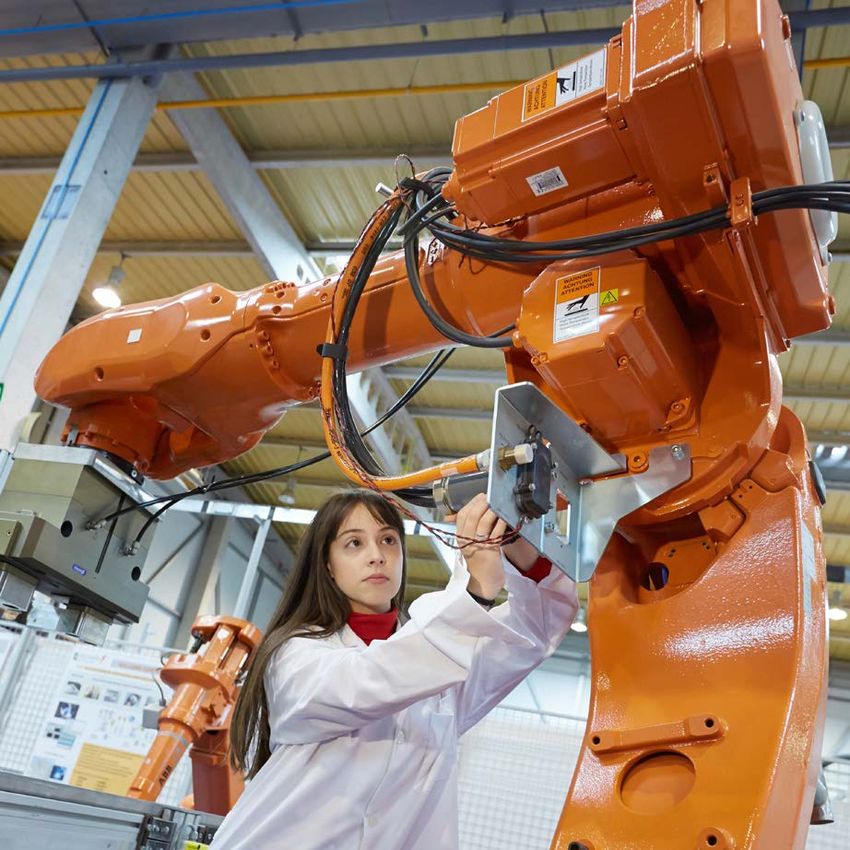
The new hire:
                      How a new generation of
                      robots is transforming
                      manufacturing

September 2014

In conjunction with
Table of contents Executive summary: The R generation 1 I. The rise of robots 2 II. Landing new jobs…in new industries 4 III. People and robots: Creating a new kind of 6 manufacturing workforce IV. Robotics: A path to flexibility and greater competitiveness 10 V. Barriers to widespread adoption: Cost, user-friendliness 12 VI. Robot-ready? A self-assessment of whether robots are for you 13
Executive summary: The R generation

Industrial robots are on the verge of                    This maturing “R generation” holds myriad             (such as those of high precision or force)
revolutionizing manufacturing. As they                   implications for the future of manufac-               which will open new opportunities of faster
become smarter, faster and cheaper,                      turing. Wider adoption of robots comes at             and greater production of existing prod-
they’re being called upon to do more—well                a time when manufacturers—both big and                ucts—or, perhaps more important, enable
beyond traditional repetitive, onerous or                small—are under increasing pressures to               altogether new product development? Are
even dangerous tasks such as welding and                 squeeze even greater productivity from their          robots an economically viable and real-
materials handling. They’re taking on more               workforces and when wage arbitrage seems              istic solution to the increasing difficulty
“human” capabilities and traits such as                  less attractive in some locales, such as China,       of securing a sustainable manufacturing
sensing, dexterity, memory, trainability,                as it was a decade ago for US manufacturers.          workforce? If robots displace employees,
and object recognition. As a result, they’re             Broader adoption of robots may even help              are there plans in place to move those
taking on more jobs—such as picking and                  to spur greater reshoring of manufacturing            employees to other tasks—preferably more
packaging, testing or inspecting products,               from overseas back to the US—or closer to             interesting and attractive to them and
or assembling minute electronics. In addi-               the US market, such as in Mexico.                     more valuable to the company?
tion, a new generation of “collaborative”
robots ushers in an era shepherding robots               And, for small and medium-sized compa-                To get a better grasp on how US manu-
out of their cages and literally hand-in-                nies, a question is arising sooner than most          facturers are enlisting robots in their
hand with human workers who train them                   probably expected: “Is now the time to hire           production lines—and future plans—PwC
through physical demonstration. As costs                 some automated help?” That question isn’t             carried out a survey of 120 manufac-
of advanced robotics continue to fall (from              being prompted only as a result of increased          turers.3 We found that while the majority
several hundreds of thousands of dollars                 affordability. The nascent age of “nearly             of respondents have already adopted
now to tens of thousands) and applications               human” robots is driving greater efficien-            robotics technology, there still exists real
widen, industries beyond automotive—                     cies, and holds promise to reduce labor               barriers for those which have yet to do
such as food and beverage—are adding                     force injuries. It’s already showing signals          so, citing limitations such as cost, the
them to their ranks. One major robotics                  of changing how the industrial workforce              lack of perceived need, and expertise and
company refers to its new-generation robot               is composed—and even the very nature                  skills needed to properly exploit them.
as an “intelligent industrial work assistant.”           of industrial jobs as we now know them.               Highlights from that survey include:
                                                         Manufacturers are also finding that being             • 59% of manufacturers are currently
Presently, there are estimated 1.5 million               competitive means injecting greater flexi-               using some sort of robotics technology
robots toiling away globally, with about                 bility into their production in order to satisfy
230,000 in the US alone. Global shipments                consumer demand for products with shorter             • 28% believe that replacement of
hit about 180,000 in 2013, an all-time                   life cycles and a greater variety of products            workers will be the biggest impact of
high, with 200,000 forecasted for 2014,                  or variants of existing products, and are                robots on the US manufacturing work-
estimates the International Federation of                tapping robots to help on this front as well.            force in the next 3–5 years
Robots (IFR).1,2 Robots have also caught                                                                       • 35% believe the biggest impact will be
the eyes of investors, such as recent                    All this opens new options, choices and                  the creation of new job opportunities to
high-profile pure-play robotics investments              paths for manufacturers. Can robots                      engineer advanced robots and robotic
by Google and Amazon. According to                       take on labor in ways that frees up and                  operating systems
PwC/NVCA MoneyTree Report based on                       makes better use of human resources and
data from Thomson Reuters, US venture                    unleashes innovation? Are there ways                  • 27% listed “not having a need” as the
                                                         robots can be applied in applications that               biggest limitation for not adopting
capital investment in robotics technology
                                                         a current workforce is unable to carry out               robotics in the next 3–5 years.
has surged in the last couple of years.

1   “Outlook on World Robotics 2014,” IFR, June 4, 2014.
2   “Global robotics industry: Record beats record,” IFR statistical department press release, June 4, 2014.
3    Disruptive Manufacturing Innovations Survey, PwC and Zpryme, 2014.

Executive summary                                                                                                                                             1
I. The rise of robots
Post-recession robot generation boom? America surpassing 20,000 units from global shipments in 2013 (see chart). The
2011–2013, and a surge so far in the first global robotic systems market (including
The last several years have seen a sharp half of 2014, according to the Robotic software peripherals and other related
resurgence in orders of industrial robots, Industries Association (see chart).4 Five costs) was estimated at $26 billion in 2012,
roughly tripling in the wake of the Great countries (US, China, Japan, Korea and according to IFR and the global indus-
Recession, with annual orders in North Germany) accounted for some 70% of all trial robot market is estimated to reach
$41 billion by 2020, according to Allied
Market Research.5,6
North American industrial robot orders (RIA)
Quarterly, 1999–2014 Gripping investors
8 Thousands of units (left scale) A flurry of investor activity has accom-
$800
panied the rise in adoption of robots by
Millions of dollars (right scale)
manufacturers, piquing the interest of
7 $700 manufacturers of all stripes and, interest-
ingly, firms outside traditional industrial
6 $600 manufacturing. Consider Google’s dive—
an acquisition of at least eight robotics
companies since 2013, including Boston
5 $500 Dynamics, Redwood Robotics, Industrial
Perception and Schaft Inc.7 In 2012,
4 $400 Amazon demonstrated its commitment to
using robotics for warehousing operations
through its acquisition of Kiva Systems for
3 $300
$775 million. The online retailer plans to
roll out 10,000 Kiva robots into a network
2 $200 of warehouses by the end of 2015, a move
that could realize fulfilment cost-savings by
1 $100
up to $900 million—or up to 40% savings
on cost per order (on picking, packing
and shipping), according to an analysis
0 0 published on Robohub.org.8,9
’99 ’00 ’01 ’02 ’03 ’04 ’05 ’06 ’07 ’08 ’09 ’10 ’11 ’12 ’13 ’14
Source: Robotic Industries Association.
4 “Record Year for Robots, healthier year for manu-
Estimated yearly shipments of multipurpose industrial robots facturing”, mhlnews.com, August 1, 2014.
Number of units 5 “Industrial Robotics Market Is Expected to Reach
$41.17 Billion, Globally, by 2020,” Allied Market
United Research company press release, May 28, 2014.
Japan China States Korea Germany Other 6 “World Robotics 2013 Industrial Robots,”
International Federation of Robotics 2013.
2011 27,894 22,577 20,555 25,536 19,533 50,316 7 “Google and robots: The real reasons behind the
shopping spree),” Conner Forrest, March 5, 2014,
2012 28,680 22,987 22,414 19,424 17,528 48,313 techrepublic.com.
8 “Bezos expects 10,000 robots at Amazon
warehouses by 2015,” The Seattle Times, May 21,
2013 25,110 36,560 23,679 21,307 18,297 54,179 2014.
9 Shawn Milne and Michael Carroll, “Forget the
Source: “World Robotics 2013 Industrial Robots,” International Federation of Robotics 2013. Octocopter, let’s talk about Kiva,” robohub.org,
2013 figures provided to PwC from IFR Statistical Department. December 10, 2013.
2 The new hire: How a new generation of robots is transforming manufacturingUS venture capital investments in Robotics patent race? Total number of published patents
robotics technology companies for robotics and autonomous
Patents for robotics and autonomous systems
Number of systems have swelled in the last decade
investment
$ million rounds as well, with double-digit year-on-year 2013 5,094
2013 172 (10) jumps in the last three years. According to 2012 4,594
a report published by the UK Intellectual
2012 69 (6) 2011 3,696
Property Office, the number of global
2011 60 (4) published patents for these technologies 2010 3,353
2010 30 (4)
passed 5,000, the highest level ever, in
2009 3,315
2013, up from 1,400 in 2004 (see chart).
2009 13 (5) That translates into about 9% of all global 2008 3,036
2008 23 (4) patents across all technologies.11 Japan, 2007 2,662
Germany and the US account for most of
2007 0.3 (1) 2006 2,024
the patents (see chart).
2006 4 (2) 2005 1,656
2005 0 2004 1,400
2004 19 (3) Source: “Eight Great Technologies Robotics and
Autonomous Systems,” UK Intellectual Property
Source: PwC/NVCA MoneyTree Report based on Office, June 2014 (figures supplied to PwC by Peter
data from Thomson Reuters. Keefe, Patent Informatics Analyst UK Intellectual
Property Office).
In Europe, euRobotics (comprising the
European Commission and 180 companies Applicant country distribution of published patents for robotics and
and research groups) created a robotics autonomous systems, 2004–2013
research program called SPARC, to kindle a
regional robotics hub, with investments of
Japan 24%
€700 million from the EC and €2.1 billion
from euRobotics. The program is expected to
create 240,000 jobs and lift Europe’s market
in robotics by about €4 billion per year.10 Korea 10%
Venture capital investments in robotics
technology start-ups are up, too. According
to PwC/NVCA MoneyTree Report based
on data from Thomson Reuters (which China 13%
tracks VC investment in the US), capital
investments by US venture capital firms Germany 22%
rose to about $172 million (in 10 invest-
ment rounds) in 2013, nearly tripling 2011
levels (see chart). This rise is an especially USA 17%
meaningful signal that robotics industry
could see an accelerated development Source: “Eight Great Technologies Robotics and Autonomous Systems,” UK Intellectual Property Office, June
as these VC-backed companies grow. It 2014 (figures supplied to PwC by Peter Keefe, Patent Informatics Analyst UK Intellectual Property Office).
provides a window into the future as to
what this investment community believes
will be a promising (and profitable) sector.
10 “EU launches world’s largest civilian robotics programme—240,000 new jobs expected,” European
Commission website, March 6, 2014.
11 “Eight Great Technologies Robotics and Autonomous Systems.” UK Intellectual Property Office, June 2014.
The rise of robots 3II. Landing new jobs … in new industries
Beyond automotive: making inroads Industrial robot orders in North America by industry, % of all
across manufacturing sectors
2005 2013
For decades, advanced industrial robotics
have been chiefly pioneered and deployed Automotive OEM Automotive Automotive OEM Automotive
41% components 27% components
by the automotive industry, particularly
28% 29%
Japanese carmakers such as Toyota,
followed closely in their wake by European
and North American counterparts. Indeed,
in 2005, 69% of all industrial robot
orders in North America were made by
automotive OEMs (original equipment
manufacturers) to automotive compo- Metals 7% 4% 6% 2%
nents companies, according to data from 11%
the Robotic Industries Association. By Metals 3% 3% 2%
2014, that figure had eroded to 56% (see 10%
1% Other Other
chart), offset by increasing shares by other
11% 14%
industries including the food and beverage,
consumer goods, life sciences/pharmaceu-
tical/biomedical and metals industries. Food and consumer goods
“We have received orders from tier-one Semiconductor/electronics/photonics
and tier-two suppliers to the automotive Life sciences/pharmaceuticals/biomedical
industry, but we are attracting interest
Plastics and rubber
from other industries such as the plastics,
medical devices, food and beverage and Source: Robotic Industries Association.
high-tech industries,” said Jim Lawton,
CMO of Boston-based Rethink Robotics
(maker of the Baxter collaborative robot) An expanding job description But enabling technologies are making
in an interview with PwC. Still, there is robots smarter at a rapid clip: these include
much room for growth in the non-automo- Industrial robots are most commonly used greater computing power, sensor tech-
tive sectors. The “robot density” (robots to carry out onerous, dangerous, repetitive nology to enable vision recognition, more
per 10,000 employees) in the automotive or tedious tasks, with common applica- sophisticated sound and movement detec-
industry in the US in 2013 is more than 10 tions including materials handling (e.g., tion and tactile, force and torque control
times higher than that in general industry tasks associated with machine tending or sensing (giving robots the ability, for
(1,091 vs. 76), according to IFR.12 plastic molding) or robotic welding (e.g., example, to sense when they are bumped
arc welding operations). A PwC survey of and “give” to prevent hurting humans or
US manufacturers found the most common sense when a human in nearby). Advances
task was assembly (25%) followed by in artificial intelligence software, too,
machining (21%), with the least common are enabling greater autonomy—to
tasks being warehousing and performing make decisions based on new situations
dangerous tasks (both 6.5%) (see chart). in unstructured environments (as on a
factory line or in a warehouse) as opposed
to performing in one repetitive task while
fixed and sequestered in a cell, or cage.
12 IFR World Robotics 2013.
4 The new hire: How a new generation of robots is transforming manufacturingHow manufacturers are using robots Planned investments in robots for
assembly, machining
Q. If you are using robotic technology, what is its primary application?
According to a PwC survey of US manu-
Assembly 25.2% facturers, the areas that respondents plan
to invest most in robotics technology were
Machining: Tasks that require high assembly (27%), followed by machining
levels of dexterity and precision
20.6%
(26%) and performing dangerous tasks
(22%) (see chart). When asked about what
Warehousing: Materials handling/packaging 6.5%
limitations will keep them from investing
in robotics technology in the next three
Performing highly dangerous/onerous tasks 6.5% years, respondents cited the top reasons
were that it was “not cost effective” (26%)
Not using robotic technology 41.1% and that they did not see a need for it
(27%).
Number of respondents: 107.
Source: PwC and Zpryme survey and analysis, “2014 Disruptive Manufacturing Innovations Survey,”
conducted in February 2014.
These advances are leading to a wider Banking on bots
range of capability and applications.
Robots are being enlisted to carry out Q. Looking ahead to the next 3 years, in which areas do you expect to make the
tasks including transportation of mate- highest capital investments in robotic technology? (Check all that apply.)
rials or supplies, picking and packaging,
product testing and inspection. They’re None, we don’t plan to use robotic technology 32%
also increasingly being deployed to work
on products or components that are too
tiny for humans to efficiently manipu-
Assembly 27%
late, such as micro-electro-mechanical Machining: Tasks that require high
systems (including micro sensors, motors levels of dexterity and precision
26%
or nozzles), a market that, by 2017, is
estimated to hit $21 billion.13 “Robots Performing highly dangerous/onerous tasks 22%
are doing more than fast automated
tasks for the automotive industry,” said Warehousing: Materials handling/packaging 16%
Jeff Burnstein, president of the Robotic
Industries Association, in an interview Other 3%
with PwC. “They’re moving into other
areas like filling, packaging, palletizing and Number of respondents: 107.
loading. The next-gen robot is anthropo- Source: PwC and Zpryme survey and analysis, “2014 Disruptive Manufacturing Innovations Survey,”
morphizing and moving out of the factories conducted in February 2014.
and warehouses to do new things. They’re
already performing in hospitals, and
are working side-by-side with people,”
Burnstein added.
13 “MEMS will continue to see steady, sustainable double digit growth for the next six years” says Yole
Development” Yole Dévelopment press release, July 4, 2012.
0 10 20 30 40 50
Landing new jobs … in new industries 5III. People and robots: Creating a new kind of
manufacturing workforce
As legions of robots and other automation The robot effect on workforces
technologies wend their ways into not
only production facilities and distribu- Q. What will be the biggest impact of robots on the US manufacturing workforce
tion centers—but also through supply in the next 3–5 years?
chains—companies will grapple with the
commingling of human and machine. New job opportunities to engineer advanced
robots and robotic operating systems
35.2%
Manufacturers could be looking at an
awkward period of systemic human-re-
source change as they introduce robots
Replacement of workers 27.6%
to more varied manufacturing tasks and More demand for talent to manage
as they call for greater human-machine the robotic workplace
25.7%
collaboration. Manufacturers will also Creation of more jobs as a result
prepare for the implications of displacing of increased manufacturing
9.5%
human workers with robots through
so-called “botsourcing.” Consider a recent Other 1.9%
study by University of Oxford which
estimates that nearly half (47%) of U.S. Number of respondents: 105.
employees are in jobs that could be at Source: PwC and Zpryme survey and analysis, “2014 Disruptive Manufacturing Innovations Survey,”
risk of being displaced by computerized conducted in February 2014.
technology.14 As robotics become more
pervasive on factory floors, employers and
employees will need to manage not only
the benefits but also the human-resource
1.5 million robot-driven jobs in next 2 years?
challenges that their rise will likely prompt.
Potential global job creation, 2012–2016
Jobs maker…or jobs taker? New industrial activity Expanding existing Downstream jobs
industries
Robots are being brought on lines to do
work that’s undesirable or dangerous, or
that they can perform better (with greater
precision, strength or stamina) than
humans. But could a greater robotic work- 200,000–
350,000–500,000 400,000–600,000
force actually drive a need for more human 300,000
talent to train, repair and minister to that
growing robotic workforce? Not to mention
the talent needed to develop the burgeoning
robotic technology industry itself?
According to a PwC survey of US manu-
facturers, over one-third of manufacturers Total robot-driven employment: 900,000–1,5 million globally
said that the biggest impact robots will
have on the manufacturing workforce in Source: “Positive Impact of Industrial Robots”, January 2013, International Federation of Robots.
the next three years is that they will lead
to “new job opportunities to engineer
advanced robots and robotic operating
systems.” And about one in four felt the
biggest impact would be “more demand for 0 5 10 15 20 25 30 35 4
14 “The Future of Employment: How Susceptible are Jobs to Computerization?,” Carl Benedikt Frey and
Michael A. Osborne, University of Oxford, September 17, 2013.
6 The new hire: How a new generation of robots is transforming manufacturingtalent to manage the robotic workplace.” its shoulder in fear of losing jobs to new
Equally important is that 27% of manu- robotic hires? Consider a recent Harvard
facturers said the biggest impact would be study which explored German, British and
“replacement of workers.” Chinese workers’ response to different
conditions surrounding being replaced by
“The conventional thinking is that compa- a robot. It concluded that workers were
nies are buying robots to replace people. more concerned over being botsourced
It’s not that simple. In many cases, compa- (displaced by a robot) when their jobs
nies are using robots so they can expand are described as requiring more emotion
and improve product quality and increase than cognition. It also found that workers
production. They end up hiring more of different nationalities tend to define
people such as engineers or sales staff to cognitive-oriented and emotion-oriented
support that growth,” said Greg Selke, jobs differently.17
CEO of ONEXia, Inc., a Philadelphia-based
provider of automation hardware and soft- Robot-driven employment?
ware to manufacturers. “One of our clients
is an electronics company that needed a There is also speculation that robots
robot to apply epoxy on very small parts— could actually stimulate employment of
the robot justified that functionality as the humans—through not only their manu-
task would be very difficult for a human to facturing, but also the talent needed to
accomplish. It had nothing to do with firing program, train, maintain and repair them.
people,” added Selke. According to one study, global “robot-
driven” job creation could reach 1.5 million
Consider electric auto-maker Tesla, now through 2016 (see chart).18 However, it is
the largest auto-industry employer in important to note that while new robot-
California (employing more than 6,000 ics-related job growth is likely, it is also
with plans to add another 500 by the end likely that robot-linked job losses will also
of 2014) but also renowned for its cutting- accompany that growth and that the net
edge automation. The company deploys jobs growth as a product of robotics tech-
at least 160 robots to help produce its nologies will likely differ from company to
Model S—chipping in to install batteries, company and sector to sector.
cabling components and to bend and
form aluminum. The company is targeting Robotics-intensive sectors: more
production of 500,000 vehicles a year by skilled workers, higher wages
2020 and is mulling opening a factory (to
mass produce car batteries) which would As companies continue to embrace robotics
employ an additional 6,500 workers.15, 16 and other types of automation and grow
more data-driven, their success will largely
While in Tesla’s case, automation has hinge on shaping and building a workforce
helped fuel overall growth which has, in that can best exploit such technological
turn, been followed by additional hiring, advancements. To do that, manufacturers
other companies could well find that the are feeling a growing need to pull from
adding of robotics (and subsequent growth a wider—and deeper—pool of talent.
through automation) does not necessarily According to a PwC analysis based on
lead to increased hiring. Indeed, the U.S. Bureau of Labor Statistics, the most
effects of robotics on workforces are many robotics-intensive manufacturing sectors in
and varied. the US as a proportion of the total work-
force—i.e., automotive, electronics and
Botsourcing: an emotional thing metals—employ about 20% more mechan-
ical and industrial engineers than do less
Deploying robotics is not only a func-
robotics-intensive manufacturing sectors.
tional or operational issue for companies
They also happen to pay higher wages
and their employees. It can also be an
than other manufacturing sectors. These
emotional one. How best to keep morale
industries also employ a higher proportion
up among human workers and to nurture
(nearly twice) of installation mainte-
professional mobility and avoid conster-
nance and repair workers, than do other
nation amongst a workforce looking over
15 “Tesla edges out Toyota as California’s top auto employer,” Bloomberg BusinessWeek, May 17, 2014.
16 “Peek inside Tesla’s Robotic Factory,” Wired, July 16, 2013.
17 Waytz, Adam, and Michael I. Norton. “Botsourcing and Outsourcing: Robot, British, Chinese, and German
Workers Are for Thinking—Not Feeling—Jobs.” Emotion 14, no. 2 (April 2014): 434–444.
18 “Positive Impact of Industrial Robots,” January 2013, International Federation of Robots.
People and robots: Creating a new kind of manufacturing workforce 7manufacturing sectors, partially due to Robotics, talent and wages: A connection?
their need to program, operate and service Occupation and wages in robotics-intensive industries (automotive,
robots. Interestingly, these sectors also electronics and metals) compared to all manufacturing sectors in US,
tend to have a higher proportion of produc- as of May 2013
tion-line workers—and these workers earn
higher wages than sectors that are less % of total employment Median hourly wage
robotics-intensive. However, engineers at
the most robotics-intensive manufacturing 60% $40
sectors earn slightly less than engineers
employed by the overall manufacturing
industry (see chart).
50%
Human and robot collaboration
As manufacturers adopt a new gener- $30
ation of robots designed not only to be
safe around humans but also to actually 40%
work collaboratively with humans, a new
relationship will emerge between man
and machine, with robots as bona fide
co-workers and assistants—not just high-
tech tools sequestered behind glass. 30% $20
The entry of the collaborative robot (or
so-called “co-bot”) on the factory floors,
assembly lines and distribution centers
is already underway. Plug-and-play 20%
robots, such as the newest generations of
Universal’s UR5 and UR10 are designed $10
to work next to people in warehouses
and small businesses, doing tasks such as
10%
sorting packages, operating CNC machines
or applying glue in an automotive factory.
They’re designed to be safe around people;
they can slow their speed when a human
enters their work space, then speed up 0 $0
after the human leaves.19
Engineers Three most robotics-
Rethink Robotics’ Baxter, a human- intensive industries
Installation, maintenance and repair occupations
oid-looking robot with a torso, two arms
Production occupations Total manufacturing sector
and even a screen with a face that shows
facial expressions (e.g., of concentration, Sources: U.S. Bureau of Labor Statistics and PwC analysis.
confusion or satisfaction) lets factory
workers guide its arm through a task and
program the activity through physical
19 “Universal robots show 3rd generation UR5, UR10 industrial robots,” Robotics Business Review, June 24, 2014.
8 The new hire: How a new generation of robots is transforming manufacturingexample, rather through programming. Getting humans and robots to work more It can learn—through relatively fast closely will likely come about as robotics physical demonstration—simple, repetitive developers continue to incorporate tasks like picking up parts off a conveyor or human characteristics in robotics systems. packing and unpacking boxes. This saves University of British Columbia researchers, time and costs on complex set-ups which can for example, programmed a robot that uses take weeks or even months, depending on human-like non-verbal communication the task, with traditional industrial robots. cues and body language (e.g., head, neck Ease of trainability of the next generation and eye movements) to improve commu- of robots will likely be useful especially for nication with humans. They found that small and medium-sized enterprises which movements such as eye gaze as a cue made need to toggle between different products a robot’s handing over of a water bottle to a and produce in small batches. human more fluid.20 Getting closer to humans A blended approach The newer generation of co-bots is also Robots are good at precision, for example lowering the barrier to entry for smaller to polish a part. But even polishing can companies with limited capital and require human touch or human perception. expertise to program, calibrate and set-up So, there are ways in which it makes sense traditional industrial robots. “What we’re for robots and humans to work on the really talking about for the end-goal is same application, added Gupta, with each for the human and the robot to move a taking on sub-routines of a multiple-task heavy part together in a safe way,” said job. “There are many instances in the final Dr. S.K. Gupta, Professor, Department of steps of assembly of a product that could Mechanical Engineering and Institute for require precise alignment, for example, Systems Research, University of Maryland, bringing a part into place which takes a in an interview with PwC. “We are really lot of dexterity and precision. You could close—I think within two years—from break a large task into sub-tasks that bring getting robots to genuinely and commonly into play human-robot collaboration. In take part in physical collaboration... Not these ways, instead of two humans working just the dirty dangerous or hard tasks together, you could have one human and in structured environments, but say, for one or two robots working in a hybrid example, mix batch injection molding approach,” Gupta said. where a specific part is removed, cleaned, inspected and placed into a container,” Gupta added. 20 “Eye of the beholder: Improving the human-robot connection,” University of British Columbia, ScienceDaily. com, April 11, 2014. People and robots: Creating a new kind of manufacturing workforce 9
IV. Robots: A path to flexibility and greater
competitiveness?

For decades, robotics and other forms                   Could robotics, then, contribute to the                 “You have to use technology in any way
of automation have delivered on the                     beginning of an end to wage arbitrage?                  you can to stay competitive, to reduce
promises of speed, efficiency, productivity.            Going forward, the role of robots in a
But how will a widespread adoption of                   company’s changing or expanding oper-                   overall cost, to increase quality and
advanced robotics deliver on flexibility                ational footprint could be significant,                 productivity. There are companies that
and adaptability to fast-changing customer              as companies rethink the viability and                  will tell you that the only reason they
needs—and on rising expectations for                    attractiveness of offshoring carried out to
                                                                                                                came back to the US is because of the
developing new products faster. Or, how                 great extent in the last several decades.
will they help manufacturers produce                    Robots could relieve pressure on compa-                 automation. And I think this is a trend
variants and customization of existing                  nies to contend with rising wages, currency             we’ll see persist in the future.”
products dictated both by varying                       fluctuations and volatile transportation,
geographical preferences and needs and                  logistics and trade-related costs. China,                               —Jeff Burnstein, President,
even by the individual (the so-called “lot              for example, which ordered more robots                                Robotic Industries Association
of one”)?                                               in 2013 than any other country (some
                                                        37,000), is ramping up automation in
Can robots help reshape manufacturers’                  response to higher labor costs, availability            selling to the US market, customizing to
operational footprint? As companies                     of skilled labor and higher expectations                consumers’ choice or preferences is a solid
program or train their robotic fleets to                and demand for higher-quality products.                 reason to bring manufacturing back to
perform more and more applications in one                                                                       the US,” said Scott Paul, President of the
plant, what is the potential for a company              Robots and manufacturing closer to                      Alliance for American Manufacturing, in
to transfer that knowledge to robotic                   the end-market                                          an interview with PwC. “With automation
cohorts in another plant—even one on a                                                                          technology, it makes it easier to be closer
different continent? Such machine-to-ma-                What role could robots play in making                   to the customer and perform better for that
chine knowledge sharing could well make                 it easier for companies to manufacture                  local customer. Whichever economy uses
it easier for companies to switch produc-               closer to their end-markets? Merchant                   and exploits robots and automation the
tion from one locale to another, or from                House International, Ltd., a Hong Kong                  best will have a distinct global advantage.
the production of one product to another                based footwear maker, opened a factory                  For competitive reasons, this is no time for
without the considerable investments in                 in Jefferson City, Tennessee in 2013, to get            US manufacturers to shy away from this
talent, training, set-up time and related               closer to its end-market of US consumers,               technology,” Paul added. Part of the math
costs. “Perhaps most exciting for the future            instead of having leather shipped to China              that will go into offshoring or reshoring,
of cloud computing in robotics is when one              only to have footwear produced from that                then, may more importantly figure robotics
robot can impart something it perceives                 leather shipped back to the US. The compa-              costs into their total costs. Some collab-
or learns instantaneously to other robots.              ny’s US plant is more automated than the                orative robots, for example, cost roughly
This sharing could have a catalytic effect              company’s plants in Asia, employing robots              one-half of a human worker’s salary in the
on the capabilities of robots, particularly             to “rough” leather before gluing to soles.20            US, or about three times that of a Chinese
in unstructured environments.” said Dr.                 “It costs the same to buy the same robot                manufacturing salary, Paul noted.
S.K. Gupta Professor, Department of                     in China or the US, so, for US companies
Mechanical Engineering and Institute for
Systems Research University of Maryland
in an interview with PwC.

20 Hagerty, James R., “Shoemaking gets a foot in the door in the US”, The Wall Street Journal, July 14, 2014.

10                                                                                      The new hire: How a new generation of robots is transforming manufacturing
Robots: helping manufacturers “In some cases, robotics has been
customize, innovate mis-deployed and has made it hard for
The entry of faster, smarter robots is companies to innovate continuously.
coming at a time when companies— When twelve-year old girls buy red nail
from aerospace and defense to medical polish one month but blue is the rave
devices to consumer products—are under
increasing pressure to respond quickly to
next month, how do manufacturers
customer preferences and expectations respond quickly to that change in
and as products’ life cycles shorten. Faster consumer demand?”
set-up times and increasing applications
will enable robots to play a greater role —Jim Lawton, CMO, Rethink Robotics
in companies following through with the
mandate of customization. “For compa-
nies that are using robotics well, I look at
companies that are both highly automated
and those that can be flexible enough to
quickly and cheaply change set-up to fabri-
cations of different variations on the same
product. That’s the factory of the future.
Some will be more customized than others,
but most all plants will need to adapt
to making different products quicker,”
said Scott Paul of Alliance for American
Manufacturing.
Robots: A path to flexibility and greater competitiveness? 11V. Barriers to widespread adoption:
Cost, user-friendliness
Despite strong momentum surrounding Limits to robotics adoption
the development and adoption of robotic
technology described in this report, there Q. Looking ahead to the next 3 years, what would limit your future investment in
nevertheless still exists resistance to their robotic technology?
use holding back widespread adoption.
Much of this resistance seems to be tied to Nothing, we will start/continue investing
cost, expertise and a lack of understanding in robotic technology
28.0%
of how they could produce an attractive
return on their investment—both up front Not cost effective 26.2%
and ongoing through maintenance and
programming of new tasks. According to Insufficient resources and expertise 14.0%
our survey of US manufacturers, some 41%
of companies surveyed do not currently Displaces workers and lowers morale 4.7%
use advanced robotics technology. Top
reasons for limiting investment in robotics Do not see a need for robotics 27.1%
technology in the next three years include:
“they are not cost effective” and “see no
Number of respondents: 107.
need” (see chart). Source: PwC and Zpryme survey and analysis, “2014 Disruptive Manufacturing Innovations Survey,”
conducted in February 2014.
According to Greg Selke, CEO of ONExia,
the total cost of a robotics system (in
the hundreds of thousands of dollars) is
approximately three times the cost of the Small and medium-sized manufacturers “Robots get dirty and might fail and
robot itself, when figuring in software, will likely need robotics that can accom-
controller, technical help, set-up and work people cannot stop what they’re doing
modate smaller production runs and more
cell, etc., and can take weeks or months frequent set-ups and re-programming of on the factory floor to fix the problem or
to install, surround with a cage and their robotic workers to adapt quickly for call a company help desk or technician
program. “But prices are coming down, production of new products or variants of
and programming can be less cumbersome, to resolve the issue. The new robots will
existing ones. Bigger growth in robot adop-
Selke said in an interview with PwC. “In tion, then, will likely come when robots
really need to be ones that are easy to
the last three or four years we’ve seen sales can easily produce in small lots situations. use—as easy almost as a robotic vacuum
get much stronger with robots, but the rise Programming a robot can take hours for cleaner. You won’t need to learn how to
is largely attributed to large companies,” small specialty batches of product. Most
added Selke. “The smaller companies are use it. It doesn’t make sense for an expert
small and medium-sized enterprises will
still struggling with their adoption and are need cheaper and more easily program- human welder to write code to program
slower to adopt new technologies. The cost mable robots to make that happen. a robot—he or she needs to spend the
of entry is somewhat high, and they have
time teaching the robot through physical
trouble making the leap either because of
staff or because of the cost. But the new demonstration—which we call “learning
breed of robots will make it easier for them from demonstration.”
to find ways to innovate and compete.
Even at $35,000 a collaborative robot, it’s —SK Gupta, Professor, Department of
a compelling argument to buy one even if Mechanical Engineering and Institute for
you’re a very small operation—it can work Systems Research University of Maryland
24-hours a day,” Selke said.
12 The new hire: How a new generation of robots is transforming manufacturingVI. Robot-ready?
A self-assessment of whether robots are for you
Certainly, manufacturers are approaching • Is your workforce prepared to integrate
robotics in many and varied ways, and robotics into their workspace and be
assessing the degree of need and spot- able to offload some of their responsibil-
ting the “right” application differs across ities to a machine? Are they prepared to
industries and from manufacturing explore other work that relies on their
plant to manufacturing plant. As compa- experience, perception and judgment
nies—especially small and mid-sized and less upon their physical skills?
enterprises—look for new and viable ways • Have you assessed how applying
to integrate robotics and automation into robotics technology could help you
their operations, robots are becoming a shift production more easily to a new
stronger factor in manufacturing competi- geographical location, or to reshore
tiveness globally. back to the US?
A few questions companies might ask • Is your company prepared to graduate
themselves as a sort of “robot-ready self- workers displaced by robots to higher
assessment” include: skill-level tasks/jobs?
• Have you audited your manufacturing • Have you assessed the potential savings
processes and identified repetitive, on health care costs and the effect on
onerous or dangerous tasks done by the wellness and morale of your work-
humans that could be carried out by force by using robots to relieve tedious
robots? or potentially deleterious tasks?
• Have you explored what sorts of • What useful life are you expecting for
gains in productivity, efficiency and your robotics technology?
waste reduction could be achieved by • How can robotics contribute to your
deploying robots in your operations? firm spending more time on innovating
• Are there manufacturing processes that (new product development, improve-
require high precision and dexterity ments in production strategies) and less
for which you find it difficult to secure time on labor- and human resource-re-
human talent to perform? lated issues and costs?
• Have you assessed what a possible • How can robotics technology add to
return on investment and cost-ben- your company’s flexibility (i.e., ability to
efit analysis robotics would bring customize products, unleash innovation
(comparing initial and ongoing cost of for new product development, replicate
robotics system, and expected useful manufacturing more easily from one
life span of that system) versus cost of facility to another)?
relying on human labor?
• Does your company have the talent
to exploit robotics technology to the
fullest (e.g., train, repair, clean, de-bug,
program for quick set-up)?
Robot-ready? A self-assessment of whether robots are for you 1314 The new hire: How a new generation of robots is transforming manufacturing
About Zpryme Research Survey
The survey findings in this report were generated by Zpryme, which
conducted an online survey of 120 U.S. manufacturing professionals in
February of 2014.

Acknowledgments
PwC would like to thank the following interviewees for their time, care and
insights:
Jeff Burnstein, President of Robotic Industries Association
Jim Lawton, CMO of Rethink Robotics
Greg Selke, CEO of ONEXia, Inc.
Dr. S.K. Gupta Professor, Department of Mechanical Engineering and Insti-
   tute for Systems Research University of Maryland
Scott Paul, President of the Alliance for American Manufacturing
www.pwc.com

To have a deeper conversation about how this subject may affect
your business, please contact:

Robert McCutcheon                                        From the Manufacturing Institute
Partner
                                                         Jennifer McNelly
US Industrial Products Leader
                                                         President
412 355 2935
                                                         202 637 3426
robert.w.mccutcheon@us.pwc.com
                                                         jmcnelly@nam.org
Robert Pethick
                                                         Gardner Carrick
US Industrial Products Advisory Leader
                                                         Vice President, Strategic Initiatives
313 394-3016
                                                         202 637 3491
bob.pethick@us.pwc.com
                                                         gcarrick@nam.org
Bobby Bono
US Industrial Manufacturing Leader
704 350 7993                                             Editorial team:
robert.b.bono@us.pwc.com                                 Chris Sulavik
                                                         Senior Research Fellow
Michael Burak
                                                         US Thought Leadership Institute
US and Global Industrial Products Tax leader
973 236 4459                                 Michael Portnoy
michael.burak@us.pwc.com                     Senior Manager
                                             Research & Analysis Group
Tracey A. Stover
US Industrial Products Assurance Leader      Thomas Waller
720 931 7466                                 Director, US Industrial Products
tracey.a.stover@us.pwc.com.

© 2014 PricewaterhouseCoopers LLP, a Delaware limited liability partnership. All rights reserved. PwC refers to the US member firm, and may sometimes refer to the
PwC network. Each member firm is a separate legal entity. Please see www.pwc.com/structure for further details. This content is for general information purposes only,
and should not be used as a substitute for consultation with professional advisors. NY-15-0067
You can also read


