Application Guidebook - March 2021 - Dayton, OH
←
→
Page content transcription
If your browser does not render page correctly, please read the page content below
Application Guidebook

        March 2021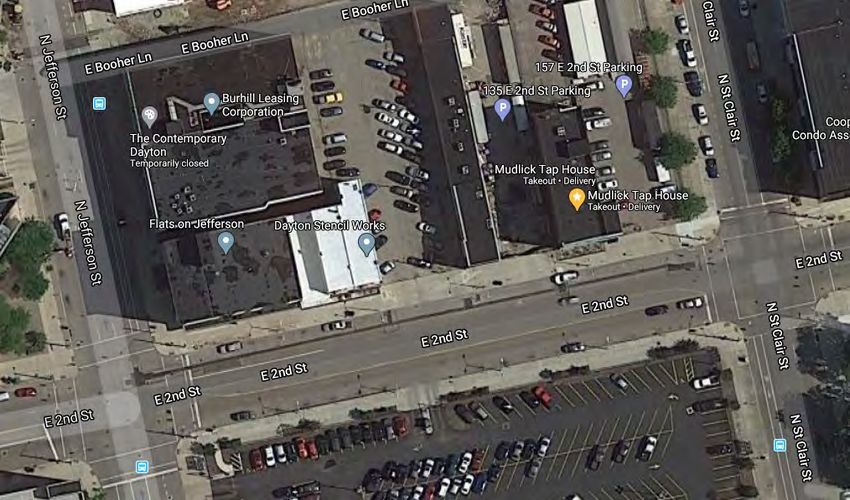
CONTENTS
About..................................................................... 3
Definitions............................................................. 4
Process Overview: Public Right-of-Way..............5
Process Overview: Private Property....................6
REGULATIONS
  Eligible Applicants.............................................8

                                                                                                                         Matt Sauer
  Site Selection..................................................... 9
  Public Health and Safety.................................10
  Liquor Permits..................................................11
  Design Standards.............................................12
PROCESS AND PROCEDURES
  Application.......................................................16
  Review and Approval.......................................19
  Installation.......................................................19
  Operation and Maintenance...........................20
  Evaluation & De-Installation...........................20
APPENDIX

                                                                                                                         Matt Sauer
  Application Checklist......................................22
  Application Form: Public Right-of-Way..........23
  Application Form: Private Property................24
  Permission Letter Template............................26
  Terms and Conditions......................................27
  Exhibit A: Restaurants and Bars.....................35

    CONTACT
    For public right-of-way application questions:                             For private property installation questions:

    Joe Weinel                                                                 Carl Daugherty
    Chief Engineer                                                             Zoning Administrator
    Bureau of Design Engineering                                               Zoning Administration
    Division of Civil Engineering                                              Department of Economic Development
    Department of Public Works
                                                                               (937) 333-3903
    (937) 333-4218                                                             carl.daugherty@daytonohio.gov
    joe.weinel@daytonohio.gov

                                                                                                Pop-Up Patio Program, 2021 | 2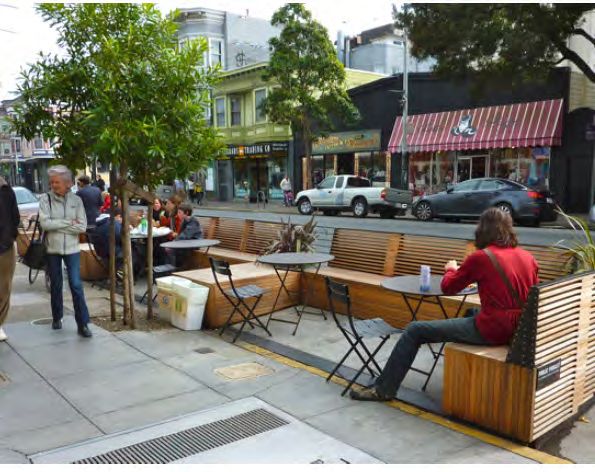
ABOUT
 About this guidebook
 The City of Dayton’s Pop-Up Patio Application
 Guidebook will lead applicants through the
 application process for authorization to install a
 temporary patio, parklet, or pedlet both within
 the public right-of-way or on private property. This
 guidebook provides an overview of the program,
 regulations, process, procedures, terms and
 conditions, and design best practices for
 expanding or creating temporary outdoor seating
 areas. Business owners, property owners, and
 other potential applicants are encouraged to
 read this guidebook in advance of submitting an Pop-up Patios may be located on the sidewalk or
 application.                                         in an existing parking lot, parklets and pedlets
                                                      are located in the parking lane adjacent to the
 Many thanks to Public Health Dayton Montgomery curb – designed as an extension of the sidewalk.
 County and Downtown Dayton Partnership for
 their guidance and contributions to the design of The City supports business’ use of temporary and
 this program.                                        low-cost materials to quickly install a temporary
                                                      patio, parklet or pedlet; however, all materials
 About the program                                    must meet the design standards laid out in this
 Temporary patios, parklets, and pedlets are guidebook. Each application will be reviewed
 creative and cost-effective ways to add outdoor individually and will allow for the unique situations
 seating as businesses make changes to meet new found at each of our unique business locations.
 social distancing requirements. This program was
 developed as a direct response to the COVID-19
                                                        Temporary Patios on Private Property
 crisis. Concepts included in this guide offer
 potential solutions for local businesses as they       The City is allowing businesses to temporarily
 look for ways to spread out tables and customers.      expand or create outdoor seating areas on
                                                        private property. Interested businesses must
 The concept for this Pop-Up Patio program              follow the application process outlined on
                                                        page 6. Proposals will be reviewed by the City’s
 grew from the tradition of Parklets. Parklets
                                                        Zoning Administrator, Carl Daugherty, with the
 are gathering spaces that offer public seating
                                                        highest degree of flexibility including the waiver
 accessible by all. In the City of Dayton’s program,
                                                        of parking minimums for the duration of this
 the focus will be on creating additional private       program. Prior to installation, businesses must
 seating areas managed and maintained by                receive a zoning certificate from the Zoning
 the applicant businesses. Pop-Up spaces are            Administrator.
 not intended as one-time event spaces, large
                                                        Applicants are encouraged to review and follow
 gathering opportunities, or parties. Rather, they
                                                        the design guidelines included in the Temporary
 are intended to support local businesses as
                                                        Patio section of this guidebook. Terms and
 they seek to recoup lost capacity due to social
                                                        Conditions for temporary patios installed on
 distancing requirements.                               private property are included in the Appendix.

                                                                             Pop-Up Patio Program, 2021 | 3
DEFINITIONS
                                                         Public right-of-way
                                                         An easement (privilege or right) for public travel.
                                                         In our cities, public right-of-ways take the form of
                                                         sidewalks, streets, alleys, multipurpose paths, and
                                                         other public spaces.
                      Pub
                          lic rig
                                 ht-o
                                      f-wa
                                          y

                                                         Temporary Patio
                                                         New or expanded seating areas installed on the

                                              NACTO
Public right-of-way                                      public right-of-way (sidewalks or in parallel parking
                                                         spaces) or in a private parking lot.

                                                         Parklet (Platform Cafe)
                                                         Seating platforms that convert curbside parking
                                                         spaces (or public right-of-way) into commercial dining
                                                         space.
                                              WHSV.com

                                                         Pedlet
Temporary Patio
                                                         Pedlets are public platforms that convert curbside
                                                         parking spaces into safe, pedestrian walkways. These
                                                         semi-permanent installations provide access around
                                                         expanded or new patios installed on the sidewalk.

                                                         Temporary
                                                         When this guidebook references installations as
                                                         “temporary” it means any patio, parklet, or pedlet
                                                         would be removed by December 31, 2021.
                                              smwi.org

Parklet

                                                         Permanent
                                                         When this guidebook references installations as
                                                         “permanent” it means any patio, parklet, or pedlet
                                                         would remain in place after December 31, 2021.
                                              KRTV.com

Pedlet

                                                                               Pop-Up Patio Program, 2021 | 4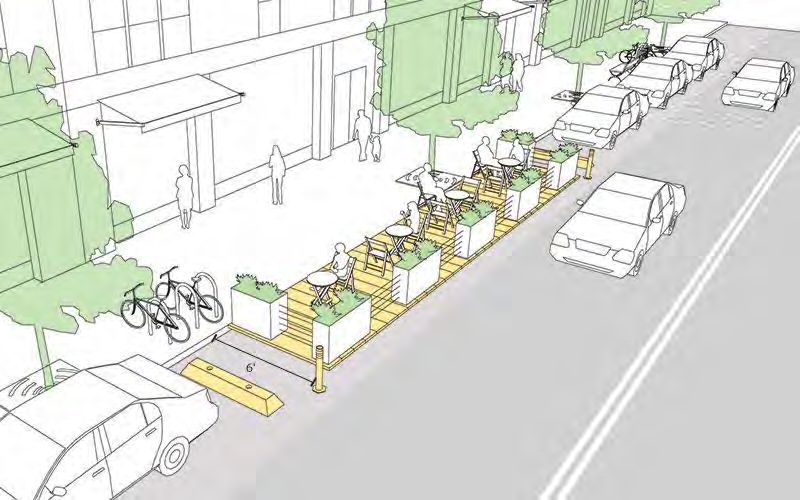
PROCESS OVERVIEW: PUBLIC RIGHT-OF-WAY
                                 1. Development and Design
     Review guidelines, select site, communicate with neighbors and property owner, and
                                     design your installation

                                         2. Application
    Complete the Public Right-of-Way application, pay the $40 application fee, and submit
                                 to Public Works for review.
                                                                              Contact Public Works
                                                                               for questions about
                                                                                 your application.

                                   3. Review and Approval
     Public Works review of applications may take up to 1 week. Temporary permission to
        use the public right-of-way will be issued in the form of a construction permit.

                                        4. Installation
       Build your design elements and install your temporary patio, parklet, or pedlet.

                               5. Operation and Maintenance
           Maintain and clean daily. If appropriate, stow or secure furniture nightly.

                                  6. Evaluation and Removal
     At the close of the program (December 31, 2021) remove all temporary installations
                     from the public right-of-way and share your experience.

                                                                        Pop-Up Patio Program, 2021 | 5
PROCESS OVERVIEW: PRIVATE PROPERTY
                                 1. Development and Design
     Review guidelines, select site, communicate with neighbors and property owner, and
                                     design your installation

                                         2. Application
    Complete the Private Property application, pay the $75 application fee, and submit to
                             Zoning Administration for review.
                                                                               Contact Zoning for
                                                                              questions about your
                                                                                  application.

                                   3. Review and Approval
     Zoning review of applications may take up to 1 week. Temporary permission to use
              private property will be issued in the form of a zoning certificate.

                                        4. Installation
                 Build your design elements and install your temporary patio.

                               5. Operation and Maintenance
           Maintain and clean daily. If appropriate, stow or secure furniture nightly.

                                  6. Evaluation and Removal
     At the close of the program (December 31, 2021) remove all temporary installations
                                  and share your experience.

                                                                        Pop-Up Patio Program, 2021 | 6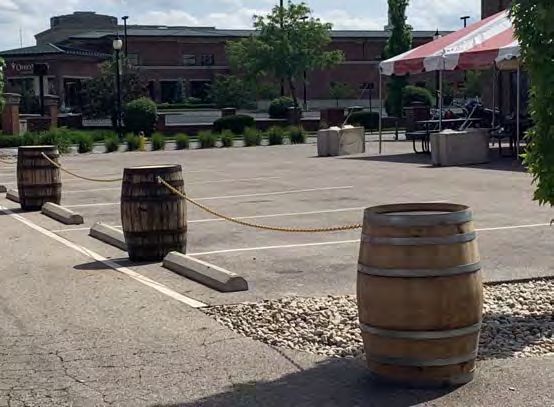
Pop-Up
   Patio
    program

REGULATIONS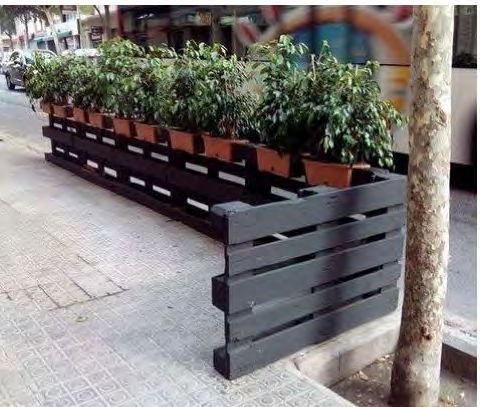
ELIGIBLE APPLICANTS
 Eligible applicants must have the organizational capacity to manage the installation and maintenance
 of a new or expanded outdoor space.

 Eligible applicants may be, but are not limited to:
   □       Ground-floor business owners
   □       Property owners
   □       Non-profit and community-based organizations
   □       Special service districts
   □       Others on a case-by-case basis

 Roles and Responsibilities
               Applicant Responsibility                           City Responsibility
       •    Application submission                      •   Program management
       •    Design                                      •   Application review
       •    Letters of support (if applicable)          •   Design review and approval
       •    Installation and/or construction            •   Permit/certificate issuance
       •    Maintenance                                 •   Site inspection
       •    Liability                                   •   Oversight and enforcement
       •    For parklets and pedlets, installation
            of necessary traffic devices (wheel
            stops, flexible bollards, traffic/parking
            signage or markings)

                                                                                 Pop-Up Patio Program, 2021 | 8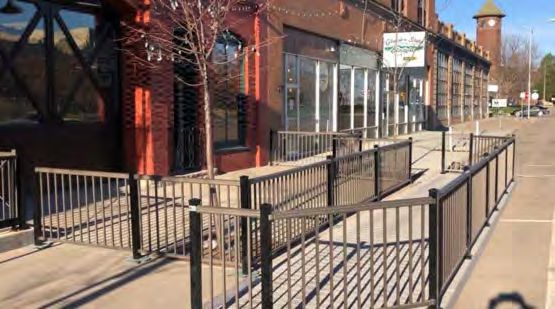
SITE SELECTION
Parklet Location Crtieria Parklet Manual 2.0 (March 2015)
In order to ensure the safety of all users, applicants should carefully consider the best location for
each different type of installation. The City recognizes that every business location is different and will
require tailored site plans and special accomodations. We will review every application and site plan
individually to ensure adequate access remains around existing street lights, street trees, planters,
etc. and to ensure pedestrians can pass by easily.
IMPORTANT LOCATION CRITERIA
All sites must meet the following requirements:
□ Not located within a residential area (business must be in a commerical-zoned area)
□ Does not block access to public utilities, waste collection receptacles,
PARALLEL hydrants, alleys, manhole DIAG
covers, ADA parking spaces, or driveways Parklet Location Crtieria Parklet Manual 2.0 (March 2015)
□ If in the public right-of-way, the installation must fitLocation
Parklet within the applicant’s
Crtieria
Parklet property
Parklet Manual boundaries
2.0 (March 2015)
or frontage
□ Not exceed 2,500 square feet in total area.
4 ft 4 ft 4 ft
If proposing a parklet or pedlet: 3f
□ Located in an unrestricted parking lane, parallel to the curb edge, adjacent to the sidewalk
□ Does not block existing street drainage patterns
Parklet footprint. Parklets are sited along the Perpend
□ Located at least one 20’ parking space away from the
curbside nearestwhere
on streets intersection
on-street parking spaces located
□ Cannot occupy more than 4 parking spacesexist. They can be considered in any location where
PARALLEL are DIAG
typic
there are or would be space(s) for on-street parallel,
PARALLEL combine
DI
□ Cannot be located in or within 40’ of a bus angled,
stop or perpendicular parking, including spaces within th
Parklet Driveway
□ Cannot be located on streets with steep slopes
with metered or unmetered parking. back 3 f
Parklet
□ Include a 3- to 4-foot inner buffer when adjacent side.
Parallel parking. parking
to another Sidewalk
Most parklets (see
spaceare thediagram
length ofonone
p 11)
4 ft parking spaces, although 4the
or two ft City will consider
4 ft
Corner Locations and Bus Stops Areas3wf
larger4parklets
ft depending on Parklet
neighborhood
4 ft and 4 ft where p
paveme
Sidewalk adjacent to another parallel parking space (2 ft when “orphan
adjacent to aone
driveway, Busparking,
motorcycle/scooter stop or
At least parking space 2’ setback parking
Parklet a bicycle corral).
away from street corners from active
(20 ft) driveways
Driveway
Driveway
At least one parking space At least 40 feet away
Source: San Francisco Parklet Manual
Sidewalk
away from the corner from bus stops
(20 ft) Sidewalk
Parklet
Unrestricted Parking Lane Parklet
A parking lane that does not have signs At least one parking space 2’ setback
posted or painted curbs restricting the away from street corners
At least one parking space
from active
(20 ft) 4’ setback
time or type of vehicle that can park away from street corners
driveways
from active
(20 ft)
there. driveways
Corner locations. Parklets should be located at least Street sl
one parking space (20 ft) away from an intersection streets w
Pop-Up
or street corner. Parklets closer Patio
to the Program,
corner may be2021 | 9 less.
considered on a case by case basis.
Parklets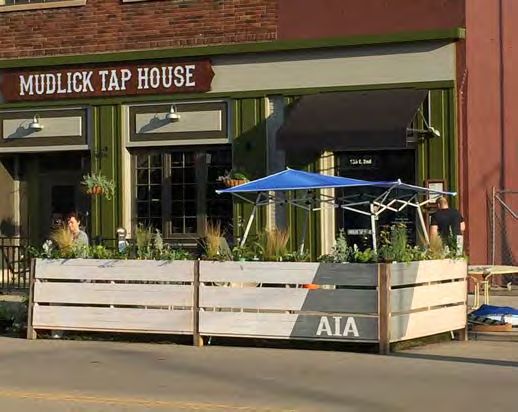
PUBLIC HEALTH AND SAFETY
 Public Health
 All applicants with the desire to install outdoor seating areas in support of a restaurant operation must
 meet the Ohio Uniform Food Safety Code including building code compliance, sanitation, solid waste
 disposal, food and equipment storage, and dogs in outdoor dining areas.

 Outdoor dining must also comply with all items under the State of Ohio Governor’s Dine Safe Order which
 can be downloaded from this site: https://coronavirus.ohio.gov/static/publicorders/Directors-Order-Dine-
 Safe-Ohio.pdf.

 The intent of the Pop-Up Patio Program is to help our business community recoup lost internal capacity
 by providing a streamlined permitting process for exterior seating and retail spaces. The program is not
 intended to support large exterior party venues or to accommodate large gatherings. Any application or
 proposal that violates this intent will be denied approval.

 The City of Dayton will work with our local restaurants to address individual concerns, but any applicant
 found to be in knowing violation of these safety regulations will be required to close their temporary patio
 or parklet.

 Public Safety
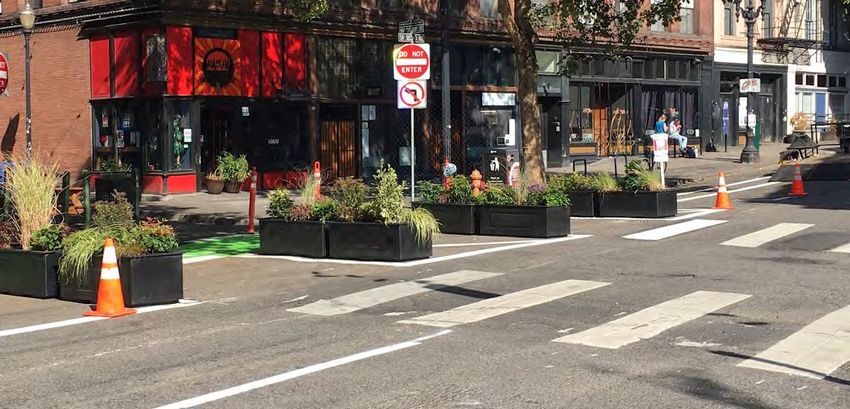
 Site selection is a crucial element in ensuring the safety of installations within the public right-of-way. For
 the purposes of the City of Dayton’s program, parklets and pedlets must include the installation of vertical
 elements or barriers such as planters, railings, cables, etc. to help distinguish the seating or pedestrian
 space created by the parklet or pedlet from the moving and parked car traffic on the street. Reflective
 elements and wheel stops are required on the corner posts around the perimeter of installation in the
 parking lane of the street.

         Vertical,
        reflective
        elements

        Wheel stops
        bolted to the
         pavement

                                                                                Pop-Up Patio Program, 2021 | 10
LIQUOR PERMITS
Restaurant and bar owners who wish to serve alcohol in their temporary expanded or new outdoor seating
area must notify the Division of Liquor Control and the Department of Public Safety Investigative Unit of
the area to where their permit will expand.
• The permit holder should email the Division of Liquor Control at notifydolc@com.ohio.gov your permit
number, where you are expanding to (i.e., parking lot), and the start and end date for when the
expanded sales will occur in your notification.
• The permit holder must also notify the Cincinnati District office of the Department of Public Safety
Investigative Unit by emailing the same information to ADOIUCin@dps.ohio.gov.
Access a full explanation of this process and the rules and requirements for temporary versus permanent
liquor permit expansions in the Department of Commerce’s publication: Temporary Expansions at Your
Liquor Permit Premises.
Pop-Up Patio Program, 2021 | 11DESIGN STANDARDS
The City supports the use of temporary or low-cost materials to create temporary pop-up patio spaces;
however, all materials must improve the pedestrian experience in the public right-of-way. Streetscapes
are our City’s living room, and all pop-up spaces must be visually pleasing and fit within the context
of their environment. If an applicant wants to propose a permanent installation, additional design
standards will apply.
All installations shall:
□ Have a barrier, fence, or perimeter enclosure no higher than 3 feet to define the space.
□ Utilize materials or elements that provide a sense of enclosure or create a boundary around the
installation (planters, barrels, stantions, etc.)
□ (If using rope or chain) Utilize bright colors to help low vision pedestrians see thin elements.
□ Install rope, chain or lights no lower than 2’ off the ground to prevent tripping hazards.
□ Design electrical connections to buildings that do not impede pedestrian traffic.
□ Not connect to City light poles.
□ Place elements that cross or sit perpendicular to the walking path of the sidewalk no greater
than 2’ apart.
In addition to the above, all parklets and pedlets shall:
□ Have reflective vertical elements that make □ Have a surface that is constructed of a
them visible to traffic, such as flexible posts slip-resistant material that has a minimum
or bollards. load bearing weight of 100 pound per sq ft.
□ Be buffered by a minimum of 4 feet from □ Utilize barriers such as planters or railings
adjacent parallel parking spaces and 3 feet to protect the user.
from adjacent diagonal or perpendicular □ Maintain clear, unobstructed sightlines to
parking spaces using a wheel stop.
Parklet Location Crtieria Parklet Manual 2.0 (March 2015) and from the street
□ Have a minimum of a 1-foot buffer space □ Be ADA compliant (refer to the ADA’s
from the edge of the parking lane or 13 website for all requirements)
feet from the nearest lane line.
SA N FR A NCISCO PA RK LET M A NUA L 17
□ Not block curbside drainage
□ Have a flush transition at the curb to permit
easy access for wheelchairs or others with □ Provide sidewalk-facing edges that are
mobilityLOCATION
issues and to avoid any tripping open to pedestrians
IMPORTANT CRITERIA
hazards. □ Be constructed of durable, quality materials
PARALLEL DIAGONAL PERPENDICULAR
Parklet Location Crtieria Parklet Manual 2.0 (March 2015)
LOCATION CRITERIA
Parklet Location Crtieria Parklet Manual 2.0 (March 2015)
Parklet
4 ft 4 ft 4 ft
3 ft 3 ft 3 ft 3 ft
Source: San Francisco Parklet Manual
Parklet footprint. Parklets are sited along the Perpendicular and diagonal parking. Parklets
curbside on streets where on-street parking spaces located in perpendicular or diagonal parking spaces
exist. They can be considered in any location where
PARALLEL are DIAGONAL
typically designed to be the sizePatio
Pop-Up of three or more 2021 | 12
PERPENDICULAR
Program,
there are or wouldPARALLEL
be space(s) for on-street parallel, combined parking
DIAGONAL spaces to maximize habitable space
PERPENDICULAR
angled, or perpendicular
Parklet parking, including spaces
Driveway within the parklet. The edge of the parklet must be set
with metered or unmetered parking. Running parking space
back 3 ft from the adjacent Cross on eitherTemporary Patios
ARBORVITAE
Temporary patios may be constructed out of
IN A POT
simple and mobile materials to allow easy set-
BARRIER ELEMENTS: CU
ROPE/ PLASTIC CHAIN
up and tear-down. However, materials must be BLACK
W/ EYE BOLTS
stable (not easily knocked over), create a sense THROUGH 1¼” CL FENCE/
2x4 @ Corners
of enclosure for the outdoor area, and look nice. POST MATERIALS
e
For more examples of how to create modular 8’ - 0” +/-
units or repurpose other materials to create
4’/5’-0” +/-
3’-6” +/-
barriers check out the Tactical Urbanist’s Guide
9, to Materials and Design (free to download here:
th tacticalurbanismguide.com)
TREATED / CEDAR
PLANTERS
Concrete or water filled jersey barriers shall not
16X16X16” CUBE
A - CL Fence Matl
ON 2X4/6 PLATES
ety be used to construct temporary patios within the B - 2x4
public right-of-way. Planter boxes combined with vertical posts,
small plants, and a simple chain reduce
the costs for materials
UT Guide
.
Planter boxes provide visual interest while
marking the boundary of a space
The company Sybertech offers a series of self-watering reservoir planters, called the
Millennium Series. Planters are available in a variety of shapes, sizes, and finishes, including a
new Divider Planter designed to sit on top of a concrete jersey barrier. Top left: planters used
to protect a downtowm bikeway in Seattle, WA (Craig MacPherson for Sybertech). Top right:
Sybertech planter detail in Vancouver, BC (Street Plans). Planters arranged Barrels
to calmprovide
traffic at a stable vertical elements
pedestrian crossing (Craig MacPherson / Sybertech). combined with simple rope to mark the
boundary of an outdoor space
UT Guide
Reusing materials and sprucing them up
(like the pallets shown) can provide a
cheap way to create fencing
Jersey barriers are not permitted.
Pop-Up Patio Program, 2021 | 13clear gutter space must be provided along the entire
length of the parklet adjacent to the curb. Openings
at either end of the parklet may be covered with Sidewalk
Sidewalk
screens to prevent debris buildup beneath theParklets
deck and Pedlets
and in the gutter.
Drain
Parklet
Parklets and Pedlets need to be constructed out of more Drain
durable and stable materials than temporary
S.6 Maintenance access. Parklets must be Parklet
patios. These platforms must support 100 Lbs per square foot, be level, not impede the flow of
designed stormwater,
to provide access undertothe
and connect theplatform to
curb. Parklets and pedlets must include vertical elements that alert
allow for maintenance (i.e. repairs or clearing debris).
vehicles to their presence and include materials that create some enclosure around the perimeter
If the platform
(and base is not
also look a solid mass, access can be
nice).
provided through access panels, removable pavers,
or other means.
For more examples for how to create a parklet, visit the National Association of6” min.
SA N FR A NCISCO PA RK LET M A NUA L
Citygutter
Transportation
width 31
Platform
Officials’Platform
(NACTO) Diagrams
Parklets Parklet Manual 2.0 (March 2015)
Parkletguide
Manualonline (free to access here: Parklets) 6” min. gutter width
Diagrams 2.0 (March 2015)
All parklets must provide access through the parklet
Parklet 6” min.
platform or threshold to the gutter adjacent to the gutter height Gutter
Parklet 6” min.
Curb
curb. gutter height Gutter
Curb
Drainage. Parklets cannot impede the flow
S.5
Close-up of drainage allowance
Road
S.7 Street crown and curb
of curbside height.
drainage. A 6 Most
inch bySan
6 inch minimum S.5 Drainage
Francisco streets slope upward from the gutteralong the entire
clear gutter space must be provided Road
length of the
towards the centerline parklet
of the adjacent
street. Thetogutters
the curb. Openings
at either end of the parklet may be covered with Sidewalk
are typically edged with a six-inch-high curb. This
screens to prevent debris buildup beneath the deck Sidewalk
ensures that stormwater flows towards the curb and
and in the gutter.
Drain
gutter during a rainstorm. The curb is intended to Drain
Parklet
prevent water from jumping the curb and flooding
S.6 Maintenance access. Parklets must be Parklet
designed
adjacent buildings. Applicants to provide access
and under the
designers platform to
are
allow for maintenance (i.e. repairs or clearing debris).
strongly advised to take field measurements before
If the platform base is not a solid mass, access can be
beginning design to ensure
provided throughthe proposed
access panels, platform
removable pavers,
solution will fit within the
or other means.allotted space and satisfy all 6” min. gutter width
slope and accessibility requirements for the finished 6” min. gutter width
deck. All parklets must provide access through the parklet
Parklet 6” min.
platform or threshold to the gutter adjacent to the gutter height Gutter
Parklet 6” min.
Curb
curb. gutter height Gutter
Curb
Road
S.7 Street
S.7
Street Crown andcrown
Curband curb height. Most San
Height
Francisco streets slope upward from the gutter Road
towards the centerline of the street. The gutters
Illustration of platform
are typically edgeddesign and stormwater
with a six-inch-high curb. Thisflow
ensures that stormwater flows towards the curb and
gutter during a rainstorm. The curb is intended to
prevent water from jumping the curb and flooding
adjacent buildings. Applicants and designers are
strongly advised to take field measurements before
Reduced platform depth
beginning design to ensure the proposed platform
solution will fit within the allotted space and satisfy all
Reduced platform depth
slope and accessibility requirements for the finished
deck.
ROADWAY CENTERLINE PARKLET GUTTER SIDEWALK
ROADWAY CENTERLINE PARKLET GUTTER SIDEWALK
Source: San Francisco
S.7 ParkletCrown
Street Manual and Curb Height
Pop-Up Patio Program, 2021 | 14Pop-Up
Patio
program
PROCESS AND PROCEDURESAPPLICATION
The City of Dayton’s Department of Public Works will review all applications for pop-up patio installations
located within the public right-of-way while the Zoning Division will review applications for temporary
patios located on private property.
Applications shall include:
□ Completed application form (See Appendix)
□ Payment of a one-time application fee of either $40 (public right-of-way installations) or $75
(private property installations) made payable to the “City of Dayton”
□ Adjacent address and photographs of proposed location
□ A map showing the installation’s location (see example below)
□ A scaled drawing showing the design of the installation (see example site plans on following
pages), location of existing signs, waste containers, and meters
□ Proof of permission from the property owner (see letter template in the Appendix)
□ If a site plan extends past the applicant’s property boundaries or business frontage, proof of
support from neighboring businesses
□ Pictures or drawings that illustrate the materials to be used in the installation
□ Brief description of operations including if alcohol sales will occur and hours of operation
□ Proof of liability insurance
□ Maintenance Plan (See maintenance checklist example on page 17)
Example location map
Pop-Up Patio Program, 2021 | 16Example site plan: Public Right-of-Way
Business Name sign
Pedlet & Temporary Patio
7.1’
5’
14’
5’
meter
Street Name
10 boards wide
48’
}
Business 5’
Exis�ng
pa�o 8’
Proposed
34’ pa�o expansion
Proposed
meter
pedlet
9’ 10’
5’
7.1’
public sidewalk
Business
meter
Pop-Up Patio Program, 2021 | 17Example site plan: Private Property
Business Name
Private Temporary Patio
Proposed
pa�o expansion
Entrance
Maintain a
Business
minimum
of 44”
pathway to
6�
entrances
6�
18 � minimum
Must maintain all
6�
ADA parking spaces
ADA ACCESS
public sidewalk
Street
Pop-Up Patio Program, 2021 | 18REVIEW AND APPROVAL
The City of Dayton’s Public Works Department and Zoning Division will review applications to:
□ Determine if the application is complete.
□ Determine if the application meets all requirements.
□ Review individual aspects related to the specific location and streetscape elements.
The City expects application reviews to take up to 1 week to complete.
Applicants will be notified in writing if their application is approved or denied. Approved applicants for
installation within the public right-of-way will receive a construction permit and will be authorized to
begin construction, installation, or use of the public right-of-way. Approved applicants for installations
on private property will receive a zoning certificate and will be authorized to begin construction and
installation on private property.
Decisions to deny the application will state the reasons for denial and provide the applicant information
on how to appeal the denial determination.
All appeals shall be submitted in writing. Appeals of public right-of-way decisions shall be sent via
certified U.S. mail to the City Manager or Director of Public Works. Appeals of private property zoning
decisions shall be sent via email to the City’s Zoning Administrator for review by the City Manager or
her designee.
If an applicant is requesting a permanent installation, the applicant will need to apply for a special
privilege permit and follow the established process for approval. For more information about the
special privilege permit process contact, Joe Weinel at (937) 333-4218.
INSTALLATION
When the City notifies applicants about approval, City staff will also advise applicants on site-specific
considerations related to your installation. Materials should be assembled off-site to the extent
possible in order to reduce the installation time in the street or blocking vehicle egress.
If an applicant’s installation will be located within a metered parking space, they willl be required to
rent meter covers from the Department of Public Works for $1 each. Meter covers must be in place
for the duration of the meter closure.
Permanent installations of parklets or pedlets will require additional oversight and inspections.
Contact Joe Weinel at (937) 333-4218 for more information. Permanent patios installed on private
property will require full permitting and zoning reviews; applicants should contact Carl Daugherty at
(937) 333-3903 for more information.
Pop-Up Patio Program, 2021 | 19OPERATION AND MAINTENANCE
Applicants are solely responsible for the maintenance and upkeep of their installations. This includes
all duties and costs related to keeping the installation clean and in good condition. Areas should
be cleaned daily, furniture stowed or locked nightly (if appropriate), and any damage repaired
promptly. Proper maintenance is a condition of the permission to install, and failure to conduct proper
maintenance may result in the loss of permission.
Example Maintenance Checklist:
□ Clean up rubbish within and around the pop-up
□ Sweep the area in and around the pop-up
□ Remove debris against the outside edge of the pop-up (especially at the curb to help maintain
free flow of storm water drainage)
□ Water, and maintain plantings
□ Place furniture each morning
□ Wipe down tables and chairs after each use
□ If appropriate, take down and secure furniture overnight
EVALUATION AND DE-INSTALLATION
Evaluation
After the pop-up is installed, we want to know how businesses are doing. City staff may walk by
installations to count the number of people in the pop-up patio to record how it’s being used. In
addition to the observational data we collect, we may ask applicants to respond to a few surveys and
provide us with sales data (if applicant is a business) from before and after the pop-up installation.
This information will help us measure the impact of this program on the success of the business and
evaluate whether the program should be extended, how it might be improved, and how it helped our
businesses through this trying time.
Removal
Applicants are to remove all temporary installations and restore spaces to their original condition
no later than December 31, 2021.
All pop-ups must be constructed and installed in a way that allows them to be easily removed when
needed. In rare circumstances, the City may require the temporary or permanent removal of a pop-
up patio. Applicants must be able to do so within 30 days of our notice. The City reserves the right
to remove your installation if emergency or utility work needs to be conducted. The applicant is
responsible for all costs associated with the disassembly and removal of the pop-up.
Pop-Up Patio Program, 2021 | 20Pop-Up Patio program APPENDIX
APPLICATION CHECKLIST
    □ I have read and reviewed the Pop-Up Patio Program Application Guidebook and the Pop-Up
      Patio Program Terms and Conditions.
    □ My business/organization has the capacity to manage an installation and the daily
      maintenance of a new or expanded outdoor space.
    □ I found a location that meets all of the site selection requirements (with the understanding
      that the City of Dayton will do its best to meet the unique needs of each business and
      make accomodations when necessary).
    □ (If serving food) My business/restaurant is able to meet the Ohio Uniform Food Safety Code
      and is able to comply with the State of Ohio Governor’s Dine Safe Order.
    □ (If serving alcohol) I understand that I must contact and receive approval from the Division
      of Liquor Control prior to serving alcohol in my Pop-Up space.
    □ I have reviewed the Design Standards and have planned my installation to meet them,
      including all social distancing requirements.
    □ I have assembled and submitted all of my application materials including:
            □ A completed application form
            □ A check or money order made payable to the “City of Dayton” in the amount of:
                   • $40 for an installation in the public right-of-way OR
                   • $75 for an installation on private property
            □ Photographs of the proposed location
            □ A map showing the installation’s location
            □ A scaled drawing (or site plan) showing the design of the installation
            □ Proof of permission from the property owner
            □ (If applicable) Proof of support from neighboring businesses
            □ Pictures or drawings that illustrate the materials to be used in the installation
            □ A brief description of operations, including if alcohol sales will occur and hours of
              operation
            □ Proof of liability insurance
            □ A maintenance plan
    □ I am aware that City of Dayton employees will monitor my installation and may request that
      I complete short surveys to report how the installation is going.
    □ I agree to remove my temporary installation by December 31, 2021 and return the property
      to its original condition.

                                                                             Pop-Up Patio Program, 2021
APPLICATION FORM: PUBLIC RIGHT-OF-WAY
For Permit for Privileges in Streets and Public Places
Dayton, Ohio 20
TO THE DIRECTOR OF PUBLIC WORKS
Applicant, owner, lessee(*) by
, the duly authorized representative makes
application for a permit for
in front of
Lot number , known as number Street
Pursuant to all of the provisions of Section 95.30 to 95.49, both inclusive, of the Revised Code of General Ordinances as
the same now exist or may hereafter be amended, and with such other provisions of other ordinances as may be passed by
the Commission, which said existing and future ordinances are made a part of this contract by express reference.
It is understood and agreed that if this application is granted and a permit is issued for the purpose aforesaid, same will
be accepted by the applicant subject to all the conditions set out in Sections 95.30 to 95.49, both inclusive, of the Revised
Code of General Ordinances as the same now exists or may hereafter be amended as well as subject to such other and
further conditions as may hereafter imposed by law or ordinance.
Applicant
By
Authorized Agent
(*) Strike out word or words not applicable.
Owner
Pop-Up Patio Program, 2021APPLICATION FORM: PRIVATE PROPERTY
City of Dayton 371 W. Second St.
Department of Economic Development Dayton, Ohio 45402
Division of Building Inspection Phone: 937-333-3883
One Stop Center Fax: 937-333-4284
Project address Building / Zoning Application
Applicant PERMIT #
Applicant address Occupant or Project
City State ZIP Property Owner
Federal I.D. # Owner Address
Person to contact City State ZIP
Phone # Agent's Name
Cell #
Email Phone # Cell #
SEPARATE PERMITS ARE REQUIRED FOR ANY FIRE PROTECTION SYSTEMS, WRECKING,
ELECTRICAL, HEATING, OR PLUMBING WORK
Commercial plan review fee must be paid at the time of application. Fees are based on the value of the
project. Enter the estimated value of the work represented on the drawings that accompany this application.
I certify the information contained in this form is complete and accurate, and the work will be done as described
hereon, and in accordance with the laws and ordinances of the City of Dayton.
Project Value
Applicant’s signature and date $_____________
DO NOT WRITE BELOW THIS LINE – FOR OFFICE USE ONLY
AREA (SF): CONST. USE NO. OF PLANS
TYPE: GROUP: SUBMITTED:
PROJECT/ZONING DESCRIPTION:
ASSIGN REJ APPROVED DATE BPIO - -
FLOOD PLAIN
ZONING LOT # ATLAS
ENGINEERING
ADDRESS
FIRE PREV. DATE STAMP
STRUCTURAL
WATER ENG.
PLUMBING
HEATING
ELECTRICAL
HEALTH
FIRE DEPT.
ZONING DISTRICT: OVERLAY:
PLAN FILE #
BZA CASE #: PLAN BRD CASE #:
REV. 11/18
Pop-Up Patio Program, 2021REQUIREMENTS FOR SUBMITTING BUILDING PLANS
A minimum of three (3) sets of plans are required for all Commercial and Residential Projects. Two
(2) sets are required for separate submittals of mechanical work (HVAC, Electric, Plumbing) and for
all fire suppression and alarms.
For commercial projects, the Design Professional’s signature and SEAL must be on all plans.
If the project will require permits for Electrical, HVAC, or Plumbing, the schematics should be submitted with your plans.
PLANS MAY NOT BE ACCEPTED WITHOUT ALL NECESSARY INFORMATION. SEE CHECKLIST BELOW:
Site Plan HVAC Schematic
Building Code Notes Plumbing Schematic
Accessibility* Structural Plans
Architectural Plans Electrical Schematic
* New construction, additions and changes in occupancy of buildings must meet ICC A117.1 Accessibility
Guidelines, including: handicap accessible restrooms, entrance ramps and parking spaces. These items must
be shown on the plans for approval.
Separate plan submittal (two sets of drawings) is required for the following types of projects.
Fire Suppression w/Calculations
Fire Alarm System w/Strobes & Horns and calculations
Kitchen Hoods
PERMIT FEES
COMMERCIAL PLAN REVIEW FEES will be collected when plans are submitted.
Plan Review fees are 0.1% of the Project Value, with a minimum fee of $30.00, plus a 3% State surcharge.
Building permit fees are calculated in accordance with the “BOCA” type of construction method using the use
group, the type of construction and the square footage of the project or based on the Project Value.
Calculations for permits fees:
Note: A State of Ohio surcharge will be added to all the following permit fees. The state surcharge is 3% of
the permit fee for commercial projects and 1% of the permit fee for residential projects.
For Project Values less than $2000, the permit fee shall be $35.00 ($60.00 minumum for mechanical work) plus
the State of Ohio surcharge. NOTE: A Building Permit will also include the Zoning Certificate Fee.
For Project Values more than $2000 but less than $100,000, the fee shall be $35.00 plus 1.0% of the costs in excess of $2000.
Example: Assume Project Value = $50,000; Permit Fee = {[($50,000 - $2,000) x 0.010 ] + $35} = $515.00. Add to
this amount the State of Ohio surcharge. NOTE: A Building Permit will also include the Zoning Certificate Fee.
For Project Values $100,000 or more, the fee shall be $1015.00 plus 0.50% of the cost in excess of $100,000.
Example: Assume Project Value = $500,000; Permit Fee = {[($500,000 - $100,000) x 0.005 ] + $1015} = $3,015.00. Add
to this amount the State of Ohio surcharge. NOTE: A Building Permit will also include the Zoning Certificate Fee.
Zoning Certificate Fee:
Zoning certificate fees are charged on all building permits. Zoning fees are 0.2% of the cost, with a minimum fee of $75.00
and a maximum of $10,000. (The state surcharge is not added to this fee.)
Example: Project Value = $50,000; Zoning Fee = $50,000 x 0.002 = $100.00
Additional Fees:
Revisions to Plans - A minimum fee will be charged for the second and subsequent filing of changes and/or additions
•
of $150.00 for commercial and $75.00 for residential plans.
Certificate of Use and Occupancy (CUO) – The fee is $203.30 for commercial or $100.60 for residential property. The fee
• for a replacement CUO is $36.05 for commercial or $35.35 for residential. The Ohio State surcharge is included in the fee
amounts shown. Fees for time limited occupancy CUOs will also include a $50.00 inspection fee and a
$30.90 plan review fee.
• Construction Water is charged for all NEW construction. Call the Department of Water for more information at
937-333-6804 or 937-333-3749.
Special Inspections - Inspections to assess vehicle, fire, or wind damage to buildings and to assess property listed as
• a nuisance by Housing Inspection are limited to 1-, 2-, and 3-family dwellings with a fee of $50.00 for the inspection.
All other structures must have an assessment made by a licensed professional registered with the State of Ohio.
Rev 11/18
Pop-Up Patio Program, 2021PERMISSION LETTER TEMPLATE
[[NAME OF BUSINESS]]
[[ADDRESS]]
[[CONTACT]]
Dear [[PROPERTY OWNER NAME, NEIGHBOR NAME]],
As you may know, my business, [[NAME OF YOUR BUSINESS]], located at [[ADDRESS]], has been impacted by
the effects of COVID-19. Indoor space will be limited in the near future; therefore, I would like to take advan-
tage of the new Pop-Up Patio program created by the City of Dayton to expand my outdoor dining area.
I am writing today [[“as your tenant” OR “as your neighbor”]] to seek your permission
[[CHOOSE ONE]]
…to expand my business’ existing patio space to include adjacent space on the sidewalk.
…to create new outdoor dining space by creating a parklet.
…to create a pedlet into the adjacent parking spaces that will allow safe pedestrian travel around my expanded
outdoor dining area.
I am following the rules set forth by the City of Dayton to create this outdoor space for my customers, and I’m
happy to share details about the layout and setup of the space, if you would like. If you’d like to see all the
guidelines in detail, you can find a copy at DaytonOhio.gov.
This temporary installation will only remain in place through December 31, 2021. If I have your permission to
proceed with this plan, please sign below. I am happy to answer any questions as best I can.
Sincerely,
[[SIGNATURE]]
□ YES, I understand the nature of this Pop-Up Patio program, and I consent to this business’ application, know-
ing this business must adhere to the guidelines established by the City of Dayton.
______________________________________ ___________________________________________
(sign name) (print name)
Pop-Up Patio Program, 2021TERMS AND CONDITIONS
Pop-Up Patio Public Right-of-Way: Terms and Conditions
By applying for the Pop-Up Patio Program (“Program”), Applicant agrees and shall comply with all
terms and conditions included in this Program Guide and any related permit issued by the City of Day-
ton (“City”), which terms and conditions are detailed herein. Applicant acknowledges and agrees that the
City may, in its sole discretion, deny or reject any application site that presents safety or traffic circula-
tion concerns. Further, the City may, in its sole discretion, limit, reduce, or revoke any permit issued that
presents safety or traffic circulation concerns.
A. General Terms and Conditions. Applicant acknowledges that this Program and any permit
issued are revocable, at the sole discretion of the City, and temporary. As a result, any permit issued by
the City shall be a revocable, temporary license permitting the applicant to operate an outdoor dining
area for a limited period of time. Any permit issued creates no other property interest than a revocable
license. This Program or any permit issued does not create a private right to occupy the public right-of-
way or diminish the City Manager’s, or his or hers designee, authority to oversee and manage the use of
the public right-of-way in the City’s best interests. This revocable street privilege for outdoor dining is
subject to modification or revocation at the City’s sole discretion. Applicant agrees and acknowledges
that the City’s Engineering Department will review the application and grant, grant with conditions, or
deny the application. The Applicant agrees and acknowledges that the City has the authority to condi-
tion or revoke approvals deemed to have been improvidently granted or inappropriate in light of new
information or changed circumstances. In addition, the City may impose conditions on new or existing
approvals in order to promote the public health, safety, and welfare and to mitigate adverse impacts that
have arisen or may arise in connection with a new or expanded outdoor dining area approved under
this program. Anyone who wishes to challenge the approval or denial may seek reconsideration by the
City’s Senior Engineer by submitting the appeal to the approval or denial via email to the City’s Senior
Engineer. This shall be the exclusive means of appealing any approvals granted or revoked under the
program. The Senior Engineer shall have the sole discretion to approve or reject a challenge, but such
determination shall consider application requirements, program guidelines, and public health, safety, and
welfare needs.
B. Operating Terms and Conditions. Applicants by applying for a Program Permit agree to com-
ply with the following operating conditions:
1. Applicant shall comply with and enforce customer compliance with the state’s require-
ments for restaurant and bar operation, a copy of which is attached as Exhibit A, includ-
ing but not limited to refusing to serve customers that do not comply with the public
health orders of the State of Ohio and Public Health – Dayton & Montgomery County.
2. Applicant shall properly clean and disinfect all dining tables and chairs between each
customers use with the approved cleaning/disinfecting agent.
3. Applicant shall have adequate on-site hand sanitizing and hand-washing stations available
to employees and customers.
4. Applicant shall be responsible for coordinating any issues or permissions required from
neighboring operators affected by its proposed site
5. Applicant shall not permit any dogs or other animals, except as required for persons with
disabilities (i.e., as accommodations under the Americans with Disabilities Act), in its
proposed site.
6. Applicant shall comply with all required liquor laws and be responsible for coordinating
compliance with applicable local and state authorities.
Pop-Up Patio Program, 20217. Applicant shall not store or prepare food in its proposed site.
C. Standard Terms and Condition: Pop-Up Patio Program Permit
Each applicant receiving permission to establish outdoor street dining in the right-of-way (“Permittee”)
agrees and shall abide by the following standard terms and conditions:
1. COVID-19 Health Requirements and Other Standard Conditions. The Permittee
shall comply and further shall cause its employees, agents, guests, invitees, and contrac-
tors to comply with all state and local orders addressing public health and social distanc-
ing, including any orders issued by the Public Health - Dayton & Montgomery County
(“Public Health”) and/or the City of Dayton (“City”) concerning the establishment of
outdoor street dining in the right-of-way. This shall include requirements governing
social distancing, face covering, and other requirements for restaurants from the State
of Ohio in conjunction with the reopening of outdoor dining effective May 15, 2020, as
amended or supplemented over time. In the event of a conflict between Public Health and
state guidance, Permittee shall comply with whichever is more protective of the public
health as determined by the City. In addition, the Permittee shall comply and further shall
cause its employees, agents, guests, invitees, and contractors to comply with these terms
and conditions and any other rules or regulations established by the City concerning the
establishment of outdoor street dining in the right-of-way, which the City may modify or
supplement from time to time in order to protect and promote the public health, safety,
and welfare.
2. Expenses. All expenses associated with the Permittee’s establishment and operation of
outdoor street dining in the right-of-way shall be borne by Permittee. The City shall not
be responsible for any costs associated with the Permittee’s establishment and operation
of outdoor street dining in the right-of-way.
3. Establishment of Outdoor Street Dining Area. In establishing outdoor street dining in
the right-of-way, Permittee shall not modify, alter, or demolish existing curbs, sidewalks,
streets or other encroachments within or near the right-of-way or attach furniture or other
fixtures using fasteners, adhesives, or other invasive means, unless specifically approved
by the City as part of the City’s approval of Permittee’s plans.
4. Maintenance of Outdoor Street Dining Area. Following the Permittee’s establishment
and operation of outdoor street dining in the right-of-way, Permittee shall maintain the
area in good, clean, and safe condition and repair and in accordance with applicable City
rules and regulations. If the City determines that the outdoor street dining poses a haz-
ardous condition, has caused damage to City property, or is otherwise not being properly
maintained, the City may require Permittee to immediately take such action as is nec-
essary to rectify the situation to the City’s satisfaction. If Permittee fails to correct the
identified hazardous condition, improper maintenance, damage, or other problem caused
by the outdoor street dining, the City may do so; whereupon Permittee shall pay all costs
incurred by the City, together with interest thereon from the date that the City pays or
incurs such costs at a reasonable rate of interest determined by the City, within thirty (30)
days after the City’s written demand.
5. City’s Right to Enter upon Right-of-Way Property. Permittee acknowledges that the
City and its authorized representatives have the unlimited right to enter upon the right-of-
way at any time for any purpose, including without limitation to inspect the right-of-way
and permitted encroachments; provided, however, the City shall have no duty to inspect.
6. Rights of Utility Companies. All rights herein granted to Permittee establish and operate
Pop-Up Patio Program, 2021outdoor street dining in the right-of-way are subject and subordinate to the rights of any
and all utility companies that may now or hereafter have utility lines and/or other utili-
ty installations within the right-of-way. Permittee shall not alter, relocate, or otherwise
interfere with such utility lines and installations and shall not do anything that will impair
such utility companies’ right to enter upon the right-of-way from time to time for all pur-
poses associated with the operation, maintenance, repair, replacement or removal of such
utility lines and installations. Permittee shall ensure that such utility companies have con-
tinued access to the subject area, 24 hours per day, 7 days per week, 52 weeks per year.
7. Insurance. During the period in which this revocable privilege is in effect, Permittee
shall maintain a policy of General Liability insurance with respect to the right-of-way and
the outdoor street dining in an amount not less than One Million Dollars per occurrence,
combined single limit, naming the City as an additional insured. Permittee shall furnish
to the City a certificate of insurance evidencing such insurance prior to commencing
construction of Permittee’s permitted encroachments, unless otherwise authorized by the
City.
8. Waiver of Claims for Damage. The City shall have no responsibility or liability for loss
or damage to any person or property including the permitted encroachments or theft of
any permitted encroachments or any items of personal property that may at any time be
on the right-of-way, including without limitation damage caused by the general public,
trespassers, graffiti, thrown objects, wind, hail, fire, or other casualty, no matter how such
damage is caused. As a material inducement to the City to grant this outdoor street dining
privilege, Permittee hereby waives, as against the City and its elected officials, officers,
employees, agents, guests, invitees, and contractors, all claims and liability, and on behalf
of Permittee’s insurers, rights of subrogation, with respect to property damaged or de-
stroyed by fire or other casualty or any other cause, no matter how caused.
9. Indemnification. Permittee shall indemnify, defend, and save the City, its elected offi-
cials, officers, employees, agents, and contractors harmless from and against any and all
losses, damages, settlements, costs, charges professional fees, and other expenses and
liabilities of every kind and character (including without limitation attorney fees) arising
out of or related to any and all claims, liens, demands, obligations, actions, proceedings,
or causes of action of every kind and character in connection with Permittee’s establish-
ment and operation of outdoor street dining in the right-of-way, use of the right-of-way,
or violation of the provisions set forth in this outdoor dining privilege, including without
limitation any of the foregoing that may arise or be claimed with respect to any death,
personal injury, or loss of or damage to property on or about the right-of-way. Permittee
shall assume the defense (with counsel acceptable to the City) and settlement of any and
all such suits or other legal proceedings brought against the City and shall pay all judg-
ments entered in such suits or other legal proceedings. The assumption of liability and
indemnity obligations of Permittee under this outdoor dining privilege shall survive the
termination of this outdoor dining privilege with respect to matters arising prior thereto.
10. Compliance with all applicable laws. Permittee shall at all times maintain compliance
with all applicable federal, state and local laws, regulations, ordinances, or other rules.
11. Adverse impacts on adjacent properties. Permittee shall undertake all reasonable
efforts to avoid undue adverse impacts to adjacent properties and/or uses that may arise
from the construction, operation, maintenance, modification, or removal of the permitted
encroachments.
12. Accessibility. Permission for outdoor street dining in the right-of-way shall be condi-
tioned on maintenance of accessible conditions along the sidewalk adjacent to the outdoor
Pop-Up Patio Program, 2021dining area. Permittee shall maintain a minimum path of travel along the sidewalk area of
at least 48” in width at all points adjacent to the outdoor dining area, which area shall be
permitted to be narrowed due to existing sidewalk fixtures (e.g., light posts, fire hydrants,
and other fixtures) but in no case shall be narrower than 36” for a length of more than two
feet.
13. City’s Right to Revoke. The City shall have the right to revoke or alter, at its sole dis-
cretion, this outdoor dining privilege, upon providing written notice to Permittee. Within
14-days, unless otherwise agreed to by the City, Permittee shall remove the permitted
encroachment and restore the right-of-way to a condition that is acceptable to the City.
a. Obligation to Remove Permitted encroachment. If Permittee fails to time-
ly remove the permitted encroachment and restore the right-of-way as required
under this outdoor dining privilege, the City may do so at Permittee’s expense. All
obligations of Permittee hereunder that have accrued but have not been fully per-
formed as of the effective date of the termination of this outdoor dining privilege
shall survive such termination until fully performed.
b. Transfer of Permittee’s Property. This outdoor dining privilege is personal to
Permittee, shall not inure to the benefit of Permittee’s successors-in-interest with
respect to Permittee’s property, and shall not be recorded in the public records.
Permittee shall provide the City thirty (30) days’ prior written notice of its intent
to close on the sale or transfer of Permittee’s property. Upon Permittee’s sale or
transfer of Permittee’s property, this outdoor dining privilege shall automatically
terminate. Prior to the closing on any such sale or transfer, unless the City has
granted, and the purchaser or transferee has accepted, an outdoor dining privilege
for the permitted encroachments to take effect upon closing, Permittee shall re-
move the permitted encroachments and restore the right-of-way to a condition that
is acceptable to the City.
14. Governing Law. This Permit is governed and construed under the laws of the State of
Ohio, without giving effect to choice of law provisions. By execution hereof, Permittee
irrevocably submits to the original jurisdiction of the courts located within the County of
Montgomery, State of Ohio, with regard to any controversy arising out of, relating to, or
in any way concerning the execution or performance of this Permit.
Pop-Up Patio Private Outdoor Dining: Terms and Conditions
By applying for the Pop-Up Patio Program (“Program”), Applicant agrees and shall comply with all
terms and conditions included in this Program Guide and any related permit issued by the City of Day-
ton (“City”), which terms and conditions are detailed herein. Applicant acknowledges and agrees that
the City may, in its sole discretion, deny or reject any application outdoor dining site that presents safety
or traffic circulation concerns. Further, the City may, in its sole discretion, limit, reduce, or revoke any
permit issued that presents safety or traffic circulation concerns. Applicant acknowledges and agree that
approvals granted under this program are not building permits or zoning permits. Rather, the authoriza-
tion is a special temporary permission to suspend aspects of City building and zoning requirements to
address public health concerns. Any permit issued pursuant to this program will temporarily supersede
existing laws that conflict with the program’s goal of allowing for the efficient and orderly expansion of
outdoor dining to promote public health and safety. However, this Program does not supersede applica-
ble building codes, health codes, accessibility laws, or other laws, rules, or regulations under the juris-
diction of the Public Health – Dayton and Montgomery County, the Ohio Department of Health, or Ohio
Division of Liquor Control requirements that govern the operations of the restaurant.
Pop-Up Patio Program, 2021You can also read


