As of 05 October 2015 - United Nations Office for Disaster ...
←
→
Page content transcription
If your browser does not render page correctly, please read the page content below
*As of 05 October 2015
Page 2 of 86
Page 3 of 86
Page 4 of 86
Page 5 of 86
Page 6 of 86
PROVISIONAL PROGRAMME

Background

Since 2003, the East Asian Seas (EAS) Congress has established its reputation as an intellectual
marketplace and ocean‐based forum that uniquely focuses on the world’s most diverse and
fastest‐growing region.

This triennial event provides a dynamic platform for knowledge sharing, collaborative action,
partnership building and a forum to advance commitment and cooperation in achieving the
shared vision of a sustainable East Asian Seas.

The EAS Congress 2015 will be held in Danang City, Vietnam from 16‐21 November and carries
the theme, “Global Targets – Local Benefits: Setting the Sustainable Development Agenda for the
Seas of East Asia beyond 2015”. The EAS Congress 2015 will serve as a venue for assessing
lessons learned and progress made, scaling up of good practices and initiatives towards building
an ocean‐based blue economy and mapping new targets and schedule for the East Asian region
in accordance with the UN Sustainable Development Goals and other international commitments.

The EAS Congress will feature the Fifth Ministerial Forum, the International Conference on
Sustainable Ocean and Coastal Development, the annual forum of the PEMSEA Network of Local
Governments for Sustainable Coastal Development (PNLG), an Exhibition and the Fourth EAS
Youth Forum.

NOTE: This Information Package includes provisional programmes on the different conference workshops
and events to be held at the East Asian Seas Congress. Each programme is subject to further review and
consultation with the host country and local government as well as with the different PEMSEA Country and
Non‐Country Partners and collaborators.

                                              Page 7 of 86
MAJOR EVENTS: PROVISIONAL PROGRAMMES
Pre‐Congress Briefing
Venue: Furama Hotel Gallery 1 & 2
Date: November 16, 2015
Time: 1000 – 1130
A briefing will be organized for chairs, panelists, resource speakers and paper presenters the day before
the International Conference.
Opening Ceremony of the EAS Congress 2015
Venue: Furama Hotel Grand Ballroom
Date: November 16, 2015
Time: 1600 – 1730
1600 – 1610 Entrance/Procession
Country and Congress flags
VIPs
1610 – 1615 Opening Video
1615 – 1625 Welcome Remarks
Hon. Huynh Duc Tho
Chairman of People’s Committee of Danang
1625 – 1635 Welcome Remarks
Hon. Nguyen Minh Quang
Minister of the Ministry of Natural Resources and Environment, Vietnam
1635 – 1640 Opening Remarks
Hon. Pratibha Mehta (to be confirmed)
UN Resident Coordinator to Vietnam and UNDP Resident Representative
UNDP Vietnam
1640 – 1645 Opening Remarks
Amb. Mary Seet‐Cheng
East Asian Seas Partnership Council Chair
1645 ‐ 1655 Special Performance
1655 – 1725 Special Address
H. E. Nguyen Tan Dung (to be confirmed)
Prime Minister
Socialist Republic of Vietnam
1725 – 1730 Awarding of tokens of appreciation to Special Address Speaker
Page 8 of 861730 ‐1732 Declaration of Official Opening of the International Conference
Mr. Terence Jones
International Conference Chair
1735 – 1740 Proceed to Exhibition
Master of Ceremony‐ (to be determined)
Opening of the Exhibition
Venue: Furama Hotel Grand Ballroom Lobby and Foyer
Date: November 16, 2015
Time: 1740 – 1930
1740 – 1750 Opening of the Exhibition
Special Message
Mr. Stephen Adrian Ross
Executive Director
PEMSEA Resource Facility
Ribbon Cutting Ceremony
(Key speakers from the Opening Ceremony to lead the ribbon cutting ceremony)
1750 ‐ 1930 Tour of the Exhibit
(Welcome Dinner‐ hosted by Danang City)
Fourth EAS Youth Forum
Theme: Charting the Future We Want
Venue: Danang People’s Committee Hall
Date: 16‐21 November 2015
Background
The Earth Summit of 1992 and the World Summit on Sustainable Development of 2012 both posited how
critical it is to include the youth in achieving sustainable development goals. It is now 2015 and
fundamental questions regarding youth participation should be addressed: What role does the youth
have in influencing the post‐2015 sustainable development agenda? How do governments ensure that the
youth are included in the process from the very beginning? How does the youth directly contribute to the
achievement of these global targets?
The EAS Youth Forum (YF) is one of the special events of the EAS Congress which was first launched in
2006. The 1st YF adopted the Youth Agenda for the Seas of East Asia, detailing a plan of action on
informing, inspiring and involving the region’s youth. In 2009, the 2nd YF committed to the sustainable
development of the seas of East Asia through the Youth Statement and Country Work Plans. The 3rd YF in
2012 formulated the Changwon Youth Declaration on the Protection of the Seas of East Asia.
Now on its fourth cycle, the EAS Youth Forum (YF4) carries the theme, “Charting the Future We Want:
Engaging Young Champions for the Ocean Beyond 2015.” The YF4 will gather young leaders in the EAS
Page 9 of 86region to showcase their initiatives contributing to the sustainable development agenda. Putting the
youth as actors for, and stakeholders to a healthy world, YF4 will encourage participants to display ideas
and convictions, innovative frameworks, approaches and methodologies in addressing pressing
environmental issues in their respective communities.
Objectives
The YF4 aims to:
a. Discuss the youth’s crucial role in the post‐2015 development agenda by recognizing young leaders
and innovators involved in youth‐led ridge‐to‐reef initiatives in the EAS region;
b. Provide a conducive platform for mutual exchange of knowledge, experience and skills in sustainable
ocean and coastal management;
c. Strengthen the youth’s capacity to develop and/or lead initiatives in the local, national or regional
level;
d. Review the recommendations to national and local governments, nongovernmental organizations,
universities and the private sector drafted in previous youth forums (e.g., Changwon Youth
Declaration 2012, EAS Youth Forum Statement 2009, Youth Agenda for the Seas of East Asia 2006);
e. Sustain and expand the network of young people empowered to take actions in protecting the
region’s oceans and coasts through the EAS Youth Network and its country hubs; and
f. Develop case studies showcasing the environmental initiatives of the youth participants.
Target Audience
The YF4 is open to the youth, ages 18 to 25 years old, from the countries in the EAS region: Brunei
Darussalam, Cambodia, PR China, DPR Korea, Indonesia, Japan, Lao PDR, Malaysia, Philippines, RO Korea,
Singapore, Thailand, Timor‐Leste, and Vietnam. It will target 70 participants consisting of university
students, young professionals, and active members of youth organization/s and institution/s working in
the field of sustainable development. In line with the objectives to build the capacity of youth on coastal
and ocean management and development, youth from communities where integrated coastal
management (ICM) programs are being implemented are highly encouraged to participate.
Expected Outputs
Some of the expected outputs include
an exhibit of relevant case studies/projects on initiatives led by the youth;
a YF toolkit;
empowered working groups grounded on specific coastal issues for the establishment of
the EAS Youth Network; and
Youth Statement/Declaration on actual commitments to address relevant coastal issues
Provisional Programme
Time Activity Possible Speaker/Facilitator
NOVEMBER 15
Arrival YF Coordinators
Page 10 of 86Time Activity Possible Speaker/Facilitator
Check‐in
Registration
DAY 1 NOVEMBER 16
Orientation ‐ Setting into context the 4th Youth Forum
0900‐0930
Team Building
0930‐1230 Expectations and commitments (Place mat activity)
YF Coordinators
Name game
1230‐1400 Lunch break
1400‐1430 Taking Initiative Activity
1430‐1500 Flag Parade Rehersal for Opening Ceremony
1500‐1600 Coffee break
1600‐1730 EAS Congress Opening Ceremony
1730‐1930 Welcome Reception
DAY 2 NOVEMBER 17
Opening Plenary:
0900‐1000
Keynote and Panel Discussion
1000‐1030 Coffee break
Mr. Douglas Woodring
Board of Directors
Keynote Presentation and Open Forum: Role of the
1030‐1130 Ocean Recovery Alliance (to
youth in the road to sustainable development
be confirmed)
1130‐1200 Processing session on SDGs and YF Keynote Presentation YF Coordinators
1230‐1400 Lunch break
Mr. Mark Cheng
1400‐1500 Youth in green entrepreneurship
Greenprints, Singapore
1500‐1630 Presentations per country YF Participants
1630‐1645 Coffee break
YF Participants
Mr. Chu Tengfei, Qingdao
Agricultural University,
1645‐1800 Presentations per country China
(Youth presenter from each of
the countries to be
determined)
1800‐1930 Cultural Night and Dinner
Page 11 of 86Time Activity Possible Speaker/Facilitator
DAY 3 NOVEMBER 18
0900‐1000 Plenary: Keynote and Panel Discussion
1000‐1030 Coffee break
1030‐1230 International Conference Session 1:3/Session 2:1
1230‐1400 Lunch break
1400‐1800 International Conference Session 1:3/Session 2:1
Processing/feedback on the international conference
1800‐1930 YF Coordinators
sessions attended
DAY 4 NOVEMBER 19
0900‐1000 Plenary: Keynote and Panel Discussion
1000‐1030 Coffee break
Ms. Adeline Tiffanie Suwana,
Aham Salabat, Youth
1030‐1125 Youth in environmental advocacy
Biodiversity Champion,
Indonesia
1125‐1135 Energizer Activity
Skills Development
o Development of project proposal Dr. Natalie Degger
1135‐1230 o Fund raising Fellow, PEMSEA Resource
o Use of social media Facility
o Science and socio‐cultural communication
1230‐1400 Lunch break
Youth engagement activity: Forming the Youth
1400‐1600 Communities of Practice.
Create proposals according to issues/challenges chosen YF Coordinators
Development of Youth Statement/Declaration and
1600‐1800 discussions on presentation for the EAS Congress Closing
Ceremony
1810‐2000 Partnership Night
DAY 5 NOVEMBER 20
EAS Congress Closing Ceremony
0900‐1100 YF Participant
• Presentation of Youth Statement/Declaration
1400‐1600 Scavenger’s Hunt YF Coordinators
1600 YF Closing Ceremony YF Coordinators
DAY 6 NOVEMBER 21
0900‐1700 Field Visit YF Coordinators
DAY 7 NOVEMBER 22
Departure of Youth Forum Participants
Page 12 of 86Senior Government Officials Meeting*
Venue: Furama Son Tra
Date: November 18, 2015
Time: 1230 – 1400
The purpose of the SGOM is to examine and verify that the preparations for the Fifth Ministerial Forum
are duly accomplished for the effective conduct of the event, including the status of preparation, agenda,
documentation, administrative and other arrangements. The meeting is expected to be participated in by
National Focal Points of PEMSEA Country Partners or their designated representatives.
Chair: Usec. Analiza Rebuelta Teh
Intergovernmental Session Chair
EAS Partnership Council
Co‐Chair: Dr. Zhang Haiwen
Intergovernmental Session Co‐Chair
EAS Partnership Council
1230 – 1245 Registration of the Senior Government Officials Meeting
1245 – 1250 Opening Remarks by Chair
1250 – 1300 Review of Status of Preparation of the Fifth Ministerial Forum
1300 – 1315 Review of Documentation
1315 – 1355 Review of the Fifth Ministerial Forum Agenda and Arrangements
1355 – 1400 Closing
Special East Asian Seas Partnership Council Meeting*
Venue: Furama Ocean Ballroom
Date: November 18, 2015
Time: 1800 – 2000
The Special EAS Partnership Council Meeting will be limited to the participation of the Executive
Committee, PEMSEA Country and Non‐Country Partners and sponsoring organizations. The Meeting will
tackle key issues including the post‐2015 implementation of the SDS‐SEA and the implementation of the
plan for a self‐sustained PEMSEA.
1800 – 1810 Opening Ceremony
Welcome Remarks
Amb. Mary Seet‐Cheng
EAS Partnership Council Chair
Welcome Remarks
Hon. Nguyen Minh Quang
Minister
Page 13 of 86Ministry of Natural Resources and Environment
Viet Nam
Opening Remarks
Mr. Stephen Adrian Ross
PRF Executive Director
1810 – 1945 Provisional Agenda:
Keynote Address
Dr. Chua Thia‐Eng
Chair Emeritus
EAS Partnership Council
Launch of the Regional Review and SDS‐SEA Implementation Plan 2016‐2021
Launch of the PEMSEA Network of Learning Centers
Statement from Partners and Sponsors
Collaborative projects/initiatives and Partnerships
Other agenda to be identified
1945 – 2000 Closing of the Meeting
Partnership Night
Venue: VinPearl Hotel
Date: November 19, 2015
Time: 1810 – 2000
The Partnership Night will serve as a venue for celebrating partnerships as well as achievements in efforts
toward a sustainable East Asian Seas. The Partnership Night 2015, in particular, will include the launching
of various new initiatives related to the new PEMSEA brand and new networks, as well as awarding of
PEMSEA ICM Certification and PEMSEA Port Safety, Health and Environmental Management System
(PSHEMS) Certification.
1810 ‐1815 Acknowledgement of Ministers and VIPs
Welcome Remarks
Mr. Stephen Adrian Ross
PRF Executive Director
1815 – 1830 Launch of the New PEMSEA Brand
Launch of the new PEMSEA brand and logo
1830 – 1900 Partners Recognition
PEMSEA ICM Certification
PEMSEA PSHEMS Certification
Launch of the ICM Professional Certification Programme
Launch of the East Asian Seas Sustainable Business Network (EAS SBN)
Special Recognition of PEMSEA Partners
1900 ‐ 2000 Special Performance and Cocktails
Note: * ‐ by invitation only
Page 14 of 86Closing of the International Conference
Venue: Furama Grand Ballroom
Date: November 20, 2015
Time: 0900 – 1100
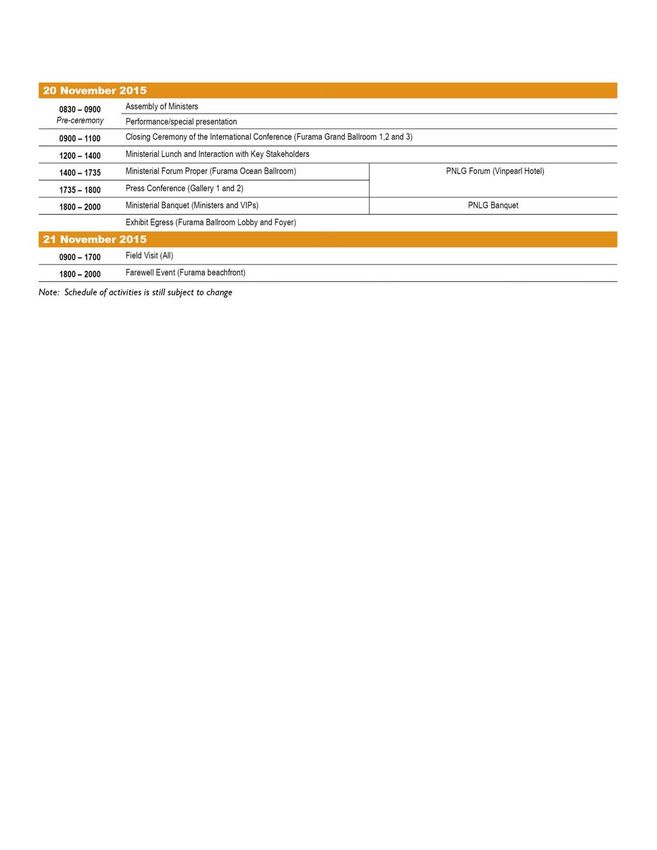
0830 – 0900 Assembly of Ministers
0830 – 1100 Closing Ceremony of the International Conference
The Closing Ceremony of the International Conference will include the following
highlights:
A. Reporting of the Session Conclusions and Recommendations of the International
Conference
Session 1: Prof. Bui Cach Tuyen
Former Deputy Minister
Ministry of Natural Resources and Environment
Viet Nam
Session 2: Prof. Wong Poh Poh
National University of Singapore
Session 3: Dr. Zhang Zhanhai
State Oceanic Administration
PR China
B. Youth Statement
C. Reporting of the International Conference Key Messages
International Conference Chair: Mr. Terence D. Jones
Former UNDP Resident Representative and
UN Resident Coordinator to the Philippines
D. Moderated Discussion with the Ministers
Moderator: Mr. Terence D. Jones
Turn over of the EAS Congress Flag
The Minister of the Ministry of Natural Resources and Environment of Vietnam will turn
over the EAS Congress flag to the representative of the host country for the EAS Congress
2018.
The representative of the host country for the EAS Congress 2018 will be requested to
deliver a short acceptance message.
Closing of the International Conference
The International Conference Chair will declare the closing of the EAS Congress
International Conference.
1100 – 1200 Viewing of Exhibition Gallery
Following the Closing Ceremony, the Ministers and selected VIPs will be invited to view
the Exhibition Gallery.
Page 15 of 861200 – 1400 Ministerial Lunch*
The lunch will be hosted by the Minister of MONRE, Viet Nam. The Ministers will be
joined by selected VIPs during lunch.
The Fifth Ministerial Forum
November 19, 2015 (Thursday)
Pre‐Forum Event
1730 – 1800 Assembly of Ministers
The Ministers and selected VIPs will be escorted to the Partnership Night venue.
(8 Ministers are expected to join the Partnership Night. Late arrival: Japan, RO Korea
and Singapore)
1800 – 2100 Partnership Night (see programme above)
November 20, 2015 (Friday)
PART 1 Closing of the International Conference (see programme above)
PART 2 Ministerial Forum Proper*
Venue: Furama Ocean Ballroom
The Master of Ceremony will introduce the Chair of the Ministerial Forum, the
Minister of MONRE.
1400 – 1410 Introductory Remarks
Hon. Nguyen Minh Quang
Minister
Ministry of Natural Resources and Environment (MONRE)
Vietnam
The Chair, the Minister of MONRE, Vietnam will welcome the Ministers
participating in the Ministerial Forum. The Chair will call on the Secretariat to
introduce the agenda and schedule for the Forum.
1410 – 1430 Keynote Speech
Hon. Haoliang Xu (to be confirmed)
Assistant Administrator and Director
Regional Bureau for Asia and the Pacific
United Nations Development Programme
New York
As a milestone year in global sustainable efforts, the keynote speech is expected
to highlight the experiences, achievements, gaps and lessons learned with regard
Page 16 of 86to the implementation of the Millennium Development Goals (MDGs) and the
new Sustainable Development Goals (SDGs) and how they relate to the East Asian
region and the SDS‐SEA. The keynote speech hopes to underscore the value of
cooperation and partnerships from local, national to regional level in meeting
global commitments and in addressing persistent or emerging challenges
particularly in the coastal and ocean development sphere.
1430 – 1500 Facilitated Discussion
Facilitator: Amb. Mary Seet‐Cheng, Chair, EAS Partnership Council
1. What are policymakers thinking about with regard to the UN SDGs (Target 14
in particular) and sustainable coastal and ocean development? What
innovative policies, legislation, frameworks and guidelines (legal, insitutional
and financial) are being considered, put forward, expanded on or put into
practice in your country?
2. What challenges arise with regard to SDG implementation in your country
and how do you envision addressing these?
3. Are governance mechanisms at the regional level adequate to facilitate
progress from an ocean economy to a sustainable ocean economy (e.g., blue
economy)? How can they be strengthened?
1505 – 1520 Introduction of the Updated SDS‐SEA and Post‐2015 Targets
Mr. Stephen Adrian Ross
PRF Executive Director
The PRF Executive Director will review the achievements at the country and
regional levels with regard to SDS‐SEA implementation since 2003, and introduce
the updated SDS‐SEA 2015. The PRF Executive Director will also present PEMSEA’s
post‐2015 strategic targets, the action programme for achieving the targets, and
the impact indicators that will be used to measure benefits.
1520 – 1540 Coffee Break
1540 – 1700 Ministers’ Statements
In response to the SDS‐SEA 2015 and PEMSEA’s post‐2015 targets (2016‐2021),
the Ministers will be invited to provide their country’s views and introduce their
respective initiatives or national plans. The Ministers will be given maximum of
eight minutes each for the delivery of their statements.
1700 – 1730 Signing of the Ministerial Document
The Chair will invite the Ministers to sign the Ministerial Document adopting the
SDS‐SEA 2015 and PEMSEA’s strategic targets for 2016‐2021.
Page 17 of 861730 – 1735 Closing and Photo Session
The Chair will close the Forum Session. The Chair will invite the Ministers for a
group photo to be facilitated by the Secretariat.
1735 – 1800 Press Conference
Venue: Gallery 1 & 2
The Minister of MONRE Vietnam will take the lead in the press conference. The
press conference will focus on the following tentative agenda:
(1) PEMSEA’s targets (2016‐2021) and its implication to the EAS countries
(2) Countries’ commitments to achieve the targets
(3) Countries’ commitments to PEMSEA as the regional collaborating mechanism
for SDS‐SEA implementation and achievement of the UN SDG’s Target 14
(4) Announcement of the EAS Congress 2018
1830 – 2030 Ministerial Banquet*
Host: MONRE Minister
The Minister of MONRE, Vietnam will host the Ministerial Banquet. The Ministers
will be joined by senior government officials, PEMSEA’s Executive Committee,
representatives from Non‐Country Partners, local chief executives, and selected
VIPs.
21 November 2015 (Saturday)
The Ministers will be invited to the field visit. The detailed programme of the field visit will be announced
in due course.
Part 3 Activity Session
0900 – 1800 Field Activity
Ministers will take part in the field visit to sites showcasing ICM initiatives, as well
as historic and natural heritage sites in the beautiful coastal city of Danang.
1800 – 2000 Farewell Event
Following the field visit, the Ministers will be invited to join the farewell event of
the EAS Congress 2015, hosted by the Vietnam Government. The event will be
participated in by all EAS Congress 2015 participants.
***
Page 18 of 86Field Visit
Field Trip Provisional Program
The Field Trip offers two themes, which will be conducted in parallel. The EAS Congress
participants may choose which theme they would like to participate in.
Theme 1: Biodiversity Conservation
09:00 – 10:30: Presentation on Accomplishments from the Club of Tho Quang community
focusing on coastal sustainable economic development (East Sea Resort, Son Tra
Peninsula, Danang)
10:30 – 12:00: Visit to the coastal tourism development site that promotes protection of natural
ecological system and biodiversity (Intercontinental Danang Sun Peninsula Resort)
12:00 – 14:00: Lunch
14:00 – 17:00: Boat ride at the Son Tra Peninsula featuring coastal ecological system and tourism
livelihood of the Tho Quang Club of fishermen
Theme 2: Sustainable City
09:00 – 12:00: Visit to the Khanh Son area for solid waste treatment and application of solid
waste treatment technology
12:00 – 14:00: Lunch
14:00 – 17:00: Visit to the typhoon resistant housing model within the framework of the Project
on 100 Resilience Cities of Rockefeller – Women Association of Danang
Page 19 of 86International Conference on Sustainable Coastal and Ocean Development
Date: November 17‐20, 2015
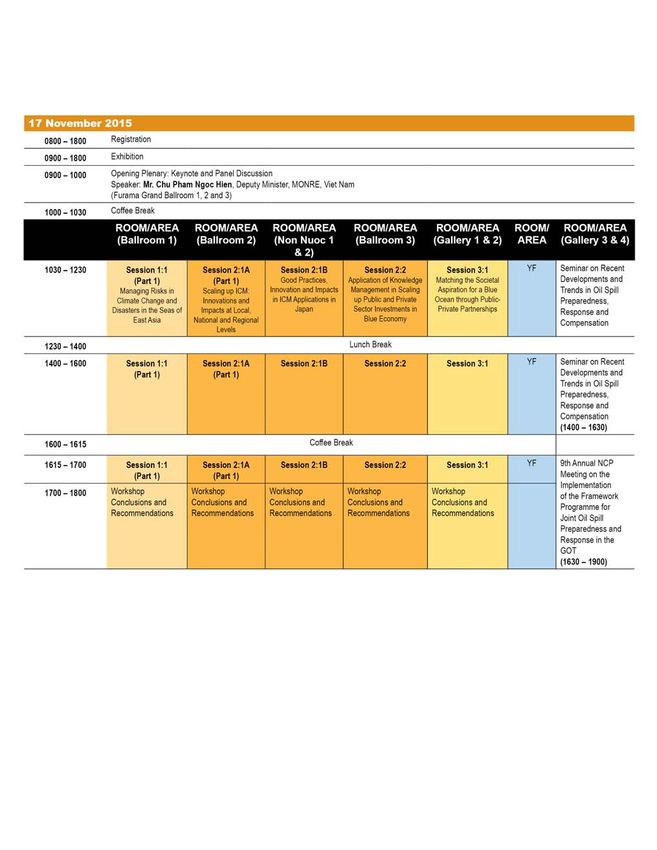
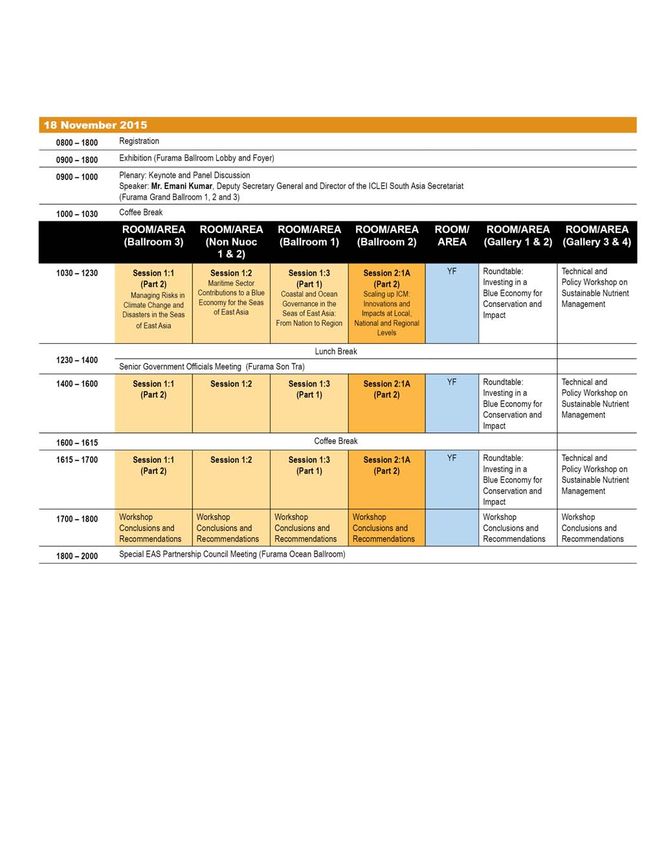
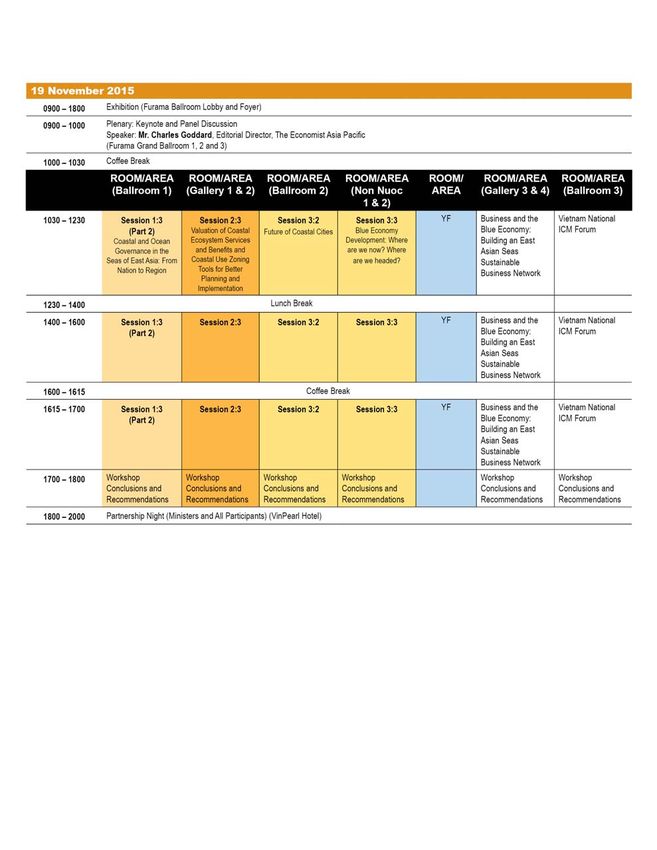
The International Conference will feature three major sessions that cover essential aspects of
sustainable coastal and ocean development. Each day, the International Conference will open
with a Plenary Keynote Address followed by a panel discussion. The plenary session will then
close, and a series of workshops will commence for the balance of the day. For each workshop,
conclusions and recommendations will be prepared by the workshop participants. The workshop
conclusions and recommendations will be incorporated into session conclusions and
recommendations, which will be reported at the Closing Ceremony of the International
Conference on 20 November.
The three sessions of the International Conference and the corresponding workshops include:
Session 1: A Decade of 1.1 Managing Risks in Climate Change and Disasters in the Seas of
Partnerships in East Asia
Sustainable Development 1.2 Maritime Sector Contributions to a Blue Economy for the Seas
of the Seas of East Asia: of East Asia
Synergies and 1.3 Coastal and Ocean Governance in the Seas of East Asia: From
Achievements Nation to Region
2.1 Scaling up ICM: Innovations and Impacts at Local, National
and Regional Levels
Session 2: Accelerating 2.2 Application of Knowledge Management in Scaling up
Actions for Sustainable Partnership Investments in Sustainable Development and a
Development and Climate Blue Economy
Change 2.3 Economic Valuation of Coastal Ecosystem Services and Marine
Spatial Planning: Tools for Better Planning and
Implementation
3.1 Matching the Societal Aspiration for a Blue Ocean through
Session 3: From Vision to
Public‐Private Partnerships
Reality: Aligning the
3.2 Future of Coastal Cities
Global Agenda with Local
3.3 Blue Economy Development: Where are we now? Where are
Benefits
we headed?
Session Chairs:
Session 1: Mr. Chu Pham Ngoc Hien, Deputy Minister of MONRE, Viet Nam
Session 2: Prof. Wong Poh Poh, National University of Singapore
Session 3: Dr. Zhang Zhanhai, Director General, Department of Strategic Planning and Economy,
State Oceanic Administration, PR China
Page 20 of 86Daily Opening Plenary Sessions
Venue: Furama Grand Ballroom
Date: November 17, 18 and 19, 2015
Time: 0900 – 1000
The Daily Opening Plenary Sessions of the International Conference will entail plenary keynote
presentations and panel discussions. Each day, the plenary sessions will focus on specific issue
areas, including: (a) redefining coastal and ocean governance in the East Asian Seas region; (b)
local actions contributing to national, regional and global commitments and targets through on‐
the‐ground actions and ICM implementation; and (c) engagement of the business sector in
building a Blue Economy in the East Asian Seas region.
Plenary Keynote Speakers and Panelists:
Plenary Keynote 1: Redefining Coastal and Ocean Governance in the East Asian Seas Region
Speaker: Mr. Chu Pham Ngoc Hien, Deputy Minister, MONRE, Viet Nam
Facilitator: Dr. Tony La Viña, EAS Partnership Council Co‐Chair
Panelists:
Ms. Louise Chamberlain, Country Director, UNDP Vietnam(to be confirmed)
Dr. Gunnar Kullenberg
Dr. Yoon Jin Sook, Former Minister, Ministry of Oceans and Fisheries, RO Korea
Plenary Keynote 2: Local Actions Contributing to National, Regional and Global Commitments
Speaker: Mr. Emani Kumar, Deputy Secretary General and Director of the ICLEI South Asia
Secretariat
Facilitator: Prof. Chul Hwan Koh, EAS Partnership Council Technical Session Co‐Chair
Panelists:
Mr. Huynh Duc Tho, Chairman, Danang People’s Committee
Dr. Delfin Ganapin, Global Manager, UNDP GEF Small Grants Programme
Mr. Samuel Gumarin, M.D., Governor, Guimaras Province, Philippines (to be
confirmed)
GEF (to be determined)
Plenary Keynote 3: Engagement of the Business Sector in Building a Blue Economy in the East
Asian Seas Region
Speaker: Mr. Charles Goddard, Editorial Director, The Economist Asia Pacific
Facilitator: Mr. Makoto Harunari, EAS Partnership Council Technical Session Co‐Chair
Panelists:
Dr. Doan Duy Khuong, Chairman, Viet Nam Business Council for Sustainable
Development
Ms. Christine Valentin, Director for Strategy, Members and Finance., World Ocean
Council
Ms. Charmaine Canillas, AVP for Corporate Affairs, Petron Corp. and General Manager,
Petron Foundation, Inc.
Mr. Abid Butt, CEO, Banyan Tree (to be confirmed)
Page 21 of 86Session 1: A Decade of Partnerships in Sustainable Development of the Seas of
East Asia: Synergies and Achievements
This session explores the progress and achievements in coastal and ocean governance since the
signing of the Putrajaya Declaration adopting the Sustainable Development Strategy for the Seas
of East Asia (SDS‐SEA) in 2003 and explores new challenges and international commitments, and
their impact on important coastal and ocean sectors and economies in the region.
Workshop 1.1: Managing risks in climate change and disasters in the seas of East Asia
Venue: Furama Ballroom 1 (Day 1); Furama Ballroom 3 (Day 2)
Date: November 17‐18, 2015
Time: 1030‐1800
Workshop Co‐conveners: Korea Marine Environment Management Corporation (KOEM); Korea
Environment Institute (KEI)
Workshop coordinator: Mr. Danilo Bonga and Ms. Daisy Padayao, PEMSEA
TITLE OF WORKSHOP:
Managing risks in climate change and disasters in the seas of East Asia
Owing to its geographical location, socioeconomic condition and growing population, the East Asian Seas
(EAS) region is one of the most vulnerable areas to the impacts of the changing climate. Socioeconomic
losses and environmental issues have been aggravated by stronger typhoons, prolonged droughts,
intense flooding and sea level rise. Addressing climate change and disaster risks is key because it provides
opportunities to improve, strengthen and realize the ingenuities of societies to adapt. Of varying scope,
strategies and methodologies, efforts at all levels (globally, regionally, nationally and locally) and sectors
are increasing towards adapting to the impacts of climate change, reducing the vulnerabilities of
communities and enhancing their capacities to cope and respond to disaster risk.
Governed by the commitments made by the EAS countries in the last three past Congresses, and by the
recent changes towards a post‐2015 frameworks by three important international instruments, namely,
sustainable development agenda and goals, climate change and disaster risk reduction, it is an opportune
time to re‐visit progress made to advance specific actions for managing risks in the seas of East Asia
Over the years, the region has seen the explosive growth in the knowledge and information on the
impacts and risks, which were translated as policy changes and practice in CCA and DRR, including the
scaling up ICM. We have rejoiced in well crafted implementation. But we have missed in some too:
knowledge gaps, capacity development and financing and investment needs.
To date however, a strategy for East Asia integrating interventions to further address threat of climate
change and reduce disaster risk has not been adopted. Adopting a strategic framework for adaptation—
with clearer goals and targets—would help set the direction for, and track progress in managing risks in
climate change and disasters the EAS region.
The workshop is a two‐day event. It will articulate and encapsulate valuable lesson lessons learned. Too,
as offered by the new paradigms, this is a forum which aims to articulate new ways of looking at climate
change and disaster risks as more than just an external shock but symptomatic of continuing
accumulation of risks driven by economic and development plans, policies and actions.
Page 22 of 86The workshop will present good practices, working models and innovative solutions in managing risks in
climate change and disasters at the local level in the EAS region. It will discuss how an integrated
approach has facilitated local governments to adapt, prepare and reduce disaster risks. These local
initiatives will also highlight their contribution in addressing national priorities, regional and global
targets to CCA/DRR.
The workshop will also tackle the need for a strategic framework for CCA/DRR, and how its
implementation can be facilitated and scaled up through the transfer and replication of working models
and good practices in CCA/DRR. The workshop will identify priority areas for implementation, key targets,
needs and challenges, including opportunities for knowledge‐sharing, replication and collaborative
efforts for advancing CCA/DRR in the EAS region.
The forum offers a platform to synergize actions in East Asia that needs to be coherently complementing
those set forth by the three international instruments.
TARGET AUDIENCE AND EXPECTED NUMBER OF PARTICIPANTS:
● Practitioners of ICM, climate change and disaster risk reduction programs
● Regional and international organizations, NGOs working on climate change and disaster risk
reduction programs
● National and local governments, including ICM sites,
● Business sector, academe, interdisciplinary researchers
● ICM Learning Centers and academic institutions
FORMAT OF THE EVENT:
Workshop with keynote presentations, related presentations and panel discussions
OBJECTIVE(S):
The workshop aims to:
● Articulate and encapsulate the lesson lessons learned in the last 10 years and new paradigms of
looking at issues of climate change and disaster risk reduction.
● Share good practices and working models in managing risks in climate change and disasters in the
EAS region
● Build consensus on a regional strategy for CCA/DRR in the EAS region
● Identify priority areas, key targets, needs and challenges for the implementation of the regional
strategy for climate change adaptation, including opportunities for knowledge‐sharing, replication
and collaborative efforts for advancing CCA/DRR in the EAS region
● Serve as platform to synergize actions in East Asia that needs to be coherently complementing those
set forth by the three international instruments
EXPECTED OUTPUTS:
1. Resource document on lesson learned in the maturation of local governments’ ICM systems and
their contributions to international, regional and national targets for managing climate change and
disaster risks
2. Compilation of good practices and working models in managing risks in climate change and disasters
in the EAS region
3. Consensus on a regional strategy for CCA/DRR
4. Action plan for CCA/DRR including priority areas for implementation, key targets, needs and
challenges, including opportunities for knowledge‐sharing, replication and collaborative efforts for
advancing climate change adaptation in the EAS region
Page 23 of 86PROVISIONAL WORKSHOP PROGRAMME
Workshop Chair: N.M.S.I. Arambepola, Asian Disaster Preparedness Center (ADPC)
Co‐Chair (Day 1: Dr. Chang Man, KOEM)
Co‐Chair (Day 2: Dr. Park Kwang Kook, KEI)
Time Activity/Presentation Possible
Speaker/Panelist
Day 1 Focus: International, Regional, National
Part 1: Addressing the new challenges in managing risks
1030 ‐ 1035 Opening Remarks Dr. Chang Man
President
KOEM
1035 ‐ 1045 Workshop Chair’s Introduction Mr. N.M.S.I. Arambepola,
Workshop Chair
Overview of the workshop ADPC
Objectives of the workshop and expected
outputs
Introduction of keynote presentation
1045 – 1120 Keynote presentation Mr. Abhilash Panda
Urban Risk Reduction
Major international frameworks in the and Resilience,
post‐2015 era—managing disaster and The Making Cities
climate risk for sustainable development Resilient Campaign,
UN Office for Disaster
Risk Reduction
(UNISDR)
1120 ‐ 1140 Towards Urban Risk Reduction: Experience Mr. N.M.S.I.
from EAS Region Arambepola/
Mr. Anisur Rahman
ADPC
Part 2: Towards convergence: unpacking the obstacles on integrating disaster risk reduction and
climate change adaptation in development planning process
1140 – 1230 Panel discussion on the obstacles in policy, Panelists:
research and practice including constraints in: Head, Department
international and national policy processes; funding of Meteorology,
institutions and support mechanisms; research and Hydrology and
sharing of knowledge Climate Change,
Vietnam (TBD)
Dr. Tony La Vina, Co‐
Chair, Executive
Committee, PEMSEA
Mr. Abhilash Panda ,
UNISDR
Mr. N.M.S.I.
Arambepola, ADPC
1230 – 1400 Lunch break
Page 24 of 86Part 3: Overcoming institutional and practical difficulties
1400 – 1420 Strategies in responding to disappearing coastlines Prof. Wong Poh Poh
Visiting Associate
Professor at the School of
Social Sciences and
Centre for Coastal
Research, University of
Adelaide, South Australia
1420 ‐ 1440 Ocean observation to increase predictability in Prof. Qiao Fangli
climate change adaptation: status of scientific First Institute of
studies and challenges in Asia and Pacific Oceanography (FIO),
China
1440 ‐ 1500 Overcoming institutional challenges: Republic of Dr. Lee Suk‐hui
Korea's climate change policy Deputy General Manager
KOEM
1500 ‐‐1520 Capacity development and responding to CCA/DRR Dr. Michael DiGregorio,
Asia Foundation
Representative in
Vietnam
1520 ‐ 1540 Funding mechanisms for CCA and DRR Pradeep Kurukulasuriya
Head‐ Climate Change
Adaptation (Global)
Global Environment
Finance Unit
Sustainable Development
Cluster
Bureau for Policy and
Programme Support
United Nations
Development
Programme
(UNDP)
1540 ‐ 1600 Open forum
1600 ‐ 1615 Coffee break
1615 ‐ 1645 Strengthening PEMSEA’s contribution in CCA/DRR Dr. Tony La Viña,
in the EAS region PEMSEA
Introduce the Adapt Strategy of the updated
Sustainable Development Strategy for the Seas of
East Asia and linking lessons learned in the
maturation of local governments’ ICM systems in
the seas of East Asia and their contributions to
international, regional and national targets for
managing climate change and disaster risks.
1645 ‐ 1745 Panel discussion on synergizing actions to Panelists:
complement those set forth by the three Mr. Titon Mitra,
international instruments Country Director
o Contributions of international/regional UNDP Philippines
organizations/institutions/national to the Mr. Abhilash Panda,
Adapt Strategy, including post‐disaster UNISDR
Page 25 of 86recovery Mr. N.M.S.I.
Arambepola, ADPC
GIZ‐Vietnam
Prof. Qiao Fangli,
China (SOA)
Climate Change
Commission of the
Philippines/ DENR
Climate Change Office,
Philippines
1745 ‐ 1800 Wrap‐up Workshop Chair
Day 2 Focus: Local Contributions
1030 ‐ 1040 Recap of previous day’s discussion Workshop Chair
1040 ‐ 1110 Responding to climate change and disaster risk Dr. Park Kwang Kook
through local actions President
KEI
Part 4: Good practices and working models: Contributions to the Adapt Strategy
Local contributions to mainstreaming CCA/DRR in planning and management
1110 ‐ 1130 Integrating CCA/DRR in local planning and Danang Department of
management Construction, Vietnam
(TBD)
1130 ‐ 1150 Environmentally and climate‐friendly urban and Nampho City, DPRK
coastal development for climate change adaptation (TBD)
Innovative local solutions to CCA/DRR
1150 – 1210 Use of traditional knowledge in responding to Mr. Doddy Achadijat
climate change and disaster risks Somantri
Sukabumi ICM Program
Sukabumi, Indonesia
1210 ‐ 1230 Application of innovative technologies for CCA/DRR KEI, ROK
(TBD)
1230 ‐ 1400 Lunch break
1400 ‐ 1420 Land subsidence and CCA in Jakarta Bay, Indonesia Dr. Park Hansan
Korea Institute of Ocean
Science and Technology
(KIOST)
1420 – 1440 Sustaining coastal and marine ecosystem services Nisakorn Wiwekwin
for climate change adaptation and disaster risk Chonburi ICM Program
reduction Chonburi, Thailand
1440 ‐‐ 1510 Panel discussions Panelists:
o Replicability to other sites o GIZ‐Vietnam
o Challenges and constraints o National Climate
Change/Disaster
Offices (Philippines,
Vietnam, Japan)
Building Back Better
1510 – 1530 Post‐Haiyan Recovery Alma Evangelista
Page 26 of 86Team Leader
Resilience and Peace
Building Unit
UNDP Philippines
1530 ‐‐ 1550 Post‐tsunami Recovery: The 2004 Indian Ocean Dr. Abdul Muhari
tsunami in Banda Aceh‐Indonesia Directorate General for
Marine, Coasts and Small
Islands
Ministry of Marine Affairs
and Fisheries (MOMAF)
Indonesia
1550 ‐ 1615 Panel discussions Panelists:
o Distilling lessons learned from post‐
recovery efforts Dr. Wong Poh Poh,
o How can ICM respond to post‐recovery University of
efforts? Adelaide, South
Australia
Dr. Abdul Muhari,
MOMAF, Indonesia
Mr. N.M.S.I.
Arambepola, ADPC
Dr. Michael
DiGregorio, Asia
Foundation
1615 ‐ 1630 Coffee break
Part 5: Implementing the Adapt strategy…Way Forward
1630 ‐ 1800 Synthesis, wrap‐up and conclusions Workshop Chair/Co‐
Chairs
Distill the learning experiences from the
presented case studies and how these
experiences can be scaled up, transferred or
replicated in other sites.
Identify priority areas, gaps and challenges for
CCA/DRR in the EAS region
Identify opportunities for knowledge‐sharing,
replication and collaborative efforts for
advancing CCA/DRR in the EAS region.
Page 27 of 86Workshop 1.2: Maritime Sector Contributions to a Blue Economy for the Seas of East Asia
Venue: Furama Non Nuoc 1 & 2
Date: November 18, 2015
Time: 1030 – 1800
Workshop Co‐conveners: International Petroleum Industry Environmental Conservation Asso. (IPIECA)
and ASEAN‐German Technical Cooperation ‘Sustainable Port Development in the ASEAN Region’ Project
Supporting Organizations: IMO, IOPC Fund, ITOPF, OSRL,
Workshop coordinator: Ms. Diana Factuar, PEMSEA
TARGET AUDIENCE:
Representatives from the following groups:
Key officials from IMO, IOPC Fund, ITOPF, IPIECA, OSRL, ASEAN‐GIZ Project
Maritime administrations
Ports authorities and operators
Academe and research institutes
Local government representatives
Oil industry associations and companies
Ship owners association representatives (FASA, FSA, SSA, etc)
OBJECTIVE(S):
1. To update participants on global maritime industry trends and opportunities and its contribution to
blue economy;
2. To showcase the initiatives and achievements of various stakeholders of the maritime industry in
promoting a blue economy;
3. To come up with policy recommendations, strategy and road map to further facilitate and
strengthen blue economy in the EAS region.
FORMAT OF THE EVENT:
The workshop consists of 2 parts:
Part 1: “Developments, Prospects and Challenges in Promoting a Sustainable Maritime
Industry “
Part 2: “Protecting our Shared Values in the Seas of East Asia: Maritime Contributions to
Achieving Blue Economy ”
Part 1 will have a keynote presentation followed by a panel discussion (panelist representing the
subsectors such as port, shipping, oil and gas industry and government)
Part 2 will consist of presentations on various initiatives of the maritime industry (both government
and private sector) to promote sustainable and environment‐friendly operations.
Page 28 of 86Part 1
Introduction from the Chair)
Keynote presentation: The keynote presentation focused on Recent Developments and Trends in
International Maritime Industry will provide an overview of the global maritime industry specifically on
international shipping, port and energy sectors, their economic contribution to world trade,
opportunities and challenges.
Plenary Presentations and Panel Discussion
The keynote presentation will be followed by a plenary presentations and panel discussion. The panel
will consist of sector representatives from the port, shipping and energy (oil and petroleum industry and
government representatives). The panel discussion will cover the following topics: (1) How the 3 sectors
contribute to blue economy? (2) What are the opportunities available in the 3 sectors? (3) What are
the areas for further development? (4) What are the challenges? and (4) How do they balance the
increasing demand for its services with environmental sustainability?
Part 2
Part 2 will consist of a keynote presentation, plenary presentation and a panel discussion. The keynote
presentation will focus on Prospects for Sustainable Growth from the Maritime Sector.
Plenary presentations and Panel Discussion
The plenary presentations will cover actions and initiatives at the regional and national level.
Workshop
A moderated discussion will follow after the plenary presentations to come up with a roadmap that will
promote the development of a blue economy in the EAS region to maximize sustainable use of the
oceans and seas while enabling growth of the maritime economy and coastal regions.
EXPECTED OUTPUTS:
1. Increased awareness on recent developments, prospects and challenges in the international
maritime industry and its role in promoting a blue economy;
2. Showcase various initiatives of stakeholders in the maritime industry to promote blue economy and
environmental sustainability;
3. Identify strategies to further enhance environmental performance of the maritime operations in
collaboration with international organizations, national and local governments and key
stakeholders;
4. Develop a road map that will promote the development of a blue economy in the EAS region to
maximize sustainable use of the oceans and seas while enabling growth of the maritime economy
and coastal regions.
KEY MESSAGE(S) OF THE WORKSHOP
The maritime transport sector is an essential component to blue economy.
IMO has developed and maintained a comprehensive regulatory framework that provides countries
Page 29 of 86with a blueprint for a sustainable maritime transport industry.
As environmental sustainability is increasingly recognized as an important consideration for
transport, the sector is coming under greater pressure to shift towards greener, low‐carbon and
more environment‐friendly patterns.
Over the past few years, maritime transport has increasingly moved to the center stage of
discussions on climate change and energy sustainability. The drive to improve the sector’s
environmental and energy performance, including its carbon footprint, is driven both by regulation
(for example, the IMO) and by customers’ demands for greater corporate social responsibility in
global supply chains.
Several government‐ and industry‐led initiatives have emerged to mainstream sustainability criteria
into planning processes, policies, and investment strategies.
There is a need to formulate or reshape approaches and strategies to promote blue economy
complemented with sustainable and integrated maritime policies, programmes and investment
strategies that balance economic, environmental and social objectives towards sustainable and
inclusive development.
PROVISIONAL WORKSHOP PROGRAMME
Time Activity/Presentation Possible
Speaker/Panelist
Part 1: Developments, Prospects and Challenges in Promoting a Sustainable Maritime Industry
1030 ‐ 1040 Introduction from the Chair Mr. Brian Sullivan
Executive Director
IPIECA
1040 ‐ 1100 Keynote Presentation : Recent Developments, Mr. Gerardo A. Borromeo
Emerging Trends and Challenges in the International Chief Executive Officer
Maritime Industry Philippine Transmarine
Carriers, Inc. (PTC)/
Vice Chairman,
International Chamber of
Shipping (ICS)
(to be confirmed)
1100 – 1230 Panel Discussion: Promoting Economic Growth
and Environmental Sustainability in the Maritime
Sector
(each panelist will provide a 10 minute response to
the keynote address, focusing on sectoral
perspectives on emerging trends and challenges in
the International maritime sector)
Recent Developments and Emerging Trends with Mr. Alex Hunt
regard to shipping incidents: Its Impacts to the Technical Team Manager
development of the maritime industry The International Tanker
Owners Pollution
Federation Limited
(ITOPF)
Perspective from the Port Industry IAPH (TBD)
Page 30 of 86Time Activity/Presentation Possible
Speaker/Panelist
Perspectives from the Oil and Gas Industry and Mr. Dave Davidson
efforts to strengthen preparedness and response to Emergency Management
oil spill incidents (The Oil Spill Response Joint Advisor
Industry Project) Chevron Services
Company
Perspectives on the Availability of Mr Thomas Liebert (TBC)
Compensation following an oil spill incident in SEA Head, External Relations
& Conference
IOPC Funds
Perspective from the Government Sector (from
maritime administration)
China
Japan
Singapore
Vietnam
1230 ‐ 1400 Lunch break
Part 2: Protecting our Shared Values in the Seas of East Asia: Maritime Contributions to Achieving Blue
Economy
1400 – 1410 Introduction from the Co‐Chair Ms Franca Sprong‐
Wijnreder
Project Director
GIZ –Sustainable Port
Development in the
ASEAN Region
1410 ‐ 1430 Keynote Presentation on Blue Growth: Prospects IMO (TBC)
for Sustainable Growth from the Maritime Sector
Panel Discussion: Actions and Initiatives at the
Regional and National Level (each panelist will provide
a 10 minute response to the keynote address, focusing
on sectoral initiatives/perspectives on investment and
partnership opportunities in blue economy
development across the maritime sector)
1430 – 1615 Improving Port Productivity and Environmental Ms Franca Sprong‐
Performance of Ports in the ASEAN Region (20 min) Wijnreder
Project Director
GIZ –Sustainable Port
Development in the
ASEAN Region
Promoting Government‐Industry partnership to Mr. Philip Ruck
Minimise the Impacts and Risks of the Petroleum Manager for Oil Spill and
Industry (The GI South East Asia programme) Biodiversity, Ecosystem
Services
IPIECA
Embedding Tiered Preparedness and Response Mr. Darren Waterman
Regional Director (Asia
Pacific)
Page 31 of 86Time Activity/Presentation Possible
Speaker/Panelist
Oil Spill Response
Limited (OSRL )
Governments’ Response Representatives from
(TBD):
Indonesia
Malaysia
Philippines
RO Korea
Thailand
1615‐ 1630 Coffee break
1630 – 1700 Open Discussion
Part 3: Workshop Conclusion and Recommendations
1700 – 1800 Moderated Discussion: Roadmap to promote blue IMO (Moderator) TBC
growth in the EAS region to maximize sustainable use
of the oceans and seas while enabling growth of the
maritime economy and coastal regions.
Page 32 of 86Workshop 1.3: Coastal and Ocean Governance in the Seas of East Asia: from Nation to Region
Venue: Furama Ballroom 1
Date: November 18‐19, 2015
Time: 1030 – 1800
Workshop Co‐conveners: GIZ and Ocean Policy Research Institute‐ Sasakawa Peace Foundation (OPRI‐SPF)
Supporting organization: UNDP
Workshop Coordinator: Mr. Yinfeng Guo, PEMSEA
TARGET AUDIENCE:
Members of governing bodies of regional seas programs, mechanisms and initiatives, senior
national and local ocean and coastal development planners and managers from EAS region
Beneficiaries of regional seas programs, initiatives and mechanisms, including:
o Community of practice in fishery, MPAs, climate change adaptation, water resource
management, pollution reduction, etc
o Business community
o Academia, PEMSEA Regional Centers of Excellence, ICM learning Centers, etc
o Local government representatives
o Non‐governmental organizations
OBJECTIVE(S):
1. To showcase the progress, achievements, impacts and lessons learnt from transboundary
management of LMEs and regional seas governance in the EAS region and globally;
2. To learn from national initiatives in institutional, policy and legal reforms in support of
implementation of LME SAPs and regional sustainable development strategies;
3. To better understand the challenges and gaps in research and education, implementation and
reporting, and transboundary partnerships within the seas of East Asia and identify solutions and
respond to challenges, and opportunities for collaboration among regional mechanisms, national
and local governments and donor agencies; and
4. To facilitate exchanges in regional and national policies and initiatives for coastal and ocean
governance reflected in the Future We Want at Rio+20 and SDGs
Rationale
The six Large Marine Ecosystems (LMEs) and subregional seas1 of East Asian region are experiencing
physical, ecological and socio‐economic changes associated with infrastructure development,
urbanization, extreme climate events, land and sea‐based activities, and population increase.
International cooperation at regional and LME levels has facilitated in many ways collaborative
responses among countries to the challenges and uncertainties with countries’ adoption of ocean
policies and measures in alignment with the regional action programs such as the strategic action
programme (SAP) and regional sustainable development strategy.
What are the drivers that have shaped the regional coast and ocean governance? What achievements
and impact have these regional governance mechanisms made in addressing overfishing,
eutrophication, loss of coastal and marine biodiversity and other transboundary issues in the last
decade? What are the gaps in our understanding of the coasts and oceans? What are the innovative
implementation and governance mechanisms for SAPs and the regional strategy? What should the
1
Yellow Sea, East China Sea, South China Sea, Sulu‐Sulawesi Seas, Indonesia Seas and Gulf of Thailand
Page 33 of 86collaborating countries do in terms of policy and regulatory framework and institutional arrangements
to make these regional mechanisms and initiatives work more effectively? This workshop is designed to
facilitate regional and national initiatives to respond to the ocean agenda enshrined in the Future We
Want at Rio+20 and SDGs. The workshop seeks to attract around 180‐200 participants.
EXPECTED OUTPUTS:
1. Improved knowledge and appreciation of progresses, achievements, and impacts of regional ocean
governance in the EAS region at national and subnational, LME and regional level;
2. Better understanding of the gaps, challenges, lessons learnt and opportunities for making regional
governance of transboundary LMEs and regional seas more country‐owned, effective and
sustainable; and
3. Elaboration and common understanding on the way forward in development of national policies
and regulatory framework and partnerships for improving coastal and ocean governance to
contribute to achieve SDGs in the EAS region
PROVISIONAL WORKSHOP PROGRAMME
Time Activity/Presentation Possible Speaker/Panelist
Day 1 (Regional and National)
Chair: PEMSEA
Keynote presentation: Regionalizing the SDGs – Dr. Andrew Hudson
the Perspectives of the UNDP/GEF Head, Water & Ocean
Governance Programme,
1030 – 1100 This introductory session will set the scene and Bureau for Programme and
outline the ocean agenda under SDGs, and their Policy Support, UNDP
relevance to EAS region and countries
Towards Good Regional Ocean Governance – Dr. Andreas Kalk
Status, Gaps and Policy Recommendations at Resident Director GIZ
Regional and National Levels Philippines and Pacific &
1100 – 1130 Project Director GIZ SSME
This presentation will cover the results of a regional Project
review of LMEs and regional sea governance
mechanisms
Part 1: From Johannesburg Plan of Implementation to SDGs: Meeting the Aspirations of Nations in
Regional Seas Governance.
This workshop will showcase the progress and lessons learnt from multi‐country cooperation in the EAS
region, as well as the gaps and opportunities to effectively respond to existing and emerging coast and
ocean management challenges. The workshop assessment will focus on ways and means of
strengthening regional seas governance to address gaps in knowledge and capacity, as well as facilitate
implementation and reporting on progress of regional action plans and partnership arrangements.
Panelists will each have 10 minutes to introduce areas of progress, innovation and gaps in their
respective countries/organizations.
Page 34 of 86Time Activity/Presentation Possible Speaker/Panelist
Chair: Dr. Andreas Kalk, Resident Director GIZ Philippines and Pacific & Project Director GIZ SSME
Project
Panel Part 1: Regional Seas Governance Panelists:
Mechanisms: drivers, progress and lessons Dr. Tonny Wagey, Former
learnt Project Manager, ATSEA
Regional Project
This panel session will focus on the general Dr. Widi Agoes Pratikto,
approaches and impacts of regional coastal and Executive Director, CTI‐CFF
ocean governance mechanisms, including Regional Secretariat
synergies with national coordinating Mr. Stephen Adrian Ross,
mechanisms and other important stakeholders, Executive Director,
1130 – 1230 as well as achievements, shortcomings and PEMSEA
lessons learnt in addressing common Dir. Rayner Stuel Galid,
challenges encountered by participating Chair, SSME Tri‐national
countries. Committee (TBD)
Dr. SungKwon Soh, Project
Manager, WCPFC
Regional Seas Programme,
UNEP (TBD)
Dr. Alexander Tkalin,
Coordinator, NOWPAP
1230 – 1400 Lunch
1400 – 1600 Panel Part 1 cont’d, with Open Forum Facilitated by GIZ
(Continuation of
Part 1) Panel discussion will focus on the following
questions:
1. What factors/indicators are being used to
determine the success of regional seas
governance mechanisms and SAPs?
2. What are the means applied to monitor
and report on progress towards SAP
objectives, and the impact and benefits
derived?
3. How can regional organizations work better
together, to the greater benefit of
countries of the region and the health and
resiliency of the regional seas?
1600 – 1615 Coffee break
Panel Part 2: Partnerships for Win‐Wins Panelists:
towards Achieving the SDGs Thi Thai Vai Van Quang,
Head of Technical Division,
This part will explore good practices in Department of Agriculture
partnership development with academia, and Rural Development, Da
1615 – 1745
youth, local governments, private sector and Nang, Viet Nam
other stakeholders to achieve the desired goals Atty. Roberto Oliva ,
of SAPs in line with the SDGs. Executive Director, ASEAN
Center for Biodiversity
(ACB)
Page 35 of 86Time Activity/Presentation Possible Speaker/Panelist
Mr. Roberto Baylosis,
former president of
Southern Philippines Deep
See Fishing Association
Inc., Philippines (SOPHIL)
Dr. Theresa Mundita Lim,
Chair, CTI MPA TWG
Dr. Toni Ruchimat,
Chair, TWG on
CTI‐CFF Ecosystem
Approach for Fisheries
Management,
Director of Fish Resources‐
Directorate General of
Capture Fisheries, MoMAF,
Indonesia
Dr. Chung Fungchen, Lead
marine biologist, Reef
Guardian, Sabah, Malaysia
Dr. Sulan Chen, Program
Advisor ‐International
Waters and Chemicals
Regional Focal Point ‐ Asia,
Europe and CIS countries,
UNDP GEF Small Grants
Programme,
Panel Part 2 with Open Forum Facilitated by Dr. Gunnar
Kullenberg
Moderated discussion focuses on:
1. What mechanisms facilitate your
participation in implementation of the
regional SAP or SDS?
2. What are the motivations that attracted
your organization to partner with the
regional seas programme?
3. How are you benefiting from the
partnership? What would you do to
improve the partnership?
4. What do you hope to achieve through this
partnership?
1745 – 1800 Wrap‐up of day 1 UNDP, with inputs from
PEMSEA and GIZ
Day 2: (National and Local)
Part 2: Development of ocean policies in the Seas of East Asia – Case studies of selected countries
This Part will discuss the status of national policies, legal and regulatory frameworks under framework
of UNCLOS, Agenda 21, WSSD Plan of Implementation and The Future We Want. The workshop will
Page 36 of 86You can also read


