Better health and well-being - planning for
←
→
Page content transcription
If your browser does not render page correctly, please read the page content below
planning for
better health
and well-being
in wales

A briefing on integrating planning and public health
for practitioners working in local planning authorities
and health organisations in Wales

Town & Country Planning Association, with
Wales Health Impact Assessment Support Unit and Public Health Wales
Planning for Better Health and Well-being in Wales
t
     A Briefing on Integrating Planning and Public Health for Practitioners Working in Local Planning
     Authorities and Health Organisations in Wales

     Town & Country Planning Association, with
     Wales Health Impact Assessment Support Unit and Public Health Wales
     © November 2016

     Authors:
     Michael Chang, TCPA
     Liz Green, Wales Health Impact Assessment Support Unit/Public Health Wales
     Hilde Steinacker, TCPA
     Steinthora Jonsdottir, Public Health Wales

r
     Acknowledgements:
     The authors would like to acknowledge the contribution made by a number of individuals during the process of
     writing this document. Contributions were received by email as well as through attendance at a stakeholder
     workshop held on 20 May 2016 in Cardiff. The contributors are:
     ● Sumina Azam, Public Health Wales
     ● Rodney Berman, BMA Wales
     ● Bronia Brendall, Natural Resources Wales

9.   ● Hywel Butts, Welsh Government
     ● Rachel Davies, City and County of Swansea
     ● Nerys Edmonds, Public Health Wales
     ● Maria Godfrey, Caerphilly County Borough Council
     ● Nicola Gordon, Public Health Wales
     ● Lara Griffiths, Denbighshire County Council
     ● Ed Huckle, Public Health England
     ● Kristian James, Public Health Wales
     ● Lisa James, Caerphilly County Borough Council
     ● Adam Jones, Public Health Wales
s    ● Mark Newey, Welsh Government
     ● Lee Parry-Williams, Public Health Wales/Wales Health Impact Assessment Support Unit
     ● Kay Powell, TCPA
     ● Ruth Tipping, Natural Resources Wales
     ● Jonni Tomos, Welsh Government
     ● Sue Toner, Public Health Wales
     ● Malcolm Ward, Public Health Wales
     ● Stuart Williams, Cardiff City Council

h
Contents
0 Executive summary page 2
1 Introduction page 3
1.1 Purpose and audience
1.2 Why planning for health and well-being is so important
2 Opportunities for public health involvement in page 8
the planning system
2.1 Planning policy context
2.2 The roles and responsibilities of key planning organisations
2.3 Opportunities for public health teams to engage with development
planning (policy)
2.4 Opportunities for public health teams to engage with development
management (planning applications)
3 Opportunities for planning involvement in public page 15
health system
3.1 Health policy context
3.2 The roles and responsibilities of key health organisations
3.3 Opportunities for planners to engage with the public health system
4 Opportunities in the Well-being of page 19
Future Generations (Wales) Act 2015
4.1 Well-being policy context
4.2 The roles and responsibilities of key bodies
4.3 Ensuring planning representation in Public Services Boards
4.4 Setting out local planning for health objectives in the local well-being plan
and statement
5 Practical resources page 22
6 Conclusions page 28
Annex 1 Glossary page 29
Annex 2 Useful resources and national organisations page 31
Annex 3 Topical summaries page 33
Annex 4 The health of the population in Wales page 362 Briefing on integrating planning and public health for practitioners
Section 0
Executive summary
The way we plan and design the built environment can resources for navigating through the processes and
have a profound impact on people’s health and well- protocols in both the planning and health domains.
being. Welsh public authorities – the 22 local planning
authorities and the seven Local Health Boards across The Briefing concludes by setting out four messages
Wales – have specific duties and powers, as set out in crucial to improving policy and practice in planning for
legislation, to improve well-being and reduce health health and well-being:
inequalities. ● stronger together through improved collaboration;
● shared evidence, leading to shared policy actions;
This Briefing was prompted by the duty placed on ● shared policy actions, leading to shared outcomes;
public bodies by the Well-being of Future Generations and
(Wales) Act 2015 to contribute to achieving national ● building crucial relationships and exchanging
well-being goals, and by the strengthening the plan- knowledge.
led planning system, again with a requirement to
contribute to well-being goals, instituted by the
Planning (Wales) Act 2015. These legislative changes
provided a timely opportunity to develop practical
guidance for both planning and public health
practitioners and policy-makers, to help them take
health and well-being considerations into account
when drawing up local well-being plans and Local
Development Plans and when making decisions on
planning applications.
The TCPA, the Wales Health Impact Assessment
Support Unit (WHIASU) and Public Health Wales have
collaborated to develop this Briefing as a practical
guide for practitioners across disciplines. It has been
strengthened by the contribution of other national and
local stakeholders to the preparation process,
including discussions at an advisory workshop. It is
aimed specifically at planners and environmental and
public health specialists working in local government,
local public health teams and Local Health Boards, as
well as at other practitioners working in the built and
natural environments.
In addition to setting out policy and legislative
requirements for planning for health within the current
planning and public health systems, Sections 2 and 3
the Briefing highlight – and illustrate through current
good practice – where specific actions can be
undertaken at key stages of the respective systems.
Section 4 suggests how the new well-being
requirements can help frame strategic actions in
planning for health, and Section 5 provides practical3 Briefing on integrating planning and public health for practitioners
Section 1
Introduction
1.1 Purpose and audience While this document can be read from cover to cover,
some readers might choose instead to focus on
The preparation and publication of this Briefing was particular topics and resources. Figure 1 on page 4
prompted by recent legislative developments in Wales provides an overview of the contents of the Briefing
in three overlapping areas: and shows how they fit together.
● The Well-being of Future Generations (Wales)
Act 2015 places a duty on public bodies, including This Briefing is aimed specifically at planners,
local planning authorities and Local Health Boards, environmental health and public health specialists
to contribute to achieving national well-being goals, working in local government, local public health
including health, cohesion and equality. teams, and Local Health Boards. It will also be useful
● The Planning (Wales) Act 2015 strengthens the to those in other built environment professions in
role of the plan-led planning system in delivering helping to secure more locally joined-up working
sustainable development and contributing to well- when shaping the well-being and sustainability of
being goals through the preparation of Local communities and places.
Development Plans and when making planning
decisions. It may also be help those in the private sector,
● The Environment (Wales) Act 2016 sets out healthcare providers and community and third-sector
the statutory role of Natural Resources Wales in groups to understand both the wider context in which
preparing area statements to contribute to the they operate and how they could help to deliver wider
sustainable management of the natural environment. public benefits.
Planning for health and well-being is not a new activity, However, it is recognised that the readership will
and there are already examples of good practice across contain many practitioners and officers who are
Wales. But, taking the three new pieces of legislation already more experienced in the field and who may
together, the planning profession, with input from public require some more detailed, easily accessible
health professionals, now has a clearer obligation to resources to refer to and use. This Briefing aims to
improve health and well-being, deliver high-quality add value to existing work and provide some of
place-making and sustainable environments, and these practical resources.
reduce health inequalities across communities.
This Briefing aims to:
● introduce planners to the public health system and
public health professionals to the planning system
and set out where key legislative and policy
requirements overlap;
● highlight opportunities at key stages within the two
systems (such as the preparation of Local
Development Plans) where greater integrated
working between planners and public health
professionals can help to deliver health, well-being
and sustainability outcomes;
● highlight opportunities to promote health and well-
being; and
● signpost useful resources, information and
examples of good practice.4 Briefing on integrating planning and public health for practitioners
Section 1: Introduction
Opportunities in the Well-being of Future Generations (Wales) Act
● How does the local well-being plan relate to the Local Development Plan (LDP)?
● Which local well-being objectives could be developed?
● What kind of planning and health evidence can feed into the local well-being assessment?
‘I want to influence ‘I want to comment on ‘I want to influence the
planning policies over the individual planning public health planning
medium to long term’ applications’ process’
DEVELOPMENT DEVELOPMENT HEALTH
PLANNING MANAGEMENT PLANNING
Find out: Find out: Find out:
● What national planning ● How can public health ● How can planners
polices does the LDP teams engage in the get involved in the
have to consider with planning application production of health
regard to health? process? strategies and plans?
● How can health ● What are the different ● Could health-based
evidence best inform types of development, strategies be material
the development and what are their considerations in
planning process? health and well-being planning?
● Can health impact implications? ● How can planners get
assessments help to ● When should public involved, and planning
inform the LDP? health teams be issues be reflected,
● How can the annual consulted? in the process of
monitoring report help ● How useful could producing Local Health
in tracking progress a health impact Board integrated
on health? assessment be? medium-term plans?
● How can Directors of
Public Health annual
reports better recognise
planning’s contribution?
PRACTICAL RESOURCES
● Resource 1: ● Resource 3: ● Resource 5:
LDP policy checklist Planning application Involving planners in
● Resource 2: process the health planning
Development planning ● Resource 4: process
process Process for consulting
with public health teams
Figure 1
Summary of topics and sections5 Briefing on integrating planning and public health for practitioners
Section 1: Introduction
1.2 Why planning for health and
well-being is so important
There is strong evidence linking health and well-being
outcomes with the quality of the built and natural
environments, over which the planning system has
great influence. In short:
Economic impacts: ● Good place-making adds between 5% and 50% to the commercial value of
residential developments.
● The benefits to the NHS of reducing health and safety hazards in housing in
Wales is around £67 million per year.
● If every household (in England) were provided with equitable access to good-
quality green space, savings of £2.1 billion per year could be achieved in health
costs.
● Savings to the England and Wales NHS from a modal shift to walking and cycling
would be more than £17 billion over a period of 20 years.
Built environment: ● Mixed land use, higher population densities and highly connected street layouts
are associated with a greater likelihood of walking, of between 25% and 100%.
● Investments in more walking-friendly neighbourhoods are good value for
money. Evaluations of the cost-benefit impact of a number of walking-friendly
neighbourhood projects showed positive ratios of value for money.
Food environment: ● Takeaway exposure was found to be associated with a higher consumption of
fast food, and with BMIs (body mass indexes) up to 1.21 higher than for those
less exposed.
● Takeaways are predominantly located in areas with lower socio-economic status.
● Less than 30 minutes of allotment gardening can result in improvements in self-
esteem and mood through reductions in tension and depression. A Welsh study
found that allotment gardeners aged over 50 had significantly lower levels of
perceived stress levels when compared with other adults of similar ages.
Natural environment: ● A Caerphilly study conducted with elderly men found that an increase of
available green space within 440 metres of the home had a significant impact
on their level of physical activity.
● Mental health patients reported reduced levels of rumination after taking part in
a 90-minute nature walk, while patients taking part in similar walk in an urban
environment reported no improvements.
● The potential value of urban green spaces’ role (stemming from their recreational
importance) in improving physical and mental health has been estimated to be
equivalent to £2.1 billion in reduced health treatment costs.
Transport and active ● Public transport infrastructure can result in increases in active commuting travel
travel: trips, reductions in trips made entirely by car, and increases in weekly cycling
commuting time.
● Mortality rates are 30% lower for cycle commuters than for commuters using
passive transport.
Note: Topical evidence summaries are presented in Annex 3 – for references, see the evidence references within the
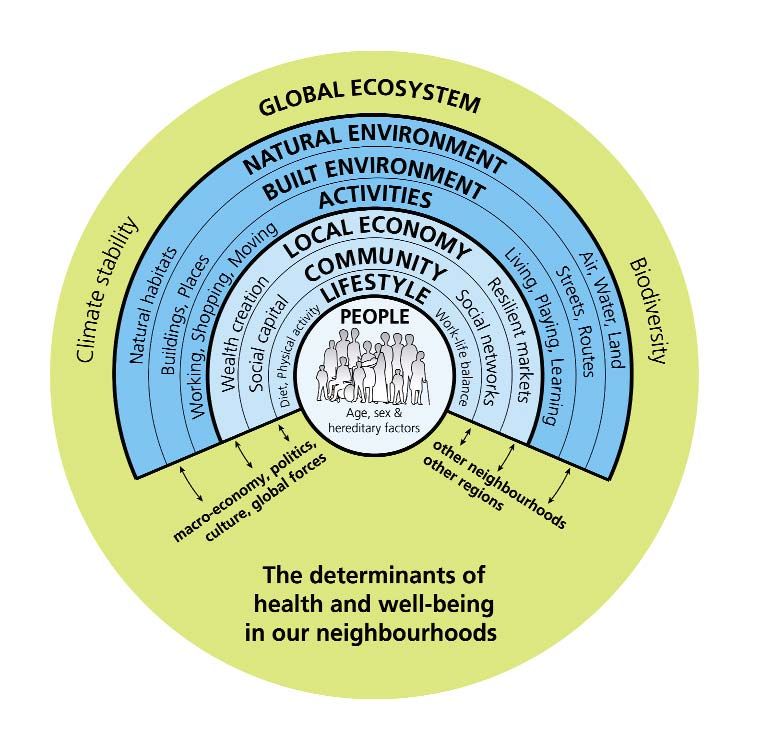
topical summaries6 Briefing on integrating planning and public health for practitioners Section 1: Introduction Figure 2 The settlement health map – relationship between health and the physical, social and economic environments Source: H. Barton and M. Grant: ‘A health map for the local human habitat’. Journal of the Royal Society for the Promotion of Health, 2006, Vol. 126 (6), 252-253. http://dx.doi.org/10.1177/1466424006070466 Health and well-being for individuals and the wider For the planning system and those working with and community are determined by a wide range of factors, in it, meeting health and well-being objectives (see including genetic make-up, lifestyle choices, cultural Figure 3 on page 7) can be achieved through good and community settings, and environmental and sustainable planning practices and place-making – the global factors. These factors shape health and well- subject of this Briefing. The Marmot Strategic Review being and are known collectively as the wider or social of Health Inequalities1 also highlighted the important determinants of health – see Figure 2, above. contribution of the planning system. 1 Fair Society, Healthy Lives. Strategic Review of Health Inequalities in England post-2010. The Marmot Review, 2010. http://www.instituteofhealthequity.org/projects/fair-society-healthy-lives-the-marmot-review
7       Briefing on integrating planning and public health for practitioners

Section 1: Introduction

Spheres from the                Objectives
‘health map’

People                          ●   Providing for the needs of all groups in the population
                                ●   Reducing health inequalities.

Lifestyle                       ● Promoting active travel
                                ● Promoting physically active recreation
                                ● Facilitating healthy food and drink choices (including licensed premises)

Community                       ● Facilitating social networks and social cohesion
                                ● Supporting a sense of local pride and cultural identity
                                ● Promoting a safe environment

Local economy                   ●   Promoting accessible job opportunities for all sections of the population
                                ●   Encouraging a resilient, vibrant and diverse local economy

Activities                      ● Ensuring the provision of retail, educational, leisure, cultural and health facilities
                                  that are accessible to all
                                ● Providing good-quality facilities, responsive to local needs

Built environment               ● Ensuring the good quality and required supply of housing
                                ● Promoting a green urban environment that supports mental well-being
                                ● Planning an aesthetically stimulating environment, with acceptable noise levels

Natural environment             ● Promoting good air quality
                                ● Ensuring security and quality of water supply and sanitation
                                ● Reducing the risk of environmental disaster

Global ecosystem                ●   Promoting the substitution of fossil fuel use with renewable energy
                                ●   Adapting the environment to climate change

Figure 3
Health and well-being objectives in planning for health, with respect to spheres within the
‘health map’ (Figure 2)
Adapted from: M. Braubach and M. Grant (Eds): ‘Evidence review on the spatial determinants of health in urban settings’.
Annex 2, in Urban Planning, Environment and Health: From Evidence to Policy Action. Meeting Report. WHO Regional Office for
Europe, 2010, pp. 22-97. http://www.euro.who.int/__data/assets/pdf_file/0004/114448/E93987.pdf?ua=1
8 Briefing on integrating planning and public health for practitioners
Section 2
Opportunities for public health
involvement in the planning system
‘The planning system in Wales manages the development and use of land in the public interest.’
Planning (Wales) Act 2015 – Explanatory Notes. TSO, 2015.
http://www.legislation.gov.uk/anaw/2015/4/notes/division/1
Planning may seem like a complex system to 2.1 Planning policy context
navigate, but engagement and involvement becomes
much more straightforward with an understanding Planning (Wales) Act 2015
of where the entry points are (and there are many). TSO, 2015.
http://www.legislation.gov.uk/anaw/2015/4/contents/
This Section highlights opportunities to: enacted
● Shape Local Development Plans by providing The Town and Country Planning Act 1990 and the
health evidence, developing health-specific Planning and Compulsory Purchase Act 2004 are the
policies, and informing other relevant policies to main pieces of planning legislation in England and
meet health aims. Wales, which are amended by the Planning (Wales) Act
2015. Together, these pieces of planning legislation,
● Undertake health impact assessments on Local
and accompanying regulations, set out the statutory
Development Plans and development proposals
requirements and processes for the Welsh planning
to mitigate health impacts, promote health
system. Under the Planning and Compulsory Purchase
benefits and address inequalities.
Act every local planning authority in Wales is required to
● Influence the process of determining planning prepare and adopt a Local Development Plan for its area.
applications through involvement in pre-
application discussions, commenting on planning National Development Framework
applications as a consultee. http://gov.wales/topics/planning/legislation/planning-
● Jointly develop planning guidance and evidence wales-act-2015/development-planning/?lang=en
for health on specific topics such as takeaways The Planning (Wales) Act 2015 sets out a requirement
density and accessibility mapping, healthcare for the Welsh Government to prepare and keep up to
facilities planning, and green infrastructure and date a National Development Framework (NDF), which
active travel provision. will replace the Wales Spatial Plan and is due to be
● Contribute to future reviews of key national published in 2020. Local planning authorities must
planning policies such as Planning Policy Wales, have regard to the NDF in preparing Local
the National Development Framework for Wales, Development Plans. The NDF focuses on land use
and Technical Advice Notes. issues and developments of national significance.
Planning Policy Wales
Edition 9. Welsh Government, Nov. 2016.
http://gov.wales/topics/planning/policy/ppw/?lang=en
Planning Policy Wales (PPW) is the overarching national
policy document setting out land use policies, including
planning for sustainability, transport, housing and
managing environmental risks. Local planning
authorities must take account of PPW in preparing Local
Development Plans. PPW also provides specific guidance
on what Local Development Plans should include to
guide the determination of planning applications. It is
regularly updated by the Welsh Government.9 Briefing on integrating planning and public health for practitioners
Section 2: Opportunities for public health involvement in the planning system
Technical Advice Notes 2.3 Opportunities for public health
http://gov.wales/topics/planning/policy/tans/?lang=en teams to engage with
Planning Policy Wales is supplemented by a suite of development planning (policy)
detailed guidance on specific topics. Technical Advice
Notes (TANs) that have relevance for health and well- Development planning refers to the process of creating
being are those on noise (1997), sport, recreation and the suite of local planning documents such as Local
open space (2009), design (2016) and transport (2007). Development Plans and supplementary planning
Local planning authorities must take account of TANs guidance (supplementary planning documents),
in preparing Local Development Plans and when carried out by planning officers in the local planning
making planning decisions. authority. These documents create the framework and
criteria against which individual planning applications
Other technical planning guidance are considered. Each local planning authority is
There are also Minerals Technical Advice Notes required to produce an LDP for the medium to long
(MTANs) (http://gov.wales/topics/planning/policy/ term, typically interpreted as around 15 years.
mineralstans/?lang=en) on minerals developments,
and Welsh Government planning circulars to consider. The early stages of creating a new Local Development
MTAN 1: Quarrying and MTAN 2: Coal include Plan involve collating evidence and setting the vision
requirements for health impact assessments for new and objectives. Consequently, the earlier public health
or extended developments. teams can get involved in the process of creating the
LDP, the more embedded health and well-being
considerations are likely to be. The process for creating
2.2 The roles and responsibilities of a Local Development Plan follows a series of statutory
key planning organisations stages over a number of years, during which public
health professionals, the general public and other
The Planning Directorate, Welsh Government agencies have opportunities to offer input, regardless of
The Planning Directorate is responsible for setting the whether they are statutory or non-statutory consultees.
legislative and policy framework for planning in Wales The scope of such input can vary, from providing
such as developing policy (Planning Policy Wales) and public health evidence and developing health-specific
guidance (Technical Advice Notes). policies to commenting on the strategic environmental
assessment/sustainability appraisal of the LDP.
Planning Inspectorate
The Planning Inspectorate is an independent executive If the Local Development Plan has already been adopted
agency of the Welsh Government with responsibility by the local planning authority, the opportunity to help
for examining Local Development Plans and deciding shape policies will be limited until a full review is
on planning appeals (including applications ‘called in’ undertaken. This happens every four years or so. If the
by ministers) and national infrastructure projects. plan has already been adopted, public health teams
should focus on assisting with monitoring through the
Local planning authorities annual monitoring report.
Local planning authorities are responsible for planning
at the local level, including preparing Local Development There are also other opportunities for public health
Plans, annual monitoring reports, and deciding on teams to support the development of supplementary
planning applications for new developments and planning guidance on issues such as access to healthy
regeneration schemes. There are 25 local planning foods, green infrastructure, design, sustainable transport
authorities in Wales: 22 local authority areas and three and even area-specific guidance. Such activities should
National Parks. be agreed jointly by the local planning authority and
the Local Health Board, according to local priorities.
Which national planning polices do Local
Development Plans have to consider in
relation to health?
Local Development Plans have to consider a range of
planning issues, build up supporting evidence, and
develop policies accordingly to meet sustainable
development objectives. National planning policy10 Briefing on integrating planning and public health for practitioners
Section 2: Opportunities for public health involvement in the planning system
Area Relevant evidence
Local health and well- ● Inequalities in health and gaps in life expectancy.
being needs ● Health conditions.
● Causes and burdens of ill-health.
● Trends such as obesity, physical inactivity, alcohol abuse and mental well-being.
● Health challenges across equality groups.
Place-based ● Indices of multiple deprivation (IMD).
information ● Accessibility and proximity to existing community services.
● Safety and crime (including road safety).
● Locations and quality of green and open spaces.
● Air quality, noise and water pollution, and other environmental health risks.
● Flood risk areas.
● Minerals and waste.
Access to /demand for ● Locations, accessibility and proximity to existing health facilities.
health facilities ● Quality, capacity and condition of existing health facilities.
Figure 4
Summary of useful evidence
comprises Planning Policy Wales and the suite of for both the informal and formal involvement of public
Technical Advice Notes, Minerals Technical Advice Notes, health teams. Practical advice is set out in Figure 7 on
planning circulars and other guidance. The checklist in page 24. Local planning authorities must consult the
Figure 6 on page 23 sets out practical advice. It should Local Health Board2 and should consider consulting
also be borne in mind that Local Development Plans Public Health Wales during the LDP process.3
have to consider a range of other strategies and plans,
and this is where health strategies and well-being How can the annual monitoring report help in
statements, and relevant health evidence, should be tracking health progress?
a strong influence. The local planning authority is required to prepare an
annual monitoring report to review progress on
How can health evidence best inform the process? implementing policies in the Local Development Plan,
The local public health team, the Public Health Wales and can introduce indicators aligned to LDP policies to
Observatory and others in the local authority will have a monitor progress on health and well-being. Each local
wealth of health evidence to support the development planning authority and Local Health Board should
of planning policies that will maximise health benefits determine which indicators will be developed and
for the population, such as the evidence sources listed monitored, according to local health priorities.
in Figure 4, above, and summarised in Annex 4. The Consideration should be given to how to align with
information will be useful in identifying the distribution national well-being and health indicators for Wales and
of health challenges, and in presenting them in map the strategic environmental assessment/sustainability
formats and aligning them to growth and population appraisal process.
change projections. Much of the information should
already be in the local well-being assessment. Informing the strategic environmental
assessment /sustainability appraisal process
Which stages of the Local Development Plan It is a requirement to undertake a strategic environmental
process can public health teams engage in? assessment and sustainability appraisal of the Local
The process of creating the Local Development Plan Development Plan, and the Welsh Government
takes many years and goes through a range of stages recommends that these tasks are carried out together.
that are set out in statute. This provides opportunities The process involves considering the likely significant
2 Town and Country Planning (Local Development Plan) (Wales) (Amendment) Regulations 2015. Statutory Instrument 2015 No. 1598
(W. 197). National Assembly for Wales, 2015. http://www.assembly.wales/laid%20documents/sub-ld10332/sub-ld10332-e.pdf
3 Local Development Plan Manual. Edition 2. Welsh Government, Aug. 2015. http://gov.wales/topics/planning/policy/policy-and-
guidance-on-development-plans/ldpmanual/?lang=en11 Briefing on integrating planning and public health for practitioners
Section 2: Opportunities for public health involvement in the planning system
effects of the LDP on the environment, including on Health evidence for use in planning
population and human health; proposing alternatives
Worcestershire County Council’s strategic planning
to mitigate these effects; and setting out measures to
team, with the adult services and health directorate,
monitor them. These measures could be fed into the
has produced a paper setting out health evidence to be
monitoring process.
used as an evidence base to inform development
planning. The development of the paper was supported
Can health impact assessments inform the Local
by local workshops.
Development Plan?
Planning for Health in Worcestershire Technical Research
Health impact assessments can be carried out when Paper. Worcestershire County Council, Mar. 2015.
developing the Local Development Plan, in parallel http://www.worcestershire.gov.uk/downloads/file/5775/
with strategic environmental assessments and planning_for_health_in_worcestershire_technical_research_
sustainability assessments, but this is not a statutory paper
requirement. There are a range of health impact
assessment examples published on the Wales Health Health-specific Local Development Plan policies
Impact Assessment Support Unit (WHIASU) website, at
The City of Cardiff Council’s Local Development Plan
http://www.wales.nhs.uk/sites3/home.cfm?orgid=522
Policy KP14: ‘Healthy living’ and Policy C6: ‘Health’ are
examples of health-specific planning policies that have
been developed to ensure that developments provide
Examples of good practice
for active travel, accessible and useable green spaces,
access to a food-growing environment, including
Health impact assessments in Local
allotments, and access to healthcare facilities with the
Development Plans
aim of reducing health inequalities.
Councils such as the City and County of Swansea and Cardiff Local Development Plan 2006-2026. City of Cardiff
the City of Cardiff have undertaken health impact Council, Jan. 2016.
assessments (HIAs) of Local Development Plans. https://www.cardiff.gov.uk/ENG/resident/Planning/Local-
Cardiff undertook HIAs of its LDP preferred options and Development-Plan/Examination/Pages/default.aspx
deposit plans initially using the London Healthy Urban
Development Unit self-appraisal toolkit, and later using
Wales Health Impact Assessment Support Unit
Summary of key actions
guidance. The HIAs were carried out by a group of
officers drawn from various council departments,
● Nominate a contact person or identify an email
including planning, transportation, housing and
address to support liaison between the local
sustainable development, together with the Cardiff and
planning authority and the local public health
Vale University Health Board.
team during the development planning process.
Cardiff Local Development Plan 2006-2026 Health Impact
Assessment Report. City of Cardiff Council, Oct. 2012 and ● Develop an understanding of both the limitations
Sept. 2013. and opportunities for public health involvement
http://www.wales.nhs.uk/sites3/Documents/522/Background_ at each stage of the production of the Local
Paper_3_-_Background_Technical_Paper_2_-_Health_Impact_ Development Plan.
Assessment_Report1.pdf and https://www.cardiff.gov.uk/
● Consider how best to apply public health
ENG/ resident/Planning/Local-Development-
Plan/Documents/Health%20Impact%20Assessment.pdf
evidence to support the planning process.
● Consider developing health-specific or health-
Healthy-food environments relevant planning policies.
Denbighshire County Council has produced ● Consider including health-relevant indicators to
supplementary planning guidance on hot-food support specific planning policies, which in turn
takeaways to implement its Local Development Plan can be used to help inform the annual monitoring
policies on ensuring the viability of commercial areas. report.
It sets out the main considerations, including healthy- ● Consider whether supplementary planning
eating duties, for local authorities. guidance is required to help support the
Supplementary Planning Guidance: Hot Food Takeaways. implementation of specific policies to meet
Denbighshire County Council, Apr. 2015. local health priorities.
http://www.denbighldp.co.uk/Webfiles/SPG/
HFT%20SPG%20April%202015%20final%20published.pdf12 Briefing on integrating planning and public health for practitioners
Section 2: Opportunities for public health involvement in the planning system
2.4 Opportunities for public health general public and specified consultees for ‘major’
teams to engage with developments and developments of national significance
development management (such as a new nuclear power station). While public
(planning applications) health bodies are not required consultees, it may be
good practice to seek insight from them early on for
This Section is intended to help local planning authorities certain types of proposed development, particularly in
and Local Health Boards to identify when there is a areas of poorer health outcomes or with many known
need for public health evidence and support during vulnerable groups.
the development management (planning application)
stage. Where possible, effort to become involved further How can public health teams engage in the
‘upstream’ during the development planning process planning application process?
of the Local Development Plan should be prioritised. A planning application goes through a series of
statutory stages, as set out in planning legislation.
How does the development management process Each of these stages provides opportunities for both
relate to development planning? informal and formal engagement and the involvement
Most developments, inclusive of, but not limited to of public health teams. Figure 8 on page 25 sets out
household extensions, new schools, new and changing further guidance. There is a greater chance of influencing
retail uses and new large-scale housing or mixed-use policy development if public health is involved earlier
developments, will require planning permission from in the process. There are also opportunities for public
the local planning authority. The process of taking a health teams to engage with colleagues in licensing
proposed development from inception to delivery is and environmental health, who operate under their
generally known as development management. Planners own statutory processes.
will assess proposed developments against national
policies set out in Planning Policy Wales and Technical Should public health be consulted?
Advice Notes and against their Local Development Public health colleagues are often unaware of proposed
Plan policies – this is the basis of the ‘plan-led’ system. developments and miss opportunities to build in health-
promoting elements or to identify negative health
What are the different types of development and implications. Local Health Boards are consultees under
what are their health implications? the planning regime, but are not statutory consultees, so
Developments fall within different land use categories it is important to ensure that public health involvement
(housing, retail, schools, business, etc.) and size in the planning process is formalised and not just
thresholds (such as ‘major’ for developments over reliant on personal relationships between individuals.
ten housing units or exceeding 1 hectare in area and For example, a dedicated email address can be set up
‘minor’ for those of smaller scale). Their impact on by the local public health team so that notification of
local amenity, health and well-being will vary in scale planning applications can be sent to them – either all
and location, dependent on the environment. It should planning applications, or only those with a potential
be up to the local public health team to determine public health concern. Figure 9 on page 26 sets out a
the nature and scale of any health and well-being process that planners could use to consult with public
implications of any development as part of prioritising health colleagues.
which planning applications they will get involved
with. Public Health Wales’ Planners Guide – When to Is there a case for using a ‘planning-for-health’
Consult with Public Health in Supporting Local checklist?
Planning Authorities 4 sets out a process for deciding Some local planning authorities or local public health
whether and when to consult with public health (and teams use a mutually agreed ‘planning-for-health’
see Figure 9 on page 26). checklist to help prioritise which planning applications
the Local Health Board should comment on. Such a
What are the pre-application requirements? checklist can be tailored to a set of questions to address
Pre-application is the stage before a planning local health objectives or can be comprehensive,
application is submitted to the local planning authority including all the wider determinants of health.
for a decision. Planning applicants are required to Examples of checklists that have been adopted in
undertake pre-application consultation with the practice are given later in this Section.
2 Planners Guide – When to Consult with Public Health in Supporting Local Planning Authorities. Public Health Wales, Sept. 2015.
http://www.wales.nhs.uk/sitesplus/888/page/8390613 Briefing on integrating planning and public health for practitioners
Section 2: Opportunities for public health involvement in the planning system
Considering health and well-being through consultation stages. It is important to structure and
environmental impact assessment present a response which is succinct, linked to
From May 2017, the EU EIA Directive requires all national and adopted Local Development Plan
environmental impact assessments (EIAs) to consider policies, and based on local evidence, and which
‘population and human health’. UK regulations set makes recommendations to make the development
out the threshold for those developments requiring acceptable.
an EIA, but generally EIA is required for those
developments deemed to have significant How should planning conditions related to
environmental impact. While not all planning health be used?
applications will be subject to an EIA, explicit Planning conditions are set on a case-by-case basis
consideration of and references to health, well-being to mitigate the impacts arising from a particular
and inequalities provide another opportunity during development. A good practice approach is to front-load
the planning application process. discussions on conditions during pre-application to
encourage the submission of details during the
How useful can a health impact assessment be? application process, rather than during later public
A health impact assessment (HIA) can be beneficial consultation. Local planning authorities will normally
as both an engagement and an assessment tool for a have model planning conditions, but the final wording
planning application, particularly those applications of conditions will need to be considered according to
that do not require an EIA but may still have some the development circumstances and assessed against
significant health impacts. There are a number of types the six policy tests in Section 3.5.2 of Planning Policy
of HIAs that can be undertaken: Wales.
● A ‘comprehensive’ HIA can be demanding in both
time and resources – requiring, for example, an Can Section 106 planning obligations be used
extensive evidence search, expert analysis, and for health?
primary data collection (including qualitative Section 106 planning obligations can be used to seek
feedback from local residents and other monetary or in-kind contributions from planning
stakeholders). applicants, to address or even promote on-site health
● A ‘rapid’ HIA is a less resource-intensive and more and well-being impacts arising from the development.
time-effective process, involving a more focused New and improved open spaces and public realm,
investigation of health impacts (but it still considers public art and transport improvements are examples
both quantitative and qualitative evidence sources, of what could be secured through Section 106
including some consultation with local agreements. Many local planning authorities will have
stakeholders). Local Development Plan policies or supplementary
● A ‘desktop’ HIA draws on existing knowledge and planning documents setting out clearly what they
evidence to complete the assessment, often using expect planning applicants to contribute. The
published ‘checklists’ developed for this purpose. Community Infrastructure Levy (CIL) can also be used
to fund the capital or maintenance needs of wider local
The approach taken to deciding on the type of HIA social infrastructure to support health and well-being
required when considering a planning application priorities.
should be proportionate to the size, scale, scope and
nature of the application or project type and its likely What are the links to the environmental
implications for local public health and health permitting regime?
infrastructure. Planning permission and environmental permitting
are subject to separate applications, but they are
How should public health comments be closely linked. Environmental permits determine
submitted? whether an operation can be managed on an ongoing
There is a formal route for submitting comments on basis to prevent or minimise pollution. Permits are
public health considerations via Local Health Boards, issued by Natural Resources Wales.5 Both processes
which are non-statutory consultees in the planning should take account of environmental risks and
process. Local planning authorities will receive many impacts and are needed before a developer can
comments on a planning application during the proceed with the proposed development. Where any
5 For further guidance, see Natural Resources Wales’ ‘Development management’ webpage, at
https://naturalresources.wales/planning-and-development/development-management/?lang=en14 Briefing on integrating planning and public health for practitioners
Section 2: Opportunities for public health involvement in the planning system
significant issues are identified, it is recommended Environmental and public health risk assessment
that environmental permits are processed at the same
Local Health Boards are supported in providing
time as the planning application, to resolve any issues
specialist public health advice by the Environmental
as early as possible.
Public Health Service in Wales (a collaboration
between Public Health Wales’ health protection team
What are ‘use classes’ and why do they matter?
and Public Health England’s Centre for Radiation,
National planning legislation categorises different uses
Chemical and Environmental Hazards in Wales), which
of land and buildings into ‘use classes’, as set out in
provides a holistic public health risk assessment of
the Use Class Order. An understanding of the Use
environmental hazards and advises on measures to
Class Order is relevant as any change in use may
safeguard communities, including advice for local
require planning permission – for example from a
planning authorities on proposed or existing
retail shop (categorised as ‘A1’ use) to a food and drink
developments.
outlet (‘A3’). Such changes present opportunities to
http://www.wales.nhs.uk/sitesplus/888/page/83906
promote healthier food retailing and vibrant and
diverse shopping areas by preventing the proliferation
Health impact assessment protocol for planning
or over-concentration of use of premises that supply
applications
unhealthy foods.
The Wales Health Impact Assessment Support Unit
(WHIASU) has published guidance on conducting
Examples of good practice health impact assessments (HIAs), from considering
the need to conduct an HIA to monitoring the
Adopting a local planning-for-health checklist implementation of a planning decision (see
Improving Health and Reducing Inequalities, at
The London Healthy Urban Development Unit has
http://www.wales.nhs.uk/sites3/Documents/522/
developed a checklist to ensure that the health and
improvinghealthenglish.pdf). WHIASU has undertaken
well-being implications of major planning applications
several HIAs, and case studies can be accessed at
are taken into account consistently. By bringing
http://www.wales.nhs.uk/sites3/page.cfm?orgid=
together national and London planning policy
522&pid=10092
requirements and standards that influence health and
well-being, the checklist seeks to mainstream health
into the planning system.
Summary of key actions
Healthy Urban Planning Checklist. London Healthy
Urban Development Unit, Jul. 2015.
● Nominate a contact person or identify an email
http://www.healthyurbandevelopment.nhs.uk/our-
address to support liaison between the local
services/delivering-healthy-urban-development/health-
planning authority and the local public health team
impact-assessment/
during the development management process.
Public health response template ● Agree a process of public health team
engagement in the pre-application stage and in
The Cardiff and Vale public health team has devised a
consultation during the application stages.
template to help the Local Health Board respond to
● Where appropriate, agree requirements for health
planning applications. It sets out the policy frameworks
for health and planning and areas for comment on impact assessments between the local planning
healthcare service provision and public health issues. authority and the local public health team for
The local public health team has developed a protocol specified developments which may have
of engagement between Vale University Health Board potential health implications.
and the City of Cardiff Council and the Vale of ● Ensure that health and well-being considerations
Glamorgan Council with a view to securing are adequately considered during the
appropriate health service and public health facilities environmental impact assessment process.
related to large-scale development. It has also ● Submit appropriate public health responses to
developed a planning for health financial model. public consultation.
● Consider whether planning conditions or Section
106 planning obligations may be required to
address specific health impacts.15 Briefing on integrating planning and public health for practitioners
Section 3
Opportunities for planning
involvement in the
public health system
‘Local government is vital to health and wellbeing, through for example, its education, housing and
environmental services...’
Together for Health – A Five Year Vision for the NHS in Wales. Welsh Government, 2011.
http://www.wales.nhs.uk/sitesplus/documents/829/togetherforhealth.pdf
This Section provides an introduction to the public Together for Health: A Five-Year Vision for the
health system and public health responsibilities, to NHS in Wales
provide a better understanding of where Welsh Government, Nov. 2011.
opportunities lie to foster links and develop http://gov.wales/topics/health/publications/health/
alignment with the planning process. reports/together/?lang=en
The Five-Year Vision for the NHS in Wales sets out,
with a clear focus on delivery, seven areas of change,
3.1 Health policy context including improving health through the activities of
the Local Health Boards to create a healthy Wales.
Our Healthy Future Indicators, 2015
Public Health Wales Observatory. Public Health Wales NHS Wales Planning Framework
NHS Trust. 2015. Welsh Government, Updated 2016.
http://www.wales.nhs.uk/sitesplus/922/page/83567 http://gov.wales/topics/health/nhswales/organisations/
The Our Healthy Future strategic framework, planning/?lang=en
published in 2009, set the agenda for public health The NHS Wales Planning Framework provides guidance
and commits the Welsh Government and its partners for the development of integrated medium-term plans
in local government and Local Health Boards to (IMTPs) by Local Health Boards and NHS Trusts. IMTPs
improving health and well-being. It set out a vision focus on the health planning role with a view to
and key themes, including reducing health inequities developing and managing healthcare services to
and delivering healthy sustainable communities. A respond to local challenges. IMTPs are the vehicle for
set of indicators has been developed to monitor strengthening existing and forging new partnerships
progress against the priorities in Our Healthy Future, across the public and third sectors.
and these indicators could be useful in informing
Local Development Plan policies and the monitoring NHS Wales Infrastructure Investment Guidance
thereof. Welsh Health Circular. Welsh Government, Mar. 2015.
http://www.wales.nhs.uk/sites3/Documents/254/WHC-
A Healthier, Happier and Fairer Wales. Public 2015-012%20-%20English%20Version.pdf
Health Wales Strategic Plan 2015-2018 The Infrastructure Investment Guidance sets out
Public Health Wales, Apr. 2015. requirements for the planning, delivery and management
http://www.wales.nhs.uk/sitesplus/888/page/82750 of NHS infrastructure investment (which includes land
The Public Health Wales Strategic Plan sets out seven and buildings). It aims to support the delivery of safe,
priorities, including influencing policy to help protect sustainable and accessible services and the provision of
and improve the health of the population. This is a care closer to home; maximise the efficient use of assets;
driver for PHW representatives to engage with (among improve asset condition and performance; and promote
other policy-makers) planners in order to promote innovation to improve the quality of care. It supports the
consideration of health and well-being in the planning use of health impact assessments as part of the evidence
policy and decision-making process. to justify infrastructure investment proposals.16 Briefing on integrating planning and public health for practitioners
Section 3: Opportunities for planning involvement in the public health system
3.2 The roles and responsibilities of health services and reduce health inequalities. Its
key health organisations aim is to provide signposting and guidance at the
appropriate contextual level, in addition to working
Public Health Wales with others to improve the quality of information
Public Health Wales (PHW) was established in October available on health and health services in Wales. The
2009, bringing together a number of organisations Public Health Wales Observatory serves as a resource
previously responsible for public health. Its vision is to of information and evidence for planners trying to
achieve a healthier, happier and fairer Wales. It has incorporate health and well-being into the planning
four statutory functions: process.
● To provide and manage a range of public health,
health protection, healthcare improvement, health Wales Health Impact Assessment Support Unit
advisory, child protection and microbiological The Wales Health Impact Assessment Support Unit
laboratory services, and services relating to the (WHIASU) is a part of Public Health Wales. Its key
surveillance, prevention and control of roles are:
communicable diseases. ● To support the development and effective use of
● To develop and maintain arrangements for making the health impact assessment (HIA) approach in
information about matters related to the protection Wales through building partnerships and
and improvement of health in Wales available to collaborations with key statutory, voluntary,
the public; to undertake and commission research community and private organisations in Wales.
into such matters; and to contribute to the provision ● To provide direct information and advice to those
and development of training in such matters. conducting HIAs.
● To undertake the systematic collection, analysis and ● To contribute to the provision of new research, and
dissemination of information about the health of provide access to existing evidence, that will inform
the people of Wales, in particular including cancer and improve judgements about the potential
incidence, mortality and survival, and prevalence of impacts of policies, programmes and projects.
congenital anomalies.
● To provide, manage, monitor, evaluate and conduct NHS Wales
research into screening of health conditions and NHS Wales underwent significant restructuring in
screening of health-related matters. 2009. The NHS now delivers services through the
seven Local Health Boards, which are responsible
Health improvement falls under the Health and Well- for healthcare services.
being Directorate of PHW. Health improvement
responsibilities are shared across several all-Wales Local Health Boards and Directors of Public
teams, as well as local public health teams. The Policy, Health
Research and International Development Directorate Wales has seven Local Health Boards (LHBs), which
can help support policy development through its plan, secure and deliver healthcare services in their
activities and outputs. areas. The aim of the LHBs is to improve the health of
their communities, reduce health inequalities, and
The Health Protection division of Public Health Wales deliver effective and efficient healthcare services,
supports all agencies involved in communicable disease articulated through an integrated medium-term plan
management, prevention and control in Wales. It helps of service priorities. Each LHB appoints a Director of
deliver the Environmental Public Health Service (i.e. Public Health, who has responsibility for the health of
the service dealing with environmental hazards other the local population, leads on local needs assessment,
than those responsible for communicable diseases) and has responsibility for producing an independent
collaboratively with Public Health England’s Centre for annual report on the health of the local population.
Radiation, Chemical and Environmental Hazards in
Wales. This integrated team provides partner agencies Local public health team
and the public with independent, specialist and For every Local Health Board in Wales there is a local
contextualised advice and support. public health team (LPHT), which works to the Director
of Public Health and is responsible for providing
Public Health Wales Observatory specialist public health support to the LHBs and other
The Public Health Wales Observatory assists local and stakeholders. Local public health teams also plan,
national partners by providing health intelligence to develop, implement and evaluate a range of public
address public health issues, improve health and health programmes and services that focus on health17 Briefing on integrating planning and public health for practitioners
Section 3: Opportunities for planning involvement in the public health system
improvement, health protection and disease engagement with local communities and local
prevention. authority partners. Figure 10 on page 27 sets out the
opportunities for involving planners and considering
Community health councils issues relevant to the built and natural environments,
Community health councils represent the voice of the such as those issues identified in Figure 3 on page 7,
community and the general public in the health including taking into account the location and
process. There are seven community health councils, accessibility of services to the population.
in alignment with the seven LHBs.
Planning for health infrastructure is an obvious
area for collaboration, as planners plan for social
3.3 Opportunities for planners to infrastructure needs for the local authority area for,
engage with the public health typically, 15 years ahead. Other obvious areas are
system collaborating to address obesity and promote
physical activity through the creation of open space;
There are no specific statutory ‘entry points’ within facilitating active travel and minimisation of
local public health teams and Local Health Boards obesogenic environments through healthy urban
through which planners can engage – this can prove planning processes; and mitigating the harmful
challenging. However, with the range of statutory and environmental effects of planning applications
non-statutory points of entry for public health (such as impacts on air quality). If a health impact
involvement in the planning system (see Section 2), assessment is carried out as part of a Local
there is already significant scope for collaboration. Development Plan, it could be extended to assess
This Section highlights further opportunities for the impact of infrastructure developments on the
planners to be involved in public health and health health of the population.
service facilities planning. The overarching principle
of building on established links and partnerships Could integrated medium-term plans, well-being
between the planning and health professions is very plans and statements or other health-based
important. strategies be material in the planning process?
Such plans and strategies should be taken into account
Within the health and care systems, there are and referred to as part of the Local Development Plan
opportunities for collaboration, including the following: evidence base and within policy justification texts.
● The new well-being plans will become the focal They can also be material considerations in decisions
point. Previously, the single integrated plans on planning applications if they have an impact on
(comprising the community strategy, the children how a site will be developed and if, according to
and young people’s plan, the health, social care and Section 3.1.4 of Planning Policy Wales, they are
well-being strategy, and the community safety relevant to the ‘development and use of land in the
partnership plan) provided the basis for public interest’.
engagement.
● The statutory rolling three-year integrated Engaging with local public health teams
medium-term plans prepared by Local Health Local public health teams, in collaboration with the
Boards and NHS Trusts provide further Environmental Public Health Service, can support
opportunities for planners to contribute to health planners in many ways, as suggested in Section 2 –
planning and to help align land use planning including by providing advice and guidance on health
decisions with the evidence base. impact assessments and comments on planning
applications. Having a clear engagement protocol for
How are the integrated medium-term plans the development management process will be critical.
relevant to planners, and how could planners Many Local Health Boards will have topical or sectoral
be involved in the plan process? strategies focused on, for example, older people,
Like the land use planning process, integrated physical activity or estates, which will touch upon the
medium-term plans go through a process of wider environmental determinants of health where
development, approval and monitoring. This includes the planning system will have a role. The Director of
evidence-gathering and needs assessment activities Public Health can play a central role in securing local
that cover the physical and mental health and well- commitment and can prioritise working with planners
being of the resident population, capacity planning to improve the population’s health.
across all the health and care services, andYou can also read


