City of Derry Airport Draft Master Plan - November 2012
←
→
Page content transcription
If your browser does not render page correctly, please read the page content below
City of Derry Airport
   Draft Master Plan
         November 2012
Foreword
    By Roy Devine & Sharon O’Connor
                                                                Alongside the Master Plan, CoDA has undertaken a
                                                                detailed business plan to fully explore and understand
                                                                the potential of the Airport and its surroundings. This
                                                                Master Plan is a spatial representation of the outcomes
                                                                from the business plan. The environmental impacts
                                                                of the proposals have also been assessed and are
                                                                presented in summary within this document. CoDA
                                                                and the Council aims to ensure that, along with growth,
                                                                the Airport delivers the widest possible economic and
                                                                social benefits to local communities and the north west
                                                                region.
    We are delighted to publish our Draft Master Plan
    setting out our vision for the future development of City
    of Derry Airport (CoDA).                                    Increased Employment/Investment
                                                                In 2011 the Airport was estimated to support nearly
    Wide Ranging Consultation                                   400 full time direct and indirect jobs; and the number
                                                                of people directly employed at the Airport will play an
    This is not a definitive document – rather it sets out      increasingly important role in the social and economic
    our ideas and aspirations for the future with a view to     fortunes of the region – providing, supporting and
    stimulating debate and generating ideas. I am sure          safeguarding jobs (many requiring high quality skills).
    that we will be asked questions and presented with          The airport currently contributes £14.5 million of Gross
    alternative views to consider before we adopt the           Value Add to the region and this is forecast to rise to
    Master Plan as a firm statement of intent.                  £35 million by 2022.

    We want to grow and develop an airport that reflects        We have proposed this plan so that our stakeholders,
    the unique character of the region it serves. Therefore,    owners and planning authorities can help shape
    following adoption of its Master Plan, the Airport will     and protect one of the most significant generators of
    seek further contributions and suggestions about how        economic activity in the north west of Ireland
    we can develop a terminal and other facilities to capture
    the culture, heritage and nature of the region.             In addition to describing how the airport will satisfy
                                                                the demand for air travel to and from the north west
    Our airport is an increasingly popular gateway to           and how it will support the region’s vitally important
    both Northern Ireland and the Republic of Ireland,          tourism industry, the plan sets out our determination
    and offers a speedy alternative to road travel to the       to maximise the social and economic benefits that a
    airports in Belfast and Dublin. Since purchasing the        thriving regional airport brings to the local population
    airfield in 1978, with a view to improving the transport    and area.
    infrastructure for the north west of Ireland, Derry City
    Council has been fully committed to its growth and,
    now, is beginning to realise the significant impact on      Mitigating the Impacts of CoDA’s Growth
    the regional economy envisaged by the Council when          At the centre of this plan is an emphasis on carefully
    they acquired it.                                           managing CoDA’s relationship with local communities
                                                                ensuring that the Airport manages its relationship with
    The Master Plan sets our vision for the development         the environment and is sustainable. CoDA will protect
    of the Airport as a transport gateway for the north         its neighbours from our growth whilst managing our
    west of the island of Ireland. It presents a range of       wider impacts on the environment.
    improvements and enhancements to the existing
    facilities that we wish to develop to meet this vision.

2   					                                   			                              City of Derry Airport Master Plan - Autumn 2012
New Destinations                                            CoDA is determined to develop for the benefit of the
                                                            people it serves and we hope that local communities,
Over the last few years the Airport has been one of the     businesses, organisations and individuals will engage
fastest growing in the UK and has become an important       in the debate about how it will develop in the future.
gateway and a key asset for the north west. In 2011,
the airport handled more than 400,000 passengers            CoDA has an effective Airport Consultative Committee,
and we are determined to develop CoDA as the ‘Airport       which regularly meets to represent the interests of
of Choice’ in the north west - helping local people,        local communities and airport users. In addition to this,
businesses and visitors avoid the long and unreliable       further engagement is being sought from across the
surface journeys to airports elsewhere. To achieve this     wider region to help ensure that the Airport can grow
requires the Airport to grow its portfolio of more than     in a sustainable way, reflecting the green ambitions
ten destinations to other parts of the UK and Europe.       of the region whilst still delivering long term economic
We anticipate this choice will grow to include a more       benefits. We are very keen to take account of the views
extensive European network. We will also look to            of those with an interest in the growth of CoDA including
increase inbound tourism to the region to benefit the       local communities, business and tourism, agencies and
local economy and grow visitor numbers to the north         representatives of local and regional government.
west.
In addition to providing for growing demand for air         I therefore invite you to consider this Master Plan and
transport, the Plan safeguards the interests of private     its supporting documentation, and recognise that a
and corporate aviation.                                     comprehensive development approach to the Airport
                                                            and its environs is crucial to the forward planning of the
                                                            A2 Campsite Corridor and the region as a whole.
No New Runway
Despite the forecast growth in aircraft movements,          It is intended that after the consultation period this
the Plan identifies no need to build new runways or to      Plan will be integrated with local planning policy as an
extend the existing one.                                    advisory document.

More Passenger Journeys                                     The Way Forward
We believe that by 2030 approximately 1.2                   Please make your comments on these proposals by
million passenger journeys will start or finish at          31st January 2013. There are a number of ways for you
CoDA. Accommodating this level of demand with               to comment are outlined in chapter 12 of this document.
facilities that reflect the qualities and standards of      All comments and observations will be responded to
service sought by the region will require capital           and considered for incorporation in the adopted Master
investment.                                                 Plan, which will be published during 2013.

                                                                            Sharon O’Connor
Local Emphasis                                               Town Clerk and Chief Executive, Derry City Council
Derry City Council also sees the Airport as a potential
location for high profile business development                                         and
associated to the Airport. The development of a
strategic business park will help to attract significant                Roy Devine, Chairman of Board
investment into the region, reinforcing Derry’s role as a               City of Derry Airport Operations
key driver of the Northern Ireland economy.

                                                                                                                         3
Contents
    Foreword
    1.    Introduction
    2.    Vision for City of Derry Airport
          A summary of the vision and objectives that City of Derry Airport has developed for the growth of the Airport.

    3.    City of Derry Airport Today
          A history of City of Derry Airport and a description of the current airport operations and infrastructure.

    4.    Regulatory & Policy Context
          A summary of the relevant statutory local and regional policies and governing bodies.

    5.    Forecasts for Growth
          Traffic growth and performance over the last 10 years and forecast for future growth including new routes
          and markets

    6.    Master Plan
          An outline of plans for the Airport to 2030 including development of passenger facilities and operational
          facilities.

    7.    Airspace
          A summary of airspace management at CoDA and potential future change.

    8.    Surface Access
          An outline of plans for surface access.

    9.    Impacts & Mitigation
          A description of how CoDA will develop sustainably bringing social and economic benefits and ensuring
          that the effects of its operations on the environment and local communities are minimised.

    10.   Safeguarding, Risk Assessment & Land Acquisition
          An overview of the measures taken to safeguard the operations of the Airport together with the methods for
          assessing risks.

    11.   Glossary
          Definition of terms used in this Master Plan.

    12.   Next Steps
          How CoDA will consult on this Master Plan.

    13.   References

4   					                                			                               City of Derry Airport Master Plan - Autumn 2012
5
Chapter 1
    Introduction
    Why Prepare a Master Plan?                                   Importance of Air Travel
    The last 30 years have seen a five-fold increase in air      The White Paper recognises that airports and air
    travel with each UK citizen now taking an average of         services play a key role in the UK’s economy and that
    three flights per year and the average being just over       the country’s airports should:
    four flights per year for the population of Northern
    Ireland. Nationally, the demand for air travel is forecast    •    Support the UK’s position as one of the leading
    to grow between two and three times current levels by              global economies;
    2030.                                                         •    Facilitate the growth of UK tourism;
    UK Government policy, set out in the 2003 White               •    Provide the building blocks for future economic
    Paper “The Future of Air Transport” established a                  development;
    framework for the development of airport capacity in          •    Provide accessibility to all areas of the country;
    the UK to 2030 and set out the Government’s case for          •    Offer opportunities for travel for UK residents;
    the future expansion at airports across the country.               and
    The Department for Transport (DfT) asked airports to
                                                                  •    Provide employment and prosperity.
    prepare Master Plans defining how the developments
    and growth set out in the White Paper could be
                                                                 Airports also play a vital role in less direct ways. In
    achieved. The White Paper does not itself confer,
                                                                 2004, the UK tourism sector employed about 1.4 million
    authorise or preclude any particular development,
                                                                 people, around 5% of the total working population and
    but sets out policies that will inform and guide the
                                                                 around approximately 28 million people visited the UK,
    consideration of specific planning applications brought
                                                                 spending some £13 billion. These visitors accounted
    forward by airport owners.
                                                                 for around 85% of tourism expenditure and 70% arrived
                                                                 by air.
    This Master Plan sets out the development proposals
    for City of Derry Airport to 2030 in accordance with
                                                                 It is estimated that air transport directly supports
    advice from the DfT on the preparation of Master Plans.
                                                                 around 186,000 jobs nationally and contributes about
                                                                 £11.4 billion. Taking account of indirect and induced
    In July 2012, the Government provided a Draft Aviation
                                                                 effects, this rises to 580,000 jobs and £22.2 billion of
    Policy framework for consultation. It is understood that
                                                                 Gross Value Added (GVA). If UK airports are able to
    this will replace the 2003 White Paper and that a final
                                                                 grow to meet their full potential, it is estimated that the
    framework will be published in March 2013. During the
                                                                 industry could support around 675,000 jobs and £32
    consultation process for this Master Plan, emerging
                                                                 billion of GVA.
    comments on the new Government framework will be
    taken into account and provided in the final adopted
                                                                 The National Strategy set out in the White Paper
    airport Master Plan.
                                                                 supports the generation of this level of economic
                                                                 benefit for the national economy. Importantly, it seeks
    The draft aviation policy framework combined with the
                                                                 to spread these benefits to regions both as a means
    proposed Localism Bill will require airports to mitigate
                                                                 of reducing the pressure on the airports in the south
    their impacts on local communities and it is likely that
                                                                 east of England as well as enabling the opportunity for
    the adopted policy will be more prescriptive.
                                                                 economic growth in the regions.
    Throughout this Master Plan we have abbreviated the
    name City of Derry Airport to CoDA.

6   					                                    			                               City of Derry Airport Master Plan - Autumn 2012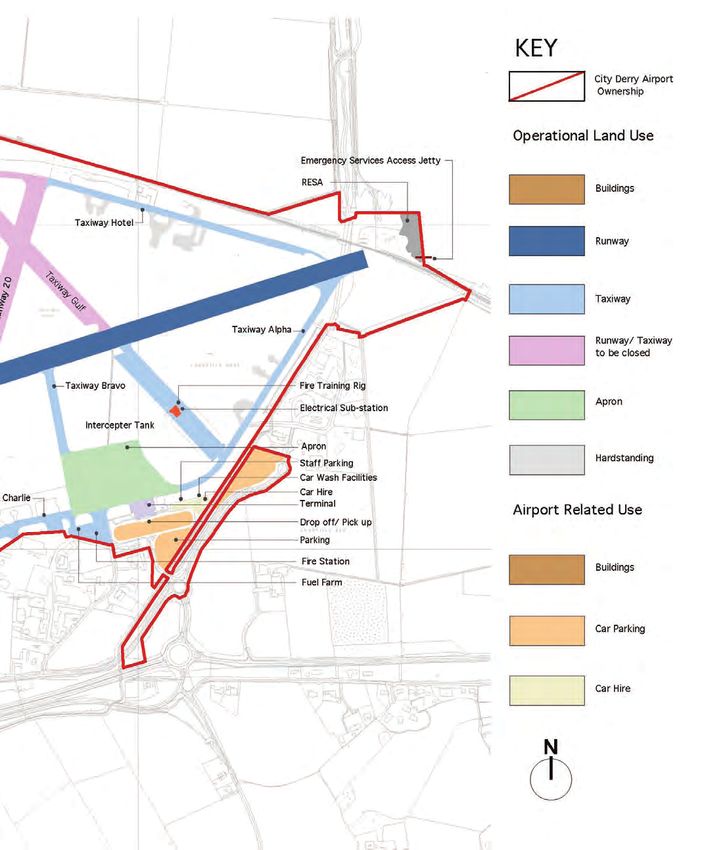
Northern Ireland                                             City of Derry Airport
Chapter 7 of the White Paper covers Northern Ireland         The City of Derry Airport is located approximately 12km
and identifies that due to its geographical location,        north east of the City of Derry (see Figure 1.1) and is
good air links to Great Britain are important for future     the third largest in Northern Ireland, currently serving
economic development. Northern Ireland is well served        just over 400,000 passengers per annum. The Airport
for travel to and from London and other parts of the         is an important gateway for the economy of the north-
UK, but currently only has limited connections to other      west of Northern Ireland and the Republic of Ireland.
European countries.
                                                             Specifically referring to CoDA, the White Paper states
Within Northern Ireland, air travel is currently split       that:
between Belfast City, Belfast International and CoDA.
All cater for scheduled and ‘no-frills’ carriers. Belfast    “Unlike the other two Northern Ireland airports, City
International also caters for freight traffic. CoDA serves   of Derry Airport is in public ownership and serves the
a catchment largely covering the north west of Northern      market for air services in the north west of the island
Ireland and Donegal in the Republic of Ireland.              of Ireland. It provides services to a limited range of
                                                             destinations, but could have potential to develop routes
                                                             to a number of others.

                                                             The airport is regarded as having an important role in
                                                             facilitating access to the north west of the Province and
                                                             Donegal in the Republic of Ireland, and in contributing
                                                             to the development of the area. Proposals for a runway
                                                             extension are currently under consideration and give
                                                             rise to a number of technical, economic and competition
                                                             issues outside the scope of this White Paper.

                                                             Given the cross-border nature of the market served by
                                                             the airport, the Northern Ireland authorities will want to
                                                             consider the airport’s future infrastructure requirements
                                                             carefully, in conjunction with the Government of the
                                                             Republic of Ireland”.

                                                             The Airport has been in the ownership of Derry City
                                                             Council since 1978, during which time the Governments
                                                             of Northern Ireland and the Republic of Ireland have
                                                             assisted with substantial funding for major capital
                                                             projects to develop the airfield including the runway
                                                             extension referred to in the above extract from the
                                                             White Paper.

                                                             In April 2010, the airport was established as an
                                                             incorporated company separating its management
                                                             from Derry City Council (DCC). DCC continue to own
                                                             the airport and are the sole shareholder. In October
                                                             2010, DCC entered into a 10 year contract with Parsons
                                                             Brinckerhoff, a Balfour Beatty Company, through a
                                                             Managed Services Agreement to operate the Airport.

                                                                                                                          7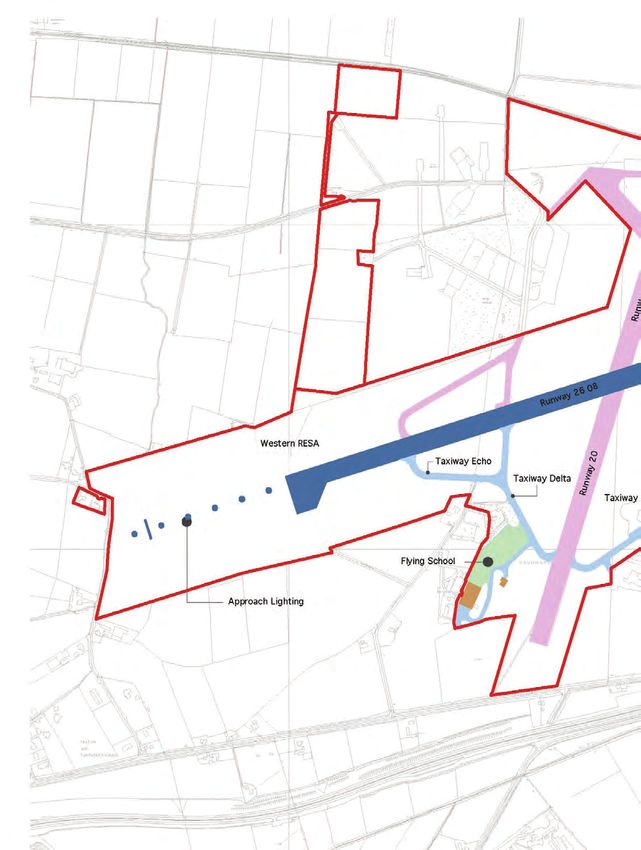
8 City of Derry Airport Master Plan - Autumn 2012
9
CoDA’s Economic Benefits                                   The Plan covers the period up to 2030 and considers the
                                                                growth options for the Airport including the implication
     CoDA acts as a catalyst for the local and regional         on the local economy and environment. It also presents
     economy, not only by providing good airline connections    an indication of the phasing of the development within
     to the UK and Europe, but also as an employment            this timescale. It sets out the short term development
     centre in its own right.                                   potential of the Airport, along with a strategic framework
                                                                for the longer term development opportunities. As such,
     The Airport supports approximately 380 full time           the Master Plan will be referenced by CoDA in future
     equivalent jobs in the local economy and contributes       planning applications, funding bids and for decisions
     approximately £14 million of GVA to the Northern           on making best use of the assets of the airport.
     Ireland economy and £7 million to the local economy
     per annum. By 2022 it is estimated that the Airport will   A steering group on the Master Plan was formed by
     support 800 jobs in the local economy and add £35          Derry City Council, who have worked closely, though
     million GVA to the Northern Ireland economy                the group, with interested parties and statutory
                                                                undertakers, including the Department of Environment
     Relationship with the Planning Process                     (DOE) Planning Service throughout the development of
                                                                the Master Plan proposals.
     CoDA has structured this document in accordance with
     the DfT’s guidance on the content of airport Master        As part of the preparation of the Master Plan, we have
     Plans.                                                     looked closely at the requirements for undertaking a
                                                                Sustainability Appraisal (SA) of the document. Based
     The Master Plan is not an application for planning         on current guidance, and in discussion with the Steering
     permission for the development of the Airport; its         Group, we have concluded that as the Master Plan is
     purpose is to provide a framework for the Airport’s        not to be adopted as a statutory planning document
     longer term aspirations.                                   there is no requirement for a SA to be undertaken.
                                                                However, as it is intended that the Plan will form part of
     It describes the way the Airport is expected to develop    the evidence base for any new Area Plan, the Master
     over the Master Plan period, however this development      Plan will be subject to a SA at that point.
     will remain subject to the planning system unless it
     comprises development (on operational land) permitted
     under the provisions of The Planning (General
     Development) Order (Northern Ireland) 1993. Figure
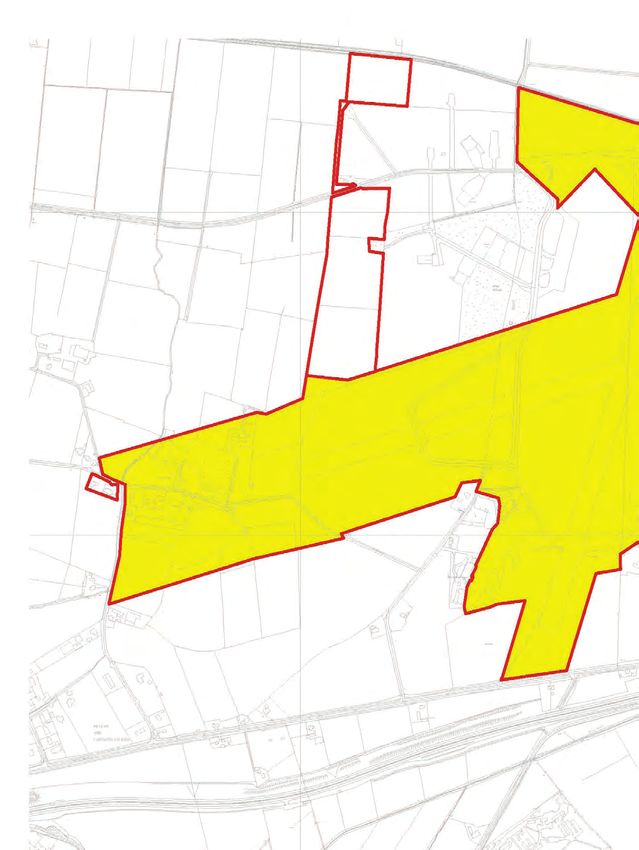
     1.2 shows the extent of the existing operational area
     of the airfield.

10   					                                  			                              City of Derry Airport Master Plan - Autumn 2012
Draft Master Plan
This draft Master Plan is being issued for consultation
following which CoDA will revise this Master Plan taking
account of comments.
The likely programme for publication of the adopted
plan is:
Structure of the Document • Airport Business Plan including forecast studies
and catchment area analysis;
Master Plan Life
• Baseline Report including an environmental
This Master Plan will be reviewed every 10 years. appraisal, background on the Master Plan
optionneering exercise and details of the
The Master Plan has been informed by a number consultation undertaken; and
of technical reports and studies undertaken by a
• Airport Economic Impact Study
range of specialist consultants, as well as the CoDA
Management Team and Derry City Council. These
include:
11Figure 1.2 Operational Area 12 City of Derry Airport Master Plan - Autumn 2012
13
14 City of Derry Airport Master Plan - Autumn 2012
Chapter 2
Vision for City of Derry Airport
City of Derry Airport’s vision is to be:                        •    Set out the long-term growth plans of CoDA
                                                                     in order that these are taken into account by
     “The Airport of choice for the north west                       authorities in preparing their development,
                                                                     economic and transport plans and associated
                    of Ireland”                                      policies to make investment decisions;
In delivering this vision CoDA will work to:                    •    Develop a vibrant and profitable business as a
                                                                     stable and a secure foundation to ensure future
 •     Perform as a viable entity providing long-term                investment and continued development of CoDA;
       benefit for the north west of Ireland;                   •    Improve public transport access to the Airport
 •     Improve air access to the north west;                         and increase opportunities for sustainable travel
 •     Reduce and eliminate the Council subvention of                to the Airport;
       the airport by improving its profitability;              •    Ensure that the Airport makes a full contribution
 •     Ensure that the airport performs as a key driver              to the profile and image of Londonderry/Derry
       for the north west region;                                    and the north west or Ireland by developing high
                                                                     quality facilities that reflect the aspirations of the
 •     Ensure full compliance with regulatory and                    region; and
       safety requirements; and
                                                                •    Enable the continued use of the Airport by
 •     Manage the airport in a fit for purpose condition             general aviation and flying schools and support
                                                                     the development of existing and additional
This Master Plan sets out development plans for the                  aviation related Small Medium Enterprises
airport to 2030. The objectives are to;                              (SMEs) within the boundaries of the Airport

 •     Continue to put people first by meeting and
       exceeding the expectations of our customers,            Our Aims
       stakeholders and the community;                         In terms of its operations, CoDA aims to:
 •     Improve affordable access to more destinations,
       with a better frequency for business and leisure         •    Achieve a throughput of 1.2 million passengers
       travellers to and from the region;                            per annum by the year 2030 through new route
 •     Maintain a sustainable airport by carefully                   development and the growth of existing services;
       managing our relationship with the environment;          •    Aspire to a throughput of 1.6 million passengers
 •     Provide the right infrastructure, at the right time,          up to 2050;
       at a cost that the airlines and their passengers         •    Operate and develop the Airport in a manner
       can afford;                                                   that ensures full compliance with the safety
 •     Reduce the need for passengers to travel long                 and security requirements of regulatory bodies
       distances to other airports and to develop                    including the Civil Aviation Authority (CAA) and
       international linkages through good connections               DfT;
       to major European hubs;                                  •    Operate to the highest standards of performance
 •     Maintain the highest standards of safety for                  and efficiency, incorporating the best models of
       passengers, staff and the community to ensure                 good practice for customer care, aircraft handling
       that all of our activities are carried out safely and         and commercial development;
       securely;                                                •    Maximise the use of existing land within the
 •     Maximise the contribution that CoDA provides                  ownership of the Airport for aviation related
       as an economic driver creating employment                     uses and associated activities as a source of
       and stimulating investment in support of the                  additional revenue; and
       economic growth and development of the region;           •    Achieve established targets in terms of operating
                                                                     costs and income generation in order to reduce
                                                                     subvention and improve future profitability.

                                                                                                                              15
Regional Economic Improvement CoDA is committed to ensuring that future development
is undertaken in a sustainable manner and CoDA fully
The growth of the airport will increase employment both supports the Northern Ireland Government’s 2006
directly at the airport and also by acting as a catalyst to sustainable development strategy ‘First Steps Towards
the growth and development of the region. Sustainability’ which identifies the following key
priorities for action:
We forecast that the contribution that CoDA will make
to the local economy will increase from the current level • Climate Change and Energy;
of £7 million per annum to over £14 million per annum.
• Sustainable Consumption and Production;
CoDA is committed to using local suppliers and • Natural Resource Protection;
local produce where possible to supply services to • Environmental Enhancement;
the Airport. We will encourage our airport business
• Sustainable Communities;
partners to also support the local supply chain.
• Governance for Sustainable Development; and
CoDA will develop a community relations programme • Learning and Communication.
and we encourage communities to take an active
interest in our operation. We aim to reach out and These priorities lie at the heart of the Master Plan and
support local projects and initiatives whilst at the same have informed the development of the Airport’s own
time developing our business. sustainability principles which are highlighted in Table
3.1.
Sustainable Development
Development of the Airport will undoubtedly exert
As a minimum, it is anticipated that CoDA will comply pressure on the environment. However, through
with all relevant safety and environmental legislation careful planning and, in partnership with stakeholders,
in the management and operation of ground based we believe that any such pressures can be managed to
operations at the Airport. facilitate growth without resulting in a negative impact
on the environment.
16 City of Derry Airport Master Plan - Autumn 2012Table 3.1 Sustainability Principles
Theme Principle
Sustainability Learning and To provide opportunities to develop skills in: sustainable construction,
Skills renewable technologies, environmental site management and resource
efficiency.
Health and Wellbeing To provide a clean and safe environment for staff, visitors and local
residents, through maximisation of best practice environmental and
sustainability opportunities.
Equality in Meeting Basic Needs To provide opportunities for improved access to employment, income
and learning opportunities. Compliance with Section 75 of the Northern
Ireland Act.
Wise use of Resources To develop an energy, water and resource efficient ground-based airport
operation, maximising the use of local renewable energy and minimising
carbon emissions and waste.
Low Carbon Access To provide the opportunity to promote and plan for low carbon access
through demand-responsive public transport and alternative fuels.
Sustainable Sourcing To provide the opportunity to use locally and ethically sourced goods and
services where possible – and strengthen local/regional supply chains.
Distinctiveness and Diversity To provide opportunities to protect and enhance the local natural
environment, biodiversity and cultural heritage.
Inclusive Decision Making To provide the opportunity to develop more informed participation in
public and community decision-making.
Long Term Approach To provide a long term, sustainable approach to an integrated
development with lasting beneficial outcomes for society, economy and
the environment.
In this context, the environmental impacts and
mitigation of the proposed development of CoDA are
presented in chapter 8. This appraisal seeks to:
• Identify, as early as possible, potential
environmental issues related to the Airport’s
development;
• Help ensure that the overall environmental
impact of the Airport’s development is minimised;
• Enhance the potential to realise environmental
gains related to the development of CoDA; and
• Develop opportunities for management and
mitigation of any impacts.
17Chapter 3
City of Derry Airport Today
History This programme upgraded runways, taxiways, access
roads, navigation equipment and runway lighting, with
As part of the national defences during World War II, the centrepiece being a new purpose-built terminal and
various military bases were established throughout fire station.
Northern Ireland. Along the eastern coast of Lough
Foyle the Government located three air bases at The programme was completed early in 1994 and the
Ballykelly, Maydown and Eglinton. The Eglinton air base new terminal was officially opened in March of that
was a Fleet Air Army base named HMS Gannet and year. The name of the Airport was officially changed
was primarily used to provide convoy air cover for the from Eglinton to the City of Derry Airport (CoDA). At
North Atlantic Fleet. After the war the base remained that time there were still only two scheduled routes
as a military establishment into the 1950’s at which carrying approximately 40,000 passengers per year.
time the Ministry of Defence returned much of the land With the completion of the physical work the emphasis
in and around the base to the original landowners. switched to route development and the search for new
carriers. 1995 saw the first major breakthrough with the
Some limited commercial activities were undertaken at arrival of Jersey European Airways.
the airfield during the 1960’s when Emerald Airways
operated a Glasgow service. During the 1970’s the only During 1998 and 1999 various safety improvements
flying at Eglinton, as it was then known, was carried were undertaken at the Airport with funding received
out by Eglinton Flying Club. This flying club and flight from the British and Irish Governments as well as Derry
school is still based at the airport to this day. City Council. These improvements opened the way for
larger aircraft to use the facilities at the airport and in
It was not until 1978 that Derry City Council took the summer 1999 Falcon Holidays and Ryanair launched
decision to purchase the airfield with a view to improving services.
the transport infrastructure for the north-west of Ireland.
At the time, this was a very forward-thinking decision Since then, a number of carriers have launched a
particularly since there were no airlines operating at range of services from the Airport to UK destinations
the airfield at the time and most of the airfield property including a low fare route to London Stansted in 1999.
had reverted to local landowners.
Thirty years after its acquisition the airport is beginning
Over the intervening years the Airport has slowly to have the impact on the regional economy envisaged
developed. Loganair introduced the first scheduled by the Council in 1978. CoDA is being developed as the
flight between CoDA and Glasgow in 1979. This route main gateway to the entire north west region for both
was the only route for ten years until British Airways business and leisure traffic. The Airport is ideally placed
introduced a daily Manchester service in 1989. to serve not only the City but its natural hinterland in
County Derry, North Antrim, Tyrone and Donegal. This
The Council gradually acquired most of the airfield cross border dimension has been recognised by both
property. However, by the late 1980s it became evident Donegal County Council and the Irish Government
that the Airport needed major investment if it was going who have clearly identified the Airport as a principal
to achieve the potential envisaged in 1978. The Council gateway.
applied for grant aid from the European Regional
Development Fund and a major redevelopment
programme was undertaken from 1989 to 1993. £10.5
million was spent upgrading all of the facilities at the
Airport with 75% grant aid provided from Europe and
25% from Derry City Council.
18 City of Derry Airport Master Plan - Autumn 2012CoDA Today Unfortunately the Public Service Obligation route to
Dublin was terminated by the Irish Government during
As of May 2012, the scheduled routes operating out of 2011 and the current operators at CoDA are Ryanair
CoDA include the following destinations: and Falcon/Thomson.
Alicante The most recent CAA survey data available for CoDA
is for the year 2006. This data provides information on
Birmingham
the profile of passengers travelling through the Airport,
Tenerife which shows that of the total number of passengers
Glasgow travelling in 2006, around 55.6% were travelling
outbound from Derry and around 44.4% were travelling
Prestwick
inbound, i.e. resident outside Northern Ireland or the
Faro Republic. Overall about 13% of passengers were
Liverpool travelling on business, with the remainder (87%)
travelling for leisure-related purposes. The majority
London Stansted
of leisure travellers were travelling to visit friends and
relatives, with 63% of overall passenger numbers in
In addition, the Airport operates summer charter routes 2006 falling into this category, and around 20% of the
to: total travelling as ‘pure’ tourists. Overall, around 62%
had journey origins or destinations within Northern
Palma/Majorca Ireland and around 38% within the Republic of Ireland.
Reus/Salou
Lanzarote
19Existing Airport Facilities
The current configuration and arrangement of the
airport is shown on Figure 3.1 and set out in detail
below.
Passenger Facilities
Terminal
The existing terminal building comprises approximately
2,800m2 of floor space consisting of core operational,
commercial and passenger uses and a small operations
staff area on a mezzanine level, an administration suite
on the first floor and an Air Traffic Control (ATC) tower
above.
The terminal is structured to incorporate four main
operational areas, each with specific passenger
services and commercial areas;
• Landside departures incorporating airline desks,
food and drink outlets, toilets, check-in area and
central search queuing;
• Airside departures incorporating a central Car Parking
security search area, departures lounge/seating,
a catering outlet, two shops, business lounge, The majority of passenger and staff car parking
toilets and departures gates; is located to the front of the terminal in two areas,
both accessed off the one way circulatory road.
• Airside Arrivals incorporating arrivals, immigration Approximately 450 spaces, for both short and long stay
and customs control accommodation, baggage parking, are provided in these locations.
reclaim area, toilets, customs channels and
baggage desk; and In addition a summer long-stay parking area has been
• Landside arrivals incorporating a ‘meet and developed a short walk to the east of the terminal.
greet’ area with seating, information desk, a
food and drink outlet, car hire desks, transport All car parking areas are located on-site and are subject
ticket desks, cash ATM’s and car park payment to barrier access and egress restrictions.
machines.
Car Hire Facilities
Public Transport Car hire facilities are provided to the east of the car
Immediately outside the terminal building is the City park. This area accommodates customer pick-up and
of Derry Airport bus stop. This is served by routes to drop-off facilities, offices for the car hire companies
Londonderry/Derry, Limavady and Coleraine. An area and a wash down facility.
is provided for taxis immediately ouside of the terminal.
20 City of Derry Airport Master Plan - Autumn 2012Operational Infrastructure
Runway, Taxiways and Aprons
CoDA has one operational runway, which is just less
than 2,000 metres in length and capable of handling
an aircraft up to the size of a Boeing 757. A complete
resurfacing of the runway was completed in November
2009. There is no parallel taxiway linking the apron
to the ends of the runway but instead Taxiway Bravo
connects to the apron at a central position along the
runway and Taxiway Alpha connects the apron to the
eastern end of the runway. Large commercial aircraft
(B737) use taxiway Bravo resulting in arriving and
departing aircraft taxing along the runway after landing
or prior to take-off.
The existing apron at the Airport accommodates
four stands. Improvement works were completed in
November 2009 to this area to make it compliant with
CAA requirements.
Fire Station, Fire Training and Fuel Farm Western Apron
The existing fire station and fuel farm are located to
the west of the terminal building. The fire training rig is Access
currently located adjacent to the electrical substation, Access to the Airport terminal for passengers and staff
on hardstanding between the runway and Taxiway is via Airport Road, off the A2 Clooney Road. As part of
Alpha. the Department for Regional Development (DRD) Road
Services 10 year Regional Transport Strategy (RTS) for
Northern Ireland works have recently been completed
to dual the A2 between Maydown Roundabout and
CoDA.
These road improvements assist in alleviating the
existing congestion along this part of the road. It has
also greatly improved accessibility to the Airport for
those travelling from the west. The existing A2 Clooney
Road has been retained for local access via a link to
the new airport roundabout.
Emergency vehicle access to the airfield is provided, in
accordance with CAA guidelines, via numerous gates
in the security fence around the airport, along with a
slip-way on Lough Foyle.
21Figure 3.1 Operational Land Use 22 City of Derry Airport Master Plan - Autumn 2012
23
Surrounding Uses
     Beyond the Airport land ownership boundary there are
     a range of existing uses, including:

      •    Longfield Industrial Estate (West and East)
           – including light industrial units and storage,
           several of which are currently vacant;
      •    Longfield Care Home – located off Longfield
           Road within Longfield Industrial Estate West,
           providing a purpose built home for elderly and
           young physically disabled residents;
      •    Longfield Inn - public house and restaurant
           located off Longfield Road within Longfield
           Industrial Estate West;
      •    Residential properties located within Longfield
           Industrial Estate West and East, off Airfield
           Road, Clooney Road, Kee Road, Station Road
           and Donnybrewer Road;
      •    Eglinton Equestrian Centre – indoor facility
           located to the north of the main runway and
           accessed off Lower Airfield Road; and
      •    Warehouse and Industrial units located off Lower
           Airfield Road, adjacent to the Equestrian Centre.

     To the north of the Airport, forming the northern
     boundary to the site, is the main Belfast to Derry railway
     line. Beyond this, to the north east, lies Lough Foyle,
     part of the River Foyle estuary.

24   					                                    			                 City of Derry Airport Master Plan - Autumn 2012
Chapter 4
Regulatory and Policy Framework
Introduction Approach to Growth
There are a range of policies which influence the The Government’s approach to airport expansion is a
future growth and development of CoDA, in addition balanced one that:
to the existing regulatory framework within which the
Airport operates. This chapter presents a brief outline • “Recognises the importance of air travel to our
of those policies and legislation relevant to CoDA, national and regional economic prosperity, and
which influenced the preparation of the Master Plan, that not providing additional capacity would
including: significantly damage the economy and national
prosperity;
• National policies, including Government policy in • Reflects people’s desire to travel further and
relation to aviation; more often by air, and to take advantage of the
• Regional development policies which determine affordability of air travel and the opportunities
economic objectives, set transport priorities and this brings;
ensure that regional sustainability objectives are • Seeks to reduce and minimise the impacts of
met; and airports on those who live nearby, and on the
• Local policies which ensure that the social and natural environment;
economic benefits of the Airport’s growth and • Ensures that, over time, aviation pays the
development are balanced with the needs of the external costs its activities impose on society at
local communities and environment large - in other words, that the price of air travel
reflects its environmental and social impacts;
The following sections provide an overview of the • Minimises the need for airport development in
legislation and policies which have influenced the new locations by making best use of existing
development of this Master Plan. It also sets out the airports where possible;
key statutory and regulatory requirements within which
development must comply. • Respects the rights and interests of those
affected by airport development;
UK Airports Policy • Provides greater certainty for all concerned in
the planning of future airport capacity, but at the
Aviation White Paper same time is sufficiently flexible to recognise and
adapt to the uncertainties inherent in long-term
National policy on aviation is set out in the Government’s planning”.
White Paper, ‘The Future of Air Transport’, published in
December 2003. This sets out a strategic framework The Government policy seeks to encourage growth
for the development of airport capacity over the next to serve local and regional demand, subject to
30 years against a background of wider development environmental constraints. The White Paper states that
in air transport. encouraging growth will have a number of benefits,
including:
However, in July 2012 the Government published
a consultative document for a new Aviation Policy
• Supporting regional economic growth;
framework. It is considered likely that the new policy
will have limited impact in Northern Ireland in the short- • Relieving congestion at more over-crowded
term and consequently the remainder of this Plan airports, particularly in the south east of England,
continues to refer to the 2003 document. and therefore making better use of existing
capacity;
However before the plan is finally adopted, CoDA will • Reducing the need for long-distance travel to
ensure that it takes account of the new framework and from airports; and
policy as this becomes defined by the DfT. • Giving passengers greater choice.
25Northern Ireland The Future of Air Transport Progress Report
In relation to Northern Ireland, the White Paper In December 2006, the Government issued a Progress
identifies that, given its geographical location, good Report that assessed progress on the policies and
air links to Great Britain are important to its future proposals set out in the White Paper. This report
economic development, and highlights that whilst confirms that the Government remains committed to
Northern Ireland has good links to London and other the strategy set out in the White Paper, stating that “it
parts of Great Britain, connections with the European strikes the right balance between economic, social and
continent are limited. environmental goals”.
With specific regard to CoDA, the White Paper The Progress Report focuses strongly on the issues of
acknowledges the Airport’s role in facilitating access climate change, the need for sustainable growth in air
to, and contributing to the development of the north transport and the key role this growth will play in the
west of the province and identifies that, whilst the future economic development of the UK. It identifies
Airport currently provides services to a limited range that, since the Civil Aviation Act 2006, airport operators
of destinations, it could have potential to develop now have statutory powers to introduce noise control
additional routes. In light of the Airport’s cross- schemes and fine aircraft that breach such controls.
border market, the White Paper concludes that “the It also provides powers for all airports to introduce
Northern Ireland authorities will want to consider the charges that reflect the pollution generated by each
airport’s future infrastructure requirements carefully, aircraft type and supports the inclusion of aviation
in conjunction with the Government of the Republic of within the EU Emissions Trading Scheme.
Ireland”.
The Progress Report notes that demand for air travel
Airport Master Plans continues to increase and forecasts growth from
228mppa to 465mppa in 2030 and, as such, confirms
The White Paper sets out that the Government expects continued support for the expansion of regional airports
airport operators to produce a Master Plan or, where in order to relieve congestion elsewhere and support
appropriate, update existing plans to take account the growth of regional economies.
of the conclusions on future development contained
within the White Paper. Master Plans should set out In August 2011 the Government issued revised
proposals for development to 2015 in some detail with passenger forecasts for a 50 year horizon. These
indicative land use plans included for the period from confirmed the previous forecasts in the 2006 document.
2016-2030. Master Plans should also take account of
the Regional Development Strategy (and the Regional
Transport Strategy incorporated within it) and local
Planning Policy
transport plans in Northern Ireland. These documents Planning policies are set out at the regional level
should, in turn, take account of airport Master Plans primarily within the Regional Development Strategy
when they are revised. (RDS) which is supported through a series of Planning
Policy Statements (PPSs). Local development plans,
which may be in the form of Area Plans, Local Plans or
Subject Plans, must be prepared in accordance with the
Regional Development Strategy. These contain more
detailed policies and proposals to guide development
in local areas.
26 City of Derry Airport Master Plan - Autumn 2012Shaping Our Future: Regional Development • To strengthen the role of Londonderry/Derry as
the regional city and transport hub of the north
Strategy for Northern Ireland 2025 west, including by supporting the expansion of
The RDS was published by the Department for CoDA;
Regional Development in 2001. It sets out the long- • To encourage economic growth and industrial
term strategic framework for development of Northern development to meet the employment needs of
Ireland to 2025. Policies contained within the RDS a fast growing population; and
will be material to decisions on planning applications
• To enhance the city through continuing
related to CoDA and have consequently informed the
regeneration and establish a unique city tourism
preparation of the Master Plan.
market.
The RDS seeks to strengthen key hubs, corridors and
The Republic of Ireland’s National Spatial Strategy
gateways in order to make best use of regional assets
complements the RDS by identifying Derry and
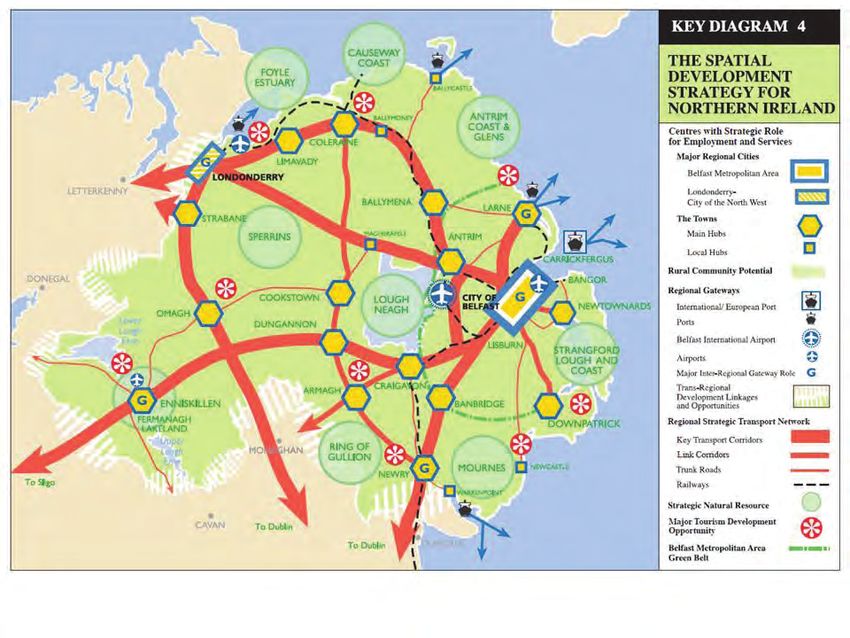
to accommodate growth, locating CoDA within the
Letterkenny, in Ireland, as a linked regional gateway,
Western Corridor of the Regional Strategic Transport
reflecting the potential to work in partnership to promote
Network (see Figure 4.1). In this context, the RDS
economic and social development and promote cross
recognises Derry as the principal urban centre in
border co-operation.
the north west region and highlights its pivotal role in
cross-border and international trading relationships. It
sets out the following key objectives for Derry and the
north west:
27Planning Strategy for Rural Northern Ireland • The proposal would not result in an unacceptable
impact on any area, feature or species of
The Planning Strategy for Rural Northern Ireland nature conservation importance or feature of
(PSRNI) was published by the Department of the archaeological or historic interest.
Environment in 1993. It covers all of the towns, villages
and countryside of Northern Ireland outside Belfast
(and adjoining built up areas) and Derry. Planning Policy Statements
The Strategy establishes the objectives and the
Planning Policy Statement 13: Transportation
policies for land use and development appropriate and Land Use
to the particular circumstances of Northern Ireland
This PPS has been prepared to assist in the
which need to be considered on a scale wider than the
implementation of the Regional Development Strategy
individual District Council Area.
to guide the integration of transportation and land use.
PPS 13, at paragraph 74 states;
Planning Policy Statements (PPSs) are gradually
replacing the policy provisions of the Planning Strategy
“The RDS places considerable importance on the
for Rural Northern Ireland and each PPS indicates
potential role of the regional gateways, including the
those policies of the Strategy that it is superseding. In
ports and airports, as appropriate locations for major
the meantime, the Planning Strategy remains in force
economic development and additional employment
for those topics not covered by a PPS or other policy
generation. It is likely therefore, that regional gateway
publication and where still applicable, remain a material
air and seaports could generate considerable
consideration until it is completely superseded.
additional volumes of commercial and commuter
traffic in the future. Only a small proportion of this
Policy PSU3 of the PSRNI relates to transport facilities,
traffic is currently conveyed by means other than
including airports, and stipulates that proposals
private road vehicles. In future the emphasis will be on
necessary to maintain operational requirements or to
ease of access by alternative modes, including access
expand facilities will be supported provided that:
by public transport users, pedestrians, cyclists and
people with restricted mobility and, where feasible, by
• It is necessary for the current operational rail freight”.
requirements of the facility;
• It forms part of a scheme for the improvement Planning Policy Statement 21: Sustainable
to or for an appropriate level of expansion of the
existing facility; Development in the Countryside
• The proposal is for development clearly related This Draft Planning Policy Statement sets out planning
to and dependent on siting adjacent to the facility. policies for development in the countryside. For the
General industrial or warehousing development purpose of this document the countryside is defined
is unlikely to be permitted adjacent to airports as land lying outside of settlement limits as identified
which are located in rural areas; in development plans. The provisions of this document
• The proposal would not result in an unacceptable will apply to all areas of Northern Ireland’s countryside.
reduction in the amenity of adjoining residents
or businesses as a result of noise, dust, smell, Derry Area Plan 2011
pollution or excessive traffic generation;
The majority of the Airport is situated within Derry City
• In relation to port development the proposal Council area but outside the development boundary
would not lead to an unacceptable impact on for any settlement and not covered by any specific
coastal ecology or processes; and designation.
28 City of Derry Airport Master Plan - Autumn 2012The Derry Area Plan was adopted in May 2000 in order All development work at CoDA will be undertaken in
to inform the policy framework and broad land use accordance with the CAA’s requirements that are laid
proposals, and used to guide development up to 2011. out in their publication CAP168, including:
Although the Area Plan does not contain policies • The layout, separation and widths of runways
specifically relating to CoDA, the generic policies and taxiways;
contained within it remain a key consideration in the • Aircraft stand sizes and apron layouts;
determination of applications for development. A Local
Plan was to be prepared for the area in and around the • The height and design of buildings and structures;
Airport. and
• The airport fire service facilities.
To date, this has not been carried out. In the future,
and whilst there is no specific time frame, it is likely Future development of CoDA will be designed to
that most planning functions will be devolved to local ensure that risks are minimised. For example the
authorities, therefore it is envisaged that future planning location of future facilities will be determined to reduce
policies relating specifically to CoDA will eventually be runway crossings to a minimum in order to reduce the
contained within the Local Development Plan for the unnecessary risk of runway incursions.
area.
Development Control
Draft Northern Area Plan 2016
Airport developments are subject to statutory
A portion of the Airport lies within the Limavady control as laid down in Town & Country Planning
Borough Council boundary under the Northern Area Legislation. Small airport developments may however
Plan 2016 (Draft) published in May 2005. Paragraph be progressed without the need to submit a planning
3.2.6 of the Plan states: application, these developments are progressed under
General Purpose Development Order (GPDO) powers.
“The Department proposes to prepare a Local Plan Such works are limited and do not include:
for the area in and around the City of Derry Airport,
which adjoins the North West periphery of the • Development on non-operational land;
Limavady Borough Council area. The Local Plan is
• Non-operational buildings (those unrelated to
likely to include lands in the vicinity of the main airport
the movement or maintenance of aircraft, or the
access road that itself is located within the Limavady
embarking, disembarking, loading, discharge or
Borough”.
transport of passengers, livestock or goods);
• Development falling within the scope of the
Airport Safety and Design Environmental Assessment Regulations;
CoDA operates within the terms of a license issued by • The construction or extension of a runway; and
the Civil Aviation Authority (CAA), the body charged • A passenger terminal with a floor space greater
with ensuring that UK airports operate in accordance than 500m2, or the extension of the existing
with the International Civil Aviation Organisation terminal beyond 15% of the original terminal floor
(ICAO) criteria. Future development will be undertaken space.
in accordance with the requirements of the CAA as set
out in CAP168: Licensing of Aerodromes, which sets
out the standards required at UK licensed aerodromes
relating to, for example, the height and design of
buildings and structures, the layout of runways and
taxiways, and operational procedures.
29Airport Security Environmental Regulations
The Department of Transport (DfT) regulates the CoDA operates within a number of nationally applicable
security standards and anti terrorism measures at policies and standards and has established key
the UK’s airports. These standards control both the environmental targets that are described in chapter
operational running of the Airport and the form and 9. The commitment to developing in a managed
design of new and existing facilities. Security directions sustainable manner underpins CoDA’s approach to
from the DfT relate to such key matters as the achieving the goal of carbon neutrality in its ground
segregation of departing and arriving passengers, the operations.
screening of baggage and the access to secure airside
areas.
30 City of Derry Airport Master Plan - Autumn 2012Chapter 5
Passenger Forecasts
Introduction Up until the late 1990s passenger numbers at CoDA
were approximately 50,000 per annum and were
CoDA has experienced significant growth in passenger generally composed of a number of short haul
traffic over the last decade. Passenger numbers have services on small aircraft to Manchester and Glasgow.
grown from around 104,000 in 1998 to around 400,000 Breakthrough was achieved in 1999 when Ryanair and
in 2011. The figure below illustrates the overall trend in Falcon/Thomson commenced operations to CoDA.
passenger numbers: This resulted in a rapid expansion in passengers to
the current volumes. In 2011, Ryanair accounted for
Figure 5.1 approximately 85% of passengers.
There is currently virtually no freight traffic to the airport.
The majority of air cargo is carried in the belly hold of
passenger aircraft. Given Ryanair’s business model
relies on fast turnarounds they currently do not carry
belly hold cargo. Given that Belfast International Airport
provides a significant cargo operation it is unlikely that
any general cargo other than specialist charter and one
off operations will be scheduled at CoDA.
Passenger Mix
The current passenger mix can be defined as follows:
;
• 56% travelling outbound
• 44% travelling inbound
The average growth over the period is 25% compared • 13% are travelling on business
with a UK average of 5% meaning that CoDA was one • 24% of passengers are travelling on leisure
of the fastest growing regional airports during this • 63% of passengers are travelling to visit friends
period. and relatives
The decrease in 2009 and 2010 reflects the combined
effects of the global financial crisis and introduction
• 62% had journey origins or destinations within
Northern Ireland
of air passenger duty; however in 2011 passenger
numbers started to increase as Ryanair added • 38% had journey origins or destinations within
additional services to the airport. the Republic of Ireland
Scheduled domestic (intra UK) services still account
for the largest proportion of passenger traffic and in
common with other airports in Northern Ireland there
is only a limited international route network, generally
summer sun destinations.
31The charter market has been reasonably static at CoDA Commercial ATMs are defined as air transport
with Falcon/Thomson serving two destinations for a 20 movements by scheduled or charter aircraft. The other
week season in the summer months. A number of other ATMs are a collection of movements due to:
charter operations have been handled through CoDA
over the decade to a variety of destinations, however, • Air taxi;
as a result of falling demand caused by macroeconomic • Business Aviation;
circumstances, the airlines have generally consolidated
these services into Belfast or Dublin. • Positioning flights;
• Test & training;
With the continued development of CoDA in the past • Aeronautical clubs;
decade and a gradually increasing route network, an
• Private aviation; and
increasing number of business travellers are using
the Airport. It is anticipated that additional frequencies • Military.
per week and added double daily operations on some
routes will significantly increase the percentage of The common name given to non-commercial ATMs is
business travellers. general aviation.
Compared to other airports of similar size, CoDA has a
Air Traffic Movements relatively low number of ATMs and this is due to:
Air Traffic Movements (ATMs) are defined as a single
take off or landing on a runway. Figure 5.2 shows the • Relatively low GA use; and
historic air traffic movements since 2000. • Average size of commercial aircraft which at 180
seats is considerably larger than other similar
airports that often have a blend of small and
Figure 5.2: medium sized aircraft.
32 City of Derry Airport Master Plan - Autumn 2012You can also read


