COVID-19 Situation Reporting across Europe - ASPHER
←
→
Page content transcription
If your browser does not render page correctly, please read the page content below
ASPHER Report
COVID-19 Situation Reporting across Europe

                           Week of May 10th 2021

Authors: Pallavi Chatarajupalli1,2, Ralf Reintjes1,3, John Middleton3,4,*
1 HAW  Hamburg University, Germany
2 ASPHER Young Professional
3 ASPHER COVID-19 Task Force
4 ASPHER President

* Corresponding Author: john.middleton@aspher.org

 This is ASPHER’s weekly surveillance report. We hope it is complementary to other resources such as ECDC and
 Our World in Data, where the reader can go for more detailed information. Please give us your feedback: is the
 presentation helpful to you and your colleagues? What other information would you like to see in it?

 ASPHER celebrates the extraordinary and dramatic falls of deaths from COVID-19 in Israel, Spain, UK
 and urges all countries to address their internal problems with vaccination programmes and get these sorted.
 We are concerned about the disastrous explosion of the pandemic in India. We call on the international
 community to respond to needs identified by the public health authorities in India and offer every feasible
 support. The situation in India presents an extreme case of need that cannot be met within a country and
 why we need international health action agencies capable of responding to need, as set out in our BMJ
 piece. It also shows the need for further efforts to promote internationalism in vaccination programmes for
 the protection of everyone.
 ASPHER is concerned about the recognition of an increasing number of new variants of the SARS-COV2
 virus. We believe there should be increasing international collaboration and capacity in the surveillance of
 the variants of the virus, surveillance of the outcomes of vaccination, resistance to infection and timespan
 of immunity. There needs to be coordinated global effort towards anticipating new variants and adapting
 vaccinations to meet mutating changes of the virus. (see also: https://blogs.bmj.com/bmj/2021/01/28/we-
 need-an-equitable-and-coordinated-global-approach-to-covid-19-vaccination/)
 The data on the transmission of variants is very limited and the criteria for sequencing of samples tested
 across countries is not yet standardized.

                                                                                                       1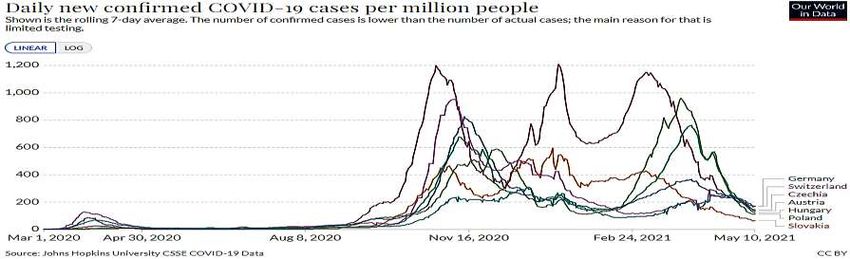
The COVID-19 pandemic has entered its second year since the time WHO declared the coronavirus
outbreak as a global pandemic on 11th March 2020 (1). From the experiences of initial lockdown,
countries have learned to develop strategies to sustain economic stability by imposing strict regulations
instead of complete lockdown. Continuing the non-pharmacological interventions alongside vaccine
rollout, some countries have significantly reduced the number of deaths and the infection rate (UK,
Spain, Israel, Portugal). A few countries in individual European sub-regions have started easing
lockdown restrictions (UK, Bulgaria, Hungary, Estonia, Israel, Portugal, France, Denmark, Belgium).
However, some countries are still experiencing a mounting infection rate, which is a major concern
(Turkey, France, Germany).
Since the beginning of the COVID-19 pandemic, the rapid spread of the virus in almost all countries
has resulted in considerable disruption of public health at a global level. The pandemic has cost over
three million lives to date (3,299,764) and the total number of confirmed COVID-19 cases has surpassed
0.1 billion (158,651,638). Individual WHO Regions confirmed COVID-19 cases are as follows (2).
Table 1
 WHO Region                                                Confirmed COVID-19 cases

 Americas                                                               63,848,602
 Europe                                                                 53,010,891
 South-East Asia                                                        26,289,943
 Eastern Mediterranean                                                   9,500,567
 Africa                                                                 3,366,036
 Western-Pacific                                                         2,634,853

As per the WHO weekly epidemiological report, the European Region is contributing 35% of
cumulative COVID-19 confirmed cases worldwide. The number of new cases and deaths in the past 7
days has reduced by 23% and 18% respectively compared to the previous week. In Turkey, France
and Germany a high incidence of coronavirus is reported at 197.7, 188.3, 124.5 per 100,000 population
respectively in two consecutive weeks (3). According to IHME COVID briefing, as of 10th May, 29%
of the European population has been infected with COVID-19; in two consecutive weeks, COVID-
19 is the top one leading cause of mortality in Europe. Overall, the effect of the pandemic is declining
in Europe, which is reflected through the decrease in the number of daily reported cases and
deaths. Analysis of the transmission of variants suggests that the variant identified in India may lead to
further outbreaks in the coming months which is already prevalent at the moment in the UK (4).
Vaccination plays an important role in controlling the pandemic, protecting against death and serious
disease. There is further work ongoing to determine its effectiveness in preventing disease
transmission. Research regarding the effectiveness of vaccines is still open-ended (5). Globally a total
of 1,264,164,553 vaccine doses have been administered against coronavirus by 12th May (6). The
distribution of vaccine is unequal among countries and regions. The share of the population who
received at least one dose of the COVID-19 vaccine is 30.56% in high-income countries and is
0.36% in low-income countries (Figure 11) (7). Although differences exist within the countries,
accessibility and vaccine hesitancy are also important factors to be looked into affecting the vaccination
process. A recent online survey (between February and March 2021) among 27 EU member states
revealed that 27% of people in Europe are showing unwillingness to receive the vaccine.
Especially, age groups between 18-34years are skeptical to take up vaccine giving the reason that
vaccine may cause unhealthy consequences. Comparatively women (25%) are less reluctant than men
(29%) to accept the vaccine. The amount of time spent on social media, taking into account as the main
source of information is strongly associated with vaccine hesitancy. The study also found that the
inclination to receive the vaccine is higher in Northwest Europe and Scandinavian countries and
the contrast is seen in South-East Europe. In Malta, Denmark and Ireland the proportion of people
likely to get vaccinated is above 70 at 72.9%,73.5%,76.6% respectively and the willingness is above
60% in Spain, Italy, Portugal, Sweden, Finland. Bulgarians are found to be more reluctant with
48% stating they are very unlikely to get vaccinated (8) (9).
The following table shows daily new confirmed coronavirus cases, deaths and an estimate of the
effective reproduction rate (R) across European countries as reported on 10/05/2021 (table 2) (10).
                                                                                                        2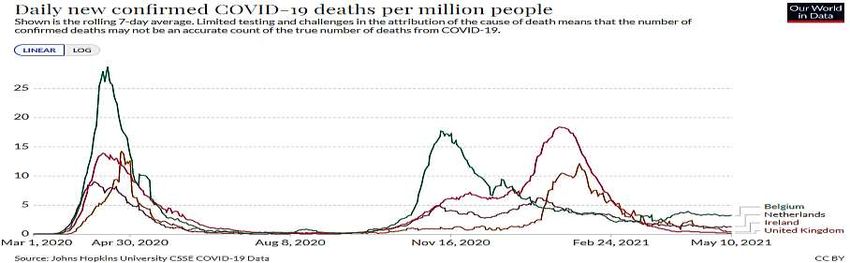
Table 2
                         Rolling 7-day average     Rolling 7-day            Effective
                         of daily new              average of daily new     reproduction rate
                         confirmed COVID-19        confirmed COVID-         (R)estimate
WHO Europe region        cases/mill people         19 deaths/mill people
Sweden                                    483.18                     1.77                   1.06
Cyprus                                    456.60                     2.61                   0.75
Lithuania                                 434.82                     4.67                   1.06
Netherlands                               410.59                     1.33                   0.93
Georgia                                   340.71                     5.08                   1.12
Latvia                                    329.31                     4.47                   1.11
Croatia                                   321.02                     9.92                   0.82
Slovenia                                  298.78                     2.06                   0.90
France                                    263.10                     3.29                   0.79
Belgium                                   258.61                     3.22                   0.96
Bosnia and Herzegovina                    258.61                    13.54                   0.76
Estonia                                   257.81                     3.45                   0.91
Andorra                                   247.76                     0.00                   0.75
Turkey                                    245.29                     3.59                   0.60
Luxembourg                                213.61                     0.91                   0.94
Greece                                    210.19                     6.88                   1.02
Serbia                                    171.25                     3.02                   0.75
Switzerland                               170.74                     0.99                   0.94
Germany                                   170.54                     2.58                   0.87
Spain                                     158.76                     1.84                   0.91
Kosovo                                    158.62                     5.40                   0.49
Denmark                                   155.85                     0.17                   1.15
Italy                                     154.95                     3.78                   0.83
Montenegro                                147.16                     7.73                   0.71
Czech Republic                            144.46                     4.62                   0.75
North Macedonia                           142.78                    10.15                   0.63
Austria                                   137.92                     2.09                   0.73
Hungary                                   122.37                    11.61                   0.61
Belarus                                   121.72                     1.06                   0.99
Ukraine                                   121.70                     5.92                   0.82
Kazakhstan                                115.12                     0.15                   0.92
Armenia                                   113.05                     4.82                   0.71
Azerbaijan                                112.52                     1.66                   0.66
Bulgaria                                  112.15                     9.19                   0.80
Poland                                    110.70                     7.28                   0.66
Ireland                                    83.87                     0.43                   0.98
Norway                                     80.90                     0.26                   1.03
San Marino                                 67.35                     0.00                   0.32
Slovakia                                   66.96                     6.38                   0.81
Romania                                    62.33                     4.86                   0.72
Monaco                                     58.24                     0.00                   0.70
Russia                                     54.93                     2.35                   0.97
Kyrgyzstan                                 50.73                     0.83                   1.14
Moldova                                    50.29                     3.83                   0.66
Finland                                    39.22                     0.23                   0.91
Malta                                      33.65                     0.32                   0.57
United Kingdom                             32.52                     0.15                   1.03
Portugal                                   31.98                     0.22                   0.88
Albania                                    23.63                     0.84                   0.69
Iceland                                    15.07                     0.43                   0.81
Uzbekistan                                 11.75                     0.04                   1.10
Israel                                      5.55                     0.18                   0.60
Tajikistan                                  0.00                     0.00                   0.00
                                                                                                3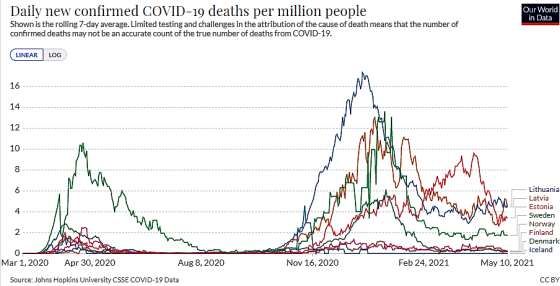
•   In Cyprus - Between 10th and 11th May, 390 new coronavirus cases (114 cases more than the
    previous day) and 2 new deaths have been recorded. The 7-day moving average is 436.78 per million
    people which was 644.40 a week before (11). The government of Cyprus has extended measures
    to control the pandemic until 31st May such as restricted movement from 11 pm to 5 am,
    gatherings both indoors and outdoors, religious ceremonies are limited to 10 people, for Church
    attendance the limit is 50 people until 16th May. From 17th May, a maximum of 200 people can
    participate in outdoor dining and religious ceremonies with mandatory Coronapass. It is mandatory
    to present a “Safepass” at certain places for age group 12 and above (social events, religious
    gatherings, shopping centres, and catering services). A Safepass can be a vaccination certificate or
    vaccination card, proof of recovery from COVID-19 in the last six months (received from Ministry
    of Health), a negative antigen or PCR test report (12) (13).
•   In Hungary - The number of new coronavirus cases (122.37) and deaths (11.61) rolling 7-day
    average per million people is showing a downtrend in Hungary (14) also the number of people
    recovered from COVID-19 is improving. As of 12th May, 4.3 million people have received the first
    dose and 2.5 million received the second dose of vaccine against COVID-19. Vaccination for the
    age group 16-18 years will commence from 13th May (15). Indoor catering services, leisure
    activities, sports events, entry to gyms, swimming pools are accepted for people holding vaccine
    certificate (16)
•   In Bulgaria - For the first time, three districts out of 28 in Bulgaria turned to “orange zone”
    where the infection rate falls between 60 and 119.9/100 thousand population and the remaining 25
    districts are in COVID-19 “red zones” (17). To accelerate the vaccine rollout Bulgaria has
    planned to open green corridors at eight Diagnostic and Consulting Centers (DCC) from 17th
    May (18).
•   In Finland - Between 11th and 12th May, Finland has reported 280 new coronavirus cases and three
    new deaths associated with coronavirus bringing the total numbers to 89,550 and 933 respectively
    (19). The country has planned to ease restrictions starting from April through to August 2021
    assuming the vaccination campaign will move on with set agenda and the changes in
    restrictions will be updated according to the governments hybrid strategy by analyzing the
    situation (three phases - baseline, acceleration phase and community transmission phase)
    throughout the country (20).
•   In Sweden - According to the weekly epidemiological report (3rd to 9th May) since the second week
    of April, the number of confirmed COVID-19 cases is showing a declining trend also the
    number of intensive care admissions. However, high pressure on the health care system is
    persisting. The overall incidence is 326/100 thousand inhabitants this week, which was 346 in the
    past week. Between the 10-19 years age group, a significant statistical rise in incidence is observed
    followed by the 40-49 years age group and the contrast is seen among 30-79 years. The survey on
    genome sequencing shows that the presence of variant B.1.1.7 is prevailing compared to the
    other two variants in Sweden (21). The Swedish public health agency is predicting that the
    infection level may go down by September 2021 provided that the vaccine drive continues according
    to the plan combined with adherence to the rules as recommended. The proposed level based plan
    for lifting the measures will begin from 1st June in three steps and depends on the level of
    spread of infection, pressure on health care and the number of people receiving vaccine which
    take place from 1st June in three steps (22).
•   In Belgium - The moving 7-day average of daily new confirmed COVID-19 cases and deaths are
    258.61, 3.22 respectively per million people (10). The number of new hospital admissions due to
    COVID-19 is showing a downtrend (23). Easing restrictions began from 19th April after Easter pause
    such as reopening schools, shops and non-medical close contact professions, outdoor gatherings to a
    maximum of ten people (24). A summer plan is proposed, which is a four-step gradual return to
    normal life provided that the vaccine rollout continues as planned and the number of intensive
    care admissions of COVID-19 patients does not exceed 500 (25).
•   In the United Kingdom - In the United Kingdom, an increasing number of cases of variants first
    detected in India is observed. The confirmed variant cases rose to 1,313 this week (520 last week)
    in some regions of the UK (Northwest and London). As part of the surveillance especially, to find
    the variants, test kits were distributed to ten schools and 153 existing test centres. For people who
    do not experience any symptoms, 133 mobile testing units have been arranged for PCR testing. In

                                                                                               4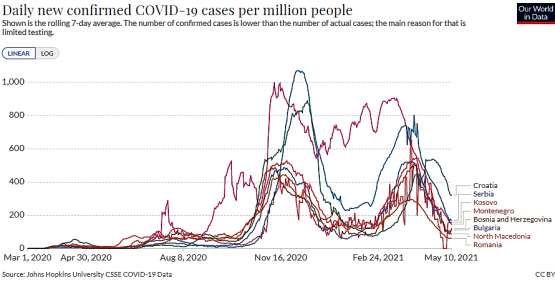
Bolton (Northwest region), mobile testing units are established with door-to-door PCR testing is
        offered for more than 20,000 households in the areas where the variants are recognized also a
        vaccine bus is organized to accelerate the process of vaccination. To identify clusters, throughout
        London, enhanced contact tracing, PCR testing, genome sequencing are employed (26).
Mediterranean Region:
Figure 1

Figure 2

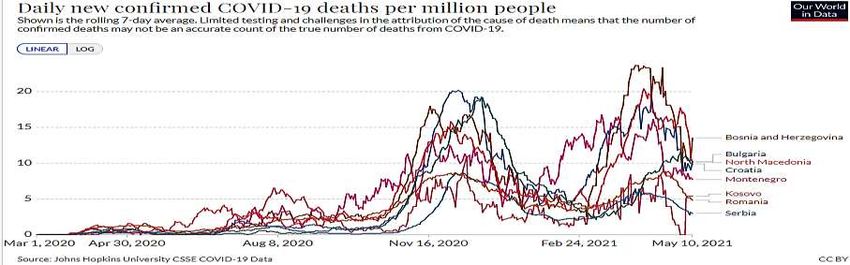
South-East Europe Region:
Figure 3

                                                                                                 5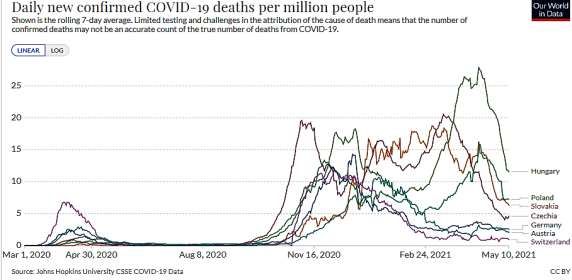
Figure 4

Central Europe:
Figure 5

Figure 6

                  6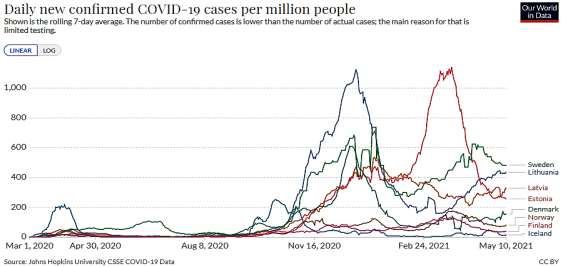
Baltics and Nordic countries:
Figure 7

Figure 8

Northwestern Europe:
Figure 9

                                7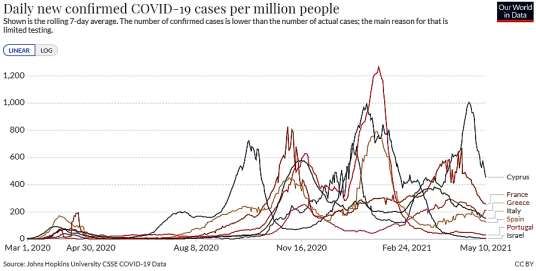
Figure 10

Figure 11

References:
1.   WHO Declares COVID-19 a Pandemic [Internet]. [cited 2021 May 12]. Available from:
     https://www.ncbi.nlm.nih.gov/pmc/articles/PMC7569573/
2.   WHO Coronavirus (COVID-19) Dashboard [Internet]. [cited 2021 May 12]. Available from: https://covid19.who.int
3.   Weekly epidemiological update on COVID-19 - 11 May 2021 [Internet]. [cited 2021 May 12]. Available from:
     https://www.who.int/publications/m/item/weekly-epidemiological-update-on-covid-19---11-may-2021
4.   44566_briefing_European_Region_17.pdf [Internet]. [cited 2021 May 16]. Available from:
     http://www.healthdata.org/sites/default/files/files/Projects/COVID/2021/44566_briefing_European_Region_17.pdf
5.   COVID-19 vaccines [Internet]. [cited 2021 May 16]. Available from: https://www.who.int/emergencies/diseases/novel-coronavirus-2019/covid-
     19-vaccines
6.   WHO Coronavirus (COVID-19) Dashboard [Internet]. [cited 2021 May 16]. Available from: https://covid19.who.int
7.   Coronavirus (COVID-19) Vaccinations - Statistics and Research [Internet]. Our World in Data. [cited 2021 May 16]. Available from:
     https://ourworldindata.org/covid-vaccinations
8.   Vaccinations during COVID-19 [Internet]. Eurofound. [cited 2021 May 16]. Available from: https://www.eurofound.europa.eu/data/covid-
     19/vaccinations
9.   Mental health, trust in decline across the EU and inequalities rise as pandemic enters another year [Internet]. Mynewsdesk. [cited 2021 May 16].
     Available from: https://www.mynewsdesk.com/eurofound/news/mental-health-trust-in-decline-across-the-eu-and-inequalities-rise-as-pandemic-
     enters-another-year-426898
10. {Max Roser, Hannah Ritchie, Esteban Ortiz-Ospina and Joe Hasell}. {Coronavirus Pandemic (COVID-19)}. {Our World in Data} [Internet].
    2020; Available from: https://ourworldindata.org/coronavirus
11. Coronavirus (COVID-19) Cases - Statistics and Research [Internet]. Our World in Data. [cited 2021 May 12]. Available from:
    https://ourworldindata.org/covid-cases
                                                                                                                                          8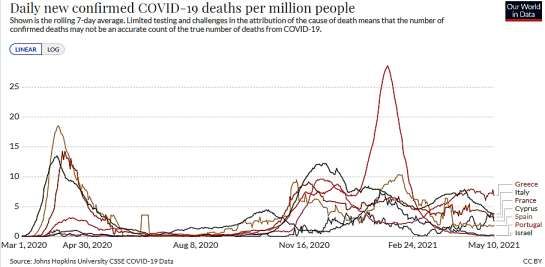
12. 10052021_safepassrequirementEN.pdf [Internet]. [cited 2021 May 12]. Available from:
    https://www.pio.gov.cy/coronavirus/uploads/10052021_safepassrequirementEN.pdf
13. 05052021_METRA_EN.docx.pdf [Internet]. [cited 2021 May 12]. Available from:
    https://www.pio.gov.cy/coronavirus/pdf/05052021_METRA_EN.docx.pdf
14. Coronavirus (COVID-19) Cases - Statistics and Research [Internet]. Our World in Data. [cited 2021 May 12]. Available from:
    https://ourworldindata.org/covid-cases
15. 4 millió 392 ezer a beoltott, 905 az új fertőzött, elhunyt 96 beteg [Internet]. 2021 [cited 2021 May 12]. Available from:
    https://koronavirus.gov.hu/cikkek/4-millio-392-ezer-beoltott-905-az-uj-fertozott-elhunyt-96-beteg
16. Four Million People Vaccinated: Here Are the New Rules [Internet]. Hungary Today. 2021 [cited 2021 May 12]. Available from:
    https://hungarytoday.hu/hungary-four-million-people-vaccinated-new-rules-restrictions/
17. 25 districts in Bulgaria are Covid-19 ‘red zones’ [Internet]. The Sofia Globe. 2021 [cited 2021 May 16]. Available from:
    https://sofiaglobe.com/2021/05/11/25-districts-in-bulgaria-are-covid-19-red-zones/
18. От 17 май зелени коридори за ваксиниране в 8 ДКЦ в София [Internet]. 2021 [cited 2021 May 16]. Available from:
    https://coronavirus.bg/bg/news/1841
19. Situation update on coronavirus - Infectious diseases and vaccinations - THL [Internet]. Finnish Institute for Health and Welfare (THL), Finland.
    [cited 2021 May 13]. Available from: https://thl.fi/en/web/infectious-diseases-and-vaccinations/what-s-new/coronavirus-covid-19-latest-
    updates/situation-update-on-coronavirus
20. Plan for lifting COVID-19 restrictions [Internet]. Valtioneuvosto. [cited 2021 May 13]. Available from: https://valtioneuvosto.fi/en/information-
    on-coronavirus/lifting-of-restrictions
21. Senaste covidrapporten — Folkhälsomyndigheten [Internet]. [cited 2021 May 14]. Available from:
    http://www.folkhalsomyndigheten.se/folkhalsorapportering-statistik/statistik-a-o/sjukdomsstatistik/covid-19-veckorapporter/senaste-
    covidrapporten/
22. Förslag om anpassade smittskyddsåtgärder — Folkhälsomyndigheten [Internet]. [cited 2021 May 15]. Available from:
    http://www.folkhalsomyndigheten.se/nyheter-och-press/nyhetsarkiv/2021/maj/forslag-om-anpassade-smittskyddsatgarder/
23. Belgium COVID-19 Dashboard - Sciensano [Internet]. Google Data Studio. [cited 2021 May 13]. Available from:
    http://datastudio.google.com/reporting/c14a5cfc-cab7-4812-848c-0369173148ab/page/ZwmOB?feature=opengraph
24. Consultative Committee decides on end of “Easter pause” | Coronavirus COVID-19 [Internet]. [cited 2021 May 13]. Available from:
    /en/news/occ-1404/
25. Summer Plan: four steps towards a more normal life | Coronavirus COVID-19 [Internet]. [cited 2021 May 13]. Available from: /en/news/occ1105/
26. Confirmed cases of COVID-19 variants identified in the UK [Internet]. GOV.UK. [cited 2021 May 16]. Available from:
    https://www.gov.uk/government/news/confirmed-cases-of-covid-19-variants-identified-in-uk

                                                                                                                                          9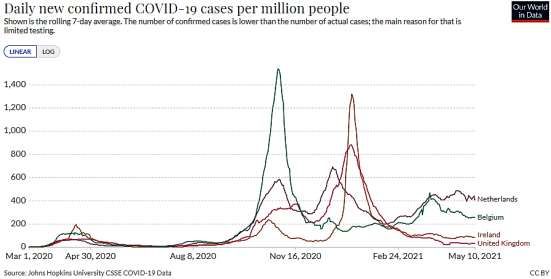
You can also read


