Data. Analysis. Insight - Five charts to sum up 2020 in online retail - IMRG
←
→
Page content transcription
If your browser does not render page correctly, please read the page content below
Five charts to sum up 2020 in online retail                              Five charts to sum up 2020 in online retail      2

                                                                                                                                      www.imrg.org
               Data.
                                                                                            Five charts
               Analysis.                                                                    to sum up
               Insight.                                                                     2020 in
                                                                                            online
                                                                                            retail
www.imrg.org

                                                                 IMRG, 16 Neal’s Yard
                      0203 696 0980         enquiries@imrg.org   London, WC2H 9DP

    1
Five charts to sum up 2020 in online retail Five charts to sum up 2020 in online retail 2
Foreword The trajectory of online
sales growth
www.imrg.org
Emarsys
With five years’ worth of ecommerce growth occurring in less than a year,
The below chart shows year-on-year online sales growth for 2018-20. The trend
the last twelve months have provided us with more digital shopping
leading into 2020 was a general decline; in 2018, growth was relatively strong in
data than ever before.
the first half, then weaker in the second half. It was particularly notable for an
As retailers prepare for the next retail event in the calendar — underwhelming Black Friday period, which raised questions as to whether it was
Valentine’s Day — we have examined the lessons that can be beginning to run out of steam. Then, in 2019, growth was subdued for the whole year
learned from the busiest shopping periods of 2020. until November, when the Black Friday peak was strong throughout the whole period.
Through the data made available by IMRG — and Emarsys’s own Good Christmas trading generally helped overall growth for 2019 to come in at 6.7%;
experience working with the world’s biggest retail brands — this guide still the lowest recorded in 19 years of tracking in the IMRG Capgemini Online Sales
uncovers the purchase behaviours and buying trends that emerged in Index.
2020, and how these can be applied to future shopping seasons. As can be seen, the
For those currently planning their Valentine’s Day ecommerce campaigns, this subdued trading
should help to guarantee a shopping success story and avoid the pitfalls of a high trend continued into
street heartache. the first few months
of 2020. This poor
Alex Timlin, SVP Verticals, Emarsys performance was
underscored by the
IMRG
fact that the same
The pandemic had a negative impact on many business sectors. Retail, with non- months in 2019
essential stores forced to close for several months of the year, was no exception, but featured low growth,
Chart I – YoY growth in online sales, 2018-2020
that disruption was very lopsided. Supermarkets had to bring in purchasing limits so they were building
on certain ranges as demand was so high and online retail overall boomed for much on a low base. Then, in March 2020, the first lockdown was introduced and the trend
of 2020 with categories such as home, electricals, garden, beers, wine and spirits, line changed dramatically. Online was a key beneficiary of lockdown, as there were
www.imrg.org
and beauty all recording triple-digit growth at various points. Clothing retailers, not many other options for spending money. From July, as things started to open
meanwhile, did not experience that online uplift. up again, the rate of growth gradually declined but then rebounded as the second
lockdown was introduced in England in November. Overall growth in 2020 came in at
As we head into 2021 — probably the most unpredictable year in living memory
37%, a near six-fold increase on that of 2019.
— there are many lingering questions as to which of the changes enforced by
the pandemic will continue long term. As these charts show, Covid-19 scattered Looking ahead to 2021, it seems certain that the rate of growth will remain very
established trend lines through peaks and troughs that could never have been high in Q1.
foreseen in 2019.
From that point on, however, there are numerous possible directions things could go in
Forecasting for 2021 is a fraught process… but at least 2020, as disruptive as it was, depending on how the vaccination programme progresses, how the economic fallout
can be assessed with some certainty as to what happened now. impacts shopper spending, and how long the government’s restrictions remain in
place.
1Five charts to sum up 2020 in online retail Five charts to sum up 2020 in online retail 4
A multichannel year,
For many, this means using their existing bank of online consumer data to ensure
that loyal customers are being rewarded with discounts and contextually relevant
online at least
promotions — promotions that they simply couldn’t get anywhere else.
www.imrg.org
As brands begin preparing for the busiest shopping periods of 2021, digital-native
retailers also need to refocus on optimising their tech stacks, removing data silos and
providing the best possible multichannel experience for customers.
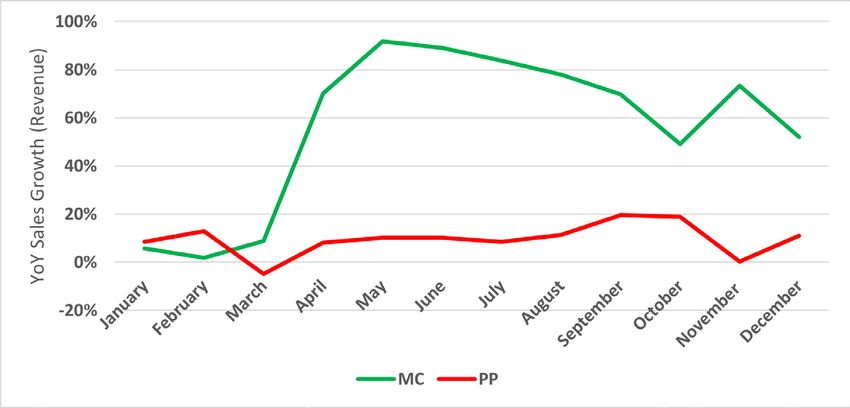
This chart from IMRG contrasts year-on-year online sales growth for multichannel
and online-only retailers in 2020. At the start of the year, the online-only retailers were
securing the stronger growth of the two groups, but once the first lockdown came in,
the demand shifted very sharply over to the multichannel retailers. Online demand by
Put simply, the story of the
pandemic f rom a retail
perspective is that stores
categories
were shut for three months,
This chart shows online sales growth for five categories in 2019 and 2020. As can be
so people were forced to
seen, for four of them the 2020 growth rate far outstripped that of 2019, illustrating
shop through those store
the extent to which demand was accelerated by the pandemic and even, in the case
retailers’ online channels.
of electricals,
The demand shift was reversed. As it
lopsided here as well was negative in
Chart II – YoY growth for online sales, multichannel though; those multichannel 2019, the very high
and online-only (PP) retailers
retailers selling in rate of growth
categories such as home and electricals saw massive spikes in growth, while for electricals
multichannel clothing retailers did not see the same uplift. Footwear was particularly needs to be
badly impacted by that dip in contextualised
demand, with the category rarely accordingly,
out of negative growth all year.
Multichannel but it is still a
Emarsys commentary
and mobile remarkable
www.imrg.org
Chart III – YoY online sales growth for 2020 vs 2019, five categories
turnaround.
With 52% of all web traffic coming
With so many high street retailers f rom mobile, the mobile web By contrast, clothing actually secured lower growth in 2020 than it did in 2019, as
now perfecting their online presence experience is more critical today than demand was dramatically reduced for many sub-categories (shoes, dresses, suits etc).
ever before. If it’s not mobile-f riendly,
and adopting a truly multichannel For 2021, clothing retailers will be hoping for a quick conclusion to the pandemic so
50% of customers will stop shopping,
approach, digital-first brands need even if they like the brand. And mobile office work, events and functions (weddings etc) return.
to work even harder to maintain or doesn’t just have to mean apps and
regain their share of online online experiences, multichannel
campaigns that include SMS
spending.
are also 48% more likely
to convert.
3Five charts to sum up 2020 in online retail Five charts to sum up 2020 in online retail 6
A boom time for Emarsys commentary
With more online customers comes more data, something which retailers of all sizes
small retailers are now taking advantage of. As the Covid crisis has forced more shoppers online,
www.imrg.org
brands have been able to build ever-larger data sets, helping them understand who
their customers are and how best to satisfy them.
This chart shows While many are still struggling to manage this influx of data, with data silos
online sales remaining a common concern, those that have succeeded are using this new
growth for small information to create increasingly targeted and personalised ecommerce campaigns.
(Five charts to sum up 2020 in online retail Five charts to sum up 2020 in online retail 8
In 2017, there were few campaigns live until the Monday of Black Friday week, then In the case of Charlotte Tilbury, this even includes unique on-site experiences, such as
a gradual increase as the week unfolded before peaking on the Friday. In 2018, the a virtual consulting session, and the ability to ‘try on’ make up using AR. These new,
same pattern is discernible, but with a greater number live on that Monday. In 2019, personalised technologies will further help to bring the in-store experience online this
there was a notable increase in the number of campaigns live in the week before Valentine’s Day.
www.imrg.org
Black Friday week. Then, in 2020, campaigns launched in much higher numbers right
For these brands, Valentine’s Day is a major retail event. With consumers unable
across the whole of November, coinciding with the second English lockdown. For the
to splash out on dinners, events, or experiences, this year will provide the perfect
f irst time then, it is accurate to describe it as ‘Black November’.
opportunity to ramp up gift sales online.
The question for 2021 is whether that will be repeated, with campaigns going very
As the category data shown in section three, these trends could mean big boosts in
early, if there is no lockdown or even much in the way of restrictions in place by that
online sales, especially for health and beauty gifts. According to the 2020 IMRG data,
point.
online sales of beauty products are up 67.9%, while gift sales have increased by 32.3%.
Emarsys commentary The The lingerie market has also seen a significant spike online, hitting a 42.2% increase
Black Friday over the last twelve months. As retailers prepare for Valentine’s Day, they should
Already, Emarsys is planning for “Black Friday in Boom ensure that their ecommerce stores bump these product categories to the homepage,
July”, anticipating that many of its biggest retail putting them front of shop — and front of mind — for consumers.
2020 was a huge year for
clients will start their holiday campaigns early on digital retailers, with the Black Of course, boosting profits this Valentine’s Day is only the beginning. The most
in 2021. While it’s unlikely that these retailers will Friday sales proving no exception.
successful brands will be those who not only make sales, but also encourage
launch consumer-facing sales in July, many will
According to data f rom Emarsys,
58% of UK shoppers headed online customers to return after the Valentine’s Day rush is over. Retailers need to see such
begin planning their campaigns, organising their for the Black Friday sales last seasonal events as more than just a ‘holiday boom’, instead viewing them as an
customer data sets and preparing their technology year, with one in five setting
opportunity to build loyalty and secure repeat customers throughout 2021.
stacks long before November rolls around. out to spend more than
they had in previous
And so…2021
For many multichannel retailers, this early start years.
will provide an opportunity to recoup losses from
the Christmas holiday season when high street
stores were forced to close due to a sudden, second wave of Covid restrictions.
As we saw in chart I in this report, retail was not in a strong position heading
A digital-first Valentine’s
into 2020; online growth in 2019 was at a historic low and retailers seemed to be
experiencing myriad issues… then 2020 happened. Whatever conf idence we had in
www.imrg.org
established trend lines continuing was suddenly ruptured but, although it might
Day seem odd to say it, after the initial shock of the March lockdown, 2020 actually
became rather predictable (f rom a retail perspective, and with the benef it of
hindsight perhaps).
Emarsys commentary 2021 may end up going down the same predictable path if, say, the vaccination
programme goes according to plan. But at the moment 2021 could, in equal
For those preparing their 2021 Valentine’s Day campaigns (the next big retail event likelihood, be a year of continued pandemic disruption, one of overcoming and
in the calendar), the continued lockdown will mean an urgent focus on digital renewal, or a mixture of both. Quite which kind of year we are going to get seems
experiences and optimising ecommerce stores. Emarsys is already working with very hard to predict.
many of the largest retail brands — including Lounge Underwear, Charlotte Tilbury,
Whatever happens, online has been catapulted forward by the events of 2020, so
PrettyLittleThing and others — to deliver personalised, omnichannel experiences that
7 retailers (or, those selling in the right categories at least) have a very strong platform
drive growth online.
to build upon.Five charts to sum up 2020 in online retail Five charts to sum up 2020 in online retail 10
About Emarsys
www.imrg.org
Emarsys empowers digital marketing leaders and
business owners with the only omnichannel customer
engagement platform built to accelerate business
outcomes. By rapidly aligning desired business results
with proven omnichannel customer engagement
strategies — crowdsourced f rom leading brands across
your industry — our platform enables you to accelerate
time to value, deliver superior one-on-one experiences
and produce measurable results… fast. Emarsys is
the platform of choice for more than 1,500 customers
around the world. Join thousands of leading brands
who trust Emarsys to deliver the predictable, prof itable
outcomes that their businesses demand and the highly
personalized omnichannel experiences that their
customers deserve.
www.imrg.org
For more information, visit www.emarsys.com.
9You can also read


