December comet brings back Rosetta memories - Phys.org
←
→
Page content transcription
If your browser does not render page correctly, please read the page content below
December comet brings back Rosetta
memories
16 December 2018

                                                                closest approach to Earth this weekend, when it
                                                                 might become visible to the naked eye.

                                                                A bright comet with a period of 5.5 years, 46P had
                                                                been chosen in the 1990s as the target of ESA's
                                                                Rosetta mission.

                                                                "When we began to study Rosetta, one of the most
                                                                important tasks was to create a list of comets that
                                                                could be reached by a spacecraft launched on an
                                                                Ariane 5 and carrying sufficient payload to study
                                                                the comet," says Gerhard Schwehm, who was the
                                                                ESA Rosetta project scientist at the time.

                                                                "It turned out that a mission to Comet 46P/Wirtanen
An image of Comet 46P/Wirtanen taken by Wouter Van              with launch in early 2003 would be one of the best
Reeven at ESA’s European Space Astronomy Centre                 opportunities. This initiated an intensive
(ESAC) near Madrid, Spain, on 6 December 2018. The              observation campaign from the ground to prepare
comet nucleus is at the core of the brightest spot at the       for the mission."
centre of the image, and the green diffuse cloud is its
coma. The green colour is caused by molecules – mainly          However, a launch delay from 2003 to 2004 meant
CN (cyanogen) and C2 (diatomic carbon) – that                   the spacecraft would not be able to rendezvous
are ionised by sunlight as the comet approaches the
                                                                with that comet at its closest approach to the Sun in
Sun. A hint of the comet’s tail is visible to the upper left.
The diagonal stripes are star trails. The comet reached
                                                                2013, prompting the Rosetta team to select a new
perihelion, the closest point to the Sun along its orbit, on    target, the now famed
Wednesday 12 December, and is on the way to its                 67P/Churyumov–Gerasimenko.
closest approach to Earth this weekend, when it might
become visible to the naked eye from dark locations. A          "The rest, as they say, is history, but because of the
bright comet with a period of 5.5 years, 46P had been           original choice, Comet 46P remains one of the best-
chosen in the 1990s as the target of ESA’s Rosetta              observed comets to date," adds Gerhard.
mission. However, a launch delay prompted the mission
team to select a new target, Comet 67P/Churyumov-
                                                                Comets from ground and space
–Gerasimenko, which was visited by Rosetta between
2014 and 2016. This image is a composite of 120
individual images, each with a 15 second exposure,              While we've learnt the ins and outs of Comet 67P
using a William Optics ZS 71 ED (71 mm refractor)               thanks to the comprehensive data collected there
telescope and a Canon EOS 700D DSLR camera (ISO:                by Rosetta between 2014 and 2016, the mission's
3200). The field of view spans 2 degrees x 1.5 degrees.         original target has still many secrets in store.
Credit: ESA / ESAC Astronomy Club / W. Van Reeven               Astronomers are now taking advantage of its visit to
                                                                observe it from the ground and uncover some of its
                                                                mysteries.

A special visitor is crossing the sky: Comet                    Comet 46P reached perihelion, the closest point to
46P/Wirtanen, sighted with telescopes and                       the Sun along its orbit, on Wednesday 12
binoculars in recent weeks, is on the way to its                December, and will appear at its brightest to

                                                                                                              1/4
observers on Earth in coming days, as it keeps
moving towards our planet, reaching the closest
distance on Sunday.                                   Colin coordinated the ground-based campaign to
                                                      observe 67P while Rosetta was investigating the
"The main advantage of observing comets with          comet from orbit, and is now involved in observing
telescopes on the ground is that we can study them 46P as well.
as a whole, including the coma and tails that stretch
over millions of kilometres," explains Colin          In the case of 67P, observations from the ground
Snodgrass of University of Edinburgh, UK.             provided a global context to the detailed
                                                      measurements that Rosetta made in the inner
                                                      coma, revealing the way that the gas observed in
                                                      the coma was linked to the comet's season cycle.

                                                                "From their vantage point, spacecraft like Rosetta
                                                                can see details that we cannot resolve from the
                                                                ground," says Colin. "However, for Comet 46P we
                                                                now have a very special opportunity to get detailed
                                                                observations from Earth, because the comet is
                                                                coming really close to us: at its closest approach, it
                                                                will be just 30 times farther than the Moon."

                                                                "We still won't get anything like the detail that
                                                                Rosetta returned – we won't be able to resolve the
                                                                nucleus of 46P, for example – but we can study the
                                                                outflow of gas and dust in the inner coma better
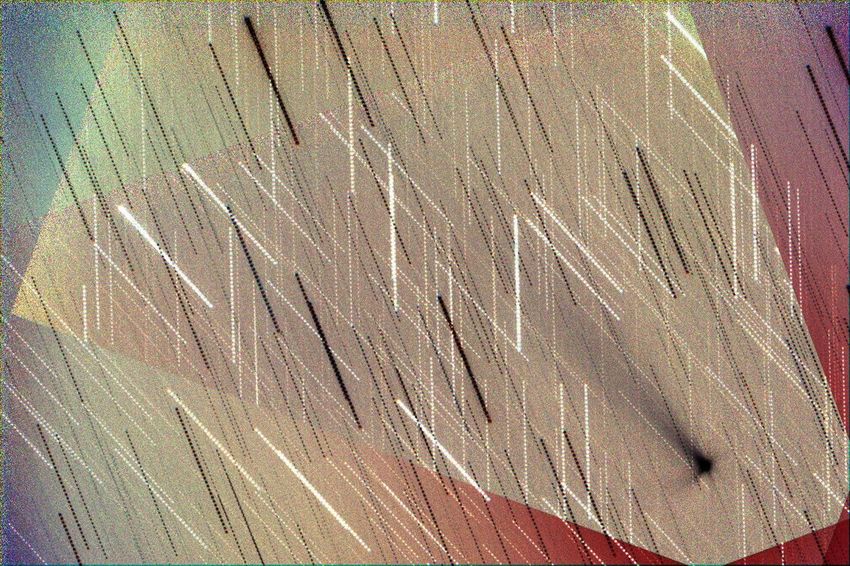
An image of Comet 46P/Wirtanen taken by Jost Jahn at            than is possible for most comets."
Observatoire de Haute Provence, France, on 10
December 2018. The comet is visible in the lower right          Because Comet 46P is passing so close to us, it is
part of the image, with its tail extending to the upper left.   very bright – millions of times brighter than 67P
The diagonal stripes across the image are star trails. The      appeared from Earth in 2015 – allowing
comet reached perihelion, the closest point to the Sun          astronomers to observe it with a wide range of
along its orbit, on Wednesday 12 December, and is on
                                                                telescopes and at different wavelengths. With these
the way to its closest approach to Earth this weekend,
                                                                data, they will piece together a more complete
when it might become visible to the naked eye from dark
locations. This image is a composite of 3x33 short, 15          picture of the comet and what drives its activity.
second exposures taken using RBGfilters on the ROTAT
telescope, a coma-corrected Newtonian (60cm f/3.2               From one comet to the next
equipped with an SBIG STL11000 full-frame CCD). It
was taken within the framework of a research project by         Observing Rosetta's original target is also providing
two 11th grade students from Mannheim, Germany, at              astronomers with a chance to test techniques and
the Hector Seminar, an organization that fosters gifted         develop expertise that will be of use when 67P –
high-school students in STEM subjects; the students are
                                                                Rosetta's actual target – will have its next perihelion
being supervised by Carolin Liefke from Haus der
                                                                in late 2021.
Astronomie in Heidelberg, Germany. The image has
been processed with the Larson-Sekanina rotational
gradient filter technique to enhance the contrast and           Helen Usher, a Ph.D. student at the Open
reveal the comet’s tail. ROTAT, the Remote Observatory          University and Cardiff University, working with the
Theoretical Astrophysics Tuebingen, is operated by the          Faulkes Telescope Project in the UK, is
German foundation Interactive Astronomy and                     coordinating an effort to involve students from
Astrophysics (Stiftung Interaktive Astronomie und               schools across Europe, collecting and analysing
Astrophysik), which aims to inspire young adults with           data for Comet 46P and in preparation of future
hands-on science. Credit: J. Jahn, Amrum
                                                                observations of 67P.

                                                                                                               2/4
"I was inspired by the Rosetta mission to start my mission team to select a new target, Comet
Ph.D., and I'm pleased to share this enthusiasm 67P/Churyumov–Gerasimenko, which was visited by
with school children, who are thrilled to be Rosetta between 2014 and 2016. Credit: T. Lister / C.
Snodgrass / Faulkes Telescope Project / Las Cumbres
contributing to our scientific research," says Helen.
Observatory
Eight schools from the UK, Germany, France and
Norway have joined the project so far, including a
primary school, and Helen hopes more will join in
The Faulkes Telescope Project makes use of a
coming weeks.
worldwide network of robotic telescopes, built and
operated by Las Cumbres Observatory, including
two 2-m telescopes in Hawaii and Australia.
In particular, the Faulkes Telescope North in Hawaii
is equipped with a series of filters that were
provided by ESA to study Comet 67P from the
ground during the Rosetta mission, and are now
being used to observe 46P.
"These filters are great to observe a bright comet
like 46P, enabling us to separate the gas and dust
content of the coma," adds Helen.
As the weekend approaches, astronomers across
the world – professional, student and amateur alike
– look forward to clear skies for their observations.
How to observe the comet
Comet 46P/Wirtanen as viewed with the Faulkes
Telescope North, Las Cumbres Observatory, Hawaii on 9
Comets are notoriously unpredictable, but 46P is
December 2018. The image was produced by combining
expected to reach magnitude 3 on Sunday, so it
images taken with three narrow-band filters at 385, 511
and 683 nm, which are part of a series of filters that were might become visible to the naked eye for sky
provided by ESA to study Comet gazers in dark locations. During the weekend, the
67P/Churyumov–Gerasimenko from the ground during comet can be found near the Pleiades, a star
the Rosetta mission, and are now being used to observe cluster not far in the sky from the iconic Orion
46P. The green diffuse cloud is the comet’s coma – the constellation.
green colour being caused by carbon (C2) molecules.
The narrow-band filters allow light from different gasses Enthusiasts of astronomical photography may try to
in the coma to be separated, giving a measurement of
capture the comet with a camera and telephoto
the comet’s composition. The three filters used here
lens or a portable telescope, but because of its
isolate CN (blue), C2 (green) and sunlight reflected from
dust grains (red). The coma’s asymmetry is visible in the rapid motion across the sky, a series of short,
image. The reddish stripe in the lower part of the image roughly 10 second exposures is recommended
is a background star, trailed due to the fact that the rather than a longer one.
telescope was tracking the fast-moving comet The
comet reached perihelion, the closest point to the Sun Rosetta mission experts will also look at the sky
along its orbit, on Wednesday 12 December, and is on this weekend to contemplate the comet that was
the way to its closest approach to Earth this weekend, almost theirs to explore.
when it might become visible to the naked eye from dark
locations. A bright comet with a period of 5.5 years, 46P
"We had to say good-bye to 46P for Rosetta, but
had been chosen in the 1990s as the target of ESA’s
Rosetta mission. However, a launch delay prompted the the comet was for so many years at the core of my
professional life so it is very emotional that I might
3/4have a chance to see it directly with my own eyes,"
concludes Gerhard.
Provided by European Space Agency
APA citation: December comet brings back Rosetta memories (2018, December 16) retrieved 24 April
2019 from https://phys.org/news/2018-12-december-comet-rosetta-memories.html
This document is subject to copyright. Apart from any fair dealing for the purpose of private study or research, no
part may be reproduced without the written permission. The content is provided for information purposes only.
4/4
Powered by TCPDF (www.tcpdf.org)You can also read


