Disrupting Audio Event Detection Deep Neural Networks with White Noise
←
→
Page content transcription
If your browser does not render page correctly, please read the page content below
technologies
Article
Disrupting Audio Event Detection Deep Neural Networks with
White Noise
Rodrigo dos Santos * , Ashwitha Kassetty and Shirin Nilizadeh

                                          Computer Science and Engineering Department, Main Campus, The University of Texas at Arlington,
                                          701 S Nedderman Dr., Arlington, TX 76019, USA; ashwitha2000@gmail.com (A.K.);
                                          shirin.nilizadeh@uta.edu (S.N.)
                                          * Correspondence: rodrigoaugusto.silvadossantos@uta.edu

                                          Abstract: Audio event detection (AED) systems can leverage the power of specialized algorithms for
                                          detecting the presence of a specific sound of interest within audio captured from the environment.
                                          More recent approaches rely on deep learning algorithms, such as convolutional neural networks
                                          and convolutional recurrent neural networks. Given these conditions, it is important to assess how
                                          vulnerable these systems can be to attacks. As such, we develop AED-suited convolutional neural
                                          networks and convolutional recurrent neural networks, and attack them next with white noise
                                          disturbances, conceived to be simple and straightforward to be implemented and employed, even by
                                          non-tech savvy attackers. We develop this work under a safety-oriented scenario (AED systems for
                                          safety-related sounds, such as gunshots), and we show that an attacker can use such disturbances
                                          to avoid detection by up to 100 percent success. Prior work has shown that attackers can mislead
                                          image classification tasks; however, this work focuses on attacks against AED systems by tampering
                                with their audio rather than image components. This work brings awareness to the designers and

                                          manufacturers of AED systems, as these solutions are vulnerable, yet may be trusted by individuals
Citation: dos Santos, R.; Kassetty, A.;   and families.
Nilizadeh, S. Disrupting Audio Event
Detection Deep Neural Networks            Keywords: AED; neural networks; deep learning; spectrograms
with White Noise. Technologies 2021, 9,
64. https://doi.org/10.3390/
technologies9030064

                                          1. Introduction
Academic Editor: Pedro Antonio
                                                IoT-based cyber–physical systems (CPSs) have been developed to advance person-
Gutiérrez
                                          alized health care, emergency response, traffic flow management, and electric power
Received: 25 August 2021
                                          generation and delivery [1–7]. IoT-based CPSs include smart networked systems with
Accepted: 1 September 2021                embedded sensors, processors and actuators that sense and interact with the physical
Published: 6 September 2021               world. A core element of IoT-based CPSs is decision making, which analyzes the data ob-
                                          tained from sensors. As more sensors became pervasive, generating huge volumes of data,
Publisher’s Note: MDPI stays neutral      deep learning algorithms, in particular, more recent neural networks, are also becoming
with regard to jurisdictional claims in   pervasive, playing a vital role in the good performance of decision-making in real-life
published maps and institutional affil-   CPS applications.
iations.                                        The growing use of deep learning approaches in such critical purpose applications
                                          has raised concerns about their robustness against malicious attacks, where the attacker
                                          tries to fool the deep learning model. Some studies have already shown that deep neural
                                          network classifiers are susceptible to attacks aimed at causing misclassifications [8–10].
Copyright: © 2021 by the authors.
                                          Most attacks against these classifiers are focused on image classification tasks [11–14]. An
Licensee MDPI, Basel, Switzerland.        example would be changing some particular pixels [15,16] or creating new images that
This article is an open access article    will misclassify to a target [17,18], maliciously chosen by the attacker. A few recent works
distributed under the terms and           studied attacks against speech and speaker recognition applications [19–21]. These attacks
conditions of the Creative Commons        involve generating malicious audio commands that are recognized and interpreted by the
Attribution (CC BY) license (https://     audio models, used in voice processing systems, but are either inaudible or sound like
creativecommons.org/licenses/by/          mere noise to the human ear.
4.0/).

Technologies 2021, 9, 64. https://doi.org/10.3390/technologies9030064                                https://www.mdpi.com/journal/technologies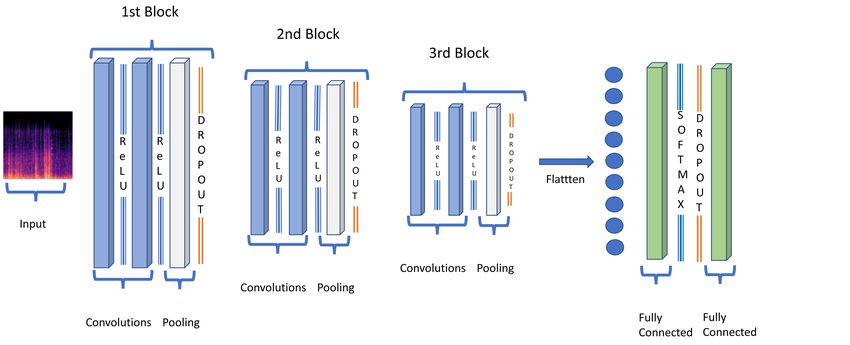
Technologies 2021, 9, 64                                                                                                   2 of 11

                                Speech recognition is just one example of the possible audio processing capabilities
                           made available by CPS systems. Another one would be that of audio event detection
                           (AED), where the systems obtain the audio inputs from some acoustic sensors and then
                           process them to detect and classify some sonic events, such as gunshots. This is different
                           from speech recognition in the sense that AED algorithms, unlike SR ones, do not look
                           for specific phonetic sequences to identify a specific sound event [22]. Additionally im-
                           portant to mention is that, unlike in SR, where the basic units of sounds are similar (e.g.,
                           phonemes) [23,24], in AED, the different sound events (e.g., dog bark, gunshot) all present
                           very distinct patterns, thus making the AED task more challenging.
                                AED systems have been employed for safety purposes, through the detection of
                           suspicious sounds such as gunshots, footsteps and others. Gunshot sound detection has
                           been extensively researched, and represents a good starting point for this work. AED
                           systems for gunshot detection can be employed anywhere, from home to business, and
                           even public spaces, where they would constantly monitor the environment for suspicious
                           events. These systems currently make extensive use of state-of-the-art deep learning
                           classifiers, such as convolutional neural networks (CNN) [25] and convolutional recurrent
                           neural networks (CRNN) [26], as their primary detection and classification algorithms.
                                In this paper, we examine these two state-of-the-art gunshot detection algorithms
                           against simple, accessible and easy-to-reproduce disturbances made of noise, to be used
                           as a means of disrupting the classifiers. Several studies have shown that unwanted noise
                           can have a detrimental effect on classifier performance [27,28]. We focus on this niche,
                           and as such, study how to attack deep learning AED systems, focusing on employing
                           simple, accessible and easy-to-reproduce disturbances made of white noise, to be used as a
                           means of disrupting the classifiers. A major reason for choosing white noise is the concrete
                           possibility of employing it as part of practical, on-the-field attacks. Another reason is the
                           simplicity of the attack, thus making it largely available for a large roster of attackers.
                                In our threat model (seen in Figure 1), we assume that the attacker, while attempting
                           to cause harm, actively adds white noise perturbations to the sound being fed to the AED
                           system; in other words, white noise is overlaid to to the gunshot sounds being used as the
                           AED input. The ultimate goal of the attacker is to prevent the AED system from detecting
                           the gunshot sounds. We implement a CNN and a CRNN, and we use gunshot sound
                           datasets from [29–31]. We first test the classifiers with undisturbed gunshot samples in or-
                           der to examine their performance under baseline conditions, and then digitally inject white
                           noise perturbations, interleaving them with the gunshot sounds. Experiments covering real
                           on-the-field experiments will be covered in future publications. Our consolidated results
                           show that AED classifiers are susceptible against these noisy attacks, as the performance
                           of both the CNN and CRNN are strongly affected, being degraded by nearly 100% when
                           tested against the perturbations.

                           Figure 1. A hypothetical scenario where an attacker tries to evade detection by injecting noise sounds,
                           in the open, to the audio input captured by AED systems.

                                In particular, our contributions reside on attacking deep learning classifiers with a
                           simple and very easy to reproduce disturbance, which is relevant in present day when
                           there is not only a proliferation of real deep learning devices that rely on deep learning
                           classifiers for suspicious sound detection, but also of sophisticated audio equipment that
                           could be used for practical attack purposes.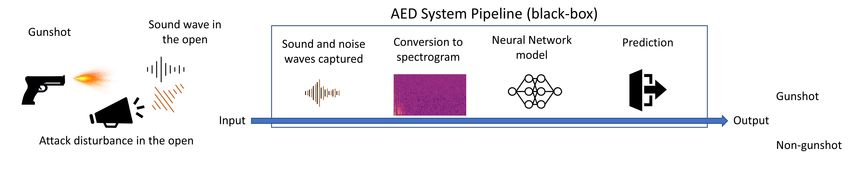
Technologies 2021, 9, 64                                                                                              3 of 11

                           2. Materials and Methods
                                In this section, we present our overall research methodology and setup as well as the
                           details behind the two supervised neural network algorithms we implemented, namely
                           CNN and CRNN. These two neural network algorithms are state-of-the-art classification
                           algorithms that were recently used for audio detection and classification in IoT-based CPSs,
                           including gunshots and other safety-driven applications. We implement these algorithms
                           as binary classifiers, where we feed them audio samples as an input, and they provide an
                           output label of gunshot (1) or non-gunshot (0).

                           2.1. CNN Models in Audio Detection Systems
                                Convolutional neural networks are considered to be the best among learning algo-
                           rithms in understanding image contents [32]. CNNs were inspired by the organization of
                           the animal visual cortex [33], providing increasingly better performance as they become
                           deeper, while also becoming harder to train [34]. We implement a CNN model based on
                           the work of Zhou et al. [25], as it was successfully used for the purpose of urban sound
                           recognition, gunshots included. Our model is tailored after much experimentation, and it
                           is composed of the following:
                           1.   Convolutional layers: three convolutional blocks, each one with two convolutional
                                2D layers. These layers have 32, 64, 64, 64, 128 and 128 filters (total of 480) of size 3 by
                                3. Same padding is also applied to the first convolutional layer of each block.
                           2.   Pooling layers: three 2 by 2 max pooling layers, each coming right after the second
                                convolutional layer of each convolutional block.
                           3.   Dense layers: two dense (also known as fully connected) layers come after the last
                                convolutional block.
                           4.   Activation functions: these functions compute the weighted sum of inputs and biases,
                                and as such, are responsible for the firing or no firing of neurons [35]. For the
                                presented CNN, ReLU activation is applied after each convolutional layer as well as
                                after the first fully connected layer, while Softmax activation is applied only once,
                                after the second fully connected layer. In other words, ReLU is applied to all inner
                                layers, while Softmax is applied to the most outer layer.
                           5.   Regularization: applied in the end of each convolutional block as well as after the
                                first fully connected layer, with 25, 50, 50 and 50% respectively. Regularization, also
                                known as dropout, per [36], addresses the overfitting problem, among other common
                                neural network issues.
                                The CNN uses sparse categorical cross entropy as a loss function and RMSprop as an
                                optimizer. A visual representation of its architecture can be seen in Figure 2.

                           Figure 2. CNN architecture.
Technologies 2021, 9, 64 4 of 11
2.2. CRNN Models in Audio Detection Systems
Convolutional recurrent neural networks (CRNN) address one shortfall of regular
CNNs—the lack of memory about long-term dependencies over sequences [37,38]. Xinyu
Fu [37] proposed to implement a CRNN, where common sigmoid activation function is
replaced by a long short-term memory (LSTM) advanced activation. It was shown that
CRNNs work better with longer or lengthier inputs [38] because LSTM activation ensures
that outputs of the previous point in time connect to the next point in time.
For the purpose of this study, we implement a CRNN model inspired by the work of
Lim et al. [26], which was also successfully used for gunshot recognition with some good
performance. We tailor the model after much experimentation, which is composed by the
following:
1. Convolutional layers: one convolutional block, with one convolutional layer. This
block is made by 128 filters of size 32, ReLU activation and batch normalization,
pooling layer of size of 40 and a dropout layer of 0.3.
2. LSTM layer: one backwards LSTM layer with 128 units, followed by tanh activation
and a new dropout of 0.3.
3. Dense layers: two stacked dense layers, the first with 128 units and the second with
two, each one followed by batch normalization and the first one followed by a ReLU
activation and the last one by a Softmax activation.
The CRNN used sparse categorical cross entropy as loss function and Adam as optimizer.
2.3. Datasets
DCASE 2017 Challenge [30] provides datasets for several different acoustic classi-
fication tasks. We acquired the detection of rare sound events dataset. The reason for the
selection of this specific dataset as our main source of data points stem from the fact that it
is publicly available, making it easily acquirable, while also containing a relatively high
number of good quality sounds. This dataset includes one training and one testing set,
each one containing 1500 sound samples. From 3000 samples in total, 1000 are gunshot
sounds, which are the ones used in our experiments. To increase the number of data points
available to our research, we also obtained gunshot samples from [29,31], bringing the
total number of samples to 2000. For our experiments, 1500 of these sounds are dedicated
for training and 500 for testing. Finally, we obtained the samples for the negative classes
from several other sources, such as MIMII [39], environmental Sounds [40], FreeSound [41],
Zapsplat [42] and Fesliyan Studios [43]. The negative classes are made of pump, children
playing, fan, valve and music, in other words, sounds that did not carry gunshot sounds.
It is important to mention that we cleaned and preprocessed the audio by perform-
ing frequency normalization (normalizing the frequencies of all samples at 22,000 Hertz),
audio channel normalization (set all samples to monaural) and audio length normalization
(made all samples to have 3 seconds in length by cropping lengthier ones and discarding
shorter ones).
2.4. Spectrograms
We adopt the same approach adopted by other authors, such as [25–27] with regards
to the input to be fed to our models, relying on spectrograms. Audio files can be represented
by spectrograms. Spectrograms display in a graph (usually 2D) the spectrum of frequency
changes over time for a sound signal, by chopping it up and then stacking the slices close
to each other [44]. Unlike speech, sound events often have a shorter duration but with
more distinctive time-frequency representations, which was shown to be a good feature for
sound classification [25,26,45]. Spectrograms are images, and they fit well as input to both
CNN and CRNN models.
The authors in [25,26] used spectrograms as input to their neural network models.
Similarly, we also convert the audio samples into spectrograms and then pass them to
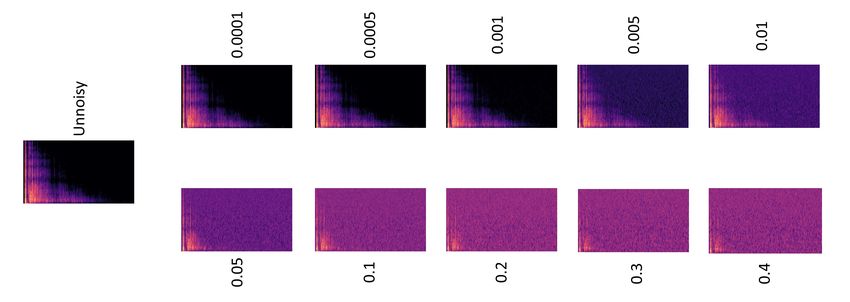
the CNN and CRNN classification algorithms. Note that the disturbances represented by
the proposed attacks are introduced directly to the audio files, prior to their conversionTechnologies 2021, 9, 64 5 of 11
to spectrograms. As such, in our threat model, the attacker does not have direct access
to the spectrogram generation algorithm (black-box IoT/CPS system). This is because in
our attack model, we assume that the attacker does not have any knowledge about the
system and simply tries to alter the sounds generated by the gun, before capture by the
hypothetical AED system. Samples of spectrograms generated as part of this study can be
seen in Figure 3.
Figure 3. Spectrogram samples under unnoisy and noisy conditions.
2.5. Attacks with Noise
Every practical application that deals with audio signals also deals with the issue of
noise. As stated by Prasadh et al. [46], “natural audio signals are never available in pure,
noiseless form”. As such, even under ideal conditions, natural noise may be present in
the audio in use. In this work, we craft noisy disturbances made of white noise, which,
according to [47], happens when “each audible frequency is equally loud,” meaning no
sound feature, “shape or form can be distinguished”. We choose this noise variant, due to
its ubiquity in day-to-day life, and especially its simplicity with regard to how to reproduce
it. It is important to highlight once again that in our threat model, the attack occurs during
audio capturing, prior to spectrogram generation; as such, our proposed attack is audio-
based, not image-based. This type of noise is widely adopted by different research across
different domains [48–50], thereby facilitating future comparisons.
2.6. Experiments
Our experiments involve the use of our two neural network classifiers set as two
different representation of an AED system that detects gunshot sounds. We employ digital
gunshot samples, first in unnoisy conditions, and then we infuse the same samples with
progressively higher levels noise. We crafted our own training and testing sets, and employ
them to train and test our CNN models. The experiments were binary (output could
be either gunshot and non-gunshot. Both the training and test sets always had the two
participating classes in a balanced fashion. In other words, we always made sure to have
the same number of samples per class in each experiment.
A summary of our experiments follows next.
1. Unnoisy experiments: Both AED classifiers exposed to digital gunshot sounds, with-
out any disturbance.
2. White noise experiments: Both AED classifiers exposed to digital gunshot sounds.
The disturbances, made of white noise, are dynamic in nature, and after much exper-
imentation, ten different noisy thresholds, namely 0.0001, 0.0005, 0.001, 0.005, 0.01,
0.05, 0.1, 0.2, 0.3 and 0.4. The process for generating the white noise infused samples
can be seen in Algorithm 1.Technologies 2021, 9, 64 6 of 11
Algorithm 1: White Noise Generation Algorithm
Result: Perturbed audio sample
initialization;
for number of audio files in the test set do
sample = load audio file as an array;
noise = adjustment factor * max element of the array;
perturbed sample = sample + noise * normal distribution;
save perturbed sample;
end
3. Results
In this section, we present the results obtained from the several experiments that show
the robustness of CNN and CRNN classifiers against the white noise attacks. We start by
providing the baseline classification results achieved by both models, CNN and CRNN,
using the undisturbed test samples, which can be found in Table 1. Both models were
trained for 100 epochs; however, the last learning occurred at 52 and 98 epochs (CNN) and
at 56 and 29 epochs (CRNN), respectively. Both algorithms are trained and tested on the
same datasets. The full experiment results can be seen in Table 1.
Table 1. CNN / CRNN classification performance on noise-free test datasets followed by increasing
levels of white noise.
CNN CRNN
Condition Acc. Prec. Rcl. F1 Acc. Prec. Rcl. F1
Unnoisy 0.88 0.88 0.88 0.88 0.81 0.93 0.66 0.77
0.0001 0.88 0.88 0.88 0.88 0.81 0.93 0.66 0.78
0.0005 0.87 0.89 0.84 0.87 0.81 0.92 0.67 0.78
0.001 0.87 0.89 0.85 0.87 0.81 0.92 0.67 0.78
0.005 0.88 0.90 0.86 0.88 0.81 0.92 0.68 0.79
0.01 0.85 0.90 0.78 0.84 0.81 0.88 0.73 0.80
0.05 0.83 0.90 0.74 0.81 0.84 0.87 0.80 0.83
0.1 0.64 0.93 0.30 0.45 0.70 0.66 0.83 0.73
0.2 0.56 0.94 0.13 0.23 0.66 0.64 0.74 0.68
0.3 0.51 1 0.012 0.02 0.49 0.48 0.35 0.41
0.4 0.5 0 0 0 0.49 0.34 0.11 0.16
When executing the baseline unnoisy experiments, both models perform reasonably
well, with accuracies above 80%. This sets the tone for the experiments that come next,
where we proceed to attack these same classifiers with white noise. When this happens,
both models present drops in classification performance as soon as such noise is introduced
to the test sets. The drops are small but cumulative, and a sharper drop is noticed when
the 0.1 threshold is reached, only to become unacceptably worse from there on, to the point
of rendering both models essentially useless. One can also realize that the CRNN is proved
to be slightly more robust than the CNN, and we credit this to its memory advantage over
the CNN [37,38]. The graphical visualization of these results can be seen in Figures 4 and 5.Technologies 2021, 9, 64 7 of 11
Figure 4. CNN experiments detailed results.
Figure 5. CRNN experiments detailed results.
4. Discussion
We tested CNN and CRNN algorithms for AED, and while their detection performance
was reasonable under ideal circumstances, a sharp drop in it was seen, even when little
white noise was injected into the test audio samples. This is important because white noise
is simple to reproduce and to be employed by non-technically savvy individuals. It also
can be hard to be filtered out without affecting the sound capture capability needed for an
AED system, especially when higher noisy thresholds are used and when its amplitude is
tailored to closely follow that of the sound of interest.
AED practical solutions are already a reality, currently being in the process of becoming
ubiquitous for a large audience. These are real physical devices that employ deep learning
models for the detection of suspicious events for security purposes, being largely available
for purchase and deployment to homes around the world. Some examples of these devices
are ones manufactured by major companies, such as the Echo Dot and Echo Show by
Amazon [51], and Nest Mini and Nest Hub by Google [52,53]. Despite still being limitedTechnologies 2021, 9, 64 8 of 11
in terms of detection capabilities, as most of these devices can detect only a few variety
of audio events, attempts to create general purpose devices, capable of detecting a wide
spectrum of audio events, are known to be in the making, e.g., See-Sound [54]. Practical
attacks against these devices are, as such, just a matter of time.
As a matter of fact, white-noise reproduction capable gear based on speakers and
other specialized equipment have been widely available to the broad audience for a long
time now [55]. These can become physical devices that generate audio disturbances on
the field. More sophisticated gear with increased capabilities are also a reality and are
intensively researched and used by military and law enforcement agencies around the
world [56–59]. As such, attack solutions that could rely on all sorts of gear, from tiny and
discrete devices to large and complex ones are available today.
One cannot ignore the apparent heavy planning needed in order to implement such
attacks from a practical standpoint; however, one cannot also ignore the motivation of
attackers who intend to do harm. For example, the attack that occurred in the Mandalay
Hotel at Las Vegas [60] showcases such motivation, as the attacker spent months smuggling
guns and ammunition into his hotel room, and even went to the extent of setting, possibly,
other sensors in the corridor leading to his room, so he would be better prepared to deal
with law enforcement officials when they responded to the emergency situation he was
about to set. Therefore, it is not a stretch to envision a scenario where an attacker (e.g.,
burglar) could plan for days, weeks, or even months in advance on how to deploy attacks
against an audio-based AED system.
By doing so, such an attacker would either delay or avoid detection by an AED system,
and as such, gain time to perform their malicious intents. For instance, a burglar could use
an “on-the-field” variant of the white noise attack to disrupt a home-based AED system,
and thus be able to invade an empty residency without being detected and/or triggering
AED-associated alarms and notifications (since a potential glass breakage would not be
detected by the under-attack AED system). After gaining entrance, the burglar could
potentially perform their activities, such as robbery, without being disturbed. As AED
systems gain popularity and scale, it is not difficult to envision a scenario where an AED
system may be protecting a public area, and terrorists, aware of such monitoring, employ
white noise disturbances to disrupt such a system. This, in turn, would make it hard for
authorities to respond properly through the negation of the system’s ability to detect a
sound of interest (e.g., gunshots being fired) and subsequently to relay the location of the
sound.
5. Conclusions
Through extensive amount of experiments, we evaluated the robustness of AED
systems against noisy attacks, which are generated by adding different levels of white
noise to test samples fed to neural network classifiers. Our consolidated results show
that AED systems are susceptible against white noise attacks, as the performance of both
the CNN and CRNN classifiers were degraded by nearly 100% when tested against the
perturbations. These strongly suggest that actually deployable solutions that rely on these
AED classifiers cannot be trusted, especially if they are used for safety purposes. More
research is currently underway, seeking to test the white disturbances as well as other types
of audio disturbances on real, existing AED capable devices. We also are currently actively
researching practical countermeasures for these attacks and will report the appropriate
results in upcoming publications.
Author Contributions: Conceptualization, R.d.S. and S.N.; methodology, R.d.S. and S.N.; software,
R.d.S.; validation, R.d.S.; formal analysis, R.d.S.; investigation, R.d.S.; resources, S.N.; data curation,
R.d.S. and A.K.; writing—original draft preparation, R.d.S.; writing—review and editing, S.N.;
visualization, R.d.S. and S.N.; supervision, S.N.; project administration, R.d.S.; funding acquisition,
S.N. All authors have read and agreed to the published version of the manuscript.
Funding: This research received no external funding.Technologies 2021, 9, 64 9 of 11
Conflicts of Interest: The authors declare no conflict of interest.
Abbreviations
The following abbreviations are used in this manuscript:
AED Audio Event Detection
SR Speech Recognition
DL Deep Learning
ML Machine Learning
References
1. Wang, Z.; Song, H.; Watkins, D.; Ong, K.; Xue, P.; Yang, Q.; Shi, X. Cyber-physical systems for water sustainability: Challenges
and opportunities. IEEE Commun. Mag. 2015, 53, 216–222. [CrossRef]
2. Zhang, Y.; Qiu, M.; Tsai, C.; Hassan, M.; Alamri, A. Health-CPS: Healthcare cyber-physical system assisted by cloud and big data.
IEEE Syst. J. 2015, 11, 88–95. [CrossRef]
3. Wang, L.; Onori, M. Current status and advancement of cyber-physical systems in manufacturing. J. Manuf. Syst. 2015, 37,
517–527. [CrossRef]
4. Zander, J.; Mosterman, P.; Padir, T.; Wan, Y.; Fu, S.X. Cyber-physical systems can make emergency response smart. Procedia Eng.
2015, 107, 312–318. [CrossRef]
5. Reddy, R.; Mamatha, C.; Reddy, R. A Review on Machine Learning Trends, Application and Challenges in Internet of Things. In
Proceedings of the International Conference on Advances in Computing, Communications and Informatics (ICACCI), Bangalore,
India, 19–22 September 2018.
6. Chan, R. Internet of Things Business Models. J. Serv. Sci. Manag. 2015, 8, 552–568. [CrossRef]
7. Venkatesh, J.; Aksanli, B.; Chan, C.; Akyurek, A.; Rosing, T. Scalable-Application Design for the IoT. IEEE Software 2017, 34, 62–70.
[CrossRef]
8. Carlini, N.; Wagner, D. Towards evaluating the robustness of neural networks. In Proceedings of the IEEE Symposium on Security
and Privacy, San Jose, CA, USA, 22–26 May 2017.
9. Brown, T.; Mane, D.; Roy, A.; Abadi, M.; Gilmer, J. Adversarial Patch. arXiv 2017, arXiv:1712.09665.
10. Goodfellow, I.; Shlens, J.; Szegedy, C. Explaining and harnessing adversarial examples. arXiv 2014, arXiv:1412.6572.
11. Akhtar, N.; Mian, A. Threat of adversarial attacks on deep learning in computer vision: A survey. IEEE Access 2018, 6, 14410–14430.
[CrossRef]
12. Athalye, A.; Engstrom, L.; Ilyas, A.; Kwok, K. Synthesizing robust adversarial examples. arXiv 2017, arXiv:1707.07397.
13. Metzen, H.; Kumar, C.; Brox, T.; Fischer, V. Universal adversarial perturbations against semantic image segmentation. In
Proceedings of the IEEE International Conference on Computer Vision, Venice, Italy, 22–29 October 2017.
14. Su, J.; Vargas, D.; Sakurai, K. One pixel attack for fooling deep neural networks. IEEE Trans. Evol. Comput. 2019, 23, 828–841.
[CrossRef]
15. Kurakin, A.; Goodfellow, I.; Bengio, S. Adversarial examples in the physical world. arXiv 2016, arXiv:1607.02533.
16. Szegedy, C.; Zaremba, W.; Sutskever, I.; Bruna, J.; Erhan, D.; Goodfellow, I.; Fergus, R. Intriguing properties of neural networks.
arXiv 2013, arXiv:1312.6199.
17. Nguyen, A.; Yosinski, J.; Clune, J. Deep neural networks are easily fooled: High confidence predictions for unrecognizable images.
In Proceedings of the IEEE Conference on Computer Vision and Pattern Recognition, Boston, MA, USA, 7–12 June 2015.
18. Liu, Y.; Ma, S.; Aafer, Y.; Lee, W.; Zhai, J.; Wang, W.; Zhang, X. Trojaning attack on neural networks. In Proceedings of the Network
and Distributed Systems Security (NDSS) Symposium, San Diego, CA, USA, 26 February–1 March 2017.
19. Carlini, N.; Mishra, P.; Vaidya, T.; Zhang, Y.; Sherr, M.; Shields, C.; Zhou, W. Hidden Voice Commands. In Proceedings of the
USENIX Security, Austin, TX, USA, 10–12 August 2016.
20. Carlini, N.; Wagner, D. Audio adversarial examples: Targeted attacks on speech-to-text. In Proceedings of the IEEE Security and
Privacy Workshops (SPW), San Francisco, CA, USA, 24 May 2018.
21. Kwon, H.; Kim, Y.; Yoon, H.; Choi, D. Selective audio adversarial example in evasion attack on speech recognition system. IEEE
Trans. Inf. Forensics Secur. 2019, 15, 526–538. [CrossRef]
22. Hamid, A.; Mohamed, A.; Jiang, H.; Deng, L. Convolutional Neural Networks for Speech Recognition. IEEE/ACM Trans. Audio
Speech Lang. Process. 2014, 22, 1533–1545. [CrossRef]
23. Bilen, Ç.; Ferroni, G.; Tuveri, F.; Azcarreta, J. A Framework for the Robust Evaluation of Sound Event Detection. In Proceedings
of the IEEE International Conference on Acoustics, Speech and Signal Processing, Barcelona, Spain, 4–8 May 2020.
24. Cowling, M. Comparison of techniques for environmental sound recognition. Pattern Recognit. Lett. 2003, 10, 2895–2907.
[CrossRef]
25. Zhou, H.; Song, Y.; Shu, H. Using deep convolutional neural network to classify urban sounds. In Proceedings of the IEEE Region
10 Conference (TENCON), Penang, Malaysia, 5–8 November 2017.
26. Lim, H.; Park, J.; Han, Y. Rare sound event detection using 1D convolutional recurrent neural networks. In Proceedings of the
Detection and Classification of Acoustic Scenes and Events 2017 Workshop, Munich, Germany, 16–17 November 2017.Technologies 2021, 9, 64 10 of 11
27. Alraddadi, S.; Alqurashi, F.; Tsaramirsis, G.; Luhaybi, A.; Buhari, S. Aroma Release of Olfactory Displays Based on Audio-Visual
Content. Appl. Sci. 2019, 9, 4866. [CrossRef]
28. Boyat, A.; Joshi, B. A review paper: Noise models in digital image processing. arXiv 2015, arXiv:1505.03489.
29. The Free Firearm Library—Expanded Edition. Available online: airbornesound.com (accessed on 1 January 2021).
30. Detection of Rare Sound Events. Available online: cs.tut.fi/sgn/arg/dcase2017/challenge/task-rare-sound-event-detection
(accessed on 1 January 2021).
31. A Dataset and Taxonomy for Urban Sound Research. Available online: justinsalamon.com (accessed on 1 January 2021).
32. Khan, A.; Sohail, A.; Zahoora, U.; Qureshi, A. A survey of the recent architectures of deep convolutional neural networks. arXiv
2019, arXiv:1901.06032
33. Yamashita, R.; Nishio, M.; Do, R.; Togashi, K. Convolutional neural networks: An overview and application in radiology. Insights
Imaging 2018, 9, 611–629. [CrossRef]
34. Thakkar, V.; Tewary, S.; Chakraborty, C. Batch Normalization in Convolutional Neural Networks—A comparative study with
CIFAR-10 data. In Proceedings of the Fifth International Conference on Emerging Applications of Information Technology (EAIT),
Kolkata, India, 12–13 January 2018.
35. Nwankpa, C.; Ijomah, W.; Gachagan, A.; Marshall, S. Activation Functions: Comparison of Trends in Practice and Research
for Deep Learning. In Proceedings of the Machine Learning: Computer Vision and Pattern Recognition, Boston, MA, USA,
7–12 June 2015.
36. Srivastava, N.; Hinton, G.; Krizhevsky, A.; Sutskever, I.; Salakhutdinov, R. Dropout: A Simple Way to Prevent Neural Networks
from Overfitting. J. Mach. Learn. Res. 2014, 15, 1919–1958.
37. Fu, X.; Ch’ng, E.; Aickelin, U.; See, S. CRNN a joint neural network for redundancy detection. In Proceedings of the IEEE
International Conference on Smart Computing (SMARTCOMP), Hong Kong, China, 29–31 May 2017.
38. Gao, S.; Lin, B.; Wang, C. Share price trend prediction using CRNN with LSTM structure. In Proceedings of the International
Symposium on Computer, Consumer and Control (IS3C), Taichung, Taiwan, 6–8 December 2018.
39. Sound Dataset for Malfunctioning Industrial Machine Investigation and Inspection. Available online: zenodo.org/ (accessed on 1
January 2021).
40. ESC-50 Dataset for Environmental Sound Classification. Available online: github.com/karolpiczak/ESC-50 (accessed on 1
January 2021).
41. Freesound. Available online: freesound.org/help/faq/ (accessed on 1 January 2021).
42. Free Sound Effects & Royalty Free Music. Available online: www.zapsplat.com (accessed on 1 January 2021).
43. Fesliyan Studios Royalty Free Music. Available online: fesliyanstudios.com/contact (accessed on 1 January 2021).
44. What Is a Spectrogram. Available online: tomroelandts.com/articles/what-is-a-spectrogram (accessed on 1 January 2021).
45. Dennis, J.; Tran, H.; Li, H. Spectrogram Image Feature for Sound Event Classification in Mismatched Conditions. IEEE Signal
Process. Lett. 2011, 18, 130–133. [CrossRef]
46. Prasadh, S.; Natrajan, S.; Kalaivani, S. Efficiency analysis of noise reduction algorithms: Analysis of the best algorithm of noise
reduction from a set of algorithms. In Proceedings of the International Conference on Inventive Computing and Informatics
(ICICI), Coimbatore, India, 23–24 November 2017.
47. Edmonds, E. Abstraction and interaction: An art system for white noise. In Proceedings of the International Conference on
Computer Graphics, Imaging and Visualisation (CGIV), Sydney, NSW, Australia, 26–28 July 2006.
48. Dahlan, R. AdaBoost Noise Estimator for Subspace based Speech Enhancement. In Proceedings of the International Conference
on Computer, Control, Informatics and its Applications (IC3INA), Tangerang, Indonesia, 1–2 November 2018.
49. Vasuki, P.; Bhavana, C.; Mohamed, S.; Lakshmi, E. Automatic noise identification in images using moments and neural network.
In Proceedings of the International Conference on Machine Vision and Image Processing (MVIP), Coimbatore, India, 14–15
December 2012.
50. Montillet, J.; Tregoning, P.; McClusky, S.; Yu, K. Extracting White Noise Statistics in GPS Coordinate Time Series. IEEE Geosci.
Remote Sens. Lett. 2013, 10, 563–567. [CrossRef]
51. How to Set up Alexa Guard on an Amazon Echo. Available online: cnbc.com/2019/05/14/how-to-set-up-alexa-guard-on-an-
amazon-echo.html (accessed on 1 January 2021).
52. Nest Hub. Available online: store.google.com/us/product/google_nest_hubl (accessed on 1 January 2021).
53. Nest Mini. Available online: store.google.com/product/google_nest_mini (accessed on 1 January 2021).
54. See Sound. Available online: see-sound.com/devices/ (accessed on 1 January 2021).
55. The Best Sound Machines on Amazon, According to Hyperenthusiastic Reviewers. Available online: nymag.com/strategist/
article/best-sound-machines-noise-machines.html (accessed on 1 January 2021).
56. So What Is This Secretive Chinese Sonic Weapon Exactly? Available online: popularmechanics.com/military/ (accessed on 1
January 2021).
57. U.S. Military Is Developing a Sound Weapon that Sounds Like a Retro Modem. Available online: digitaltrends.com/cool-tech/
military-sound-weapon-old-modem/ (accessed on 1 January 2021).
58. Plug your Ears and Run’: NYPD’s Use of Sound Cannons Is Challenged in Federal Court. Available online: nbcnews.com/news/
us-news/plug-your-ears-run-nypd-s-use-sound-cannons-challenged-n1008916 (accessed on 1 January 2021).Technologies 2021, 9, 64 11 of 11
59. Using Sound to Attack: The Diverse World of Acoustic Devices. Available online: cnn.com/2017/08/10/health/acoustic-
weapons-explainer/index.html (accessed on 1 January 2021).
60. A Man Stashed Guns in His Las Vegas Hotel Room. 3 Years Later, a Killer Did the Same. Available online: nytimes.com/2018/0
9/28/us/las-vegas-shooting-mgm-lawsuits.html (accessed on 1 January 2021).You can also read


