Driving toward the future of the fresh food industry - Insights from the FMI FreshForward 2019 executive forum - Deloitte
←
→
Page content transcription
If your browser does not render page correctly, please read the page content below

Driving toward the future
of the fresh food industry
Insights from the FMI FreshForward 2019
executive forum
Driving toward the future of the fresh food industry | Insights from FMI FreshForward 2019

                            FMI and Deloitte: Working together
                            to improve food freshness

                            The fresh food industry is on the cusp of transformative change,
                            faced with policy and business choices that will carry more
                            consequential impact than anything we’ve seen in the past decade.
                            As scale tends to be less of an advantage in fresh categories like
                            produce, meat, and dairy, many of these policies and business
                            decisions tend to be reactionary and driven by short-term thinking.
                            FMI has the exciting opportunity to help remove barriers and
                            establish a unified voice with a stronger, positive influence on
                            regulatory policy and ultimately the future of our industry.

                            Barb Renner, Vice Chairman and US Consumer Products Leader, Deloitte

2
Driving toward the future of the fresh food industry | Insights from FMI FreshForward 2019

FMI is committed to helping our members navigate consumer
shopping habits in complex categories, especially those influenced
by volatile markets and limited shelf life—historically, meat, produce,
and foodservice, but widening in 2019 to reflect new shopper
perspectives on seafood and bakery. To that end, in addition
to investing in consumer research and insights, FMI once again
held our annual FreshForward event to give industry leaders an
opportunity to review and discuss the business implications for the
fresh category and how large industry players view fresh foods as a
competitive differentiator.

FreshForward was designed to generate actionable takeaways for
industry leaders. Our goal was to encourage thought leadership
among food retailers and their suppliers, with a focus on topics
that have the most influence on the growth and sustainability of
businesses’ brands. Organized and facilitated with an open and
organic approach, the event sets up challenges to help solve for
senior leaders all along the fresh foods supply chain. We anticipate
that the actionable takeaways, specific to technology in fresh,
food safety, and sustainable practices related to food waste and
packaging, will emerge to be among the most aggressive areas for
evolving the business of fresh, now and in the future.

Rick Stein, Vice President, Fresh Foods, FMI

                                                                                                                       3
Driving toward the future of the fresh food industry | Insights from FMI FreshForward 2019

Among many other anticipated changes in the industry, research shows that fresh food
is projected to grow at a stronger rate than total food, confirming the need for industry
leaders to collaborate on goals and expectations for advancement.

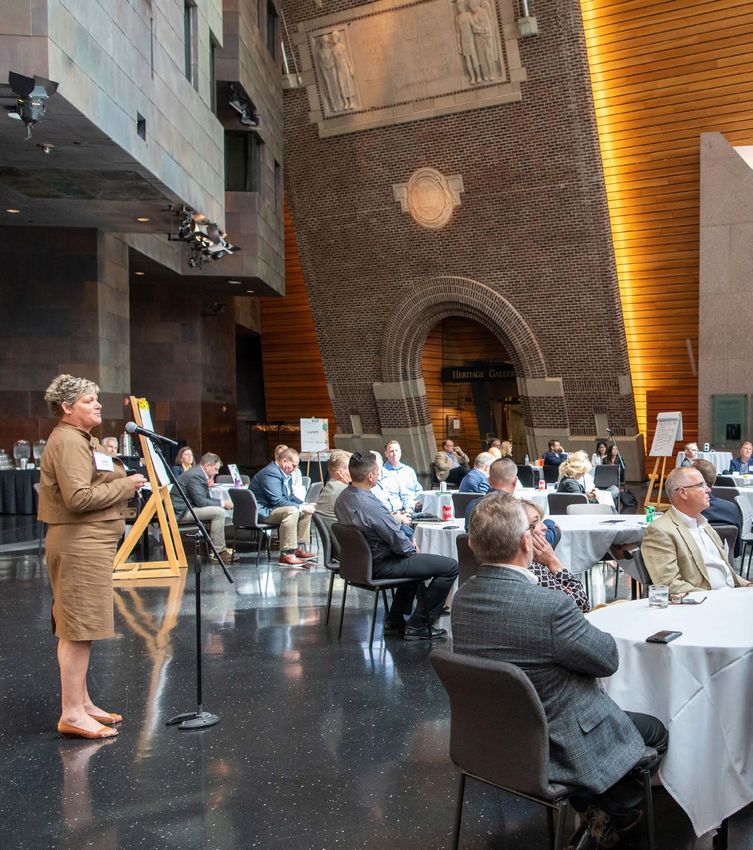
The second annual FMI FreshForward was
held at the University of Minnesota in August                Produce accounts for 60% of growth
2019, bringing together leading fresh food                   Contribution of categories to fresh perimeter growth
suppliers and retailers to brainstorm and
share ideas around three pressing issues:
                                                                                                               60%             19%           15%    6%
       Impact of disruptive technologies

       Food safety and quality
                                                                 Produce        Bakery       Deli       Meat

       Food loss and sustainability
                                                             Trended growth since 1984                         Projected growth until 2022
The three themes were introduced on the                      Produce grew at 3.6%, stronger than               3.4% growth for produce implies that
main stage by guest speakers, then attendees                 total food (2.6%), total fresh foods              it will outshine the total food category
split into smaller groups to discuss, evaluate,              (2%), and other fresh food segments.              (1.1%) and total fresh foods (1.3%).
and identify potential solutions for the                     Source: Deloitte 2019 Future of Fresh Survey
fresh industry. The need for culture shifts
and industry collaboration were recurring
messages as attendees identified action
items that can help the industry move
forward more quickly and smoothly to
keep up with the rapid and profound
changes of technology, consumers, and
regulatory policy.

4
Driving toward the future of the fresh food industry | Insights from FMI FreshForward 2019

Impact of disruptive
technologies in fresh food

Discussion and problem solving around disruptive technologies
in fresh food began with a presentation to all attendees,
offering the following key points for consideration.

1                                                  2                                                    3
New tools and techniques can                       Machine AI can simplify and                          Merchandising, operations, and
help the fresh industry resolve long-              better address the fresh industry’s                  supply chain leaders—rather than IT
standing problems                                  biggest challenges, compared to                      departments—should embrace best-of-
                                                   current practices                                    breed technologies
Brian Baker, Managing Director, Deloitte
Consulting, LLP                                    Nick Ciminillo, Vice President of                    Michael Lang, Partner,
Food waste was previously considered               Retail Solutions, RELEX Solutions                    Invatron Systems Corporation
a cost of business. Baker highlighted this         Offering fresh replenishment as an example,          Lang held the perspective that many
and other opportunities for technology             Ciminillo highlighted how new tech could             operational and merchandising needs
to create a connected value chain and              allow hyper-scaling through measures                 could be solved today with technologies
boost profitability in fresh. With the help        such as more accurately calculating the              that address the complexities of fresh item
of technology like artificial intelligence (AI),   cost of waste versus out-of-stocks and               management. However, people in all areas
blockchain, and advanced analytics, the            optimizing the continuous flow of product            of the industry should adopt this outlook and
focus can shift toward reducing cost of            from distribution centers to stores. Ciminillo       work to incorporate it rather than looking
goods and providing better-quality products.       discussed other examples, including                  to IT departments to implement alone.
For example, by “closing the digital to            specialized AI analyzing weather                     Lang said organizations may not realize that
physical loop” in food waste, organizations        to predict supply and demand of fresh                some simple technology can make a big
could have a scenario in which in-truck            product, and transparent AI allowing analysis        difference in operations and that automation
sensors provide real-time updates on the           at a level as detailed as reasons                    has become a requirement, not a choice. If
condition of the produce in transit, send          for high spoilage of one particular product on       leaders in fresh merchandising, operations,
an alert if there is a problem, and prompt         a certain day of the week.                           and supply chain welcome tech adoption,
the truck to stop before the scheduled                                                                  benefits could include increased efficiency
destination so produce can be sold instead of                                                           in operations, greater confidence in food
going to waste along the rest of the journey.                                                           safety, and better customer ROI.

                                                                                                                                                            5
Driving toward the future of the fresh food industry | Insights from FMI FreshForward 2019

97%

Many of the presenters’ points are confirmed
by Deloitte’s Future of Fresh survey,                        Implementation of AI-based technologies is low
particularly around the ample opportunity
for increased focus on technology by                                                                                             3%
both manufacturers and retailers. For
example, AI is frequently discussed in the
                                                                                             38%
context of managing fresh foods, but our
                                                                        62%                                         97%
survey confirms that adoption of AI-based
technologies is in its nascent stages: Only
38 percent have partially or fully implemented
AI-based warehouse management to
monitor fresh food stocks, and only 3 percent                               AI - Warehouse                                AI - Consumers
of respondents have partially or fully started                   Partially/fully implemented        Not yet implemented
implementing AI that allows consumers
access to product information. The two                       Only 38% of manufacturers and retailers          Only 3% of manufacturers and retailers
main barriers to implementing technology,                    have partially or fully implemented              have partially or fully implemented
according to survey respondents: time                        AI-based warehouse management to                 AI-based in-store technologies that
required to implement it and lack of                         monitor fresh food stocks.                       allow consumers to access product
skilled workers.                                                                                              information using a smartphone.
                                        97%                  Source: Deloitte 2019 Future of Fresh Survey

Attendees who participated
in the breakout session on                               change quickly, leading to the same issue
                                                                                                              “There’s never been a
                                                         of “patched systems” that companies
disruptive technologies                                  struggle with today. Stakeholders should             more powerful time to
also echoed the presenters’                              identify standard processes for the
                                                                                                              lean in on fresh.”
                                                         fresh industry that can be configured
points and offered the                                   for exceptions, instead of customizing.              —Speaker, FMI FreshForward
following summary
                                                         UPC or QR codes on labels offer a specific
of observations and                                      opportunity for collaboration that could
action items.                                            benefit the entire industry. Embedding
                                                         a UPC or QR code with more product
High-level observations around                           information—production date, origin,
disruptive technology                                    shelf life—can help reduce waste and improve
                                                         transparency on freshness.
Your entire organization should be ready
for the introduction of new technology. The              FMI and third-party organizations play an
business—rather than the IT department—                  important role in technology adoption,
should take ownership of the technology                  providing benchmarking, best practices,
and make sure the organization has the                   case studies, and proofs of concept to
right skills and talent to adopt and make                support the business case and ROI. FMI
full use of the new capabilities. Organizations          can also spearhead additional industry
can take a pilot-and-scale approach to                   events to promote collaboration and take
build confidence.                                        a more assertive role in helping lawmakers
                                                         and regulators create responsible and
The industry is transforming rapidly,                    standardized regulation for the industry.
making it even more challenging to
implement technology that will continue
to be relevant over time. Business can

6
Driving toward the future of the fresh food industry | Insights from FMI FreshForward 2019

Action items related to
disruptive technology
• Start with basics: Use technology to target
  the challenges all retailers, wholesalers, and
  vendors face, such as traceability across the
  entire life cycle, inventory positions, shrink,
  and store sales data. Design solutions
  that improve agility and readiness for the
  inevitable changes to come.

• Establish industry standards for data,
  with a free universal data set that would
  benefit the entire industry. Emphasize
  data integrity, particularly the need
  for clean data, fewer error points, and
  increased transparency around core
  competencies and goals.

• Strengthen trust between CPG and
  retailers: Demonstrate technology
  outcomes through workshops in proof
  of concept, speed, customization, and
  elimination of risk; have skin in the game
  to create stronger partnerships and move
  away from transactional relationships.
  Willingness to share information and
  basic data is a key to vendors, suppliers,
  and retailers working together to tackle
  challenges around issues such as food
  waste and recalls.

• Build the case for change: Understand
  the potential upside (look to the industry
  to understand what’s possible), involve
  leadership in strategic planning sessions,
  perform a business assessment, and
  continue to monitor potential ROI and
  customer experience improvements
  resulting from tech implementation.

•

                                                                                                                                            7
Driving toward the future of the fresh food industry | Insights from FMI FreshForward 2019

Boosting fresh food safety

The food safety introduction on the main stage covered the
following topics, which participants then explored further in
the breakout session.

1                                                        2                                                3
Ensure that your suppliers and partners                  Enable “smarter food safety” by                  Understand your organizational food
in the supply chain are helping your food                investing in research, holding suppliers         safety culture and act to improve it at the
safety performance and culture                           accountable, and leveraging technology           store level
                                                         across the industry
                                                                                                          Adam Johnson, Vice President and
Gigi Vita, Vice President of Sales, Safe
                                                         Natalie Dyenson, Vice President, Food            General Manager, Global Food Retail
Quality Food Institute (SQFI)
                                                         Safety and Quality, Dole Food Company            Services, Ecolab, Inc.
Vita began her discussion by outlining the               Dyenson stressed that food safety should be      Johnson spoke about the need to self-assess
need for food safety measures to reflect                 part of business conversations and viewed        and define realistic goals that will carry
market changes, particularly the increase in             as a business enabler rather than merely         food safety improvements from leadership
fresh food concepts and changes in consumer              a quality checkpoint. In addition to quality     to each employee. Technology-enabled
perceptions around food freshness and                    checks on suppliers, there should also be an     assessment tools can help define goals
safety. She noted that for the industry to               established process for food safety checks.      and communicate expectations, verify that
progress, the general culture around food                Dyenson expressed the need for retailers         education and training are provided, and track
safety should evolve to prioritize constant              and suppliers to partner around leveraging       progress against the organization’s historical
education and improvement. While the                     technology for food safety, noting that it       performance.
leaders of the organization establish the                could increase interoperability and improve
standards, every employee should also uphold             how information is shared across the industry.
them. Benchmark certifications like those
offered by the Safe Quality Food Institute help
mitigate risks, but the onus is on the industry
to work together to prevent recalls.

                                                          “Beyond being a business issue, food
                                                          safety and sustainability are moral issues.”
                                                          —Attendee, FMI FreshForward

8
Driving toward the future of the fresh food industry | Insights from FMI FreshForward 2019

Participants in the food safety
presentation and breakout
session offered the following
observations and action items.

High-level observations around
food safety

Today, food safety professionals are often
siloed from other parts of their organization;
they should report directly to C-level
leadership, be involved in business operations
and planning, and play a part in all decision
making to contribute to forecasting and
increased cost savings.

Culture around food safety is currently a
compliance mindset, with organizations
reacting to food safety concerns rather than
being proactive. Reliance on third-party
auditors can be risky: Competence, accuracy,
and reporting may be inconsistent and
can become a “check the box” indication
of whether a supplier has completed their          The culture of reporting exists, and everyone
audit, rather than an accurate assessment          understands the importance of keeping
of safety. For example, issues with romaine        consumers safe, but ownership from the
lettuce in 2018 were caused by a known             line to the top needs to be constant. Today,
water-source problem the supplier was              particularly in the United States, we enjoy a
treating—without evidence that treatment           presumption of safety from consumers, but
was effective.                                     this could be at risk if the industry does not
                                                   treat food safety as a fundamental concern.
Food safety should be owned by everyone,           We should collaborate to be the undisputed
not just suppliers or retailers, with strong       leader in this space and have the safest food
commitment and rigorous standards,                 in the world.
regardless of size. Food safety should not
be a competitive advantage: By increasing
transparency and knowledge sharing
throughout the industry, food safety can be
treated as a common goal that’s much more
likely to be achieved. Suppliers, retailers, and
industry groups should also work together to
encourage regulatory bodies to provide more
effective responses to food safety issues and
recall events, and establish more consistent
standards and regulations for food safety.

                                                                                                                                                            9
Driving toward the future of the fresh food industry | Insights from FMI FreshForward 2019

Action items related to
food safety
• Broaden the discussion to all levels of
  the business: Analyze sustainability, food
  safety, and quality as an organization,
  rather than departments, and show
  business impact. Weave food safety
  into business operations decisions,
  and involve food safety experts in joint
  planning meetings with retailers/suppliers
  to increase integration into budgeting
  and forecasting, and to help identify cost
  savings. Aim to make advocacy a C-suite
  priority, with leaders promoting a culture
  of food safety with a common language,
  “zero tolerance,” and no fear around
  identifying problems. Provide compliance
  training, certification, and retention
  incentives for talent to maintain effective
  food safety practices.

• Adopt a more proactive mindset: Use
  predictive analytics and other scalable
                                                         • Establish industry-level standards and
  tools and technology, with a focus on
                                                           benchmarks based on shared data and
  the achievable, such as sensors and IoT
                                                           proven case studies: For one, audit
  to increase effectiveness of compliance;
                                                           procedures can be standardized with
  automation of activities where human
                                                           simple language, a universal supplier
  error presents extraordinary risk; and
                                                           scorecard that incentivizes improvement,
  technology that can increase visibility and
                                                           and solutions that emphasize education
  minimize corruption and claims.
                                                           rather than penalties.
• Bond together and leverage collective
                                                         • Seek to improve regulatory coordination,
  influence: Suppliers, wholesalers,
                                                           notifications, and the recall process:
  retailers, academia, researchers, industry
                                                           FMI and other industry voices can push
  associations, and government agencies
                                                           through greater clarity with the FDA; use
  can collaborate to research, prioritize,
                                                           product data to isolate root causes quickly
  and address root causes; strengthen the
                                                           and minimize impact; and establish a
  culture and expectation to increase food
                                                           standard communication process for
  safety; and align on issues and standards
                                                           more rapid response to recalls.
  to advance food safety globally. The
  industry can help educate regulators                   • Account for allergens as a part of food
  on the proper food safety and recall                     safety management: Know who owns it
  responses and mentor smaller suppliers                   and involve the food safety team.
  by offering support through continued
  education.

10
Driving toward the future of the fresh food industry | Insights from FMI FreshForward 2019
Game-changing strategies for food
loss, packaging, and sustainability
To address food loss, packaging, and sustainability, the
following main-stage presentations kicked off conversations
and provided a starting point for breakout discussions.
1 2 3
Where can the industry collaborate to “Plastic waste is the
What is the outlook for “smart
achieve sustainability goals? problem, not plastics.”
packaging,” and how can the industry
Tom Windish, President, Retail Channel, Janis McIntosh, Director of Marketing achieve the benefits?
Cargill Incorporated Innovation & Sustainability, Naturipe
Francesco Fazio, Principal,
Windish emphasized the importance of McIntosh encouraged a closer look at plastics
Doblin, Deloitte Consulting LLP
connecting “people, planet, and products” in the berry industry and why a switch to
Fazio described innovative packaging options
to solve challenges impacting each group, corrugated paper containers might actually
adopted by other industries and retailers
whether around food and nutrition, limited be more wasteful. McIntosh first noted how
around the world. He noted that “smart” in
natural resources, or sustainable supply the plastic clamshell revolutionized the
packaging can refer to a number of elements:
chains. He described Cargill’s BeefUp berry category by improving visibility and
high-functioning form or design that
Initiative that aims for 30 percent reduction merchandizing, as well as reducing food
enhances the consumer experience; unique
in greenhouse gas emissions in beef; a waste, grazing, and pilferage. In considering
materials and chemicals that interact with the
collaboration with the Nature Conservancy a move to a fiber tray, she notes some
environment; and even digital connectivity
that helps farmers save water with effective unintended consequences for growers and
that senses, measures, stores, analyzes, and
irrigation; and other activities around retailers, including bringing back the visibility
communicates with other technology. Fazio
blockchain and traceability. The presentation and merchandizing issues, increased shrink
described notable examples, including an
was also a call to action for the industry to on both the product and the non-waterproof
app that manages inventory and supports
partner on joint initiatives to realize these packaging, and increased need for warehouse
dynamic pricing for retailers to reduce
types of goals. space, among other possible challenges. She
waste; a seafood supplier creating an end-
then posed the question:
to-end traceability platform to increase
Is the move to a fiber tray simply exchanging
transparency for their consumers; and a
one problem (plastic waste) with another
CPG company partnering with an appliance
(deforestation)? Lastly, McIntosh called
company to create an oven that operates
attention to the fact that the growers, who
through connected technologies to deliver,
have been struggling with slim margins,
prepare, and dispose of full meals. Fazio
weather-related strains on the farm, and
advised focusing on inventory management,
depleting employee resources, would also
product integrity, and user experience when
be the ones absorbing the cost of the
considering how to apply these technologies
packaging switch.
and smart packaging ideas to fresh products.
11Driving toward the future of the fresh food industry | Insights from FMI FreshForward 2019
In the breakout session
that followed, participants
compiled a list of action
items that could help the
industry improve strategies
for food loss, packaging,
and sustainability
going forward.
High-level observations around
food loss, packaging, and
sustainability
Sustainability comes at a cost, the
benefits of sustainability are not always
communicated throughout an organization,
government standards differ in different
Similarly, there is consumer pressure to For suppliers and retailers, cost is a major
jurisdictions and regions, and consumers
reduce plastic use, though plastics are not barrier to more sustainable practices.
make decisions with limited information.
going away soon: ICIS, one of the world’s Retailers may push for suppliers to be more
leading plastics market research companies, sustainable, but suppliers often cannot pay
Lack of consumer knowledge is a major
anticipates that the petrochemical the up-front costs, nor do they want to pass
problem: There is much room for
industry will double plastic manufacturing along extra cost to consumers. And despite
improvement for the industry around
capacity from 2016 to 2024. The American consumer demands for sustainable options,
communicating sustainability challenges.
Chemistry Council expects the industry to their purchasing behavior indicates that
Consumers need to understand what can be
spend nearly $25 billion to build new plastic most are not willing to absorb the increase.
recycled, how to recycle effectively, and the
manufacturing capacity by 2025, compared
full repercussions of sustainable options. For
with $1.5 billion the industry plans to spend Ultimately, retailers and suppliers should
example, if suppliers invest in compostable
on cleaning up plastic waste. The World collaborate and be jointly committed both
packaging but consumers don’t recycle them
Economic Forum has issued a report on ideologically and financially to implementing
properly, it just perpetuates the problem of
plastic that predicts a doubling of production improved sustainability practices; should not
waste. Many consumers assume anything
in the next two decades.1 make it a point of competitive advantage;
in a recycling bin will be recycled—“wishful
and should seek out opportunities to share
recycling”—which is rarely the case in the
knowledge and work together.
United States.
Improving knowledge within the industry is
also imperative. For example, the industry
made significant commitments to the cage-
free movement before fully understanding
what was driving demand. After the fact,
it was realized that though consumers
think cage-free is a great idea, they are not
willing to pay for it. Benefits of the cage-
1 Christopher Joyce, “U.S. Recycling Industry Is Struggling to Figure Out a Future without China,” All Things Considered National
free environment may not be as simple or
Public Radio, https://www.npr.org/2019/08/20/750864036/u-s-recycling-industry-is-struggling-to-figure-out-a-future-
1 1 Christopher Joyce, “U.S. Recycling Industry Is Struggling
beneficial as they appear on the surface. without-china, broadcast August 20, 2019.
To Figure Out A Future Without China,” All Things Considered
National Public Radio. https://www.npr.
12Driving toward the future of the fresh food industry | Insights from FMI FreshForward 2019
Action items related to food loss, suggested that FMI can help facilitate
packaging, and sustainability lobbying. Improve materials recovery
facilities (MRF) through partnerships
• Focus on consumer education— between manufacturers and retailers, be
particularly pros and cons of seemingly willing to initiate small pilots, and share
sustainable options, cost increases, overall findings.
impact of waste on the environment,
and how to recycle effectively. Create a • Implement a good-better-best approach
standard glossary for communicating to sustainability: Make an impact through
the product life cycle to the consumer. incremental improvements, moving the
Incorporate sustainability into brand needle without significantly impacting
stories in a big way, from packaging to in- cost/ROI. Create a consumer-facing guide
store signage to training for associates. or rating system that promotes good-
better-best sustainability practices in the
• Use smart packaging and analytics for industry, through universal messaging.
better supply chain decisions. Monitor
KPIs at a store level and tie to individual • Do not use packaging as a competitive
performance reviews to change behaviors; edge. Close the gap between packagers,
give individuals incentives to make suppliers, and retailers. Create a
decisions that align with sustainability collaborative environment to identify
goals, not just profitability. shared issues, implications, facts, and next
steps, including influencing government
• Shift the conversation from plastic to for rules that support achievable
plastic waste by helping regulators focus sustainability goals.
on incentivizing recycling and the use
of recycled materials, making these
economically viable alternatives, instead
of banning virgin plastic outright. It was
13Driving toward the future of the fresh food industry | Insights from FMI FreshForward 2019
Looking ahead
Many candid conversations this year addressed a wide range
of topics, with sentiments from participants resonating with
these common themes and action items.
Increase collaboration across
the industry
• Hold one another accountable against
a standard (food safety, freshness,
and sustainability)
• Share knowledge rather than using it
as a competitive edge
Participate in policy discussions
• Participate in conversations with
government regulators
• Educate decision makers on the benefits
of standardization
• Lead the discussion around establishing
clear language and processes related
to recalls, food safety compliance,
and sustainability goals
Take action to distribute costs
• Cost is a significant inhibitor of progress
for all themes discussed at the forum
• Consensus on both sides of the aisle
is needed to implement real change
As the industry continues to evolve,
FreshForward will stand to provide an
intimate setting for leaders to explore
challenges and solutions for the future of
fresh food.
14Driving toward the future of the fresh food industry | Insights from FMI FreshForward 2019
Contacts
Barb Renner Rick Stein
Vice Chariman & US Leader | Consumer Products Vice President | Fresh Foods
Deloitte Tax LLP FMI
brenner@deloitte.com rstein@fmi.org
The authors would also like to thank the following professionals who have contributed to the publication
of this document:
All FreshForward 2019 speakers
Mark Baum, Chief Collaboration Officer & SVP, Industry Relations, FMI
Amanda Bond-Thorley, Director of Education, FMI
David Orgel, David Orgel Consulting LLC
Nilesh Phillips, Senior Manager, Deloitte Services LP
Michele Stoffel, Manager, Deloitte Services LP
Kim Chook, Marketing Specialist, Deloitte Services LP
Kelly Alonzo, US Consumer Products Sector Specialist, Deloitte Services LP
15This publication is not a substitute for such professional advice or services, nor should it be used as a basis for any decision or action that may affect your business. Before making any decision or taking any action that may affect your business, you should consult a qualified professional advisor. Deloitte shall not be responsible for any loss sustained by any person who relies on this publication. Deloitte Consumer Industry Center (the “Center”) provides a forum for innovation, thought leadership, groundbreaking research, and industry collaboration to help companies solve the most complex industry challenges. The Center is your trusted source for information on leading trends and research that connect insights, issues, and solutions for Deloitte’s four Consumer sectors: Automotive, Consumer Products, Retail, Wholesale & Distribution, and Transportation, Hospitality and Services. This publication contains general information only and Deloitte is not, by means of this publication, rendering accounting, business, financial, investment, legal, tax, or other professional advice or services. About Deloitte Deloitte refers to one or more of Deloitte Touche Tohmatsu Limited, a UK private company limited by guarantee (“DTTL”), its network of member firms, and their related entities. DTTL and each of its member firms are legally separate and independent entities. DTTL (also referred to as “Deloitte Global”) does not provide services to clients. In the United States, Deloitte refers to one or more of the US member firms of DTTL, their related entities that operate using the “Deloitte” name in the United States, and their respective affiliates. Certain services may not be available to attest clients under the rules and regulations of public accounting. Please see www. deloitte.com/about to learn more about our global network of member firms. About FMI Food Marketing Institute proudly advocates on behalf of the food retail industry, which employs nearly 5 million workers and represents a combined annual sales volume of almost $800 billion. FMI member companies operate nearly 33,000 retail food stores and 12,000 pharmacies. FMI membership includes the entire spectrum of food retail venues; single owner grocery stores, large multi-store supermarket chains, pharmacies, online and mixed retail stores. Through programs in public affairs, food safety, research, education, health and wellness and industry relations, FMI offers resources and provides valuable benefits to almost 1,000 food retail and wholesale member companies and serves 85 international retail member companies. In addition, FMI has almost 500 associate member companies that provide products and services to the food retail industry. For more information, visit www.fmi.org and for information regarding the FMI Foundation, visit www.fmifoundation.org. Copyright ©2020 Food Marketing Institute All rights reserved. This publication may not be reproduced, stored in any information or retrieval system or transmitted in whole or in part, in any form or by any means—electronic, mechanical, photocopying, recording or otherwise—without the express written permission of the Food Marketing Institute. Prepared for FMI by: Deloitte Development LLC .
You can also read


