GUIDE TO CONDUCTING PARTICIPATORY COOKING DEMONSTRATIONS - TO IMPROVE COMPLEMENTARY FEEDING PRACTICES - FAO
←
→
Page content transcription
If your browser does not render page correctly, please read the page content below

GUIDE TO CONDUCTING
PARTICIPATORY COOKING
DEMONSTRATIONS
TO IMPROVE COMPLEMENTARY
FEEDING PRACTICES
GUIDE TO CONDUCTING
   PARTICIPATORY COOKING
      DEMONSTRATIONS
    TO IMPROVE COMPLEMENTARY
         FEEDING PRACTICES

FOOD AND AGRICULTURE ORGANIZATION OF THE UNITED NATIONS
                      Manila, 2017
The designations employed and the presentation of material in this information product do not imply the
expression of any opinion whatsoever on the part of the Food and Agriculture Organization of the United Nations
(FAO) concerning the legal or development status of any country, territory, city or area or of its authorities, or
concerning the delimitation of its frontiers or boundaries. The mention of specific companies or products of
manufacturers, whether or not these have been patented, does not imply that these have been endorsed or
recommended by FAO in preference to others of a similar nature that are not mentioned.

The views expressed in this information product are those of the author(s) and do not necessarily reflect the
views or policies of FAO.

ISBN 978-92-5-109758-8

© FAO, 2017

FAO encourages the use, reproduction and dissemination of material in this information product. Except where
otherwise indicated, material may be copied, downloaded and printed for private study, research and teaching
purposes, or for use in non-commercial products or services, provided that appropriate acknowledgement
of FAO as the source and copyright holder is given and that FAO’s endorsement of users’ views, products or
services is not implied in any way.

All requests for translation and adaptation rights, and for resale and other commercial use rights should be
made via www.fao.org/contact-us/licence-request or addressed to copyright@fao.org.

FAO information products are available on the FAO website (www.fao.org/publications) and can be purchased
through publications-sales@fao.org.

Cover photo: ©UPLB
Participatory cooking demonstrations in the Visayas region of the Philippines
Contents

              About this document ..........................................................................................          iv
              Acknowledgements ............................................................................................           v
              References ..........................................................................................................   49

SESSION   1   Understanding complementary feeding and its importance                                                                  1

SESSION   2   Introducing participatory cooking demonstrations                                                                        11

SESSION   3   Complementary feeding guide and recipes for children 6-9 months old                                                     21

SESSION   4   Complementary feeding guide and recipes for children 9-12 months old                                                    28

SESSION   5   Complementary feeding guide and recipes for children 12-24 months old                                                   33

SESSION   6   Rethinking food taboos                                                                                                  38

SESSION   7   Return demonstrations by community nutrition workers                                                                    41

SESSION   8   Re-entry planning                                                                                                       44

                                         GUIDE TO CONDUCTING PARTICIPATORY COOKING DEMONSTRATIONS
                                                      TO IMPROVE COMPLEMENTARY FEEDING PRACTICES                                      iii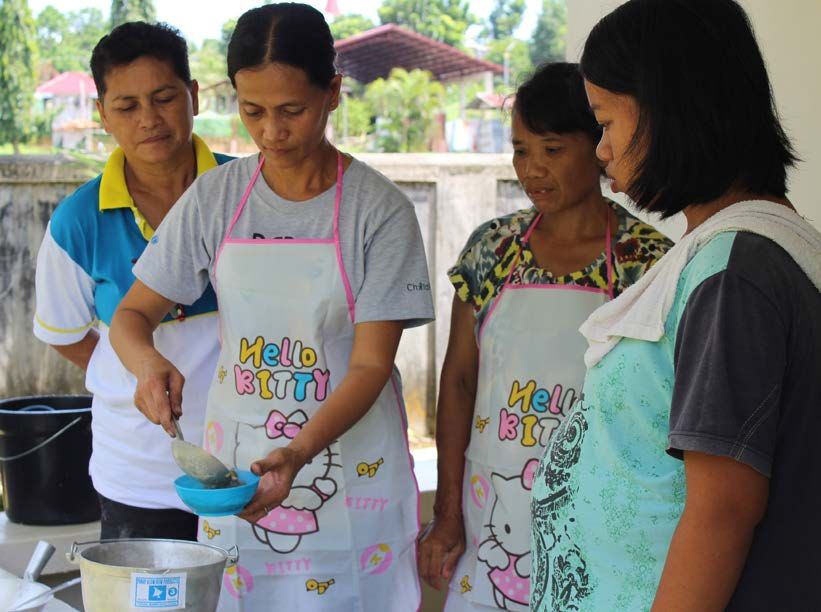
About this document
       Optimal complementary feeding of infants and young children helps to
       ensure proper infant growth and development, and prevent malnutrition.
       In the Philippines, many children are underweight, short in stature, and
       lacking in micronutrient intake. An inadequate diet and inappropriate
       complementary feeding practices contribute to the increase and/or
       prevalence of malnutrition among young children. A key strategy in
       battling child malnutrition is to ensure that mothers and others responsible
       for children’s welfare are provided with knowledge and skills in preparing
       nutritionally balanced food. This strategy is implemented, in part, through
       participatory cooking demonstrations involving community nutrition and
       health workers, mother-leaders, and peer counsellors.

       This is a guide on how to conduct participatory cooking demonstrations
       of dishes using locally-grown and affordable ingredients. It includes
       traditional recipes that have been revised to enhance their nutritional
       value, as well as a complementary feeding guide for children aged 6 to
       9 months, 9 to 12 months, and 12 to 24 months. Parents, caregivers
       and feeding program managers can adapt these recipes to meet local
       conditions and ensure successful complementary feeding. Many of the
       recipes used in the participatory cooking demonstrations presented in this
       guide originally appeared in a collection of recipes for complementary
       foods for children aged 6 months and up, published by the Food and
       Agriculture Organization of the United Nations (FAO) in 2012.

       Included is information on when to start giving complementary foods;
       how to know a child is ready for complementary foods; why giving
       complementary foods too early or too late can be dangerous; the different
       kinds of complementary foods; and how to plan and conduct participatory
       cooking demonstrations.

       Those responsible for producing complementary foods are encouraged
       to use ingredients from home gardens or community gardens in cooking
       and preparation. In addition, complementary foods can be prepared
       using foods for the rest of the family as long as the consistency, texture,
       taste, aroma, and amount of food are suitable for the child’s stage of
       development.

     GUIDE TO CONDUCTING PARTICIPATORY COOKING DEMONSTRATIONS
iv   TO IMPROVE COMPLEMENTARY FEEDING PRACTICES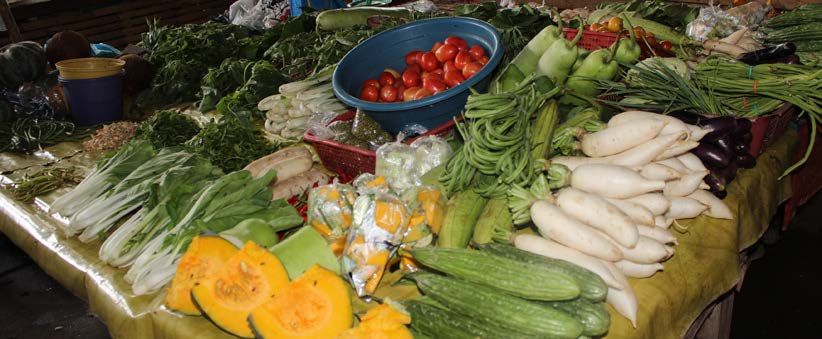
Acknowledgements
This Guide to conducting participatory cooking demonstrations to
improve complementary feeding practices was developed as part of a
project entitled Early warning system for food and nutrition security
(EWS-FNS), which was implemented by the Food and Agriculture
Organization of the United Nations (FAO) in the Philippines, through the
support of the United Nations Children’s Fund (UNICEF).

This document was written by Maria Theresa Talavera and Anna Teresa
Orillo, with assistance from Apple Espino, Tristan Tenorio, Gracielle
Dupaloc and Mark Reblora, and reviewed by Divine Grace Domingo and
Sheila Abacan. Technical guidance and support was provided by Maria
Cecilia Pastores, FAO Project Team Leader; Dr Demetria Bongga, FAO
EWS-FNS Consultant; Dr Raymundo Celestino F Habito, FAO Food and
Nutrition Security Monitoring Systems Specialist; and Ms Evelyn Carpio,
UNICEF Philippines.

The recipes in this guide were kitchen-tested using locally available foods
and cooking utensils. The complementary feeding messages were adopted
from the UNICEF Philippines Counselling Cards.

The authors of this book are grateful to the Institute of Human Nutrition
and Food, under the leadership of Dr Normahitta Gordoncillo, and to the
University of the Philippines in Los Baños, Laguna.

The authors also wish to acknowledge the invaluable help of the municipal
mayors, barangay captains, Barangay Nutrition Scholars (BNS), barangay
health workers, mother-leaders, peer counsellors, municipal nutrition
action officers, and provincial nutrition action officers in the provinces of
Capiz and Aklan, in organizing and conducting the participatory cooking
demonstrations featured in this guide.

                   GUIDE TO CONDUCTING PARTICIPATORY COOKING DEMONSTRATIONS
                                TO IMPROVE COMPLEMENTARY FEEDING PRACTICES
                                                                                v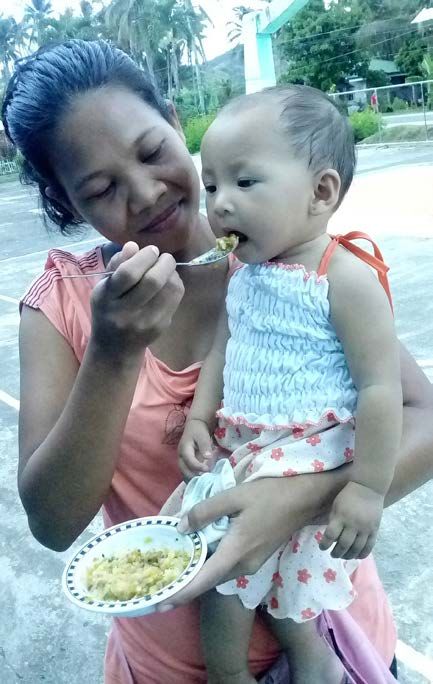
SESSION          1
                  UNDERSTANDING COMPLEMENTARY
                      FEEDING AND ITS IMPORTANCE

Objectives: At the end of the session, the participants will be able to:
              1. Describe complementary feeding;
              2. Explain the importance of complementary feeding; and
              3. Enumerate optimal complementary feeding practices.

Duration:     30 minutes

Materials:    Manila paper
              Masking tape
              Marking pen

Learning activities:
1. Begin the first session by stating its title and objectives.
2. Inform participants that many young children are thin and lacking in height due
   to improper complementary feeding practices, e.g. feeding children with watery
   lugao, holding to certain food taboos, discontinuing
   breastfeeding as soon as the child starts to eat food,
   and introducing particular foods into their feeding too
   early or too late in their development. Malnutrition can
   be prevented by feeding children adequate, nutritious,             Complementary
   and safe complementary foods and by following good              Feeding is the period of
   complementary feeding practices.                               transition from exclusive
                                                                      breastfeeding to the
3. Describe complementary feeding and its importance.
                                                                     consumption of regular
                                                                          family foods.

                              GUIDE TO CONDUCTING PARTICIPATORY COOKING DEMONSTRATIONS
                                           TO IMPROVE COMPLEMENTARY FEEDING PRACTICES
                                                                                              1
● It refers to the gradual introduction of semi-solid and solid foods to the infant’s
           diet, along with continued breastfeeding, until the child can be fed fully with
           ordinary family foods in adequate quantities.
         ● It covers the period of a child’s life from 6 to 23 months. This is when the baby
           learns about the various flavors, aromas, appearances and textures of food.
           It is at this stage that children are especially vulnerable to malnutrition. The
           incidence of malnutrition rises sharply among children aged 6 to 18 months in
           most countries, and the effects of nutritional deficits at this age may be difficult
           to compensate for later in childhood.
         ● Good complementary feeding means providing the child daily with nutritious
           food, such as enriched lugao or food from the family pot, as well as nutritious
           snacks between meals, along with continued breastfeeding.
         ● After they reach six months of age, infants require more energy, protein,
           and micronutrients—like iron, zinc, and vitamins—than can be provided by
           breast milk alone. Good complementary feeding entails adding these nutrients
           through the introduction of semi-solid and solid foods, along with continued
           breastfeeding.
         ● When children are adequately fed, they are healthy, active, alert and happy, and
           are less prone to cry.

                                                                       © UPLB
                               © UPLB

                                                                                              © UPLB

    GUIDE TO CONDUCTING PARTICIPATORY COOKING DEMONSTRATIONS
2   TO IMPROVE COMPLEMENTARY FEEDING PRACTICES
4. Facilitate the game entitled “Nutri Group”. The game provides participants with a
review of the basic food groups.
a. Give participants strips of paper, each with the name of a food item written on it.
b. Let each participant classify the food item as energy-rich, protein-rich,
vitamin-rich, mineral-rich or fat-rich, and post each strip of paper under the
corresponding category on the board/wall.
c. Discuss the participants’ output. Encourage active participation.
© UPLB
© UPLB
© UPLB
GUIDE TO CONDUCTING PARTICIPATORY COOKING DEMONSTRATIONS
TO IMPROVE COMPLEMENTARY FEEDING PRACTICES
35. Share the first complementary feeding guide, below.
Continue to breastfeed (for at least 2 years) and feed a variety of foods at each
meal to your young child. For example:
● Animal-source foods (meat, chicken, fish, liver) and eggs, milk and milk
products
● Staples (maize, wheat, rice, millet and sorghum); roots and tubers
(cassava, potatoes)
● Legumes (beans, lentils, peas, groundnuts) and seeds (sesame)
● Vitamin A-rich fruits and vegetables (mango, papaya, passion fruit,
oranges, dark- green leaves, carrots, yellow sweet potato and pumpkin)
and other fruit and vegetables (banana, pineapple, watermelon,
tomatoes, avocado, eggplant and cabbage)
Sources:
UNICEF. The Community Infant and Young Child Feeding Counselling Package (Key
Messages). Retrieved from: https://www.unicef.org/nutrition/files/Key_Messages_Booklet_
for_counselling_cards.pdf
UNICEF. Infant and Young Child Feeding (IYCF) Counselling Cards. Retrieved from:
https://www.unicef.org/nutrition/files/Philippines_C-IYCF_cards_2011.pdf
GUIDE TO CONDUCTING PARTICIPATORY COOKING DEMONSTRATIONS
4 TO IMPROVE COMPLEMENTARY FEEDING PRACTICES6. Describe the various complementary foods.
● Complementary foods are foods and liquids which are fed to children to
complement breastfeeding, but which may not be adequate as the sole source
of nutrients.
● Complementary foods must be of the correct texture, consistency, and amount
to ensure that recommended energy and nutrient requirements are met.
● A balanced set of complementary foods must include the following:
Staple/Starchy Food Protein-rich Food Vegetable and Fruits Fats and oil
© UPLB
© UPLB
© UPLB
© UPLB
7. Show examples of food groupings (staples, legumes and seeds, vitamin A-rich fruits
and vegetables, other fruits and vegetables, animal-source foods), and oil.
© UPLB
a. Staple/starchy foods: Staple foods should form the largest part of the meal,
and supply the bulk of the child’s energy needs. Rice can be substituted with
corn, potatoes, sweet potatoes, cassava and other root crops as the starchy
base of complementary foods.
© UPLB
© UPLB
© UPLB
© UPLB
© UPLB
GUIDE TO CONDUCTING PARTICIPATORY COOKING DEMONSTRATIONS
TO IMPROVE COMPLEMENTARY FEEDING PRACTICES
5b. Protein-rich foods: Foods of animal origin such as pork, chicken liver, eggs and
fish are excellent sources of: protein; fat which gives the body energy; zinc
for recovery from diarrhoea; and iron, which promotes child growth and brain
development. Iron-rich foods must be taken together with vitamin-rich fruits
to ensure that the iron is absorbed. Liver and eggs are rich sources of vitamin
A. Milk and small fishes are good sources of calcium. Legumes and nuts are
good sources of protein in the absence of fish, eggs, poultry, or meat, and can
provide variety in the diet.
© UPLB
© UPLB
© UPLB
© UPLB
© UPLB
© UPLB
© UPLB
c. Vegetables and fruits: Yellow and orange fruits, and dark green leafy
vegetables, are rich in vitamins A and C.
© UPLB
© UPLB
© UPLB
© UPLB
© UPLB
d. Fats and oil: Fats and oil are concentrated sources of energy. They also add
flavor and improve the texture of foods.
© UPLB
© UPLB
© UPLB
© UPLB
GUIDE TO CONDUCTING PARTICIPATORY COOKING DEMONSTRATIONS
6 TO IMPROVE COMPLEMENTARY FEEDING PRACTICES8. Explain the risks of starting complementary foods too early or too late.
RISKS TO STARTING RISKS TO STARTING
COMPLEMENTARY FOODS TOO COMPLEMENTARY FOODS TOO
EARLY LATE
Adding complementary foods too soon Adding complementary foods too late is
(before six months) may: also a risk, because:
• As a substitute for breast milk, make it • The child does not receive the extra
difficult to meet the child’s nutritional food required to meet his/her growing
needs needs
• Result in a diet that is low in nutrients, • The child will grow and develop more
especially if thin, watery soups and slowly
porridges are used because these are • The child might end up lacking nutri-
considered easy for the child to ingest ents needed to avoid malnutrition and
• Increase the risk of illness because less to combat nutrition-related diseases
of the protective factors in breast milk such as anemia (which is due to iron
are consumed deficiency)
• Increase the risk of diarrhea because
the complementary foods may not be
as clean or as easy to digest as breast
milk
• Increase the risk of wheezing and other
allergic conditions because the child
cannot yet digest and absorb non-hu-
man protein well
• Increase the mother’s risk of another
pregnancy if breastfeeding is less fre-
quent
9. Encourage the participants to recall some good complementary feeding practices
for infants and young children. Listen to their answers. Compliment and thank the
participants for sharing their knowledge.
10. Share the following optimal complementary feeding practices.
a. Practice exclusive breastfeeding from the child’s birth to six months of age.
Continue frequent, on-demand breastfeeding until the child is two years of age
or beyond.
b. Introduce complementary foods at six months (180 days after birth) while
continuing to breastfeed. From 6 months onwards, breast milk alone is no
longer enough to support child growth.
GUIDE TO CONDUCTING PARTICIPATORY COOKING DEMONSTRATIONS
TO IMPROVE COMPLEMENTARY FEEDING PRACTICES
7c. Start complementary feeding at six months of age with small amounts of food,
and increase the quantity or amount as the child grows older, while continuing
breastfeeding.
d. Gradually increase food consistency and the variety of foods as the child grows
older, adapting to the infant’s requirements and abilities.
e. Increase the number of times daily that the child is fed complementary foods, as
he/she gets older.
f. Give children a variety of foods to ensure that their nutrient needs are met.
Avoid giving drinks with low nutrient value, such as tea and coffee, and sugary
drinks like soft drinks. Limit the amount of juice given so as to avoid displacing
more nutrient-rich foods. Remember, young children have limited stomach
capacity.
© UPLB
© UPLB
© UPLB
© UPLB
© UPLB
© UPLB
© UPLB
© UPLB
© UPLB
GUIDE TO CONDUCTING PARTICIPATORY COOKING DEMONSTRATIONS
8 TO IMPROVE COMPLEMENTARY FEEDING PRACTICESg. Practice responsive feeding: feed slowly and patiently; try different food
combinations, tastes, textures and methods of encouragement; minimize
distractions during meals if the child loses interest easily; and talk to children
during feeding, with eye-to-eye contact. Do not be discouraged if the child
refuses to eat a food that is introduced for the first time. Children need to get
used to new or different tastes.
h. Use fortified complementary foods such as iodized salt, Vitamin A-fortified
margarine or vitamin–mineral supplements, as needed.
i. Enhance the feeding of sick children both during and after their illness, e.g.
increase their fluid intake and include more frequent breastfeeding. After the
illness has passed, continue to give food more often than usual and encourage
the child to eat more.
© UPLB
© UPLB
© UPLB
GUIDE TO CONDUCTING PARTICIPATORY COOKING DEMONSTRATIONS
TO IMPROVE COMPLEMENTARY FEEDING PRACTICES
911. Share with participants the signs
indicating that a child is ready for
complementary foods. At the end of six
months, an infant’s reflexes, skills and
physiology will have matured enough to
help him/her consume foods other than
breast milk. An infant who is ready to be
introduced to solids will:
● Hold its head up and maintain a
steady, upright position
● Sit well when supported
● Make chewing motions, i.e. the
baby can move food to the back of
its mouth before swallowing
● Have gained weight appropriately,
i.e. most babies will have doubled
their birth weight by six months of
age
● Be interested in what others are
© UPLB
eating, i.e. the baby will eye and
reach out for these foods
12. End the session by stating that a young child gradually gets used to eating family
foods during the complementary feeding period and that breast milk is usually fully
replaced by family foods at 2 years of age.
GUIDE TO CONDUCTING PARTICIPATORY COOKING DEMONSTRATIONS
10 TO IMPROVE COMPLEMENTARY FEEDING PRACTICESSESSION 2
INTRODUCING PARTICIPATORY
COOKING DEMONSTRATIONS
Objectives: At the end of the session, the participants will be able to:
1. Identify different parts of a recipe;
2. Discuss various cooking methods;
3. Describe participatory cooking demonstration;
4. Demonstrate the steps of cooking demonstration; and
5. Apply food safety and sanitation practices in the kitchen.
Duration: 30 minutes
Materials: Spoon and fork Knife
Bowl Strainer
Hand towel Mortar and pestle
Chopping board Plates
Water dipper Hand soap
Flipchart Counseling cards
Metacards
Learning activities:
1. Begin session 2 by stating its title and objectives.
2. Describe participatory cooking demonstrations, their purpose and objectives.
a. Participatory cooking demonstrations are a practical way of showing mothers
and caregivers how to prepare improved dishes for young children, using readily
available local ingredients.
GUIDE TO CONDUCTING PARTICIPATORY COOKING DEMONSTRATIONS
TO IMPROVE COMPLEMENTARY FEEDING PRACTICES
11b. The purpose of conducting
participatory cooking
demonstrations is to:
● Enable the mothers/caregivers
to gain new food preparation
skills.
● Develop their confidence in
preparing improved or new
dishes.
● Create awareness of under-
© UPLB
utilized nutritious food
ingredients readily available at
home or in the area.
● Instruct them on how to prepare nutritious meals through hands-on
participation in meal preparation, e.g. washing or cutting ingredients.
● Provide them an opportunity to taste prepared dishes and give feedback on the
color and appearance, aroma/smell, and taste of the improved dish.
c. The objective of participatory cooking demonstrations is to:
● Show the mothers/caregivers how to prepare nutritionally improved dishes (in
terms of diversity, quality, and quantity).
● Provide them with practical skills and confidence in preparing nutritionally
improved dishes through their hands-on participation in cooking
demonstrations.
● Give them the chance to taste what was cooked and express their opinions of
the improved/enriched food.
© UPLB
© UPLB
GUIDE TO CONDUCTING PARTICIPATORY COOKING DEMONSTRATIONS
12 TO IMPROVE COMPLEMENTARY FEEDING PRACTICESd. Venue/location:
● Food preparation demonstrations may be conducted within the community, at
home, in health centers, at community centers and in local schools.
© UPLB
© UPLB
Barangay health center Barangay covered court
3. Describe the general procedures in conducting an actual participatory cooking
demonstration. Make sure that mothers/caregivers have been invited and informed
of the time, date and location of the demonstration. If the cooking or processing
time of some food components will take too long, these may instead be prepared
beforehand.
Step 1 Know the recipe
● Choose a recipe that conforms to local eating
patterns and make improvements/adjustments as
needed. A recipe consists of a list
of ingredients in specific
● Note the basic components of complementary
amounts, followed
feeding: staple/starchy food + protein-rich food +
vegetable or fruit + a little oil. by the procedures for
turning these ingredients
● Identify the ingredients and their required amounts, into a dish.
utensils needed, steps in cooking and cooking time.
GUIDE TO CONDUCTING PARTICIPATORY COOKING DEMONSTRATIONS
TO IMPROVE COMPLEMENTARY FEEDING PRACTICES
13THICK RICE PORRIDGE
Makes 2-4 servings Serving size: ½ cup
Preparation time: 5 minutes Cooking time: 30 minutes
© UPLB
Ingredients:
Rice Water
¼ cup 2 ½ cups
½ cup 4 cups
Utensils needed:
Measuring cups and spoons, small cast-iron pot, basting spoon
Procedure:
1. In the pot, wash rice lightly to prevent loss of water-soluble nutrients.
2. Add water and cover pot. Set cooking flame on high to boil the rice and water for
about 5 minutes.
3. Stir. Continue cooking for about 10 minutes, or until rice is cooked but still watery.
Keep the cover slightly open to prevent the contents of the pot from boiling over.
4. Stir constantly until mixture thickens.
Step 2 Select and prepare the ingredients
● Make a list of the ingredients and utensils to use.
● Choose ingredients that are available in home gardens or at the local market.
© UPLB
© UPLB
GUIDE TO CONDUCTING PARTICIPATORY COOKING DEMONSTRATIONS
14 TO IMPROVE COMPLEMENTARY FEEDING PRACTICESStep 3 Cook the food
● Ensure that everybody has a clear view of the demonstration.
● Explain the objectives, recipes and complementary feeding message/s.
● Actively involve the mothers/caregivers in the preparation process, e.g. cutting
of vegetables, and encourage them to ask questions and offer suggestions.
© UPLB
● Conserve nutrients. Do not overcook. Do not use seasonings.
● Use utensils, cooking facilities and processing equipment that are found in most
homes. Follow kitchen safety and sanitation practices, which include proper
hygiene and washing of hands; cleaning of work surfaces and washing of
utensils; and washing of ingredients before
cooking.
© UPLB
© UPLB
© UPLB
GUIDE TO CONDUCTING PARTICIPATORY COOKING DEMONSTRATIONS
TO IMPROVE COMPLEMENTARY FEEDING PRACTICES
15Step 4 Serve and taste the cooked food
● Serve the right amount of food according to the age of the child
● Ask the mothers/caregivers to taste the cooked food using their own clean
eating utensils and to rate the food in terms of appearance, taste and smell/
aroma.
● Remember that children can eat pureed, mashed and semi-solid foods
beginning at six months; by eight months most infants can also eat “finger
foods”(snacks that they can eat on their own); and by twelve months, most
children can eat the same foods consumed by the rest of the family.
© UPLB
© UPLB
GUIDE TO CONDUCTING PARTICIPATORY COOKING DEMONSTRATIONS
16 TO IMPROVE COMPLEMENTARY FEEDING PRACTICES4. Guide participants in different ways of preparing food in order to prevent choking
among young children.
Flake the foods using fingers or
a spoon and fork (e.g. fish, pork,
chicken, beef and other meats)
© UPLB
© UPLB
Mash with a fork (e.g. eggs,
potatoes, squash, banana, sweet
potato, papaya)
© UPLB
© UPLB
Pound with a mortar and pestle (e.g.
peanuts, sweet potato, anchovies or
dilis, roasted mung beans)
© UPLB
Chop or slice with a knife (e.g.
morninga leaves, carrots, cabbage,
unripe jackfruit, local vine spinach or
alugbati)
© UPLB
© UPLB
Grind (e.g. rice, corn, mung beans,
anchovies or dilis)
© UPLB
Scrape with a spoon (e.g. banana,
apple, papaya, mango, melon)
© UPLB
GUIDE TO CONDUCTING PARTICIPATORY COOKING DEMONSTRATIONS
TO IMPROVE COMPLEMENTARY FEEDING PRACTICES
17GUIDE TO PREPARING SELECTED FOODS
© UPLB
© UPLB
© UPLB
© UPLB
© UPLB
1. Wash the sweet 2. Boil the sweet 3. Peel the boiled 4. Slice the peeled 5. Mash the cooked
potato with running potato sweet potato sweet potato sweet potato into
water to remove dirt paste
© UPLB
© UPLB
© UPLB
© UPLB
© UPLB
1. Clean fish by 2. Boil fish in pot 3. Debone fish 4. Mash fish with 5. Measure and put
removing scales and ladle or spoon in pot
guts
© UPLB
© UPLB
© UPLB
© UPLB
1. Wash meat 2. Slice the meat 3. chop the meat 4. Measure and put
thinly to pot
© UPLB
© UPLB
© UPLB
© UPLB
1. Wash egg 2. Break egg 3. Scramble egg 4. Add to pot
© UPLB
© UPLB
© UPLB
© UPLB
1. Remove the 2. Soak the mung 3. Boil the mung 4. Pound the mung
mung beans of poor beans beans beans
quality
GUIDE TO CONDUCTING PARTICIPATORY COOKING DEMONSTRATIONS
18 TO IMPROVE COMPLEMENTARY FEEDING PRACTICESGUIDE TO PREPARING SELECTED FOODS (CONT.)
© UPLB
© UPLB
© UPLB
© UPLB
1. Wash vegetable 2. Cut the vegetable 3. Chop the leaves 4. Measure and add
leaves finely vegetables to pot
© UPLB
© UPLB
© UPLB
1. Wash banana with 2. Remove half the 3. Lightly scrape the
clean water banana skin banana
5. Remind the participants to practice safe and sanitary food preparation and storage to
ensure that food given to children is not contaminated, and to prevent the children
from getting sick. This includes:
a. Washing their hands with running water and
soap before preparing food, and before feeding
the child. It is important that they wash their
hands after changing baby diapers or going to
the toilet.
b. Washing all bowls, cups and utensils with clean
water and soap. These should be covered or
stored before use. A baby should have his or
her own cup and bowl.
© UPLB
© UPLB
© UPLB
GUIDE TO CONDUCTING PARTICIPATORY COOKING DEMONSTRATIONS
TO IMPROVE COMPLEMENTARY FEEDING PRACTICES
19c. Preparing food on clean surfaces and
keeping it covered.
d. Serving food immediately after
preparation.
e. Thoroughly reheating any food that has
been kept standing for more than an
hour.
f. Babies gradually learn to feed
themselves. An adult or an older child
should encourage the baby to eat
enough food and ensure that the food
remains clean.
6. End the session by sharing practical tips on
preparing food to ensure its palatability and to
conserve nutrients.
a. Choose the correct cooking method
to ensure the desired texture and
© UPLB
consistency.
b. Do not overcook; overcooking causes
toughening and drying up of meats, eggs and other protein dishes.
c. Wash foods before peeling, paring and cutting.
d. Peel, pare, cut, or chop foods just before cooking.
e. Use small amounts of water in washing rice and mix gently.
f. Use just enough water to cover the food when cooking.
g. Cover food while cooking.
h. Cook root crops such as potatoes and sweet potatoes with the skin on.
GUIDE TO CONDUCTING PARTICIPATORY COOKING DEMONSTRATIONS
20 TO IMPROVE COMPLEMENTARY FEEDING PRACTICESSESSION 3
COMPLEMENTARY FEEDING GUIDE AND
RECIPES FOR CHILDREN 6-9 MONTHS OLD
Objectives: At the end of the session, the participants will be able to:
1. Explain complementary feeding guide for children 6 to 9 months old;
2. Prepare enhanced rice porridge; and
3. Demonstrate cooking rice porridge and other recipes
Duration: 2 hours
Materials:
Flipchart Manila paper Bowls
Marking pen Stove Chopping board
Cast iron pots Ladle
Spoon and fork Knife
Tablespoon Cup
Learning activities:
1. Begin the session by stating its title and objectives.
2. Tell the participants that the complementary feeding guide and recipes for each age
group, i.e. 6 to 9 months, 9 to 12 months, and 12 to 24 months, will be shared with
them. Recipes suggested for one age group may also be used for other age groups
so long as appropriate modifications are made in terms of texture, amount per
serving and taste.
3. Share the complementary feeding guide for 6 to 9 months-old children.
4. Point out that while the first food commonly given to children is thin rice porridge, it is
more appropriate to feed them thick and enhanced rice porridge, as this is an energy-
and nutrient-dense dish suitable for a growing child. As children grow older, they
are given soft-cooked grains, and eventually regularly cooked rice moistened with
minimal liquid.
GUIDE TO CONDUCTING PARTICIPATORY COOKING DEMONSTRATIONS
TO IMPROVE COMPLEMENTARY FEEDING PRACTICES
21■ Starting at about 6 months,
your baby needs other foods
in addition to breast milk.
■ Continue breastfeeding your
baby on demand both day
and night.
■ Breast milk continues to be
the most important part of
your baby’s diet.
■ Breastfeed first before giving other foods.
■ When giving complementary foods, think: frequency, amount, thickness, variety,
active/responsive feeding and hygiene:
● Frequency: Feed your baby complementary foods twice a day.
● Amount: Give 2 to 3 tablespoonfuls (‘tastes’) each feeding.
● Thickness: The food should be thick enough to be fed by hand.
● Variety: Begin with the staple foods like porridge (corn, wheat, rice, millet,
potatoes, sorghum), mashed banana or mashed potato
● Active/responsive feeding: Baby may need time to get used to eating foods
other than breast milk. Be patient and actively encourage your baby to eat.
Don’t force your baby to eat. Use a separate plate to feed the baby to make
sure he or she eats all the food you give.
● Hygiene: Good hygiene (cleanliness) is important to avoid diarrhoea and
other illnesses. Use a clean spoon or cup to give foods or liquids to your
baby. Store the foods to be given to your baby in a safe hygienic place.
Wash your hands with soap and water before preparing foods and feeding
baby. Wash your hands and your baby’s hands before eating. Wash your
hands with soap and water after using the toilet and washing or cleaning
baby’s bottom.
Sources:
UNICEF. The Community Infant and Young Child Feeding Counselling Package (Key Messages).
Retrieved from: https://www.unicef.org/nutrition/files/Key_Messages_Booklet_for_counselling_
cards.pdf
UNICEF. Infant and Young Child Feeding (IYCF)Counselling Cards.
Retrieved from:https://www.unicef.org/nutrition/files/Philippines_C-IYCF_cards_2011.pdf
GUIDE TO CONDUCTING PARTICIPATORY COOKING DEMONSTRATIONS
22 TO IMPROVE COMPLEMENTARY FEEDING PRACTICES■ Continue breastfeeding your
baby on demand both day and
night. This will maintain his
or her health and strength as
breast milk continues to be the
most important part of your
baby’s diet.
■ Breast milk supplies half (1/2)
of the baby’s energy needs
from 6 up to 12 months.
■ Breastfeed first before giving other foods.
■ When giving complementary foods to your baby, think: frequency, amount,
thickness, variety, active/responsive feeding and hygiene:
● Frequency: Feed your baby complementary foods 3 times a day.
● Amount: Increase amount gradually to half (½) cup (250 ml cup). Use a
separate plate to make sure a young child eats all the food given.
● Thickness: Give mashed/pureed family foods. By 8 months your baby can
begin eating finger foods.
● Variety: Try to feed a variety of foods at each meal. For example: Animal-
source foods (flesh meats, eggs and dairy products); Staples (grains, roots
and tubers); Legumes and seeds; Vitamin A rich fruits and vegetables and
other fruits and vegetables.
● Active/responsive feeding: Be patient and actively encourage your baby to
eat. Don’t force your baby to eat. Use a separate plate to feed the baby to
make sure he or she eats all the food given.
● Hygiene: Good hygiene (cleanliness) is important to avoid diarrhoea and
other illnesses. Use a clean spoon or cup to give foods or liquids to your
baby. Store the foods to be given to your baby in a safe hygienic place.
Wash your hands with soap and water before preparing foods and feeding
baby. Wash your hands and your baby’s hands before eating. Wash your
hands with soap and water after using the toilet and washing or cleaning
the baby’s bottom.
Sources:
UNICEF. The Community Infant and Young Child Feeding Counselling Package (Key Messages).
Retrieved from: https://www.unicef.org/nutrition/files/Key_Messages_Booklet_for_counselling_
cards.pdf
UNICEF. Infant and Young Child Feeding (IYCF)Counselling Cards.
Retrieved from:https://www.unicef.org/nutrition/files/Philippines_C-IYCF_cards_2011.pdf
GUIDE TO CONDUCTING PARTICIPATORY COOKING DEMONSTRATIONS
TO IMPROVE COMPLEMENTARY FEEDING PRACTICES
235. Demonstrate how to cook thick rice porridge following the steps in participatory
cooking demonstration, i.e. know the recipe, select and prepare the ingredients, cook
the food, serve and taste.
© UPLB
© UPLB
© UPLB
Thin rice porridge runs Medium-thick rice Thick rice porridge stays
quickly off the ladle porridge drops slowly on the ladle
from the ladle
6. Show the differences in the consistency of rice porridge as cooking progresses.
7. The thicker rice porridge is what should be fed to children aged 6 to 8 months.
© UPLB
© UPLB
© UPLB
Thin rice porridge Medium consistency rice Thick rice porridge
porridge
8. Explain the following key points:
● Energy density is associated with food consistency. The thicker the consistency,
the more energy it can provide.
● Lumping can be avoided by mixing the dry ingredients well with water before
applying heat. Stir constantly at low to medium heat.
● Additional ingredients like milk, squash, mung beans and banana may be added
just prior to feeding, to prevent darkening and spoilage.
● Rice porridge gets thick upon cooling, and should not be allowed to stand for
too long.
GUIDE TO CONDUCTING PARTICIPATORY COOKING DEMONSTRATIONS
24 TO IMPROVE COMPLEMENTARY FEEDING PRACTICES9. Tell the participants that recipes can be modified to enhance their nutrient content.
Recipe modification can be in the form of adding new ingredients or substitution. If
the prescribed ingredients in a recipe are not available, substitutions may be made,
depending on what is available and acceptable to the child and family.
Food Group Food Item/Ingredient You may substitute with:
Other green leafy
vegetables, such as local
vine spinach or alugbati,
Morninga leaves
jute or saluyot, pechay,
swamp cabbage or
Vegetables
kangkong
Other yellow or orange-
Squash colored vegetables, such
as carrots or sweet potato
Other root crops, such
Starches Sweet potato as potato, taro (gabi) or
purple yam (ubi)
Pork, beef, shellfish,
Chicken/fish
seafood
Meat
Chicken liver Pork or beef liver
Mung beans/pigeon peas Patani, paayap, green
Legumes and Nuts
or kadyos peas, garbanzos
Sugar Refined sugar Crude sugar or panutsa
10. Demonstrate the preparation and cooking of enhanced rice porridge.
Rice porridge with mashed squash
1. Set aside squash which has been cooked in water
and some oil.
2. Mash the squash.
3. Blend well to make a smooth paste.
4. Blended mixture can be poured through a sieve/
© UPLB
strainer to make sure there are no large chunks of
food.
5. Add mashed squash to the rice gruel.
GUIDE TO CONDUCTING PARTICIPATORY COOKING DEMONSTRATIONS
TO IMPROVE COMPLEMENTARY FEEDING PRACTICES
25Rice porridge with chopped local vine
spinach or alugbati
1. Set aside alugbati leaves which have been cooked in
water and some oil.
2. Chop the leaves finely.
© UPLB
3. Add chopped leaves to the rice gruel.
Rice porridge with scraped eggplant
1. Set aside a slice of eggplant which has been cooked
in water and some oil.
2. Scrape the flesh of the boiled eggplant.
3. Add scraped eggplant flesh to the rice gruel.
© UPLB
Rice porridge with flaked fish
1. Separate fish which has been boiled in water and
some oil.
2. Flake the fish and remove fish bones.
3. Add 1 tablespoon of flaked fish to the rice gruel.
© UPLB
GUIDE TO CONDUCTING PARTICIPATORY COOKING DEMONSTRATIONS
26 TO IMPROVE COMPLEMENTARY FEEDING PRACTICES11. Introduce COOKING DEMONSTRATION #1. Divide the participants into 3 to 4 groups.
Each group will have 4 to 5 members. Each group will be provided with a work table
and a set of cooking utensils and equipment. Each group will assign from among its
members a group leader/cook, assistant cook, dishwasher, and marketer. Each group
shall present the plain rice porridge in three different consistencies and, in a separate
bowl, the enhanced/modified rice porridge.
12. Ask each group to put the cooked foods on one table. Ask the participants to examine
the cooked rice porridge in terms of taste, smell/aroma, texture and quantity. Let
the participants vote for the group with the best-tasting rice porridge. Ask 2 to 3
participants to share their experience.
13. End the session by stating that when introducing new foods to children aged 6 to 9
months, mothers and caregivers should select foods that are soft, thick and without
strong flavors.
GUIDE TO CONDUCTING PARTICIPATORY COOKING DEMONSTRATIONS
TO IMPROVE COMPLEMENTARY FEEDING PRACTICES
27SESSION 4
COMPLEMENTARY FEEDING GUIDE AND
RECIPES FOR CHILDREN 9-12 MONTHS OLD
Objectives: At the end of the session, the participants will be able to:
1. Explain the complementary feeding guide for children 9 to 12 months
old;
2. Modify recipes for children 9 to 12 months old; and
3. Demonstrate how to cook recipes for children 9 to 12 months old.
Duration: 2 hours
Materials:
Copy of recipe
Foods/ingredients
Cooking utensils
Eating utensils
Learning activities:
1. Begin session 4 by stating its title and objectives.
2. State that in session 4, the focus is on preparing complementary foods from the
family pot, going by the simple rule that what the family eats, the child also eats.
3. Share the complementary feeding guide for children aged 9 to 12 months.
GUIDE TO CONDUCTING PARTICIPATORY COOKING DEMONSTRATIONS
28 TO IMPROVE COMPLEMENTARY FEEDING PRACTICES■ Continue breastfeeding your baby on demand both day and night. This will
maintain his or her health and strength as breast milk continues to be the most
important part of your baby’s diet.
■ Breast milk supplies half (1/2) baby’s energy needs from 6 up to 12 months.
■ Breastfeed first before giving other foods.
■ When giving complementary foods to your baby, think: frequency, amount,
thickness, variety, active/responsive feeding and hygiene:
● Frequency: Feed your baby complementary foods 4 times a day.
● Amount: Increase amount to half (½) cup (250 ml cup). Use a separate
plate to make sure young child eats all the food given.
● Thickness: Give finely chopped family foods, finger foods and sliced
foods.
● Variety: Try to feed a variety of foods at each meal. For example:
Animal-source foods (flesh meats, eggs and dairy products); Staples
(grains, roots and tubers); Legumes and seeds; Vitamin A-rich fruits and
vegetables and other fruits and vegetables.
● Active/responsive feeding: Be patient and actively encourage your baby
to eat. Don’t force your baby to eat. Use a separate plate to feed the baby
to make sure he or she eats all the food given.
● Hygiene: Good hygiene (cleanliness) is important to avoid diarrhoea and
other illnesses. Use a clean spoon or cup to give foods or liquids to your
baby. Store the foods to be given to your baby in a safe hygienic place.
Wash your hands with soap and water before preparing foods and feeding
GUIDE TO CONDUCTING PARTICIPATORY COOKING DEMONSTRATIONS
TO IMPROVE COMPLEMENTARY FEEDING PRACTICES
29baby. Wash your hands and your baby’s hands before eating. Wash your
hands with soap and water after using the toilet and washing or cleaning
baby’s bottom.
Sources:
UNICEF. The Community Infant and Young Child Feeding Counselling Package (Key Messages).
Retrieved from: https://www.unicef.org/nutrition/files/Key_Messages_Booklet_for_counselling_
cards.pdf
UNICEF. Infant and Young Child Feeding (IYCF)Counselling Cards. Retrieved from:https://www.
unicef.org/nutrition/files/Philippines_C-IYCF_cards_2011.pdf
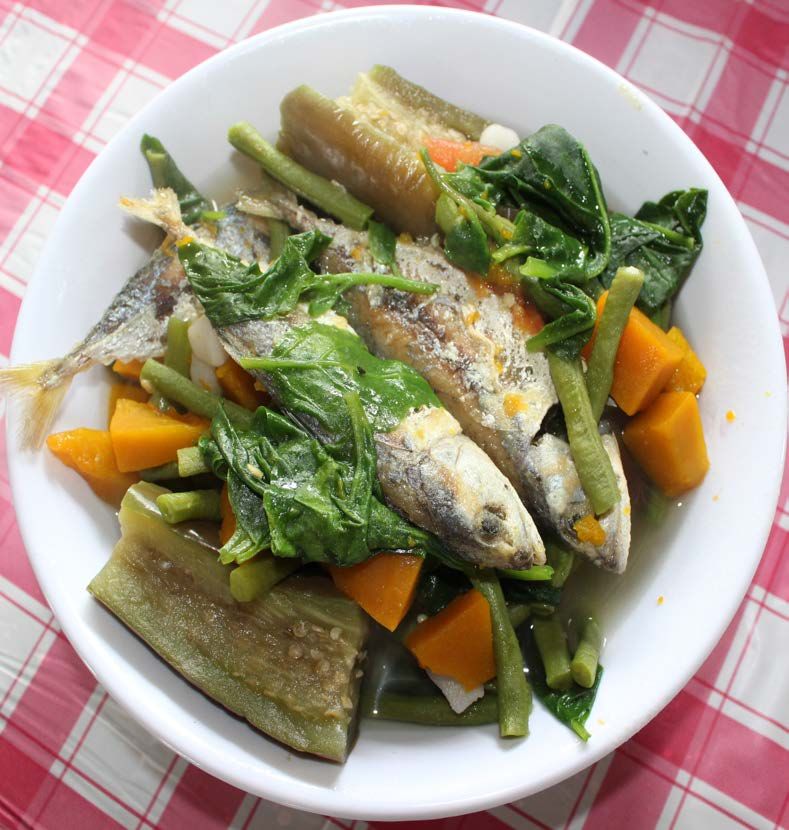
4. Introduce the recipe “Boiled mixed vegetables with fish”. Modification of the
recipe may be done by adding or substituting ingredients based on availability and
preference. Use locally available vegetables or those produced from home gardens.
© UPLB
GUIDE TO CONDUCTING PARTICIPATORY COOKING DEMONSTRATIONS
30 TO IMPROVE COMPLEMENTARY FEEDING PRACTICESBOILED MIXED VEGETABLES
WITH FISH
Makes 6 servings
Serving size: ½ cup, 1 cup cooked rice
© UPLB
Preparation time: 15 minutes
Cooking time: 20 minutes
Ingredients:
3 cups Water
2 pieces, medium Taro root or gabi, cut into strips
1 cup String beans or sitao, cut 1 ½ inches long
1 piece, medium Tomato, cut into quarters
1 cup Squash, cut into cubes
2 pieces, medium Eggplant, split into halves and cut into three
1 cup Local vine spinach or alugbati leaves
¼ cup Cooking oil
1 piece, medium Fish (tilapia), cut into three slices
2 teaspoons Iodized salt
Utensils needed:
Measuring cups and spoons, knife, chopping board, medium cast-iron pot,
basting spoon/wooden spoon, metal pan for cooking
Procedure:
1. Fry fish until golden brown and set aside.
2. Boil 3 cups of water in a pot. Add taro root, string beans and tomato.
Simmer for 5 minutes.
3. Add squash and eggplant. Cook for 5 minutes.
4. Add local vine spinach or alugbati leaves and fried fish. Season with salt,
cook for another 3 minutes. Serve.
GUIDE TO CONDUCTING PARTICIPATORY COOKING DEMONSTRATIONS
TO IMPROVE COMPLEMENTARY FEEDING PRACTICES
315. Divide the participants into 3 to 4 groups. Each group will assign from among its
members a group leader/cook, assistant cook, dishwasher, and marketer. Give each
group a copy of the recipe. Ask them to prepare and assemble the ingredients in 10
minutes and then cook the food. Each group should prepare a plate for a child aged 9
to 11months.
6. Remind the participants that when they are preparing and cooking foods for young
children, they should observe proper hygiene, including: thoroughly washing their
hands; cleaning work surfaces and washing utensils. They should also wash fresh
foods before cooking.
7. Assemble the cooked food prepared by the different groups on a table in front of
everyone. Ask the participants to taste the cooked food. Solicit their comments and
suggestions.
8. Remind the participants that they can also add micronutrient powder (MNP) to
complementary foods.
9. End the session by reiterating that complementary foods for children can be prepared
from the family food.
GUIDE TO CONDUCTING PARTICIPATORY COOKING DEMONSTRATIONS
32 TO IMPROVE COMPLEMENTARY FEEDING PRACTICESSESSION 5
COMPLEMENTARY FEEDING GUIDE AND
RECIPES FOR CHILDREN 12-24 MONTHS OLD
Objectives: At the end of the session, the participants will be able to:
1. Explain the complementary feeding guide for 12 to 24 months old
children;
2. Practice the knowledge and skills in conducting participatory cooking
demonstration.
Duration: 2 hours
Materials: Copy of recipe
Foods/ingredients
Cooking utensils
Eating utensils
Learning activities:
1. Introduce session 5. In this session, the participants will prepare the recipes
simultaneously with the facilitator. By this time, it is expected that the participants will
have the confidence to prepare their own complementary food.
2. Share the complementary feeding guide for children 12 to 24 months old.
GUIDE TO CONDUCTING PARTICIPATORY COOKING DEMONSTRATIONS
TO IMPROVE COMPLEMENTARY FEEDING PRACTICES
33■ Continue breastfeeding your
baby on demand both day and
night. This will maintain his
or her health and strength as
breast milk continues to be the
most important part of your
baby’s diet.
■ Breast milk continues to make
up about one third (1/3) of the
energy needs of the young child
from 12 up to 24 months.
■ When giving complementary foods to your baby, think: frequency, amount,
thickness, variety, active/responsive feeding and hygiene:
● Frequency: Feed your young child complementary foods 5 times a day.
● Amount: Increase amount to three-quarters (¾) to 1 cup (250 ml cup). Use
a separate plate to make sure young child eats all the food given.
● Thickness: Give family foods cut into small pieces, finger foods, sliced food.
● Variety: Try to feed a variety of foods at each meal. For example: Animal-
source foods (flesh meats, eggs and dairy products); Staples (grains, roots
and tubers); Legumes and seeds; Vitamin A rich fruits and vegetables and
other fruits and vegetables.
● Active/responsive feeding: Be patient and actively encourage your baby to
eat. Don’t force your baby to eat. Use a separate plate to feed the baby to
make sure he or she eats all the food given.
● Hygiene: Good hygiene (cleanliness) is important to avoid diarrhoea and
other illnesses. Use a clean spoon or cup to give foods or liquids to your
baby. Store the foods to be given to your baby in a safe hygienic place.
Wash your hands with soap and water before preparing foods and feeding
baby. Wash your hands and your baby’s hands before eating. Wash your
hands with soap and water after using the toilet and washing or cleaning
the baby’s bottom.
Sources:
UNICEF. The Community Infant and Young Child Feeding Counselling Package (Key Messages).
Retrieved from: https://www.unicef.org/nutrition/files/Key_Messages_Booklet_for_counselling_
cards.pdf
UNICEF. Infant and Young Child Feeding (IYCF)Counselling Cards. Retrieved from:https://www.
unicef.org/nutrition/files/Philippines_C-IYCF_cards_2011.pdf
GUIDE TO CONDUCTING PARTICIPATORY COOKING DEMONSTRATIONS
34 TO IMPROVE COMPLEMENTARY FEEDING PRACTICES3. Introduce the recipe “Mung beans with anchovies or dilis and moringa leaves in
coconut cream”. This dish is rich in iron, vitamins A and C, calcium, potassium and
protein, all of which are essential nutrients for growth and development. Coconut
milk can add energy to food. Moringa contains galactagogues, which favor milk
production among breastfeeding mothers.
MUNG BEANS WITH ANCHOVIES
AND MORINGA LEAVES IN
COCONUT CREAM
Makes 5 servings
Serving size: ½ cup, 1 cup cooked rice
© UPLB
Preparation time: 10 minute
Cooking time: 30 minutes
Ingredients:
2 cups Mung beans, pre-soaked overnight
2 cups Water
1/3 cup Coconut cream
1 ¼ cups Water
½ cup Dried anchovies, chopped
1 cup Moringa leaves, shredded
2 teaspoon Cooking oil
3 cloves Garlic, sliced
1 piece, small Onion, sliced
½ teaspoon Iodized salt
Utensils needed:
Measuring cups and spoons, knife, chopping board, small cast iron pot,
metal pan, basting spoon/wooden spoon
GUIDE TO CONDUCTING PARTICIPATORY COOKING DEMONSTRATIONS
TO IMPROVE COMPLEMENTARY FEEDING PRACTICES
35Procedure:
1. Drain water from pre-soaked mung beans. Set aside.
2. In a pot, put 2 cups of water and add mung beans. Boil for 10 minutes or
until the mung beans are slightly soft.
3. Add cocount cream and second extract of cocnut milk, and boil for
another 10 minutes. Stir occasionally.
4. Add dried anchovies or dilis and moringa leaves and boil for 3 minutes.
Stir occasionally. While waiting, put oil in a pan. Sauté onion first then
add garlic. Stir for one minute, or until the garlic is slightly brown. Set
aside.
5. Add moringa leaves and cook for
another 3 minutes. Then add sautéed
onion-and-garlic and salt. Boil for another
minute. Serve.
Extracting the coconut cream
1. Place grated mature coconut in a
© UPLB
cheesecloth or net bag.
2. Press and extract the coconut cream.
3. Strain and set aside.
Second extraction
1. After extracting the coconut cream, add 1 ½ cups of water to grated
coconut.
2. Place the grated coconut in the net bag for the second extraction and
press.
3. Strain and set aside.
4. Divide the participants into 3 to 4 groups. Each group will assign from among its
members a group leader/cook, assistant cook, dishwasher, and marketer. Give each
group a copy of the recipe. Ask each group to assemble the ingredients in 10 minutes
and then cook the food. Each group will prepare three plates of the cooked food, with
a plate for each age group, i.e. 6-8 months, 9-11 months and 12-24 months.
5. In plenary, assemble the cooked food of each group. Let each briefly present their
outputs. Ask the participants to taste the cooked food.
6. Show examples of complementary foods that can be prepared from the same recipe.
GUIDE TO CONDUCTING PARTICIPATORY COOKING DEMONSTRATIONS
36 TO IMPROVE COMPLEMENTARY FEEDING PRACTICESFor 6 to 9 months old
Mashed boiled mung beans
1. Follow procedures 1 and 2 for the mung beans.
2. Into¼ cup mung beans, mash in 1 tablespoon diluted
coconut cream.
© UPLB
3. Blended mixture can be poured through a sieve/
strainer to remove large mung bean chaff or peel.
For 9 to 12 months old
Rice porridge with mung beans, anchovies and
morninga leaves in coconut cream
1. Set aside1-2 tablespoons of mung beans, anchovies
and morninga leaves before adding salt, garlic and
onion.
© UPLB
2. Chop the mung beans, anchovies and morninga
leaves finely.
3. Blend ½ cup soft-cooked rice with 1 tablespoon
warm coconut cream mixture.
4. Mix the finely chopped mung beans, anchovies and
morninga leaves with the rice mixture.
For 12 to 24 months old
Mung beans, anchovies and morninga leaves in
coconut cream served with rice
1. Make sure the rice is well-cooked and soft.
2. Chop the mung beans, anchovies and morninga
leaves finely.
© UPLB
3. Serve the dish with rice on the side.
7. End the session by commending the participants on a job well done.
GUIDE TO CONDUCTING PARTICIPATORY COOKING DEMONSTRATIONS
TO IMPROVE COMPLEMENTARY FEEDING PRACTICES
37SESSION 6
RETHINKING FOOD TABOOS
Objectives: At the end of the session, the participants will be able to:
1. Identify food taboos and other traditions in food preparation that limit
variety in foods consumed by young children; and
2. Recommend ways on how to correct or overcome food taboos.
Duration: 30 minutes
Materials: Flashcards of different food items
Learning activities:
1. Begin the session by introducing the title and objectives. Then proceed by letting the
participants recall the previous days’ activities.
2. Explain that although there is a variety of food available, children are not given
certain foods because of food taboos. Taboos pertaining to specific foods and feeding
practices are believed to have negative effects on the child’s health. Certain foods are
believed to cause indigestion or skin allergy, or introduce parasites or leprosy.
GUIDE TO CONDUCTING PARTICIPATORY COOKING DEMONSTRATIONS
38 TO IMPROVE COMPLEMENTARY FEEDING PRACTICES© UPLB
3. Ask the participants to form a sharing circle. Encourage the participants to share their
thoughts about beliefs related to food and the feeding of children.
4. Give each participant two metacards of different colors, i.e. green and pink. Tell the
participants to list on the green metacard the foods they give children 6-24 months
old, as well as the beliefs and practices they adhere to in relation to complementary
feeding. Then tell the participants to list on the pink metacard the foods they WOULD
NOT give to children 6-24 months old, as well as the beliefs and practices they do
NOT adhere to in relation to complementary feeding. Let each participant share their
answers.
5. Actively listen to the participants’ sharing. Then explain the reasons why certain
taboo foods can, after all, be given to children. Gently correct any erroneous beliefs
about certain foods and feeding practices. Also note and provide explanations and
recommendations on the feeding practices identified by the participants.
GUIDE TO CONDUCTING PARTICIPATORY COOKING DEMONSTRATIONS
TO IMPROVE COMPLEMENTARY FEEDING PRACTICES
39© UPLB
© UPLB
© UPLB
Local vine spinach or alugbati Tilapia Clams
© UPLB
© UPLB
© UPLB
Liver Eggplant Banana
6. Show pictures of different foods, one at a time, and ask the participants if they are
willing to give these foods (shown above) to children aged 6 to 24 months. Separate
the foods that were selected from those not selected by the participants.
7. Show the pictures of foods that participants said they would feed to children. Ask
them why they give these foods to children. Actively listen to their sharing.
8. Show the pictures of the foods that participants said they would NOT give to children.
Ask the participants why they do not consider these suitable. Gently correct any
erroneous beliefs about these foods and explain why they can actually be eaten by
children.
9. End the session by reiterating that children should be given a variety of foods and that
certain food taboos have to be corrected.
GUIDE TO CONDUCTING PARTICIPATORY COOKING DEMONSTRATIONS
40 TO IMPROVE COMPLEMENTARY FEEDING PRACTICESSESSION 7
RETURN DEMONSTRATIONS BY
COMMUNITY NUTRITION WORKERS
Objectives: At the end of the session, the participants will be able to:
1. Conduct their own participatory cooking demonstration;
2. Share experiences in conducting the cooking demonstrations; and
3. Adapt the cooking demonstrations to the situations in their communities.
Duration: 2 hours
Materials: Foods/ingredients
Cooking utensils
Eating utensils
Advance preparation:
1. Collect recipes to be prepared by the mothers a day before the return demonstration.
Ask participants to bring foods from their home garden or community gardens.
Purchase only the ingredients which are not available from the participants.
2. Invite 10 to 12 mothers/caregivers to the participatory cooking demonstrations.
3. Prepare tokens of appreciation for the mothers/caregivers.
Learning activities:
1. Begin session 7 by stating its title and objectives. The session serves as a venue
for nutrition and health workers to simulate an actual participatory cooking
demonstration.
GUIDE TO CONDUCTING PARTICIPATORY COOKING DEMONSTRATIONS
TO IMPROVE COMPLEMENTARY FEEDING PRACTICES
412. Explain the mechanics of the session.
a. Divide the participants into 4 or 5 groups.
b. Each group will select one recipe for demonstration to a group of mothers/
caregivers.
c. Each group will assemble the ingredients and utensils needed for cooking the
dish.
d. Each group will then conduct the cooking demonstration while explaining key
concepts on complementary feeding to mothers/caregivers.
e. Each group will let the mothers/caregivers taste the cooked food and provide
feedback on the cooked food in terms of taste, texture, aroma and consistency.
3. While the different groups are conducting their demonstration to a group of mothers/
caregivers, the facilitators will observe each group to ascertain that they are able to
follow the procedures and effectively share the complementary feeding messages
with the mothers/caregivers.
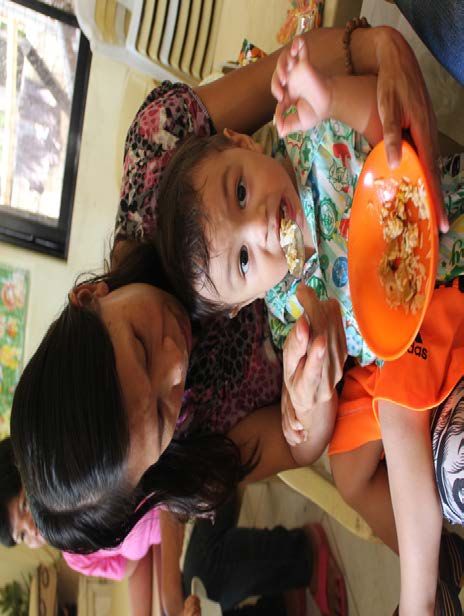
4. Instruct each group to let the invited mothers/caregivers feed the cooked food to
the children they have with them, and observe the children’s reactions. Make sure
that each child has his or her own clean eating utensils. Note that some mothers/
caregivers may be hesitant to give the cooked food to their children.
© UPLB
© UPLB
© UPLB
GUIDE TO CONDUCTING PARTICIPATORY COOKING DEMONSTRATIONS
42 TO IMPROVE COMPLEMENTARY FEEDING PRACTICESYou can also read


