ELECTRICITY DISTRIBUTION SERVICES 2021 PRICING METHODOLOGY - From 1 April 2020 Pursuant to: The Electricity Distribution Information Disclosure ...
←
→
Page content transcription
If your browser does not render page correctly, please read the page content below
ELECTRICITY DISTRIBUTION SERVICES
2021 PRICING METHODOLOGY
 From 1 April 2020

Pursuant to:
The Electricity Distribution Information Disclosure
Determination 2012 (Consolidated April 2018)

EXECUTIVE SUMMARY
Vector (“our”, “we”, or “us”) recovers the cost of owning and operating our electricity distribution networks (Network) through a combination of standard
(published) and non-standard prices for electricity distribution services, and capital contributions for new connections. We are regulated by the
Commerce Commission (Commission) and are required to publish our pricing methodology for electricity distribution services (Pricing Methodology).
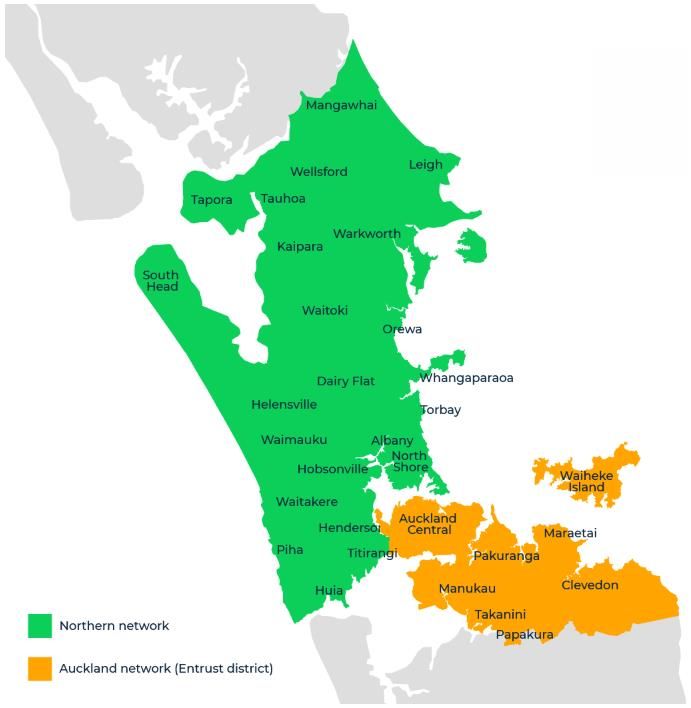
This document sets out our Pricing Methodology to meet the requirements of the Information Figure 1: Our electricity distribution networks
                                      1
Disclosure Determination 2012 (ID) . It explains the consumer groups, the price categories and
components within each consumer group, how prices are set and the Cost of Service Model (COSM)
                                                                                                                                  Networks
allocation of target revenue to consumer groups. The ID requires price change commentary relating
                                                                                                                                    in the
to the pricing strategy2, but we do not currently have a pricing strategy as defined in the ID. We do
                                                                                                                                   greater
however have a publicly available electricity pricing road map3 that sets out how we are evolving on
                                                                                                                                  Auckland
prices to enable and deliver better outcomes for consumers.
                                                                                                                                    region
        PY21 prices4 are derived from PY20 prices & change in net allowable revenue & change in pass-                             delivering
        through and recoverable costs & pass-through balance allowance5 & change in quantities                                    electricity
                                                                                                                                  to approx.
        When setting prices, historical price structures, minimising rate shock to consumers and                                   584,000
        minimising recovery risk are taken into account                                                                          homes and
                                                                                                                                 businesses
        Given network costs are largely fixed we typically apply any price increases to fixed
        components and price decreases to variable components

          The prices determined are checked to ensure they will not earn revenue “out of step” with
          target revenue for each consumer group

          Price setting is an iterative process, where the prices are only finalised once the price path
          compliance is managed, bill impacts are fair and tolerable and prices deliver revenue from
          each consumer group consistent with their target revenue allocation
1   Electricity Distribution Information Disclosure Determination 2012 (consolidated April 2018), available at https://comcom.govt.nz/regulated-industries/electricity-lines/information-
    disclosure-requirements-for-electricity-distributors/current-information-disclosure-requirements-for-electricity-distributors
2   A pricing strategy is a decision made by the Directors on the electricity distribution business’ plans or strategy to amend or develop prices in the future, and recorded in writing
3   Available at https://www.vector.co.nz/personal/electricity/about-our-network/pricing under the heading “customer-led pricing design”
4   Pricing year (PY) is the 12 month period from 1 April to 31 March each year. PY21 is 1 April 2020 to 31 March 2021
5   The pass-through balance allowance is an estimated wash-up of the under or over-recovery from PY20 of pass-through and recoverable costs. It is estimated as PY21 prices were set
    before the end of PY20                                                                                                                                                                  2
CONTENTS
Topic Chapter Page
Executive summary 2
Contents 3
1 - Consumer groups 4
Consumer groups, price categories and components 2 - Price categories 5
3 - Price components 6
4 - Pricing developments 7
5 - Mass market pricing reform 8
How prices are derived
6 - How mass market and unmetered prices are derived 9
7 - How commercial prices are derived 10
8 - Non-standard contracts & distributed generation policies 11
Policies and obligations
9 - Obligations and responsibilities to consumers 12
10 - Price setting 13
Impact of 2021 price changes
11 - Price changes 14
12 - Target revenue and its categorisation 15
13 - Cost drivers 16
Target revenue allocation 14 - Cost driver allocation approaches 17
15 - Target revenue allocation 18
16 - Price comparison 19
Line charge prices Appendix 1 - Line charge prices from 1 April 2020 20
Target revenue allocation Appendix 2 - Target revenue recovery 22
Pricing principles Appendix 3 - Pricing principles 23
Directors’ certification Appendix 4 - Directors’ certification 27
31 – CONSUMER GROUPS
Consumer groups are determined on how they use the network and the nature of the network service they receive. These consumer groups are
determined at a relatively high level, due to the physical nature of electricity distribution networks and the information that is available on consumer
demand characteristics, as outlined below:
➢ There is a high degree of network meshing and interconnection of consumers;
➢ End consumers are not generally geographically segmented in their use of different network assets, for example, there are very few purely
“industrial zones” or “residential zones”; and
➢ There is a mix of consumers, including a large number of consumers with relatively low individual consumption, and vice versa.
We have maintained the same five standard consumer groups as in the previous year, based on a measure of capacity connection and supply
connection point type as shown in Table 1.
Table 1: Consumer groups Consumers on non-standard contracts which have met
certain eligibility criteria, as outlined on page 11, are
Capacity included in a separate consumer group.
Consumer group and subgroup Supply connection
connection
➢ Residential Small ≤ Consumer groups are mutually exclusive so a consumer
Mass market Low voltage network
can only be in one group.
➢ General 69kVA
Unmetered ➢ General Tiny ≤ 1kVA Low voltage network The mass market consumer group is split into two
Low voltage ➢ Commercial
Large ≥
Low voltage network
subgroups: residential and general with a key difference
69kVA between the subgroups being that the Low User
Large ≥ Vector owned transformer(s) which supplies Regulations6 apply only to the residential subgroup.
Transformer ➢ Commercial
69kVA consumer’s Low Voltage network
The unmetered consumer group is also in the general
Large ≥ High voltage or sub-transmission (6.6kV or higher)
High voltage ➢ Commercial subgroup.
69kVA network
Non-standard Various Various The low voltage, transformer and high voltage consumer
groups are collectively referred to as commercial
consumers.
6 The Electricity (Low Fixed Charge Tariff Option for Domestic Consumers) Regulations 2004 (the Low User Regulations) require distributors to offer residential consumers a price
option at their primary place of residence with a fixed price of no more than $0.15 per day (excluding GST) and where the sum of the annual fixed and volume charges on that price
option is no greater than any other residential price option for consumers using up to 8,000 kWh per annum
42 – PRICE CATEGORIES
Table 2 sets out the price categories7 for consumers on our Auckland network (codes beginning with A) and our Northern network (beginning with W).
Table 2: Price categories from 1 April 2020
Consumer group Price category codes
Short description Key eligibility criteria / purpose
and subgroup Auckland Northern
Residential - time of use ARHL WRHL
Residential consumers without controllable load
(TOU) - uncontrolled ARHS WRHS
Residential
Residential - TOU - ARHLC WRHLC
Residential consumers with controllable load or reticulated gas connections
controlled ARHSC WRHSC
Residential - exemption - ARUL WRUL Residential consumers with a Vector provided exemption from TOU price categories, and without
Mass market uncontrolled ARUS WRUS controllable load or reticulated gas connections
Residential - exemption - ARCL WRCL Residential consumers with a Vector provided exemption from TOU price categories, and with
controlled ARCS WRCS controllable load or reticulated gas connections
General - TOU ABSH WBSH Non-residential < 69kVA consumers
General
General - exemption ABSN WBSN Non-residential < 69kVA consumers with a Vector provided exemption from TOU price categories
Unmetered General - unmetered ABSU WBSU Unmetered < 1kVA capacity connections, mostly street lighting
LV- TOU ALVT WLVH Main category for LV consumers, requires TOU metering
Low voltage (LV)
LV- non TOU ALVN WLVN For smaller LV consumers (< 345kVA) who may not have TOU metering
TX - TOU ATXT WTXH Main category for TX consumers, requires TOU metering
Transformer (TX)
TX - non TOU ATXN WTXN For smaller TX consumers (< 345kVA) who may not have TOU metering
HV - TOU AHVT WHVH Main category for HV consumers, requires TOU metering
High voltage (HV)
HV - non TOU AHVN WHVN For smaller HV consumers (< 345kVA) who may not have TOU metering
7 Price categories are the relevant price plan (or tariff) from the price schedule that define the line prices applicable to a particular ICP. An ICP is an installation control point being a
physical point of connection on a local network which a distributor nominates as the point at which a retailer will be deemed to supply electricity to a consumer
53 – PRICE COMPONENTS
We have a range of price components8 that apply to different price categories depending on the characteristics of a particular category and the
availability of metering data. Table 3 describes the various price components that we have. There are no changes from the previous year.
Table 3: Price components
Type Component Codes Units Description
Daily price applied to the number of days each consumer’s point of connection (or fitting for unmetered
Daily FIXD $/day
Fixed
connections) is energised
Capacity CAPY $/kVA/day9 Daily price applied to the installed capacity (or nominated capacity for AHVT and WHVH) of each consumer
Volume price, applies to all electricity distributed to each consumer. Controlled volume (AICO), uncontrolled volume
AICO, 24UC,
Volume $/kWh10 (24UC), off peak volume (OFPK), or peak volume (PEAK) (0700 to 1100 and 1700 to 2100 weekdays including public
OFPK, PEAK
holidays)
Daily price applied to the average of the consumer’s ten highest kVA demands between 8am and 8pm on weekdays
Demand DAMD $/kVA/day
each month
Variable
Excess Daily price applied when the anytime maximum demand is greater than the nominated capacity and is applied to
DEXA $/kVA/day
demand the difference between the anytime maximum kVA demand and the nominated capacity
Daily price determined each month where a consumer’s power factor is less than 0.95 lagging. The kVAr amount is
Power factor PWRF $/kVAr/day11 calculated as twice the largest difference between the recorded kVArh12 in any one half-hour period and the kWh
demand recorded in the same period divided by three
Injection INJT $/kWh Volume injection price applies to all electricity injected into the network by each consumer
8 Price components are the various prices that constitute the components of the total prices paid, or payable, by a consumer
9 kVA is kilovolt–ampere (amp), a measure of apparent power being the product of volts and amps. Used for the measurement of capacity and demand for pricing
10 kWh is kilowatt-hour, a unit of energy being the product of power in watts and time in hours. Used for the measurement of consumption for volumetric prices
11 kVAr is kilovolt ampere reactive, is a unit used to measure reactive power in an AC electric power system. Used for the measurement of power factor in pricing
12 kVArh is kilovolt ampere reactive hour, a unit of energy being the product of reactive power in kVAr and time in hours. Used for the measurement of power factor in pricing
64 – PRICING DEVELOPMENTS
The future is unpredictable. New business models are evolving in response to new consumer demands and new technologies. We have taken the
strategic decision to embrace these changes rather than resist them. We see this new environment as an opportunity to revise our pricing in response
to an evolving market. We do not believe economically-principled, efficient pricing should be an end goal in and of itself.
Our consumer insights show that some consumers are interested in adopting new technology to manage their usage and save money while others
prefer simplicity and convenience. Ultimately, we seek to implement pricing structures that meet consumer preferences, send the right signals and are
well understood by consumers. Therefore, we have decided to undertake a consumer-led review of pricing. This included consultations with consumers,
retailers, industry experts and obtaining consumers insights through application of detailed data analytics.
Successful pricing reform will not be just about economics. Careful consideration of the trade-off between the extent of cost-reflectivity and the
practical understanding of the price signal is paramount. Consideration is also needed of bill impacts resulting from moving to new pricing. This
transition needs to be careful managed especially in regard to vulnerable consumers.
To assess the potential impacts of new line charge pricing models on consumers, it is essential that distributors have access to half-hourly consumer
usage data at the ICP level. The current lack of access to this data is providing a barrier to the development and assessment of new pricing models.
Retailers need to ensure that our pricing is passed through to our consumers. Re-packaging our tariffs risks obscuring the price signal and in turn
preventing consumers from the potential benefits our pricing may afford.
It is worth highlighting that any substantial change to pricing structures creates challenges under the current regulatory framework in forecasting and
allocating volumes for the purpose of weighting and setting prices. The Low User Regulations have introduced inefficiencies and inequities as the
majority of distributors’ costs are fixed and hence could be more efficiently recovered via some form of fixed charge.
For further information on our future pricing developments, please see our electricity roadmap which is available at can be at
https://www.vector.co.nz/personal/electricity/about-our-network/pricing under the heading “consumer-led pricing design”. The roadmap is an evolving
document and will updated periodically, but at least twice a year.
75 - MASS MARKET PRICING REFORM
We have undertaken a thorough review of our mass market price structures with the intention of increasing the economic price signals; the primary
distribution investment driver is peak demand or capacity. Our commercial plans (low voltage, transformer and high voltage) already include demand
and capacity prices so no change to their pricing structure was considered at this point in time.
There are trade-offs between competing goals when considering pricing structures such as service base/cost reflectivity, simplicity/acceptability and bill
impact. These are underpinned by regulatory requirements, including the Low User Fixed Charge Regulations and Electricity Authority’s Pricing
Principles, economic theory, practical implementation aspects, regulatory and public perceptions, consumer effects and expectations and revenue risk
implications.
Five pricing structures were considered for our mass market price categories for PY21: existing pricing, two-part TOU, dynamic volumetric, demand
based and fixed. These pricing structures were assessed against the objectives and upon balancing a range of trade-offs, TOU is the best overall
candidate for a standard price structure for now. TOU offers consumers the ability to reduce their electricity bill by shifting some electricity use from
peak to off-peak times as well as encouraging take-up of new technology.
Table 4: Price category mapping for mass market consumers
Mass market TOU plans were in place prior to 1 April
2020, but from 1 April 2020 we have made them From 1 April 2020
Consumer Prior to 1 April 2020 From 1 April 2020 TOU
mandatory, with only exemptions available for group exemption
retailers and consumer meters that are currently Price category description and code(s)
incapable of reconciling on these plans. There are Uncontrolled ARUL, WRUL ARHL, ARUL,
Residential -
now two time of use options, the existing TOU which Uncontrolled Uncontrolled
WRHL WRUL
low user
is now an ‘uncontrolled’ plan and a new ‘controlled’ Half hourly13 ARHL, WRHL
plan. The previous ‘gas’ plans have been merged
ARHLC, ARCL,
with the ‘controlled’ plans, which had the same Controlled ARCL, WRCL Controlled Controlled
WRHLC WRCL
Mass market
prices, as shown in the mapping table for mass Gas ARGL, WRGL
market consumers. Uncontrolled ARUS, WRUS ARHS, ARUS,
Residential -
13 For ICPs currently on residential half hourly price categories, Uncontrolled Uncontrolled
WRHS WRUS
standard
they would migrate to the uncontrolled price categories
Half hourly13 ARHS, WRHS
unless they meet one of the following criteria, then they
would migrate to controlled price categories: ARHSC, ARCS,
Controlled ARCS, WRCS Controlled Controlled
- Consumer has an electrical hot water cylinder connected WRHSC WRCS
to our load control system; or Gas ARGS, WRGS
- Consumer has an active connection to our gas distribution Half hourly ABSH, WBSH ABSH, ABSN,
network. General General General
General ABSN, WBSN WBSH WBSN 86 – HOW MASS MARKET AND UNMETERED PRICES ARE DERIVED
From 1 April 2020, our mass market price categories are split into two pricing structures;
➢ two-part time of use - daily fixed price with different volumetric prices depending on the time period when the electricity is used (that has peak
time pricing during 7am-11am and 5pm-9pm weekdays and off-peak pricing during other times), and
➢ flat volumetric pricing - daily fixed price and any anytime volumetric price, available only as an exemption to TOU of consumption information.
Our residential price categories include both controlled and uncontrolled price categories, with the controlled price categories designed to reward
residential consumers for the benefit these households deliver to us in helping to reduce load during peak periods, via electrical hot water load control
system or gas connections which typically use less electricity during peak periods.
Our residential prices are subject to the Low User Regulations, and we comply with these regulations by offering low user price categories for
residential consumers at their primary place of residence with a fixed price of $0.15 per day and volume prices that ensure that consumers who use
8,000 kWh per year or less are better off on the low fixed price categories.
We have a two-part charge for unmetered price categories with fixed and volumetric prices. The fixed price is the number of days each point of
connection of fitting is energised. Unmetered consumers’ volumes are determined by us based on load profiles and fitting input wattages.
Table 5 shows the price components applicable to the price categories for the mass market and unmetered consumer groups. The price components
for mass market and unmetered are the same as the previous year.
Table 5: Price components applicable to mass market and unmetered price categories from 1 April 2020
Volume
Price category code Daily
Consumer group and anytime off-peak peak injection
Price category description
subgroup -FIXD -24UC -AICO -OFPK -PEAK -INJT
Auckland Northern
$/day $/day/fitting $/kWh
TOU - uncontrolled ARHL, ARHS WRHL, WRHS ✓ ✓ ✓ ✓
General Residential
TOU - controlled ARHLC, ARHSC WRHLC, WRHSC ✓ ✓ ✓ ✓
Exemption - uncontrolled ARUL, ARUS WRUL, WRUS ✓ ✓ ✓
Mass market
Exemption - controlled ARCL, ARCS WRCL, WRCS ✓ ✓ ✓
TOU ABSH WBSH ✓ ✓ ✓ ✓
Exemption ABSN WBSN ✓ ✓ ✓
Unmetered Unmetered ABSU WBSU ✓ ✓ ✓
97 – HOW COMMERCIAL PRICES ARE DERIVED
Our price structure for commercial price categories is largely historical. There were (and, to a lesser extent, still are) a variety of price categories with
different combinations of price components and price levels, due largely to pricing differences that existed prior to both networks being owned by
us which have not been fully aligned yet due to the resulting bill shock.
Current TOU price categories on the Auckland network consist of volume, capacity, demand, power factor, and (in the case of AHVT) excess
demand prices. On the Northern network TOU plans also include a daily fixed price. Non-TOU plans on both networks include daily fixed, volume,
capacity and power factor prices.
We maintain a relativity in price levels between low voltage, transformer and high voltage price categories. Except for power factor prices, high
voltage price levels are 97% of transformer price levels which are, in turn, 98% of low voltage price levels. This approach reflects the relative costs of
serving these consumer groups.
Table 6 shows the price components applicable to the price categories for the commercial consumer groups, there is no change from the previous
year.
Table 6: Price components applicable to commercial price categories
Volume - Excess Volume -
Daily Capacity Demand Power factor
Consumer Price category Price category anytime demand injection
group description codes -FIXD -24UC -CAPY -DAMD -DEXA -PWRF -INJT
$/day $/kWh $/kVA/day $/kVAr /day $/kWh
ALVT ✓ ✓ ✓ ✓ ✓
TOU
Low voltage WLVH ✓ ✓ ✓ ✓ ✓ ✓
Non TOU ALVN, WLVN ✓ ✓ ✓ ✓ ✓
ATXT ✓ ✓ ✓ ✓ ✓
TOU
Transformer WTXH ✓ ✓ ✓ ✓ ✓ ✓
Non TOU ATXN, WTXN ✓ ✓ ✓ ✓ ✓
AHVT ✓ ✓ ✓ ✓ ✓ ✓
TOU
High voltage WHVH ✓ ✓ ✓ ✓ ✓ ✓ ✓
Non TOU AHVN, WHVN ✓ ✓ ✓ ✓ ✓
108 – NON-STANDARD CONTRACTS & DISTRIBUTED GENERATION POLICIES
Table 7: Criteria for non-standard contracts
Approach Description
Criteria For any new investments required by consumers, we apply our capital contributions policy. Our policy for determining capital contributions on our
electricity distribution network is available at http://vector.co.nz/disclosures/electricity/capital-contributions. When a new investment is recovered through
capital contributions, standard pricing applies.
Historical investments required by consumers and not recovered through capital contributions may be subject to non-standard contracts allowing for
non-standard prices and tailored commercial arrangements to be applied to individual consumers.
Methodology For determining prices for consumers subject to non-standard contracts, we use actual costs and/or allocated costs derived from an allocation model to
determine prices. This allocation model is similar to the Cost of Service Model (COSM) used in assessing standard pricing.
Approach to pricing distributed generation
Our policies and procedures for installation and connection of distributed generation are in accordance with the requirements of Part 6 (Connection of
distributed generation) of the Electricity Industry Participation Code 2010 (the Code).
We charge each distributed generator14 prior to them connecting to the network based on the fees set out in Part 6 of the Code. We do not charge for
connections smaller than 10 kW.15
We do not make Avoided Cost of Distribution payments to any distributed generators. We make Avoided Cost of Transmission (ACOT) payments to
distributed generators in accordance with our ACOT methodology.
To date given the small number of distributed generation consumers, we have not identified any short run incremental costs from injection of energy
into the network so this price continues to be $0.0000/kWh from 1 April 2020 for all distributed generators. As more distributed generation connects this
may require more in-depth consideration and as a result pricing may change.
Further information on our policies for distributed generation can be found at https://www.vector.co.nz/personal/solar/connecting-your-generation-to-
our-network.
14 Distributed generator is a party with whom we have an agreement for the connection of plant or equipment to our electricity distribution network where the plant or equipment
is capable of injecting electricity into our distribution network
15 kW is kilowatt, a measure of electrical power. Also used for the measurement of demand during peak periods for the allocation of transmission charges from Transpower
119 – OBLIGATIONS AND RESPONSIBILITIES TO CONSUMERS
For PY21, our obligations and responsibilities to consumers in the event that the supply of electricity lines services to them is interrupted have no
implications for determining prices.
A summary of our obligations and responsibilities to consumers subject to non-standard contracts on our network (in the event that the supply of
electricity lines services to the consumer is interrupted) is provided in Table 8. Our standard contract terms and non-contract terms are also
compared.
Table 8: Summary of our obligations and responsibilities to consumers
No. of interruptions No. of
Planned interruption notice Unplanned interruption notice Fault restoration
per annum consumers
CBD/Industrial: 2 hours
Standard
As soon as practicable but no later than: Urban: 4 Approx.
4 days - 20 mins during staffed control room hours, Urban: 2.5 hours
584,000
- 40 mins during on-call control room hours
Rural: 4.5 hours Rural: 10
Same as standard consumers 1
1 April each year, or 10 working days As soon as practicable 2 hours 1 unplanned 1
1 June each year As soon as practicable As soon as practicable Not stated 2
1 November each year As soon as practicable Priority Not stated 6
Non-standard
10 working days As soon as practicable 3 hours Not stated 7
10 working days Not stated 3 hours Not stated 2
10 working days Not stated Not stated Not stated 2
30 working days As soon as practicable As soon as practicable Not stated 1
4 working days As soon as practicable 3 hours Not stated 5
7 working days As soon as practicable Priority 3 planned 2
August each year Not stated 1 hour Not stated 2
1210 – PRICE SETTING
Our prices are subject to the Electricity Distribution Services Default
Price-Quality Path Determination 2020 (DPP)16 which states that
our Forecast Revenue from Prices (FRFP) must not exceed Forecast FRFP ≤ FNAR + FPRC + OWAB + PTBA
Allowable Revenue (FAR).
FAR equals the Forecast Net Allowable Revenue (FNAR) plus
Forecast Pass-through and Recoverable Costs (FPRC) (e.g.
transmission costs, council rates and statutory levies) plus Opening
Wash-up Account Balance (OWAB, any under/over recovery from
the previous periods during the current regulatory period) plus
Pass-Through Balance Allowance (PTBA, any under/over recovery
from the previous regulatory period). The DPP sets our Forecast Net
Allowable Revenue (FNAR) that can be earned from prices for every
pricing year in the five year DPP regulatory period.
PY21 prices are derived from PY20 prices & ∆ net allowable
revenue & ∆ pass-through and recoverable costs & pass-
through balance allowance & ∆ quantities
From 1 April 2020 (the first year of the regulatory period), our
electricity line charge prices are decreasing by a weighted average
9.5% with a breakdown shown in Figure 3. This decrease is primarily
due to:
➢ lower net allowable revenue from the DPP;
➢ a reduction in forecast transmission charges; and
➢ forecast pass-through balance from PY20 carried forward
16 Available at https://comcom.govt.nz/regulated-industries/electricity-lines/
electricity-lines-price-quality-paths/electricity-lines-default-price-quality-path/
2020-2025-default-price-quality-path
1311 – PRICE CHANGES
We are conscious of the effect of price changes for consumers. Our starting point for calculating prices is the corresponding price from the previous year.
Figure 4 shows how the weighted average price decrease of 9.5% is split across the consumer groups and price component type. Our electricity prices
that apply from 1 April 2020, including the previous year’s prices that were effective from 1 April 2019, are set out in Appendix 1.17
When setting prices, historical price structures, minimising rate shock to For mass market consumers, this is achieved by keeping fixed daily
consumers, and minimising recovery risk are taken into account prices unchanged and reducing the variable volumetric prices.18
For unmetered consumers, both the fixed daily and variable
Figure 4: Weighted average price change by consumer group volumetric prices were significant reduced, but volumetric prices to
Mass market Unmetered Low voltage Transformer High voltage Non-standard Total a greater extent to increase the fixed proportional share.
0%
For commercial consumers, this is achieved by predominantly
-2.5%
-10% keeping fixed daily and capacity prices unchanged (there are some
-9.1% -9.7% -8.5% -8.9% -9.5% low voltage daily price reductions to obtain price level relativity).
-20% Different level of reductions across the variable volumetric and
demand prices to allow for similar overall price changes between
-30% the TOU and non TOU commercial price categories. Power factor
Changes to individual prices will vary from weighted remains unchanged, consistent with previous years approaches.
-40% average price changes. This is due to differences in
individual consumption levels The decision to primarily decrease the variable prices reflects the
-50% fact that the majority of our costs are fixed and sunk, so implicitly
-52.0% Fixed Variable Total increasing the fixed portion of revenues aligns the recovery of
-60%
revenues with the way costs are incurred.
-70% We did not directly seek the views of consumers when setting
prices. Rather, we consulted with Entrust, which represents mass
Given network costs are largely fixed we typically apply any price market consumers on the Auckland network, and retailers on behalf
increases to fixed components and price decreases to variable of consumers on the proposed price changes. We have considered
components and largely accommodated their views in our final prices.
17 Our full price schedules are available at https://www.vector.co.nz/personal/electricity/about-our-network/pricing and https://www.vector.co.nz/business/electricity/about-our-
network/ pricing
18 There is a slight reduction in the mass market weighted average fixed price due to an assumed shift from standard to low user price categories, this reduces the weighted average
price but there are no changes to the actual fixed prices 1412 – TARGET REVENUE AND ITS CATEGORISATION
Our COSM is used to allocate target revenue to consumer groups using Figure 5: COSM structure
various cost drivers. The model structure is outlined in Figure 5.
Cost inputs Allocator inputs by consumer group
Target revenue is the total revenue we expect to recover from our prices
target revenue ICPs kWh kW @RCPD
(complying with the regulated price path) and our forecasted quantities.
The total target revenue for PY21 is $565m ($624m for PY20).
Calculations
The total target revenue is broken down into the key components required
allocate target revenue to
to cover the costs and return on investment associated with the provision cost drivers
consumer group using allocators
of electricity distribution services as shown in Figure 6. These key
components are categorised by cost driver i.e. either ‘asset’, ‘non-asset’,
Outputs Comparison
‘transmission’ or ‘profit’. These categorisations determine the way that the
target revenue is allocated to consumer groups. target revenue range by target revenue from
consumer group prices and COSM
Figure 6: Target revenue by key components
$250
$208 PY20 PY21
$200 $180
Forecast value ($m)
$150
$110 $109 $105 $104
$100
$60 $57 $51 $44 $49
$50 $37
$10 $11 $11 $20 $16
$8 $5 $7
-$3 -$10
$0
Asset Asset Non-asset Non-asset Asset Non-asset Asset Transmission Non-asset Non-asset Profit
-$50 Maintenance Direct costs Indirect costs Allocated costs Depreciation Depreciation Regulatory tax Transmission Other pass- Pass-through Return on
costs through costs balance capital
allowance
Key component and driver
1513 – COST DRIVERS
As indicated in Figure 6 on the previous page, the key components of target
Figure 7: Target revenue by cost driver
revenue are categorises by cost driver, which are summarised in Figure 7.
The key components categorised as ‘asset costs’ are those associated with
expenditure and return on the electricity distribution network assets. We PY21 $213 $69 $179 $104 $565
have grouped these network assets into three distinct categories as shown in
Table 9.
We assume that costs associated with assets are incurred in proportion to the PY20 $227 $84 $208 $105 $624
value of the assets. For example, as Category A assets make up 71% of the
asset value of our Regulatory Asset Base (RAB)19, we assume that 71% of
maintenance costs will be associated with Category A assets. each consumer $0 $100 $200 $300 $400 $500 $600 $700
group’s utilisation of network assets. Asset Non-asset Transmission Profit Forecast value ($m)
Table 9: Asset categorisation
Asset Consumer Asset value 20 A key feature of an electricity distribution network is
Assets interconnected assets. Many consumers on the network
category groups (RAB)
• Sub-transmission lines / cables
share assets and it is difficult to identify precisely who
A • Zone-substations All $2,075m 71%
benefits from which assets. While this means that the
• HV lines / cables
allocation of target revenue between consumers or groups
of consumers can be made in many ways, it also means that
• Distribution substations that have no Vector-
the cost of providing the network is shared widely and
B owned low voltage lines / cables leaving the Transformer $58m 2%
therefore the cost of network services is generally low for
substation
each consumer.
• Distribution substations that:
o have Vector-owned low voltage lines
Low voltage,
leaving the substation, or
C unmetered, $797m 27%
o supply multiple end-consumers
mass market
connected at low voltage
• Low voltage assets
19 The regulatory asset base represents the amount that we have invested in our regulated network, indexed to inflation and adjusted for depreciation
20 The values are weighted averages of the last five years’ worth of data, with each year being weighted twice the previous year
1614 – COST DRIVER ALLOCATION APPROACHES
The cost drivers of ‘Asset’, ‘Non-Asset’, ‘Transmission’ and ‘Profit’ are applied to the combined Northern and Auckland networks. Our COSM allocates the
recovery of the $565m to consumer groups using various cost drivers as summarised in Table 10. We aim to allocate asset-related costs on the basis of a
consumer group’s usage of the assets during peak periods, as this usage drives the need for, and the size of, the assets.
Table 10: Cost drivers used in the COSM
Consumer Asset For Category A assets, an appropriate and readily
Non-asset Transmission Profit available measure to allocate their costs, is consumer
group A B C
group’s contribution to Transpower’s Regional Coincident
Amount $151m $4m $58m $69m $179m $104m Peak Demand (RCPD)22 periods.
Mass market Contribution to For Category B assets, the costs do not require an
RCPD allocation approach as they are used by one consumer
Number of
Unmetered n/a or consumers
group (transformer consumers).
annual Rate of
Contribution or Contribution For Category C assets, that are assets located close to the
Low voltage consumption return on
end consumer, appropriate readily-available allocators
to RCPD annual to RCPD
assets are contribution to RCPD and annual consumption. We
consumption
Transformer Direct use both allocators to generate a band of cost allocation
n/a values as no one allocator is preferred to the other.
High voltage n/a
‘Non-asset costs’ can be broadly summarised as overhead costs and pass-through and recoverable costs (other than transmission costs). Costs
categorised as ‘Non-asset’ have no direct cost driver. We have chosen to create a band of cost allocations using annual consumption and the number
of consumers as the allocators.
21 Grid exit point (GXP) is a point of connection between Transpower’s transmission system and the distributor’s network
22 RCPD for a Transmission Region is the sum of the offtake measured in kW in that Region during Regional Coincident Peak Demand Periods, as determined by Transpower each
year. Where a Transmission Region is one of the four regional groups of connection locations (as defined in Transpower’s Transmission Pricing Methodology), Upper North Island,
Lower North Island, Upper South Island, and Lower South Island; and Regional Coincident Peak Demand Period means for the Upper North Island a half hour in which any of the
100 highest regional demands (measured in kW) occurs during 1 September to 30 August immediately prior to the start of the Pricing Year
1715 – TARGET REVENUE ALLOCATION
Costs categorised as ‘Transmission’ are transmission charges from Transpower that we pass through to consumers. Transmission interconnection costs
(which form the majority of transmission charges) are charged to us by Transpower on the basis of demand during RCPD periods. We mirror this
approach by allocating transmission costs to each consumer group on the basis of that consumer group’s demand during these RCPD periods.
‘Profit’ is the return on capital and is broadly generated through the usage of Vector’s assets. A consumer groups’ asset values are calculated in the
same way as ‘Asset’ related costs are, as outlined in the previous page. ‘Profit’ is allocated using a constant rate of return across the consumer groups’
asset values. each consumer group’s utilisation of network assets.
Table 11: Value of allocators23 and target revenue allocation range
Annual Contribution to
Consumer group No. of consumers Target revenue ($m)
consumption RCPD
Unit ICPs GWh MW Lower Upper
Mass market 550,502 98.5% 4,576 54% 1,143 69% 387.8 421.3
Unmetered 2,322 0.4% 53 1% 13 1% 4.2 4.5
Low voltage 4,646 0.8% 1,030 12% 151 9% 47.1 61.3
Transformer 1,463 0.3% 1,563 19% 209 13% 55.3 69.4
High voltage 165 0.0% 578 7% 75 5% 18.3 23.4
Non-standard 31 0.0% 638 8% 70 4% 18.9 18.9
Total 559,129 8,438 1,661
The result of using the different allocators for category C ‘asset costs’ and ‘non-asset costs’ creates a target revenue range by consumer group as the
use of different allocators gives rise to different target revenue allocation results. The bands represent the lower and upper bounds of the different
allocation approaches, as shown in two right hand columns of Table 11.
The pricing for non-standard consumers is calculated as per their contracts and is separate from the other consumer groups. The COSM is calibrated
to produce the forecasted target revenue of $18.9m (3.3%) to be recovered from the 31 non-standard consumers.
23 Weighted average of last five year’s values from the billed quantities in Schedule 8 of our annual Electricity Information Disclosures (available at https://www.vector.co.nz/about-
us/regulatory/ disclosures-electricity/financial-and-network-information), with each year being weighted twice the previous year
1816 – PRICE COMPARISON
Figure 8 shows target revenue calculated from Figure 8: PY21 target revenue from prices compared with COSM allocations
PY21 prices by consumer group compared with
Non-standard
the COSM allocation. The result is that PY21 prices The green bands are the target
produce forecast revenues that are in an COSM Range
High Voltage revenue range for each consumer
acceptable range when compared to target group based on our COSM allocations Target revenue
revenue allocations. Transformer
Low Voltage
The blue markers represent the target
The prices determined are checked to revenues from PY21 prices
Unmetered
ensure they will not earn revenue “out of
step” with target revenue for each Mass Market
consumer group
- 50 100 150 200 250 300 350 400 450
The proportion of the aggregated price Target revenue ($m)
categories’ target revenue is shown by price Table 12: Value of allocators and target revenue allocation range
component in Table 12. All price categories within
the aggregation have similar proportioned price Consumer Fixed prices Variable prices
components. Please see Appendix 2 for the Description
group Daily Capacity Volume Demand24 Power factor
proportion of target revenue split by individual
Residential - low user 12% - 88% - -
price category and price component.
Mass Market Residential - standard user 45% - 55% - -
General 28% - 72% - -
Price setting is an iterative process, Unmetered Unmetered 73% - 27% - -
where the prices are only finalised once
the price path compliance is managed, Auckland - TOU - 19% 27% 51% 3%
Low Voltage,
bill impacts are fair and tolerable and Northern - TOU 9% 17% 14% 57% 3%
Transformer
prices deliver revenue from each
consumer group consistent with their & High Auckland - non TOU 7% 26% 66% - 1%
target revenue allocation Voltage
Northern - non TOU 22% 20% 56% - 2%
24 Includes demand and excess demand price components
19APPENDIX 1 - LINE CHARGE PRICES FROM 1 APRIL 2020
Table 9: Mass market and unmetered line charges prices Transmission
Total line charge prices
(previous price, if changing) charge price*
Daily Volume Volume
Estimated off- anytime or
Price Price Price anytime peak injection
Consumer group number of peak peak
category category category
and subgroup consumers $/day $/day/fitting $/kWh $/kWh $/kWh $/kWh $/kWh $/kWh
type description codes
(PY21 avg.)
-24UC, -AICO
-FIXD -FIXD -24UC -AICO -OFPK -PEAK -INJT
or -PEAK
ARHL 25,623 0.0621 0.1542* 0.0921
Uncontrolled 0.15 -
WRHL 13,849 (0.0644) (0.1551)* (0.0877)
TOU
Residential
- low user
ARHLC 127,913 0.15 0.0621 0.1354* 0.0733
Controlled -
WRHLC 82,839 (new) (new) (new) (new)
ARUL 5,980 0.0925* 0.0369
Uncontrolled 0.15 -
WRUL 3,111 (0.1000)* (0.0344)
Exemption
ARCL 32,931 0.0863* 0.0307
Controlled 0.15 -
WRCL 21,465 (0.0928)* (0.0274)
ARHS 13,407 0.0229 0.1150* 0.0921
Uncontrolled 1.01 -
WRHS 13,270 (0.0252) (0.1159)* (0.0877)
Mass market TOU
Residential
- standard
ARHSC 76,205 1.01 0.0229 0.0962* 0.0733
Controlled -
WRHSC 60,411 (new) (new) (new) (new)
ARUS 3,176 0.0533* 0.0369
Uncontrolled 1.01 -
WRUS 3,108 (0.0608)* (0.0344)
Exemption
ARCS 18,099 0.0471* 0.0307
Controlled 1.01 -
WRCS 14,348 (0.0536)* (0.0274)
ABSH 29,354 0.0229 0.1150* 0.0921
TOU 1.01 -
WBSH 17,941 (0.0252) (0.1159)* (0.0877)
General
ABSN 7,264 0.0533* 0.0369
Exemption 1.01 -
WBSN 4,441 (0.0608)* (0.0344)
ABSU 1,746 0.08 0.0257* 0.0260
Unmetered Unmetered -
WBSU 629 (0.15) (0.0680)* (0.0344)
* The transmission charge price is only included in this component of the line charge price 20APPENDIX 1 - LINE CHARGE PRICES FROM 1 APRIL 2020
Table 10: Commercial line charge prices Transmission
Total line charge prices
(previous price, if changing) charge price*
Volume Excess Power Volume Volume anytime
Estimated Daily Capacity Demand
Price Price anytime demand factor injection or Demand
Consumer number of
category category
group consumers $/day $/kVA/day $/kWh $/kVA/day $/kVA/day $/kVAr/day $/kWh $/kWh or $/kVA/day
description code
(PY21 avg.)
-FIXD -CAPY -24UC -DAMD -DEXA -PWRF -INJT -24UC or -DAMD
1.78 0.0541* 0.0187
ALVN 2,232 0.0421 0.2917 -
(1.79) (0.0632)* (0.0212)
Non TOU
5.74 0.0335* 0.0187
WLVN 901 0.0339 0.2917 -
(6.26) (0.0430)* (0.0212)
Low voltage
0.0120 0.2917* 0.1900
ALVT 1,479 0.0421 0.2917 -
(0.0139) (0.3205)* (0.2208)
TOU
10.82 0.0050 0.2628* 0.1900
WLVH 260 0.0339 0.2917 -
(11.79) (0.0059) (0.2908)* (0.2208)
0.0530* 0.0187
ATXN 165 1.74 0.0412 0.2917 -
(0.0619)* (0.0212)
Non TOU
0.0328* 0.0187
WTXN 132 5.63 0.0332 0.2917 -
(0.0383)* (0.0212)
Transformer
0.0117 0.2858* 0.1900
ATXT 937 0.0412 0.2917 -
(0.0137) (0.3132)* (0.2208)
TOU
0.0049 0.2575* 0.1900
WTXH 288 10.61 0.0332 0.2917 -
(0.0058) (0.2842)* (0.2208)
0.0514* 0.0187
AHVN 8 1.68 0.0399 0.2917 -
(0.0599)* (0.0212)
Non TOU
0.0318* 0.0187
WHVN 0 5.46 0.0322 0.2917 -
(0.0371)* (0.0212)
High voltage
0.0113 0.2772* 0.1900
AHVT 143 0.0399 0.8778 0.2917 -
(0.0132) (0.3024)* (0.2208)
TOU
0.0048 0.2498* 0.1900
WHVH 24 10.30 0.0322 0.7084 0.2917 -
(0.0056) (0.2745)* (0.2208)
* The transmission charge price is only included in this component of the line charge price 21APPENDIX 2 –TARGET REVENUE RECOVERY
Table 13: Proportion of mass market target revenue by price component
Code Fixed Variable Code Fixed Variable
Consumer group and subgroup Price category description
Auckland Daily Volumetric Northern Daily Volumetric
TOU - uncontrolled ARHL 0.25% 1.92% WRHL 0.13% 1.11%
Residential - TOU - controlled ARHLC 1.24% 8.97% WRHLC 0.80% 6.20%
low user Exemption - uncontrolled ARUL 0.06% 0.36% WRUL 0.03% 0.23%
Exemption - controlled ARCL 0.32% 2.50% WRCL 0.21% 1.60%
TOU - uncontrolled ARHS 0.87% 1.19% WRHS 0.87% 1.21%
Mass market
Residential - TOU - controlled ARHSC 4.97% 6.01% WRHSC 3.94% 4.88%
standard user Exemption - uncontrolled ARUS 0.21% 0.21% WRUS 0.20% 0.21%
Exemption - controlled ARCS 1.18% 1.41% WRCS 0.94% 1.07%
TOU ABSH 1.91% 5.17% WBSH 1.17% 2.81%
General Exemption ABSN 0.47% 1.35% WBSN 0.29% 0.73%
Unmetered Unmetered ABSU 0.36% 0.13% WBSU 0.22% 0.09%
Table 14: Proportion of commercial target revenue by price component
Consumer Short Category Fixed Variable Category Fixed Variable
Power Power
group description Auckland Daily Capacity Volumetric Demand Northern Daily Capacity Volumetric Demand
factor factor
TOU ALVT - 1.02% 1.19% 2.44% 0.21% WLVH 0.18% 0.14% 0.12% 0.48% 0.03%
Low voltage
Non TOU ALVN 0.26% 0.90% 2.29% - 0.02% WLVN 0.33% 0.29% 0.75% - 0.02%
TOU ATXT - 1.76% 2.41% 4.60% 0.22% WTXH 0.20% 0.47% 0.33% 1.45% 0.08%
Transformer
Non TOU ATXN 0.02% 0.10% 0.21% - 0.00% WTXN 0.05% 0.07% 0.23% - 0.01%
TOU AHVT - 0.43% 0.92% 1.70% 0.07% WHVH 0.02% 0.09% 0.12% 0.45% 0.01%
High voltage
Non TOU AHVN 0.00% 0.00% 0.01% - 0.00% WHVN - - - - -
22APPENDIX 3 – CONSISTENCY WITH PRICING PRINCIPLES The Electricity Authority’s Pricing Principles25 (Pricing Principles) and Distribution Pricing Practice Note26 (Practice Note) provide guidance to developing pricing methodologies for electricity distribution services. Table 15 demonstrates the extent to which the Pricing Methodology is consistent with the Pricing Principles and Practice Note. Table 15: Pricing principles Principle (a): Economic costs of service provision Prices are to signal the economic costs of service provision, including by: i. being subsidy free (equal to or greater than avoidable costs and less than or equal to standalone costs); ii. reflecting the impacts of network use on economic costs; iii. reflecting differences in network service provided to (or by) consumers; and, iv. encouraging efficient network alternatives. The avoidable cost test can be applied both for individual consumers and for groups of consumers. The avoidable cost for an individual consumer is the cost of connecting that consumer to the network, and therefore excludes the cost of shared assets. The avoidable cost for a group of consumers is the cost of connecting that group of consumers to the network, and includes the cost of assets shared by that group. Our capital contributions policy ensures that individual consumers generally pay the costs of connecting to the network. Applying the avoidable cost test at a group level is more stringent because it includes shared costs for the group. Revenues for the group must be higher than just the sum of the avoidable cost for each individual consumer. While we monitor the cost of a range of alternative options for consumers, it can be difficult to apply these on a consumer-specific basis. In some instances, the economic value of the service, including where that is set by the cost of an alternative form of supply, may be notified to us by the consumer. In these situations, this pricing principle is delivered through the operation of pricing principle (c), detailed below. The electricity distribution system consists of assets with significant capacity. When building the system, economies of scale exist such that the cost of installing an asset larger than that which is immediately required does not add significantly to the cost of network build. As a consequence, some parts of the distribution system have spare capacity. In most cases, due to the availability of spare capacity, the short run cost of the next unit of capacity is significantly less than the average cost. 25 Available at https://www.ea.govt.nz/development/work-programme/pricing-cost-allocation/distribution-pricing-review/development/summary-of-submissions-and-decision-paper/ 26 Available at https://www.ea.govt.nz/development/work-programme/pricing-cost-allocation/distribution-pricing-review/development/distribution-pricing-practice-note-and-scorecards/ 23
APPENDIX 3 – CONSISTENCY WITH PRICING PRINCIPLES

Principle (a): Economic costs of service provision (cont.)

Some areas of our network have high utilisation and the system
                                                                                                     Figure 9: Forecast capital expenditure to meet future demand
requires expansion (for example, to connect a new user to the
                                                                                              $140
distribution system). We generally fund this expansion through

                                                                                   Millions
                                                                                                                                                             Consumer connection
capital contributions and/or non-standard prices which ensure                                 $120
recovery of the incremental capital investment. Our approach                                                                                                 System growth
                                                                                              $100
to recovering these costs is outlined in our electricity
distribution capital contribution policy.                                                     $80

                                                                                              $60
Figure 9 shows our forecast capital expenditure excluding
capital contributions to meet future demand from our 2019                                     $40
Asset Management Plan27. Consumer connections allow for the
                                                                                              $20
costs of connecting new consumers and reticulating new
subdivisions, while system growth relates to expansion of the                                  $0
                                                                                                     FY20   FY21   FY22   FY23   FY24   FY25   FY26   FY27       FY28        FY29
network to provide the capacity to meet the electricity needs of
all connections.
Our target revenue allocation illustrates how we utilise relevant cost drivers. We translate these into prices taking account of the materiality of the
costs, our ability to estimate and signal the costs as well as the ability of participants to respond. We also consider important consumer aspects such
as predictability, bill stability and equity.

We signal the level of available capacity and future investment costs over different time periods using time of use prices and controlled load prices.
Prices for commercial consumers are structured in a very service reflective manner, utilising a variety of prices (daily, capacity, demand, volumetric,
power factor) while our mass market prices are two part time of use, reflecting that peak usage is a general driver of investment over time. We offer
controlled load prices to residential end consumers in return for the ability to remotely manage their hot water cylinders. This pricing approach
signals the benefits to consumers of allowing us to control their hot water load and manage network congestion during peak periods through lower
price options. These pricing options provide incentives to end consumers to shift demand away from peak periods and therefore reduce the need
for future investment costs.
27   Available at https://www.vector.co.nz/about-us/regulatory/disclosures-electricity/asset-management-plan

                                                                                                                                                                                    24
APPENDIX 3 – CONSISTENCY WITH PRICING PRINCIPLES
Principle (b): Recovery of any shortfall
Where prices that signal economic costs would under-recover target revenues, the shortfall should be made up by prices that least distort network
use.
Pricing based on avoidable costs would almost certainly under-recover allowed revenues as the majority of our costs are fixed, so do not vary with
the next unit of consumption. Our fixed costs are generally also sunk, so do not reduce if consumption reduces. Accordingly, the Pricing
Methodology attempts to recover allowed target revenues in a manner that is as least distortionary as possible to investment decisions. As we have
limited information of demand responsiveness by consumer group, we allocate the shortfall across all consumer groups.
Principle (c): Responsive to requirements of consumers
Prices should be responsive to the requirements and circumstances of end users by allowing negotiation to:
i. reflect the economic value of services;
ii. enable price/quality trade-offs.
We offer non-standard pricing in certain circumstances including where standard pricing would cause uneconomic bypass of the network.
Non-standard contractual arrangements are also able to address changes to the structure or level of prices (e.g. for atypical load patterns, or to
address particular by-pass or fuel substitute situations), and differing service levels (e.g. a higher level of redundancy, or priority response if an outage
occurs). The Pricing Methodology obliges us to take account of the issues described above when considering the design of a non-standard contract.
The Pricing Methodology does not provide specific incentives for investment in transmission and distribution alternatives. Where the connection of
new load requires investment in the network (e.g. new subdivisions) then the cost of that investment is recovered via capital contributions and/or
non-standard prices. Those prices provide the economic incentive for transmission and distribution alternatives to be investigated by the proponent
of the development. For example, a new subdivision that adapts new technologies to reduce load will not require the same level of network
investment.
25APPENDIX 3 – CONSISTENCY WITH PRICING PRINCIPLES
Principle (d): Pricing process
Development of prices should be transparent and have regards to transaction costs, consumer impacts, and uptake incentives.
We believe that a simple pricing structure enhances transparency. Costs are clearly identified and allocated to consumer groups on a simple and
transparent basis.
A simple pricing structure reduces the likelihood that changes in consumer behaviour will result in significant changes to cost allocations between
consumer groups. A simple pricing structure also makes it easier for consumers to understand and estimate their likely costs.
We are particularly conscious of the effect of our pricing on consumers and seek to implement a pricing framework that provides appropriate
incentives for consumers to continue to use our distribution services. Our decision to move mass market and general to two part time of use
followed extensive modelling of consumer effects for a range of potential pricing structures that considered the consumer impacts and incentives.
We have consulted with stakeholders, including retailers and Entrust, and obtained consumer insights through application of detailed data analytics
in the development of this Pricing Methodology and we continue to consult as appropriate when applying it and future methodologies. The
information we receive helps us to understand consumer drivers and preferences. We continue to undertake a range of trials so that we can
anticipate and respond to consumer’s requirements as technology changes the future of energy. As previously mentioned, we update and publish
our pricing roadmap on a regular basis.
In recent years we have simplified our distribution price structure so that the transaction costs on retailers, end consumers, and ourselves are
minimised. We offer retailers and Entrust the opportunity to comment on our proposed price structures each year. This provides an opportunity for
these stakeholders to identify any proposals that may increase transaction costs, and provides us the opportunity to address any concerns they may
have.
We offer the same network pricing to all end consumers irrespective of which retailer they use i.e. we do not provide any discounts or special terms
to end consumers who are supplied by a particular retailer. The non-differentiation of network prices is outlined in the agreements that we have
with retailers operating on our network.
We expect to continue to evolve our pricing as consumer’s respond to the range of choices they have through technological innovation and
increasing electrification, and regulatory reforms such as the Low User Regulations. Our intent is to provide a clear pathway to the new energy
future.
26APPENDIX 4 – DIRECTORS’ CERTIFICATION
27You can also read


