Emerging markets: the new consumer superpowers - Presentation Leon Svejgaard Pedersen 15th March 2011
←
→
Page content transcription
If your browser does not render page correctly, please read the page content below
Emerging markets: the new consumer
superpowers

                      Presentation
                      Leon Svejgaard Pedersen
                      15th March 2011
Investment thesis
The Nordea 1 – Emerging Consumer Fund captures one of the
strongest and most sustainable trends in the coming decades,
the migration from rural areas to cities in the world’s emerging
economies, a trend that we believe is highly unaffected by short-to-
medium term cycles
2Urbanisation
• The urban population is expected to rise to 4.9 billion people, or to 60% of total global
population by 2030 according to UN
• Urban growth will be particularly notable in Asia and Africa, where the UN estimates
the urban population will double between 2000 and 2030
• 70-80 million people are entering the middle class per year in the emerging economies
Urban population by region
3 Source: UN Population Division, 2009Spending Power
• The consumers come to the cities with no debts, and their first wages have an
immediate impact on their spending patterns
• Urbanisation is leading to:
• Higher disposable incomes
• Different spending patterns
• Along with the increased power to spend comes willingness to do so
thousands of USD
BRIC’s income per capita expected to continue to rise
4 Source: Goldman Sachs Global ECS Research, 2007Discretionary spending
• As income level increases spending becomes more discretionary
• Trend accelerates, as it is supported by consumer financing
Consumption will become more discretionary
Share of consumption directed to major categories,
averages of countries in each wealth band
5 Source: National Accounts, World Bank, 2009Emerging Consumer framework
Richemont
LVMH Luxury
Swatch
50 million
Jet Airways Ctrip
Travel
Suzuki Motor BYD
China Lilang
300 million Li Ning Aspiration
Adidas Yes Bank China Taiping
HDFC Banco Std. Brasil Consumer
Finance
Reckitt B. P&G
Nestle Wal-Mart de Mexico
500 million New Urban
Colgate Tingyi
Consumer
Want Want
Coca-Cola
Ruinian International
1.5 billion
Local companies
International companies
6Multinational companies
Substantial exposure to the Emerging Consumer
Both local and multinational companies will benefit from the increase in consumption in
emerging markets
Current developed Part ofofrevenue
Part andEBIT
revenue and EBIT coming
coming from from
markets holdings Emerging Markets
Emerging M arkets
Emerging market exposure 2009
Company % 60%
Millicom 100.0
CFAO 94.0 50% 49% 50%
SABMiller 74.0
Avon Products 61.2 40%
Colgate-Palmolive 53.1 40% 39%
Unilever 45.9
Coca-Cola 42.2 29%
30%
Nestle 39.3 27%
Adidas 38.7
Suzuki Motor 36.4 20%
YUM! Brands 33.9
Swatch 32.8
Gea Group 32.5 10%
Kimberly-Clark 32.0
Procter & Gamble 32.0
0%
LVMH 31.6
Richemont 31.2 2004 2009 2014
Reckitt Benckiser 27.4 Revenue EBIT
7 Source: Nordea Investment Management. Date: 31.07.2010Strategy example: “New Urban Consumer”
Urbanisation leads to higher income and different spending patterns. New Urban
Consumer is targeting new urban citizens and their basic consumption.
Drivers Income per-capita growth in China
• Migration from rural areas to cities (rural and urban)
• Consumers starting to buy processed
food and personal care articles
Focus
• Local companies
• Food
• Dairy
• International companies
• Personal care
• Food
• Beverages
Source: Swiss Re, 2009
8Strategy example: “Consumer Finance”
When the need for basic consumer goods is covered, the possibilities for
discretionary spending is accelerated by using credit facilities.
Drivers Credit cards per person in China and India
• Credit card spending increases with 3.0
disposable income 2.43
2.5
2.17
Demographics – young consumers
Credit cards per person
• 2.00
more willing to use credit facilities 2.0
• Demand for more complex financial 1.5
services e.g. mortgage loans
1.0
Focus 0.5
0.02 0.09
• Credit card issuers 0.0
India China Korea Japan US
• Mortgage institutions
Source: UBS estimates, 2009
• Insurance companies
9Strategy example: “Aspiration”
When basic needs have been covered the consumers starts to aspire for a more
comfortable living with extraordinary items that they could not afford earlier.
Drivers Automobile penetration in select countries
• Growing wealth (population above 14 years)
• Young Emerging Markets population
• Consumer preferences – young
consumers has more brand-awareness
• Consumer credit
Focus
• International brands
• Local companies producing discretionary
spending products at a entry price level
equivalent to the emerging consumer’s
wealth
Source: Wards, CEIS, UBS estimates, 2009
10Strategy example: “Travel”
As wealth is increasing, so will discretionary spending do. Besides wealth, a more
organised workforce will lead to more holidays and hereby increased travelling.
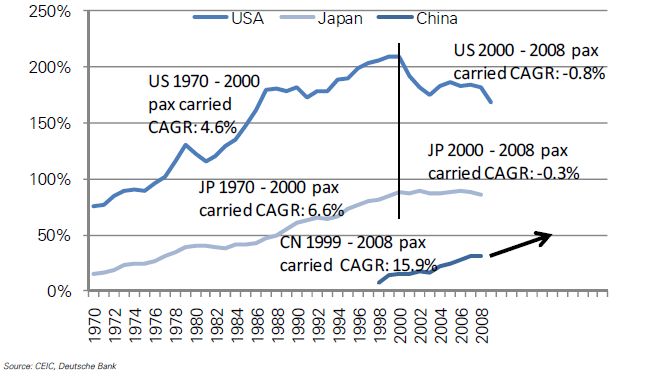
Drivers Passenger air traffic penetration trend
• Increasing wealth (No. of passengers/population)
• Modification of the legal holidays
• Easier access to visa
Focus
• Local Emerging Markets travel agencies
• Providers of packaged holidays
• Online providers
Source: CEIS, Deutsche Bank, 2009
11Strategy example: “Luxury”
With increasing wealth in the middle class, consumption will for some develop into
the luxury space.
Drivers Household income, 2004 versus 2009
• Increasing proportion of wealthy people (from poor to rich)
in Emerging Markets countries
• Brand awareness in a globalised World
Focus
• International high end brands
Source: Credit Suisse China Consumer Survey, 2009
12Creating smart-beta
• Not only a directional bet on the market
• Only exposure to the most attractive growth area
Equity Universe
Th
Themes
Alp atic I
em
ha nve
ge stm
ne
rat ent P
Strategies
ion
in oces
the s
r
Stock Selection
Portfolio
13Investment process
Research Process
Investment
Idea generation Conviction Building Strategy Rating
Philosophy Filter
- Company interaction Is it structural? - Cross sectorial & 3 Highest
regional
- Changing value-chains - Demographics
- Top-down trends - Technology
- Data discovery 2
- Company visits
- Globalization
- Modelling
1 Lowest
Thematic strategies are utilised as a filter in our stock selection process
14Investment process
Stock Selection
We use proprietary theme strategies to filter the investment universe and apply
bottom-up stock selection
Management 3 - Horizon
Company's valuation
Strategy Shareholder’s
ability to model
ability to
capitalise on Portfolio
Competitive capitalise on
theme strategies Catalysts
advantage theme strategies
Industry dynamics Liquidity
Invest in strongest stock ideas within the theme strategies
15Investment process
Company Valuation Model
• 3 horizon framework for Value
mapping thematic drivers
V3
• Dynamic model
Opportunities
• V2 is the target price
V2
Target Thematic
• Current stock price is evaluated Price Growth Drivers
relative to our theme strategy
V1
valuation span V1+V2+V3
Core
Business
• Uncertainty increases as we
Horizon
move from horizon 1 to 2 to 3 H1 H2 H3
16Investment process
Research Team
Thematic Stock
strategy selection
ratings
(1 – 3)
Portfolio Team
Optimal Portfolio
Factor
Volatility Sensitivity Correlation
Risk Team
Portfolio is constructed to capitalise on our strongest convictions
17Performance since inception
• Strong performance in a very challenging and volatile period
• Outperforming MSCI World since inception (Nov. 3rd 2008)
Nordea Emerging Consumer Fund
MSCI World
170
160 EMC MSCI
150 fund World
140
130 2008 -6.4% -12.9%
120
110 2009 44.7% 26.6%
100
90
80 2010 19.5% 19.8%
70
2011 -8.41% 2.8%
Ju 9
Se
Ju
Se
Ja
M
Ja
M
M
Ja
M
N
N
N
ov
ov
ov
ar
ar
ay
ay
l-0
l-1
n-
n-
n-
p-
p-
-1
-0
-1
-0
-0
-1
-0
09
10
11
10
09
9
0
0
9
9
0
8
0
18 Source: Nordea Investment Management AB and Bloomberg. Date: 28.02.2011Volatility
Performance achieved at an attractive volatility level compared to the market
Volatility since inception (30D)
Nordea Emerging Consumer Fund
MSCI World
MSCI Emerging Markets
55
45
35
25
15
5
Ju
Au
O
Fe
Ap
Ju
Au
O
Fe
Ap
D
D
D
ct
ct
ec
ec
ec
n
n
b-
b-
r-1
g-
r-0
g-
-1
-0
-1
-0
-1
-0
-0
10
09
1
0
0
0
9
9
0
9
0
9
0
8
9
19 Source: Nordea Investment Management AB and Bloomberg. Date: 02.03.2011Sharpe ratio comparison
Sharpe ratio - one year rolling
Emerging Consumer fund
MSCI World
7
MSCI Emerging Markets
6
5
4
3
2
1
0
11
12
01
03
04
06
07
09
10
11
01
02
/0
/1
/2
/1
/2
/0
/2
/0
/1
/2
/1
/2
3
6
8
2
6
8
1
2
5
9
1
3
/2
/2
/2
/2
/2
/2
/2
/2
/2
/2
/2
/2
0
0
0
0
0
0
0
0
0
0
0
0
09
09
10
10
10
10
10
10
10
10
11
11
20 Source: Nordea Investment Management AB and Bloomberg. Date: 02.03.2011Portfolio positioning
Nordea Emerging Consumer - Beta and P/E
35,0 Portfolio Beta 0.87
Portfolio P/E '11 = 14.0
MSCI World P/E '11 = 13.1
30,0
25,0
New Urban EM
P/E (1Y forward)
Consumer
20,0
Finance
New Urban Consumer Luxury
Travel
15,0
10,0 Aspiration
New Urban DM
5,0
0,0
0,60 0,70 0,80 0,90 1,00 1,10 1,20 1,30 1,40
Beta (Bloomberg)
21 Source: Nordea Investment Management AB and Bloomberg. Date: 02.03.2011Composition of the fund
Regional Exposure Strategy Exposure
Rest of World North America Consumer Finance New Urban Consumer
36% 19% 10% 48%
Travel
6%
Aspiration
Europe 27%
Japan 38%
7% Luxury
9%
Currency Exposure Market Capitalisation Exposure
MXNZAR KRW
INR Small €10bn
22 Source: Nordea Investment Management AB. Date: 02.03.2011 76%Historical composition
100%
80%
60%
40%
20%
0%
Nov-08
Jan-09
Jul-09
Nov-09
Jan-10
Jul-10
Nov-10
Jan-11
Mar-09
May-09
Mar-10
May-10
Sep-09
Sep-10
Developed Markets Companies Emerging Markets Companies
23 Source: Nordea Investment Management AB. Date: 02.03.2011Summary
• Exposure to high growth area with strong long term structural drivers
– Rapid urbanisation
– Increasing spending power
– Changing spending patterns
• Dynamic framework
– Five strategies
– Developed vs. Emerging Markets
• Highly attractive risk/return profile
– Performance
– Volatility
– Sharpe ratio
• Well documented investment process
• Uniqueness
– Not just a directional bet on the market
– No similar product on the market
24Appendix 25
Nordea 1 – Emerging Consumer Fund
     Monthly update as of 28.02.2011

     •   Fund performance
     •   Top 10 holdings
     •   Sector, country and currency breakdown
     •   Market capitalisation
     •   Fund information

26
Nordea 1 – Emerging Consumer Fund
Fund performance as of 28.02.2011
170
Cumulative returns
160 Period Fund Benchmark*
Year to date -8.41% 2.80%
150 1 month 0.20% 2.74%
3 months -6.68% 7.08%
140
6 months -0.40% 16.01%
130 1 year 8.81% 20.22%
Since launch** 48.20% 36.49%
120
110
100
90
MSCI World - Net Return Index
80
Nordea 1 - Emerging Consumer Fund BP-EUR
70
Nov-08 May-09 Nov-09 May-10 Nov-10
* MSCI World – Net Return Index. The sub-fund has no official reference index. This index is only used for performance comparison purpose. ** Launch date:
03.11.2008. Source: Nordea Investment Funds S.A. and Datastream. Date 28.02.2011. Performance is calculated NAV to NAV gross income reinvested, in
EUR, excluding initial and exit charges as per 28.02.2011. Past performance is not necessarily a guide to the future and investors may not recover the full
27 amount invested.Nordea 1 – Emerging Consumer Fund
Top 10 holdings as of 28.02.2011
Top Ten in %
Toyota Motor JP3633400001 5.09
Coca-Cola US1912161007 4.59
SABMiller GB0004835483 4.31
GEA Group AG DE0006602006 4.20
Richemont CH0045039655 3.95
Colgate-Palmolive US1941621039 3.87
Yum Brands US9884981013 3.85
Banco Santander Brasil ADR US05967A1079 3.76
Unilever GB00B10RZP78 3.66
WPP JE00B3DMTY01 3.58
Total 40.86
Source: Nordea Investment Funds S.A., Date: 28.02.2011
28Nordea 1 – Emerging Consumer Fund
Sector, country and currency breakdown as of 28.02.2011
Sector Breakdown in % Country Breakdown in %
Consumer Discretionary 35.26 (Top 10)
Consumer Staples 35.19
United States of America 21.25
Financials 9.66
United Kingdom 11.55
Industrials 9.46
Information Technology 2.63 Switzerland 9.51
Telecommunication Services 2.31 Japan 7.19
Net Liquid Assets 5.49 India 6.92
Total 100.00 Hong Kong 6.56
Source: Nordea Investment Funds S.A., Date: 28.02.2011
Germany 5.91
Currency breakdown in % China 4.27
USD 27.32 Brazil 3.76
EUR 13.17 France 3.69
HKD 12.98 Net Liquid Assets 5.49
GBP 11.55 Total 80.62
CHF 9.51 Source: Nordea Investment Funds S.A., Date: 28.02.2011
JPY 7.19
INR 6.92
KRW 3.48
MXN 2.37
Net Liquid Assets 5.49
Total 100.00
Source: Nordea Investment Funds S.A., Date: 28.02.2011
29Nordea 1 – Emerging Consumer Fund
Market capitalisation as of 28.02.2011
Market Capitalisation in % (in mln. Without
Cash included
EUR) cash
[500] – [1000] 2.15 2.27
[1000] – [2000] 5.57 5.90
[3000] – [4000] 1.15 1.22
[4000] – [5000] 7.20 7.62
[5000] – [10000] 10.18 10.77
[10000] – [20000] 17.31 18.32
> [20000] 50.94 53.90
Net Liquid Assets 5.49
Total 100.00 100.00
Source: Nordea Investment Funds S.A., Date: 28.02.2011
30Nordea 1 – Emerging Consumer Fund
Fund information as of 28.02.2011
Subfunds name Emerging Consumer Fund
Fund Manager Leon Svejgaard Pedersen
Fund Domicile 562, rue de Neudorf, L-2220 Luxembourg
Share class BP
Annual Man. Fee 1.500 %
Security number (ISIN) LU0390857471
Security number (WKN) A0RASQ
Fund Size in millions 335.08
Currency EUR
Reference index N/A
No. of holdings 33
Launch date 03/11/2008
Minimum investment (EUR) 50
Source: Nordea Investment Funds S.A., Date: 28.02.2011
31Research Responsibilities
Technology
Health Care
Materials &
Telecom &
Industrials
Consumer
Consumer
Financials
Utilities
Staples
Energy
Media
Basic
Disc.
Years with
Years Exp. Thematic Reseach
Nordea
Charlotte Winther, COO 23 19 Industrial Renaissance 9
Emerging Consumer, Fulfil your
Leon S. Pedersen, CIO 24 24 9 9
Dreams, Strong Getting Stronger
Convergence of Communication &
Jesper Krüger 13 1 9
Media
Thomas M. Ladefoged 13 5 Underdeveloped Financial Markets 9
Robert Madsen 20 19 Education 9
Environment & Resource Efficiency,
Thomas Sørensen 15 15 9 9
Fighting the Decline Curve
Kristina Ganea 6 6 Universal Healthcare 9
Lotte Eriksen 7 7 Emerging Consumer 9
Henning Padberg 4 4 Cloud Computing, Mobile Computing 9
Hans-Martin Thorsen 26 12 Market Repair 9 9 9 9
Jorry Nøddekær 11 1 Cross Straits 9 9 9 9
Morten Eddy 14 14 Head of Risk Management
Bjørn Burmeister 15 12 Product Manager
32Biographies
Mr. Leon S. Pedersen, CFA
Mr. Pedersen began his career as a financial analyst in 1988 with Privatbanken, a direct predecessor of Nordea’s. He
began working as a portfolio manager for our organisation in 1991, and during his tenure, has been pivotal to the
development of the strategy and investment philosophy of the Thematic Investment Process. Leon also led regional
equity portfolio management teams and contributed to the development of the Matrix Organisation of team member
responsibility. He was promoted to senior portfolio manager in 1994, to chief portfolio manager in 1998, and finally to
Head of Equity in 2001. Leon is now the Chief Investment Officer within Equities, and is primary upon Global portfolios.
Leon holds a M.Sc. in Finance & Investment from Copenhagen Business School, Denmark and is a CFA Charter
holder.
Ms. Lotte Eriksen, CFA
Ms. Eriksen is currently responsible for Telecommunications and Commercial Services globally. Further, she is the
deputy on the Emerging Consumer Fund. Prior to covering Telecommunications and Commercial Services, she was
responsible for Consumer Staples globally. Lotte joined the Thematic Investment team in June 2007 as a research
associate specializing within global consumer goods. Before joining the team, Lotte was management assistant and
strategic advisor in Nordea Investment Management, and from 2005-2006 she worked within Risk Management and
Controlling in Nordea Treasury.
Lotte holds a M.Sc. in Economics from University of Copenhagen and is a CFA Charter holder.
33Contact France
Nordea Investment Funds S.A. Marc Olivier
90, Avenue des Champs Elysées Directeur Général
F-75008 Paris +33.(0)1.56.43.50.23
www.nordea.fr marc.olivier@nordea.com
nordeafunds@nordea.lu
The sub-funds mentioned are part of the Nordea 1, SICAV, an open-ended Luxembourg-based investment company (Société d'Investissement à Capital Variable), validly
formed and existing in accordance with the laws of Luxembourg and with European Community Directive 85/611/CEE of 20 December 1985.
The custodian of the SICAV’s assets is Nordea Bank S.A., Luxembourg. Investments in the Nordea funds should be made on the basis of the current prospectus, which is
available, along with the simplified prospectus, current annual and semi-annual reports, free of charge upon request from Nordea Investment Funds S.A., 562, rue de Neudorf,
P.O. Box 782, L-2017 Luxembourg, from the local representatives or information agents, or from our distributors.
A transaction involving a foreign exchange transaction may be subject to fluctuations of currency values which may affect the value of an investment. Investments in Emerging
Markets involve a higher element of risk.
Nordea Investment Funds S.A. only publishes product-related information and does not make any investment recommendations.
Further information can be obtained from your financial advisor. He/she can advise you independently of Nordea Investment Funds S.A.
Published by Nordea Investment Funds S.A., 562, rue de Neudorf, P.O. Box 782, L-2017 Luxembourg.
Additional information for investors in France: With the authorisation of the Autorité des Marchés Financiers (AMF) as per 11 March 2003, 13 December 2005, 03 April
2007, 28 September 2007, 29 February 2008, 29 April 2008, 25 November 2008 and 09 June 2009, Nordea 1, SICAV may be distributed to investors in France, as published in
the Bulletin des Annonces Légales Obligatoire dated 19 March 2003, 19 December 2005, 18 April 2007, 10 October 2007, 19 March 2008, 28 May 2008, 15 December 2008
and 26 June 2009. Centralising Correspondent in France is CACEIS Bank, located at 1-3, place Valhubert, 75013 Paris. Investors are advised to conduct thorough research
before making any investment decision.
Performance calculated NAV to NAV (net of fees and Luxembourg taxes) gross income reinvested, in EUR, excluding initial and exit charges as per 28.02.2011.
The performance represented is historical; past performance is not necessarily a guide to the future and investors may not recover the full amount invested. The
value of shares can fluctuate and is not guaranteed. Unless otherwise stated, all views expressed are those of Nordea Investment Funds S.A. This document may not be
reproduced or circulated without prior permission. Reference to companies or other investments mentioned within this document should not be construed as a recommendation
34 to the investor to buy or sell the same, but is included for the purpose of illustration.You can also read


