Estimation of COVID-19 under-reporting in the Brazilian States through SARI
←
→
Page content transcription
If your browser does not render page correctly, please read the page content below
Paixão et al.
 1
 2
 3
 4
 5
         RESEARCH ARTICLE
 6
 7
 8
 9
10
     Estimation of COVID-19 under-reporting in the
11
12
     Brazilian States through SARI
13
14
15   Balthazar Paixão1† , Marcel Pedroso2† , Lais Baroni1† , Rebecca Salles1† , Luciana Escobar1† ,
16   Carlos de Sousa2† , Raphael de Freitas Saldanha2† , Jorge Soares1† , Rafaelli Coutinho1† ,
17   Fabio Porto3† and Eduardo Ogasawara1*†
18
19   *
       Correspondence:
20   eogasawara@ieee.org                     Abstract
     1
21      Federal Center for Technological
     Education of Rio de Janeiro,            Background: Due to its impact, COVID-19 has been stressing the academy to
22   CEFET/RJ, Rio de Janeiro, RJ,           search for curing, mitigating, or controlling it. However, when it comes to control,
23   Brazil                                  there are still few studies focused on under-reporting estimates. It is believed that
24   Full list of author information is
                                             under-reporting is a relevant factor in determining the actual mortality rate and,
     available at the end of the article
25   †
                                             if not considered, can cause significant misinformation. Therefore, the objective
       Equal contributor
26
                                             of this work is to estimate the under-reporting of cases and deaths of COVID-19
27
                                             in Brazilian states using data from the InfoGripe on notification of Severe Acute
28
29                                           Respiratory Infection (SARI). Methodology: The methodology is based on the
30                                           combination of data analytics (event detection methods) and time series
31                                           modeling (inertia and novelty concepts) over hospitalized SARI cases. The
32                                           estimate of real cases of the disease, called novelty, is calculated by comparing the
33                                           difference in SARI cases in 2020 (after COVID-19) with the total expected cases
34                                           in recent years (2016 to 2019). The expected cases are derived from a seasonal
35                                           exponential moving average. Results: The results show that under-reporting
36                                           rates vary significantly between states and that there are no general patterns for
37                                           states in the same region in Brazil. The states of Minas Gerais and Mato Grosso
38                                           have the highest rates of under-reporting of cases. The rate of under-reporting of
39                                           deaths is high in the Rio Grande do Sul and the Minas Gerais. Conclusions: Our
40                                           work presents the estimation of the under-reporting rates of COVID-19 in
41                                           Brazilian states. This work can be highlighted for the combination of data
42                                           analytics and time series modeling. Our calculation of under-reporting rates based
43                                           on SARI is conservative and better characterized by deaths than for cases.
44
45                                           Keywords: COVID-19; under-reporting; time series; SARI; epidemiology
46
47
48
49                                         1 Background
50
                                           In January 2020, the new coronavirus (COVID-19) was considered a Public Health
51
52                                         Emergency of International Importance by the World Health Organization (WHO).
53                                         Later, in March, WHO characterized the disease as a pandemic. Due to its relevance,
54                                         many efforts are being made to combat COVID-19, either by discovering the char-
55
                                           acteristics of the virus, methods of prevention, treatment, or directing public policy
56
57                                         action [1].
58                                           In Brazil, interventional measures such as the creation of field hospitals, surveil-
59                                         lance information systems, and actions to reduce the economic impact are being
60
                                           adopted to mitigate the effects caused by COVID-19. Among the main objectives is
61
62                                         the one to slow down the spread of the virus to avoid overloading the health system.
63
64
65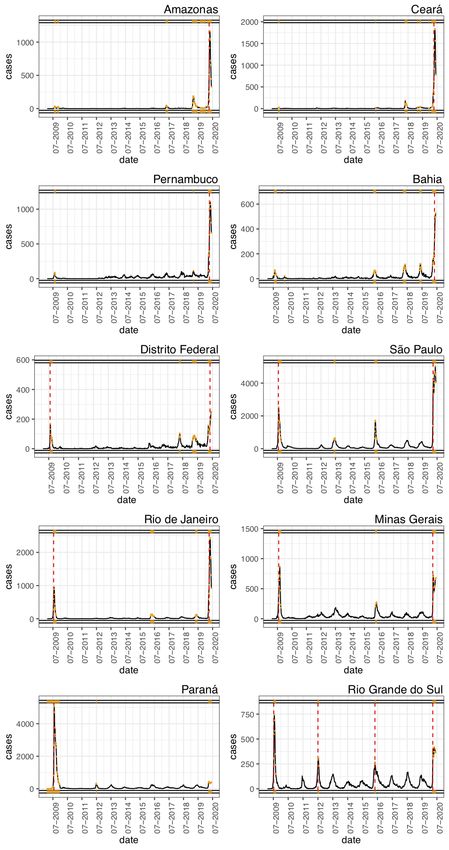
Paixão et al.                                                                                                     Page 2 of 21
 1
 2
 3
 4
 5
 6                    In this sense, policies to encourage prevention are adopted, such as, for example,
 7                    the recommendation or imposition of physical isolation and quarantine [2].
 8                      Decision-making for the adoption of public policies in this pandemic scenario is
 9                    stressing and, at the same time, challenging task. Part of the difficulty comes from
10
11                    the lack of specific information about essential characteristics such as the total
12                    number of people infected. There is a lack of availability of tests to confirm the
13                    infection by SARS-CoV-2, which ends up being performed only in more severe cases
14                    of the disease, with exceptions. Such a scenario makes the capacity of the health
15
16                    system to monitor the evolution of the number of cases uncertain. The discrepancy
17                    between the actual amount of infected and diagnosed individuals constitutes under-
18                    reporting [3].
19                      It is estimated that under-reporting is a relevant factor in determining the ac-
20
21                    tual mortality rate and, if not considered, can cause significant misinformation [4].
22                    Therefore, the objective of this work is to estimate the under-reporting of cases
23                    and deaths of COVID-19 in Brazilian states. If the possibility of testing the entire
24                    population is not viable, data from the InfoGripe on notification of Severe Acute
25
26                    Respiratory Infection (SARI) are used.
27                      Our paper stands out for adopting a methodology based on the combination of
28                    data analytics (event detection methods) and time series modeling (inertia and
29                    novelty). Data analytics is applied to determine the parameters to be used for time
30
31                    series modeling. The estimated parameters consider time series analysis through
32                    event detection methods.
33                      The estimate of real cases of the disease, called novelty, is calculated by comparing
34                    the difference in SARI cases in 2020 (after COVID-19) with the total expected
35
36                    cases in recent years (2016 to 2019). The expected cases are derived from a seasonal
37                    exponential moving average. The novelty is based on inertial concepts. That is,
38                    there is a strength to maintain the values of a time series in a stable state over time
39                    [5]. Inertia remains until a rupture occurs. In this case, the rupture is the influence
40
41                    of the COVID-19. Under-reporting, then, is given by the difference between the
42                    novelty and the number of reported cases. In the end, under-reporting (cases and
43                    deaths) is presented as a rate for each state in Brazil.
44                      For the sake of clarity, it is important to introduce some background for time
45
46                    series (Section 1.1), moving averages (Section 1.2), and event detection (Section
47                    1.3) used in the context of this work.
48
49                    1.1 Time Series
50
                      A time series is a sequence of observations collected in time. Usually, a time series
51
52                    y can be considered as a stochastic process, i.e., a sequence of n random variables
53                    [6, 7]. A specific observation of a time series is represented as yi ,
54                    indexed in time by i = 1, . . . , n, where y1 represents the first observation, and yn is
55
                      the most recent observation.
56
57                      The i-th subsequence of size p in a time series y, represented as seqi,p (y), is a
58                    continuous sequence of values , where |seqi,p (y)| = p e
59                    p ≤ i ≤ |y|. The sequence contains i-th observation and its p − 1 predecessors.
60
                        The i-th subsequence outdated seasonally in periodicity s of size p in a time series
61
                                                  s
62                    y, represented as seqi,p       (y), is an ordered sequence of values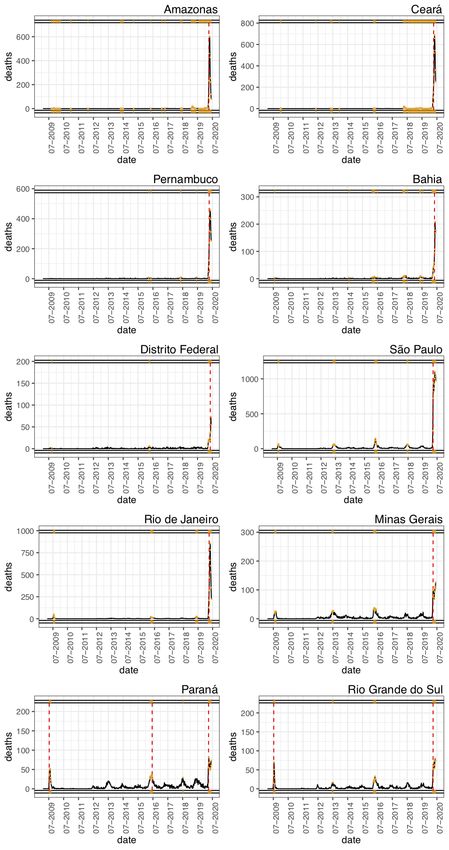
Paixão et al.                                                                                                 Page 3 of 21
 1
 2
 3
 4
 5                                           s
 6                    . . ., yi >, where |seqi,p (y)| = p and p ≤ i ≤ |y|. The sequence contains i-th observa-
 7                    tion and its p − 1 predecessors outdated seasonally.
 8
 9                    1.2 Seasonal Moving Averages
10
11                    The i-th moving average y i,p of p terms in a time series y is calculated by the
12                    average of tk observations in the sequence seqi,p (y), as shown in Equation 1. The
13                    i-th exponential moving average ŷi,p of p terms in a time series y is calculated by
14                    the weighted average of tk observations in the sequence seqi,p (y) and the weights
15
16                    αk . The ŷi,p is described in Equation 2, where there is more emphasis on the most
17                    recent observations.
18                                    Pp
19                                       k=1 tk
20                          y i,p =               | tk ∈ seqi,p (y), p ≤ i ≤ |y|                             (1)
                                           p
21
22
23
24                                    Pp                                          p−k
                                       k=1 αk · tk                              2
25                          ŷi,p   =  P p         | tk ∈ seqi,p (y), αk = 1 −          , p ≤ i ≤ |y|        (2)
26                                       k=1 αk                                p+1
27
28                      The i-th seasonal moving average y si,p and the i-th seasonal exponential moving
29                              s
                      average ŷi,p of p terms in a time series y are similarly calculated replacing the
30                                                                                  s
                      continuous sequence seqi,p (y) with the seasonal sequence seqi,p (y), respectively, in
31
32                    Equations 1 and 2.
33
34                    1.3 Event Detection
35                    Event detection methods include the discovery of anomaly and change points.
36
37                    Anomalies are observations that stand out because they do not appear to have
38                    been generated by the same process as the other observations in the time series [8].
39                    Change points characterize a transition between different states in a process that
40                    generates the time series data [9, 10].
41
42                      There are several methods to address the detection of anomalies [11, 12] and
43                    change points [13]. Among them, some methods consider the effects of inertia on
44                    time series data. As this work is based on inertial concepts [5], two methods of this
45
                      group are presented.
46
47
48                    1.3.1 Anomaly by Adaptive Normalization
49                    Adaptive Normalization [14] is used to detect anomalies. This technique uses inertia
50
                      to address heteroscedastic non-stationary series. Given a time series y, the outlier
51
52                    removal process consists of three stages: (i) inertia calculation, (ii) noise calculation,
53                    and (iii) anomaly identification. In the inertia calculation, a moving average for the
54                    series y i,p with p terms is calculated, as described by Equation 1. The higher the
55
                      value of p, the greater the inertia and the lower the adaptation speed. The noise i
56
57                    is calculated by the difference between yi and y i,p , i.e., i = yi − y i,p . Finally, the
58                    observations i classified as outliers by boxplot correspond to anomalies in Equation
59                    3.
60
61
62                          anomaly(y) = {i, ∀i | yi ∈
                                                     / [Q1 (y) − 3 · IQR(y), Q3 (y) + 3 · IQR(y)]}           (3)
63
64
65
Paixão et al. Page 4 of 21
1
2
3
4
5
6 1.3.2 Change Points by Change Finder
7 Change Finder is a technique that detects change points in univariate time series
8 data [9]. Given a time series y, the event detection process consists of two phases.
9 In the first phase, outliers are detected. For this, a learning model ξ is adjusted
10
11 to the time series y, resulting in ŷi = ξ(y)i [1] . Next, a score si is calculated for
12 each observation in the series related to its deviation from the learned model. This
13 calculation produces a time series s, as presented in Equation 4. The highest scores
14 for s, classified according to Equation 3, indicate the occurrence of anomalies.
15
16 In the second phase, change points are detected. For this, a new time series sp is
17 produced, composed of moving averages of s with p terms, according to Equation
18 1. The detection of change points is then reduced to the outlier detection problem
19 in sp like the first phase.
20
21 2
22 si = (ŷi − yi ) , ŷi = ξ(y)i (4)
23
24 1.4 Related Work
25
Due to its relevance and novelty, COVID-19 has been attracting much interest in
26
27 the academy. Therefore, many works on COVID-19 have been published since the
28 beginning of 2020 until today. However, there are still few studies focused on under-
29 reporting estimates.
30
Looking for similar work, we searched in the Scopus database in May 2020 with
31
32 the search string ((“covid-19” OR “covid19”) AND (“sub-notification” OR “under-
33 reporting” OR “under-reporting”)). The search returned only four papers in En-
34 glish. This low number of related publications can be a consequence of the time
35
spent on the execution, review, editing, and publication of papers in scientific jour-
36
37 nals. Therefore, we accomplished a search for academic works in Google Scholar to
38 complement the research, employing the same words as the search string used in
39 the Scopus database and on the same date.
40
From the returned works, ten were selected for reading. Most of them discuss the
41
42 characteristics of COVID-19, such as under-reporting (cases and deaths) and its
43 possible impact on different scenarios [15, 16]. Some works address the specificities
44 of COVID-19 together with other diseases and the under-reporting rate as a factor
45
to be considered [17, 18]. Others make different estimates related to COVID-19 and
46
47 cite the under-reporting as a limitation or parameter [19, 20]. Three of the returned
48 works are more specific regarding the under-reporting estimate, being more closely
49 related to this work [4, 21, 22].
50 Krantz et al. [21] used harmonic analysis and wavelets to model the under-
51
52 reporting of COVID-19 in several countries around the world. They developed
53 susceptibility and infection equations with parameters varied according to the char-
54 acteristics of each country to build adaptive models. The under-reporting rate was
55 calculated by the difference between the numbers predicted by the model and re-
56
57 ported numbers. The result provided the ratio between reported and unreported
58 cases in the format (1 to x) in seven countries. The authors concluded that the
59 results are not entirely accurate due to the lack of some important information that
60 should be included in the model and were not available.
61
62
[1]
in this work, linear regression was used for adjustment.
63
64
65Paixão et al. Page 5 of 21
1
2
3
4
5
6 Similarly, to review the numbers of reported COVID-19 cases in several coun-
7 tries, Lachmann et al. [4] also estimated expected cases. For this, the author used
8 demographic data and fixed mortality rates of the countries as well as the paired
9 comparison with the reference country (South Korea). It presented and discussed
10 estimates of the number of people infected with COVID-19, considering a set of
11
12 situations that must be true to justify the model.
13 Ribeiro et al. [22] used regression techniques on hospitalization data in Brazil
14 with a type of acute respiratory syndrome as the cause. They analyzed the time
15 evolution of hospitalizations for each month in the period between 2012 and 2019.
16
They created a mathematical function that replicates the typical behavior of cases
17
18 of hospitalization for SARI. This function was compared with data from 2020 in the
19 same months to estimate under-reporting. The results showed an under-reporting
20 rate of 7.7:1 for Brazil.
21 Our work stands out for estimating the under-reporting of COVID-19 in Brazilian
22
states weekly. The estimate considers the weighted historical record (in which most
23
24 recent years have more weight than less recent ones) to predict expected SARI cases
25 in 2020. It enriches the analysis allowing an estimate closer to reality. This work
26 can also be highlighted for focusing on time series and using event detection tools
27 in the study. Furthermore, with the exception of the article by Ribeiro et al. [22],
28
29 as far as we know, the data used in this work to obtain under-reporting rates were
30 not used in any other work with the same or similar purpose.
31
32 2 Methods
33 In seasonal phenomena, time series are generated by superimposing a seasonal pro-
34
cess and random noises. Based on this premise, Equation 5 models the seasonal
35 s
36 component of the time series, where yi is an observation, ŷi−s,p is the seasonal
37 exponential moving average (SEMA) in the previous season, and i is the random
38 noise. The obtained seasonal component brings up the inertia concept in time series.
39 It enables the analysis of the intrinsic random noise of the observed phenomenon.
40
At the same time, the influences that determine the behavior of the series are not
41
42 changed [5].
43
s
44 yi − ŷi−s,p − i = 0 (5)
45
46 In the case of rupture (i.e., a “break” in inertial behavior), we adopt the concept
47
of novelty η. The novelty is the influence introduced in each interval resulting from
48
49 a rupture in a time series. Once the novelty begins, the modeled SEMA from past
50 data is no longer the only representative process of the new behavior of the time
51 series. In this context, Equation 5 is expanded to Equation 6, that expresses novelty
52 ηi and error ˆi . We have that ˆi is approximated by the average error observed in
53
54 the pre-novelty period, i.e., ˆi is expected to be inside the interval confidence for
55 ([min − max ]).
56
s
57 yi − ŷi−s,p − ηi − ˆi = 0, ˆi ≈ , ˆi ∈ [min − max ] (6)
58
59 s
Until the seasonal component ŷi−s,p incorporates the novelty ηi , ηi defines a new
60
61 phenomenon in the time series. Regarding SARI, we assume that ηi is directly
62 associated with COVID-19, i.e., the new known phenomenon.
63
64
65Paixão et al. Page 6 of 21
1
2
3
4
5
6 From this concept, we first compute the inertial behavior of the time series to
7 estimate under-reporting. Let t be the period in which the rupture yt occurs. In
8 novelty period (i.e., t ≤ i ≤ |y|), ηi is the subtraction of the observations of the
9 s
time series yi by the values of SEMA from the previous period ŷi−s,p and the error
10
11 ˆi (approximated by ). Equation 6 shows the calculation of the time series with
12 ηi for each i in the novelty period. The novelty ηi estimates the brute number of
13 observations that exceed the expected according to the inertial behavior of the time
14 series and its fundamental error.
15
16 To estimate the brute number of under-reported time series, we use the num-
17 ber of observations classified as SARS-CoV-2 (Severe Acute Respiratory Infection
18 Coronavirus 2) in the novelty period. Equation 7 presents the calculation of the
19 time series with absolute numbers of under-reported observations, where covi are
20
21 observations classified as SARS-CoV-2.
22
23 subi = ηi − covi , t ≤ i ≤ |y| (7)
24
25
26 As we assume that the modeled novelty in time series ηi represents COVID-19
27 cases, the time series subi defines the number of under-reported observations per
28 week. Then, the estimates subi are added together to form the accumulated number
29
of under-reported observations in the period, represented as curi in Equation 8.
30
31
|y|
32 X
33 curi = subi , t ≤ i ≤ |y| (8)
34 i=t
35
36 The under-reporting rate is estimated by dividing the accumulated number of
37 under-reported time series curi by the accumulated number of total time series
38 covi for the period. Equation 9 describes the under-reporting rate, denoted as txi ,
39
40 where tx|y| is the final rate. In this work, this calculation provides the estimated
41 under-reporting rates for cases and deaths of COVID-19 for each Brazilian state
42 individually. Thus, these rates allow for a comparable interpretation between the
43
states.
44
45 curi
46 txi = (9)
47 covi
48
49 2.1 Experimental Setup
50 This section discusses the experimental setup of the scenario in which the method-
51 ology was applied. Section 2.1.1 presents the process of data acquisition and prepa-
52
ration, whereas Section 2.1.2 describes the methods and parameters applied in the
53
54 analysis. Section 2.1.3 presents the implementation details.
55
56 2.1.1 Data Acquisition and Preparation
57
58 InfoGripe is the principal data source used for the analysis and development of
59 the work[2] . It is an initiative of the Oswaldo Cruz Foundation (Fiocruz) with the
60 Getulio Vargas Foundation (FGV) and the Brazilian Health Surveillance System of
61
62
[2]
Data collected on July 27th , 2020
63
64
65Paixão et al. Page 7 of 21
1
2
3
4
5
6 the Ministry of Health. It records weekly SARI reported cases since January 2009.
7 The data comes from the Influenza Epidemiological Surveillance Information Sys-
8 tem (SIVEP-Gripe). It presents the cases following the criteria: (fever) AND (cough
9 OR sore throat) AND (dyspnoea OR oxygen saturation < 95% OR respiratory diffi-
10
11 culty) AND (hospitalization OR death), symptoms equivalent to SARI international
12 records [23]. For the sake of simplicity, we are calling the dataset DT SARI.
13 To keep only the relevant data, we apply the following filter: type = “State” ∧
14 gender = “Total” ∧ scale = “Cases”. The resulting dataset shows the number of
15
cases or deaths per epidemiological week of a given year for each state. Besides, it
16
17 specifies the number of observations that correspond to Influenza A, Influenza B,
18 SARS-CoV-2, Respiratory Syncytial Virus (RSV), Parainfluenza 1, Parainfluenza
19 2, Parainfluenza 3, and Adenovirus.
20
It is then performed the differentiation of the case observations that evolved to
21
22 death. For this, we apply a second filter that resulted in two datasets, one with
23 cases (DT SARI c) and another with deaths (DT SARI d). Finally, five attributes
24 of interest are selected: Year, Week, State, Total, and SARS-CoV-2. Table 1
25
describes these attributes.
26
27
28 Table 1: Attributes of processed datasets DT SARI c and DT SARI d
29 Attribute Description
30
31 Year the epidemiological year of first symptoms
Week the epidemiological week of first symptoms
32 State the state name
33 Total the total number of recorded cases (DT SARI c) / deaths (DT SARI d)
34 SARS-CoV-2
the total number of cases with positive results for COVID-19 (DT SARI c) /
35 deaths by COVID-19 (DT SARI d)
36
37
38 In addition to these data, we use the number of confirmed cases (DT M H c) and
39 confirmed deaths (DT M H d) from COVID-19 by state, provided by the Ministry
40
of Health[3] . These numbers are updated daily on the COVID-19 Portal, the official
41
42 communication channel on the epidemiological situation of COVID-19 in Brazil [24].
43 The values are used for purposes of comparison with the results obtained in this
44 work.
45
46
47 2.1.2 Method and Parameter Selection
48 The method and parameter selection are a determining factor for the quality of
49 the results obtained in the research. This section aims at justifying the applied
50 methodology, which includes the choice of the used dataset, and the methods and
51
52 parameters adopted in the data analysis.
53
54 Datasets The most severe cases of COVID-19 manifest respiratory symptoms, such
55 as difficulty in breathing or shortness of breath, and chest pain or pressure [25],
56
symptoms also present in Acute Respiratory Infection (ARI). Fever is another com-
57
58 mon symptom, even in mild cases of the disease. It is the reason for choosing of
59 SARI data (DT SARI) instead of ARI data (DT ARI). DT SARI is a subset of
60 DT ARI. They differ only in the manifestation of fever. Therefore, we consider that
61
62
[3]
Data collected on July 09th , 2020
63
64
65Paixão et al. Page 8 of 21
1
2
3
4
5
6 the probable cases of COVID-19 with severe symptoms also present fever, making
7 DT SARI the most suitable dataset to estimate the under-reporting of the disease
8 [26, 27].
9
10
11 SEMA for Inertial Model It is necessary to identify the SARI observations that cor-
12 respond to the COVID-19 to compute the under-reporting of COVID-19 in Brazil.
13 For this, data from years predating COVID-19 should be observed to model the
14 expected inertial behavior if there was no pandemic. Thus, it is possible to estimate
15
16 the COVID-19 case number as being the value that exceeds the expected for the
17 same period in the year.
18 SEMA provides an appropriate method to create the inertial function since it is
19 a trend indicator that assigns more weight to the most recent data considering a
20
seasonal pattern. It is efficient to estimate the inertial behavior of a time series if
21
22 the series has not undergone any significant behavior change in the period.
23 First, we define the time series for which SEMA is to be calculated. For this, three
24 parameters are required: p, i, and s (see Section 1). The i represents the time index
25
of the reference time series, p is the number of predecessors, and s is the seasonality
26
27 to be considered. Note that p and s are defined based on the locality of i.
28 The s is chosen based on the seasonal variation of respiratory viral diseases. The
29 annual epidemics of the common cold and the flu affect the human population of
30
temperate regions in the winter season [28–31]. Therefore, s is defined as 52, since
31
32 52 corresponds to the number of weeks in the year. In this way, we guarantee the
33 analysis of comparable observation sequences in the SARI series.
34 The parameters p and i are based on the response of the event detection algorithms
35
in each state. The event detection (targeting both change points and anomalies) in
36
37 the series DT SARI c and DT SARI d consistently evidence, in several states,
38 behavior change in two periods: (i) between the end of 2015 and the beginning of
39 2016, and (ii) between February and March 2020. Table 2 shows the dates of events
40
detected in 2020 for each state.
41
42
43 Table 2: Change point (CP) dates that occurred in 2020
44 State Cases Deaths State Cases Deaths
45
46 Acre Mar. 28 Feb. 08 Paraı́ba Mar. 14 Mar. 14
Alagoas Mar. 14 Mar. 21 Pernambuco Mar. 07 Mar. 07
47 Amazonas Mar. 14 Mar. 14 Piauı́ Feb. 29 Mar. 07
48 Amapá Mar. 14 Mar. 07 Paraná - Mar. 14
49 Bahia Mar. 07 Mar. 07 Rio de Janeiro Mar. 14 Mar. 07
50 Ceará Mar. 07 Mar. 07 Rio Grande do Norte Mar. 21 Mar. 14
Dirito Federal Mar. 07 Mar. 07 Rondônia Mar. 28 Mar. 28
51 Espı́rito Santo Mar. 14 Mar. 14 Roraima Mar. 14 Mar. 14
52 Goiás Mar. 14 Mar. 14 Rio Grande do Sul Mar. 21 Mar. 21
53 Maranhão Feb. 01 Feb. 08 Santa Catarina Mar. 28 Mar. 14
54 Minas Gerais Mar. 14 Mar. 14 Sergipe Mar. 14 Mar. 07
Mato Grosso do Sul Mar. 14 Mar. 14 São Paulo Mar. 07 Mar. 07
55 Mato Grosso Mar. 07 Mar. 14 Tocantins Mar. 07 Feb. 08
56 Pará Mar. 14 Feb. 29
57
58
59 The events detected in 2020 are a consequence of COVID-19 in Brazil. These
60
events coincide with the first record of the disease in the country, considering the
61
62 time for the disease spread and the manifestation of symptoms [32, 33]. The events
63
64
65Paixão et al. Page 9 of 21
1
2
3
4
5
6 appear for most of the states from March 07 and March 14. They correspond,
7 respectively, to the 11th and 12th epidemiological week, two or three weeks after
8 the first confirmed case of COVID-19 in Brazil.
9 It is possible to identify the beginning period (t) of the novelty for a determined
10
11 state[4] . The online method consists of seeking a change point in 2020, running
12 it weekly since the first week of 2020 until it detects a change point in the year.
13 When the change point is detected, the method stops and considers that week as
14 the beginning of the period. So, for each state, the parameter i admits values after
15
16 t and extended until the last week of data (|y|), which corresponds the week 26 of
17 2020 (i.e., June 27, 2020).
18 Figure 1 shows the events detected in the SARI cases curve in Brazil. In addition
19 to 2009 (H1N1) and 2020 (COVID-19), events are observed in the 2016 period.
20
Events presented in Figure 1 correspond to abnormal behavior. They can affect the
21
22 previous inertial behavior of the series. For this reason, the value attributed to p is
23 4, meaning that the previous four years (2016 to 2019) are considered.
24
25
26
27
28
29
30
31
32
33
34
35
36
37
38
39 Figure 1: Anomalies (yellow) and change points (red) detected in SARI cases of Brazil
40
41
42 The model errors (random noise) for this period for both the cases and deaths
43 in each state are, respectively, described in Tables 3 and 4. Since i follows a non-
44 normal distribution, the interval confidence for is computed by bootstrap with
45
46 1000 repetitions. These values are important to determine the novelty calculation,
47 reducing the chance of an increase generated by a random event.
48
49 2.1.3 Implementation
50
The adopted methodology was implemented in R [34]. The code description and
51
52 Jupyter notebook also developed in R complements this work[5] . In it, it is possible
53 to check the entire process on the calculation of the under-reporting rates and all
54 numerical and graphical results. The graphics with the cases and deaths series from
55
the DT SARI and the marking of the detected events are presented in this notebook
56
57 for all states. Also, the site contains graphics with the evolution of under-reported
58 [4]
According to the corresponding epidemiological week identified by change points.
59
60 They are presented in Table 2. For the state of Paraná, the date detected for deaths
61 was used instead.
62
[5]
Available at https://eic.cefet-rj.br/~dal/covid-19-under-report/
63
64
65Paixão et al. Page 10 of 21
1
2
3
4
5
6 Table 3: Errors of the models (cases)
7 State [min , max ]
8
Acre 1.727 [1.177, 2.305]
9 Paraı́ba 2.198 [1.740, 2.855]
10 Alagoas 1.482 [0.972, 2.028]
11 Pernambuco 11.537 [9.336, 13.903]
12 Amazonas 9.770 [6.689, 14.797]
Piauı́ 26.50 [1.735, 3.796]
13 Amapá 0.299 [0.163, 0.457]
14 Paraná 24.465 [19.121, 31.052]
15 Bahia 10.211 [7.582, 13.304]
16 Rio de Janeiro 9.788 [6.700, 13.761]
Ceará 6.967 [4.397, 10.813]
17 Rio Grande do Norte 1.230 [0.705, 1.833]
18 Distrito Federal 13.036 [11.223, 14.998]
19 Rondônia 0.502 [0.141, 0.959]
20 Espı́rito Santo 4.021 [2.853, 5.709]
Roraima -0.012 [-0.119, 0.117]
21 Goiás 6.349 [3.413, 10.248]
22 Rio Grande do Sul 7.516 [2.343, 14.642]
23 Maranhão 9.80 [6.35, 14.58]
24 Santa Catarina 4.396 [1.655, 7.998]
Minas Gerais 6.320 [1.580, 12.928]
25 Sergipe 1.851 [1.370, 2.341]
26 Mato Grosso do Sul 9.276 [6.377, 12.874]
27 São Paulo 49.934 [22.327, 91.296]
Mato Grosso 1.515 [0.843, 23.07]
28 Tocantins 1.172 [0.889, 1.454]
29 Pará 6.403 [4.842, 8.280]
30
31
32
33 Table 4: Errors of the models (deaths)
34 State [min , max ]
35
36 Acre 0.480 [0.284, 0.683]
Paraı́ba 0.585 [0.402, 0.816]
37 Alagoas 0.293 [0.146, 0.452]
38 Pernambuco 0.325 [0.128, 0.552]
39 Amazonas 0.670 [0.391, 1.075]
40 Piauı́ 0.185 [0.024, 0.417]
Amapá 0.047 [0.007, o.102]
41 Paraná 3.015 [2.086, 4.005]
42 Bahia 0.847 [0.571, 1.142]
43 Rio de Janeiro 1.066 [0.531, 1.660]
Ceará 0.670 [0.381, 1.107]
44 Rio Grande do Norte 0.409 [0.238, 0.634]
45 Distrito Federal 0.422 [0.271, 0.618]
46 Rndônia 0.056 [-0.025, 0.155]
47 Espı́rito Santo 0.381 [0.150, 0.661]
Roraima 0.009 [-0.020, 0.053]
48 Goiás 0.940 [0.496, 1.454]
49 Rio Grande do Sul 0.902 [0.175, 1.870]
50 Maranhão 0.093 [0.029, 0.186]
51 Santa Catarina 0.632 [0.247, 1.054]
Minas Gerais 0.993 [0.147, 2.085]
52 Sergipe 0.119 [0.047, 0.210]
53 Mato Grosso do Sul 0.976 [0.451, 1.592]
54 São Paulo 3.941 [1.178, 8.057]
55 Mato Grosso 0.246 [0.076, 0.457]
Tocantins 0.302 [0.197, 0.432]
56 Pará 0.449 [0.225, 0.694]
57
58
59
60
records over the weeks after COVID-19 for each state. There it is possible to see
61
62 whether under-reported records increase, decrease or remain constant over time.
63
64
65Paixão et al. Page 11 of 21
1
2
3
4
5
6 The Harbinger[6] framework was used for detecting events in time series (adaptive
7 normalization and change finder). It receives the time series and parameters and
8 returns the detected events. The parameters used are those defined in Section 2.1.2.
9 For each state, two time series were submitted to the process described in Section
10
11 2, both from the InfoGripe dataset on hospitalizations for SARI (DT SARI). The
12 first is the weekly series with information on the number of registered SARI cases
13 in the state. The second is the weekly series with information on the number of
14 SARI deaths in the state.
15
16 Under-reporting rates were calculated for states where it was found that there
17 were, in fact, novelty and under-reported notification. For this, two independent
18 tests were carried out using the Wilcoxon test. The average error observed in the
19 pre-novelty period () was compared with the novelty (ηi ) to check if there was a
20
21 novelty. To check if there was an under-reported notification, the number of novelty
22 calculated (ηi ) was compared with the number classified as SARS-CoV-2 at Info-
23 Gripe data (covi ) in a paired test. Then, in both cases, only when there is a relevant
24 difference at a significance level of 0.05, the under-reporting rates were calculated.
25
26
27 3 Results
28 This work focuses on estimating under-reporting rates for cases and deaths of
29 COVID-19. In Section 3.1, exploratory analysis is conducted. It contains discus-
30
sions based on the results of event detection (change points and anomaly) over the
31
32 SARI time series. These findings bring valuable information to help understand the
33 disease scenario in the most affected states. Besides, they helped to evaluate the
34 choice of the method and the confidence of the estimates. Then, Section 3.2 briefly
35
discusses the characteristics of the under-reporting rates calculated. Finally, Section
36
37 3.3 presents the evolution of under-reporting in the period considered in this work.
38
39 3.1 Data Analytics
40
The detection of change points and anomalies in the time series of SARI hospital-
41
42 ization in Brazil was an important aspect to understand the beginning process of
43 the pandemic situation of COVID-19 in the country. It also enabled the analyses of
44 epidemic moments over the last years. In Figures 2 and 3, it is possible to observe
45
the behavior of data and specificity of the most affected Brazilian state[7] .
46
47 Amazonas state is the epidemic center in the North region, and its capital, Man-
48 aus, was the first capital from Brazil to suffer from a wave of deaths. The state
49 presented in 2019 an increase in the number of hospitalizations. This increase is
50
also observed in other states from 2016 until 2019. The Amazonas time series shows
51
52 some anomalies, but just one change point for both the number of cases and deaths.
53 The change point in the number of cases and deaths is marked in the 11th epidemi-
54 ological week of 2020. The state reaches its peak of hospitalizations and deaths at
55
17th epidemiological week, and now presents a decrease in the curve.
56
57 In the Northeast region, it is possible to highlight the cases and deaths that
58 occurred at Ceará, Pernambuco, and Bahia. Both Ceará and Pernambuco displayed
59
60
[6]
Available at https://eic.cefet-rj.br/~dal/harbinger/.
[7]
The graphics for all states are available at https://eic.cefet-rj.br/~dal/
61
62 covid-19-under-report/
63
64
65Paixão et al. Page 12 of 21 1 2 3 4 5 6 7 8 9 10 11 12 13 14 15 16 17 18 19 20 21 22 23 24 25 26 27 28 29 30 31 32 33 34 35 36 37 38 39 40 41 42 43 44 45 46 47 48 49 50 51 52 53 54 55 56 57 Figure 2: Event detection in time series of cases 58 59 60 61 62 63 64 65
Paixão et al.                                                        Page 13 of 21
 1
 2
 3
 4
 5
 6
 7
 8
 9
10
11
12
13
14
15
16
17
18
19
20
21
22
23
24
25
26
27
28
29
30
31
32
33
34
35
36
37
38
39
40
41
42
43
44
45
46
47
48
49
50
51
52
53
54
55
56
57                    Figure 3: Event detection in time series of deaths
58
59
60
61
62
63
64
65
Paixão et al.                                                                                            Page 14 of 21
 1
 2
 3
 4
 5
 6                    the highest numbers in the region. All three states present both of the change
 7                    points in the 10th week. Pernambuco and Ceará, respectively, reached their peaks
 8                    of hospitalizations in the 18th (more than 1,000 cases) and 19th week (more than
 9                    1,800 cases). The peak for deaths for both of these states is located in the 18th
10
11                    week. In Bahia and Pernambuco, the number of cases and deaths show, between
12                    2016 and 2019, a similar increase and decrease in shaping a curve between March
13                    and July.
14                      Distrito Federal, located in the Central-West region of Brazil, was then considered
15
16                    one of the main focuses of COVID-19 contagion beside Rio de Janeiro and São
17                    Paulo. Previously, the peak of the number of cases in Distrito Federal was August
18                    of 2009, during the H1N1 epidemic. The pandemic superseded this high number in
19                    2020. Besides, when analyzing the number of deaths caused by H1N1, it was not as
20
21                    expressive as the number of deaths registered by COVID-19.
22                      The Southeast is the most populous region and the most infected area in the coun-
23                    try. São Paulo was the first state to register a case (February) and death (March)
24                    by COVID-19. It is still the epicenter of the disease in Brazil. The state has the
25
26                    mark of the change point for cases and deaths in the 10th week.
27                      Rio de Janeiro, also in the Southeast region, was impacted by SARS-CoV-2. It is
28                    possible to observe in cases two change points. The first one is 2009 and the second
29                    in 2020. However, the number of observed change points for the number of deaths
30
31                    occurred only once, in 2020, showing the seriousness of this pandemic.
32                      Another state in the Southeast is Minas Gerais. It registered outliers in 2015 and
33                    more stable behavior between 2017 and 2019 for the numbers of cases and deaths.
34                    In 2020 the change point was detected in the 11th epidemiological for both cases
35
36                    and deaths.
37                      The 2009 H1N1 crisis also impacted the states in the south region. According to
38                    the time series, it is noticeable that Paraná and the Rio Grande do Sul were affected
39                    in the number of cases. On the other hand, if we compare the number of deaths, we
40
41                    can observe and analyze the lethality between these two epidemic moments. Paraná
42                    is an example of that analysis, where the maximum point of cases in 2009 surpasses
43                    5,000 records. Meanwhile, the top of 2020 cases (until the current moment) is less
44                    than 1,000. Nonetheless, when observing the number of deaths, the highest numbers
45
46                    occur in 2020, during the COVID-19 pandemic.
47
48                    3.2 Under-Reporting Rates
49                    The under-reporting rates were computed according to the proposed methodology.
50
                      Tables 5 and 6 show the values of the under-reporting rates of cases and deaths
51
52                    for the 27 states of Brazil (columns cases rate and deaths rate, respectively). The
53                    rates shown are calculated for the period between the week detected by the event
54                    detection methods (see Table 2) and the epidemiological week 26 (which corresponds
55
                      to the date 27/06/2020). Thus, the periods considered vary for cases and deaths
56
57                    and between states.
58                      The second column of both tables (cum. novelty) presents the novelty values
59                    (ηi ) computed according to the methodology. In the third column (cum. cases
60
                      DT SARI c and cum. deaths DT SARI d) are the number of cases/deaths clas-
61
62                    sified as SARS-CoV-2 in InfoGripe data. In the fifth column (disclosed cum. cases
63
64
65
Paixão et al. Page 15 of 21
1
2
3
4
5
6 Table 5: Under-reporting rates of cases of COVID-19 for the states of Brazil
7 disclosed cum.
cum. novelty cum. cases
8 State
(DT SARI c) (DT SARI c)
cases rate cases
9 (DT M H c)
10 Acre 356 297 0.198 ± 0.027 12913
11 Alagoas 2856 1520 0.879 ± 0.006 33521
12 Amazonas 7453 5080 0.467 ± 0.016 69022
Amapá 488 337 0.450 ± 0.008 27901
13 Bahia 4416 2936 0.504 ± 0.018 65244
14 Ceará 13028 7804 0.669 ± 0.008 106628
15 Distrito Federal 2569 2094 0.227 ± 0.016 42766
16 Espı́rito Santo 1039 924 0.124 ± 0.029 41652
Goiás 2298 1306 0.760 ± 0.048 21620
17 Maranhão 3144 1597 0.969 ± 0.007 78115
18 Minas Gerais 10076 3584 1.811 ± 0.029 40966
19 Mato Grosso do Sul 852 530 -• 7307
20 Mato Grosso 1945 884 1.200 ± 0.015 13805
Pará 10924 7449 0.467 ± 0.004 99313
21 Paraı́ba 2213 1272 0.740 ± 0.009 44242
22 Pernambuco 8987 5418 0.659 ± 0.008 57089
23 Piauı́ 2558 1535 0.666 ± 0.013 18665
24 Paraná 4000 2238 0.787 ± 0.047 19819
Rio de Janeiro 18786 11483 0.636 ± 0.006 108803
25 Rio Grande do Norte 1873 1361 0.376 ± 0.006 24253
26 Rondônia 631 523 0.207 ± 0.012 19273
27 Roraima 401 260 0.541 ± 0.008 13078
Rio Grande do Sul 4896 2515 0.947 ± 0.043 25000
28 Santa Catarina 1767 1101 0.605 ± 0.046 23808
29 Sergipe 810 558 0.451 ± 0.014 23319
30 São Paulo 57546 37025 0.554 ± 0.019 265581
31 Tocantins 630 389 0.619 ± 0.013 9966
32 • The difference between computed novelty and reported values as SARS-CoV-2 was not statistically
33 significant.
34
35
36 DT M H c and disclosed cum. deaths DT M H d) are the number of cases/deaths
37 reported by the Ministry of Health, for comparison purposes. The information pub-
38
lished by the Ministry of Health is all confirmed cases/deaths of COVID-19. They
39
40 are presented regardless of whether there was hospitalization for SARI or not, so
41 they capture a broader number of reported records.
42 The under-reporting rates presented in this paper can be applied to compute
43 the under-reported cases or deaths of COVID-19 in each state. It is computed by
44
45 multiplying the under-reporting rates with the number of confirmed cases or deaths
46 of COVID-19. The result can be added to reported cases/deaths to estimate the
47 expected number of cases or deaths of COVID-19 in the state.
48 The under-reporting rates of cases vary between 0.124 and 1.811, while the under-
49
reporting rates of deaths vary between 0.072 and 0.983. Among the states for which
50
51 it was possible to calculate the two rates, the majority had a higher under-reporting
52 rate of cases than under-reporting rate of deaths. Only the states of Rio Grande do
53 Sul, Roraima, Distrito Federal, Amazonas, and Amapá behaved differently.
54 There is no dominant pattern between states in each region of Brazil. It suggests
55
56 that under-reporting is a characteristic of each state. The regional similarity is not
57 a relevant factor. The states of Minas Gerais and Mato Grosso have the highest
58 rates of under-reporting of cases. The rate of under-reporting of deaths is high in
59 the Rio Grande do Sul and the Minas Gerais.
60
61 The Distrito Federal, São Paulo, and Rio de Janeiro are identified as the focus of
62 the contagion of COVID-19 in Brazil. Nevertheless, these states are not among the
63
64
65Paixão et al. Page 16 of 21
1
2
3
4
5
6 Table 6: Under-reporting rates of deaths by COVID-19 for the states of Brazil
7 disclosed cum.
cum. novelty cum. deaths
8 State
(DT SARI d) (DT SARI d)
death rate deaths
9 (DT M H d)
10 Acre 135 160 -• 351
11 Alagoas 1082 797 0.357 ± 0.003 993
12 Amazonas 3288 2169 0.516 ± 0.003 2772
Amapá 242 154 0.574 ± 0.006 406
13 Bahia 1523 1133 0.345 ± 0.005 1697
14 Ceará 4437 3543 0.252 ± 0.002 5981
15 Distrito Federal 595 465 0.280 ± 0.007 537
16 Espı́rito Santo 689 643 0.072 ± 0.007 1507
Goiás 585 454 0.288 ± 0.018 429
17 Maranhão 1480 1080 0.371 ± 0.002 1943
18 Minas Gerais 1582 853 0.855 ± 0.021 882
19 Mato Grosso do Sul 104 89 -• 68
20 Mato Grosso 238 198 0.202 ± 0.017 527
Pará 4176 3263 0.280 ± 0.002 4834
21 Paraı́ba 789 629 0.255 ± 0.006 896
22 Pernambuco 3520 2773 0.269 ± 0.002 4708
23 Piauı́ 457 352 0.297 ± 0.011 592
24 Paraná 761 471 0.616 ± 0.034 575
Rio de Janeiro 5573 4170 0.337 ± 0.003 9789
25 Rio Grande do Norte 646 546 0.184 ± 0.007 909
26 Rondônia 206 187 0.102 ± 0.007 476
27 Roraima 307 195 0.574 ± 0.003 281
Rio Grande do Sul 984 496 0.983 ± 0.029 554
28 Santa Catarina 334 250 0.337 ± 0.027 304
29 Sergipe 222 194 0.143 ± 0.008 605
30 São Paulo 13253 9458 0.401 ± 0.007 14263
31 Tocantins 160 136 0.177 ± 0.020 191
32 • The difference between computed novelty and reported values as SARS-CoV-2 was not statistically
33 significant.
34
35
36 ones with the highest rates of under-reporting. It may be because they might be
37 better structured and less susceptible to reporting failures. This same observation is
38
not valid for the states Mato Grosso and Minas Gerais. They are respectively from
39
40 the mid-west and Southeast regions. They have the highest rates of under-reporting
41 of cases across Brazil.
42 The proposed model did not capture under-reporting of cases in the Mato Grosso
43 do Sul. Similar behavior occurred for under-reporting deaths in the states of Acre
44
45 and Mato Grosso do Sul. These are the cases in which under-reporting cannot be
46 observed (• ).
47 Regarding the margin of error considered for the case rates, the states of the south
48 region are highlighted. A factor that may have been determinant for this result is
49
50 their historical temperature. As they have low temperatures, they generally, a higher
51 number of SARI records. Thus, the novelty modeled in this work takes longer to be
52 noticed, as it needs to reach even higher values to provide statistically significant
53 changes.
54
55
56 3.3 Evolution of the under-reporting rates
57 In order to create a better characterize the behavior of underrates-report, we analyze
58 them week by week. It is important to have in mind that the COVID-19 tests were
59 not available in most states at the beginning of the pandemic (11th week). Therefore,
60
61 aiming for a better comparison, we present the analysis from the 12th week for all
62 states.
63
64
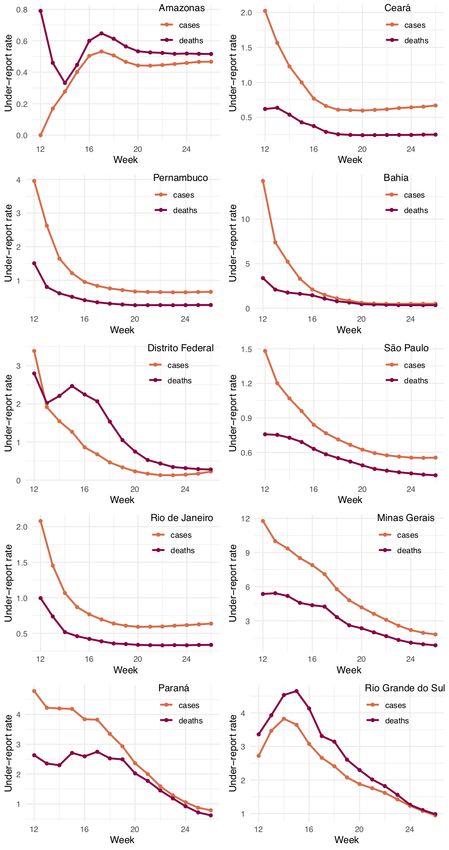
65Paixão et al. Page 17 of 21 1 2 3 4 5 6 The lack of tests for the population results in an increased rate of under-report 7 in the beginning. Over time, tests are expected to occur more, and the rates start 8 to decrease. This explanation can be observed in the graphs of the weekly rates 9 10 (Figure 4). 11 12 As it can be observed, under-report rates tend to stabilize throughout time. This 13 convergence enables more confidence in computed under-report rates. Besides, it 14 15 shows that even when more tests for COVID-19 are available, there is still a high 16 under-reporting rate for some states like Minas Gerais and the Rio Grande do Sul. 17 18 19 20 21 22 23 24 25 26 27 28 29 30 31 32 33 34 35 36 37 38 39 40 41 42 43 44 45 46 47 48 49 50 51 52 53 54 55 56 57 58 59 Figure 4: Under-report rates 60 61 62 63 64 65
Paixão et al.                                                                                              Page 18 of 21
 1
 2
 3
 4
 5
 6                    4 Discussion
 7                    The three sections of the results complement each other. Data analytics (with results
 8                    presented in Section 3.1) is used to set the parameters to be applied in the modeling
 9                    of time series and determinant for the calculation of under-reporting rates (Section
10
                      3.2). The subsequent analysis (with results presented in Section 3.3) shows the
11
12                    trend towards stability for the behavior of the calculated under-reporting rates.
13                    When rates are stable, the long-term estimation is more reliable, as there is no
14                    significant change in rate values over time.
15                      Limitations should be noted. One limitation is inherent to the dataset used. In
16
17                    times of epidemic, health services tend to be more sensitive and report more oc-
18                    currences. Thus, the increase in the number of SARI cases in 2020 is partially
19                    justified by the over-notification of health units. This super notification, however,
20                    is mitigated when only hospitalized cases are observed.
21
                        Another limitation is due to random noise i . The states with higher i are slower
22
23                    to characterize the novelty ηi . Again, the computed under-reporting rates presented
24                    in this paper are conservative. They can be improved by predicting i using autore-
25                    gressive models.
26                      Since the under-reporting is inferred from SARI data, estimates are limited to
27
28                    cases of COVID-19, who were hospitalized from the specific symptoms: fever, cough
29                    or sore throat, dyspnoea, or oxygen saturation below 95% and difficulty to breathe.
30                    It corresponds to a portion of the cases of COVID-19, as many individuals have
31                    milder symptoms or are even asymptomatic. Thus, we can consider the computed
32
                      of under-reporting rates as conservative since it only considers symptomatic and
33
34                    hospitalized cases of the disease.
35                      For this same reason, we believe that the results are better characterized for under-
36                    reporting of deaths than cases. It is reasonable since people who died are much more
37                    likely to have been hospitalized and, therefore, present in SARI data. It is quite clear
38
39                    when looking at Tables 5 and 6. The cases reported by the Ministry of Health mostly
40                    account for more cases than those determined by novelty. Conversely, the number
41                    of deaths found by novelty is sometimes even higher than the ones presented by the
42                    Ministry of Health.
43
44
45                    5 Conclusions
46                    This paper estimates the rates of under-reporting of cases and deaths in the states
47                    of Brazil. The methodology studies the time series of hospitalized SARI cases as a
48                    proxy variable for COVID-19. The paper contributes by combining data analytics
49
                      (event detection methods) and time series modeling (inertia and novelty concepts).
50
51                    Data analytics ensures transparency and consistency in the choice of the adopted
52                    parameters. In contrast, novelty and inertia enable a comprehensible approach to
53                    estimate under-report.
54
                        COVID-19 causes a rupture in the SARI series inertial behavior, changing the
55
56                    statistical properties of the time series. Event detection techniques identify this
57                    rupture. Assuming that the change occurred is due to COVID-19, the computed
58                    novelty then corresponds to estimates of the values of cases and deaths from the
59                    disease. From this, under-reporting rates were computed for both cases and deaths.
60
61                      The rates of under-reporting of cases were estimated for all states except for Mato
62                    Grosso do Sul. The values vary between 0.124 (Espı́rito Santo) and 1.811 (Minas
63
64
65
Paixão et al. Page 19 of 21
1
2
3
4
5
6 Gerais), thus reaching almost two under-reported cases for each notified case. The
7 novelty observed by our SARI analysis in the states is lower, in their majority,
8 compared to the cases reported by the Ministry of Health. It is expected since
9 many diagnosed cases of COVID-19 are asymptomatic.
10
Under-reporting rates for deaths were estimated for 25 of the 27 states in Brazil.
11
12 For the states of Acre and Mato Grosso do Sul, the under-report was not verified
13 and, therefore, death rates were not calculated for these states. Rates vary between
14 0.072 (Espı́rito Santo) and 0.983 (the Rio Grande do Sul), thus indicating that
15
there may be more than twice as many deaths as reported. The novelties for deaths
16
17 cases using SARI analysis in the states are commonly higher when compared to the
18 deaths notified by the Ministry of Health. It helps to corroborate the justification
19 that the death rates are better estimated since SARI covers most of the individuals
20 who die.
21
22 No pattern of behavior was observed for the events detected or for the evolution
23 and values of under-reporting rates between states in the same Brazilian region.
24 Therefore, it is observed that the states behave in different and independent ways
25 concerning the occurrence/notification of COVID-19.
26
The methodology developed in this paper can be adapted to support the under-
27
28 report rate for other diseases as long as it exists a proxy variable that presents an
29 inertial behavior. Besides, the methodology is also able to support the detection of
30 outbreaks, as it uses both the combination of event detection and inertia concepts.
31
32
33 Declarations
34
Ethics approval and consent to participate
35 DATASUS provided the datasets used in this study. They were produced by aggregating and anonymizing all
36 personal information of SARI registers contained in the SIVEP-Gripe. The Ministry of Health of Brazil is committed
37 to respect the ethical precepts and to guarantee the privacy and reliability of the data.
38 Consent for publication
39 Not applicable.
40
Availability of data and materials
41 The datasets analyzed during the current study and additional documentation is freely and openly available. It
42 corresponds to weekly aggregated of anonymized records of patients contained in the SIVEP-Gripe. The Ministry of
43 Health of Brazil is committed to respect the ethical precepts and to guarantee the privacy and reliability of the data.
The continuously updated SARI data was obtained from the GitLab repository of Infogripe at
44 https://gitlab.procc.fiocruz.br/mave/repo/-/blob/master/Dados/InfoGripe/dados_semanais_faixa_
45 etaria_sexo_virus.csv. In this paper, we used a copy of Infogripe made on July 27th, 2020. It can be accessed on
46 the GitHub repository at https://github.com/balthapaixao/Covid19_BR_underreport/tree/master/Aux_arqs.
47 The dataset used in this paper has not been reported in any other submission by us or anyone else.
The authors are committed to keeping the under-reporting rates updated. It means that the under-reporting rates
48 will be recalculated periodically, provided that new data referring to SARI are made available by InfoGripe. The new
49 under-reporting rates to be included will undergo the same methodological process described in this paper.
50
Competing interests
51 The authors declare that they have no competing interests.
52
53 Funding
BP, LB, FP were supported by CNPq. RS was supported by CAPES (finance code 001). MP was supported by
54 FAPERJ. EO was supported by both CNPq and FAPERJ. The content is solely the responsibility of the authors. It
55 does not necessarily represent the official views of the funding agencies. The funding agencies had no role in the
56 study design, data collection, and analyses, decision to publish, or preparation of the manuscript.
57 Author’s contributions
58 All authors contributed equally to the study. EO conceptualized the study design. MP and RFS acquired the data.
59 BP and LB conducted data analysis and interpretation. RS, LE, CS, RC, FP, and JS revised it critically for
intellectual content. All authors have the approval of the final version.
60
61 Acknowledgments
62 The authors thank CNPq, CAPES (finance code 001), and FAPERJ for partially funding this research.
63
64
65Paixão et al. Page 20 of 21
1
2
3
4
5
Author details
6 1
Federal Center for Technological Education of Rio de Janeiro, CEFET/RJ, Rio de Janeiro, RJ, Brazil. 2 Oswaldo
7 Cruz Foundation, Fiocruz, Rio de Janeiro, RJ, Brazil. 3 National Laboratory of Scientific Computing, LNCC,
8 Petropolis, RJ, Brazil.
9
References
10 1. Callaway, E., Cyranoski, D., Mallapaty, S., Stoye, E., Tollefson, J.: The coronavirus pandemic in five powerful
11 charts. Nature 579(7800), 482–483 (2020)
12 2. Zheng, Z., Peng, F., Xu, B., Zhao, J., Liu, H., Peng, J., Li, Q., Jiang, C., Zhou, Y., Liu, S., Ye, C., Zhang, P.,
13 Xing, Y., Guo, H., Tang, W.: Risk factors of critical & mortal COVID-19 cases: A systematic literature review
and meta-analysis. Journal of Infection (2020)
14 3. Marson, F.A.L., Ortega, M.M.: COVID-19 in Brazil. Pulmonology (2020)
15 4. Lachmann, A., Jagodnik, K.M., Giorgi, F.M., Ray, F.: Correcting under-reported COVID-19 case numbers:
16 estimating the true scale of the pandemic. medRxiv, 2020–031420036178 (2020)
5. Gujarati, D.: Basic Econometrics, 4th edn. McGraw-Hill/Irwin, Boston; Montreal (2002)
17
6. Esling, P., Agon, C.: Time-series data mining. ACM Computing Surveys 45(1) (2012)
18 7. Shumway, R.H., Stoffer, D.S.: Time Series Analysis and Its Applications: With R Examples, 4th edn. Springer,
19 New York, NY (2017)
20 8. Kuchar, J., Ashenfelter, A., Kliegr, T.: Outlier (anomaly) detection modelling in PMML. In: CEUR Workshop
Proceedings, vol. 1875 (2017)
21 9. Takeuchi, J.-I., Yamanishi, K.: A unifying framework for detecting outliers and change points from time series.
22 IEEE Transactions on Knowledge and Data Engineering 18(4), 482–492 (2006)
23 10. Ding, J., Xiang, Y., Shen, L., Tarokh, V.: Multiple Change Point Analysis: Fast Implementation and Strong
24 Consistency. IEEE Transactions on Signal Processing 65(17), 4495–4510 (2017)
11. Chandola, V., Banerjee, A., Kumar, V.: Anomaly detection: A survey. ACM Computing Surveys 41(3) (2009)
25 12. Gupta, M., Gao, J., Aggarwal, C.C., Han, J.: Outlier Detection for Temporal Data: A Survey. IEEE
26 Transactions on Knowledge and Data Engineering 26(9), 2250–2267 (2014)
27 13. Aminikhanghahi, S., Cook, D.J.: A survey of methods for time series change point detection. Knowledge and
28 Information Systems 51(2), 339–367 (2017)
14. Ogasawara, E., Martinez, L.C., De Oliveira, D., Zimbrão, G., Pappa, G.L., Mattoso, M.: Adaptive
29 Normalization: A novel data normalization approach for non-stationary time series. In: Proceedings of the
30 International Joint Conference on Neural Networks (2010)
31 15. Ricoca Peixoto, V., Nunes, C., Abrantes, A.: Epidemic Surveillance of Covid-19: Considering Uncertainty and
32 Under-Ascertainment. Portuguese Journal of Public Health (2020)
16. Abbara, A., Rayes, D., Fahham, O., Alhiraki, O.A., Khalil, M., Alomar, A., Tarakji, A.: Coronavirus 2019 and
33 health systems affected by protracted conflict: The case of Syria. International Journal of Infectious Diseases
34 96, 192–195 (2020)
35 17. Mohindra, P., Buckey, C.R., Chen, S., Sio, T.N., Rong, Y.: Radiation therapy considerations during the
COVID-19 Pandemic: Literature review and expert opinions. Journal of Applied Clinical Medical Physics (2020)
36
18. Ong, J., Young, B.E., Ong, S.: COVID-19 in gastroenterology: A clinical perspective. Gut (2020)
37 19. Lau, H., Khosrawipour, V., Kocbach, P., Mikolajczyk, A., Ichii, H., Schubert, J., Bania, J., Khosrawipour, T.:
38 Internationally lost COVID-19 cases. Journal of Microbiology, Immunology and Infection (2020)
39 20. Russell, T.W., Hellewell, J., Abbott, S., Jarvis, C., van Zandvoort, K., group, C.n.w., Flasche, S., Kucharski,
A., et al.: Using a delay-adjusted case fatality ratio to estimate under-reporting. Technical report,
40 https://cmmid.github.io/topics/covid19/global cfr estimates.html (2020)
41 21. Krantz, S.G., Rao, A.S.R.S.: Level of underreporting including underdiagnosis before the first peak of
42 COVID-19 in various countries: Preliminary retrospective results based on wavelets and deterministic modeling.
43 Infection Control & Hospital Epidemiology 41(7), 857–859 (2020)
22. Ribeiro, L.C., Bernardes, A.T., et al.: Estimate of underreporting of COVID-19 in Brazil by Acute Respiratory
44 Syndrome hospitalization reports. Technical report, https://econpapers.repec.org/paper/cdptecnot/tn010.htm
45 (2020)
46 23. InfoGripe: Weekly bulletin - Week 18 of 2020. Technical report, https://covid-19.procc.fiocruz.br/ (May 2020)
47 24. Ministry of Health, H.S.S.: Covid-19 epidemiological surveillance guide. Technical report,
https://covid.saude.gov.br/ (June 2020)
48 25. Rothan, H.A., Byrareddy, S.N.: The epidemiology and pathogenesis of coronavirus disease (COVID-19)
49 outbreak. Journal of Autoimmunity 109 (2020)
50 26. Ksiazek, T.G., Erdman, D., Goldsmith, C.S., Zaki, S.R., Peret, T., Emery, S., Tong, S., Urbani, C., Comer,
51 J.A., Lim, W., Rollin, P.E., Dowell, S.F., Ling, A.-E., Humphrey, C.D., Shieh, W.-J., Guarner, J., Paddock,
C.D., Roca, P., Fields, B., DeRisi, J., Yang, J.-Y., Cox, N., Hughes, J.M., LeDuc, J.W., Bellini, W.J.,
52 Anderson, L.J.: A novel coronavirus associated with severe acute respiratory syndrome. New England Journal of
53 Medicine 348(20), 1953–1966 (2003)
54 27. Rota, P.A., Oberste, M.S., Monroe, S.S., Nix, W.A., Campagnoli, R., Icenogle, J.P., Peñaranda, S., Bankamp,
B., Maher, K., Chen, M.-H., Tong, S., Tamin, A., Lowe, L., Frace, M., DeRisi, J.L., Chen, Q., Wang, D.,
55
Erdman, D.D., Peret, T.C.T., Burns, C., Ksiazek, T.G., Rollin, P.E., Sanchez, A., Liffick, S., Holloway, B.,
56 Limor, J., McCaustland, K., Olsen-Rasmussen, M., Fouchier, R., Günther, S., Osterhaus, A.D.H.E., Drosten,
57 C., Pallansch, M.A., Anderson, L.J., Bellini, W.J.: Characterization of a novel coronavirus associated with
58 severe acute respiratory syndrome. Science 300(5624), 1394–1399 (2003)
28. Dowell, S.F., Shang Ho, M.: Seasonality of infectious diseases and severe acute respiratory syndrome - What we
59 don’t know can hurt us. Lancet Infectious Diseases 4(11), 704–708 (2004)
60 29. Tchidjou, H.K., Vescio, F., Boros, S., Guemkam, G., Minka, E., Lobe, M., Cappelli, G., Colizzi, V., Tietche, F.,
61 Rezza, G.: Seasonal pattern of hospitalization from acute respiratory infections in Yaoundé, Cameroon. Journal
62 of Tropical Pediatrics 56(5), 317–320 (2010)
63
64
65You can also read


