Fife Retail Capacity Study 2020 - Fife Council
←
→
Page content transcription
If your browser does not render page correctly, please read the page content below

Fife Council

                                            Fife Retail Capacity
                                            Study 2020

                                             December 2020

                   Roderick MacLeanJanuary 2017 Ltd
                                    Associates
                              In association with Ryden

1/2 West Cherrybank, Stanley Road Edinburgh EH6 4SW     Tel. 0131 552 4440   Mobile 0775 265 5706
                                 e mail roderick @ rmacleanassociates.com
                                                         June 2016
Contents
1     Introduction and catchment areas ............................................................................. 1
1.1           Scope ............................................................................................................. 1
1.2           List of updates................................................................................................. 1
1.3           Retail catchment areas and population projections .......................................... 1
2     Planning policy framework ........................................................................................ 3
2.1           Introduction ..................................................................................................... 3
2.2           Scottish Planning Policy .................................................................................. 3
2.3           National Planning Framework.......................................................................... 4
2.4           Reforms to the planning system ...................................................................... 4
2.5           SESplan 2013 ................................................................................................. 4
2.6           TAYplan .......................................................................................................... 4
2.7           FIFEplan ......................................................................................................... 5
3     National trends in retailing ........................................................................................ 6
3.1           Introduction ..................................................................................................... 6
3.2           National trends in retail expenditure and turnover ............................................ 6
3.3           Retail Sales in Scotland .................................................................................. 6
3.4           UK total household expenditure ....................................................................... 7
3.5           Forecast retail expenditure trends ................................................................... 7
3.6           Market trends .................................................................................................. 7
3.7           Impending uncertainties .................................................................................. 9
4     Fife retail market overview ...................................................................................... 10
4.1           Introduction ................................................................................................... 10
4.2           Fife overview................................................................................................. 10
4.3           Retailer requirements .................................................................................... 10
4.4           Retail rents.................................................................................................... 10
4.5           West Fife- market activity and demand .......................................................... 11
4.6           Mid Fife- market activity and demand ............................................................ 12
4.7           East Fife- market activity and demand ........................................................... 13
5     Convenience expenditure and turnover................................................................... 15
5.1           Introduction ................................................................................................... 15
5.2           Convenience goods- definition ...................................................................... 15
5.3           Convenience expenditure potential ................................................................ 15
5.4           Convenience shopping patterns-market shares ............................................. 15
5.5           Convenience expenditure and turnover by catchment area ............................ 17
5.6           Convenience floorspace and turnover 2020 ................................................... 17
5.7           Online food shopping .................................................................................... 22
5.8           Convenience planning consents & opportunities ............................................ 22
6     Convenience expenditure capacity ......................................................................... 25
6.1             Introduction ................................................................................................... 25
6.2             Definition ....................................................................................................... 25
6.3             Spare convenience expenditure capacity....................................................... 25
6.4             Interpretation................................................................................................. 26
7       Comparison expenditure and turnover .................................................................... 29
7.1             Introduction ................................................................................................... 29
7.2             Comparison goods- definition ........................................................................ 29
7.3             Comparison expenditure potential and the internet ........................................ 29
7.4             Comparison shopping patterns- market shares.............................................. 30
7.5             Comparison expenditure and turnover by catchment area ............................. 31
7.6             Comparison floorspace and turnover 2020 .................................................... 34
7.7             Comparison planning consents & opportunities ............................................. 38
7.8             Edinburgh St James Centre .......................................................................... 38
8       Comparison expenditure capacity ........................................................................... 40
8.1             Introduction ................................................................................................... 40
8.2             Spare comparison expenditure capacity ........................................................ 40
8.3             Spare comparison expenditure capacity ........................................................ 40
8.4             Comparison spare capacity applying only Precisely forecasts of SFT ............ 42
8.5             Interpretation................................................................................................. 43
9       Summary................................................................................................................ 44
9.1             Population change ........................................................................................ 44
9.2             Updates since 2019 ...................................................................................... 44
9.3             Retail trends.................................................................................................. 44
9.4             Fife retail market ........................................................................................... 44
9.5             Forecast convenience retail capacity to 2030 ................................................ 44
9.6             Forecast comparison retail capacity to 2030 .................................................. 44

Appendix 1 Fife retail catchment areas- population forecasts
Appendix 2 Convenience expenditure inflows and outflows, including visitor spending
Appendix 3 Comparison expenditure inflows and outflows, including visitor spending
Appendix 4 Retail Parks in Fife- list of retailers
Appendix 5 Low comparison expenditure forecast
Fife Retail Capacity Study 2020

1            Introduction and catchment areas
                                                          Capacity Study. However, the proportions of
                                                          online retail spending are now higher.
1.1          Scope
1.1.1        The Fife Retail Capacity Study
                                                          1.2.3        In     addition,      the     following
2020 is the latest in the series of annual retail
capacity studies produced by consultants for              information is included:
Fife Council. These follow a similar format, with         •     Summary of the planning policy framework
updates to the retail capacity forecasts every                  on town centres and retailing covering Fife;
year and updates on retail market conditions              •     Appraisal of the latest national retail trends,
every second year. The 2020 Study includes a                    plus the retail market demand in Fife;
review of the retail market conditions by Ryden           •     Relating to the above, commentary on the
LLP in addition to the analysis of retail capacity.             effects of Covid 19 on the retail sector
1.1.2       The main purposes are to                      •     Broad overview of the general quality of the
contribute updated information to interpret the                 retail offer in the main towns;
FIFEplan Local Development Plan (adopted                  •     Interpretation of the overall findings
September 2017) and to assist development
                                                          1.3           Retail catchment areas and
management on issues relating to planning
applications for retail development.                                    population projections
                                                          1.3.1         The three retail catchment areas in
1.2          List of updates
                                                          Fife, as defined in the 2016 Study, are illustrated
1.2.1      The Fife Retail Capacity Study                 on Map 1.1 (West Fife, Mid Fife and East Fife).
2020 contains the following updates:
                                                          1.3.2        The     current      and    projected
•   Retail capacity forecasts for 2020-25, 2025-          populations for Fife and the three retail
    30 and combined for 2020-30 for                       catchment areas is shown in Table 1.1. In the
    convenience and comparison expenditure                2020 Study, the catchment area populations are
•   All values in constant 2019 prices                    now based on the NRS 2019 mid-year
    (previously 2018 prices)                              populations for the electoral wards and data
•   Projected population for the updated                  zones comprising each area. The projections to
    periods, based on the National Records                2030 are based on the 2018 based NRS
    Scotland (NRS) 2019 mid-year estimates                population projections for Fife. The projections
    and the 2018 based projections                        for each of the three catchment areas are
•   Retail expenditure forecasts to match the             controlled to the total for Fife- see Appendix 1.
    updated periods, commissioned from                    1.3.3        There is a projected decrease in
    Precisely (formerly Pitney Bowes)                     the Council area population of -940 from 2020
•   Note- at the time of writing, updated retail          to 2030 (-0.2%), with a forecast population of
    floorspace information in Fife for 2020 had           370,942 for Fife by 2030. These projections are
    not been provided by Experian Goad, so                significantly lower than the superseded 2016
    the 2019 Goad data has been applied.                  based NRS projections applied in the 2019
    New store completions in 2020 are included            Capacity Study, where the population was
    and closures deducted from the 2019 data              projected to grow to 378,885 by 2029.
    where known.
•   Updated average company turnover ratios
    based on the 2020 Retail Rankings
•   Updated list of major retail planning
    consents and commitments for 2020
1.2.2      It is not considered that there is any
need to adjust the physical shopping patterns
from the NEMS surveys in 2016 for the 2020

                                                      1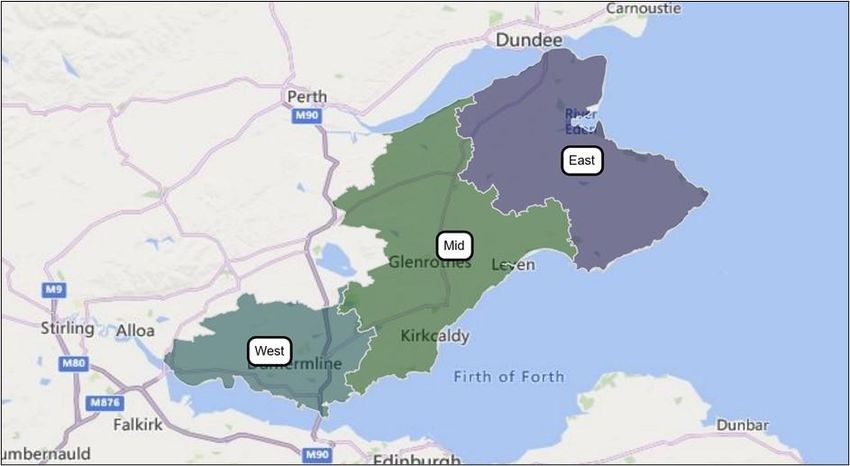
Fife Retail Capacity Study 2020

Table 1.1
Fife retail catchment area population projections for the Fife Retail Capacity Study 2020

                                                 Census              Mid-year
Retail catchment area                              2011                2019               2020               2025                2030
West Fife                                        123,608             128,806             128,231            128,202             127,907
Mid Fife                                         181,860             182,913             182,096            182,056             181,636
East Fife                                         59,730              61,831             61,555             61,541              61,399
Total Fife                                       365,198             373,550             371,882            371,799             370,942
Note
The 2011 data is taken directly from the 2011 Census, Scotland, based on postcode sector population data for each catchment.
The 2019 Mid-year data is from National Records Scotland (NRS) online based on electoral wards and data zones comprising each catchment.
Data for 2020, 2025 & 2030 derives from the NRS 2018-based population projections for the Fife Council area, apportioned to the three catchment
areas from the 2019 Mid-year data. See Appendix 1

                                        Map 1.1 Fife Retail Catchment Areas 2020

See Appendix 1 for details of the composition of the three areas (wards and data zones)

                                                                       2
Fife Retail Capacity Study 2020
2 Planning policy framework
2.1 Introduction
2.2.4 Spatial elements of town centre
2.1.1 This section provides a summary of strategies should be included in the
the planning policy framework in Fife, as it development plan or supplementary guidance.
relates to town centres and retailing. Plans should address any significant changes in
2.2 Scottish Planning Policy the roles and functions of centres over time,
where change is supported by the results of a
2.2.1 The SPP supports the promotion of health check. Plans should assess how centres
town centres and reflects the importance of can accommodate development and identify
these as a key element of the economic and opportunities.
social fabric of Scotland. It states that planning
should support the role of town centres to thrive 2.2.5 Where a town centre strategy
and meet the needs of their residents, indicates that further provision of certain
businesses, and visitors. It embeds the town activities would undermine the character and
centre first principle, and that planning for town amenity of centres or the well-being of
centres should be flexible and proactive, communities, plans should include policies to
enabling a wide range of uses which bring prevent such over-provision and clustering.
people into town centres. The planning system 2.2.6 Under the ‘town centres first’ policy
is directed to: development plans should adopt the sequential
• apply a town centre first policy when planning approach to preferred locations for uses which
for uses which attract significant numbers of generate significant footfall, including retailing
people, including retail and commercial leisure, and other uses, in the following order of
offices, community and cultural facilities; preference:
• encourage a mix of uses in town centres to • Town centres
• Edge of town centres
support their vibrancy, vitality and viability
• Other commercial centres
throughout the day and into the evening;
• Out of centre locations that are readily
• ensure that development plans, decision- accessible by a choice of transport.
making and monitoring support successful town 2.2.7 All parties are advised to be
centres; and realistic and flexible in applying the sequential
• consider opportunities for promoting test. New development in a town centre should
residential use within town centres where this contribute to diversity and be of a scale
fits with local need and demand. appropriate to that centre. A retail impact
analysis is required for retail and leisure
2.2.2 Development Plans should identify
developments over 2,500 sq m gross which are
a network of centres and explain how they can
contrary to the development plan. For smaller
complement each other. Plans should also
developments which affect vitality and viability,
identify commercial centres which have a more
an impact analysis may also be required.
specific focus on retailing and/or leisure uses.
2.2.8 Out of centre locations should only
2.2.3 Local planning authorities, working
be considered where the town centre/ edge of
with community planning partners, businesses
centre and commercial centre options are
and community groups as appropriate, should
unavailable or do not exist, together with
prepare town centre health checks to assess
meeting other criteria specified in the SPP.
town centres’ strengths, vitality and viability,
weaknesses and resilience to inform 2.2.9 The 2014 SPP was amended in
development plans and decisions on planning December 2020 to include a few changes.
applications. A list of health check indicators is These relate to paragraphs 28,29,30,32,33 and
contained in Appendix A of the SPP. 125.
3Fife Retail Capacity Study 2020
2.2.10 Under Policy Principles and 2.5 SESplan 2013
Development Planning there is now a
presumption in favour of sustainable 2.5.1 SESplan Strategic Development
development, whereas before it was just a Plan sets out a vision to 2032 for the
presumption in favour of development that development of the south-east Scotland region.
contributes to sustainable development. The second Proposed Strategic Development
Plan (SESplan 2) was rejected by the Scottish
2.2.11 Under Development Management, Ministers in 2019, leaving the existing Plan in
proposals that do not accord with the force for now.
development plan should not be considered
acceptable unless material considerations 2.5.2 The area covers the West Fife retail
indicate otherwise. Where a proposal is for catchment area and most of the Mid Fife
sustainable development, this is a material catchment, excluding a small part to the north
consideration. The changes appear more (see TAYplan).
emphatic than the original version. 2.5.3 Policy 3 (Town Centres and Retail)
states that Local Development Plans will:
2.3 National Planning
Framework • Identify town centres and commercial
centres clearly defining their roles;
2.3.1 In November 2020, the Scottish
Government published the 4th National Planning • Support and promote the defined network
of centres; and
Framework Position Statement. The document
sets out ideas and lines of thinking following • Promote a sequential approach to the
consultations in course of preparation of the selection of locations for retail and
next NPF. commercial leisure proposals.
2.3.2 On page 2, there is reference to 2.5.4 The SESplan requires local
strengthening support for development in town development plans to support a wide mix of
centres and restricting out of town retail and uses in town centres. This includes high footfall
leisure. The aim is to reduce car-dependent generating uses, including retailing. Strategic
developments and encourage use of public Centres include Dunfermline, Glenrothes,
transport, cycling and walking generally. Kirkcaldy and Livingston.
2.3.3 On Spatial Strategy (page 31), 2.6 TAYplan
there is a sub section on how planning policies
2.6.1 The TAYplan was approved in
can promote ‘re-imaging’ of city and town
October 2017. In Fife, the TAYplan covers the
centres to respond to current and future
East Fife retail catchment area and a small part
challenges. In relation to the 2020 Capacity
of the Mid Fife retail catchment area including
Study, this requires policies to address the
Falkland and Newburgh. Like the SESplan, it
changing patterns of retailing on town centres in
remains unchanged for now.
section 3 of the Study. It also requires future
policies to support town centres following the 2.6.2 There is a hierarchy of principal
continuing ravages of Covid 19 where the settlements in the TAYplan. Tier 1 includes
impact on shops and the hospitality sectors Perth and Dundee, which are anticipated to
remains drastic. accommodate most new development. Tier 2
settlements will take smaller shares of
2.4 Reforms to the planning development but have the potential to make
system significant contributions to the regional
economy. Tier 3 settlements will take a small
2.4.1 The Planning (Scotland) Act was
share of development and make a modest
passed in July 2019. It removes the requirement
contribution to the regional economy. Cupar
to prepare strategic development plans.
and St Andrews are defined as larger town
Instead, one or more local planning authorities
centres. Anstruther and Newburgh are defined
must jointly prepare regional spatial strategies.
as smaller town centres.
Amendments to what must be included in local
development plans were included.
4Fife Retail Capacity Study 2020
2.6.3 Policy 2 in the TAYplan aims to • Fife Central Retail Park
‘Shape Better Quality Places’. Of principal • Saltire Retail Park
relevance to our study is Policy 5 -Town Centres
First, which is to protect and enhance the
vitality, viability and vibrancy of city/ town
centres.
2.7 FIFEplan
2.7.1 The Fife Local Development Plan
(FIFEplan) was adopted in September 2017
and it replaced all previous local plans in Fife.
2.7.2 Policy 6 in the FIFEplan is the Town
Centres First policy. It re-iterates the policy
requirements in the SPP on promoting town
centres and establishing a network of centres.
2.7.3 In Fife, application of the sequential
test must relate to the retail market area level,
rather than at the town level, as illustrated in
Figure 6.1 of the FIFEplan.
2.7.4 Figure 6.2 sets out the framework
for the roles of town centres, local centres and
commercial centres in Fife.
2.7.5 Figure 6.3 in the FIFEplan shows
the size thresholds for proposed developments
where the sequential test would apply.
2.7.6 Town centre frameworks have
been developed for the town centres and out-of-
centre commercial centres and these must be
referenced alongside the policies. Figure 6.4A
illustrates existing uses in the commercial
centres and Figure 6.4B indicates acceptable
uses in the commercial centres. Figure 6.5
indicates acceptable uses in the town centres.
Together, these Figures in the FIFEplan identify
the main towns and commercial centres in Fife:
Town Centres
• Dunfermline
• Kirkcaldy
• Glenrothes
• St Andrews
• Cupar
• Cowdenbeath
• Leven
• Lochgelly
• Dalgety Bay Town Centre
Commercial Centres
• Fife Leisure Park
• Halbeath Retail Park
5Fife Retail Capacity Study 2020
3 National trends in retailing
3.2 National trends in retail
expenditure and turnover
3.1 Introduction
3.2.1 The Scottish Government has
3.1.1 This section considers some of the
released figures which show that the economy
national trends driving activity in the UK and
contracted by 19.4% during April to June 2020,
Scottish retail and leisure sectors. It provides a
coinciding with the previous peaks in the virus.
high-level context for local market trends and
The services sector, which includes retailing
projections for Fife, later in the report. The main
and leisure among others, contracted by 18.4%.
feature of 2020 is the impact of Covid 19 on the
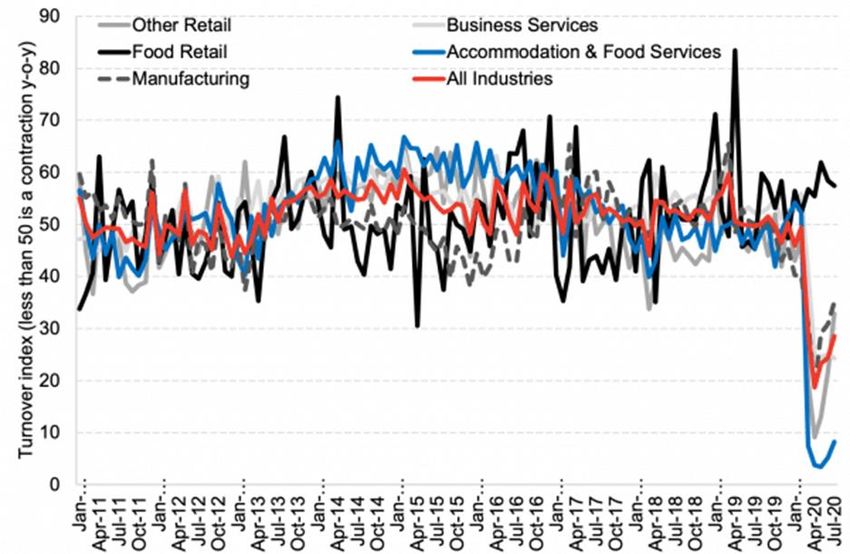
economy and its indefinite continuation, which 3.2.2 The Scottish Government publish a
makes for uncertain forecasts all round. The monthly business turnover index by sector and
Capacity Study looks up to ten years ahead and the graph in Figure 3.1 shows the changes from
adopts a positive outcome that there will be a June 2011 to July 2020. Turnover in July this
recovery. year was lower than in July 2019. The only
exception was food retailing which increased.
Non-food retail turnover plummeted. Sources:
Scottish Government and Fraser of Allander
Institute.
Figure 3.1 Business turnover index by sector
3.3 Retail Sales in Scotland slow road to recovery. On a like for like basis,
the decline in retail sales was 14% compared to
3.3.1 Much of this year has been June 2019. From the Retail Monitor, food sales
dominated by the effects of lockdowns and grew by 4%, but online-adjusted non-food sales
measures such as social distancing and mask- declined by 19.4%, despite a marked
wearing to reduce the impact of Covid19. In the improvement over the 33% decline recorded in
Scottish Retail Monitor, KPMG and the Scottish May 2020.
Retail Consortium report that, despite the
decline of over 18% in retail sales year on year
to June 2020, Scotland’s retail sector is on the
6Fife Retail Capacity Study 2020
3.3.2 Categories including technology, 3.5 Forecast retail expenditure
sports equipment, toys and DIY made gains. trends
Other categories, especially clothing retailers,
have suffered badly during and following the 3.5.1 There is a large difference between
initial total lockdown. the forecast growth in convenience retail
expenditure and comparison retail expenditure
3.3.3 The easing of lockdown in the
over the next ten years. The forecasts for Fife in
summer did not fully kick-start the retail sector this report are based on UK trends, adapted by
and there is a possibility of more restrictions
Precisely (Oxford Economics) in their forecasts
which will affect retail sales. to allow for the socio economic characteristics
3.4 UK total household of the Council area.
expenditure 3.5.2 As shown in Table 5.1 later in the
report, the forecast growth in expenditure per
3.4.1 Figure 3.2 shows UK household
capita on convenience goods per annum by
weekly average weekly spending from 2002-
Precisely is mostly negative for each of the
2019. The chart shows that spending has
three Fife catchment areas from 2020-25, and
stagnated since 2017. UK average weekly
less than 1% per annum from 2025-30. So, the
expenditure per household was £585 in
case for more convenience floorspace is mostly
2018/19. The three- year average for the years
about improved choice.
ending 2017/19 was £572 for the UK and £508
for Scotland. (Source ONS).
Figure 3.2 Total household weekly spending 2002-2019 ( in 2019 prices) ONS
3.5.3 Expenditure per capita on 3.6 Market trends
comparison goods is at a low point just now
because of the pandemic but is forecast to 3.6.1 The retail sector is complex and
recover and rise by nearly 6% per annum in Fife dynamic. There are major, secular trends
to 2025. Thereafter it is forecast to rise at a driving the sector.
slower rate of around 2% per annum from 2025- 3.6.2 Concentration in dominant
30. A substantial part of the forecast increase in centres- long run evidence shows consumers
comparison expenditure will be online willing to travel for an increasing range of goods
shopping, leaving a reduced amount to service and services. Retailers, leisure operators and
shop floorspace.
7Fife Retail Capacity Study 2020
service providers are investing in those 3.6.7 In town centres, the effect of this
dominant centres, and disinvesting from many trend, in combination with increasing online
other medium and small centres. retailing, is to put pressure on the viability of
some high street retailers. Town centres which
3.6.3 To meet these markets, developers
offer high quality shopping and associated
and investors in turn focus on centres where
visitor experience are likely to continue to thrive.
they can anticipate that these national
Examples include the prosperous small towns
occupiers are likely to take high value and often
of St Andrews, North Berwick, and Peebles to
larger premises. Edinburgh and Glasgow are
mention a few
among those dominant centres, which include
not only major city centres but also regional 3.6.8 For others (the majority), especially
malls and major retail parks. Our consultations those with limited distinctive offer, the future is
with the Scottish Retail Consortium (SRC) less certain. High streets are taking a battering.
suggest that shoppers will probably return to the Mid-size towns like Dunfermline, Kirkcaldy and
major centres at pre-Covid levels eventually. Glenrothes fall into that category. There will
probably be less shops in the future as the
3.6.4 These market trends are
public choose to visit fewer centres for
manifesting themselves in continuing closures
shopping.
of chain outlets across Scotland, whether
through administration, company voluntary 3.6.9 Online shopping- includes both
agreements (CVAs) with landlords to reduce online-only and click-and-collect, or delivery).
floorspace and costs, or closing outlets at lease The process is exacerbating the costs and
breaks or expiries. Department and variety market concentration challenges facing some
stores have struggled. Mothercare closed its retailers. Online shopping for groceries is
last stores in 2020. The House of Fraser went estimated to account for about 17% of sales
into administration in 2018 and it is now owned (online only and click and collect/ delivery).
by Sports Direct but said to be struggling.
3.6.10 For non-food shopping, the
Debenhams has been in administration, but
proportion is estimated to be around 35%
now set to close. Also, most recently, the
(before allowing for the overlap between non
Arcadia Group has gone into administration.
store sales and store-related internet sales
3.6.5 There has been a steady pruning of (Precisely). However, it could be closer to 40%
branch networks extends across many retailers of non-food sales (SRC), depending on the
and formats as well as services such as sources. During the lock down, internet sales
traditional pubs and banks. Examples of other were estimated at around 70% of non-food
retailers going into administration in 2020, (but sales, but this has fallen back. The proportion of
mostly still trading) include The Edinburgh internet spending is forecast to continue to
Woolen Mill and Ponden, M&Co., DW Sports, increase. Covid 19 has accelerated the change
Harvey’s Furniture, Benson Beds, Oak in shopping habits to much more extensive use
Furnitureland, Monsoon Accessorise, Quiz, of the internet compared to previous levels.
Oasis and Warehouse, among many others.
3.6.11 Multi-channel retailing (meaning
3.6.6 There are high costs in running both in store and internet) is becoming
stores with burdens and risks associated with increasing sophisticated and retailers need to
lease periods against the background of carefully manage their sales information and
increasing online shopping. One of the effects target the most profitable sectors. The best
of online shopping is that there is less retailers are often very online-specific in terms
requirement for traditional retail floorspace of targeting their offer. Online grocery
except for markets where the merchandise is operations generally must be large scale and
targeted, such as distinctive goods and those efficient to be profitable. A noticeable new
aimed at visitors for example. The major entrant is Amazon. For independent retailers in
property investment company Intu, owner of small towns, the market lesson is that
major shopping malls, went into administration development of internet based sales is
in June 2020. becoming essential for survival.
8Fife Retail Capacity Study 2020
3.6.12 Much of the service sector, such as experienced great difficulties, especially with
banks, estate agents and travel agents have some major retailers failing to correctly read
rationalized their services to be orientated fashion trends and demands.
online, which means that they are unlikely to
3.6.17 The restaurant, cafes and
reappear in small towns in the future.
beverage market sectors have probably
3.6.13 Diversion away from shopping- peaked, and all have been very severely
in part this is a response to the above two affected by restrictions relating to Covid. When
challenges. It is also a trend as landlords and the crisis ends, a return to popularity can be
developers seek alternative sources of revenue expected, as the virus has revealed just how
and footfall through introducing leisure (cafes, important these are to support contentment in
bars, restaurants, cinemas), then other active society. However, a cycle of lockdowns
uses such as hotels, offices and potentially extending into the future is a possibility until
residential uses. For example, Drive Thru fast vaccines are found. That scenario would pose a
food and coffee is now common and popular major threat to the hospitality sector. Recent
with the public who want to refreshments on the news announcements indicate that a successful
go. Before the pandemic, hot food outlets such vaccine has just emerged, so there is more
as Greggs, McDonalds and KFC, and cafes reason to be optimistic.
such as Tim Horton and Costa, were
3.6.18 The increased local focus is
expanding. Whether this trend will continue post
supported by the growth of cycling and public
Covid is uncertain. Diversification is also
transport, although the latter has been severely
evident within superstores where service uses
affected by Covid. Reduced commuting creates
are offered within the units.
more opportunities for local retailers. Ever-
3.6.14 There are examples of increasing traffic congestion in major cities is
diversifications among small retailers, such as also an incentive creating opportunities for more
provision of cafes within shops and retail art local shopping in suburbs and small towns.
galleries. Achievement of a complementary mix However, cars remain the dominant form of
of retail and services within small town centres transport for visits to supermarkets and to major
is more relevant. shopping malls for substantial purchasing trips.
3.6.15 Lifestyle changes- the recent 3.7 Impending uncertainties
move towards much more working from home
driven by Covid 19 is a major change and much 3.7.1 Two matters deserve reference but
of it will probably remain. Before the pandemic, are not part of the Capacity Study. The UK has
people were switching towards shopping for now left the EU after a last-minute deal in
groceries and some comparison shopping more December. There will probably be continuing
locally than before. Small store formats have disruption to the availability of goods and
proved popular, such as Tesco Express and services as the markets adjust to the new
Sainsbury’s Local. Co-op stores have also relationship, which includes some formidable
proved important in this shift, particularly in administrative challenges.
small towns. 3.7.2 The other matter is the uncertainty
3.6.16 Examples of thriving retailers surrounding the issue of Scottish
include the expansion of discount foodstores independence, where polls indicate growing
such as Lidl and Aldi and budget mixed goods support since 2014. This could also generate
retailers such as B&M and Home Bargains in further changes to the markets by investors,
suburban locations and in small towns all over suppliers, and retailers, depending on the
the country. These types of store are part of the outcome.
‘value retailing’ sector, which has become
especially important. More households have
limited budgets, because of furloughing and
higher unemployment. Other successes in the
value retail sector include TK Maxx and
Primark. Otherwise, the clothing sector has
9Fife Retail Capacity Study 2020
4 Fife retail market overview
as shown in the list of planning consents in
4.1 Introduction Table 5.11. Development of planning consents
4.1.1 This section of the report contains has been slow, accompanied by scheme
a review of the retail market in Fife. It includes revisions and delays.
broad assessment of retailing in the main town 4.2.5 There is also interest in securing a
centres: Dunfermline, Cowdenbeath, Kirkcaldy, higher proportion of convenience floorspace in
Glenrothes, Leven, St Andrews and Cupar. The retail parks by seeking variations to existing
market assessments also include the leisure- consents. In line with national trends, there is
related, non-retail service sector, who are no evidence of market interest in developing
important occupiers of town centres. more traditional mid-size supermarkets and
4.1.2 Assessment is also included of the superstores.
retail parks at Carnegie Drive and Halbeath in 4.2.6 On comparison retailing,
Dunfermline, Fife Central Retail Park in development of planning consents has been
Kirkcaldy and Saltire Retail Park in Glenrothes, slow, accompanied by scheme revisions and
plus reference to Fife Leisure Park. delays, as in the convenience sector. There has
4.1.3 The convenience and comparison been little in the way of new comparison
floorspace in the main towns is shown in the floorspace development over the past year.
tables in sections 5 and 7. The retail park
4.3 Retailer requirements
occupiers are listed in Appendix 4.
4.3.1 Owing to the market turmoil caused
4.2 Fife overview by Covid 19, there are no published lists of
4.2.1 Fife has three large town centres retailer demand for units by geographic area,
(Dunfermline, Kirkcaldy and Glenrothes) and such as those available past years. Some
four commercial centres. It has the largest retailers do have specific requirements which
online retail offer in Scotland at the Amazon they are progressing, but they are just not
Regional Distribution Centre. However, it is also reported on a published list.
exposed to the channeling of most investment
4.4 Retail rents
into major cities such as Edinburgh, as
mentioned in the previous section. 4.4.1 Table 4.1 shows the achieved
average Zone A retail rents in the main town
4.2.2 Fife’s large town centres face a
centres in Fife, for 2020. Comparison with rents
continuing competitive challenge to retain their
in 2018 is shown. Apart from Cowdenbeath,
retail and service mix and maintain their market
recorded rents are lower compared to 2018.
positions. In the absence of retail floorspace
Caution should be applied though, because the
data from Experian for 2020, there is no up to
records relate to specific properties, which may
date information on vacancy rates in Fife. In the
not represent the wider levels of rents in the
past, the vacancy rates were mostly higher than
town centres. However, as the recorded rents
the Scottish average, apart from St Andrews.
are mostly lower than the past, it is probable that
4.2.3 The Scottish vacancy rate in high this is the actual case.
streets was 12.4%, and 12.9% across all
4.4.2 St Andrews has among the highest
centres in March 2020 taking account of
retail rents, which is reflected by its prosperity,
vacancy levels in shopping malls 15.6% and
visitor spending and the high
9.4% in retail parks (source: SRC and Local
turnover/floorspace ratios for its size, as shown
Data Company).
in Tables 5.10 and 7.10.
4.2.4 On convenience shopping, the
4.4.3 Retail rents in Dunfermline town
market interest in Fife is mainly on the
centre are holding-up as the second highest,
development of additional discount foodstores,
but down from 2018. There have been several
store closures, as identified later in this section.
10Fife Retail Capacity Study 2020
Most of its stronger performance relates to the corresponding lower turnover/ floorspace ratios
Kingsgate Centre. The rents in Kirkcaldy and compared to Dunfermline, as indicated in
Glenrothes town centres are lower. The position Tables 7.8 and 7.9.
relative to Dunfermline is consistent with the
Table 4.1
Zone A retail rents in the main town centres in Fife, 2020
2018 2020
£ per sq ft £ per sq ft
Dunfernline up to 60 12-35
Cowdenbeath 5-10 6-11
Kirkcaldy 16 to 34 11-26
Glenrothes 10-22 *18
Leven 7-24 7-12
Cupar 11-20 around 11
St Andrews 35 to 60 32-44
Source: Ryden
Mostly records of achieved rents and asking rents. There are ranges, and the highest figures are for the best premises.
*Only one record found
4.5 West Fife- market activity 4.5.4 The leisure sector has been active
and demand in the town centre. New restaurants and cafes
include: the Kinema buffet restaurant and Koko
4.5.1 Dunfermline town centre- there Sushi on Carnegie Drive, Jack O’Bryans on
has been market activity in the Kingsgate Chalmers Street, Juniper Wine Café on New
Shopping Centre. New shops have been Row, and Delicious café opened (and closed)
opened by The Wee Tea Company, Subway on Guildhall Street with Old Town Café now
(relocation from Douglas Street) and a unit is open in its place. Reubens deli/cafe on the New
currently being fitted out by B & M. However, Row closed. The City Hotel Group has plans to
Bonmarche, H & M and DW Sports all closed turn the former post office on Queen Anne
stores and the units are now vacant. Ramsay Street into a 180-seat restaurant with garden
Travel also closed in the Kingsgate and but courtyard area.
opened on Douglas Street (in the former
4.5.5 The town centre will be boosted by
Subway unit).
the development of The Linen Quarter at the
4.5.2 On Dunfermline High Street, Bob & former Pilmuir Works, bringing premium new-
Berts’ café, Dears Pharmacy (no 85), Everyday build residential.
Loans (57-59) and Blue Tattoo Box (no 5) all
opened new outlets. H Samuel jewellers closed 4.5.6 Carnegie Retail Park contains a
in summer 2020 and Andrew Thompson mix of retailers which complement the town
centre (see Appendix 4). No activity has taken
electrical / furniture store is closing.
place recently and one unit remains available.
4.5.3 Dunfermline town centre has a At Inglis Street, beside the retail park, there is a
good range of independent outlets. Recent consent extended to April 2021 to demolish the
store openings include Dollbox /The Beauty former Tile Warehouse and replace it with three
Lounge at Maygate, Ramsay Travel opened on retail units (see Table 7.11).
Douglas Street and Well Pharmacy relocated
on Douglas Street. Stores were opened by 4.5.7 Halbeath Retail Park has a good
mix of retailers (see Appendix 4). It has consent
Klozet fashion on Pilmuir Street and Barber
for an extension, including provision for bulky
Station on Bruce Street. Closures include
Serpentus Exotics and Maggies Farm on New goods and convenience retailing, including Lid
Row and Williamson Design florist on Douglas and possibly an M&S Simply Food store- see
Street. Table 5.11. The consent has not yet been
developed and there is an application to
11Fife Retail Capacity Study 2020
introduce flexibility in the sales floorspace in Money Shop, Folk Love restaurant and
terms of convenience/ comparison goods. Ladbrokes. Burtons and Dorothy Perkins is due
to close but Amber Tavers has plans to convert
4.5.8 The former Harveys
into a bar.
furniture/Bensons for Beds unit has closed and
is vacant. The Thomson’s World of Furniture 4.6.4 Market activity in the town centre
store on Kingseat Road, beside Halbeath Retail has mainly come from independent and
Park, has recently become a Sterling Home specialist retailers. There have been new
store. Opposite here, on Halbeath’s Main openings on the High Street with The Works (no
Street, development has just begun on three 122-126), Bob & Berts’ café (no 157-159), VIP
retail units, a café/ restaurant and two drive electronic cigarettes (the Mercat), and a
thrus, where Costa coffee and Burger King will concessions store is due to open in the former
open. Debenhams unit including a café. Independent
retailers investing in the town centre include
4.5.9 Fife Leisure Park- there have
Skynails (no 134), C Sinclair Fishmonger (no
been no openings, however Bella Italia and
174) Kerry Photography (no 243) and Strange
Chiquito restaurants both closed, and the
Ray Vintage fashion (no 305).
former Eastern Buffet remains vacant.
4.6.5 Elsewhere in the town centre,
4.5.10 Cowdenbeath is a smaller centre
Pommy’s World Buffet restaurant opened on
where the retail offer has been greatly improved
the Esplanade in the Spring of 2020, WR&P on
by development of a Lidl store and a B&M store
Kirk Wynd and Amy King Bridal on Tolbooth
at North End Park in 2019. Cowdenbeath is
Street. At the east end in the Merchants Quarter
close to Dunfermline and residents have easy
a new hub for independent businesses known
access to the range of stores there.
as Enlightenments, House of Adam Smith has
4.5.11 On High Street, Fife Laundry opened. The current occupiers include 3 Beans
Services (dry cleaners) opened in the former Coffee Co and some artisan craft vendors.
Pressed for Time unit, other new stores include
4.6.6 Plans for residential development
First Foot podiatrist, Subway and Ruby’s Bits n
in the redevelopment of the site of the former
Bobs pet products. Greggs the baker has
Co-op and demolition of the vacant Reid
closed, and the Cancer Research charity shop
Furniture shop at the east end of the High Street
will not re-open after Covid closure.
will remove surplus retail space from the town
4.6 Mid Fife- market activity centre.
and demand 4.6.7 The 80,620 sq.ft. Postings
4.6.1 Kirkcaldy town centre continues Shopping Centre was sold by Columbia
to suffer the effects of three large store closures. Threadneedle at the start of 2019 to Evergold
The town centre is linear and too long for most Property has been re-branded The Kirkcaldy
shoppers to trail from on end to the other. It also Centre. Only a handful of tenants are currently
has too many shop units, including many of in occupation and the landlord is considering
which are less than ideal for modern retailer options.
requirements. There is nothing distinctive in the 4.6.8 A planning application was
retail offer, which makes it vulnerable to the submitted in November 2017 by Lasalle
retail market trends described in section 3. Investment Management, owners of the Mercat
4.6.2 The Tesco supermarket closed in Shopping Centre for a cinema, leisure and food
the Postings Shopping Centre in 2015. On the and drink/public house use on the site of the
High Street at the Mercat Shopping Centre the swimming pool which has been demolished.
BHS store closed in 2016 and Marks & Spencer The application was approved (with conditions)
store closed in 2019. These large units all in March 2020.
remain vacant. 4.6.9 A revised application has been
4.6.3 More recent closures include submitted for relocation of the Lidl supermarket
Debenhams, Quiz clothing, HM Samuel on the Esplanade to the former Stagecoach
jeweller, Clarks shoes, Carlton Bakeries, The depot site (see Table 5.11).
12Fife Retail Capacity Study 2020
4.6.10 Fife Central Retail Park is the 4.6.16 Leven- Store openings include
largest retail park in Fife, with a wide range of Pixel Planet gaming store and Loved By Bridget
retailers (see Appendix 4). It has performed gift shop, while Carlton Bakeries has closed.
well and attracted continuing investment. There The future of Peacocks store in the town is
has been limited activity over the past year, understood to be at risk. There is planning
though. The ‘One Below’ bargain store has consent for four retail units (Class 1) east of
closed. DW Sports shop and Frankie and Durie Street and adjacent to the Lidl foodstore -
Benny’s restaurant closed during 2020 and both see Table 5.11.
remain vacant.
4.6.17 Riverside Retail Park- the list of
4.6.11 Premier Inn received planning retailers is in Appendix 4. A Starbucks drive thru
permission in 2016 for a 60-bedroom hotel with coffee shop has just received planning
restaurant adjacent to the retail park at John permission here and a McDonalds drive thru
Smith Business Park, however development restaurant opened opposite Sainsbury’s on
has been not progressed. Riverside Road in 2019.
4.6.12 Glenrothes- the Kingdom Centre 4.7 East Fife- market activity
mall appears well maintained and clean, but the and demand
property is rather from a past era. The former
Dunnes store remain vacant. The retail offer is 4.7.1 In East Fife, a high proportion of
generally rather undistinctive, which makes it non-food shopping is done in Dundee. The
vulnerable to the retail market trends described University town of St Andrews is the main
in section 3. It would greatly benefit from further shopping centre.
investment, but the challenge is high under the 4.7.2 St Andrews- has many shop units
retail market trends described in this study. with quality multiple retailers in small units
4.6.13 The former Co-op department store which is unusual, plus high-quality independent
was due to be demolished. However, this has shops. The retail offer is probably the
been put on hold. New stores were opened by consequence of being an affluent University
Toytown, One Below bargain store (in the town, together with being a destination for
former Poundworld unit) and Home DIY. The tourists and golfers. Visitor spending in St
following stores have closed: Clarks shoe shop, Andrews is relatively high (see Appendix 2).
Carphone Warehouse, HM Samuel, and it is 4.7.3 New stores were opened by
understood Argos is potentially not re-opening clothing brand Seasalt, Highland Soap
following lock-down. Company and Mountain Warehouse on Market
4.6.14 Easy Living Developments’ £10 Street. Closures on Market Street include
million Henge Retail Park, on the site of the Reiths menswear, Burns sweet Shop,
CISWO club on North Street in Glenrothes, Carphone Warehouse, while New Look closed
opened at the end of 2018- see Table 5.11. It but was replaced by Taste of Scotland.
is anchored by Food Warehouse (by Iceland) 4.7.4 On Bell Street Mac Cosmetics
and Marks & Spencer Foodhall, with an Indigo opened in the former Bobbi Brown cosmetics
Sun tanning salon. KFC and Tony Macaroni store, Hays Travel took over the Thomas Cook
withdrew from the development. Units 2 & 3 unit, while Jack Wills and Ladybirds florist
which have class 3 restaurant consent are closed. Weft Studio textiles opened, and Short
available. Two drive thru restaurants are Stay St Andrews opened a holiday letting
proposed neighbouring this retail park, one of business on South Street, while The Junor
which will be a Starbucks coffee shop. Gallery and Thistle Dae gift shop have closed,
4.6.15 Saltire Park- the list of retailers is and Artery gift shop relocated.
in Appendix 4. The Pet Hut, American Golf both 4.7.5 New food and beverage openings
opened here during summer 2018 while include BrewDog St Andrews in the former
Bensons for beds has closed. One of the former Nardini’s ice cream parlour and
retail units has been converted into a trampoline breakfast/brunch/lunch outlet Next Door.
centre. Contemporary seafood restaurant and
takeaway Harbour opened on Alexandra Place.
13Fife Retail Capacity Study 2020
Meanwhile St Andrews Waffle Company has restaurant opened, while Rhubarb gifts and
closed, and the future of Zizzi is uncertain. Print Stationery closed.
4.7.6 Cupar- is a local service centre for 4.7.8 At South Road, Cupar, there has
shopping. The small town has a moderately been a succession of alternative planning
affluent catchment, which is not close to any consents for a mixed retail development by
large centre, London & Scottish Developments. The latest
version was approved in September 2020 for
4.7.7 New stores on Bonnygate in Cupar
Class 1 retail including take-away (Class 3 and
include Candy & Crunch dessert shop, Anthony
Sui Generis)- see Tables 5.11 and 7.11. It
Nails, The Bubble Bar (in the former Munch
includes seven retail units with a total of 3,815
unit), Interiors at Forty Four opened (former
sq m gross. It is understood that largest unit
Debra charity Shop), Enlighten health &
(2,136 sq m) has been pre-let to B&M, plus
wellbeing social enterprise, while Kingdom
agreed pre-lets with Indigo Sun, Burger King,
Health Clinic moved from Bonnygate to shared
and coffee chain Costa.
premises. Hardware business R Dott Thomson
has been taken over and rebranded as Cupar
Hardware Store. On Crossgate, Lloyds
Pharmacy relocated to larger premises,
Specsavers opticians and Number 10 bar
14Fife Retail Capacity Study 2020
5 Convenience expenditure and turnover
forms of retailing which are not wholly
5.1 Introduction dependent on retail floorspace. In fact, internet
5.1.1 This section of the report assesses shopping comprises almost all SFT. For retail
the convenience expenditure and turnover planning purposes, it is removed from the
relationships for each the three retail catchment expenditure per capita data, so that the
areas and for Fife, taking account of the expenditure relates to conventional store
convenience shopping patterns identified by floorspace, as shown in Table 5.1.
2016 household shopping interview survey. 5.3.4 The proportion of SFT, or non-store
5.1.2 The total turnover in each sales, is forecast to increase up to 2030. It
catchment area derives from the residents’ should be noted that the proportions of SFT
expenditure potential, plus inflows, less shown in this table are mostly non-store sales
outflows. The distribution of the turnover and the proportions are low, but more than in
among the various centres and supermarkets is the 2019 Capacity Study. Not included are
then controlled to the total deduced turnover for internet related SFT sales with home delivery or
each catchment area from the shopping click and collect for example, because the
patterns. goods mainly come off existing supermarket
shelves and that proportion is much larger but
5.2 Convenience goods- excluded here. The national proportions are
definition applied in Table 5.1, based on data from
Precisely.
5.2.1 Convenience goods include:
5.3.5 Forecasts of the total convenience
• Food and non- alcoholic drinks
expenditure potential of the residents of each
• Alcoholic drinks
catchment area are shown in Table 5.2. The
• Tobacco forecast expenditure totals are lower than those
• Non-durable household goods and in the 2019 Capacity Study, because of lower
• Newspapers and magazines. population forecasts and lower expenditure per
5.2.2 This definition is provided in the capita.
Precisely (formerly Pitney Bowes) Retail
5.4 Convenience shopping
Expenditure Guide 2020/21, based on ONS
classifications. patterns-market shares
5.4.1 In the 2016 NEMS household
5.3 Convenience expenditure
shopping interview survey, the respondents
potential were asked where they last visited for their main
5.3.1 Table 5.1 shows the forecast food shopping (Q1), and the time before that
convenience expenditure per capita data for (Q2). They were also asked where they last
each of the three retail catchment areas in Fife. visited for their top-up shopping (Q3). The
It is based on data commissioned from findings were weighted and combined to
Precisely for this study, which incorporates provide estimates of all convenience shopping
forecasts by Oxford Economics. patterns relating to each of the catchment
areas, as shown in Table 5.3.
5.3.2 The forecast growth rates per
annum for each catchment area from 2020-25 5.4.2 Market shares refer to the
are minimal or negative as shown in the table, proportions of expenditure by residents of a
before deducting special forms of trading. The defined area which are spent in that area and in
growth rates per annum pick up for 2025-30 but other areas. Table 5.3 shows the convenience
are still low. The expenditure per capita data is market shares for each catchment area, based
lower than in the 2019 Capacity Study. on the shopping patterns identified from the
household survey.
5.3.3 Special forms of trading (SFT)
include internet shopping, mail order and other
15Fife Retail Capacity Study 2020
Table 5.1
Fife convenience expenditure per capita per annum (in 2019 prices)
Catchment areas 2020 2025 2030
£ £ £
West Fife 2,280 2,277 2,356
Mid Fife 2,366 2,372 2,461
East Fife 2,158 2,122 2,168
*excluding special forms of trading
West Fife 2,139 2,129 2,193
Mid Fife 2,219 2,218 2,291
East Fife 2,024 1,984 2,018
Note (Pitney Bowes is now Precisely )
Original expenditure per capita data in the top three rows provided by Precisely in their GeoInsight report 2020 for this study is in 2019 prices
Growth rate per annum 2020-25 2025-30
West Fife -0.03% 0.68%
Mid Fife 0.05% 0.74%
East Fife -0.34% 0.43%
*The proportion of convenience goods expenditure relating to Special Forms of Trading (SFT- mainly internet spend)- is small when store-based
internet spending is removed, such as items picked off supermarket shelves by staff for delivery or click.and collect. Precisely publish
their estimates of non-store based internet spending on convenience goods for the UK in their Retail Expenditure Guide 2020/21- Table 3.5
Deductions for SFT -6.2% -6.5% -6.9%
Table 5.2
Fife residents' convenience expenditure potential (in 2019 prices)
Excluding SFT (special forms of trading)
Catchment areas growth growth
2020 2020-25 2025 2025-30 2030
£ million £ million £ million £ million £ million
West Fife 274.2 -1.3 272.9 7.6 280.6
Mid Fife 404.1 -0.4 403.8 12.4 416.2
East Fife 124.6 -2.5 122.1 1.8 123.9
Total Fife 803.0 -4.2 798.8 21.8 820.6
Note
From Tables 1.1 and 5.1. Figures are rounded.
Table 5.3
Fife Council area residents- all convenience shopping patterns (Q1-Q3 combined) 2016 survey
Origin
Catchment areas West Fife Mid Fife East Fife Total
Fife
Destination
West Fife 92% 8% 0% 35%
Mid Fife 4% 87% 10% 46%
East Fife 0% 3% 73% 13%
Outside Fife 5% 2% 17% 6%
Total 100% 100% 100% 100%
Source: NEMS household shopping interview survey 2016 for Fife Council
The above data relates to the weighted survey data and filtered to remove don't knows, varies, internet and mail order
Main food shopping (Q1&Q2) and top-up shopping (Q3) is weighted 80%:20% for the combination
5.4.3 In West Fife, 92% of convenience Fife. In Mid Fife, 87% of convenience shopping
shopping is done locally, with small proportions is done locally and 8% in West Fife, with small
undertaken in Mid Fife and in centres outside proportions elsewhere. In East Fife, 73% of
16Fife Retail Capacity Study 2020
convenience shopping is done locally and 17% 5.6.2 Average company turnover/
outside Fife and 10% in Mid Fife. floorspace ratios from the Retail Rankings 2020
are applied to the main supermarkets and
5.4.4 For Fife, 94% of convenience
discount foodstores, with adjustments to include
expenditure is retained in the Council area,
VAT and remove petrol/ non-retail sales,
leaving only 6% leakage. Graphs showing the
expressed in 2019 prices. These ratios
most visited stores for main food shopping by
embrace research published by Mintel on the
respondents to the survey are shown in Figure
split of convenience and comparison floorspace
5.1, reproduced from the Fife Retail Capacity
among the various operators and the
Study 2016 for ease of reference.
associated division of turnover.
5.5 Convenience expenditure 5.6.3 Estimated average ratios are
and turnover by catchment applied to all other shops. Those in the smaller
area towns are apportionments from the turnover
ratios in the largest town centres in each
5.5.1 The relationship between total
catchment area. Tables 5.8 to 5.10 show the
expenditure and turnover in each retail
total average turnover in each catchment area
catchment area is defined at the beginning of
at average levels, based on this method.
this section.
5.6.4 Comparison with the survey-based
5.5.2 Appendix 2 shows the estimates of
totals (actual turnover) is included for each
convenience expenditure inflows to each
area. This reveals significant under-trading in
catchment area in detail, based on the
West Fife, slight under-trading in Mid Fife and
household survey in Table 5.3 and visitor
minimal under-trading at below average levels
spending.
in East Fife.
5.5.3 Visitor spending- in 2019, the
5.6.5 On a technical point, there is no
Council commissioned a study entitled The
widely agreed benchmark for determining any
Economic Impact of Tourism in Fife & Districts
over/ under-trading. Some consultants ignore
by Destination Research Consultants. This
the subject and rely on the survey- based ratios
information is applied to the current 2020 Retail
only, although there are issues related to
Capacity Study to derive estimates of
accuracy at the individual store level and
convenience and comparison expenditure by
consistency in the treatment of turnover of new
visitors to the three Fife catchment areas. It
development proposals.
updates research applied in previous versions-
see Appendix 2.
5.5.4 Expenditure and turnover
forecasts - Tables 5.4 to 5.7 show the survey-
based convenience expenditure and turnover
relationships for each catchment area and for
Fife in 2020, 2025 and 2030. These are lower
compared to the 2019 Capacity Study.
5.6 Convenience floorspace
and turnover 2020
5.6.1 The distribution of convenience
floorspace in the three retail catchment areas is
shown in Tables 5.8 to 5.10. The floorspace
data is mainly based on Goad surveys for 2019.
At the time of writing, Experian had been unable
to provide the Council with floorspace data for
2020. Other sources include Council data for
most of the main out of centre supermarkets for
example, which will not have changed apart
from new additions.
17You can also read


