Real-World fNIRS Brain Activity Measurements during Ashtanga Vinyasa Yoga - MDPI
←
→
Page content transcription
If your browser does not render page correctly, please read the page content below
brain
              sciences
Article
Real-World fNIRS Brain Activity Measurements during
Ashtanga Vinyasa Yoga
Henrikke Dybvik *                and Martin Steinert

                                          TrollLABS, Department of Mechanical and Industrial Engineering, Norwegian University of Science and
                                          Technology (NTNU), 7491 Trondheim, Norway; martin.steinert@ntnu.no
                                          * Correspondence: henrikke.dybvik@ntnu.no; Tel.: +47-95-41-72-45

                                          Abstract: Functional near-infrared spectroscopy (fNIRS) is often praised for its portability and
                                          robustness towards motion artifacts. While an increasing body of fNIRS research in real-world envi-
                                          ronments is emerging, most fNIRS studies are still conducted in laboratories, and do not incorporate
                                          larger movements performed by participants. This study extends fNIRS applications in real-world
                                          environments by conducting a single-subject observational study of a yoga practice with considerable
                                          movement (Ashtanga Vinyasa Yoga) in a participant’s natural environment (their apartment). The
                                          results show differences in cognitive load (prefrontal cortex activation) when comparing technically
                                          complex postures to relatively simple ones, but also some contrasts with surprisingly little difference.
                                          This study explores the boundaries of real-world cognitive load measurements, and contributes to
                                          the empirical knowledge base of using fNIRS in realistic settings. To the best of our knowledge,
                                          this is the first demonstration of fNIRS brain imaging recorded during any moving yoga practice.
                                          Future work with fNIRS should take advantage of this by accomplishing studies with considerable
                                          real-world movement.

                                          Keywords: fNIRS; cognitive load; human cognition; real-world; in situ; ecological validity; ashtanga; yoga


Citation: Dybvik, H.; Steinert, M.
Real-World fNIRS Brain Activity           1. Introduction
Measurements during Ashtanga
                                                Functional near-infrared spectroscopy (fNIRS) is a non-invasive, lightweight, and
Vinyasa Yoga. Brain Sci. 2021, 11, 742.
                                          portable neuroimaging technique which measures cortical brain activity [1,2]. fNIRS uses
https://doi.org/10.3390/
                                          optical fibers to emit near-infrared light into a region of the brain, and detect changes in
brainsci11060742
                                          blood flow oxygenation (oxygenated (∆HbO)) and deoxygenated hemoglobin (∆HbR),
                                          caused by neural activation [1]. The light of different wavelengths in the near-infrared
Received: 29 April 2021
Accepted: 31 May 2021
                                          (NIR) spectrum penetrates the scalp and travels through different layers of the head, before
Published: 3 June 2021
                                          reaching neuronal tissue. Inside the tissue, NIR light is absorbed differently in hemoglobin
                                          depending on the oxygen saturation state. Non-absorbed light scatter components are
Publisher’s Note: MDPI stays neutral
                                          detected, and ∆HbO and ∆HbR are calculated by the modified Beer-Lambert Law. Neural
with regard to jurisdictional claims in
                                          activity induces changes in local hemodynamics, causing an increase in HbO concentration
published maps and institutional affil-   in the activated region, and a decreased concentration of HbR [1–3] (although this is not
iations.                                  always the case [4]). This is used to measure cognitive states and cognitive load [5–8].
                                                For cerebral hemodynamics, fNIRS can act as a surrogate for functional magnetic
                                          resonance imaging (fMRI) [9–11]. FNIRS is not limited to the restrictive fMRI environment,
                                          and since it is relatively robust against motion artifacts, the technique allows for freely
Copyright: © 2021 by the authors.
                                          moving participants in contexts with high ecological validity and in the real world (or in
Licensee MDPI, Basel, Switzerland.
                                          situ) [1,2,12]. Examples of such studies include, but are not limited to, outdoor activities,
This article is an open access article
                                          such as riding a bike [13] and walking [14]; farm workers at individual farm locations [15];
distributed under the terms and           driving a car on an expressway [16]; setting a table [17]; radiologists interpreting MRI
conditions of the Creative Commons        and CT images [18]; exposure therapy of arachnophobia [19]; performing penalty kicks
Attribution (CC BY) license (https://     in soccer [20]; playing table tennis, playing the piano, and human interaction during a
creativecommons.org/licenses/by/          violin duo [12]. Such studies are important since they may help us understand how the
4.0/).                                    brain functions in real-life situations. They may also allow us to detect brain activity that

Brain Sci. 2021, 11, 742. https://doi.org/10.3390/brainsci11060742                                         https://www.mdpi.com/journal/brainsci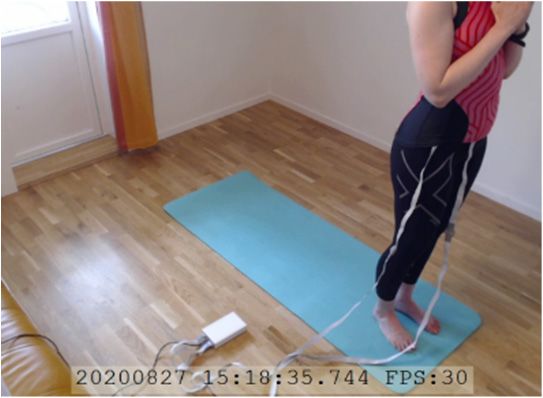
Brain Sci. 2021, 11, 742                                                                                             2 of 21

                           can only be detected during movement. For example, one study revealed that the cortical
                           activation from conducting an everyday task was not detected during an imitation of the
                           same task [21]. To investigate and understand brain activity during any activity or task, it
                           is, therefore, best to measure it directly in the environment where it naturally occurs (in
                           situ). In situ studies may, for example, be beneficial when analyzing sports or strenuous
                           exercise, social interaction in natural environments [13], operators at work (air traffic
                           controllers [22], captains [23], and drivers [24,25]), and walks in nature. Moreover, when
                           studying populations who may not be able to come to the lab (e.g., severe Alzheimer’s
                           patients [26]), or when coming to a lab would be counterproductive to the topic of interest
                           (e.g., during physical therapy and rehabilitation [27,28]), it may be necessary to conduct
                           the study in the participant’s own environment.
                                 FNIRS is often praised for its portability and robustness towards motion artifacts.
                           However, most fNIRS studies are still conducted in laboratories today. An increasing body
                           of research uses fNIRS in real-world environments at moderate levels of motion; indeed,
                           several of the studies mentioned above include moderate levels of motion, e.g., [12], but
                           none incorporate considerable or vigorous movements. We believe that fNIRS can be
                           applied in real situations to a greater extent than it is currently. There is a need for in situ
                           fNIRS studies with considerable movement.
                                 Thus, the aim of this study was to extend fNIRS applications in real-world envi-
                           ronments by recording fNIRS during a moving yoga practice in a participant’s natural
                           environment. Ashtanga Vinyasa Yoga is a practice with considerable movement and com-
                           plex postures, which may have some effect on cognitive functions. Therefore, we explored
                           changes in brain activity (prefrontal cortex activation) within postures in the Ashtanga
                           primary series. The research objectives were as follows: (1) Test the feasibility of fNIRS
                           recordings during a yoga practice with considerable movement. (2) Test if different yoga
                           postures have different cognitive loads. To this end, a single-subject observational study
                           was adopted, in which one participant practiced Ashtanga with a wearable fNIRS in their
                           own apartment for a total of seven times. The results show differences in cognitive load
                           when comparing technically complex postures to relatively simple ones, but also some
                           contrasts with little difference, although a greater difference was hypothesized. The fNIRS
                           measurements taken during Ashtanga Vinyasa Yoga deepen our understanding of the
                           effect of yoga postures and thus contributes to the scientific foundation of yoga. This study
                           explores the boundaries of cognitive load measurements in the real-world, and contributes
                           to the empirical knowledge base of using fNIRS in realistic settings.

                           2. Background
                           2.1. Yoga
                                The term “Yoga” denotes a group of physical, mental, and spiritual practices originat-
                           ing in ancient India [29–31]. Today, modern schools of yoga and thus styles of yoga each
                           have a distinct relative content of ethics (yama and niyama), physical postures and exercises
                           (asanas), breathing techniques (pranayama), and meditation practices, which aims to cul-
                           tivate awareness; unite the mind, body, and spirit, alleviating suffering; and ultimately
                           obtain profound states of consciousness [29–32]. Meditation practices include sensory
                           withdrawal (pratyahara), concentration (dharana), meditation (dhyana), and a deep level of
                           concentration (or absorption) described as self-transcendence (samadhi) [30].

                           2.2. Ashtanga Vinyasa Yoga
                                Ashtanga Vinyasa Yoga (Ashtanga for short) is a popular and physically demanding
                           yoga style [33–35]. It is known for its vigorous flow, which may be why some adap-
                           tations of the practice are known as power yoga [36]. In Ashtanga, physical postures
                           (asanas) are linked by flowing movements (vinyasas) and synchronous breathing techniques
                           (pranayama) [35–37]. An Ashtanga session begins with sun salutations as a warmup, fol-
                           lowed by a predefined sequence of postures, and a closing sequence. A total of six series
                           exists, each with different sequences. The primary series is often called yoga therapy or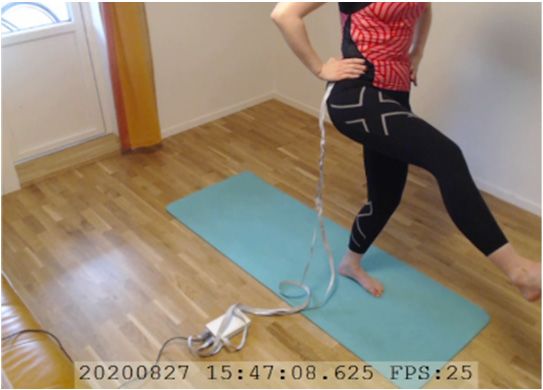
Brain Sci. 2021, 11, 742                                                                                             3 of 21

                           yoga for health. It focuses on health healing effects, the release of trapped emotions, and
                           raising and overcoming emotional and other unhealthy habitual patterns [37,38]. Ashtanga
                           focuses on the coordination of posture, breath, and gaze [34]. These components form
                           the Tristana, which is unique to Ashtanga [34]. A strong focus on physical embodiment is
                           necessary since the postures are technically complex, and each movement is coordinated
                           with an inhale or exhale, while the postures are held for five breaths [34,39]. The breathing
                           technique is called Ujjayi Breathing, or victorious breath [39]. Each posture and movement
                           has a specific gaze point intended to reduce external distractions and induce concentration
                           (e.g., navel-gazing or omphaloskepsis, which is defined as the “contemplation of one’s navel
                           as an aid to meditation” [40]) [34]. The repetitive practice is intended to move practitioners
                           towards a control of mental activity that enables true self-realization [37,38]. Due to this
                           highly focused attention during bodily movements, yoga is often called “meditation in
                           motion” [30]. The rigid adherence to a standardized and documented posture series makes
                           Ashtanga a strong candidate for scientific study [35].

                           2.3. Existing Research on Yoga
                                 An increasing body of research shows positive effects from yoga practices and inter-
                           ventions on physical and psychological health [29,30]. Symptoms of depression, PTSD,
                           epilepsy, ADHD, stress, and anxiety have been alleviated with yoga-based therapies. A
                           reduction in stress and anxiety symptoms is also found in healthy individuals [30,41]. Yoga
                           practitioners report increased psychological wellbeing, life satisfaction, happiness, motiva-
                           tion, and relaxation [30,36,42]. Reduced levels of galvanic skin response and blood lactate
                           have been measured [41], along with improvements in physical fitness, and reduced sym-
                           pathetic nervous system activity [33,39]. Some can also reduce their heart rate voluntarily
                           without external cues [32]. Ashtanga practitioners specifically show improvements in mus-
                           cular strength, endurance, flexibility, health perception, diastolic blood pressure, perceived
                           stress [39], cardiac and respiratory fitness [33], and self-transcendence [43]. The results of
                           Ashtanga intervention studies show significant improvements in psychological wellbeing,
                           self-esteem, assertiveness, attention to one’s needs, and capacity to connect [34,44].
                                 Several yoga techniques claim to enhance cognitive and executive functions, such as
                           attention/awareness, concentration, emotion regulation, and cognitive control. Studies
                           of such found greater gray matter volume, increased functional connectivity, improved
                           cognitive performance, the strengthening of interoceptive and executive/control networks
                           for yoga practitioners, and decreased glucose metabolism (which is linked to the improved
                           regulation of negative emotions) [45]. Both elderly and adolescent practitioners have signif-
                           icantly improved cognitive performance [46,47]. A functional near-infrared spectroscopy
                           (fNIRS) study found increased blood flow (measured by HbO concentration) to the dor-
                           solateral prefrontal cortex during a yoga breathing technique [48] and increased bilateral
                           blood flow to the prefrontal cortex in yoga practitioners compared to non-practitioners
                           during sustained attention [49]. Electroencephalograms (EEGs) have also been conducted
                           during various yoga practices with little movement [50]. In [30], the findings are consistent
                           with the notion that yoga can improve cognitive regulation, to the point of offsetting the
                           age-related decline in fluid intelligence in practitioners. They further suggest that this may
                           be explained by the increased availability of neural resources, and postulate that neuronal
                           interactions occurring during yoga practice include the cortical regions (i.e., the dorsolateral
                           prefrontal cortex (DLPFC), anterior cingulate cortex (ACC), and orbitofrontal cortex) [30].

                           2.4. The Prefrontal Cortex
                                  Executive and cognitive functions, such as attention/awareness, working memory,
                           cognitive flexibility, and cognitive control and planning, are performed by the prefrontal
                           cortex (PFC) [51–54]. The PFC synthesizes diverse information related to a given goal;
                           it is responsible for planning and selecting complex cognitive behavior; and it is crucial
                           for higher order processing [52]. Further studies relate cognitive control to activity in
                           dorsolateral PFC (DLPFC) [55]. DLPFC plays an important role in the anticipatory organi-
Brain Sci. 2021, 11, 742                                                                                           4 of 21

                           zation of action and effortful tasks [56,57]. The mid-dorsolateral PFC (mDLPFC) aids in
                           planning action sequences (organization external/internal action), i.e., mental conception
                           and evaluation of behavioral sequences and associated outcomes before execution [56].
                           The frontopolar cortex (FPC) is involved in mind wandering, planning, abstract reasoning,
                           multitasking, and cognitive branching, which require switching away from an ongoing be-
                           havioral option, considering multiple behavioral options, and/or exploring new ones [58].
                           Thus, the FPC is suggested to make a crucial contribution to the exploration and rapid
                           acquisition of novel behavioral options [59]. The medial FPC governs undirected explo-
                           ration, i.e., monitoring the current goal for possibly redistributing cognitive resources to
                           other potential goals. The lateral (right/left) FPC cortex governs directed exploration, i.e.,
                           monitoring a few alternative tasks/goals for possibly re-engaging one as a replacement of
                           the current task/goal [58].

                           3. Materials and Methods
                                Given that there are cognitive benefits of yoga practices, and that executive and
                           cognitive functions are governed by the PFC, our aim was to determine whether we could
                           measure any of them. Specifically, we investigated whether there were differences in
                           cognitive load and cognitive state within postures in the Ashtanga primary series. The
                           features of Ashtanga makes its practice a suitable context for demonstrating that brain
                           activity can be measured during vigorous movement. To our knowledge, while intervention
                           and laboratory studies of various yoga practices have been conducted, there is no study
                           that incorporates neuroscientific measurements during a moving yoga session, nor in a
                           real-world setting. We thus believe that this study is the first to record fNIRS during a
                           moving yoga session.

                           3.1. Single-Subject Observational Study
                                 A single-subject real-world (in situ) study of the half primary series in Ashtanga was
                           conducted in the participant’s own living room. The participant was fitted with an fNIRS
                           sensor cap aided by another person. The signal quality check, and the start and stop of
                           data collection, was performed by the participant.
                                 A video of the full primary series performed and led by Ty Landrum was used for
                           instructional purposes [60]. In this video, the yogi practices the sequence and gives voice-
                           over instructions with postures and queues. The yogi also performs the opening and
                           closing mantra (or chant). The participant listened to the chants in Mountain Pose with
                           their hands in prayer position. This video was used in all sessions. The practice was
                           adapted to accommodate the head-mounted sensors, i.e., the participant refrained from
                           postures requiring the head to be placed on the ground. Table A1 in Appendix A includes
                           a list of the postures that were a part of the practice, and if they were adapted or not
                           conducted. The postures were held for five long breaths. Repeated measures over time
                           were made corresponding to the repeated postures over several full practices, as explained
                           in the introduction.

                           3.2. Participant
                                The participant was 26–27 years old, female, right-handed, had corrected-to-normal
                           vison, and had a good general physical fitness level. The participant had 3 months of
                           practicing the primary series in Ashtanga once a week and was, therefore, considered a
                           novice in Ashtanga. She had two years of experience practicing other yoga types at the
                           time of recording. The participant was obtained by convenience sampling and had worn
                           fNIRS ahead of this study.

                           3.3. Data Collection
                               fNIRS data were sampled at 7.81 Hz by NIRSport (NIRx Medical Technologies, Berlin,
                           Germany) with 8 sources and 8 detectors at two wavelengths (760 and 850 nm). Optodes
                           were placed on the PFC, per montage by NIRx, as illustrated in Figure 1. The sources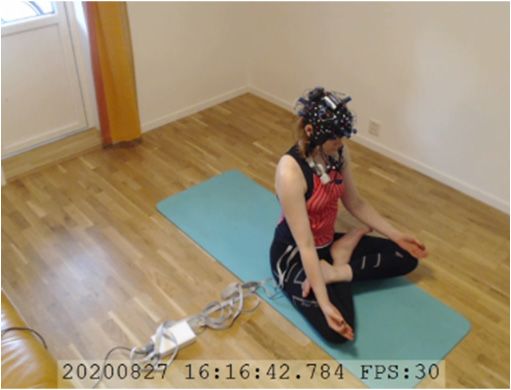
fNIRS data were sampled at 7.81 Hz by NIRSport (NIRx Medical Technologies, Ber-
lin, Germany) with 8 sources and 8 detectors at two wavelengths (760 and 850 nm).
Optodes were placed on the PFC, per montage by NIRx, as illustrated in Figure. 1. The
sources (denoted Sx) were placed as follows: S1: F3; S2: AF7; S3: AF3; S4: Fz; S5: Fpz; S6:
Brain Sci. 2021, 11, 742 AF4; S7: F4; S8: AF8. The detectors (denoted Dx) were placed as follows: D1: F5; D2 F1; 5 ofD3
21
Fp1; D4 AFz; D5 F2; D6: Fp2; D7: F6. We used an EASYCAP AC-128-X1-C-58 (EASYCAP
GmbH, Herrsching, Germany) with a 128-channel layout following the 10–5 system [61].
This montage covers the anterior frontal lobe, more specifically anterior regions of the
(denoted Sx) were placed as follows: S1: F3; S2: AF7; S3: AF3; S4: Fz; S5: Fpz; S6: AF4;
right, left, and mid-dorsolateral PFC (l/r/mDLPFC), and right, left, and medial FPC
S7: F4; S8: AF8. The detectors (denoted Dx) were placed as follows: D1: F5; D2 F1; D3
(r/l/mFPC). A sensitivity profile of the montage/probe was generated with AtlasViewer
Fp1; D4 AFz; D5 F2; D6: Fp2; D7: F6. We used an EASYCAP AC-128-X1-C-58 (EASYCAP
[62] and is illustrated in Figure 1c.
GmbH, Herrsching, Germany) with a 128-channel layout following the 10–5 system [61].
In the bilateral PFC, HbO activation increases linearly with increasing cognitive load.
This montage covers the anterior frontal lobe, more specifically anterior regions of the right,
In the
left, andPFC, an increase inPFC
mid-dorsolateral functional connectivity
(l/r/mDLPFC), and between
right, left,hemispheres and across
and medial FPC hemi-
(r/l/mFPC).
Aspheres is associated
sensitivity profile ofwith
the increasing cognitive
montage/probe wasload. Moreover,
generated withfunctional connectivity
AtlasViewer [62] and isis
different for different
illustrated in Figure 1c. cognitive states [51].
(a) (b) (c)
Figure1.1.(a)
Figure (a) The
The montage
montage rendered
renderedonto
ontothe
theICBM
ICBM152
152Nonlinear
Nonlinearatlases
atlasesversion
version2009
2009[63,64],
[63,64],created
createdwith
withNIRSite
NIRSite2020.7
2020.7
(NIRx Medical Technologies). (b) The channels from above in an anterior orientation, created with NIRS toolbox
(NIRx Medical Technologies). (b) The channels from above in an anterior orientation, created with NIRS toolbox [65]. [65]. (c)
The sensitivity profile of the probe, created with AtlasViewer [62].
(c) The sensitivity profile of the probe, created with AtlasViewer [62].
NIRSport
In was connected
the bilateral PFC, HbOvia cables toincreases
activation a Dell Latitude
linearly7490
withlaptop (with cognitive
increasing Microsoft
Windows 10 Education, Intel(R) Core(TM) i7-8650U CPU @ 1.90 GHz 2.11
load. In the PFC, an increase in functional connectivity between hemispheres and across GHz processor,
32.0 GB RAM
hemispheres is installed,
associated64-bit operating cognitive
with increasing system, x64-based processor,
load. Moreover, and a connectivity
functional 500 GB SSD
harddrive).
is Nirstar
different for 15.2cognitive
different Acquisition Software
states [51]. (NIRx Medical Technologies) [66] was used
to forward
NIRSporta continuous data stream
was connected through
via cables to aLabStreamingLayer [67] to iMotions
Dell Latitude 7490 laptop 8.1 [68],
(with Microsoft
which synchronized
Windows 10 Education, physiology data and i7-8650U
Intel(R) Core(TM) video recordings. Two
CPU @ 1.90 GHzvideo
2.11recordings were
GHz processor,
made with a laptop-integrated web camera and an additional external
32.0 GB RAM installed, 64-bit operating system, x64-based processor, and a 500 GB SSD web camera
(Logitech HD
harddrive). Pro Webcam
Nirstar C920, Newark,
15.2 Acquisition Software NJ,(NIRx
USA).Medical Technologies) [66] was used
In total,
to forward seven (N =data
a continuous 7) yoga sessions
stream through were recorded from April
LabStreamingLayer [67] to toiMotions
September8.1 2020.
[68],
Sessionsynchronized
which 1 was a pilot physiology
session, lasting
dataonly
and 50 minsrecordings.
video due to software issues;recordings
Two video therefore, were
there
are nowith
made dataa from the last partweb
laptop-integrated of this practice.
camera and anThere was a external
additional problem web withcamera
the external
(Log-
webcam
itech HD in
Prosessions
Webcam 1 and
C920,4, Newark,
and so this
NJ,footage
USA). is incomplete.
In total, seven (N = 7) yoga sessions were recorded from April to September 2020.
Session 1 was a pilot session, lasting only 50 mins due to software issues; therefore, there
are no data from the last part of this practice. There was a problem with the external
webcam in sessions 1 and 4, and so this footage is incomplete.
3.4. Data Analysis
3.4.1. Video Coding
Physiology data were labeled with names of postures (English translations of Sanskrit)
from half primary series in Ashtanga post recording by video coding in BORIS [69]. A total
of 57 postures were used in the analysis; see Table A2 in Appendix B for a list of these
postures. Information on head position (up, down, side, and uptilted; side and down-tilted;
or changing), whether the pose required bilateral, or unilateral muscle activation (left
and right sides, respectively), its order in the sequence and which part of the sequence it
belonged to (warm-up, standing, seated, or finishing) were added as metadata.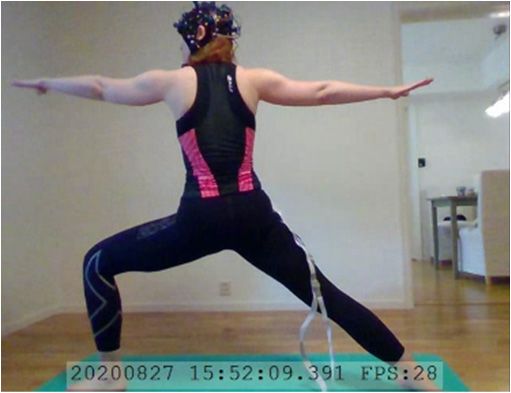
Brain Sci. 2021, 11, 742                                                                                              6 of 21

                           3.4.2. fNIRS Analysis
                                FNIRS data were prepared in python and analyzed in MATLAB R2020a with NIRS
                           toolbox [65]. The standard pre-processing included conversion from raw data to optical
                           density, then conversion to hemoglobin concentration using the modified Beer–Lambert
                           Law with extinction coefficient from [70], and a partial pathlength factor (PPF) of 0.1.
                           Statistical analysis used a first-level general linear model regression, which used an autore-
                           gressive pre-whitening method with iteratively reweighted least-squares (AR-IRLS) [65,71]
                           for motion artifact correction that controls type-I errors. For second-level (group) statistics,
                           a linear mixed-effects model was used, which tested for the main effect of conditions
                           (the yoga postures constitute the conditions). A mixed-effects model was selected since
                           it more effectively accounts for design imbalances and missing values. Then, we ran all
                           permutations of condition contrasts with t-tests; i.e., each posture was compared to all other
                           postures. To correct for multiple comparisons, the Benjamini–Hochberg procedure was
                           used, and the corrected p-value is denoted as the q-value [72]. The statistical significance
                           level was set at q < 0.05. We refer to [65,71,73] for further details on analysis techniques.

                           3.4.3. Selection of Contrasts
                                A number of P(57,2) = 3192 permutations were tested. After removing duplicate
                           contrasts, a total of 1309 contrasts had one or more statistically different channels. We
                           removed postures where the top of the head was facing down or changing position during
                           the posture as this causes increased or unstable blood flow to PFC due to gravity. This
                           returned 939 contrasts. Then, we made sure to only compare postures with the same head
                           position, which resulted in 371 significantly different contrasts. These contrasts were sorted
                           based on the number of significantly different channels. Thereafter, the ten contrasts with
                           the most significantly different channels, the ten contrasts with the least significant different
                           channels, and the ten contrasts with a mid-range number of significantly different channels
                           were selected for visual inspection. The visual inspection of the 30 contrasts determined
                           the postures presented in the results.

                           4. Results
                                  First, we present combinations of postures yielding the greatest number of chan-
                           nels with expected significantly different brain activation or cognitive load. Second, we
                           present posture combinations that show some unexpected differences in activation. Fi-
                           nally, we also highlight some interesting combinations with little significant difference,
                           i.e., postures where we hypothesized differences but were unable to measure any greater
                           significant difference.

                           4.1. Posture Combinations with Expected Greater Statistical Difference
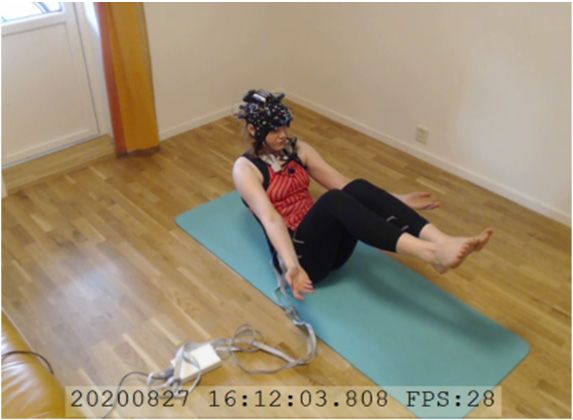
                                 Boat–Mountain Pose Start. There was a significant increase in HbO in the Boat
                           compared to the Mountain Pose Start, in 21 channels. Activations occurred along the
                           medial line and parts of r/lPFC, and mDLPFC; see Table 1, row 1, for Hbo visualization,
                           and Table A3 (Appendix C) for statistics. Increased HbO in the PFC, and hemisphere
                           connectivity indicate that the Boat Pose has a higher cognitive load compared to the
                           Mountain Pose. This is an expected finding. Mountain Pose Start is the opening posture of
                           the sequence, by some described as a resting pose. Instructions usually include clearing
                           the head and preparing for the practice. In contrast, Boat is physically demanding in
                           that muscle activation, posture, and balance require presence and concentration. Boat
                           is strenuous, but is claimed to aid in developing concentration stamina, focus, internal
                           awareness, and emotional calmness. Activation of the mFPC may indicate a mental
                           exploration of behavioral changes (e.g., changes in posture and muscle activation) to make
                           the posture easier. The activation predominantly in the mFPC, which is responsible for
                           undirected exploration, may suggest that the practitioner was seeking a new, unknown
                           alternative (as opposed to directed exploration of a known alternative). Activation in
                           the mDLPFC, which plans upcoming behavioral actions, may further suggest that the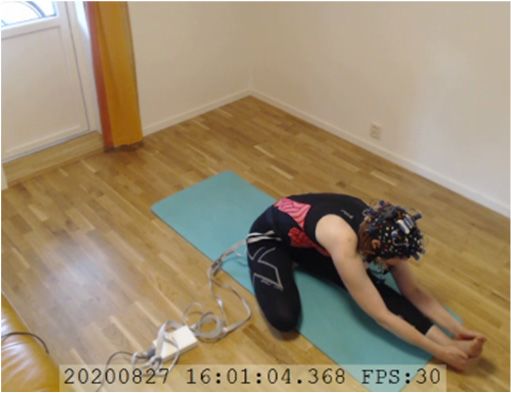
Brain Sci. 2021, 11, 742 7 of 21
BrainSci.
Brain Sci.2021,
2021,11,
11,x xFOR
FORPEER
PEERREVIEW
REVIEW 8of
ofof 20
Brain
Brain
Brain Sci.
Sci.
BrainSci.
Brain 2021,
2021,
Sci.2021,
Sci. 11,
11,xxxxxFOR
11,
2021,11,
2021, 11, FOR
FOR PEER
PEER
FORPEER
FOR REVIEW
REVIEW
PEERREVIEW
PEER REVIEW
REVIEW 888888of
of
of 20
20
20
of20 20
20
practitioner had begun to think about and plan upcoming postures. It is possible that there
was an attempt to divert thoughts from the strenuous Boat posture.
Table 111 1
Table
Table 1.1.
Table1.
Table
Table
Table 1.
1. Contrasts
Contrasts
Contrasts
1.Contrasts
1. postures
postures
postures
Contrastspostures
Contrasts with
with
with
postureswith
postures with greater
greater
greater
withgreater
greater statistical
statistical
statistical
greaterstatistical
statistical differences.
differences.
differences.
statisticaldifferences.
differences. Contrasts
Contrasts
Contrasts
Contrasts
differences.Contrasts are
are
are
are
Contrastsare
Contrasts shown
shown
shown
shown
areshown
are as
as
as
as
shownas
shown t-tests
t-tests
t-tests
t-tests
ast-tests
as of
of
of
of
t-testsof
t-tests Posture
Posture1111111minus
Posture
Posture
Posture
ofPosture
of Posture minus
minus
minus
minus Posture
Posture222222111.....1..
Posture
Posture
Posture
minusPosture
minus Posture
Contrast
Contrast
Contrast
Contrast
Contrast
Contrast
Contrast Statistics
Statistics
Statistics
Statistics Visualized
Visualized
Visualized
Visualized
Statistics
Statistics
Statistics onon
on
on Probe
Visualized
Visualized
Visualized onon
on
Posture
Posture11111
Posture
Posture
Posture Posture
Posture22222
Posture
Posture
Posture
Probe Montage
Montage
Probe
Probe Montage
Montage
Probe
ProbeMontage
Probe Montage
Montage
Boat
Boat
Boat
Boat
Boat
Boat
Boat HbO
HbO
HbO
HbO
HbO
HbO
HbO Mountain
Mountain
Mountain
Mountain Pose
Pose
Pose
MountainPose
Mountain
Mountain Pose
Pose
Pose Start
Start
Start
Start
Start
Start
Start
Mountain
Mountain
Mountain Pose
Mountain Pose
Mountain Pose
Pose Start
Start
Start
PoseStart
Start HbO
HbO
HbO
HbO
HbO MA
MA
MA Right
MARight
Right
Right Knee
RightKnee
Knee Bent
Bent
Bent
KneeBent
Knee Bent Bind
Bind
Bind
Bind
Bind
Boat
Boat
Boat
Boat HbO
HbO
HbO
HbO Lotus
Lotus
Lotus
Lotus
Boat HbO Lotus
Second-level
11 1
Second-level
Second-level
Second-level
111 1 analysis
analysis
analysis
analysis of
of
of
of HbO
HbO
HbO
HbO and
and
and
and HbR
HbR
HbR
HbR changes
changes
changes
changes for
for
for
for selected
selected
selected
selected contrasts;
contrasts;
contrasts;
contrasts; t-statistic
t-statistic
t-statistic
t-statistic maps
maps
maps
maps with
with
with
with significantly
significantly
significantly
significantly different
different
different
different brain
brain
brain
brain
1 Second-level
Second-levelanalysis
Second-level
Second-level
analysisof
analysis
analysis of
ofHbO
of
HbO
HbOand
HbO
and
andHbR
and
HbR
HbRchanges
HbR
changes
changesfor
changes
for
forselected
for
selected
selectedcontrasts;
selected
contrasts;
contrasts;t-statistic
contrasts;
t-statistic
t-statisticmaps
t-statistic
maps with
mapswith
maps withsignificantly
with
significantly
significantlydifferent
significantly
different brain
differentbrain
different
activation (q
brain
brain
< 0.05)
activation
activation
activation
activation
activation (q
(q
(q
(q (q < < 0.05)
0.05)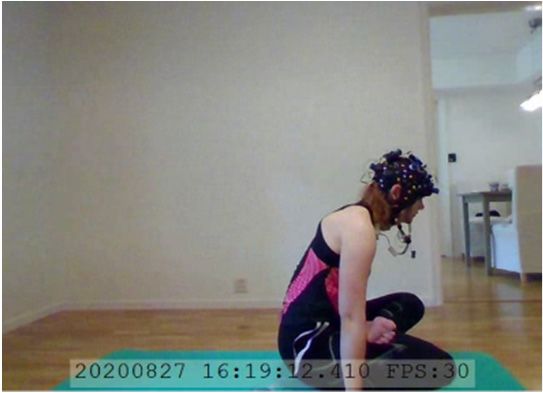
Brain Sci. 2021, 11, 742                                                                                           8 of 21

                                 Boat–Lotus. There was significant increase in HbO in Boat compared to Lotus in
                           19 channels. Activations occurred in mFPC, some r/lFPC lateralization prevailing in the
                           left hemisphere, and mDLPFC. This indicates a clear difference in cognitive load and state.
                           See Table 1, row 3 for HbO visualization, and Table A5 (Appendix C) for statistics. This
                           result was also expected since Boat was compared to the traditional meditation pose Lotus,
                           which aims to clear the mind. Interestingly, there was less significant activation along
                           the medial line as compared to the Boat–Mountain Pose Start contrast. Activation was
                           predominantly at the montage’s front (mFPC) and back (mDLPFC). This may be due to
                           the greater similarity of these postures, i.e., they are both seated postures, whereas the two
                           former contrasts compare standing and seated postures. We conclude that standing and
                           seated postures have differing requirements.

                           4.2. Postures Combinations with Some Unexpected Differences (Mid-Range)
                                 Head to Knee Pose B, sit on right heel–Extended Hand to Right Big Toe, hold. There
                           was a significant increase in HbO in mFPC for Head to Knee Pose B compared to Extended
                           Hand to Right Big Toe Hold. See Table 2, row 1 for HbO visualization, and Table A6
                           (Appendix C) for statistics. Head to Knee Pose B poses a greater cognitive demand than the
                           Extended Hand to Right Big Toe Hold. This is interesting since we expected the opposite
                           effect. Extended Hand to Right Big Toe imposes a great demand on leg and thigh muscles to
                           statically hold the leg out and up in a straight line while maintaining balance. Additionally,
                           the practitioner was not strong enough to hold their leg straight out and up, but worked
                           hard to not let their foot fall further. Head to Knee Pose B is a seated position where
                           practitioners sit on their heel, folding forward, stretching the hamstring and the back of
                           the leg. The posture is generally considered uncomfortable due to the pressure of the
                           heel on the perineum, especially for novice practitioners. This pain may have caused
                           the unexpected finding. Head to Knee Pose (Sanskrit: Janu Sirsasana) is a hip opener,
                           hamstring stretch, and a slight torso twist, with three variations (A, B, and C) on both
                           the left and right sides, which become incrementally more difficult. A recurring patten of
                           HbO recruitment to mFPC (as depicted in Table 1, row 1) appeared when comparing the
                           Extended Hand to Right Big Toe Hold to both the left and right sides of variation A and
                           B, and the left side of variation C. However, the right side of variation C only recruited
                           D3-S6 and S5-D6, but not S5-D4 (along the medial line), as prior variations did. Since this
                           is the final side in the last variation of this pose, this may suggest the anticipation of and
                           preparation for the next pose, and thus a decreased activation in mFPC overall possibly
                           due to decreasing focus and attention to the posture.
                                 Lotus Uplifting–Warrior 2 Left. There was a significant increase in HbO for Lotus
                           Uplifting compared to Warrior 2 Left, lateralized to left hemisphere, in lFPC, lDLPFC. Lotus
                           Uplifting is more cognitively demanding than Warrior 2 Left. See Table 2, row 2 for HbO
                           visualization, and Table A7 (Appendix C) for statistics. In Lotus Uplifting practitioners lift
                           their legs off the ground while maintaining the classical Lotus formation of the legs. It is
                           interesting to see increased activity only in the left hemisphere, suggesting a lateralization
                           of cognitive functions in this contrast. Moreover, when we compared Lotus Uplifting
                           to Warrior 2 Right (same posture performed on the right side), there was no statistical
                           significance in any channels.
                                 Mountain Pose Start–Extended Hand to Right Big Toe Hold. There was a significant
                           decrease in HbR in Mountain Pose compared to Extended Hand to Right Big Toe Hold
                           in mDLPFC, and some in lFPC. See Table 2, row 3 for HbR visualization, and Table A8
                           (Appendix C) for statistics. Decreased HbR in mDLPFC indicates neural activity in this
                           region, which indicates increased cognitive load in Mountain Pose compared to Extended
                           Hand to Right Big Toe Hold. This is an unexpected finding since Extended Hand to Right
                           Big Toe Hold is, as previously described, demanding. Since activity is localized to DLPFC,
                           which activates in anticipation of difficult tasks, it may suggest that the practitioner is
                           mentally preparing themselves for the practice by mentally mapping out coming postures.
                           Therefore, we speculate that there is less need for planning ahead when in Extended Hand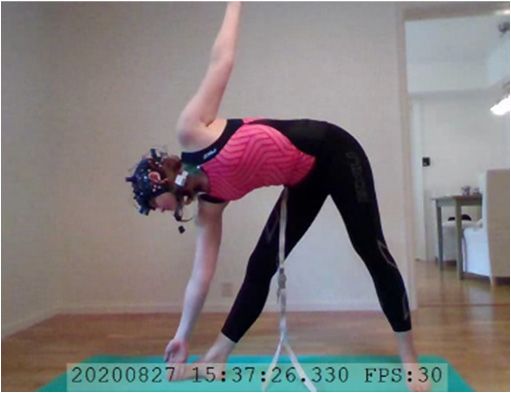
mDLPFC,and
mDLPFC, andsome
someininlFPC.
lFPC.SeeSeeTable
Table2,2,rowrow 3for forHbRHbRvisualization,
visualization,and andTable
TableA8 A8(Ap-
(Ap-
mDLPFC,
mDLPFC,and andsome
somein inlFPC.
lFPC.SeeSeeTable
Table2, 2,row
row333forforHbRHbRvisualization,
visualization,and andTable
TableA8 A8(Ap-
(Ap-
pendix
pendix
pendix C)C) for
for statistics.
statistics. Decreased
Decreased HbR
HbR inin mDLPFC
mDLPFC indicates
indicates neural
neural activity
activity inin this
this region,
region,
pendixC) C)for
forstatistics.
statistics.Decreased
DecreasedHbR HbRininmDLPFC
mDLPFCindicatesindicatesneural
neuralactivity
activityininthis
thisregion,
region,
whichindicates
which indicatesincreased
increasedcognitive
cognitiveload loadininMountain
MountainPose Posecompared
comparedto toExtended
ExtendedHand Hand
which indicates increased cognitive load in Mountain Pose compared to ExtendedHand
which indicates increased cognitive load in Mountain Pose compared to Extended Hand
to to Right Big Toe Hold. This is an unexpected finding since Extended Hand to Right Big
totoRight
RightBig
Right BigToe
Big ToeHold.
Toe Hold.This
Hold. Thisis
This isisan
ananunexpected
unexpectedfinding
unexpected findingsince
finding sinceExtended
since ExtendedHand
Extended Handto
Hand totoRight
RightBig
Right Big
Big
ToeToeHold
Holdis,is,asaspreviously
previouslydescribed,
described,demanding.
demanding.Since Sinceactivity
activityisislocalized
localizedtotoDLPFC,
DLPFC,
Brain Sci. 2021, 11, 742 Toe
ToeHold
Holdis, is,as
aspreviously
previouslydescribed,
described,demanding.
demanding.Since Sinceactivity
activityisislocalized
localizedto toDLPFC,
DLPFC,
9 of 21
which
which
which activates
activates inin anticipation
anticipation ofof difficult
difficult tasks,
tasks, it it
maymay suggest
suggest that
that the
the practitioner
practitioner isisis
whichactivates
activatesininanticipation
anticipationofofdifficult
difficulttasks,
tasks,ititmay maysuggest
suggestthat
thatthethepractitioner
practitioneris
mentally
mentally
mentally preparing
preparing themselves
themselves for
for thethe practice
practice byby mentally
mentally mapping
mapping out
out coming
coming pos-
pos-
mentallypreparing
preparingthemselves
themselvesfor forthethepractice
practiceby bymentally
mentallymapping
mappingout outcoming
comingpos- pos-
tures.
tures.
tures. Therefore,
Therefore, wewe speculate
speculate that
that there
there isis less
less need
need forfor planning
planning ahead
ahead when
when in inExtended
Extended
tures. Therefore, we speculate that there is less need for planning ahead when inExtended
Therefore, we speculate that there is less need for planning ahead when in Extended
Hand
Hand totoBig
Right Big ToeHold,
Hold, duetotogreater
greater need forconcentrating
concentrating onproper
properperformance
performance
to
HandRight
Hand toRight
to Right
Right Big
ToeBig
Big Toe
Hold,
Toedue
Toe todue
Hold,
Hold, dueto
greater
due need
togreater
greater need
for
need
need for
forconcentrating
concentrating
for concentrating on
on properonproper
on properperformance
performance during
performance
during
during
the
during the
the
posture. posture.
posture.
duringthetheposture.
posture.
Table
Table
Table 2.2.
2. Contrasts
Contrasts
Contrasts postures
postures
postures
postures with
with
with
with middle
middle
middle
middle significant
significant
significant
significant differences.
differences.
differences.
differences. Contrasts
Contrasts
Contrasts are
are
Contrasts are
are shown
shown
shown as as
asas
shown t-tests
t-tests
t-tests of of
ofof
t-tests Posture
Posture
Posture 11 1minus
Posture minus
1minus
minus Posture
Posture
Posture 22 12112.. 11. .
Posture
Table
Table2.2.Contrasts
Contrastspostures
postureswith
withmiddle
middlesignificant
significantdifferences.
differences.Contrasts
Contrastsare
areshown
shownasast-tests
t-testsofofPosture
Posture11minus
minusPosture
Posture221.1.
Contrast
Contrast
Contrast
Contrast Statistics
Statistics
Statistics Visualized
Visualized
Visualized
Statistics on
on
on Probe
Visualized on
Posture 1
Posture Contrast Statistics Visualized on Posture 2
Posture1111
Posture
Posture Probe Montage
Montage
Probe Montage
Posture
Posture2222
Posture
Posture
Probe
ProbeMontage
Montage
Head
Head
HeadtotoKnee
KneePose
PoseB,B,sit
siton
on right heel. HbO Extended Handto toRight
RightBig
Big Toe Hold
Head
Head toto
to Knee
Knee
Knee PoseB,
Pose
Pose B,sit
siton
sit on
onright
right
right
rightheel.
heel.
heel.
heel. HbO
HbO
HbO
HbO Extended
ExtendedHand
Extended
Extended Handto
Hand
Hand to
toRight
RightBig
Right Big
BigToe
Toe
Toe
ToeHold
Hold
Hold
Hold
LotusUplifting
Lotus Uplifting HbO
HbO Warrior 2Left
Warrior Left
Lotus
LotusUplifting
Lotus Uplifting
Uplifting HbO
HbO
HbO Warrior2222Left
Warrior
Warrior Left
Left
Brain
BrainSci.
Brain Sci.2021,
Sci. 2021,11,
2021, 11,xxxFOR
11, FORPEER
FOR PEERREVIEW
PEER REVIEW
REVIEW 10
1010of
ofof20
2020
MountainPose
Mountain
Mountain PoseStart
Start
Start HbR
HbR ExtendedHand
Extended HandtotoRight
Hand RightBig
Right BigToe
Big ToeHold
Toe Hold
Hold
Mountain Pose
Mountain PoseStart
Pose Start HbR
HbR
HbR Extended
Extended Handto
Extended Hand toRight
to RightBig
Big Toe
Toe Hold
Hold
1 Second-level
Second-levelanalysis
analysisof
ofofHbO
HbOand andHbR
HbRchanges
changesfor forselected
selectedcontrasts;
contrasts;t-statistic
t-statisticmaps
mapswith
withsignificantly
significantlydifferent
differentbrain
brain
11 1
Second-level analysis HbO and HbR changes for selected contrasts; t-statistic maps with significantly different brain
Second-level analysis of HbO and HbR changes for selected contrasts; t-statistic maps with significantly different brain activation (q < 0.05)
activation
activation
activation (q
(q(q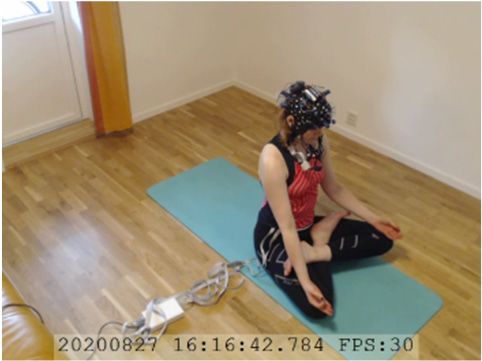
Brain Sci. 2021, 11, 742 10 of 21
Table 3. Contrasts postures with little significant difference. Contrasts are shown as t-tests of Posture 1 minus Posture 2 1 .
Brain
Brain Sci.
Brain
BrainSci.
2021,2021,
Sci.
Sci. 11,
2021,
2021, 11,
xxx11,xxxFOR
FOR
11,
11, FOR PEER
PEER
xxxPEER
FOR
FOR REVIEW
REVIEW
PEER
PEER REVIEW
REVIEW 11 11
11 of
of of of
20 20 20
Brain
Brain Sci.
Brain
Sci.
Brain 2021,
Sci.
Brain2021,
Sci. 11,
2021,
Sci. 11,
2021,
11,
2021, FOR
11,
FOR FOR FOR
PEER REVIEW
PEER REVIEW
PEER REVIEW
REVIEW
PEER REVIEW 11 1111
11 11
of 11of of
20
of
20 2020
20
of 20
Posture 1 Contrast Statistics Visualized on Probe Montage Posture 2
Lotus Uplifting HbO Lotus
West
West
WestWest
West
Side
West
West Side
Side Side
Side
Side
Side Intense
Intense Stretch
Stretch
Intense
Intense
Intense
Intense
Intense Stretch
Stretch
Stretch
Stretch
Stretch HbO
HbO
HbO HbO
HbO
HbO
HbO Warrior
Warrior
Warrior
Warrior
Warrior
Warrior 222Right
222 Right
Warrior RightRight
222Right
Right
Right
2Right
WestWest
Side
West Side
Side Intense
Intense Stretch
Stretch
Intense Stretch HbO HbO
HbO Warrior
Warrior
Warrior Right Right
Triangle
Triangle Left
Triangle
Triangle
Triangle Left
Triangle Left
Left
Left
Left HbO
HbO
HbO HbO
HbO
HbO Triangle
Triangle
Triangle
Triangle
Triangle Right
Right
Triangle
RightRight
Right
Right
Triangle
Triangle Left
Triangle
Triangle Left Left
Left HbO HbO
HbO
HbO Triangle
Triangle Right
Triangle Right
Right
Triangle Right
1 1 Second-level
Second-level analysis
analysis ofHbO
of HbO HbOandand HbR HbR changes
changes for selected
for selected
selected contrasts;
contrasts; t-statistic
t-statistic maps maps
withwith significantly
significantly different
different brain
brain
Second-level
11 Second-level analysis
analysis of HbO and HbR changes for selected contrasts; t-statistic maps with significantly different brain
Second-level analysis of ofof
of HbO HbO
and and
HbR HbR
changes changes
for for selected contrasts;
contrasts; t-statistic
t-statistic maps maps
with with significantly
significantly different
different brain brain
1 1 Second-level
1 1 Second-level
Second-level
1 Second-level analysis
analysis analysis
analysis of
HbO of
HbOandand
HbO HbR
and HbR
and HbR changes
changes
HbR changesforfor
changes selected
for
selected
for selected contrasts;
contrasts;
contrasts;
selected t-statistic
t-statistic
contrasts; maps
t-statistic maps
t-statistic mapswith
with
maps significantly
with significantly
significantly
with significantly different
different
different brain
brain
different brain
brain
1 Second-level
activation (q < 0.05) in solid lines; color bar represents the t-statistic (scaled to range [−10, 10]) with red/blue indicating
activation (q
activation
activation < 0.05)
(q <
analysis
(q inBrain Sci. 2021, 11, 742 11 of 21
5. Discussion
5.1. Lateralization
An overall observation of contrasts in Table 3 shows that all the lateralization of
activation occurs in the left hemisphere. This observation also holds when inspecting
Tables 1 and 2. As found by [51], load-dependent HbO activation yielded stronger ac-
tivation in the left hemisphere in bilateral DLPFC. This may explain why we observed
more activation in the left hemisphere, as it is an indication of increasing cognitive load.
Moreover, changes in cognitive state changes functional connectivity in adjacent frontal
lobe regions (i.e., FPC and DLPC) measured by HbO [51], which supports the notion that
HbO changes found in this study stem from changes in cognitive states.
5.2. Reflections on Motion Artifacts
We observed systemic motion artifacts in these data. The practice’s transitions between
postures are fast paced. This slightly reduces the optodes pressure on the scalp during the
movement across all channels causing spikes in fNIRS data. The practice also includes
postures with the head positioned upside-down, e.g., Downward Facing Dog, which causes
increased blood flow to the head due to gravity and the head’s position relative to the heart,
which adds a baseline shift to the fNIRS data. Postures with the head upside-down can
of course not be compared with most of the other postures in which the head is upright.
Therefore, we found it helpful to add information on the head position for each posture
during the video coding. We did not see any major problems in the fNIRS data for postures
with the head positioned on the side, with different tilts or rotations of the head.
As mentioned by [8], head movement, heartbeat, and respiration artifacts may be
corrected with filtering, which helps to reduce noise in fNIRS data. The AR-IRLS filter
used to process these data is designed for correcting slippage of optodes, motion, and
physiological noise by designing optimal pre-whitening filters using autoregressive models
and iteratively reweighted least squares [71]. As described in [71], AR-IRLS removes serially
correlated errors, and by doing so reduces the false positive rate to 5–9%, which, compared
to 37% of ordinary least squares (OLS) with no motion correction, is impressive. We also
tested a Temporal Derivative Distribution Repair (TDDR) [74] motion correction method,
which allowed us to visually inspect time-series fNIRS data without the visual clutter of
artifacts, which was helpful in distilling the insights above (but we did not use it for our
analyses here). As outlined by [74], future work on fNIRS motion correction should include
whether combinations of two or more correction methods yield improved performance,
given the growing number of fNIRS motion correction methods with different strengths
and limitations. We look forward to seeing results from these efforts in the coming years.
Despite excellent motion correction methods, for future studies, we obviously rec-
ommend keeping gravity where it usually is, but larger changes in, for example, posture
and activity performed by participants can be integrated. FNIRS measurement can distin-
guish between various stimuli within similar contexts, despite noise from the real-world
environment and activity.
6. Conclusions
This study obtained fNIRS brain activity measurements from seven (N = 7) sessions
of an Ashtanga Vinyasa Yoga practice conducted in a real-world environment. The re-
sults show differences in cognitive load when comparing technically complex postures to
relatively simple ones, but also some contrasts with little difference, although a greater
difference was initially hypothesized. We now know more about cortical brain activity
during a yoga practice. Despite motion artifacts and real-world noise, we can distill cog-
nitive load from applications with considerable motion in the real world, and conclude
that it is feasible to obtain neuroimaging measurements in such settings. To the best of
our knowledge, this is the first demonstration of fNIRS neuroimaging recorded during
any moving yoga practice. It exemplifies that we now have the technologies available
for neuroimaging measurements in the real world. This study explores the boundaries ofBrain Sci. 2021, 11, 742 12 of 21
cognitive load measurements in the real world, and contributes to the empirical knowledge
base of using fNIRS in realistic settings. Future work with fNIRS should take advantage of
this by accomplishing studies with considerable movement in the real world.
Author Contributions: Conceptualization, H.D. and M.S.; methodology, H.D.; software, H.D.; val-
idation, H.D. and M.S.; formal analysis, H.D.; investigation, H.D.; resources, M.S. and H.D.; data
curation, H.D.; writing—original draft preparation, H.D.; writing—review and editing, H.D. and
M.S.; visualization, H.D.; supervision, M.S.; funding acquisition, M.S. Both authors have read and
agreed to the published version of the manuscript.
Funding: This research was supported by strategic funds from the Department of Mechanical and
Industrial Engineering (MTP) at NTNU.
Institutional Review Board Statement: The study was conducted in accordance with the Declaration
of Helsinki, and approved by the Norwegian Centre for Research Data (NSD) (reference: 124330).
Informed Consent Statement: Informed consent was obtained from all participants involved in
the study.
Data Availability Statement: The data presented in this study are available on request from the
corresponding author.
Acknowledgments: We would like to thank Hendrik Santosa and Theodore J. Huppert for their
helpful input to fNIRS analysis.
Conflicts of Interest: The authors declare no conflict of interest.
Appendix A
Table A1 includes the list of the postures that were a part of the practice. Postures
were held for 5 breaths unless otherwise stated.
Table A1. Practice sheet/list of postures.
Sanskrit English Comment
Warm-up
Conducted. Participant listened to chant
Samasthitih Mountain Pose
in video.
Surya Namaskara A x5 Sun Salutation A Conducted.
Surya Namaskara B x5 Sun Salutation A Conducted.
Standing postures
Padangusthasana Big Toe Pose Conducted.
Pada Hastasana Hand to Foot Pose/hands under feet Conducted.
Utthita Trikonasana Triangle Conducted.
Parivr.tta Trikonasana Revolved Triangle Conducted.
Utthita Parsvakonasana Extended Side Angle Conducted.
Parivr.tta Parsvakonasana Revolved Side Angle Conducted.
Conducted, but adapted to accommodate
Prasarita Padottanasana, A, B, C and D Wide Leg Forward Fold A, B, C, and D the sensors. The head was not placed on
the ground.
Parsvottanasana Side Intense Stretch Conducted.
Utthita Hasta Padangusthasana Extended Hand to Big Toe Pose Conducted.
Extended Hand to Big Toe Side and Hold
Utthita Parsvasahita
Pose
Ardha Baddha Padmottanasana Half Bound Lotus Standing Forward Bend Conducted.Brain Sci. 2021, 11, 742 13 of 21
Table A1. Cont.
Sanskrit English Comment
Utkatasana Chair Pose Conducted.
Virabhadrasana I/A Warrior 1/A Conducted.
Virabhadrasana II/B Warrior 2/B Conducted.
Seated postures
Dandasana Staff Pose Conducted.
Pascimottanasana A, B West Intense Stretch Conducted.
Purvottanasana East Intense Stretch Conducted.
Ardha Baddha Padma
Half Bound Lotus Forward Fold Conducted.
Pascimottanasana
Triyang Mukha Eka Pada
One Leg Folded Back, Forward Fold Conducted.
Pascimottanasana
Janu Sirsasana A, B and C Head to Knee Pose A, B, and C Conducted.
Marichi’s Pose. A seated pose with twist
Maricyasana A, B C and D Conducted.
variations.
Navasana x5 Boat Conducted.
The first half of the Primary Series is finished
Baddha Konasana A and B Bound Angle Pose A (upright) and B (fold) Conducted sometimes.
Finishing sequence
Urdhva Dhanurasana Wheel Pose Not conducted.
Pascimottanasana—10 breaths Seated Forward Fold/Bend Conducted.
Salamba Sarvangasana—10 breaths Shoulderstand Not conducted.
Halasana Plow Not conducted.
Karna Pidasana Ear Pressure Pose Not conducted.
Urdhva Padmasana Upward Lotus Pose Not conducted.
Pindasana Embryo Not conducted.
Matsyasana Fish Pose Not conducted.
Uttana Padasana Raised Leg Pose Not conducted.
Sirsasana A and B—10 breaths Headstand A and B Not conducted.
Conducted. The head was not placed on
Balasana Child’s Pose
the ground.
Baddha Padmasana (–10 breaths) Bound Lotus and Bow Conducted.
Padmasana Lotus position Conducted
Utplutih Scale Pose/Lotus Uplifting Conducted
Conducted. Participant listened to chant
Samasthitih Mountain Pose
in video.
Savasana Corpse Pose Not conducted.
Appendix B
The labels used for video coding in BORIS can be found in Table A2. These are the
postures used in the analysis.Brain Sci. 2021, 11, 742 14 of 21
Table A2. Video coded postures/list of postures used in the analysis.
Sanskrit English
Samasthitih (start of practice) Mountain_Pose_Start
Surya Namaskar A Sun_Salutation_A
Surya Namaskar B Sun_Salutation_B
Adho Mukha Svanasana Downward_Facing_Dog
Padangusthasana Big_toe_pose
Pada Hastasana Hands_under_feet
Utthita Trikonasana (right foot forward) Trikonasana_Right
Utthita Trikonasana (left foot forward) Trikonasana_Left
Parivrtta Trikonasana (right foot forward) Revolved_triangle_Right
Parivrtta Trikonasana (left foot forward) Revolved_triangle_Left
Utthita Parsvakonasana (right foot forward) Extended_side_angle_Right
Utthita Parsvakonasana (left foot forward) Extended_side_angle_Left
Parivr.tta Parsvakonasana (right foot forward) Revolved_side_angle_Right
Parivr.tta Parsvakonasana (left foot forward) Revolved_side_angle_Left
Prasarita Padottanasana Wide_leg_forward_fold
Parsvottanasana (right foot forward) Side_intense_stretch_Right
Parsvottanasana (left foot forward) Side_intense_stretch_Left
Utthita Hasta Padangusthasana (right toe) Extended_hand_to_Right_big_toe
Utthita Parsvasahita (right foot uplifted) Extended_hand_to_Right_big_toe_hold
Utthita Hasta Padangusthasana (left toe) Extended_hand_to_Left_big_toe
Utthita Parsvasahita (left foot uplifted) Extended_hand_to_Left_big_toe_hold
Ardha Baddha Padmottanasana (right foot bound) Right_foot_in_half_bound_lotus
Ardha Baddha Padmottanasana (left foot bound) Left_foot_in_half_bound_lotus
Utkatasana Chair_Pose
Virabhadrasana I (right foot forward) Warrier_1_Right
Virabhadrasana I (left foot forward) Warrier_1_Left
Virabhadrasana II (right foot forward) Warrier_2_Left
Virabhadrasana II (left foot forward) Warrier_2_Right
Dandasana Staff_pose
Pascimottanasana A, B West_intense_stretch_A_B
Purvottanasana East_intense_stretch
Ardha Baddha Padma Pascimottanasana (right foot) Right_foot_in_half_bound_lotus_forward_fold
Ardha Baddha Padma Pascimottanasana (left foot) Left_foot_in_half_bound_lotus_forward_fold
Triyang Mukha Eka Pada Pascimottanasana (right leg) Right_leg_folded_back_forward_fold
Triyang Mukha Eka Pada Pascimottanasana (left leg) Left_leg_folded_back_forward_fold
Janu Sirsasana A (right leg) Head_to_knee_pose_A_Right_Leg_folded
Janu Sirsasana A (left leg) Head_to_knee_pose_A_Left_Leg_folded
Janu Sirsasana B (right heel) Head_to_knee_pose_B_sit_on_Right_heel
Janu Sirsasana B (left heel) Head_to_knee_pose_B_sit_on_Left_heel
Janu Sirsasana C (right toe) Head_to_knee_pose_C_Right_toe_stretch
Janu Sirsasana C (left toe) Head_to_knee_pose_C_Left_toe_stretch
Maricyasana A (right knee bent up) MA_Right_knee_bent_bindBrain Sci. 2021, 11, 742 15 of 21
Table A2. Cont.
Sanskrit English
Maricyasana A (left knee bent up) MA_Left_knee_bent_bind
Maricyasana B (left leg Lotus) MB_Left_leg_lotus_Right_knee_bent_bind
Maricyasana B (right leg Lotus) MB_Right_leg_lotus_Left_knee_bent_bind
Maricyasana C (right knee bent up) MC_Right_knee_bent_twist_bind
Maricyasana C (left knee bent up) MC_Left_knee_bent_twist_bind
Maricyasana D (left leg Lotus) MD_Left_leg_lotus_Right_knee_bent_twist_bind
Maricyasana D (right leg Lotus) MD_Right_leg_lotus_Left_knee_bent_twist_bind
Navasana Boat
Baddha Konasana Bound_angle_upright_and_fold
Pascimottanasana Forward_fold_end
Balasana Childs_pose
Baddha Padmasana Bound_lotus_bow
Padmasana Lotus
Utplutih Lotus_uplifting
Samasthitih (end of practice) Mountain_Pose_Stop
Appendix C
Table A3. t-test statistics for each channel (source–detector pair). Boat–Mountain Pose Start.
Source Detector Type Beta Se Tstat Dfe Q Power
1 2 hbo 197.46 60.05 3.29 321 0.00 0.79
1 2 hbr 95.15 20.27 4.69 321 0.00 0.99
2 3 hbo 313.03 90.63 3.45 321 0.00 0.83
3 3 hbo 313.97 60.74 5.17 321 0.00 1.00
3 3 hbr 49.19 13.82 3.56 321 0.00 0.86
3 4 hbo 253.23 58.59 4.32 321 0.00 0.97
4 2 hbo 192.11 71.50 2.69 321 0.02 0.58
4 2 hbr 153.95 21.13 7.29 321 0.00 1.00
4 4 hbo 337.58 92.19 3.66 321 0.00 0.88
4 4 hbr 94.87 30.08 3.15 321 0.00 0.75
4 5 hbo 205.60 40.26 5.11 321 0.00 1.00
4 5 hbr 99.92 14.15 7.06 321 0.00 1.00
5 3 hbo 485.21 68.56 7.08 321 0.00 1.00
5 3 hbr 87.51 24.00 3.65 321 0.00 0.88
5 4 hbo 322.83 57.88 5.58 321 0.00 1.00
5 6 hbo 691.47 87.80 7.88 321 0.00 1.00
5 6 hbr 58.16 19.36 3.00 321 0.01 0.70
6 4 hbo 179.67 71.04 2.53 321 0.02 0.51
6 6 hbo 272.10 85.00 3.20 321 0.00 0.76
7 5 hbr 115.30 21.91 5.26 321 0.00 1.00
8 6 hbo 225.62 94.04 2.40 321 0.03 0.46You can also read


