First record of a new microsporidium pathogenic to Gonipterus platensis in Brazil
←
→
Page content transcription
If your browser does not render page correctly, please read the page content below
www.nature.com/scientificreports
OPEN First record of a new
microsporidium pathogenic
to Gonipterus platensis in Brazil
Carolina Jordan1*, Vanessa Rafaela de Carvalho1, Gabriel Moura Mascarin2*,
Leiliane Rodrigues dos Santos Oliveira3, Christopher A. Dunlap4 & Carlos Frederico Wilcken1
Microsporidia are naturally occurring fungal-related parasites that can infect nearly all animal hosts,
but their biocontrol potential of insect pests is routinely overlooked in agriculture and forestry.
This research brings the first report describing the natural occurrence of a microsporidium causing
disease in field-collected populations of the invasive eucalyptus snout beetle, Gonipterus platensis
(Coleoptera: Curculionidae), a major destructive pest of eucalyptus plantations in Brazil. Adult
beetles were collected during field surveys in commercial eucalyptus plantations in southern Brazil
to be examined and dissected with typical symptoms to verify presence of microsporidian spores
in haemolymph. From 14 plantations in different sites, the natural infection occurrence in these
populations ranged from 0 to 65%, while a lab colony exhibited an infection incidence of 70%. Spore
density in haemolymph of symptomatic insects averaged 2.1 (± 0.4) × 107 spores/beetle. Symptoms
in infected adults were identified by an abnormal abdomen with malformation of the second
pair of wings, impairing their flight activity. Electron transmission microscopy of the pathogen
showed morphological features similar to species belonging to the genus Nosema or Vairimorpha.
Phylogenetic analysis of the full-length small subunit ribosomal RNA gene suggests this pathogen’s
placement in the genus Vairimorpha, but with a sequence identity of ~ 94% with the nearest
neighbours. The low level of sequence identity suggests this pathogen may represent a novel taxon
in the genus and further requires whole genome sequencing for definitive taxonomic resolution.
These findings provide insights on the natural occurrence of this novel pathogen of this invasive
pest in Eucalyptus plantations in Brazil. Further studies are needed to determine potential of this
microsporidium in the design of conservative or augmentative biological control programs for this
invasive pest.
Various environmental, biological and genetic factors can influence performance and fitness during an insect’s
life cycle. A relevant factor is the occurrence of pathogens such as bacteria, viruses, fungi, and parasites that are
responsible for about 80% of the diseases in insect p opulations1. Recent research has highlighted several cases
icroorganisms2–6, including some microsporidia.
of success in insect invasions facilitated by m
Microsporidia have been reported to cause substantial deleterious effects on host fitness in host insects. These
effects include malformations in infected pupae, increased larval mortality, developmental delay of immatures,
reduced fertility and longevity of adults, and increased susceptibility to stress c onditions7. These stress factors
cause biological changes in the host insect and may be associated with a decrease in its rate of p arasitism1. As
microsporidian pathogens generally display efficient transmission mechanisms and moderate virulence, these
traits may make them more effective agents in establishing enzootics in host p opulation8, as evidenced by the
use of a microsporidium to control grasshoppers9. In this context, microsporidian entomopathogens hold a
great potential as long-term biocontrol agents of numerous arthropod pests, but their natural incidence and
pathogenicity in populations of forest pests have been u nderexplored10.
1
School of Agricultural Sciences, São Paulo State University (UNESP), Campus of Botucatu, Av. Universitária, 3780,
Altos do Paraíso, Fazenda Experimental Lageado, Botucatu, SP 18610‑034, Brazil. 2Laboratory of Environmental
Microbiology, Brazilian Agricultural Research Corporation, Embrapa Environment, Rodovia SP‑340, km 127.5,
Jaguariúna, SP 13918‑110, Brazil. 3Botucatu Medical School, Dept. Internal Medicine, Sao Paulo State University
(UNESP), Campus of Botucatu, Av. Prof. Mário Rubens Guimarães Montenegro, s/n, Botucatu, SP 18618‑687,
Brazil. 4USDA, Agricultural Research Service, National Center for Agricultural Utilization Research, Crop
Bioprotection Research Unit, 1815, N. University St, Peoria, IL 61604, USA. *email: carolina.jordan@unesp.br;
gabriel.mascarin@embrapa.br
Scientific Reports | (2021) 11:10971 | https://doi.org/10.1038/s41598-021-90041-9 1
Vol.:(0123456789)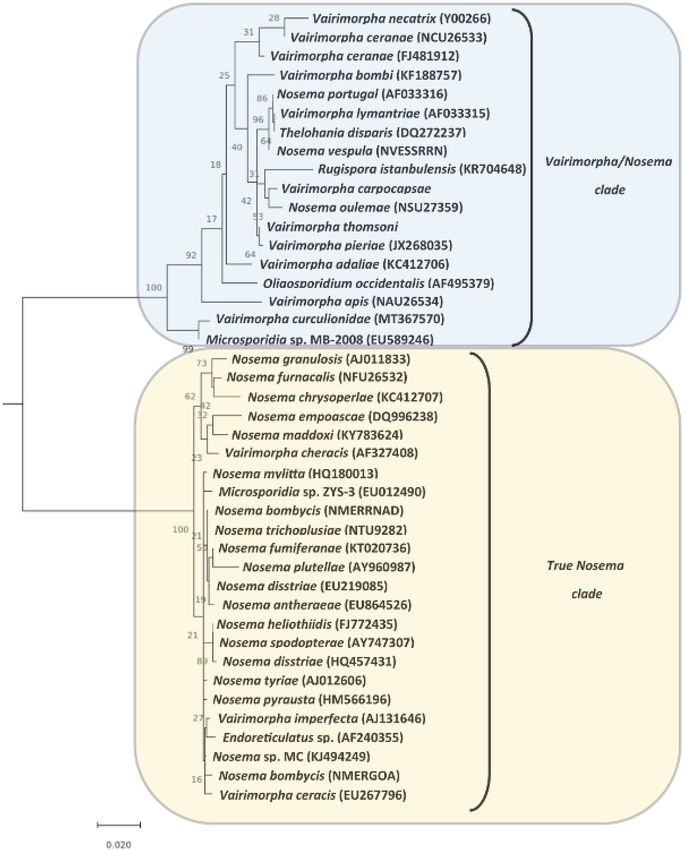
www.nature.com/scientificreports/
In the past, microsporidia were considered to be spore-forming protozoa, but in the light of modern tax-
onomy, this group was relocated to in or near the Fungi kingdom and are now called non-flagellate, single-celled
fungi, and obligate intracellular parasites11. Several studies suggest a new classification for microsporidia within
or near the fungi group, and the majority of entomopathogenic microsporidia belong to the genus Nosema, with
more than 150 insect host species described in 12 insect orders, notably Lepidoptera, Hymenoptera, Diptera,
Orthoptera and Coleoptera are among them12.
Microsporidia generally cause sublethal and chronic deleterious effects in infected hosts and, as a result, are
a serious problem in insects that are massively rearing in laboratories and bio-factories1,7. Spores are generally
small and most entomopathogenic microsporidia are approximately 2 to 6 µm in length. Spores can have different
morphologies, including rounded, oval, or pyriform, and less frequently reniform, long ovals to almost tubular
shape and refringent appearance when examined under phase contrast m icroscopy7.
The Eucalyptus snout beetle, Gonipterus platensis Marelli 1927 (Coleoptera: Curculionidae), also known as
the eucalyptus beetle, is currently the primary coleoptereus pest in commercial eucalyptus forestry in Brazil.
Gonipterus platensis is native to Australia, has a high destructive potential as adults and larvae feed mainly on
young leaves13, and are distributed across the South and Southeast of Brazil14. In a study carried out in Portugal,
defoliation by G. platensis resulted in wood losses of 648 million euros in the last twenty y ears15.
Despite microsporidiosis being reported in a variety of different insect populations, there are no previous
studies reporting the presence of this pathogen in populations of G. platensis in the literature. Recently, micro-
sporidiosis symptoms observed in infected adult beetles (males and females) included typical morphological
malformations comprising an abnormal abdomen with the second pair of wings displaced, which impairs flight
activity in a laboratory colony. This promptly motivated us to identify the pathogen and determine its incidence
in natural populations. Identifying the pathogen would also allow us to evaluate the potential of the organism
to serve as a potential biological control agent, as it can both cause slow mortality and more pronounced reduc-
tion in host fitness and deformations in adults, or at least an ecological factor in a biological control program
developed towards this insect pest in forest plantations. The knowledge of a microsporidium associated with
G. platensis is of great importance to understand the ecology of this insect pathogen interactions. It may also
contribute to the development of a conservative biological control program with this entomopathogen that can
negatively impact on this pest population. This knowledge is also relevant to prevent the pathogen from infecting
laboratory-grown or mass-reared colonies of this insect.
Results
Morphological characterization and spore density of microsporidium. Field-collected G. platen-
sis adult beetles were observed with visible symptoms of microsporidiosis disease, as they exhibited notable mal-
formations characterized by spread pair of wings with abnormal and shrivelled abdomen, and the membranous
pair of wings completely extended from the elytra (Fig. 1A). In this study, oval spores were identified as resist-
ance structures of intracellular parasites isolated from the body content of G. platensis adults. In slides prepared
with the beetle’s body content, a large amount of spores of the pathogen was easily and clearly observed, which
was also used as a quick and easy diagnosis parameter to confirm microsporidiosis in field-collected beetles from
different localities, as described later in this study (Fig. 1B). Microscopy is an inexpensive and routine technique
for the diagnosis of microsporidiosis, but it is not an accurate method for species identification since the mor-
phological structures of some pathogens are similar16.
Light microscopy revealed that fresh Vairimorpha sp. spore were generally elongated ovoid or oval shapes.
Spore dimensions (n = 10) averaged 2.07 (± 0.136) µm in length and 1.20 (± 0.066) µm in width, respectively
(Fig. 1B). Ultrastructure of microsporidian spores were examined under transmission microscopy and revealed
spore wall consisted of an electron-dense exospore. The coiled region of the polar tube comprised 8 turns, and
the diplokaryotic nuclei were slightly separated from each other (Fig. 1C). Yet, this does not discard that this
pathogen also forms uninucleate spores as well. All the above-mentioned cellular features corresponded to the
basic characteristics found in the genus Vairimorpha. Microsporidian spores from 10 beetles with similar size and
weight were collected in Eucalyptus plantation located at São Jerônimo da Serra, SP, Brazil, and presented a sex
ratio of 1:1. As result, the averaged of spore load of symptomatic beetles was determined at 2.15 (± 0.402) × 107
spores per adult with (Fig. 1D).
Molecular identification and phylogenetic construction. Sequencing of the SSU rRNA gene was
performed to confirm the identification of the pathogen found infecting populations of G. platensis. The PCR
results confirmed the isolate was closely related to Microsporidia species, with the highest sequence identity
(98%) to a sequence submitted to Genbank as Microsporidia sp. MB-2008 (GenBank accession no. EU589246).
A phylogenetic analysis of the strain and closely related strains of Microsporidia species was conducted (Fig. 2).
The closest phylogenetic neighbor of the isolate found in G. platensis was found to be Microsporidia sp. MB-2008,
which was isolated from another weevil, Otiothynchus sulcatura (Coleoptera: Curculionidae), followed by Vairi-
morpha apis, isolated from Apis cerana (Hymenoptera: Apidae). Based on the recent formal redefinition of the
genera Nosema and Vairimorpha (Microsporidia: Nosematidae), the strain belongs to the Vairmorpha genus.
Based on these findings, the name Vairimorpha curculionidae is proposed, when the species is formally circum-
scribed in the future.
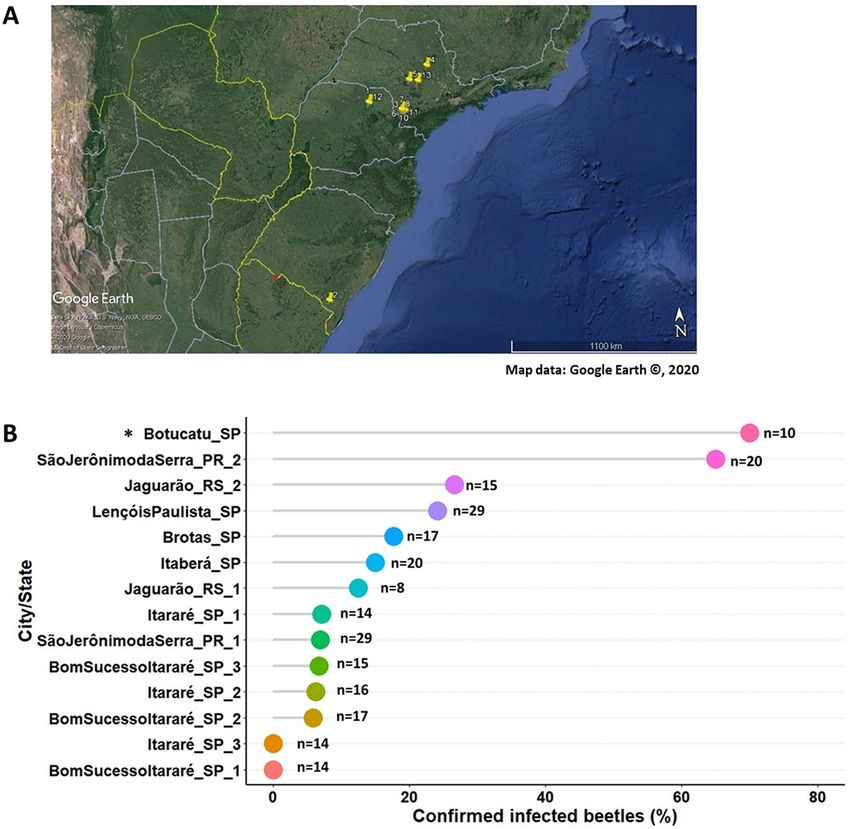
Prevalence of microsporidiosis in different field populations of Gonipterus spp.. To determine
the presence of microsporidium in other populations of the host insect, collections were made at 13 different
sampling points distributed in three states as shown in the Fig. 3A. Identification of infected adult beetles was
based on visual diagnosis of the microsporidiosis symptoms and by checking for spores in haemolymph. Posi-
Scientific Reports | (2021) 11:10971 | https://doi.org/10.1038/s41598-021-90041-9 2
Vol:.(1234567890)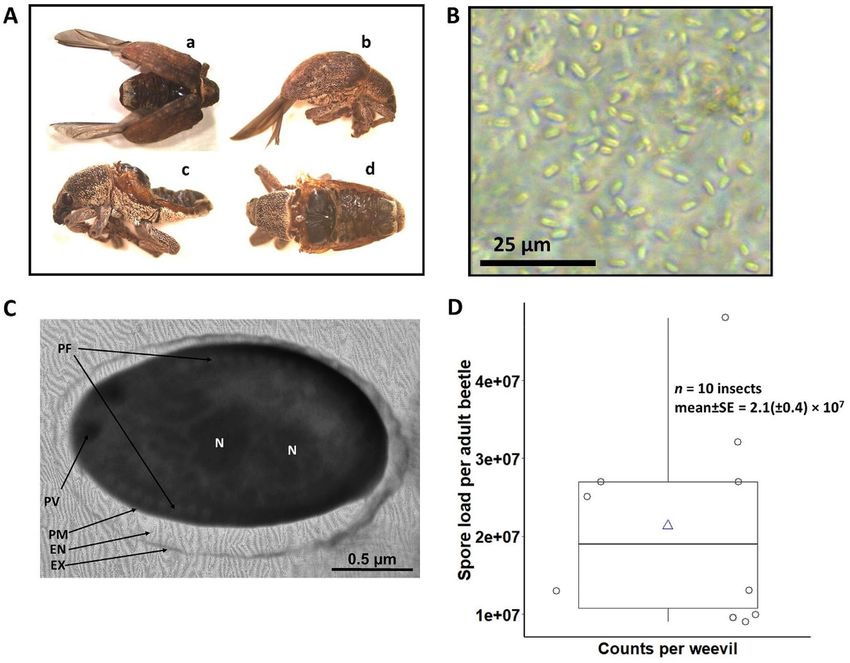
www.nature.com/scientificreports/
Figure 1. Disease diagnosis for the new microsporidiosis in symptomatic adult beetles and spore load
in infected beetles. (A) Field-collected Gonipterus platensis adult beetles depicting visible symptoms of
microsporidiosis disease. (a) Spread pair of wings exposing the abnormal and shrivelled abdomen; (b) Side
view of a dead insect showing the membranous pair of wings extended from the elytra; (c) Wingless adult
with abnormal abdomen. (d) Dorsal view of the abnormal abdomen. (B) Microsporidian spores found in the
haemolymph of G. platensis adults, observed under a phase contrast microscope. Scale bar = 25 µm. (C) Electron
micrograph of a longitudinal section of a mature microsporidian spore. The nucleus (binucleate, N), exospore
(Ex), endospore (En), plasma membrane (PM), polar filament (PF) coiling posterolaterally around central
diplokaryon showing 8 coils, and posterior vacuole (PV) are visible. Scale bar = 1 µm. (D) Density of spores per
insect determined by enumerating the spore load from smeared symptomatic beetles and performing counts
under a phase contrast microscope using a Neubauer chamber at × 400 magnification. (symbols on the boxplot:
circle = data points, triangle = mean).
tive results were obtained for microsporidium in most surveyed field sites, including beetles sampled from a
second-generation,mass-reared laboratory insect colony in Botucatu-SP. There was a significant variation in
natural infection caused by microsporidium across different regions or sites of collection in South and Southeast
Brazil (χ2 = 62.87, df = 13, P < 0.0001). The prevalence of natural infection in these field-collected beetle popu-
lations sampled at different locations under field conditions ranged from 0 to 65%, but the highest pathogen
incidence was observed in the insect colony maintained at the laboratory corresponding to 70% infection in
adults confirmed by microscopic examination of the haemolymph sample, and these infected beetles were gen-
erally associated with typical symptoms of microsporidiosis previously described here (Fig. 3B). The percentage
of mortality of beetles were not calculated in these field populations, because these insects were collected alive
and them immediately frozen prior to taking to the laboratory. Interestingly, it was the first time that we found
microsporidium infecting Gonipterus pulverulentus (26.7% infection), despite the lower frequency of this insect
species compared to G. platensis throughout Brazil.
Discussion
The present work is the first to describe the occurrence of microsporidiosis in an insect colony from the second
generation and in field populations of G. platensis collected in commercial Eucalyptus plantations, with the dis-
ease being confirmed in two species present in Brazil, G. platensis and G. pulverulentus (Coleoptera: Curculioni-
dae). Microsporidian infections have been reported in other Curculionidae17,18 as well as other c oleopterans19–22,
which demonstrate that this fungal pathogen is more common than previously thought infecting this diverse
insect order. Adult beetles collected across the three Brazilian states that tested positive for the presence of this
Scientific Reports | (2021) 11:10971 | https://doi.org/10.1038/s41598-021-90041-9 3
Vol.:(0123456789)www.nature.com/scientificreports/
Figure 2. Phylogenetic tree based upon a small subunit rRNA gene alignment of 1068 positions in MEGA X
with the Maximum Likelihood method using the Tamura 3-parameter model with a gamma distribution model.
Values at branches indicate bootstrap support. The new microsporidium isolate is assigned to the Vairimorpha
genus with a proposed name of Vairimorpha curculionidae. The outgroup was Ordospora colligata and is not
shown.
pathogen. Prevalence of natural infection in these field populations varied from 0 to 65% and 70% infection
was detected in the laboratory-grown colony, indicating that this pathogen is spreading with expansion of the
pest in Brazil and is established in mass-reared laboratory-grown colonies of G. platensis. However, additional
research should still focus on the development of specific gene markers for rapid and accurate detection of this
microsporidium in both asymptomatic and symptomatic G. plantesis beetles in complement to the traditional
microscopic examination.
Scientific Reports | (2021) 11:10971 | https://doi.org/10.1038/s41598-021-90041-9 4
Vol:.(1234567890)www.nature.com/scientificreports/
Figure 3. Natural prevalence of the new microsporidian pathogen in different field populations of the
Eucalyptus snout beetle. (A) Collection field sites (marked with yellow pins) mapped with Google Earth
showing where Gonipterus platensis adults were sampled in South and Southeast Brazil from commercial
Eucalyptus plantations. (B) Proportion of infected beetles (number of infected versus number of healthy adults)
by location. Survey of 14 distinct geographical points were performed to collect adult beetles (where n = number
of total beetles collected in each site) for diagnosis based on typical microsporidiosis symptoms and presence
of microsporidian spores in the haemolymph expressed as percent of confirmed infected beetles: one collection
point was made in Botucatu, SP (*from insect colony kept in the lab); three samples from Bom Sucesso do
Itararé, SP; three from Itararé, SP; one from Lençóis Paulista, SP; one from Brotas, SP; one from Itaberá, SP; two
from Jaguarão, RS (Gonipterus pulverulentus was collected only in sample 2); and two from São Jerônimo da
Serra, PR.
More than 1400 microsporidian species have been described so far and new species are being discovered
each year23,24. There are several reports of these microorganisms infecting lepidopterans25, hymenopterans26 and
orthopterans27, demonstrating the high genetic plasticity of this group of pathogens. Even more important is the
frequent occurrence of microsporidian epizootics in laboratory colonies, in which there is high aggregation and
population density of insects facilitating pathogen spread and new i nfections28.
Microsporidiosis is considered an important problem in the life cycle of insects29 because of the reduction in
pupal size, number and viability, along with a longer duration of the pupal stage30. We also described conspicu-
ous morphological abnormalities in infected G. platensis and G. pulverulentus beetles, and these symptoms are
good indicators of microsporidiosis diagnostic alongside the presence of spores in the haemocoel. Additionally,
spore numbers in G. platensis adults beetles reached an average concentration of 2.15 (± 0.40) × 107 spores in
symptomatic insects. This is similar to other microsporidian infections, Nosema cerane in honey bees yielded
1.15 × 10⁷ spores/bee at 18 days post-inoculation31. However, diet had a considerable effect on the spore load
observed in honey b ees31. This difference illustrates the specific interaction between microsporidium and its host
insect in regard to spore density for the development of microsporidiosis.
Scientific Reports | (2021) 11:10971 | https://doi.org/10.1038/s41598-021-90041-9 5
Vol.:(0123456789)www.nature.com/scientificreports/
The morphological similarity between microsporidian species, particularly based on spore measurements
in isolation, makes identification to species difficult. Therefore, other methods are needed to confirm identifica-
tion. Classification based on spore morphology can be difficult and inconsistent because some microsporidia
have complex life cycles and form various types of spores. In some cases, different sporulation cycles occur at
different stages of the host. Some species can also form different types of spores in the same host and sometimes
in the same tissues32. Such evidence indicates high diversity of the spore dimension; hence, molecular analysis
is essential in the identification of microsporidian s pecies16.
The SSU rRNA sequence has been widely used as a molecular marker to estimate phylogenetic relationships
between microsporidia, because it is a highly conserved gene12. However, this gene alone cannot be used to
distinguish closely related species. This is a limitation of this gene for a more refined phylogenetic separation
between species of this pathogen33,34. Nevertheless, it can be used in the taxonomic classification at the genus
level35,36. In this case, the species is well resolved, even amongst members of the same genus. Future efforts are
planned for whole-genome sequencing of this pathogen and then elucidate their key genes related to the infec-
tion process in G. platensis.
In general, the role of microsporidia as insect pathogens requires us to consider their ecological effects when
developing a pest control program. This pathogen group could cause a chronic disease, which is debilitating to the
host37. Moreover, the transmission of microsporidia takes place by one or more means, including the ingestion of
spores present in the environment, and parental transmission to offspring, which facilitates their multiplication
and persistence in the target population38. This high transmissibility of microsporidia in host population coupled
with low lethality are key for their enzootic and long-term prevalence, which may not be a suitable feature for an
applied biological control agent, but it could be a desirable for conservative biological control strategy towards
forest pests. Despite the method of transmission in G. platensis is currently unknown. Furthermore, we have
observed that infected symptomatic G. platensis beetles under laboratory conditions survive shorter and females
do not lay eggs (i.e., impaired fecundity) in comparison to healthy beetles (data not shown).
Due to their low virulence, microsporidia act slowly in host death and are likely insufficient to control an
insect pest when used alone39. However, when used in combination with another type of chemical or micro-
biological insecticide, it reveals enormous potential and tends to be the most successful, as recently reported
for the synergistic effect when combining Metarhizium brunneum with Paranosema locustae in the control
of the migratory grasshopper Melanoplus sanguinipes40, as well as improved grasshopper control achieved by
combined application of P. locustae and an insect growth regulator, fl ufenoxuron41. More importantly, there is
a need to know in advance the environmental effects on the pathogen cycle in its host, in order to analyze the
different strategies of release of the microsporidian pathogen in the field. In this sense, based on the historical
use of microsporidia as biocontrol agents, especially in the case of P. locustae for management of locusts and
grasshoppers, past lessons indicate that successful use of microsporidian pathogens for pest control is still a chal-
lenge in face of numerous drawbacks related to their production (they are obligatory pathogens), formulation,
storage, and efficacy42. It also must be considered whether the microsporidium have a negative effect on control
actions. It was recently reported that infection with a microsporidium reduced the efficacy of a granulovirus in
larvae of Phthorimaea operculella43. While infection with Bacillus thuringiensis made Galleria mellonella more
susceptible to infection by a microsporidium44. The lack of information about the ecological and biological
aspects in the host–pathogen interactions of this new microsporidium with G. platensis makes this obligatory
parasite an important natural enemy of this insect pest. Accordingly, the current study provides the first insight
on the interaction between the eucalyptus snout beetle and its unreported microsproridium with a focus on the
pathogen incidence in field and lab-reared beetle populations, molecular and morphological characterization,
and description of typical microsporidiosis symptoms associated with infected adults.
Associated pathogens may also be present in other countries, so there is a need for a more in-depth study
aimed at detecting the microsporidium in Australia, the native range of Gonipterus, and in other countries where
G. platensis and other species of Gonipterus are present. We also need to investigate the host spectrum of this
new microsporidiosis to different Gonipterus species as well as to non-target native beetles in Brazil, especially
concerning predatory beetles, in order to find out if this pathogen could be lethal or harmless to non-target hosts.
In summary, this data indicates a probable new species of this pathogen, providing support for new studies
on its biology and distribution, as well as identifying its potential to be a positive or negative factor in forest
protection programs against Gonipterus spp. in Brazilian eucalyptus plantations.
Materials and methods
The research was conducted in the Laboratory of Biological Control of Forest Pests and Molecular Biology Labo-
ratory in Department of Plant Protection, School of Agricultural Sciences, São Paulo State University (UNESP),
Botucatu, SP, Brazil.
Colony maintenance of Gonipterus platensis. Adults of G. platensis, collected during field surveys in
Eucalyptus plantations located in Botucatu, SP, Brazil, were housed in wooden cages (40 × 45 × 80 cm) with glass
roofs and sides covered with voile fabric. These adults were fed on young leaves and buds of Eucalyptus urophylla
(clone 433) (which were cleaned with hypochlorite solution (0.01%) and neutral detergent prior to use), main-
tained in an air-conditioned room at 25 ± 1 °C, RH 50 ± 10% and photoperiod of 12:12 h light:dark.
Genomic DNA extraction. For the extraction of genomic DNA, five insects with symptoms of infec-
tion (found dead with open wings and deformed abdomen) were washed in 0.85% (w/v) NaCl sterile solution
(Fig. 1). To extract genomic DNA from G. platensis, the abdomens of the five adults were macerated and added
to a microtube with 160 µL of 10% Chelex solution (Sigma-Aldrich) and 8 µL of 20 mg/mL proteinase K. The
Scientific Reports | (2021) 11:10971 | https://doi.org/10.1038/s41598-021-90041-9 6
Vol:.(1234567890)www.nature.com/scientificreports/
samples were placed in a thermal block at 95 °C for 20 min, following a protocol for DNA e xtraction45, with
Chelex 100 resin (Sigma-Aldrich). The DNA was eluted and stored at − 20 °C until use.
Sequencing of SSU rRNA. Polymerase chain reaction (PCR) was performed with Amplitaq Gold mas-
termix (Thermofisher Willington, MA) using the following parameters; 95 °C, 10 min, 35 cycles of 95 °C, 30 s;
58 °C, 30 s; 72 °C, 60 s. PCR primers targeting the SSU rRNA were: 18f, 5′-CACCAGGTTGATTCTGCC-3′
and 1537r, 5′-TTATGATCCTGCTAATGGTTC-3′46. The resultant amplicons were prepared using a Nextera XT
library preparation kit and indices (Illumina inc, San Diego, CA). The samples were sequenced using an Illumina
MiSeq system with a MiSeq V3 2 × 300 bp sequencing kit. The demultiplexed reads were quality trimmed to Q30
and assembled using CLC genomics workbench v20.0 (Qiagen inc., Valencia, CA). The consensus sequences for
two full length SSU rRNA genes were accessioned in GenBank under MT367570-MT367571.
Phylogenetic analysis. Phylogenetic analysis was conducted with MEGA X using Maximum Likelihood
analysis and the Tamura 3-parameter model with a discrete gamma distribution (5 categories), as this model
was found to be the best-fit using the maximum likelihood-based model selection algorithm implemented in
MEGA X. The partial deletion (90%) option was used, and the level of bootstrap support was calculated from
1000 replicates.
Determination of microsporidian spore density in beetles. Microsporidian spores were isolated
from typically symptomatic insects, which were originated from the field, and maintained at the Laboratory for
Biological Control of Forest Pests (LCBPF/UNESP, Botucatu, SP, Brazil). The infected insects were homogenized
in nuclease-free water in 0.2-mL microtubes. The suspension was subjected to three series of centrifugation:
2000 rpm for 10 min followed by 2 cycles at 12,000 rpm for 1 min. After each centrifugation, the supernatant
was discarded. The spores accumulated at the bottom of the tube forming a "pellet", which was later resuspended
in nuclease-free water7. This procedure was performed individually for 10 insects, in order to determine the
average concentration of spores per beetle (n = 10). The spores from each insect were purified and suspended
in nuclease-free water and then immediately quantified with a Neubauer chamber at × 400 magnification under
a phase-contrast microscope (Leica DM 2500, Leica Microsystems, Heerbrugg, Switzerland). At the end of the
counts, the spore density per insect was determined.
Phase contrast microscopy. Spore immobilization and photomicrographs were performed according to
the methods described in Vávra and Maddox28. Fresh spores were visualized from macerated body contents of
infected insects after dilution in sterile 0.85% NaCl solution (w/v). A drop of this macerate was transferred to a
glass slide and the spores were examined under a phase-contrast microscope (Leica DM 2500, Leica Microsys-
tems, Heerbrugg, Switzerland) at × 400 magnification.
Transmission electron microscopy. The material was prepared at the Center for Electron Microscopy
(Biosciences Institute—UNESP). Tissue samples from the digestive tract of G. platensis adults were fixed in
Karnovsky’s solution47 modified (glutaraldehyde 25% paraformoldehyde 8% and 0.2 M monosodium/disodium
phosphate buffer solution, pH 7.3). The samples were cut into small fragments of up to 2 mm3 for better fixation
and incubated for at least 3 h at room temperature. The samples were removed from the fixative and washed 3
times for 5 min in 0.1 M phosphate buffer with pH 7.3, followed by immersing the material in osmium tetroxide
for 2 h. After, the material was washed 3 times for 10 min in distilled water and immersed in 0.5% uranyl acetate
in distilled water for about 2 h, in order to have the block contrast, revealing/highlighting the nucleic acids.
Dehydration was accomplished with a series of solution containing an increasing amount of acetone. The series
consisted of 10 min in 50% acetone, 2 washes for 10 min in 70% acetone, 3 washes for 15 min in 90% acetone,
and finally, 3 washes for 15 min in 100% acetone.
The infiltration was done slowly using a 1:1 mixture of Araldite resin + 100% acetone and left for approxi-
mately 12 h at room temperature. The fixed biological material was made in an appropriate form and further
placed in an oven at 60 °C for 2 to 3 days. Semi-thin cuts (0.5 μm thick) were made for choosing the region of
interest and selected regions were trimmed again to further reduce the block surface allowing ultrathin cuts
(60–90 nm) to be made and placed in appropriate grids. The cuts were contrasted with a saturated solution of
uranyl acetate in 50% alcohol for about 20 min, followed by lead citrate for 10 min.
The slides were firstly examined under a light microscope (Zeiss Axioscop 2, Germany) to select the materials
to be subsequently observed in the electron microscope. The analysis of the material was performed using the
transmission electron microscope JEM 1011 (JEOL, Inc., Peabody, MA), operating at 40.60, 80 and 100 kV JEO
at the Electronic Microscopy Laboratory (ESALQ—USP, Piracicaba, SP, Brazil).
Detection of microsporidiosis in different field‑collected ESB populations from Southern Bra-
zil. In order to confirm the presence of the microsporidian pathogen in different field populations from South
to Southeast Brazil, insects from three different states were collected in commercial Eucalyptus plantations
(Table 1). After collection in the field, the insects were brought to the laboratory, examined for microsporidiosis
Scientific Reports | (2021) 11:10971 | https://doi.org/10.1038/s41598-021-90041-9 7
Vol.:(0123456789)www.nature.com/scientificreports/
Sample City and State Eucalyptus host Geographical coordinates
1 São Jerônimo da Serra, PR E. grandis × E. urophylla − 23.7516S/− 50.7955W
2.1* Jaguarão, RS E. dunnii − 32.3760S/− 53.3263W
2.2 Jaguarão, RS E. dunnii − 32.3760S/− 53.3263W
3 Itaberá, SP E. grandis × E. urophylla − 24.1403S/− 49.1091W
4 Brotas, SP E. grandis × E. urophylla − 22.2117S/− 47.9985W
5 Lençóis Paulista, SP E. grandis × E. urophylla − 22.8249S/− 48.8533W
6 Itararé, SP E. grandis × E. urophylla − 24.1958S/− 49.2242W
7 Itararé, SP E. grandis − 24.1768S/− 49.1959W
8 Itararé, SP E. grandis × E. urophylla − 24.1175S/− 49.2479W
9 Bom Sucesso do Itararé, SP E. grandis × E. urophylla − 24.1495S/− 49.0802W
10 Bom Sucesso do Itararé, SP E. grandis − 24.1484S/− 49.1054W
11 Bom Sucesso do Itararé, SP E. grandis − 24.1485S/− 49.0980W
12 Laboratory rearing (Botucatu, SP) E. grandis × E. urophylla − 22.8456S/− 48.4348W
13 São Jerônimo da Serra, PR E. grandis × E. urophylla − 23.7556S/− 50.7965W
Table 1. Field sampling of Gonipterus spp. beetles retrieved from different localities in South and Southeast
Brazil in 2019 for assessment of microsporidian pathogen incidence. Asterisk (*) indicates another species
found during field surveys that was identified as Gonipterus pulverulentus.
symptoms in adult beetles to calculate the percent natural infection, and then stored in a − 20 °C freezer prior to
dissection and microscopy to confirm the presence of the pathogen.
Received: 9 January 2021; Accepted: 12 April 2021
References
1. Simões, R. A., Reis, L. G., Bento, J. M., Solter, L. F. & Delalibera, I. Jr. Biological and behavioral parameters of the parasitoid Cote-
sia flavipes (Hymenoptera: Braconidae) are altered by the pathogen Nosema sp. (Microsporidia: Nosematidae). Biol. Control 63,
164–171 (2012).
2. Frago, E., Dicke, M. & Godfray, H. C. J. Insect symbionts as hidden players in insect–plant interactions. Trends Ecol. Evol. 27,
705–711 (2012).
3. Himler, A. G. et al. Rapid spread of a bacterial symbiont in an invasive whitefly is driven by the fitness benefits and female bias.
Science 332, 254–256 (2011).
4. Lu, M., Wingfield, M. J., Gillette, N. & Sun, J. H. Do novel genotypes drive the success of an invasive bark beetle–fungus complex?
Implications for potential reinvasion. Ecology 92, 2013–2019 (2011).
5. Vilcinskas, A., Stoecker, K., Schmidtberg, H., Röhrich, C. R. & Vogel, H. Invasive harlequin ladybird carries biological weapons
against native competitors. Science 340, 862–863 (2013).
6. Zhao, L. et al. A native fungal symbiont facilitates the prevalence and development of an invasive pathogen–native vector symbiosis.
Ecology 94, 2817–2826 (2013).
7. Solter, L. F., Becnel, J. J. & Vávra, J. Research methods for entomopathogenic microsporidia and other protists. Manual of Techniques
in Invertebrate Pathology 329–371 (2012).
8. Maddox, J. V. Protozoan diseases. Epizootiol. Insect Dis. 1, 417–452 (1987).
9. Latchininsky, A. V. & VanDyke, K. A. Grasshopper and locust control with poisoned baits: a renaissance of the old strategy?.
Outlooks Pest Manag. 17, 105–111 (2006).
10. Sweeney, A. W. & Becnel, J. J. Potential of microsporidia for the control of mosquitoes. Parasitol. Today. 7, 217–220 (1991).
11. Capella-Gutierrez, S., Marcet-Houben, M. & Gabaldon, T. Phylogenomics supports microsporidia as the earliest diverging clade
of sequenced fungi. BMC Biol. 10, 47–52 (2012).
12. Tokarev, Y. S. et al. A formal redefinition of the genera Nosema and Vairimorpha (Microsporidia: Nosematidae) and reassignment
of species based on molecular phylogenetics. J. Invertebr. Pathol. 169, 107279 (2020).
13. Tooke, F. G. C. The Eucalyptus Snout beetle, Gonipterus scutellatus Gyll. A study of its ecology and control by biological means
Union of South Africa, Department of Agriculture. Entomol. Mem. 3, 1–184 (1955).
14. Mapondera, T. S., Burgess, T., Matsuki, M. & Oberprieler, R. G. Identification and molecular phylogenetics of the cryptic species
of the Gonipterus scutellatus complex (Coleoptera: Curculionidae: Gonipterini). Aust. J. Entomol. 51, 175–188 (2012).
15. Valente, C. et al. Economic outcome of classical biological control: a case study on the Eucalyptus snout beetle, Gonipterus platensis,
and the parasitoid Anaphes nitens. Ecol Econ. 149, 40–47 (2018).
16. Ansari, M. J., Al-Ghamdi, A., Nuru, A., Khan, K. A. & Alattal, Y. Geographical distribution and molecular detection of Nosema
ceranae from indigenous honeybees of Saudi Arabia. Saudi J. Biol. Sci 24, 983–991 (2017).
17. Ovcharenko, M., Świątek, P., Ironside, J. & Skalski, T. Orthosomella lipae sp. n. (Microsporidia) a parasite of the weevil, Liophloeus
lentus Germar, 1824 (Coleoptera: Curculionidae). J. Invertebr. Pathol. 112, 33–40 (2013).
18. Weiser, J. A new microsporidian from the bark beetle Pityokteines curvidens Germar (Coleoptera, Scolytidae) in Czechoslovakia.
J. Invertebr. Pathol. 3, 324–329 (1961).
19. Malone, L. A. A new pathogen, Microsporidium itiiti n. sp. (Microsporida), from the Argentine Stem Weevil, Listronotus bonariensis
(Coleoptera, Curculionidae). J. Protozool. 32, 535–541 (1985).
20. Purrini, K. & Weiser, J. Ultrastructural study of the microsporidian Chytridiopsis typographi (Chytridiopsida: Microspora) infect-
ing the bark beetle, Ips typographus (Scolytidae: Coleoptera), with new data on spore dimorphism. J. Invertebr. Pathol. 45, 66–74
(1985).
21. Yaman, M., Radek, R., Aslan, I. & Erturk, O. Characteristic features of Nosema phyllotretae Weiser 1961, a microsporidian parasite
of Phyllotreta atra (Coleoptera: Chrysomelidae) in Turkey. Zool. Stud. Taipei. 44, 368 (2005).
Scientific Reports | (2021) 11:10971 | https://doi.org/10.1038/s41598-021-90041-9 8
Vol:.(1234567890)www.nature.com/scientificreports/
22. Zhu, F. et al. A new isolate of Nosema sp. (Microsporidia, Nosematidae) from Phyllobrotica armata Baly (Coleoptera, Chrysomeli-
dae) from China. Jour J. Invertebr. Pathol. 106, 339–342 (2011).
23. Andreadis, T. G., Takaoka, H., Otsuka, Y. & Vossbrinck, C. R. Morphological and molecular characterization of a microsporidian
parasite, Takaokaspora nipponicus n. gen. n. sp. from the invasive rock pool mosquito, Ochlerotatus japonicus japonicus. J. Invertebr.
Pathol. 114, 161–172 (2013).
24. Sapir, A. et al. Microsporidia-nematode associations in methane seeps reveal basal fungal parasitism in the deep sea. Front. Micro-
biol. 5, 43–52 (2014).
25. Solter, L. F., Maddox, J. V. & McManus, M. L. Host specificity of microsporidia (Protista: Microspora) from European populations
of Lymantria dispar (Lepidoptera: Lymantriidae) to indigenous North American Lepidoptera. J. Invertebr. Pathol. 69, 135–150
(1997).
26. Knell, J. D., Allen, G. E. & Hazard, E. I. Light and electron microscope study of Thelohania solenopsae n. sp. (Microsporida: Pro-
tozoa) in the red imported fire ant Solenopsis invict. J. Invertebr. Pathol. 29, 192–200 (1977).
27. Henry, J. E., & Oma, E. A. Pest control by Nosema locustae, a pathogen of grasshoppers and crickets. Microbial Control of Pests and
Plant Diseases 1970–1980 (1981).
28. Vávra, J. & Maddox, J. V. Methods in microsporidiology. In Biology of the Microsporidia 281–319 (Springer, Boston, 1976).
29. Simões, R. A., Feliciano, J. R., Solter, L. F. & Delalibera, I. Jr. Impacts of Nosema sp. (Microsporidia: Nosematidae) on the sugarcane
borer, Diatraea saccharalis (Lepidoptera: Crambidae). J. Invertebr. Pathol. 129, 7–12 (2015).
30. Inglis, G. D., Lawrence, A. M. & Davis, F. M. Impact of a novel species of Nosema on the southwestern corn borer (Lepidoptera:
Crambidae). J. Econ. Entomol. 96, 12–20 (2003).
31. Zheng, H. Q. et al. Spore loads may not be used alone as a direct indicator of the severity of Nosema ceranae infection in honey
bees Apis mellifera (Hymenoptera: Apidae). J. Econ. Entomol. 107, 2037–2044 (2014).
32. Goettel, M. S., Inglis, G. D. & Lacey, L. A. Manual of Techniques in Invertebrate Pathology (Academic Press, 2012).
33. Canning, E. U., Curry, A., Cheney, S., Lafranchi-Tristem, N. J., Haque, M. A. Vairimorpha imperfecta n. sp., a microsporidian
exhibiting an abortive octosporous sporogony in Plutella xylostella L. (Lepidoptera: Yponomeutidae). Parasitology 119, 273–286
(1999).
34. Tsai, S. J., Lo, C. F., Soichi, Y. & Wang, C. H. The characterization of microsporidian isolates (Nosematidae: Nosema) from five
important lepidopteran pests in Taiwan. J. Invertebr. Pathol. 83, 51–59 (2003).
35. Cai, S. F., Lu, X. M., Qiu, H. H., Li, M. Q. & Feng, Z. Z. Phagocytic uptake of Nosema bombycis (Microsporidia) spores by insect
cell lines. J. Integr. Agric. 11, 1321–1326 (2012).
36. Dong, S., Shen, Z., Xu, L. & Zhu, F. Sequence and phylogenetic analysis of SSU rRNA gene of five microsporidia. Curr. Microbiol.
60, 30 (2010).
37. Becnel, J. J. & Andreadis, T. G. Microsporidia in insects. The microsporidia and microsporidiosis 447-501 (1999).
38. Knell, R. J. & Webberley, K. M. Sexually transmitted diseases of insects: Distribution, evolution, ecology and host behaviour. Biol.
Rev. 79, 557–581 (2004). (PERMANECE)
39. Bell, H. A., Down, R. E., Kirkbride‐Smith, A. E. & Edwards, J. P. Effect of microsporidian infection in Lacanobia oleracea (Lep.,
Noctuidae) on prey selection and consumption by the spined soldier bug Podisus maculiventris (Het., Pentatomidae). J. Appl.
Entomol. 128(8), 548–553 (2004).
40. Dakhel, W. H., Latchininsky, A. V. & Jaronski, S. T. Efficacy of two entomopathogenic fungi, Metarhizium brunneum, strain F52
alone and combined with Paranosema locustae against the migratory grasshopper, Melanoplus sanguinipes, under laboratory and
greenhouse conditions. Insects 10(4), 94–102 (2019).
41. Guo, Y., An, Z. & Shi, W. Control of grasshoppers by combined application of Paranosema locustae and an insect growth regulator
(IGR) (cascade) in rangelands in China. J. Econ. Entomol. 105(6), 1915–1920 (2012).
42. Lockwood, J. A., Bomar, C. R. & Ewen, A. B. The history of biological control with Nosema locustae: Lessons for locust manage-
ment. Int. J. Trop. Insect Sci. 19(4), 333–350 (1999).
43. Larem, A., Fritsch, E., Undorf-Spahn, K., Kleespies, E. G. & Jehle, J. A. Interaction of Phthorimaea operculella granulovirus with
a Nosema sp. microsporidium in larvae of Phthorimaea operculella. J. Invertebr. Pathol. 160, 76–86 (2019).
44. Tokarev, Y. S., Grizanova, E. V., Ignatieva, A. N. & Dubovskiy, I. M. Greater wax moth Galleria mellonella (Lepidoptera: Pyralidae)
as a resistant model host for Nosema pyrausta (Microsporidia: Nosematidae). J. Invertebr. Pathol. 157, 1–3 (2018).
45. Coombs, N. J., Gough, A. C. & Primrose, J. N. Optimisation of DNA and RNA extraction from archival formalin-fixed tissue.
Nucleic Acids Res. 27, e12-I (1999).
46. Huang, W. F., Tsai, S. J., Lo, C. F., Soichi, Y. & Wang, C. H. The novel organization and complete sequence of the ribosomal RNA
gene of Nosema bombycis. Fungal Genet. Biol 41, 473–481 (2004).
47. Karnovsky, M. J. A formaldehyde glutaraldehyde fixative of high osmolality for use in electron microscopy. J. Cell. Biol. 27, 1A-149A
(1965).
Acknowledgements
The study was financially supported by the following Brazilian agencies “Coordination for the Improvement of
Higher Education Personnel (CAPES)”. The authors acknowledge Forest Protection Programme (PROTEF)/
Forest Science and Research Institute (IPEF) to funding field trips and lab resources. This work was supported in
part by the U.S. Department of Agriculture, Agricultural Research Service. Any opinions, findings, conclusions,
or recommendations expressed in this publication are those of the author(s) and do not necessarily reflect the
views of the U.S. Department of Agriculture. The mention of firm names or trade products does not imply they
are endorsed or recommended by the USDA over other firms or similar products not mentioned. USDA is an
equal opportunity provider and employer.
Author contributions
The study was conceived and designed by C.J., V.R.C. and C.F.W.; data were collected by C.J., V.R.C. and L.R.S.O.;
data analysis was realized by C.J., V.R.C., G.M.M., C.A.D. and C.F.W., figure, table and manuscript preparation
was carried out by C.J., V.R.C., G.M.M., L.R.S.O., C.A.D. and C.F.W.; and all authors participates in the writing
and approved the final version of the manuscript.
Competing interests
The authors declare that they have no competing interests.
Additional information
Correspondence and requests for materials should be addressed to C.J. or G.M.M.
Scientific Reports | (2021) 11:10971 | https://doi.org/10.1038/s41598-021-90041-9 9
Vol.:(0123456789)www.nature.com/scientificreports/
Reprints and permissions information is available at www.nature.com/reprints.
Publisher’s note Springer Nature remains neutral with regard to jurisdictional claims in published maps and
institutional affiliations.
Open Access This article is licensed under a Creative Commons Attribution 4.0 International
License, which permits use, sharing, adaptation, distribution and reproduction in any medium or
format, as long as you give appropriate credit to the original author(s) and the source, provide a link to the
Creative Commons licence, and indicate if changes were made. The images or other third party material in this
article are included in the article’s Creative Commons licence, unless indicated otherwise in a credit line to the
material. If material is not included in the article’s Creative Commons licence and your intended use is not
permitted by statutory regulation or exceeds the permitted use, you will need to obtain permission directly from
the copyright holder. To view a copy of this licence, visit http://creativecommons.org/licenses/by/4.0/.
© The Author(s) 2021
Scientific Reports | (2021) 11:10971 | https://doi.org/10.1038/s41598-021-90041-9 10
Vol:.(1234567890)You can also read


